EP0176310A2 - Wickelmaschine - Google Patents
Wickelmaschine Download PDFInfo
- Publication number
- EP0176310A2 EP0176310A2 EP85306603A EP85306603A EP0176310A2 EP 0176310 A2 EP0176310 A2 EP 0176310A2 EP 85306603 A EP85306603 A EP 85306603A EP 85306603 A EP85306603 A EP 85306603A EP 0176310 A2 EP0176310 A2 EP 0176310A2
- Authority
- EP
- European Patent Office
- Prior art keywords
- drive
- forming
- arbor
- rolls
- diameter
- Prior art date
- Legal status (The legal status is an assumption and is not a legal conclusion. Google has not performed a legal analysis and makes no representation as to the accuracy of the status listed.)
- Withdrawn
Links
- 230000002093 peripheral effect Effects 0.000 claims description 11
- 230000001360 synchronised effect Effects 0.000 abstract description 4
- 238000004519 manufacturing process Methods 0.000 description 5
- 229910000831 Steel Inorganic materials 0.000 description 3
- 230000007246 mechanism Effects 0.000 description 3
- 239000010959 steel Substances 0.000 description 3
- 239000004411 aluminium Substances 0.000 description 2
- 229910052782 aluminium Inorganic materials 0.000 description 2
- XAGFODPZIPBFFR-UHFFFAOYSA-N aluminium Chemical compound [Al] XAGFODPZIPBFFR-UHFFFAOYSA-N 0.000 description 2
- 238000010276 construction Methods 0.000 description 2
- 230000014759 maintenance of location Effects 0.000 description 2
- 230000006835 compression Effects 0.000 description 1
- 238000007906 compression Methods 0.000 description 1
- 238000005516 engineering process Methods 0.000 description 1
- 239000002783 friction material Substances 0.000 description 1
- 238000010438 heat treatment Methods 0.000 description 1
- 238000012423 maintenance Methods 0.000 description 1
- 229910052751 metal Inorganic materials 0.000 description 1
- 239000002184 metal Substances 0.000 description 1
- 230000000737 periodic effect Effects 0.000 description 1
- 229920001084 poly(chloroprene) Polymers 0.000 description 1
- 238000009987 spinning Methods 0.000 description 1
Images

Classifications
-
- B—PERFORMING OPERATIONS; TRANSPORTING
- B21—MECHANICAL METAL-WORKING WITHOUT ESSENTIALLY REMOVING MATERIAL; PUNCHING METAL
- B21F—WORKING OR PROCESSING OF METAL WIRE
- B21F3/00—Coiling wire into particular forms
- B21F3/02—Coiling wire into particular forms helically
- B21F3/04—Coiling wire into particular forms helically externally on a mandrel or the like
Definitions
- the coiling power needs to be transferred from the rear of the coiling machine to the front where the coil is being formed.
- the power takeoff rolls at the rear were of very substantial diameter, e.g. at least four inches (about 10cm), and later greater than six inches (about 15cm) in diameter, driving much smaller forming rolls at the front arbor, see for example the relationship between the roll diameters in US-A-3,082,810.
- the device shown in US-A-4,258,561 was developed to coil very fine wire. Unfortunately, it was subsequently learned that the power pickup in that latter apparatus caused it to be extremely limited in the wire size it would accommodate.
- regrinding of the power takeoff rolls and the coiling or forming rolls is a constant maintenance necessity, so that the usefulness of the apparatus in this patent was considered too limited.
- a wire coiling apparatus comprises a rotatable arbor shaft having a forming arbor and a drive arbor; first and second drive rolls astraddle the driver arbor and having peripheral surfaces in engagement therewith; first and second forming rolls astraddle the forming arbor, having coil-forming peripheral surfaces for engagement with a wire coil being formed around the forming arbor; characterised in that the diameter of the drive rolls is substantially equal to that of the forming rolls, and in having flexible drive shafts between the first drive roll and the first forming roll and between the second drive roll and the second forming roll, to cause a one-to-one drive therebetween while accommodating slight diametral variations by minor lateral movement of the forming rolls.
- the resulting product is a greatly simplified, uncomplicated, dependable machine considered capable of handling approximately 80% of the coiling needs existing. Viewing this novel coiler in hindsight, the construction with its simplicity and effectiveness seems readily understood. Yet its very uncomplicated, synchronized arrangement was not believed known heretofore.
- the high friction drive rolls at the rear arbor may be of essentially the same diameter as the front steel forming rolls or rings, the rear drive rolls engaging a rear drive arbor that has a diameter essentially the same as the outer diameter of the coil being formed on the front arbor.
- the front arbor may have a diameter essentially the same as the internal diameter of the coil being formed.
- the rear drive rolls may be mounted above their pivot shafts on their centre of mass, and may also be biased toward the rear drive arbor therebetween. These are connected directly to the front forming rolls by flexible drive shafts which allow slight lateral movement of the forming rolls.
- the front forming rolls may be suspended beneath the pivot axes and are biased toward the forming arbor therebetween.
- Coiling pressures at the front arbor are substantially independent of drive pressures: the coiling or forming rolls being capable of flexing laterally minor amounts while the flexible drive shafts keep the drive pressure constant.
- the machine requires no frame. Rather, a single block of metal such as aluminium serves as a central element which sets up the relationships of parts. The parts are strung along three parallel rods for positioning and alignment. Synchronization of the coiling forces is built into the system, using a rear drive arbor essentially equal in diameter to the coil outer diameter. Wire diameter is thereby automatically compensated for because of speed equalization between the coil outer diameter and the coiling or forming ring surface, not the forming arbor.
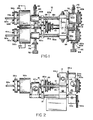
- a coiling machine 10 is centred about a central drive shaft 12 mounted in bearings (not shown) in a support block 14 of aluminium, and a rearwardly spaced block 16.
- the block 14 and the block 16 are connected by three fixed tie rods 18a, 18b and 18c.
- the forward ends of these tie rods project past the block 14 to enable a pair of hangers 20a and 20b to be suspended thereon for mounting wire feed pulleys 22a and 22b of conventional type and shown for example in US-A-3,359,768.
- drive pulleys 26 Mounted on the drive shaft 12 is one or more drive pulleys 26, here shown to be three in number and of differing diameters to allow a selected rotational speed of the drive shaft during operation.
- a suitable drive belt from a motorized source engages the pulley.
- a chuck 28 At the rear end of the drive shaft 12 is a chuck 28 which retains a rearwardly projecting drive arbor 30.
- chuck 32 At the forward end of the drive shaft 12 is another chuck 32 which retains a forwardly projecting front coiling arbor 34.
- Astraddle the rear drive arbor 30 is a pair of drive rolls 38a and 38b mounted on respective axle shafts having a bearing support within the upper portions of a pair of upstanding pivotal mounting blocks 40a and 40b.
- the lower ends of these mounting blocks are pivotally attached to the rear end portions of the rods 18a and 18c.
- the drive rolls 38a and 38b are mounted upon these pivot rods, basically with the centreline of the mass of the rolls in the same vertical plane as the axes of the pivot rods.
- the periphery of these drive rolls constitutes a high friction material such as neoprene rubber for optimum drive engagement with the small diameter steel drive arbor 30 therebetween.
- a pair of drive rings 39a and 39b secured by a plurality of connectors 41a and 41b to the drive rolls, and also attached to the rear ends of a pair of flexible cable drive shafts 50a and 50b by set screws 52a and 52b ( Figure 1).
- These flexible drive shafts 50a and 50b extend forwardly through the drive rolls 38a and 38b, the blocks 40a and 40b, and through a pair of front hangers 54a and 54b, to a pair of forming or coiling rings 60a and 60b and their adjacent backup rings 62a and 62b just to the rear of the forming rings.
- the forming rings 60a and 70b are purposely axially offset relative to each other to accommodate the pitch of the coil being formed, with the backup rings 62a and 62b also being axially offset from each other by a like amount.
- the backup rings 62a and 62b have a radius larger than that of the forming rings 60a and 60b by an amount equal to the diameter of the wire being formed.
- the hanger brackets 54a and 54b have their upper ends pivotally attached to hollow threaded support rods 64a and 64b threadably attached to the block 14, and axially adjustable relative to each other by a pair of knurled rings 66a and 66b thereon for selected axial adjustment of the forming rings relative to each other to accommodate the desired coil pitch.
- the biasing force on the backup rings 62a and 62b and the forming rings 60a and 60b toward the forming arbor 34 is controlled by a transverse threaded shaft 66 having a knurled knob 68 on one end thereof, extending through the two hangers 54a and 54b and having a compression spring 70 and retention nuts 72 on the opposite end thereof. Adjustment of this threaded shaft and of a knurled lock knob 69 allows variation of the biasing pressure applied by the spring uniformly on both hangers and therefore uniformly on the forming and backup rolls relative to the arbor 34.
- a similar threaded biasing rod arrangement extends between the mounts 40a and 40b for the drive rolls, i.e. a threaded rod 76 having a knurled knob 78 and a knurled lock knob 79, a spring 80 and retention nuts 82 on the opposite end thereof, for controlled balanced biasing of the drive rolls against the drive arbor 30.
- the diameter of the rear drive arbor 30 is essentially the same as the outer diameter of the wire coil being formed around the forming arbor 34, i.e. the diametral spacing between the forming rolls 60a and 60b.
- the diameter of the front coiling arbor 34 is essentially the same as the internal diameter of the coil being formed.
- the diameter of the forming rolls 38a and 38b is essentially the same as the diameter of the forming or coiling rings or rolls 60a and 60b.
- a suitable motor is attached, via a belt drive, to the pulley 26 on the main drive shaft, causing both the front and rear arbors to spin at a high speed.
- Spinning of the rear drive arbor 30 causes the straddling engaging drive rolls 38a and 38b to rotate, thereby driving the flexible drive shafts 50a and 50b and hence the front forming and backup rolls, causing the peripheral speed of the forming rolls 60a and 60b to be essentially the same as the peripheral speed of the drive rolls 38a and 38b.
- This peripheral speed therefore is the same as the peripheral outer diameter speed of the coil being formed around the arbor 34, from wire fed over the feed pulleys 22a and 22b in the manner shown in US-A-3,359,768 referred to above.
- the peripheral speed of the coil being formed remains synchronized with the peripheral speed of the drive arbor 30. Any minor variations in the forming roll and/or drive roll diameters are accommodated by the microflexing of the forming rolls laterally as suspended by their hangers on pivot rods.
- the flexible drive shafts enable this minor flexing without disturbing the synchronization between the peripheral speeds noted above. Further, with additional minor variations in forming roll diameter and/or drive roll diameter due to regrinding after wear conditions during extended production, the synchronization is maintained.
- the result is a smooth, reliable, simple, uncomplicated, synchronized mechanism having forming pressures substantially independent of the drive pressures, with full synchronization being maintained from the rear drive arbor to the exterior of the coil being formed.
Landscapes
- Engineering & Computer Science (AREA)
- Mechanical Engineering (AREA)
- Wire Processing (AREA)
- Forwarding And Storing Of Filamentary Material (AREA)
- Coil Winding Methods And Apparatuses (AREA)
Applications Claiming Priority (2)
| Application Number | Priority Date | Filing Date | Title |
|---|---|---|---|
| US06/652,509 US4561278A (en) | 1984-09-20 | 1984-09-20 | Coiling machine |
| US652509 | 1984-09-20 |
Publications (2)
| Publication Number | Publication Date |
|---|---|
| EP0176310A2 true EP0176310A2 (de) | 1986-04-02 |
| EP0176310A3 EP0176310A3 (de) | 1986-07-30 |
Family
ID=24617082
Family Applications (1)
| Application Number | Title | Priority Date | Filing Date |
|---|---|---|---|
| EP85306603A Withdrawn EP0176310A3 (de) | 1984-09-20 | 1985-09-17 | Wickelmaschine |
Country Status (3)
| Country | Link |
|---|---|
| US (1) | US4561278A (de) |
| EP (1) | EP0176310A3 (de) |
| JP (1) | JPS61119345A (de) |
Families Citing this family (4)
| Publication number | Priority date | Publication date | Assignee | Title |
|---|---|---|---|---|
| US4993250A (en) * | 1989-11-17 | 1991-02-19 | S. A. Platt, Inc. | Variable gear ratio coiling machine |
| US5069080A (en) * | 1990-03-08 | 1991-12-03 | Simon Joseph A | Elongated, lightweight rack |
| CN105460688A (zh) * | 2015-12-05 | 2016-04-06 | 芜湖山野电器有限公司 | 一种多线圈绕匝装置 |
| CN105600596A (zh) * | 2015-12-27 | 2016-05-25 | 天津尚吉液压设备有限公司 | 一种双向收卷装置 |
Family Cites Families (9)
| Publication number | Priority date | Publication date | Assignee | Title |
|---|---|---|---|---|
| US2227602A (en) * | 1939-08-16 | 1941-01-07 | Stephen A Platt | Automatic coil winding machine |
| US2388401A (en) * | 1943-02-17 | 1945-11-06 | Spiral Binding | Manufacture of helical binders |
| US2909209A (en) * | 1954-05-24 | 1959-10-20 | Driver Harris Co | Apparatus for making helical electric resistance heating wire coils and provided with a rotary mandrel and a pressing roll having an elastically deformable coil embracing surface |
| US2868267A (en) * | 1957-03-21 | 1959-01-13 | Stephen A Platt | Wire coiling machine with rotating mandrel and coiling tools |
| US3082810A (en) * | 1959-12-09 | 1963-03-26 | Stephen A Platt | Wire coiling machine |
| US3359768A (en) * | 1965-06-23 | 1967-12-26 | Stephen A Platt | Wire coiling |
| US3401557A (en) * | 1965-09-01 | 1968-09-17 | Stephen A. Platt | Wire coiling machine |
| US4208896A (en) * | 1979-01-29 | 1980-06-24 | S. A. Platt, Inc. | Wire coiling apparatus |
| US4258561A (en) * | 1979-05-21 | 1981-03-31 | S. A. Platt, Inc. | Coiling machine |
-
1984
- 1984-09-20 US US06/652,509 patent/US4561278A/en not_active Expired - Lifetime
-
1985
- 1985-09-17 EP EP85306603A patent/EP0176310A3/de not_active Withdrawn
- 1985-09-19 JP JP60205509A patent/JPS61119345A/ja active Pending
Also Published As
| Publication number | Publication date |
|---|---|
| EP0176310A3 (de) | 1986-07-30 |
| JPS61119345A (ja) | 1986-06-06 |
| US4561278A (en) | 1985-12-31 |
Similar Documents
| Publication | Publication Date | Title |
|---|---|---|
| US3641755A (en) | Machine and process for making wire cables | |
| CN210456791U (zh) | 一种流延膜收卷装置 | |
| EP0006507A2 (de) | Vorrichtung zum Abtrennen von Streifen von Rollen gewebter Textilien, die aus durch Hitze schweissbaren Fäden bestehen | |
| JPS6135318B2 (de) | ||
| US2724944A (en) | Apparatus for making stranded wire structures | |
| US4718202A (en) | Method and apparatus for rounding the edges of semiconductive wafers | |
| CN219098338U (zh) | 一种收卷均匀的自动线缆收卷装置 | |
| US4561278A (en) | Coiling machine | |
| SE444804B (sv) | Anordning for reglering av ett bandformigt materials framforing i en derfor avsedd bearbetningsmaskin | |
| CN116022585A (zh) | 一种用于纸卷加工的复卷机 | |
| US2909209A (en) | Apparatus for making helical electric resistance heating wire coils and provided with a rotary mandrel and a pressing roll having an elastically deformable coil embracing surface | |
| US4258561A (en) | Coiling machine | |
| US1882655A (en) | Machine for rolling or piercing billets | |
| CN210438147U (zh) | 一种薄膜收卷机 | |
| US3949543A (en) | Stranded wire forming method and apparatus | |
| US3082810A (en) | Wire coiling machine | |
| CN212664532U (zh) | 一种高精度金属拉丝设备 | |
| US4569216A (en) | Sequential variable pitch coiler | |
| EP0141375B1 (de) | Drahtspeichervorrichtung | |
| CN115178687A (zh) | 一种辐条坯料调直装置 | |
| CN221064259U (zh) | 一种弹簧机压力精准调节部件 | |
| CN217433854U (zh) | 一种无心磨床自动上料装置 | |
| US4396043A (en) | Prestraightener for axial lead components | |
| CN214989011U (zh) | 一种可调速的卷布装置 | |
| CN219971467U (zh) | 一种电缆放线装置 |
Legal Events
| Date | Code | Title | Description |
|---|---|---|---|
| PUAI | Public reference made under article 153(3) epc to a published international application that has entered the european phase |
Free format text: ORIGINAL CODE: 0009012 |
|
| AK | Designated contracting states |
Kind code of ref document: A2 Designated state(s): AT BE CH DE FR GB IT LI LU NL SE |
|
| PUAL | Search report despatched |
Free format text: ORIGINAL CODE: 0009013 |
|
| RHK1 | Main classification (correction) |
Ipc: B21F 3/02 |
|
| AK | Designated contracting states |
Kind code of ref document: A3 Designated state(s): AT BE CH DE FR GB IT LI LU NL SE |
|
| 17P | Request for examination filed |
Effective date: 19870112 |
|
| 17Q | First examination report despatched |
Effective date: 19880318 |
|
| STAA | Information on the status of an ep patent application or granted ep patent |
Free format text: STATUS: THE APPLICATION IS DEEMED TO BE WITHDRAWN |
|
| 18D | Application deemed to be withdrawn |
Effective date: 19880729 |
|
| RIN1 | Information on inventor provided before grant (corrected) |
Inventor name: PLATT, STEPHEN ALFRED |