EP0176643A1 - Antriebsvorrichtung für ein automatisches Gerät mit mehreren kombinierten bewegbaren Organen - Google Patents
Antriebsvorrichtung für ein automatisches Gerät mit mehreren kombinierten bewegbaren Organen Download PDFInfo
- Publication number
- EP0176643A1 EP0176643A1 EP84401964A EP84401964A EP0176643A1 EP 0176643 A1 EP0176643 A1 EP 0176643A1 EP 84401964 A EP84401964 A EP 84401964A EP 84401964 A EP84401964 A EP 84401964A EP 0176643 A1 EP0176643 A1 EP 0176643A1
- Authority
- EP
- European Patent Office
- Prior art keywords
- disc
- slave
- cylinder
- cylinders
- master cylinder
- Prior art date
- Legal status (The legal status is an assumption and is not a legal conclusion. Google has not performed a legal analysis and makes no representation as to the accuracy of the status listed.)
- Granted
Links
- 239000007788 liquid Substances 0.000 claims description 23
- 239000012530 fluid Substances 0.000 claims description 14
- 239000003153 chemical reaction reagent Substances 0.000 claims description 11
- 238000013519 translation Methods 0.000 claims description 11
- 230000009466 transformation Effects 0.000 claims description 5
- 230000001131 transforming effect Effects 0.000 claims description 4
- 238000001514 detection method Methods 0.000 claims description 3
- 239000002245 particle Substances 0.000 claims description 3
- 238000011002 quantification Methods 0.000 claims description 3
- 238000005070 sampling Methods 0.000 claims description 2
- 238000012360 testing method Methods 0.000 claims description 2
- 238000009434 installation Methods 0.000 description 8
- 239000008280 blood Substances 0.000 description 4
- 210000004369 blood Anatomy 0.000 description 4
- 238000006243 chemical reaction Methods 0.000 description 3
- 238000000034 method Methods 0.000 description 3
- 230000004520 agglutination Effects 0.000 description 2
- 241000135309 Processus Species 0.000 description 1
- 238000005452 bending Methods 0.000 description 1
- 230000000740 bleeding effect Effects 0.000 description 1
- 238000004891 communication Methods 0.000 description 1
- 238000010586 diagram Methods 0.000 description 1
- 238000006073 displacement reaction Methods 0.000 description 1
- 238000012545 processing Methods 0.000 description 1
- 230000000135 prohibitive effect Effects 0.000 description 1
- 238000010926 purge Methods 0.000 description 1
- 238000005096 rolling process Methods 0.000 description 1
- 239000000725 suspension Substances 0.000 description 1
- 239000012780 transparent material Substances 0.000 description 1
Images


Classifications
-
- F—MECHANICAL ENGINEERING; LIGHTING; HEATING; WEAPONS; BLASTING
- F15—FLUID-PRESSURE ACTUATORS; HYDRAULICS OR PNEUMATICS IN GENERAL
- F15B—SYSTEMS ACTING BY MEANS OF FLUIDS IN GENERAL; FLUID-PRESSURE ACTUATORS, e.g. SERVOMOTORS; DETAILS OF FLUID-PRESSURE SYSTEMS, NOT OTHERWISE PROVIDED FOR
- F15B7/00—Systems in which the movement produced is definitely related to the output of a volumetric pump; Telemotors
- F15B7/005—With rotary or crank input
-
- F—MECHANICAL ENGINEERING; LIGHTING; HEATING; WEAPONS; BLASTING
- F15—FLUID-PRESSURE ACTUATORS; HYDRAULICS OR PNEUMATICS IN GENERAL
- F15B—SYSTEMS ACTING BY MEANS OF FLUIDS IN GENERAL; FLUID-PRESSURE ACTUATORS, e.g. SERVOMOTORS; DETAILS OF FLUID-PRESSURE SYSTEMS, NOT OTHERWISE PROVIDED FOR
- F15B7/00—Systems in which the movement produced is definitely related to the output of a volumetric pump; Telemotors
- F15B7/003—Systems in which the movement produced is definitely related to the output of a volumetric pump; Telemotors with multiple outputs
-
- G—PHYSICS
- G01—MEASURING; TESTING
- G01N—INVESTIGATING OR ANALYSING MATERIALS BY DETERMINING THEIR CHEMICAL OR PHYSICAL PROPERTIES
- G01N35/00—Automatic analysis not limited to methods or materials provided for in any single one of groups G01N1/00 - G01N33/00; Handling materials therefor
-
- G—PHYSICS
- G01—MEASURING; TESTING
- G01N—INVESTIGATING OR ANALYSING MATERIALS BY DETERMINING THEIR CHEMICAL OR PHYSICAL PROPERTIES
- G01N35/00—Automatic analysis not limited to methods or materials provided for in any single one of groups G01N1/00 - G01N33/00; Handling materials therefor
- G01N35/02—Automatic analysis not limited to methods or materials provided for in any single one of groups G01N1/00 - G01N33/00; Handling materials therefor using a plurality of sample containers moved by a conveyor system past one or more treatment or analysis stations
Definitions
- the present invention relates to an actuating device for an automation comprising a plurality of combined movable members, that is to say mounted movable relative to each other.
- electric motors are generally used, for example step by step.
- These electric motors are "on-board”, that is to say carried respectively by that of said movable members with respect to which the movable member that they actuate is mounted.
- the object of the present invention is to remedy these drawbacks and to indicate an actuating device making it possible to make the automation rapid, precise, reliable and powerful without significant energy expenditure.
- the actuation device for an automation comprising a plurality of combined movable members is remarkable in that it comprises a single electric motor, for example of the step-by-step type, capable of rotate in both directions of rotation, means for transforming the rotational movement of said electric motor into a translational movement, a hydraulic master cylinder whose piston is controlled in translation by said movement transforming means, a plurality of hydraulic lines connected in parallel to the cylinder of said mold- cylinder, a plurality of solenoid valves each mounted on one of said hydraulic lines, a control device for said solenoid valves and a plurality of slave hydraulic cylinders, the cylinders of which are each connected to one of said hydraulic lines and whose pistons are each connected to one of said movable members.
- the electric motor, the movement transformation means, the hydraulic master cylinder, the solenoid valves and the control device can be mounted at a fixed station and that only , possibly, the slave cylinders must be mounted on one of the mobile parts of the automation. In this case, they are connected to the solenoid valves by portions of flexible pipes. It is then possible to choose an electric motor of large size and therefore reliable, powerful and efficient.
- the movement transformation means can be of the screw and nut type.
- a source of pressurized fluid connected via a plurality of connections to the cylinders of the slave cylinders, on the piston side thereof opposite the master cylinder connecting lines.
- the various mobile members automatically return to a rest position determined at the end of the cycle, corresponding to the end-of-travel position of the pistons of the slave jacks repelled by the fluid under pressure from said source.
- the device according to the invention is susceptible of numerous applications. However, it is particularly suitable for being used in a device for the detection and quantification of agglutinates capable of being formed, under the action of at least one reagent, by particles in suspension in a liquid, for example of the type used in immunohematology, in particular for the determination of blood groups.
- Such a known device for detecting and quantifying agglutinates uses containers of which at least the bottoms are transparent, and can use, to detect and quantify agglutinates capable of being formed, under the action of at least a liquid reagent, by particles suspended in doses of liquids to be tested being in said containers, a linear arrangement of a plurality of photosensitive elements observing by transparency the bottoms of said containers containing any agglutinates by scanning said bottoms of said containers, so as to form nxm observation points distributed over a rectangular or square surface occupying most of the bottom surface of each container.
- Such containers may consist of cells distributed along radii of a transparent horizontal disc which can rotate around its vertical axis and an oscillating arm rotating around a vertical axis, capable of being raised and lowered and provided with means for sampling and restitution of liquid doses can be provided for collecting such doses in reagent and liquid test tanks and bringing them into said cells of the rotating disc, while said linear arrangement of photosensitive elements is arranged at a fixed post orthogonally to a diameter of the transparent disc and that the axis of rotation of the disc is mounted movable in translation orthogonally to said linear arrangement of photosensitive elements.
- the oscillating and sliding arm can introduce into each cell of the rotating disc a liquid to be tested and the corresponding reagent. After reaction, each cell is examined by the arrangement of photosensitive elements during the translation of the axis of the disc, translation of which the amplitude is sufficient for all the cells of a radius of the disc to be observed, each in I'm not.
- the linear arrangement of photosensitive elements can be arranged orthogonally to the vertical plane passing through the vertical axes of the transparent disc and of the swinging arm, on the side of the axis of the disc opposite to said swinging arm, so that the disc must rotate through 180 ° so that a ray of cells loaded with doses of liquids to be tested and with reagent can be read by said arrangement.
- slave cylinders are provided, namely respectively a first for the rotation of the swinging arm, a second for lifting and lowering of said arm, a third for removal and the return of liquid doses and the fourth for the translation of the axis of rotation of the disc.
- the actuation device shown in FIG. 1, comprises a DC control device and a step-by-step electric motor M which is capable of rotating in both directions of rotation and whose output shaft consists of a screw a.
- a nut b prevented from rotating by sliding guides c, is engaged with the screw a.
- This nut b is connected by a rod d, with the piston e of a master cylinder MV, the cylinder f of which is filled with a hydraulic liquid and is connected, by a plurality of lines g 1 , g 2 ′ g 3 ' ⁇ g q in parallel, to cylinders h 1 , h 2 h 3 ... h q of a plurality of VE 1 slave cylinders.
- a three-way solenoid valve i 1 to i q On each of the lines q 1 to g q is mounted a three-way solenoid valve i 1 to i q , controlled by the electronic control device DC. The latter controls said solenoid valves i 1 to i q independently of one another, and possibly sequentially according to a cycle.
- the slave cylinders VE 1 to VEq are each provided with a piston j 1 to j q connected by a rod k 1 to k q to a movable member (not shown in FIG. 1) to be moved.
- the capacity in hydraulic fluid of the cylinder f of the master cylinder MV is at least equal to the sum of the capacities of the cylinders h 1 to h q of the slave cylinders VE 1 to VE q .
- the device of FIG. 1 comprises a reservoir R1 of pressurized fluid (gas or liquid) connected by a plurality of pipes pl to pq, to the cylinders hl to hq of the slave jacks VE1 to VEq, respectively, on the side of the piston jl to jq opposite to the pipes gl to gq.
- the reservoir R1 is also connected to the cylinder f of the master cylinder MV on the side of the piston e opposite the solenoid valves il to iq.
- the device of FIG. 1 further comprises a reservoir R2 containing a reserve of hydraulic liquid at atmospheric pressure.
- Each slave cylinder VE1 to VEq and the bending cylinder MV can be connected to the tank R2 by means of the solenoid valves il to iq and of a solenoid valve ix, also controlled by the control device DC.
- the DC control device coordinates over time, in accordance with the cycle to be carried out, the control of the solenoid valves ix and it to iq, as well as the rotation of the motor M.
- the installation for the recognition of blood groups comprises a device 1 for the detection and quantification of agglutinates, associated with a display device 2, with a control device 3 and with a device for impression 4.
- the entire installation is controlled by a microprocessor (not shown) according to a process not described below. Part of this microprocessor constitutes the DC control device of FIG. 1.
- the device 1 comprises a horizontal oscillating arm 5 capable of rotating around a vertical axis 6, as well as of raising and lowering vertically.
- the arm 5 carries a plurality of vertical syringes 7, the pistons of which can be actuated to aspirate or discharge a liquid.
- the syringes 7 scan an annular zone 8.
- reagent containers 9 in each of which the vertical syringes 7 can take a reagent, and a rinsing container 10.
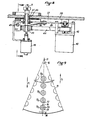
- the device 1 comprises a vertical axis 11 capable of rotating a disc 12 of transparent material in the what are the cells 13.
- the cells 13 of the disc 12 are distributed at a plurality of points 18 located at the intersection of spokes 19 and concentric circles 20.
- FIG. 4 For the sake of clarity of the drawing, in FIG. 4, only a few cells 13 have been shown.
- the annular zone 8 for scanning the syringes 7 cuts the disc 12 so that it is possible to fill all the cells 13 arranged on a radius 19 of the disc 12, in doses of reagents coming from the reservoirs 9 by introducing the syringe needles 7 in said cells by lowering said syringes. Likewise, it is possible to introduce into the containers 13 doses of liquids coming from reservoirs 26 located in the zone 8.
- the reservoirs 26 contain blood samples from donors. They are introduced into the said p o-operative part 1 by a conveyor 30 which makes them pass successively to different processing stations 31, 32 and 33, prior to bring them to the station 34 where the needle 7 of the arm 5 can collect the liquid that 'they contain.
- each cell 13 of the disc 12 can serve as a reaction vessel between a liquid coming from a tank 26 and a reagent coming from a tank 9.
- the swinging arm 5 is supported by the slave cylinder VE1, arranged vertically so. that its cylinder hl can rotate around the vertical axis 6 thanks to a bearing system 14 allowing it to rotational movement relative to the frame 15 of the device 1.
- the swinging arm 5 is carried by the rod kl of the piston of said slave cylinder VE1. Furthermore, a rib and groove system 16 prevents the rod kl from rotating relative to the cylinder hl.
- the arm 5 can be raised and lowered parallel to the vertical axis 6.
- a link 17 makes a loop 53 around the cylinder hl of the slave cylinder VE1 and is linked, at one of its ends to the piston rod k2 of the slave cylinder VE2 (possibly via a deflection pulley 54) and, at its other end, to said frame 15, by means of a tension spring 55.
- the cylinder h2 of the jack VE2 is linked to the frame 15 (see FIG. 6).
- the arm 5 can rotate around the vertical axis 6, the loop 53 rolling with friction on the cylinder hl of the cylinder VE1 under the combined action of the cylinder VE2 and the spring 55.
- the arm 5 comprises a part 5a, integral with the rod kl of the slave cylinder VE1 and carrying the bodies 7a of the syringes 7, and a mobile part 5b, which can slide vertically relative to the fixed part 5a, thanks to sliding guides 56 and integral with the rods 7b of the pistons of said syringes 7.
- the slave cylinder VE3 is carried by the fixed part 5a, while the mobile part 5b is connected to the rod k3 of said cylinder - VE3 slave.
- the syringes 7 can be actuated to withdraw and dispense liquid doses.
- the device 1 comprises a strip 35 of CCD diodes, placed under the disc 12 opposite a lighting device 36.
- the strip 35 and the lighting device 36 are opposite the arm 5 relative to the axis 11 and the strip 35 is orthogonal to the vertical plane defined by axes 6 and 11.
- the bar 35 examines by transparency the bottom 25 of each cell 13 according to m observations each shifted by one step. So that all the cells 13 with a radius 19 of the disc 12 can each be examined in m steps, the axis 11 of the said disc is made movable in horizontal translation, orthogonally to the said bar 35.
- Figures 7 and 8 show that the axis 11 of the disc 12 is secured to a carriage 37 movable relative to the base plate 38 of the device, secured to the frame 15.
- This carriage 37 has a frame 39 bearing a motor 40 and a plain bearing 41 for the axis 11.
- the output shaft of the motor 40 rotates a pulley 42 which is connected to a pulley 43 fixed on the axis 11, by means of a belt notched 44.
- the carriage 37 is guided in translation by a rail 45 and it moves under the action of the slave cylinder VE4, whose piston rod k4 is connected to the carriage 37 by a rod 48, while the cylinder h4 of said cylinder is integral with plate 38.
- the axis 11 can slide in a slot 49, from the base plate 38, parallel to the rail 45 and orthogonal to the strip 35 of CCD diodes.
- the carriage 37 can also carry a vibrator 49 intended to animate sporadically, against the action of a spring 50, the axis 11 of an alternating movement parallel to its axis, in order to possibly agitate the liquid contained in the cells 13 of the disc 12.
- the disc 12 is advanced by the jack VE4 in the direction of the arrow F1 so that the arrangement 35 is perpendicular to the external limit 51 of the field 25 of the bottom of the first cell 13 1 .
- the jack VE4 is actuated m times so that the n photosensitive elements of the arrangement 35 examine in nxm points said field 25.
- the jack VE4 displaces the axis 11, still in the direction F 1 , so that the external limit 52 of the field 25 of the bottom of the second cell 13 2 comes into line with the photosensitive elements of the arrangement 35. 'This second cell 13 2 is read identically and the process continues until the complete reading of the cell 13 p .
- the operation of the analysis device 1 of FIG. 2 can be achieved using four slave cylinders VE1 to VE4 of the device of FIG. 1.
- the cylinders VE1 to VE4 can be carried by moving parts, the rest of the device, namely the motor M, the system a to d, the master cylinder MV, the DC control device, the solenoid valves i 1 to i4, and the reservoirs Rl and R2 can be arranged at a fixed position on the frame 15.
- the cylinders VE1 to VE4 are connected to the solenoid valves i 1 to i4 by flexible pipes.
Landscapes
- Physics & Mathematics (AREA)
- Engineering & Computer Science (AREA)
- Immunology (AREA)
- Pathology (AREA)
- Analytical Chemistry (AREA)
- Biochemistry (AREA)
- General Health & Medical Sciences (AREA)
- General Physics & Mathematics (AREA)
- Life Sciences & Earth Sciences (AREA)
- Chemical & Material Sciences (AREA)
- Health & Medical Sciences (AREA)
- Fluid Mechanics (AREA)
- Mechanical Engineering (AREA)
- General Engineering & Computer Science (AREA)
- Automatic Analysis And Handling Materials Therefor (AREA)
- Apparatus Associated With Microorganisms And Enzymes (AREA)
- Sampling And Sample Adjustment (AREA)
Priority Applications (2)
| Application Number | Priority Date | Filing Date | Title |
|---|---|---|---|
| AT84401964T ATE35568T1 (de) | 1984-10-02 | 1984-10-02 | Antriebsvorrichtung fuer ein automatisches geraet mit mehreren kombinierten bewegbaren organen. |
| DE8484401964T DE3472583D1 (en) | 1984-10-02 | 1984-10-02 | Actuating device for an automatic apparatus comprising a plurality of combined movable elements |
Applications Claiming Priority (1)
| Application Number | Priority Date | Filing Date | Title |
|---|---|---|---|
| FR8309763A FR2547417B1 (fr) | 1983-06-13 | 1983-06-13 | Dispositif d'actionnement pour un automatisme comportant une pluralite d'organes mobiles combines |
Publications (2)
| Publication Number | Publication Date |
|---|---|
| EP0176643A1 true EP0176643A1 (de) | 1986-04-09 |
| EP0176643B1 EP0176643B1 (de) | 1988-07-06 |
Family
ID=9289733
Family Applications (1)
| Application Number | Title | Priority Date | Filing Date |
|---|---|---|---|
| EP84401964A Expired EP0176643B1 (de) | 1983-06-13 | 1984-10-02 | Antriebsvorrichtung für ein automatisches Gerät mit mehreren kombinierten bewegbaren Organen |
Country Status (3)
| Country | Link |
|---|---|
| US (1) | US4587103A (de) |
| EP (1) | EP0176643B1 (de) |
| FR (1) | FR2547417B1 (de) |
Families Citing this family (2)
| Publication number | Priority date | Publication date | Assignee | Title |
|---|---|---|---|---|
| FR2547417B1 (fr) * | 1983-06-13 | 1990-01-26 | Materiel Biomedical | Dispositif d'actionnement pour un automatisme comportant une pluralite d'organes mobiles combines |
| US9499234B2 (en) * | 2013-04-25 | 2016-11-22 | Shimano Inc. | Bicycle component control apparatus |
Citations (6)
| Publication number | Priority date | Publication date | Assignee | Title |
|---|---|---|---|---|
| FR1187238A (fr) * | 1957-11-22 | 1959-09-08 | Rech Etudes Production Sarl | Système de commande hydro-manuelle pour plusieurs récepteurs |
| FR1539674A (fr) * | 1967-05-12 | 1968-09-20 | Centre Nat Rech Scient | Appareillage destiné plus particulièrement à la détermination automatique des groupes sanguins |
| EP0088679A1 (de) * | 1982-03-05 | 1983-09-14 | Union de Coopératives Agricoles ENSEMBLE COOPERATIF LAITIER ELNOR | Verfahren und automatische Maschine zur Kontrolle der bakteriologischen Qualität einer in einem Behälter enthaltenen Flüssigkeit |
| DE3301916A1 (de) * | 1983-01-21 | 1984-07-26 | Rische, Karl, 5249 Hamm | Vorrichtung zur hydraulischen uebertragung einer linearen antriebs- oder stellbewegung |
| GB2135737A (en) * | 1983-02-21 | 1984-09-05 | Narishige Scient Instr Lab | Fine control system for glass electrode |
| FR2547417A1 (fr) * | 1983-06-13 | 1984-12-14 | Materiel Biomedical | Dispositif d'actionnement pour un automatisme comportant une pluralite d'organes mobiles combines |
Family Cites Families (4)
| Publication number | Priority date | Publication date | Assignee | Title |
|---|---|---|---|---|
| US3883308A (en) * | 1967-05-12 | 1975-05-13 | Centre Nat Rech Scient | Apparatus for analysing liquid substances likely to form agglutinates |
| US3767364A (en) * | 1971-07-30 | 1973-10-23 | Sherwood Medical Ind Inc | Reagent pipette system |
| US4439986A (en) * | 1981-01-23 | 1984-04-03 | Snitgen Joseph D | Hydraulic power unit |
| US4486097A (en) * | 1981-09-09 | 1984-12-04 | E. I. Du Pont De Nemours & Company, Inc. | Flow analysis |
-
1983
- 1983-06-13 FR FR8309763A patent/FR2547417B1/fr not_active Expired - Fee Related
-
1984
- 1984-10-02 EP EP84401964A patent/EP0176643B1/de not_active Expired
- 1984-10-04 US US06/657,530 patent/US4587103A/en not_active Expired - Fee Related
Patent Citations (6)
| Publication number | Priority date | Publication date | Assignee | Title |
|---|---|---|---|---|
| FR1187238A (fr) * | 1957-11-22 | 1959-09-08 | Rech Etudes Production Sarl | Système de commande hydro-manuelle pour plusieurs récepteurs |
| FR1539674A (fr) * | 1967-05-12 | 1968-09-20 | Centre Nat Rech Scient | Appareillage destiné plus particulièrement à la détermination automatique des groupes sanguins |
| EP0088679A1 (de) * | 1982-03-05 | 1983-09-14 | Union de Coopératives Agricoles ENSEMBLE COOPERATIF LAITIER ELNOR | Verfahren und automatische Maschine zur Kontrolle der bakteriologischen Qualität einer in einem Behälter enthaltenen Flüssigkeit |
| DE3301916A1 (de) * | 1983-01-21 | 1984-07-26 | Rische, Karl, 5249 Hamm | Vorrichtung zur hydraulischen uebertragung einer linearen antriebs- oder stellbewegung |
| GB2135737A (en) * | 1983-02-21 | 1984-09-05 | Narishige Scient Instr Lab | Fine control system for glass electrode |
| FR2547417A1 (fr) * | 1983-06-13 | 1984-12-14 | Materiel Biomedical | Dispositif d'actionnement pour un automatisme comportant une pluralite d'organes mobiles combines |
Also Published As
| Publication number | Publication date |
|---|---|
| US4587103A (en) | 1986-05-06 |
| EP0176643B1 (de) | 1988-07-06 |
| FR2547417B1 (fr) | 1990-01-26 |
| FR2547417A1 (fr) | 1984-12-14 |
Similar Documents
| Publication | Publication Date | Title |
|---|---|---|
| EP0107580B1 (de) | Einrichtung zur Feststellung und zahlenmässigen Auswertung von Agglutinaten | |
| FR2545610A1 (fr) | Procede et dispositif pour la detection et la quantification d'agglutinats | |
| EP0286536B1 (de) | Schrittweise fortschreitende rotierende Transportvorrichtung und mit einer solchen Vorrichtung ausgestattetes Probenentnahmesystem | |
| BE1001048A5 (fr) | Instrument automatise pour analyse d'echantillon de patient. | |
| FR2981750A1 (fr) | Dispositif d'acquisition pour la realisation de mesures et/ou le prelevement d'echantillons dans un liquide | |
| CA3010672C (fr) | Systeme de convoyage de supports pour recipients d'echantillons de liquide biologique, et systeme d'analyse automatique comprenant un tel systeme de convoyage | |
| FR2600166A1 (fr) | Procede et dispositif de prise en charge et d'analyses automatiques d'echantillons de produits amenes de facon aleatoire | |
| CA2889536A1 (fr) | Dispositif d'analyse pour diagnostic in vitro | |
| EP0176643B1 (de) | Antriebsvorrichtung für ein automatisches Gerät mit mehreren kombinierten bewegbaren Organen | |
| EP1266211B1 (de) | Verbesserte vorrichtung zur probenanalyse durch multikapillar-elektrophorese mit festkörper/festkörper-thermoregulierung | |
| EP0097577A1 (de) | Vorrichtung zur schnellen Filtrierung, besonders von biologischen Flüssigkeiten | |
| EP0074888B1 (de) | Einrichtung zur Manipulation einer Last sowie Anwendung bei der Manipulation einer eingetauchten Last | |
| FR2629914A1 (fr) | Procede et dispositif pour determiner la masse volumique d'un volume elementaire de matiere | |
| EP2579970B1 (de) | Vorrichtung und verfahren zur messung der eigenschaften eines komplexen mediums durch analyse des unterschieds in rückgestreutem und/oder durchfallendem licht | |
| FR2474697A1 (fr) | Mecanisme de transfert de fluide a plusieurs positions | |
| EP1733205B1 (de) | Verfahren und system zur bestimmung von massedichte und abmessungsmerkmalen eines gegenstands sowie dessen verwendung zur überwachung von kernbrennstoffpellets während deren herstellung | |
| EP1032817B1 (de) | Automatische hämatologische zähl-und messvorrichtung | |
| FR2485003A1 (fr) | Appareillage automatise utilisable pour la synthese des peptides en phase solide | |
| EP0271398B1 (de) | Einrichtung und Behälter zur Feststellung und zahlenmässigen Auswertung von Agglutinaten | |
| FR2699676A1 (fr) | Dispositif de manipulation d'une seringue et automate d'analyse biologique comportant un tel dispositif. | |
| FR2726653A1 (fr) | Dispositif pour la collecte ou la distribution d'echatillons liquides | |
| FR2616537A1 (fr) | Appareil de mesure automatique du poids apparent d'une boue chargeant un liquide et systeme de mesure automatique de l'indice de ponsar d'une telle boue, utilisant l'appareil | |
| FR2491899A1 (fr) | Appareil pour transferer des plateaux ou autres | |
| EP0300894A1 (de) | Gerät zur Bestimmung der Blutgruppe einer Probe | |
| FR2475735A1 (fr) | Analyseurs et procede pour la determination automatique de differents parametres sur de echantillons liquides |
Legal Events
| Date | Code | Title | Description |
|---|---|---|---|
| PUAI | Public reference made under article 153(3) epc to a published international application that has entered the european phase |
Free format text: ORIGINAL CODE: 0009012 |
|
| AK | Designated contracting states |
Kind code of ref document: A1 Designated state(s): AT BE CH DE GB IT LI LU NL SE |
|
| 17P | Request for examination filed |
Effective date: 19860404 |
|
| 17Q | First examination report despatched |
Effective date: 19861127 |
|
| GRAA | (expected) grant |
Free format text: ORIGINAL CODE: 0009210 |
|
| AK | Designated contracting states |
Kind code of ref document: B1 Designated state(s): AT BE CH DE GB IT LI LU NL SE |
|
| REF | Corresponds to: |
Ref document number: 35568 Country of ref document: AT Date of ref document: 19880715 Kind code of ref document: T |
|
| GBT | Gb: translation of ep patent filed (gb section 77(6)(a)/1977) | ||
| REF | Corresponds to: |
Ref document number: 3472583 Country of ref document: DE Date of ref document: 19880811 |
|
| ITF | It: translation for a ep patent filed | ||
| PLBE | No opposition filed within time limit |
Free format text: ORIGINAL CODE: 0009261 |
|
| STAA | Information on the status of an ep patent application or granted ep patent |
Free format text: STATUS: NO OPPOSITION FILED WITHIN TIME LIMIT |
|
| 26N | No opposition filed | ||
| ITTA | It: last paid annual fee | ||
| EPTA | Lu: last paid annual fee | ||
| EAL | Se: european patent in force in sweden |
Ref document number: 84401964.6 |
|
| PGFP | Annual fee paid to national office [announced via postgrant information from national office to epo] |
Ref country code: LU Payment date: 19950901 Year of fee payment: 12 |
|
| PGFP | Annual fee paid to national office [announced via postgrant information from national office to epo] |
Ref country code: CH Payment date: 19950918 Year of fee payment: 12 |
|
| PGFP | Annual fee paid to national office [announced via postgrant information from national office to epo] |
Ref country code: GB Payment date: 19950922 Year of fee payment: 12 |
|
| PGFP | Annual fee paid to national office [announced via postgrant information from national office to epo] |
Ref country code: SE Payment date: 19950925 Year of fee payment: 12 Ref country code: DE Payment date: 19950925 Year of fee payment: 12 |
|
| PGFP | Annual fee paid to national office [announced via postgrant information from national office to epo] |
Ref country code: AT Payment date: 19950927 Year of fee payment: 12 |
|
| PGFP | Annual fee paid to national office [announced via postgrant information from national office to epo] |
Ref country code: NL Payment date: 19951031 Year of fee payment: 12 |
|
| BERE | Be: lapsed |
Owner name: LE MATERIEL BIOMEDICAL Effective date: 19951031 |
|
| PGFP | Annual fee paid to national office [announced via postgrant information from national office to epo] |
Ref country code: BE Payment date: 19960906 Year of fee payment: 12 |
|
| PG25 | Lapsed in a contracting state [announced via postgrant information from national office to epo] |
Ref country code: LU Free format text: LAPSE BECAUSE OF NON-PAYMENT OF DUE FEES Effective date: 19961002 Ref country code: GB Effective date: 19961002 Ref country code: AT Effective date: 19961002 |
|
| PG25 | Lapsed in a contracting state [announced via postgrant information from national office to epo] |
Ref country code: SE Effective date: 19961003 |
|
| PG25 | Lapsed in a contracting state [announced via postgrant information from national office to epo] |
Ref country code: LI Effective date: 19961031 Ref country code: CH Effective date: 19961031 Ref country code: BE Effective date: 19961031 |
|
| BERR | Be: reestablished | ||
| BERE | Be: lapsed |
Owner name: LE MATERIEL BIOMEDICAL Effective date: 19961031 |
|
| PG25 | Lapsed in a contracting state [announced via postgrant information from national office to epo] |
Ref country code: NL Effective date: 19970501 |
|
| GBPC | Gb: european patent ceased through non-payment of renewal fee |
Effective date: 19961002 |
|
| REG | Reference to a national code |
Ref country code: CH Ref legal event code: PL |
|
| NLV4 | Nl: lapsed or anulled due to non-payment of the annual fee |
Effective date: 19970501 |
|
| PG25 | Lapsed in a contracting state [announced via postgrant information from national office to epo] |
Ref country code: DE Effective date: 19970701 |
|
| EUG | Se: european patent has lapsed |
Ref document number: 84401964.6 |