EP0177508B1 - Transport et stockage de nematodes - Google Patents
Transport et stockage de nematodes Download PDFInfo
- Publication number
- EP0177508B1 EP0177508B1 EP85900599A EP85900599A EP0177508B1 EP 0177508 B1 EP0177508 B1 EP 0177508B1 EP 85900599 A EP85900599 A EP 85900599A EP 85900599 A EP85900599 A EP 85900599A EP 0177508 B1 EP0177508 B1 EP 0177508B1
- Authority
- EP
- European Patent Office
- Prior art keywords
- nematodes
- nematode
- group
- formulation
- storing
- Prior art date
- Legal status (The legal status is an assumption and is not a legal conclusion. Google has not performed a legal analysis and makes no representation as to the accuracy of the status listed.)
- Expired - Lifetime
Links
Images
Classifications
-
- A—HUMAN NECESSITIES
- A01—AGRICULTURE; FORESTRY; ANIMAL HUSBANDRY; HUNTING; TRAPPING; FISHING
- A01K—ANIMAL HUSBANDRY; AVICULTURE; APICULTURE; PISCICULTURE; FISHING; REARING OR BREEDING ANIMALS, NOT OTHERWISE PROVIDED FOR; NEW BREEDS OF ANIMALS
- A01K67/00—Rearing or breeding animals, not otherwise provided for; New or modified breeds of animals
- A01K67/30—Rearing or breeding invertebrates
- A01K67/34—Insects
- A01K67/36—Industrial rearing of insects, e.g. insect farms
-
- A—HUMAN NECESSITIES
- A01—AGRICULTURE; FORESTRY; ANIMAL HUSBANDRY; HUNTING; TRAPPING; FISHING
- A01N—PRESERVATION OF BODIES OF HUMANS OR ANIMALS OR PLANTS OR PARTS THEREOF; BIOCIDES, e.g. AS DISINFECTANTS, AS PESTICIDES OR AS HERBICIDES; PEST REPELLANTS OR ATTRACTANTS; PLANT GROWTH REGULATORS
- A01N63/00—Biocides, pest repellants or attractants, or plant growth regulators containing microorganisms, viruses, microbial fungi, animals or substances produced by, or obtained from, microorganisms, viruses, microbial fungi or animals, e.g. enzymes or fermentates
- A01N63/10—Animals; Substances produced thereby or obtained therefrom
- A01N63/12—Nematodes
Definitions
- This invention relates to the storage of entomopathogenic nematodes which are particularly useful for the control of insect pests.
- Entomopathogenic nematode families which include Steinernematidae and Heterorhabditidae: offer such a possibility, being natural pathogens of insects.
- Entomopathogenic nematodes are found in soil as the third stage "infective" juvenile, which is able to seek out and penetrate insect larvae/adults. These nematodes carry specific symbiotic bacteria Xenorhabdus nematophilus/luminescens which assist in the killing of the insect. Once inside the insect, the nematodes interfere with the insect's immune system and release symbiotic bacteria which multiply rapidly and breakdown the haemocoel (insect blood/tissue). The nematodes begin to feed on the bacteria and the partially digested haemocoel , mature and reproduce. Together the nematodes and the bacteria cause death of the insect within 24-72 hours.
- the concept of pest control with entomopathogenic nematodes is based on mass rearing of nematodes and effective application to insect pests susceptible to nematodes.
- Progress in exploitation of entomopathogenic nematodes for biological control has been hindered due to problems mainly with mass rearing and the inability to efficiently store them.
- rearing of nematodes was restricted to in vivo methods such as on Galleria mellonella , but recently much progress has been made with in vitro rearing. Now that artificial mass rearing has been achieved, the feasibility of using entomopathogenic nematodes as commercial bioinsecticides is more realistic.
- the third stage juvenile can survive in soil for an extended period and under very extreme conditions such as desiccation and freezing, revive as the condition becomes favourable and infect insects when they emerge, however the numbers surviving these conditions are not large.
- the nematode is, on the other hand, particularly vulnerable to quick desiccation and exposure to UV radiation and high temperature.
- survival capacity of a given nematode species will relate to its ability to accummulate particular energy reserves, such as glycogen or lipids, during the growth phases prior to the desired infective stage, and to mobilise these at a rate sufficient to meet non-growth (survival) demands.
- energy reserves such as glycogen or lipids
- Excessive mobilisation in environments not conducive to infection of the target insect host by this infective third-stage would constitute wasteful energy consumption and reduce duration of survival and subsequent chance of infection.
- survival time may in part be determined by the available energy store, but may also involve several additional factors such as, enzyme deactivation and the generation and excretion of toxic metabolic by-products.
- Nematodes currently used for efficacy tests on certain insects, are stored at a reduced temperature, 1-10°C, where the rate of catabolism in the nematode is reduced.
- Oxygen is either fed continuously/intermittently or provided by limiting the number of nematodes in sealed containers. Many workers have emphasised importance of oxygenation and large surface area-to-volume ratio for oxygen exchange when storing nematodes (Dutky et al, 1964 and Hara et al 1981).
- the contact area of the nematode suspension to air is increased by using filter paper, tracing paper, cottonwool, sponge etc.
- 500 million Steinernema feltiae and S. bibionis can be stored on 100g clean dry sponge for up to 4 months in a continuously aerated bag at 1-2°C (Bedding, 1984).
- a method of storing entomopathogenic nematodes comprising mixing a suspension of infective juvenile entomopathogenic nematodes with an adsorbent, which adsorbs to its surface, water molecules to lower water activity in the mixture, and storing the mixture under conditions in which microbial growth is inhibited.
- nematodes are stored in the presence of an adsorbent such as activated carbon, or synthetic type resins such as Amberlite.
- the adsorbent is in the form of a powder, powder embedded in a gel or pellets.
- a nematode cream or suspension is mixed with an appropriate quantity of an adsorbent such as activated carbon and stored under conditions which inhibit microbial growth.
- the nematodes may be stored under substantially anaerobic conditions or aerobic conditions or under vacuum.
- the nematodes are stored in the container in substantialy anaerobic conditions.
- the adsorbent in the nematode/adsorbent mixture comprises from 10-70% by weight.
- the nematode cream preferably comprises 90-30% by weight of the mixture.
- the nematode concentration in the nematode cream is from 0.2 to 2 x 10⁶ nematodes per gram of cream.
- the adsorbent is a material which adsorbs to its surface various chemical entities (possibly toxins or water molecules to lower water activity). This is to be differentiated from an absorbent material or other relatively inert materials such as wood chips, sponge, sand, filter paper and charcoal (non activated).
- Another aspect of the present invention is based upon the surprising discovery that infective nematodes will remain viable for substantial periods of time in the absence of oxygen and at temperatures up to 40°C.
- a method of storing entomopathogenic nematodes wherein a cream of infective juvenile entomopathogenic nematodes is stored under substantially anaerobic conditions.
- substantially anaerobic conditions means that the conditions are such that the nematodes are deprived of free oxygen. It should be noted that the amount of oxygen present in the storage atmosphere may vary, and anaerobiosis may mean different O2 levels for different species. This aspect of the invention is premised on the finding by the present inventors that the infective juveniles do not require oxygenation/aeration or high surface-to-volume ratios during storage and hence initial storage conditions may be relatively aerobic but will become anaerobic once O2 levels are depleted by nematode respiration.
- Anaerobic conditions may be obtained by a variety of methods.
- the nematodes themselves may deplete the O2 in the storage atmosphere.
- the nematodes may be packed under vacuum or under nitrogen, carbon dioxide or other inert gases.
- oxygen levels are less than about 0.4% v/v, more preferably 0.25% but, as indicated above, anaerobiosis may be higher for different species.
- the above conditions relate to commercially used quantites of nematodes i.e. levels of at least about 0.2 x 10⁶ nematodes/gm of cream, which is even more surprising in light of the prior art which describes relatively low concentrations of nematodes.
- the nematodes are stored under conditions wherein microbial growth is inhibited, preferably in the presence of an antimicrobial agent.
- antimicrobial refers to substances which will either destroy or inhibit the growth of bacteria and fungi.
- the term embraces bacteriostats, bacteriocides, fungistats and fungicides.
- the antimicrobial embodiment is formaldehyde or sodium hypochlorite solution, preferably a 0.1 to 1.0% w/w solution.
- formaldehyde or sodium hypochlorite solution preferably a 0.1 to 1.0% w/w solution.
- alternative antimicrobial agents are available so long as they are non-toxic in the amounts used to the nematodes.
- the nematodes are washed with an antimicrobial agent capable of sterilising the surface of the nematodes before storage in the container.
- the nematodes are stored/transported in a high osmotic strength solution, non-toxic to the nematodes.
- the nematodes are suspended in a 30-70 w/w % solution of a mono- or disaccharide, such as sucrose or glucose.
- a mono- or disaccharide such as sucrose or glucose.
- the high osmotic strength solution reduces undesirable microbial growth or possibly lowers the water activity of the system and directly enhances nematode stability.
- the nematodes are stored on a powdery or particulate adsorbent.
- the nematodes can be applied in admixture with the charcoal but in a number of other instances where the adsorbent is in the form of pellets or where the nematodes are transported on a carrier matrix, it is necessary to recover the nematodes from the carrier prior to application to the desired locus. Recovery of the nematodes can be time-consuming, labour intensive and often results in high losses due to poor removal from the carrier. In addition, small pieces of the carrier present in the isolated nematode suspension can cause subsequent handling problems such as by blocking application devices.
- a container for the storage and transport of nematodes which comprises a sealable container having a first chamber to receive a nematode carrier matrix, a second chamber to facilitate recovery of the nematodes from said matrix and means adapted to retain the carrier matrix in said first chamber but which means is nematode-permeable.
- the means to retain the carrier matrix in said first chamber comprises a mesh of suitable mesh size through which the nematodes may penetrate, a nematode-permeable sponge filter, or a pouch, all or a portion of which is nematode permeable.
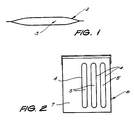
- a sealed container 2 such as of a plastic material which contains a nematode cream 3 mixed with adsorbent such as activated carbon.
- the amount of activated carbon may vary within broad limits, but satisfactory results have been achieved with an amount of activated carbon in the range 30-50% by wt.
- the nematode cream 5 is contained within a semi-permeable membrane sac 4, such as a dialysis tube.
- the sac 4 is enveloped by container 6 which contains charcoal or a suspension of charcoal in a liquid, such as water or buffer.
- an antimicrobial agent is incorporated in the nematode cream or in the liquid contained within container 6 surrounding sac 4.
- the permeable membranes have pore sizes smaller than 10 microns in diameter. It should be appreciated that charcoal formulation allows the nematodes to be packed at a high density, e.g. 1 million per gram with S. feltiae . There is no restriction on the size of the pack, from less than 1 gram to 1 kg or greater depending on the area and rate of application.
- each of the above embodiments of this invention allow the nematodes to be stored under varying degrees of anaerobiosis/oxygen tension.
- Nematodes may be stored under vacuum, or stored in nitrogen, nitrous oxide, carbon dioxide, or air. Moreover, the storage conditions do not require reduced temperatures. It will be seen that the nematodes can retain viability for significant periods of time at ambient temperatures up to about 37°C.
- the above methods are applicable to a wide range of nematodes and in particular pure or a mixture of strains of Steinernematidae and Heterorhabditidae including S. bibionis, S. feltiae (known previously as Neoaplectama carpocapsae ), Heterophabditis. bacteriophora and H. heliothides .
- the field containers useful in the above transport methods of the present invention are of any suitable material or size, such as vacuum packed plastic sachets, syringe-like moulds, air or inert gas-filled bottles, jars, tins, or dialysis tubes.
- the nematodes may be removed from the container to be used directly or diluted with water or other solutions depending on the particular product formulation and application.
- the nematode S. glaseri strain NC513 was reared in monoxenic culture on artificial medium consisting of chicken offal homogenate and polyurethane sponge crumbs. The third stage infective juveniles were harvested from the medium and washed with water. The clean nematodes were mixed with 0.1% formaldehyde solution and stored in sealed bottles at 37°C. The results of the experiment are given in Table 1 and demonstrate the enhanced stability on addition of a biocide, formaldehyde, over water as control.
- the nematode S. glaseri strain NC513 was prepared as outlined in Example 1. The washed nematodes were suspended in M9 buffer solution and stored in sealed bottles at 22, 28, 33 and 37°C for 30 days, and the control, nematodes suspended in water, were stored for 19 days.
- the nematodes S. feltiae strain Agriotis were prepared as outlined in Example 1. The nematodes were suspended in water or 1.0% formaldehyde, filtered and lightly covered with activated carbon powder. The nematodes were then stored at 22°C, and the results of this test after 33 days of storage are given in Table 2.
- the nematode S. feltiae strain Agriotis was prepared as outlined in Example 1. The washed nematode was suspended in high osmotic strength solution, 30% sucrose, and stored at 22°C. The viability of the nematodes after 33 days of storage was 85% compared to a water control which showed no viability.
- the nematode S. bibionis strain Otio was prepared as outlined in Example 1.
- the washed nematodes (4,000/ml in 0.1% formaldehyde) was mixed with activated carbon powder (20% w/v in 0.1% formaldehyde) at 1:1 ratio.
- the viability of nematodes was 92% after being stored for 140 days at room temperature. The infectivity declined slightly after storage.
- the nematode S. feltiae strain Mexican was prepared as outlined in Example 1.
- the 65 x 106 washed nematode cream (1.5 x 10⁶/ml in 0.1% formaldehyde) was mixed with dry activated carbon powder (finer than 400 micron) at a ratio of 1:1 and sealed in plastic sachets.
- Infectivity was intact for 30 days at 24°C and at least 180 days at 4°C.
- the content of one sachet (90 gram) is sufficient to cover 500-5,000 m2 of soil at an application rate, 104 - 105 nematodes/m2.
Landscapes
- Life Sciences & Earth Sciences (AREA)
- Zoology (AREA)
- Environmental Sciences (AREA)
- General Health & Medical Sciences (AREA)
- Engineering & Computer Science (AREA)
- Health & Medical Sciences (AREA)
- Wood Science & Technology (AREA)
- Microbiology (AREA)
- Plant Pathology (AREA)
- Virology (AREA)
- Agronomy & Crop Science (AREA)
- Dentistry (AREA)
- Biotechnology (AREA)
- Pest Control & Pesticides (AREA)
- Animal Behavior & Ethology (AREA)
- Animal Husbandry (AREA)
- Biodiversity & Conservation Biology (AREA)
- Agricultural Chemicals And Associated Chemicals (AREA)
- Pharmaceuticals Containing Other Organic And Inorganic Compounds (AREA)
- Medicinal Preparation (AREA)
Abstract
Claims (32)
- Un procédé de stockage de nématodes entomopathogènes comprenant le mélange d'une suspension de nématodes entomopathogènes juvéniles infectieux avec un adsorbant qui adsorbe, à sa surface, des molécules d'eau afin d'abaisser l'activité de l'eau dans le mélange, et le stockage du mélange sous des conditions dans lesquelles est empêchée la croissance microbienne.
- Un procédé comme revendiqué à la revendication 1, dans lequel ladite matière adsorbante est choisie parmi le groupe comprenant du charbon de bois activé et des résines synthétiques.
- Un procédé comme revendiqué à la revendication 2, dans lequel ladite matière adsorbante est du charbon de bois et la concentration du charbon de bois est dans une quantité comprise dans la gamme de 10 à 70 % en poids, la suspension de nématodes entomopathogènes juvéniles infectieux étant présente dans une quantité dans la gamme de 30 à 90 % en poids.
- Le procédé comme revendiqué dans une quelconque des revendications 1 à 3, dans lequel la concentration des nématodes est de 0,2 à 2 x 10⁵ nématodes par gramme de ladite suspension de nématodes.
- Un procédé comme revendiqué dans une quelconque des revendications 1 à 4, dans lequel lesdits nématodes sont choisis parmi le groupe des souches comprenant les Steinernematidae et les Heterorhabditae et un mélange de souches de Steinernematidae et de Heterorhabditae.
- Un procédé comme revendiqué à la revendication 5, dans lequel lesdites souches sont choisies parmi le groupe comprenant les S. bibionis, les S. glaseri, les S. feltiae, les H. bacteriophora et les H. heliothidis.
- Un procédé comme revendiqué dans une quelconque des revendications 1 à 6, dans lequel ledit stockage est effectué en présence d'un agent antimicrobien pour empêcher la croissance microbienne.
- Un procédé comme revendiqué dans une quelconque des revendications 1 à 7, dans lequel lesdits nématodes sont lavés avec un agent antimicrobien avant ledit stockage pour empêcher la croissance microbienne.
- Un procédé comme revendiqué à la revendication 7 ou 8, dans lequel ledit agent antimicrobien est choisi parmi le groupe comprenant des solutions de formaldéhyde et d'hypochlorite de sodium.
- Un procédé comme revendiqué à la revendication 7 ou 8, dans lequel ledit agent antimicrobien comprend une solution ayant une pression osmotique élevée.
- Un procédé comme revendiqué à la revendication 9, dans lequel ladite solution a une gamme de concentration de 0,1 à 1,0 p/p %.
- Une formulation de nématodes appropriée à un stockage prolongé comprenant une suspension de nématodes entomopathogènes juvéniles infectieux mélanges avec un adsorbant qui adsorbe, à sa surface, des molécules d'eau pour diminuer l'activité de l'eau dans la formule, ainsi qu'un agent antimicrobien.
- Une formulation de nématodes comme revendiquée à la revendication 12, dans laquelle la concentration des nématodes est dans la gamme de 0,2 à 2 x 10⁵ nématodes par gramme de ladite suspension de nématodes.
- Une formulation de nématodes comme revendiquée dans la revendication 12 ou 13, dans laquelle ladite formulation est stockée dans un récipient étanche.
- Un procédé comme revendiqué à la revendication 1 ou 2 ou 3, comprenant le stockage desdits nématodes dans une atmosphère de stockage sous des conditions sensiblement anaérobies.
- Un procédé comme revendiqué à la revendication 2 ou 3, comprenant le stockage desdits nématodes dans une atmosphère de stockage sous des conditions sensiblement anaérobies.
- Un procédé comme revendiqué à la revendication 14, dans lequel lesdits nématodes épuisent l'oxygène dudit récipient étanche pour l'amener à une condition anaérobie.
- Un procédé comme revendiqué à la revendication 14, dans lequel lesdits nématodes sont stockés sous vide.
- Un procédé comme revendiqué à la revendication 14, dans lequel lesdits nématodes sont stockés sous azote.
- Un procédé comme revendiqué dans une quelconque des revendications 15 à 17 ou 19, dans lequel lesdits nématodes sont stockés sous un niveau d'oxygène inférieur à environ 0,4 % v/v.
- Un procédé comme revendiqué à la revendication 20, dans lequel ledit niveau d'oxygène est d'environ 0,25 % v/v.
- Un procédé comme revendiqué à la revendication 10, dans lequel ladite solution présentant une pressison osmotique élevée comprend un élément choisi parmi le groupe des monosaccharides et des disaccharides.
- Un procédé comme revendiqué à la revendication 22, dans lequel ledit disaccharide est le sucrose et ledit monosaccharide est le glucose.
- Un procédé comme revendiqué à la revendication 2, dans lequel ledit adsorbant est dans une forme choisie parmi le groupe comprenant des particules de poudre, de la poudre noyée dans un gel et des pastilles.
- Une formulation de nématodes comme à la revendication 12, dans laquelle ledit adsorbant est présent dans la gamme d'environ 10 à 70 % par poids total.
- Une formulation de nématodes comme à la revendication 12, dans laquelle ledit agent antimicrobien est choisi parmi le groupe comprenant des solutions de formaldéhyde et d'hypochlorite de sodium.
- Une formulation de nématodes comme à la revendication 26, dans laquelle lesdites solutions présentent une concentration comprise entre 0,1 et 1,0 p/p %.
- Une formulation de nématodes comme à la revendication 12, dans laquelle ledit agent antimicrobien comprend une solution présentant une pression osmotique élevée.
- Une formulation de nématodes comme à la revendication 26, dans laquelle ladite solution comprend des éléments choisis parmi le groupe comprenant les monosaccharides et les disaccharides.
- Une formulation de nématodes comme à la revendication 29, dans laquelle ledit monosaccharide est le glucose et ledit disaccharide est le sucrose.
- Une formulation de nématodes comme à la revendication 12, dans laquelle lesdits nématodes sont choisis parmi un groupe de souches comprenant les Steinernematidae et les Heterorhabditae et un mélange de souches de Steinernematidae et de Heterorhabditae.
- Une formulation de nématodes comme à la revendication 31, dans laquelle lesdites souches sont choisies parmi le groupe comprenant les S. bibionis, les S. glaseri, les S.feltiae, les H. bacteriophora et les H. heliothidis.
Applications Claiming Priority (4)
| Application Number | Priority Date | Filing Date | Title |
|---|---|---|---|
| AUPG349284 | 1984-02-07 | ||
| AU3492/84 | 1984-02-07 | ||
| AUPG572184 | 1984-06-27 | ||
| AU5721/84 | 1984-06-27 |
Publications (3)
| Publication Number | Publication Date |
|---|---|
| EP0177508A1 EP0177508A1 (fr) | 1986-04-16 |
| EP0177508A4 EP0177508A4 (fr) | 1987-01-28 |
| EP0177508B1 true EP0177508B1 (fr) | 1994-02-02 |
Family
ID=25642758
Family Applications (1)
| Application Number | Title | Priority Date | Filing Date |
|---|---|---|---|
| EP85900599A Expired - Lifetime EP0177508B1 (fr) | 1984-02-07 | 1985-02-07 | Transport et stockage de nematodes |
Country Status (11)
| Country | Link |
|---|---|
| US (1) | US4765275A (fr) |
| EP (1) | EP0177508B1 (fr) |
| JP (2) | JPH0725641B2 (fr) |
| CA (1) | CA1293186C (fr) |
| DE (1) | DE3587742T2 (fr) |
| DK (1) | DK461085A (fr) |
| FI (1) | FI853870L (fr) |
| IT (1) | IT1183183B (fr) |
| NO (1) | NO170251C (fr) |
| NZ (1) | NZ211067A (fr) |
| WO (1) | WO1985003412A1 (fr) |
Families Citing this family (35)
| Publication number | Priority date | Publication date | Assignee | Title |
|---|---|---|---|---|
| ATE84934T1 (de) * | 1986-08-18 | 1993-02-15 | Biosys | Kommerzielle lagerung und versendung entomogener nematoden. |
| US5183950A (en) * | 1986-08-18 | 1993-02-02 | Biosys | Commercial storage and shipment of entomogenous nematodes |
| WO1988008668A1 (fr) * | 1987-05-05 | 1988-11-17 | Commonwealth Scientific And Industrial Research Or | Stockage de nematodes entomopathogenes |
| JPS6431705A (en) * | 1987-07-29 | 1989-02-02 | Univ Saga | Method for controlling insect pest by using synthetic agricultural chemical and useful nematode in combination |
| WO1990010063A1 (fr) * | 1989-02-21 | 1990-09-07 | Biosys | Procede et milieu d'emballage de nematodes entomogenes |
| US5127186A (en) * | 1990-07-02 | 1992-07-07 | Advanced Biotechnology, Inc. | Encapsulated earthworm cocoons |
| US5170744A (en) * | 1991-12-13 | 1992-12-15 | Biosys Corporation | Long-term storage of infective juvenile nematodes in pseudoplastic layers |
| BR9306616A (pt) * | 1992-05-27 | 1998-12-08 | Ecoscience Corp | Método para armazenar culturas e conídios fungosos |
| US5989898A (en) * | 1992-05-27 | 1999-11-23 | Ecoscience Corporation | Method for storing fungal conidia |
| WO1994019940A1 (fr) * | 1993-03-04 | 1994-09-15 | Commonwealth Scientific And Industrial Research Organisation | Procede d'emballage de nematodes entomopathogenes pour stockage et transport |
| US5965149A (en) * | 1993-08-13 | 1999-10-12 | Thermo Trilogy Corporation | Granular formulation of biological entities with improved storage stability |
| USD374511S (en) | 1994-12-02 | 1996-10-08 | Schenck Marc W | Ladybug hibernation box |
| US5739005A (en) * | 1995-03-17 | 1998-04-14 | Auburn University A Public University Of The State Of Alabama | Use of polymeric films for delivery of nematode eggs and ecological evaluations |
| CA2235581A1 (fr) * | 1995-10-25 | 1997-05-01 | Kubota Corporation | Procede de production d'une preparation de nematode entomopathogene et d'un insecticide nematode entomopathogene |
| EP0823215A1 (fr) * | 1996-08-06 | 1998-02-11 | BIO INTEGRATED TECHNOLOGY S.r.l. | Bactéries insecticides |
| EP0909532A1 (fr) * | 1997-10-16 | 1999-04-21 | Development Center For Biotechnology | Matériau poreux et compatible avec l'environnement contenant des nématodes benefiques et sa préparation |
| AUPP616798A0 (en) * | 1998-09-28 | 1998-10-22 | Commonwealth Scientific And Industrial Research Organisation | Method and apparatus for the storage of entomapathogenic nematodes |
| DE19925996A1 (de) * | 1999-06-08 | 2000-12-14 | Wilhelm Fleischmann | Verfahren und Vorrichtung zur Herstellung des Sekrets von Fliegenlarven für die therapeutische Applikation |
| WO2002047481A2 (fr) * | 2000-11-17 | 2002-06-20 | The Ohio State University Research Foundation | Application directe de nematodes entomopathogenes anhydres destines a la lutte antparasitaire biologique |
| EP1835943A1 (fr) * | 2004-11-20 | 2007-09-26 | Zoobiotic Limited | Systeme d apport d asticots |
| US20080295774A1 (en) * | 2005-02-11 | 2008-12-04 | Chesapeake Perl, Inc. | Automated Packaging, Inoculation, and Harvesting of Lepidopterous Larvae for Protein Manufacturing |
| US20110197289A1 (en) * | 2010-02-08 | 2011-08-11 | Shahina Fayyaz | Storage of Entomopathogenic Nematodes |
| US8677935B1 (en) * | 2011-08-25 | 2014-03-25 | The United States Of America As Represented By The Secretary Of Agriculture | System and method for producing beneficial parasites |
| US20150128865A1 (en) * | 2013-11-14 | 2015-05-14 | Allison Hope Justice | Entomopathogenic nematode do-it-yourself application and rearing system |
| CN103891710B (zh) * | 2014-03-11 | 2015-07-29 | 中国科学院东北地理与农业生态研究所 | 一种Oscheius tipulae线虫冻存液及其制备方法及该冻存液的应用 |
| US9642344B2 (en) * | 2014-07-05 | 2017-05-09 | Livin Farms Ltd. | System and method for breeding and harvesting insects |
| US10159229B2 (en) * | 2014-07-21 | 2018-12-25 | Enterra Feed Corporation | Continuous production system for culturing dipteran insects |
| WO2016176764A1 (fr) | 2015-05-04 | 2016-11-10 | Green Advantage Technology Inc. | Procédés et formulations pour stocker des nématodes entomopathogènes |
| US10051845B1 (en) | 2016-10-05 | 2018-08-21 | Verily Life Sciences Llc | Pupae emergence method and apparatus |
| US10306875B1 (en) * | 2016-10-05 | 2019-06-04 | Verily Life Sciences Llc | Disposable container for the mass-rearing of insects |
| US10779521B2 (en) | 2016-10-05 | 2020-09-22 | Verily Life Sciences Llc | Automated mass rearing system for insect larvae |
| US10278368B1 (en) | 2016-10-05 | 2019-05-07 | Verily Life Sciences Llc | Automated flying insect separator |
| US11051490B2 (en) * | 2017-03-27 | 2021-07-06 | The United States Of America, As Represented By The Secretary Of Agriculture | Insect water supply system |
| PL3578043T3 (pl) * | 2018-06-05 | 2022-11-21 | Bühler AG | Przechowywanie larw na dużą skalę i przy dużym zagęszczeniu |
| US20210352878A1 (en) * | 2020-05-12 | 2021-11-18 | Alfredo LLECHA GALIÑANES | Transportable container for the breeding of invertebrates with three-dimensional prismatic interior of gyroid structure. |
Family Cites Families (8)
| Publication number | Priority date | Publication date | Assignee | Title |
|---|---|---|---|---|
| US3813465A (en) * | 1971-12-16 | 1974-05-28 | I Lerner | Cytological preservative and mucolytic composition |
| DE2532183C3 (de) * | 1975-07-18 | 1982-03-04 | Behringwerke Ag, 3550 Marburg | Polyionische isotonische Salzlösung zur Konservierung von Erythrozyten oder zur Perfusion und zur Konservierung von zur Transplantion bestimmter Organen |
| US4178366A (en) * | 1975-08-26 | 1979-12-11 | Commonwealth Scientific And Industrial Research Organization | Nematode larvae as biological insecticides |
| DE2638299A1 (de) * | 1975-08-26 | 1977-03-10 | Commw Scient Ind Res Org | Formulierung zur biologischen insektenbekaempfung |
| AU509879B2 (en) * | 1975-08-26 | 1980-05-29 | Commonwealth Scientific And Industrial Research Organisation | Biological control means |
| US4161158A (en) * | 1977-08-03 | 1979-07-17 | Kartesz Frank A | Preservation of live fish bait |
| CA1165694A (fr) * | 1981-09-21 | 1984-04-17 | Jean R. Finney | Conditonnement des nematodes pour leur transport |
| FR2542617B2 (fr) * | 1982-07-09 | 1986-06-06 | Rgl Transfusion Sanguine Centr | Solution protectrice pour la conservation de cellules fonctionnelles |
-
1985
- 1985-02-07 FI FI853870A patent/FI853870L/fi not_active Application Discontinuation
- 1985-02-07 WO PCT/AU1985/000020 patent/WO1985003412A1/fr not_active Ceased
- 1985-02-07 CA CA000473826A patent/CA1293186C/fr not_active Expired - Lifetime
- 1985-02-07 IT IT19430/85A patent/IT1183183B/it active
- 1985-02-07 EP EP85900599A patent/EP0177508B1/fr not_active Expired - Lifetime
- 1985-02-07 US US06/787,805 patent/US4765275A/en not_active Expired - Fee Related
- 1985-02-07 NZ NZ211067A patent/NZ211067A/en unknown
- 1985-02-07 JP JP60500744A patent/JPH0725641B2/ja not_active Expired - Lifetime
- 1985-02-07 DE DE3587742T patent/DE3587742T2/de not_active Expired - Fee Related
- 1985-10-04 NO NO85853940A patent/NO170251C/no unknown
- 1985-10-09 DK DK461085A patent/DK461085A/da not_active Application Discontinuation
-
1994
- 1994-02-28 JP JP6054496A patent/JPH06293601A/ja active Pending
Non-Patent Citations (1)
| Title |
|---|
| JOURNAL OF ECONOMIC ENTOMOLOGY, vol. 75, no. 1, February 1982, pages 97-101, College Park, Maryland, US ; C.M. Mac VEAN et al.:"Field tests of antidesiccants to extend the infection period of an entomogenous nematode, Neoplectana carpocapsae, against the colorado potato beetle." * |
Also Published As
| Publication number | Publication date |
|---|---|
| JPS61501392A (ja) | 1986-07-10 |
| DE3587742D1 (de) | 1994-03-17 |
| EP0177508A4 (fr) | 1987-01-28 |
| EP0177508A1 (fr) | 1986-04-16 |
| US4765275A (en) | 1988-08-23 |
| DE3587742T2 (de) | 1994-06-09 |
| IT1183183B (it) | 1987-10-05 |
| FI853870A0 (fi) | 1985-10-04 |
| CA1293186C (fr) | 1991-12-17 |
| JPH0725641B2 (ja) | 1995-03-22 |
| WO1985003412A1 (fr) | 1985-08-15 |
| FI853870A7 (fi) | 1985-10-04 |
| IT8519430A0 (it) | 1985-02-07 |
| DK461085A (da) | 1985-12-09 |
| NZ211067A (en) | 1987-09-30 |
| NO170251B (no) | 1992-06-22 |
| DK461085D0 (da) | 1985-10-09 |
| JPH06293601A (ja) | 1994-10-21 |
| NO170251C (no) | 1992-09-30 |
| FI853870L (fi) | 1985-10-04 |
| NO853940L (no) | 1985-12-03 |
Similar Documents
| Publication | Publication Date | Title |
|---|---|---|
| US4765275A (en) | Nematode storage and transport | |
| EP0359764B1 (fr) | Stockage de nematodes entomopathogenes | |
| US5849284A (en) | Biological control of molluscs with dauer larvae of Phasmarhabditis nematodes | |
| Woodring | Observations on the biology of six species of acarid mites | |
| Grewal | Formulations of entomopathogenic nematodes for storage and application | |
| US6110480A (en) | Method for preparing an environmentally compatable porous material comprising beneficial nematodes and the biotic preparations produced therefrom | |
| Wilson et al. | Mass cultivation and storage of the rhabditid nematode Phasmarhabditis hermaphrodita, a biocontrol agent for slugs | |
| Touray et al. | Evaluation of different sponge types on the survival and infectivity of stored entomopathogenic nematodes | |
| JPH10215729A (ja) | 菌食性線虫アフェレンクス・アベネの大量生産法とその長期保存法並びに利用法 | |
| Binns | Laboratory rearing, biology and chemical control of the mushroom sciarid Lycoriella auripila (Diptera: Lycoriidae) | |
| EP0668718A1 (fr) | Procede de stockage de nematodes entomopathogenes | |
| AU567459B2 (en) | Nematode storage and transport | |
| Richardson et al. | Laboratory rearing of the mushroom phorid Megaselia halterata (Diptera: Phoridae) | |
| Salama et al. | Biological effects of Bacillus thuringiensis on the egg parasitoid, Trichogramma evanescens | |
| AU635921B2 (en) | Method and medium for packaging entomogenous nematodes | |
| CN1019258B (zh) | 线虫贮存和运输的改进方法 | |
| JP3113910B2 (ja) | 菌食性線虫アフェレンクス・アベネの長期保存法 | |
| AU2683692A (en) | Storage of nematodes in pseudoplastic layers | |
| Kincade et al. | A survey of leafhoppers in soybean fields in Mississippi | |
| Hassler et al. | Techniques For Hatching And Rearing Dolphin," Coryphaena Hippurus", Through Larvae And Juvenile Stages | |
| KR19990067050A (ko) | 곤충 기생성 선충 제제의 제조 방법 및 보존방법 | |
| JPH11266769A (ja) | 菌食性線虫アフェレンクス・アベネによる土壌病害虫の予防法 | |
| McLINTOCK | INORNATA (Will)(DIPTERA: CULICIDAE) | |
| WO1997015193A1 (fr) | Procede de production d'une preparation de nematode entomoparasite, et preparation dudit nematode | |
| AU4809793A (en) | Method for the storage of entomopathogenic nematodes |
Legal Events
| Date | Code | Title | Description |
|---|---|---|---|
| PUAI | Public reference made under article 153(3) epc to a published international application that has entered the european phase |
Free format text: ORIGINAL CODE: 0009012 |
|
| AK | Designated contracting states |
Kind code of ref document: A1 Designated state(s): BE CH DE FR GB LI LU NL SE |
|
| 17P | Request for examination filed |
Effective date: 19860207 |
|
| A4 | Supplementary search report drawn up and despatched |
Effective date: 19870128 |
|
| 17Q | First examination report despatched |
Effective date: 19881104 |
|
| RAP1 | Party data changed (applicant data changed or rights of an application transferred) |
Owner name: ECOGEN-BIO INC. |
|
| GRAA | (expected) grant |
Free format text: ORIGINAL CODE: 0009210 |
|
| AK | Designated contracting states |
Kind code of ref document: B1 Designated state(s): BE CH DE FR GB LI LU NL SE |
|
| REF | Corresponds to: |
Ref document number: 3587742 Country of ref document: DE Date of ref document: 19940317 |
|
| EPTA | Lu: last paid annual fee | ||
| ET | Fr: translation filed | ||
| PLBE | No opposition filed within time limit |
Free format text: ORIGINAL CODE: 0009261 |
|
| STAA | Information on the status of an ep patent application or granted ep patent |
Free format text: STATUS: NO OPPOSITION FILED WITHIN TIME LIMIT |
|
| 26N | No opposition filed | ||
| EAL | Se: european patent in force in sweden |
Ref document number: 85900599.3 |
|
| PGFP | Annual fee paid to national office [announced via postgrant information from national office to epo] |
Ref country code: NL Payment date: 19950228 Year of fee payment: 11 |
|
| PGFP | Annual fee paid to national office [announced via postgrant information from national office to epo] |
Ref country code: LU Payment date: 19950501 Year of fee payment: 11 |
|
| PGFP | Annual fee paid to national office [announced via postgrant information from national office to epo] |
Ref country code: CH Payment date: 19950523 Year of fee payment: 11 |
|
| PGFP | Annual fee paid to national office [announced via postgrant information from national office to epo] |
Ref country code: FR Payment date: 19950524 Year of fee payment: 11 |
|
| PGFP | Annual fee paid to national office [announced via postgrant information from national office to epo] |
Ref country code: SE Payment date: 19950526 Year of fee payment: 11 |
|
| PGFP | Annual fee paid to national office [announced via postgrant information from national office to epo] |
Ref country code: GB Payment date: 19950530 Year of fee payment: 11 |
|
| PGFP | Annual fee paid to national office [announced via postgrant information from national office to epo] |
Ref country code: DE Payment date: 19950601 Year of fee payment: 11 |
|
| PGFP | Annual fee paid to national office [announced via postgrant information from national office to epo] |
Ref country code: BE Payment date: 19950613 Year of fee payment: 11 |
|
| PG25 | Lapsed in a contracting state [announced via postgrant information from national office to epo] |
Ref country code: LU Free format text: LAPSE BECAUSE OF NON-PAYMENT OF DUE FEES Effective date: 19960207 Ref country code: GB Effective date: 19960207 |
|
| PG25 | Lapsed in a contracting state [announced via postgrant information from national office to epo] |
Ref country code: SE Effective date: 19960208 |
|
| PG25 | Lapsed in a contracting state [announced via postgrant information from national office to epo] |
Ref country code: LI Free format text: LAPSE BECAUSE OF NON-PAYMENT OF DUE FEES Effective date: 19960228 Ref country code: CH Free format text: LAPSE BECAUSE OF NON-PAYMENT OF DUE FEES Effective date: 19960228 Ref country code: BE Effective date: 19960228 |
|
| BERE | Be: lapsed |
Owner name: ECOGEN-BIO INC. Effective date: 19960228 |
|
| PG25 | Lapsed in a contracting state [announced via postgrant information from national office to epo] |
Ref country code: NL Effective date: 19960901 |
|
| GBPC | Gb: european patent ceased through non-payment of renewal fee |
Effective date: 19960207 |
|
| REG | Reference to a national code |
Ref country code: CH Ref legal event code: PL |
|
| PG25 | Lapsed in a contracting state [announced via postgrant information from national office to epo] |
Ref country code: FR Effective date: 19961031 |
|
| NLV4 | Nl: lapsed or anulled due to non-payment of the annual fee |
Effective date: 19960901 |
|
| PG25 | Lapsed in a contracting state [announced via postgrant information from national office to epo] |
Ref country code: DE Effective date: 19961101 |
|
| REG | Reference to a national code |
Ref country code: FR Ref legal event code: ST |