EP0177978B1 - Naphtolamin-Derivate - Google Patents
Naphtolamin-Derivate Download PDFInfo
- Publication number
- EP0177978B1 EP0177978B1 EP85113502A EP85113502A EP0177978B1 EP 0177978 B1 EP0177978 B1 EP 0177978B1 EP 85113502 A EP85113502 A EP 85113502A EP 85113502 A EP85113502 A EP 85113502A EP 0177978 B1 EP0177978 B1 EP 0177978B1
- Authority
- EP
- European Patent Office
- Prior art keywords
- hydroxy
- nitro
- naphthalene
- sulfophenylamino
- formula
- Prior art date
- Legal status (The legal status is an assumption and is not a legal conclusion. Google has not performed a legal analysis and makes no representation as to the accuracy of the status listed.)
- Expired
Links
- -1 Naphthol amine Chemical class 0.000 title description 10
- 150000001875 compounds Chemical class 0.000 claims description 14
- 125000004178 (C1-C4) alkyl group Chemical group 0.000 claims description 4
- 239000000975 dye Substances 0.000 description 26
- XLYOFNOQVPJJNP-UHFFFAOYSA-N water Substances O XLYOFNOQVPJJNP-UHFFFAOYSA-N 0.000 description 16
- HEMHJVSKTPXQMS-UHFFFAOYSA-M Sodium hydroxide Chemical compound [OH-].[Na+] HEMHJVSKTPXQMS-UHFFFAOYSA-M 0.000 description 15
- 230000008878 coupling Effects 0.000 description 12
- 238000010168 coupling process Methods 0.000 description 12
- 238000005859 coupling reaction Methods 0.000 description 12
- 229920000742 Cotton Polymers 0.000 description 7
- 239000011734 sodium Substances 0.000 description 7
- 239000002253 acid Substances 0.000 description 5
- 229910052739 hydrogen Inorganic materials 0.000 description 5
- 238000000034 method Methods 0.000 description 5
- 239000000843 powder Substances 0.000 description 5
- MTJBGOVUBIQLSE-UHFFFAOYSA-N 4-hydroxy-6-(4-nitro-2-sulfoanilino)naphthalene-2-sulfonic acid Chemical compound C1=C2C(O)=CC(S(O)(=O)=O)=CC2=CC=C1NC1=CC=C([N+]([O-])=O)C=C1S(O)(=O)=O MTJBGOVUBIQLSE-UHFFFAOYSA-N 0.000 description 4
- PAYRUJLWNCNPSJ-UHFFFAOYSA-N Aniline Chemical compound NC1=CC=CC=C1 PAYRUJLWNCNPSJ-UHFFFAOYSA-N 0.000 description 4
- KWYUFKZDYYNOTN-UHFFFAOYSA-M Potassium hydroxide Chemical compound [OH-].[K+] KWYUFKZDYYNOTN-UHFFFAOYSA-M 0.000 description 4
- CDBYLPFSWZWCQE-UHFFFAOYSA-L Sodium Carbonate Chemical compound [Na+].[Na+].[O-]C([O-])=O CDBYLPFSWZWCQE-UHFFFAOYSA-L 0.000 description 4
- UIIMBOGNXHQVGW-UHFFFAOYSA-M Sodium bicarbonate Chemical compound [Na+].OC([O-])=O UIIMBOGNXHQVGW-UHFFFAOYSA-M 0.000 description 4
- FAPWRFPIFSIZLT-UHFFFAOYSA-M Sodium chloride Chemical compound [Na+].[Cl-] FAPWRFPIFSIZLT-UHFFFAOYSA-M 0.000 description 4
- 238000009833 condensation Methods 0.000 description 4
- 230000005494 condensation Effects 0.000 description 4
- 239000000203 mixture Substances 0.000 description 4
- 230000007935 neutral effect Effects 0.000 description 4
- 125000000449 nitro group Chemical group [O-][N+](*)=O 0.000 description 4
- 239000000985 reactive dye Substances 0.000 description 4
- WFQDTOYDVUWQMS-UHFFFAOYSA-N 1-fluoro-4-nitrobenzene Chemical compound [O-][N+](=O)C1=CC=C(F)C=C1 WFQDTOYDVUWQMS-UHFFFAOYSA-N 0.000 description 3
- ZWEHNKRNPOVVGH-UHFFFAOYSA-N 2-Butanone Chemical compound CCC(C)=O ZWEHNKRNPOVVGH-UHFFFAOYSA-N 0.000 description 3
- GOYNRDSJTYLXBU-UHFFFAOYSA-N 5-chloro-2,4,6-trifluoropyrimidine Chemical compound FC1=NC(F)=C(Cl)C(F)=N1 GOYNRDSJTYLXBU-UHFFFAOYSA-N 0.000 description 3
- FBNKHQRVOKNNHK-UHFFFAOYSA-N 8-hydroxy-3-(2-nitro-4-sulfoanilino)naphthalene-1,5-disulfonic acid Chemical compound C=1C(S(O)(=O)=O)=C2C(O)=CC=C(S(O)(=O)=O)C2=CC=1NC1=CC=C(S(O)(=O)=O)C=C1[N+]([O-])=O FBNKHQRVOKNNHK-UHFFFAOYSA-N 0.000 description 3
- UHOVQNZJYSORNB-UHFFFAOYSA-N Benzene Chemical compound C1=CC=CC=C1 UHOVQNZJYSORNB-UHFFFAOYSA-N 0.000 description 3
- ZMXDDKWLCZADIW-UHFFFAOYSA-N N,N-Dimethylformamide Chemical compound CN(C)C=O ZMXDDKWLCZADIW-UHFFFAOYSA-N 0.000 description 3
- 239000000987 azo dye Substances 0.000 description 3
- 239000001049 brown dye Substances 0.000 description 3
- 238000001816 cooling Methods 0.000 description 3
- 125000001424 substituent group Chemical group 0.000 description 3
- BGLZITKOZLXCEK-UHFFFAOYSA-N 2-[(7-hydroxynaphthalen-1-yl)amino]-5-nitrobenzenesulfonic acid Chemical compound C12=CC(O)=CC=C2C=CC=C1NC1=CC=C([N+]([O-])=O)C=C1S(O)(=O)=O BGLZITKOZLXCEK-UHFFFAOYSA-N 0.000 description 2
- QPKNFEVLZVJGBM-UHFFFAOYSA-N 2-aminonaphthalen-1-ol Chemical compound C1=CC=CC2=C(O)C(N)=CC=C21 QPKNFEVLZVJGBM-UHFFFAOYSA-N 0.000 description 2
- YAIKCRUPEVOINQ-UHFFFAOYSA-N 2-aminonaphthalene-1,5-disulfonic acid Chemical compound OS(=O)(=O)C1=CC=CC2=C(S(O)(=O)=O)C(N)=CC=C21 YAIKCRUPEVOINQ-UHFFFAOYSA-N 0.000 description 2
- JHOXTVPHOJWWLI-UHFFFAOYSA-N 3-hydroxy-7-(2-nitro-4-sulfoanilino)naphthalene-1-sulfonic acid Chemical compound C1=CC2=CC(O)=CC(S(O)(=O)=O)=C2C=C1NC1=CC=C(S(O)(=O)=O)C=C1[N+]([O-])=O JHOXTVPHOJWWLI-UHFFFAOYSA-N 0.000 description 2
- BFFGRESQMLAOPL-UHFFFAOYSA-N 4-hydroxy-5-(2-nitro-4-sulfoanilino)naphthalene-2-sulfonic acid Chemical compound C=12C(O)=CC(S(O)(=O)=O)=CC2=CC=CC=1NC1=CC=C(S(O)(=O)=O)C=C1[N+]([O-])=O BFFGRESQMLAOPL-UHFFFAOYSA-N 0.000 description 2
- GCSYZKCYWVVEKB-UHFFFAOYSA-N 4-hydroxy-5-(4-nitro-2-sulfoanilino)naphthalene-2-sulfonic acid Chemical compound C=12C(O)=CC(S(O)(=O)=O)=CC2=CC=CC=1NC1=CC=C([N+]([O-])=O)C=C1S(O)(=O)=O GCSYZKCYWVVEKB-UHFFFAOYSA-N 0.000 description 2
- CMHANIMENVQZOI-UHFFFAOYSA-N 4-hydroxy-6-(2-nitro-4-sulfoanilino)naphthalene-1-sulfonic acid Chemical compound C1=C2C(O)=CC=C(S(O)(=O)=O)C2=CC=C1NC1=CC=C(S(O)(=O)=O)C=C1[N+]([O-])=O CMHANIMENVQZOI-UHFFFAOYSA-N 0.000 description 2
- KFTFMEWFODYESN-UHFFFAOYSA-N 4-hydroxy-6-(2-nitro-4-sulfoanilino)naphthalene-2-sulfonic acid Chemical compound C1=C2C(O)=CC(S(O)(=O)=O)=CC2=CC=C1NC1=CC=C(S(O)(=O)=O)C=C1[N+]([O-])=O KFTFMEWFODYESN-UHFFFAOYSA-N 0.000 description 2
- GFHYVIMKLOKIJK-UHFFFAOYSA-N 4-hydroxy-6-(4-nitro-2-sulfoanilino)naphthalene-1-sulfonic acid Chemical compound C1=C2C(O)=CC=C(S(O)(=O)=O)C2=CC=C1NC1=CC=C([N+]([O-])=O)C=C1S(O)(=O)=O GFHYVIMKLOKIJK-UHFFFAOYSA-N 0.000 description 2
- UERILYGMKHIONY-UHFFFAOYSA-N 4-hydroxy-7-(2-nitro-4-sulfoanilino)naphthalene-2-sulfonic acid Chemical compound C=1C=C2C(O)=CC(S(O)(=O)=O)=CC2=CC=1NC1=CC=C(S(O)(=O)=O)C=C1[N+]([O-])=O UERILYGMKHIONY-UHFFFAOYSA-N 0.000 description 2
- HCIBYIYNFDKODQ-UHFFFAOYSA-N 4-hydroxy-7-(4-nitro-2-sulfoanilino)naphthalene-2-sulfonic acid Chemical compound C=1C=C2C(O)=CC(S(O)(=O)=O)=CC2=CC=1NC1=CC=C([N+]([O-])=O)C=C1S(O)(=O)=O HCIBYIYNFDKODQ-UHFFFAOYSA-N 0.000 description 2
- IWGFHZKOCKHHSZ-UHFFFAOYSA-N 4-hydroxy-8-(2-nitro-4-sulfoanilino)naphthalene-2-sulfonic acid Chemical compound C1=CC=C2C(O)=CC(S(O)(=O)=O)=CC2=C1NC1=CC=C(S(O)(=O)=O)C=C1[N+]([O-])=O IWGFHZKOCKHHSZ-UHFFFAOYSA-N 0.000 description 2
- ZPWUWHGHKZMUCA-UHFFFAOYSA-N 4-hydroxy-8-(4-nitro-2-sulfoanilino)naphthalene-2-sulfonic acid Chemical compound C1=CC=C2C(O)=CC(S(O)(=O)=O)=CC2=C1NC1=CC=C([N+]([O-])=O)C=C1S(O)(=O)=O ZPWUWHGHKZMUCA-UHFFFAOYSA-N 0.000 description 2
- HBZVNWNSRNTWPS-UHFFFAOYSA-N 6-amino-4-hydroxynaphthalene-2-sulfonic acid Chemical compound C1=C(S(O)(=O)=O)C=C(O)C2=CC(N)=CC=C21 HBZVNWNSRNTWPS-UHFFFAOYSA-N 0.000 description 2
- IODMYCLABBASTQ-UHFFFAOYSA-N 8-hydroxy-3-(4-nitro-2-sulfoanilino)naphthalene-1,5-disulfonic acid Chemical compound C=1C(S(O)(=O)=O)=C2C(O)=CC=C(S(O)(=O)=O)C2=CC=1NC1=CC=C([N+]([O-])=O)C=C1S(O)(=O)=O IODMYCLABBASTQ-UHFFFAOYSA-N 0.000 description 2
- QGZKDVFQNNGYKY-UHFFFAOYSA-N Ammonia Chemical compound N QGZKDVFQNNGYKY-UHFFFAOYSA-N 0.000 description 2
- WKBOTKDWSSQWDR-UHFFFAOYSA-N Bromine atom Chemical compound [Br] WKBOTKDWSSQWDR-UHFFFAOYSA-N 0.000 description 2
- ZAMOUSCENKQFHK-UHFFFAOYSA-N Chlorine atom Chemical compound [Cl] ZAMOUSCENKQFHK-UHFFFAOYSA-N 0.000 description 2
- PXGOKWXKJXAPGV-UHFFFAOYSA-N Fluorine Chemical compound FF PXGOKWXKJXAPGV-UHFFFAOYSA-N 0.000 description 2
- UFHFLCQGNIYNRP-UHFFFAOYSA-N Hydrogen Chemical compound [H][H] UFHFLCQGNIYNRP-UHFFFAOYSA-N 0.000 description 2
- WMFOQBRAJBCJND-UHFFFAOYSA-M Lithium hydroxide Chemical compound [Li+].[OH-] WMFOQBRAJBCJND-UHFFFAOYSA-M 0.000 description 2
- WCUXLLCKKVVCTQ-UHFFFAOYSA-M Potassium chloride Chemical compound [Cl-].[K+] WCUXLLCKKVVCTQ-UHFFFAOYSA-M 0.000 description 2
- QAOWNCQODCNURD-UHFFFAOYSA-N Sulfuric acid Chemical compound OS(O)(=O)=O QAOWNCQODCNURD-UHFFFAOYSA-N 0.000 description 2
- WAAFILFRVJACLE-UHFFFAOYSA-N [K].FC1=C(C=C(C=C1)[N+](=O)[O-])S(=O)(=O)O Chemical compound [K].FC1=C(C=C(C=C1)[N+](=O)[O-])S(=O)(=O)O WAAFILFRVJACLE-UHFFFAOYSA-N 0.000 description 2
- 150000001447 alkali salts Chemical class 0.000 description 2
- 125000003277 amino group Chemical group 0.000 description 2
- 125000002915 carbonyl group Chemical group [*:2]C([*:1])=O 0.000 description 2
- 125000003178 carboxy group Chemical group [H]OC(*)=O 0.000 description 2
- 229920002678 cellulose Polymers 0.000 description 2
- 239000001913 cellulose Substances 0.000 description 2
- 150000008049 diazo compounds Chemical class 0.000 description 2
- 125000000664 diazo group Chemical group [N-]=[N+]=[*] 0.000 description 2
- 239000000835 fiber Substances 0.000 description 2
- 229910052731 fluorine Inorganic materials 0.000 description 2
- 229910052736 halogen Inorganic materials 0.000 description 2
- 150000002367 halogens Chemical class 0.000 description 2
- 229910001385 heavy metal Inorganic materials 0.000 description 2
- 125000002887 hydroxy group Chemical group [H]O* 0.000 description 2
- 235000017557 sodium bicarbonate Nutrition 0.000 description 2
- 229910000030 sodium bicarbonate Inorganic materials 0.000 description 2
- 229910000029 sodium carbonate Inorganic materials 0.000 description 2
- 239000007858 starting material Substances 0.000 description 2
- 125000000565 sulfonamide group Chemical group 0.000 description 2
- YKPQUSLRUFLVDA-UHFFFAOYSA-N $l^{2}-azanylmethane Chemical compound [NH]C YKPQUSLRUFLVDA-UHFFFAOYSA-N 0.000 description 1
- 0 *c(cc1)cc([N+]([O-])=O)c1Br=O Chemical compound *c(cc1)cc([N+]([O-])=O)c1Br=O 0.000 description 1
- NGCRLFIYVFOUMZ-UHFFFAOYSA-N 2,3-dichloroquinoxaline-6-carbonyl chloride Chemical compound N1=C(Cl)C(Cl)=NC2=CC(C(=O)Cl)=CC=C21 NGCRLFIYVFOUMZ-UHFFFAOYSA-N 0.000 description 1
- GVBHCMNXRKOJRH-UHFFFAOYSA-N 2,4,5,6-tetrachloropyrimidine Chemical compound ClC1=NC(Cl)=C(Cl)C(Cl)=N1 GVBHCMNXRKOJRH-UHFFFAOYSA-N 0.000 description 1
- WVHMPQKZPHOCRD-UHFFFAOYSA-N 2,4,5,6-tetrafluorobenzene-1,3-dicarbonitrile Chemical compound FC1=C(F)C(C#N)=C(F)C(C#N)=C1F WVHMPQKZPHOCRD-UHFFFAOYSA-N 0.000 description 1
- LCYNPYDWNHQFSO-UHFFFAOYSA-N 2,4,6-trichloro-5-ethylsulfonylpyrimidine Chemical compound CCS(=O)(=O)C1=C(Cl)N=C(Cl)N=C1Cl LCYNPYDWNHQFSO-UHFFFAOYSA-N 0.000 description 1
- MAGUTJHZIADTKE-UHFFFAOYSA-N 2,4,6-trichloro-5-methylsulfonylpyrimidine Chemical compound CS(=O)(=O)C1=C(Cl)N=C(Cl)N=C1Cl MAGUTJHZIADTKE-UHFFFAOYSA-N 0.000 description 1
- LWTFYBZNGZGGRD-UHFFFAOYSA-N 2,4,6-trifluorobenzene-1,3,5-tricarbonitrile Chemical compound FC1=C(C#N)C(F)=C(C#N)C(F)=C1C#N LWTFYBZNGZGGRD-UHFFFAOYSA-N 0.000 description 1
- KNPJEYHXTBTYCQ-UHFFFAOYSA-N 2-[(2,6-difluoro-5-methylsulfonylpyrimidin-4-yl)amino]benzenesulfonic acid Chemical compound CS(=O)(=O)C1=C(F)N=C(F)N=C1NC1=CC=CC=C1S(O)(=O)=O KNPJEYHXTBTYCQ-UHFFFAOYSA-N 0.000 description 1
- KDEKLNRJLDFBDQ-UHFFFAOYSA-N 2-fluoro-5-nitrobenzenesulfonic acid Chemical compound OS(=O)(=O)C1=CC([N+]([O-])=O)=CC=C1F KDEKLNRJLDFBDQ-UHFFFAOYSA-N 0.000 description 1
- 125000003903 2-propenyl group Chemical group [H]C([*])([H])C([H])=C([H])[H] 0.000 description 1
- BXILACNIBRVAII-UHFFFAOYSA-N 3-[(4,6-dichloro-1h-triazin-2-yl)amino]benzenesulfonic acid Chemical compound OS(=O)(=O)C1=CC=CC(NN2N=C(Cl)C=C(Cl)N2)=C1 BXILACNIBRVAII-UHFFFAOYSA-N 0.000 description 1
- URQHXMHWXZMRHS-UHFFFAOYSA-N 3-[(4,6-difluoro-1h-triazin-2-yl)amino]benzenesulfonic acid Chemical compound OS(=O)(=O)C1=CC=CC(NN2N=C(F)C=C(F)N2)=C1 URQHXMHWXZMRHS-UHFFFAOYSA-N 0.000 description 1
- BAIJUHNFHQYGHR-UHFFFAOYSA-N 4,5-dichloro-2,6-difluoropyrimidine Chemical compound FC1=NC(F)=C(Cl)C(Cl)=N1 BAIJUHNFHQYGHR-UHFFFAOYSA-N 0.000 description 1
- NZXOCWXWWQNPOF-UHFFFAOYSA-N 4,5-dichloro-6-methyl-2-methylsulfonylpyrimidine Chemical compound CC1=NC(S(C)(=O)=O)=NC(Cl)=C1Cl NZXOCWXWWQNPOF-UHFFFAOYSA-N 0.000 description 1
- MCLXKFUCPVGZEN-UHFFFAOYSA-N 4,6-dichloro-1,3,5-triazin-2-amine Chemical compound NC1=NC(Cl)=NC(Cl)=N1 MCLXKFUCPVGZEN-UHFFFAOYSA-N 0.000 description 1
- WFZXIHBXPFGXBN-UHFFFAOYSA-N 4,6-dichloro-2-methyl-N-phenyl-1H-triazin-5-amine Chemical compound CN1NC(=C(C(=N1)Cl)NC1=CC=CC=C1)Cl WFZXIHBXPFGXBN-UHFFFAOYSA-N 0.000 description 1
- AQGPBQYRJAGGQI-UHFFFAOYSA-N 4,6-dichloro-n-methyl-1h-triazin-2-amine Chemical compound CNN1NC(Cl)=CC(Cl)=N1 AQGPBQYRJAGGQI-UHFFFAOYSA-N 0.000 description 1
- ZMXTVHXMNYOIAL-UHFFFAOYSA-N 4,6-dichloro-n-phenyl-1h-triazin-2-amine Chemical compound N1C(Cl)=CC(Cl)=NN1NC1=CC=CC=C1 ZMXTVHXMNYOIAL-UHFFFAOYSA-N 0.000 description 1
- YFXVZFLUERQASK-UHFFFAOYSA-N 4,6-difluoro-1h-triazin-2-amine Chemical compound NN1NC(F)=CC(F)=N1 YFXVZFLUERQASK-UHFFFAOYSA-N 0.000 description 1
- CYXCUCZNKIZHOB-UHFFFAOYSA-N 4,6-difluoro-5-(2-methoxyethoxy)triazine Chemical compound COCCOC1=C(F)N=NN=C1F CYXCUCZNKIZHOB-UHFFFAOYSA-N 0.000 description 1
- DKTHYHUBAJBOAX-UHFFFAOYSA-N 4,6-difluoro-n-methyl-1h-triazin-2-amine Chemical compound CNN1NC(F)=CC(F)=N1 DKTHYHUBAJBOAX-UHFFFAOYSA-N 0.000 description 1
- CLBRUKFHCFJLCK-UHFFFAOYSA-N 4,6-difluoro-n-phenyl-1h-triazin-2-amine Chemical compound N1C(F)=CC(F)=NN1NC1=CC=CC=C1 CLBRUKFHCFJLCK-UHFFFAOYSA-N 0.000 description 1
- UWPJYQYRSWYIGZ-UHFFFAOYSA-N 5-aminonaphthalene-2-sulfonic acid Chemical compound OS(=O)(=O)C1=CC=C2C(N)=CC=CC2=C1 UWPJYQYRSWYIGZ-UHFFFAOYSA-N 0.000 description 1
- GBKXRWNDORMHSG-UHFFFAOYSA-N 5-chloro-2,4,6-trifluorobenzene-1,3-dicarbonitrile Chemical compound FC1=C(Cl)C(F)=C(C#N)C(F)=C1C#N GBKXRWNDORMHSG-UHFFFAOYSA-N 0.000 description 1
- RMULVUFPLMJWOK-UHFFFAOYSA-N 5-chloro-2,4-difluoro-6-methylpyrimidine Chemical compound CC1=NC(F)=NC(F)=C1Cl RMULVUFPLMJWOK-UHFFFAOYSA-N 0.000 description 1
- FJHSNXNUBNWBJG-UHFFFAOYSA-N 6-hydroxy-7-(2-nitro-4-sulfoanilino)naphthalene-2-sulfonic acid Chemical compound OC1=CC2=CC=C(S(O)(=O)=O)C=C2C=C1NC1=CC=C(S(O)(=O)=O)C=C1[N+]([O-])=O FJHSNXNUBNWBJG-UHFFFAOYSA-N 0.000 description 1
- AWXXHZLOECKTPG-UHFFFAOYSA-N CC1=C(C=C(C=C1)S(=O)(=O)O)NN1NC(=CC(=N1)F)F Chemical compound CC1=C(C=C(C=C1)S(=O)(=O)O)NN1NC(=CC(=N1)F)F AWXXHZLOECKTPG-UHFFFAOYSA-N 0.000 description 1
- IAZDPXIOMUYVGZ-UHFFFAOYSA-N DMSO Substances CS(C)=O IAZDPXIOMUYVGZ-UHFFFAOYSA-N 0.000 description 1
- KRHYYFGTRYWZRS-UHFFFAOYSA-N Fluorane Chemical compound F KRHYYFGTRYWZRS-UHFFFAOYSA-N 0.000 description 1
- YGYAWVDWMABLBF-UHFFFAOYSA-N Phosgene Chemical compound ClC(Cl)=O YGYAWVDWMABLBF-UHFFFAOYSA-N 0.000 description 1
- KSEOEQPWOMNBJC-UHFFFAOYSA-N S(=O)(=O)(O)C1=C(C=CC=C1)NN1NC(=CC(=N1)F)F Chemical compound S(=O)(=O)(O)C1=C(C=CC=C1)NN1NC(=CC(=N1)F)F KSEOEQPWOMNBJC-UHFFFAOYSA-N 0.000 description 1
- VINAFFDONFRDJH-UHFFFAOYSA-N S(=O)(=O)(O)C1=CC=C(C=C1)NN1NC(=CC(=N1)Cl)Cl Chemical compound S(=O)(=O)(O)C1=CC=C(C=C1)NN1NC(=CC(=N1)Cl)Cl VINAFFDONFRDJH-UHFFFAOYSA-N 0.000 description 1
- IOAHKGFDWIJDGQ-UHFFFAOYSA-N S(=O)(=O)(O)C1=CC=C(C=C1)NN1NC(=CC(=N1)F)F Chemical compound S(=O)(=O)(O)C1=CC=C(C=C1)NN1NC(=CC(=N1)F)F IOAHKGFDWIJDGQ-UHFFFAOYSA-N 0.000 description 1
- 229910006069 SO3H Inorganic materials 0.000 description 1
- HCHKCACWOHOZIP-UHFFFAOYSA-N Zinc Chemical compound [Zn] HCHKCACWOHOZIP-UHFFFAOYSA-N 0.000 description 1
- XGELKFNZHYTXEE-UHFFFAOYSA-N [K].OS(=O)(=O)C1=CC=C(F)C([N+]([O-])=O)=C1 Chemical compound [K].OS(=O)(=O)C1=CC=C(F)C([N+]([O-])=O)=C1 XGELKFNZHYTXEE-UHFFFAOYSA-N 0.000 description 1
- 230000002378 acidificating effect Effects 0.000 description 1
- 150000007513 acids Chemical class 0.000 description 1
- 230000010933 acylation Effects 0.000 description 1
- 238000005917 acylation reaction Methods 0.000 description 1
- 229910052782 aluminium Inorganic materials 0.000 description 1
- XAGFODPZIPBFFR-UHFFFAOYSA-N aluminium Chemical compound [Al] XAGFODPZIPBFFR-UHFFFAOYSA-N 0.000 description 1
- 150000001412 amines Chemical class 0.000 description 1
- 229910021529 ammonia Inorganic materials 0.000 description 1
- 238000004458 analytical method Methods 0.000 description 1
- 239000008346 aqueous phase Substances 0.000 description 1
- 125000004391 aryl sulfonyl group Chemical group 0.000 description 1
- 125000000751 azo group Chemical group [*]N=N[*] 0.000 description 1
- 239000002585 base Substances 0.000 description 1
- 239000011230 binding agent Substances 0.000 description 1
- GDTBXPJZTBHREO-UHFFFAOYSA-N bromine Substances BrBr GDTBXPJZTBHREO-UHFFFAOYSA-N 0.000 description 1
- 229910052794 bromium Inorganic materials 0.000 description 1
- 125000003917 carbamoyl group Chemical group [H]N([H])C(*)=O 0.000 description 1
- 125000005521 carbonamide group Chemical group 0.000 description 1
- 125000006297 carbonyl amino group Chemical group [H]N([*:2])C([*:1])=O 0.000 description 1
- 239000007795 chemical reaction product Substances 0.000 description 1
- 229910052801 chlorine Inorganic materials 0.000 description 1
- 239000000460 chlorine Substances 0.000 description 1
- 229910052804 chromium Inorganic materials 0.000 description 1
- 230000009918 complex formation Effects 0.000 description 1
- 239000007859 condensation product Substances 0.000 description 1
- 229910052802 copper Inorganic materials 0.000 description 1
- 125000004093 cyano group Chemical group *C#N 0.000 description 1
- 238000006193 diazotization reaction Methods 0.000 description 1
- HPNMFZURTQLUMO-UHFFFAOYSA-N diethylamine Chemical compound CCNCC HPNMFZURTQLUMO-UHFFFAOYSA-N 0.000 description 1
- IJKVHSBPTUYDLN-UHFFFAOYSA-N dihydroxy(oxo)silane Chemical compound O[Si](O)=O IJKVHSBPTUYDLN-UHFFFAOYSA-N 0.000 description 1
- 239000000982 direct dye Substances 0.000 description 1
- 238000001035 drying Methods 0.000 description 1
- 238000004043 dyeing Methods 0.000 description 1
- 239000011737 fluorine Substances 0.000 description 1
- 239000011888 foil Substances 0.000 description 1
- 239000001046 green dye Substances 0.000 description 1
- 238000000227 grinding Methods 0.000 description 1
- 239000001257 hydrogen Substances 0.000 description 1
- 229910000040 hydrogen fluoride Inorganic materials 0.000 description 1
- 239000000543 intermediate Substances 0.000 description 1
- 239000000463 material Substances 0.000 description 1
- 229910052751 metal Inorganic materials 0.000 description 1
- 239000002184 metal Substances 0.000 description 1
- NYGZLYXAPMMJTE-UHFFFAOYSA-M metanil yellow Chemical group [Na+].[O-]S(=O)(=O)C1=CC=CC(N=NC=2C=CC(NC=3C=CC=CC=3)=CC=2)=C1 NYGZLYXAPMMJTE-UHFFFAOYSA-M 0.000 description 1
- 150000004682 monohydrates Chemical class 0.000 description 1
- 150000002790 naphthalenes Chemical class 0.000 description 1
- 229910052759 nickel Inorganic materials 0.000 description 1
- 230000001590 oxidative effect Effects 0.000 description 1
- 239000001103 potassium chloride Substances 0.000 description 1
- 235000011164 potassium chloride Nutrition 0.000 description 1
- 239000002244 precipitate Substances 0.000 description 1
- 238000002360 preparation method Methods 0.000 description 1
- 125000002924 primary amino group Chemical group [H]N([H])* 0.000 description 1
- 238000000425 proton nuclear magnetic resonance spectrum Methods 0.000 description 1
- 239000002002 slurry Substances 0.000 description 1
- 239000011780 sodium chloride Substances 0.000 description 1
- 239000002904 solvent Substances 0.000 description 1
- 238000003756 stirring Methods 0.000 description 1
- 238000006277 sulfonation reaction Methods 0.000 description 1
- 125000000542 sulfonic acid group Chemical group 0.000 description 1
- 125000000472 sulfonyl group Chemical group *S(*)(=O)=O 0.000 description 1
- 210000002268 wool Anatomy 0.000 description 1
Classifications
-
- C—CHEMISTRY; METALLURGY
- C09—DYES; PAINTS; POLISHES; NATURAL RESINS; ADHESIVES; COMPOSITIONS NOT OTHERWISE PROVIDED FOR; APPLICATIONS OF MATERIALS NOT OTHERWISE PROVIDED FOR
- C09B—ORGANIC DYES OR CLOSELY-RELATED COMPOUNDS FOR PRODUCING DYES, e.g. PIGMENTS; MORDANTS; LAKES
- C09B62/00—Reactive dyes, i.e. dyes which form covalent bonds with the substrates or which polymerise with themselves
- C09B62/002—Reactive dyes, i.e. dyes which form covalent bonds with the substrates or which polymerise with themselves with the linkage of the reactive group being alternatively specified
- C09B62/006—Azodyes
- C09B62/0064—Azodyes with coupling components containing both hydroxyl and amino groups as directing groups
-
- C—CHEMISTRY; METALLURGY
- C09—DYES; PAINTS; POLISHES; NATURAL RESINS; ADHESIVES; COMPOSITIONS NOT OTHERWISE PROVIDED FOR; APPLICATIONS OF MATERIALS NOT OTHERWISE PROVIDED FOR
- C09B—ORGANIC DYES OR CLOSELY-RELATED COMPOUNDS FOR PRODUCING DYES, e.g. PIGMENTS; MORDANTS; LAKES
- C09B29/00—Monoazo dyes prepared by diazotising and coupling
- C09B29/24—Monoazo dyes prepared by diazotising and coupling from coupling components containing both hydroxyl and amino directing groups
- C09B29/28—Amino naphthols
- C09B29/30—Amino naphtholsulfonic acid
-
- C—CHEMISTRY; METALLURGY
- C09—DYES; PAINTS; POLISHES; NATURAL RESINS; ADHESIVES; COMPOSITIONS NOT OTHERWISE PROVIDED FOR; APPLICATIONS OF MATERIALS NOT OTHERWISE PROVIDED FOR
- C09B—ORGANIC DYES OR CLOSELY-RELATED COMPOUNDS FOR PRODUCING DYES, e.g. PIGMENTS; MORDANTS; LAKES
- C09B31/00—Disazo and polyazo dyes of the type A->B->C, A->B->C->D, or the like, prepared by diazotising and coupling
- C09B31/02—Disazo dyes
- C09B31/08—Disazo dyes from a coupling component "C" containing directive hydroxyl and amino groups
-
- C—CHEMISTRY; METALLURGY
- C09—DYES; PAINTS; POLISHES; NATURAL RESINS; ADHESIVES; COMPOSITIONS NOT OTHERWISE PROVIDED FOR; APPLICATIONS OF MATERIALS NOT OTHERWISE PROVIDED FOR
- C09B—ORGANIC DYES OR CLOSELY-RELATED COMPOUNDS FOR PRODUCING DYES, e.g. PIGMENTS; MORDANTS; LAKES
- C09B43/00—Preparation of azo dyes from other azo compounds
- C09B43/12—Preparation of azo dyes from other azo compounds by acylation of amino groups
- C09B43/136—Preparation of azo dyes from other azo compounds by acylation of amino groups with polyfunctional acylating agents
- C09B43/14—Preparation of azo dyes from other azo compounds by acylation of amino groups with polyfunctional acylating agents with phosgene or thiophosgene
-
- C—CHEMISTRY; METALLURGY
- C09—DYES; PAINTS; POLISHES; NATURAL RESINS; ADHESIVES; COMPOSITIONS NOT OTHERWISE PROVIDED FOR; APPLICATIONS OF MATERIALS NOT OTHERWISE PROVIDED FOR
- C09B—ORGANIC DYES OR CLOSELY-RELATED COMPOUNDS FOR PRODUCING DYES, e.g. PIGMENTS; MORDANTS; LAKES
- C09B45/00—Complex metal compounds of azo dyes
Definitions
- This condensation generally takes place in the aqueous phase at temperatures between 60 and 120 ° C., preferably between 80 and 100 ° C.
- the hydrogen fluoride liberated in the condensation expediently by adding bases such as, for example, LiOH, Li 2 CO 3 , NaOH, NaHC0 3 , KOH, K 2 C0 3 , CaO, Ca (OH) 2, CaC0 3 , MgO, MgC0 3 , K 2 HP0 4 , K 3 P0 4 , Na 2 HP0 4 , Na 3 P0 4 , Na (CH 3 COO), K (CH 3 COO) is bound.
- bases such as, for example, LiOH, Li 2 CO 3 , NaOH, NaHC0 3 , KOH, K 2 C0 3 , CaO, Ca (OH) 2, CaC0 3 , MgO, MgC0 3 , K 2 HP0 4 , K 3 P0 4 , Na 2 HP0 4 , Na 3 P0 4 , Na (CH 3 COO), K (
- 2-Fluoro-5-nitrobenzenesulfonic acid of the formula (1e) is obtained by treating 4-fluoronitrobenzene with oleum at elevated temperature, preferably at 60-120 ° C., in particular at 80-100 ° C.
- oleum at elevated temperature, preferably at 60-120 ° C., in particular at 80-100 ° C.
- SO 3 in particular 1.2 to 1.4 moles of SO 3
- the radical D contains complex-forming groups, such as hydroxy and carboxy
- the heavy metal complexes of the dyes of the formula (1) can also be used.
- Heavy metals suitable for complex formation are: Cu, Ni, Fe, CO and Cr.
- non-fiber-reactive carbonyl or sulfonyl Z examples are:
- Fiber-reactive radicals Z 1 are understood to mean those which have one or more reactive groups or removable substituents which, when the dyes are applied to cellulose materials in the presence of acid-binding agents and, if appropriate, under the action of heat with the hydroxyl groups of the cellulose or when applied to superpolyamide fibers, such as wool to react with the NH groups of these fibers to form covalent bonds.
- a large number of such fiber-reactive groups are known from the literature.
- the starting dye is obtained by coupling diazotized 2-aminonaphthalene-1,5-disulfonic acid to 1-hydroxy-7- (2'-sulfo-4'-nitrophenylamino) -naphthalene-3-sulfonic acid in a neutral to weakly alkaline medium and subsequent reduction of the nitro to the amino group with Na 2 S.
- Example 1 If the procedure of Example 1 is followed, but instead of the aminoazo dyes used there, those are used which are obtained by coupling the diazotized amines mentioned in column 1 with the compounds listed in column 2 in the neutral to weakly alkaline range and subsequent Na If 2 S reduction of the nitro group is obtained and the compounds mentioned in Table 1 and Example 1 are used as the reactive component, this also results in valuable reactive dyes which dye cotton in the tones mentioned in column 3.
- the color specification according to the Color Index Hue Indication Chart Hue number
- the diazo compound prepared from 30.3 g of 2-amino-naphthalene-1,5-disulfonic acid becomes a slurry of 55.9 g of 1-hydroxy-7- [2'-sulfo-4 '- (2 ", 4" - difluoro-5 "-chloropyrimidinyl-6" -amino) -phenylamino] -naphthalene-3-sulfonic acid in 500 ml of water and 28 g of sodium hydrogen carbonate.
- the dye is salted out. After vacuuming, drying and grinding, a dark brown dye powder is obtained.
- the dye is identical to the dye of Example 1.
- the diazo compound obtained from 33.7 g of 2-amino-4- (2 ', 4' -difluoro-5 '-chloropyrimidinyl-6'-aminol-benzene-1-sulfonic acid becomes a solution of 44 g of 7-hydroxy-6 - (2'-nitro-4'-sulfophenyl-amino) -naphthalene-3-sulfonic acid is added to 28 g of sodium hydrogen carbonate in 1 liter of water.
- the dye is salted out, suction filtered, dried and ground. A yellow powder is obtained, which easily dissolves in water.
- the dye of the formula dyes cotton in a brilliant yellowish orange (hue number 4) using one of the methods commonly used for reactive dyes.
- the dye of the formula dyes cotton in brown tones (hue number 26) using one of the usual methods for direct dyes.
- Solvent dimethylformamide / diethylamine / 5n ammonia / methyl ethyl ketone in a volume ratio of 75/120/120/600
- TLC plate aluminum foil, silica gel 60 F 254 (Merck)
- ⁇ max outside the visible range.
- the compound of the formula (is present as a neutral alkali salt) easily dissolves in water with a yellow color.
- the proton at C-4 with 8 lines (d / d / d) absorbs around 8.32 ppm, that at C-6 with 4 lines (d / d) at 8.55 ppm.
Landscapes
- Chemical & Material Sciences (AREA)
- Organic Chemistry (AREA)
- Coloring (AREA)
- Plural Heterocyclic Compounds (AREA)
Description
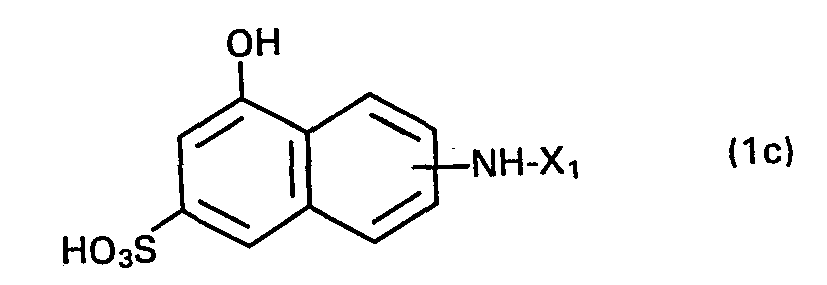
- Die vorliegende Erfindung betrifft Naphtholamin-Derivate der Formel

- R = H oder S03H
- R1 = H oder C1-C4-Alkyl

- R1 steht in Formel (1a) bevorzugt für Wasserstoff.
- Im Rahmen der Formel (1a) bevorzugte Verbindungen entsprechen den Formeln


- Die Verbindungen der Formel (1a) werden hergestellt, indem man Amino-hydroxynaphthaline der Formel

- mit Fluornitrobenzolsulfosäuren der Formel oder


- Diese Kondensation erfolgt im allgemeinen in wässriger Phase bei Temperaturen zwischen 60 und 120°C, bevorzugt zwischen 80 und 100°C, wobei der bei der Kondensation freiwerdende Fluorwasserstoff zweckmässigerweise durch Zusatz von Basen wie z.B. wie z.B. LiOH, Li2C03, NaOH, NaHC03, KOH, K2C03, CaO, Ca(OH)2, CaC03, MgO, MgC03, K2HP04, K3P04, Na2HP04, Na3P04, Na(CH3COO), K(CH3COO) gebunden wird.
- Pro Mol Ausgangsverbindung der Formel (1 d) werden 1 bis 1,1 Mol und vorzugsweise 1 Mol der Komponenten (1e) oder (1f) eingesetzt.
- Beispiele für die Formel (1a) wiedergegebenen Verbindungen sind folgende:
- 1-Hydroxy-8-(2'-nitro-4'-suifophenylamino)-naphthalin-3,6- oder -3,5-disulfonsäure,
- 1-Hydroxy-8-(2' -sulfo-4' -nitrophenylamino)-naphthalin-3,6- oder 3,5-disulfonsäure,
- 1-Hydroxy-7-(2'-nitro-4'-sulfophenylamino)-naphthalin-3-sulfonsäure,
- 1-Hydroxy-7-(2' -sulfo-4' -nitrophenylamino)-naphthalin-3-sulfonsäure,
- 1-Hydroxy-6-(2' -nitro-4' -sulfophenylamino)-naphthalin-3-sulfonsäure,
- 1-Hydroxy-6-(2' -sulfo-4' -nitrophenylamino)-naphthalin-3-sulfonsäure,
- 1-Hydroxy-6-(2' -nitro-4' -sulfophenylamino)-naphthalin-4,8-disulfonsäure,
- 1-Hydroxy-6-(2'-sulfo-4'-nitrophenylamino)-naphthalin-4,8-disulfonsäure,
- 1-Hydroxy-5-(2'-nitro-4'-sulfophenylamino)-naphthalin-3-sulfonsäure,
- 1-Hydroxy-5-(4'-nitro-2'-sulfophenylamino)-naphthalin-3-sulfonsäure,
- 2-Hydroxy-6-(2' -nitro-4' -sulfophenylamino)-naphthalin-4-sulfonsäure,
- 2-Hydroxy-6-(2' -sulfo-4' -nitrophenyiamino)-naphthalin-4-sulfonsäure,
- 2-Hydroxy-8-(2' -sulfo-4' -nitrophenylamino)-naphthalin,
- 1-Hydroxy-8-(2' -nitro-4' -sulfophenylamino)-naphthalin-3-sulfonsäure,
- 1-Hydroxy-8-(2'-sulfo-4'-nitrophenylamino)-naphthalin-3-sulfonsäure,
- 1-Hydroxy-7-(2' -nitro-4' -sulfophenylamino)-naphthalin-4-sulfonsäure,
- 1-Hydroxy-7-(2' -sulfo-4' -nitrophenylamino)-naphthalin-4-sulfonsäure,
- 1-Hydroxy-6-N-methyl-(2' -nitro-4' -sulfophenyl- amino)-naphthalin-3-sulfonsäure.
- 2-Fluor-5-nitrobenzolsulfonsäure der Formel (1e) erhält man durch Behandlung von 4-Fluornitrobenzol mit Oleum bei erhöhter Temperatur vorzugsweise bei 60-120°C, insbesondere bei 80-100°C. Hierbei werden pro Mol 4-Fluornitrobenzol 1 bis 1,6 Mol S03 insbesondere 1,2 bis 1,4 Mol S03 eingesetzt.
- Die erfindungsgemässen Verbindungen der Formel (1a) sind wertvolle Zwischenprodukte für die Herstellung von wertvollen Azofarbstoffen, z.B. von Azofarbstoffen der Formel (1) sowie von Metallkomplexen der Azofarbstoffe (1),

- Für Formel (1) gilt:
- D = aromatisch carbocyclischer oder aromatisch heterocyclischer Rest,
- R = H oder S03H
- R1 = H oder C1-C4-Alkyl

- Y = -N02, -NH2 oder -NH-Z
- Z = faserreaktiver Rest oder nichtfaserreaktiver Carbonyl- oder Sulfonylrest,
- D = ist vorzugsweise der Rest einer gegebenenfalls Azogruppen enthaltenden Diazokomponente der Benzol- oder Naphthalinreihe,
- Z = steht vorzugsweise für einen faserreaktiven Rest, Z1.
- Der Rest D kann weitere Substituenten enthalten: als Beispiel seien genannt:
- C1-C4-Alkyl, C,-C4-Alkoxy, Rest der Formel


- Falls der Rest D komplexbildende Gruppen enthält, wie Hydroxy und Carboxy, kommen auch die Schwermetallkomplexe der Farbstoffe der Formel (1) in Betracht.
- Zur Komplexbildung geeignete Schwermetalle sind: Cu, Ni, Fe, CO und Cr.
- Als Beispiele für nicht faserreaktive Carbonyl- oder Sulfonylreste Z seien erwähnt:


- Unter faserreaktiven Resten Z1 werden solche verstanden, die eine oder mehrere reaktive Gruppen oder abspaltbare Substituenten aufweisen, welche beim Aufbringen der Farbstoffe auf Cellulosematerialien in Gegenwart säurebindender Mittel und gegebenenfalls unter Einwirkung von Wärme mit den Hydroxylgruppen der Cellulose oder beim Aufbringen auf Superpolyamidfasern, wie Wolle, mit den NH-Gruppen dieser Fasern unter Ausbildung kovalenter Bindungen zu reagieren vermögen. Derartige faserreaktive Gruppierungen sind aus der Literatur in grosser Zahl bekannt.
- 72,4 g des Farbstoffs der Formel
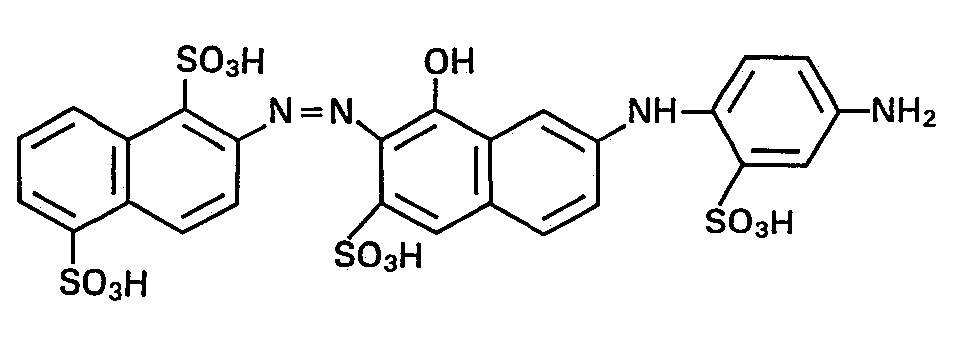

- Nach einem der für Reaktivfarbstoffe üblichen Verfahren erhält man damit auf Baumwolle kräftige dunkelbraune Färbungen (hue number 32).
- Der Ausgangsfarbstoff wird erhalten durch Kupplung von diazotierter 2-Aminonaphthalin-1,5-disulfonsäure auf 1-Hydroxy-7-(2'-sulfo-4'-nitrophenyl- amino)-naphthalin-3-sulfonsäure im neutralen bis schwach alkalischen Medium und anschliessende Reduktion der Nitro- zur Aminogruppe mit Na2S.
- Verwendet man anstelle von 2,4,6-Trifluor-5-chlor-pyrimidin eine äquivalente Menge der nachfolgend aufgeführten Reaktivkomponenten, so erhält man gleichfalls wertvolle Reaktivfarbstoffe, die Baumwolle dunkelbraun färben. Der Farbe nach Colour-Index-Hue Indication Chart beträgt Hue Nr. 32.
-
- 2,4-Difluor-5-chlor-6-methyl-pyrimidin
- 5-Chlor-2,4,6-trifluorisophthalonitril
- 2,4,6-Trifluor-1,3,5-tricyanobenzol
- 2,4,5,6-Tetrafluorisophthalonitril
- 2,4,6-Trichlor-5-methylsulfonyl-pyrimidin
- 2,4,6-Trichlor-5-ethylsulfonyl-pyrimidin
- 2,4-Difluor-5-methylsulfonyl-6-(2'-sulfophenyl- amino)-pyrimidin
- 2,4,5,6-Tetrachlor-pyrimidin
- 2-Methylsulfonyl-4,5-dichlor-6-methyl-pyrimidin
- 2-Amino-4,6-difluor-triazin
- 2-Methylamino-4,6-difluortriazin
- 2-Phenylamino-4,6-difluortriazin
- 2-(2'-Sulfophenylamino)-4,6-difluor-triazin
- 2-(3'-Sulfophenylamino)-4,6-difluor-triazin
- 2-(4'-Sulfophenylamino)-4,6-difluor-triazin
- 2-(2' -Methyl-5' -sulfophenyl-amino)-4,6-difluor- triazin
- 2-(2' -Chlor-4' -sulfophenyl)-amino-4,6-difluor- triazin
- 2-(6' -Sulfonaphthyl-2' -amino)-4,6-difluortriazin
- 2-Methoxyethoxy-4,6-difluor-triazin
- 2-Amino-4,6-dichlor-triazin
- 2-Methylamino-4,6-dichlor-triazin
- 2-Phenylamino-4,6-dichlor-triazin
- 2-(3'-Sulfophenylamino)-4,6-dichlortriazin
- 2-(4'-Sulfophenylamino)-4,6-dichlortriazin
- (2'-Methyl-5'-sulfophenylamino)-4,6-dichlor- triazin
- 2-N-Methylphenylamino-4,6-dichlortriazin
- 2,3-Dichlorchinoxalin-6-carbonsäurechlorid
- 2,4,6-Trifluor-5-pyrimidin
- 2,4-Difluor-5,6-dichlor-pyrimidin.
- Wenn man nach den Angaben des Beispiels 1 verfährt, jedoch anstelle der dort verwendeten Aminoazofarbstoffe diejenigen einsetzt, die man durch Kupplung der diazotierten Amine, die in Spalte 1 genannt sind, mit den in Spalte 2 aufgeführten Verbindungen im neutralen bis schwach alkalischen Bereich und anschliessende Na2S-Reduktion der Nitrogruppe erhält, und als Reaktivkomponente die in Tabelle 1 und im Beispiel 1 genannten Verbindungen verwendet, so resultieren gleichfalls wertvolle Reaktivfarbstoffe, die Baumwolle in den in Spalte 3 genannten Tönen färben. Angegeben wird hierbei und in den Beispielen jeweils die Farbtonangabe nach Colour Index Hue Indication Chart (Hue number).

- Die aus 30,3 g 2-Amino-naphthalin-1,5-disulfonsäure bereitete Diazoverbindung wird zu einer Anschlämmung von 55,9 g 1-Hydroxy-7-[2'-sulfo-4'-(2" ,4" -difluor-5" -chlorpyrimidinyl-6" -amino)-phenylamino]-naphthalin-3-sulfonsäure in 500 ml Wasser und 28 g Natriumhydrogencarbonat gegeben. Nach beendeter Kupplung wird der Farbstoff ausgesalzen. Nach dem Absaugen, Trocknen und Mahlen erhält man ein dunkelbraunes Farbstoffpulver. Der Farbstoff ist identisch mit dem Farbstoff des Beispiels 1.
- Die aus 33,7 g 2-Amino-4-(2' ,4' -difluor-5' -chlorpyrimidinyl-6'-aminol-benzol-1-sulfonsäure erhaltene Diazoverbindung wird zu einer Lösung von 44 g 7-Hydroxy-6-(2'-nitro-4'-sulfophenyl-amino)-naphthalin-3-sulfonsäure mit 28 g Natriumhydrogencarbonat in 1 Liter Wasser gegeben. Nach beendeter Kupplung wird der Farbstoff ausgesalzen, abgesaugt, getrocknet und gemahlen. Man erhält ein gelbes Pulver, das sich leicht in Wasser orangefarbig löst. Der Farbstoff der Formel

- Verfährt man nach den Angaben dieses Beispiels unter Verwendung der nachfolgenden aufgeführten Diazo- (Spalte 1) und Kupplungskomponenten (Spalte 2), so erhält man gleichfalls wertvolle Farbstoffe, die Baumwolle in den in Spalte 3 genannten Tönen färben.

- 51,4 g des Farbstoffs der Formel

- Der Farbstoff der Formel

- 111,6 g des Farbstoffs der Formel


- 239 g 1-Hydroxy-7-amino-naphthalin-3-sulfonsäure werden in 0,5 Liter Wasser mit 60 ml conc. Natronlauge auf pH 6 gestellt. Man gibt dann 259,1 g 2-Fluor-5-nitro-benzolsulfonsaures Kalium zu, wärmt auf 100°C und tropft 15%ige Sodalösung in dem Masse ein, dass der pH zwischen 5,5 und 6,5 liegt. Nach beendeter Kondensation wird die stark gelbgefärbte Lösung mitdem gleichen Volumen einer gesättigten Natriumchlorid-Lösung versetzt. nach dem Abkühlen saugt man ab. Die Verbindung der Formel
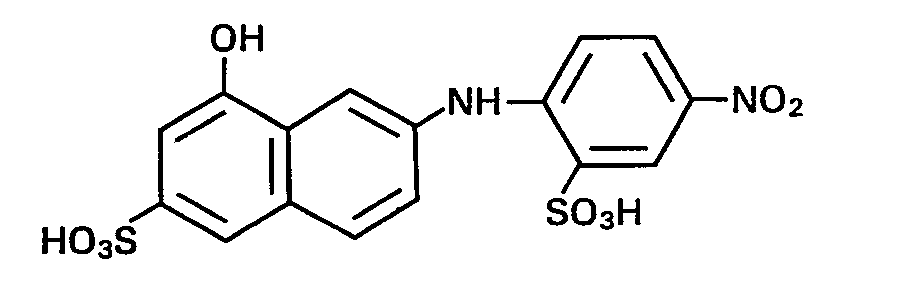
- Rf-Wert: 0,36
- Laufmittel: Dimethylformamid/Diethylamin/5n Ammoniak/Methylethylketon im Volumenverhältnis 75/120/120/600
- DC-Platte: Aluminium-Folie, Kieselgel 60 F 254 (Merck)
- λ max: ausserhalb des sichtbaren Bereiches.
- 239 g 1-Hydroxy-7-amino-naphthalin-3-sulfonsäure werden in 0,5 Liter Wasser mit 60 ml conc. Natronlauge (d = 1,5) auf pH 6 gestellt. Man gibt dann 259,1 g 3-Nitro-4-fluor-benzolsulfonsaures Kalium zu, erwärmt auf 80°C und tropft 15%ige Sodalösung in dem Masse ein, dass der pH zwischen 5,5 und 6,5 liegt. Nach beendeter Kondensation wird die tief gelb gefärbte Lösung mit dem gleichen Volumen an gesättigter Kochsalzlösung versetzt. Nach dem Abkühlen auf Raumtemperatur saugt man ab.
- Die Verbindung der Formel

- Ausbeute: 96% nach Kupplungswert.
- Atomverhältnis C:N:S wie 8:1:1
- Rf-Wert: 0,26
- λ max: 430 nm
- In der gleichen Weise wie in Beispiel 6 und 7 beschrieben erhält man die nachfolgenden Verbindungen:

- In 250 ml Monohydrat (= 100%ige Schwefelsäure) trägt man 423 g 4-Fluor-nitrobenzol ein und tropft dann 250 ml 65%iges Oleum ein. Man erwärmt dann im Laufe von 2 Stunden auf 100°C und hält solange diese Temperatur, bis eine mit Wasser versetzte Probe keine öligen Tropfen des Ausgangsmaterials mehr ausscheidet. Nach dem Abkühlen trägt man die Sulfierungsschmelze auf soviel Eis aus, dass die Temperatur nicht über 20°C steigt. Zu Abscheidung des Reaktionsproduktes setzt man 15 Volumenprozent Kaliumchlorid zu und saugt nach einstündigem Rühren ab. Der farblose Niederschlag wird erneut in 1 Liter Wasser angerührt und mit Kalilauge neutralisiert. Nach dem Absaugen erhält man 950 g wasserfeuchte Paste. Die Bestimmung der Ausbeute durch Zinkstaubreduktion der Nitrogruppe ergibt 84%.
- Die Struktur des 2-Fluor-5-nitro-benzolsulfonsau- ren Kaliums wird durch das 1H-NMR-Spektrum ([D6]-DMSO; 80 MHz) belegt.
- Das Proton an C-3 absorbiert als Triplett bei 7.50 ppm, wobei die H,H-ortho- und die F,H-ortho-Kopplungskonstanten mit J = 9,0 Hz gleich gross sind. Das Proton an C-4 absorbiert mit 8 Linien (d/d/d) um 8,32 ppm, dasjenige an C-6 mit 4 Linien (d/d) bei 8,55 ppm.
Claims (5)



Applications Claiming Priority (4)
| Application Number | Priority Date | Filing Date | Title |
|---|---|---|---|
| DE19823223257 DE3223257A1 (de) | 1982-06-22 | 1982-06-22 | Azofarbstoffe |
| DE3223257 | 1982-06-22 | ||
| DE3223255 | 1982-06-22 | ||
| DE19823223255 DE3223255A1 (de) | 1982-06-22 | 1982-06-22 | Naphtholamin-derivate |
Related Parent Applications (1)
| Application Number | Title | Priority Date | Filing Date |
|---|---|---|---|
| EP83105681.7 Division | 1983-06-10 |
Publications (3)
| Publication Number | Publication Date |
|---|---|
| EP0177978A2 EP0177978A2 (de) | 1986-04-16 |
| EP0177978A3 EP0177978A3 (en) | 1987-02-04 |
| EP0177978B1 true EP0177978B1 (de) | 1988-04-20 |
Family
ID=25802545
Family Applications (2)
| Application Number | Title | Priority Date | Filing Date |
|---|---|---|---|
| EP85113502A Expired EP0177978B1 (de) | 1982-06-22 | 1983-06-10 | Naphtolamin-Derivate |
| EP83105681A Expired EP0097289B1 (de) | 1982-06-22 | 1983-06-10 | Azofarbstoffe |
Family Applications After (1)
| Application Number | Title | Priority Date | Filing Date |
|---|---|---|---|
| EP83105681A Expired EP0097289B1 (de) | 1982-06-22 | 1983-06-10 | Azofarbstoffe |
Country Status (2)
| Country | Link |
|---|---|
| EP (2) | EP0177978B1 (de) |
| DE (2) | DE3366953D1 (de) |
Families Citing this family (1)
| Publication number | Priority date | Publication date | Assignee | Title |
|---|---|---|---|---|
| DE59206771D1 (de) * | 1991-05-15 | 1996-08-22 | Ciba Geigy Ag | Azofarbstoffe |
Family Cites Families (8)
| Publication number | Priority date | Publication date | Assignee | Title |
|---|---|---|---|---|
| US2347042A (en) * | 1940-05-21 | 1944-04-18 | Gen Aniline & Film Corp | 1-arylamino-5-hydroxynaphthalene-7-sulphonic acid |
| CH361068A (de) * | 1956-08-10 | 1962-03-31 | Ciba Geigy | Verfahren zur Herstellung neuer Metallkomplexverbindungen von Monoazofarbstoffen |
| US2957862A (en) * | 1957-10-11 | 1960-10-25 | Ciba Ltd | Metalliferous triazine monoazodyestuffs |
| FR75771E (fr) * | 1957-11-29 | 1961-08-11 | Sandoz Sa | Colorants contenant un noyau pyrimidique, leur procédé de fabrication et leurs applications |
| CH359228A (de) * | 1957-11-29 | 1961-12-31 | Sandoz Ag | Verfahren zur Herstellung von Pyrimidinfarbstoffen |
| FR1257986A (fr) * | 1959-05-20 | 1961-04-07 | Ici Ltd | Fabrication de complexes de cuivre de colorants azoïques pour textiles cellulosiques |
| FR1257386A (fr) * | 1959-05-20 | 1961-03-31 | Ici Ltd | Complexes de cuivre de composés azoïques pour la coloration des matières textiles cellulosiques |
| DE2844597A1 (de) * | 1978-10-13 | 1980-04-24 | Bayer Ag | Verfahren zur herstellung von kupferhaltigen azo-farbstoffen |
-
1983
- 1983-06-10 DE DE8383105681T patent/DE3366953D1/de not_active Expired
- 1983-06-10 EP EP85113502A patent/EP0177978B1/de not_active Expired
- 1983-06-10 DE DE8585113502T patent/DE3376318D1/de not_active Expired
- 1983-06-10 EP EP83105681A patent/EP0097289B1/de not_active Expired
Also Published As
| Publication number | Publication date |
|---|---|
| EP0177978A3 (en) | 1987-02-04 |
| EP0177978A2 (de) | 1986-04-16 |
| EP0097289B1 (de) | 1986-10-15 |
| EP0097289A2 (de) | 1984-01-04 |
| DE3366953D1 (en) | 1986-11-20 |
| EP0097289A3 (en) | 1984-04-04 |
| DE3376318D1 (de) | 1988-05-26 |
Similar Documents
| Publication | Publication Date | Title |
|---|---|---|
| CH622818A5 (en) | Process for the preparation of novel reactive dyestuffs | |
| EP0568876B1 (de) | Reaktivfarbstoffe, deren Herstellung und Verwendung | |
| EP0168703A2 (de) | Reaktivfarbstoffe | |
| DE2819787C2 (de) | ||
| DE2331518A1 (de) | Neue farbstoffe, deren herstellung und verwendung | |
| EP0019785A2 (de) | Reaktivfarbstoffe, ihre Herstellung und Verwendung zum Färben und Bedrucken von Cellulose oder Polypeptiden | |
| EP0387579B1 (de) | Verdoppelte Reaktivfarbstoffe | |
| EP0201026B1 (de) | Metallkomplex-Farbstoffe | |
| EP0001451B1 (de) | Wasserlösliche faserreaktive grüne Phthalocyanin-Azofarbstoffe, Verfahren zu ihrer Herstellung und ihre Verwendung | |
| CH624426A5 (en) | Process for preparing reactive azo dyes | |
| EP0213071A1 (de) | Verfahren zur Herstellung faserreaktiver Azoverbindungen | |
| EP0189081B1 (de) | Azo-Reaktivfarbstoffe | |
| DE2050901A1 (de) | Wasserlösliche Azofarbstoffe | |
| EP0071168A2 (de) | Wasserlösliche Disazoverbindungen und neue Bis-(aminophenoxy)-äthan-Verbindungen mit faserreaktiven Gruppen als Tetrazokomponenten, Verfahren zur Herstellung dieser Verbindungen und Verwendung der Disazoverbindungen als Farbstoffe | |
| EP0125650B1 (de) | Reaktivfarbstoffe, Verfahren zu ihrer Herstellung und ihre Verwendung zum Färben und Bedrucken von Substraten | |
| EP0406629B1 (de) | Verfahren zur Herstellung von Azofarbstoffen | |
| DE3023855A1 (de) | Reaktivfarbstoffe, verfahren zu ihrer herstellung und ihre verwendung zum faerben und bedrucken hydroxylgruppenhaltiger oder stickstoffhaltiger fasermaterialien | |
| EP0641841B1 (de) | Azo-Reaktivfarbstoffe | |
| EP0014882B1 (de) | Azofarbstoffe sowie deren Verwendung zum Färben und Bedrucken stickstoffhaltiger Materialien und Leder | |
| DE2733109C2 (de) | Faserreaktive Disazofarbstoffe, deren Herstellung und Verwendung | |
| EP0177978A2 (de) | Naphtolamin-Derivate | |
| DE2054198A1 (de) | Neue wasserlösliche faserreaktive Azofarbstoffe und Verfahren zu ihrer Herstellung | |
| DE1644132A1 (de) | Neue Monoazofarbstoffe,Verfahren zu deren Herstellung und Verwendung | |
| EP0162386B1 (de) | Azoreaktivfarbstoffe | |
| EP0012350B1 (de) | Azofarbstoffe sowie deren Herstellung und Verwendung zum Färben von N-haltigen Materialien |
Legal Events
| Date | Code | Title | Description |
|---|---|---|---|
| PUAI | Public reference made under article 153(3) epc to a published international application that has entered the european phase |
Free format text: ORIGINAL CODE: 0009012 |
|
| 17P | Request for examination filed |
Effective date: 19851024 |
|
| AC | Divisional application: reference to earlier application |
Ref document number: 97289 Country of ref document: EP |
|
| AK | Designated contracting states |
Kind code of ref document: A2 Designated state(s): CH DE FR GB LI |
|
| PUAL | Search report despatched |
Free format text: ORIGINAL CODE: 0009013 |
|
| AK | Designated contracting states |
Kind code of ref document: A3 Designated state(s): CH DE FR GB LI |
|
| 17Q | First examination report despatched |
Effective date: 19870729 |
|
| GRAA | (expected) grant |
Free format text: ORIGINAL CODE: 0009210 |
|
| AC | Divisional application: reference to earlier application |
Ref document number: 97289 Country of ref document: EP |
|
| AK | Designated contracting states |
Kind code of ref document: B1 Designated state(s): CH DE FR GB LI |
|
| PG25 | Lapsed in a contracting state [announced via postgrant information from national office to epo] |
Ref country code: FR Free format text: THE PATENT HAS BEEN ANNULLED BY A DECISION OF A NATIONAL AUTHORITY Effective date: 19880420 |
|
| GBT | Gb: translation of ep patent filed (gb section 77(6)(a)/1977) | ||
| REF | Corresponds to: |
Ref document number: 3376318 Country of ref document: DE Date of ref document: 19880526 |
|
| EN | Fr: translation not filed | ||
| PLBE | No opposition filed within time limit |
Free format text: ORIGINAL CODE: 0009261 |
|
| STAA | Information on the status of an ep patent application or granted ep patent |
Free format text: STATUS: NO OPPOSITION FILED WITHIN TIME LIMIT |
|
| 26N | No opposition filed | ||
| PGFP | Annual fee paid to national office [announced via postgrant information from national office to epo] |
Ref country code: DE Payment date: 19890520 Year of fee payment: 7 |
|
| PGFP | Annual fee paid to national office [announced via postgrant information from national office to epo] |
Ref country code: GB Payment date: 19890531 Year of fee payment: 7 |
|
| PGFP | Annual fee paid to national office [announced via postgrant information from national office to epo] |
Ref country code: CH Payment date: 19890622 Year of fee payment: 7 |
|
| PG25 | Lapsed in a contracting state [announced via postgrant information from national office to epo] |
Ref country code: GB Effective date: 19900610 |
|
| PG25 | Lapsed in a contracting state [announced via postgrant information from national office to epo] |
Ref country code: LI Effective date: 19900630 Ref country code: CH Effective date: 19900630 |
|
| GBPC | Gb: european patent ceased through non-payment of renewal fee | ||
| REG | Reference to a national code |
Ref country code: CH Ref legal event code: PL |
|
| PG25 | Lapsed in a contracting state [announced via postgrant information from national office to epo] |
Ref country code: DE Effective date: 19910301 |