EP0178009A1 - Verfahren zur Rekonditionierung von kontaminiertem Boden - Google Patents
Verfahren zur Rekonditionierung von kontaminiertem Boden Download PDFInfo
- Publication number
- EP0178009A1 EP0178009A1 EP85201548A EP85201548A EP0178009A1 EP 0178009 A1 EP0178009 A1 EP 0178009A1 EP 85201548 A EP85201548 A EP 85201548A EP 85201548 A EP85201548 A EP 85201548A EP 0178009 A1 EP0178009 A1 EP 0178009A1
- Authority
- EP
- European Patent Office
- Prior art keywords
- flotation
- soil
- separated
- contaminated
- fraction
- Prior art date
- Legal status (The legal status is an assumption and is not a legal conclusion. Google has not performed a legal analysis and makes no representation as to the accuracy of the status listed.)
- Granted
Links
- 239000002689 soil Substances 0.000 title claims abstract description 57
- 238000000034 method Methods 0.000 title claims abstract description 29
- 230000008569 process Effects 0.000 title claims abstract description 29
- 238000005188 flotation Methods 0.000 claims abstract description 69
- 239000002245 particle Substances 0.000 claims abstract description 34
- JTJMJGYZQZDUJJ-UHFFFAOYSA-N phencyclidine Chemical class C1CCCCN1C1(C=2C=CC=CC=2)CCCCC1 JTJMJGYZQZDUJJ-UHFFFAOYSA-N 0.000 claims abstract description 22
- 238000011109 contamination Methods 0.000 claims abstract description 17
- 230000007062 hydrolysis Effects 0.000 claims abstract description 15
- 238000006460 hydrolysis reaction Methods 0.000 claims abstract description 15
- 150000002825 nitriles Chemical class 0.000 claims abstract description 13
- 150000002894 organic compounds Chemical class 0.000 claims abstract description 9
- WRIDQFICGBMAFQ-UHFFFAOYSA-N (E)-8-Octadecenoic acid Natural products CCCCCCCCCC=CCCCCCCC(O)=O WRIDQFICGBMAFQ-UHFFFAOYSA-N 0.000 claims abstract description 8
- LQJBNNIYVWPHFW-UHFFFAOYSA-N 20:1omega9c fatty acid Natural products CCCCCCCCCCC=CCCCCCCCC(O)=O LQJBNNIYVWPHFW-UHFFFAOYSA-N 0.000 claims abstract description 8
- QSBYPNXLFMSGKH-UHFFFAOYSA-N 9-Heptadecensaeure Natural products CCCCCCCC=CCCCCCCCC(O)=O QSBYPNXLFMSGKH-UHFFFAOYSA-N 0.000 claims abstract description 8
- ZQPPMHVWECSIRJ-UHFFFAOYSA-N Oleic acid Natural products CCCCCCCCC=CCCCCCCCC(O)=O ZQPPMHVWECSIRJ-UHFFFAOYSA-N 0.000 claims abstract description 8
- 239000005642 Oleic acid Substances 0.000 claims abstract description 8
- 229910001385 heavy metal Inorganic materials 0.000 claims abstract description 8
- QXJSBBXBKPUZAA-UHFFFAOYSA-N isooleic acid Natural products CCCCCCCC=CCCCCCCCCC(O)=O QXJSBBXBKPUZAA-UHFFFAOYSA-N 0.000 claims abstract description 8
- ZQPPMHVWECSIRJ-KTKRTIGZSA-N oleic acid Chemical compound CCCCCCCC\C=C/CCCCCCCC(O)=O ZQPPMHVWECSIRJ-KTKRTIGZSA-N 0.000 claims abstract description 8
- 239000000356 contaminant Substances 0.000 claims abstract description 7
- 235000021281 monounsaturated fatty acids Nutrition 0.000 claims abstract description 6
- 239000000126 substance Substances 0.000 claims description 7
- 238000005406 washing Methods 0.000 claims description 6
- 235000014113 dietary fatty acids Nutrition 0.000 claims description 4
- 239000000194 fatty acid Substances 0.000 claims description 4
- 229930195729 fatty acid Natural products 0.000 claims description 4
- 150000004665 fatty acids Chemical class 0.000 claims description 4
- 125000000325 methylidene group Chemical group [H]C([H])=* 0.000 claims description 4
- 239000012991 xanthate Substances 0.000 claims description 3
- 239000011203 carbon fibre reinforced carbon Substances 0.000 claims description 2
- WCMZEVKEHSGWJB-UHFFFAOYSA-M hexadecyl-dimethyl-propylazanium;chloride Chemical compound [Cl-].CCCCCCCCCCCCCCCC[N+](C)(C)CCC WCMZEVKEHSGWJB-UHFFFAOYSA-M 0.000 claims description 2
- 150000003868 ammonium compounds Chemical class 0.000 claims 1
- QIQXTHQIDYTFRH-UHFFFAOYSA-N octadecanoic acid Chemical compound CCCCCCCCCCCCCCCCCC(O)=O QIQXTHQIDYTFRH-UHFFFAOYSA-N 0.000 claims 1
- 230000000063 preceeding effect Effects 0.000 claims 1
- XLYOFNOQVPJJNP-UHFFFAOYSA-N water Substances O XLYOFNOQVPJJNP-UHFFFAOYSA-N 0.000 description 14
- 229910001868 water Inorganic materials 0.000 description 14
- HEMHJVSKTPXQMS-UHFFFAOYSA-M Sodium hydroxide Chemical compound [OH-].[Na+] HEMHJVSKTPXQMS-UHFFFAOYSA-M 0.000 description 12
- XFXPMWWXUTWYJX-UHFFFAOYSA-N Cyanide Chemical compound N#[C-] XFXPMWWXUTWYJX-UHFFFAOYSA-N 0.000 description 11
- 238000000926 separation method Methods 0.000 description 10
- 230000003750 conditioning effect Effects 0.000 description 9
- 239000007788 liquid Substances 0.000 description 9
- 239000002002 slurry Substances 0.000 description 9
- 239000002562 thickening agent Substances 0.000 description 9
- 238000009434 installation Methods 0.000 description 8
- 239000004927 clay Substances 0.000 description 5
- 239000011148 porous material Substances 0.000 description 4
- 239000000203 mixture Substances 0.000 description 3
- 229910000027 potassium carbonate Inorganic materials 0.000 description 3
- 239000007787 solid Substances 0.000 description 3
- -1 creosoles Chemical class 0.000 description 2
- 238000010586 diagram Methods 0.000 description 2
- 230000000694 effects Effects 0.000 description 2
- 239000002480 mineral oil Substances 0.000 description 2
- 150000004045 organic chlorine compounds Chemical class 0.000 description 2
- 150000002989 phenols Chemical class 0.000 description 2
- BWHMMNNQKKPAPP-UHFFFAOYSA-L potassium carbonate Chemical compound [K+].[K+].[O-]C([O-])=O BWHMMNNQKKPAPP-UHFFFAOYSA-L 0.000 description 2
- 150000003856 quaternary ammonium compounds Chemical class 0.000 description 2
- 238000012216 screening Methods 0.000 description 2
- 239000007921 spray Substances 0.000 description 2
- OKTJSMMVPCPJKN-UHFFFAOYSA-N Carbon Chemical compound [C] OKTJSMMVPCPJKN-UHFFFAOYSA-N 0.000 description 1
- CDBYLPFSWZWCQE-UHFFFAOYSA-L Sodium Carbonate Chemical compound [Na+].[Na+].[O-]C([O-])=O CDBYLPFSWZWCQE-UHFFFAOYSA-L 0.000 description 1
- 230000009471 action Effects 0.000 description 1
- 230000009286 beneficial effect Effects 0.000 description 1
- 229910052799 carbon Inorganic materials 0.000 description 1
- 230000001143 conditioned effect Effects 0.000 description 1
- 230000009977 dual effect Effects 0.000 description 1
- 230000002349 favourable effect Effects 0.000 description 1
- 239000000706 filtrate Substances 0.000 description 1
- 244000144992 flock Species 0.000 description 1
- 238000005187 foaming Methods 0.000 description 1
- 230000006872 improvement Effects 0.000 description 1
- 238000004519 manufacturing process Methods 0.000 description 1
- 239000000463 material Substances 0.000 description 1
- 229920002401 polyacrylamide Polymers 0.000 description 1
- 230000009467 reduction Effects 0.000 description 1
- 230000001105 regulatory effect Effects 0.000 description 1
- 229910052911 sodium silicate Inorganic materials 0.000 description 1
- 238000003860 storage Methods 0.000 description 1
- 239000012536 storage buffer Substances 0.000 description 1
- 230000008719 thickening Effects 0.000 description 1
- 239000002699 waste material Substances 0.000 description 1
- 238000005303 weighing Methods 0.000 description 1
Images



Classifications
-
- B—PERFORMING OPERATIONS; TRANSPORTING
- B03—SEPARATION OF SOLID MATERIALS USING LIQUIDS OR USING PNEUMATIC TABLES OR JIGS; MAGNETIC OR ELECTROSTATIC SEPARATION OF SOLID MATERIALS FROM SOLID MATERIALS OR FLUIDS; SEPARATION BY HIGH-VOLTAGE ELECTRIC FIELDS
- B03D—FLOTATION; DIFFERENTIAL SEDIMENTATION
- B03D1/00—Flotation
- B03D1/02—Froth-flotation processes
-
- B—PERFORMING OPERATIONS; TRANSPORTING
- B03—SEPARATION OF SOLID MATERIALS USING LIQUIDS OR USING PNEUMATIC TABLES OR JIGS; MAGNETIC OR ELECTROSTATIC SEPARATION OF SOLID MATERIALS FROM SOLID MATERIALS OR FLUIDS; SEPARATION BY HIGH-VOLTAGE ELECTRIC FIELDS
- B03D—FLOTATION; DIFFERENTIAL SEDIMENTATION
- B03D1/00—Flotation
- B03D1/001—Flotation agents
- B03D1/004—Organic compounds
- B03D1/008—Organic compounds containing oxygen
-
- B—PERFORMING OPERATIONS; TRANSPORTING
- B03—SEPARATION OF SOLID MATERIALS USING LIQUIDS OR USING PNEUMATIC TABLES OR JIGS; MAGNETIC OR ELECTROSTATIC SEPARATION OF SOLID MATERIALS FROM SOLID MATERIALS OR FLUIDS; SEPARATION BY HIGH-VOLTAGE ELECTRIC FIELDS
- B03D—FLOTATION; DIFFERENTIAL SEDIMENTATION
- B03D1/00—Flotation
- B03D1/001—Flotation agents
- B03D1/004—Organic compounds
- B03D1/01—Organic compounds containing nitrogen
- B03D1/011—Quaternary ammonium compounds
-
- B—PERFORMING OPERATIONS; TRANSPORTING
- B03—SEPARATION OF SOLID MATERIALS USING LIQUIDS OR USING PNEUMATIC TABLES OR JIGS; MAGNETIC OR ELECTROSTATIC SEPARATION OF SOLID MATERIALS FROM SOLID MATERIALS OR FLUIDS; SEPARATION BY HIGH-VOLTAGE ELECTRIC FIELDS
- B03D—FLOTATION; DIFFERENTIAL SEDIMENTATION
- B03D1/00—Flotation
- B03D1/001—Flotation agents
- B03D1/004—Organic compounds
- B03D1/012—Organic compounds containing sulfur
-
- B—PERFORMING OPERATIONS; TRANSPORTING
- B09—DISPOSAL OF SOLID WASTE; RECLAMATION OF CONTAMINATED SOIL
- B09C—RECLAMATION OF CONTAMINATED SOIL
- B09C1/00—Reclamation of contaminated soil
- B09C1/02—Extraction using liquids, e.g. washing, leaching, flotation
-
- B—PERFORMING OPERATIONS; TRANSPORTING
- B03—SEPARATION OF SOLID MATERIALS USING LIQUIDS OR USING PNEUMATIC TABLES OR JIGS; MAGNETIC OR ELECTROSTATIC SEPARATION OF SOLID MATERIALS FROM SOLID MATERIALS OR FLUIDS; SEPARATION BY HIGH-VOLTAGE ELECTRIC FIELDS
- B03D—FLOTATION; DIFFERENTIAL SEDIMENTATION
- B03D2201/00—Specified effects produced by the flotation agents
- B03D2201/02—Collectors
-
- B—PERFORMING OPERATIONS; TRANSPORTING
- B03—SEPARATION OF SOLID MATERIALS USING LIQUIDS OR USING PNEUMATIC TABLES OR JIGS; MAGNETIC OR ELECTROSTATIC SEPARATION OF SOLID MATERIALS FROM SOLID MATERIALS OR FLUIDS; SEPARATION BY HIGH-VOLTAGE ELECTRIC FIELDS
- B03D—FLOTATION; DIFFERENTIAL SEDIMENTATION
- B03D2203/00—Specified materials treated by the flotation agents; Specified applications
- B03D2203/006—Oil well fluids, oil sands, bitumen
Definitions
- the invention relates to a process for reconditioning soil contaminated with cyanides, heavy metals, organic compounds and/or the like, comprising:
- the process according to the invention is therefore characterised by the step wherein contaminants are freed from the flotation residue by hydrolysis. Not only is an extra amount of contamination freed from the soil, butbecause the hydrolysis step follows the flotation step, an important saving of hydrolysis chemicals (K 2 CO 3 and NaOH up to pH 12) can moreover be achieved.
- the volume of the concentrated fraction to be removed can be limited further if the float is thickened.
- scalped soil fraction is added to the soil to be reconditioned, a maximum quantity of scalped soil fraction is continuously recycled and thereby "sand-blasted" during the following scalping process, which involves a reduction of the particle dimension of said scalped soil fraction as a result of which said sand-blasted and also scalped fraction can be better floated.
- the scalped soil fraction be thickened.
- quaternary ammonium compound In view of the fact that oleic acid reacts mainly with crystalline cyanide compounds, it is to be recommended that a quaternary ammonium compound also be used as collector, so that ionic cyanide compounds are thereby separated in the float.
- Ethylhexadecyltrimethylammonium chloride (arquad) is preferably used as quaternary ammonium compound.
- foaming substances other collectors and also depressors can if necessary be added.
- the contaminated soil also contains contamination in the form of heavy metals
- both the contaminants, respectively heavy metals and cyanide compounds are separated successively in two separate flotation steps, while because the pH increases in the successive flotation steps, a saving of chemicals can be achieved.
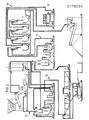
- Fig. 1 shows a first installation for performing the process according to the invention. Said installation is built up out of a number of separate, mobile units:
- the whole system has a throughput of 27 tons of contaminated soul 10 per hour (corresponding at a density of 1,3 tons per cubic metre to 21 cubic metres contaminated soil per hour).
- the cyanide concentration in the contaminated soil 10 can amount to 3,000 ppm., while the cyanide concentration in the reconditioned soil 11 is equal to a maximum 5 ppm.
- the units 1-9 are placed on carriages 12, so that the whole installation is mobile and, as will be found from reading the full description, can be set up on the spot in an appropriated sequence, depending on the composition of the contaminated soil.
- the contaminated soil 10 is carried from a holder 112 onto a conveyor belt 13 provided with unshown weihging means. By regulating the feed from said holder 12 the in-feed of contaminated soil 10 can generally be determined exactly with said weighing means.
- the conveyor belt 13 unloads the contaminated soil into a holder 14, wherein said contaminated soil 10 is mixed with water coming from the thickener 15 and the screening unit 8, and is subsequently conveyed onto a shaking screen 16.
- Said screen 16 has an aperture of a nominal 4 mm.
- the material to be screened is sprayed with water coming from spray heads 17 so that generally only particles 18 having a particle dimension larger than 4 mm reach the container 19.
- the fraction having a particle dimension generally smaller than 4 mm is subsequently conveyed via the conduit 20 to the separation/conditioning unit 3.
- the greatest part of the cyanide contamination is concentrated in a particle fraction smaller than 74 micrometres is carried out in two stages with the aid of cyclones 21 and 22.
- the overflow from the cyclone 22 (a slurry containing the particles of a dimension smaller than 74 micrometres) is conveyed via the conduit 23, the pump 24, into the thickener 15, wherein a solid/liquid separation is carried out.
- the liquid is added to the holder 14 in the previously described manner.
- the thickened slurry is taken via the conduit 125 into the container 25, in which concentrated waste is collected.
- the combined underflow from cyclones 21 and 22 is car - ried into a first conditioning vessel 26.
- 1 kg Na 2 Si0 3 , 1 kg NaOH, 100 g oleic acid and 400 g arquad are herein added to the slurry per ton of dry substance.
- this mixture has a pH of 10 and is conveyed to the first flotation cell 28.
- the float 31 from said flotation cell 28 is floated once again in flotation cell 30, the float 32 thereof being carried away to the container 25.
- the flotation residue 33 from flotation cell 28 is added to flotation cell 29, the float thereof being returned to said flotation cell 28. It is also possible for float 34 to be floated in flotation cell 30, the float 32 thereof also arriving in the container 25.
- the flotation residue 35 of the flotation cell 30 is added to the conditioned slurry entering the flotation cell 28.
- the flotation residue 36 from flotation cell 29 is subsequently added to the separation/hydrolysis unit 5.
- About 95% of the cyanides present are removed by flotation in the flotation unit 4 and carried into the container 25. 5% of the cyanide present is firmly caked onto or trapped in pores of the soil particles, the particle size whereof lies between 250 micrometres and 2 mm, this fraction generally not being floatable.
- the overflow 44 from said cyclones 43 is returned to the hydrolysis vessel 41, while the underflow 45 from said cyclones 43 is conveyed into a tank 46 wherein said de- watered underflow 45 is mixed with cleaner water 47.
- the amount of water to be added in each case is such that the slurry again obtains a density inherently equal to that of the slurry 42. Washing is repeated in the tanks 48 and 49, whereby in each case cleaner water is used, which in the case of the vessel 48 comes from the group of cyclones 53 and which in the case of the vessel 49 comes from a filter unit 6, wherein contamination is absorbed with the aid of carbon filters 54.
- the groups of cyclones 43, 51, 52 and 53 are, as regards their number, chosen such that an optimal liquid/solid separation is obtained.
- the de-watered slurry 155 is transported from the tank 50 to the rotating filter unit 55, where a last solid substance/ water separation is performed and whereafter the reconditioned soil 11 is carried away via the conveyor belt 56.
- the filtrate 57 is added to the holder 14 and/or the spray heads 17 of the classification unit 2.
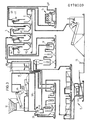
- Fig. 2 shows a flow diagram inherently the same as that in fig. 1, but wherein the different liquid cycles are shown at the moment when the installation is started up.
- the liquid cycle 55 contains water
- the liquid cycle 56 contains water, oleic acid, arquad, cylycate (to increase the hydrophilic character of the soil) and soda, while the pH lies between 9 and 11.
- the liquid cycle 57 contains water, K2C03, and NaOH and has a pH of about 12.
- the liquid cycle 58 generally contains water.
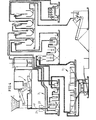
- Fig. 3 shows a variant where an improvement is made relative to the installation as shown in fig. 1.
- the particle fraction smaller than 75 micrometres scalped with the aid of cyclones 21 and 22 is not, as according to fig. 1 and 2, thickened and carried away as thickened slurry 125, but is returned via conduit 59 to the holder 14, wherein said scalped particle fraction is mixed with the soil 10 to be reconditioned.
- said scalped particle fractions are subsequently so-called sand-blasted with larger particles in cyclones 21 and 22, whereby their particle size is reduced to about 30 micrometres, which is considerably beneficial to their subsequent flotation in the flotation unit 4.
- the consequence of this is that not always, as according to fig.
- the thickener 15 can be applied in the counter current washing unit 7 in order to increase the water volume present therein by about 25 cubic metres.
- the overflow from the group of cyclones 51 is connected onto the thickener 15, the overflow of which 159 discharges into the tank 46.
- the overflow 60 of the group of cyclones 53 is connected onto the filter unit 6, which, as already described, discharges the filtered water into the tank 49.
- the overflow 44 of the group of cyclones 43 is connected onto the hydrolysis vessel 41.
- Fig. 4 shows yet another embodiment, whereby the cyclones 21 and 22 are in this case rendered completely inoperative.
- the mixture 61 leaving the classification unit 2 is conveyed directly into the conditioning unit 3' and subsequently floated in the flotation unit 4.
- Fig. 5 shows another variant whereby, with regard to fig. 4, the thickener 15 is not incorporated in the counter current washing unit 7 but is connected onto the flotation cell 30 of flotation unit 4, in order to thicken the float 32, whereafter the thickened float 62 is de-watered with the aid of cyclone 21' and the de-watered underflow 63 is emptied into container 25 and the watery overflow 64 returned to the flotation unit 4.
- the total production of highly concentrated contaminated soil amounts to only about 2% of the throughput of the whole installation.
- fig. 6 shows a variant corresponding with fig. 1 and 2, whereby the separation/conditioning unit 3 and the flotation unit 4 are given a dual form as separation/conditioning units 3a and 3b and flotation units 4a and 4b.
- the units 3a and 4a heavy metals from the contaminated soil 10 can now, by application of xanthates at a pH of about 7, be carried away via the float 63 into the container 64, while in the subsequent conditioning unit 3b and flotation unit 4b cyanide particles and cyanide ions are removed into the container 25 in the previously described manner, using oleic acid/arquad at a pH of 7-11.
- the adjustment of the pH in the flotation step and hydrolysis step is to a large extend dependend on the nature of the contamination. If the nature of the contamination emphasizes flotation then the pH is chosen near 7 (the hydrolysis step operates sub-optimally); is the hydrolysis emphasized then the pH is chosen near 11 (flotation operates sub-optimally). That is pH is a process condition which varies in dependence of the contaminated soil to be processed.
- the washing unit 7 is of great importance to:
- fig. 7 shows on a larger scale the thickener 15.
- a thorough mixing between both flows results inside the space enclosed by said ring 66, 67, so that the flocks sink downward via the central opening 70 and the water flows away likewise via opening 70, subsequently flowing upwards and being carried off via the overflow 72.
- Said diameter can for example be as small as 3 m in an installation as shown in the figures 1, 2 and 6.
Landscapes
- Life Sciences & Earth Sciences (AREA)
- Soil Sciences (AREA)
- Engineering & Computer Science (AREA)
- Environmental & Geological Engineering (AREA)
- Processing Of Solid Wastes (AREA)
Applications Claiming Priority (2)
| Application Number | Priority Date | Filing Date | Title |
|---|---|---|---|
| NL8402951 | 1984-09-27 | ||
| NL8402951A NL8402951A (nl) | 1984-09-27 | 1984-09-27 | Werkwijze voor het reinigen van verontreinigde grond. |
Publications (2)
| Publication Number | Publication Date |
|---|---|
| EP0178009A1 true EP0178009A1 (de) | 1986-04-16 |
| EP0178009B1 EP0178009B1 (de) | 1990-04-11 |
Family
ID=19844525
Family Applications (1)
| Application Number | Title | Priority Date | Filing Date |
|---|---|---|---|
| EP85201548A Expired - Lifetime EP0178009B1 (de) | 1984-09-27 | 1985-09-25 | Verfahren zur Rekonditionierung von kontaminiertem Boden |
Country Status (3)
| Country | Link |
|---|---|
| EP (1) | EP0178009B1 (de) |
| DE (1) | DE3577046D1 (de) |
| NL (1) | NL8402951A (de) |
Cited By (14)
| Publication number | Priority date | Publication date | Assignee | Title |
|---|---|---|---|---|
| EP0251562A1 (de) * | 1986-06-17 | 1988-01-07 | MTARRI Remedial Resources Inc. | Verfahren zur Dekontaminierung |
| DE3724779A1 (de) * | 1987-07-25 | 1989-02-02 | Frank Lorenz | Verfahren zur aufbereitung kontaminierter boeden und vorrichtung zur durchfuehrung des verfahrens |
| WO1989007014A1 (en) * | 1988-02-08 | 1989-08-10 | Biotrol, Inc. | Process for treating contaminated soil |
| EP0332958A1 (de) * | 1988-03-12 | 1989-09-20 | Pahl, Ekke, Dipl.-Ing. | Verfahren zur Dekontaminierung schlammartiger Sedimente |
| US4906302A (en) * | 1987-10-26 | 1990-03-06 | Bruya James E | Solids decontamination method with ammonia |
| US4923125A (en) * | 1988-02-08 | 1990-05-08 | Biotrol, Inc. | Process for treating contaminated soil |
| DE3902535A1 (de) * | 1989-01-28 | 1990-08-02 | Riker Rudolf Ing Grad | Verfahren und vorrichtung zum behandeln kontaminierter boeden |
| WO1990014892A1 (en) * | 1989-06-02 | 1990-12-13 | Electric Power Research Institute, Inc. | Method of recovery of hydrocarbons from contaminated soil or refuse materials |
| WO1991002592A1 (en) * | 1989-08-24 | 1991-03-07 | Biotrol, Inc. | Process for treating contaminated soil |
| US5203212A (en) * | 1990-02-13 | 1993-04-20 | Serasea B.V. | Method for determining the composition of a sample |
| US5223147A (en) * | 1990-12-07 | 1993-06-29 | Metallgesellschaft Aktiengesellschaft | Process of treating contaminated soils |
| US5303871A (en) * | 1988-02-08 | 1994-04-19 | Biotrol, Incorporated | Process for treating contaminated soil |
| US5417864A (en) * | 1994-04-26 | 1995-05-23 | Exxon Research And Engineering Company | Decontamination of hydrocarbon containing substrates (LAW100) |
| WO1997010063A1 (en) * | 1995-09-13 | 1997-03-20 | Chemtech Analysis Inc. | Mobile soil treatment apparatus and method |
Families Citing this family (1)
| Publication number | Priority date | Publication date | Assignee | Title |
|---|---|---|---|---|
| CN109663804A (zh) * | 2017-10-17 | 2019-04-23 | 北京高能时代环境技术股份有限公司 | 重度铬污染土壤处理方法 |
Citations (6)
| Publication number | Priority date | Publication date | Assignee | Title |
|---|---|---|---|---|
| FR506763A (fr) * | 1919-11-29 | 1920-08-30 | Minerals Separation Ltd | Perfectionnements dans la concentration de minerais |
| US2578790A (en) * | 1951-05-07 | 1951-12-18 | Minerals Separation North Us | Froth flotation of ferruginous impurities from finely divided granite rock |
| US2780585A (en) * | 1951-10-19 | 1957-02-05 | Exxon Research Engineering Co | Separation of contact solids according to degree of contamination |
| US3979282A (en) * | 1968-03-11 | 1976-09-07 | English Clays Lovering Pochin & Company Limited | Flotation of fine-grained materials |
| US4336136A (en) * | 1980-06-02 | 1982-06-22 | Giguere Marcel L | System for processing soils contaminated by crude oils or other refined petroleum products |
| NL8203415A (nl) * | 1982-09-01 | 1984-04-02 | Raadgevend Bureau Drs A Tukker | Werkwijze voor de zuivering van met cyanide verontreinigde bodem. |
-
1984
- 1984-09-27 NL NL8402951A patent/NL8402951A/nl not_active Application Discontinuation
-
1985
- 1985-09-25 DE DE8585201548T patent/DE3577046D1/de not_active Expired - Fee Related
- 1985-09-25 EP EP85201548A patent/EP0178009B1/de not_active Expired - Lifetime
Patent Citations (6)
| Publication number | Priority date | Publication date | Assignee | Title |
|---|---|---|---|---|
| FR506763A (fr) * | 1919-11-29 | 1920-08-30 | Minerals Separation Ltd | Perfectionnements dans la concentration de minerais |
| US2578790A (en) * | 1951-05-07 | 1951-12-18 | Minerals Separation North Us | Froth flotation of ferruginous impurities from finely divided granite rock |
| US2780585A (en) * | 1951-10-19 | 1957-02-05 | Exxon Research Engineering Co | Separation of contact solids according to degree of contamination |
| US3979282A (en) * | 1968-03-11 | 1976-09-07 | English Clays Lovering Pochin & Company Limited | Flotation of fine-grained materials |
| US4336136A (en) * | 1980-06-02 | 1982-06-22 | Giguere Marcel L | System for processing soils contaminated by crude oils or other refined petroleum products |
| NL8203415A (nl) * | 1982-09-01 | 1984-04-02 | Raadgevend Bureau Drs A Tukker | Werkwijze voor de zuivering van met cyanide verontreinigde bodem. |
Non-Patent Citations (3)
| Title |
|---|
| CHEMICAL ABSTRACTS, vol. 74, no. 12, 22nd March 1971, page 220, no. 57113w, Columbus, Ohio, US; R.B. GRIEVES et al.: "Precipitate flotation of coplexed cyanide", & ENG. BULL. PURDUE UNIV., ENG. EXT. SER. 1969, no. 135 (Pt. 2), 989-97 * |
| HANDBOEK BODEMSANERINGSTECHNIEKEN, 1st July 1983, page 33, Staatsuitgeverij, 's-Gravenhage, NL: *"Part II, page 33, lines 1-26; figure * * |
| TAGGART HANDBOOK OF MINERAL DRESSING, 1945, Wiley & Sons, New York, US * |
Cited By (17)
| Publication number | Priority date | Publication date | Assignee | Title |
|---|---|---|---|---|
| EP0251562A1 (de) * | 1986-06-17 | 1988-01-07 | MTARRI Remedial Resources Inc. | Verfahren zur Dekontaminierung |
| DE3724779A1 (de) * | 1987-07-25 | 1989-02-02 | Frank Lorenz | Verfahren zur aufbereitung kontaminierter boeden und vorrichtung zur durchfuehrung des verfahrens |
| US4906302A (en) * | 1987-10-26 | 1990-03-06 | Bruya James E | Solids decontamination method with ammonia |
| US5303871A (en) * | 1988-02-08 | 1994-04-19 | Biotrol, Incorporated | Process for treating contaminated soil |
| WO1989007014A1 (en) * | 1988-02-08 | 1989-08-10 | Biotrol, Inc. | Process for treating contaminated soil |
| US4923125A (en) * | 1988-02-08 | 1990-05-08 | Biotrol, Inc. | Process for treating contaminated soil |
| EP0332958A1 (de) * | 1988-03-12 | 1989-09-20 | Pahl, Ekke, Dipl.-Ing. | Verfahren zur Dekontaminierung schlammartiger Sedimente |
| DE3902535A1 (de) * | 1989-01-28 | 1990-08-02 | Riker Rudolf Ing Grad | Verfahren und vorrichtung zum behandeln kontaminierter boeden |
| WO1990014892A1 (en) * | 1989-06-02 | 1990-12-13 | Electric Power Research Institute, Inc. | Method of recovery of hydrocarbons from contaminated soil or refuse materials |
| US5019245A (en) * | 1989-06-02 | 1991-05-28 | Teresa Ignasiak | Method for recovery of hydrocarbons form contaminated soil or refuse materials |
| US5115986A (en) * | 1989-08-02 | 1992-05-26 | Biotrol, Inc | Process for treating contaminated soil |
| WO1991002592A1 (en) * | 1989-08-24 | 1991-03-07 | Biotrol, Inc. | Process for treating contaminated soil |
| US5203212A (en) * | 1990-02-13 | 1993-04-20 | Serasea B.V. | Method for determining the composition of a sample |
| US5223147A (en) * | 1990-12-07 | 1993-06-29 | Metallgesellschaft Aktiengesellschaft | Process of treating contaminated soils |
| AU645152B2 (en) * | 1990-12-07 | 1994-01-06 | Metallgesellschaft Aktiengesellschaft | Process of treating contaminated soils |
| US5417864A (en) * | 1994-04-26 | 1995-05-23 | Exxon Research And Engineering Company | Decontamination of hydrocarbon containing substrates (LAW100) |
| WO1997010063A1 (en) * | 1995-09-13 | 1997-03-20 | Chemtech Analysis Inc. | Mobile soil treatment apparatus and method |
Also Published As
| Publication number | Publication date |
|---|---|
| NL8402951A (nl) | 1986-04-16 |
| DE3577046D1 (de) | 1990-05-17 |
| EP0178009B1 (de) | 1990-04-11 |
Similar Documents
| Publication | Publication Date | Title |
|---|---|---|
| EP0178009B1 (de) | Verfahren zur Rekonditionierung von kontaminiertem Boden | |
| CN1186126C (zh) | 一种可实现全部粗煤泥重介质分选的选煤工艺 | |
| US4036441A (en) | Process for recovering usable materials from waste material containing metals and non-metals | |
| US4144164A (en) | Process for separating mixtures of particles | |
| US2932395A (en) | Process of separating mixtures of particles | |
| JP2006116397A (ja) | 汚染土壌の洗浄方法及び洗浄装置 | |
| RU2275248C2 (ru) | Улучшенный способ флотации сульфидных минералов | |
| JPH11574A (ja) | プラスチックの効果的な選別方法および装置 | |
| US6273263B1 (en) | Sediment and soil remediation by column flotation | |
| JP2002248459A (ja) | 汚染土壌の浄化法および装置 | |
| CN203635312U (zh) | 重介质选煤厂中煤磁选机尾矿分级分选回收系统 | |
| CN109967226A (zh) | 一种末精煤的回收利用方法 | |
| US20220001391A1 (en) | System and method for recovering desired materials using a ball mill or rod mill | |
| JP2014021062A (ja) | 汚染土壌の分級工法 | |
| US2654479A (en) | Separation of suspensions of solid matter in liquids | |
| JPS6318653B2 (de) | ||
| US3687284A (en) | Reconditioning of suspensions used in the separation of minerals | |
| US2849113A (en) | Methods of and means for handling flotation middlings in ore concentration processes | |
| CN108855586A (zh) | 一种浮游选煤的联合机组 | |
| US3043426A (en) | Black water clarification | |
| JP3280293B2 (ja) | 水処理装置及び水処理方法 | |
| JP2006000764A (ja) | 不純物除去方法と不純物除去装置及び土壌洗浄処理装置 | |
| CN114522798A (zh) | 一种用于极细粒高灰难选煤泥的分选工艺 | |
| CN207525118U (zh) | 一种黑臭水体底泥的处理系统 | |
| CN112844811A (zh) | 一种煤炭脱泥分选的方法 |
Legal Events
| Date | Code | Title | Description |
|---|---|---|---|
| PUAI | Public reference made under article 153(3) epc to a published international application that has entered the european phase |
Free format text: ORIGINAL CODE: 0009012 |
|
| AK | Designated contracting states |
Kind code of ref document: A1 Designated state(s): BE DE FR GB IT NL SE |
|
| 17P | Request for examination filed |
Effective date: 19861016 |
|
| 17Q | First examination report despatched |
Effective date: 19880219 |
|
| ITF | It: translation for a ep patent filed | ||
| GRAA | (expected) grant |
Free format text: ORIGINAL CODE: 0009210 |
|
| AK | Designated contracting states |
Kind code of ref document: B1 Designated state(s): BE DE FR GB IT NL SE |
|
| REF | Corresponds to: |
Ref document number: 3577046 Country of ref document: DE Date of ref document: 19900517 |
|
| ET | Fr: translation filed | ||
| PLBE | No opposition filed within time limit |
Free format text: ORIGINAL CODE: 0009261 |
|
| STAA | Information on the status of an ep patent application or granted ep patent |
Free format text: STATUS: NO OPPOSITION FILED WITHIN TIME LIMIT |
|
| 26N | No opposition filed | ||
| ITTA | It: last paid annual fee | ||
| NLT1 | Nl: modifications of names registered in virtue of documents presented to the patent office pursuant to art. 16 a, paragraph 1 |
Owner name: HEIDEMIJ REALISATIE B.V. TE ARNHEM. |
|
| EAL | Se: european patent in force in sweden |
Ref document number: 85201548.6 |
|
| PGFP | Annual fee paid to national office [announced via postgrant information from national office to epo] |
Ref country code: GB Payment date: 19961007 Year of fee payment: 12 |
|
| PGFP | Annual fee paid to national office [announced via postgrant information from national office to epo] |
Ref country code: SE Payment date: 19961008 Year of fee payment: 12 |
|
| PGFP | Annual fee paid to national office [announced via postgrant information from national office to epo] |
Ref country code: NL Payment date: 19961010 Year of fee payment: 12 |
|
| PGFP | Annual fee paid to national office [announced via postgrant information from national office to epo] |
Ref country code: FR Payment date: 19961016 Year of fee payment: 12 |
|
| PGFP | Annual fee paid to national office [announced via postgrant information from national office to epo] |
Ref country code: BE Payment date: 19961022 Year of fee payment: 12 |
|
| PGFP | Annual fee paid to national office [announced via postgrant information from national office to epo] |
Ref country code: DE Payment date: 19961129 Year of fee payment: 12 |
|
| PG25 | Lapsed in a contracting state [announced via postgrant information from national office to epo] |
Ref country code: GB Free format text: LAPSE BECAUSE OF NON-PAYMENT OF DUE FEES Effective date: 19970925 |
|
| PG25 | Lapsed in a contracting state [announced via postgrant information from national office to epo] |
Ref country code: SE Free format text: LAPSE BECAUSE OF NON-PAYMENT OF DUE FEES Effective date: 19970926 |
|
| PG25 | Lapsed in a contracting state [announced via postgrant information from national office to epo] |
Ref country code: FR Free format text: THE PATENT HAS BEEN ANNULLED BY A DECISION OF A NATIONAL AUTHORITY Effective date: 19970930 Ref country code: BE Free format text: LAPSE BECAUSE OF NON-PAYMENT OF DUE FEES Effective date: 19970930 |
|
| BERE | Be: lapsed |
Owner name: HEIDEMIJ UITVOERING B.V. Effective date: 19970930 |
|
| PG25 | Lapsed in a contracting state [announced via postgrant information from national office to epo] |
Ref country code: NL Free format text: LAPSE BECAUSE OF NON-PAYMENT OF DUE FEES Effective date: 19980401 |
|
| GBPC | Gb: european patent ceased through non-payment of renewal fee |
Effective date: 19970925 |
|
| NLV4 | Nl: lapsed or anulled due to non-payment of the annual fee |
Effective date: 19980401 |
|
| PG25 | Lapsed in a contracting state [announced via postgrant information from national office to epo] |
Ref country code: DE Free format text: LAPSE BECAUSE OF NON-PAYMENT OF DUE FEES Effective date: 19980603 |
|
| EUG | Se: european patent has lapsed |
Ref document number: 85201548.6 |
|
| REG | Reference to a national code |
Ref country code: FR Ref legal event code: ST |