EP0178372A2 - Etoffe non tissée microporeuse à plusieurs couches pour applications médicales et procédé pour sa fabrication - Google Patents
Etoffe non tissée microporeuse à plusieurs couches pour applications médicales et procédé pour sa fabrication Download PDFInfo
- Publication number
- EP0178372A2 EP0178372A2 EP85103757A EP85103757A EP0178372A2 EP 0178372 A2 EP0178372 A2 EP 0178372A2 EP 85103757 A EP85103757 A EP 85103757A EP 85103757 A EP85103757 A EP 85103757A EP 0178372 A2 EP0178372 A2 EP 0178372A2
- Authority
- EP
- European Patent Office
- Prior art keywords
- layer
- nonwoven
- nonwoven fabric
- hydrophobic
- paste
- Prior art date
- Legal status (The legal status is an assumption and is not a legal conclusion. Google has not performed a legal analysis and makes no representation as to the accuracy of the status listed.)
- Granted
Links
Images


Classifications
-
- D—TEXTILES; PAPER
- D04—BRAIDING; LACE-MAKING; KNITTING; TRIMMINGS; NON-WOVEN FABRICS
- D04H—MAKING TEXTILE FABRICS, e.g. FROM FIBRES OR FILAMENTARY MATERIAL; FABRICS MADE BY SUCH PROCESSES OR APPARATUS, e.g. FELTS, NON-WOVEN FABRICS; COTTON-WOOL; WADDING ; NON-WOVEN FABRICS FROM STAPLE FIBRES, FILAMENTS OR YARNS, BONDED WITH AT LEAST ONE WEB-LIKE MATERIAL DURING THEIR CONSOLIDATION
- D04H1/00—Non-woven fabrics formed wholly or mainly of staple fibres or like relatively short fibres
- D04H1/40—Non-woven fabrics formed wholly or mainly of staple fibres or like relatively short fibres from fleeces or layers composed of fibres without existing or potential cohesive properties
- D04H1/58—Non-woven fabrics formed wholly or mainly of staple fibres or like relatively short fibres from fleeces or layers composed of fibres without existing or potential cohesive properties by applying, incorporating or activating chemical or thermoplastic bonding agents, e.g. adhesives
- D04H1/593—Non-woven fabrics formed wholly or mainly of staple fibres or like relatively short fibres from fleeces or layers composed of fibres without existing or potential cohesive properties by applying, incorporating or activating chemical or thermoplastic bonding agents, e.g. adhesives to layered webs
-
- A—HUMAN NECESSITIES
- A61—MEDICAL OR VETERINARY SCIENCE; HYGIENE
- A61B—DIAGNOSIS; SURGERY; IDENTIFICATION
- A61B46/00—Surgical drapes
- A61B46/40—Drape material, e.g. laminates; Manufacture thereof
-
- D—TEXTILES; PAPER
- D04—BRAIDING; LACE-MAKING; KNITTING; TRIMMINGS; NON-WOVEN FABRICS
- D04H—MAKING TEXTILE FABRICS, e.g. FROM FIBRES OR FILAMENTARY MATERIAL; FABRICS MADE BY SUCH PROCESSES OR APPARATUS, e.g. FELTS, NON-WOVEN FABRICS; COTTON-WOOL; WADDING ; NON-WOVEN FABRICS FROM STAPLE FIBRES, FILAMENTS OR YARNS, BONDED WITH AT LEAST ONE WEB-LIKE MATERIAL DURING THEIR CONSOLIDATION
- D04H1/00—Non-woven fabrics formed wholly or mainly of staple fibres or like relatively short fibres
- D04H1/40—Non-woven fabrics formed wholly or mainly of staple fibres or like relatively short fibres from fleeces or layers composed of fibres without existing or potential cohesive properties
- D04H1/58—Non-woven fabrics formed wholly or mainly of staple fibres or like relatively short fibres from fleeces or layers composed of fibres without existing or potential cohesive properties by applying, incorporating or activating chemical or thermoplastic bonding agents, e.g. adhesives
- D04H1/64—Non-woven fabrics formed wholly or mainly of staple fibres or like relatively short fibres from fleeces or layers composed of fibres without existing or potential cohesive properties by applying, incorporating or activating chemical or thermoplastic bonding agents, e.g. adhesives the bonding agent being applied in wet state, e.g. chemical agents in dispersions or solutions
- D04H1/66—Non-woven fabrics formed wholly or mainly of staple fibres or like relatively short fibres from fleeces or layers composed of fibres without existing or potential cohesive properties by applying, incorporating or activating chemical or thermoplastic bonding agents, e.g. adhesives the bonding agent being applied in wet state, e.g. chemical agents in dispersions or solutions at spaced points or locations
-
- Y—GENERAL TAGGING OF NEW TECHNOLOGICAL DEVELOPMENTS; GENERAL TAGGING OF CROSS-SECTIONAL TECHNOLOGIES SPANNING OVER SEVERAL SECTIONS OF THE IPC; TECHNICAL SUBJECTS COVERED BY FORMER USPC CROSS-REFERENCE ART COLLECTIONS [XRACs] AND DIGESTS
- Y10—TECHNICAL SUBJECTS COVERED BY FORMER USPC
- Y10S—TECHNICAL SUBJECTS COVERED BY FORMER USPC CROSS-REFERENCE ART COLLECTIONS [XRACs] AND DIGESTS
- Y10S428/00—Stock material or miscellaneous articles
- Y10S428/903—Microfiber, less than 100 micron diameter
-
- Y—GENERAL TAGGING OF NEW TECHNOLOGICAL DEVELOPMENTS; GENERAL TAGGING OF CROSS-SECTIONAL TECHNOLOGIES SPANNING OVER SEVERAL SECTIONS OF THE IPC; TECHNICAL SUBJECTS COVERED BY FORMER USPC CROSS-REFERENCE ART COLLECTIONS [XRACs] AND DIGESTS
- Y10—TECHNICAL SUBJECTS COVERED BY FORMER USPC
- Y10S—TECHNICAL SUBJECTS COVERED BY FORMER USPC CROSS-REFERENCE ART COLLECTIONS [XRACs] AND DIGESTS
- Y10S428/00—Stock material or miscellaneous articles
- Y10S428/913—Material designed to be responsive to temperature, light, moisture
-
- Y—GENERAL TAGGING OF NEW TECHNOLOGICAL DEVELOPMENTS; GENERAL TAGGING OF CROSS-SECTIONAL TECHNOLOGIES SPANNING OVER SEVERAL SECTIONS OF THE IPC; TECHNICAL SUBJECTS COVERED BY FORMER USPC CROSS-REFERENCE ART COLLECTIONS [XRACs] AND DIGESTS
- Y10—TECHNICAL SUBJECTS COVERED BY FORMER USPC
- Y10T—TECHNICAL SUBJECTS COVERED BY FORMER US CLASSIFICATION
- Y10T428/00—Stock material or miscellaneous articles
- Y10T428/24—Structurally defined web or sheet [e.g., overall dimension, etc.]
- Y10T428/24802—Discontinuous or differential coating, impregnation or bond [e.g., artwork, printing, retouched photograph, etc.]
- Y10T428/24826—Spot bonds connect components
Definitions
- the invention relates to a microporous multilayer nonwoven fabric for medical applications such.
- the multi-layer nonwoven fabric is a largely waterproof composite nonwoven fabric that contains a microfiber layer made of hydrophobic fibers, which is covered on both sides by nonwoven fabric laminates which may be bonded.
- the composite nonwoven is soft and drapable. All layers are permanently connected.
- a method for producing such a composite nonwoven is also proposed.
- Multilayer or composite nonwovens of the type defined above are known for medical applications and also as disposable surgical materials.
- the microfiber layer made of hydrophobic fibers serves as a filter medium for the finest particles and bacteria.
- the microfiber layer is covered on both sides with nonwoven envelopes. In this way, the passage of bacteria is prevented. A largely impermeable waterproof construction of the laminate is necessary.
- Surgical materials, surgical gowns and surgical drapes which are coated with hydrophobic nonwovens, e.g. B. are based on polypropylene or laminated with foils.
- the individual layers of the laminate structure are often poorly connected to one another, so that such products can only be used to a limited extent in large areas of application.
- the laminate is held together by sewing or welding the three-layer structure.
- thermally welded nonwoven layers known from synthetic fibers.
- the microfiber layer can be manufactured in different ways, e.g. B. by the electrostatic spinning of dielectric polymer fibers from volatile solvents or the electrostatic spinning from the melt or the blowing of a melt. It has proven disadvantageous that, for. B. after the electrostatic spinning process from low-boiling solvents such as methylene chloride, only very hard and brittle polymers such as polycarbonate, polysulfone, cellulose triacetate and polystyrene or blends can be processed with each other. The strength within such a microfiber layer is very low. At least one-sided covering with tear-resistant carrier materials is essential here. When such laminates are thermally welded, however, very hard and brittle melting points are obtained, which lead to unpleasant wearing properties. Due to the embrittlement there is also the risk of destruction and cracking of the microfiber layer when subjected to mechanical stress.
- low-boiling solvents such as methylene chloride
- the known multi-layer nonwovens also have the serious disadvantage that they cannot be draped.
- the short elongation associated with embrittlement and the low capacity for work of the composite material means that movements or mechanical influences during use, e.g. B. as protective clothing, can lead to the destruction of the filter layer.
- most of the filter performance based on electrostatics or electret fibers is lost due to the thermal treatment.
- breaking, removing or penetrating microfibers is also not permitted.
- the sealing of the microfiber layer with a film lubrication provides absolute protection against bacterial penetration, but the wearing comfort is extremely poor. Heat accumulation is to be expected during longer operations.
- the invention is based on the object of developing a microporous multilayer nonwoven fabric for medical applications, in particular for use in the operating theater, the products being said to be soft and drapable and still be able to withstand the mechanical stresses that occur during use.
- the material must therefore be waterproof, breathable, ie permeable to air and permeable to water vapor.
- the laminate structure should not separate even under mechanical loads.
- the filter effect of the microfiber layer must not deteriorate during use. It must also be avoided that individual microfibers penetrate the nonwoven covering of the laminate outwards.
- the object according to the invention furthermore lies in the development of a method for producing a multilayer nonwoven fabric with the properties specified above.
- the laminate structure proposed according to the invention consists of a very drapable non-woven carrier material on which the microfiber layer is arranged.
- the microfiber layer is expediently spun on electrostatically. It is preferred here that the method described in DE-PS 20 32 072.
- the microfiber layer is covered with a second very drapable nonwoven.
- the nonwoven laminates both the backing and the cover nonwoven, are dry or wet laid nonwovens. Spunbonded nonwovens are preferred for particularly demanding applications.
- the nonwovens expediently have a weight of approximately 10 to 40 g / m 2 .
- binder-free and lightweight staple fiber nonwovens are advantageous.
- the abrasion resistance can be increased by binder-enriched nonwovens. It will often preferred if the microfiber medium is covered on both sides with the same materials.
- the cover fleece materials are usually hydrophobic. At least one of the two nonwovens can, according to an expedient embodiment, consist of hydrophilic fibers and not be hydrophobic.
- the printing paste is hydrophobic and penetrates the entire three-layer laminate in the form of columnar structures: the base area of these structures can be of any design. The printing paste is thus "riveted through” and enables a permanent bond of the laminate. For relatively thin laminates, one-sided printing of the hydrophobic printing paste is sufficient to achieve sufficient strength. In cases where the laminate is thicker, printing on both sides is recommended for the application of the printing paste. This is to be done in such a way that the respectively pressed amounts of printing paste touch each other inside the laminate.
- the printing paste is expediently applied as an aqueous paste emulsion.
- the finished print is elastic to the desired extent.
- the process for the production of the multilayer nonwoven consists in that the microfiber layer is first applied to the very drapable nonwoven, the electrostatic spinning in particular having proven itself.
- the cover nonwoven is then fed in and the three-layer laminate is lightly pressed on before winding.
- the laminate is then expediently washed in water at temperatures above 60 ° C., squeezed off and then by a Fleet containing hydrophobizing agent, squeezed off again and printed with the hydrophobically adjusted elastic binder paste.
- the printed material is then dried.
- washing the laminate before hydrophobing is used to remove unwanted foreign substances, e.g. B. spin finishes of the fibers or emulsifiers in binder-bound nonwoven fabrics. Existing foam aids, wetting agents or the like are also largely removed.
- the wash water should be at least 60 ° C hot to ensure that the microfiber medium is well wetted.
- the residual moisture based on the dry weight of the laminate, depends on the weight, thickness and structure of the laminate as well as the squeezing conditions. So that it can be taken up into the water repellant bath from the impregnation bath that has subsequently passed through, it is necessary that after washing it is more strongly pressed than after the water repellent impregnation.
- n 2 must be greater than n 1 .
- n 2 > n 1 the values for (n 2 - n l ) or n 1 should be within the following limits: where it is advantageous for drying energy reasons to keep n 1 as deep as possible, ie as much as possible after washing without squeezing the material.
- the material is then printed. It was surprising that the printing paste penetrates the extremely fine microfiber layer without difficulty and ensures a firm bond with the formation of rod-shaped webs. It was surprisingly found that the printing paste easily penetrates the microfiber layer due to the printing of the still moist material, although this must not be too voluminous and heavy. The weight of the microfiber layer must therefore be within the range of 0.5 to 60 g / m 2 .
- the printing paste essentially consists of a low-emulsifier polymer dispersion which contains only hydrophobic constituents, in particular hydrophobic monomers, and a low-body, high-molecular thickener and a hydrophobizing agent.
- a very low emulsifier printing paste which has no or only traces of water-soluble agents and additionally contains a hydrophobizing agent, ensures the perfect penetration of the microfilter medium and prevents leakage against water or a deterioration in the water resistance of the three-layer structure produced.
- the print pattern is expediently applied as a stencil print, the arrangement of the print points being largely arbitrary.
- very brittle polymers in the microfiber layer such as are present, for example, after electrostatic spinning from a solution, it is expedient if the distance between the elastic pressure-binding points is set closely.
- the multilayer nonwoven can be adjusted according to the wishes of the consumer. It is possible to produce disposables as well as reusable materials. For resistance to washing and cleaning, it is important to use crosslinkable water repellents and binders. Such agents and their corresponding properties are known and are available as commercial products.
- voluminous and heavier materials are to be riveted through with the printing paste, it is advisable to add effective defoamers, e.g. B. on a silicone basis.
- the printing paste is then expediently used in a foamed form. By touching the foam paste with the defoamer-containing, yet moist, composite nonwoven, spontaneous defoaming then takes place during the printing process, with a sharp reduction in the viscosity of the printing paste. This facilitates the penetration and penetration of thicker and more voluminous composite nonwovens.
- the watertightness results from the printing on the material impregnated with the hydrophobizing agent with the elastic hydrophobic printing paste.
- the difference between a 3-layer laminate not soaked with water repellent and water repellent is all the more pronounced, the higher the weight ratio of the cover nonwovens to the microfiber layer. is.
- a print on both sides is recommended for heavier composites.
- the pressure points can be set exactly one above the other or in mirror image to each other.
- a stick-like print pattern has proven itself, whereby the very slim sticks are no longer exactly mirror images, but are applied at an angle to each other, expediently at an angle of 90 °, because they touch at the crossing points and thus ensure the laminate strength.
- the nonwovens used for covering are usually hydrophobic.
- at least one of the laminates can consist of cellulose-containing or cellulose-containing nonwovens.
- Such nonwovens are relatively flat due to their high water absorption and their uncrimped structure. They can therefore be easily penetrated by the printing paste.
- Such nonwovens are comfortable to wear because of the high moisture balance and are always preferred when increased comfort is desired.
- the drapability of the nonwoven laminates used for covering can be increased by a mechanical softening process. This is particularly advantageous when the microfiber medium is surrounded by wet laid nonwoven fabrics.
- the hydrophobicization of the enveloping nonwoven can optionally be omitted if one or two absorbent surfaces of the three-layer multi-nonwoven are desired.
- nonwovens with a very high proportion of cellulose and / or cellulose are expedient, which are then not bound over the entire surface but only over part of the surface. After washing, the suction power of the fibers comes into play.
- the microfiber layer consists of fibers with a diameter between 0.1 and 10 ⁇ m.
- the layer thickness depends on the intended use and is within the range of 0.5 to 60 g / m 2 .
- weights of less than 1 g / m 2 microfibers with extremely even distribution can be achieved.
- the preferred range of microfiber application is usually between. l and 30 g / m 2 .
- the layer of the microfibers is determined.
- a water tightness of 40 mbar measured according to DIN standard 53 886/77, z. B. a microfiber pad of 8 g / m 2 made of 93 wt .-% polycarbonate and 7 wt .-% polystyrene electrostatically spun from a solution of microfibers with an average fineness of 4.5 microns if the microfiber layer on both sides with 20 g / m 2 heavy cellulose-cellulose-containing wet nonwovens is covered.
- Such a three-layer structure is described in Example 2.
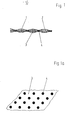
- Figures 1 to 6 show the structure of the multilayer nonwoven and a process scheme.
- Figure 1 shows a cross section through the three-layer multilayer nonwoven.
- the microfiber layer 1 is located on the hydrophobic carrier nonwoven 2 and is provided with the likewise non-hydrophobic covering nonwoven 3.
- the hydrophobic elastic printing paste riveting 4 guarantee provides a firm bond.
- Figure la shows a plan view of a multilayer nonwoven according to Figure 1.
- the pressure points 4 are arranged in a pattern on the water-repellent covering nonwoven fabric 3.
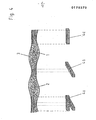
- FIG. 2 shows a three-layer multilayer nonwoven, in which the dielectric microfiber medium 1 is arranged on an absorbent carrier nonwoven 5 and provided with a water-repellent finishing nonwoven 3.
- the hydrophobic elastic riveting 4 ensures the bond.
- FIG. 3 shows a three-layer multilayer nonwoven fabric that absorbs on both sides.
- the dielectric microfiber medium 1 is located on an absorbent carrier nonwoven 5 and is provided with the likewise absorbent cover nonwoven 6.
- the hydrophobic elastic printing paste riveting 4 ensures the bond.
- FIG. 4 illustrates the function of the hydrophobic elastic printing paste riveting 4.
- the dielectric microfiber medium 1 is surrounded by the enveloping nonwovens 2 and 3.
- the printing paste points 4 are arranged differently. There are juxtaposed a binder pressure 4a, a binder pressure 4b applied at the bottom and a binder pressure 4c applied at the top.
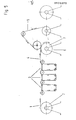
- FIG. 5 shows a schematic of the production process for the three-layer multilayer nonwoven before the hydrophobization and printing.
- the carrier material 1 is pulled off the roll 2 and fed to the electrostatic spinning system 3.
- the cover material 5 is fed to the carrier material to which the microfiber layer 4 is applied and loosely connected to it by light pressing.
- the three-layer multilayer laminate 6 is then pulled off over the roll 7.
- Figure 6 shows schematically the completion of the multi-layer nonwoven.
- the three-layer laminate 6 is at
- the microfiber coating was 0 g / m 2 .
- the fiber fineness ranged between 1.9 and 9.4 ⁇ m, with an average of 4.5 ⁇ m, measured on 20 capillaries.
- the second side of the microfiber layer was covered with the same 20 g / m 2 wet fleece, lightly pressed on and rolled up.
- the water resistance, measured according to DIN 53 086/77, of the loose 3-layer laminate was 20 mbar.
- the bond strength of the three layers to one another was almost 0, as can be seen from the following test report.
- Such goods can only be used for small-scale applications, such as disposable face masks, in particular due to the very weak bond strength.
- a product manufactured according to Example 1 is too stiff, too hard, too little drapable and far too weak in the laminate composite.
- step 2 * The 48 g / m 2 heavy nonwoven fabric with a central microfiber layer produced according to Example 1 is shown schematically in step 2 * .
- washing is carried out continuously first at 60 ° C. and then at room temperature and squeezed to a minimum moisture in a squeezer.
- An aqueous impregnation bath which consists of an 8% hydrophobizing agent mixture is then run through, ie the wet-on-wet impregnation described is carried out.
- a paraffin emulsion containing zirconium salt was used.
- the moist goods are printed on one side using a 10 mesh circular screen template with a foam printing paste with the aid of a magnetic squeegee.
- the methyl cellulose had an average degree of substitution of 1.4-1.6 and a Höppler viscosity in 2% solution of 20,000 CP.
- the application of printing paste was 10 g / m 2 solid substance.
- the viscosity of the non-foamed mixture was 995 CP - ßrookfield, measured with spindle no. 4 at 20 rpm.
- the mixture was foamed to a liter weight of 200 g (pot weight 200 g / liter).
- the goods After drying, the goods were relatively stiff and were made mechanically soft and drapable by crumpling them by hand.
- example 2 has an extremely high air permeability. Due to this fact, a material that was produced according to Example 2 could be used as an operating drape.
- Hydrophobic disposable surgical drape nonwovens have a water tightness of 17 to 23 mbar, weights of 62 to 80 g / m 2 and, depending on the manufacturing method and weight, have air permeability values of approx. 30 to 250 1 / s'm 2 0.5 mbar air pressure.
- Example 3 Production of the green carrier material for microfiber spinning.
- the 2-layer fiber composite is ver by means of foam impregnation with solvent consolidates.
- the plastic dispersion consists of 70 parts of a firm, self-crosslinking polyacrylate (Acronal 35 D) and 30 parts of a rigid raw material (Acronal 80 D).
- An anionic foamer, a wetting agent based on sulfosuccinate and green pigment dye were added to the impregnation mixture.
- the ratio of fiber material to binder was 74:26 and the weight of the carrier nonwoven was 19 g / m 2 .
- the nonwoven had a very hydrophilic character.
- the carrier nonwoven fabric was electrostatically spun with the polymer solution of Example 1, with the only difference that this time the average fiber fineness of the microfiber was 2.8 ⁇ m (scatter from 1.1 to 7.8 ⁇ m).
- microfibers were 8 g / m 2 .
- a partially coated (24% welding area) 10 g / m 2 heavy-weight polyamide spunbond with fine fiber titer (approx. 2.0 dtex) was placed and lightly pressed on.
- washing was carried out, wet-on-wet hydrophobized, wet-on-wet printed and dried with foam paste containing hydrophobizing agent.
- hydrophobizing agent was 0.8 g / m 2 and 7 g / m 2 of foam paste, so that a finished material weight of 44.8 g / m 2 resulted.
- the strong wetting properties of the carrier nonwoven favor the wetting of the microfiber layer during the washing process.
- the watertightness is so high that it is not possible to let water pass through even with high mechanical stress (like tapping a puddle of water on the material).
- the water vapor permeability is very high.
- a hydrophobic material manufactured according to Example 3 could be used as a drapable semipereal laminate with microporous microfiber incorporation in the rain protective clothing.
- the breathability and high water vapor permeability convey a comfortable fit without the risk of condensation.
- Example 4 This example differs from Example 3 only in that the microfiber layer has been reduced from 8 g / m 2 to 2.5 g / m 2 .
- the finished material weight was only 39 g / m 2 .
- the goods manufactured according to Example 4 are very watertight in relation to their very low weight.
- the draping ability (drop coefficient) is very good and is favored by the low weight.
- the material can be used as a disposable surgical drape material or disposable surgical gown material. Using the Stan of the technology, nonwoven fabric weights of at least 72 g / m 2 are necessary for the same application. The weight saving and thus the raw material saving is therefore remarkable.
Landscapes
- Health & Medical Sciences (AREA)
- Engineering & Computer Science (AREA)
- Surgery (AREA)
- Life Sciences & Earth Sciences (AREA)
- Textile Engineering (AREA)
- Public Health (AREA)
- Chemical & Material Sciences (AREA)
- Molecular Biology (AREA)
- Animal Behavior & Ethology (AREA)
- General Health & Medical Sciences (AREA)
- Heart & Thoracic Surgery (AREA)
- Veterinary Medicine (AREA)
- Medical Informatics (AREA)
- Chemical Kinetics & Catalysis (AREA)
- Dispersion Chemistry (AREA)
- General Chemical & Material Sciences (AREA)
- Biomedical Technology (AREA)
- Nonwoven Fabrics (AREA)
- Laminated Bodies (AREA)
- Treatments For Attaching Organic Compounds To Fibrous Goods (AREA)
- Materials For Medical Uses (AREA)
Applications Claiming Priority (2)
| Application Number | Priority Date | Filing Date | Title |
|---|---|---|---|
| DE3437183A DE3437183C2 (de) | 1984-10-10 | 1984-10-10 | Mikroporöser Mehrschichtvliesstoff für medizinische Anwendungszwecke und Verfahren zu dessen Herstellung |
| DE3437183 | 1984-10-10 |
Publications (3)
| Publication Number | Publication Date |
|---|---|
| EP0178372A2 true EP0178372A2 (fr) | 1986-04-23 |
| EP0178372A3 EP0178372A3 (en) | 1989-04-05 |
| EP0178372B1 EP0178372B1 (fr) | 1991-09-11 |
Family
ID=6247575
Family Applications (1)
| Application Number | Title | Priority Date | Filing Date |
|---|---|---|---|
| EP85103757A Expired - Lifetime EP0178372B1 (fr) | 1984-10-10 | 1985-03-28 | Etoffe non tissée microporeuse à plusieurs couches pour applications médicales et procédé pour sa fabrication |
Country Status (8)
| Country | Link |
|---|---|
| US (1) | US4618524A (fr) |
| EP (1) | EP0178372B1 (fr) |
| JP (1) | JPS6197453A (fr) |
| CN (1) | CN1023885C (fr) |
| BR (1) | BR8503118A (fr) |
| CA (1) | CA1256008A (fr) |
| DE (2) | DE3437183C2 (fr) |
| ES (1) | ES8606548A1 (fr) |
Cited By (3)
| Publication number | Priority date | Publication date | Assignee | Title |
|---|---|---|---|---|
| DE102005030484A1 (de) * | 2005-06-28 | 2007-01-04 | Carl Freudenberg Kg | Elastischer, weicher, punktförmig gebundener Vliesstoff mit Füllstoffpartikel, Verfahren zu dessen Herstellung und dessen Verwendung |
| US8449947B2 (en) | 2000-08-05 | 2013-05-28 | Carl Freudenberg Kg | Thermal control nonwoven material |
| DE202014001563U1 (de) * | 2014-02-24 | 2014-12-05 | STS Textiles GmbH & Co. KG | Transportverpackung |
Families Citing this family (63)
| Publication number | Priority date | Publication date | Assignee | Title |
|---|---|---|---|---|
| US4681801A (en) * | 1986-08-22 | 1987-07-21 | Minnesota Mining And Manufacturing Company | Durable melt-blown fibrous sheet material |
| US4921743A (en) * | 1987-09-25 | 1990-05-01 | Minnesota Mining And Manufacturing Company | Use of sorbent sheet materials as evaporative coolants |
| US4818597A (en) * | 1988-01-27 | 1989-04-04 | Kimberly-Clark Corporation | Health care laminate |
| US5042465A (en) * | 1988-07-22 | 1991-08-27 | Minnesota Mining & Manufacturing Company | Method of immobilizing a body part with an orthopedic cast |
| US5027803A (en) * | 1988-07-22 | 1991-07-02 | Minnesota Mining & Manufacturing Company | Orthopedic splinting and casting article |
| US4989593A (en) * | 1988-07-22 | 1991-02-05 | Minnesota Mining & Manufacturing Company | Orthopedic cast |
| US4936319A (en) * | 1989-09-06 | 1990-06-26 | Seth Neubardt | Surgical towel and procedure for avoiding hypothermia |
| US5145727A (en) * | 1990-11-26 | 1992-09-08 | Kimberly-Clark Corporation | Multilayer nonwoven composite structure |
| US5149576A (en) * | 1990-11-26 | 1992-09-22 | Kimberly-Clark Corporation | Multilayer nonwoven laminiferous structure |
| US6406674B1 (en) | 1993-06-30 | 2002-06-18 | Kimberly-Clark Worldwide, Inc. | Single step sterilization wrap system |
| CA2111071E (fr) * | 1993-06-30 | 2011-08-23 | Sonya Nicholson Bourne | Systeme d'enveloppement pour sterilisation, en une seule etape |
| CA2116081C (fr) * | 1993-12-17 | 2005-07-26 | Ann Louise Mccormack | Materiau permeable a l'air constitue d'une pellicule et d'un non-tisse colles |
| CA2124237C (fr) | 1994-02-18 | 2004-11-02 | Bernard Cohen | Barriere non tisse amelioree et methode de fabrication |
| US5688157A (en) * | 1994-04-05 | 1997-11-18 | Kimberly-Clark Worldwide, Inc. | Nonwoven fabric laminate with enhanced barrier properties |
| US5482765A (en) * | 1994-04-05 | 1996-01-09 | Kimberly-Clark Corporation | Nonwoven fabric laminate with enhanced barrier properties |
| CA2136576C (fr) | 1994-06-27 | 2005-03-08 | Bernard Cohen | Barriere non tissee amelioree et methode pour sa fabrication |
| US5455110A (en) * | 1994-06-29 | 1995-10-03 | Kimberly-Clark Corporation | Nonwoven laminated fabrics |
| CA2149701A1 (fr) * | 1994-10-12 | 1996-04-13 | Kimberly-Clark Worldwide, Inc. | Enveloppe de sterilisation |
| AU4961696A (en) | 1994-12-08 | 1996-06-26 | Kimberly-Clark Worldwide, Inc. | Method of forming a particle size gradient in an absorbent article |
| CA2153278A1 (fr) | 1994-12-30 | 1996-07-01 | Bernard Cohen | Materiau de protection forme de couches de non-tisse |
| MX9709101A (es) * | 1995-05-25 | 1998-02-28 | Kimberly Clark Co | Matriz de filtro. |
| US5705251A (en) * | 1995-06-27 | 1998-01-06 | Kimberly-Clark Worldwide, Inc. | Garment with liquid intrusion protection |
| ZA965786B (en) * | 1995-07-19 | 1997-01-27 | Kimberly Clark Co | Nonwoven barrier and method of making the same |
| US5834384A (en) | 1995-11-28 | 1998-11-10 | Kimberly-Clark Worldwide, Inc. | Nonwoven webs with one or more surface treatments |
| US6332952B1 (en) | 1996-04-26 | 2001-12-25 | Kimberly-Clark Worldwide, Inc. | Tissue with strikethrough resistance |
| US5968853A (en) * | 1997-03-10 | 1999-10-19 | The Procter & Gamble Company | Tissue with a moisture barrier |
| US6537932B1 (en) | 1997-10-31 | 2003-03-25 | Kimberly-Clark Worldwide, Inc. | Sterilization wrap, applications therefor, and method of sterilizing |
| US6365088B1 (en) | 1998-06-26 | 2002-04-02 | Kimberly-Clark Worldwide, Inc. | Electret treatment of high loft and low density nonwoven webs |
| US6573203B1 (en) | 1998-07-15 | 2003-06-03 | Kimberly-Clark Worldwide, Inc. | High utility towel |
| SE9904525L (sv) * | 1999-12-10 | 2001-02-05 | Moelnlycke Health Care Ab | Operationslakan av engångstyp |
| US6413363B1 (en) | 2000-06-30 | 2002-07-02 | Kimberly-Clark Worldwide, Inc. | Method of making absorbent tissue from recycled waste paper |
| US6998068B2 (en) * | 2003-08-15 | 2006-02-14 | 3M Innovative Properties Company | Acene-thiophene semiconductors |
| US6977113B2 (en) * | 2001-10-09 | 2005-12-20 | 3M Innovative Properties Company | Microfiber articles from multi-layer substrates |
| US6966971B1 (en) | 2001-10-31 | 2005-11-22 | Sellars Absorbent Materials, Inc. | Absorbent wipe having bonding material logo |
| US6821387B2 (en) * | 2001-12-19 | 2004-11-23 | Paper Technology Foundation, Inc. | Use of fractionated fiber furnishes in the manufacture of tissue products, and products produced thereby |
| US20030111195A1 (en) * | 2001-12-19 | 2003-06-19 | Kimberly-Clark Worldwide, Inc. | Method and system for manufacturing tissue products, and products produced thereby |
| US6797114B2 (en) * | 2001-12-19 | 2004-09-28 | Kimberly-Clark Worldwide, Inc. | Tissue products |
| US6758943B2 (en) | 2001-12-27 | 2004-07-06 | Kimberly-Clark Worldwide, Inc. | Method of making a high utility tissue |
| US20040002273A1 (en) * | 2002-07-01 | 2004-01-01 | Kimberly-Clark Worldwide, Inc. | Liquid repellent nonwoven protective material |
| US20040076564A1 (en) * | 2002-10-16 | 2004-04-22 | Schild Lisa A. | Multi-layer products having improved strength attributes |
| US20040074593A1 (en) * | 2002-10-16 | 2004-04-22 | Schild Lisa A. | Methods of making multi-layer products having improved strength attributes |
| US8513147B2 (en) | 2003-06-19 | 2013-08-20 | Eastman Chemical Company | Nonwovens produced from multicomponent fibers |
| US7892993B2 (en) | 2003-06-19 | 2011-02-22 | Eastman Chemical Company | Water-dispersible and multicomponent fibers from sulfopolyesters |
| US20040260034A1 (en) | 2003-06-19 | 2004-12-23 | Haile William Alston | Water-dispersible fibers and fibrous articles |
| US7592277B2 (en) * | 2005-05-17 | 2009-09-22 | Research Triangle Institute | Nanofiber mats and production methods thereof |
| US7297305B2 (en) * | 2004-04-08 | 2007-11-20 | Research Triangle Institute | Electrospinning in a controlled gaseous environment |
| US7762801B2 (en) * | 2004-04-08 | 2010-07-27 | Research Triangle Institute | Electrospray/electrospinning apparatus and method |
| US7134857B2 (en) * | 2004-04-08 | 2006-11-14 | Research Triangle Institute | Electrospinning of fibers using a rotatable spray head |
| US7922983B2 (en) | 2005-07-28 | 2011-04-12 | Kimberly-Clark Worldwide, Inc. | Sterilization wrap with additional strength sheet |
| US7799169B2 (en) | 2004-09-01 | 2010-09-21 | Georgia-Pacific Consumer Products Lp | Multi-ply paper product with moisture strike through resistance and method of making the same |
| US20060104857A1 (en) * | 2004-11-15 | 2006-05-18 | Pigott James M | Sterilization wrap with indicia for placement of medical instrumentation or trays |
| US20060137317A1 (en) * | 2004-12-28 | 2006-06-29 | Bryner Michael A | Filtration media for filtering particulate material from gas streams |
| US7635745B2 (en) | 2006-01-31 | 2009-12-22 | Eastman Chemical Company | Sulfopolyester recovery |
| US20080026688A1 (en) * | 2006-07-25 | 2008-01-31 | Paul Musick | Method and system for maintaining computer and data rooms |
| FR2928383B1 (fr) | 2008-03-06 | 2010-12-31 | Georgia Pacific France | Feuille gaufree comportant un pli en materiau hydrosoluble et procede de realisation d'une telle feuille. |
| US8512519B2 (en) | 2009-04-24 | 2013-08-20 | Eastman Chemical Company | Sulfopolyesters for paper strength and process |
| EP2322710B1 (fr) * | 2009-11-09 | 2014-12-17 | W.L.Gore & Associates Gmbh | Article composite textile |
| US20120183861A1 (en) | 2010-10-21 | 2012-07-19 | Eastman Chemical Company | Sulfopolyester binders |
| US8840757B2 (en) | 2012-01-31 | 2014-09-23 | Eastman Chemical Company | Processes to produce short cut microfibers |
| US9617685B2 (en) | 2013-04-19 | 2017-04-11 | Eastman Chemical Company | Process for making paper and nonwoven articles comprising synthetic microfiber binders |
| US9605126B2 (en) | 2013-12-17 | 2017-03-28 | Eastman Chemical Company | Ultrafiltration process for the recovery of concentrated sulfopolyester dispersion |
| US9598802B2 (en) | 2013-12-17 | 2017-03-21 | Eastman Chemical Company | Ultrafiltration process for producing a sulfopolyester concentrate |
| IT202100022343A1 (it) * | 2021-08-25 | 2023-02-25 | Maurizio Fanelli | Metodo per il fissaggio di stampe su materiali per abbigliamento ed indumento prodotto con detto metodo |
Family Cites Families (16)
| Publication number | Priority date | Publication date | Assignee | Title |
|---|---|---|---|---|
| GB1071191A (en) * | 1963-12-24 | 1967-06-07 | Johnson & Johnson | Absorbent non-woven fibrous product |
| US3873486A (en) * | 1967-02-24 | 1975-03-25 | Johnson & Johnson | Resin compositions |
| GB1453447A (en) * | 1972-09-06 | 1976-10-20 | Kimberly Clark Co | Nonwoven thermoplastic fabric |
| US3879257A (en) * | 1973-04-30 | 1975-04-22 | Scott Paper Co | Absorbent unitary laminate-like fibrous webs and method for producing them |
| US3908058A (en) * | 1974-01-16 | 1975-09-23 | Johnson & Johnson | Spot-bonded nonwoven fabrics and methods of making the same |
| US4287251A (en) * | 1978-06-16 | 1981-09-01 | King Mary K | Disposable absorbent nonwoven structure |
| US4196245A (en) * | 1978-06-16 | 1980-04-01 | Buckeye Cellulos Corporation | Composite nonwoven fabric comprising adjacent microfine fibers in layers |
| US4211227A (en) * | 1978-07-03 | 1980-07-08 | The Kendall Company | Surgical sponge material |
| US4298649A (en) * | 1980-01-07 | 1981-11-03 | Kimberly-Clark Corporation | Nonwoven disposable wiper |
| US4374888A (en) * | 1981-09-25 | 1983-02-22 | Kimberly-Clark Corporation | Nonwoven laminate for recreation fabric |
| US4468428A (en) * | 1982-06-01 | 1984-08-28 | The Procter & Gamble Company | Hydrophilic microfibrous absorbent webs |
| US4379192A (en) * | 1982-06-23 | 1983-04-05 | Kimberly-Clark Corporation | Impervious absorbent barrier fabric embodying films and fibrous webs |
| US4436780A (en) * | 1982-09-02 | 1984-03-13 | Kimberly-Clark Corporation | Nonwoven wiper laminate |
| GB2132939A (en) * | 1982-11-29 | 1984-07-18 | Wycombe Marsh Paper Mills Ltd | Sterilizable medical wrap |
| US4493868A (en) * | 1982-12-14 | 1985-01-15 | Kimberly-Clark Corporation | High bulk bonding pattern and method |
| US4507351A (en) * | 1983-01-11 | 1985-03-26 | The Proctor & Gamble Company | Strong laminate |
-
1984
- 1984-10-10 DE DE3437183A patent/DE3437183C2/de not_active Expired
-
1985
- 1985-03-28 EP EP85103757A patent/EP0178372B1/fr not_active Expired - Lifetime
- 1985-03-28 DE DE8585103757T patent/DE3584067D1/de not_active Expired - Lifetime
- 1985-04-29 ES ES542663A patent/ES8606548A1/es not_active Expired
- 1985-06-07 CN CN85104314A patent/CN1023885C/zh not_active Expired - Fee Related
- 1985-06-26 CA CA000485396A patent/CA1256008A/fr not_active Expired
- 1985-06-28 BR BR8503118A patent/BR8503118A/pt not_active IP Right Cessation
- 1985-09-17 US US06/776,811 patent/US4618524A/en not_active Expired - Fee Related
- 1985-10-04 JP JP60221702A patent/JPS6197453A/ja active Granted
Cited By (5)
| Publication number | Priority date | Publication date | Assignee | Title |
|---|---|---|---|---|
| US8449947B2 (en) | 2000-08-05 | 2013-05-28 | Carl Freudenberg Kg | Thermal control nonwoven material |
| DE102005030484A1 (de) * | 2005-06-28 | 2007-01-04 | Carl Freudenberg Kg | Elastischer, weicher, punktförmig gebundener Vliesstoff mit Füllstoffpartikel, Verfahren zu dessen Herstellung und dessen Verwendung |
| DE102005030484B4 (de) * | 2005-06-28 | 2007-11-15 | Carl Freudenberg Kg | Elastischer Vliesstoff, Verfahren zu dessen Herstellung und dessen Verwendung |
| US8114794B2 (en) | 2005-06-28 | 2012-02-14 | Carl Freudenberg Kg | Elastic, soft and punctiformly bound non-woven fabric provided with filler particles and method for production and the use thereof |
| DE202014001563U1 (de) * | 2014-02-24 | 2014-12-05 | STS Textiles GmbH & Co. KG | Transportverpackung |
Also Published As
| Publication number | Publication date |
|---|---|
| EP0178372A3 (en) | 1989-04-05 |
| DE3437183A1 (de) | 1986-04-17 |
| DE3584067D1 (de) | 1991-10-17 |
| JPS6197453A (ja) | 1986-05-15 |
| CN1023885C (zh) | 1994-03-02 |
| ES542663A0 (es) | 1986-04-01 |
| US4618524A (en) | 1986-10-21 |
| CN85104314A (zh) | 1986-03-10 |
| DE3437183C2 (de) | 1986-09-11 |
| BR8503118A (pt) | 1986-05-27 |
| JPH0215655B2 (fr) | 1990-04-12 |
| CA1256008A (fr) | 1989-06-20 |
| EP0178372B1 (fr) | 1991-09-11 |
| ES8606548A1 (es) | 1986-04-01 |
Similar Documents
| Publication | Publication Date | Title |
|---|---|---|
| EP0178372B1 (fr) | Etoffe non tissée microporeuse à plusieurs couches pour applications médicales et procédé pour sa fabrication | |
| DE69127428T2 (de) | Vliesstoff und sein Herstellungsverfahren | |
| DE68913057T2 (de) | Nichtgewebtes, faseriges, nichtelastisches Material und Verfahren zu dessen Herstellung. | |
| DE3689638T2 (de) | Schmelzbare und mikrofeine Fasern enthaltendes, mehrschichtiges Faserprodukt. | |
| EP0435001B1 (fr) | Laminé | |
| DE69721816T3 (de) | Wischtücher aus punktungebundenen vliessroffen | |
| DE69711616T2 (de) | Dauerhafte, wasserstrahlenverfestigte vliesstoffe | |
| DE69110015T2 (de) | Sperrschicht für Flüssigkeiten und Verwendung. | |
| EP2207926B1 (fr) | Surface textile fixable | |
| DE3875328T2 (de) | Nassgelegter, nichtgewebter stoff hoher festigkeit und verfahren zu seiner herstellung. | |
| EP2911765B1 (fr) | Matériau de filtre à durée d'utilisation accrue et élément filtrant contenant ce matériau de filtre | |
| DE69113184T2 (de) | Verfahren zur Herstellung und Verwendung von durchtränkten Elastomer-Vliesstoffen. | |
| DE3733097A1 (de) | Reissbare wirrfaservliesbahn und verfahren zu deren herstellung | |
| DE3516247A1 (de) | Faservlieslaminat | |
| WO2004007826A2 (fr) | Rondelle cosmetique et procede de fabrication de ladite rondelle | |
| DE1102693B (de) | Genadelter Vliesstoff und Verfahren zu seiner Herstellung | |
| DE3919166A1 (de) | Flexibles oberflaechenmaterial mit einer perforierten kunststoffolie und einer faserschicht sowie verfahren zur herstellung desselben | |
| EP2207925B1 (fr) | Surface textile thermofixable | |
| DE69716689T2 (de) | Absorbierender Verbundvliesstoff mit einer weichen Fläche und einer rauhen Fläche und Verfahren zur Herstellung | |
| EP2123440A1 (fr) | Bande de matière fibreuse absorbante | |
| DE102005016246B4 (de) | Elastischer Verbundvliesstoff und Verfahren zu dessen Herstellung | |
| EP0137094B1 (fr) | Masque facial pour chirurgien | |
| DE2232785A1 (de) | Textiles flaechengebilde aus mineralfasern, verfahren zu seiner herstellung und seine anwendung | |
| DE102014208200B3 (de) | Filterelement und Verfahren zu dessen Herstellung | |
| WO2013041193A1 (fr) | Non-tissé pourvu d'une matrice contenant des filaments élémentaires |
Legal Events
| Date | Code | Title | Description |
|---|---|---|---|
| PUAI | Public reference made under article 153(3) epc to a published international application that has entered the european phase |
Free format text: ORIGINAL CODE: 0009012 |
|
| AK | Designated contracting states |
Kind code of ref document: A2 Designated state(s): DE FR GB NL SE |
|
| PUAL | Search report despatched |
Free format text: ORIGINAL CODE: 0009013 |
|
| AK | Designated contracting states |
Kind code of ref document: A3 Designated state(s): DE FR GB NL SE |
|
| 17P | Request for examination filed |
Effective date: 19890227 |
|
| 17Q | First examination report despatched |
Effective date: 19901012 |
|
| GRAA | (expected) grant |
Free format text: ORIGINAL CODE: 0009210 |
|
| AK | Designated contracting states |
Kind code of ref document: B1 Designated state(s): DE FR GB NL SE |
|
| ET | Fr: translation filed | ||
| REF | Corresponds to: |
Ref document number: 3584067 Country of ref document: DE Date of ref document: 19911017 |
|
| GBT | Gb: translation of ep patent filed (gb section 77(6)(a)/1977) | ||
| PLBE | No opposition filed within time limit |
Free format text: ORIGINAL CODE: 0009261 |
|
| STAA | Information on the status of an ep patent application or granted ep patent |
Free format text: STATUS: NO OPPOSITION FILED WITHIN TIME LIMIT |
|
| 26N | No opposition filed | ||
| EAL | Se: european patent in force in sweden |
Ref document number: 85103757.2 |
|
| PGFP | Annual fee paid to national office [announced via postgrant information from national office to epo] |
Ref country code: SE Payment date: 19950215 Year of fee payment: 11 |
|
| PGFP | Annual fee paid to national office [announced via postgrant information from national office to epo] |
Ref country code: DE Payment date: 19950220 Year of fee payment: 11 |
|
| PGFP | Annual fee paid to national office [announced via postgrant information from national office to epo] |
Ref country code: GB Payment date: 19950227 Year of fee payment: 11 |
|
| PGFP | Annual fee paid to national office [announced via postgrant information from national office to epo] |
Ref country code: FR Payment date: 19950314 Year of fee payment: 11 |
|
| PGFP | Annual fee paid to national office [announced via postgrant information from national office to epo] |
Ref country code: NL Payment date: 19950331 Year of fee payment: 11 |
|
| PG25 | Lapsed in a contracting state [announced via postgrant information from national office to epo] |
Ref country code: DE Effective date: 19950620 |
|
| PG25 | Lapsed in a contracting state [announced via postgrant information from national office to epo] |
Ref country code: GB Effective date: 19960328 |
|
| PG25 | Lapsed in a contracting state [announced via postgrant information from national office to epo] |
Ref country code: SE Effective date: 19960329 |
|
| PG25 | Lapsed in a contracting state [announced via postgrant information from national office to epo] |
Ref country code: NL Effective date: 19961001 |
|
| GBPC | Gb: european patent ceased through non-payment of renewal fee |
Effective date: 19960328 |
|
| PG25 | Lapsed in a contracting state [announced via postgrant information from national office to epo] |
Ref country code: FR Effective date: 19961129 |
|
| NLV4 | Nl: lapsed or anulled due to non-payment of the annual fee |
Effective date: 19961001 |
|
| EUG | Se: european patent has lapsed |
Ref document number: 85103757.2 |
|
| REG | Reference to a national code |
Ref country code: FR Ref legal event code: ST |