EP0178960B1 - Compositions combustibles pour Diesel - Google Patents
Compositions combustibles pour Diesel Download PDFInfo
- Publication number
- EP0178960B1 EP0178960B1 EP85401724A EP85401724A EP0178960B1 EP 0178960 B1 EP0178960 B1 EP 0178960B1 EP 85401724 A EP85401724 A EP 85401724A EP 85401724 A EP85401724 A EP 85401724A EP 0178960 B1 EP0178960 B1 EP 0178960B1
- Authority
- EP
- European Patent Office
- Prior art keywords
- amine
- condensation product
- aldehyde
- molecular weight
- alkylphenol
- Prior art date
- Legal status (The legal status is an assumption and is not a legal conclusion. Google has not performed a legal analysis and makes no representation as to the accuracy of the status listed.)
- Expired
Links
Images
Classifications
-
- C—CHEMISTRY; METALLURGY
- C10—PETROLEUM, GAS OR COKE INDUSTRIES; TECHNICAL GASES CONTAINING CARBON MONOXIDE; FUELS; LUBRICANTS; PEAT
- C10L—FUELS NOT OTHERWISE PROVIDED FOR; NATURAL GAS; SYNTHETIC NATURAL GAS OBTAINED BY PROCESSES NOT COVERED BY SUBCLASSES C10G OR C10K; LIQUIFIED PETROLEUM GAS; USE OF ADDITIVES TO FUELS OR FIRES; FIRE-LIGHTERS
- C10L1/00—Liquid carbonaceous fuels
- C10L1/10—Liquid carbonaceous fuels containing additives
- C10L1/14—Organic compounds
- C10L1/22—Organic compounds containing nitrogen
-
- C—CHEMISTRY; METALLURGY
- C10—PETROLEUM, GAS OR COKE INDUSTRIES; TECHNICAL GASES CONTAINING CARBON MONOXIDE; FUELS; LUBRICANTS; PEAT
- C10L—FUELS NOT OTHERWISE PROVIDED FOR; NATURAL GAS; SYNTHETIC NATURAL GAS OBTAINED BY PROCESSES NOT COVERED BY SUBCLASSES C10G OR C10K; LIQUIFIED PETROLEUM GAS; USE OF ADDITIVES TO FUELS OR FIRES; FIRE-LIGHTERS
- C10L1/00—Liquid carbonaceous fuels
- C10L1/10—Liquid carbonaceous fuels containing additives
- C10L1/14—Organic compounds
- C10L1/22—Organic compounds containing nitrogen
- C10L1/23—Organic compounds containing nitrogen containing at least one nitrogen-to-oxygen bond, e.g. nitro-compounds, nitrates, nitrites
- C10L1/231—Organic compounds containing nitrogen containing at least one nitrogen-to-oxygen bond, e.g. nitro-compounds, nitrates, nitrites nitro compounds; nitrates; nitrites
-
- C—CHEMISTRY; METALLURGY
- C10—PETROLEUM, GAS OR COKE INDUSTRIES; TECHNICAL GASES CONTAINING CARBON MONOXIDE; FUELS; LUBRICANTS; PEAT
- C10L—FUELS NOT OTHERWISE PROVIDED FOR; NATURAL GAS; SYNTHETIC NATURAL GAS OBTAINED BY PROCESSES NOT COVERED BY SUBCLASSES C10G OR C10K; LIQUIFIED PETROLEUM GAS; USE OF ADDITIVES TO FUELS OR FIRES; FIRE-LIGHTERS
- C10L1/00—Liquid carbonaceous fuels
- C10L1/10—Liquid carbonaceous fuels containing additives
- C10L1/14—Organic compounds
- C10L1/22—Organic compounds containing nitrogen
- C10L1/234—Macromolecular compounds
- C10L1/238—Macromolecular compounds obtained otherwise than by reactions involving only carbon-to-carbon unsaturated bonds
-
- F—MECHANICAL ENGINEERING; LIGHTING; HEATING; WEAPONS; BLASTING
- F02—COMBUSTION ENGINES; HOT-GAS OR COMBUSTION-PRODUCT ENGINE PLANTS
- F02B—INTERNAL-COMBUSTION PISTON ENGINES; COMBUSTION ENGINES IN GENERAL
- F02B3/00—Engines characterised by air compression and subsequent fuel addition
- F02B3/06—Engines characterised by air compression and subsequent fuel addition with compression ignition
Definitions
- This invention relates to compression ignition fuel compositions and additive mixtures of organic nitrate ignition accelerator and the condensation product of a high molecular weight alkylphenol, an aldehyde and an amine having a H-N group in amounts sufficient to resist the coking tendencies of compression ignition fuel compositions when used in the operation of indirect injection diesel engines.
- Throttling diesel nozzles have recently come into widespread use in indirect injection automotive and light-duty diesel truck engines, i.e., compression ignition engines in which the fuel is injected into and ignited in a prechamber or swirl chamber. In this way, the flame front proceeds from the pre-chamber into the larger compression chamber where the combustion is completed. Engines designed in this manner allow for quieter and smoother operation.
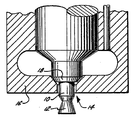
- the Figure of the Drawing illustrates the geometry of a typical throttling diesel nozzle (often referred to as the "pintle nozzle").
- the carbon tends to fill in all of the available corners and surfaces of the obturator 10 and the form 12 until a smooth profile is achieved.
- the carbon also tends to block the drilled orifice 14 in the injector body 16 and fill up to the seat 18.
- carbon builds up on the form 12 and the obturator 10 to such an extent that it interferes with the spray pattern of the fuel issuing from around the perimeter of orifice 14.
- Such carbon build up or coking often results in such undesirable consequences as delayed fuel injection, increased rate of fuel injection, increased rate of combustion chamber pressure rise, and increased engine noise, and can also result in an excessive increase in emission from the engine of unburned hydrocarbons.
- US-A-4,208,190 discloses the addition of certain straight chain aliphatic primary amines, such as oleyl amine, optionally with an organic nitrate ignition accelerator, as anti-wear additives in diesel engines operated with alcohols fuels, such as methanol or ethanol.
- this invention provides distillate fuel for indirect injection compression ignition engines containing at least the combination of (a) organic nitrate ignition accelerator, and (b) the condensation product of a high molecular weight alkylphenol, an aldehyde and an amine having at least one active hydrogen atom bonded to an amino nitrogen atom, said combination being present in an amount sufficient to minimize coking, especially throttling nozzle coking, in the prechambers or swirl chambers of indirect injection compression ignition engines operated on such fuel.
- Another embodiment of the present invention is a distillate fuel additive fluid concentrate comprising (a) organic nitrate ignition accelerator, and (b) the condensation product of a high molecular weight. alkylphenol, an aldehyde and an amine having at least one active hydrogen atom bonded to an amino nitrogen atom, which can be added to the distillate fuel in an amount sufficient to minimize the coking characteristics of such fuel, especially throttling nozzle coking, in the prechambers or swirl chambers of indirect compression ignition engines operated on such fuel.
- Still further embodiment of the present invention is a method of inhibiting coking, especially throttling nozzle coking, in the prechambers or swirl chambers of an indirect injection compression ignition engine, which comprises supplying said engine with a distillate fuel containing at least the combination of (a) organic nitrate ignition accelerator, and (b) the condensation product of a high molecular weight alkylphenol, an aldehyde and an amine having at least one active hydrogen atom bonded to an amino nitrogen atom, said combination being present in an amount sufficient to minimize such coking in an engine operated on such fuel.
- the amount of said combination of components which is sufficient to minimize coking in an engine operated on such fuel corresponds to an amount.of at least 0.286 gram of said ignition accelerator per liter of fuel and an amount of at least 0.1144 gram of said condensation product per liter of fuel.
- a feature of this invention is that the combination of additives utilized in its practice is capable of suppressing coking tendencies of fuels used to operate indirect injection compression ignition engines. Such behavior was exhibited in a series of standard engine dynamometer tests conducted as described in Example I hereinafter.
- nitrate ignition accelerators may be employed in the fuels of this invention.
- Preferred nitrate esters are the aliphatic or cycloaliphatic nitrates in which the aliphatic or cycloaliphatic group is saturated, contains up to 12 carbons and, optionally, may be substituted with one or more oxygen atoms.
- Typical organic nitrates that may be used are methyl nitrate, ethyl nitrate, propyl nitrate, isopropyl nitrate, allyl nitrate, butyl nitrate, isobutyl nitrate, sec-butyl nitrate, tert-butyl nitrate, amyl nitrate, isoamyl nitrate, 2-amyl nitrate, 3-amyl nitrate, hexyl nitrate, heptyl nitrate, 2-heptyl nitrate, octyl nitrate, isooctyl nitrate, 2-ethylhexyl nitrate, nonyl nitrate, decyl nitrate, undecyl nitrate, dodecyl nitrate, cyclopentyl nitrate, cyclohexyl
- the organic nitrate ignition accelerator-component (a) - should be present in an amount of at least 100 to 1000 PTB (pounds per thousand barrels) (0.286 to 2.86 grams per liter) of the base fuel.
- the concentration of the ignition accelerator is 400 to 600 PTB (1.144 to 1.716 grms/liter).
- condensation products, component (b) of the fuels of this invention are well known. They are made by condensing a phenol and preferably a high molecular weight alkylphenol, an aldehyde and ammonia or preferably an aliphatic amine having at least one reactive hydrogen atom bonded to nitrogen. In other words, an amine having at least one H-N group.
- This reaction is the well-known “Mannich reaction” (see “Organic Reactions,” Volume I).
- the conditions for carrying out such a condensation are well known.
- the preferred alkylphenol reactants is an alkylphenol wherein the alkyl radical has an average molecular weight of from 400 to 1500. In a more preferred alkylphenol reactant the alkyl radical has an average molecular weight of from 800 to 1300, and in the most preferred alkylphenols the alkyl radical has an average molecular weight of from 900 to 1100.
- Alkylphenols suitable for use in the preparation of the present invention are readily prepared by adaptation of methods well known in the art. For example, they may be prepared by the acid catalyzed alkylation of phenol with an olefin. In this method, a small amount of an acid catalyst such as sulfuric or phosphoric acid, or preferably a Lewis acid such as BF 3 -etherate, BF 3 -phenate complex or AICI O --HS0 4 , is added to the phenol and the olefin then added to the phenol at temperatures ranging from 0°C. up to 200°C. A preferred temperature range for this alkylation is from 25°C. to 150°C., and the most preferred range is from 50°C. to 100°C.
- the alkylation is readily carried out at atmospheric pressure, but if higher temperatures are employed the alkylation may be carried out at super atmospheric pressures up to about 1000 psig (69.96 x 10 5 P a ).
- the alkylation of phenols produces a mixture of mono-, di- and trio-alkylation phenols.
- the preferred reactants are the mono-alkylated phenols
- the alkylation mixture can be used without removing the higher alkylation products.
- the alkylation mixture formed by alkylating phenol with an olefin using an acid catalyst can be merely water washed to remove the unalkylated phenol and the acid catalyst and then used in the condensation reaction without removing the di- and tri-alkylated phenol products.
- Another method of removing the unreacted phenol is to distill it out, preferably using steam distillation or under vacuum, after washing out the alkylation catalyst.
- the maount of di-and tri-alkylated phenols can be kept at a minimum by restricting the amount of olefin reactant added to the phenol. Good results are obtained when the mole ratio of olefin to phenol is 0.25 moles of olefin per mole of phenol to 1.0 mole of olefin per mole of phenol. A more preferred ratio is from 0.33 to 0.9, and a most preferred ratio is from 0.5 to 0.67 moles of olefin per mole of phenol.
- the olefin reactant used to alkylate the phenol is preferably a monoolefin with an average molecular weight of from 400 to 1500.
- the more preferred olefins are those formed from the polymerization of low molecular weight olefins containing from 2 to 10 carbon atoms, such as ethylene, propylene, butylene, pentene and decene. These result in polyalkene substituted phenols.
- a most preferred olefin is that made by the polymerization of propylene or butene to produce a polypropylene or polybutene mixture with an average molecular weight of from 900-1100. This gives the highly preferred polypropylene and polybutene substituted phenols.
- the aldehyde reactant preferably contains from 1 to 7 carbon atoms. Examples are formaldehyde, acetaldehyde, propionaldehyde, butyraldehyde, valeraldehyde, hexaldehyde and heptaldehyde.
- the more preferred aldehyde reactants are the low molecular weight aliphatic aldehydes containing from 1 to 4 carbon atoms such as formaldehyde, acetaldehyde, butyraldehyde and isobutyraldehyde.
- the most preferred aldehyde reactant is formaldehyde, which may be used in its monomeric or its polymeric form such as paraformaldehyde.
- the amine reactants contain at least one active hydrogen atom bonded to an amino nitrogen atom, such that they can partake in a Mannich condensation. They may be primary amines, secondary amines or may contain both primary and secondary amino groups. Examples include the primary alkyl amines such as methyl amine, ethyl amine, n-propyl amine, isopropyl amine, n-butyl amine, isobutyl amine, 2-ethyhexyl amine, dodecyl amine, stearyl amine, eicosyl amine, triacontyl amine, pentacontyl amine, and the like, including those in which the alkyl group contains from 1 to 50 carbon atoms.
- dialkyl amines may be used such as dimethyl amine, diethyl amine, methylethyl amine, methybutyl amine, di-n-hexyl amine, methyl dodecyl amine, dieicosyl amine, methyl triacontyl amine, dipentacontyl amine, and the like, including mixtures thereof.
- N-substituted compounds such as the N-alkyl imidazolidines and pyrimidines.
- aromatic amines having a reactive hydrogen atom attached to nitrogen can be used. These include aniline, N-methyl aniline, ortho, meta and para phenylene diamines, -naphthyl amine, N-isopropyl phenylene diamine, and the like.
- Secondary heterocyclic amines are likewise useful including morpholine, thiomorpholine, pyrrole, pyrroline, pyrrolidine, indole, pyrazole, pyrazoline, pyrazolidine, imidazole, imidazoline, imidazolidine, piperidine, phenoxazine, phenathiazine, and mixtures thereof, including their substituted homologs in which the substituent groups include alkyl, aryl, alkaryl, aralkyl, cycloalkyl, and the like.
- a preferred class of amine reactants is the diamines represented by the formula: wherein R 3 is a divalent alkylene radical containing 1-6 carbon atoms, and R 4 and R 5 are selected from the group consisting of alkyl radicals containing from 1-6 carbon atoms and radicals having the formula: wherein R 6 is a divalent alkylene radical containing from 1 ⁇ 6 carbon atoms, and X is selected from the group consisting of the hydroxyl radical and the amine radical.
- divalent alkylene radical as used herein means a divalent saturated aliphatic hydrocarbon radical having the empirical formula: wherein n is an integer from 1 to 6.
- R 3 is a lower alkylene radical such as the ⁇ C 2 H 47 ⁇ , ⁇ C 3 H 6 ⁇ , or C 4 H 6 ⁇ groups.
- the two amine groups may be bonded to the same or different carbon atoms.
- diamine reactants wherein the amine groups are attached to the same carbon atoms of the alkylene radical R 3 are N,N-dialkylmethylenediamine, N,N-dialkanol-1,3-ethanediamine, and N,N-di(aminoalkyl)-2,2-propanediamine.
- diamine reactants in which the amine groups are bonded to adjacent carbon atoms of the R 3 alkylene radical are N,N-dialkyl-1,2-ethanediamine, N,N-dialkanol-1,2-propanediamine, N,N-di-(aminoalkyl)-2,3-butanediamine, and N,N-dialkyl-2,3-(4-methylpentane)diamine.
- diamine reactants in which the amine groups are bonded to carbon atoms on the alkylene radical represented by R 3 which are removed from each other by one or more intervening carbon atoms are N,N-dialkyl-1,3-propanediamine, N,N-dialkanol-1,3-butanediamine, N,N-di(aminoalkyl)-1,4-butanediamine, and N,N-dialkyl-1,3 hexanediamine.
- R 4 and R 5 are alkyl radicals containing 1 to 6 carbon atoms which are substituted with the hydroxyl or amine radical.
- hydroxyl substituted radicals are 2-hydroxy-n-propyl, 2-hydroxyethyl, 2-hydroxy-n-hexyl, 3-hydroxy-n-propyl, 4-hydroxy-3-ethyl-n-butyl, and the like.
- amine substituted R 4 and R 5 radicals are 2-amino-ethyl, 2-amino-n-propyl, 4-amino-n-butyl, 4-amino-3,3-dimethyl-n-buty, 6-amino-n-hexyl, and the like.
- R 4 and R 5 radicals are unsubstituted alkyl radicals such as methyl, ethyl, n-propyl, isopropyl, sec-butyl, n-amyl, n-hexyl, 2-methyl- n-pentyl, and the like.
- the most preferred R 4 and R 5 substituents are methyl radicals.
- diamine reactants are N,N-dimethyl-1,3-propanediamine, N,N-dibutyl-1,3-propanediamine, N,N-dihexyl-1,3-propanediamine, N,N-dimethyl-1,2-propanediamine, N,N-dimethy-1,1-propanediamine, N,N-dimethyl-1,3-hexanediamine, N,N-dimethyl-1,3-butanediamine, N,N-di(2-hydroxyethyl)-1,3-propanediamine, N,N-di(2-hydroxybutyl)-1,3-propanediamine, N,N-di(6-hydroxyhexyl)-1,1-hexanediamine, N,N-di(2-aminoethyl)-1,3-propanediamine, N,N-di(2-amino-n-hexyl)-1,2-butanediamine, N,N-di(2-a
- alkylene polyamines which have the formula: wherein R 8 , R 9 and R 10 are selected from hydrogen and lower alkyl radicals containing 1-4 carbon atoms, and R 7 is a divalent saturated aliphatic hydrocarbon radical containing from 2 to 4 carbon atoms and m is an integer from 0 to 4.
- Examples of these are ethylene diamine, diethylene triamine, propylene diamine, dipropylene triamine, tripropylene tetraamine, tetrapropylene pentamine, butylene diamine, dibutylene trimine, diisobutylene triamine, tributylene tetramine, and the like, including the NC 1 - 4 alkylsubstituted homologs.
- a most preferred class of amine reactants is the ethylene polyamines. These are described in detail in Kirk-Othmer, "Encyclopedia of Chemical Technology," Vol. 5, pages 898-9, Interscience Publishers Inc., New York. These include the series ethylene diamine, diethylene triamine, triethylene tetramine, tetraethylene pentamine, pentaethylene hexamine, and the like.
- a particularly preferred amine reactant is a mixture of ethylene polyamines containing a substantial amount of triethylene tetramine and tetraethylene pentamine.
- the condensation products are easily prepared by mixing together the alkylphenol, the aldehyde reactant and the amine reactant, and heating them to a temperature sufficient to cause the reaction to occur.
- the reaction may be carried out without any solvent, but the use of a solvent is usually preferred.
- Preferred solvents are the water immiscible solvents including water-insoluble alcohols (e.g., amyl alcohol) and hydrocarbons.
- the more preferred water-immiscible solvents are hydrocarbon solvents boiling from 50°C. to 100°C.
- Highly preferred solvents are the aromatic hydrocarbon solvents such as benzene, toluene, xylene, and the like. Of these, the most preferred solvent is toluene.
- the amount of solvent employed is not critical. Good results are obtained when from one to about 50 percent of the reaction mass is solvent. A more preferred quantity is from 3 to 25 percent, and a most preferred quantity of solvent is from 5 to 10 percent.
- the ratio of reactants per mole of alkylphenol can vary from 1 to 5 moles of aldehyde reactant and 0.5-5 moles of amine reactant. Molar amounts of amine less than one can be used when the amine contains more than one H-N group, such as in the ethylene polyamines (e.g., tetraethylenepentamine).
- a more preferred reactant ratio based on one mole of alkylphenol is from 2.5 to 4 moles of aldehyde and from 1.5 to 2.5 moles of amine reactant.
- a most preferred ratio of reactants is 2 moles of alkylphenol to 3 moles of aldehyde to 2 moles of amine reactant.
- This ratio gives an especially useful product when the alkylphenol is a polybutene-substituted phenol in which the polybutene group has a molecular weight of 900-1100, the aldehyde is formaldehyde and the amine is N,N-dimethyl-1,3-propanediamine.
- the condensation reaction will occur by simply warming the reactant mixture to a temperature sufficient to effect the reaction.
- the reaction will proceed at temperatures ranging from 50°C. to 200°C. A more preferred temperature range is from 75°C. to 175°C.
- a solvent it is desirable to conduct the reaction at the reflux temperature of the solvent-containing reaction mass.
- the condensation proceeds at 100°C. to 150°C. as the water formed in the reaction is removed.
- the water formed in the reaction co-distills together with the water-immiscible solvent, permitting its removal from the reaction zone. During this water removal portion of the reaction period the water-immiscible solvent is returned to the reaction zone after separating water from it.
- the time required to complete the reaction depends upon the reactants employed and the reaction temperature used. Under most conditions the reaction is complete in from 1 to 8 hours.
- the reaction product is a viscous oil and is usually diluted with a neutral oil to aid in handling.
- a particularly useful mixture is about two-thirds condensation product and one-third neutral oil.
- distillate fuel for indirect injection compression ignition engines containing at least the combination of (a) organic nitrate ignition accelerator, and (b) the condensation product of:
- distillate fuel additive fluid composition comprising (a) organic nitrate ignition accelerator, and (b) the condensation product of:
- the fuels of this invention should contain at least 40 PTB (pounds per thousand barrels) (0.1144 grams/ liter) of component (b), the condensation product, although smaller amounts may be successfully employed.
- the coking-inhibiting components (a) and (b) of the invention can be added to the fuels by any means known in the art for incorporating small quantities of additives into distillate fuels.
- Components (a) and (b) can be added separately or they can be combined and added together. It is convenient to utilize additive fluid mixtures which consist of organic nitrate ignition accelerator and the condensation products of this invention. These additive fluid mixtures are added to distillate fuels.
- part of the present invention are coking inhibiting fluids which comprise organic nitrate ignition accelerator and the condensation product of a high molecular weight alkylphenol, an aldehyde and an amine having a H-N group.
- the amount of components (a) and (b) can vary widely.
- the fluid compositions contain 5% to 95% by weight of the organic nitrate ignition accelerator component and from 95% to 5% by weight of the condensation product component.
- the combination typically, from 0.01 % by weight up to 1.0% by weight of the combination will be sufficient to provide good coking-inhibiting properties to the distillate fuel.
- a preferred distillate fuel composition contains from 0.1% to 0.5% by weight of the combination containing from 25% to 95% by weight of the organic nitrate ignition accelerator, and from 75% to 5% by weight of the condensation product component.
- the additive fluids, as well as the distillate fulel compositions of the present invention may also contain other additives such as, corrosion inhibitors, antioxidants, metal deactivators, detergents, cold flow improvers, inert solvents or diluents, and the like.
- the base fuel employed in these engine tests was a commercially-available diesel fuel having a nominal cetane rating of 46.2.
- FIA analysis indicated the fuel was composed by volume of 32.1 % aromatics. Its distillation range (ASTM D-86) was as follows:
- Fuel A contained a combination of (i) 509 PTB (1.456 grams/liter) of mixed octyl nitrates (a commercial product available from Ethyl Corporation under the designation DII-3 Ignition Improver), (ii) 38 PTB (0.1087 grams/liter) of the reaction product of a polybutene-substituted phenol in which the polybutene group had a molecular weight of about 900-1100, formaldehyde and N,N-dimethyl-1 ,3-propanediamine, and (iii) 1.2 PTB (0.0034 grams/liter) of "Ethyl" Metal Deactivator, a product of Ethyl Corporation, the active ingredient of which is N,N'-disalicylidene-1,2-diaminopropane.
- Fuel A also contained 1.0 PTB (0.00286 grams/liter) of a corrosion inhibitor produced by the Alox Corporation of Niagara Falls, New York sold commercially under the designation Alox 1846.
- the product is described by the manufacturer as an oxygenerated hydrocarbon in which a portion of the free organic acid produced by oxidation is neutralized with an amine.
- the manufacturer lists the following typical properties for its "Alox 1846" corrosion inhibitor:
- a solvent comprised of a mixture of C s to C 13 aromatic hydrocarbons produced by the Ashland Chemical Company of Columbus, Ohio and sold under the designation Hysol 70B and 1.2 PTB (0.00343 grams/liter) of a demulsifier produced by the Treatolite Division of the Petrolite Corporation of St. Louis sold under the designation Tolad 286 which is believed to consist for the most part of an aryl sulfonate, a polyether glycol and an oxyalkylated phenol formaldehyde resin.
- Shell Rotella T an SAE 30, SF/CD oil was used as the crankcase lubricant.
- Hydrocarbon exhaust emissions were measured at the start of each test (after the first 16-minute cycle), at the 6-hour test interval and at the end of the test. These measurements were made at 750, 1000, and 1400 rpm idle. Noise level readings were made at a location three feet from the engine exhaust side. The measurements were made at the start and at the end of the test while operating at three idle speeds, viz., 750, 1000 and 1400 rpm.
- Example 1 The test procedure of Example 1 was repeated with the exception that a different base fuel was used.
- the base fuel employed in this set of engine tests was a commercially available diesel fuel having a nominal cetane rating of 41.
- a test blend was prepared from this base fuel (Fuel B), which contained 38 PTB (0.1087 grams/liter) of the reaction product of a polybutene substituted phenol in which the polybutene group had a molecular weight of about 900-1100, formaldehyde and N,N-dimethyl-1,3-propanediamine, 509 PTB (1.4557 grams/ liter) of DII-3, 1.2 PTB (0.00343 grams/liter) of "Ethyl" Metal Deactivator, 1.0 PTB (0.00286 grams/liter) of Alox 1846, 19 PTB (0.0543 grams/liter) of Hysol 70B and 1.2 PTB (0.00343 grams/liter) of Tolad 286.
- the test results are given in Table II below.
Landscapes
- Chemical & Material Sciences (AREA)
- Oil, Petroleum & Natural Gas (AREA)
- Engineering & Computer Science (AREA)
- Chemical Kinetics & Catalysis (AREA)
- General Chemical & Material Sciences (AREA)
- Organic Chemistry (AREA)
- Solid Fuels And Fuel-Associated Substances (AREA)
- Liquid Carbonaceous Fuels (AREA)
Claims (9)


Priority Applications (1)
| Application Number | Priority Date | Filing Date | Title |
|---|---|---|---|
| AT85401724T ATE37899T1 (de) | 1984-10-15 | 1985-09-05 | Diesel-brennstoffzusammensetzungen. |
Applications Claiming Priority (2)
| Application Number | Priority Date | Filing Date | Title |
|---|---|---|---|
| US661222 | 1984-10-15 | ||
| US06/661,222 US4553979A (en) | 1984-10-15 | 1984-10-15 | Diesel fuel compositions |
Publications (2)
| Publication Number | Publication Date |
|---|---|
| EP0178960A1 EP0178960A1 (fr) | 1986-04-23 |
| EP0178960B1 true EP0178960B1 (fr) | 1988-10-12 |
Family
ID=24652679
Family Applications (1)
| Application Number | Title | Priority Date | Filing Date |
|---|---|---|---|
| EP85401724A Expired EP0178960B1 (fr) | 1984-10-15 | 1985-09-05 | Compositions combustibles pour Diesel |
Country Status (6)
| Country | Link |
|---|---|
| US (1) | US4553979A (fr) |
| EP (1) | EP0178960B1 (fr) |
| JP (1) | JPS6197390A (fr) |
| AT (1) | ATE37899T1 (fr) |
| CA (1) | CA1241839A (fr) |
| DE (1) | DE3565555D1 (fr) |
Families Citing this family (7)
| Publication number | Priority date | Publication date | Assignee | Title |
|---|---|---|---|---|
| US4944770A (en) * | 1988-09-02 | 1990-07-31 | Texaco, Inc. | Motor fuel additive and ori-inhibited motor fuel composition |
| US5047069A (en) * | 1989-07-27 | 1991-09-10 | Petrolite Corporation | Antioxidants for liquid hydrocarbons |
| GB9621263D0 (en) † | 1996-10-11 | 1996-11-27 | Exxon Chemical Patents Inc | Lubricity additives for fuel oil compositions |
| GB0021970D0 (en) | 2000-09-07 | 2000-10-25 | Octel Starreon Llc | Diesel fuel stabiliser |
| AU2002341150A1 (en) * | 2001-11-02 | 2003-05-12 | Octel America, Inc. | Method |
| WO2010039282A1 (fr) * | 2008-10-01 | 2010-04-08 | Baker Hughes Incorporated | Additif de combustible utile pour l'augmentation de la puissance en chevaux-vapeur |
| GB202113683D0 (en) * | 2021-09-24 | 2021-11-10 | Innospec Ltd | Use and method |
Family Cites Families (8)
| Publication number | Priority date | Publication date | Assignee | Title |
|---|---|---|---|---|
| US2280217A (en) * | 1938-11-30 | 1942-04-21 | Standard Oil Dev Co | Super-diesel fuel |
| US2785662A (en) * | 1953-04-06 | 1957-03-19 | Leonard D Boyce | Compositions and methods for removing deposits |
| US3994698A (en) * | 1972-02-29 | 1976-11-30 | Ethyl Corporation | Gasoline additive concentrate composition |
| US4231759A (en) * | 1973-03-12 | 1980-11-04 | Standard Oil Company (Indiana) | Liquid hydrocarbon fuels containing high molecular weight Mannich bases |
| US3980569A (en) * | 1974-03-15 | 1976-09-14 | The Lubrizol Corporation | Dispersants and process for their preparation |
| US4116644A (en) * | 1975-03-24 | 1978-09-26 | Jackisch Philip F | Gasoline compositions |
| US4208190A (en) * | 1979-02-09 | 1980-06-17 | Ethyl Corporation | Diesel fuels having anti-wear properties |
| US4482356A (en) * | 1983-12-30 | 1984-11-13 | Ethyl Corporation | Diesel fuel containing alkenyl succinimide |
-
1984
- 1984-10-15 US US06/661,222 patent/US4553979A/en not_active Expired - Lifetime
-
1985
- 1985-09-05 DE DE8585401724T patent/DE3565555D1/de not_active Expired
- 1985-09-05 EP EP85401724A patent/EP0178960B1/fr not_active Expired
- 1985-09-05 AT AT85401724T patent/ATE37899T1/de not_active IP Right Cessation
- 1985-09-13 CA CA000490688A patent/CA1241839A/fr not_active Expired
- 1985-10-14 JP JP60228548A patent/JPS6197390A/ja active Granted
Also Published As
| Publication number | Publication date |
|---|---|
| CA1241839A (fr) | 1988-09-13 |
| EP0178960A1 (fr) | 1986-04-23 |
| JPS6197390A (ja) | 1986-05-15 |
| ATE37899T1 (de) | 1988-10-15 |
| US4553979A (en) | 1985-11-19 |
| DE3565555D1 (en) | 1988-11-17 |
| JPS6310199B2 (fr) | 1988-03-04 |
Similar Documents
| Publication | Publication Date | Title |
|---|---|---|
| EP0251419B1 (fr) | Composition combustible et concentrés d'additifs, et leurs utilisations pour inhiber la formation de dépôts dans un moteur | |
| US4482357A (en) | Fuel Compositions | |
| US4482356A (en) | Diesel fuel containing alkenyl succinimide | |
| US4398921A (en) | Gasohol compositions | |
| US4357148A (en) | Method and fuel composition for control or reversal of octane requirement increase and for improved fuel economy | |
| RU2487924C2 (ru) | Топливная композиция | |
| US20100107476A1 (en) | Compositions and Methods Including Hexahydrotriazines Useful as Direct Injection Fuel Additives | |
| US4568358A (en) | Diesel fuel and method for deposit control in compression ignition engines | |
| US6270539B1 (en) | Mannich dispersants with enhanced lubricity | |
| JPH07197052A (ja) | 燃料組成物およびそれ用の添加剤 | |
| US4553979A (en) | Diesel fuel compositions | |
| CA1142360A (fr) | Compose cyclomatique manganesien avec une polyamine aliphatique dans un carburant pour moteurs a c.i. | |
| US4482355A (en) | Diesel fuel compositions | |
| AU2014314324B2 (en) | Methods and uses for controlling deposits on valves in direct-injection spark-ignition engines | |
| US20060277819A1 (en) | Synergistic deposit control additive composition for diesel fuel and process thereof | |
| AU2014314325A1 (en) | Methods and uses for intake-valve and direct-injector deposit clean-up. | |
| US20170260468A1 (en) | Additive and fuel compositions | |
| EP0133375B1 (fr) | Combustibles pour moteurs Diesel, compositions et mélanges d'additifs pour leur production et l'utilisation de ceux-ci | |
| US4588417A (en) | Fuel compositions | |
| US8070837B2 (en) | Use of fatty acid alkoxylates as a method to remedy engine intake valve sticking | |
| EP1568757A1 (fr) | Dispersants mannich à forte teneur en amine pour combustibles à ignition par compression | |
| CA2005707A1 (fr) | Composition stabilisatrice pour combustible | |
| US9650583B2 (en) | Additive and fuel compositions containing detergent and fluidizer and method thereof | |
| EP3191568B1 (fr) | Utilisations pour maîtriser les émissions de particules dans un moteur à combustion interne |
Legal Events
| Date | Code | Title | Description |
|---|---|---|---|
| PUAI | Public reference made under article 153(3) epc to a published international application that has entered the european phase |
Free format text: ORIGINAL CODE: 0009012 |
|
| AK | Designated contracting states |
Kind code of ref document: A1 Designated state(s): AT BE CH DE FR GB IT LI LU NL SE |
|
| 17P | Request for examination filed |
Effective date: 19860704 |
|
| 17Q | First examination report despatched |
Effective date: 19861201 |
|
| GRAA | (expected) grant |
Free format text: ORIGINAL CODE: 0009210 |
|
| AK | Designated contracting states |
Kind code of ref document: B1 Designated state(s): AT BE CH DE FR GB IT LI LU NL SE |
|
| REF | Corresponds to: |
Ref document number: 37899 Country of ref document: AT Date of ref document: 19881015 Kind code of ref document: T |
|
| ITF | It: translation for a ep patent filed | ||
| REF | Corresponds to: |
Ref document number: 3565555 Country of ref document: DE Date of ref document: 19881117 |
|
| ET | Fr: translation filed | ||
| PLBE | No opposition filed within time limit |
Free format text: ORIGINAL CODE: 0009261 |
|
| STAA | Information on the status of an ep patent application or granted ep patent |
Free format text: STATUS: NO OPPOSITION FILED WITHIN TIME LIMIT |
|
| 26N | No opposition filed | ||
| PGFP | Annual fee paid to national office [announced via postgrant information from national office to epo] |
Ref country code: SE Payment date: 19920814 Year of fee payment: 8 Ref country code: CH Payment date: 19920814 Year of fee payment: 8 Ref country code: AT Payment date: 19920814 Year of fee payment: 8 |
|
| PGFP | Annual fee paid to national office [announced via postgrant information from national office to epo] |
Ref country code: LU Payment date: 19920828 Year of fee payment: 8 |
|
| ITTA | It: last paid annual fee | ||
| PGFP | Annual fee paid to national office [announced via postgrant information from national office to epo] |
Ref country code: NL Payment date: 19920930 Year of fee payment: 8 |
|
| EPTA | Lu: last paid annual fee | ||
| PG25 | Lapsed in a contracting state [announced via postgrant information from national office to epo] |
Ref country code: LU Free format text: LAPSE BECAUSE OF NON-PAYMENT OF DUE FEES Effective date: 19930905 Ref country code: AT Effective date: 19930905 |
|
| PG25 | Lapsed in a contracting state [announced via postgrant information from national office to epo] |
Ref country code: SE Effective date: 19930906 |
|
| PG25 | Lapsed in a contracting state [announced via postgrant information from national office to epo] |
Ref country code: LI Effective date: 19930930 Ref country code: CH Effective date: 19930930 |
|
| PG25 | Lapsed in a contracting state [announced via postgrant information from national office to epo] |
Ref country code: NL Effective date: 19940401 |
|
| NLV4 | Nl: lapsed or anulled due to non-payment of the annual fee | ||
| REG | Reference to a national code |
Ref country code: CH Ref legal event code: PL |
|
| EUG | Se: european patent has lapsed |
Ref document number: 85401724.1 Effective date: 19940410 |
|
| PGFP | Annual fee paid to national office [announced via postgrant information from national office to epo] |
Ref country code: DE Payment date: 19960820 Year of fee payment: 12 |
|
| PG25 | Lapsed in a contracting state [announced via postgrant information from national office to epo] |
Ref country code: DE Free format text: LAPSE BECAUSE OF NON-PAYMENT OF DUE FEES Effective date: 19980603 |
|
| PGFP | Annual fee paid to national office [announced via postgrant information from national office to epo] |
Ref country code: GB Payment date: 20000825 Year of fee payment: 16 |
|
| PGFP | Annual fee paid to national office [announced via postgrant information from national office to epo] |
Ref country code: BE Payment date: 20000908 Year of fee payment: 16 |
|
| PG25 | Lapsed in a contracting state [announced via postgrant information from national office to epo] |
Ref country code: GB Free format text: LAPSE BECAUSE OF NON-PAYMENT OF DUE FEES Effective date: 20010905 |
|
| PG25 | Lapsed in a contracting state [announced via postgrant information from national office to epo] |
Ref country code: BE Free format text: LAPSE BECAUSE OF NON-PAYMENT OF DUE FEES Effective date: 20010930 |
|
| BERE | Be: lapsed |
Owner name: ETHYL PETROLEUM ADDITIVES INC. Effective date: 20010930 |
|
| PGFP | Annual fee paid to national office [announced via postgrant information from national office to epo] |
Ref country code: FR Payment date: 20040920 Year of fee payment: 20 |