EP0179330A2 - Train de laminoirs pour un appareil de moulage placé en amont et à action continue pour la fabrication de fil - Google Patents
Train de laminoirs pour un appareil de moulage placé en amont et à action continue pour la fabrication de fil Download PDFInfo
- Publication number
- EP0179330A2 EP0179330A2 EP85112561A EP85112561A EP0179330A2 EP 0179330 A2 EP0179330 A2 EP 0179330A2 EP 85112561 A EP85112561 A EP 85112561A EP 85112561 A EP85112561 A EP 85112561A EP 0179330 A2 EP0179330 A2 EP 0179330A2
- Authority
- EP
- European Patent Office
- Prior art keywords
- stands
- rolling
- stand
- roll
- vario
- Prior art date
- Legal status (The legal status is an assumption and is not a legal conclusion. Google has not performed a legal analysis and makes no representation as to the accuracy of the status listed.)
- Granted
Links
Images





Classifications
-
- B—PERFORMING OPERATIONS; TRANSPORTING
- B21—MECHANICAL METAL-WORKING WITHOUT ESSENTIALLY REMOVING MATERIAL; PUNCHING METAL
- B21B—ROLLING OF METAL
- B21B1/00—Metal-rolling methods or mills for making semi-finished products of solid or profiled cross-section; Sequence of operations in milling trains; Layout of rolling-mill plant, e.g. grouping of stands; Succession of passes or of sectional pass alternations
- B21B1/46—Metal-rolling methods or mills for making semi-finished products of solid or profiled cross-section; Sequence of operations in milling trains; Layout of rolling-mill plant, e.g. grouping of stands; Succession of passes or of sectional pass alternations for rolling metal immediately subsequent to continuous casting
- B21B1/463—Metal-rolling methods or mills for making semi-finished products of solid or profiled cross-section; Sequence of operations in milling trains; Layout of rolling-mill plant, e.g. grouping of stands; Succession of passes or of sectional pass alternations for rolling metal immediately subsequent to continuous casting in a continuous process, i.e. the cast not being cut before rolling
-
- B—PERFORMING OPERATIONS; TRANSPORTING
- B21—MECHANICAL METAL-WORKING WITHOUT ESSENTIALLY REMOVING MATERIAL; PUNCHING METAL
- B21B—ROLLING OF METAL
- B21B35/00—Drives for metal-rolling mills, e.g. hydraulic drives
- B21B35/02—Drives for metal-rolling mills, e.g. hydraulic drives for continuously-operating mills
-
- B—PERFORMING OPERATIONS; TRANSPORTING
- B21—MECHANICAL METAL-WORKING WITHOUT ESSENTIALLY REMOVING MATERIAL; PUNCHING METAL
- B21B—ROLLING OF METAL
- B21B1/00—Metal-rolling methods or mills for making semi-finished products of solid or profiled cross-section; Sequence of operations in milling trains; Layout of rolling-mill plant, e.g. grouping of stands; Succession of passes or of sectional pass alternations
- B21B1/16—Metal-rolling methods or mills for making semi-finished products of solid or profiled cross-section; Sequence of operations in milling trains; Layout of rolling-mill plant, e.g. grouping of stands; Succession of passes or of sectional pass alternations for rolling wire rods, bars, merchant bars, rounds wire or material of like small cross-section
- B21B1/18—Metal-rolling methods or mills for making semi-finished products of solid or profiled cross-section; Sequence of operations in milling trains; Layout of rolling-mill plant, e.g. grouping of stands; Succession of passes or of sectional pass alternations for rolling wire rods, bars, merchant bars, rounds wire or material of like small cross-section in a continuous process
-
- B—PERFORMING OPERATIONS; TRANSPORTING
- B21—MECHANICAL METAL-WORKING WITHOUT ESSENTIALLY REMOVING MATERIAL; PUNCHING METAL
- B21B—ROLLING OF METAL
- B21B13/00—Metal-rolling stands, i.e. an assembly composed of a stand frame, rolls, and accessories
- B21B13/005—Cantilevered roll stands
-
- B—PERFORMING OPERATIONS; TRANSPORTING
- B21—MECHANICAL METAL-WORKING WITHOUT ESSENTIALLY REMOVING MATERIAL; PUNCHING METAL
- B21B—ROLLING OF METAL
- B21B3/00—Rolling materials of special alloys so far as the composition of the alloy requires or permits special rolling methods or sequences ; Rolling of aluminium, copper, zinc or other non-ferrous metals
- B21B2003/005—Copper or its alloys
-
- B—PERFORMING OPERATIONS; TRANSPORTING
- B21—MECHANICAL METAL-WORKING WITHOUT ESSENTIALLY REMOVING MATERIAL; PUNCHING METAL
- B21B—ROLLING OF METAL
- B21B35/00—Drives for metal-rolling mills, e.g. hydraulic drives
- B21B2035/005—Hydraulic drive motors
-
- B—PERFORMING OPERATIONS; TRANSPORTING
- B21—MECHANICAL METAL-WORKING WITHOUT ESSENTIALLY REMOVING MATERIAL; PUNCHING METAL
- B21B—ROLLING OF METAL
- B21B3/00—Rolling materials of special alloys so far as the composition of the alloy requires or permits special rolling methods or sequences ; Rolling of aluminium, copper, zinc or other non-ferrous metals
- B21B3/003—Rolling non-ferrous metals immediately subsequent to continuous casting, i.e. in-line rolling
-
- B—PERFORMING OPERATIONS; TRANSPORTING
- B21—MECHANICAL METAL-WORKING WITHOUT ESSENTIALLY REMOVING MATERIAL; PUNCHING METAL
- B21B—ROLLING OF METAL
- B21B31/00—Rolling stand structures; Mounting, adjusting, or interchanging rolls, roll mountings, or stand frames
- B21B31/16—Adjusting or positioning rolls
- B21B31/20—Adjusting or positioning rolls by moving rolls perpendicularly to roll axis
- B21B31/22—Adjusting or positioning rolls by moving rolls perpendicularly to roll axis mechanically, e.g. by thrust blocks, inserts for removal
- B21B31/26—Adjusting eccentrically-mounted roll bearings
Definitions
- the invention relates to a rolling mill for an upstream, continuous working G monanla g e Wire manufacturing with several horizontal and vertical mill stands, each having individually Vario frameworks adjustable roller speeds, and with horizontal and vertical rolling stands driven jointly with mutually rigid speed ratios are.
- Casting and rolling systems in particular for the production of copper or steel wire - consisting essentially of a continuously operating casting machine together with a cooling compensation section and a drive unit as well as a subsequent rolling mill - are usually equipped with a few independently variable individual stands to adapt to changing operating conditions and to avoid malfunctions, which are upstream or downstream of a multi-stand mill block with central drive.
- the configuration of the last two roll stands as individual stands is particularly desirable because even small, unavoidable temperature differences in the strand lead to differences in the wire diameter and therefore with regard to the required dimensional tolerances have to be caught.
- it must be ensured that the strand runs through two adjacent rolling stands, as far as possible without tensile and compressive stresses, in particular in the last rolling stands. The latter, in particular, leads to the strand jamming in front of the subsequent roll stand, forming a knot, and finally tearing off.
- the strand in the area of the last rolling stands has been monitored by means of a loop control, that is to say by means of photoelectric scanning of a loop, the height of which is kept within a predetermined fluctuation range by adjusting the speed of the rolling stands.
- a group drive for several roll stands of a rolling mill is already known from German patent specification 970 102. Starting from the basic speed of the group drive, the speed of each roll stand can be changed via an associated differential gear, which is equipped with an auxiliary drive that is adjustable in speed and acts on the total gear.
- the invention has for its object to develop a rolling mill as part of a casting and rolling mill, which can be used with reasonable effort for casting and rolling machines of lower performance, allows adaptation to changing operating conditions and which is based on the statement whether the strand is under tension or pressure who are at risk of Reduces operational disruptions and facilitates the manufacture of a flawless product.
- the basic idea of the invention is to connect all the rolling stands of the rolling mill to a central drive, but at the same time to design the two first and last two rolling stands individually as variable speed stands; the entire rolling mill thus forms a rolling block with four Vario stands.
- the second and third vario stands i.e. the second and second to last roll stands in the rolling direction
- the adjacent roll stand which are pivotably arranged, and which accommodate the associated pair of rolls together with drive elements and which are each supported on two pressure transducers, which are effectively held in the roll stand in the rolling direction or in the counter-rolling direction.
- the two adjacent chocks move towards one another and stress the internal pressure transducers with respect to the strand section.
- the display of the pressure cells loaded in each case can thus be used as an output signal for a change in the roller speed of the relevant variator stands in order to set an unlatched state in the strand.
- the speed-changing adjustment unit belonging to each Vario scaffold can be mechanical, hydraulic or be electrically effective. It is preferably designed (regardless of its other configuration) in such a way that it enables the speed of the Vario stand rollers to be changed continuously or rapidly.
- a PIV transmission is particularly suitable as a speed-changing adjustment unit (claim 2). It is a form-fitting gear, which essentially consists of two pairs of conical disks with conical disks that can be moved against each other and a chain as a power transmission. Such gears are particularly suitable for small torques and high speeds and can therefore be used without additional gears, in particular on the two last vario stands of the rolling mill in the rolling direction.
- the vario stands are connected to the central drive by means of hydraulic adjusting gears, each consisting of a hydraulic pump with a downstream hydraulic motor.
- the hydraulic pump is driven at the primary speed of the central drive; the output speed of the adjustment gear can be changed continuously in a known manner.
- the invention can be implemented particularly well if the rolling stands - which have pivotably arranged chocks - are equipped with overhung rollers, the pitch of which can be changed via eccentric bushes held in the chocks (claim 4).
- a rolling stand of this type is known, for example, from European patent O 042 879.
- the speed-changing adjusting units are preferably driven via the free ends of the main drive shafts and the rollers of the vario stands via hollow shafts which surround the main drive shaft in question coaxially with it (claim 5).
- the adjustment unit is thus connected on the drive side to the main drive shaft in question and on the drive side via the hollow shaft to the associated vario scaffold.
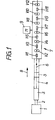
- the casting and rolling plant for producing copper wire shown by way of example in FIG. 1 has the following the main components: an intermediate container 1 for receiving liquid copper, which is connected to a casting machine 3 via a feed channel 2, a cooling section 4 with a drive unit 5 for the onward transport of the strand 6 leaving the casting machine and a subsequent rolling train 7.
- this consists of twelve roll stands, namely the horizontal roll stands H1, H3, H5, H7, H9 and H11 as well as the vertical roll stands V2, V4, V6, V8, V10 and V12 ; a vertical roll stand is followed by a vertical roll stand.
- the rolling mill 7 is combined to form a rolling block by means of a central drive 9 which is arranged in the center and is common to all the rolling stands.
- the central drive is located between the vertical mill stand V6 and the subsequent horizontal mill stand H7.
- the central drive 9 designed as a DC motor drives a downstream branching gear 10 via its shaft 9a to drive four main drive shafts 11 to 14 rotating at different speeds (FIG. 2).
- the first and second as well the penultimate and last roll stand with the interposition of a speed-changing adjusting unit 16, 17, 18 and 19 driven by the associated main drive shaft 11 to 14.
- the adjustment unit is designed in such a way that the speed of the roll stands in question - which are accordingly referred to as vario stands - can be changed continuously regardless of the speed of the main drive shaft.
- All variometer stands H1, V2, H11, V12 have speed sensors 20.
- the second and penultimate Vario stand V2 or H11 and the adjacent roll stand H3 or V10 are each equipped with pressure transducers 21L, 21R arranged in pairs, the task and mode of operation of which will be described later.
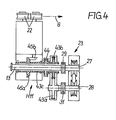
- a PIV transmission 23 which in a known manner consists of two conical disk pairs 24, 25 with a chain 26 as a transmission element.
- the translation between the input shaft 27 and the output shaft 28 can be changed smoothly and continuously by moving the conical disks of each conical disk pair relative to one another.
- the main shaft 11 assigned to the variometer stand H1 is connected via a coupling 29 to the sun gear 30a of a planetary gear 30, which drives the input shaft 27 at an increased speed via a ring gear 30b, the sun gear 30a and a web 30c.
- the output shaft 28 moves via a clutch 31, a spur gear 32a, b and a hollow shaft 32c; a cone gear 33a, b, a further spur gear 34a, b two ring gears 35a, b which are in engagement with one another via their external toothing;
- the spur gears 36 of the drive shafts 37 for the two interacting rollers 22 are driven in a known manner via their internal toothing.
- the mutual distance between the overhung rollers 22 can be changed continuously by rotating two eccentric bushes 38, in which the drive shafts 37 are mounted and which in turn are supported in a chock 39.
- This is movably connected via a pivot axis 40 and a guide pin 41 to the stationary stand 42 of the variometer stand H1.
- the main drive shaft 11 is passed coaxially through the hollow shaft 32c, which carries the spur gear 32b and the bevel gear 33a.
- the associated drive arrangement can be of simpler design than the one just described.
- the main drive shaft 13 - which a hollow shaft 43c penetrates coaxially - via the coupling 29 directly to an input shaft 27 of the PIV transmission 23 for the Vario stand H11 (last horizontal rolling stand of the rolling mill) in connection (cf. FIG. 4).
- the output shaft 28 drives the rollers 22 via the clutch 31, a neutral spur gear 43a, b, a further clutch 44 and a bevel gear 45a, b in the manner already described (cf. FIG. 3); the design of the drive elements between the bevel gear 45b and the rollers 22 is therefore not shown.
- the speed-changing adjustment unit 16 to 19 can also consist of a hydraulic adjustment gear which connects to the main drive shaft in question, for example the main drive shaft 13 shown in FIG. 5.
- the parts 46 and 48 are additionally connected to one another via an unpressurized return line 50.
- the hydraulic adjustment gear can, depending on the requirements, also be designed in such a way that only the hydraulic pump 46 or the hydraulic motor 48 is adjustable for the purpose of changing the speed.
- the speed adjustment of the rollers 22 of the variometer stands H1, V2, H11 and V12 can also be done with others speed-changing adjustment units are brought about.
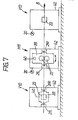
- the horizontal rolling stand H3 and the last vario stand (or last horizontal shown in FIG. 6) are - Roll stand) H11 - like the vertical roll stands V2 and V10 - each equipped with two pressure transducers 21L and 21R, on whose sensors 21a the chock 39 (which receives the eccentric bushes 38 and roller drive shafts 37) is supported in the counter-rolling direction or in the rolling direction.
- Each load cell is attached via a mounting plate 51 and a base 52 in a recess 42a in the roller stand 42.
- the vertical rolling stands V2 and V10 differ from the illustrated embodiment only in that the pivot axis 40, the chock 39 and the guide pin 41 are not horizontal but vertical.
- the suspension of the chocks 39 should in any case - for example by using bearings with as little friction as possible - be such that the pivoting movement in the counter-rolling direction or in the rolling direction is opposed as little resistance as possible.
- the load cell 21R will produce a related output signal.
- the load cell 21L provided that the chock is pivoted to the left with respect to the roller stand 42 under the tensile action exerted by the strand.
- the associated strand section is subject to a compressive stress with the risk of jamming and knot formation.
- the load cell 21L of the roll stand H11 shows increased values. These can be influenced by the fact that the roller speed of the last roll stand V12 is increased by engaging in the associated adjustment unit (cf. FIGS. 3 to 5).
- the setting of a state in which the strand section between the roll stands V10 and H11 passes through without stress could in principle be brought about in a corresponding manner, as has just been described for the last two roll stands.
- the Vario stand H11 (like the last Vario stand V12 before) is to be regarded as the last rolling stand on which the required speed adjustment is carried out; the status of the continuous strand section is displayed via the pressure transducers 21L and 21R of the roll stand V10.
- one measure of the method is to equip the two last (or first two) roll stands in question with speed sensors 20 and the measurement signals obtained by means of these with an electronic control unit to process, which comprises a computer and a comparison unit.
- the computer calculates the change in speed of the H11 Vario stand into the following ratio E um:
- the output signal of the rotary counter 20 on the roll stand V12 corresponding to n (12) beforehand is also input into the computer, which has the value determined. To adjust the speed, corresponding control signals are transmitted to the switching unit of the V12 scaffolding.
- the above-mentioned comparison unit alzen speed during the adjustment of the W skeleton of the zoom V12 continuously the difference value determined, indicates when the differential value reaches zero and the speed adjustment on the V12 scaffolding has been completed.
- the procedure basically consists of first adjusting the operating state between the roll stands H11 and V12 by adjusting the speed of the last V12 stand, then adjusting the operating state between the H11 and V12 stands by adjusting the speed of the H11 and V12 and the third last roll stand V10 and taking into account the speed change on the H11 stand to maintain the already set operating state between the last two roll stands in the same ratio to make a speed adjustment on the last roll stand V12.
- the described method can be carried out accordingly on the first three roll stands H1, V2 and H3, the speed adjustment between H1 and V2 being effected via the variometer stand H1 and the speed adjustment between V2 and H3 being effected via the variator stand V2.
- the front roll stands H1 and V2 in question are also equipped with speed sensors 2 0 , whose measurement signals are processed in the manner already described in an electronic control unit with a computer and a comparison unit.
- the operating state initially set between the two variometer stands H1 and V2 is also changed after a speed adjustment between the
- Vario stand V2 and the subsequent rolling stand H3 are maintained in that the roller speed of the first vario stand B3 is influenced simultaneously and in the same ratio with the speed change on the second vario stand V2.
- the invention is not limited to rolling mills with main drive shafts; Rather, it can also be used when all the rolling stands are driven by a central drive via a gear box.
- the central drive 9 with the shaft 9a is connected upstream of a gear box 53, from which the horizontal and vertical roll stands h1, v2, h3, v4, h5 and v6, which follow one another in the rolling direction (arrow 8), are theirs Receive drive energy.
- the first two and last two roll stands h1, v2 and h5, v6 are designed as vario stands with individually variable speed; the roll speed of the middle roll stands h3 and v4 depends invariably on the speed of the shaft 9a of the central drive 9.
- the roll stands h1, v2, h5 and v6 correspond to the previously described vario-stands H1, V2, H11 and V12
- the middle roll stands h3, v4 correspond to the roll stands H3 and V10 (cf. Fig. 2).
- the shaft 9a is connected via spur gears 54a, b or 55a, b, c in terms of drive to a roller drive shaft 56 or 57 of the roll stands h3 and v4.
- the roller drive shafts 56 and 57 in turn, drive a hollow shaft 60 or 61 via spur gears 58a, b or 59a, b and from there a further hollow shaft 64 or 65 via spur gears 62a, b or 63a, b.
- Each hollow shaft is connected to the input shaft 27 of a speed-changing adjusting unit 16, 17, 18 and 39, respectively, via an additional gear (which is designated 66 for the sake of simplicity), the output shaft 28 of the rollers 22 of the relevant variator stand h1, v2 with an infinitely variable speed , h5 or v6 rotated.
- roller drive shaft 67, 68, 69 and 70 coupled to the output shaft 28 is passed through the hollow shaft 64, 60, 61 and 65 in question.
- PIV gearboxes are particularly suitable as speed-changing adjustment units.
- the advantage achieved by the invention is that even in the area of the first roll stands (H1, V2 and H3 or h1, v2 and h3), despite the large strand cross sections present (which preclude the use of loop control with optical observation), an operating state can be set in which the strand sections between the relevant roll stands are not subject to any stress.
- the rolling mill only has a common central drive, the adjustment between casting machine and rolling mill required for casting rolling can be carried out by engaging in a single drive, although - although some rolling stands (H1, V2, H11, V12 or h1, v2, h5, v6 ) are designed as Vario stands with individually variable roll speeds - the roll speeds of all roll stands of the rolling mill are changed together.
- some rolling stands H1, V2, H11, V12 or h1, v2, h5, v6
- the deformation conditions cannot be kept constant to the desired extent because the strand temperature fluctuates to an unavoidable extent.
- the rolling mill can therefore be adapted to the fluctuations in question via the front of the Vario stands in the rolling direction.
- By suitably setting the operating conditions in the last rolling stands tight tolerances can be maintained during the manufacture of the wire rod, and that for any wire diameter.
- the proposed solution is also interesting from an economic point of view because instead of several individual drives and additional devices, only one central drive is used.
Landscapes
- Engineering & Computer Science (AREA)
- Mechanical Engineering (AREA)
- Control Of Metal Rolling (AREA)
- Metal Rolling (AREA)
Applications Claiming Priority (2)
| Application Number | Priority Date | Filing Date | Title |
|---|---|---|---|
| DE19843439269 DE3439269A1 (de) | 1984-10-26 | 1984-10-26 | Walzstrasse fuer eine vorgeschaltete, kontinuierlich arbeitende giessanlage zur drahtherstellung |
| DE3439269 | 1984-10-26 |
Publications (3)
| Publication Number | Publication Date |
|---|---|
| EP0179330A2 true EP0179330A2 (fr) | 1986-04-30 |
| EP0179330A3 EP0179330A3 (en) | 1987-01-21 |
| EP0179330B1 EP0179330B1 (fr) | 1989-08-02 |
Family
ID=6248846
Family Applications (1)
| Application Number | Title | Priority Date | Filing Date |
|---|---|---|---|
| EP19850112561 Expired EP0179330B1 (fr) | 1984-10-26 | 1985-10-04 | Train de laminoirs pour un appareil de moulage placé en amont et à action continue pour la fabrication de fil |
Country Status (2)
| Country | Link |
|---|---|
| EP (1) | EP0179330B1 (fr) |
| DE (1) | DE3439269A1 (fr) |
Cited By (2)
| Publication number | Priority date | Publication date | Assignee | Title |
|---|---|---|---|---|
| EP0904863A3 (fr) * | 1997-09-19 | 2002-01-16 | Aktiebolaget SKF | Dispositif dans un laminoir pour fils |
| CN109848208A (zh) * | 2017-11-30 | 2019-06-07 | 浙江立新珠宝科技有限公司 | 一种全自动环形轧线机构 |
Families Citing this family (1)
| Publication number | Priority date | Publication date | Assignee | Title |
|---|---|---|---|---|
| DE4009861C2 (de) * | 1990-03-28 | 2003-06-12 | Sms Demag Ag | Verfahren zur Herstellung von warmgewalztem Stangenmaterial wie Feinstahl oder Draht und Anlage zur Durchführung des Verfahrens |
Family Cites Families (5)
| Publication number | Priority date | Publication date | Assignee | Title |
|---|---|---|---|---|
| DE970102C (de) * | 1950-02-21 | 1958-08-21 | Mannesmann Meer Ag | Gruppenantrieb fuer kontinuierliche Walzwerke |
| US3214970A (en) * | 1963-04-02 | 1965-11-02 | Asea Ab | Device for measuring tensile force in rolling goods |
| GB1070825A (en) * | 1964-04-11 | 1967-06-07 | Schloemann Ag | Improvements in continuous rolling-mill trains consisting of more than three roll stands, for rolling out small-section iron or wire |
| DE2833456C2 (de) * | 1978-07-29 | 1986-03-20 | Kocks Technik Gmbh & Co, 4010 Hilden | Antriebsvorrichtung für eine Walzstraße zum Streckreduzieren von Rohren |
| DE3067932D1 (en) * | 1980-06-26 | 1984-06-28 | Krupp Gmbh | Rolling mill stand |
-
1984
- 1984-10-26 DE DE19843439269 patent/DE3439269A1/de not_active Withdrawn
-
1985
- 1985-10-04 EP EP19850112561 patent/EP0179330B1/fr not_active Expired
Cited By (2)
| Publication number | Priority date | Publication date | Assignee | Title |
|---|---|---|---|---|
| EP0904863A3 (fr) * | 1997-09-19 | 2002-01-16 | Aktiebolaget SKF | Dispositif dans un laminoir pour fils |
| CN109848208A (zh) * | 2017-11-30 | 2019-06-07 | 浙江立新珠宝科技有限公司 | 一种全自动环形轧线机构 |
Also Published As
| Publication number | Publication date |
|---|---|
| EP0179330A3 (en) | 1987-01-21 |
| EP0179330B1 (fr) | 1989-08-02 |
| DE3439269A1 (de) | 1986-04-30 |
Similar Documents
| Publication | Publication Date | Title |
|---|---|---|
| DE102009050710B4 (de) | Drahtwalzgerüst mit Einzelantrieb | |
| DE69210552T2 (de) | Walzwerk | |
| DE69301014T2 (de) | Walzwerk mit einem eine Drehzahlverstellmöglichkeit aufweisenden Fertigwalzblock | |
| EP0179330B1 (fr) | Train de laminoirs pour un appareil de moulage placé en amont et à action continue pour la fabrication de fil | |
| DE2617285C2 (de) | Walzstraße zum Walzen von Draht oder Stäben | |
| EP0340505A2 (fr) | Mode opératoire et train de laminoirs pour laminer continuellement une matière à laminer profilée en une section transversale de dimensions exactes et données | |
| DE69209632T2 (de) | Verfahren und Vorrichtung zum Walzen von Metallen zur Herstellung von rundem Stabmaterial oder Walzdraht aus rundem Stab- oder Drahtmaterial mit grösserem Durchmesser | |
| DE2517536A1 (de) | Streckreduzierwalzwerk | |
| DE69107762T2 (de) | Verfahren zum Masswalzen von Langprofilen, Walzgrüstantriebssystem, Walzenanstellvorrichtung und Walzenbefestigungsvorrichtung. | |
| EP0560093A1 (fr) | Laminoir à fers marchands et à fil d'acier | |
| EP0560115B1 (fr) | Procédé et laminoir pour le laminage de précision de fil respectivement de produit laminé à section circulaire | |
| DE3905244C2 (de) | Verfahren und Vorrichtung zur Herstellung von strangförmigem metallischen Gut | |
| EP0775537A2 (fr) | Procédé pour la régulation de la section transversale d'un produit laminé | |
| DE976308C (de) | Universal-, insbesondere Rohr-Reduzierwalzwerk | |
| DE3028210C2 (de) | Walzstraße zum Streckreduzieren von Rohren | |
| EP1837090B1 (fr) | Procédé pour le laminage de fils et train de laminoir de fils | |
| DE2908409C2 (de) | Walzstraße zum Walzen von Stäben oder Draht | |
| DE2833456C2 (de) | Antriebsvorrichtung für eine Walzstraße zum Streckreduzieren von Rohren | |
| AT391819B (de) | Walzstrasse zum streckreduzieren von rohren | |
| EP0126059B1 (fr) | Cage de laminoir | |
| DE2745684C2 (de) | Schrägwalzwerk | |
| DE2732496C2 (fr) | ||
| DE2450224A1 (de) | Verfahren zur veraenderung der wanddickenaenderung beim streckreduzierwalzen nebst walzwerk | |
| DE1652548B2 (de) | Vielgerustiges Universalwalzwerk, insbesondere Drahtwalzwerk | |
| DD226207A1 (de) | Kontinuierliches drahtwalzwerk |
Legal Events
| Date | Code | Title | Description |
|---|---|---|---|
| PUAI | Public reference made under article 153(3) epc to a published international application that has entered the european phase |
Free format text: ORIGINAL CODE: 0009012 |
|
| AK | Designated contracting states |
Kind code of ref document: A2 Designated state(s): BE FR GB IT SE |
|
| PUAL | Search report despatched |
Free format text: ORIGINAL CODE: 0009013 |
|
| AK | Designated contracting states |
Kind code of ref document: A3 Designated state(s): BE FR GB IT SE |
|
| 17P | Request for examination filed |
Effective date: 19870702 |
|
| 17Q | First examination report despatched |
Effective date: 19880510 |
|
| GRAA | (expected) grant |
Free format text: ORIGINAL CODE: 0009210 |
|
| AK | Designated contracting states |
Kind code of ref document: B1 Designated state(s): BE FR GB IT SE |
|
| GBT | Gb: translation of ep patent filed (gb section 77(6)(a)/1977) | ||
| ET | Fr: translation filed | ||
| PGFP | Annual fee paid to national office [announced via postgrant information from national office to epo] |
Ref country code: FR Payment date: 19890915 Year of fee payment: 5 |
|
| PGFP | Annual fee paid to national office [announced via postgrant information from national office to epo] |
Ref country code: SE Payment date: 19890919 Year of fee payment: 5 |
|
| PGFP | Annual fee paid to national office [announced via postgrant information from national office to epo] |
Ref country code: GB Payment date: 19890930 Year of fee payment: 5 |
|
| PGFP | Annual fee paid to national office [announced via postgrant information from national office to epo] |
Ref country code: BE Payment date: 19891011 Year of fee payment: 5 |
|
| ITF | It: translation for a ep patent filed | ||
| ITTA | It: last paid annual fee | ||
| RAP2 | Party data changed (patent owner data changed or rights of a patent transferred) |
Owner name: MANNESMANN AKTIENGESELLSCHAFT |
|
| REG | Reference to a national code |
Ref country code: GB Ref legal event code: 732 |
|
| ITPR | It: changes in ownership of a european patent |
Owner name: CESSIONE;MANNESMANN AG |
|
| PLBE | No opposition filed within time limit |
Free format text: ORIGINAL CODE: 0009261 |
|
| STAA | Information on the status of an ep patent application or granted ep patent |
Free format text: STATUS: NO OPPOSITION FILED WITHIN TIME LIMIT |
|
| 26N | No opposition filed | ||
| REG | Reference to a national code |
Ref country code: FR Ref legal event code: TP |
|
| PG25 | Lapsed in a contracting state [announced via postgrant information from national office to epo] |
Ref country code: GB Effective date: 19901004 |
|
| PG25 | Lapsed in a contracting state [announced via postgrant information from national office to epo] |
Ref country code: SE Effective date: 19901005 |
|
| PG25 | Lapsed in a contracting state [announced via postgrant information from national office to epo] |
Ref country code: BE Effective date: 19901031 |
|
| BERE | Be: lapsed |
Owner name: MANNESMANN A.G. Effective date: 19901031 |
|
| GBPC | Gb: european patent ceased through non-payment of renewal fee | ||
| PG25 | Lapsed in a contracting state [announced via postgrant information from national office to epo] |
Ref country code: FR Effective date: 19910628 |
|
| REG | Reference to a national code |
Ref country code: FR Ref legal event code: ST |
|
| EUG | Se: european patent has lapsed |
Ref document number: 85112561.7 Effective date: 19910603 |