EP0179932B1 - Procédé et appareil de séchage de produits tubulaires tricotés - Google Patents
Procédé et appareil de séchage de produits tubulaires tricotés Download PDFInfo
- Publication number
- EP0179932B1 EP0179932B1 EP84112969A EP84112969A EP0179932B1 EP 0179932 B1 EP0179932 B1 EP 0179932B1 EP 84112969 A EP84112969 A EP 84112969A EP 84112969 A EP84112969 A EP 84112969A EP 0179932 B1 EP0179932 B1 EP 0179932B1
- Authority
- EP
- European Patent Office
- Prior art keywords
- fabric
- nozzle
- wet
- stage
- further characterized
- Prior art date
- Legal status (The legal status is an assumption and is not a legal conclusion. Google has not performed a legal analysis and makes no representation as to the accuracy of the status listed.)
- Expired
Links
Images


Classifications
-
- D—TEXTILES; PAPER
- D06—TREATMENT OF TEXTILES OR THE LIKE; LAUNDERING; FLEXIBLE MATERIALS NOT OTHERWISE PROVIDED FOR
- D06B—TREATING TEXTILE MATERIALS USING LIQUIDS, GASES OR VAPOURS
- D06B15/00—Removing liquids, gases or vapours from textile materials in association with treatment of the materials by liquids, gases or vapours
- D06B15/02—Removing liquids, gases or vapours from textile materials in association with treatment of the materials by liquids, gases or vapours by squeezing rollers
- D06B15/025—Removing liquids, gases or vapours from textile materials in association with treatment of the materials by liquids, gases or vapours by squeezing rollers for tubular fabrics
Definitions
- Tubular knitted fabric typically is manufactured on circular knitting machines in semi-continuous lengths of tubular fabric. In most cases, the tubular fabric is processed through finishing and even cutting while retained in tubular form. Typically, such processing includes a number of wet processing states, such as washing, bleaching, sometimes dyeing, etc. At the end of this wet processing stage, the fabric is dried and prepared for finishing.
- the semi-continuous tubular fabric at the end of the wet processing stage, is directed over an internal spreader device, which is designed to restore the fabric width to some desirable and appropriate dimension.
- knitted fabric is inherently unstable geometrically (as distinguished from woven fabric, which is rather stable), and typically becomes substantially elongated in length and reduced in width, by reason of the lengthwise tensions applied to the fabric during wet processing.
- the fabric After passing over the spreader, the fabric conventionally goes through extractor rolls, in the form of one or more opposed sets of resilient nip rollers.
- a so-called Mach nozzle particularly of the type described in US ⁇ A ⁇ 4,137,045.
- the nozzle is arranged to act on the tubular knitted fabric in advance of the dryer and serves to remove a substantial portion of the liquid content of the fabric before the fabric enters the dryer.
- the nozzle treatment serves to reduce the liquid content of the fabric well below the 85% level, achievable with conventional roller extraction, typically, to under 50%, thus greatly reducing the workload on the dryer for a given amount of fabric.
- energy costs per kg of water removed are significantly less than with conventional drying arrangements. Accordingly, significant overall production cost savings are achieved.
- the operating rate of the entire processing line which tends to be limited by the dryer capacity, can be greatly increased.
- a novel procedure and apparatus is provided, which indeed does enable tubular knitted fabric to be effectively processed and dried, using a Mach nozzle treatment stage in advance of a tensionless dryer.
- wet processed fabric may be taken directly from a truck or similar container and is spread to flat form and predetermined width while still in wet form.
- the wet, spread fabric is then discharged directly into a resilient control nip, comprising a pair of opposed resilient rollers.
- a resilient control nip comprising a pair of opposed resilient rollers.
- the fabric is guided downward and around the high velocity nozzle and then upwardly to an exit- side pair of resilient rollers.
- the respective pairs of rollers make very light contact with the fabric, so as not to crease the fabric edges, but sufficient, nevertheless, together with the degree of wrap- around of the fabric about the lower rollers, to provide relatively positive control over the movement of the fabric.
- pre-drying extraction operations are usually carried out on an off-line basis from the dryer proper, because such operations can be performed at much greater rates of speed than the rate of operation of a typical dryer.
- the extraction equipment may service more than one dryer, and, in many cases multiple strings of tubular knitted fabric are run side by side through the dryer.
- the fabric may be processed by the Mach nozzle section on an in-line basis with the dryer, perhaps with a plurality of nozzle sections feeding two or more webs to a single dryer.
- the procedures of the invention are additionally advantageous with respect to the application of wet-on-wet foam processing.
- the use of foam-based chemicals in the processing of fabrics is advantageous because the lower liquid content of the foam-based chemicals reduces subsequent drying costs.
- the application of foam-based chemicals to wet processed fabric has not, under conventional practices, enabled consequential savings to be realized because of the high residual content of the incoming fabric.
- the liquid level of the incoming fabric is sufficiently low that the low moisture content of the foam-based chemicals results in a meaningfully low total liquid content after foam processing.
- the invention involves a process of treating tubular knitted fabric, which comprises (a) supplying wet processed tubular knitted fabric in wet form, (b) laterally distending said wet tubular knitted fabric in a first stage to flat smooth form, (c) guiding the laterally distended tubular fabric to pass in a generally V-shaped path around and in contact with a gas discharge nozzle, (d) while said fabric is passing said nozzle, discharging a gaseous drying medium through the fabric at extremely high velocity, (e) adjustably controlling the speed of advance of the tubular fabric on the entry side of said nozzle (f) adjustably driving the tubular fabric on the exit side of the nozzle to elongate said fabric and maintain it under tension and in contact with said nozzle as the fabric passes over said nozzle, (g) said fabric being elongated and reduced in width in the region immediately in advance of and immediately downstream of said nozzle, (h) substantially immediately thereafter, laterally distending said tubular fabric in a second stage to flat form and predetermined
- the invention also encompasses an apparatus for the processing of wet tubular knitted fabric in accordance with the process of claim 1, which comprises (a) first stage internal spreader means for receiving wet-processed tubular knitted fabric and spreading it to flat form, (b) means for controlling the speed of advance of the incoming wet fabric, (c) a nozzle disposed transversely of the path of fabric movement and on the downstream side of said first stage spreader means, (d) means to supply said nozzle with gaseous drying medium under pressure, (e) said nozzle and said means to supppy being so related as to provide for the discharge of drying medium from the nozzle at approximately sonic velocities, (f) means for guiding the fabric around and in contact with said nozzle whereby said drying medium may be discharged through the fabric, (g) said means for guiding including an exit side drive roll engaging the tubular knitted fabric across its width, (h) controllable drive means for driving said first stage spreader and said exit side drive roll, whereby said fabric is elongated and maintained
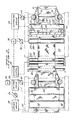
- the reference numeral 10 designates a truck or other container, usually on wheels, for containing a length of wet processed tubular knitted fabric, which is ready for detwisting, wet spreading and extracting, in preparation for drying.
- the fabric 11 typically is drawn upwardly, through an eye guide 12 and onto the forward end of an adjustable width spreader 13 which may, by way of example only, be of the type shown in US ⁇ A ⁇ 3,207,616, US-A-3,875,624, or US-A-4,103,402.
- the spreader generally designated by the numeral 13 is comprised of opposed, spaced belt frames 14, 15, connected by an adjustable length bar 16.
- the illustrated form of belt frames contain entry side and exit side belts 17, 18, respectively.
- Adjacent drive sheaves 19, 20, for the respective belts are engaged, supported and driven by rotatable edge drive rolls 21, 22 at opposite sides of the machine.
- the edge drive rolls are mounted on carriages 23 which are movable toward and away from the center line of the processing equipment, in accordance with known practices, in order to suppport and drive the fabric spreaders of various predetermined width settings.
- a water (liquid) removal apparatus which, in part, comprises a so-called Mach nozzle 24, substantially as described in US-A-4,137,045, incorporated herein by reference.
- Mach nozzle 24 On each side of the nozzle, upstream and downstream thereof, is a pair of fabric driving and control rolls. Rolls 25, 26 are located on the entry side of the nozzle and rolls 27, 28 are located on the exit or discharge side of the nozzle.
- the upper rolls 25, 27, of each of the roll pairs straddling the Mach nozzle are not loaded, in the sense of being urged downward toward the corresponding lower rolls by springs, air loading devices, weights, or the like.
- the upper rolls are desirably relatively light in weight, and are loosely supported above their respective lower rolls, as for example by means of loose vertical guide slots or the like (not shown).
- the first stage spreading device 13 discharges the spread, wet fabric directly into the first roll pair 25, 26.
- the roll pair 25, 26 is not required to perform any significant liquid extracting function.
- the operation of the Mach nozzle 24 is not significantly affected by the presence or absence of the amount of liquid that could be expressed by the first roll pair.
- the loading forces necessary to achieve expression of significant liquid at the first roll pair would result in increased power consumption, reduced roll life, and possibly some fabric distortion resulting from the squeezing action of the rolls. It has been found that, by providing the rolls with resilient coverings, which have good gripping action on the fabric, the roll pairs 25, 26 and 27, 28 can serve their principal function of controllably and adjustably advancing the forward movement of the fabric, using relatively lightweight upper rolls without any external loading.
- liquid removal from the fabric 11 is effected by passing the fabric around and in contact with a wedge-shaped nozzle having a wedge angle of 60° to 90° and having a somewhat rounded lower edge provided with a transverse slit for the discharge of high velocity gaseous drying medium, typically, in this case, steam.
- a wedge-shaped nozzle having a wedge angle of 60° to 90° and having a somewhat rounded lower edge provided with a transverse slit for the discharge of high velocity gaseous drying medium, typically, in this case, steam.
- the nozzle 24 is positioned below the plane of the roller pairs, so as to cause the fabric 11 to be diverted downward, around the nozzle, and back up to the exit side roller pair.
- the fabric thus forms a V-like trough and is in intimate contact with the wedge-like surfaces of the nozzle from which the high velocity steam is ejected.
- Figs. 4 and 5 illustrate end elevational and fragmentary cross sectional views respectively of the high velocity nozzle 24 according to the before mentioned US ⁇ A ⁇ 4,137,045, which is utilized in the process and apparatus of the invention.
- the nozzle consists of two half sections 29,30, of more or less symmetrical configuration, arranged to be bolted together in the manner reflected in Fig; 4;
- An inlet passage 31 is formed in one of the sections 30 and is arranged for connection to a pipe 32 (Fig. 1) leading to an appropriate source of steam under pressure.
- the passage 31 discharges into a horizontally elongated manifold cavity 33, which extends over substantially the full width of the nozzle, being closed at each end.
- a plurality of distribution passages 34 lead downwardly from the manifold cavity and diverge at 35 into a secondary manifold cavity 36, which also extends along substantially the full width of the nozzle.
- a narrow slot forming recess 37 is machined in one or both of the nozzle sections, to define a transversely extending narrow discharge slot 38.
- the size and configuration of the slot is, in accordance with the teachings of US-A-4,137,045, such as to provide for the discharge of the gaseous treating medium, typically, steam, at extremely high velocity, approximating the speed of sound.
- the wedge-like lower surfaces 39, 40 of the assembled nozzle halves form an included angle of 60° to 90° and are desirably smoothly polished in order to accommodate the movement thereover of fabric being treated.
- the lower extremity of the nozzle is rounded, as at 41, to allow for the relatively abrupt change in direction of the fabric without abrasion or damage.
- a steam recovery chamber 42 is provided under the nozzle 24.
- the chamber leads to an exhaust duct 43, by which excess steam is vented off.
- the tubular knitted fabric being processed by the high velocity steam nozzle 24 is unsupported, that is, it is neither conveyed by nor supported from below by a secondary carrier web. Rather, it is held in tension contact with the high velocity nozzle by reason of lengthwise tension in the fabric itself.
- the wet fabric being discharged from the first stage spreader 13 is highly dimensionally unstable and, when placed under the tension necessary to maintain working contact with the high velocity nozzle 24, both elongates significantly (e.g., fifteen percent in a typical case) and correspondingly narrows in width, as reflected at 44 in Fig. 2.
- the respective entry side and exit side roll pairs are adjustably synchronized by way of a variable speed drive 56 (P.I.V.) such that the speed of operation of the exit side rolls can be adjusted to be appropriately higher than the speed of operation of the entry side rolls.
- a variable speed drive 56 P.I.V.
- This can be adjusted as a function of visual observations of the machine operator such that proper tension is maintained in the fabric without, on the other hand, excessively distorting it. This is a matter of empirical determination in each case, depending on the specifics of the fabric construction, but is an adjustment easily carried out by an operator of even modest capability.
- the liquid content of the nozzle-processed fabric may be on the order of 50% (i.e., 50 kg of water per 100 kg of dry fabric), whereas fabric subjected to roller expressing according to prior art techniques would more typically have a water content of 85% (i.e., some 70% greater liquid content than after nozzle processing).
- the now-damp fabric is distended to a predetermined uniform width, approximating desired finished width, by way of a second stage belt spreader device 51 which may, for example, be of the same construction as the first spreader 13.
- the second stage spreader 51 may be integrated directly into the nozzle processing unit, and this is of course contemplated by the disclosure.
- a multi-purpose system is provided, in which the second stage spreader forms part of a so-called Tri-Pad unit, such as illustrated in US ⁇ A ⁇ 3,207,616.
- the second stage spreader 51 discharges onto a set of rolls of inverted triangular configuration.
- Fabric leaving the processing roller 54 may be directed into a tensionless dryer unit 62 of the type illustrated in, for example US-A-3,207,616 or the beforementioned US-A-3,496,647.
- the controlling drive for the processing line is a variable speed motor 45 which, through a drive mechanism 46, is directly connected to the rollers 52 to 54 of the Tri-Pad unit.
- the second stage spreader unit 51 forming part of the Tri-Pad apparatus, is driven off of the main Tri-Pad drive 46 through a variable speed pulley or the like 47, such that a range of speed adjustment of the spreader relative to the rolls of the Tri-Pad is possible. Most typically, this is adjusted to provide for a slight degree of overfeeding of the fabric by the spreader 51 to assure tensionless conditions in passing over the Tri-Pad rolls.
- a drive 48, for the dryer unit 62 is driven off of the Tri-Pad drive 46 through a P.I.V. or similar variable speed drive 49, such that the speed of the dryer may be adjusted to be slightly less than the operating speed of the Tri-Pad rolls, again for the purpose of maintaining tension free conditions for the fabric 11.
- the extractor section consisting of the first stage spreader 13, roll pairs 25, 26 and 27, 28, and the high velocity nozzle 24, advantageously may be independently driven by a second variable speed motor 50.
- the operation of the extractor unit is controlled to follow automatically the operation of the Tri-Pad unit, by means of a dancer control unit 58.
- a dancer control unit 58 As reflected in Fig. 1, there is positioned between the Tri-Pad unit, generally designated by the reference numeral 63, and the extractor unit, generally designated by the numeral 64, a pair of guide rolls 56, 60 and a vertically movable dancer roll 61, all forming part of the dancer control 58.
- the speed of the extractor unit motor 50 is controlled by the position of the vertically movable dancer roll 61 in accordance with known control techniques.
- the dancer roll 61 will be elevated by the progressively shortening loop 59 of fabric passing around the dancer roll.
- the speed of operation of the motor 50 is increased proportionately, such that, on the average, the dancer roll 61 seeks a predetermined average elevation and, in doing so, enables the speed of the extractor unit 64 to closely track that of the Tri-Pad unit.
- the extractor unit motor operates through an extractor drive 55 to drive directly the lower roll 26 of the entry side roll pair.
- the lower roll 28 of the exit side pair is driven off of the extractor drive 55 through a variable speed P.I.V. unit 56, which provides for the exit side pair to be driven at a somewhat higher rate of speed than the entry side pair, enabling the fabric to be elongated sufficiently to maintain desired levels of lengthwise tension in the fabric.
- the first stage spreader unit 13 is also driven off of the extractor drive 55, through a variable speed pulley system 57 or the like, such that the speed of the spreader unit may be varied slightly with respect to that of the entry side roll pair. Typically, there might be a slight overfeeding of the fabric from the spreader unit 13.
- tubular knitted fabric after second stage spreading, can be directed immediately into the dryer for completion of the drying operation. This results in part from the fact that the fabric, immediately after nozzle processing, is very hot, virtually at the temperature level for the commencement of drying, such that additional energy savings and increased operating speeds may be realized in the dryer.
- the speed of operation of the nozzle processing unit typically is much greater than the maximum operating speed of a typical commercial tensionless dryer.
- processors find it to be more economical to fold the damp fabric as it emerges from the second stage spreading operation, transport the folded fabric to a dryer at another location, and feed the dryer from the supply of folded fabric.
- a nozzle processing unit operating at speeds significantly greater than that of the dryer, can supply fabric to several dryers and/or supply several strings or webs of fabric to a given dryer.
- dryers it is quite common for dryers to process multiple webs side by side to increase overall throughput of fabric even though operating at relatively slow linear speeds of advance.
- Folders suitable for the purposes hereof are reflected in US ⁇ A ⁇ 2,761,678 and/or US-A-4,053,152, for example, incorporated by reference.
- a nozzle unit of about 1.1 m (forth- three inches) in width was provided for the processing of tubular knitted fabric up to maximum width somewhat less than the nozzle width.
- Steam was supplied at a pressure of about 0.5 (80 psi) corresponding to a steam temperature of about 163°C (325°C). Under such conditions, the nozzle temperature, in the region of the tip, can be stabilized at about 105°C (220°F). Steam at the rate of 10°C (460 pounds) per hour was discharged through a 0.025 mm wide (0.001") slot, approximately at sonic velocities.
- a conventional tensionless dryer of the type herein described and in common use throughout the industry, utilizes approximately 2.5 kg of steam to remove one kg of water, as compared to approximately 0.7 kg of steam per kg of water removed via the nozzle processing procedure of the invention.
- a typical two drum commercial dryer of known and widely used construction may have a maximum water removal capacity of, say, 160 kg (350 pounds) per hour.
- the incoming fabric to the dryer will contain approximately 85% moisture, such that approximately 185 kg (410 pounds) of dry weight fabric can be processed in an hour's time.
- fabric subjected to nozzle processing according to the invention has a liquid content of 50% or less, such that approximately 320 kg (700 pounds) or more of dry weight fabric can be processed in an hour's time.
- foam processing of tubular knitted fabrics has certain advantages in enabling the application of dyes and other processing chemicals through a foam medium, rather than more conventional liquid medium, with a resulting reduction in liquid input to the fabric and a concomitant reduction in energy cost in the subsequent drying and/or curing of the foam-processed fabric.
- foam-based chemicals are applied to wet processed fabric, the economics of foam processing are less evident, at least with conventional extraction procedures.
- the addition of foam-based chemicals will raise the moisture content of the fabric to approximately 95%, as compared to perhaps 105% where the fabric is conventionally processed with liquid-based chemicals followed by roller expression of the excess processing liquid.
- the moisture content of fabric entering the dryer after a wet-on-wet processing operation is a 105% with liquid-based chemical processing versus about 95% with foam-based processing, a difference that frequently does not justify modification of a processing line to utilize foam processing.
- the incoming moisture level of the fabric is approximately 50% or less, which increases to, say, 60% or less after application of foam-based chemicals.
- foam-based application of chemicals in wet-on-wet processing achieves an advantage of 60% or less moisture going into the dryer versus 105% moisture resulting from liquid processing (liquid processing results in 105%, say, independently of the moisture level of the incoming fabric, as will be understood).
- the upper rolls of each pair are relatively lightweight, non-loaded rolls whose function is merely to assist in the frictional engagement of the fabric with the lower, driven rolls of each pair, so as to provide for the necessary tension control of the fabric, without on the other hand undesirably creasing the edges of the fabric.
- the fabric after being nozzle processed and laterally distended in damp form to desired width, is gathered, as by folding, and subsequently delivered in its gathered form to a suitable dryer.
- the damp fabric at its state of elevated temperature from the high velocity steam nozzle, is conveyed substantially directly and in a continuous manner into the dryer, such that the dryer can be operated at somewhat increased rates of speed, with a reduction in energy utilization.
- the last described procedure logically requires, however, a dryer whose nominal speed of operation is consistent with the rate of throughput of the nozzle processing equipment.
- the nozzle processing according to the invention also makes highly attractive, for the first time, foam processing of fabric in a wet-on-wet procedure, in which foam-based chemicals are applied to the fabric in its "wet" form, but after reduction ; of its liquid content by nozzle processing according to the invention.
- foam-based chemicals are applied to the fabric in its "wet" form, but after reduction ; of its liquid content by nozzle processing according to the invention.
- conventional roll expressing techniques for the reduction of liquid content of the fabric the advantages of wet-on-wet foam processing are rather minimal, and typically insufficient to justify conversion of the processing line to utilize foam techniques.
- the reduction in liquid content of the fabric is sufficiently dramatic that very significant advantages can be realized through wet-on-wet foam processing.
Landscapes
- Engineering & Computer Science (AREA)
- Textile Engineering (AREA)
- Treatment Of Fiber Materials (AREA)
Claims (13)
Priority Applications (4)
| Application Number | Priority Date | Filing Date | Title |
|---|---|---|---|
| US06/489,960 US4484369A (en) | 1983-04-29 | 1983-04-29 | Method for drying tubular knitted fabric |
| EP84112969A EP0179932B1 (fr) | 1983-04-29 | 1984-10-27 | Procédé et appareil de séchage de produits tubulaires tricotés |
| DE8484112969T DE3475630D1 (en) | 1984-10-27 | 1984-10-27 | Method and apparatus for drying tubular knitted fabric |
| AT84112969T ATE39270T1 (de) | 1984-10-27 | 1984-10-27 | Verfahren und vorrichtung zum trocknen von rundstrickwaren. |
Applications Claiming Priority (2)
| Application Number | Priority Date | Filing Date | Title |
|---|---|---|---|
| US06/489,960 US4484369A (en) | 1983-04-29 | 1983-04-29 | Method for drying tubular knitted fabric |
| EP84112969A EP0179932B1 (fr) | 1983-04-29 | 1984-10-27 | Procédé et appareil de séchage de produits tubulaires tricotés |
Publications (2)
| Publication Number | Publication Date |
|---|---|
| EP0179932A1 EP0179932A1 (fr) | 1986-05-07 |
| EP0179932B1 true EP0179932B1 (fr) | 1988-12-14 |
Family
ID=26092338
Family Applications (1)
| Application Number | Title | Priority Date | Filing Date |
|---|---|---|---|
| EP84112969A Expired EP0179932B1 (fr) | 1983-04-29 | 1984-10-27 | Procédé et appareil de séchage de produits tubulaires tricotés |
Country Status (2)
| Country | Link |
|---|---|
| US (1) | US4484369A (fr) |
| EP (1) | EP0179932B1 (fr) |
Families Citing this family (4)
| Publication number | Priority date | Publication date | Assignee | Title |
|---|---|---|---|---|
| US4484369A (en) * | 1983-04-29 | 1984-11-27 | Samcoe Holding Corporation | Method for drying tubular knitted fabric |
| US5046208A (en) * | 1990-03-26 | 1991-09-10 | Frank Catallo | Method and apparatus for applying additives in a ballooned fabric extraction system |
| US7735342B1 (en) * | 2004-06-22 | 2010-06-15 | Highland Industries, Inc. | Apparatus for forming an unbalanced, circular knit fabric and a coated fabric produced therefrom |
| US10570542B2 (en) * | 2015-09-11 | 2020-02-25 | Teresa Catallo | Apparatus and method for pre-shrinking a wet fabric prior to drying |
Family Cites Families (9)
| Publication number | Priority date | Publication date | Assignee | Title |
|---|---|---|---|---|
| US2187644A (en) * | 1938-02-24 | 1940-01-16 | Samcoe Holding Corp | Fabric finishing system |
| US3412411A (en) * | 1960-09-13 | 1968-11-26 | Samcoe Holding Corp | Method for dyeing tubular knit material |
| NL273799A (fr) * | 1961-01-23 | |||
| GB1189927A (en) * | 1967-09-27 | 1970-04-29 | Bruckner Trockentechnik Komman | A Device for Treating a Continually Moving Fabric Web |
| US3574261A (en) * | 1968-09-24 | 1971-04-13 | Grace W R & Co | Apparatus and method for drying permeable webs |
| US3688354A (en) * | 1970-07-28 | 1972-09-05 | Samcoe Holding Corp | Method of handling and processing open width fabric |
| US4137045A (en) * | 1974-09-13 | 1979-01-30 | Brugman Machinefabriek B.V. | Method for treating a textile web with steam |
| GB2048974B (en) * | 1978-11-15 | 1982-12-01 | Catallo F | Method and apparatus for heat-treating tubular knit fabrics |
| US4484369A (en) * | 1983-04-29 | 1984-11-27 | Samcoe Holding Corporation | Method for drying tubular knitted fabric |
-
1983
- 1983-04-29 US US06/489,960 patent/US4484369A/en not_active Expired - Fee Related
-
1984
- 1984-10-27 EP EP84112969A patent/EP0179932B1/fr not_active Expired
Also Published As
| Publication number | Publication date |
|---|---|
| EP0179932A1 (fr) | 1986-05-07 |
| US4484369A (en) | 1984-11-27 |
Similar Documents
| Publication | Publication Date | Title |
|---|---|---|
| US3015146A (en) | Method and apparatus for compacting web materials, such as fabrics | |
| US2109469A (en) | System for treating fabrics | |
| US3199317A (en) | Dyeing and similar liquid treatment of textile fibres | |
| US2084367A (en) | Apparatus for treating cloth | |
| US3175272A (en) | Method and apparatus for treating tubular knitted fabric by lateral distention | |
| US4562627A (en) | Method for finish drying of tubular knitted fabrics | |
| EP0179932B1 (fr) | Procédé et appareil de séchage de produits tubulaires tricotés | |
| US5016329A (en) | Apparatus for compressive shrinkage of tubular knitted fabrics and the like | |
| US4523389A (en) | Apparatus for drying tubular knitted fabric | |
| US4888848A (en) | System for treating fabrics in cord in closed ring | |
| US3688354A (en) | Method of handling and processing open width fabric | |
| US4146946A (en) | Apparatus for steaming of tubular knitted fabric | |
| US4882819A (en) | Method for compressively shrinking of tubular knitted fabrics and the like | |
| GB1191007A (en) | Apparatus for processing a Continuous Web of Textile Material | |
| US3670375A (en) | Apparatus and method for tenter processing of open width fabric | |
| US4888860A (en) | Apparatus and method for shrink treating a textile fabric web | |
| US8590122B2 (en) | Method and apparatus for compacting tubular fabrics | |
| KR900002105B1 (ko) | 종이웨브 건조장치 및 그 작동방법 | |
| US4247969A (en) | Method for moisture conditioning of compressively treated fabric | |
| CA1245432A (fr) | Methode et dispositif de sechage de tricots tubulaires | |
| NZ210005A (en) | Tensioned tubular knitted fabric dried by passage beneath steam nozzle | |
| EP0014787B1 (fr) | Procédé et appareil de déshydratation d'un matériau, perméable à l'air, de forme tubulaire | |
| JPH026436B2 (fr) | ||
| US3590450A (en) | Opening tenter, for tubular knitted fabrics and the like | |
| US3253311A (en) | Apparatus for converting tubular knitted fabric to open width form |
Legal Events
| Date | Code | Title | Description |
|---|---|---|---|
| PUAI | Public reference made under article 153(3) epc to a published international application that has entered the european phase |
Free format text: ORIGINAL CODE: 0009012 |
|
| 17P | Request for examination filed |
Effective date: 19850403 |
|
| AK | Designated contracting states |
Kind code of ref document: A1 Designated state(s): AT BE CH DE FR GB IT LI LU NL SE |
|
| 17Q | First examination report despatched |
Effective date: 19870909 |
|
| GRAA | (expected) grant |
Free format text: ORIGINAL CODE: 0009210 |
|
| AK | Designated contracting states |
Kind code of ref document: B1 Designated state(s): AT DE FR GB IT |
|
| REF | Corresponds to: |
Ref document number: 39270 Country of ref document: AT Date of ref document: 19881215 Kind code of ref document: T |
|
| ITF | It: translation for a ep patent filed | ||
| REF | Corresponds to: |
Ref document number: 3475630 Country of ref document: DE Date of ref document: 19890119 |
|
| ET | Fr: translation filed | ||
| PLBE | No opposition filed within time limit |
Free format text: ORIGINAL CODE: 0009261 |
|
| STAA | Information on the status of an ep patent application or granted ep patent |
Free format text: STATUS: NO OPPOSITION FILED WITHIN TIME LIMIT |
|
| 26N | No opposition filed | ||
| PGFP | Annual fee paid to national office [announced via postgrant information from national office to epo] |
Ref country code: GB Payment date: 19910926 Year of fee payment: 8 |
|
| PGFP | Annual fee paid to national office [announced via postgrant information from national office to epo] |
Ref country code: AT Payment date: 19910927 Year of fee payment: 8 |
|
| PGFP | Annual fee paid to national office [announced via postgrant information from national office to epo] |
Ref country code: FR Payment date: 19911021 Year of fee payment: 8 |
|
| PGFP | Annual fee paid to national office [announced via postgrant information from national office to epo] |
Ref country code: DE Payment date: 19911030 Year of fee payment: 8 |
|
| ITTA | It: last paid annual fee | ||
| PG25 | Lapsed in a contracting state [announced via postgrant information from national office to epo] |
Ref country code: GB Effective date: 19921027 Ref country code: AT Effective date: 19921027 |
|
| GBPC | Gb: european patent ceased through non-payment of renewal fee |
Effective date: 19921027 |
|
| PG25 | Lapsed in a contracting state [announced via postgrant information from national office to epo] |
Ref country code: FR Effective date: 19930630 |
|
| PG25 | Lapsed in a contracting state [announced via postgrant information from national office to epo] |
Ref country code: DE Effective date: 19930701 |
|
| REG | Reference to a national code |
Ref country code: FR Ref legal event code: ST |