EP0180144B1 - Dispersionsverstärkte Aluminiumlegierungen - Google Patents
Dispersionsverstärkte Aluminiumlegierungen Download PDFInfo
- Publication number
- EP0180144B1 EP0180144B1 EP85113483A EP85113483A EP0180144B1 EP 0180144 B1 EP0180144 B1 EP 0180144B1 EP 85113483 A EP85113483 A EP 85113483A EP 85113483 A EP85113483 A EP 85113483A EP 0180144 B1 EP0180144 B1 EP 0180144B1
- Authority
- EP
- European Patent Office
- Prior art keywords
- alloy
- extrusion
- temperature
- forging
- carried out
- Prior art date
- Legal status (The legal status is an assumption and is not a legal conclusion. Google has not performed a legal analysis and makes no representation as to the accuracy of the status listed.)
- Expired
Links
Images
Classifications
-
- C—CHEMISTRY; METALLURGY
- C22—METALLURGY; FERROUS OR NON-FERROUS ALLOYS; TREATMENT OF ALLOYS OR NON-FERROUS METALS
- C22C—ALLOYS
- C22C1/00—Making non-ferrous alloys
- C22C1/10—Alloys containing non-metals
- C22C1/1084—Alloys containing non-metals by mechanical alloying (blending, milling)
-
- C—CHEMISTRY; METALLURGY
- C22—METALLURGY; FERROUS OR NON-FERROUS ALLOYS; TREATMENT OF ALLOYS OR NON-FERROUS METALS
- C22C—ALLOYS
- C22C32/00—Non-ferrous alloys containing at least 5% by weight but less than 50% by weight of oxides, carbides, borides, nitrides, silicides or other metal compounds, e.g. oxynitrides, sulfides, whether added as such or formed in situ
- C22C32/001—Non-ferrous alloys containing at least 5% by weight but less than 50% by weight of oxides, carbides, borides, nitrides, silicides or other metal compounds, e.g. oxynitrides, sulfides, whether added as such or formed in situ with only oxides
- C22C32/0015—Non-ferrous alloys containing at least 5% by weight but less than 50% by weight of oxides, carbides, borides, nitrides, silicides or other metal compounds, e.g. oxynitrides, sulfides, whether added as such or formed in situ with only oxides with only single oxides as main non-metallic constituents
- C22C32/0036—Matrix based on Al, Mg, Be or alloys thereof
-
- B—PERFORMING OPERATIONS; TRANSPORTING
- B22—CASTING; POWDER METALLURGY
- B22F—WORKING METALLIC POWDER; MANUFACTURE OF ARTICLES FROM METALLIC POWDER; MAKING METALLIC POWDER; APPARATUS OR DEVICES SPECIALLY ADAPTED FOR METALLIC POWDER
- B22F2998/00—Supplementary information concerning processes or compositions relating to powder metallurgy
- B22F2998/10—Processes characterised by the sequence of their steps
-
- B—PERFORMING OPERATIONS; TRANSPORTING
- B22—CASTING; POWDER METALLURGY
- B22F—WORKING METALLIC POWDER; MANUFACTURE OF ARTICLES FROM METALLIC POWDER; MAKING METALLIC POWDER; APPARATUS OR DEVICES SPECIALLY ADAPTED FOR METALLIC POWDER
- B22F2999/00—Aspects linked to processes or compositions used in powder metallurgy
Definitions
- the present invention relates to dispersion strengthened aluminum-base alloys, and a method of producing forged "mechanically alloyed" aluminum alloy systems having improved mechanical properties.
- the new aluminum alloys would be particularly valuable if they could be shaped into desired forms using cost effective techniques such as forging while retaining their preshaped properties and/or if they could be fabricated economically into the same complex shapes now used with other materials so as to eliminate the need for retooling for fabrication of weight saving structures.
- the fabricated parts must have reproducible properties. From a vantage point of commercial viability, the reproducibility will be attainable under a practical range of conditions.
- Powder metallurgy techniques generally offer a way to produce homogenous materials, to control chemical composition and to incorporate dispersion strengthening particles into the alloy. Also, difficult-to-handle alloying elements can at times be more easily introduced by powder metallurgy than ingot melt techniques.
- the preparation of dispersion strengthened powders having improved properties by a powder metallurgy technique known as mechanical alloying has been disclosed, e.g., in U.S. Patent No. 3,591,362 (incorporated herein by reference). Mechanically alloyed materials are characterized by fine grain structure which is stabilized by uniformly distributed dispersoid particles such as oxides and/or carbides.
- Patent Nos. 3,740,210, 3,816,080 pertain particularly to the preparation of mechanically alloyed dispersion strengthened aluminum. Other aspects of mechanically alloyed aluminum-base alloys have been disclosed in U.S. Patents No. 4,292,079, 4,297,136 and 4,409,038.
- a powder For most uses a powder must be fabricated into a final product, e.g. by degassing, compaction, consolidation and shaping in one or more steps.
- the fabrication may take the form, e.g., of extruding, forging and machining.
- the less machining required to make a part the greater the economy in material use, labor and time. It will be appreciated that it is an advantage to be able to make a complex shape by forging rather than by a route which requires the shaping by manual labor on an individual basis.
- composition of an alloy often dictates the fabrication techniques that can be used to manufacture a particular product.
- target properties which must be attained in the type aluminum alloys of this invention before other properties will be considered are strength, density and ductility.
- One of the marked advantages of mechanically alloyed powders is that they can be made into materials having the same strength and ductility as materials made of similar compositions made by other routes, but with a lower level of dispersoid. This enables the production of alloys which can be fabricated more easily without resorting to age hardening additives.
- the mechanical alloying route produces materials that are easier to fabricate than other aluminum alloys of comparable composition
- the demands for strength and low density and the additives used to obtain higher strength and/or lower density usually decrease workability of the alloy system.
- Workability takes into account at least ductility at the working temperature and the load necessary to form the material).
- the extent of the effect is generally related to the level of additive in the alloy.
- the additives not only affect the method by which the material can be fabricated, but also the fabrication techniques affect the properties of the materials.
- low density dispersion strengthened, mechanically alloyed aluminum- lithium-magnesium alloys can be fabricated into forged parts characterized by improved strength along with adequate ductility by extruding and forging the alloys under controlled narrow conditions. It has further been found that controlling the extrusion of the materials under specific conditions makes possible a wider range of conditions under which the materials can be forged. This further enhances the commercial value of the alloys and improves the reproducibility of the forged parts. It has also been found that the temperatures at which the alloys should be forged are in a lower range than would be expected from normal handbook practice for forging aluminum alloys, e.g., as described in the Metals Handbook, 8th Ed., Vol. 5 (1970) on pp . 127-132.
- the present invention is directed to a method for obtaining a forged product composed of a dispersion strengthened, low density aluminum-base alloy containing by weight, from 0.5 to 4% Li, 0.5 to 7% Mg, 0 to 4% Si, a small but effective amount for increased strength, up to 5% carbon, a small but effective amount for increased strength and stability up to 1% oxygen, the balance, apart from impurities, being aluminum, and having a dispersoid content of a small but effective amount for increased strength up to 10 volume % dispersoid, said alloy being derived from a powder of said alloy prepared by a mechanical alloying process, and said method for obtaining the forged product being comprised of a sequence of steps comprising: degassing and compacting said powder under vacuum to obtain a compaction billet having a density sufficiently high to obtain an extruded billet of substantially full density; extruding the resultant compaction billet at a temperature in the range of above the incipient extrusion temperature up to about 400°C
- Degassing is carried out at a temperature higher than any temperature to be subsequently experienced by the alloy, and compaction is carried out at least to the extent that the porosity is isolated, and preferably to at least about 95% of full density and higher.
- incipient extrusion temperature is meant the lowest temperature at which a given alloy can be extruded on a given extrusion press at a given extrusion ratio.
- the extrusion ratio is at least 3:1 and may range, for example, to about 20:1 and higher.
- a conical die a die in which the transition from the extrusion liner to the extrusion die is gradual.
- the angle of the head of the die with the liner is less than about 60°, and preferably it is about 45°.
- the alloys contain about 1.5% up to about 2.5% lithium and about 2% up to about 4% magnesium, 0.5% to about 1.2% carbon and up to less than 1% oxygen, and the extrusion is carried out at a temperature in the range of about 230°C (450°F) to about 400°C (750°F).
- the extrusion is carried out below about 370°C (700°F), preferably in the range of about 260°C (500°F) to about 360°C (675°F), and most preferably at about 260°C (500°F).
- the forging operation (or in a multi-step forging operation the initial forging step) is carried out at a temperature of about 230°C (450°F) to about 400°C (750°F) when extrusion is carried out at about 260°C, and the forging operation (or initial forging step) is carried out at a narrow range at the lower end of the extrusion temperature range, e.g. at about 260°C (500°F) when extrusion is previously carried out at 370°C (700°F).
- low density alloys of such system can be provided which are characterized by an 0.2% offset yield strength (YS) of at least 410 MPa (60 ksi), an elongation of at least 3%.
- the Al-Li alloys have a density of less than 2.57 g/cm 3 .
- the essential components of the matrix of the alloy systems of the present invention are aluminum, magnesium and lithium.
- the alloys contain silicon.
- the alloys are characterized in that they are dispersion strengthened and they are formed from mechanically alloyed powders. In one preferred embodiment they are prepared as forged articles.
- the dispersion strengthening agents comprise carbides and oxides and/or silicides.
- Carbon and oxygen along with small amounts of magnesium and lithium are present as a small weight percentage of the alloy system in combination as insoluble dispersoids such as oxides and/or carbides.
- insoluble dispersoids such as oxides and/or carbides.
- Other elements may be incorporated in the alloy so long as they do not interfere with the desired properties of the alloy for a particular end use. Also, a minor amount of impurities may be picked up from the charge materials or in preparing the alloy.
- Additional insoluble, stable dispersoids or dispersoid forming agents may be incorporated in the system, e.g., for strengthening of the alloy at elevated temperatures, so long as they do not otherwise adversely affect the alloy.
- the lithium level in the alloys may range, for example, from about 0.5 to about 4%, advantageously in an amount of about 1 up to about 3%, and preferably from about 1.5 or 1.6 up to about 2.5%.
- the lithium is introduced into the alloy system as a powder (elemental or preferably prealloyed with aluminum) thereby avoiding problems which accompany the melting of lithium in ingot metallurgy methods.
- Magnesium may be present, for example, in an amount of about 0.5% to about 7%.
- the magnesium level may range from above 1 up to about 5%, preferably it is about 2 up to about 4 or 4.5%.
- Exemplary alloys contain above 1.5 up to about 2.5% lithium and about 2 to about 4.5% magnesium.
- the silicon level may range, for example, from 0 up to about 4%.
- the silicon level may range from a small but effective amount for strength up to about 4%.
- the silicon-containing alloys contain about 0.2 up to about 2%, and preferably about 0.5% to about 1.5%, and typically about 0.5 to about 1%, and the invention includes the silicon-containing alloys having the compositions set forth in claims 13, 14 and 15.
- Carbon is present in the system at a level ranging from a small but effective amount for increased strength e.g. about 0.05%, up to about 5%. Typically the level of carbon ranges from about 0.05 up to about 2%, advantageously from about 0.2% up to about 1 % or 1.5%, preferably about 0.5 up to about 1.2%.
- the carbon is generally provided by a process control agent during the formation of the mechanically alloyed powders. Preferred process control agents are methanol, stearic acid, and graphite. In general the carbon present will form carbides, e.g. with one or more of the components of the system.
- Oxygen is usually present in the system, and it is usually desirable at a very low level. In general, oxygen is present in a small but effective amount for increased strength and stability, e.g., about 0.05% up to 1%, and preferably, it does not exceed about 0.4 to 0.5%.
- the low oxygen content is believed to be critical. When the oxygen content is above 1% the alloy is found to have poor ductility. In alloys containing above 1.5% Li, the oxygen content preferably does not exceed about 0.5%.
- the dispersoid comprises oxides and carbides present in a range of a small but effective amount for increased strength up to about 10 volume % (vol. %) or even higher.
- the dispersoid level is as low as possible consistent with desired strength.
- the dispersoid level is about 1.5 to 7 vol. %.
- it is about 2 to 6 vol. %.
- the dispersoids may be present, for example, as an oxide of aluminum, lithium, or magnesium or combinations thereof.
- the dispersoid can be formed during the mechanical alloying step and/or later consolidation and thermomechanical processing. Possibly they may be added as such to the powder charge. Other dispersoids may be added or formed in-situ so long as they are stable in the aluminum alloy matrix at the ultimate temperature of service.
- dispersoids examples include AI z 0 3 , AIOOH, Li 2 0, Li 2 A1 2 0 4 , LiAI0 2 , LiAl 5 O 8 , Li 5 AlO 4 and MgO.
- the dispersoids may be carbides, e.g. A1 4 C 3 . Intermetallics may also be present.
- the dispersoid may contain silicides, e.g. Mg 2 Si.
- the lithium content is about 1.5 up to about 2.5%
- the magnesium content is about 2 up to about 4%
- the carbon content is about 0.5 to about 2%
- the oxygen content is less than about 0.5%
- the dispersoid level is about 2 or 3 to 6 volume %.
- the alloys may be comprised of:
- Powder compositions treated in accordance with the present invention are all prepared by a mechanical alloying technique.
- This technique is a high energy milling process, which is described in the aforementioned patents incorporated herein by reference.
- aluminum powder is prepared by subjecting a powder charge to dry, high energy milling in the presence of a grinding media, e.g. balls, and a process control agent, under conditions sufficient to comminute the powder particles to the charge, and through a combination of comminution and welding actions caused repeatedly by the milling, to create new, dense composite particles containing fragments of the initial powder materials intimately associated and uniformly interdispersed. Milling is done in a protective atmosphere, e.g.
- the process control agent is a weld-controlling amount of a carbon-contributing agent and may be, for example, graphite or a volatilizable oxygen-containing hydrocarbon such as organic acids, alcohols, heptanes, aldehydes and ethers.
- a carbon-contributing agent may be, for example, graphite or a volatilizable oxygen-containing hydrocarbon such as organic acids, alcohols, heptanes, aldehydes and ethers.
- the formation of dispersion strengthened mechanically alloyed aluminum is given in detail in U.S. Patents No. 3,740,210 and 3,816,080, mentioned above.
- the powder is prepared in an attritor using a ball-to-powder weight ratio of 15:1 to 60:1.
- process control agents are methanol, stearic acid, and graphite. Carbon from these organic compounds and/or graphite is incorporated in the powder and contributes to the dispersoid content.
- Degassing and compacting are effected under vacuum and generally carried out at a temperature in the range of about 480°C (895°F) up to just below incipient liquefication of the alloy. As indicated above, the degassing temperature should be higher than any subsequently experienced by the alloy. Degassing is preferably carried out, for example, at a temperature in the range of from about 480°C (900°F) up to 545°C (1015°F) and more preferably above 500°C (930°F). Pressing is carried out at a temperature in the range of about 545°C (1015°F) to about 480°C (895°F).
- the degassing and compaction are carried out by vacuum hot pressing (VHP).
- VHP vacuum hot pressing
- the degassed powder may be upset under vacuum in an extrusion press.
- compaction should be such that the porosity is isolated, thereby avoiding internal contamination of the billet by the extrusion lubricant. This is achieved by carrying out compaction to at least 85% of full density, advantageously above 95% density, and preferably the material is compacted to over 99% of full density.
- the powders are compacted to 99% of full density and higher, that is, to substantially full density.
- Consolidation in the present process is carried out by extrusion.
- the extrusion of the material not only is necessary to insure full density in the alloy, but also to break up surface oxide on the particles.
- the extrusion temperature is critical and within a narrow range. The lubrication practice and the conical die-type equipment used for extrusion are also important.
- the extrusion temperature is chosen so that the maximum temperature achieved in the extruder is no greater than 10°C (50°F) below the solidus temperature. Typically it will be in the range of about 230°C (450°F) and about 400°C (750°F). Advantageously, it should be carried out below about 370°C (700°F) and should not exceed about 345°C (650°F). Preferably it should be lower than about 330°C (625°F).
- the temperature should be high enough so that the alloy can be pushed through the die at a reasonable pressure. Typically this will be above about 230°C (450°F). It has been found that a temperature of about 260°C (500°F) for extrusion is highly advantageous. By carrying out the extrusion at about 260°C (500°F), there is the added advantage of greater flexibility in conditions which may be used during the forging operation. This flexibility decreases at the higher end of the extrusion temperature range.
- the extrusion in the present process is carried out in a conical-faced die as defined above, as opposed to a shear-faced die.
- Lubrication is applied to the die or the compaction billet or both of them.
- the lubricants which aid in the extrusion operation, must be compatible with the alloy compaction billet and the extrusion press, e.g. the liner and die.
- the lubricant applied to the billet further protects the billet from the lubricant applied to the extrusion press.
- Properly formulated lubricants for specific metals are well known in the art. Such lubricants take into account, for example, requirements to prevent corrosion and to make duration of contact of the billet with the extrusion press less critical.
- lubricants for the billets are kerosene, mineral oil, fat emulsion and mineral oil containing sulfurized fatty oils. Fillers such as chalk, sulfur and graphite may be added.
- An example of a lubricant for an extrusion press is colloidal graphite carried in oil or water, molydisulfide, boron sulfide, and boron nitride.
- the extruded billets are then in condition to be forged. If necessary the billets may be machined to remove surface imperfections.
- forged aluminum alloys of the present invention will benefit from forging temperatures being as low as possible consistent with the alloy composition and equipment.
- Forging may be carried out as a single or multi-step operation.
- multi-step forging the temperature control applies to the initial forging or blocking-type step.
- the aluminum alloys of this invention should be forged at a temperature below one where a decrease in strength will occur.
- AI-Mg-Li alloys system forging should be carried out below about 400°C (750°F), and preferably less than 370°C) (700°F), e.g. in the range of 230°C (450°F) to about 345°C (650°F), typically about 260°C (500°F).
- a heat treatment may be carried out, if desired, on alloy systems susceptible to age hardening.
- additional strength may be gained, but this may be with the loss of other properties, e.g. corrosion resistance.
- alloys of this invention containing silicon can be age hardened without significant loss of corrosion resistance.
- low density aluminum alloys can be made with high strength, e.g. over 410 MPa (60 ksi) in the forged condition without having to resort to precipitation hardening treatments which might result in alloys which have less attractive properties other than strength.
- alloys are prepared from dispersion strengthened alloys comprising aluminum, magnesium, lithium, carbon and oxygen, prepared by a mechanical alloying technique.
- silicon is present in the alloy.
- This example illustrates the processing conditions used to prepare forged AI-Mg-Li dispersion strengthened mechanically alloyed composed of aluminum, magnesium, lithium, carbon and oxygen containing about 1.1-1.2% carbon and less than 1% oxygen.
- Mechanically alloyed powders are prepared having the nominal magnesium and lithium contents given in Table I.
- the powders are vacuum hot pressed (VHP) to from 27.9 cm (11 in) diameter degassed compaction billets.
- the compaction billets are then extruded at temperatures of about 260 and 370°C (500 and 700°F) at ram speeds of 45.7 and 25.4 cm (18 and 10 in.), depending on the extrusion temperature.
- All billets are sandblasted and coated with Fel-Pro C-300 (a molybdenum disulfide air drying product of Fel-Pro Inc.) prior to heat-up for extrusion, and the extrusion liner coated with resin and swathed with the lubricant LUBE-A-TUBE hot extrusion 230A (a graphite in heavy oil product of G. Whitfield Richards Co.). All the extrusions pushed successfully except for some surface tearing at 700°F. Alloy compositions and extrusion conditions, are given in Table I.
- the 260°C (500°F) extrusions forged better than the 370°C (700°F) extrusions, and this is believed to be due to the better extruded surface quality of the 500°F extrusions.
- Surface grinding prior to forging should improve forgeability.
- the 2Mg-2Li alloy extruded at 370°C (700°F) had the poorest forgeability.
- a forging condition can be found that does not cause edge cracking.
- the alloys extruded at 260°C (500°F) have a higher hardness than material extruded at 370°C (700°F).
- the 4Mg-1.5Li composition extruded at 260°C (500°F) did not soften under any of the forging conditions tried.
- the 2Mg-2Li alloys soften after forging at about 400°C (750°F).
- This example concerns the aging response of extruded and forged alloys described in Example 1.
- Example 1 To streamline the aging study two forgings from each alloy of Example 1 are selected. One of each type is forged at 260°C (500°F) at 50.8 cm (20 in)/min to 2.54 cm (1 in.) final height, and the other is forged at 400°C (750°F) at 5.08 cm (2 in)/min to 1.27 cm (0.5 in.) final height. These are the two extreme forging conditions.
- compositions 4Mg-1.75Li and 2Mg-2Li show hardness increases at about 125°C (255°F) after solution treating at about 480°C (900°F), and from the hardness data it can be predicted that both these alloys can be aged to achieve the desired target YS in the forged condition of about 410 to 450 MPa (60 ⁇ 65 ksi).
- the "as-extruded" alloys appear to age slower than the forged stock. It is assumed that the additional working of forging speeds the aging kinetics.
- This example illustrates forgeability of alloys in a cruciform forging test.
- Cruciform forging trials are performed on extruded billets of the alloy type shown in Example 1, all alloys being extruded with lubrication through a 3.875 in. dia. conical die in an 8:1 extrusion ratio.
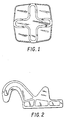
- the "cruciform"-type forging is shown in plan view in Figure 1.
- the center portion of the forging is a cruciform formed from two perpendicular raised ribs.
- the rib portion of the forging is thicker than the base portion.
- the forging in the tests is made in a two-step operation: (1) blocking extrusion preform on flat dies; (2) forging blocker into raised rib "cruciform", the blocking extrusion corresponding to an initial forging step in a forging operation.
- the 5 in.x3.675 in. dia. extruded preforms are blocked in the extrusion direction to 2.5 in. high.
- the blockers are "squared-up" by repeatedly pressing perpendicular to the extrusion direction forming an octahedron approximately 2.5 in.
- All of the 4Mg-1.5Li alloys have "as-forged" hardnesses greater than 78 R B except for the alloy extruded, blocked and forged at 370°C (700°F) and it was ascertained that in these forgings a hardness of 78 R B or better correlates to a YS of 410 MPa (60 ksi) or better. Accordingly, the inference can be made that alloys extruded at 370°C (700°F) and blocked at 260°C (500°F) would meet the target forged YS requirement of 410 MPa (60 ksi).
- compositions 4Mg-1.75Li and 2Mg-2Li can be improved by aging treatments.
- the 2Mg-2Li ages slower than the 4Mg-1.75Li alloy.
- This example illustrates the tensile properties of various AI-Mg-Li alloys of this invention in the extruded, blocked, forged and/or aged conditions of cruciform-type forgings tested at two different sites.
- TPR tensile sample
- the non-heat treatable AI-4Mg-1.5Li alloy extruded at 260°C (500°F), blocked at 260°C (500°F) and forged at 370°C (700°F), has a 444 MPa (64.4 ksi) YS, 518 MPa (75.2 ksi) UTS (ultimate tensile strength) and 11 % EI (elongation to failure).
- the "as-extruded", YS 477 MPa (69.3 ksi) is higher than the forged material, while the "as-extruded" ductility, 7% El, is lower.
- the strengths of the 260°C (500°F) blocker are less than the forged strengths.
- the 4Mg-1.75Li alloy extruded at 260°C (500°F) has a YS of greater than 410 MPa (60 ksi). Solution treating and aging raises the YS to approximately 572 MPa (83 ksi) with just a slight decrease in ductility from the "as-forged" condition.
- the 370°C (700°F) extrusion blocked at 370°C (700°F) has a 537 MPa (78 ksi) YS.
- the 2Mg-2Li alloy extruded at either 260°C (500°F) or 370°C (700°F) produce forgings that have lower as-forged strength than the alloys containing 4% magnesium.
- the "Hook" forging die set used in the tests consists of a high deformation 1st blocker die, a 2nd blocker die which raises the ribs of the forging and a finish die which produces minimal deformation but achieves final tolerances in the part.
- evaluation of the forgings was made after the 2nd blocker, i.e. at an intermediate forging step.
- Figure 2 shows a plan drawing of the finished "Hook"-type forging. Tensile specimens were heat treated in sets of two, representing the longitudinal (L) and the short transverse (ST) orientations.
- Table VI shows properties in two directions for forgings in two conditions: F (as-forged) and T4 (solution treated and naturally aged) for an alloy system containing 4Mg-1.5Li.
- the data show no significant difference in results between the F and T4 conditions.
- the best properties exhibited in Table VI are for the alloy of test 1, i.e. in the as-forged condition processed at 260°C (500°F) extrusion and first blocker temperatures.
- the data confirm that strength is primarily controlled by extrusion temperature and secondarily by blocker temperature.
- This example illustrates the effect of normal forging practice on the tensile properties of a forged sample of an alloy of the type AI-4Mg-1.5Li.
- An extruded billet is prepared from a vacuum hot pressed compaction billet as described in Example 1.
- the compaction billet was extruded from 27.9 cm (11 in.) to 9.53 cm (3-3/4 in.) diameter rod at temperatures of 650-700°F through a shear-faced die at an extrusion ram speed of 0.1 in/sec. and a breakthrough pressure of 1100-1600 tons.
- the extrusion liner was lubricated but not the billets.
- a "Hook" forging was made at a temperature of 420°C (788°F) in the first blocker and 488°C (838°F) in the second blocker.
- Tensile tests on various locations on the specimen showed it to have in the as-forged condition the average properties: YS of 368 MPA (52.7 ksi), UTS of 470 MPa (68.3 ksi), EI of 14.5% and RA of 19.7%.
- the average properties are: YS of 352 MPa (51.5 ksi), UTS of 466 MPa (67.6 ksi), EI of 14% and the RA of 19.9%.
- the method of this example is not effective for achieving the maximum strength potential of the alloy.
- This example illustrates the effect of normal forging practice on the tensile properties of a cruciform forging.
- An extruded billet of an alloy of the 4Mg-1.5Li-type is prepared as described in Example 6.
- the first blocker temperature of the cruciform forging is carried out at 370°C (700°F).
- a lubricant a Withrow A Paste-mineral oil mixture, is used in the finish forging which is carried out at various temperatures. Finish forging temperatures and tensile properties of the finish cruciform forgings in the longitudinal and transverse directions are shown in TABLE VII.
- the method of this example is not effective for achieving maximum strength potential of the alloy.
- This example illustrates dispersion strengthend low density alloys of this invention composed of aluminum, lithium, magnesium, silicon, carbon and oxygen, and containing about 1.1 to 1.2% carbon and less than 1% oxygen.
- Mechanically alloyed powders are prepared having the nominal magnesium, lithium and silicon contents given in Table VIII.
- the powders are vacuum hot pressed to compaction billets and extruded essentially as described in Example 1, except that all extruded billets are prepared at 260°C (500°F) and at ram speeds of 25.4 cm (10 in)/min.
- Extruded billets are forged at 260°C (500°F) to form "Hook"-type forgings essentially as described in Example 5.
- An age hardening treatment is applied to the forged product consisting of a solution treatment at a temperature of about 520°C (970°F), water quenching, and aging at about 145° to 175°C (300° to 340°F) for up to 18 hours.
- the silicon-containing alloys of this invention in the forged, age hardened condition have high strength, with advantageous preservation of corrosion resistant properties in the alloy. It is believed that the increased strength is due to the precipitation of a silicide such as Mg 2 Si and/or lithium silicide.
Landscapes
- Chemical & Material Sciences (AREA)
- Engineering & Computer Science (AREA)
- Materials Engineering (AREA)
- Mechanical Engineering (AREA)
- Metallurgy (AREA)
- Organic Chemistry (AREA)
- Forging (AREA)
Claims (16)
Priority Applications (1)
| Application Number | Priority Date | Filing Date | Title |
|---|---|---|---|
| AT85113483T ATE51037T1 (de) | 1984-10-23 | 1985-10-23 | Dispersionsverstaerkte aluminiumlegierungen. |
Applications Claiming Priority (4)
| Application Number | Priority Date | Filing Date | Title |
|---|---|---|---|
| US06/664,058 US4643780A (en) | 1984-10-23 | 1984-10-23 | Method for producing dispersion strengthened aluminum alloys and product |
| US664058 | 1984-10-23 | ||
| US66424184A | 1984-10-24 | 1984-10-24 | |
| US664241 | 1984-10-24 |
Publications (2)
| Publication Number | Publication Date |
|---|---|
| EP0180144A1 EP0180144A1 (de) | 1986-05-07 |
| EP0180144B1 true EP0180144B1 (de) | 1990-03-14 |
Family
ID=27098878
Family Applications (1)
| Application Number | Title | Priority Date | Filing Date |
|---|---|---|---|
| EP85113483A Expired EP0180144B1 (de) | 1984-10-23 | 1985-10-23 | Dispersionsverstärkte Aluminiumlegierungen |
Country Status (3)
| Country | Link |
|---|---|
| EP (1) | EP0180144B1 (de) |
| CA (1) | CA1284896C (de) |
| DE (1) | DE3576535D1 (de) |
Families Citing this family (15)
| Publication number | Priority date | Publication date | Assignee | Title |
|---|---|---|---|---|
| US4758273A (en) * | 1984-10-23 | 1988-07-19 | Inco Alloys International, Inc. | Dispersion strengthened aluminum alloys |
| DE3809345A1 (de) * | 1988-03-19 | 1989-10-05 | Bayerische Motoren Werke Ag | Verfahren zur herstellung von poroesen bauteilen |
| US4959195A (en) * | 1988-05-12 | 1990-09-25 | Sumitomo Electric Industries, Ltd. | Method of forming large-sized aluminum alloy product |
| JP2787466B2 (ja) * | 1988-05-12 | 1998-08-20 | 住友電気工業株式会社 | 大径の製品用アルミニウム合金の成形方法 |
| AU7162191A (en) * | 1989-11-09 | 1991-06-13 | Allied-Signal Inc. | Dual processing of aluminum base alloys |
| US5045278A (en) * | 1989-11-09 | 1991-09-03 | Allied-Signal Inc. | Dual processing of aluminum base metal matrix composites |
| WO1992019781A1 (en) * | 1991-04-29 | 1992-11-12 | Allied-Signal Inc. | Degassing of aluminum-lithium powder alloys |
| WO1994012677A1 (de) * | 1992-11-20 | 1994-06-09 | 'techma' Gesellschaft Mit Beschränkter Haftung | Aluminiumlegierung |
| GB2341612A (en) * | 1998-09-03 | 2000-03-22 | Secr Defence | Dispersion strengthened aluminium alloy |
| US7651659B2 (en) | 2003-10-02 | 2010-01-26 | Hitachi Powdered Metals Co., Ltd. | Manufacturing method of sinter forged aluminum parts with high strength |
| DE102006031366C5 (de) * | 2006-07-06 | 2010-01-28 | Ecka Granulate Velden Gmbh | Verfahren zur Herstellung von Formteilen aus dispersionsverfestigten Metalllegierungen |
| EP1978120B1 (de) * | 2007-03-30 | 2012-06-06 | Technische Universität Clausthal | Aluminium-Silizium-Gussleglerung und Verfahren zu Ihrer Herstellung |
| US12071680B2 (en) | 2020-08-14 | 2024-08-27 | Lawrence Livermore National Security, Llc | Mechanically alloyed Li—Sn—Zn |
| CN113702178B (zh) * | 2021-08-06 | 2024-02-09 | 京仪股份有限公司 | 一种弥散强化铝镁合金丝抗撕裂性能检测装置 |
| CN116694960B (zh) * | 2023-05-29 | 2025-03-25 | 东北大学 | 一种轻质、铸造性能优越的低成本铸造铝锂合金及其制备方法 |
Family Cites Families (3)
| Publication number | Priority date | Publication date | Assignee | Title |
|---|---|---|---|---|
| US4069042A (en) * | 1975-12-08 | 1978-01-17 | Aluminum Company Of America | Method of pressing and forging metal powder |
| EP0045622B1 (de) * | 1980-07-31 | 1984-12-05 | MPD Technology Corporation | Dispersionsgehärtete Aluminiumlegierungen |
| US4379719A (en) * | 1981-11-20 | 1983-04-12 | Aluminum Company Of America | Aluminum powder alloy product for high temperature application |
-
1985
- 1985-10-21 CA CA000493474A patent/CA1284896C/en not_active Expired - Lifetime
- 1985-10-23 DE DE8585113483T patent/DE3576535D1/de not_active Expired - Fee Related
- 1985-10-23 EP EP85113483A patent/EP0180144B1/de not_active Expired
Also Published As
| Publication number | Publication date |
|---|---|
| EP0180144A1 (de) | 1986-05-07 |
| CA1284896C (en) | 1991-06-18 |
| DE3576535D1 (de) | 1990-04-19 |
Similar Documents
| Publication | Publication Date | Title |
|---|---|---|
| EP0180144B1 (de) | Dispersionsverstärkte Aluminiumlegierungen | |
| US4758273A (en) | Dispersion strengthened aluminum alloys | |
| US4643780A (en) | Method for producing dispersion strengthened aluminum alloys and product | |
| Liu et al. | Design of powder metallurgy titanium alloys and composites | |
| US5078962A (en) | High mechanical strength magnesium alloys and process for obtaining these by rapid solidification | |
| US4297136A (en) | High strength aluminum alloy and process | |
| US4853179A (en) | Method of manufacturing heat resistant, high-strength structural members of sintered aluminum alloy | |
| US4681629A (en) | Powder metallurgical process for manufacturing copper-nickel-tin spinodal alloy articles | |
| WO2002083964A1 (en) | Quasi-crystalline phase hardened magnesium alloy with excellent hot formability and method for preparing the same | |
| US4600556A (en) | Dispersion strengthened mechanically alloyed Al-Mg-Li | |
| US5466277A (en) | Starting powder for producing sintered-aluminum alloy, method for producing sintered parts, and sintered aluminum alloy | |
| CA1213758A (en) | Dispersion strengthened low density ma-a1 | |
| EP0445114B1 (de) | Thermomechanische behandlung von schnell erstarrten al-legierungen | |
| US4801339A (en) | Production of Al alloys with improved properties | |
| US2001134A (en) | Metal powder | |
| EP0015934B1 (de) | Verfahren zum heisspressen von teilchen | |
| JPS63169340A (ja) | セラミツクス分散強化型アルミニウム合金の製造方法 | |
| EP0535167A1 (de) | Verbesserung metallurgischer produkte durch umformung | |
| US5993576A (en) | Wear resistant wrought aluminum alloy and scroll of wear-resistant wrought aluminum alloy | |
| US4731129A (en) | Superplastic zinc/aluminum alloy | |
| Dixon et al. | Properties of aluminium-tin alloys produced by powder metallurgy | |
| Parkinson et al. | Microstructure and extrusion characteristics of PM alloys 7090 and 7091 | |
| KR20010073098A (ko) | 알루미늄-리튬 합금 | |
| LOONG | Cold compression in direct recycling of aluminium 6061 | |
| JPH02194130A (ja) | 耐熱性a1基合金粉末焼結体の製造方法 |
Legal Events
| Date | Code | Title | Description |
|---|---|---|---|
| PUAI | Public reference made under article 153(3) epc to a published international application that has entered the european phase |
Free format text: ORIGINAL CODE: 0009012 |
|
| AK | Designated contracting states |
Kind code of ref document: A1 Designated state(s): AT CH DE FR GB IT LI NL SE |
|
| 17P | Request for examination filed |
Effective date: 19861013 |
|
| 17Q | First examination report despatched |
Effective date: 19871103 |
|
| GRAA | (expected) grant |
Free format text: ORIGINAL CODE: 0009210 |
|
| AK | Designated contracting states |
Kind code of ref document: B1 Designated state(s): AT CH DE FR GB IT LI NL SE |
|
| REF | Corresponds to: |
Ref document number: 51037 Country of ref document: AT Date of ref document: 19900315 Kind code of ref document: T |
|
| REF | Corresponds to: |
Ref document number: 3576535 Country of ref document: DE Date of ref document: 19900419 |
|
| ITF | It: translation for a ep patent filed | ||
| ET | Fr: translation filed | ||
| PLBE | No opposition filed within time limit |
Free format text: ORIGINAL CODE: 0009261 |
|
| STAA | Information on the status of an ep patent application or granted ep patent |
Free format text: STATUS: NO OPPOSITION FILED WITHIN TIME LIMIT |
|
| 26N | No opposition filed | ||
| PGFP | Annual fee paid to national office [announced via postgrant information from national office to epo] |
Ref country code: SE Payment date: 19910917 Year of fee payment: 7 |
|
| PGFP | Annual fee paid to national office [announced via postgrant information from national office to epo] |
Ref country code: NL Payment date: 19911031 Year of fee payment: 7 |
|
| PGFP | Annual fee paid to national office [announced via postgrant information from national office to epo] |
Ref country code: CH Payment date: 19920915 Year of fee payment: 8 |
|
| PG25 | Lapsed in a contracting state [announced via postgrant information from national office to epo] |
Ref country code: SE Effective date: 19921024 |
|
| ITTA | It: last paid annual fee | ||
| PG25 | Lapsed in a contracting state [announced via postgrant information from national office to epo] |
Ref country code: NL Effective date: 19930501 |
|
| NLV4 | Nl: lapsed or anulled due to non-payment of the annual fee | ||
| PG25 | Lapsed in a contracting state [announced via postgrant information from national office to epo] |
Ref country code: LI Effective date: 19931031 Ref country code: CH Effective date: 19931031 |
|
| REG | Reference to a national code |
Ref country code: CH Ref legal event code: PL |
|
| PGFP | Annual fee paid to national office [announced via postgrant information from national office to epo] |
Ref country code: FR Payment date: 19940912 Year of fee payment: 10 |
|
| PGFP | Annual fee paid to national office [announced via postgrant information from national office to epo] |
Ref country code: GB Payment date: 19940914 Year of fee payment: 10 |
|
| PGFP | Annual fee paid to national office [announced via postgrant information from national office to epo] |
Ref country code: AT Payment date: 19940915 Year of fee payment: 10 |
|
| PGFP | Annual fee paid to national office [announced via postgrant information from national office to epo] |
Ref country code: DE Payment date: 19940919 Year of fee payment: 10 |
|
| EUG | Se: european patent has lapsed |
Ref document number: 85113483.3 Effective date: 19930510 |
|
| PG25 | Lapsed in a contracting state [announced via postgrant information from national office to epo] |
Ref country code: GB Effective date: 19951023 Ref country code: AT Effective date: 19951023 |
|
| GBPC | Gb: european patent ceased through non-payment of renewal fee |
Effective date: 19951023 |
|
| PG25 | Lapsed in a contracting state [announced via postgrant information from national office to epo] |
Ref country code: FR Effective date: 19960628 |
|
| PG25 | Lapsed in a contracting state [announced via postgrant information from national office to epo] |
Ref country code: DE Effective date: 19960801 |
|
| REG | Reference to a national code |
Ref country code: FR Ref legal event code: ST |