EP0180877A2 - Photovoltaische Zellenanordnung mit Lichtkonzentrator - Google Patents
Photovoltaische Zellenanordnung mit Lichtkonzentrator Download PDFInfo
- Publication number
- EP0180877A2 EP0180877A2 EP85113647A EP85113647A EP0180877A2 EP 0180877 A2 EP0180877 A2 EP 0180877A2 EP 85113647 A EP85113647 A EP 85113647A EP 85113647 A EP85113647 A EP 85113647A EP 0180877 A2 EP0180877 A2 EP 0180877A2
- Authority
- EP
- European Patent Office
- Prior art keywords
- cell
- array
- struts
- prism
- pair
- Prior art date
- Legal status (The legal status is an assumption and is not a legal conclusion. Google has not performed a legal analysis and makes no representation as to the accuracy of the status listed.)
- Withdrawn
Links
- 230000000712 assembly Effects 0.000 claims abstract description 23
- 238000000429 assembly Methods 0.000 claims abstract description 23
- 239000004020 conductor Substances 0.000 claims description 36
- 230000005855 radiation Effects 0.000 claims description 18
- 239000002245 particle Substances 0.000 claims description 9
- 238000005192 partition Methods 0.000 claims description 3
- 210000004027 cell Anatomy 0.000 claims 38
- 239000012141 concentrate Substances 0.000 claims 4
- 210000003168 insulating cell Anatomy 0.000 claims 1
- 239000002918 waste heat Substances 0.000 abstract 1
- 239000000463 material Substances 0.000 description 9
- 238000003491 array Methods 0.000 description 6
- 238000001816 cooling Methods 0.000 description 5
- 238000006467 substitution reaction Methods 0.000 description 3
- 239000000853 adhesive Substances 0.000 description 2
- 230000001070 adhesive effect Effects 0.000 description 2
- 229910052782 aluminium Inorganic materials 0.000 description 2
- XAGFODPZIPBFFR-UHFFFAOYSA-N aluminium Chemical compound [Al] XAGFODPZIPBFFR-UHFFFAOYSA-N 0.000 description 2
- 239000006059 cover glass Substances 0.000 description 2
- 230000003247 decreasing effect Effects 0.000 description 2
- 238000009413 insulation Methods 0.000 description 2
- 238000000034 method Methods 0.000 description 2
- FRWYFWZENXDZMU-UHFFFAOYSA-N 2-iodoquinoline Chemical compound C1=CC=CC2=NC(I)=CC=C21 FRWYFWZENXDZMU-UHFFFAOYSA-N 0.000 description 1
- OKTJSMMVPCPJKN-UHFFFAOYSA-N Carbon Chemical compound [C] OKTJSMMVPCPJKN-UHFFFAOYSA-N 0.000 description 1
- 229910001218 Gallium arsenide Inorganic materials 0.000 description 1
- XUIMIQQOPSSXEZ-UHFFFAOYSA-N Silicon Chemical compound [Si] XUIMIQQOPSSXEZ-UHFFFAOYSA-N 0.000 description 1
- 230000003190 augmentative effect Effects 0.000 description 1
- LTPBRCUWZOMYOC-UHFFFAOYSA-N beryllium oxide Inorganic materials O=[Be] LTPBRCUWZOMYOC-UHFFFAOYSA-N 0.000 description 1
- 230000015556 catabolic process Effects 0.000 description 1
- 239000000919 ceramic Substances 0.000 description 1
- 229910010293 ceramic material Inorganic materials 0.000 description 1
- 238000010276 construction Methods 0.000 description 1
- 238000006731 degradation reaction Methods 0.000 description 1
- 230000000694 effects Effects 0.000 description 1
- 239000012530 fluid Substances 0.000 description 1
- 229910002804 graphite Inorganic materials 0.000 description 1
- 239000010439 graphite Substances 0.000 description 1
- 230000017525 heat dissipation Effects 0.000 description 1
- 239000011159 matrix material Substances 0.000 description 1
- 238000012986 modification Methods 0.000 description 1
- 230000004048 modification Effects 0.000 description 1
- 239000000615 nonconductor Substances 0.000 description 1
- 230000001681 protective effect Effects 0.000 description 1
- 229910052710 silicon Inorganic materials 0.000 description 1
- 239000010703 silicon Substances 0.000 description 1
- 230000001052 transient effect Effects 0.000 description 1
Images
Classifications
-
- H—ELECTRICITY
- H10—SEMICONDUCTOR DEVICES; ELECTRIC SOLID-STATE DEVICES NOT OTHERWISE PROVIDED FOR
- H10F—INORGANIC SEMICONDUCTOR DEVICES SENSITIVE TO INFRARED RADIATION, LIGHT, ELECTROMAGNETIC RADIATION OF SHORTER WAVELENGTH OR CORPUSCULAR RADIATION
- H10F77/00—Constructional details of devices covered by this subclass
- H10F77/60—Arrangements for cooling, heating, ventilating or compensating for temperature fluctuations
- H10F77/63—Arrangements for cooling directly associated or integrated with photovoltaic cells, e.g. heat sinks directly associated with the photovoltaic cells or integrated Peltier elements for active cooling
-
- B—PERFORMING OPERATIONS; TRANSPORTING
- B64—AIRCRAFT; AVIATION; COSMONAUTICS
- B64G—COSMONAUTICS; VEHICLES OR EQUIPMENT THEREFOR
- B64G1/00—Cosmonautic vehicles
- B64G1/22—Parts of, or equipment specially adapted for fitting in or to, cosmonautic vehicles
- B64G1/42—Arrangements or adaptations of power supply systems
- B64G1/44—Arrangements or adaptations of power supply systems using radiation, e.g. deployable solar arrays
- B64G1/443—Photovoltaic cell arrays
-
- H—ELECTRICITY
- H10—SEMICONDUCTOR DEVICES; ELECTRIC SOLID-STATE DEVICES NOT OTHERWISE PROVIDED FOR
- H10F—INORGANIC SEMICONDUCTOR DEVICES SENSITIVE TO INFRARED RADIATION, LIGHT, ELECTROMAGNETIC RADIATION OF SHORTER WAVELENGTH OR CORPUSCULAR RADIATION
- H10F19/00—Integrated devices, or assemblies of multiple devices, comprising at least one photovoltaic cell covered by group H10F10/00, e.g. photovoltaic modules
- H10F19/90—Structures for connecting between photovoltaic cells, e.g. interconnections or insulating spacers
- H10F19/902—Structures for connecting between photovoltaic cells, e.g. interconnections or insulating spacers for series or parallel connection of photovoltaic cells
- H10F19/904—Structures for connecting between photovoltaic cells, e.g. interconnections or insulating spacers for series or parallel connection of photovoltaic cells characterised by the shapes of the structures
-
- H—ELECTRICITY
- H10—SEMICONDUCTOR DEVICES; ELECTRIC SOLID-STATE DEVICES NOT OTHERWISE PROVIDED FOR
- H10F—INORGANIC SEMICONDUCTOR DEVICES SENSITIVE TO INFRARED RADIATION, LIGHT, ELECTROMAGNETIC RADIATION OF SHORTER WAVELENGTH OR CORPUSCULAR RADIATION
- H10F77/00—Constructional details of devices covered by this subclass
- H10F77/40—Optical elements or arrangements
- H10F77/42—Optical elements or arrangements directly associated or integrated with photovoltaic cells, e.g. light-reflecting means or light-concentrating means
- H10F77/488—Reflecting light-concentrating means, e.g. parabolic mirrors or concentrators using total internal reflection
-
- H—ELECTRICITY
- H10—SEMICONDUCTOR DEVICES; ELECTRIC SOLID-STATE DEVICES NOT OTHERWISE PROVIDED FOR
- H10F—INORGANIC SEMICONDUCTOR DEVICES SENSITIVE TO INFRARED RADIATION, LIGHT, ELECTROMAGNETIC RADIATION OF SHORTER WAVELENGTH OR CORPUSCULAR RADIATION
- H10F77/00—Constructional details of devices covered by this subclass
- H10F77/93—Interconnections
- H10F77/933—Interconnections for devices having potential barriers
- H10F77/935—Interconnections for devices having potential barriers for photovoltaic devices or modules
-
- Y—GENERAL TAGGING OF NEW TECHNOLOGICAL DEVELOPMENTS; GENERAL TAGGING OF CROSS-SECTIONAL TECHNOLOGIES SPANNING OVER SEVERAL SECTIONS OF THE IPC; TECHNICAL SUBJECTS COVERED BY FORMER USPC CROSS-REFERENCE ART COLLECTIONS [XRACs] AND DIGESTS
- Y02—TECHNOLOGIES OR APPLICATIONS FOR MITIGATION OR ADAPTATION AGAINST CLIMATE CHANGE
- Y02E—REDUCTION OF GREENHOUSE GAS [GHG] EMISSIONS, RELATED TO ENERGY GENERATION, TRANSMISSION OR DISTRIBUTION
- Y02E10/00—Energy generation through renewable energy sources
- Y02E10/50—Photovoltaic [PV] energy
- Y02E10/52—PV systems with concentrators
Definitions
- the present invention relates in general to a solar battery array and in particular to an array of photovoltaic assemblies including photovoltaic cells and light concentrating reflectors.
- PV photovoltaic
- Another object of the present invention is to provide a PV cell array which uses light concentrating reflectors to increase the efficiency of the PV cells.
- a further object of the present invention is to provide a PV cell array which can utilize light concentrating reflectors without requiring complicated or unwieldy heat dissipation apparatus and which can, with minimal degradation in performance, withstand high transient temperatures such as may be induced by externally generated particle radiation.
- a further object of the present invention is to provide a PV cell array which does not require the use of separate structures for supporting and electrically interconnecting the PV cells in the array.
- Yet another object of the present invention is to provide a PV cell array which does not require the use of heat damageable materials, such as polymeric electrical wire insulation or cover glass adhesive, in its construction.
- a further object of the present invention is to provide apparatus for easily and simply interconnecting a plurality of PV cells in an array.
- Another object of the present invention is to provide a new and improved photovoltaic assembly which can be easily and quickly combined with identical assemblies to form a relatively inexpensive array of assemblies.
- Yet another object of the present invention is to provide a new and improved PV assembly which can provide the necessary heat rejection for the entire array from the sun-facing array side alone.
- a further object of the present invention is to provide a new and improved PV assembly wherein the cells are positioned within the array so as to receive maximum protection from external particle radiation.
- a new and improved photovoltaic assembly having a light concentrating reflector which can be quickly combined with identical assemblies to form a solar battery array.
- the electrical interconnection of the cells is accomplished by the cell support structure. Specifically, a combination of electrical conductors and electrical insulating elements is used to support each cell at the focal point of its reflector, the latter being spaced from the cell.
- the conductors are connected to the cells and interconnected to each other in a manner which provides both the desired series and parallel electrical connection of the cells.
- the cell support structure in conjunction with the remainder of the array, is configured to reject heat by dissipation into space. This occurs from the sun-facing side of the array alone, where the anti-sun side of the array is shrouded by a panel, e.g. for protection against external particle radiation. Further, the PV cells are positioned within the array in a manner whereby they are shielded from externally generated particle radiation.
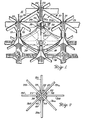
- Figure 1 shows a single photovoltaic assembly 12 partly cut away to illustrate interior details.
- Assembly 12 is adapted to be attached to adjacent, substantially identical assemblies, shown in part in Figure 1, so as to jointly form a photovoltaic array.
- Assembly 12 includes a frame structure 14 in the form of a quadrilateral right prism.
- Frame structure 14 comprises individual frames 20 which jointly define generally square top and bottom prism bases 16 and 18, respectively.
- Frames 20 individually form common partitions between adjacent PV assemblies.
- Support struts 24 and 26 are firmly attached to frame structure 14 at the respective corners of top prism base 16 by means of isolators 22, preferably consisting of a ceramic material, which electrically insulate the struts from the frame structure.
- an electrically insulating fastener 23 extends across the top of isolator 22 and fastens to a pair of frames of frame structure 14. Fastener 23 thus secures the ends of the struts which are received in isolator 22 against vertical movement, as well as fastening the aforesaid frames to the isolator.
- a cell holder 28 is supported by struts 24 and 26, as will become clear in connection with the discussion of Figure 3 below.
- a PV cell 30 is attached at one end of cell holder 28 and has a light receiving face 32 . Face 32 is oriented towards a light concentrating reflector 34 located proximate to bottom prism base 18. All the PV cell faces in the array lie substantially in a common plane parallel to and positioned between bases 16 and 18. Struts 24 and 26 support cell holder 28, and thus cell 30, within frame structure 14 such that the cell is substantially centered on an imaginary axis extending through the centers of bases 16 and 18.
- Cell 30 includes a pair of electrically conductive terminals 29 and 31 which are connected to strut sections 26b and 24b respectively. Thus, struts 26 and 24 are electrically connected to opposite polarity terminals of cell 30. Assembly 12 is shown positioned on a planar back panel 36 which underlies the entire array.
- FIG. 2 shows in greater detail the mechanical interconnection of each isolator 22 with struts 24 and 26 and with frame structure 14.
- each isolator 22 is shown to consist of an octogonal prism having a hollow cylindrical center 23.
- Each isolator 22 includes two pairs of oppositely facing, mutually aligned, blind slots 38 and 40 positioned in mutually perpendicular planes.
- Each of the blind slots is capable of receiving a frame 20 in edgewise relationship.
- each isolator is capable of receiving up to four frames, herein designated 20a, 20b, 20c and 20d.
- Isolator 22 further includes two pairs of through slots, 42 and 44, which are positioned in a pair of mutually perpendicular planes rotationally displaced by 45 * from the planes of blind slots 38 and 40.
- Each pair of through slots is adapted to receive a pair of struts endwise from opposite directions. The various components received by each isolator are securely fastened to the latter.
- a substantially rigid support structure is provided for each cell holder and for the cell held therein.
- slots 42 are shown to receive strut sections 24a and 26b, while slots 44 receive strut sections 26a and 24b.
- These four strut sections are mechanically fastened to each other inside the hollow center 23 of isolator 22, and thus they also form electrical interconnections.
- the abutting ends of the aforesaid strut sections may be brazed or otherwise soldered to each other.
- Figure 3 illustrates the arrangement of struts 24 and 26 inside the surrounding cell holder 28.
- strut 24 includes strut sections 24a and 24b on opposite sides of a bend 24c, which forms an arc of approximately 90' inside cell holder 28.
- strut 26 includes sections 26a, 26b and a bend 26c between them which also forms a 90 * arc proximate bend 24c.
- Cell 30, which is positioned on the underside of the cell holder, is shown in phantom outline in the drawing and includes light receiving surface 32 which is directed away from the viewer in Figure 3.
- a clip 25 snap fits over the top surface and a pair of opposing side walls 48 of cell holder 28, so as to firmly secure struts 24 and 26 to the cell holder.
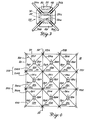
- Figure 4 schematically illustrates the mechanical and electrical interconnections of multiple assemblies 12P through 12X to form an array 10. It is to be understood that array 10 may contain more or fewer assemblies than shown and that all the assemblies are substantially identical.
- the conductive struts entering each isolator 22 are firmly held by the latter, as well as being mechanically and electrically interconnected to form a rigid structure.
- strut 24P of assembly 12P is rigidly connected at isolator 22A to strut 24Q of assembly 12Q.
- struts 24Q and 24R of assemblies 12Q and 12R respectively are rigidly interconnected at isolator 22B.
- struts 24P, 24Q and 24R jointly form an elongate rigid conductor. designated 100 in Figure 4.
- Struts 26P, 26Q and 26R jointly form a rigid conductor half 200A, while struts 24S, 24T and 24U form a rigid conductor half 200B.
- isolators 22C, 22D, 22E and 22F provide not only the electrical interconnection between struts 26 and 24 respectively, but also accomodate the interconnection of struts 26 and 24 to each other.
- conductor halves 200A and 200B together constitute a single, elongate, rigid conductor 200, as indicated in Figure 4.
- each pair of interconnected struts has opposed central bends to form a lozenge-shaped link rigidly connected to identical, adjacent links.
- array 10 includes a succession of elongate, rigid conductors 100, 200, 300, and 400, which are generally parallel to each other.
- a series of solar batteries is positioned between each pair of successive conductors.
- the term solar battery designates a photovoltaic cell, its corresponding cell holder and reflector, as well as appropriate interconnecting components.
- the batteries are preferably positioned such that successive cells of each series are aligned in a row.
- the cells indicated by cell holders 28P, 28Q and 28R form a row between the bracketing conductors 100 and 200.
- the cells of cell holders 285, 28T, and 28U are aligned in a row between the bracketing conductors 200 and 300, and the cells of cell holders 28V, 28W, and 28X form a row between the bracketing conductor pair 300 and 400.
- each row is equidistantly spaced from each other and successive cell rows are likewise spaced at equal distances from each other.
- the arrangement is such that cells in the preferred array illustrated in Figure 4 form a matrix of parallel rows and columns.
- Each cell holder 28 bridges the bracketing pairs of conductors and is firmly attached thereto to provide a substantially rigid cell support structure.
- the cells in each battery series have their terminals connected to the respective conductors of the bracketing conductor pair such that all cells in a given series are connected in parallel with each other, and the respective series of batteries are connected seriatim with each other.
- conductor 200 connects the positive terminals of all cells in the cell row indicated by cell holders 28S, 28 T , and 28U.
- Conductor 300 connects the negative terminals of the same cells.
- the cells in the aforesaid row i.e. cells held by holders 28S, 28T, and 28U, are connected in parallel with each other.
- conductor 300 connects the negative terminals of all cells in cell row 28S, 28T, and 28U with the positive terminals of all cells in the cell row constituted by cell holders 28V, 28W, and 28X.
- the two series of batteries or more specifically the two rows of cells held by holders 28S, 28T, 28U and 28V, 28W, 28X, are connected seriatim, i.e. in series with each other.
- array 10 will be positioned such that reflectors 34 face the sun, giving array 10 an anti-sun side generally defined by panel 36 and a sun-facing side as shown facing the viewer in Figure 1.
- Light incident on the respective reflectors 34 of array 10 is concentrated on light receiving faces 32 of the corresponding cells 30. Accordingly, each cell develops a voltage potential between its terminals 29 and 31.
- conductive struts 24 and 26 are connected to opposite polarity terminals of cell 30 in each assembly 12, and they are electrically interconnected at their ends to establish the aforesaid parallel and series connections of the cells in the array.
- the voltage potential of array 10 varies with the total number of the battery series connected seriatim, while the current capacity of the array varies with the number of solar batteries per series.
- a cell 30 in array 10 should fail so as to produce an open circuit, the array will continue to function at a reduced current capacity. In effect, such a cell failure will result in the removal of that cell alone from its series, thus decreasing the current capacity of that series only. If a cell 30 should develop a short circuit, one entire row of cells will be electrically shorted out. Thus, the array voltage will be reduced by the voltage of one cell.
- struts 24 and 26 provide mechanical support as well as electrical interconnections for cells 30.
- the struts, as well as frames 20 and back panel 36 are preferably constructed to be light in weight.
- the material for these components is selected to be thermally conductive and the components are configured to reject substantial amounts of heat by radiation into space, e.g. by providing large, heat-radiating surface areas.
- the thermally conductive components of the array are adapted to reject the heat from the sun-facing array side alone, i.e. without assistance from the back side of the array.
- each PV cell is seen to be positioned within its assembly such that the assembly structure substantially surrounds the cell face and shields it from externally generated particle radiation which may damage the cell.
- struts 24 and 26, frame structure 14 and back panel. 36 may all be constructed from graphite/aluminum materials which are light in weight and which provide good electrical conductivity for the struts and good thermal conductivity for the entire structure.
- Isolators 22 and cell holder 28 may be fabricated from a ceramic such as beryllium oxide, a lightweight electrical insulator.
- Cells 30 may be gallium arsenide cells and may be used in combination with segmented paraboloidal concentrating reflectors 34 made of aluminum. With such a combination of materials, a lightweight structure may be constructed which is readily deployable in space and which is more efficient and provides a substantially higher electrical output in absolute voltage and current capacity than similarly sized, conventional, planar silicon cell arrays without concentrators.
- terminals 29 and 31 may be augmented with redundant pairs of similarly connected terminals, preventing an open circuit fault if one of the terminals should fail.
Landscapes
- Engineering & Computer Science (AREA)
- Life Sciences & Earth Sciences (AREA)
- Sustainable Development (AREA)
- Remote Sensing (AREA)
- Aviation & Aerospace Engineering (AREA)
- Photovoltaic Devices (AREA)
Applications Claiming Priority (2)
| Application Number | Priority Date | Filing Date | Title |
|---|---|---|---|
| US06/669,082 US4604494A (en) | 1984-11-07 | 1984-11-07 | Photovoltaic cell array with light concentrating reflectors |
| US669082 | 1991-03-14 |
Publications (2)
| Publication Number | Publication Date |
|---|---|
| EP0180877A2 true EP0180877A2 (de) | 1986-05-14 |
| EP0180877A3 EP0180877A3 (de) | 1987-07-15 |
Family
ID=24684936
Family Applications (1)
| Application Number | Title | Priority Date | Filing Date |
|---|---|---|---|
| EP85113647A Withdrawn EP0180877A3 (de) | 1984-11-07 | 1985-10-26 | Photovoltaische Zellenanordnung mit Lichtkonzentrator |
Country Status (4)
| Country | Link |
|---|---|
| US (1) | US4604494A (de) |
| EP (1) | EP0180877A3 (de) |
| JP (1) | JPS61119081A (de) |
| CN (1) | CN85108094A (de) |
Cited By (4)
| Publication number | Priority date | Publication date | Assignee | Title |
|---|---|---|---|---|
| EP0373234A1 (de) * | 1988-12-12 | 1990-06-20 | Siemens Aktiengesellschaft | Solargenerator |
| CN102386278A (zh) * | 2011-10-21 | 2012-03-21 | 无锡绿波新能源设备有限公司 | 多晶载片器快速转换为单晶载片器的快速转换装置 |
| WO2014021948A1 (en) * | 2012-07-31 | 2014-02-06 | Semprius, Inc. | Surface-mountable lens cradles and interconnection structures for concentrator-type photovoltaic devices |
| EP2806468A1 (de) * | 2013-05-24 | 2014-11-26 | Universidad Politécnica de Madrid | Photovoltaikempfänger für Solarkonzentrator |
Families Citing this family (42)
| Publication number | Priority date | Publication date | Assignee | Title |
|---|---|---|---|---|
| US5212916A (en) * | 1984-07-26 | 1993-05-25 | Peter Raupach | Device for shading spaces |
| US4716258A (en) * | 1987-01-23 | 1987-12-29 | Murtha R Michael | Stamped concentrators supporting photovoltaic assemblies |
| US5374317A (en) | 1990-09-26 | 1994-12-20 | Energy Systems Solar, Incorporated | Multiple reflector concentrator solar electric power system |
| US5086828A (en) * | 1991-09-25 | 1992-02-11 | The United States Of America As Represented By The Administrator Of The National Aeronautics And Space Administration | Lunar radiator shade |
| US5632032A (en) * | 1994-02-07 | 1997-05-20 | International Business Machines Corporation | Cross address space thread control in a multithreaded environment |
| US8577839B2 (en) * | 2002-08-06 | 2013-11-05 | Sheng Tai (Ted) Tsao | Method and apparatus of dynamic updating web portals |
| US20060243319A1 (en) * | 2005-04-29 | 2006-11-02 | Arizona Public Service Company | Clustered solar-energy conversion array and method therefor |
| US7622666B2 (en) * | 2005-06-16 | 2009-11-24 | Soliant Energy Inc. | Photovoltaic concentrator modules and systems having a heat dissipating element located within a volume in which light rays converge from an optical concentrating element towards a photovoltaic receiver |
| US20070089777A1 (en) * | 2005-10-04 | 2007-04-26 | Johnson Richard L Jr | Heatsink for concentrating or focusing optical/electrical energy conversion systems |
| WO2007044385A2 (en) * | 2005-10-04 | 2007-04-19 | Practical Instruments, Inc. | Self-powered systems and methods using auxiliary solar cells |
| CN101375112A (zh) * | 2006-01-17 | 2009-02-25 | 索利安特能源公司 | 用于光学聚光器的混合式主光学部件 |
| US20070193620A1 (en) * | 2006-01-17 | 2007-08-23 | Hines Braden E | Concentrating solar panel and related systems and methods |
| JP4863792B2 (ja) * | 2006-07-05 | 2012-01-25 | 日軽金アクト株式会社 | 太陽光発電装置 |
| US20080135096A1 (en) * | 2006-09-30 | 2008-06-12 | Johnson Richard L | Optical concentrators having one or more line foci and related methods |
| US20080128586A1 (en) * | 2006-10-13 | 2008-06-05 | Johnson Richard L | Sun sensor assembly and related method of using |
| US20090000662A1 (en) * | 2007-03-11 | 2009-01-01 | Harwood Duncan W J | Photovoltaic receiver for solar concentrator applications |
| WO2008113837A2 (en) * | 2007-03-20 | 2008-09-25 | Lemnis Lighting Patent Holding B.V. | Heat management system for photovoltaic cell panels and led-based light sources |
| US20100269428A1 (en) * | 2007-05-23 | 2010-10-28 | Robert Stancel | Cost Effective, Elongate Member Mounting System For Photovoltaic Devices |
| US20090114213A1 (en) * | 2007-11-03 | 2009-05-07 | Solfocus, Inc. | Solar concentrator with square mirrors |
| US8748727B2 (en) | 2008-01-18 | 2014-06-10 | Tenksolar, Inc. | Flat-plate photovoltaic module |
| US8933320B2 (en) | 2008-01-18 | 2015-01-13 | Tenksolar, Inc. | Redundant electrical architecture for photovoltaic modules |
| US20090183764A1 (en) * | 2008-01-18 | 2009-07-23 | Tenksolar, Inc | Detachable Louver System |
| US8212139B2 (en) * | 2008-01-18 | 2012-07-03 | Tenksolar, Inc. | Thin-film photovoltaic module |
| ES2421107T3 (es) | 2008-05-12 | 2013-08-28 | Arizona Board Of Regents On Behalf Of University Of Arizona | Procedimiento de fabricación de reflectores parabólicos grandes para un aparato de concentración solar |
| ES2538815T3 (es) * | 2008-05-16 | 2015-06-24 | Suncore Photovoltaics Incorporated | Panel solar fotovoltaico de concentración |
| WO2010000108A1 (en) * | 2008-07-01 | 2010-01-07 | Yingtian Chen | Concentrating photovoltaic cell system, wiring and aranging methods thereof |
| US20100018009A1 (en) * | 2008-07-22 | 2010-01-28 | Solfocus, Inc. | Clips for Aligning Optical Components in a Solar Concentrating Array |
| US8664514B2 (en) * | 2008-10-13 | 2014-03-04 | George M. Watters | Multiplexing solar light chamber |
| IN2012DN00387A (de) | 2009-06-15 | 2015-08-21 | Tenksolar Inc | |
| US9605877B2 (en) * | 2010-02-10 | 2017-03-28 | Edward Wu | Compact parabolic solar concentrators and cooling and heat extraction system |
| US9773933B2 (en) | 2010-02-23 | 2017-09-26 | Tenksolar, Inc. | Space and energy efficient photovoltaic array |
| US9299861B2 (en) | 2010-06-15 | 2016-03-29 | Tenksolar, Inc. | Cell-to-grid redundandt photovoltaic system |
| KR101425136B1 (ko) | 2010-08-10 | 2014-08-04 | 텐케이솔라 인코포레이티드 | 고효율 태양전지판 |
| US9893223B2 (en) | 2010-11-16 | 2018-02-13 | Suncore Photovoltaics, Inc. | Solar electricity generation system |
| US9528724B1 (en) | 2011-06-08 | 2016-12-27 | Solarreserve Technology, Llc | Apparatus and method for configuring heliostat fields |
| US10050583B2 (en) | 2012-11-30 | 2018-08-14 | Arizona Board Of Regents On Behalf Of University Of Arizona | Solar generator with large reflector dishes and concentrator photovoltaic cells in flat arrays |
| WO2015061323A1 (en) | 2013-10-22 | 2015-04-30 | The Arizona Board Of Regents On Behalf Of The University Of Arizona | Octohedral frame and tripod for rotating equipment |
| US10186628B2 (en) * | 2014-06-20 | 2019-01-22 | Vismunda Srl | Apparatus for the automatic horizontal assembly of photovoltaic panels |
| US10505059B2 (en) | 2015-01-16 | 2019-12-10 | The Arizona Board Of Regents On Behalf Of The University Of Arizona | Micro-scale concentrated photovoltaic module |
| WO2016141041A1 (en) | 2015-03-02 | 2016-09-09 | The Arizona Board Of Regents On Behalf Of The University Of Arizona | Glass forming mold of adjustable shape |
| WO2016200988A1 (en) | 2015-06-12 | 2016-12-15 | The Arizona Board Of Regents On Behalf Of The University Of Arizona | Tandem photovoltaic module with diffractive spectral separation |
| WO2017024038A1 (en) | 2015-08-03 | 2017-02-09 | The Arizona Board Of Regents On Behalf Of The University Of Arizona | Solar concentrator for a tower-mounted central receiver |
Family Cites Families (8)
| Publication number | Priority date | Publication date | Assignee | Title |
|---|---|---|---|---|
| US3459391A (en) * | 1964-02-13 | 1969-08-05 | Nasa | Interconnection of solar cells |
| US3446676A (en) * | 1966-09-07 | 1969-05-27 | Webb James E | Solar battery with interconnecting means for plural cells |
| US3756858A (en) * | 1970-09-14 | 1973-09-04 | Trw Inc | Folding thin-film deployable panel structure |
| US3658596A (en) * | 1970-09-21 | 1972-04-25 | Lockheed Missiles Space | Flexible solar cell modular assembly |
| US3819417A (en) * | 1972-05-17 | 1974-06-25 | Communications Satellite Corp | Mechanically interlaced and electrically interconnected silicon solar cells |
| US3984256A (en) * | 1975-04-25 | 1976-10-05 | Nasa | Photovoltaic cell array |
| US4086485A (en) * | 1976-05-26 | 1978-04-25 | Massachusetts Institute Of Technology | Solar-radiation collection apparatus with tracking circuitry |
| US4361717A (en) * | 1980-12-05 | 1982-11-30 | General Electric Company | Fluid cooled solar powered photovoltaic cell |
-
1984
- 1984-11-07 US US06/669,082 patent/US4604494A/en not_active Expired - Fee Related
-
1985
- 1985-05-16 CN CN198585108094A patent/CN85108094A/zh active Pending
- 1985-10-26 EP EP85113647A patent/EP0180877A3/de not_active Withdrawn
- 1985-11-01 JP JP60244273A patent/JPS61119081A/ja active Pending
Cited By (5)
| Publication number | Priority date | Publication date | Assignee | Title |
|---|---|---|---|---|
| EP0373234A1 (de) * | 1988-12-12 | 1990-06-20 | Siemens Aktiengesellschaft | Solargenerator |
| CN102386278A (zh) * | 2011-10-21 | 2012-03-21 | 无锡绿波新能源设备有限公司 | 多晶载片器快速转换为单晶载片器的快速转换装置 |
| WO2014021948A1 (en) * | 2012-07-31 | 2014-02-06 | Semprius, Inc. | Surface-mountable lens cradles and interconnection structures for concentrator-type photovoltaic devices |
| EP2806468A1 (de) * | 2013-05-24 | 2014-11-26 | Universidad Politécnica de Madrid | Photovoltaikempfänger für Solarkonzentrator |
| WO2014187975A1 (en) * | 2013-05-24 | 2014-11-27 | Universidad Politécnica de Madrid | Solar cell receiver suitable for reflective solar concentrator modules |
Also Published As
| Publication number | Publication date |
|---|---|
| US4604494A (en) | 1986-08-05 |
| CN85108094A (zh) | 1986-10-01 |
| JPS61119081A (ja) | 1986-06-06 |
| EP0180877A3 (de) | 1987-07-15 |
Similar Documents
| Publication | Publication Date | Title |
|---|---|---|
| US4604494A (en) | Photovoltaic cell array with light concentrating reflectors | |
| US8450596B2 (en) | Solar generator panel and an associated satellite | |
| US4433200A (en) | Roll formed pan solar module | |
| ES2360614T3 (es) | Módulos fotovoltaicos y metodología de interconexión para fabricar los mismos. | |
| US4834805A (en) | Photovoltaic power modules and methods for making same | |
| EP0581889B1 (de) | Erzeugung elektrischer energie aus sonnenstrahlung | |
| US5185042A (en) | Generic solar cell array using a printed circuit substrate | |
| US5167724A (en) | Planar photovoltaic solar concentrator module | |
| US3340096A (en) | Solar cell array | |
| US3903427A (en) | Solar cell connections | |
| US3375141A (en) | Solar cell array | |
| US4153476A (en) | Double-sided solar cell package | |
| KR20120018369A (ko) | 광전도 모듈 스트링 배열 및 그 쉐이딩 보호 | |
| US20100275976A1 (en) | Photovoltaic module with edge access to pv strings, interconnection method, apparatus, and system | |
| JPH0656897B2 (ja) | 砒化ガリウム太陽電池装置 | |
| US11056997B2 (en) | Universal photovoltaic laminate | |
| US4209347A (en) | Mounting for solar cell | |
| EP4354567B1 (de) | Batteriemodul und verfahren zur herstellung des batteriemoduls | |
| US4162174A (en) | Solar cell array | |
| US2889498A (en) | Semiconductor rectifier assembly | |
| EP4133591A1 (de) | Miura-ori-photovoltaikmodul | |
| RU2053937C1 (ru) | Космический аппарат | |
| US4153475A (en) | Three dimensional solar panel assembly | |
| JP2000036329A (ja) | 宇宙空間応用の3次元バッテリ | |
| JPS62229985A (ja) | 太陽電池パネル装置 |
Legal Events
| Date | Code | Title | Description |
|---|---|---|---|
| PUAI | Public reference made under article 153(3) epc to a published international application that has entered the european phase |
Free format text: ORIGINAL CODE: 0009012 |
|
| AK | Designated contracting states |
Kind code of ref document: A2 Designated state(s): DE FR GB IT NL SE |
|
| PUAL | Search report despatched |
Free format text: ORIGINAL CODE: 0009013 |
|
| AK | Designated contracting states |
Kind code of ref document: A3 Designated state(s): DE FR GB IT NL SE |
|
| 17P | Request for examination filed |
Effective date: 19880107 |
|
| STAA | Information on the status of an ep patent application or granted ep patent |
Free format text: STATUS: THE APPLICATION IS DEEMED TO BE WITHDRAWN |
|
| 18D | Application deemed to be withdrawn |
Effective date: 19900501 |
|
| RIN1 | Information on inventor provided before grant (corrected) |
Inventor name: SHEPARD, NEAL FRANKLIN, JR. |