EP0180935B1 - Procédé pour diminuer la porosité d'une pièce coulée - Google Patents
Procédé pour diminuer la porosité d'une pièce coulée Download PDFInfo
- Publication number
- EP0180935B1 EP0180935B1 EP85113951A EP85113951A EP0180935B1 EP 0180935 B1 EP0180935 B1 EP 0180935B1 EP 85113951 A EP85113951 A EP 85113951A EP 85113951 A EP85113951 A EP 85113951A EP 0180935 B1 EP0180935 B1 EP 0180935B1
- Authority
- EP
- European Patent Office
- Prior art keywords
- container
- casting
- pressure medium
- heated
- press
- Prior art date
- Legal status (The legal status is an assumption and is not a legal conclusion. Google has not performed a legal analysis and makes no representation as to the accuracy of the status listed.)
- Expired
Links
Images
Classifications
-
- B—PERFORMING OPERATIONS; TRANSPORTING
- B30—PRESSES
- B30B—PRESSES IN GENERAL
- B30B11/00—Presses specially adapted for forming shaped articles from material in particulate or plastic state, e.g. briquetting presses, tabletting presses
- B30B11/001—Presses specially adapted for forming shaped articles from material in particulate or plastic state, e.g. briquetting presses, tabletting presses using a flexible element, e.g. diaphragm, urged by fluid pressure; Isostatic presses
-
- B—PERFORMING OPERATIONS; TRANSPORTING
- B22—CASTING; POWDER METALLURGY
- B22D—CASTING OF METALS; CASTING OF OTHER SUBSTANCES BY THE SAME PROCESSES OR DEVICES
- B22D31/00—Cutting-off surplus material, e.g. gates; Cleaning and working on castings
- B22D31/002—Cleaning, working on castings
- B22D31/005—Sealing or impregnating porous castings
-
- C—CHEMISTRY; METALLURGY
- C21—METALLURGY OF IRON
- C21D—MODIFYING THE PHYSICAL STRUCTURE OF FERROUS METALS; GENERAL DEVICES FOR HEAT TREATMENT OF FERROUS OR NON-FERROUS METALS OR ALLOYS; MAKING METAL MALLEABLE, e.g. BY DECARBURISATION OR TEMPERING
- C21D8/00—Modifying the physical properties of ferrous metals or ferrous alloys by deformation combined with, or followed by, heat treatment
Definitions
- the invention relates to a method of reducing the porosity of a casting according to the precharacterising part of claim 1.
- Aluminum castings are currently manufactured mainly by two methods, namely, by die casting or chill casting. With both methods a porous casting results, the pores weakening the casting. Among other things, the fatigue strength of the casting is reduced by the pores. It is known that porous castings can be densified by subjecting them to a hot isostatic compression. In the known method, the casting is placed in the press chamber of a press of autoclave type, whereafter the casting is heated within the press chamber to the necessary temperature for pressure treatment and is then subjected to the necessary pressure in the press chamber, usually via a gaseous pressure medium. Such an isostatic pressing operation is a relatively slow process.
- the invention aims at improving a method of the afore-mentioned kind to the effect that the overall time required for the isostatic compression process is considerably reduced.
- the invention is based on the realization that the treatment time for densifying a casting by isostatic compression can be drastically reduced by simultaneously using a liquid pressure medium, with its inherent low compressibility, and a press with a rapid pressure-increasing capacity such as a piston press, provided that the casting can be brought to the temperature necessary for rapid densifying without the liquid pressure medium having to be heated, in its entirety, up to this temperature.
- the casting is heated while located within a special container before the container with the casting, is located in the press chamber of a fast-acting press and the liquid pressure medium is supplied to the press chamber.
- a number of through-channels are provided, through which the liquid pressure medium is supplied into the container. While passing through the channels, the pressure medium is heated by the hot container wall(s) to the necessary temperature, so that the casting is not subjected to any significant temperature reduction on being contacted by the liquid pressure medium.
- the container is thus utilized as a heat reservoir.
- the method according to the invention is particularly suitable for densification of light weight metal and light weight metal alloys.
- the isostatic compression is suitably carried out at a pressure of at least 100 MPa and preferably at a pressure in the range 100 to 1000 MPa. A pressure in excess of 300 Mpa is particularly preferred.
- the casting and the container are suitably heated to a temperature which lies above 300°C but below the solidus temperature of the casting material in question.
- the maximum temperature is 659°C and for pure magnesium 651°C.
- a temperature in the range 370 to 550°C is suitable.
- the invention is applicable to the densification of castings of all conventional aluminum and magnesium alloys, which are used for castings.
- Such aluminum alloys contain at least 85 per cent by weight AI as well as one or more additional elements which form a eutectic with the aluminum, normally Si, Cu and Mg.
- additional elements which form a eutectic with the aluminum, normally Si, Cu and Mg.
- Such alloys are an alloy containing 7 per cent by weight Si and 0.37 per cent by weight Mg, the balance being AI; an alloy containing 4.5 per cent.by weight Cu, 1.5 per cent by weight Mg and 2 per cent by weight Ni, the balance being Al, and an alloy containing 9 per cent by weight Si, 0.5 per cent by weight Mg and 1.8 per cent by weight Cu, the balance being Al.
- Magnesium alloys of this kind contain at least 85 per cent by weight Mg as well as one or more additional elements which form a eutectic with the aluminum, normally Zn, Zr, Al, Mn and Th.
- additional elements which form a eutectic with the aluminum, normally Zn, Zr, Al, Mn and Th.
- Such alloys are an alloy containing 4.6 per cent by weight Zn and 0.7 per cent by weight Zr, the balance being Mg; an alloy containing 10 per cent by weight AI and 0.1 per cent by weight Mn, the balance being AI; an alloy containing 6 per cent by weight Al, 0.15 per cent by weight Mn and 3 per cent by weight Zn, the balance being Mg; and an alloy containing 3.3 per cent by weight Th and 0.7 per cent by weight Zr, the balance being Mg.
- the liquid pressure medium may advantageously consist of a vegetable oil, an animal oil or a mineral oil. Such pressure media also function as lubricant. It would be possible, per se, to use other liquid pressure media.
- oils those with good thermal stability and low inflammability are particularly preferred.
- castor oil but also palm oil and colza oil may be used to advantage.
- the free volume in the container, available for the liquid pressure medium, between the casting and the inner walls of the container is normally considerably smaller than the volume of the material making up the container, suitably constituting at most 30% and preferably at most 20% of the volume of said material.
- the free volume available for the liquid pressure medium between the casting and the inner walls of the container is suitably also considerably smaller than the pressure medium volume of the piston press.
- the container is preferably made of a metallic material with a higher melting point than that of the casting, for example copper, steel or cast iron when densifying castings of light weight metals and light weight metal alloys.
- any wall of the container which contains the channels is formed with a greater thickness than the other walls thereof.
- the channels in the container wall(s) are arranged to be longer than the thickness of the wall in which they are arranged.
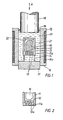
- the volume of the space 12 left between the internal walls of the container 11 and the casting 10 constitutes about 10% of the volume of the steel making up the container 11.
- a plurality of channels 13 for pressure medium are provided in one wall 11a of the container. These channels 13 each have a diameter of about 4 mm.
- the wall 11a, in which the channels are arranged, has a greater thickness than the other walls of the container 11 in order for the pressure medium to be heated sufficiently before it contacts the casting 10.
- the container 11, with its casting 10, is heated up to a temperature of about 500°C and is then placed on support means 14 in a piston press 15.
- the piston press 15 comprises a cylinder 16, which is provided with a wire-wound reinforcing mantle 16a, a bottom plate 17, which is in liquid- tight sealing engagement with the cylinder 16, and a movable piston 18.
- the integers 16, 17, 18 and 19 define a press chamber 20 that surrounds the container 11. Between the cylinder 16 and the piston 18, an annular seal 19 is provided.
- the piston press 15 is placed in a hydraulic press (not shown), in which there is a cylinder with a piston for applying a force on the piston 18 in the direction of the arrow A.
- the castor oil which is supplied at room temperature or at a slightly elevated temperature, passes, via the channels 13, into the free space 12 in the container available for the pressure medium. In passing through the channels 13, the castor oil is heated to a temperature close to 500°C.
- the pressure medium completely surrounds the casting 10, the casting is subjected to an isostatic pressure, reducing or eliminating the porosity of the casting and rendering it at least approximately free of pores.
- the process time for the treatment of the casting in the piston press can be made to be less than 1 minute.
- the channels 13 in the container wall Ila can be elongated by being shaped so that the direction of flow of pressure medium is changed one or more times in its flow through the wall 11a, for example by forming the channels with a zigzag configuration as shown at 13a in Figure 2, or otherwise by arranging sets of two or more channels 13 in series connection.
- the volume within the container 11 is partly occupied by the casting 10 and partly by one or more filling bodies 22 (only one of which is shown in Figure 1) so that the remaining free space 12 is less than 30% of the combined volume of both, the container walls and the filling bodies 22.
Landscapes
- Engineering & Computer Science (AREA)
- Chemical & Material Sciences (AREA)
- Mechanical Engineering (AREA)
- Physics & Mathematics (AREA)
- Metallurgy (AREA)
- Thermal Sciences (AREA)
- Crystallography & Structural Chemistry (AREA)
- Materials Engineering (AREA)
- Fluid Mechanics (AREA)
- Organic Chemistry (AREA)
- Powder Metallurgy (AREA)
- Press Drives And Press Lines (AREA)
- Forging (AREA)
- Transition And Organic Metals Composition Catalysts For Addition Polymerization (AREA)
- Diaphragms For Electromechanical Transducers (AREA)
- Air Bags (AREA)
- Pistons, Piston Rings, And Cylinders (AREA)
Claims (8)
Applications Claiming Priority (2)
| Application Number | Priority Date | Filing Date | Title |
|---|---|---|---|
| SE8405604A SE450095B (sv) | 1984-11-09 | 1984-11-09 | Sett att gora gjutgods av aluminium i det nemaste porfritt |
| SE8405604 | 1984-11-09 |
Publications (3)
| Publication Number | Publication Date |
|---|---|
| EP0180935A2 EP0180935A2 (fr) | 1986-05-14 |
| EP0180935A3 EP0180935A3 (en) | 1987-07-15 |
| EP0180935B1 true EP0180935B1 (fr) | 1989-10-11 |
Family
ID=20357675
Family Applications (1)
| Application Number | Title | Priority Date | Filing Date |
|---|---|---|---|
| EP85113951A Expired EP0180935B1 (fr) | 1984-11-09 | 1985-11-02 | Procédé pour diminuer la porosité d'une pièce coulée |
Country Status (7)
| Country | Link |
|---|---|
| US (1) | US4615745A (fr) |
| EP (1) | EP0180935B1 (fr) |
| JP (1) | JPS61115697A (fr) |
| CA (1) | CA1239852A (fr) |
| DE (1) | DE3573615D1 (fr) |
| NO (1) | NO854445L (fr) |
| SE (1) | SE450095B (fr) |
Families Citing this family (8)
| Publication number | Priority date | Publication date | Assignee | Title |
|---|---|---|---|---|
| US4814025A (en) * | 1986-07-29 | 1989-03-21 | Northrop Corporation | Method of improving properties of superplastically formed alloys by healing cavities |
| US5816090A (en) * | 1995-12-11 | 1998-10-06 | Ametek Specialty Metal Products Division | Method for pneumatic isostatic processing of a workpiece |
| JP3610716B2 (ja) * | 1997-01-23 | 2005-01-19 | トヨタ自動車株式会社 | 鋳物のシール面の加工方法 |
| DE10051525A1 (de) * | 2000-10-17 | 2002-05-02 | Thyssen Krupp Automotive Ag | Verfahren zur Herstellung von Blechen, insbesondere Karosserieblechen |
| GB2421207A (en) * | 2004-12-16 | 2006-06-21 | Cosworth Technology Ltd | Casting with a halogen containing compound provided on the mould surface |
| EP3160670B1 (fr) | 2014-06-30 | 2019-05-15 | Mahavadi Management and Technology Services GmbH | Procédé de fabrication de matériaux composites de haute qualité au moyen d'un réacteur à haute pression isostatique |
| JP6681099B1 (ja) * | 2019-07-09 | 2020-04-15 | ミカドテクノス株式会社 | 液体加圧加工処理装置及び液体加圧加工処理方法 |
| WO2025158433A1 (fr) * | 2024-01-24 | 2025-07-31 | Technion Research & Development Foundation Limited | Procédé de réduction de la porosité de matériaux métalliques solides ou de réparation de microfissures dans lesdits matériaux à l'aide d'un pressage isostatique à chaud |
Family Cites Families (9)
| Publication number | Priority date | Publication date | Assignee | Title |
|---|---|---|---|---|
| FR781003A (fr) * | 1934-06-18 | 1935-05-08 | High Duty Alloys Ltd | Perfectionnements au traitement des pièces moulées en alliages non ferreux |
| US2273500A (en) * | 1939-09-18 | 1942-02-17 | Automatic Button Company | Machine for compressing lenses or the like |
| GB819942A (en) * | 1957-04-17 | 1959-09-09 | Jaime De Sternberg | Process and apparatus for compressing and compacting a workpiece |
| IT1043001B (it) * | 1974-10-24 | 1980-02-20 | Howmet Corp | Meiudo per il trattamento isosta tico a caldo di pezzi fusi |
| US4250610A (en) * | 1979-01-02 | 1981-02-17 | General Electric Company | Casting densification method |
| US4349333A (en) * | 1981-02-09 | 1982-09-14 | Pressure Technology, Inc. | Hot isostatic press with rapid cooling |
| GB2098119B (en) * | 1981-05-11 | 1985-09-04 | Chromalloy American Corp | Method of improving mechanical properties of alloy parts |
| US4379725A (en) * | 1982-02-08 | 1983-04-12 | Kemp Willard E | Process for hot isostatic pressing of a metal workpiece |
| GB2143170B (en) * | 1983-07-14 | 1986-03-12 | H I P | Treatment of materials by isostatic pressing |
-
1984
- 1984-11-09 SE SE8405604A patent/SE450095B/sv not_active IP Right Cessation
-
1985
- 1985-11-02 DE DE8585113951T patent/DE3573615D1/de not_active Expired
- 1985-11-02 EP EP85113951A patent/EP0180935B1/fr not_active Expired
- 1985-11-06 JP JP60248701A patent/JPS61115697A/ja active Pending
- 1985-11-07 NO NO854445A patent/NO854445L/no unknown
- 1985-11-07 CA CA000494827A patent/CA1239852A/fr not_active Expired
- 1985-11-08 US US06/796,120 patent/US4615745A/en not_active Expired - Fee Related
Also Published As
| Publication number | Publication date |
|---|---|
| EP0180935A3 (en) | 1987-07-15 |
| SE8405604L (sv) | 1986-05-10 |
| SE8405604D0 (sv) | 1984-11-09 |
| CA1239852A (fr) | 1988-08-02 |
| US4615745A (en) | 1986-10-07 |
| JPS61115697A (ja) | 1986-06-03 |
| EP0180935A2 (fr) | 1986-05-14 |
| NO854445L (no) | 1986-05-12 |
| SE450095B (sv) | 1987-06-09 |
| DE3573615D1 (en) | 1989-11-16 |
Similar Documents
| Publication | Publication Date | Title |
|---|---|---|
| US6048432A (en) | Method for producing complex-shaped objects from laminae | |
| US4099314A (en) | Method of producing hollow bodies in aluminum-silicon alloys by powder-extrusion | |
| KR100405910B1 (ko) | 분말야금부품의예비성형을위한방법및금속분말의압축된부품 | |
| JPH0344403A (ja) | 圧縮体形成方法 | |
| EP0180935A2 (fr) | Procédé pour diminuer la porosité d'une pièce coulée | |
| CN101612664A (zh) | 压制第一粉状材料及第二粉状材料的方法 | |
| US5666632A (en) | Valve seat insert of two layers of same compact density | |
| US5062908A (en) | Valve guide | |
| US4972898A (en) | Method of forming a piston containing a cavity | |
| US3232754A (en) | Porous metallic bodies and fabrication methods therefor | |
| US4155756A (en) | Hollow bodies produced by powder extrusion of aluminum-silicon alloys | |
| US4860542A (en) | Piston-cylinder pulsator circuit with superplastic alloy pressure transmitting medium | |
| US3837848A (en) | Method of making tools by impregnating a steel skeleton with a carbide, nitride or oxide precursor | |
| CA1162182A (fr) | Methode de deposition d'une couche superficielle dure sur des outils de foration | |
| US3611546A (en) | Method of highly-densifying powdered metal | |
| Morgan et al. | Isostatic compaction of metal powders | |
| MX2007016027A (es) | Metodo para la aleacion aditiva de aluminio en componentes. | |
| US3065073A (en) | Method for producing composite bodies of aluminum and sintered aluminum powder | |
| MX2007008208A (es) | Metodo de formacion de componentes de polvo de metal con densificacion de superficie. | |
| US2936520A (en) | Method of compressing and compacting a solid body of metal | |
| RU2101137C1 (ru) | Способ изготовления двухслойных втулок | |
| ElWakil et al. | Lubrication effects in the compaction of sponge-iron powder at low and high speeds | |
| DE4234004C1 (de) | Verfahren zur Herstellung von Blechen oder Keramikplatten | |
| RU2278766C2 (ru) | Способ уплотнения изделия и устройство для его осуществления | |
| RU2055697C1 (ru) | Способ изготовления изделий из порошка со сквозными каналами |
Legal Events
| Date | Code | Title | Description |
|---|---|---|---|
| PUAI | Public reference made under article 153(3) epc to a published international application that has entered the european phase |
Free format text: ORIGINAL CODE: 0009012 |
|
| AK | Designated contracting states |
Kind code of ref document: A2 Designated state(s): BE CH DE FR GB IT LI |
|
| PUAL | Search report despatched |
Free format text: ORIGINAL CODE: 0009013 |
|
| AK | Designated contracting states |
Kind code of ref document: A3 Designated state(s): BE CH DE FR GB IT LI |
|
| 17P | Request for examination filed |
Effective date: 19871124 |
|
| 17Q | First examination report despatched |
Effective date: 19881216 |
|
| GRAA | (expected) grant |
Free format text: ORIGINAL CODE: 0009210 |
|
| AK | Designated contracting states |
Kind code of ref document: B1 Designated state(s): BE CH DE FR GB IT LI |
|
| PGFP | Annual fee paid to national office [announced via postgrant information from national office to epo] |
Ref country code: GB Payment date: 19891031 Year of fee payment: 5 |
|
| PGFP | Annual fee paid to national office [announced via postgrant information from national office to epo] |
Ref country code: BE Payment date: 19891115 Year of fee payment: 5 |
|
| REF | Corresponds to: |
Ref document number: 3573615 Country of ref document: DE Date of ref document: 19891116 |
|
| PGFP | Annual fee paid to national office [announced via postgrant information from national office to epo] |
Ref country code: FR Payment date: 19891120 Year of fee payment: 5 |
|
| PGFP | Annual fee paid to national office [announced via postgrant information from national office to epo] |
Ref country code: CH Payment date: 19891128 Year of fee payment: 5 |
|
| ITF | It: translation for a ep patent filed | ||
| ET | Fr: translation filed | ||
| PLBE | No opposition filed within time limit |
Free format text: ORIGINAL CODE: 0009261 |
|
| STAA | Information on the status of an ep patent application or granted ep patent |
Free format text: STATUS: NO OPPOSITION FILED WITHIN TIME LIMIT |
|
| 26N | No opposition filed | ||
| PG25 | Lapsed in a contracting state [announced via postgrant information from national office to epo] |
Ref country code: GB Effective date: 19901102 |
|
| PGFP | Annual fee paid to national office [announced via postgrant information from national office to epo] |
Ref country code: DE Payment date: 19901127 Year of fee payment: 6 |
|
| ITTA | It: last paid annual fee | ||
| PG25 | Lapsed in a contracting state [announced via postgrant information from national office to epo] |
Ref country code: LI Effective date: 19901130 Ref country code: CH Effective date: 19901130 Ref country code: BE Effective date: 19901130 |
|
| BERE | Be: lapsed |
Owner name: ASEA A.B. Effective date: 19901130 |
|
| GBPC | Gb: european patent ceased through non-payment of renewal fee | ||
| PG25 | Lapsed in a contracting state [announced via postgrant information from national office to epo] |
Ref country code: FR Effective date: 19910731 |
|
| REG | Reference to a national code |
Ref country code: CH Ref legal event code: PL |
|
| REG | Reference to a national code |
Ref country code: FR Ref legal event code: ST |
|
| PG25 | Lapsed in a contracting state [announced via postgrant information from national office to epo] |
Ref country code: DE Effective date: 19920801 |