EP0181266A2 - Procédé de préparation d'une phase stationnaire pour colonne chromatographique, colonne chromatographique ainsi obtenue, et son utilisation - Google Patents
Procédé de préparation d'une phase stationnaire pour colonne chromatographique, colonne chromatographique ainsi obtenue, et son utilisation Download PDFInfo
- Publication number
- EP0181266A2 EP0181266A2 EP85402133A EP85402133A EP0181266A2 EP 0181266 A2 EP0181266 A2 EP 0181266A2 EP 85402133 A EP85402133 A EP 85402133A EP 85402133 A EP85402133 A EP 85402133A EP 0181266 A2 EP0181266 A2 EP 0181266A2
- Authority
- EP
- European Patent Office
- Prior art keywords
- silica
- stationary
- phase
- grafting
- preparing
- Prior art date
- Legal status (The legal status is an assumption and is not a legal conclusion. Google has not performed a legal analysis and makes no representation as to the accuracy of the status listed.)
- Granted
Links
- 230000005526 G1 to G0 transition Effects 0.000 title claims abstract description 28
- 238000004519 manufacturing process Methods 0.000 title claims abstract description 5
- VYPSYNLAJGMNEJ-UHFFFAOYSA-N Silicium dioxide Chemical compound O=[Si]=O VYPSYNLAJGMNEJ-UHFFFAOYSA-N 0.000 claims abstract description 75
- 239000000377 silicon dioxide Substances 0.000 claims abstract description 35
- 239000012071 phase Substances 0.000 claims abstract description 23
- 239000000470 constituent Substances 0.000 claims abstract description 18
- 238000000926 separation method Methods 0.000 claims abstract description 11
- 125000000217 alkyl group Chemical group 0.000 claims abstract description 10
- 125000000524 functional group Chemical group 0.000 claims abstract description 10
- 150000001412 amines Chemical class 0.000 claims abstract description 9
- 230000007062 hydrolysis Effects 0.000 claims abstract description 9
- 238000006460 hydrolysis reaction Methods 0.000 claims abstract description 9
- 239000003209 petroleum derivative Substances 0.000 claims abstract description 5
- 238000011049 filling Methods 0.000 claims abstract description 4
- 239000007791 liquid phase Substances 0.000 claims abstract description 4
- XLYOFNOQVPJJNP-UHFFFAOYSA-N water Substances O XLYOFNOQVPJJNP-UHFFFAOYSA-N 0.000 claims description 16
- 238000000034 method Methods 0.000 claims description 14
- 238000001035 drying Methods 0.000 claims description 11
- VLKZOEOYAKHREP-UHFFFAOYSA-N n-Hexane Chemical compound CCCCCC VLKZOEOYAKHREP-UHFFFAOYSA-N 0.000 claims description 11
- 238000006243 chemical reaction Methods 0.000 claims description 10
- IJOOHPMOJXWVHK-UHFFFAOYSA-N chlorotrimethylsilane Chemical compound C[Si](C)(C)Cl IJOOHPMOJXWVHK-UHFFFAOYSA-N 0.000 claims description 10
- 239000000203 mixture Substances 0.000 claims description 7
- WYURNTSHIVDZCO-UHFFFAOYSA-N Tetrahydrofuran Chemical compound C1CCOC1 WYURNTSHIVDZCO-UHFFFAOYSA-N 0.000 claims description 6
- CTQNGGLPUBDAKN-UHFFFAOYSA-N O-Xylene Chemical compound CC1=CC=CC=C1C CTQNGGLPUBDAKN-UHFFFAOYSA-N 0.000 claims description 5
- 239000005051 trimethylchlorosilane Substances 0.000 claims description 5
- 239000008096 xylene Substances 0.000 claims description 5
- 238000003756 stirring Methods 0.000 claims description 4
- 239000002253 acid Substances 0.000 claims description 3
- 238000002242 deionisation method Methods 0.000 claims description 2
- 238000010438 heat treatment Methods 0.000 claims description 2
- SIXQMBHNPLICFH-UHFFFAOYSA-N n-trichlorosilylpropan-1-amine Chemical compound CCCN[Si](Cl)(Cl)Cl SIXQMBHNPLICFH-UHFFFAOYSA-N 0.000 claims description 2
- 230000000750 progressive effect Effects 0.000 claims description 2
- 229920006395 saturated elastomer Polymers 0.000 description 7
- 239000002904 solvent Substances 0.000 description 7
- 125000001931 aliphatic group Chemical group 0.000 description 6
- 125000003118 aryl group Chemical group 0.000 description 6
- 239000010779 crude oil Substances 0.000 description 6
- 238000004811 liquid chromatography Methods 0.000 description 5
- 230000014759 maintenance of location Effects 0.000 description 5
- 125000005372 silanol group Chemical group 0.000 description 5
- 239000000741 silica gel Substances 0.000 description 5
- 229910002027 silica gel Inorganic materials 0.000 description 5
- 150000003973 alkyl amines Chemical class 0.000 description 4
- 238000004810 partition chromatography Methods 0.000 description 4
- 239000005046 Chlorosilane Substances 0.000 description 3
- 150000001336 alkenes Chemical class 0.000 description 3
- -1 aminopropyl Chemical group 0.000 description 3
- 239000013626 chemical specie Substances 0.000 description 3
- KOPOQZFJUQMUML-UHFFFAOYSA-N chlorosilane Chemical compound Cl[SiH3] KOPOQZFJUQMUML-UHFFFAOYSA-N 0.000 description 3
- 238000004587 chromatography analysis Methods 0.000 description 3
- 150000002430 hydrocarbons Chemical class 0.000 description 3
- 230000000717 retained effect Effects 0.000 description 3
- 239000000126 substance Substances 0.000 description 3
- 238000004458 analytical method Methods 0.000 description 2
- 238000010586 diagram Methods 0.000 description 2
- 239000010419 fine particle Substances 0.000 description 2
- 239000000499 gel Substances 0.000 description 2
- 229930195733 hydrocarbon Natural products 0.000 description 2
- 230000003993 interaction Effects 0.000 description 2
- 150000002500 ions Chemical class 0.000 description 2
- 125000002496 methyl group Chemical group [H]C([H])([H])* 0.000 description 2
- WGYKZJWCGVVSQN-UHFFFAOYSA-N mono-n-propyl amine Natural products CCCN WGYKZJWCGVVSQN-UHFFFAOYSA-N 0.000 description 2
- 125000004888 n-propyl amino group Chemical group [H]N(*)C([H])([H])C([H])([H])C([H])([H])[H] 0.000 description 2
- 230000035484 reaction time Effects 0.000 description 2
- 230000002441 reversible effect Effects 0.000 description 2
- 229910001220 stainless steel Inorganic materials 0.000 description 2
- 239000010935 stainless steel Substances 0.000 description 2
- 239000004215 Carbon black (E152) Substances 0.000 description 1
- GRYLNZFGIOXLOG-UHFFFAOYSA-N Nitric acid Chemical compound O[N+]([O-])=O GRYLNZFGIOXLOG-UHFFFAOYSA-N 0.000 description 1
- BLRPTPMANUNPDV-UHFFFAOYSA-N Silane Chemical compound [SiH4] BLRPTPMANUNPDV-UHFFFAOYSA-N 0.000 description 1
- QAOWNCQODCNURD-UHFFFAOYSA-N Sulfuric acid Chemical compound OS(O)(=O)=O QAOWNCQODCNURD-UHFFFAOYSA-N 0.000 description 1
- 238000010521 absorption reaction Methods 0.000 description 1
- 238000005377 adsorption chromatography Methods 0.000 description 1
- 238000013019 agitation Methods 0.000 description 1
- 150000001343 alkyl silanes Chemical group 0.000 description 1
- 230000006399 behavior Effects 0.000 description 1
- 230000001588 bifunctional effect Effects 0.000 description 1
- 239000003153 chemical reaction reagent Substances 0.000 description 1
- 150000001875 compounds Chemical class 0.000 description 1
- 238000006482 condensation reaction Methods 0.000 description 1
- 150000002009 diols Chemical class 0.000 description 1
- KPUWHANPEXNPJT-UHFFFAOYSA-N disiloxane Chemical class [SiH3]O[SiH3] KPUWHANPEXNPJT-UHFFFAOYSA-N 0.000 description 1
- 230000000694 effects Effects 0.000 description 1
- 239000003480 eluent Substances 0.000 description 1
- 238000010828 elution Methods 0.000 description 1
- 239000012156 elution solvent Substances 0.000 description 1
- 238000001914 filtration Methods 0.000 description 1
- 239000000295 fuel oil Substances 0.000 description 1
- 239000011521 glass Substances 0.000 description 1
- 238000004128 high performance liquid chromatography Methods 0.000 description 1
- 229910052500 inorganic mineral Inorganic materials 0.000 description 1
- 238000009434 installation Methods 0.000 description 1
- 125000000956 methoxy group Chemical group [H]C([H])([H])O* 0.000 description 1
- 239000011707 mineral Substances 0.000 description 1
- CFNHVUGPXZUTRR-UHFFFAOYSA-N n'-propylethane-1,2-diamine Chemical group CCCNCCN CFNHVUGPXZUTRR-UHFFFAOYSA-N 0.000 description 1
- AXNCVDQWNPJQOM-UHFFFAOYSA-N n-triethoxysilylpropan-1-amine Chemical compound CCCN[Si](OCC)(OCC)OCC AXNCVDQWNPJQOM-UHFFFAOYSA-N 0.000 description 1
- 229910017604 nitric acid Inorganic materials 0.000 description 1
- 150000002825 nitriles Chemical class 0.000 description 1
- 150000001282 organosilanes Chemical class 0.000 description 1
- 239000002245 particle Substances 0.000 description 1
- 239000002798 polar solvent Substances 0.000 description 1
- 238000002360 preparation method Methods 0.000 description 1
- 238000007670 refining Methods 0.000 description 1
- 238000005070 sampling Methods 0.000 description 1
- 230000035945 sensitivity Effects 0.000 description 1
- 229910000077 silane Inorganic materials 0.000 description 1
- 238000002444 silanisation Methods 0.000 description 1
- 230000007958 sleep Effects 0.000 description 1
- 239000007787 solid Substances 0.000 description 1
- 230000002195 synergetic effect Effects 0.000 description 1
- 239000003643 water by type Substances 0.000 description 1
Images
Classifications
-
- B—PERFORMING OPERATIONS; TRANSPORTING
- B01—PHYSICAL OR CHEMICAL PROCESSES OR APPARATUS IN GENERAL
- B01J—CHEMICAL OR PHYSICAL PROCESSES, e.g. CATALYSIS OR COLLOID CHEMISTRY; THEIR RELEVANT APPARATUS
- B01J20/00—Solid sorbent compositions or filter aid compositions; Sorbents for chromatography; Processes for preparing, regenerating or reactivating thereof
- B01J20/281—Sorbents specially adapted for preparative, analytical or investigative chromatography
- B01J20/286—Phases chemically bonded to a substrate, e.g. to silica or to polymers
-
- B—PERFORMING OPERATIONS; TRANSPORTING
- B01—PHYSICAL OR CHEMICAL PROCESSES OR APPARATUS IN GENERAL
- B01J—CHEMICAL OR PHYSICAL PROCESSES, e.g. CATALYSIS OR COLLOID CHEMISTRY; THEIR RELEVANT APPARATUS
- B01J20/00—Solid sorbent compositions or filter aid compositions; Sorbents for chromatography; Processes for preparing, regenerating or reactivating thereof
- B01J20/02—Solid sorbent compositions or filter aid compositions; Sorbents for chromatography; Processes for preparing, regenerating or reactivating thereof comprising inorganic material
- B01J20/10—Solid sorbent compositions or filter aid compositions; Sorbents for chromatography; Processes for preparing, regenerating or reactivating thereof comprising inorganic material comprising silica or silicate
- B01J20/103—Solid sorbent compositions or filter aid compositions; Sorbents for chromatography; Processes for preparing, regenerating or reactivating thereof comprising inorganic material comprising silica or silicate comprising silica
-
- B—PERFORMING OPERATIONS; TRANSPORTING
- B01—PHYSICAL OR CHEMICAL PROCESSES OR APPARATUS IN GENERAL
- B01J—CHEMICAL OR PHYSICAL PROCESSES, e.g. CATALYSIS OR COLLOID CHEMISTRY; THEIR RELEVANT APPARATUS
- B01J20/00—Solid sorbent compositions or filter aid compositions; Sorbents for chromatography; Processes for preparing, regenerating or reactivating thereof
- B01J20/281—Sorbents specially adapted for preparative, analytical or investigative chromatography
- B01J20/286—Phases chemically bonded to a substrate, e.g. to silica or to polymers
- B01J20/287—Non-polar phases; Reversed phases
-
- B—PERFORMING OPERATIONS; TRANSPORTING
- B01—PHYSICAL OR CHEMICAL PROCESSES OR APPARATUS IN GENERAL
- B01J—CHEMICAL OR PHYSICAL PROCESSES, e.g. CATALYSIS OR COLLOID CHEMISTRY; THEIR RELEVANT APPARATUS
- B01J20/00—Solid sorbent compositions or filter aid compositions; Sorbents for chromatography; Processes for preparing, regenerating or reactivating thereof
- B01J20/30—Processes for preparing, regenerating, or reactivating
- B01J20/3078—Thermal treatment, e.g. calcining or pyrolizing
-
- B—PERFORMING OPERATIONS; TRANSPORTING
- B01—PHYSICAL OR CHEMICAL PROCESSES OR APPARATUS IN GENERAL
- B01J—CHEMICAL OR PHYSICAL PROCESSES, e.g. CATALYSIS OR COLLOID CHEMISTRY; THEIR RELEVANT APPARATUS
- B01J20/00—Solid sorbent compositions or filter aid compositions; Sorbents for chromatography; Processes for preparing, regenerating or reactivating thereof
- B01J20/30—Processes for preparing, regenerating, or reactivating
- B01J20/3085—Chemical treatments not covered by groups B01J20/3007 - B01J20/3078
-
- B—PERFORMING OPERATIONS; TRANSPORTING
- B01—PHYSICAL OR CHEMICAL PROCESSES OR APPARATUS IN GENERAL
- B01J—CHEMICAL OR PHYSICAL PROCESSES, e.g. CATALYSIS OR COLLOID CHEMISTRY; THEIR RELEVANT APPARATUS
- B01J20/00—Solid sorbent compositions or filter aid compositions; Sorbents for chromatography; Processes for preparing, regenerating or reactivating thereof
- B01J20/30—Processes for preparing, regenerating, or reactivating
- B01J20/3092—Packing of a container, e.g. packing a cartridge or column
-
- B—PERFORMING OPERATIONS; TRANSPORTING
- B01—PHYSICAL OR CHEMICAL PROCESSES OR APPARATUS IN GENERAL
- B01J—CHEMICAL OR PHYSICAL PROCESSES, e.g. CATALYSIS OR COLLOID CHEMISTRY; THEIR RELEVANT APPARATUS
- B01J20/00—Solid sorbent compositions or filter aid compositions; Sorbents for chromatography; Processes for preparing, regenerating or reactivating thereof
- B01J20/30—Processes for preparing, regenerating, or reactivating
- B01J20/32—Impregnating or coating ; Solid sorbent compositions obtained from processes involving impregnating or coating
- B01J20/3202—Impregnating or coating ; Solid sorbent compositions obtained from processes involving impregnating or coating characterised by the carrier, support or substrate used for impregnation or coating
- B01J20/3204—Inorganic carriers, supports or substrates
-
- B—PERFORMING OPERATIONS; TRANSPORTING
- B01—PHYSICAL OR CHEMICAL PROCESSES OR APPARATUS IN GENERAL
- B01J—CHEMICAL OR PHYSICAL PROCESSES, e.g. CATALYSIS OR COLLOID CHEMISTRY; THEIR RELEVANT APPARATUS
- B01J20/00—Solid sorbent compositions or filter aid compositions; Sorbents for chromatography; Processes for preparing, regenerating or reactivating thereof
- B01J20/30—Processes for preparing, regenerating, or reactivating
- B01J20/32—Impregnating or coating ; Solid sorbent compositions obtained from processes involving impregnating or coating
- B01J20/3231—Impregnating or coating ; Solid sorbent compositions obtained from processes involving impregnating or coating characterised by the coating or impregnating layer
- B01J20/3242—Layers with a functional group, e.g. an affinity material, a ligand, a reactant or a complexing group
- B01J20/3244—Non-macromolecular compounds
- B01J20/3246—Non-macromolecular compounds having a well defined chemical structure
-
- B—PERFORMING OPERATIONS; TRANSPORTING
- B01—PHYSICAL OR CHEMICAL PROCESSES OR APPARATUS IN GENERAL
- B01J—CHEMICAL OR PHYSICAL PROCESSES, e.g. CATALYSIS OR COLLOID CHEMISTRY; THEIR RELEVANT APPARATUS
- B01J20/00—Solid sorbent compositions or filter aid compositions; Sorbents for chromatography; Processes for preparing, regenerating or reactivating thereof
- B01J20/30—Processes for preparing, regenerating, or reactivating
- B01J20/32—Impregnating or coating ; Solid sorbent compositions obtained from processes involving impregnating or coating
- B01J20/3231—Impregnating or coating ; Solid sorbent compositions obtained from processes involving impregnating or coating characterised by the coating or impregnating layer
- B01J20/3242—Layers with a functional group, e.g. an affinity material, a ligand, a reactant or a complexing group
- B01J20/3244—Non-macromolecular compounds
- B01J20/3246—Non-macromolecular compounds having a well defined chemical structure
- B01J20/3257—Non-macromolecular compounds having a well defined chemical structure the functional group or the linking, spacer or anchoring group as a whole comprising at least one of the heteroatoms nitrogen, oxygen or sulfur together with at least one silicon atom, these atoms not being part of the carrier as such
-
- B—PERFORMING OPERATIONS; TRANSPORTING
- B01—PHYSICAL OR CHEMICAL PROCESSES OR APPARATUS IN GENERAL
- B01J—CHEMICAL OR PHYSICAL PROCESSES, e.g. CATALYSIS OR COLLOID CHEMISTRY; THEIR RELEVANT APPARATUS
- B01J2220/00—Aspects relating to sorbent materials
- B01J2220/50—Aspects relating to the use of sorbent or filter aid materials
- B01J2220/54—Sorbents specially adapted for analytical or investigative chromatography
-
- B—PERFORMING OPERATIONS; TRANSPORTING
- B01—PHYSICAL OR CHEMICAL PROCESSES OR APPARATUS IN GENERAL
- B01J—CHEMICAL OR PHYSICAL PROCESSES, e.g. CATALYSIS OR COLLOID CHEMISTRY; THEIR RELEVANT APPARATUS
- B01J2220/00—Aspects relating to sorbent materials
- B01J2220/50—Aspects relating to the use of sorbent or filter aid materials
- B01J2220/58—Use in a single column
-
- Y—GENERAL TAGGING OF NEW TECHNOLOGICAL DEVELOPMENTS; GENERAL TAGGING OF CROSS-SECTIONAL TECHNOLOGIES SPANNING OVER SEVERAL SECTIONS OF THE IPC; TECHNICAL SUBJECTS COVERED BY FORMER USPC CROSS-REFERENCE ART COLLECTIONS [XRACs] AND DIGESTS
- Y10—TECHNICAL SUBJECTS COVERED BY FORMER USPC
- Y10T—TECHNICAL SUBJECTS COVERED BY FORMER US CLASSIFICATION
- Y10T428/00—Stock material or miscellaneous articles
- Y10T428/29—Coated or structually defined flake, particle, cell, strand, strand portion, rod, filament, macroscopic fiber or mass thereof
- Y10T428/2982—Particulate matter [e.g., sphere, flake, etc.]
- Y10T428/2991—Coated
- Y10T428/2993—Silicic or refractory material containing [e.g., tungsten oxide, glass, cement, etc.]
- Y10T428/2995—Silane, siloxane or silicone coating
Definitions
- the invention also relates to a chromatographic column filled with such a stationary phase, as well as the use which can be made of it, in particular for separating the constituents of a crude oil, or of crude oil fractions, by means of a phase mobile, such as n-hexane.
- the field of the invention is that of chemical analysis, more particularly that of the separation of the constituents of more or less complex mixtures, more specifically by means of liquid chromatography;
- Liquid chromatography on a column is one of the oldest chromatographic methods, but it has been relatively little used until recent years, mainly due to the slow separations, the lack of choice of stationary phases, and the absence of detectors., Currently, these obstacles having been removed, we know a renewal of this method in a more modern form under high pressure.
- liquid chromatography can be classified into several variants depending on the nature of the phases or the phenomena involved, for the separation of the constituents, it should therefore be specified here that the invention is more specifically concerned with partition chromatography on grafted stationary phase.
- the separation of the species is based on their difference in interaction with the variously functionalized molecules which have been grafted onto a suitable solid, typically a silica gel.
- a mobile liquid phase in such a chromatographic column, progresses through the stationary phase constituted by grafting of various organic molecules on a silica gel. Said organic molecules are hereinafter called grafts.
- Sharing chromatography the possibilities of which have been considerably increased as a result of the use of various grafts, is particularly suitable for the separation of homologous species or of species comprising groups of different nature, polar or non-polar (and we will use then respectively the classic partition chromatography or reverse phase polarity sharing). It has the advantage of allowing the analysis of compounds which are too strongly adsorbed on virgin silica gels (adsorption chromatography). The presence and choice of grafts are therefore essential and determining characteristics of the method chosen.
- the Applicant having in particular the purpose of the separation of the constituents (or their families) of a crude oil, or of a fraction thereof or of the products resulting from a refining thereof, the solubility of the constituents to be separated in a hydrocarbon (such as n-hexane) directs it towards the choice of partition chromatography, the stationary phase of which is a silica grafted with a functional group of the amine type, such as for example an aminopropyl, and the phase of which mobile is an apolar solvent, such as n-hexane.
- a hydrocarbon such as n-hexane
- a proportion significant component consists of aromatic nuclei more or less substituted by long alkyl chains, and the behavior of these complex molecules vis-à-vis the apolar eluent (n-hexane) or the stationary phase, has an intermediate character between the constituents of olefinic or saturated type and the constituents of pure aromatic type. Their correct separation is therefore made extremely difficult.
- the object of the invention is to orient the selectivity of such a chromatographic column vis-à-vis the different families of hydrocarbons present in a petroleum product, in particular to separate the saturated and olefins from the aromatics.
- the process for preparing a stationary silica phase is remarkable in that the hydrolysis of said first grafts is carried out by a progressive treatment, by stirring the silica thus grafted in a bath. hydrofuran, then in that water is gradually added to the hydrofuran, finally in that the hydrofuran water mixture is completely replaced by water.
- a stationary phase comprising grafts of these two types makes it possible both to sufficiently separate the aromatics, and to retain longer the substituted aromatics of long aliphatic chain, than do the columns according to the prior art.
- the functional groups previously grafted onto the silica are obtained from n-propyl aminotrichlorosilane, and the second graft is an alkyl silane and, more specifically, a tri-methyl-chlorosilane
- This graft ensures retention by intersection with the substituted hydrocarbon chain on an aromatic nucleus.
- the partition chromatography makes it possible to separate the species according to their difference in interaction between two immiscible phases; a first stationary phase, in this case a synthetic silica in very fine particles (typically 3-10 ⁇ m nominal diameter) and on which we came to graft polar molecules, and a second mobile phase, which is an apolar solvent.
- This type of chromatography is said to be "conventional sharing” as opposed to that known as “reverse phase sharing” by which the mobile phase is a polar solvent, and the stationary phase is nonpolar.
- the processes for preparing the stationary phases according to the prior art generally consist in reacting in an absolutely anhydrous medium the silica with the organic molecule to be grafted.
- the initial product is a porous silica gel, of fine particle size, characterized by the presence of silanol groups ( ⁇ Si - OH) typically of the order of 5 - O H per nm 2 .
- silanol groups are very reactive and it; it is possible to graft on these groups, various organic molecules called grafts.
- virgin silica is agitated in an acid medium, such as a mixture of sulfuric and nitric acid, concentrated and hot so as to remove ions, then rinsed with water, so that it is freed of mineral ions present on its surface and that it thus presents as much as possible reactive silanol groups.
- the silica is then dried, for fifteen hours under vacuum at a temperature between 160 ° and 200 ° C, typically at 180 ° C.
- the actual silanization reaction is carried out: the silica is suspended in the presence of the organosilane chosen, in the presence of an anhydrous solvent (such as xylene).
- an anhydrous solvent such as xylene
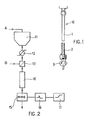
- Such a stationary phase is arranged in a chromatographic column 10, such as that shown in FIG. 1.
- the column consists of an internally smooth stainless steel tube 1, of variable length and internal diameter.
- the stationary phase 2 is immobilized in the column by means of a sintered stainless steel disc 3, of suitable porosity, to retain the finest particles but without introducing an excessive pressure drop in the installation.
- solvent A is introduced into a tank 11, which is sent, at a relatively high pressure (up to several hundred bars, etc.) by a pump 12, onto the actual chromatographic column 10.
- the pumps 12 can be of several types: at constant pressure, such as pneumatic pumps , or at constant flow such as syringe or reciprocating piston pumps.
- An injector 13 makes it possible to introduce the sample to be analyzed B into the solvent, generally by means of a sampling valve. The whole of solvent A and of sample B forms the mobile phase which crosses the chromatographic column 10, in which the stationary phase is immobilized.
- the mobile phase is analyzed by a detector 15 (such as a UV absorption detector, or a differential refractometer), then the signal from the detector 15 is recorded in a recorder 16, to which an integrator 17 can be added for the purpose of carrying out quantitative analyzes or, more generally, a system for processing the data supplied by the detector.
- a detector 15 such as a UV absorption detector, or a differential refractometer
- the aromatics present in petroleum products can have an intermediate character, between the purely aromatic character and the aliphatic character.
- the chromatographic columns according to the prior art cannot sufficiently separate these constituents, which are eluted at the same time as the simple olefins and the saturated ones.
- the hydrolysis of said first grafts is carried out by a gradual treatment, by agitating the silica thus grafted in a bath of h drofuranne there. Then water is gradually added to the hydrofuran and finally the hydrofuran-water mixture is completely replaced by water.
- a second grafting is therefore carried out, which relates in particular to the —OH groups released on the aminopropyl graft by hydrolysis, in accordance with the following reaction: where R 1 and R 2 are groups -CH 3 -OC1 or -OC 2 H 5 .
- R 1 and R 2 are groups -CH 3 -OC1 or -OC 2 H 5 .
- This second grafting thus makes it possible to obtain a bifunctional stationary phase, ensuring respectively the retention of pure aromatics and that of aromatics with a long aliphatic chain.
- the invention described above is not a simple juxtaposition of previously known means, but a real combination, having a synergistic effect.
- the mixture of two stationary phases grafted respectively one aminopropyl, the other alkyl does not allow the saturated and olefins to be separated from the long chain aromatics. There is therefore a new effect due to the grafting on the same silica of two grafts of different type, in particular one on the other.
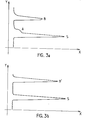
- the characteristic chromatograms represented in FIGS. 3a and 3b were carried out using as n-hexane elution solvent and as a detector a UV spectrophotometer calibrated at 210 mm.
- the flow rate is -1 1 ml.min -1 .
- the abscissa axis X represents the detector signal (arbitrary unit).
- the separation of the saturated type (peak S) and monoaromatic type (shoulder A) chemical species is clearly observed in FIG. 3a.
- the monoaromatic type species come together with the polyaromatics (peak B ') in Figure 3b.
- the functional groups previously grafted onto virgin silica are obtained by reaction with n-propylamino-triethoxysilane after hydrolysis as described above and a second drying under the same conditions as the first drying, the subsequently grafted functional group obtained by reaction is a tri-methyl chlorosilane.
- the objective sought is therefore to increase the affinity of these constituents for the stationary phase, and the retained means consists in grafting on this phase of apolar type grafts, such as alkyls, sleeps the simplest of them are methyls.
- This group is generally provided in the form of a tri-methyl-chlorosilane (TMCS), diluted in xylene, in a manner somewhat analogous to the grafting process described above.
- TMCS tri-methyl-chlorosilane
- the grafted silica-xylene-TMCS mixture is stirred for nearly fifteen hours, at a temperature between 120 and 150 ° C, and preferably at 140 ° C, in a flask. After reaction, the silica is rinsed with dry xylene, filtering through sintered glass.
- the reaction time in fact depends on the desired grafting rate, and also on the previous grafting rate obtained. We generally want to achieve the maximum grafting rate.
- the Applicant has noted that the presence of traces of residual water after the second drying facilitates the attachment of the second grafts. But in order to obtain conditions for the preparation of reproducible phases, it was not suitable to leave traces of water present in the stationary phase, but it was preferable to dry very vigorously the silica thus grafted and hydrolysed then to re- introduce some traces of water, between 0.1 and 1% by weight relative to the silica.
- the chromatographic columns according to the present invention obtained by filling from a doubly grafted stationary phase, have increased selectivity, in particular in their use to separate chemical constituents of crude oil, or a fraction of crude oil.
Landscapes
- Chemical & Material Sciences (AREA)
- Analytical Chemistry (AREA)
- Organic Chemistry (AREA)
- Chemical Kinetics & Catalysis (AREA)
- Inorganic Chemistry (AREA)
- Physics & Mathematics (AREA)
- Thermal Sciences (AREA)
- Solid-Sorbent Or Filter-Aiding Compositions (AREA)
- Treatment Of Liquids With Adsorbents In General (AREA)
Abstract
Description
- L'invention concerne un procédé de préparation d'une phase stationnaire constituée par un gel de silice greffé en vue du remplissage d'une colonne chromatographique destinée à séparer des constituants en phase liquide, comprenant les étapes suivantes :
- - une désionisation, par agitation de la silice vierge dans un bain acide,
- - un premier séchage de la silice vierge, par chauffage à une température comprise généralement entre 16 et 200°C, pendant plusieurs heures sous vide,
- - un premier greffage par des groupements fonctionnels de type amine,
- - une hydrolyse de ces premiers greffons,
- - un second séchage de la silice ainsi greffée,
- - un second greffage par des groupements fonctionnels de type alkyle, éventuellement substitué.
- L'invention concerne également une colonne chromatographique remplie avec une telle phase stationnaire, ainsi que l'utilisation qui peut en être faite, notamment pour séparer les constituants d'un pétrole brut, ou de fractions de pétrole brut, au moyen d'une phase mobile, telle que le n-hexane.
- Le domaine de l'invention est celui de l'analyse chimique, plus particulièrement celui de la séparation des constituants de mélanges plus ou moins complexe, plus spécifiquement au moyen de la chromatographie en phase liquide;
- La chromatographie en phase liquide sur colonne est une des plus anciennes méthodes chromatographiques, mais elle a été relativement peu utilisée jusqu'à ces dernières années, en raison principalement de la lenteur des séparations,du manque de choix des phases stationnaires, et de l'absence de détecteurs., Actuellement, ces obstacles ayant été levés, on connaît un renouveau de cette méthode sous une forme plus moderne sous haute pression.
- La chromatographie en phase liquide pouvant être classée en plusieurs variantes selon la nature des phases ou les phénomènes mis en jeu, pour la séparation des constituants, il convient dès lors de préciser ici que l'invention s'intéresse plus précisément à la chromatographie de partage sur phase stationnaire greffée. Selon cette variante, la séparation des espèces est fondée sur leur différence d'interaction avec les molécules diversement fonctionnalisées qui ont été greffées sur un solide convenable, typiquement un gel de silice.
- Dans une telle colonne chromatographique, une phase liquide mobile, dite phase d'élution, progresse au travers de la phase stationnaire constituée par greffage de molécules organiques variées sur un gel de silice. Lesdites molécules organiques sont appelées par la suite greffons.
- La rétention différente des espèces chimiques contenues dans la phase mobile par ces greffons, permet de les séparer.
- Les principaux greffons sont les suivants :
- - des amines
- - (CH2)3 - NH2, - (CH2)3 - N (CH3)2,

- - (CH2)3 - NH2, - (CH2)3 - N (CH3)2,
- - des diamines -(CH2)3 - NH (CH2)2 - NH2,
- - des nitriles - (CH2)n - CN
- - des chaînes alkyles - (CH2)n - CH 3
- - des diols - (CH2)3 - O - CH2 - CH OH - CH2OH etc...
- Le procédé de greffage consiste généralement en une réaction de condensation entre les groupements silanols ( ≡ Si - OH) des gels de silice et un chlorosilane, ou un alkoxysilane, selon la réaction suivante :

- avec X = Cl (chlorosilane)
- ou X = OCH3, OC2H5 (alkoxysilane).
- La chromatographie de partage, dont les possibilités ont été sensiblement accrues par suite de l'utilisation de greffons variés, convient notamment pour la séparation d'espèces homologues ou d'espèces comportant des groupements de nature différente, polaire ou non polaire (et on utilisera alors respectivement la chromatographie de partage classique ou de partage à polarité de phase inversée). Elle présente l'avantage de permettre l'analyse des composés qui sont trop fortement adsorbés sur les gels de silice vierge (chromatographie d'adsorption). La présence et le choix des greffons sont donc des caractéristiques essentielles et déterminantes de la méthode retenue.
- La Demanderesse ayant notamment pour but la séparation des constituants (ou de leurs familles) d'un pétrole brut, ou d'une fraction de celui-ci ou des produits issus d'un raffinage de celui-ci, la solubilité des constituants à séparer dans un hydrocarbure (tel que le n-hexane) l'oriente vers le choix de la chromatographie de partage, dont la phase stationnaire est une silice greffée par un groupement fonctionnel du type amine, tel que par exemple un aminopropyle, et dont la phase mobile est un solvant apolaire, tel que le n-hexane.
- Au moyen d'une telle colonne chromatographique connue, les solutés sont approximativement élués par ordre de polarité, les constituants les plus polaires sortant de la colonne en dernier. De la sorte, les constituants de type aromatique pur sont plus retenus que ceux de type oléfinique, ou saturés.
- Mais, dans le cas d'un pétrole brut, et plus particulièrement avec un pétrole dit lourd, une proportion importante de constituants est formée de noyaux aromatiques plus ou moins substitués par des chaînes alkyles longues, et le comportement de ces molécules complexes vis-à-vis de l'éluant apolaire (n-hexane) ou de la phase stationnaire, présente un caractère intermédiaire entre les constituants de type oléfinique ou saturé et les constituants de type aromatique pur. Leur séparation correcte est donc rendue extrêmement difficile.
- L'invention a pour but d'orienter la sélectivité d'une telle colonne chromatographique vis-à-vis des différentes familles d'hydrocarbures présentes dans un produit pétrolier, notamment de séparer les saturés et oléfines, des aromatiques.
- Selon la présente invention, le procédé de préparation d'une phase stationnaire de silice, mentionné en préambule, est remarquable en ce que l'hydrolyse desdits premiers greffons s'effectue par un traitement progressif, par agitation de la silice ainsi greffée dans un bain d'hydrofuranne, puis en ce que l'on ajoute progressivement de l'eau dans l'hydrofuranne, enfin en ce que l'on remplace totalement le mélange hydrofuranne eau, par de l'eau.
- De la sorte, les greffons présents sur la silice ressortent simultanément :
- - du type amine, dont la fonction est de retenir les aromatiques (la rétention étant d'autant plus élevée que le constituant contient des noyaux aromatiques),
- - du type alkyle, dont la fonction est de retenir les aromatiques à chaîne aliphatique longue.
- Ainsi, une phase stationnaire comportant des greffons de ces deux types permet à la fois de séparer suffisamment les aromatiques, et de retenir plus longtemps les aromatiques substitués de chaîne aliphatique longues, que ne le font les colonnes selon l'art antérieur.
- Selon une réalisation de l'invention les groupements fonctionnels préalablement greffés sur la silice sont obtenus à partir du n-propyl aminotrichlorosilane, et le second greffon est un alkyl silane et, plus spécifiquement, un tri-méthyl-chlorosilane
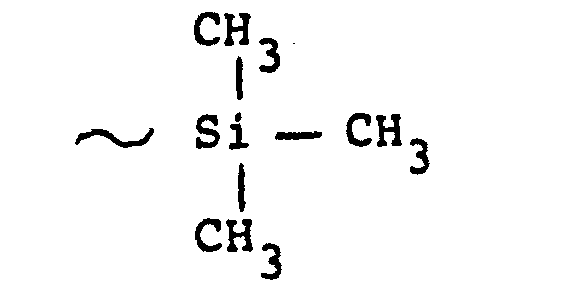
- Ce greffon assure une rétention par intersection avec la chaîne hydrocarbonée substituée sur un noyau aromatique.
- La description qui va suivre, en regard des dessins annexés, permettra de mieux comprendre comment l'invention s'exécute et se poursuit, et de mieux en apprécier sa portée.
- Sur les dessins :
- La. figure 1 montre une vue en élévation avec arrachement partiel d'une colonne chromatographique d'un type connu ;
- La figure 2 montre le schéma de principe de la chromatographie en phase liquide ;
- La figure 3a représente un chromatogramme caractéristique réalisé au moyen d'une colonne d'un type connu, et
- La figure 3b représente un chromatogramme réalisé au moyen de la colonne selon l'invention.
- La chromatographie de partage permet de séparer les espèces selon leur différence d'interaction entre deux phases non-miscibles;une première phase stationnaire, en l'espèce une silice de synthèse en particules très fines (typiquement 3-10 um de diamètre nominal) et sur laquelle on est venu greffer des molécules polaires, et une seconde phase mobile, qui est un solvant apolaire. Ce type de chromatographie est dit "de partage classique" par opposition à celle dite "de partage en phase inversée" par laquelle la phase mobile est un solvant polaire, et la phase stationnaire apolaire.
- Les procédés de préparation des phases stationnaires selon l'art antérieur, consistent généralement à faire réagir en milieu absolument anhydre la silice avec la molécule organique à greffer. Le produit initial est un gel de silice poreuse, de fine granulométrie, caractérisé par la présence de groupements silanols ( ≡Si - OH) typiquement de l'ordre de 5 - OH par nm2.
- Ces groupements silanols sont très réactifs et il ; est possible de greffer sur ces groupements, des molécules organiques variées dites greffons.
- Des phases stationnaires diverses sont commercialisées par des firmes telles que Waters, Du Pont, Varian, Merck, etc... sous des appellations commerciales diverses (telles que Micropack, Lichrosorb,...) et dont la sélectivité par rapport aux différentes espèces chimiques est très variable.
- Il est ainsi connu de l'art antérieur, des greffons du type amine, nitrile, alkyle, diol,... dont les principaux ont été cités en préambule.
- Pour des raisons tenant à l'utilisation recherchée (séparation des différentes familles d'un produit pétrolier), la Demanderesse s'est intéressée plus précisément aux phases stationnaires de type alkylamine. Ce greffon est typiquement obtenu par réaction à partir d'un alkylamine trialkoxysilane. Les principales molécules organiques commercialisées sont :
- - triéthoxysilane du type
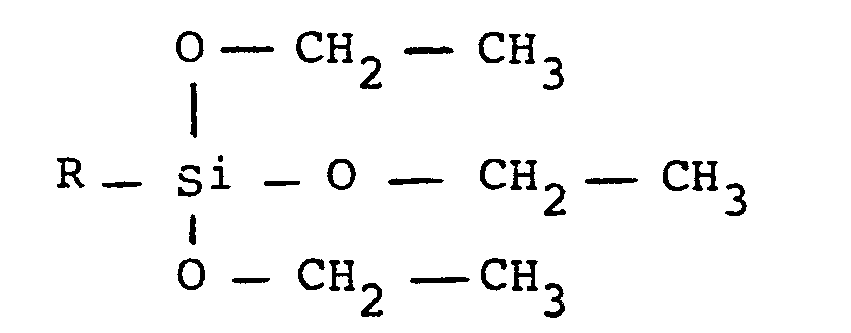
- - triméthoxysilane du type

- R = N - n - propyl éthylènediamine
- (- (CH2)3 - NH - CH2 - CH2 - NH2) ou
- R = n - propylamine (- (CH2)3 - NH2)
qui sont les deux fonctions usuellement commercialisées. On forme alots, par réaction entre la silice et la molécule à greffer une liaison du type :
- Pour ce faire, la silice vierge est agitée dans un milieu acide, tel qu'un mélange d'acide sulfurique et nitrique, concentré et chaud de manière à éliminer des ions, puis rincée à l'eau, afin qu'elle soit débarrassée des ions minéraux présentsà sa surface et qu'elle présente ainsi le plus possible de groupements silanols réactifs. La silice est ensuite séchée, pendant une quinzaine d'heures sous vide à une température comprise entre 160° et 200°C, typiquement à 180°C. Puis, l'on effectue la réaction de silanisation proprement dite : la silice est mise en suspension en présence de l'organosilane choisi, en présence d'un solvant anhydre (tel que le xylène). Selon les conditions opératoires prévues (température, temps de réaction, proportion de réactif...), on peut obtenir alors des taux de greffage variés. L'excès de silane est ensuite éliminé par rinçage avec le même solvant anhydre.
- Une telle phase stationnaire, selon l'art antérieur, est disposée dans une colonne chromatographique 10, telle que celle représentée à la figure 1. La colonne est constituée par un tube en acier inoxydable 1 lisse intérieurement, de longueur et de diamètre intérieur variables. La phase stationnaire 2 est immobilisée dans la colonne au moyen d'un disque en acier inoxydable fritté 3, de porosité convenable, pour retenir les particules les plus fines mais sans introduire une perte de charge excessive dans l'installation.
- Comme le montre le schéma de principe de la figure 2, on introduit dans un réservoir 11 un solvant A, qui est envoyé, à une pression relativement élevée (pouvant atteindre plusieurs centaines de bars...) par une pompe 12, sur la colonne chromatographique proprement dite 10. Les pompes 12 peuvent être de plusieurs types : à pression constante, telles que les pompes pneumatiques, ou à débit constant telles que les pompes à seringue ou à piston à mouvement alternatif. Un injecteur 13 permet d'introduire l'échantillon à analyser B dans le solvant, généralement au moyen d'une vanne d'échantillonnage. L'ensemble du solvant A et de l'échantillon B forme la phase mobile qui traverse la colonne chromatographique 10, dans laquelle est immobilisée la phase stationnaire. Après passage dans la colonne, la phase mobile est analysée par un détecteur 15 (tel qu'un détecteur à absorption dans l'U.V, ou un réfractomètre différentiel), puis le signal issu du détecteur 15, est enregistré dans un enregistreur 16, auquel on peut adjoindre un intégrateur 17 en vue de la réalisation des analyses quantitatives ou, plus généralement, un système de traitement des données fournies par le détecteur.
- Pour de plus amples informations sur l'état de l'art antérieur, on pourra utilement se reporter à l'ouvrage intitulé "Manuel pratique de Chromatographie en phase liquide", 2ème édition, par R. ROSSET, M. CAUDE et A. JARDY, Masson, Paris, 1982.
- L'efficacité de telles colonnes chromatographiques selon l'art antérieur se mesure d'une façon quantitative, par la résolution obtenue entre les différentes familles chimiques qu'elles permettent de séparer.
- Ainsi qu'il a été indiqué en préambule du présent mémoire, les aromatiques présents dans les produits pétroliers peuvent présenter un caractère intermédiaire, entre le caractère purement aromatique et le caractère aliphatique. Dans ce cas, les colonnes chromatographiques selon l'art antérieur ne peuvent pas séparer suffisamment ces constituants, qui sont élues en même temps que les oléfines simples et les saturés.
- Conformément à la présente invention, l'hydrolyse desdits premiers greffons s'effectue par un traitement progressif, par agitation de la silice ainsi greffée dans un bain d'hydrofuranne. On ajoute ensuite progressivement de l'eau dans l'hydrofuranne et enfin on remplace totalement le mélange hydrofuranne-eau par de l'eau.
- Un second greffage est donc effectué, qui concerne notamment les groupements -OH libérés sur la greffe aminopropyle par hydrolyse, conformément à la réaction suivante :

- Ce second greffage permet ainsi d'obtenir une phase stationnaire bi-fonctionnelle, assurant respectivement la rétention des aromatiques purs et celle des aromatiques à chaîne aliphatique longue.
- Ainsi, en jouant sur le taux de greffage de ces deux sortes de greffons, on obtient une phase stationnaire qui sépare suffisamment les aromatiques des saturés et qui retient suffisamment les aromatiques à chaînes aliphatiques longues.
- En outre, il faut noter ici que l'invention sus- décrite n'est pas une simple juxtaposition de moyens connus antérieurement, mais une véritable combinaison, présentant un effet de synergie. En effet, le mélange de deux phases stationnaires greffées respectivement l'un aminopropyle, l'autre alkyle, ne permet pas de séparer les saturés et oléfines, des aromatiques à longue chaîne. Il y a donc un effet nouveau dû au greffage sur une même silice de deux greffons de type différents, notamment l'un sur l'autre.
- Les chromatogrammes caractéristiques représentés aux figures 3a et 3b ont été réalisés en utilisant comme solvant d'élution le n-hexane et comme détecteur un spectrophotomètre U.V. calé à 210 mm. Le débit est de -1 1 ml.min-1.
- L'axe des abcisses X représente le signal du détecteur (unité arbitraire). L'axe des ordonnées Y représente le temps de rétention (unité = 1 cm ≃ 1 minute). On observe nettement la séparation des espèces chimiques de type saturé (pic S) et de type monoaromatique (épaulement A) sur la figure 3a. Les espèces de type monoaromatique viennent se regrouper avec les polyaromàtiques (pic B') sur la figure 3b.
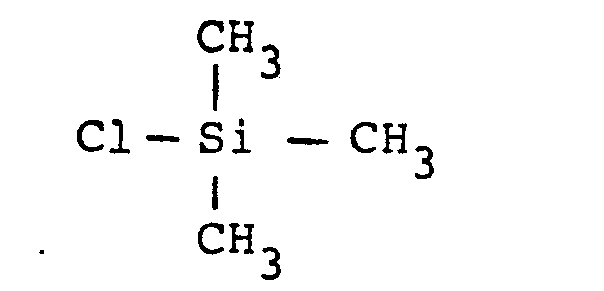
- Selon un mode de réalisation préféré de l'invention, les groupements fonctionnels antérieurement greffés sur la silice vierge sont obtenus par réaction avec du n-propylamino-triéthoxysilane après hydrolyse telle que décrite ci-dessus et un second séchage dans les mêmes conditions que le premier séchage, le groupement fonctionnel ultérieurement greffé obtenu par réaction est un tri-méthyl chlorosilane.
- En effet, l'inconvénient majeur des colonnes chromatographiques.selon l'art antérieur est de ne pas retenir suffisamment les aromatiques à chaîne(s) aliphatique(s) longue(s).
- L'objectif recherché est donc d'augmenter l'affinité de ces constituants pour la phase stationnaire, et le moyen retenu consiste à greffer sur cette phase des greffons de type apolaire, tels que des alkyles, dort les plus simples d'entre eux sont les méthyles. Ce groupement est en général apporté sous la forme d'un tri-méthyl-chlorosilane (TMCS), dilué dans du xylène, d'une manière quelque peu analogue au procédé de greffage décrit ci-dessus. Le mélange silice greffé-xylène-TMCS est agité pendant près de quinze heures, à une température comprise entre 120 et 150°C, et préférentiellement à 140°C, dans un ballon. Après réaction, on rince le silice avec du xylène sec, en filtrant sur verre fritté.
- Le temps de réaction dépend en fait du taux de greffage désiré, et également du taux de greffage antérieur obtenu. On souhaite en général atteindre le taux de greffage maximum. Afin de faciliter ce second greffage, la Demanderesse a noté que la présence de traces d'eau résiduelles après le second séchage facilitait l'accrochage des seconds greffages. Mais afin d'obtenir des conditions de préparation de phases reproductibles, il n'était pas convenable de laisser des traces d'eau présentes dans la phase stationnaire, mais il était préférable de sécher très énergiquement la silice ainsi greffée et hydrolyses puis de ré-introduire quelques traces d'eau, comprises entre.0,1 et 1 % en poids par rapport à la silice.
- Ce procédé introduit un progrès technique considérable par rapport aux procédés connus, notamment celui décrit dans l'article du Journal of Chromatographic Science, Vol. 12, Décembre 1974, pages 769, 778, R.E. MAJORS : "Studies of siloxane phases bonded to silica gel for use in high performance liquid chromatography", car il n'est pas connu dans ce procédé de laisser des traces d'eau résiduelles après le séchage.
- Ainsi, les colonnes chromatographiques selon la présente invention, obtenues par remplissage à partir d'une phase stationnaire doublement greffée, présentent une sélectivité accrue, notamment dans leur utilisation en vue de séparer des constituants cnimiques d'un pétrole brut, ou d'une fraction de pétrole brut.
- En outre, elles présentent une très faible sensibilité au taux d'humidité, puisque tous les groupements silanols accessibles sont supprimés ou très fortement réduits par le double greffage ainsi effectué ; enfin, les solutés polaires ne sont pas irréversiblement retenus pour les mêmes raisons. Les colonnes chromatographiques selon la présente invention sont donc également plus faciles d'emploi et de contrôle, et sont aisément reproductibles par l'homme de l'art qui suit les enseignements du présent mémoire.
Claims (8)
caractérisé en ce que l'hydrolyse desdits premiers greffons s'effectue par un traitement progressif, par agitation de la silice ainsi greffée dans un bain d'hydrofuranne, puis en ce que l'on ajoute progressivement de l'eau dans l'hydrofuranne, enfin en ce que l'on remplace totalement le mélange hydrofuranne-eau, par de l'eau.
Applications Claiming Priority (2)
| Application Number | Priority Date | Filing Date | Title |
|---|---|---|---|
| FR8416863 | 1984-11-06 | ||
| FR8416863 | 1984-11-06 |
Publications (3)
| Publication Number | Publication Date |
|---|---|
| EP0181266A2 true EP0181266A2 (fr) | 1986-05-14 |
| EP0181266A3 EP0181266A3 (en) | 1987-03-04 |
| EP0181266B1 EP0181266B1 (fr) | 1990-08-08 |
Family
ID=9309292
Family Applications (1)
| Application Number | Title | Priority Date | Filing Date |
|---|---|---|---|
| EP85402133A Expired - Lifetime EP0181266B1 (fr) | 1984-11-06 | 1985-11-06 | Procédé de préparation d'une phase stationnaire pour colonne chromatographique, colonne chromatographique ainsi obtenue, et son utilisation |
Country Status (3)
| Country | Link |
|---|---|
| US (1) | US4755294A (fr) |
| EP (1) | EP0181266B1 (fr) |
| DE (1) | DE3579112D1 (fr) |
Cited By (3)
| Publication number | Priority date | Publication date | Assignee | Title |
|---|---|---|---|---|
| EP0268243A3 (fr) * | 1986-11-17 | 1988-09-07 | Tosoh Corporation | Matériau de garnissage et son procédé de fabrication |
| EP0386926A3 (fr) * | 1989-03-02 | 1991-12-18 | Supelco, Inc. | Support de gel de silice pour des séparations par chromatographie |
| CN113318482A (zh) * | 2020-02-28 | 2021-08-31 | 北方民族大学 | 一种亲水杂化材料及其制备方法和应用 |
Families Citing this family (13)
| Publication number | Priority date | Publication date | Assignee | Title |
|---|---|---|---|---|
| GB8902771D0 (en) * | 1989-02-08 | 1989-03-30 | Bioprocessing Ltd | Improvements in or relating to affinity chromatography |
| US5599625A (en) * | 1992-06-17 | 1997-02-04 | Research Corporation Technologies, Inc. | Products having multiple-substituted polysiloxane monolayer |
| US5695882A (en) * | 1995-08-17 | 1997-12-09 | The University Of Montana | System for extracting soluble heavy metals from liquid solutions |
| DE19648798C2 (de) * | 1996-11-26 | 1998-11-19 | Hoechst Ag | Verfahren zur Herstellung von organisch modifizierten Aerogelen durch Oberflächenmodifikation des wäßrigen Gels (ohne vorherigen Lösungsmitteltausch) und anschließender Trocknung |
| US5965265A (en) * | 1997-11-25 | 1999-10-12 | Uop Llc | Functionalized silicas as core supports for chiral stationary phases |
| JP2002517585A (ja) * | 1998-06-05 | 2002-06-18 | カボット・コーポレーション | ナノ多孔質相互浸透有機−無機網目構造 |
| US6174926B1 (en) * | 1999-01-13 | 2001-01-16 | Cabot Corporation | Method of preparing organically modified silica |
| US6758967B1 (en) * | 2003-04-28 | 2004-07-06 | Alltech Associates, Inc. | Liquid chromatography apparatus having two stationary phases |
| JP4223894B2 (ja) * | 2003-08-21 | 2009-02-12 | 株式会社山武 | Pidパラメータ調整装置 |
| WO2006039507A2 (fr) * | 2004-10-01 | 2006-04-13 | Phenomenex, Inc. | Support chromatographique a ph stable utilisant un greffage organique/inorganique multicouche gabarie |
| RU2378332C2 (ru) * | 2004-12-21 | 2010-01-10 | Дегусса Гмбх | Система доставки душистых веществ |
| US20060165740A1 (en) * | 2005-01-24 | 2006-07-27 | Goldschmidt Chemical Corporation | Perfume delivery system |
| KR102706764B1 (ko) * | 2017-10-17 | 2024-09-19 | 리제너론 파마슈티칼스 인코포레이티드 | 크로마토그래피 수지 슬러리 결정을 위한 방법 |
Family Cites Families (9)
| Publication number | Priority date | Publication date | Assignee | Title |
|---|---|---|---|---|
| US2993809A (en) * | 1959-10-23 | 1961-07-25 | Gen Electric | Method for making treated silica fillers |
| US3722181A (en) * | 1970-05-22 | 1973-03-27 | Du Pont | Chromatographic packing with chemically bonded organic stationary phases |
| US3915735A (en) * | 1974-03-06 | 1975-10-28 | Malvern Minerals Company | Process for preparing modified silicic fillers |
| FR2267992A1 (fr) * | 1974-04-19 | 1975-11-14 | Rhone Poulenc Ind | |
| US4121946A (en) * | 1976-08-13 | 1978-10-24 | Alexei Alexeevich Chuiko | Method of producing aminated silica compounds |
| US4316807A (en) * | 1978-04-03 | 1982-02-23 | W. R. Grace & Co. | Viscosifying agent |
| US4242227A (en) * | 1979-07-31 | 1980-12-30 | The Dow Chemical Company | Chromatographic column packing having a bonded organosiloxane coating |
| US4324689A (en) * | 1980-02-26 | 1982-04-13 | Shah Ramesh M | High carbon content chromatographic packing and method for making same |
| US4298500A (en) * | 1980-05-05 | 1981-11-03 | Varian Associates, Inc. | Mixed phase chromatographic compositions |
-
1985
- 1985-11-05 US US06/795,243 patent/US4755294A/en not_active Expired - Fee Related
- 1985-11-06 DE DE8585402133T patent/DE3579112D1/de not_active Expired - Lifetime
- 1985-11-06 EP EP85402133A patent/EP0181266B1/fr not_active Expired - Lifetime
Cited By (5)
| Publication number | Priority date | Publication date | Assignee | Title |
|---|---|---|---|---|
| EP0268243A3 (fr) * | 1986-11-17 | 1988-09-07 | Tosoh Corporation | Matériau de garnissage et son procédé de fabrication |
| US4835058A (en) * | 1986-11-17 | 1989-05-30 | Tosoh Corporation | Packing material and process for its production |
| EP0386926A3 (fr) * | 1989-03-02 | 1991-12-18 | Supelco, Inc. | Support de gel de silice pour des séparations par chromatographie |
| CN113318482A (zh) * | 2020-02-28 | 2021-08-31 | 北方民族大学 | 一种亲水杂化材料及其制备方法和应用 |
| CN113318482B (zh) * | 2020-02-28 | 2022-08-09 | 北方民族大学 | 一种亲水杂化材料及其制备方法和应用 |
Also Published As
| Publication number | Publication date |
|---|---|
| US4755294A (en) | 1988-07-05 |
| EP0181266B1 (fr) | 1990-08-08 |
| EP0181266A3 (en) | 1987-03-04 |
| DE3579112D1 (de) | 1990-09-13 |
Similar Documents
| Publication | Publication Date | Title |
|---|---|---|
| EP0181266B1 (fr) | Procédé de préparation d'une phase stationnaire pour colonne chromatographique, colonne chromatographique ainsi obtenue, et son utilisation | |
| Armarego | Purification of laboratory chemicals | |
| JPH05500923A (ja) | 二相系による混合物の分離 | |
| WO1998056875A1 (fr) | Procede de separation de composes benzothiopheniques d'un melange d'hydrocarbures les contenant, et melange d'hydrocarbures obtenu par ce procede | |
| FR2598634A1 (fr) | Procede de production d'une matiere en phase inverse et matiere obtenue | |
| FR2532429A1 (fr) | Procede et appareil pour la separation et analyse chromatographiques en phase liquide d'hydrocarbures | |
| CN110870985B (zh) | 重油芳烃组分的分离、表征方法和二维液相色谱及装置 | |
| Tamogami et al. | Development of an efficient GLC system with a mixed chiral stationary phase and its application to the separation of optical isomers | |
| EP1265067B1 (fr) | Substance de remplissage de colonne pour la chromatographie | |
| CA2893466C (fr) | Procede d'isolement de diamandoides | |
| Palmentier et al. | Determination of polycyclic aromatic hydrocarbons in lubricating oil base stocks using high-performance liquid chromatography and gas chromatography—mass spectrometry | |
| FR2889699A1 (fr) | Procede de separation du metaxylene d'une charge d'hydrocarbures aromatiques par adsorption en phase liquide | |
| CA2893465C (fr) | Procede de separation d'iso-alcanes et de cycloalcanes a partir d'une huile | |
| Chartier et al. | Improved hydrocarbon group resolution of olefinic gasolines by adsorption and charge-transfer high-performance liquid chromatography | |
| EP2080020B1 (fr) | Électrophorèse capillaire bi - ou multidimensionnelle au sein d'un unique capillaire | |
| Zeng et al. | Size exclusion chromatography sample pretreatment for GC‐AED analysis of metalloporphyrins in crude oils | |
| BE1001279A3 (fr) | Procede de determination de la polarite chimique d'une huile ou d'un petrole brut et de ses fractions lourdes. | |
| EP3891255B1 (fr) | Méthode de séparation de polymères dans un mélange d'hydrocarbures | |
| EP0248694B1 (fr) | Procédé de détermination de la composition d'un mélange d'hydrocarbures en fonction de la température d'ébullition de ses constituants | |
| FR2653034A1 (fr) | Procede de preparation d'un produit particulaire poreux regiospecifique, produits obtenus et application notamment aux separations chromatographiques. | |
| US3846297A (en) | Chromatography | |
| Zahner et al. | Chromatographic Separation of Phenol from Cresylic Acids | |
| Reed et al. | Quantitative separation of alcohol and ester forms of vitamin A by solvent extraction and chromatographic methods | |
| CN112946089B (zh) | 测定柴油中氮化物的含量和/或分子结构的方法 | |
| CH586062A5 (en) | Chromatographic adsorbents - giving improved resolution due to particle size distribution |
Legal Events
| Date | Code | Title | Description |
|---|---|---|---|
| PUAI | Public reference made under article 153(3) epc to a published international application that has entered the european phase |
Free format text: ORIGINAL CODE: 0009012 |
|
| AK | Designated contracting states |
Kind code of ref document: A2 Designated state(s): BE DE FR GB IT LU NL |
|
| PUAL | Search report despatched |
Free format text: ORIGINAL CODE: 0009013 |
|
| AK | Designated contracting states |
Kind code of ref document: A3 Designated state(s): BE DE FR GB IT LU NL |
|
| 17P | Request for examination filed |
Effective date: 19870911 |
|
| D17P | Request for examination filed (deleted) | ||
| R17P | Request for examination filed (corrected) |
Effective date: 19870911 |
|
| 17Q | First examination report despatched |
Effective date: 19890406 |
|
| RAP1 | Party data changed (applicant data changed or rights of an application transferred) |
Owner name: COMPAGNIE DE RAFFINAGE ET DE DISTRIBUTION TOTAL FR |
|
| GRAA | (expected) grant |
Free format text: ORIGINAL CODE: 0009210 |
|
| AK | Designated contracting states |
Kind code of ref document: B1 Designated state(s): BE DE FR GB IT LU NL |
|
| ITF | It: translation for a ep patent filed | ||
| REF | Corresponds to: |
Ref document number: 3579112 Country of ref document: DE Date of ref document: 19900913 |
|
| GBT | Gb: translation of ep patent filed (gb section 77(6)(a)/1977) | ||
| PLBE | No opposition filed within time limit |
Free format text: ORIGINAL CODE: 0009261 |
|
| STAA | Information on the status of an ep patent application or granted ep patent |
Free format text: STATUS: NO OPPOSITION FILED WITHIN TIME LIMIT |
|
| 26N | No opposition filed | ||
| ITTA | It: last paid annual fee | ||
| EPTA | Lu: last paid annual fee | ||
| PGFP | Annual fee paid to national office [announced via postgrant information from national office to epo] |
Ref country code: LU Payment date: 19951001 Year of fee payment: 11 |
|
| PGFP | Annual fee paid to national office [announced via postgrant information from national office to epo] |
Ref country code: BE Payment date: 19951024 Year of fee payment: 11 |
|
| PGFP | Annual fee paid to national office [announced via postgrant information from national office to epo] |
Ref country code: NL Payment date: 19951025 Year of fee payment: 11 Ref country code: DE Payment date: 19951025 Year of fee payment: 11 |
|
| PGFP | Annual fee paid to national office [announced via postgrant information from national office to epo] |
Ref country code: GB Payment date: 19951026 Year of fee payment: 11 |
|
| PGFP | Annual fee paid to national office [announced via postgrant information from national office to epo] |
Ref country code: FR Payment date: 19951114 Year of fee payment: 11 |
|
| PG25 | Lapsed in a contracting state [announced via postgrant information from national office to epo] |
Ref country code: LU Free format text: LAPSE BECAUSE OF NON-PAYMENT OF DUE FEES Effective date: 19961106 Ref country code: GB Effective date: 19961106 |
|
| PG25 | Lapsed in a contracting state [announced via postgrant information from national office to epo] |
Ref country code: BE Effective date: 19961130 |
|
| BERE | Be: lapsed |
Owner name: CIE DE RAFFINAGE ET DE DISTRIBUTION TOTAL FRANCE Effective date: 19961130 |
|
| PG25 | Lapsed in a contracting state [announced via postgrant information from national office to epo] |
Ref country code: NL Effective date: 19970601 |
|
| GBPC | Gb: european patent ceased through non-payment of renewal fee |
Effective date: 19961106 |
|
| PG25 | Lapsed in a contracting state [announced via postgrant information from national office to epo] |
Ref country code: FR Effective date: 19970731 |
|
| NLV4 | Nl: lapsed or anulled due to non-payment of the annual fee |
Effective date: 19970601 |
|
| PG25 | Lapsed in a contracting state [announced via postgrant information from national office to epo] |
Ref country code: DE Effective date: 19970801 |
|
| REG | Reference to a national code |
Ref country code: FR Ref legal event code: ST |