EP0181526B1 - Dérivés d'acide benzoique - Google Patents
Dérivés d'acide benzoique Download PDFInfo
- Publication number
- EP0181526B1 EP0181526B1 EP85113265A EP85113265A EP0181526B1 EP 0181526 B1 EP0181526 B1 EP 0181526B1 EP 85113265 A EP85113265 A EP 85113265A EP 85113265 A EP85113265 A EP 85113265A EP 0181526 B1 EP0181526 B1 EP 0181526B1
- Authority
- EP
- European Patent Office
- Prior art keywords
- group
- hydrogen atom
- compound
- case
- formula
- Prior art date
- Legal status (The legal status is an assumption and is not a legal conclusion. Google has not performed a legal analysis and makes no representation as to the accuracy of the status listed.)
- Expired
Links
Classifications
-
- C—CHEMISTRY; METALLURGY
- C07—ORGANIC CHEMISTRY
- C07C—ACYCLIC OR CARBOCYCLIC COMPOUNDS
- C07C323/00—Thiols, sulfides, hydropolysulfides or polysulfides substituted by halogen, oxygen or nitrogen atoms, or by sulfur atoms not being part of thio groups
-
- A—HUMAN NECESSITIES
- A61—MEDICAL OR VETERINARY SCIENCE; HYGIENE
- A61K—PREPARATIONS FOR MEDICAL, DENTAL OR TOILETRY PURPOSES
- A61K31/00—Medicinal preparations containing organic active ingredients
- A61K31/185—Acids; Anhydrides, halides or salts thereof, e.g. sulfur acids, imidic, hydrazonic or hydroximic acids
- A61K31/19—Carboxylic acids, e.g. valproic acid
-
- C—CHEMISTRY; METALLURGY
- C07—ORGANIC CHEMISTRY
- C07C—ACYCLIC OR CARBOCYCLIC COMPOUNDS
- C07C317/00—Sulfones; Sulfoxides
Definitions
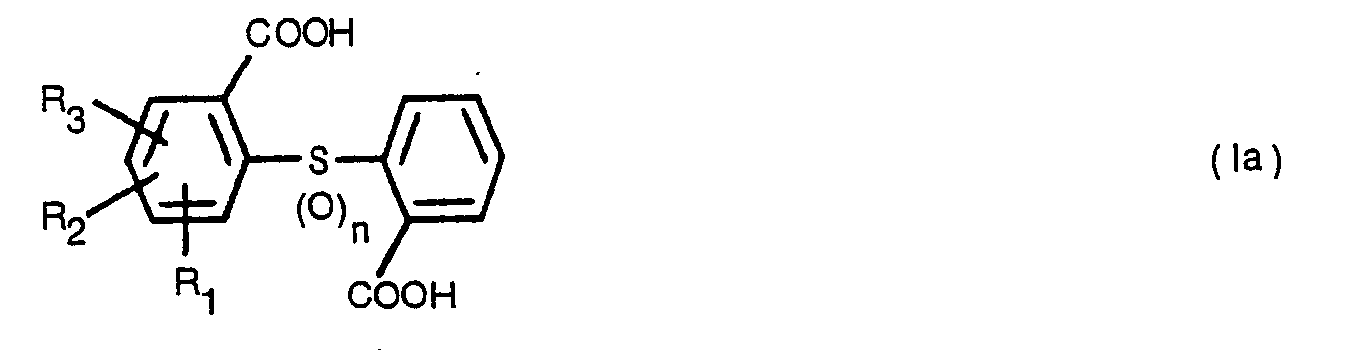
- the present invention relates to a benzoic acid derivative of the formula (I): [wherein n is an integer of 0 to 2; R 1 to R 3 which may be the same or different each represents a hydrogen atom, a halogen atom, a lower alkyl group (i.e. C 1 ⁇ C 5 ), a lower alkoxy group (i.e. (C 1 ⁇ C 5 ) or a nitro group; R 4 is a hydroxyl group or the group -NHZ (Z is a hydrogen atom or a lower alkyl group (i.e. C 1 ⁇ C 5 )] or an alkali metal salt thereof.
- R 1 to R 3 which may be the same or different each represents a hydrogen atom, a halogen atom, a lower alkyl group (i.e. C 1 ⁇ C 5 ), a lower alkoxy group (i.e. (C 1 ⁇ C 5 ) or a nitro group
- R 4 is a hydroxyl group or
- the benzoic acid derivative of the present invention is useful as an infection control agent.
- the compounds wherein n is 0 or 1; any one of R 1 to R 3 is 5-chloro, 5-methoxy, or 5-nitro and the remainder is hydrogen; and R 4 is a hydroxyl group; and the compounds wherein n is 0 or 1; and two of R 1 to R 3 are 3,5-dichloro or 3,5-dinitro and the remainder is hydrogen; and R 4 is a hydroxyl group are reported together with their preparation in Tetrahedron Vol. 35, pp. 1869-1881 (1979). However, this reference does not refer to any pharmacological activity of these compounds.
- 2,2'-dicarboxydiphenyi sulfide and sulfone and the diamides and di-n-butylamides thereof are known from Chem. Abst. Vol. 54, columns 9815 and 9816 as having antifungual activities.
- the diisopropylamides of 2,2'-dicarboxydiphenyl sulfide, sulfoxide and sulfone are described in J. Amer. Chem. Soc., Vol. 100; pp 956 and 957.
- Di-(2-carboxyphenyl)sulfone is disclosed in J. Chem. Soc. 1979, p 801. No medical use is known with respect of these latter compounds.
- cytoskeletal proteins function as one of the structure proteins in cytoplasm.
- the cytoskeletal proteins are classified as microtubules, intermediate filaments and microfibres depending on the diameter size. These cytoskeletal proteins are believed to control, on the basis of their contracting ability, the motility of cells, their migration, the change and retention of their morphology, secretion, phagocytosis, adhesion and the transfer of the receptor on the cell membrane. Furthermore, evidence is being accumulated to suggest the association of cytoskeletal proteins with the growth and differentiation of cells.
- Examples of the starting halogenobenzoic acid derivatives include 2-bromo-3,4,5-trimethoxybenzoic acid, 2-bromo-4,5-dimethoxybenzoic acid, 2,4-dichlorobenzoic acid, 2-iodo-3-methyl-4-chlorobenzoic acid, 2-iodo-4,5-dimethylbenzoic acid, 2-iodo-4,6-dimethylbenzoic acid, 2-iodo-3,4-dimethylbenzoic acid, 2-iodo-3,6-dimethylbenzoic acid, 2-iodo-3,5-dimethylbenzoic acid, 2-iodo-5,6-dimethylbenzoic acid, 2-bromo-4-t-butylbenzoic acid, 2-iodo-5-n-butylbenzoic acid, 2-iodo-5-n-propylbenzoic acid, 2-iodo-5-ethylbenzoic acid, 2-iodo-5-methylbenz
- the reaction between the 2-halogenobenzoic acid derivatives and thiosalicylic acid is performed at 90°C or higher in the presence of a solvent using an alkali and a metal catalyst. Generally, the reaction is carried out at 100-200°C for 2-10 hours, and the preferred conditions are 110-130 0 C and 3-5 hours.
- Suitable solvents are nitrobenzene, benzyl alcohol, dimethylformamide, xylene, and a mixture of toluene and dimethylformamide.
- thiosalicyclic acid may be used in excess of the 2-halogenobenzoic acid derivative, and the preferred amount ranges from 1.1 to 1.2 moles per mole of the 2-halogenobenzoic acid.
- Suitable alkalis include anhydrous potassium carbonate and anhydrous sodium carbonate.
- Suitable metal catalysts include a metallic copper powder, and metal compounds such as cuprous chloride, cupric chloride, cuprous bromide, cupric bromide and cupric acetate.
- the 2,2'-thiodibenzoic acid derivative may be converted by a general method to the corresponding alkali metal salt such as sodium or potassium salt.
- the 2,2'-sulfonyldibenzoic acid derivative may be converted by a general method to the corresponding alkali metal salt such as sodium or potassium salt.
- the 2,2'-sulfinyldibenzoic acid derivative may be converted to the corresponding alkali metal salt such as sodium or potassium salt by a general method.
- the present invention has been accomplished on the basis of the findings of the inventors that the compounds of formula (I) promote the migrating and phagocytotic abilities of macrophages in association with the cytoskeletal proteins.
- the compounds of formula (I) can be formulated by any desirable conventional method with a pharmaceutically acceptable carrier.
- the compound of this invention can be formulated into a solid preparation such as a tablets, pills, granules, powder, capsules, or the like, or a liquid preparation such as solution, suspension, emulsion or the like.
- a solid preparation such as a tablets, pills, granules, powder, capsules, or the like
- a liquid preparation such as solution, suspension, emulsion or the like.
- the preparation is formulated into a suppository, injection, an intravenous drip infusion or the like.
- pharmaceutical carriers such as starch, sucrose, crystalline cellulose, kaolin, calcium carbonate, talc, magnesium carbonate and the like are preferably used.
- the compound is dissolved in distilled water or an aqueous solution of a salt such as sodium chloride.
- a suitable fluid therapy such as a physiological saline, a glucose-sodium chloride solution or the like.
- cacao butter, laurin, glycero- gelatin, macrogol are preferably used as a base.
- the amount of the compound in a formulated preparation is selected so as to be appropriately administered depending on the age and condition of individual patient being treated.
- the compounds of formula (1) of the present invention will exhibit an excellent ability to protect animals with reduced immunological functions from contracting infections.
- the present invention is hereunder described in greater detail by reference to working examples and experiments.
- N,N'-Diethyl-4-chloro-2,2'-thiobenzoic acid diamide (1.6 g) was dissolved in dry methylene chloride (60 ml). To the solution, m-chloroperbenzoic acid (0.8 g) was added under cooling with ice. The solution was stirred at room temperature for 1.5 hours. The solution was washed with saturated aqueous sodium hydrogencarbonate and with saturated aqueous sodium chloride, and dried over magnesium sulfate. The solvent was evaporated under reduced pressure to give a crude product.
- N,N'-dimethyl-4-chloro-2,2'-thiodibenzoic acid diamide 3.3 g was suspended.
- 35% aqueous H 2 0 2 was added, and the suspension was stirred at room temperature for 3 hours, followed by heating at 50-60°C for 3 hours under stirring.
- the reaction mixture was poured into ice water and was extracted with ethyl acetate.
- the ethyl. acetate extract was washed with saturated aqueous sodium hydrogencarbonate, and with saturated aqueous sodium chloride, dried over magnesium sulfate, filtered and the filtrate was evaporated to give a crude product.
- mice 22-25 g, (5 and Y), each group consisting of ten mice, were subcutaneously injected in the back with 0.1 ml of a suspension of 1 x 10 6 S-180 cells. During the period of the 11th to 13th days of injection, selected compounds of the present invention were orally administered to the mice in doses of 120 mg/kg/day. On the 14th day of injection, 1 x 10 8 Salmonella typhimurium cells were injected into the animals through the tail vein and the length of their survival was recorded. The results are shown in Table 6.
- C57BL mice were injected subcutaneously in the back with 1 x 10 6 mouse leukemic cells EL4. During the period of the 1st to 4th day of injection, selected compounds of the present invention were orally administered to the mice in doses of 2 mg/mouse/day. On the fifth day of injection, peritoneal cells were collected from each animal and suspended in Culture Solution I (indicated below) at a concentration of 2 x 10 6 cells/ml.
- a Boiden Chamber (BioRad Laboratories, USA) equipped with a millipore filter (5 micron in pore size) was set in a C0 2 incubator; 0.2 ml of Culture Solution II (indicated below) was placed in the lower part of the filter while 0.2 ml of the previously prepared peritoneal cell suspension was put in the upper part of the filter. After incubation at 37°C for 90 minutes, the filter was removed from the chamber, fixed with methanol and Giemsastained. The number of cells that passed through the filter within one visual field under microscope (400 x) was counted, and the results are shown in Tables 7 and 8 below.
- Culture Solution I RPMI-1640 culture solution (Nissui Pharmaceutical Co., Ltd.) containing 10% fetal calf serum, FCS (Microbiological Laboratories, USA), 50 units/ml of penicillin G and 50 ⁇ g/ml of streptomycin.
- Culture Solution II RPMI-1640 culture solution containing 10% zymosan-activated human serum, ZAS.
Landscapes
- Chemical & Material Sciences (AREA)
- Organic Chemistry (AREA)
- Health & Medical Sciences (AREA)
- Animal Behavior & Ethology (AREA)
- Epidemiology (AREA)
- Life Sciences & Earth Sciences (AREA)
- Pharmacology & Pharmacy (AREA)
- General Health & Medical Sciences (AREA)
- Public Health (AREA)
- Veterinary Medicine (AREA)
- Medicinal Chemistry (AREA)
- Organic Low-Molecular-Weight Compounds And Preparation Thereof (AREA)
- Acyclic And Carbocyclic Compounds In Medicinal Compositions (AREA)
Claims (13)



Priority Applications (1)
| Application Number | Priority Date | Filing Date | Title |
|---|---|---|---|
| AT85113265T ATE40112T1 (de) | 1984-10-19 | 1985-10-18 | Benzoesaeureabkoemmlinge. |
Applications Claiming Priority (4)
| Application Number | Priority Date | Filing Date | Title |
|---|---|---|---|
| JP21851984A JPS6197257A (ja) | 1984-10-19 | 1984-10-19 | 新規な安息香酸誘導体 |
| JP21851884A JPS6197219A (ja) | 1984-10-19 | 1984-10-19 | 感染防御剤 |
| JP218519/84 | 1984-10-19 | ||
| JP218518/84 | 1984-10-19 |
Publications (2)
| Publication Number | Publication Date |
|---|---|
| EP0181526A1 EP0181526A1 (fr) | 1986-05-21 |
| EP0181526B1 true EP0181526B1 (fr) | 1989-01-18 |
Family
ID=26522602
Family Applications (1)
| Application Number | Title | Priority Date | Filing Date |
|---|---|---|---|
| EP85113265A Expired EP0181526B1 (fr) | 1984-10-19 | 1985-10-18 | Dérivés d'acide benzoique |
Country Status (4)
| Country | Link |
|---|---|
| US (1) | US4698364A (fr) |
| EP (1) | EP0181526B1 (fr) |
| CA (1) | CA1255329A (fr) |
| DE (1) | DE3567643D1 (fr) |
Families Citing this family (7)
| Publication number | Priority date | Publication date | Assignee | Title |
|---|---|---|---|---|
| GB8320943D0 (en) * | 1983-08-03 | 1983-09-07 | Lilly Industries Ltd | Organic compounds |
| US5183926A (en) * | 1989-08-23 | 1993-02-02 | Bayer Aktiengesellschaft | Process for the preparation of aromatic dicarboxylic acids and aromatic hydrocarbons |
| EP0523067A1 (fr) * | 1990-04-02 | 1993-01-20 | E.I. Du Pont De Nemours And Company | Sulfonamides herbicides selectifs |
| EP0480270B1 (fr) * | 1990-10-06 | 1994-05-04 | CASSELLA Aktiengesellschaft | Arylsulfures ainsi que procédé pour leur fabrication |
| WO1992006683A1 (fr) * | 1990-10-22 | 1992-04-30 | Research Corporation Technologies, Inc. | Composes d'aryle et d'heteroaryle presentant une activite contre un retrovirus |
| USD336198S (en) | 1991-01-15 | 1993-06-08 | Gibbons Dale L | Foot stimulating shower mat |
| CN103382171A (zh) * | 2013-07-22 | 2013-11-06 | 江苏万特制药有限公司 | 福多斯坦氧化杂质的制备方法 |
Family Cites Families (5)
| Publication number | Priority date | Publication date | Assignee | Title |
|---|---|---|---|---|
| US1841636A (en) * | 1925-07-31 | 1932-01-19 | British Dyestuffs Corp Ltd | Amino and nitro derivatives of ortho-hydroxy-carboxy-diphenyl sulphides, and process of preparing same |
| US1769423A (en) * | 1927-05-27 | 1930-07-01 | Chem Ind Basel | Sulfides of aromatic compounds and process of making same |
| US3385863A (en) * | 1964-04-22 | 1968-05-28 | Ciba Ltd | Vat dyestuffs of the anthraquinoneimidazole series |
| US3514480A (en) * | 1967-01-19 | 1970-05-26 | Standard Oil Co | Process for producing sulfur containing aromatic carboxylic acids |
| US3657431A (en) * | 1969-06-25 | 1972-04-18 | Merck & Co Inc | Treating of inflammation with substituted phenylthiosalicylic acids |
-
1985
- 1985-10-17 CA CA000493146A patent/CA1255329A/fr not_active Expired
- 1985-10-18 DE DE8585113265T patent/DE3567643D1/de not_active Expired
- 1985-10-18 US US06/788,972 patent/US4698364A/en not_active Expired - Fee Related
- 1985-10-18 EP EP85113265A patent/EP0181526B1/fr not_active Expired
Also Published As
| Publication number | Publication date |
|---|---|
| CA1255329A (fr) | 1989-06-06 |
| US4698364A (en) | 1987-10-06 |
| DE3567643D1 (en) | 1989-02-23 |
| EP0181526A1 (fr) | 1986-05-21 |
Similar Documents
| Publication | Publication Date | Title |
|---|---|---|
| JPS6123183B2 (fr) | ||
| KR960014871B1 (ko) | 5-아미노 또는 치환된 아미노 1, 2, 3-트리아졸을 포함하는, 증식억제제 및 암세포의 전이 억제제로서 유용한 약제학적 조성물 | |
| PL129383B1 (en) | Method of manufacture of novel xanthogenates | |
| KR970002904B1 (ko) | S-저급지방산 글루타티온 유도체 | |
| EP0077551A2 (fr) | 1,4-Naphtoquinones, procédés pour leurs préparations, et leurs formulations pharmaceutiques et vétérinaires | |
| EP0181526B1 (fr) | Dérivés d'acide benzoique | |
| US4134991A (en) | Derivatives of 2-(3-phenyl-2-aminopropionyloxy)-acetic acid | |
| GB1596884A (en) | Methylmethioninesulphonium compounds process for their preparation and pharmaceutical compositions containing them | |
| EP0538477B1 (fr) | Nouveau derive d'acide aminophenylacetique, production de ce derive et modulateur de reponse immune contenant ce derive comme principe actif | |
| JP4991537B2 (ja) | シス−1,2−置換スチルベン誘導体、および糖尿病の治療および/または予防のための薬剤の製造におけるそれらの使用 | |
| US4843093A (en) | Butyrolactone derivatives, process for production thereof and use therefor | |
| MXPA98000963A (en) | Derivatives of benzene sulfonamide, its preparation and its applications in terapeut | |
| EP0588797A1 (fr) | Acides amines n- 4,5-dihydroxy- et 4,5,8-trihydroxy-9,10-dihydro-9,10-dioxo-2-anthracene-yl]carbonyle] utiles dans la therapie des pathologies osteoarticulaires. | |
| RS51576B (sr) | Bifenil i naftil-fenil derivati hidroksamske kiseline | |
| GB2193210A (en) | Glycine derivatives | |
| EP0059108A1 (fr) | Dérivés d'acide dihydroxibenzoique | |
| JP3782121B2 (ja) | 新規な血行促進のために使用する医薬 | |
| CA1215366A (fr) | Derives alcanolaminoxy de 3,4-dihydro-2h-1,4- benzothiazin-3-one; preparation et utilisation en pharmacie | |
| EP1463707A2 (fr) | Groupe de composes anticancereux a structure specifique | |
| EP0195433A1 (fr) | Dérivés d'amides, leurs procédés de préparation et leur utilisation | |
| US5182294A (en) | Imidazolyl propyl guanidine derivative and a pharmaceutical composition containing this compound | |
| US3700680A (en) | Aminoalkanol esters and their pharmaceutically acceptable acid-addition salts | |
| GB2053912A (en) | Acylaminobenzoic acid derivatives | |
| CA1247623A (fr) | Derives de 2-(2-thienyl)-imidazo-¬4,5-b|- pyridines et leurs sels utilisables en pharmacie; methode de preparation | |
| US3996231A (en) | 1-Quinolinyl-pyrazolidine derivatives |
Legal Events
| Date | Code | Title | Description |
|---|---|---|---|
| PUAI | Public reference made under article 153(3) epc to a published international application that has entered the european phase |
Free format text: ORIGINAL CODE: 0009012 |
|
| AK | Designated contracting states |
Kind code of ref document: A1 Designated state(s): AT BE CH DE FR GB IT LI NL SE |
|
| 17P | Request for examination filed |
Effective date: 19860801 |
|
| 17Q | First examination report despatched |
Effective date: 19870413 |
|
| ITF | It: translation for a ep patent filed | ||
| GRAA | (expected) grant |
Free format text: ORIGINAL CODE: 0009210 |
|
| AK | Designated contracting states |
Kind code of ref document: B1 Designated state(s): AT BE CH DE FR GB IT LI NL SE |
|
| REF | Corresponds to: |
Ref document number: 40112 Country of ref document: AT Date of ref document: 19890215 Kind code of ref document: T |
|
| REF | Corresponds to: |
Ref document number: 3567643 Country of ref document: DE Date of ref document: 19890223 |
|
| ET | Fr: translation filed | ||
| PGFP | Annual fee paid to national office [announced via postgrant information from national office to epo] |
Ref country code: SE Payment date: 19890912 Year of fee payment: 5 |
|
| PGFP | Annual fee paid to national office [announced via postgrant information from national office to epo] |
Ref country code: CH Payment date: 19890913 Year of fee payment: 5 |
|
| PGFP | Annual fee paid to national office [announced via postgrant information from national office to epo] |
Ref country code: GB Payment date: 19890930 Year of fee payment: 5 |
|
| PGFP | Annual fee paid to national office [announced via postgrant information from national office to epo] |
Ref country code: AT Payment date: 19891017 Year of fee payment: 5 |
|
| PGFP | Annual fee paid to national office [announced via postgrant information from national office to epo] |
Ref country code: FR Payment date: 19891030 Year of fee payment: 5 |
|
| ITTA | It: last paid annual fee | ||
| PGFP | Annual fee paid to national office [announced via postgrant information from national office to epo] |
Ref country code: NL Payment date: 19891031 Year of fee payment: 5 |
|
| PLBE | No opposition filed within time limit |
Free format text: ORIGINAL CODE: 0009261 |
|
| STAA | Information on the status of an ep patent application or granted ep patent |
Free format text: STATUS: NO OPPOSITION FILED WITHIN TIME LIMIT |
|
| PGFP | Annual fee paid to national office [announced via postgrant information from national office to epo] |
Ref country code: DE Payment date: 19891222 Year of fee payment: 5 |
|
| 26N | No opposition filed | ||
| PGFP | Annual fee paid to national office [announced via postgrant information from national office to epo] |
Ref country code: BE Payment date: 19900118 Year of fee payment: 5 |
|
| PG25 | Lapsed in a contracting state [announced via postgrant information from national office to epo] |
Ref country code: GB Effective date: 19901018 Ref country code: AT Effective date: 19901018 |
|
| PG25 | Lapsed in a contracting state [announced via postgrant information from national office to epo] |
Ref country code: SE Effective date: 19901019 |
|
| PG25 | Lapsed in a contracting state [announced via postgrant information from national office to epo] |
Ref country code: LI Effective date: 19901031 Ref country code: CH Effective date: 19901031 Ref country code: BE Effective date: 19901031 |
|
| BERE | Be: lapsed |
Owner name: CHUGAI SEIYAKU K.K. Effective date: 19901031 |
|
| PG25 | Lapsed in a contracting state [announced via postgrant information from national office to epo] |
Ref country code: NL Effective date: 19910501 |
|
| GBPC | Gb: european patent ceased through non-payment of renewal fee | ||
| NLV4 | Nl: lapsed or anulled due to non-payment of the annual fee | ||
| PG25 | Lapsed in a contracting state [announced via postgrant information from national office to epo] |
Ref country code: FR Effective date: 19910628 |
|
| REG | Reference to a national code |
Ref country code: CH Ref legal event code: PL |
|
| PG25 | Lapsed in a contracting state [announced via postgrant information from national office to epo] |
Ref country code: DE Effective date: 19910702 |
|
| REG | Reference to a national code |
Ref country code: FR Ref legal event code: ST |
|
| EUG | Se: european patent has lapsed |
Ref document number: 85113265.4 Effective date: 19910603 |