EP0182272B1 - Auf Tenside basiertes Lösungsmittelsystem zur Entfeuchtung von verschiedenen Oberflächen - Google Patents
Auf Tenside basiertes Lösungsmittelsystem zur Entfeuchtung von verschiedenen Oberflächen Download PDFInfo
- Publication number
- EP0182272B1 EP0182272B1 EP85114415A EP85114415A EP0182272B1 EP 0182272 B1 EP0182272 B1 EP 0182272B1 EP 85114415 A EP85114415 A EP 85114415A EP 85114415 A EP85114415 A EP 85114415A EP 0182272 B1 EP0182272 B1 EP 0182272B1
- Authority
- EP
- European Patent Office
- Prior art keywords
- alkyl
- aralkyl
- aryl
- carbon atoms
- hydrogen
- Prior art date
- Legal status (The legal status is an assumption and is not a legal conclusion. Google has not performed a legal analysis and makes no representation as to the accuracy of the status listed.)
- Expired - Lifetime
Links
Classifications
-
- C—CHEMISTRY; METALLURGY
- C11—ANIMAL OR VEGETABLE OILS, FATS, FATTY SUBSTANCES OR WAXES; FATTY ACIDS THEREFROM; DETERGENTS; CANDLES
- C11D—DETERGENT COMPOSITIONS; USE OF SINGLE SUBSTANCES AS DETERGENTS; SOAP OR SOAP-MAKING; RESIN SOAPS; RECOVERY OF GLYCEROL
- C11D1/00—Detergent compositions based essentially on surface-active compounds; Use of these compounds as a detergent
- C11D1/02—Anionic compounds
- C11D1/34—Derivatives of acids of phosphorus
-
- C—CHEMISTRY; METALLURGY
- C09—DYES; PAINTS; POLISHES; NATURAL RESINS; ADHESIVES; COMPOSITIONS NOT OTHERWISE PROVIDED FOR; APPLICATIONS OF MATERIALS NOT OTHERWISE PROVIDED FOR
- C09K—MATERIALS FOR MISCELLANEOUS APPLICATIONS, NOT PROVIDED FOR ELSEWHERE
- C09K3/00—Materials not provided for elsewhere
- C09K3/18—Materials not provided for elsewhere for application to surfaces to minimize adherence of ice, mist or water thereto; Thawing or antifreeze materials for application to surfaces
-
- C—CHEMISTRY; METALLURGY
- C11—ANIMAL OR VEGETABLE OILS, FATS, FATTY SUBSTANCES OR WAXES; FATTY ACIDS THEREFROM; DETERGENTS; CANDLES
- C11D—DETERGENT COMPOSITIONS; USE OF SINGLE SUBSTANCES AS DETERGENTS; SOAP OR SOAP-MAKING; RESIN SOAPS; RECOVERY OF GLYCEROL
- C11D1/00—Detergent compositions based essentially on surface-active compounds; Use of these compounds as a detergent
- C11D1/38—Cationic compounds
- C11D1/62—Quaternary ammonium compounds
-
- C—CHEMISTRY; METALLURGY
- C11—ANIMAL OR VEGETABLE OILS, FATS, FATTY SUBSTANCES OR WAXES; FATTY ACIDS THEREFROM; DETERGENTS; CANDLES
- C11D—DETERGENT COMPOSITIONS; USE OF SINGLE SUBSTANCES AS DETERGENTS; SOAP OR SOAP-MAKING; RESIN SOAPS; RECOVERY OF GLYCEROL
- C11D3/00—Other compounding ingredients of detergent compositions covered in group C11D1/00
- C11D3/16—Organic compounds
- C11D3/18—Hydrocarbons
-
- C—CHEMISTRY; METALLURGY
- C11—ANIMAL OR VEGETABLE OILS, FATS, FATTY SUBSTANCES OR WAXES; FATTY ACIDS THEREFROM; DETERGENTS; CANDLES
- C11D—DETERGENT COMPOSITIONS; USE OF SINGLE SUBSTANCES AS DETERGENTS; SOAP OR SOAP-MAKING; RESIN SOAPS; RECOVERY OF GLYCEROL
- C11D3/00—Other compounding ingredients of detergent compositions covered in group C11D1/00
- C11D3/43—Solvents
-
- C—CHEMISTRY; METALLURGY
- C23—COATING METALLIC MATERIAL; COATING MATERIAL WITH METALLIC MATERIAL; CHEMICAL SURFACE TREATMENT; DIFFUSION TREATMENT OF METALLIC MATERIAL; COATING BY VACUUM EVAPORATION, BY SPUTTERING, BY ION IMPLANTATION OR BY CHEMICAL VAPOUR DEPOSITION, IN GENERAL; INHIBITING CORROSION OF METALLIC MATERIAL OR INCRUSTATION IN GENERAL
- C23G—CLEANING OR DE-GREASING OF METALLIC MATERIAL BY CHEMICAL METHODS OTHER THAN ELECTROLYSIS
- C23G5/00—Cleaning or de-greasing metallic material by other methods; Apparatus for cleaning or de-greasing metallic material with organic solvents
- C23G5/02—Cleaning or de-greasing metallic material by other methods; Apparatus for cleaning or de-greasing metallic material with organic solvents using organic solvents
- C23G5/028—Cleaning or de-greasing metallic material by other methods; Apparatus for cleaning or de-greasing metallic material with organic solvents using organic solvents containing halogenated hydrocarbons
- C23G5/02809—Cleaning or de-greasing metallic material by other methods; Apparatus for cleaning or de-greasing metallic material with organic solvents using organic solvents containing halogenated hydrocarbons containing chlorine and fluorine
- C23G5/02812—Perhalogenated hydrocarbons
- C23G5/02816—Ethanes
- C23G5/02819—C2Cl3F3
Definitions
- This invention relates to improved surfactant-solvent drying compositions. More particularly, this invention relates to such compositions which include a volatile solvent component and one or more surfactants that have the capability of removing water or aqueous films from the surfaces of a broad range of substrates.
- compositions have been used in the past. Illustrative of such compositions are those described in U.S. Patent Nos. 4,438,026 and 4,401,584 and German Patent No. 3,319,023. These compositions remove water from the substrate to be dried by displacement. Drying in this manner avoids an energy consuming drying step and greatly expedites subsequent processing of the substrate component.
- Prior art drying compositions suffer from a number of disadvantages which limit their usefulness. For example, some volatile solvent drying compositions used in the past have often proved less than satisfactory by failing to effectively displace water from the surface to be dried. Also, although some compositions in the past have proven effective to displace water from some substrates such as metal, e.g. stainless steel, aluminum and brass, they have not been practically effective on nonmetallic surfaces, such as glass or ceramic.
- the tendency to form emulsions with water is controlled by the incorporation of suitable demulsifier additives. While such additives do prevent emulsification, they do not improve the effectiveness of the compositions for dewatering all substrates. Moreover, some of these surfactants have excessive water extractability which necessitates the addition of more surfactant to the composition on- a periodic basis.
- composition of this invention comprises:
- composition of this invention can be conveniently used in the process of this invention for cleaning and/or drying nonabsorbent articles. More particularly, the process of this invention comprises the steps of:
- Steps (c) and (d) are optional and will not affect the drying ability of the said composition; however, they will decrease the amount of surfactant remaining on the surface of said article.
- the solvent drying composition of this invention is very effective in displacing water from a broad range of substrates of different compositions.
- the drying composition of the invention serve to displace water from various common substrates, including metals, such as stainless steel, aluminum alloys, brass and the like; and from glass and ceramic surfaces, such as lime glasses, borosilicate glass, unglazed alumina, silica (as on silicon wafers used in miniaturized electronic circuits), fired alumina and the like.
- the drying compositions of the invention do not form noticeable emulsions with the displaced water or form very small amounts of such emulsion.
- drying composition of this invention requires a minimum of attention or monitoring when being used in a drying machine for long periods of time, and infrequent additions of the surfactant component during use because of low surfactant solubility in water and resistance to chemical attack.
- the composition of this invention includes two essential components.
- the first essential component is one or more "volatile halocarbons".
- a "volatile halocarbon” is a halocarbon having a boiling point of at least about 20°C at atmospheric pressure.
- Preferred volatile halocarbons are halocarbons having at least two carbon atoms, at least one fluoro substituent and at least one chloro substituent, and having a boiling point of at least 28°C at atmospheric pressure, and particularly preferred volatile halocarbons are chloro and fluoro substituted ethanes.
- the halocarbon, FC-113 (1,1,2-trichloro-1,2,2-trifluoroethane) is most preferred.
- the amount of volatile halocarbon included in the composition can vary widely. Any amounts known to those of skill in the art can be employed, as for example amounts employed in U.S. Patent Nos. 4,438,026 and 4,401,584 and German Patent No. 3,319,023.
- the second essential component of the composition of this invention is one or more quaternary ammonium salts of ortho- and/or polyphosphate acid esters, herein referred to as "surfactants". It is an essential feature of this invention that the salts contain at least one aromatic substituent, in either the cationic quaternary ammonium moiety or the anionic ortho- and/or polyphosphate acid ester moiety. Because of the presence of the aromatic substituent or substituents, the salts do not form stable emulsions with water as do non-aromatic salt surfactants of the same general type or form small amounts of such emulsions, thus obviating the need for demulsifiers. Moreover, these materials are freely soluble in the volatile halocarbon forming substantially homogeneous compositions, and can displace water from a broad range of metallic, glass, ceramic and like substrates.
- the composition comprises an "effective amount" of one or more aromatic quaternary ammonium salts.
- an effective amount is an amount which is capable of improving the drying capability of the halocarbons to any extent.
- the amount of aromatic quaternary ammonium salt included in the composition of this invention can vary widely. Usually, the amount of such a surfactant is not greater than 5 weight percent based on the total weight of the composition primarily to reduce the amount of surfactant remaining on the surface. However, while not practical, larger amounts can be used if after treatment with the composition the article being dried is thereafter treated with a volatile halocarbon having either no surfactant or small amounts.
- the amount of surfactant is from 2 to 0.0001 weight percent based on the total weight of the composition, and in the particularly preferred embodiments it is from 1 to 0.001 weight percent on the aforementioned basis.
- the weight percent of surfactant is from 0.1 to 0.01 weight percent by weight of the composition.
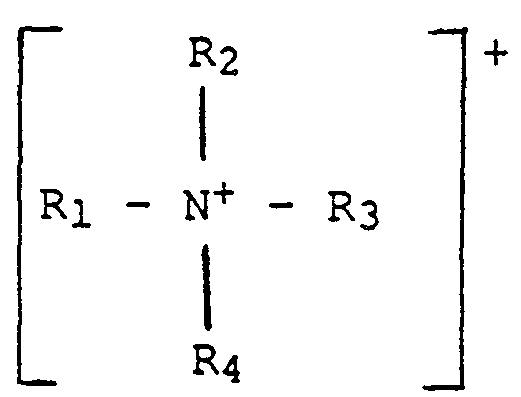
- quaternary ammonium salts which are useful in the practice of this invention are of the formula: wherein:
- Aromatic quaternary ammonium salts and aliphatic quaternary ammonium salts which are useful in the conduct of this invention can be obtained from commercial sources or prepared in accordance with standard procedures.
- such surfactants can be prepared by reacting an appropriate ortho- and/or polyphosphate acid ester, such as octylphenyl hydrogen phosphate, with a suitable amine, as for example triethylamine, to prepare the corresponding amine salt of an orthophosphate ester such as triethylamine octylphenyl phosphate.
- the amine salt of an orthophosphate ester is then reacted with a quaternary ammonium halide such as n-alkyl dimethyl benzyl ammonium chloride to provide the desired aromatic surfactant such as the n-alkyl dimethyl benzyl ammonium salt of octylphenyl hydrogen phosphate.
- a quaternary ammonium halide such as n-alkyl dimethyl benzyl ammonium chloride to provide the desired aromatic surfactant such as the n-alkyl dimethyl benzyl ammonium salt of octylphenyl hydrogen phosphate.
- Preferred for use in the practice of this invention are aromatic quaternary ammonium salts of a phosphate acid ester of the formula: wherein:
- composition contains a mixture of surfactants in which:
- composition contains a mixture of surfactants in which:
- aromatic surfactants for use in the practice of this invention are the n-alkyl dimethyl benzyl ammonium salts of bis-(2-ethylhexyl) hydrogen pyrophosphate and octylphenyl hydrogen phosphate.
- the composition of this invention can be used to clean and/or dry nonabsorbent articles constructed of such materials as metals, glasses, ceramics and the like.
- the article is first contacted with the composition of this invention in solution form.
- Method of contacting is not critical and can vary widely.
- the article can be immersed in a container of the composition, or the article can be sprayed with the composition using conventional equipment. Complete immersion of the article is preferred because it generally insures contact between the composition and all exposed surfaces of the article. However, any other method which can easily provide such complete contact can be used.
- the contacting time can vary widely. Usually, the contacting time is at least about 10 minutes. In the preferred embodiments of the invention, the contacting time is from 1 to 5 minutes, and in the particularly preferred embodiments is from about 1 to about 4 minutes. Amongst these preferred embodiments most preferred are those embodiments in which the contacting time is from 1 to 3 minutes.
- Contacting temperatures also can vary widely depending on the boiling point of the halocarbon component of the composition. In general, the contacting temperature is equal to or less than such boiling point.
- the article is removed from contact with the composition and removal of compositions adhering to exposed surfaces of the article is affected by evaporation, by conventional means.
- the remaining minimal amounts of surfactant adhering to exposed surfaces of the article can be further removed by contacting the article with surfactant-free solvent that is hot or cold.
- holding the article in the solvent vapor will further decrease the presence of surfactant residues remaining on the article. Again, removal of solvent adhering to exposed surfaces of the article is effected by evaporation.
- evaporation of the composition is effected in less than 30 seconds, and preferably less than 10 seconds. Neither temperature nor pressure is critical. Atmospheric or subatmospheric pressures can be employed; and temperatures above and below the boiling point of the halocarbon component can be used.
- composition and process of this invention are preferably carried out using conventional drying machines and systems.
- Illustrative of such drying machines are those described in U.S. Patent No. 3,386,181.
- the "Drying Test” measures the efficiency of water-displacement performance and is conducted as follows:
- phase-separation test simulates the agitation imparted to a liquid by a centrifugal circulating pump such as may be found on a vapor-phase degreasing machine. This test also measures the relative rates of separation for aqueous and solvent phases after the end of the agitation period. The more rapid and complete the separation of the phases, the more potentially useful is the solvent-surfactant composition in a drying machine.
- the "Phase Separation Test" is conducted as follows:
- the "Life Test” measures the ability of a given mixture to resist emulsification in the presence of accumulated water in the boiling sump or in the phase-separation chamber. This test is outlined below:
- compositions evaluated in the tests all contained FC 113 and the surfactants listed in the following Table I.
- compositions 1, 7 and 8 were prepared from phosphates obtained from Stauffer Chemical Co.
- Compositions 2 and 3 were prepared from phosphates obtained from Mobil Chemical Co. The remaining phosphates were prepared from "Strodex MO-100 ® ", a polyphosphate acid ester manufactured and sold by Dexter Chemical Co.
- composition of this invention was compared to that of commercial drying solvents at various pH values using the Phase Separation Test, Drying Test and Life Test procedures described above.
- the commercial drying solvent selected for testing was "Freon TDFC ®" an FC-113 based drying solvent manufactured and sold by DuPont Co. The results of these tests are set forth in the following Tables III and IV.
Landscapes
- Chemical & Material Sciences (AREA)
- Engineering & Computer Science (AREA)
- Organic Chemistry (AREA)
- Chemical Kinetics & Catalysis (AREA)
- Oil, Petroleum & Natural Gas (AREA)
- Wood Science & Technology (AREA)
- Life Sciences & Earth Sciences (AREA)
- Materials Engineering (AREA)
- Combustion & Propulsion (AREA)
- General Chemical & Material Sciences (AREA)
- Mechanical Engineering (AREA)
- Metallurgy (AREA)
- Detergent Compositions (AREA)
Claims (14)




Priority Applications (1)
| Application Number | Priority Date | Filing Date | Title |
|---|---|---|---|
| MYPI87001292A MY100552A (en) | 1984-11-23 | 1987-08-11 | Improved surfactant-based solvent system for dewatering different substrates. |
Applications Claiming Priority (4)
| Application Number | Priority Date | Filing Date | Title |
|---|---|---|---|
| US67439484A | 1984-11-23 | 1984-11-23 | |
| US674394 | 1984-11-23 | ||
| US06/791,147 US4618447A (en) | 1984-11-23 | 1985-10-29 | Surfactant-based solvent system for dewatering different substrates |
| US791147 | 2001-02-22 |
Publications (3)
| Publication Number | Publication Date |
|---|---|
| EP0182272A2 EP0182272A2 (de) | 1986-05-28 |
| EP0182272A3 EP0182272A3 (en) | 1987-11-04 |
| EP0182272B1 true EP0182272B1 (de) | 1990-04-18 |
Family
ID=27101143
Family Applications (1)
| Application Number | Title | Priority Date | Filing Date |
|---|---|---|---|
| EP85114415A Expired - Lifetime EP0182272B1 (de) | 1984-11-23 | 1985-11-13 | Auf Tenside basiertes Lösungsmittelsystem zur Entfeuchtung von verschiedenen Oberflächen |
Country Status (6)
| Country | Link |
|---|---|
| US (1) | US4618447A (de) |
| EP (1) | EP0182272B1 (de) |
| KR (1) | KR890003464B1 (de) |
| CA (1) | CA1253166A (de) |
| DE (1) | DE3577217D1 (de) |
| MY (1) | MY100552A (de) |
Families Citing this family (8)
| Publication number | Priority date | Publication date | Assignee | Title |
|---|---|---|---|---|
| US5192461A (en) * | 1991-08-23 | 1993-03-09 | Enthone-Omi, Inc. | Aqueous degreasing solution having high free alkalinity |
| US5256329A (en) * | 1991-11-27 | 1993-10-26 | Alliedsignal Inc. | 1,1-dichloro-1-fluoroethane dewatering systems |
| AU6230594A (en) * | 1993-02-01 | 1994-08-29 | University Of Iowa Research Foundation, The | Quartenary amine surfactants and methods of using same in isolation of rna |
| US5610128A (en) * | 1994-12-14 | 1997-03-11 | Alliedsignal Inc. | Surfactants and drying and drycleaning compositions which utilize said surfactants |
| US5733416A (en) * | 1996-02-22 | 1998-03-31 | Entropic Systems, Inc. | Process for water displacement and component recycling |
| IT1283794B1 (it) * | 1996-08-26 | 1998-04-30 | Ausimont Spa | Metodo per la rimozione di acqua da superfici |
| US5868799A (en) * | 1996-12-05 | 1999-02-09 | Alliedsignal Inc. | Surfactants and drying and drycleaning compositions which utilize said surfactants |
| US6660701B1 (en) | 2000-10-23 | 2003-12-09 | Polysystems Usa, Inc. | Stabilized solvent system for cleaning and drying |
Citations (1)
| Publication number | Priority date | Publication date | Assignee | Title |
|---|---|---|---|---|
| US4438026A (en) * | 1983-02-28 | 1984-03-20 | Allied Corporation | Solvent dewatering composition |
Family Cites Families (9)
| Publication number | Priority date | Publication date | Assignee | Title |
|---|---|---|---|---|
| US3397150A (en) * | 1966-03-15 | 1968-08-13 | Du Pont | Composition and method for treating surfaces |
| LU77887A1 (de) * | 1977-08-01 | 1979-05-23 | Ciba Geigy Ag | Quaternare ammoniumsalze von fettsaeurereste aufweisenden antistatika oder weichgriffmitteln,deren herstellung und verwendung |
| US4182687A (en) * | 1977-12-08 | 1980-01-08 | E. I. Du Pont De Nemours And Company | Liquid-water displacement composition |
| JPS6024840B2 (ja) * | 1979-11-14 | 1985-06-14 | ライオン株式会社 | ドライクリ−ニング用洗浄剤組成物 |
| JPS58117292A (ja) * | 1981-12-30 | 1983-07-12 | ライオン株式会社 | 硬表面用洗浄剤組成物 |
| US4401584A (en) * | 1982-05-17 | 1983-08-30 | Allied Corporation | Solvent based dewatering system with demulsifier |
| FR2527625A1 (fr) * | 1982-05-27 | 1983-12-02 | Chloe Chemie | Composition a base de fluorochlorohydrocarbure, d'ester phosphorique et d'acide carboxylique |
| US4461652A (en) * | 1982-09-13 | 1984-07-24 | Richmond Therezia L | Barnacle removal process and product |
| DE3569533D1 (en) * | 1984-01-14 | 1989-05-24 | Ciba Geigy Ag | Phosphonic-acid salts |
-
1985
- 1985-10-29 US US06/791,147 patent/US4618447A/en not_active Expired - Fee Related
- 1985-11-13 DE DE8585114415T patent/DE3577217D1/de not_active Expired - Lifetime
- 1985-11-13 EP EP85114415A patent/EP0182272B1/de not_active Expired - Lifetime
- 1985-11-22 KR KR1019850008751A patent/KR890003464B1/ko not_active Expired
- 1985-11-22 CA CA000495980A patent/CA1253166A/en not_active Expired
-
1987
- 1987-08-11 MY MYPI87001292A patent/MY100552A/en unknown
Patent Citations (1)
| Publication number | Priority date | Publication date | Assignee | Title |
|---|---|---|---|---|
| US4438026A (en) * | 1983-02-28 | 1984-03-20 | Allied Corporation | Solvent dewatering composition |
Also Published As
| Publication number | Publication date |
|---|---|
| KR860004135A (ko) | 1986-06-18 |
| KR890003464B1 (ko) | 1989-09-21 |
| EP0182272A2 (de) | 1986-05-28 |
| US4618447A (en) | 1986-10-21 |
| EP0182272A3 (en) | 1987-11-04 |
| MY100552A (en) | 1990-11-15 |
| DE3577217D1 (de) | 1990-05-23 |
| CA1253166A (en) | 1989-04-25 |
Similar Documents
| Publication | Publication Date | Title |
|---|---|---|
| EP0012478B1 (de) | Verfahren zur Entfernung einer Sulfid enthaltenden Kruste von Metalloberflächen | |
| US4618447A (en) | Surfactant-based solvent system for dewatering different substrates | |
| EP0516029A1 (de) | Verfahren zum Trocknen von Gegenständen | |
| JPS59179700A (ja) | 微細乳剤組成物およびこれを用いる表面の洗浄方法 | |
| US4401584A (en) | Solvent based dewatering system with demulsifier | |
| US4438026A (en) | Solvent dewatering composition | |
| US5514301A (en) | Compositions for dewetting or degreasing solid surfaces | |
| EP0327282A1 (de) | Azeotrope oder azeotropähnliche stabilisierte Zusammensetzung von 1,1,2-Trichlor-1,2,2-Trifluorethan, Methanol und 1,2-Dichloroethylen | |
| US5256329A (en) | 1,1-dichloro-1-fluoroethane dewatering systems | |
| RU2335581C2 (ru) | Способ удаления кислотного газа из необработанного газа и добавка, обладающая подавляющим коррозию эффектом и противопенным эффектом, для добавления к раствору амина для удаления кислотного газа | |
| JPS61133298A (ja) | トリクロルトリフルオルエタン、エタノール、アセトン、ニトロメタンおよびヘキサンの共沸混合物様組成物 | |
| US4476036A (en) | Quaternary 1,1,2-trichloro-1,2,2-trifluoro azeotropic cleaning composition | |
| US4491531A (en) | Composition based on a fluorohydrocarbon solvent, suitable for removing water from the surface of manufactured articles | |
| EP0090496B1 (de) | Reinigungsmittel | |
| KR900001828B1 (ko) | 트리클로로트리플루오로에탄, 아세톤, 니트로메탄 및 헥산의 공비성조성물 | |
| US3577348A (en) | Trichlorotrifluoroethane water emulsion system | |
| JPS61246192A (ja) | ホスフエ−ト酸エステルの四級アンモニウム塩及び該塩含有乾燥用組成物並びに物品の清浄及び/又は乾燥方法 | |
| US5106425A (en) | Method for maintaining a flammable solvent in a non-flammable environment | |
| JP3266936B2 (ja) | 水除去用組成物及び物品の水除去方法 | |
| RU2777442C1 (ru) | Средство для мойки деталей транспортных средств | |
| RU2739245C1 (ru) | Моющее средство для очистки металлических поверхностей | |
| RU2680083C1 (ru) | Моющая композиция для очистки металлических поверхностей | |
| RU2075543C1 (ru) | Ингибитор кислотной коррозии | |
| SU1641876A1 (ru) | Состав дл чистки и удалени оксидов и накипи с поверхности черных и цветных металлов | |
| JPH07284605A (ja) | 水切り溶剤組成物 |
Legal Events
| Date | Code | Title | Description |
|---|---|---|---|
| PUAI | Public reference made under article 153(3) epc to a published international application that has entered the european phase |
Free format text: ORIGINAL CODE: 0009012 |
|
| AK | Designated contracting states |
Kind code of ref document: A2 Designated state(s): DE FR GB IT |
|
| PUAL | Search report despatched |
Free format text: ORIGINAL CODE: 0009013 |
|
| RHK1 | Main classification (correction) |
Ipc: C23G 5/028 |
|
| AK | Designated contracting states |
Kind code of ref document: A3 Designated state(s): DE FR GB IT |
|
| 17P | Request for examination filed |
Effective date: 19880409 |
|
| 17Q | First examination report despatched |
Effective date: 19890627 |
|
| RAP1 | Party data changed (applicant data changed or rights of an application transferred) |
Owner name: ALLIED-SIGNAL INC. (A DELAWARE CORPORATION) |
|
| GRAA | (expected) grant |
Free format text: ORIGINAL CODE: 0009210 |
|
| ITF | It: translation for a ep patent filed | ||
| AK | Designated contracting states |
Kind code of ref document: B1 Designated state(s): DE FR GB IT |
|
| REF | Corresponds to: |
Ref document number: 3577217 Country of ref document: DE Date of ref document: 19900523 |
|
| ET | Fr: translation filed | ||
| PLBE | No opposition filed within time limit |
Free format text: ORIGINAL CODE: 0009261 |
|
| STAA | Information on the status of an ep patent application or granted ep patent |
Free format text: STATUS: NO OPPOSITION FILED WITHIN TIME LIMIT |
|
| 26N | No opposition filed | ||
| ITTA | It: last paid annual fee | ||
| PGFP | Annual fee paid to national office [announced via postgrant information from national office to epo] |
Ref country code: GB Payment date: 19931103 Year of fee payment: 9 |
|
| PGFP | Annual fee paid to national office [announced via postgrant information from national office to epo] |
Ref country code: FR Payment date: 19931110 Year of fee payment: 9 Ref country code: DE Payment date: 19931110 Year of fee payment: 9 |
|
| PG25 | Lapsed in a contracting state [announced via postgrant information from national office to epo] |
Ref country code: GB Effective date: 19941113 |
|
| GBPC | Gb: european patent ceased through non-payment of renewal fee |
Effective date: 19941113 |
|
| PG25 | Lapsed in a contracting state [announced via postgrant information from national office to epo] |
Ref country code: FR Effective date: 19950731 |
|
| PG25 | Lapsed in a contracting state [announced via postgrant information from national office to epo] |
Ref country code: DE Effective date: 19950801 |
|
| REG | Reference to a national code |
Ref country code: FR Ref legal event code: ST |