EP0182302A2 - Novel 1,4-benzodioxane and 1,4-benzodioxine derivatives and production thereof - Google Patents
Novel 1,4-benzodioxane and 1,4-benzodioxine derivatives and production thereof Download PDFInfo
- Publication number
- EP0182302A2 EP0182302A2 EP85114502A EP85114502A EP0182302A2 EP 0182302 A2 EP0182302 A2 EP 0182302A2 EP 85114502 A EP85114502 A EP 85114502A EP 85114502 A EP85114502 A EP 85114502A EP 0182302 A2 EP0182302 A2 EP 0182302A2
- Authority
- EP
- European Patent Office
- Prior art keywords
- give
- compound
- mixture
- reaction
- residue
- Prior art date
- Legal status (The legal status is an assumption and is not a legal conclusion. Google has not performed a legal analysis and makes no representation as to the accuracy of the status listed.)
- Withdrawn
Links
- 0 C[C@@](*)C1Oc(c(Cl)c(cc2)Cl)c2OC1 Chemical compound C[C@@](*)C1Oc(c(Cl)c(cc2)Cl)c2OC1 0.000 description 4
- LFCUKRXPYQWXFD-UHFFFAOYSA-N CCC(c(cc1OCC(C)Oc1c1C2CC2)c1[ClH]C)=O Chemical compound CCC(c(cc1OCC(C)Oc1c1C2CC2)c1[ClH]C)=O LFCUKRXPYQWXFD-UHFFFAOYSA-N 0.000 description 1
- OPNCIMIOCNMYGT-UHFFFAOYSA-N Oc1ccc(C2CC2)c(C2CCC2)c1O Chemical compound Oc1ccc(C2CC2)c(C2CCC2)c1O OPNCIMIOCNMYGT-UHFFFAOYSA-N 0.000 description 1
Classifications
-
- C—CHEMISTRY; METALLURGY
- C07—ORGANIC CHEMISTRY
- C07D—HETEROCYCLIC COMPOUNDS
- C07D407/00—Heterocyclic compounds containing two or more hetero rings, at least one ring having oxygen atoms as the only ring hetero atoms, not provided for by group C07D405/00
- C07D407/02—Heterocyclic compounds containing two or more hetero rings, at least one ring having oxygen atoms as the only ring hetero atoms, not provided for by group C07D405/00 containing two hetero rings
- C07D407/06—Heterocyclic compounds containing two or more hetero rings, at least one ring having oxygen atoms as the only ring hetero atoms, not provided for by group C07D405/00 containing two hetero rings linked by a carbon chain containing only aliphatic carbon atoms
-
- A—HUMAN NECESSITIES
- A61—MEDICAL OR VETERINARY SCIENCE; HYGIENE
- A61P—SPECIFIC THERAPEUTIC ACTIVITY OF CHEMICAL COMPOUNDS OR MEDICINAL PREPARATIONS
- A61P7/00—Drugs for disorders of the blood or the extracellular fluid
- A61P7/10—Antioedematous agents; Diuretics
-
- A—HUMAN NECESSITIES
- A61—MEDICAL OR VETERINARY SCIENCE; HYGIENE
- A61P—SPECIFIC THERAPEUTIC ACTIVITY OF CHEMICAL COMPOUNDS OR MEDICINAL PREPARATIONS
- A61P9/00—Drugs for disorders of the cardiovascular system
- A61P9/12—Antihypertensives
-
- C—CHEMISTRY; METALLURGY
- C07—ORGANIC CHEMISTRY
- C07D—HETEROCYCLIC COMPOUNDS
- C07D319/00—Heterocyclic compounds containing six-membered rings having two oxygen atoms as the only ring hetero atoms
- C07D319/10—1,4-Dioxanes; Hydrogenated 1,4-dioxanes
- C07D319/14—1,4-Dioxanes; Hydrogenated 1,4-dioxanes condensed with carbocyclic rings or ring systems
- C07D319/16—1,4-Dioxanes; Hydrogenated 1,4-dioxanes condensed with carbocyclic rings or ring systems condensed with one six-membered ring
- C07D319/20—1,4-Dioxanes; Hydrogenated 1,4-dioxanes condensed with carbocyclic rings or ring systems condensed with one six-membered ring with substituents attached to the hetero ring
-
- C—CHEMISTRY; METALLURGY
- C07—ORGANIC CHEMISTRY
- C07D—HETEROCYCLIC COMPOUNDS
- C07D409/00—Heterocyclic compounds containing two or more hetero rings, at least one ring having sulfur atoms as the only ring hetero atoms
- C07D409/02—Heterocyclic compounds containing two or more hetero rings, at least one ring having sulfur atoms as the only ring hetero atoms containing two hetero rings
- C07D409/06—Heterocyclic compounds containing two or more hetero rings, at least one ring having sulfur atoms as the only ring hetero atoms containing two hetero rings linked by a carbon chain containing only aliphatic carbon atoms
Definitions
- the present invention provides novel compounds having diuretic with antihypertensive activities. More particularly, it relates to 1,4-benzodioxane or 1,4-benzodioxine derivatives and processes for the production thereof.
- 1,4-Benzodioxane compounds have long been studied, for instance, it has been disclosed in Journal of Medicinal Chemistry 8, 446 (1965) that 2-guanidinomethyl-1,4-benzodioxane demonstrates antihypertensive action and adrenergic blocking action.
- the present inventors synthesized 1,4-benzodioxanesulfonamide derivatives having antihypertensive action which have been disclosed in JPN Unexam. Pat. Pub. No. 55-124781.
- This invention relates to a series of novel 1,4-benzodioxane and 1,4-benzodioxine derivatives and a process for production thereof, having an excellent diuretic and antihypertensive activity but have no or little uricosuric activity, more particularly, it relates to compounds of the formula: wherein R I is optionally protected hydroxymethyl or carboxy; R 2 is hydrogen, straight or branched chain lower alkyl or lower alkenyl, C,-C, cycloalkyl, optionally substituted phenyl, phenyl(lower alkyl), hydroxy, thienyl, or furyl; and the dotted line indicates the presence or absence of a double bond and processes for production of compounds represented by the above-shown formula (I ), which is characterized by reaction of 3,4-dichloro-1,2-benzenediol of the formula: with a -epihalohydrin or the equivalent reagent thereof in the presence of a base followed by acylation in the
- Diuretic thiazides which show a moderate antihypertensive activity on oral administration have been used over many years as first-choice drug. However, it has been a severe defect that they are usually accompanied by uricosuric action. As a result of so many studies for curing said defect, some sorts of phenoxy acetic acid derivatives such as thienylic acid, indacrinone and the like have been developed, but a very few number of the drugs have been marketed. Developement of highly safe drugs are therefore desired.
- the present inventors synthesized a series of novel 1,4-benzodioxane and 1,4-benzodioxine derivatives and found that these novel compounds have an excellent diuretic and antihypertensive activity but have no or little uricosuric activity. Consequently the present inventors have accomplished this invention.
- representatives of the protecting group for the protection of hydroxymethyl or carboxy are for example acyls derived from fatty acids such as acetyl and propionyl as said group for the former; and conventional ester forming groups as said group for the latter, i.e., lower alkyls such as methyl, ethyl and propyl or phenyl optionally substituted by halogen.
- Straight or branched chain lower alkyl is C 1 -C, alkyl and includes methyl, ethyl, n-propyl, i-propyl, n-butyl, i-butyl, sec- butyl, and t-butyl.
- Straight or branched chain lower alkenyl is C 2 -C 5 alkenyl and includes for example vinyl, allyl, propenyl, isopropenyl, 1-, 2-, or 3-butenyl, 1-pentenyl, 1-ethylvinyl, and 1-propylvinyl.
- C,-C, cycloalkyl includes for example cyclobutyl, cyclopentyl, cyclohexyl, and cycloheptyl.
- Optionally substituted phenyl is a monocyclic compound which may be substituted by one or two substitutions, e.g., halogen, methyl, and ethyl.
- Phenyl(lower alkyl) is said lower alkyl substituted by phenyl and includes for example benzyl, phenethyl, and phenylpropyl.
- the present compounds (I a) and ( b) are readily prepared by the reaction of 3,4-dichloro-1,2-benzenediol with a -epihalohydrine or the equivalents thereof and acylation or by acylation of 3,4-dichloro-1,2-benzenediol and reaction with ⁇ -epihalohydrine or the equivalents thereof, if necessary followed by oxidation or dehydrogenation after the oxidation.
- R 2 and the dotted line each has the same meaning as defined above, and R 3 and R 4 each is hydrogen or a protecting group.
- the reaction in this process is cycloaddition of the starting material ( II ) with a-epihalohydrin or the equivalents thereof and carried out in the presence of a base.
- the 2- or 3-hydroxymethyl compound (I a) or (I b) can be obtained selectively by specifying the reaction conditions, e.g., selection of the base and the like.
- the starting material is subjected to cycloaddition with an equivalent or slight excess amount of a -epihalohydrin or the equivalents thereof in the presence of a strong base at an amount of about 1.5 to about 3 eq. preferably at about 2 to about 2.3 eq.
- a strong base at an amount below 2 eq. or if the basicity of the base is weak, then the objective compound ( III a ) would be obtained in a lower yield. It is preferable to carry out this reaction at a fairly lower temperature: for instance, the reaction is carried out at 0°C or under reflux, more preferably at 20 to 30°C and completed within several minutes to several hours.
- a -Epihalohydrin or the equivalents thereof employed in this invention involve epihydrins substituted by halogen , e. g. chlorine, bromine, and iodine or by electron-attracting group, e.g. tosyloxy, mesyloxy, and the like.
- halogen e. g. chlorine, bromine, and iodine
- electron-attracting group e.g. tosyloxy, mesyloxy, and the like.
- the strong base employed in this process includes an alcoholate such as potassium t-butoxide and sodium t-pentylate; an amide such as sodium amide, potassium amide, lithium diethylamide, lithium diisopropylamide, and sodium bis-(trimethylsilyl)amide; a and/hydride such as sodium hydride and lithium hydride.
- an alcoholate such as potassium t-butoxide and sodium t-pentylate
- an amide such as sodium amide, potassium amide, lithium diethylamide, lithium diisopropylamide, and sodium bis-(trimethylsilyl)amide
- a and/hydride such as sodium hydride and lithium hydride.
- the solvent employed may be chosen according to the sort of the base or the solubility of the reactant; for example, alcohols such as t-butyl alcohol, ethers such as tetrahydrofuran (IHF) and 1,2-dimethoxyethane, benzene-type solvents such as benzene, toluene, and xylene, and aprotic polar solvents such as dimethylsulfoxide and dimethylformamide (DMF).
- alcohols such as t-butyl alcohol
- ethers such as tetrahydrofuran (IHF) and 1,2-dimethoxyethane
- benzene-type solvents such as benzene, toluene, and xylene
- aprotic polar solvents such as dimethylsulfoxide and dimethylformamide (DMF).
- the 2-hydroxy group of the starting material ( II ) may be protected by a suitable ethereal group and then subjected to addition of a -epihalohydrin or the equivalents thereof.
- Any protecting groups can be employed as long as they are against stable / said base.
- Benzyl-type protecting groups such as benzyl, benzhydrile, and nitrobenzyl or methoxymethyl are preferred for this process.
- the reaction may be carried out in a conventional manner for introduction of protecting groups, the solvent for which can also be chosen, as mentioned above, according to the sort of the base and solubility of the reactant.
- the starting material is reacted with a -epihalohydrin or equivalents thereof in the presence of a weak base.
- a weak base It is preferable to employ said weak base at an equimolar or excess amount, preferred at 3 to 5 moles.
- Representatives of the weak bases employed are carbonates or hydrogencarbonates such as potassium carbonate and sodium carbonate, organic bases such as pyridine and triethylamine, or the like.
- the solvent employed may be chosen according to the sort of the base or the solubility of the such as acetone reactant therein. Specific example for the solvents are ketons or esters / and ethyl acetate and hydrophilic solvents like alcohols such as methanol, ethanol, and isopropanol.
- the starting material ( II ) is protected at the site I-hydroxy/by a suitable ethereal protecting group and then reacted with a -epihalohydrin or equivalents thereof for cycloaddition.
- the introduction of the protecting group may be carried out in a conventional manner as explained above , but the sort and the amount of the base should be carefully selected .
- the reaction should be carried out by using a strong base as exemplified above at an amount of 2 moles or more, preferably at about 2 to about 2.3 moles.
- Any protecting group stable to bases may be employed for this process and the protecting groups listed above are the examples. Solvents exemplified above may be also employed according to the sort of the bases or solubility of the reactants. After the introduction of the protecting group, addition of a - epihalohydrin or equivalents thereof, deprotection by hydrogenation or the like, and then cyclization by treatment with alkali are carried out. Theses reactions may be carried out accroding to the manners shown above.
- an acyl is introduced to the benzene nucleus of a 2- or 3-hydroxymethyl compound ( IIIa or IIIb) obtained in Process 1 to give a compound ( I a).
- This process may preferably be carried out after the protection of hydroxy of the compound ( III ) by a protecting group stable to acids.
- the compounds (I b) may be prepared by a conventional oxidation of the compound ( IIIa ) or ( IIIb ) as the corresponding carboxylic acid, or by further esterification and introduction of an acyl.
- acyls in this process may be carried out in a conventional manner, for example, by the Friedel Crafts reaction.
- This reaction is carried out in the presence of a Lewis acid such as alminium chloride, zinc chloride, ferric chloride or titanium tetrachloride, wherein an acyl halide or acid anhydride as the acylating agent with chlorine, bromine, and iodine as the halogens of the acyl halide may be employed.
- a Lewis acid such as alminium chloride, zinc chloride, ferric chloride or titanium tetrachloride
- Solvents may be usual solvents employed in the Friedel Crafts reaction , depending on the acid catalysts involved or on the for solvents are solubility of the reactants .
- the protected- or acyl-ester compounds obtained by the Friedel Crafts reaction may be, if desired, converted to the free alcohols by alkali hydrolysis.
- This process is characterized by the oxidation of a 2- or 3-hydroxymethyl compound (I a) to give the carboxylic acid or the ester (I b).
- the subsequent dehydrogenation gives the corresponding carboxylic acid of dioxine-form or the ester (I b).
- Any usual oxidation reaction converting a primary or a corresponding secondary alcohol into the/carboxylic acid or ketone may be employed as long as they are carried out under such conditions as to avoid side-reactions at other functional groups.
- the Jones Oxidation method disclosed in Journal of Chemical Society 39 (1946), i. e., chromic acid oxidation with Jones' reagents in acetone is preferred.
- the products prepared through the oxidation may, if desired, be converted to 1,4-benzodioxine compounds (I b) by dehydrogenation.
- N-bromosuccinimide (NBS) are examples of said dehydrogenation.
- the reaction is carried out by refluxing under anhydrous conditions, in carbon tetrachloride, using benzoyl peroxide as a reaction initiator and it is completed within a period of several hours or several days.
- Process 1 and Process 2 follow the reverse course of those employed in Route 1.
- 3,4-dichloro-1,2-benzenediol ( II ) is acylated by the Friedel Crafts reaction (Process 1') and then applied to cycloaddition (Process 2') with a -epihalohydrin or the equivalent reagent thereof to yield the compounds (I a).
- 6- acyl-1,4-dioxane or 6-acyl-1,4 - dioxine derivatives are obtained.
- This process may be carried out according to the Friedel Crafts reaction employed in Process 2 of Route 1.
- the reaction conditions i.e., the solvents employed, the reagents, and the like may also be determined according to the disclosure in Process 2 of Route 1.
- acyl group is introduced selectively at/5-position of compound ( II ) and rarely at the 6-position. Since the acyl group also reacts with 1- and 2-hydroxy groups to form an ester, for the subsequent process it is necessary to convert the ester to the free alcohol by alkali hydrolysis.
- the optionally protected 2-hydroxymethyl an compounds (I a-a) are prepared by cycloaddition of /a -epihalo- with hydrin or an equivalent reagent thereof / 5-acyl-3,4-dichloro-1,2-benzenediol (IV).
- the process may be carried out according to Method A of Process 1 in said route 1.
- the objective 2-hydroxymethyl compounds ( I a-a) can be obtained under the same conditions of Method A of Process 1, (i.e., with respect to the sort and the amount of the base employed, the reaction temperature, the reaction time, etc.
- a -Epihalohydrin or an equivalent reagent thereof may be subjected to cycloaddition directly or subsequently to protection of the 2-hydroxy group of compounds ( IV) with a suitable protecting group.
- Solvents employed may be chosen from the examples disclosed in Process 1 , considering the solubility of the reactant.
- the optionally protected 3-hydroxymethyl an compounds ( Ia-b) are prepared by cycloaddition of an ⁇ -epihalohydrin or an equivalent reagent thereof to the compounds ( IV ) obtained in Process 1'.
- the objective compounds (I a-b) can be obtained by the while the Method B of Process 1 / properly selecting the sort or/amount of the base employed, the reaction temperature, the reaction time, and the like.
- a -Epihalohydrin or the equivalent reagent thereof may also be subjected to cycloaddition directly or following the group with protection of the 1-hydroxy/of compounds ( IV ) / a suitable protecting group.
- the compounds (I a) thus obtained through Route 2 may be, if desired, employed for the next 3rd process to obtain the compounds (I b).
- R 2 is a lower alkenyl
- the Friedel the Crafts reaction using/acylating agent R 2 COX wherein R 2 is a lower alkenyl
- R 2 COX the Friedel the Crafts reaction using/acylating agent
- the functional group adjacent to the carbonyl moiety of R 2 CO- is e.g. an activated methylene -CH 2 -
- a reaction with an aldehyde or a ketone to give the alkenyl compound can also be applied (see Example 12).
- reaction mixture is poured into about 600 ml of ice-cold water and extracted twice with ether.
- the ether layer is washed twice with a saturated aqueous solution of sodium chloride, dried over sodium sulfate and evaporated under reduced pressure to give 10.01 g of a residue.
- the residue is chromatographed on a silica-gel column with dichloromethane, to give 1.60 g of an oily material (oil of sodium hydride) as the first fraction, 1.22 g (Yield 8.3 %) of 2-(2,3-epoxypropyloxymethyl)-7,8-dichloro-1,4-benzodioxane as the second fraction, and 6.17 g of 2-hydroxymethyl-7,8-dichloro-1,4-benzodioxane ( IIIa ) as the last fraction. Yield 52 %. The last fraction is recrystallized from hexane-ether to give a pure substance, m.p. 53- 55 * C.
- the organic layer is washed twice with a saturated aqueous solution of sodium chloride, dried over sodium sulfate, and evaporated to give 4.00 g of a residue.
- the residue is separated into two fractions by using two columns of Lober B (Merck) with hexane : acetone (4 : 1) as an eluent.
- the former fraction gives 1380 mg of the compound (Ia-a3), which is recrystallized from ether-hexane to give 1303 mg of the pure product (Ia-a3), yield 23 %, mp. 67-70 °C.
- the separated aqueous layer is extracted three times with dichloromethane, then with a saturated aqueous solution of sodium chloride, with 2N sodium hydroxide and twice with a saturated aqueous solution of sodium chloride, dried over sodium sulfate and then evaporated to give 9.50 g of a residue.
- a solution of 9.50 g of the residue dissolved in 100 ml of ethanol and 50 ml of 2N sodium hydroxide is refluxed for 30 minutes, the ethanol is evaporated under reduced pressure, and the residue is extracted with dichloromethane three times.
- reaction mixture is poured into ice-water and extracted with ethyl ether, and the organic layer is washed with water, dried over sodium sulfate, and evaporated to leave 1.570 g of a neutral fraction and 280 mg of an acidic fraction.
- Titanium tetrachloride was employed in place of aluminium chloride, and the reaction was carried out in the same manner as above to give the compounds (I b'-50) in 19% yield and (Ib'-51) in 39% yield.
- the compounds (I ) of the present invention have excellent antihypertensive and diuretic actions and are very usuful for the treatment for hypertensives. They can be administered orally, intravenously, or hypodermically to humans at a respective daily dosage of 0.1-2 mg/kg, 0.005-0.1 mg/kg, or 0.02-0.4 mg/kg. Both the the /diuretic effect and/hyperuricosuric effect by typical compounds are explained by the following Experiments.
- Slc:SD 8-week-old rats male, about 250g body-weight each
- a few lumps of sugar in place of ordinary diets were given on the morning of the day before the test day and 5% glucose solution was given orally at a rate of 20 ml/kg in the evening (approximately at 4 p.m.) of the test day.
- a sample which was prepared by suspending or dissolving a test compound in 2X gum arabic was orally administered to each at a dose of 20 ml/kg.
- mere by 2% gum arabic was orally administered to the control group at 20.ml/kg.
- the test animals were put in a plastic cage for metabolic tests and their urine samples were collected for 5 hours. The cumulative urine volume, urinary sodium, and urinary potassium were quantitatively determined.
- mice female, about 20g body-weight each
- mice were fasted but water.
- a sample which was prepared by suspending or dissolving a test compound in 2% gum arabic was orally administered to each at 30 ml/kg.
- mere by 2X gum arabic was orally administered to the control group at 30 ml/kg.
- 5 mice employed were put in a plastic cage for metabolic tests and their urine samples were collected for 4 hours. The cumulative urine volume, urinary sodium, and urinary potassium were quantitatively determined.
- i.p. Potassium oxonate was intraperitoneally (hereinafter abbreviated as i.p.) administered to the test animals at a dose of 250 mg/kg in order to measure uric acid clearance and inulin clearance.
- canulae were placed into the femoral artery, femoral vein, and urinary bladder and a tube for administration of drugs was placed into abdominal cavity on each animal under anesthesia with 50 mg/kg i.p. of pentobarbital.
- potassium oxonate was administered again i.p. at a dose of 250 mg/kg and then 60% urethane (2 ml/kg) and 15% inulin (4 ml/kg) were subcutaneously injected.
- a mixture of 4X mannitol/1.5% inulin/ 0.9% saline was infused at a flow rate of 0.1 ml/min to the animal on a plate kept at 30°C.
- arterial blood (0.2 ml each) samples were collected 6 times every 20 minutes, and five 20-minutes urines were collected.
- the serum was separated therefrom, and the serum samples and the urine samples were stored in a refrigerater.
- a test compound was suspended in 1% gum arabic and the suspension was intraperitoneally administered at 2 ml/kg.
- Uric acid in the serum or in the urine was quantitatively analyzed by the method of Yonetani et al's. [Y. Yonetani et al., Japanese Journal of Pharmacology 30, 829-840 (1980)]. Substantially by the fluorescence method of Vurek's and Pegram's using dimedone reagent [Vurek, G.G., Pegram, S.E., Anal. Biochem. 16, 409-419 (1966)], inulin was also quantitatively analyzed in the following manner. To 0.1 ml of diluted deprotenized-serum or urine employed for the measurement of uric acid was added 5 ml of 1% dimedone/phosphoric acid solution and the resulting mixture was heated for 5 minutes. The mixture was cooled in ice-cold water, combined with 2.0 ml of acetic acid, then shaken well, and the fluorescence was measured at 410nm in the excitation wave length at 360nm.
- tienilic acid was administered to the animals at a dose of 100 mg i.p. and urine volume (ml/kg min.), urinary uric acid (ml/kg min.), and fractional excretion of uric acid [FEua ( ⁇ g/ml): (Uric acid Clearance)/(Inulin Clearance)] were measured.
- FEua ⁇ g/ml
- Urin Clearance ⁇ g/ml
- the compounds of the present invention are confirmed to be excellent diuretic antihypertensives having uricosuric activities from those experiments.
Landscapes
- Chemical & Material Sciences (AREA)
- Organic Chemistry (AREA)
- Health & Medical Sciences (AREA)
- Public Health (AREA)
- Life Sciences & Earth Sciences (AREA)
- Veterinary Medicine (AREA)
- Engineering & Computer Science (AREA)
- Chemical Kinetics & Catalysis (AREA)
- General Chemical & Material Sciences (AREA)
- Medicinal Chemistry (AREA)
- Nuclear Medicine, Radiotherapy & Molecular Imaging (AREA)
- Pharmacology & Pharmacy (AREA)
- Bioinformatics & Cheminformatics (AREA)
- Animal Behavior & Ethology (AREA)
- General Health & Medical Sciences (AREA)
- Hematology (AREA)
- Diabetes (AREA)
- Cardiology (AREA)
- Heart & Thoracic Surgery (AREA)
- Pharmaceuticals Containing Other Organic And Inorganic Compounds (AREA)
- Heterocyclic Compounds That Contain Two Or More Ring Oxygen Atoms (AREA)
- Plural Heterocyclic Compounds (AREA)
Abstract
Description
- The present invention provides novel compounds having diuretic with antihypertensive activities. More particularly, it relates to 1,4-benzodioxane or 1,4-benzodioxine derivatives and processes for the production thereof.
- 1,4-Benzodioxane compounds have long been studied, for instance, it has been disclosed in Journal of Medicinal Chemistry 8, 446 (1965) that 2-guanidinomethyl-1,4-benzodioxane demonstrates antihypertensive action and adrenergic blocking action. The present inventors synthesized 1,4-benzodioxanesulfonamide derivatives having antihypertensive action which have been disclosed in JPN Unexam. Pat. Pub. No. 55-124781.
- This invention relates to a series of novel 1,4-benzodioxane and 1,4-benzodioxine derivatives and a process for production thereof, having an excellent diuretic and antihypertensive activity but have no or little uricosuric activity, more particularly, it relates to compounds of the formula:

wherein RI is optionally protected hydroxymethyl or carboxy; R2 is hydrogen, straight or branched chain lower alkyl or lower alkenyl, C,-C, cycloalkyl, optionally substituted phenyl, phenyl(lower alkyl), hydroxy, thienyl, or furyl; and the dotted line indicates the presence or absence of a double bond and processes for production of compounds represented by the above-shown formula (I ), which is characterized by reaction of 3,4-dichloro-1,2-benzenediol of the formula:
with a -epihalohydrin or the equivalent reagent thereof in the presence of a base followed by acylation in the presence of Lewis acid; or characterized by acylation of 3,4-dichloro-1,2-benzene- diol in the presence of Lewis acid followed by reaction with a - epihalohydrin or the equivalent reagent thereof in the presence of a base, and if necessary, subsequent oxidation or dehydrogenation after the oxidation. - Diuretic thiazides which show a moderate antihypertensive activity on oral administration have been used over many years as first-choice drug. However, it has been a severe defect that they are usually accompanied by uricosuric action. As a result of so many studies for curing said defect, some sorts of phenoxy acetic acid derivatives such as thienylic acid, indacrinone and the like have been developed, but a very few number of the drugs have been marketed. Developement of highly safe drugs are therefore desired.
- The present inventors synthesized a series of novel 1,4-benzodioxane and 1,4-benzodioxine derivatives and found that these novel compounds have an excellent diuretic and antihypertensive activity but have no or little uricosuric activity. Consequently the present inventors have accomplished this invention.
- The starting materials shown by the formula (II), from which the compounds of this invention can be prepared, are known compounds and disclosed in Biochemical Journal 59, 410 (1955).
- In this invention, representatives of the protecting group for the protection of hydroxymethyl or carboxy are for example acyls derived from fatty acids such as acetyl and propionyl as said group for the former; and conventional ester forming groups as said group for the latter, i.e., lower alkyls such as methyl, ethyl and propyl or phenyl optionally substituted by halogen.
- Straight or branched chain lower alkyl is C1-C, alkyl and includes methyl, ethyl, n-propyl, i-propyl, n-butyl, i-butyl, sec- butyl, and t-butyl. Straight or branched chain lower alkenyl.is C2-C5 alkenyl and includes for example vinyl, allyl, propenyl, isopropenyl, 1-, 2-, or 3-butenyl, 1-pentenyl, 1-ethylvinyl, and 1-propylvinyl. C,-C, cycloalkyl includes for example cyclobutyl, cyclopentyl, cyclohexyl, and cycloheptyl. Optionally substituted phenyl is a monocyclic compound which may be substituted by one or two substitutions, e.g., halogen, methyl, and ethyl. Phenyl(lower alkyl) is said lower alkyl substituted by phenyl and includes for example benzyl, phenethyl, and phenylpropyl.
- As illustrated by the following reaction scheme, the present compounds (I a) and ( b) are readily prepared by the reaction of 3,4-dichloro-1,2-benzenediol with a -epihalohydrine or the equivalents thereof and acylation or by acylation of 3,4-dichloro-1,2-benzenediol and reaction with α-epihalohydrine or the equivalents thereof, if necessary followed by oxidation or dehydrogenation after the oxidation.

- The reaction in this process is cycloaddition of the starting material ( II ) with a-epihalohydrin or the equivalents thereof and carried out in the presence of a base. The 2- or 3-hydroxymethyl compound (I a) or (I b) can be obtained selectively by specifying the reaction conditions, e.g., selection of the base and the like.
-

- a -Epihalohydrin or the equivalents thereof employed in this invention involve epihydrins substituted by halogen , e.g. chlorine, bromine, and iodine or by electron-attracting group, e.g. tosyloxy, mesyloxy, and the like.
- The strong base employed in this process includes an alcoholate such as potassium t-butoxide and sodium t-pentylate; an amide such as sodium amide, potassium amide, lithium diethylamide, lithium diisopropylamide, and sodium bis-(trimethylsilyl)amide; a and/hydride such as sodium hydride and lithium hydride.
- The solvent employed may be chosen according to the sort of the base or the solubility of the reactant; for example, alcohols such as t-butyl alcohol, ethers such as tetrahydrofuran (IHF) and 1,2-dimethoxyethane, benzene-type solvents such as benzene, toluene, and xylene, and aprotic polar solvents such as dimethylsulfoxide and dimethylformamide (DMF).
- As an alternative process, the 2-hydroxy group of the starting material ( II ) may be protected by a suitable ethereal group and then subjected to addition of a -epihalohydrin or the equivalents thereof.
- In order to introduce said ethereal protecting group selectively at the 2-hydroxy group , it is preferred to employ such a one base as listed above in an amount over/eqivalent, preferably about 1 to about 1.3 eq. If over 2 eq. of said base were employed in this case , the protecting group would be introduced at 1-hydroxy.
- Any protecting groupscan be employed as long as they are against stable / said base. Benzyl-type protecting groups such as benzyl, benzhydrile, and nitrobenzyl or methoxymethyl are preferred for this process. The reaction may be carried out in a conventional manner for introduction of protecting groups, the solvent for which can also be chosen, as mentioned above, according to the sort of the base and solubility of the reactant.
- The thus obtained 2-protected-3,4-dichlorophenol is, subjected to addition of α-epihalohydrin or equivalents thereof in the presence of the base, then deprotected in a conventional manner on by hydrogenolysis with for example palladium/ carbon, and cyclized by the treatment with an alkali.
-

- There are two ways for obtaining the compound (Igb) as mentioned in section (1), i.e., direct cycloaddition of a - epihalohydrin or the equivalents thereof to the starting material or cycloaddition after introduction of a protecting group.
- For the direct cycloaddition, the starting material is reacted with a -epihalohydrin or equivalents thereof in the presence of a weak base. It is preferable to employ said weak base at an equimolar or excess amount, preferred at 3 to 5 moles. Representatives of the weak bases employed are carbonates or hydrogencarbonates such as potassium carbonate and sodium carbonate, organic bases such as pyridine and triethylamine, or the like. The solvent employed may be chosen according to the sort of the base or the solubility of the such as acetone reactant therein. Specific example for the solvents are ketons or esters / and ethyl acetate and hydrophilic solvents like alcohols such as methanol, ethanol, and isopropanol.
- For the way of cycloaddition subsequent to introduction of a protecting group, the starting material ( II ) is protected at the site I-hydroxy/by a suitable ethereal protecting group and then reacted with a -epihalohydrin or equivalents thereof for cycloaddition. The introduction of the protecting group may be carried out in a conventional manner as explained above , but the sort and the amount of the base should be carefully selected . In order to introduce said ethereal protecting group selectively at site the 1-hydroxysite,the reaction should be carried out by using a strong base as exemplified above at an amount of 2 moles or more, preferably at about 2 to about 2.3 moles.
- Any protecting group stable to bases may be employed for this process and the protecting groups listed above are the examples. Solvents exemplified above may be also employed according to the sort of the bases or solubility of the reactants. After the introduction of the protecting group, addition of a - epihalohydrin or equivalents thereof, deprotection by hydrogenation or the like, and then cyclization by treatment with alkali are carried out. Theses reactions may be carried out accroding to the manners shown above.
- In this process, an acyl is introduced to the benzene nucleus of a 2- or 3-hydroxymethyl compound ( IIIa or IIIb) obtained in Process 1 to give a compound ( I a). This process may preferably be carried out after the protection of hydroxy of the compound ( III ) by a protecting group stable to acids. If desired, the compounds (I b) may be prepared by a conventional oxidation of the compound ( IIIa ) or ( IIIb ) as the corresponding carboxylic acid, or by further esterification and introduction of an acyl.
- The introduction of acyls in this process may be carried out in a conventional manner, for example, by the Friedel Crafts reaction. This reaction is carried out in the presence of a Lewis acid such as alminium chloride, zinc chloride, ferric chloride or titanium tetrachloride, wherein an acyl halide or acid anhydride as the acylating agent with chlorine, bromine, and iodine as the halogens of the acyl halide may be employed.
- Solvents may be usual solvents employed in the Friedel Crafts reaction , depending on the acid catalysts involved or on the for solvents are solubility of the reactants . Examples, / hydrocarbon-type solvents, such as dichloromethane, dichloroethane and carbon tetrachloride; cyclohexane, carbon disulfide, nitromethane or the like.
- The protected- or acyl-ester compounds obtained by the Friedel Crafts reaction may be, if desired, converted to the free alcohols by alkali hydrolysis.
- This process is characterized by the oxidation of a 2- or 3-hydroxymethyl compound (I a) to give the carboxylic acid or the ester (I b). The subsequent dehydrogenation gives the corresponding carboxylic acid of dioxine-form or the ester (I b).
- Any usual oxidation reaction converting a primary or a corresponding secondary alcohol into the/carboxylic acid or ketone may be employed as long as they are carried out under such conditions as to avoid side-reactions at other functional groups. For instance, the Jones Oxidation method disclosed in Journal of Chemical Society 39 (1946), i. e., chromic acid oxidation with Jones' reagents in acetone is preferred.
- The products prepared through the oxidation may, if desired, be converted to 1,4-benzodioxine compounds (I b) by dehydrogenation.
- Reactions with N-bromosuccinimide (NBS) are examples of said dehydrogenation. The reaction is carried out by refluxing under anhydrous conditions, in carbon tetrachloride, using benzoyl peroxide as a reaction initiator and it is completed within a period of several hours or several days.
- In this Route, Process 1 and Process 2 follow the reverse course of those employed in Route 1. As shown in the foregoing reaction scheme, 3,4-dichloro-1,2-benzenediol ( II ) is acylated by the Friedel Crafts reaction (Process 1') and then applied to cycloaddition (Process 2') with a -epihalohydrin or the equivalent reagent thereof to yield the compounds (I a). In this route, 6- acyl-1,4-dioxane or 6-acyl-1,4-dioxine derivatives are obtained.
- This process may be carried out according to the Friedel Crafts reaction employed in Process 2 of Route 1. The reaction conditions, i.e., the solvents employed, the reagents, and the like may also be determined according to the disclosure in Process 2 of Route 1. the
- An acyl group is introduced selectively at/5-position of compound ( II ) and rarely at the 6-position. Since the acyl group also reacts with 1- and 2-hydroxy groups to form an ester, for the subsequent process it is necessary to convert the ester to the free alcohol by alkali hydrolysis.
-

- The process may be carried out according to Method A of Process 1 in said route 1. The objective 2-hydroxymethyl compounds ( I a-a) can be obtained under the same conditions of Method A of Process 1, (i.e., with respect to the sort and the amount of the base employed, the reaction temperature, the reaction time, etc.
- a -Epihalohydrin or an equivalent reagent thereof may be subjected to cycloaddition directly or subsequently to protection of the 2-hydroxy group of compounds ( IV) with a suitable protecting group.
- Solvents employed may be chosen from the examples disclosed in Process 1 , considering the solubility of the reactant.
- In this process, the optionally protected 3-hydroxymethyl an compounds ( Ia-b) are prepared by cycloaddition of an α-epihalohydrin or an equivalent reagent thereof to the compounds ( IV ) obtained in Process 1'.
- The objective compounds (I a-b) can be obtained by the while the Method B of Process 1 / properly selecting the sort or/amount of the base employed, the reaction temperature, the reaction time, and the like.
- a -Epihalohydrin or the equivalent reagent thereof may also be subjected to cycloaddition directly or following the group with protection of the 1-hydroxy/of compounds ( IV ) / a suitable protecting group.
- The compounds (I a) thus obtained through Route 2 may be, if desired, employed for the next 3rd process to obtain the compounds (I b).
- In this process, if R2 is a lower alkenyl, the Friedel the Crafts reaction using/acylating agent R2COX, wherein R2 is a lower alkenyl, can be applied. Particularly if the functional group adjacent to the carbonyl moiety of R2CO- is e.g. an activated methylene -CH2-, a reaction with an aldehyde or a ketone to give the alkenyl compound can also be applied (see Example 12).
- The present invention is explained in more detail by the following Examples, which do not limit the scope of the present invention.
-

- To a solution of 9.04 g of 3,4-dichloro-l,2-benzenediol ( II ) in 190 ml of dry dimethylformamide (DMF) is added 4.25 g (2.1 equivalent weight) of a 60 % sodium hydride oily suspension under cooling on an ice bath (internal temperature 5-10 °C) and under a stream of nitrogen gas. The temperature of the mixture is raised to room temperature (20-25 °C), then a solution of 8.30 g (1.2 equivalent) of epibromohydrin in 10 ml of dry DMF is added to the mixture and the resultant mixture is stirred at room temperature (20-25 °C) for 1 hour. After termination of the reaction, the reaction mixture is poured into about 600 ml of ice-cold water and extracted twice with ether. The ether layer is washed twice with a saturated aqueous solution of sodium chloride, dried over sodium sulfate and evaporated under reduced pressure to give 10.01 g of a residue. The residue is chromatographed on a silica-gel column with dichloromethane, to give 1.60 g of an oily material (oil of sodium hydride) as the first fraction, 1.22 g (Yield 8.3 %) of 2-(2,3-epoxypropyloxymethyl)-7,8-dichloro-1,4-benzodioxane as the second fraction, and 6.17 g of 2-hydroxymethyl-7,8-dichloro-1,4-benzodioxane ( IIIa ) as the last fraction. Yield 52 %. The last fraction is recrystallized from hexane-ether to give a pure substance, m.p. 53- 55 *C.
-

- To a solution of 8.95 g (0.05 mole) of the compound ( II ) dissolved in 300 ml of dry DMF is added a solution of 2.2 g (0.055 mole) of 60 % sodium hydride oily suspension and 9.4 g (0.055 mole) of benzyl bromide in 30 ml of DMF. The mixture is stirred at 100 °C for 2 hours, then poured into 400 ml of water and extracted with ether. The ether layer is washed twice with 100 ml of a diluted aqueous solution of sodium hydroxide, washed with water, dried and then evaporated to give 5.9 g of a residue. This is recrystallized from hexane to give 3.79 g of 1,2-dibenzyloxy-3,4-dichlorobenzene. Yield 21.1 %, mp. 74-75.5 °C.
- Anal. Calcd. (%) for C20H16O2Cl2 (MW. 359.256) : C 66.87, H 4.49, Cl 19.74,
- Found (%): C 67.49, H 4.75, Cl 19.44.
- IR (Nujol) v max: 1585 cm-1.
- NMR(CDCl3) δ ppm: about 7.36(10H), 7.12, 6.78(2×1H, d, 9Hz) 5.07, 5.04(2×2H,s).
- The above sodium hydroxide layer is acidified with hydrochloric acid and extracted with ether. The organic layer is washed with water, dried and evaporated to give 8.37 g of a residue. This is chromatogtaphed on 150 g of silica-gel and eluted with benzene. The eluate is recrystallized from pentane to give 5.464 g of 1-hydroxy-2-benzyloxy-3,4-dichlorobenzene.
- Yield 40.6 %, mp. 61 °C.
- Anal. Calcd. (%) for C13H10O2Cl2 (MW. 269.13) : C 58.02, H 3.75, Cl 26..35,
- Found (X): C 57.32, H 3.82, Cl 26.12.
- IR (Nujol) ν max: 3400, 1590, 1570 cm-1.
- NMR(CDCl3) δ ppm: about 7.40(5H), 7.12, 6.75(2×1H, d, 9Hz), 5.41(lH,s), 5.05(2H,s)
- To a solution of 2.69 g of 1-hydroxy-2-benzyloxy-3,4-dichlorobenzene dissolved in 100 ml of dry DMF are added 480 mg of 60 % sodium hydride oily suspension and 1.685 g of epibromohydrin, and the mixture is stirred at 80 °C for 6 hours. The reaction mixture is poured into 200 ml of water and extracted three times with 200 ml of ether. The organic layer is washed with water, dried and evaporated to give 3.5 g of a residue. This is recrystallized from n-hexane to give 2.569 g of 1-(2,3-epoxypropyloxy)-2-benzyloxy-3,4-dichlorobenzene, yield 79.0 %, mp. 65 °C.
- Anal. Calcd. (%) for C16H14O3Cl2 (molecular weight 325.194) : C 59.10, H 4.34, Cl 21.80,
- Found(%): C 58.87, H 4.24, Cl 22.06.
- IR (Nujol) ν max: 1580 cm-1.
- NMR (CDCl3) δ ppm: 7.59-7.23 (5H), 7.13, 6.78 (2×1H, d, J=9Hz), 5.05 (2H, s), 4.33-3.81 (2H), about 3.32 (1H), 2.90-2.64 (2H).
- In 140 ml of ethyl acetate, 5.595 g of 1-(2,3-epoxypropyloxy)-2-benzyloxy-3,4-dichlorobenzene is hydrogenated under atmospheric pressure using 1.65 g of 5 % palladium on carbon (50 % moisture) as catalyst (for 20 minutes, 625 ml of hydrogen gas is absorbed.). After the catalyst is filtered off, the filtrate is evaporated to give 4.3 g of 1-(2,3-epoxypropyloxy)-2-hydroxy-3, 4-dichlorobenzene.
- NMR (CDC1,) δ ppm: 6.93, 6.74 (2×1H, d, J=9Hz), 4.41-3.91 (2H), 3.47-3.30 (1H), 3.01- 2.79 (2H).
- To a solution of the product dissolved in 50 ml of ethanol is added 1C ml of 2N sodium hydroxide, and the mixture is heated at 80 °C for 5 minutes, then concentrated to give a residue, to which water is added and extracted with ether. The organic layer is washed with water, dried and evaporated to give 3.16 g of a residue, which is passed through a column of 20 g of silica-gel and eluted with dichloromethane to give 3.104 g of an objective compound, 2-hydroxymethyl-7,8-dichloro-1,4-benzodioxane ( IIIa ). Yield 76.7 %, mp. 53-55 °C
- Anal. Calcd. (%) for C9H5O3Cl2 (molecular weight 235.068) : C 45.99, H 3.43, Cl 30.16,
- Found(%): C 46.07, H 3.53, Cl 29.53.
- IR (CHC1,) ν max: 3580, 3400, 1590, 1570 cm-1
- NMR (CDCl3) δ ppm: 6.94, 6.72 (2×1H, d, J=9Hz), 4.38-4.03 (3H), 3.96-3.83 (2H), 2.13 (lH, t, J=6Hz).
-

- A solution of 4 g of the compound ( IIIa), 7.9 g (5 equivalents) of propionyl chloride, and 9.06 g (4 equivalents) of aluminium chloride dissolved in 50 ml of dry dichloromethane is stirred at room temperature for 30 minutes and then refluxed for 2 hours. After being cooled, the reaction mixture is poured into a mixture of concentrated hydrochloric acid with ice, and extracted three times with dichloromethane. The organic layer is washed with a saturated aqueous solution of sodium chloride, with 2N sodium hydroxide, and then twice with/saturated aqueous solution of sodium chloride, dried over sodium sulfate, and evaporated under reduced pressure to give 6.00 g of a residue. Immediately, this 6.00 g are dissolved in 60 ml of dioxane and 30 ml of 1N sodium hydroxide, and the solution is heated for 5-10 minutes ( it becomes a clear solution) and allowed to stand for about an hour. The resulting solution is poured into about 150 ml of water, extracted three times with dichloromethane. The organic layer is washed twice with a saturated aqueous solution of sodium chloride, dried over sodium sulfate and evaporated under reduced pressure to give 5.10 g of a crystalline residue, which is recrystallized from ether to give 1.95 g of 2-hydroxymethyl-5-propionyl-7,8-dichloro-1,4-benzodioxane (Ia-al), mp. 121-123 °C. The compound ( I a-al) is further recrystallized from dichloromethane-ether to give 1334 mg of a pure product (I a-al), yield 27 % [the first crop: 1114 mg (mp. 124-125 °C) and the second crop: 220 mg (mp. 122-124 °C)]. A crystalline residue (3580 mg) is recoverd from the mother liquor. In 30 ml of pyridine and 20 ml of acetic anhydride
- 3.58 g of the crystalline residue containing the compound (Ia-al) and 2-hydroxymethyl-6-propionyl-7,8-dichloro-1, are dissolved 4-benzodioxane (I a-a2)are dissolved and the solution is allowed to stand overnight at room temperature to give 2-acetoxymethyl-5-propionyl-7,8-dichloro-1,4-benzodioxane (I a-a3) and 2-acetoxymethyl-6-propionyl-7,8-dichloro-1,4-benzodioxane (Ia-a4), respectively. After the solvent is removed by evaporation under reduced pressure, the residue is extracted three times with dichloromethane. The organic layer is washed twice with a saturated aqueous solution of sodium chloride, dried over sodium sulfate, and evaporated to give 4.00 g of a residue. The residue is separated into two fractions by using two columns of Lober B (Merck) with hexane : acetone (4 : 1) as an eluent. The former fraction gives 1380 mg of the compound (Ia-a3), which is recrystallized from ether-hexane to give 1303 mg of the pure product (Ia-a3), yield 23 %, mp. 67-70 °C. The latter fraction gives 2180 mg of the compound (I a-a4), which is recrystallized from ether-hexane to give 2050 mg of the pure product (I a-a4), yield 36 %, mp. 74-77 °C.
- A solution of 1305 mg of the compound (Ia-a3) dissolved in 20 ml of dioxane and 10 ml of 1N sodium hydroxide is heated for 5-10 minutes, then allowed to stand at room temperature for 1 hour, poured into water and then extracted three times with dichloromethane. The organic layer is washed twice with a saturated aqueous solution of sodium chloride, dried over sodium sulfate, and evaporated to give 1200 mg of a residue, which is recrystallized from ether-hexane to give 1000 mg of the pure product (I a-al), yield 88 %, mp. 122-124 °C.
- Process 2 (General Procedure for Method Aa):

- In about 25-30 ml of dry dichloromethane or carbon disulfide 8 mmol of a starting material (IIIa) and acylhalide:aluminium chloride (4.0:3.0 equivalentsor 5.0:4.0 are dissolved equivalents)/,and the solution is stirred at room temperature for being 30 minutes and refluxed for 2 hours on an oil bath. After/cooled, the reaction mixture is poured into an iced concentrated hydrochloric acid, and extracted three times with dichloromethane. The organic layer is washed with a saturated aqueous solution of sodium chloride, then with 2N sodium hydroxide, and twice with a saturated aqueous solution of sodium chloride, dried over magnesium sulfate and evaporated to give an acyl ester. Subsequently, the acyl ester is refluxed in 2N sodium hydroxide/ ethanol for 10 minutes, and the reaction mixture is extracted with dichloromethane to give a mixture of 5-acyl alchohol and 6-acyl alchohol (Ia-a: R3=H). The mixture is, if necessary, separated by acylation into 5-acyl and 6-acyl compounds (I a-a: R,=acyl). Process 2 (Method Ab)

- A solution of 3.00 g of the compound (IIIa), 7.5g (4 equivalents) of 2-thenoyl chloride and 5.2 g (3 equivalents)of aluminium chloride in 30 ml of dry dichloromethane is stirred at room temperature for 30 minutes, then warmed up to 90 °C on an oil bath. The solvent is removed and the mixture is kept at the same temperature for 2.5 hours. After being cooled, the reaction mixture is poured into an iced concentrated hydrochloric acid. The separated aqueous layer is extracted three times with dichloromethane, then with a saturated aqueous solution of sodium chloride, with 2N sodium hydroxide and twice with a saturated aqueous solution of sodium chloride, dried over sodium sulfate and then evaporated to give 9.50 g of a residue. A solution of 9.50 g of the residue dissolved in 100 ml of ethanol and 50 ml of 2N sodium hydroxide is refluxed for 30 minutes, the ethanol is evaporated under reduced pressure, and the residue is extracted with dichloromethane three times. The organic layer is washed twice with water, dried over sodium sulfate, and then evaporated to give 4.250 g of a mixture of 2-hydroxymethyl-5-thenoyl-7,8-dichloro-1,4-benzodioxane (I a-a5) and 2-hydroxymethyl-6-thenoyl-7,8-dichloro-1,4-benzodioxane (I a-a6). This mixture is separated by using two columns of Lober B (Merck) with dichloromethane:acetone (20:1) as an eluent into 1990mg of the compound (I a-a6) as the first half fraction and 2010 mg of the compound (I a-a5) as the latter half. They are recrystallized from ethanol-hexane to give 1860 mg (yield 42%) of the pure compound (I a-a6), mp. 113-114 *C and 1985 mg (yield 45%) of the pure compound (I a-a5), mp.122-125 °C, respectively. Process 2 (General Procedure for Method Ab)
- A solution of 8 mmol of the compound (IIIa) and acyl hydride: aluminium chloride (4.0:3.0 equivalent) dissolved in 10-30 ml of anhydrous dichloromethane is stirred at room temperature for 30 minutes then placed on an oil bath and kept at 90 °C, at which temperature the solvent is removed. The mixture is kept at 90 °C (bath temperature) for 2.5 hours, and then worked up in the same manner as in the general procedure in Process 2 (Method A) to give the compound (I a-a).
- The compounds prepared according to Method Aa and Method Ab, their reaction conditions and physical constants are shown in Tables 4 and 5.


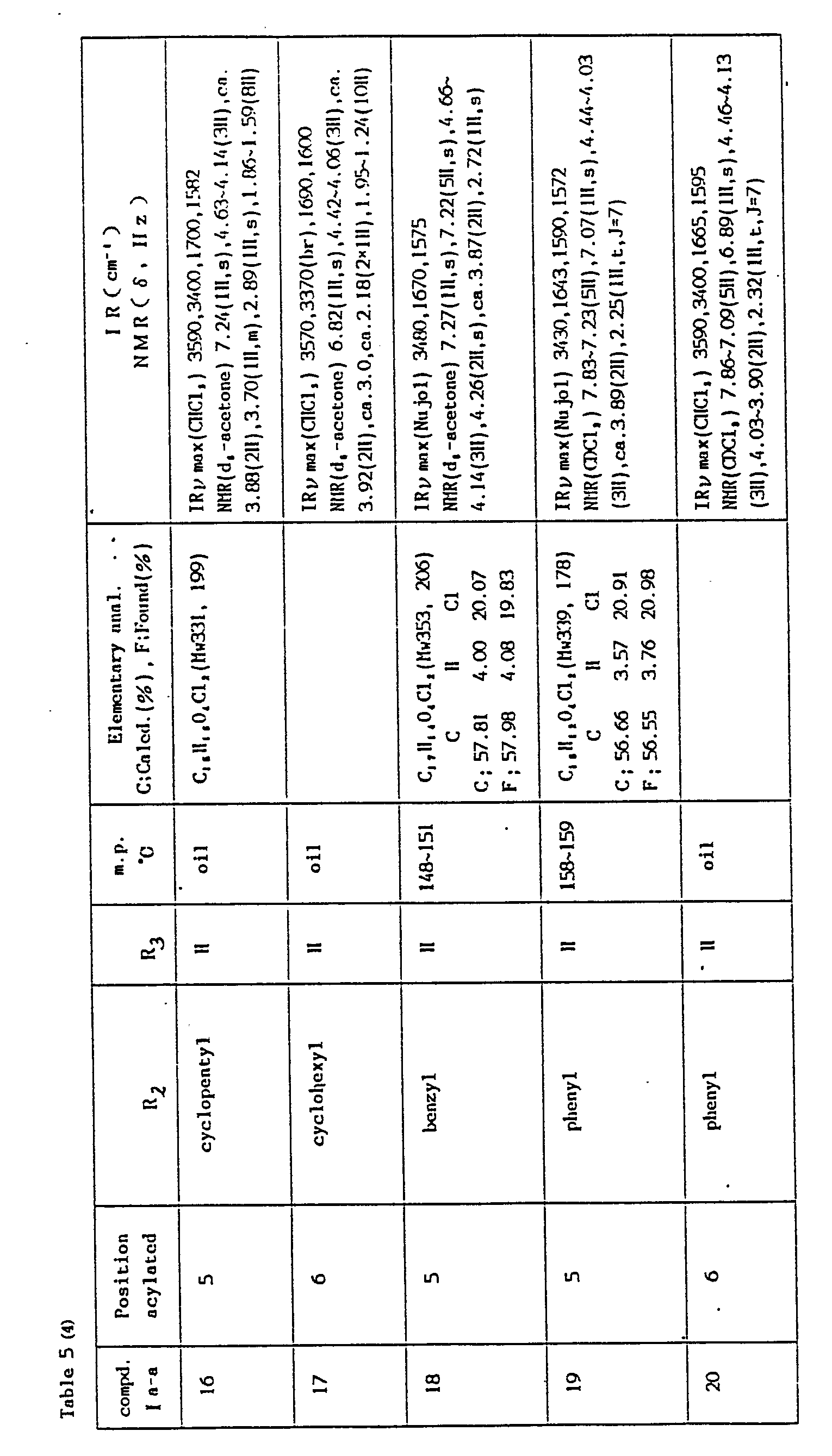


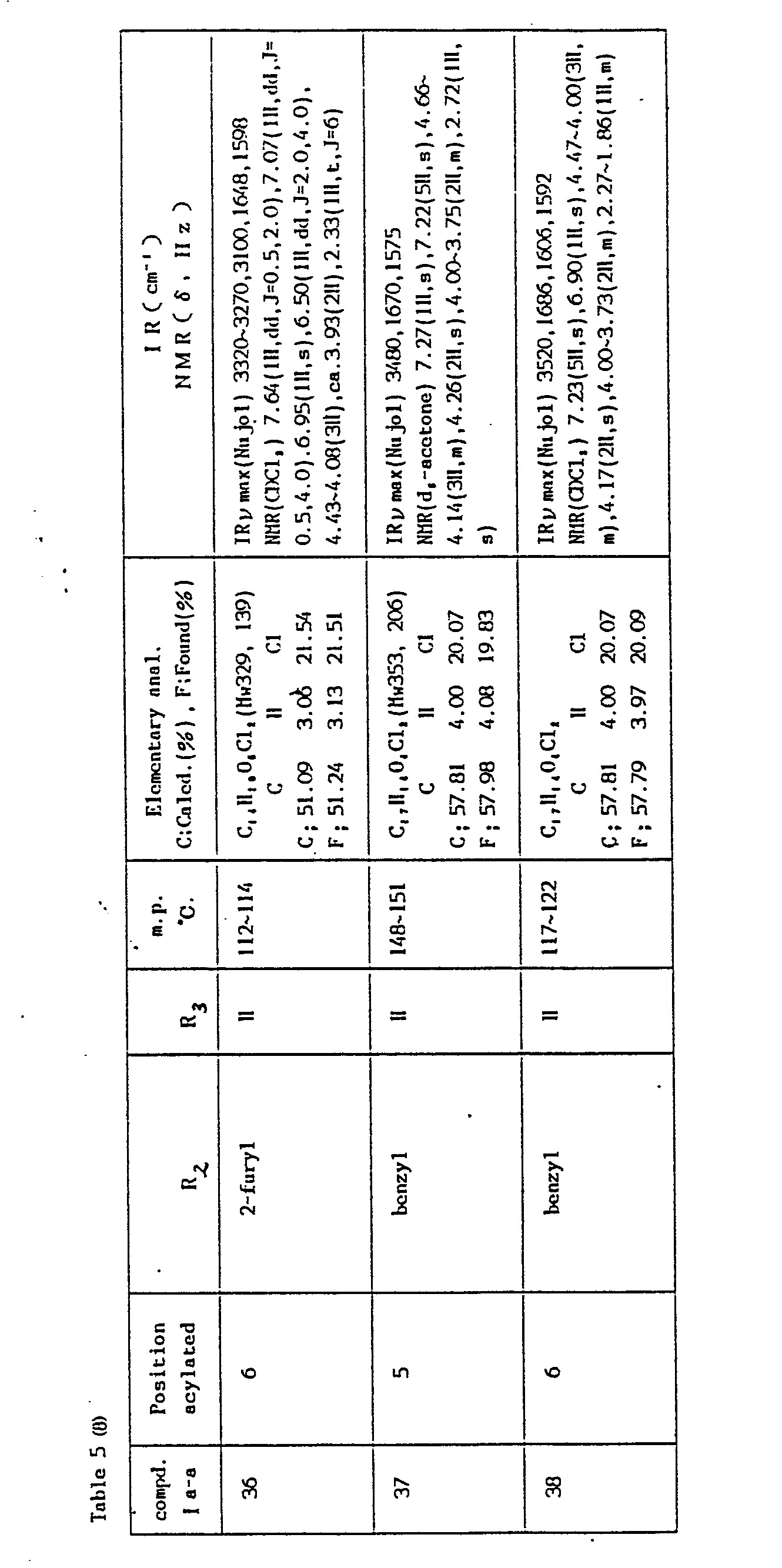
-

-

- The filtrate is acidified with hydrochloric acid and extracted twice with 300 ml of ether. The organic layer is washed with water, dried and evaporated to give 10.40 g of a residue, which is chromatogtaphed on a column of 30 g of silica-gal and eluted with dichloromethane to give 8.637 g of 1-benzyloxy-2-hydroxy-3, 4-dichlorobenzene as an oil. Yield 64.2 %, bp.155-160 °C. IR (CHCl3) ν max: 3520, 1600, 1580 cm-1.
- NMR(CDCl3) δ : about 7.40(5H), 6.92, 6.73(2×1H, d, J=9Hz), 6.00(lH,s), 5.09(2H,s)
- In 180 ml of dry DMF 9.73 g of 1-benzyloxy-2-is dissolved hydroxy-3,4-dichlorobenzene is dissolved , and 1.91 g (1.1 equivalents) of 50 % sodium hydride oily suspension and 5.45 g (1.1 equivalents) of epibromohydrin are added thereto. The mixture is stirred at 80 °C for 4 hours, then poured into 300 ml of water, and extracted twice with ether. The organic layer is washed with water, dried, and evaporated to give 11.5 g of a residue, which is passed through a column of 40 g of silica-gel to give 10.85 g of a product as a dichloromethane fraction. This is recrystallized from n-hexane to give 9.64 g of l-benzyloxy-2-(2, 3-epoxypropyloxy)-3, 4-dichlorobenzene. Yield 82.0 %, mp. 59-61 °C.
- Anal. Calcd. (%) for C15H14O3Cl2 (MW. 325.194) : C 59.10, H 4.34, Cl 21.80,
- Found (%): C 59.06, H 4.27, Cl 21.86.
- IR (Nujol) ν max: 1580 cm-1.
- NHR(CDCl3) δ ppm: about 7.36(5H), 7.08, 6.78(2×1H,d, J=9Hz), 5.05(2H,s), 4.28-3.93(2H), 3.41-3.23(1H), 2.81-2 .53(2H).
- In 50 ml of ethyl acetate, 1626 mg of 1-benzyloxy-2-(2,3-epoxypropyloxy)-3,4-dichlorobenzene is catalytically hydrogenated with 500 mg of 5 % palladium on carbon (50 % moisture) under atmospheric pressure (for 2 hours, 153 ml of hydrogen gas absorbed). After removal of the catalyst by filtration, the solvent is evaporated to give 1151 mg of 1-hydroxy-2-(2,3-epoxypropyloxy)-3, 4-dichlorobenzene. Yield 98 %. The pure product is prepared by recrystallization from cyclohexane. mp. 92-94 °C.
- Anal. Calcd. (%) for C9H8O3Cl2 (MW. 235.068) : C 45.99, H 3.43, Cl 30.16,
- Found (%): C 45.36, H 3.54, Cl 29.78.
- IR (Nujol) ν max: 3270-3210 (br.), 1590 cm-1.
- NMR(CDCl3) δ ppm: 7.12, 6.78(2×1H, d, J=9Hz), 7.9-6.3(1H, br), 4.62-3.98(2H), 3.43-3.30(1H), 3.36-2.96(2H).
- To a solution of 1.128 g of 1-hydroxy-2-(2,3-epoxypropyloxy)-3,4-dichlorobenzene dissolved in 10 ml of ethanol is added 4 ml of 2N sodium hydroxide. The mixture is heated at 80 *C for 5 minutes, to which water is then added and extracted with ether. The organic layer is washed with water, then dried and evaporated to give 1.120g of the objective 3-hydroxymethyl-7,8-dichloro-1,4-benzodioxane ( IIIb ) as an oil. Yield 99 %.
- IR (CHC1,) ν max: 3590, 3380, 1580 cm-1.
- NMR(CDCl3) δ ppm: 6.96, 6.75(2×1H, d, J=9Hz), 4.72-4.01 (2x lH), 3.93-3.80(2H), 2.04(lH,t,J=7Hz).
-

- Compounds of the general formula I a -b are prepared according to the same manner as in Process 2 (Method Aa and Ab), Example 1. The reaction conditions and the physical constants of the products are shown in Table 6 and Table 7.

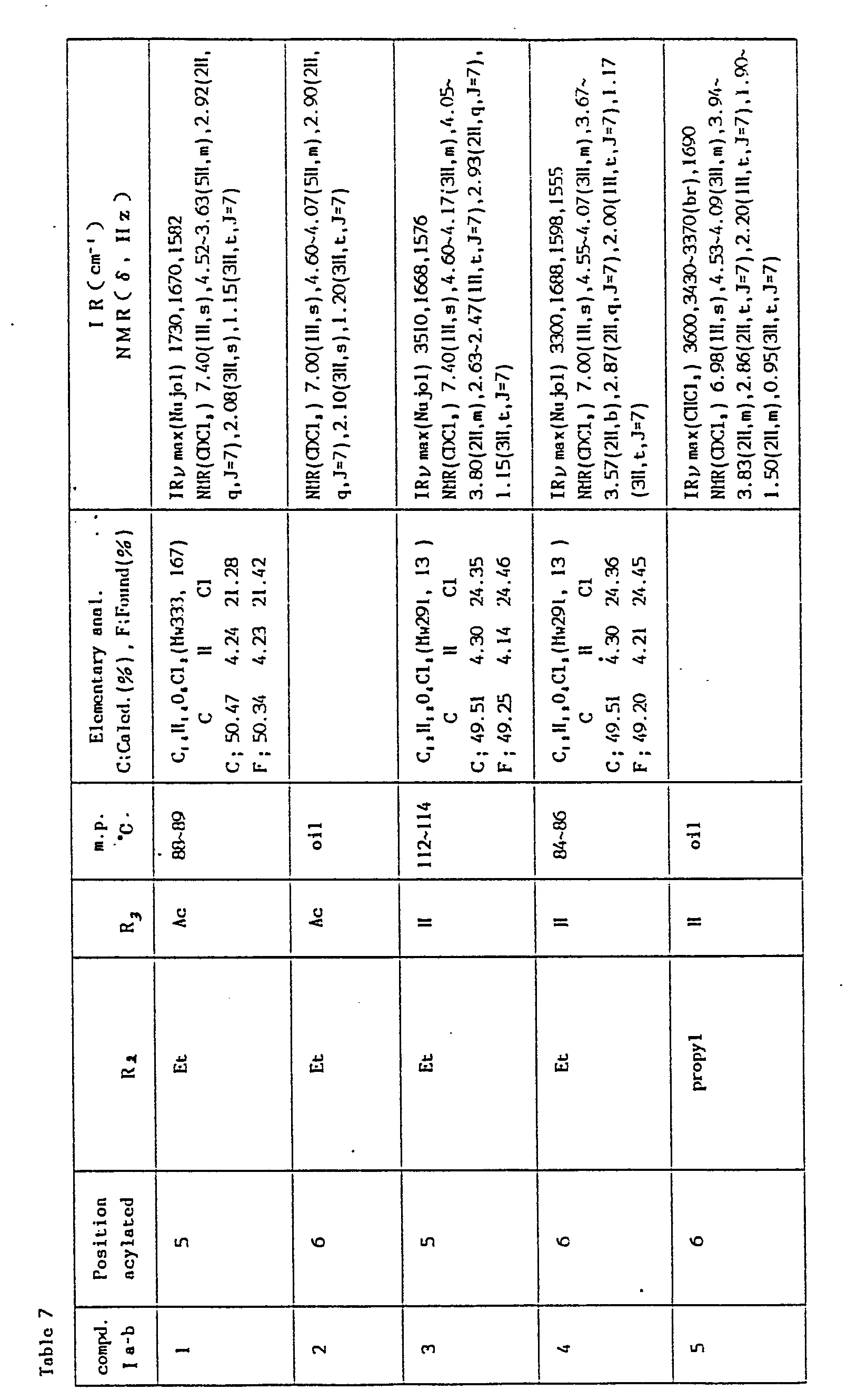

-

- To a solution of 2.5 g of the compound (I a-al) dissolved in 120 ml of acetone is dropwise added 8N chromic acid/sulfuric acid in small portions over a 1.5 hour period. The mixture is allowed to stand overnight at room temperature. The excess amount of the chromic acid is killed by adding methanol, the resulting precipitate is filtered off and washed with acetone, and the filtrate is evaporated under reduced pressure to give crystals. Water is added thereto, and the crystals are collected by filtration. The crystals (2.500 g of crystals; mp. 228-230 °C) are recrystallized from dichloromethane-ether to give 2.422 g of the objective 5-propionyl-7,8-dichloro-1,4-benzodioxane-2-carboic acid (Ib-1), mp. 229-231 °C, yield 92 X.
-

-
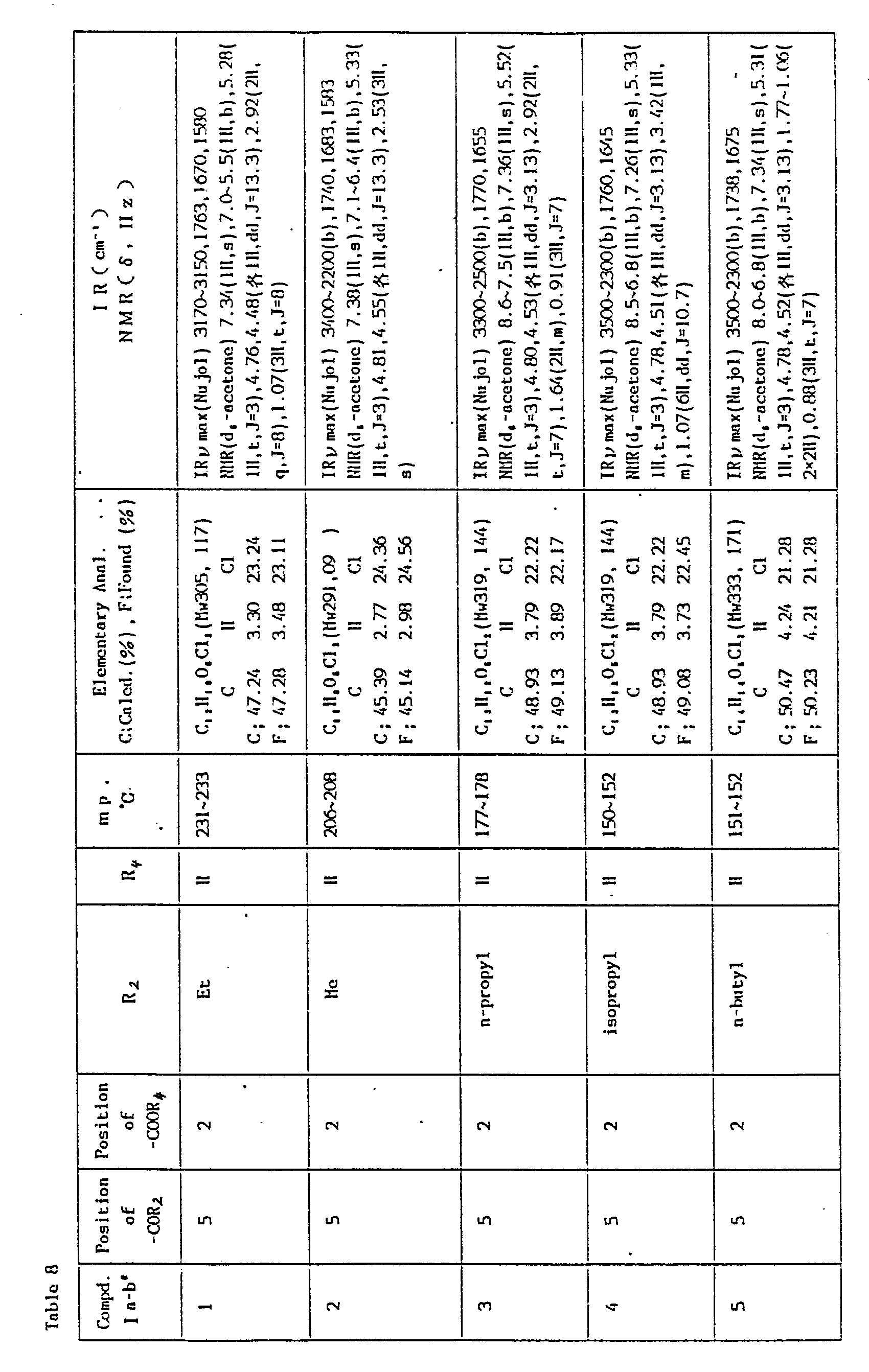


-

- A solution of 1.500 g of the compound (I b'-43), 2.500 g of N-bromosuccinimide (about 3.5 equivalents)and 230 mg of benzoyl peroxide dissolved in 80 ml of dry carbon tetrachloride is refluxed for about 20 hours. After removal of the precipitate by filtration, the filtrate is evaporated under reduced pressure to give a residue. 3.0 g of sodium iodide and 100 ml of acetone are added to the residue, and the mixture is refluxed for 1.5 hours. The reaction mixture is filtered in order to remove the precipitate and then the filtrate is evaporated under reduced pressure, and extracted three times with dichloromethane. The organic layer is washed twice with an aqueous solution of sodium thiosulfate, then with water, dried over sodium sulfate and evaporated to give 1.80 g of a residue, which is recrystallized from ethanol to give 1.100 g of the objective 2-epoxycarbonyl-5- thenoyl-7, 8-dichloro-1,4-benzodioxine (Ib"-1). Yield 73%, mp. 165-165°C.
- Anal. Calcd. (%) for C15H10O5Cl2S (MW. 385.221) : C 49.89, H 2.62, Cl 18.41, S 8.32
- Found (%): C 49.91, H 2.75, Cl 18.70, S 8.32 IR (Nujol) ν max: 3150, 3100, 1735, 1690, 1675, 1630, 1599, 1575 cm-1.
- NMR(CDC13) δ ppm: 7.77(lH,d,d,J=6.2), 7.53(lH,d,d,J=6.2), 7.12(1H, t, J=6.2), 7.12(lH,s,), 6.90(lH,s), 4.27(2H,q,J=8), 1.47(3H,t,J=8)
- To a solution of 742 mg of the compound (I b"-l) dissolved in 10 ml of dioxane, is added 3 ml of 1N sodium hydroxide. The mixture is heated at 70-80 °C for 5-10 minutes and then allowed to stand for 1 hour. After neutralized with hydrochloric acid, the reaction mixture is extracted twice with ethyl acetate. The organic layer is washed twice with a saturated aqueous solution of sodium chloride, dried over sodium sulfate, and evaporated to give 650 mg of a residue, which is recrystallized from dichloromethane- pretroleum ether to give 535 mg of 2-carboxy-5-thenoyl-7,8-dichloro-1,4-benzodioxine. (I b"-2). Yield 77.8 %, mp. 233-236 °C.
- Anal. Calcd. (%) for C14H6O5Cl2S (MW. 357.167) : C 47.08, H 1.69, Cl 19.85, S 8.98
- Found (%): C 46.92, H 1.95, Cl 19.85, S 8.79
- IR (Nujol) ν max: 3120, 1718, 1660, 1590, 1565 cm-1.
- NMR(d6-acetone) δ ppm: 8.03(lH,d,d,J=6.2), 7.77(lH,d,d, J=6.2), 7.25(lH,d,d,J=6), 7.27(lH,s), 7.10(lH,s), 7.00-6.37(lH,b).
-

- A solution of 1.5 g of a compound ( Ib ), about 3.5 equimole of N-bromosuccinimide, and 200-250 mg of benzoyl peroxide dissoved in 80 ml of dry carbon tetrachloride is heated for 20 hours. After removal of the precipitate by the filtration, the filtrate is evaporated under reduced pressure to give a residue, to which, 3 g of sodium iodide and 100 ml of acetone is added. The mixture is refluxed for about 1-2 hours, and then worked up in a usual manner (washed with sodium thiosulfate to remove Br2) to give a compound (I b") (R5=R4). To a solution of the compound in tetrahydrofuran or dioxane is added an aqueous solution of sodium hydroxide. The mixture is heated on a bath at 70 °C for 5 to 10 minutes, then allowed to stand for an hour, neutralized with hydrochloric acid and poured into water. Treatment in a conventional manner gives a compound I b" (R6=H). Compounds prepared in the same manner as above and their physical constants are shown-in Table 9.


-

- To a solution of 39.5 g (0.281 mol) of benzoyl chloride dissolved in 118 ml of dry dichloroethane is added 46.83 g (0.351 mol) of aluminium chloride. A solution of 15.712 g (0.088 mol) of the starting material ( II ) in dry dichloroethane (197 ml) is dropwise added to the mixture while being stirred for about 20 minutes and then the reaction mixture is refluxed for about 20 hours. After cooled, the mixture is poured into ice-water/conc. hydrochloric acid whereby the aluminium chloride is decomposed. The resulting mixture is extracted 3 times with ethyl ether and the organic layers are washed twice with a saturated solution of sodium chloride, dried over sodium sulfate, and evaporated under reduced pressure to give a residue (51.10 g).
- A mixture of the residue, 210 ml of ethanol, and 210 ml of 2N-sodium hydroxide is refluxed for 30 minutes, evaporated under reduced pressure, neutralized by the addition of hydrochloric acid, and the resulting mixture is extracted twice with ethyl ether. The organic layers are washed with water, dried over sodium sulfate, and evaporated to dryness to give a residue, which is recrystallized from dichloromethane/petroleum ether to give 20.824 g (yield 83%) of the titled compound (IV-1), m.p. 178-180°C.
- Anal. Calcd. (%) for C13H8Cl2O3: C; 55.15, H; 2.85, Cl; 25.05, Found (%): C; 55.05, H; 2.98, Cl; 25.30.
- IR (Nujol) ν max: 3425, 3100, 1655, 1595, 1580 cm-1.
- NMR (dε-acetone) δ ppm: 6.95 (1H, s), 7.93-7.50 (5H, m). Process 1' (General Procedure):

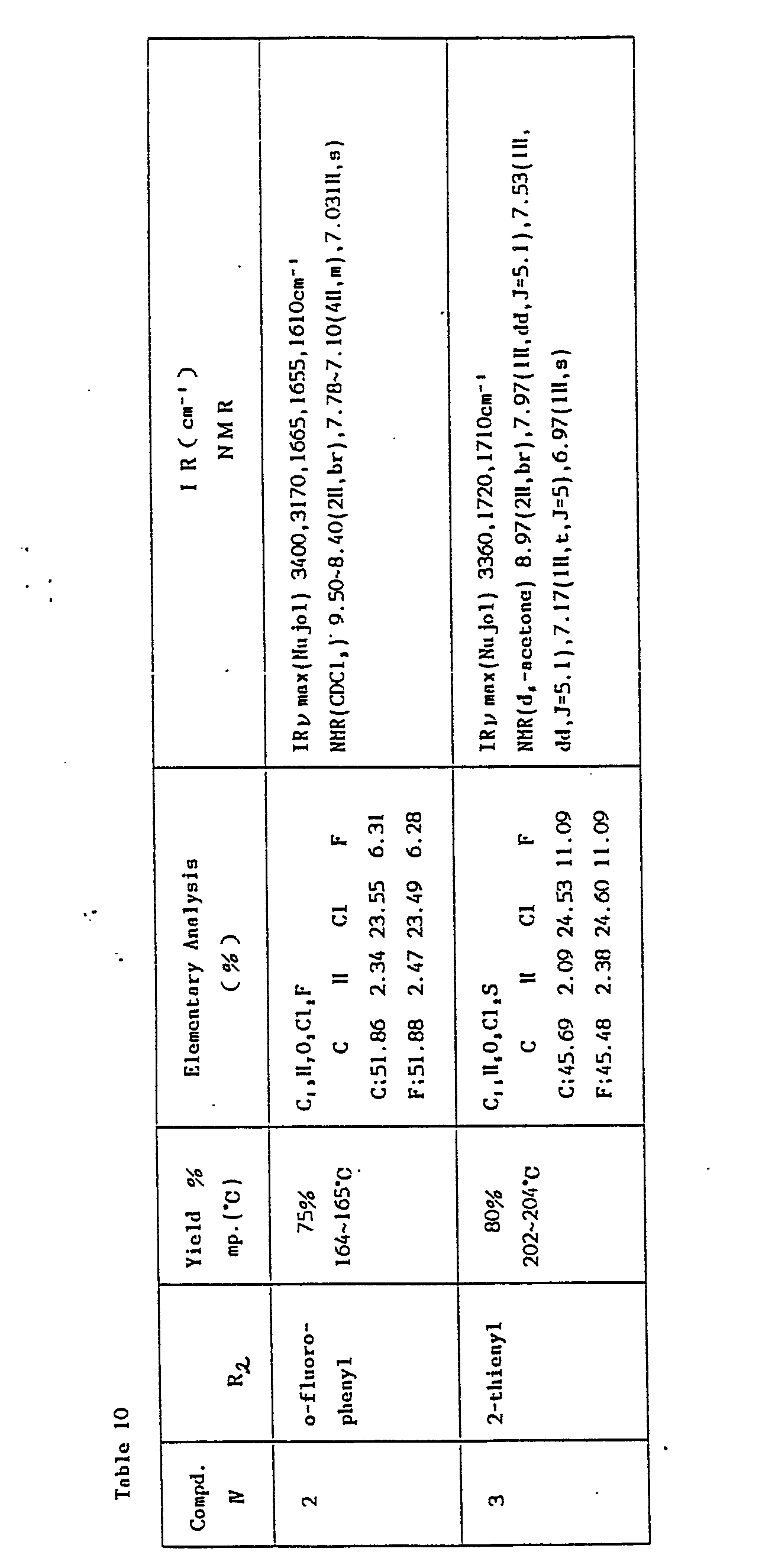
- A mixture of the starting material (II ) (0.01 mol), R2COCl (0.04-0.03 mol), and A1C1, (0.025-0.03 mol) in 350 ml.of dichloroethane is refluxed for about 20 hours and poured into ice-water/conc. hydrochloric acid. The mixture is extracted with ethyl ether or ethyl acetate. The organic layer is combined with 250 ml of ethanol and 250 ml of 2N-sodium hydroxide, and the mixture is then refluxed for about 30 minutes to give a 5-acyl compound (IV). Thus prepared compounds and their physical constants are shown in Table 10.
-

- To a solution of 3.01 g (0.01 mol) of the starting material (IV-2) dissolved in 50 ml of DMF are added 480 mg (0.02 mol) of sodium hydride and then 1.88 g (0.011 mol) of benzyl bromide, and the mixture is stirred for 15 minutes at room temperature. The reaction mixture is poured into ice-water, acidified by addition of diluted hydrochloric acid, and extracted with ethyl ether three times. The organic layer is washed twice with water, dried over sodium sulfate, and evaporated to dryness to give a residue, which is chromatographed on silica gel with dichloromethane as an eluent. After removal of the solvent, the product is recrystallized from benzene to give 2.791 g (yield 71.4%) of the captioned compound (V -b-2) , m.p. 156-157°C.
- In the same manner as above, the compounds (V-b-1) and (V -b-3) listed in the following table are prepared, whose physical constants are shown in Table 11.


-

- To a solution of 3.217 mg of the starting material (IV-2) in 90 ml of DMF is added a solution of sodium hydride (1.1 mol) and benzyl bromide (1.919 g, 1.05 mol) in DMF (10 ml), and the mixture is stirred at 100°C for 2 hours, poured into ice-water, and acidified by addition of hydrochloric acid. The mixture is extracted with ethyl ether and the organic layer is washed with water and evaporated to dryness to give 4.124 g of a residue, which is then chromatographed on silica gel (SiO2, 100 g) with dichloromethane as an eluent to give the compound (V '-a, 2) as the first fraction and the compound (V -a, 2) as the second fraction. The products are recrystallized from hexane to give 766 mg (yield 14.4%) of the compound (V '-a, 2), m.p. 84-85°C and 2.189 g (yield 52%) of the compound (V-a, 2), m.p. 109-110°C, respectively.
- In the same manner as above, the compounds (V-a, 1)(R2=o-phenyl) and (V-a, 3)(R2=2-thienyl) are prepared, whose physical constants are shown in Table 12.

-

- To a solution of 290 mg of 50% sodium hydride (washed out with petroleum ether) in DMF (40 ml) are added a solution of 1.570 g (4.13 mmol) of the compound (V-b,3) (R2=2-thienyl) dissolved in DMF (40 ml) and then a solution of 822 mg (6 mmol) of a - epibromohydrin in DMF (5 ml). The mixture is stirred under heating at a temperature of 75 to 80°C for 5 hours. The reaction mixture is poured into ice-water and extracted with ethyl ether, and the organic layer is washed with water, dried over sodium sulfate, and evaporated to leave 1.570 g of a neutral fraction and 280 mg of an acidic fraction.
- A mixture of 1.570 g of the neutral fraction with 100 ml of hydrochloric acid is refluxed for 10 hours and extracted with dichloromethane. The organic layer is washed with water and evaporated to dryness to give 1.500 g of a residue.
- A mixture of the residue (1.500 g) with sodium hydroxide (500 mg) and ethanol (30 ml) is refluxed for 15 minutes and extracted with dichloromethane. The organic layer is washed with water and evaporated to give 1.350 g of a residual product, which is chromatographed on silica gel (8 g of silica gel, dichloroethane : ethyl ether=4 : 1) and then recrystallized from ethyl ether/petroleum ether to give 830 mg (yield 58%) of the captioned compound (I a-b,7), m.p. 137-139°C. The physical constants of thus obtained compound was identical with those of the compound ( I a-b, 7) prepared in Example 2.
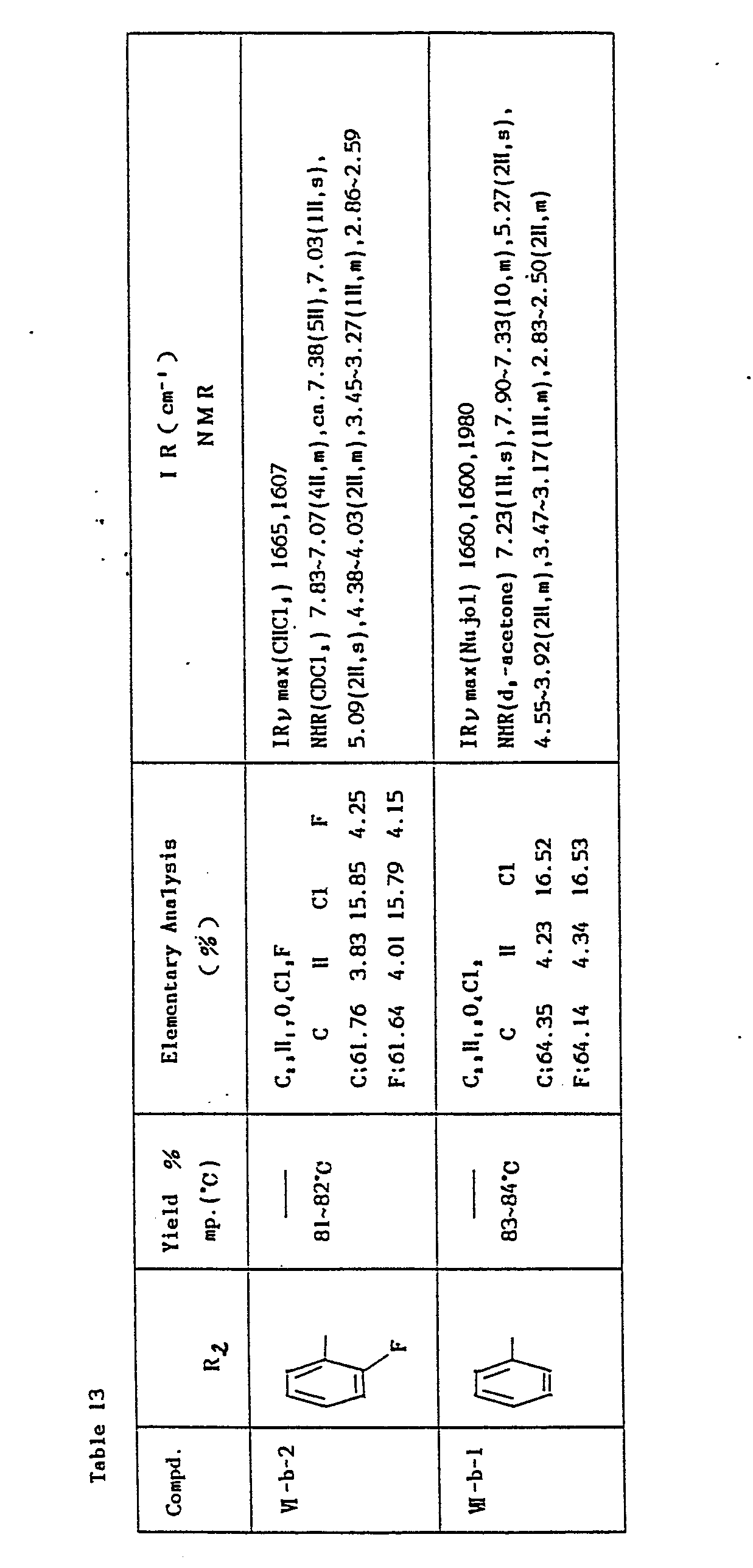
- In the same manner as above, the objective compounds (I a-b, 8) (R2=phenyl), m.p. 201-204°C (yield 49%) and (I a-b, 9) (R2=o-fluorophenyl), m.p. 197-199°C (yield 59%) were prepared via the intermediates (VI-b, 1) and (VI-b, 2) shown in Table 13.
-
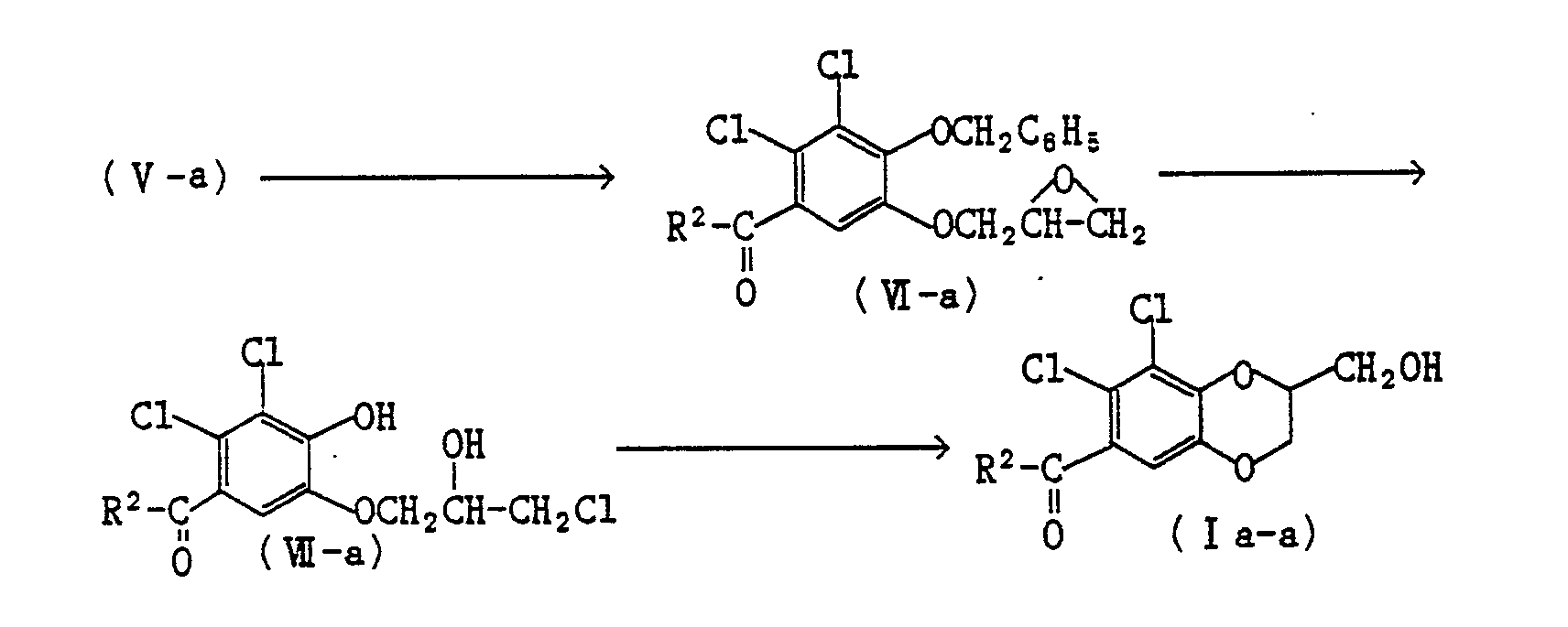
- A solution of 2.300 mg (6.05 mmol) of the compound (V a, 3) (R2=2-thienyl) in 40 ml of DMF is added to a solution of 350 mg (7.26 mmol: washed out with petroleum ether) of 50% sodium hydride in 40 ml of DMF and the mixture is heated at 70-80°C for 5 hours. After cooled, the reaction mixture is poured into ice-water and extracted with ethyl ether. The organic layer is washed with water and evaporated to dryness to give 2.700 g of a residue as a neutral fraction.
- A mixture of 2.700 g of the neutral fraction and 140 ml of hydrochloric acid is refluxed for 5 hours and extracted with ethyl acetate. The organic layer is washed with a saturated aqueous solution of sodium chloride and evaporated to give 2.300 g of a crystalline residue (VII-a, 3), m.p. 187-189°C.
- A mixture of 2.300 g of the residue with sodium hydride (700 mg) and ethanol (40 ml) is refluxed for 20 minutes and extracted with dichloromethane. The organic layer is washed with water and evaporated to dryness to give 1.900 g of a residue, which is chromatographed on silica gel. The benzene/ dichloromethane fraction is recrystallized from ethyl acetate to give 1.317 g (yield 63%) of the compound (Ia-a, 6), m.p. 113-114°C.
- The physical constants of this product were identical with those of the compound prepared in Example 1.
- In the same manner as above, the compound (I a-a 28) (R2= o-fluorophenyl), m.p. 109-110°C (yield 45%) is prepared, whose physical constants were identical with those of the compound (I a-a 28) prepared in Example 1.
- Physical constants of the intermediates are shown in Table 14.

-

- A mixture of 8.294 g of the compound (VIII-1) with dry ethanol (200 ml) and concentrated sulfuric acid (0.5 ml) is stirred for 5 hours under an anhydrous condition and extracted with dichloromethane 3 times. The organic layer is washed with water, a saturated sodium hydrogencarbonate solution, and two portions of water, dried over sodium sulfate, and evaporated to give 9.051 g of a residue, which is recrystallized from dichloromethane/petroleum ether to give 8.75 g (yield 94.8%) of ethyl 7,8-dichloro-1,4-benzodioxane-2-carboxylate (VIII-2), m.p. 92-94°C.
- In the same manner as above, the following compounds were prepared, whose physical constants are shown in Table 15.

-

- A mixture of 2.00 g of the compound (VIII-2) obtained in Example 10 with a a -dichloromethyl methyl ether (12 ml) and dichloromethane (40 ml) is cooled on an ice-bath and 4.284 g of aluminium chloride is added thereto over about 20 minutes. The reaction mixture is stirred at room temperature for 3 hours. After confirming completion of the reaction by TLC, the reaction mixture is poured into ice-water/concentrated hydrochloric acid and extracted with dichloromethane 3 times. The organic layer is washed twice with a saturated aqueous solution of sodium chloride, dried.over sodium sulfate, and evaporated to give 2.242 g of a residue.
- This residue is passed through a Lober® column B (made by Merck) with benzene/acetone (30/1) as an eluent. The product in the earliest fraction is recrystallized from acetone/ether/petroleum ether to give 1.031 g (yield 47%) of the objective ethyl 6-formyl-7,8-dichloro-1,4-benzodioxane-2-carboxylate (I b'-51), m.p. 101-102°C.
- The product in the later fractions are also recrystallized in the same manner as above to give 1.057 g (yield 49%) of ethyl 5-formyl-7,8-dichloro-1,4-benzodioxane-2-carboxylate (I b'-50), m.p. 110-113°C.
- Titanium tetrachloride was employed in place of aluminium chloride, and the reaction was carried out in the same manner as above to give the compounds (I b'-50) in 19% yield and (Ib'-51) in 39% yield.
- In the same manner as above, the following compounds were prepared, whose physical constants are shown in Table 16.


-

- Anal. Calcd. (%) for C14H12O5Cl2 (molecular weight 331.15): C; 50.78, H; 3.65, Cl; 21.41. Found (X): C; 50.60, H; 3.82, Cl; 21.33.
- IR (Nujol) ν max (cm-1): 3500-2800 (b), 1765, 1630.
- NMR (d5-acetone) δ ppm: 7.9-5.9 (1H, b), 6.97 (1H, s), about 5.91, 5.64 (2xlH, s), 5.25 (1H, t, J=3Hz), 4.59, 4.37 (2HxlH, d, d, J=3.13), 2.37 (2H, q, J=7Hz), 1.06 (3H, t, J=7Hz).
- (General Procedure)
-

- A solution of a starting material, paraformaldehyde, and p-toluenesulfonic acid dissolved in dioxane is refluxed for about 24 hours, and the resulting mixture is treated in a conventional manner to give an objective compound (I b').
- The starting material and physical constants on each compound obtained are shown in Table 17.

-

- Anal. Calcd. (%) for C12H10O6Cl2 (molecular weight 321.112): C; 44..89, H; 3.14, Cl; 22.08. Found (%): C; 44.62, H; 3.13, Cl; 21.67.
- IR (Nujol) ν max (cm-1): 2600, 1750, 1700, 1590, 1570.
- NMR (CDCl3) δ ppm: 7.68 (1H, s), 4.87-4.17 (5H, m), 2.10 (3H, s).
- To a solution of 1.00 g of the product (I a-a-43) obtained above dissolved in a mixture of THF (30 ml) with ethanol (10 ml) is added an aqueous potassium carbonate solution (a solution of 2g of potassium carbonate dissolved in 20 ml of water) and the resulting mixture is heated at 70-80°C for 5 minutes, then allowed to stand at room temperature for an hour. The mixture is made acid by addition of hydrochloric acid and extracted with dichloromethane. The organic layer is washed with water, dried, and evaporated to give 980 mg of a residue, which is recrystallized from dichloromethane/ether to give 836 mg of 2-hydroxymethyl-7,8-dichloro-1,4-benzodioxane-5-carboxylic acid (I a-a-44: R3'=H), m.p. 175-177°C.
- Anal. Calcd. (%) for C10H8O5Cl2 (molecular weight 279.075): C; 43.04, H; 2.89, Cl; 25.41. Found (%): C; 42.80, H; 2.83, Cl; 25.65.
- IR (Nujol) ν max (cm-1): 3200, 1698-1705, 1585, 1565.
- NMR (d5-acetone) δ ppm: 7.58 (1H, s), 4.70-4.20 (3H, m), 3.93 (2H, d, J=4.0).
- According to the same reaction conditions as above, the following carboxylic acids were prepared from 2-acetoxymethyl-7, 8-dichloro-1,4-benzodioxane-6-carbaldehyde (I a-a-40). * 2-Acetoxymethyl-7,8-dichloro-1,4-benzodioxane-6-carboxylic acid, m.p. 178-180°C (from dichloromethane/ether).
- Anal. Calcd. (%) for C12H10O5Cl2 (molecular weight 321.12): C; 44.89, H; 3.14, Cl; 22.08. Found (%): C; 44.61, H; 3.24, Cl; 22.34.
- IR (Nujol) ν max (cm-1): 3100, 1728, 1700, 1598, 1561.
- NMR (d5-acetone) δ ppm: 7.47 (1H, s), 4.87-4.07 (5H, m), 2.07 (3H, s).
- * 2-Hydroxymethyl-7,8-dichloro-1,4-benzodioxane-6-carboxylic acid, m.p. 220-221°C (from acetone/ether).
- Anal. Calcd. (%) for C10H8O5Cl2 (molecular weight 279.075): C; 43.04, H; 2.89, Cl; 25.41. Found (%): C; 42.77, H; 2.96, Cl; 25.43.
- NMR (d5-acetone) 8 ppm: 7.40 (lH, s), 4.67-4.13 (3H, m), 3.90 (2H, d, J=4).
- The compounds (I ) of the present invention have excellent antihypertensive and diuretic actions and are very usuful for the treatment for hypertensives. They can be administered orally, intravenously, or hypodermically to humans at a respective daily dosage of 0.1-2 mg/kg, 0.005-0.1 mg/kg, or 0.02-0.4 mg/kg. Both the the /diuretic effect and/hyperuricosuric effect by typical compounds are explained by the following Experiments.
- Slc:SD 8-week-old rats (male, about 250g body-weight each) were used for the test. A few lumps of sugar in place of ordinary diets were given on the morning of the day before the test day and 5% glucose solution was given orally at a rate of 20 ml/kg in the evening (approximately at 4 p.m.) of the test day. In the morning for the test, a sample which was prepared by suspending or dissolving a test compound in 2X gum arabic was orally administered to each at a dose of 20 ml/kg. On the other hand, mere by 2% gum arabic was orally administered to the control group at 20.ml/kg. Immediately after the administration, the test animals were put in a plastic cage for metabolic tests and their urine samples were collected for 5 hours. The cumulative urine volume, urinary sodium, and urinary potassium were quantitatively determined.
- Slc:ddy 5-week-old mice (female, about 20g body-weight each) were used for the test. From the morning of the day before the test day, the mice were fasted but water. In the morning of the test day, a sample which was prepared by suspending or dissolving a test compound in 2% gum arabic was orally administered to each at 30 ml/kg. On the other hand, mere by 2X gum arabic was orally administered to the control group at 30 ml/kg. Immediately after the administration, 5 mice employed were put in a plastic cage for metabolic tests and their urine samples were collected for 4 hours. The cumulative urine volume, urinary sodium, and urinary potassium were quantitatively determined.
- Test results are shown in the following Table 1. Indacrinon® (Merck Sharp & Dohme) was used as a reference.

- Slc:Wistar 10-week-old male rats were used for the test. Potassium oxonate was intraperitoneally (hereinafter abbreviated as i.p.) administered to the test animals at a dose of 250 mg/kg in order to measure uric acid clearance and inulin clearance. Ninety minutes later, canulae were placed into the femoral artery, femoral vein, and urinary bladder and a tube for administration of drugs was placed into abdominal cavity on each animal under anesthesia with 50 mg/kg i.p. of pentobarbital.
- Exact 2 hours after the first administration, potassium oxonate was administered again i.p. at a dose of 250 mg/kg and then 60% urethane (2 ml/kg) and 15% inulin (4 ml/kg) were subcutaneously injected. A mixture of 4X mannitol/1.5% inulin/ 0.9% saline was infused at a flow rate of 0.1 ml/min to the animal on a plate kept at 30°C. After the equilibrium for 40 minutes, arterial blood (0.2 ml each) samples were collected 6 times every 20 minutes, and five 20-minutes urines were collected. Immediately after the collection of.every blood sample, the serum was separated therefrom, and the serum samples and the urine samples were stored in a refrigerater. A test compound was suspended in 1% gum arabic and the suspension was intraperitoneally administered at 2 ml/kg.
- Uric acid in the serum or in the urine was quantitatively analyzed by the method of Yonetani et al's. [Y. Yonetani et al., Japanese Journal of Pharmacology 30, 829-840 (1980)]. Substantially by the fluorescence method of Vurek's and Pegram's using dimedone reagent [Vurek, G.G., Pegram, S.E., Anal. Biochem. 16, 409-419 (1966)], inulin was also quantitatively analyzed in the following manner. To 0.1 ml of diluted deprotenized-serum or urine employed for the measurement of uric acid was added 5 ml of 1% dimedone/phosphoric acid solution and the resulting mixture was heated for 5 minutes. The mixture was cooled in ice-cold water, combined with 2.0 ml of acetic acid, then shaken well, and the fluorescence was measured at 410nm in the excitation wave length at 360nm.
- In order to estimate hyperuricosuric effect on tienilic acid as a referrence, tienilic acid was administered to the animals at a dose of 100 mg i.p. and urine volume (ml/kg min.), urinary uric acid (ml/kg min.), and fractional excretion of uric acid [FEua (µg/ml): (Uric acid Clearance)/(Inulin Clearance)] were measured. In the tables; "zero" minute means the time when a drug was administered. A fraction before the administration and 4 fractions after the administration were employed for the measurement.
- Results are shown in the following Table 2. Experiments with 1% gum arabic solution (2 ml/kg i.p.) were also made.

- As indicated in the table, no significant increase in urine volume, urinary uric acid, and FE ua. was seen in the control group, while slightly positive diuretic effect and increase in urinary uric acid and FE ua. were observed in the Ihienilic acid (at 100 mg/kg i.p.) group as referrences. In addition, no remarkable pharmacological activities concerning those test parameters were observed in the Tienilic acid (at 50 mg/kg i.p.) group.
- Experiments on the compounds of this invention were made in the same manner as explained above and diuretic effect and hyperuricosuric effect were estimated. Increase (%) concerning each parameter on the typical compounds was shown in Table 3.

- The compounds of the present invention are confirmed to be excellent diuretic antihypertensives having uricosuric activities from those experiments.
Claims (4)

wherein R1 is optionally protected hydroxymethyl or carboxy; R2 is hydrogen, straight or branched chain lower alkyl or lower alkenyl, C4-C7 cycloalkyl, optionally substituted phenyl, phenyl(lower alkyl), hydroxy, thienyl, or furyl; and the dotted line indicates the presence or absence of a double bond.

wherein R1 is optionally protected hydroxymethyl or carboxy; R2 is hydrogen, straight or branched chain lower alkyl or lower alkenyl, C4-C7 cycloalkyl, optionally substituted phenyl, phenyl(lower alkyl), hydroxy, thienyl, or furyl; and the dotted line indicates the presence or absence of a double bond,
which is characterized by the reaction of 3,4-dichloro-1,2-benzenediol of the formula:

an with/α-epihalohydrin or an equivalent reagent in the a presence of a base followed by acylation in the presence of/Lewis the acid; or characterized by/acylation of 3,4-dichloro-1,2-benzene- a diol in the presence of/Lewis acid followed by reaction with a - epihalohydrin or an equivalent reagent in the presence of a base, and, if necessary, subsequent oxidation or dehydrogenation after the oxidation.
Applications Claiming Priority (2)
| Application Number | Priority Date | Filing Date | Title |
|---|---|---|---|
| JP241506/84 | 1984-11-14 | ||
| JP59241506A JPS61118380A (en) | 1984-11-14 | 1984-11-14 | Novel 1,4-benzodioxane and 1,4-benzodioxine derivative and preparation thereof |
Publications (2)
| Publication Number | Publication Date |
|---|---|
| EP0182302A2 true EP0182302A2 (en) | 1986-05-28 |
| EP0182302A3 EP0182302A3 (en) | 1987-04-01 |
Family
ID=17075338
Family Applications (1)
| Application Number | Title | Priority Date | Filing Date |
|---|---|---|---|
| EP85114502A Withdrawn EP0182302A3 (en) | 1984-11-14 | 1985-11-14 | Novel 1,4-benzodioxane and 1,4-benzodioxine derivatives and production thereof |
Country Status (4)
| Country | Link |
|---|---|
| US (1) | US4595767A (en) |
| EP (1) | EP0182302A3 (en) |
| JP (1) | JPS61118380A (en) |
| GB (1) | GB2169289A (en) |
Cited By (3)
| Publication number | Priority date | Publication date | Assignee | Title |
|---|---|---|---|---|
| FR2635776A1 (en) * | 1988-09-01 | 1990-03-02 | Rhone Poulenc Agrochimie | Amide derivatives, process for their manufacture and fungicidal compositions containing them |
| US5342835A (en) * | 1988-09-01 | 1994-08-30 | Rhone-Poulenc Agrochimie | Antifungal agents based on amides containing a phenyl group |
| AU2023201013B2 (en) * | 2015-07-20 | 2025-02-06 | Genzyme Corporation | Colony stimulating factor-1 receptor (CSF-1R) inhibitors |
Families Citing this family (1)
| Publication number | Priority date | Publication date | Assignee | Title |
|---|---|---|---|---|
| AU9002798A (en) * | 1997-09-19 | 1999-04-12 | Ono Pharmaceutical Co. Ltd. | Fused or nonfused benzene compounds |
Family Cites Families (7)
| Publication number | Priority date | Publication date | Assignee | Title |
|---|---|---|---|---|
| DE2549745A1 (en) * | 1974-11-20 | 1976-05-26 | Lipha | PROPIONIC ACIDS SUBSTITUTED BY A CHROMONYL RESIDUE AND THEIR DERIVATIVES AND USES |
| US4177286A (en) * | 1976-06-16 | 1979-12-04 | Farmitalia Carlo Erba, S.P.A. | Substituted 2-vinyl-chromones and process for their preparation |
| US4202818A (en) * | 1978-10-16 | 1980-05-13 | Shell Oil Company | Lipogenesis inhibition by certain esters of substituted benzodioxincarboxylic acids |
| JPS55124781A (en) * | 1979-03-20 | 1980-09-26 | Shionogi & Co Ltd | 1,4-benzdioxanesulfonamide derivative |
| GR75464B (en) * | 1981-04-24 | 1984-07-20 | Ciba Geigy | |
| JPS5829782A (en) * | 1981-08-12 | 1983-02-22 | Nippon Zoki Pharmaceut Co Ltd | Novel heterocyclic compound, its preparation and medicinal composition containing said compound |
| DE3329126A1 (en) * | 1983-08-11 | 1985-02-28 | Bayer Ag, 5090 Leverkusen | NEW BENZO-CONDENSED, TETRACHLORATED, HETEROCYCLIC COMPOUNDS AND A METHOD FOR THEIR PRODUCTION |
-
1984
- 1984-11-14 JP JP59241506A patent/JPS61118380A/en active Granted
-
1985
- 1985-10-22 US US06/791,160 patent/US4595767A/en not_active Expired - Fee Related
- 1985-11-13 GB GB08528013A patent/GB2169289A/en not_active Withdrawn
- 1985-11-14 EP EP85114502A patent/EP0182302A3/en not_active Withdrawn
Cited By (5)
| Publication number | Priority date | Publication date | Assignee | Title |
|---|---|---|---|---|
| FR2635776A1 (en) * | 1988-09-01 | 1990-03-02 | Rhone Poulenc Agrochimie | Amide derivatives, process for their manufacture and fungicidal compositions containing them |
| US5342835A (en) * | 1988-09-01 | 1994-08-30 | Rhone-Poulenc Agrochimie | Antifungal agents based on amides containing a phenyl group |
| US5475132A (en) * | 1988-09-01 | 1995-12-12 | Rhone-Poulenc Agrochimie | Antifungal agents based on amides containing a phenyl group |
| AU2023201013B2 (en) * | 2015-07-20 | 2025-02-06 | Genzyme Corporation | Colony stimulating factor-1 receptor (CSF-1R) inhibitors |
| US12503477B2 (en) | 2015-07-20 | 2025-12-23 | Genzyme Corporation | Colony stimulating factor-1 receptor (CSF-1R) inhibitors |
Also Published As
| Publication number | Publication date |
|---|---|
| GB2169289A (en) | 1986-07-09 |
| EP0182302A3 (en) | 1987-04-01 |
| US4595767A (en) | 1986-06-17 |
| JPS61118380A (en) | 1986-06-05 |
| GB8528013D0 (en) | 1985-12-18 |
| JPH0513159B2 (en) | 1993-02-19 |
Similar Documents
| Publication | Publication Date | Title |
|---|---|---|
| AU717159B2 (en) | New benzofuranone derivatives and a method for producing them | |
| JP2561354B2 (en) | Benzocycloalkenyldihydroxyalkanoic acid compound, method for producing the same and pharmaceutical composition containing the same | |
| CA2016326C (en) | Pyrido-pyridazinone acetic acids for treating chronic diabetic complications | |
| EP1102761B1 (en) | Cyclopentabenzofuran derivatives and their use | |
| RO112031B1 (en) | Benzopyrane derivates and ltb4 antagonists, procedures for their preparation, pharmaceutical composition and method for inhibition of binding the receiver with ltb4 | |
| Kitagawa et al. | Aryloxyacetic acid diuretics with uricosuric activity. II. Substituted [(4-oxo-4H-1-benzopyran-7-yl) oxy] acetic acids and the related compounds | |
| EP0149419B1 (en) | Acylindole derivatives and pharmaceutical compositions containing them | |
| EP0182302A2 (en) | Novel 1,4-benzodioxane and 1,4-benzodioxine derivatives and production thereof | |
| JPS62126180A (en) | 7-acylbenzoxazinone and derivative, manufacture and drug | |
| SU910118A3 (en) | Process for producing n -glucofuranozid-6-yl-n -nitrosocarbamide | |
| AU610379B2 (en) | New heteroarotinoid derivatives, processes for preparing them and pharmaceutical compositions containing them | |
| EP0337885B1 (en) | Trienic derivatives with chromenic structure, their processes of preparation and pharmaceutical compositions containing them | |
| US5019573A (en) | Substituted dibenzofurans and methods of using same | |
| Keserü et al. | Synthesis of Acerogenin C and (+)‐Acerogenin A, Two Macrocyclic Diarylheptanoid Constituents of Acer nikoense | |
| US4560558A (en) | 3-Alkyl-8-chloro-5,6-dihydrofuro-[3,2-f]-1,2-benzisoxazole-6-carboxylic acids | |
| PT87927B (en) | 7- (1H-PYRROL-3-YLO) ACIDS, OF ITS CORRESPONDING DELTA-LACTONES AND SALTS, AND OF PHARMACEUTICAL COMPOSITIONS THAT CONTAIN THEM | |
| CA1041526A (en) | Alkyl substituted cyclopenta benzopyrans | |
| PT94775A (en) | METHOD FOR THE PREPARATION OF SUBSTUDUTIOUS ISOTIAZOLE DERIVATIVES AND PHARMACEUTICAL COMPOSITIONS CONTAINING THEM | |
| JPS60500573A (en) | Benzisoxazole carboxylic acid | |
| US3114753A (en) | Process for the manufacture of spiro- | |
| US4013692A (en) | Certain 3-phenyl-benzofuran lower alkanoic acids and esters thereof | |
| NO770032L (en) | PROCEDURES FOR THE MANUFACTURE OF BENZOPYRANES. | |
| US4766127A (en) | 2-(3-pyridylmethyl)naphthalene-6-carboxylic acid as a thromboxane synthetase inhibitor | |
| US4007207A (en) | Alkyl substituted-4-oxo-cyclopenta benzopyrans | |
| Edward et al. | Ring–Chain Tautomerism of 5-Oxo-3, 5-seco-A-norcholestan-3-ol |
Legal Events
| Date | Code | Title | Description |
|---|---|---|---|
| PUAI | Public reference made under article 153(3) epc to a published international application that has entered the european phase |
Free format text: ORIGINAL CODE: 0009012 |
|
| AK | Designated contracting states |
Kind code of ref document: A2 Designated state(s): DE FR IT |
|
| PUAL | Search report despatched |
Free format text: ORIGINAL CODE: 0009013 |
|
| AK | Designated contracting states |
Kind code of ref document: A3 Designated state(s): DE FR IT |
|
| STAA | Information on the status of an ep patent application or granted ep patent |
Free format text: STATUS: THE APPLICATION IS DEEMED TO BE WITHDRAWN |
|
| 18D | Application deemed to be withdrawn |
Effective date: 19871002 |
|
| RIN1 | Information on inventor provided before grant (corrected) |
Inventor name: ITAZAKI, HIROSHI Inventor name: YONETANI, YUKIO Inventor name: MATSUURA, MUNENORI Inventor name: HAYASHI, KUNIO Inventor name: NAKAMURA, MASUHISA |