EP0182470A2 - Liquid rubber composition - Google Patents
Liquid rubber composition Download PDFInfo
- Publication number
- EP0182470A2 EP0182470A2 EP85306631A EP85306631A EP0182470A2 EP 0182470 A2 EP0182470 A2 EP 0182470A2 EP 85306631 A EP85306631 A EP 85306631A EP 85306631 A EP85306631 A EP 85306631A EP 0182470 A2 EP0182470 A2 EP 0182470A2
- Authority
- EP
- European Patent Office
- Prior art keywords
- composition
- copolymer
- cure
- molecular weight
- ethylene
- Prior art date
- Legal status (The legal status is an assumption and is not a legal conclusion. Google has not performed a legal analysis and makes no representation as to the accuracy of the status listed.)
- Granted
Links
Classifications
-
- C—CHEMISTRY; METALLURGY
- C08—ORGANIC MACROMOLECULAR COMPOUNDS; THEIR PREPARATION OR CHEMICAL WORKING-UP; COMPOSITIONS BASED THEREON
- C08L—COMPOSITIONS OF MACROMOLECULAR COMPOUNDS
- C08L23/00—Compositions of homopolymers or copolymers of unsaturated aliphatic hydrocarbons having only one carbon-to-carbon double bond; Compositions of derivatives of such polymers
- C08L23/02—Compositions of homopolymers or copolymers of unsaturated aliphatic hydrocarbons having only one carbon-to-carbon double bond; Compositions of derivatives of such polymers not modified by chemical after-treatment
- C08L23/16—Ethylene-propylene or ethylene-propylene-diene copolymers
-
- C—CHEMISTRY; METALLURGY
- C09—DYES; PAINTS; POLISHES; NATURAL RESINS; ADHESIVES; COMPOSITIONS NOT OTHERWISE PROVIDED FOR; APPLICATIONS OF MATERIALS NOT OTHERWISE PROVIDED FOR
- C09D—COATING COMPOSITIONS, e.g. PAINTS, VARNISHES OR LACQUERS; FILLING PASTES; CHEMICAL PAINT OR INK REMOVERS; INKS; CORRECTING FLUIDS; WOODSTAINS; PASTES OR SOLIDS FOR COLOURING OR PRINTING; USE OF MATERIALS THEREFOR
- C09D123/00—Coating compositions based on homopolymers or copolymers of unsaturated aliphatic hydrocarbons having only one carbon-to-carbon double bond; Coating compositions based on derivatives of such polymers
- C09D123/02—Coating compositions based on homopolymers or copolymers of unsaturated aliphatic hydrocarbons having only one carbon-to-carbon double bond; Coating compositions based on derivatives of such polymers not modified by chemical after-treatment
- C09D123/16—Elastomeric ethylene-propylene or ethylene-propylene-diene copolymers, e.g. EPR and EPDM rubbers
-
- C—CHEMISTRY; METALLURGY
- C09—DYES; PAINTS; POLISHES; NATURAL RESINS; ADHESIVES; COMPOSITIONS NOT OTHERWISE PROVIDED FOR; APPLICATIONS OF MATERIALS NOT OTHERWISE PROVIDED FOR
- C09J—ADHESIVES; NON-MECHANICAL ASPECTS OF ADHESIVE PROCESSES IN GENERAL; ADHESIVE PROCESSES NOT PROVIDED FOR ELSEWHERE; USE OF MATERIALS AS ADHESIVES
- C09J123/00—Adhesives based on homopolymers or copolymers of unsaturated aliphatic hydrocarbons having only one carbon-to-carbon double bond; Adhesives based on derivatives of such polymers
- C09J123/02—Adhesives based on homopolymers or copolymers of unsaturated aliphatic hydrocarbons having only one carbon-to-carbon double bond; Adhesives based on derivatives of such polymers not modified by chemical after-treatment
- C09J123/16—Elastomeric ethylene-propylene or ethylene-propylene-diene copolymers, e.g. EPR and EPDM rubbers
Definitions
- the present invention is directed to a liquid rubber composition based on liquid polymers of ethylene-propylene-(optionally) non-conjugated diene monomers (EP(D)M), which can be applied by spray techniques and may be cured under ambient conditions.
- EP(D)M ethylene-propylene-(optionally) non-conjugated diene monomers
- the cured composition is highly weather resistant and therefore suitable for exterior applications such as roofing, caulks, sealants, flashing and the like.
- roofing is a major exterior protective coating, and the roofing industry has progressed from the familiar built-up asphalt roofing to single-ply elastomeric roofing and in some cases to sprayed liquid systems such as polyurethanes. Polyurethane roofing, however, is not sufficiently resistant to weathering, so that it must be covered by a protective coating.
- Single-ply membrane roofing which possesses a high order of weather and environmental resistance has been gaining in popularity.
- membrane is meant an elastomeric sheet. Membranes are often applied to a roof surface merely by unrolling it on the roof and holding it in place by means of stone ballast, an adhesive, or by mechanical means. Although a number of different elastomers are being used for these roofing membranes, by far the most widely used one is EPDM (ethylene-propylene-diene terpolymer). This popularity is justified by the outstanding weather and environmental resistance of the terpolymer.
- EPDM ethylene-propylene-diene terpolymer
- a major problem associated with the application of all membrane roofing is the necessity for sealing off protrusions, joints, and borders. At present this is accomplished either by laboriously cutting and fitting pieces or strips of vulcanized or unvulcanized elastomers around a protuberance or applying a caulk or grout with a trowel or caulking gun to joints and borders.
- Elastomers used in strips or pieces termed “flashing" include neoprene (poly(2-chloro-1,3-butadiene)) and EPDM.
- Neoprene in either unvulcanized or vulcanized form suffers from many disadvantages. It is deficient in weather resistance, in terms of both its resistance to the high temperatures and to intense ultraviolet irradiation encountered on roof surfaces.
- Neoprene flashing it is, in fact, usually recommended that neoprene flashing be protected by a coat of reflective paint applied to it.
- Neoprene compositions are also known to be deficient for outdoor use in ozone resistance, low temperature brittle point, electrical properties and water absorptivity.
- Non-halogen-containing diene copolymer elastomers such as polybutadiene, poly(styrene-butadiene) and poly(acrylonitrile-butadiene) are considered unsuitable for outdoor applications, due to their very poor heat and light resistance.
- Butyl rubber a copolymer of isobutylene with isoprene has been used in caulks and grouts, and in liquid form has been suggested for roofing applications. Again, this polymer possesses a number of deficiencies in outdoor use including heat and weather resistance, low temperature brittle point, and adhesive receptivity. In so-called liquid form, the lowest molecular weight available has been 10,000. For spray application this material yields a compound which must be thinned with at least 50% of solvent by weight, which makes it expensive, highly flammable, and exhibits excessive degree of shrinkage as the solvent evaporates.
- a solid depolymerized EPDM has recently become available having a number average molecular weight (M ) of 90,000. As a result of its high molecular weight, this material, when compounded with fillers and curatives requires large amounts of solvent to permit its handling as a semi-solid caulk or sealant.
- U.S. Patent 3,669,918 teaches the use of blends of bituminous materials with ethylene-propylene copolymers having a molecular weight from about 50,000 to 100,000 for use as roofing compositions, protective coatings and the like. Such compositions, however, are not liquid and must be applied at temperatures of 100°C and higher. Alternatively, use of such compounds in solution would require large amounts of solvent.
- U.S. Patent 3,919,148 discloses an elastomeric paving material comprising asphalt, asphalt-soluble non-oil resistant rubbers, and high-boiling solvents. Such materials, however, are not liquid at room temperature, requiring application temperatures in excess of 150°C. They apparently gel, rather than cure, and have no storage stability, gelling soon after they are mixed.
- the present invention is directed to a liquid rubber composition based on liquid EP(D)M, suitable for coatings, especially roof coatings, flashing, caulks, and sealants.
- the application characteristics of the invention include the ability to be sprayed onto vertical surfaces without sagging with little or no solvent and to gel and cure under ambient conditions.
- the cured composition is highly weather resistant and is, therefore, especially suitable for exterior use.
- composition of the present invention which is liquid at ambient temperatures, comprises a low molecular weight EP(D)M polymer, or mixtures thereof; reinforcing agents; curatives; cure activators, as required; and optionally plasticizing oils and minor amounts of solvents.
- the instant invention relates to an elastomeric composition, an essential characteristic of which is that it is a liquid at ambient temperatures, which are about 20° to 40°C.
- liquid is meant in conventional terms that it will have a definite volume, but will assume the shape of its container. More specifically, it will be amenable to liquid handling techniques, including being pumped and sprayed onto a receptor surface.
- This composition comprises:
- the conventional adjuvants known to those skilled in the art may be employed. These include antioxidants, antiozonants, ultraviolet stabilizers, tackifiers, lubricants, color pigments and the like.
- viscosity modifiers and/or adhesion improvers such as thermoplastic elastomers, block copolymers and the like, can be added at from about 1 to about 15 phr.
- liquid EP(D)M polymers of this invention unexpectedly high tensile properties are obtained at a low level of reinforcing filler (e.g. carbon black).
- reinforcing filler e.g. carbon black
- the EP(D)M polymers used in this invention are copolymers of ethylene, propylene and, optionally, a non-conjugated diene.
- the non-conjugated diene which nay be used in the EPDM terpolymer is selected from the group consisting of 1,4-hexadiene, dicyclopentadiene (DCPD), and 5-ethylidene-2-norbornene.
- EP copolymers of this invention are similar to the EPDM terpolymers, except that they lack the non-conjugated diene moiety. Preparation of polymers of both the above types is described in U.S. Patents 3,819,852; 3,896,094; and 3,896,096, incorporated herein by reference.
- the molecular weight of the EPDM and EP polymers useful in the present invention ranges from about 500 to 20,000 with a preferred range being from about 1,000 to 10,000 and most preferred being from about 4,000 and 7,000.
- the weight ratio of ethylene to propylene (E/P) is from 85:15 to 25:75, with preferred ratios being 60:40 to 40:60 and most preferred being 55:45 to 45:55.
- the non-conjugated diene in the EPDM is present in a range of from about zero to 25%, with a preferred range of 5% to 13%. It is desirable to employ higher weight content of non-conjugated diene in the lower molecular weight polymers and lower weight content in the higher molecular weight polymers of this invention.
- the reinforcing agents employed include carbon black and silica.
- Use of carbon black is advantageous, since it provides not only reinforcement but also a large measure of ultraviolet protection. Where a color other than black is desired, however, silica or other non-black reinforcing agents may be used.
- cognizance must be taken of the well-known finding that increased reinforcement, which is desirable, is usually accompanied by increased viscosity, which for applications such as spraying, is undesirable.
- Relatively large particle reinforcing agents which yield significant enhancement of tear and tensile strengths, but also produce minimum viscosity increase are thus preferred.
- viscosity may be deliberately increased to achieve a consistency desirable for the application technique, consonant with other property requirements.
- An ambient temperature curing system is preferentially employed in the composition of the present invention, since it permits application of the composition in situ, wherever it is required, without the necessity for an elevated temperature cure.
- a unique composition that is a liquid which may be stored for extended periods without curing, and which may be cured when desired. It may be applied at ambient temperatures by spraying or any desired method.
- the pot life may be varied from a few minutes to hours or even days, with cure being completed in situ at ambient temperature, thus offering the greatest convenience to the applier.
- ambient temperature refers to the temperature encountered both indoors and out, which during the course of the various seasons can run from below -20°C to over 40°C. The rate of cure will be slower at the lower temperature and accelerated at the higher ones.
- compositions of the present invention will not be applied at temperatures below about 5°C.
- the higher temperatures encountered may reach over 40°C in the summer, and surface temperatures of black surfaces such as roofs or asphalt may run up to 65°C or higher.
- the important factor is that external heat need not be applied to cause the cure, thus permitting the present invention to be of greatly extended utility.
- the ambient temperature cure systems operable in the present invention for EPDM polymers are illustrated by, but not limited to the following types:
- organic peroxides or organic hydroperoxides are employed as cure systems.
- the dioxime cure systems utilized are described in part in U.S. Patent 3,804,798, incorporated herein by reference.
- the dioximes include both quinoid and non-quinoid types, as described in U.S. Patent 3,804,798.
- This patent involves the use of N-haloamides as "activators" or oxidizing agents for the dioximes.
- any suitable oxidizing agent may be used as activator, including metal peroxides such as lead, manganese and calcium peroxides, as well as organic peroxides such as tert-butylperoxy benzoate, tert-butylperoxy- pivalate, benzoyl peroxide, and the like.
- promoters which are known to those skilled in the art may be added.
- Such promoters include transition metal salts, including those of copper, cobalt, iron, manganese and the like, as well as tertiary amines such as dimethylaniline.
- the organic peroxides are operable by themselves in the ambient temperature cure of both EP and EPDM compositions of the invention. They include the customary peroxides, such as dialkyl-, diacyl-, peroxyesters, and the like, with the selection being dictated by practical considerations such as storage stability, pot life, handling hazards, etc. In usage of this nature, it is common to employ, on stability considerations, those peroxides which can be stored at room temperature, which in general, encompasses those peroxides with a 10 hour half life temperature (t,) of about 85°C or higher. Examples of such peroxides are tert-butyl peroxyesters of benzoic acid, acetic acid and maleic .
- the transition metal salts and certain tertiary amines may be added to accelerate the ambient temperature cure with the peroxides.
- Certain types of sulfur curing systems proceed at sufficient rates with the EPDM polymers of the present invention to be operable at ambient temperatures, particularly those in the higher ranges as are encountered during summer on black surfaces such as roofs and asphalt coated areas.
- These cure systems are usually combinations of sulfur with ultra-accelerator compounds, although some are sulfur donors and may be used without sulfur. Frequently, these accelerators are used in combinations with each other, producing synergistic acceleration of the cure rate.
- accelerators examples include mercaptobenzothiazole (MBT); zinc dialkyldithiocarbamates, the alkyl groups including methyl, ethyl, butyl, benzyl and the like; the alkylthiuram sulfides, as exemplified by tetramethylenethiuram hexasulfide; zinc-0,-0,-di-n-butylphos- phorodithioate; alkylthioureas such as dimethyl, dibutyl and diphenyl thiourea; 2,2'-dibenzothiazyl disulfide, and xanthates such as zinc dibutylxanthate and dibutylxanthogen disulfide, activated by an amine such as dibenzylamine.
- MKT mercaptobenzothiazole
- zinc dialkyldithiocarbamates the alkyl groups including methyl, ethyl, but
- halogenated phenolic resins which are halogenated condensation polymers of p-alkylphenols and formaldehyde.
- An example of this type is a mixture of dibromo- methyloctylphenol, the dibromo dimer of the preceding compound, and the bromomethylol dimer of the same.
- the composition itself may be used as vehicle in a two-part system, the dioxime in one and activator in the other.
- the cure time it is possible to adjust the cure time to whatever time span is desired, from a few minutes to many days. External heat may be applied to hasten the cure, if desired.
- solvent For adjusting the viscosity of the composition, usually after the other components have been added, small amounts of solvent may be used. Any compatible solvents may be employed, the most common being aliphatic and aromatic hydrocarbons such as hexane, naptha, toluene and xylene.
- adjuvants known to those skilled in the art may be incorporated.
- adjuvants include antioxidants, antiozoants, fillers, pigments, flame retardants, tackifiers, and thixotropes.
- co-agents are multifunctional monomeric compounds which polymerize in situ and furnish additional cross-linking. Examples of these are mono-, di" and higher functional acrylates and methacrylates such as lauryl methacrylate, hexanediol diacrylate, and the like.
- composition of this invention may be modified for application by many methods.
- application techniques include brushing, trowelling and gunning.
- gunning is meant extruding the composition out of a small cylinder, either by piston or gas pressure.
- the composition advantageously may be thickened by any of the ways known to those skilled in the art.
- the present invention avoids the problems of shrinkage, toxicity, and flammability associated with the use of large volumes of solvent. It is thus greatly amenable to many applications which previously involved solvent-based systems, such as paints or the adhesives used to bond pre-cured or uncured elastomer sheets to a substrate.
- solvent-based systems such as paints or the adhesives used to bond pre-cured or uncured elastomer sheets to a substrate.
- the present invention especially when applied by spraying, is easy inexpensive, convenient, and adheres to most surfaces with no adhesive or primer coat.
- the composition may be sprayed by the conventional techniques, i.e. either by compressed air, or by airless spray, which involves pumping it at high pressure (ca. 1,000 to 6,000 psi) through a fine nozzle.
- Spraying may be done with a one-pump system, wherein the curatives and activator are premixed into the composition in a container and then pumped under pressure to a spray nozzle.
- the mix may be divided into two portions, one containing activator but no curative, the other containing curative but no activator.
- a two pump spray system is used for this system, the mixing of activator with curative being done in-line.
- the EP and EPDM . polymers of this invention are inherently shear sensitive, i.e. possessing low viscosity at high shear rates such as are encountered in a spray nozzle and high viscosity at low or no shear such as are encountered when the spray is deposited upon its substrate, they are especially suited for spray application.
- EPDM and EP polymers are well known. Unlike the materials used hitherto for roof flashing and other outdoor coatings, such as neoprene, butyl rubber and polyurethanes, which require protective coatings, the EPDM compositions of the present invention can withstand outdoor exposure indefinitely. In a laboratory heat test for instance, they withstand exposure to 250°F temperatures for 40 days, retaining flexibility and the ability to withstand a 180° bend without cracking and many retain elongations in excess of 100%.
- composition was mixed in a high speed homogenizer (Eppenbach Homo-Mixer, Model L-1) and poured into 1/16" deep cavity molds for curing.
- Example 1 The following composition was mixed in a high speed homogenizer in a manner similar to that employed in Example 1.
- the percent solids was 75Z. Without the addition of an oxidant to activate the QDO curative the mixture was stable for at least six months. Its viscosity, as measured in a Brookfield Viscometer, was 240,000 cps. at 0.5 rpm and 28,000 cps at 10 rpm. The ratio of the two values, 8.6, is a measure of the shear sensitivity, or pseudoplasticity of the composition.
- This composition thus has a useful work life of more than seven hours, which can be adjusted by changing the quantities of Halane (rapid cure rate) and lead dioxide (slow cure rate).
- a and B were mixed together and diluted with toluene to 74% total solids. This mixture could then be sprayed, using a single pump system, at 2500 psi through a 0.026" fan-shaped spray nozzle. The spray was fine, with a minimum of "fingering" and could be applied evenly.
- This composition could be sprayed at about 6000 psi through a 0.013" nozzle onto a vertical surface to form a coherent layer which showed no sagging or dripping.
- composition was mixed in a high speed homogenizer:
- composition was poured into 1/16" cavity molds and given an accelerated cure of 24 hours at room temperature and 48 hours at 60°C. Its properties were: tensile strength 320 psi, breaking elongation 305% and hardness 39 Shore A.
- composition based on liquid butyl rubber is prepared using the following recipe: Remarks:
- composition has the following properties after cure:
- This example illustrates the formulation of a composition containing a chlorinated paraffin as plasticizing oil, a tackifier, and a thixotrope system.
- compositions of the present invention illustrate some of the various modes of ambient temperature cure possible with the compositions of the present invention. They were all mixed with a high speed homogenizer:
- Composition A represents an example of a QDO cure using a peroxide oxidant to activate the QDO.
- Composition B represents an example of a cure using a peroxide combined with a diacrylate "co-agent”.
- Composition C represents an example of a QDO cure using a combination of Halane and lead dioxide as oxidants to activate the QDO.
- compositions were poured into 1/16" cavity molds for curing, immediately after addition of activator.
- Composition C of Example 8 after cure, was aged for 7 days at 121°C and then for a total of 40 days at 121°C in a circulating air oven. Its properties after aging were:
- composition was poured into 1/16" molds and cured at 24°C for 16 hours and at 60°C for 24 hours. Its properties were:
- composition was mixed with a high speed homogenizer:
- composition was poured into 1/16" cavity molds and cured at 24°C for 16 hours and at 60°C for 24 hours.
- the properties were:
- This example shows an EPDM composition which is curable with a peroxide and an activator at room temperature.
- the instant peroxide is t-butyl peroxybenzoate and the activator a 6% solution of cobalt naphthenate in mineral spirits.
- compositions of this invention may also be used for the purpose of sealing and waterproofing such as coating of building foundations and side walls as well as for living ponds, trenches and canals. If so desired, the composition of this invention may serve as reinforcing agent in asphalt and bitumen.
Landscapes
- Chemical & Material Sciences (AREA)
- Organic Chemistry (AREA)
- Life Sciences & Earth Sciences (AREA)
- Engineering & Computer Science (AREA)
- Materials Engineering (AREA)
- Wood Science & Technology (AREA)
- Health & Medical Sciences (AREA)
- Chemical Kinetics & Catalysis (AREA)
- Medicinal Chemistry (AREA)
- Polymers & Plastics (AREA)
- Compositions Of Macromolecular Compounds (AREA)
- Sealing Material Composition (AREA)
Abstract
Description
- The present invention is directed to a liquid rubber composition based on liquid polymers of ethylene-propylene-(optionally) non-conjugated diene monomers (EP(D)M), which can be applied by spray techniques and may be cured under ambient conditions. The cured composition is highly weather resistant and therefore suitable for exterior applications such as roofing, caulks, sealants, flashing and the like.
- The concept of an exterior protective coating which can be applied in liquid form with little or no solvent is an attractive one. Roofing is a major exterior protective coating, and the roofing industry has progressed from the familiar built-up asphalt roofing to single-ply elastomeric roofing and in some cases to sprayed liquid systems such as polyurethanes. Polyurethane roofing, however, is not sufficiently resistant to weathering, so that it must be covered by a protective coating. The use of single-ply membrane roofing which possesses a high order of weather and environmental resistance has been gaining in popularity.
- By "membrane" is meant an elastomeric sheet. Membranes are often applied to a roof surface merely by unrolling it on the roof and holding it in place by means of stone ballast, an adhesive, or by mechanical means. Although a number of different elastomers are being used for these roofing membranes, by far the most widely used one is EPDM (ethylene-propylene-diene terpolymer). This popularity is justified by the outstanding weather and environmental resistance of the terpolymer.
- A major problem associated with the application of all membrane roofing is the necessity for sealing off protrusions, joints, and borders. At present this is accomplished either by laboriously cutting and fitting pieces or strips of vulcanized or unvulcanized elastomers around a protuberance or applying a caulk or grout with a trowel or caulking gun to joints and borders. Elastomers used in strips or pieces, termed "flashing", include neoprene (poly(2-chloro-1,3-butadiene)) and EPDM. Neoprene in either unvulcanized or vulcanized form suffers from many disadvantages. It is deficient in weather resistance, in terms of both its resistance to the high temperatures and to intense ultraviolet irradiation encountered on roof surfaces. It is, in fact, usually recommended that neoprene flashing be protected by a coat of reflective paint applied to it. Neoprene compositions are also known to be deficient for outdoor use in ozone resistance, low temperature brittle point, electrical properties and water absorptivity.
- Non-halogen-containing diene copolymer elastomers such as polybutadiene, poly(styrene-butadiene) and poly(acrylonitrile-butadiene) are considered unsuitable for outdoor applications, due to their very poor heat and light resistance.
- Butyl rubber, a copolymer of isobutylene with isoprene has been used in caulks and grouts, and in liquid form has been suggested for roofing applications. Again, this polymer possesses a number of deficiencies in outdoor use including heat and weather resistance, low temperature brittle point, and adhesive receptivity. In so-called liquid form, the lowest molecular weight available has been 10,000. For spray application this material yields a compound which must be thinned with at least 50% of solvent by weight, which makes it expensive, highly flammable, and exhibits excessive degree of shrinkage as the solvent evaporates.
- A solid depolymerized EPDM has recently become available having a number average molecular weight (M ) of 90,000. As a result of its high molecular weight, this material, when compounded with fillers and curatives requires large amounts of solvent to permit its handling as a semi-solid caulk or sealant.
- U.S. Patent 3,669,918, teaches the use of blends of bituminous materials with ethylene-propylene copolymers having a molecular weight from about 50,000 to 100,000 for use as roofing compositions, protective coatings and the like. Such compositions, however, are not liquid and must be applied at temperatures of 100°C and higher. Alternatively, use of such compounds in solution would require large amounts of solvent.
- U.S. Patent 3,919,148, discloses an elastomeric paving material comprising asphalt, asphalt-soluble non-oil resistant rubbers, and high-boiling solvents. Such materials, however, are not liquid at room temperature, requiring application temperatures in excess of 150°C. They apparently gel, rather than cure, and have no storage stability, gelling soon after they are mixed.
- The possibility of employing a liquid polymer suitable for outdoor use which is in the 500 to 20,000 molecular weight range has not previously been possible, because the tensile properties attainable at this low molecular weight have been too low to be of practical use.
- The present invention is directed to a liquid rubber composition based on liquid EP(D)M, suitable for coatings, especially roof coatings, flashing, caulks, and sealants. The application characteristics of the invention include the ability to be sprayed onto vertical surfaces without sagging with little or no solvent and to gel and cure under ambient conditions. The cured composition is highly weather resistant and is, therefore, especially suitable for exterior use.
- The composition of the present invention, which is liquid at ambient temperatures, comprises a low molecular weight EP(D)M polymer, or mixtures thereof; reinforcing agents; curatives; cure activators, as required; and optionally plasticizing oils and minor amounts of solvents.
- The instant invention relates to an elastomeric composition, an essential characteristic of which is that it is a liquid at ambient temperatures, which are about 20° to 40°C. By this term "liquid" is meant in conventional terms that it will have a definite volume, but will assume the shape of its container. More specifically, it will be amenable to liquid handling techniques, including being pumped and sprayed onto a receptor surface. This composition comprises:
- (A) A low molecular weight liquid EP(D)M polymer, with a molecular weight range from 500 to 20,000. The ethylene to propylene ratio is from 85:15 to 25:75 and in the EPDM, the termonomer, which is a copolymerizable non-conjugated diene, is present in a concentration of from about 0 to 25 percent.
- (B) Reinforcing agents such as carbon black and/or silica, in a range of from about 10 to 150 parts per hundred parts of elastomer (phr). Non-reinforcing fillers such as clay, whiting and the like optionally also may be added.
- (C) Curatives. These may include the classes of peroxides, sulfur plus accelerators, and dioximes plus oxidants as exemplified by p-benzoquinone dioxime (QDO) plus lead peroxide (Pb02), all of the above preferably in a range of from about 2 to 20 phr.
- (D) Cure activators, as required with the specific cure systems employed. For peroxides, the activator would be a transition metal salt of an organic acid, as exemplified by cobalt or copper naphthenates. For sulfur cures, there are applicable accelerators, and for dioximes one would use oxidants such as lead peroxide, organic peroxides, or N-halogen compounds. The cure activators are preferably present at from about 0.5 to 20 phr.
- (E) Optionally, plasticizing oils to adjust physical properties or viscosity. Paraffinic or naphthenic hydrocarbon oils compatible with EP(D)M in a range of from about 0 to 100 phr may be used. Optionally, a minor amount, preferably 35X or less, of a solvent preferably volatile at ambient temperatures, may also be employed to adjust viscosity. Aliphatic and aromatic hydrocarbons such as hexane, toluene or xylene may be used.
- In addition to these constituents, the conventional adjuvants known to those skilled in the art may be employed. These include antioxidants, antiozonants, ultraviolet stabilizers, tackifiers, lubricants, color pigments and the like.
- Furthermore, it is contemplated that viscosity modifiers and/or adhesion improvers such as thermoplastic elastomers, block copolymers and the like, can be added at from about 1 to about 15 phr.
- With the liquid EP(D)M polymers of this invention, unexpectedly high tensile properties are obtained at a low level of reinforcing filler (e.g. carbon black). In this invention, we thus possess an unexpected and unique combination of low viscosity, high strength and excellent weatherability.
- The EP(D)M polymers used in this invention are copolymers of ethylene, propylene and, optionally, a non-conjugated diene. Other alpha-olefins of the formula CH2CHR wherein R is C2 to C10 linear or branched alkyl, may be employed in place of propylene, but propylene is preferred. In a preferred embodiment, the non-conjugated diene which nay be used in the EPDM terpolymer is selected from the group consisting of 1,4-hexadiene, dicyclopentadiene (DCPD), and 5-ethylidene-2-norbornene. The EP copolymers of this invention are similar to the EPDM terpolymers, except that they lack the non-conjugated diene moiety. Preparation of polymers of both the above types is described in U.S. Patents 3,819,852; 3,896,094; and 3,896,096, incorporated herein by reference.
- The molecular weight of the EPDM and EP polymers useful in the present invention ranges from about 500 to 20,000 with a preferred range being from about 1,000 to 10,000 and most preferred being from about 4,000 and 7,000. The weight ratio of ethylene to propylene (E/P) is from 85:15 to 25:75, with preferred ratios being 60:40 to 40:60 and most preferred being 55:45 to 45:55. The non-conjugated diene in the EPDM is present in a range of from about zero to 25%, with a preferred range of 5% to 13%. It is desirable to employ higher weight content of non-conjugated diene in the lower molecular weight polymers and lower weight content in the higher molecular weight polymers of this invention.
- The reinforcing agents employed include carbon black and silica. Use of carbon black is advantageous, since it provides not only reinforcement but also a large measure of ultraviolet protection. Where a color other than black is desired, however, silica or other non-black reinforcing agents may be used. In selection of a reinforcing filler, cognizance must be taken of the well-known finding that increased reinforcement, which is desirable, is usually accompanied by increased viscosity, which for applications such as spraying, is undesirable. Relatively large particle reinforcing agents which yield significant enhancement of tear and tensile strengths, but also produce minimum viscosity increase are thus preferred.
- For applications such as trowelling or gunning (piston-extruding. the compound from a cartridge) viscosity may be deliberately increased to achieve a consistency desirable for the application technique, consonant with other property requirements.
- An ambient temperature curing system is preferentially employed in the composition of the present invention, since it permits application of the composition in situ, wherever it is required, without the necessity for an elevated temperature cure. In this way, we have a unique composition that is a liquid which may be stored for extended periods without curing, and which may be cured when desired. It may be applied at ambient temperatures by spraying or any desired method. The pot life may be varied from a few minutes to hours or even days, with cure being completed in situ at ambient temperature, thus offering the greatest convenience to the applier.
- The term "ambient temperature", as used herein, refers to the temperature encountered both indoors and out, which during the course of the various seasons can run from below -20°C to over 40°C. The rate of cure will be slower at the lower temperature and accelerated at the higher ones.
- Although there is no lower limitation on temperature, ordinarily the compositions of the present invention will not be applied at temperatures below about 5°C. The higher temperatures encountered may reach over 40°C in the summer, and surface temperatures of black surfaces such as roofs or asphalt may run up to 65°C or higher. The important factor is that external heat need not be applied to cause the cure, thus permitting the present invention to be of greatly extended utility.
- The ambient temperature cure systems operable in the present invention for EPDM polymers are illustrated by, but not limited to the following types:
- 1) Dioximes plus an oxidizing agent; .
- 2) Organic peroxides;
- 3) Ultra-accelerated sulfur cures;
- 4) Halogenated phenolic resins.
- For the EP polymers of this invention, organic peroxides or organic hydroperoxides are employed as cure systems.
- The dioxime cure systems utilized are described in part in U.S. Patent 3,804,798, incorporated herein by reference. The dioximes include both quinoid and non-quinoid types, as described in U.S. Patent 3,804,798. This patent involves the use of N-haloamides as "activators" or oxidizing agents for the dioximes. In the present invention, any suitable oxidizing agent may be used as activator, including metal peroxides such as lead, manganese and calcium peroxides, as well as organic peroxides such as tert-butylperoxy benzoate, tert-butylperoxy- pivalate, benzoyl peroxide, and the like. In cases where it is desired to accelerate the oxidative action of the organic peroxide, promoters, which are known to those skilled in the art may be added. Such promoters include transition metal salts, including those of copper, cobalt, iron, manganese and the like, as well as tertiary amines such as dimethylaniline.
- The organic peroxides are operable by themselves in the ambient temperature cure of both EP and EPDM compositions of the invention. They include the customary peroxides, such as dialkyl-, diacyl-, peroxyesters, and the like, with the selection being dictated by practical considerations such as storage stability, pot life, handling hazards, etc. In usage of this nature, it is common to employ, on stability considerations, those peroxides which can be stored at room temperature, which in general, encompasses those peroxides with a 10 hour half life temperature (t,) of about 85°C or higher. Examples of such peroxides are tert-butyl peroxyesters of benzoic acid, acetic acid and maleic . acids, and peroxyketals such as 1,1-di(tert-butylperoxy)3,3,5-trimethylcyclohexane and 1,1-di(tert-butylperoxy)cyclohexane. As described in the section on the dioxime cure, the transition metal salts and certain tertiary amines may be added to accelerate the ambient temperature cure with the peroxides.
- Certain types of sulfur curing systems proceed at sufficient rates with the EPDM polymers of the present invention to be operable at ambient temperatures, particularly those in the higher ranges as are encountered during summer on black surfaces such as roofs and asphalt coated areas. These cure systems are usually combinations of sulfur with ultra-accelerator compounds, although some are sulfur donors and may be used without sulfur. Frequently, these accelerators are used in combinations with each other, producing synergistic acceleration of the cure rate. Examples of such accelerators include mercaptobenzothiazole (MBT); zinc dialkyldithiocarbamates, the alkyl groups including methyl, ethyl, butyl, benzyl and the like; the alkylthiuram sulfides, as exemplified by tetramethylenethiuram hexasulfide; zinc-0,-0,-di-n-butylphos- phorodithioate; alkylthioureas such as dimethyl, dibutyl and diphenyl thiourea; 2,2'-dibenzothiazyl disulfide, and xanthates such as zinc dibutylxanthate and dibutylxanthogen disulfide, activated by an amine such as dibenzylamine.
- Another type of ambient temperature curatives applicable to the EPDM polymer compositions of this invention is the halogenated phenolic resins, which are halogenated condensation polymers of p-alkylphenols and formaldehyde. An example of this type is a mixture of dibromo- methyloctylphenol, the dibromo dimer of the preceding compound, and the bromomethylol dimer of the same.
- Since the aforementioned cure systems proceed at ambient temperature, the pot life and working life are limited. When it is desirable to have a long storage life for the compositions of the present invention, a practical method is to have it in two components, with the curative kept separate from the polymer until immediately prior to use.
- In cases where the curative requires an activator, such as with the dioximes, the composition itself may be used as vehicle in a two-part system, the dioxime in one and activator in the other. With many of the cure systems, it is possible to adjust the cure time to whatever time span is desired, from a few minutes to many days. External heat may be applied to hasten the cure, if desired.
- Thorough dispersion of the carbon black and the other particulate components is essential for the practice of this invention from the aspects of visual as well as physical properties. Since the liquid EP and EPDM polymers are viscous, ranging from a few hundred to several million centipoises in viscosity, high shear mixing is necessary. This may be accomplished with suitable mixers, such as homogenizers, disper- sers, and sigma blade mixers. Mixing may be done at room temperature or an elevated (30-175°C) temperature.
- For adjusting the viscosity of the composition, usually after the other components have been added, small amounts of solvent may be used. Any compatible solvents may be employed, the most common being aliphatic and aromatic hydrocarbons such as hexane, naptha, toluene and xylene.
- In addition to the previously mentioned components in the composition of the instant invention, adjuvants known to those skilled in the art may be incorporated. Such adjuvants include antioxidants, antiozoants, fillers, pigments, flame retardants, tackifiers, and thixotropes.
- An important class of adjuvants is the so-called "co-agents". These are multifunctional monomeric compounds which polymerize in situ and furnish additional cross-linking. Examples of these are mono-, di" and higher functional acrylates and methacrylates such as lauryl methacrylate, hexanediol diacrylate, and the like.
- Although the application methods of the composition of this invention are focused on its hitherto unique ability to be sprayed with little or no solvent being added, the composition may be modified for application by many methods. Such application techniques include brushing, trowelling and gunning. By gunning is meant extruding the composition out of a small cylinder, either by piston or gas pressure. For such procedures, the composition advantageously may be thickened by any of the ways known to those skilled in the art.
- By virtue of its ability to be sprayed or otherwise applied with little or no solvent, the present invention avoids the problems of shrinkage, toxicity, and flammability associated with the use of large volumes of solvent. It is thus greatly amenable to many applications which previously involved solvent-based systems, such as paints or the adhesives used to bond pre-cured or uncured elastomer sheets to a substrate. The present invention, especially when applied by spraying, is easy inexpensive, convenient, and adheres to most surfaces with no adhesive or primer coat.
- The composition may be sprayed by the conventional techniques, i.e. either by compressed air, or by airless spray, which involves pumping it at high pressure (ca. 1,000 to 6,000 psi) through a fine nozzle. Spraying may be done with a one-pump system, wherein the curatives and activator are premixed into the composition in a container and then pumped under pressure to a spray nozzle. Alternatively, the mix may be divided into two portions, one containing activator but no curative, the other containing curative but no activator.
- A two pump spray system is used for this system, the mixing of activator with curative being done in-line. Since the EP and EPDM . polymers of this invention are inherently shear sensitive, i.e. possessing low viscosity at high shear rates such as are encountered in a spray nozzle and high viscosity at low or no shear such as are encountered when the spray is deposited upon its substrate, they are especially suited for spray application.
- The outstanding weather resistance of EPDM and EP polymers is well known. Unlike the materials used hitherto for roof flashing and other outdoor coatings, such as neoprene, butyl rubber and polyurethanes, which require protective coatings, the EPDM compositions of the present invention can withstand outdoor exposure indefinitely. In a laboratory heat test for instance, they withstand exposure to 250°F temperatures for 40 days, retaining flexibility and the ability to withstand a 180° bend without cracking and many retain elongations in excess of 100%.
- The following examples are provided only to illustrate the present invention and in no way limit its scope.
- In these examples, certain ingredients were employed, which are characterized as follows:
- Polymers EP(D)M Polymers:

- Butyl Rubber Poly (co-isobutylene-isoprene), M = 10,000, 4.2% unsaturation; marketed as Butyl LM 430.
-
- MT-90 Thermal black, N990 type, surface area, average 11 sq m/g; marketed as Statex MT-90
- SL-90 Large particle black, surface area average 24 sq m/g; marketed as United SL-90.
-
- Paraffinic Oil A Paraffinic oil, ASTM D2226, Type 104B, aromatics 16.3%; marketed as Sunpar 150.
- Paraffinic Oil B Paraffinic oil, ASTM D2226, Type 104B, aromatics 23.5%; marketed as Sunpar 2280.
- Chlorinated
- Paraffin Chlorinated paraffin; formula C20C37Cl5, viscosity 300 cps @ 25°C. Marketed as Chlorowax 100.
- Tackifiers
- Tackifier A Hydrocarbon resin, softening point 95-101°C, iodine number 30.
- Tackifier B Mixed olefin polymer, softening point 100°C.
- Other Ingredients
- Naugard 445 p,p'-bis(phenylisopropyl)diphenylamine Trademark: (Uniroyal) 6
- Irganox 1076 Octadecyl bis-3,5-di-t-butyl-4-hydroxyphenyl) Trademark: (Ciba Geigy) propionate.
- Naugard Q Polymerized 1,2-dihydro-2,2,4-trimethyl-Trademark: (Uniroyal) quinoline.
- Flexzone 7F N-phenyl-N'(1,3-dimethylbutyl)-p-phenyl-Trademark: (Uniroyal) enediamine.
- BLE-25 High temperature reaction product of Trademark: (Uniroyal) diphenylamine and acetone.
- Sunproof Jr. Mixture of waxy materials, melting point Trademark: (Uniroyal) 57-61°C.
- Mistron Vapor Magnesium silicate, particle size 6 microns Trademark: (Cyprus maximum. Specific surface area 20 sq m/g. Industrial Mineral Co.)
- Halane 1,3-dichloro-5,5-diethyl-hydantoin. Trademark: (BASF Wyandotte)
- Kadox 15 Zinc oxide. Trademark: (Gulf&Western)
- Betaprene H-100 Polymer of mixed olefins. Trademark: (Reichold Chemical)
- Wingtack 95 Synthetic polyterpene Trademark: (Goodyear)
- The following composition was mixed in a high speed homogenizer (Eppenbach Homo-Mixer, Model L-1) and poured into 1/16" deep cavity molds for curing.
-

- Although the as-mixed solids content is 80%, there is usually a 5% increase in total solids in these compositions due to evaporation losses during mixing. The viscosity of the mix was similar to that of honey, so that it was readily sprayable, brushable and trowelable. After two weeks standing at room temperature (about 75°F), the samples were removed from the molds and yielded the following physical properties:

- Samples of this composition, after exposure on a roof for one year, were still resilient and flexible with no surface embrittlement.
- The following composition was mixed in a high speed homogenizer in a manner similar to that employed in Example 1.

- After mixing, the percent solids was 75Z. Without the addition of an oxidant to activate the QDO curative the mixture was stable for at least six months. Its viscosity, as measured in a Brookfield Viscometer, was 240,000 cps. at 0.5 rpm and 28,000 cps at 10 rpm. The ratio of the two values, 8.6, is a measure of the shear sensitivity, or pseudoplasticity of the composition.
- A mixture similar to the above, but containing 62% solids, and Brookfield viscosities of 80,000 cps at 0.5 rpm and 7600 at 10 rpm, a ratio of 10.5. To 50 grams of this mixture was added 0.8 grams of Halane dissolved in 2.5 grams cyclohexanone plus 1.6 grams of a 3:2 mixture of lead dioxide ground in dibutyl phthalate. Its Brookfield viscosities at 0.5 and 10 rpm were then measured at intervals, with results as shown below:

- This composition thus has a useful work life of more than seven hours, which can be adjusted by changing the quantities of Halane (rapid cure rate) and lead dioxide (slow cure rate).
- The following mixtures were made in a high speed sigma blade mixer:

- A and B were mixed together and diluted with toluene to 74% total solids. This mixture could then be sprayed, using a single pump system, at 2500 psi through a 0.026" fan-shaped spray nozzle. The spray was fine, with a minimum of "fingering" and could be applied evenly.
- The mixture of A and B, when given an accelerated cure for 24 hours at room temperature plus 48 hours at 60°C showed a tensile strength of 185 psi with an elongation at 135% at break.
- The following formula was mixed in a high speed sigma blade mixer:

- This composition could be sprayed at about 6000 psi through a 0.013" nozzle onto a vertical surface to form a coherent layer which showed no sagging or dripping.
- The following composition was mixed in a high speed homogenizer:

- After mixing, the composition was poured into 1/16" cavity molds and given an accelerated cure of 24 hours at room temperature and 48 hours at 60°C. Its properties were: tensile strength 320 psi, breaking elongation 305% and hardness 39 Shore A.
- For comparison with the present invention a composition based on liquid butyl rubber is prepared using the following recipe:

Remarks: - * Furnished as dispersion prepared on a paint mill.
- The composition, has the following properties after cure:

- This example illustrates the formulation of a composition containing a chlorinated paraffin as plasticizing oil, a tackifier, and a thixotrope system.

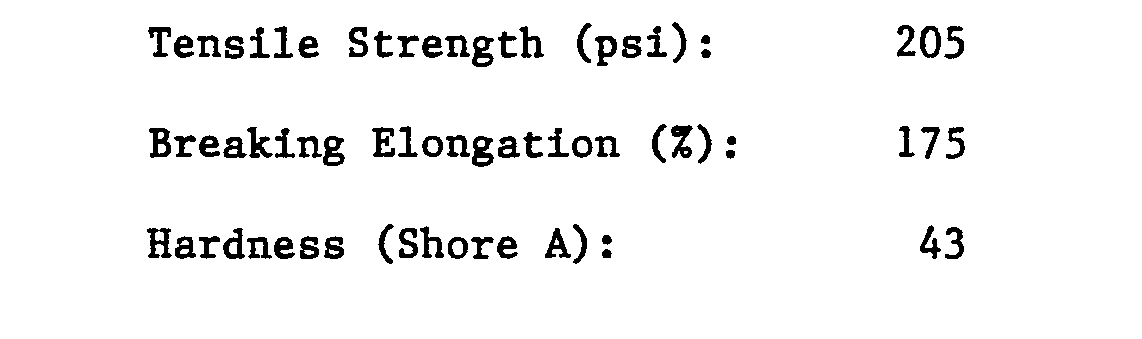
- This composition thinned out rapidly as it was stirred, indicating its pseudoplastic, shear sensitive property. When cured in a cavity mold for two weeks at room temperature, it showed the following properties:
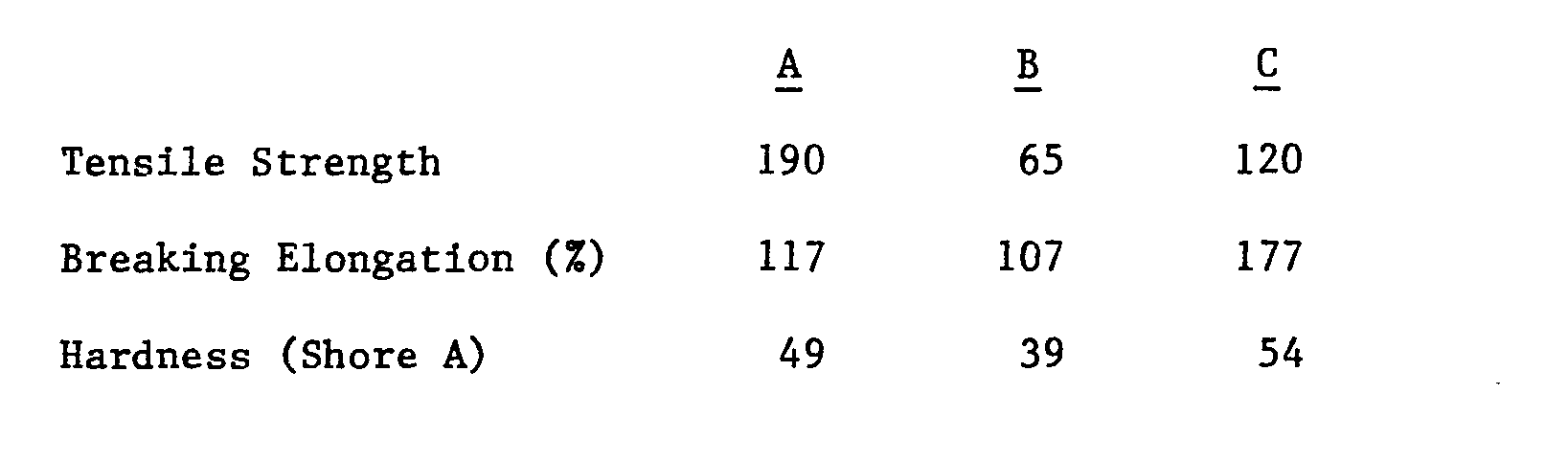
- The following were mixed in high speed sigma blade mixer:

- To 100 gram portions of each was added 3.5 grams tert-butyl peroxy- pivalate, 1 gram cobalt naphthenate (6%), and 0.3 grams triethanolamine. These were then poured into 1/16" cavity molds and cured for 24 hours at room temperature, 48 hours at 70°C and 90 hours at 50°C. The cured samples had the following properties:
- The following compositions illustrate some of the various modes of ambient temperature cure possible with the compositions of the present invention. They were all mixed with a high speed homogenizer:


- aSamples 0.075" thick are cut in the shape of a pair of trousers and the legs inserted into the jaws of a tensile test machine. The test is then run according to ASTM #D624.
- Composition A represents an example of a QDO cure using a peroxide oxidant to activate the QDO.
- Composition B represents an example of a cure using a peroxide combined with a diacrylate "co-agent".
- Composition C represents an example of a QDO cure using a combination of Halane and lead dioxide as oxidants to activate the QDO.
- In each case, the compositions were poured into 1/16" cavity molds for curing, immediately after addition of activator.
- Composition C of Example 8, after cure, was aged for 7 days at 121°C and then for a total of 40 days at 121°C in a circulating air oven. Its properties after aging were:

- None of the aged sampled cracked when folded 180°.
-

- After mixing, the composition was poured into 1/16" molds and cured at 24°C for 16 hours and at 60°C for 24 hours. Its properties were:


- The following composition was mixed with a high speed homogenizer:

- Immediately after mixing, the composition was poured into 1/16" cavity molds and cured at 24°C for 16 hours and at 60°C for 24 hours. The properties were:

- This example shows an EPDM composition which is curable with a peroxide and an activator at room temperature. The instant peroxide is t-butyl peroxybenzoate and the activator a 6% solution of cobalt naphthenate in mineral spirits.

- Properties measured after 16 hours at room temperature and 48 hours at 60°C in an air circulating oven.

- The compositions of this invention may also be used for the purpose of sealing and waterproofing such as coating of building foundations and side walls as well as for living ponds, trenches and canals. If so desired, the composition of this invention may serve as reinforcing agent in asphalt and bitumen.
Claims (10)
Applications Claiming Priority (2)
| Application Number | Priority Date | Filing Date | Title |
|---|---|---|---|
| US65547884A | 1984-09-27 | 1984-09-27 | |
| US655478 | 1984-09-27 |
Publications (3)
| Publication Number | Publication Date |
|---|---|
| EP0182470A2 true EP0182470A2 (en) | 1986-05-28 |
| EP0182470A3 EP0182470A3 (en) | 1987-04-01 |
| EP0182470B1 EP0182470B1 (en) | 1990-06-06 |
Family
ID=24629041
Family Applications (1)
| Application Number | Title | Priority Date | Filing Date |
|---|---|---|---|
| EP85306631A Expired - Lifetime EP0182470B1 (en) | 1984-09-27 | 1985-09-18 | Liquid rubber composition |
Country Status (9)
| Country | Link |
|---|---|
| EP (1) | EP0182470B1 (en) |
| JP (1) | JPS6185459A (en) |
| KR (1) | KR920008527B1 (en) |
| AU (1) | AU585893B2 (en) |
| BR (1) | BR8504700A (en) |
| CA (1) | CA1278637C (en) |
| DE (1) | DE3578089D1 (en) |
| IN (1) | IN164174B (en) |
| ZA (1) | ZA856971B (en) |
Cited By (6)
| Publication number | Priority date | Publication date | Assignee | Title |
|---|---|---|---|---|
| EP0212970A3 (en) * | 1985-08-23 | 1988-01-13 | Uniroyal Chemical Company, Inc. | Insulating adhesive tape composition and composites thereof |
| EP0990675A1 (en) * | 1998-10-02 | 2000-04-05 | Bridgestone/Firestone, Inc. | Non-black, mineral-filled roof accessories |
| GB2362172A (en) * | 2000-01-24 | 2001-11-14 | Pond Care Ltd | Polymeric spray on pond liner |
| US7629412B2 (en) | 2006-06-08 | 2009-12-08 | Chemtura Corporation | Rigid PVC blend composition |
| CN104087074A (en) * | 2014-06-18 | 2014-10-08 | 蚌埠市光华金属制品有限公司 | Preparation method for water-emulsion-type ethylene-propylene-diene-monomer waterproof material |
| CN117186637A (en) * | 2023-10-07 | 2023-12-08 | 青岛康威化纤有限公司 | Bio-based PA56 composite material and preparation method and application thereof |
Families Citing this family (1)
| Publication number | Priority date | Publication date | Assignee | Title |
|---|---|---|---|---|
| JP4944330B2 (en) * | 1999-11-05 | 2012-05-30 | ケムチュラ・コーポレーション | Rubber compound and manufacturing method thereof |
Family Cites Families (8)
| Publication number | Priority date | Publication date | Assignee | Title |
|---|---|---|---|---|
| NL284428A (en) * | 1961-10-20 | |||
| DE1494431C3 (en) * | 1965-10-06 | 1974-03-14 | Dunlop Ag, 6450 Hanau | Use of terpolymers for the production of coatings |
| US3847723A (en) * | 1973-04-25 | 1974-11-12 | Hitco | Flame retardant butyl rubber |
| JPS5829813B2 (en) * | 1975-10-01 | 1983-06-24 | 住友化学工業株式会社 | Improved vulcanizable rubber composition for waterproof sheets |
| JPS5622338A (en) * | 1979-08-02 | 1981-03-02 | Japan Synthetic Rubber Co Ltd | Waterproof sheet |
| DE3137187A1 (en) * | 1981-09-18 | 1983-03-31 | Metzeler Kautschuk GmbH, 8000 München | "VOLCANIZABLE ELASTOMER" |
| ZA831700B (en) * | 1982-03-29 | 1983-11-30 | Uniroyal Inc | Elastomeric composition |
| US4461875A (en) * | 1982-03-29 | 1984-07-24 | Uniroyal, Inc. | Roof sheeting and flashing elastomeric composition |
-
1985
- 1985-09-10 CA CA000490325A patent/CA1278637C/en not_active Expired - Fee Related
- 1985-09-11 ZA ZA856971A patent/ZA856971B/en unknown
- 1985-09-11 IN IN747/DEL/85A patent/IN164174B/en unknown
- 1985-09-18 EP EP85306631A patent/EP0182470B1/en not_active Expired - Lifetime
- 1985-09-18 DE DE8585306631T patent/DE3578089D1/en not_active Expired - Fee Related
- 1985-09-19 AU AU47616/85A patent/AU585893B2/en not_active Ceased
- 1985-09-25 BR BR8504700A patent/BR8504700A/en unknown
- 1985-09-26 JP JP60213628A patent/JPS6185459A/en active Granted
- 1985-09-27 KR KR8507132A patent/KR920008527B1/en not_active Expired
Cited By (6)
| Publication number | Priority date | Publication date | Assignee | Title |
|---|---|---|---|---|
| EP0212970A3 (en) * | 1985-08-23 | 1988-01-13 | Uniroyal Chemical Company, Inc. | Insulating adhesive tape composition and composites thereof |
| EP0990675A1 (en) * | 1998-10-02 | 2000-04-05 | Bridgestone/Firestone, Inc. | Non-black, mineral-filled roof accessories |
| GB2362172A (en) * | 2000-01-24 | 2001-11-14 | Pond Care Ltd | Polymeric spray on pond liner |
| US7629412B2 (en) | 2006-06-08 | 2009-12-08 | Chemtura Corporation | Rigid PVC blend composition |
| CN104087074A (en) * | 2014-06-18 | 2014-10-08 | 蚌埠市光华金属制品有限公司 | Preparation method for water-emulsion-type ethylene-propylene-diene-monomer waterproof material |
| CN117186637A (en) * | 2023-10-07 | 2023-12-08 | 青岛康威化纤有限公司 | Bio-based PA56 composite material and preparation method and application thereof |
Also Published As
| Publication number | Publication date |
|---|---|
| CA1278637C (en) | 1991-01-02 |
| KR920008527B1 (en) | 1992-10-01 |
| IN164174B (en) | 1989-01-28 |
| AU585893B2 (en) | 1989-06-29 |
| EP0182470A3 (en) | 1987-04-01 |
| DE3578089D1 (en) | 1990-07-12 |
| AU4761685A (en) | 1986-04-10 |
| BR8504700A (en) | 1986-07-22 |
| ZA856971B (en) | 1986-04-30 |
| JPH0459339B2 (en) | 1992-09-22 |
| JPS6185459A (en) | 1986-05-01 |
| KR860002546A (en) | 1986-04-26 |
| EP0182470B1 (en) | 1990-06-06 |
Similar Documents
| Publication | Publication Date | Title |
|---|---|---|
| EP0714963B1 (en) | Adhesive tape composition | |
| US3991025A (en) | Urethane containing hot melt sealants, adhesives and the like | |
| US4169822A (en) | Hot melt sealants | |
| US6642296B2 (en) | Lap edge roofing sealant | |
| US3932341A (en) | Hot melt sealants, adhesives and the like | |
| US4101482A (en) | Sealant based on mixture of unsaturated and hydrogenated block copolymers | |
| EP0782977B1 (en) | Liquid applied waterproofing | |
| US5880218A (en) | Compounded polymeric compositions utilizing processed paint sludge as a replacement for polymeric components | |
| KR100344940B1 (en) | Manufacturing method of unvulcanize adhesion waterproof sheet and construction method for waterproof using the waterproof sheet | |
| US3988276A (en) | Solid polysulfide containing hot melt sealants, adhesives and the like | |
| EP0182470B1 (en) | Liquid rubber composition | |
| US4607078A (en) | Blends of organic polymers and organic terminated polysulfide polymers | |
| WO2012174492A1 (en) | Durable substrate coating and process for making | |
| US3501434A (en) | Epoxy-neoprene compositions | |
| JPH1081856A (en) | Adhesive tape composition and method for covering roof | |
| US3366707A (en) | Mastic compositions | |
| US2920057A (en) | Putty comprising the reaction product of a quaternizing agent and a conjugated diene-heterocyclic nitrogen base copolymer | |
| SU1024493A1 (en) | Sealing melt | |
| US3518107A (en) | Polysulfide sealant bonded to cementious and asphaltic substrates | |
| US3003893A (en) | Rubberized bituminous sealant and method of use | |
| KR102250894B1 (en) | Surface perparation and manufacturing method thereof and complex waterproof method using thereof | |
| KR100734179B1 (en) | Natural Vulcanization Type EPDM Synthetic Rubber Waterproof Sheet and Waterproofing Method of Construction Structure Using It | |
| RU2181744C2 (en) | Sealing composition | |
| SU1735340A1 (en) | Hermetic sealing composition | |
| US3520854A (en) | Method of treating liquid dithiols and liquid dithiols-rubber blends with alkanolamines and methyl amino-alkyl phenols and compositions thereof |
Legal Events
| Date | Code | Title | Description |
|---|---|---|---|
| PUAI | Public reference made under article 153(3) epc to a published international application that has entered the european phase |
Free format text: ORIGINAL CODE: 0009012 |
|
| AK | Designated contracting states |
Kind code of ref document: A2 Designated state(s): DE FR GB IT NL SE |
|
| PUAL | Search report despatched |
Free format text: ORIGINAL CODE: 0009013 |
|
| AK | Designated contracting states |
Kind code of ref document: A3 Designated state(s): DE FR GB IT NL SE |
|
| 17P | Request for examination filed |
Effective date: 19870929 |
|
| 17Q | First examination report despatched |
Effective date: 19880613 |
|
| RAP1 | Party data changed (applicant data changed or rights of an application transferred) |
Owner name: UNIROYAL CHEMICAL COMPANY, INC. |
|
| ITF | It: translation for a ep patent filed | ||
| GRAA | (expected) grant |
Free format text: ORIGINAL CODE: 0009210 |
|
| AK | Designated contracting states |
Kind code of ref document: B1 Designated state(s): DE FR GB IT NL SE |
|
| REF | Corresponds to: |
Ref document number: 3578089 Country of ref document: DE Date of ref document: 19900712 |
|
| ET | Fr: translation filed | ||
| PLBE | No opposition filed within time limit |
Free format text: ORIGINAL CODE: 0009261 |
|
| STAA | Information on the status of an ep patent application or granted ep patent |
Free format text: STATUS: NO OPPOSITION FILED WITHIN TIME LIMIT |
|
| 26N | No opposition filed | ||
| ITTA | It: last paid annual fee | ||
| PGFP | Annual fee paid to national office [announced via postgrant information from national office to epo] |
Ref country code: NL Payment date: 19910930 Year of fee payment: 7 |
|
| PG25 | Lapsed in a contracting state [announced via postgrant information from national office to epo] |
Ref country code: NL Effective date: 19930401 |
|
| NLV4 | Nl: lapsed or anulled due to non-payment of the annual fee | ||
| EAL | Se: european patent in force in sweden |
Ref document number: 85306631.4 |
|
| PGFP | Annual fee paid to national office [announced via postgrant information from national office to epo] |
Ref country code: GB Payment date: 19950911 Year of fee payment: 11 Ref country code: FR Payment date: 19950911 Year of fee payment: 11 |
|
| PGFP | Annual fee paid to national office [announced via postgrant information from national office to epo] |
Ref country code: SE Payment date: 19950918 Year of fee payment: 11 |
|
| PGFP | Annual fee paid to national office [announced via postgrant information from national office to epo] |
Ref country code: DE Payment date: 19950928 Year of fee payment: 11 |
|
| PG25 | Lapsed in a contracting state [announced via postgrant information from national office to epo] |
Ref country code: GB Effective date: 19960918 |
|
| PG25 | Lapsed in a contracting state [announced via postgrant information from national office to epo] |
Ref country code: SE Effective date: 19960919 |
|
| PG25 | Lapsed in a contracting state [announced via postgrant information from national office to epo] |
Ref country code: FR Effective date: 19960930 |
|
| GBPC | Gb: european patent ceased through non-payment of renewal fee |
Effective date: 19960918 |
|
| PG25 | Lapsed in a contracting state [announced via postgrant information from national office to epo] |
Ref country code: DE Effective date: 19970603 |
|
| EUG | Se: european patent has lapsed |
Ref document number: 85306631.4 |
|
| REG | Reference to a national code |
Ref country code: FR Ref legal event code: ST |
|
| REG | Reference to a national code |
Ref country code: FR Ref legal event code: ST |