EP0182546A2 - Essai immunologique - Google Patents
Essai immunologique Download PDFInfo
- Publication number
- EP0182546A2 EP0182546A2 EP85308070A EP85308070A EP0182546A2 EP 0182546 A2 EP0182546 A2 EP 0182546A2 EP 85308070 A EP85308070 A EP 85308070A EP 85308070 A EP85308070 A EP 85308070A EP 0182546 A2 EP0182546 A2 EP 0182546A2
- Authority
- EP
- European Patent Office
- Prior art keywords
- antibody
- antigen
- assay
- species
- single reagent
- Prior art date
- Legal status (The legal status is an assumption and is not a legal conclusion. Google has not performed a legal analysis and makes no representation as to the accuracy of the status listed.)
- Withdrawn
Links
Images


Classifications
-
- G—PHYSICS
- G01—MEASURING; TESTING
- G01N—INVESTIGATING OR ANALYSING MATERIALS BY DETERMINING THEIR CHEMICAL OR PHYSICAL PROPERTIES
- G01N33/00—Investigating or analysing materials by specific methods not covered by groups G01N1/00 - G01N31/00
- G01N33/48—Biological material, e.g. blood, urine; Haemocytometers
- G01N33/50—Chemical analysis of biological material, e.g. blood, urine; Testing involving biospecific ligand binding methods; Immunological testing
- G01N33/53—Immunoassay; Biospecific binding assay; Materials therefor
- G01N33/536—Immunoassay; Biospecific binding assay; Materials therefor with immune complex formed in liquid phase
- G01N33/537—Immunoassay; Biospecific binding assay; Materials therefor with immune complex formed in liquid phase with separation of immune complex from unbound antigen or antibody
- G01N33/539—Immunoassay; Biospecific binding assay; Materials therefor with immune complex formed in liquid phase with separation of immune complex from unbound antigen or antibody involving precipitating reagent, e.g. ammonium sulfate
- G01N33/541—Double or second antibody, i.e. precipitating antibody
-
- G—PHYSICS
- G01—MEASURING; TESTING
- G01N—INVESTIGATING OR ANALYSING MATERIALS BY DETERMINING THEIR CHEMICAL OR PHYSICAL PROPERTIES
- G01N33/00—Investigating or analysing materials by specific methods not covered by groups G01N1/00 - G01N31/00
- G01N33/48—Biological material, e.g. blood, urine; Haemocytometers
- G01N33/50—Chemical analysis of biological material, e.g. blood, urine; Testing involving biospecific ligand binding methods; Immunological testing
- G01N33/53—Immunoassay; Biospecific binding assay; Materials therefor
- G01N33/563—Immunoassay; Biospecific binding assay; Materials therefor involving antibody fragments
-
- G—PHYSICS
- G01—MEASURING; TESTING
- G01N—INVESTIGATING OR ANALYSING MATERIALS BY DETERMINING THEIR CHEMICAL OR PHYSICAL PROPERTIES
- G01N33/00—Investigating or analysing materials by specific methods not covered by groups G01N1/00 - G01N31/00
- G01N33/48—Biological material, e.g. blood, urine; Haemocytometers
- G01N33/50—Chemical analysis of biological material, e.g. blood, urine; Testing involving biospecific ligand binding methods; Immunological testing
- G01N33/74—Chemical analysis of biological material, e.g. blood, urine; Testing involving biospecific ligand binding methods; Immunological testing involving hormones or other non-cytokine intercellular protein regulatory factors such as growth factors, including receptors to hormones and growth factors
Definitions
- This invention relates to immunoassays.
- Immunoassays depend upon the reversible and non-covalent binding of an antigen (Ag), which is the analyte to be measured by its specific antibodies (Ab), to form a complex (Ag:Ab), in accordance with the reaction: At equilibrium, some of the free reactants will be combining to form more complex, and some of the complex will be dissociating to give the free reactants.
- Ag antigen
- Abs antibodies
- a labelled reagent In order to enable, or improve the accuracy of, quantitation in immunoassays, it is known to use a labelled reagent.
- the labels commonly used are radioisotopes, enzymes and fluorophors.
- the second antibody can interfere in the primary immunological reaction between the antigen and the first antibody.
- An antibody IgG molecule comprises two antigen binding sites (in the Fab components) and another component (Fc) not directly involved in antigen-antibody binding.
- second antibody interference can be markedly reduced or even eliminated by using, as the second antibody, an antibody raised not against the whole first antibody IgG but only against the Fc fragment of the first antibody.
- the second antibodies so made will bind only to antigenic determinants on the Fc component of the first antibody and will not interfere with the primary antigen: first antibody reaction.
- the cause or main cause of interference is removed without loss of the essential function of the second antibody which is to bind with and insolubilise the first antibody.
- the present invention thus provides a method of immunoassay of an antigen wherein the antigen is reacted with a first antibody to form an antigen:antibody complex, and wherein a second antibody is used to bind to the first antibody to form a precipitate therewith, the precipitate being separated out, characterised in that the second antibody is directed only against the Fc component of the first antibody.
- the method of the invention is applicable to all second antibody assays, including those using a labelled reagent, in which there is a separation step.
- immunoassay with which the present invention may be utilised is that known as a "two-site" technique for the assay of large molecules with more than one antigenic determinant.
- a conventional "two-site” assay the sample under assay is first incubated with an excess of an antibody covalently linked to an insoluble support and directed against one antigenic determinant (SP-A b 1 ) After careful washing, excess of a second, isotopically labelled antibody (Ab 2 ) directed against another part of the antigen molecule is added Following further washes, the counts (in the case of a radiolabel) present in the solid phase fraction are determined and are related directly to the concentration of antigen present in the samples and standards.
- insolubilising second antibodies are used instead of the solid phase.
- the antibodies Ab and Ab 2 are preferably raised in different species, e.g. rabbit and sheep respectively, and the insolubilising second antibody is raised in sheep and is directed against the Fc fragment of rabbit IgG. It will therefore combine with Ab 1 ,but not with Ab 2 , and hence will insolubilise the bound Ab 2 but not the free Ab 2 . Thus, a separation can be effected.
- the present invention provides a two-site immunoassay of an antigen having more than one antigenic determinant, wherein the antigen is mixed with a first antibody against one of its determinants to form a first complex, the said complex is mixed with excess of a labelled antibody against a second determinant on the antigen to form a second complex, the second complex being insoluble and thus separable from labelled antibody remaining in solution, characterised in that there is also included in the solution an antibody directed against the Fc component only of said first antibody and which insolubilises said first antibody upon binding thereto.
- the assay gave relatively poor precision (up to 10% coefficients of variation) and high recovery (up to 125%) as compared with a conventional double antibody assay for T 4 .
- RIA radioimmunoassay
- the invention includes a single reagent label immunoassay for an antigen in which the antigen is mixed with a single reagent mixture and, optionally after the separation step, the label is assayed, characterised in that the single reagent mixture comprises a first antibody against the antigen and a second antibody against the Fc component of the first antibody.
- the two-site assay of the invention can also be conducted, in accordance with a further aspect of the invention, as a "single reagent" assay.
- the "single reagent" mixture for use in such an assay preferably comprises antibody Ab, raised in a first species against a determinant of the Ag under assay; labelled antibody Ab 2 raised in a second species against another determinant of the Ag; and antibody Ag 3 raised in said second species against the Fc fragment of the IgG of the first species.
- HSA Human serum albumin
- fluorescein molar ratio fluorescein:HSA of 2:1
- Antiserum to HSA was raised in a sheep by standard procedures.
- Antisera to sheep IgG and to sheep Fc fragment were raised in rabbits by standard procedures.
- Assay diluent buffer was sodium phosphate (50 mmol/l pH 7.4) containing bovine serum albumin (5 g/1) and sodium azide (1 g/1). Standard solutions of HSA were prepared in diluent buffer.
- working tracer reagent was prepared by diluting the fluorescein-labelled HSA to 2.6 mg/1 (based on its protein content) in diluent buffer and working antiserum reagent by diluting the anti-HSA serum by 1,430-fold in diluent buffer.
- the assay procedure with conventional second- antibody separation was as follows. To 50 ⁇ l of standard was added 200 pl of working tracer reagent followed by 100 ⁇ l of working antiserum reagent. After incubation for 1 h at room temperature, 50 ⁇ l of normal sheep serum (diluted 1,000-fold in diluent buffer) and 50 ⁇ l of second antiserum (either anti-IgG or anti-Fc, each diluted 8-fold in diluent buffer) was added.
- the assay mixtures were centrifuged, the supernatants aspirated to waste, and the precipitates re-dissolved by the addition of 1.5 ml of a mixture of methanol, water and 2 mol/l sodium hydroxide (50:50:1 parts by volume).
- the fluorescence of the re - dissolved precipitates was measured by placing each test tube into the fluorimeter.
- mixtures were prepared containing sheep anti-HSA serum (dilution 1,430-fold), normal sheep serum (dilution 2,000-fold) and either rabbit anti-(sheep IgG) serum or rabbit anti-(sheep Fc) serum (each diluted 16-fold).
- the antiserum mixtures were allowed to equilibrate for 1 h at room temperature before being used in a fluoroimmunoassay according to the following procedure.
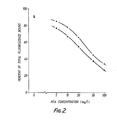
- Figures 1 and 2 show the standard curves obtained using pre-combined antisera reagents containing anti-IgG or anti-Fc second antiserum, respectively (circles).
- pre-combination with first antiserum evidently leads to hindrance of binding of the labelled HSA ( Figure 1).
- Figure 2 When anti-Fc second antiserum is employed ( Figure 2) there is no such degradation of assay performance (the slight increase in labelled HSA binding noted in the pre-combined assay system may be attributable to the longer overall time of incubation - 4 h as compared with 2 h in the conventional procedure - of the first and second antisera, leading to more efficient precipitation of the bound fraction).
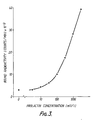
- Example of a single reagent immunoradiometric assay employing anti-Fc second antibody liquid-phase two-site assay of human prolactin
- Antisera to human prolactin were raised in sheep and rabbits by standard procedures. Specific anti-prolactin immunoglobulins were isolated from the sheep antiserum by immunoaffinity purification and were radioiodinated with 125 I by conventional procedures. Antisera to rabbit IgG and to rabbit Fc fragment were raised in sheep by standard procedures. Assay diluent buffer was sodium phosphate (64 mmol/l, pH 7.4) containing polyethylene glycol 6000 (30 g/1), bovine serum albumin (5 g/l), normal rabbit serum (10 ml/I), normal sheep serum (20 ml/l), and thiomersal (100 mg/1). Standard solutions of human prolactin were prepared in horse serum.
Landscapes
- Health & Medical Sciences (AREA)
- Life Sciences & Earth Sciences (AREA)
- Immunology (AREA)
- Engineering & Computer Science (AREA)
- Molecular Biology (AREA)
- Biomedical Technology (AREA)
- Chemical & Material Sciences (AREA)
- Hematology (AREA)
- Urology & Nephrology (AREA)
- Biotechnology (AREA)
- Microbiology (AREA)
- Cell Biology (AREA)
- Food Science & Technology (AREA)
- Medicinal Chemistry (AREA)
- Physics & Mathematics (AREA)
- Analytical Chemistry (AREA)
- Biochemistry (AREA)
- General Health & Medical Sciences (AREA)
- General Physics & Mathematics (AREA)
- Pathology (AREA)
- Endocrinology (AREA)
- Peptides Or Proteins (AREA)
Applications Claiming Priority (2)
| Application Number | Priority Date | Filing Date | Title |
|---|---|---|---|
| GB848428487A GB8428487D0 (en) | 1984-11-12 | 1984-11-12 | Immunoassays |
| GB8428487 | 1984-11-12 |
Publications (2)
| Publication Number | Publication Date |
|---|---|
| EP0182546A2 true EP0182546A2 (fr) | 1986-05-28 |
| EP0182546A3 EP0182546A3 (fr) | 1987-09-09 |
Family
ID=10569579
Family Applications (1)
| Application Number | Title | Priority Date | Filing Date |
|---|---|---|---|
| EP85308070A Withdrawn EP0182546A3 (fr) | 1984-11-12 | 1985-11-06 | Essai immunologique |
Country Status (2)
| Country | Link |
|---|---|
| EP (1) | EP0182546A3 (fr) |
| GB (1) | GB8428487D0 (fr) |
Cited By (9)
| Publication number | Priority date | Publication date | Assignee | Title |
|---|---|---|---|---|
| WO1995029938A1 (fr) * | 1994-04-28 | 1995-11-09 | Ferring Ab | Echangeur de specificite antigene/anticorps |
| WO1995033204A1 (fr) * | 1994-05-27 | 1995-12-07 | Bayer Aktiengesellschaft | Dosage immunologique d'antigenes a haut poids moleculaire |
| EP0918218A3 (fr) * | 1997-11-21 | 2000-01-05 | Daiichi Pure Chemicals Co. Ltd. | Méthode pour l'immunoessai |
| US6040137A (en) * | 1995-04-27 | 2000-03-21 | Tripep Ab | Antigen/antibody specification exchanger |
| EP1054258A1 (fr) * | 1999-04-28 | 2000-11-22 | Fuji Photo Film Co., Ltd. | Méthode homogène de dosage immunologique enzymatique faisant intervenir un second anticorps contre le premier anticorps |
| US6660842B1 (en) | 1994-04-28 | 2003-12-09 | Tripep Ab | Ligand/receptor specificity exchangers that redirect antibodies to receptors on a pathogen |
| US6933366B2 (en) | 1996-12-27 | 2005-08-23 | Tripep Ab | Specificity exchangers that redirect antibodies to bacterial adhesion receptors |
| US7318926B2 (en) | 2003-02-06 | 2008-01-15 | Tripep Ab | Glycosylated specificity exchangers |
| US7335359B2 (en) | 2003-02-06 | 2008-02-26 | Tripep Ab | Glycosylated specificity exchangers |
Family Cites Families (5)
| Publication number | Priority date | Publication date | Assignee | Title |
|---|---|---|---|---|
| US4298592A (en) * | 1979-04-05 | 1981-11-03 | Mallinckrodt, Inc. | Double antibody separation method |
| US4481298A (en) * | 1981-04-13 | 1984-11-06 | Amf Incorporated | Pre-precipitated double antibody immunoassay method |
| US4522922A (en) * | 1982-04-16 | 1985-06-11 | Jose Carro | Soluble assay |
| JPS59500832A (ja) * | 1982-05-07 | 1984-05-10 | パラゴン・ダイアグノスティクス・インコ−ポレイテッド | 競合的免疫螢光検定法及び試験セット |
| US4469787A (en) * | 1982-05-14 | 1984-09-04 | Mallinckrodt Inc. | Immunoassay involving soluble complex of second antibody and labeled binding protein |
-
1984
- 1984-11-12 GB GB848428487A patent/GB8428487D0/en active Pending
-
1985
- 1985-11-06 EP EP85308070A patent/EP0182546A3/fr not_active Withdrawn
Cited By (18)
| Publication number | Priority date | Publication date | Assignee | Title |
|---|---|---|---|---|
| US6469143B2 (en) | 1994-04-28 | 2002-10-22 | Tripep Ab | Antigen/antibody specificity exchanger |
| US5869232A (en) * | 1994-04-28 | 1999-02-09 | Tripep Ab | Antigen/antibody specificity exchanger |
| US7019111B2 (en) | 1994-04-28 | 2006-03-28 | Tripep Ab | Glycosylated ligand/receptor specificity exchangers specific for bacterial adhesion receptors |
| WO1995029938A1 (fr) * | 1994-04-28 | 1995-11-09 | Ferring Ab | Echangeur de specificite antigene/anticorps |
| US6660842B1 (en) | 1994-04-28 | 2003-12-09 | Tripep Ab | Ligand/receptor specificity exchangers that redirect antibodies to receptors on a pathogen |
| US6245895B1 (en) | 1994-04-28 | 2001-06-12 | Tripep Ab | Antigen/antibody specificity exchanger |
| WO1995033204A1 (fr) * | 1994-05-27 | 1995-12-07 | Bayer Aktiengesellschaft | Dosage immunologique d'antigenes a haut poids moleculaire |
| US6040137A (en) * | 1995-04-27 | 2000-03-21 | Tripep Ab | Antigen/antibody specification exchanger |
| US6933366B2 (en) | 1996-12-27 | 2005-08-23 | Tripep Ab | Specificity exchangers that redirect antibodies to bacterial adhesion receptors |
| EP0918218A3 (fr) * | 1997-11-21 | 2000-01-05 | Daiichi Pure Chemicals Co. Ltd. | Méthode pour l'immunoessai |
| EP1054258A1 (fr) * | 1999-04-28 | 2000-11-22 | Fuji Photo Film Co., Ltd. | Méthode homogène de dosage immunologique enzymatique faisant intervenir un second anticorps contre le premier anticorps |
| US7318926B2 (en) | 2003-02-06 | 2008-01-15 | Tripep Ab | Glycosylated specificity exchangers |
| US7332166B2 (en) | 2003-02-06 | 2008-02-19 | Tripep Ab | Glycosylated specificity exchangers |
| US7335359B2 (en) | 2003-02-06 | 2008-02-26 | Tripep Ab | Glycosylated specificity exchangers |
| US7534435B2 (en) | 2003-02-06 | 2009-05-19 | Tripep Ab | Glycosylated specificity exchangers |
| US8303956B2 (en) | 2003-02-06 | 2012-11-06 | Chrontech Pharma Ab | Glycosylated specificity exchangers |
| US8658179B2 (en) | 2003-02-06 | 2014-02-25 | Chrontech Pharma Ab | Glycosylated specificity exchangers |
| US9079962B2 (en) | 2003-02-06 | 2015-07-14 | Tripep Ab | Glycosylated specificity exchangers |
Also Published As
| Publication number | Publication date |
|---|---|
| EP0182546A3 (fr) | 1987-09-09 |
| GB8428487D0 (en) | 1984-12-19 |
Similar Documents
| Publication | Publication Date | Title |
|---|---|---|
| Gosling | A decade of development in immunoassay methodology | |
| US4469787A (en) | Immunoassay involving soluble complex of second antibody and labeled binding protein | |
| US4034074A (en) | Universal reagent 2-site immunoradiometric assay using labelled anti (IgG) | |
| EP0034050B1 (fr) | Essai immunologique pour des antigènes | |
| EP0143274B1 (fr) | Dosage immunologique hétérogène de la digoxine utilisant l'ouabain comme moyen de séparation | |
| US4504585A (en) | Affinity immunoassay system | |
| CA1202237A (fr) | Immuno-essai avec double anticorps et precipitation prealable | |
| US4298592A (en) | Double antibody separation method | |
| EP0019277A1 (fr) | Procédé de détection d'un antigène dans un échantillon | |
| WO1985000663A1 (fr) | Analyse immunometrique utilisant des anticorps polyclonaux et monoclonaux et kit d'analyse | |
| CA1050425A (fr) | Dosage radioimmunologique de la l-triiodothyronine et de la thyroxine | |
| US4522922A (en) | Soluble assay | |
| EP0088974A2 (fr) | Essai immunologique homogène avec un anti-réactif marqué monoclonal | |
| EP0161107A2 (fr) | Méthode immunométrique pour la détermination d'un haptène | |
| EP0218309B1 (fr) | Procédé pour déterminer les ligands libres dans les fluides biologiques | |
| US4307071A (en) | Analytical reagent and method | |
| EP0389301A2 (fr) | Complexe réactif pour l'essai immunologique | |
| US4548908A (en) | Competitive immunofluorescence assay and test kit | |
| EP0303980A2 (fr) | Support lié avec un antigène ou un anticorps | |
| JPH03503566A (ja) | 天然結合タンパク質に対するモノクローナル抗体を用いたイムノアツセイ | |
| JPH0688822A (ja) | 水性試料中の被分析物の測定法、測定試薬及び測定試薬キット | |
| JPH0792454B2 (ja) | 抗原の測定方法 | |
| Standefer | Separation-Required (Heterogenous) Enzyme Immunoassay for Haptens and Antigens | |
| EP0345777A2 (fr) | Immunoessai | |
| SU935791A1 (ru) | Способ количественного определени антител к коллагену |
Legal Events
| Date | Code | Title | Description |
|---|---|---|---|
| PUAI | Public reference made under article 153(3) epc to a published international application that has entered the european phase |
Free format text: ORIGINAL CODE: 0009012 |
|
| AK | Designated contracting states |
Kind code of ref document: A2 Designated state(s): BE CH DE FR GB IT LI NL SE |
|
| PUAL | Search report despatched |
Free format text: ORIGINAL CODE: 0009013 |
|
| AK | Designated contracting states |
Kind code of ref document: A3 Designated state(s): BE CH DE FR GB IT LI NL SE |
|
| STAA | Information on the status of an ep patent application or granted ep patent |
Free format text: STATUS: THE APPLICATION IS DEEMED TO BE WITHDRAWN |
|
| 18D | Application deemed to be withdrawn |
Effective date: 19880310 |
|
| RIN1 | Information on inventor provided before grant (corrected) |
Inventor name: LANDON, JOHN |