EP0182765A2 - Electrochemical controlled release drug delivery system - Google Patents
Electrochemical controlled release drug delivery system Download PDFInfo
- Publication number
- EP0182765A2 EP0182765A2 EP19850850366 EP85850366A EP0182765A2 EP 0182765 A2 EP0182765 A2 EP 0182765A2 EP 19850850366 EP19850850366 EP 19850850366 EP 85850366 A EP85850366 A EP 85850366A EP 0182765 A2 EP0182765 A2 EP 0182765A2
- Authority
- EP
- European Patent Office
- Prior art keywords
- electrode
- chemical
- charged
- polymeric body
- current
- Prior art date
- Legal status (The legal status is an assumption and is not a legal conclusion. Google has not performed a legal analysis and makes no representation as to the accuracy of the status listed.)
- Granted
Links
Images


Classifications
-
- A—HUMAN NECESSITIES
- A61—MEDICAL OR VETERINARY SCIENCE; HYGIENE
- A61K—PREPARATIONS FOR MEDICAL, DENTAL OR TOILETRY PURPOSES
- A61K9/00—Medicinal preparations characterised by special physical form
- A61K9/0002—Galenical forms characterised by the drug release technique; Application systems commanded by energy
- A61K9/0009—Galenical forms characterised by the drug release technique; Application systems commanded by energy involving or responsive to electricity, magnetism or acoustic waves; Galenical aspects of sonophoresis, iontophoresis, electroporation or electroosmosis
-
- A—HUMAN NECESSITIES
- A61—MEDICAL OR VETERINARY SCIENCE; HYGIENE
- A61K—PREPARATIONS FOR MEDICAL, DENTAL OR TOILETRY PURPOSES
- A61K47/00—Medicinal preparations characterised by the non-active ingredients used, e.g. carriers or inert additives; Targeting or modifying agents chemically bound to the active ingredient
- A61K47/50—Medicinal preparations characterised by the non-active ingredients used, e.g. carriers or inert additives; Targeting or modifying agents chemically bound to the active ingredient the non-active ingredient being chemically bound to the active ingredient, e.g. polymer-drug conjugates
- A61K47/51—Medicinal preparations characterised by the non-active ingredients used, e.g. carriers or inert additives; Targeting or modifying agents chemically bound to the active ingredient the non-active ingredient being chemically bound to the active ingredient, e.g. polymer-drug conjugates the non-active ingredient being a modifying agent
- A61K47/54—Medicinal preparations characterised by the non-active ingredients used, e.g. carriers or inert additives; Targeting or modifying agents chemically bound to the active ingredient the non-active ingredient being chemically bound to the active ingredient, e.g. polymer-drug conjugates the non-active ingredient being a modifying agent the modifying agent being an organic compound
- A61K47/559—Redox delivery systems, e.g. dihydropyridine pyridinium salt redox systems
-
- Y—GENERAL TAGGING OF NEW TECHNOLOGICAL DEVELOPMENTS; GENERAL TAGGING OF CROSS-SECTIONAL TECHNOLOGIES SPANNING OVER SEVERAL SECTIONS OF THE IPC; TECHNICAL SUBJECTS COVERED BY FORMER USPC CROSS-REFERENCE ART COLLECTIONS [XRACs] AND DIGESTS
- Y10—TECHNICAL SUBJECTS COVERED BY FORMER USPC
- Y10S—TECHNICAL SUBJECTS COVERED BY FORMER USPC CROSS-REFERENCE ART COLLECTIONS [XRACs] AND DIGESTS
- Y10S424/00—Drug, bio-affecting and body treating compositions
- Y10S424/07—Microporous membranes
Definitions
- bioactive substances such as drugs has become an important mode of treatment for many diseases and disorders.
- Pharmaceutical manufacturers have introduced many products which are designed to gradually release bioactive substances at a therapeutically- useful rate and to spatially target the release.
- the release rate may be controlled mechanically by a valving system, or physically, as by slow drug diffusion through protective encapsulation.
- Iontophoresis is an electrochemical process which has found limited utility for the controlled application of charged agents such as metal ions, analgesics and anesthetics to afflicted bodily areas such as inflamed joints.
- Iontophoresis utilizes direct electrical current to drive ionized chemicals through the intact skin. For example, in aqueous media, sodium salicylate disassociates into ions. The salicylate ions responsible for the analgesic action of the salt are negatively charged. Accordingly, these active species can be driven through the skin by the repelling action of a cathodic current which is applied to a reservoir containing the active species.
- a compound electrode was constructed by coating an inert electrode with a polystyrene-based polymer film having the neurotransmitter covalently bound to the polymer backbone through an amide linkage.
- cathodic reduction cleaved the amide bond and released the neurotransmitter into a small volume of aqueous buffer.
- the released amine was detected at a second electrode by its electrochemical oxidation or alternatively, analyzed by H PLC.
- the present invention is directed to controlled release drug delivery systems which employ an electrode comprising a polymer which can be electrochemically cycled between the charged and the neutral, or insulating states.
- the polymer In the charged, or ionic state, the polymer can be loaded with bioactive counterions.
- the counterions When the charge on the polymer is neutralized or reversed, the counterions are released into the surrounding medium and become available to perform their intended function, e.g. to exert their pharmacological . activity.
- a body of the conductive polymer can be employed to form the active portion of a working electrode.
- the polymer is then charged cathodically or anodically while in contact with an aqueous medium containing the desired drug counterion causing it to ionically-bind a pharmaceutically-effective amount of the counterions.
- the drug-loaded electrode is then contacted with a physiological medium.
- physiological medium is intended to refer to an electrolytic solution which is either a naturally-occurring body fluid such as blood, lymph, cerebrospinal fluid or the like, or which is formulated to approximate the properties of such fluids.
- the electrode may be implanted in a natural or artifically-formed body cavity or placed in contact with the skin, mucous membranes or the like.
- the drug counterions can then be released in vivo in a controlled fashion by one or more quantified current pulses.
- these polymers can be loaded with anionic compounds which are bioactive, such as amino acids, by converting the polymer into the oxidized or electropositive state with an anodic current in the presence of dissolved amino acid carboxylate salts.
- one or more cathodic pulses can be employed to electrically neutralize the polymer, resulting in the release of all or a part of the bioactive counteranions into the desired medium.
- the polymer can be removed from the delivery locale, reloaded and reused if desired.
- the unit dosage of the bioactive compound can be controlled by adjusting parameters such as the release pulse strength and duration, the loading concentration and the electrode conformation and position.
- Polymers useful in the present invention are those organic or organometallic polymers which (a) comprise functional groups which can be electrochemically cycled between the charged and neutral states and (b) possess the physical properties required for use as working electrodes. These polymers are preferably stable in air and water, highly conductive and processable.
- these polymers can attract and retain oppositely-charged, pharmaceutically-effective amounts of bioactive chemical species.
- the ionically-bound species can be released from the polymeric matrix when the polymeric charge is neutralized.
- polymers which comprise cationic sites in the charged state can be loaded with bioactive anions which are delivered by employing a cathodic current to neutralize the positively charged polymer, while polymers which comprise anionic sites when charged can be used to bind and release active species which are cationic.
- Such charged polymers may be considered as belonging to two broad classes: (a) those comprising redox sites which are covalently bound to an electrically inactive backbone, such as poly(vinylferrocene); and (b) those having redox sites integrally-incorporated into the polymeric backbone.
- an electrically inactive backbone such as poly(vinylferrocene)
- conductive polymers For a general discussion of these two classes of charged polymers, see L. R. Faulkner, Chem. Eng. News (Feb. 27, 1984) at pages 31-35, the disclosure of which is incorporated by reference herein.
- Conductive polymers can be switched from the charged (conductive) and nonconducting (neutral) states by employing an electric current to alternately reduce and oxidize the polymer chain.
- an electric current to alternately reduce and oxidize the polymer chain.
- the redox sites on polymers of type (a) can also be electrochemically oxidized and reduced, these polymers cannot readily pass current by
- Conductive polymers permit direct electron transfer along the polymeric chains, preferably via a pi-electron network. When such polymers are electrically neutral, the bonding states in the pi-electron network are full and electronic conductivity is very low. The removal of pi-electrons creates cationic vacancies that permit current to flow along the chains, while addition of pi-electrons to vacancies in neutral systems can produce anionic sites.
- these polymers are essentially metallic in character, they can be designed to bear high charge densities and exhibit efficient charge transfer. Furthermore, they need not be bound to a conductive electrode surface in order for the redox sites to be charged and discharged, but can be formed into free-standing bodies which can function as working electrodes when connected to a current source.
- Cationic charged polymers such as those comprising unsaturated carbocyclic or heterocyclic rings such as phenyl, pyrrole, pyridyl, cyclopentadienyl and thiafulvalenyl can be used in the invention.
- the rings will be linked into a continuous conjugated, pi-electron network, such as those present in polyaromatic or poly-(pseudo-aromatic) systems.
- One preferred class of conductive polymer is the polypyrroles, which are formed by the electrochemical oxidation of a pyrrole as described by A. F. Diaz et al. in J. Chem. Soc. Chem. Commun., 635, 854 (1979).
- Polythiophene and several beta-substituted polythiophenes have been prepared by electrochemical oxidation and polymerization of their respective monomers. These polymers can be repeatedly cycled between a conductive oxidized state and a semi-conductive neutral state. See G. Tourillon, J. Electroanal. Chem., 161, 51 (1984). Although their stability in aqueous media indicates that these polymers might be useful to deliver anionic drugs, their high oxidation potentials (greater than 0.70V vs. SCE) would eliminate the delivery of drugs that are electroactive in this potential region.
- the beta-substituted-thiophene, poly-3-methoxythiophene was prepared and found to possess a significantly lower oxidation poten- tion. This material can be employed to deliver anions such as amino acid carboxylates according to the method of this invention.
- conductive polymers useful to bind and release anions include substituted poly(pyrroles), substituted polythiophenes and similar poly(heterocyclic) materials.
- Other useful conductive polymers include polyanilines, poly(thiophenols), poly(aromatics) or polyacetylenes. For example, see Chem Eng. News (Sept. 10, 1984) at pages 38-39.
- Conductive polymers useful for the delivery of cations can also come from the classes of polyacetylenes as well as polyaromatics or poly(heteroaromatics). For example, poly(9-phenylquinoline) would be charged negatively to hold cations, then discharged.
- Redox polymers of the type (a) which can be used to deliver bioactive anionic species include polymers holding a variety of cationic metal complexes either electrostatically or covalently. Examples include organic polymers with pendant ligands such as cyclopentadienyl, pyridine, bipyridine, tripyridine, primary amines, porphyrins, phthalocyanines and related macrocyclic ligands. These ligands can bind a wide variety of metal ions including iron, cobalt, ruthenium, osmium which are capable of rapid electron transfer reactions between the redox centers.
- Organic polymers which could be used as anion delivery agents include those with pendant groups that are relatively stable in both the oxidized and reduced forms, like tetrathiofulvalene, aromatic diamines, cationic dyes such as those from the classes thiazines, diazines, oxazines, triarylmethanes, cyanines, mercocyanines and the like.
- Polymers of type (a) useful for cation delivery include metal complexes with a net negative charge like sulfonated complexes or oxyanions like the conjugate anion of a hydroquinone or an enolate.
- Carboxylated or sulfonated aromatics could also be useful, especially when the aromatic moiety is substituted by nitro, carbonyl, or sulfonyl.
- Anionic dyes of interest may be selected from anionic cyanines, oxonoles, quinones, and the like.
- the charged polymers can be employed to form working electrodes by electrochemically oxidizing or reducing a solution of appropriate monomer so as to deposit a coating of the charged polymer on the surface of a conventional electrode. If the monomer can be polymerized in the presence of the desired counterion, it will be deposited in the loaded condition. If the monomer will not polymerize electrochemically in the presence of the desired counterion, the undesired counterion may be exchanged for the desired species by cycling the polymeric electrode between the neutral and charged state in contact with a medium containing an excess of the desired counterions. In this manner, the undesired ions are forced out and replaced with the desired ions.
- Working electrodes comprising the present charged polymers can be formed in a wide variety of sizes, from microelectrodes of about 1 uM 2 to electrodes designed to encompass an inflamed joint or to cover a large area of a patient's skin. In many cases it will be desirable to coat inert substrates of high surface area with the charged polymer, in order to increase the reservoir of the active species bound thereto.
- Implantable electrodes, or those designed for parenteral drug delivery can be fabricated from polymer coated screens or mesh, or could consist essentially of appropriately-shaped bodies of the conductive polymeric material. The screens or mesh may be composed of a wide variety of conducting.materials including metals or carbon fibers.
- Especially preferred polymers for use in the present invention are those which are soluble in organic solvents in either the charged or neutral state.
- These polymeric solutions can be used to form films of controlled thickness by applying coatings of the solutions to conductive electrode substrates, as by dip- or spin coating and then evaporating the carrier solvent.
- the reduced form of poly-3-methoxythiophene is soluble in acetonitrile, methylene chloride, acetone and dimethyl formamide (DMF) while the oxidized form is soluble in DMF.
- the present drug-delivery method is generally applicable to the release of ionic materials such as organic cations and anions.
- Anionic bioactive species useful as counterions include-the pharmaceutically-acceptable salts of carboxylates, phosphates, sulfates, bisulfites, and the salts of acidic N-H moieties such as amides.
- Many useful drugs containing these functional groups are commercially available as their water-soluble alkali metal or alkaline earth metal salts, most commonly as sodium, lithium, potassium, magnesium or calcium salts.
- Useful bioactive organic carboxylate salts include sodium ethacrynate, levothyroxine sodium, valproate sodium, magnesium salicylate, clorazepate sodium, sodium folate, leucovorin calcium, sodium ascorbate, cephaprin sodium, cephalothin sodium, penicillin G potassium, dextrothyroxine sodium and the carboxylate salts of amino acids.
- Many carboxylic acid-containing drugs can be converted into pharmaceutically-acceptable water-soluble salts by conventional techniques, including aspirin, prostaglandins, retinoic acid, furosemide, tricrynafen, probenicid and the like.
- phosphate salts such as cortisol sodium phosphate, menadiol sodium phosphate, etidronate disodium phosphate, triclofos sodium and the like; sulfates such as estrone potassium sulfate and heparin sodium; bisulfates such as menadione sodium bisulfite and the salts of acidic amines such as purines and amides, including sulfacetamide sodium, tolbutamide sodium, sulfadiazine sodium and the salts of aminophylline, theophylline and the like.
- phosphate salts such as cortisol sodium phosphate, menadiol sodium phosphate, etidronate disodium phosphate, triclofos sodium and the like
- sulfates such as estrone potassium sulfate and heparin sodium
- bisulfates such as menadione sodium bisulfite and the salts of acidic amine
- Bioactive cationic species include the pharmaceutically-acceptable salts such as the halide, nitrate and methylsulfate salts of quaternary amines and charged sulfur and nitrogen-containing heterocyclic drugs, such as those comprising thiazinium, pyridinium, pyrrolidinium, thiazolium or piperidinium salts.
- Drugs comprising quaternary amines include gallamine triethiodide, meto- curine iodide, hexafluorenium bromide, decamethonium bromide, pancuronium bromide, succinyl choline chloride, neostigmine bromide, demacarcium bromide, amberonium chloride, diphemanil methyl sulfate, choline chloride, and the like.
- Useful heterocyclic salts include thiamine nitrate, methylene blue, trimethaphan camsylate, cetylpyridinium chloride and pyridostigmine bromide.
- Neutral, pharmacologically-active species may also be loaded and released via the electroactive polymers if they are first modified to introduce suitable ionic functional groups, such as the above-mentioned phosphates, sulfates, quaternarized nitrogen and the like.
- suitable ionic functional groups such as the above-mentioned phosphates, sulfates, quaternarized nitrogen and the like.
- Techniques for introducing such polar groups are well-known and widely-employed to increase the water-solubility of drugs which are nonsoluble or only sparingly soluble in water, so that they may be orally administered. Such techniques include the conversion of hydroxyl groups to halides and then to phosphonoxy or phosphinoxy groups, and the conversion of hydroxyl groups to the salts of half esters.
- Bisulfites may be formed by the conjugate addition of bisulfite salts to alpha, beta-unsaturated ketones, and amines may be quaternized with alkyl
- FIGS. 1 and 2 Devices useful for the controlled delivery of bioactive ions into physiological media such as mammalian fluids or tissues, are schematically depicted in FIGS. 1 and 2.
- the drug delivery device incorporates working electrode 5 which, as illustrated, comprises a coating of the charged polymer 6 on an inert conductive body 7.
- Body 7 may be formed of any physiologically inert substance, e.g. glassy carbon, graphite, gold, silver, platinum and the like.
- Body 7 is connected by wire 8 to a means capable of charging or discharging the polymer, such as power supply 11 which may be a battery or other suitable DC source, via switch 10 and variable resistor 15.
- power supply 11 which may be a battery or other suitable DC source
- the polarity of the current produced by power supply 11 may be reversed by a polarity control 16.
- Power supply 11 is also connected via wire 13 to counterelectrode 12.
- electrodes 5 and 12 can be contacted with a body of physiological medium 3, such as spinal fluid, blood, lymph, fatty tissue and the like, by positioning the electrodes in or abutting the appropriate body structure 4.
- physiological medium such as spinal fluid, blood, lymph, fatty tissue and the like
- the variable resistor permits the current to be controlled.
- the power supply could also incorporate more sophisticated current delivery apparati, such as pulse generators, counters and recorders.
- FIG. 2 illustrates in simplified form a self- contained drug delivery device suitable for implantation in a body of physiological medium 3 in a body structure 4.
- the working electrode is formed from a body of charged polymer 6 which is connected by wire 8 to current supply means 21.
- current supply means 21 comprises an electrode formed of a material having sufficient electrochemical potential with respect to charged polymer 6 that it will supply a current flow adequate to neutralize the charged sites 18 on polymeric electrode 6 when both electrodes are contacted with physiological medium 3.
- working electrode 6 will preferably be separated from the current-supplying electrode 21 by an insulator 20, which may be formed from a body of insulating polymer.
- the current-supplying electrode 21 is negatively charged, and may be formed from a reducing agent such as a negatively charged polyacetylene or a metal such as zinc.
- a reducing agent such as a negatively charged polyacetylene or a metal such as zinc.
- organic or inorganic materials capable of inducing an anodic current flow could also be employed to form electrode 21.
- switch 10 In the resting state in the devices shown in both FIGS. 1 and 2, switch 10 would be open, and the current would be off. When closed, the anodic or cathodic current flow initiates the delivery of the desired bioactive ions 17, which are ionically bound to the polymer to the desired concentration.
- polymer 6 comprises cations 18 which ionically bind bioactive anions 17.
- switch 10 can be remotely activated so that the ion delivery can be initiated or interrupted without the need for surgical procedures.
- Polypyrrole was anodically deposited to a thickness of approximately 5 uM onto a glassy-carbon rod electrode from an aqueous solution containing sodium perchlorate.
- This coated electrode which exhibited voltammetric properties similar to those reported by Diaz et al., cited hereinabove.
- a potential/time square wave was applied between the limits of 0.0V and -1.0V (SCE). At -1.0V the film was reduced; at 0.0V, it was reoxidized. The cyclic voltammogram of the coated electrode was altered by this procedure, and could be restored to its original shape in a perchlorate solution.
- the glutamate-loaded electrode was transferred to an aqueous sodium chloride solution where a 2.0 minute cathodic pulse (-1.0V) was effective to release glutamate anions.
- the electrode was then reloaded, washed and glutamate again released into the same solution.
- Amino acid analysis showed that 2.7xlO- 8 mol cm- 2 of electrode area of glutamate anions had been released. This is about 200 times the amount released by the reductive release of covalently-bound glutamic acid as described hereinabove.
- the loaded electrode was prepared and exposed to aqueous NaCl in the absence of current passage. Only 1.9x10 -9 mol cm- 2 of glutamate was released.
- FCN ferricyanide anion release from polypyrrole films
- the films were deposited from aqueous 0.05 M sodium chloride solutions that were 0.05 M in pyrrole and 0.01-0.03 M in F CN, by anodic oxidation at 0.7 V onto glassy carbon electrodes.
- Well defined waves for the FCN redox couple solid curve
- PP large polypyrrole
- a four electrode small volume (droplet) cell was constructed employing a ring (Pt)-disc (GC) electrode.
- the cell structure was otherwise as described in Neurosci. Letters, 35, 101 (1983), the disclosure of which is incorporated by reference herein.
- the disc had been previously coated with PP/FCN film.
- a constant potential pulse (-0.8V vs Ag/AgCl) was applied to the disc for 2 min.
- the ring was then made the working electrode, and by cycling the potential of the ring from -0.1 to +0.6 V, FCN was released as desired.
- the cell was assembled as usual, but no current was passed. No FCN was found in solution. Hence the release of FCN is triggered by the reduction of the film. No evidence for a spontaneous ion exchange between FCN in the film and other anions in the solution was found.
- a cyclic voltammogram (CV) of 1.34 mM 3-methoxythiophene in H 2 0-CH 3 CN (3:1) containing 0.01 M NaCl0 4 at a glassy carbon disk (A 0.090 cm 2 ) at a scan rate of 100 mVs- 1 exhibits an irreversible wave at +1.32 V (SCE).
- Constant potential oxidation of a 35.0 mM solution of 3-methoxythiophene at +1.30V (SCE) in the same electrolyte for 10 sec. (Q 7.21 mC) resulted in the formation of a film on the electrode surface.
- This coated electrode was removed from the coating solution, dipped several times in water, and introduced into an aqueous 0.01 M NaCl0 4 solution. After 5-10 cycles between +0.80 and -0.50 V, reproducible steady-state cyclic voltammograms were recorded. As is the case with polythiophene and several of its derivatives, one oxidative wave and two rather broad reduction waves are observed, albeit at potentials nearly 700 mV less positive than those for polythiophene.
- the peak potential for the oxidative wave (Ep a ) increased from 310 to 420 mV
- the peak current divided by the scan rate decreased from 2.375 to 1.568 uAs(mV)- l
- the charge of the oxidative peak decreased from 0.529 to 0.472 mC.
- the appreciable solubility of polymerized 3-methoxythiophene provides for the first time an alternate method for preparing films of this material.
- the processability of the polymer was demonstrated by dissolving the reduced film in CH 2 Cl 2 and coating a glassy carbon electrode with the polymer by evaporation of the solvent.
- the electrochemical response of the coated polymer was essentially identical to that achieved before dissolution. CVs of films with varying thicknesses prepared in this manner were recorded in 2:1 H 2 0-CH 3 CN containing 0.01 M NaCl0 4 .
- Polymerized 3-methoxythiophene was successfully employed as a vehicle for delivery of negatively charged drugs.
- the CV indicates that the polymer can be doped with the neurotransmitter glutamate as the counterion, but at a lower level than with perchlorate.
- a glassy carbon rod with a surface area of 10.8 cm 2 was coated with the oxidized film to a capacity of 463 mC cm- 2 .
- the coated electrode was dipped in water and transferred to an aqueous 0.10 M glutamate solution where sequential potentials of -0.50, +0.80, -0.50, and +0.80 V were applied, each for 30 sec. This pulsing procedure replaces (at least in part) perchlorate in the film with glutamate.
- the oxidized electrode was removed, dipped in water, and washed by dipping in an aqueous solution of 0.10 M NaCl0 4 (Solution A) for two minutes.
- the coated electrode was transferred to a second aqueous solution of 0.10 M NaCl0 4 (Solution B) for another two-minute period.
- Solution C a third aqueous 0.10 M NaCl0 4 solution which occupied the center compartment of a three-compartment cell.
- the compartments each contained 0.10 M NaCl0 4 and were separated by a glass frit and an aqueous agar (0.50 M NaCl0 4 ).
- a carbon sponge served as the counter electrode in the second compartment and the SCE reference electrode occupied the third compartment.
- the potential of the coated electrode was pulsed at -0.50 V and back to +0.80 V as in the glutamate solution.
- the electrode was dipped in water and returned to the glutamate solution for reloading.
- This loading- unloading procedure was carried out a total of four times.
- solutions A, B, and C were found to contain 101, 12, and 224 ug of sodium glutamate, respectively.
- the data show that some glutamate is weakly bound and easily washed from the film. A larger quantity, however, is more strongly bound, and is only released by reduction of the film.
- polymerized 3-methoxythiophene can be used to deliver glutamate and the coated electrode can be readily reloaded.
- the average amount of glutamate released in each loading- unloading sequence was nearly 200 times greater than the amount of glutamate that was released from polystyrene polymers containing covalently bound glutamic acid.
- polymerized 3-methoxythiophene satisfies the criteria for a useful drug delivery material. Furthermore, its solubility makes this material processable, in that coatings of the polymer can be applied to conductive substrates by applying solutions thereof and evaporating the carrier solvent.
Landscapes
- Health & Medical Sciences (AREA)
- Epidemiology (AREA)
- Animal Behavior & Ethology (AREA)
- Chemical & Material Sciences (AREA)
- Medicinal Chemistry (AREA)
- Pharmacology & Pharmacy (AREA)
- Engineering & Computer Science (AREA)
- Life Sciences & Earth Sciences (AREA)
- Bioinformatics & Cheminformatics (AREA)
- General Health & Medical Sciences (AREA)
- Public Health (AREA)
- Veterinary Medicine (AREA)
- Medicinal Preparation (AREA)
- Electrotherapy Devices (AREA)
- Micro-Organisms Or Cultivation Processes Thereof (AREA)
Abstract
Description
- The controlled release of bioactive substances such as drugs has become an important mode of treatment for many diseases and disorders. Pharmaceutical manufacturers have introduced many products which are designed to gradually release bioactive substances at a therapeutically- useful rate and to spatially target the release. For example, the release rate may be controlled mechanically by a valving system, or physically, as by slow drug diffusion through protective encapsulation.
- Iontophoresis is an electrochemical process which has found limited utility for the controlled application of charged agents such as metal ions, analgesics and anesthetics to afflicted bodily areas such as inflamed joints. Iontophoresis utilizes direct electrical current to drive ionized chemicals through the intact skin. For example, in aqueous media, sodium salicylate disassociates into ions. The salicylate ions responsible for the analgesic action of the salt are negatively charged. Accordingly, these active species can be driven through the skin by the repelling action of a cathodic current which is applied to a reservoir containing the active species. Thus, when ion- tophoresing salicylate through the skin, the electrode contacting the salicylate solution must be connected to the positive pole of a battery while the counter-electrode which contacts the skin at some remote point is connected to the negative pole to provide a return path for the current. Simple circuits effective to conduct iontophoresis are disclosed in U.S. Pat. No. 3,991,755, the disclosure of which is incorporated by reference herein.
- However, special difficulties are encountered in therapeutic or experimental situations where it is desired to release discrete units of highly active agents in vivo. For example, in neuroscience, it is important to be able to deliver neurotransmitters or drugs to specific locations at specific times. In this way, the effect of these compounds on single neurons can be studied. Iontophoresis has been employed for drug delivery at the single neuron level, whereby a solution of an active electrolyte is placed in a micropipet and then "phoresed" out with a small current. Although widely used, this technique suffers from a number of disadvantages, primarily related to quantification control. It is also necessary to apply the active substance in combination with a relatively large quantity of a carrier liquid to the area to be treated or tested.
- One electrochemical alternative to iontophoresis is presented by L. L. Miller et al. in Neuroscience Letters, 35, 101 (1983) and J. Amer. Chem. Soc., 105, 5271, 5278 (1983), who disclose electrodes which are used to deliver the neutral neurotransmitters dopamine (3, 4-dihydroxy-phenethylamine), glutamic acid and gamma-aminobutyric acid from their surfaces in response to an electrical signal. A compound electrode was constructed by coating an inert electrode with a polystyrene-based polymer film having the neurotransmitter covalently bound to the polymer backbone through an amide linkage. At sufficiently negative potentials, cathodic reduction cleaved the amide bond and released the neurotransmitter into a small volume of aqueous buffer. The released amine was detected at a second electrode by its electrochemical oxidation or alternatively, analyzed by HPLC. Although this method permitted the release of a bioactive agent into a physiological medium, the amounts released at neutral pH were very low, and could not be appreciably increased by increasing the amount of loaded polymer on the electrode, due to slow charge propagation within the film.
- The use of such polymers for drug delivery is disadvantageous, since a separate chemical synthesis is required to incorporate the active species into the polymer. Furthermore, polymers bearing covalently-bound drugs cannot be easily reloaded once the drug has been released from the polymeric matrix. Therefore, a need exists for a electrochemical method for the controlled delivery of charged bioactive chemical species from an electrode into physiological media such as blood, lymph, spinal fluid and the like.
- The present invention is directed to controlled release drug delivery systems which employ an electrode comprising a polymer which can be electrochemically cycled between the charged and the neutral, or insulating states. In the charged, or ionic state, the polymer can be loaded with bioactive counterions. When the charge on the polymer is neutralized or reversed, the counterions are released into the surrounding medium and become available to perform their intended function, e.g. to exert their pharmacological.activity.
- In practice, a body of the conductive polymer can be employed to form the active portion of a working electrode. The polymer is then charged cathodically or anodically while in contact with an aqueous medium containing the desired drug counterion causing it to ionically-bind a pharmaceutically-effective amount of the counterions. The drug-loaded electrode is then contacted with a physiological medium. As used herein, the term physiological medium is intended to refer to an electrolytic solution which is either a naturally-occurring body fluid such as blood, lymph, cerebrospinal fluid or the like, or which is formulated to approximate the properties of such fluids. For example, the electrode may be implanted in a natural or artifically-formed body cavity or placed in contact with the skin, mucous membranes or the like. The drug counterions can then be released in vivo in a controlled fashion by one or more quantified current pulses.
- For example, these polymers can be loaded with anionic compounds which are bioactive, such as amino acids, by converting the polymer into the oxidized or electropositive state with an anodic current in the presence of dissolved amino acid carboxylate salts. Once loaded, one or more cathodic pulses can be employed to electrically neutralize the polymer, resulting in the release of all or a part of the bioactive counteranions into the desired medium. The polymer can be removed from the delivery locale, reloaded and reused if desired. The unit dosage of the bioactive compound can be controlled by adjusting parameters such as the release pulse strength and duration, the loading concentration and the electrode conformation and position.
- Polymers useful in the present invention are those organic or organometallic polymers which (a) comprise functional groups which can be electrochemically cycled between the charged and neutral states and (b) possess the physical properties required for use as working electrodes. These polymers are preferably stable in air and water, highly conductive and processable.
- In the charged state, these polymers can attract and retain oppositely-charged, pharmaceutically-effective amounts of bioactive chemical species. The ionically-bound species can be released from the polymeric matrix when the polymeric charge is neutralized. For example, polymers which comprise cationic sites in the charged state can be loaded with bioactive anions which are delivered by employing a cathodic current to neutralize the positively charged polymer, while polymers which comprise anionic sites when charged can be used to bind and release active species which are cationic.
- Such charged polymers may be considered as belonging to two broad classes: (a) those comprising redox sites which are covalently bound to an electrically inactive backbone, such as poly(vinylferrocene); and (b) those having redox sites integrally-incorporated into the polymeric backbone. The latter type will be referred to herein as "conductive polymers". For a general discussion of these two classes of charged polymers, see L. R. Faulkner, Chem. Eng. News (Feb. 27, 1984) at pages 31-35, the disclosure of which is incorporated by reference herein.
- Conductive polymers can be switched from the charged (conductive) and nonconducting (neutral) states by employing an electric current to alternately reduce and oxidize the polymer chain. Although the redox sites on polymers of type (a) can also be electrochemically oxidized and reduced, these polymers cannot readily pass current by
- electron transfer along the backbone. Conductive polymers, on the other hand, permit direct electron transfer along the polymeric chains, preferably via a pi-electron network. When such polymers are electrically neutral, the bonding states in the pi-electron network are full and electronic conductivity is very low. The removal of pi-electrons creates cationic vacancies that permit current to flow along the chains, while addition of pi-electrons to vacancies in neutral systems can produce anionic sites.
- Since these polymers are essentially metallic in character, they can be designed to bear high charge densities and exhibit efficient charge transfer. Furthermore, they need not be bound to a conductive electrode surface in order for the redox sites to be charged and discharged, but can be formed into free-standing bodies which can function as working electrodes when connected to a current source.
- Cationic charged polymers such as those comprising unsaturated carbocyclic or heterocyclic rings such as phenyl, pyrrole, pyridyl, cyclopentadienyl and thiafulvalenyl can be used in the invention. Preferably the rings will be linked into a continuous conjugated, pi-electron network, such as those present in polyaromatic or poly-(pseudo-aromatic) systems. One preferred class of conductive polymer is the polypyrroles, which are formed by the electrochemical oxidation of a pyrrole as described by A. F. Diaz et al. in J. Chem. Soc. Chem. Commun., 635, 854 (1979).
- Polythiophene and several beta-substituted polythiophenes have been prepared by electrochemical oxidation and polymerization of their respective monomers. These polymers can be repeatedly cycled between a conductive oxidized state and a semi-conductive neutral state. See G. Tourillon, J. Electroanal. Chem., 161, 51 (1984). Although their stability in aqueous media indicates that these polymers might be useful to deliver anionic drugs, their high oxidation potentials (greater than 0.70V vs. SCE) would eliminate the delivery of drugs that are electroactive in this potential region. The beta-substituted-thiophene, poly-3-methoxythiophene was prepared and found to possess a significantly lower oxidation poten- tion. This material can be employed to deliver anions such as amino acid carboxylates according to the method of this invention.
- Other conductive polymers useful to bind and release anions include substituted poly(pyrroles), substituted polythiophenes and similar poly(heterocyclic) materials. Other useful conductive polymers include polyanilines, poly(thiophenols), poly(aromatics) or polyacetylenes. For example, see Chem Eng. News (Sept. 10, 1984) at pages 38-39. Conductive polymers useful for the delivery of cations can also come from the classes of polyacetylenes as well as polyaromatics or poly(heteroaromatics). For example, poly(9-phenylquinoline) would be charged negatively to hold cations, then discharged.
- Redox polymers of the type (a) which can be used to deliver bioactive anionic species include polymers holding a variety of cationic metal complexes either electrostatically or covalently. Examples include organic polymers with pendant ligands such as cyclopentadienyl, pyridine, bipyridine, tripyridine, primary amines, porphyrins, phthalocyanines and related macrocyclic ligands. These ligands can bind a wide variety of metal ions including iron, cobalt, ruthenium, osmium which are capable of rapid electron transfer reactions between the redox centers. Organic polymers which could be used as anion delivery agents include those with pendant groups that are relatively stable in both the oxidized and reduced forms, like tetrathiofulvalene, aromatic diamines, cationic dyes such as those from the classes thiazines, diazines, oxazines, triarylmethanes, cyanines, mercocyanines and the like. Polymers of type (a) useful for cation delivery include metal complexes with a net negative charge like sulfonated complexes or oxyanions like the conjugate anion of a hydroquinone or an enolate. Carboxylated or sulfonated aromatics could also be useful, especially when the aromatic moiety is substituted by nitro, carbonyl, or sulfonyl. Anionic dyes of interest may be selected from anionic cyanines, oxonoles, quinones, and the like.
- The charged polymers can be employed to form working electrodes by electrochemically oxidizing or reducing a solution of appropriate monomer so as to deposit a coating of the charged polymer on the surface of a conventional electrode. If the monomer can be polymerized in the presence of the desired counterion, it will be deposited in the loaded condition. If the monomer will not polymerize electrochemically in the presence of the desired counterion, the undesired counterion may be exchanged for the desired species by cycling the polymeric electrode between the neutral and charged state in contact with a medium containing an excess of the desired counterions. In this manner, the undesired ions are forced out and replaced with the desired ions.
- Working electrodes comprising the present charged polymers can be formed in a wide variety of sizes, from microelectrodes of about 1 uM2 to electrodes designed to encompass an inflamed joint or to cover a large area of a patient's skin. In many cases it will be desirable to coat inert substrates of high surface area with the charged polymer, in order to increase the reservoir of the active species bound thereto. Implantable electrodes, or those designed for parenteral drug delivery can be fabricated from polymer coated screens or mesh, or could consist essentially of appropriately-shaped bodies of the conductive polymeric material. The screens or mesh may be composed of a wide variety of conducting.materials including metals or carbon fibers.
- Especially preferred polymers for use in the present invention are those which are soluble in organic solvents in either the charged or neutral state. These polymeric solutions can be used to form films of controlled thickness by applying coatings of the solutions to conductive electrode substrates, as by dip- or spin coating and then evaporating the carrier solvent. For example, the reduced form of poly-3-methoxythiophene is soluble in acetonitrile, methylene chloride, acetone and dimethyl formamide (DMF) while the oxidized form is soluble in DMF.
- The present drug-delivery method is generally applicable to the release of ionic materials such as organic cations and anions. Anionic bioactive species useful as counterions include-the pharmaceutically-acceptable salts of carboxylates, phosphates, sulfates, bisulfites, and the salts of acidic N-H moieties such as amides. Many useful drugs containing these functional groups are commercially available as their water-soluble alkali metal or alkaline earth metal salts, most commonly as sodium, lithium, potassium, magnesium or calcium salts.
- Useful bioactive organic carboxylate salts include sodium ethacrynate, levothyroxine sodium, valproate sodium, magnesium salicylate, clorazepate sodium, sodium folate, leucovorin calcium, sodium ascorbate, cephaprin sodium, cephalothin sodium, penicillin G potassium, dextrothyroxine sodium and the carboxylate salts of amino acids. Many carboxylic acid-containing drugs can be converted into pharmaceutically-acceptable water-soluble salts by conventional techniques, including aspirin, prostaglandins, retinoic acid, furosemide, tricrynafen, probenicid and the like.
- Also useful as anionic counterions are phosphate salts such as cortisol sodium phosphate, menadiol sodium phosphate, etidronate disodium phosphate, triclofos sodium and the like; sulfates such as estrone potassium sulfate and heparin sodium; bisulfates such as menadione sodium bisulfite and the salts of acidic amines such as purines and amides, including sulfacetamide sodium, tolbutamide sodium, sulfadiazine sodium and the salts of aminophylline, theophylline and the like.
- Bioactive cationic species include the pharmaceutically-acceptable salts such as the halide, nitrate and methylsulfate salts of quaternary amines and charged sulfur and nitrogen-containing heterocyclic drugs, such as those comprising thiazinium, pyridinium, pyrrolidinium, thiazolium or piperidinium salts. Drugs comprising quaternary amines include gallamine triethiodide, meto- curine iodide, hexafluorenium bromide, decamethonium bromide, pancuronium bromide, succinyl choline chloride, neostigmine bromide, demacarcium bromide, amberonium chloride, diphemanil methyl sulfate, choline chloride, and the like. Useful heterocyclic salts include thiamine nitrate, methylene blue, trimethaphan camsylate, cetylpyridinium chloride and pyridostigmine bromide.
- Neutral, pharmacologically-active species may also be loaded and released via the electroactive polymers if they are first modified to introduce suitable ionic functional groups, such as the above-mentioned phosphates, sulfates, quaternarized nitrogen and the like. Techniques for introducing such polar groups are well-known and widely-employed to increase the water-solubility of drugs which are nonsoluble or only sparingly soluble in water, so that they may be orally administered. Such techniques include the conversion of hydroxyl groups to halides and then to phosphonoxy or phosphinoxy groups, and the conversion of hydroxyl groups to the salts of half esters. Bisulfites may be formed by the conjugate addition of bisulfite salts to alpha, beta-unsaturated ketones, and amines may be quaternized with alkyl halides.
- Devices useful for the controlled delivery of bioactive ions into physiological media such as mammalian fluids or tissues, are schematically depicted in FIGS. 1 and 2.
- In the simplified form illustrated in FIG. 1, the drug delivery device incorporates working
electrode 5 which, as illustrated, comprises a coating of the chargedpolymer 6 on an inertconductive body 7.Body 7 may be formed of any physiologically inert substance, e.g. glassy carbon, graphite, gold, silver, platinum and the like.Body 7 is connected by wire 8 to a means capable of charging or discharging the polymer, such as power supply 11 which may be a battery or other suitable DC source, viaswitch 10 andvariable resistor 15. The polarity of the current produced by power supply 11 may be reversed by apolarity control 16. Power supply 11 is also connected viawire 13 tocounterelectrode 12. In use,electrodes physiological medium 3, such as spinal fluid, blood, lymph, fatty tissue and the like, by positioning the electrodes in or abutting theappropriate body structure 4. Except in the case of miniaturized units intended for long-term in situ drug delivery, remote powering and switching of the device is desirable. The variable resistor permits the current to be controlled. The power supply could also incorporate more sophisticated current delivery apparati, such as pulse generators, counters and recorders. - FIG. 2 illustrates in simplified form a self- contained drug delivery device suitable for implantation in a body of
physiological medium 3 in abody structure 4. The working electrode is formed from a body of chargedpolymer 6 which is connected by wire 8 to current supply means 21. In this device, current supply means 21 comprises an electrode formed of a material having sufficient electrochemical potential with respect to chargedpolymer 6 that it will supply a current flow adequate to neutralize the chargedsites 18 onpolymeric electrode 6 when both electrodes are contacted withphysiological medium 3. In this device, workingelectrode 6 will preferably be separated from the current-supplying electrode 21 by an insulator 20, which may be formed from a body of insulating polymer. As depicted, the current-supplying electrode 21 is negatively charged, and may be formed from a reducing agent such as a negatively charged polyacetylene or a metal such as zinc. Of course, organic or inorganic materials capable of inducing an anodic current flow could also be employed to form electrode 21. In the resting state in the devices shown in both FIGS. 1 and 2, switch 10 would be open, and the current would be off. When closed, the anodic or cathodic current flow initiates the delivery of the desiredbioactive ions 17, which are ionically bound to the polymer to the desired concentration. As depicted,polymer 6 comprisescations 18 which ionically bindbioactive anions 17. In the implanted device shown in FIG. 2, switch 10 can be remotely activated so that the ion delivery can be initiated or interrupted without the need for surgical procedures. - The invention will be further described by reference to the following detailed examples.
- Polypyrrole was anodically deposited to a thickness of approximately 5 uM onto a glassy-carbon rod electrode from an aqueous solution containing sodium perchlorate. This coated electrode, which exhibited voltammetric properties similar to those reported by Diaz et al., cited hereinabove. The coated electrode was rinsed with water and transferred to an aqueous solution containing only sodium glutamate (0.1 M, pH=6.95). A potential/time square wave was applied between the limits of 0.0V and -1.0V (SCE). At -1.0V the film was reduced; at 0.0V, it was reoxidized. The cyclic voltammogram of the coated electrode was altered by this procedure, and could be restored to its original shape in a perchlorate solution.
- The glutamate-loaded electrode was transferred to an aqueous sodium chloride solution where a 2.0 minute cathodic pulse (-1.0V) was effective to release glutamate anions. The electrode was then reloaded, washed and glutamate again released into the same solution. Amino acid analysis showed that 2.7xlO-8 mol cm-2 of electrode area of glutamate anions had been released. This is about 200 times the amount released by the reductive release of covalently-bound glutamic acid as described hereinabove.
- In a control experiment, the loaded electrode was prepared and exposed to aqueous NaCl in the absence of current passage. Only 1.9x10⁻⁹ mol cm-2 of glutamate was released.
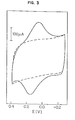
- To study ferricyanide anion (FCN) release from polypyrrole films, the films were deposited from aqueous 0.05 M sodium chloride solutions that were 0.05 M in pyrrole and 0.01-0.03 M in FCN, by anodic oxidation at 0.7 V onto glassy carbon electrodes. The coated electrode was transferred to an aqueous solution containing only the NaCl electrolyte and a typical cyclic voltammogram (film thickness=l uM) is shown in FIG. 3. Well defined waves for the FCN redox couple (solid curve) are superimposed on the large polypyrrole (PP) background. Integration of the peak current gave an estimated value for the amount of electroactive FCN in the polymer as 3.2xlO-8 mol cm-2. The FCN redox waves were stable to cycling within potential range of -0.3 to +0.4 V, and after 17 hr in buffered
pH 7 solution the peak current maintained 94% of its initial height. Stepping the potential for ca. 2 min to -1.0 V caused a dramatic change in the voltammetric response of the film. The redox couple of FCN at about 0.1 V disappeared (FIG. 3 dashed line) indicating the release of FCN anions during the reduction of the film. - The crucial experiments involved measuring the amount of FCN released and demonstrating that the amounts released could be completely controlled. A four electrode small volume (droplet) cell was constructed employing a ring (Pt)-disc (GC) electrode. The cell structure was otherwise as described in Neurosci. Letters, 35, 101 (1983), the disclosure of which is incorporated by reference herein. The disc had been previously coated with PP/FCN film. A constant potential pulse (-0.8V vs Ag/AgCl) was applied to the disc for 2 min. The ring was then made the working electrode, and by cycling the potential of the ring from -0.1 to +0.6 V, FCN was released as desired. In a control experiment the cell was assembled as usual, but no current was passed. No FCN was found in solution. Hence the release of FCN is triggered by the reduction of the film. No evidence for a spontaneous ion exchange between FCN in the film and other anions in the solution was found.
- In further experiments, the amount of FCN released was quantitated in various film thickness. The results shown in Table I indicate that the amount of released material was proportional to the thickness of the film, when the thickness was less than 1 uM.

- It was also of interest to apply short pulses to GC/PP/FCN and to check the amount of the released material to demonstrate quantitative control. Using the small volume cell (50uL, 0.1M NaCl) the coated disc was pulsed for 1 sec (at -0.8 V). After each pulse a cyclic voltammogram (CV) using the ring was taken. In this way the profile of FCN concentration as a function of time was obtained. The results are shown in FIG. 4. The peak current from released FCN is plotted vs the number of pulses for different thickness of films. The amount of the released FCN increased to a constant value after about twelve pulses and the total amount of the released FCN after these twelve one-second pulses was in agreement with the amount found previously for a 2 min. pulse.
- The results of Examples I and II clearly demonstrate that a polymeric film can be electrically controlled to intermittently release controlled amounts of the ionically-bound counteranions.
- A cyclic voltammogram (CV) of 1.34 mM 3-methoxythiophene in H20-CH3CN (3:1) containing 0.01 M NaCl04 at a glassy carbon disk (A = 0.090 cm2) at a scan rate of 100 mVs-1 exhibits an irreversible wave at +1.32 V (SCE). Constant potential oxidation of a 35.0 mM solution of 3-methoxythiophene at +1.30V (SCE) in the same electrolyte for 10 sec. (Q = 7.21 mC) resulted in the formation of a film on the electrode surface. This coated electrode was removed from the coating solution, dipped several times in water, and introduced into an aqueous 0.01 M NaCl04 solution. After 5-10 cycles between +0.80 and -0.50 V, reproducible steady-state cyclic voltammograms were recorded. As is the case with polythiophene and several of its derivatives, one oxidative wave and two rather broad reduction waves are observed, albeit at potentials nearly 700 mV less positive than those for polythiophene. As the scan rate was increased from 20 to 200 mVs-1, the peak potential for the oxidative wave (Epa) increased from 310 to 420 mV, the peak current divided by the scan rate decreased from 2.375 to 1.568 uAs(mV)-l, and the charge of the oxidative peak decreased from 0.529 to 0.472 mC.
- Films of polymerized 3-methoxythiophene with varying thicknesses were prepared by varying the oxidation time. Both the oxidized and reduced states of polymerized 3-methoxythiophene are quite stable in the presence of oxygen and water. CVs of either film in aqueous C104- are virtually identical before and after exposure to air for periods of 6-12 hr or after repeated cycling between +0.80 and -0.50 V. After 40 cycles in this potential range, only a 5% decrease in Q was observed. Surprisingly, it was found that the reduced film of polymerized 3-methoxythiophene, which is green in reflected light, is quite soluble in CH3CN, CH2Cl2, acetone and DMF, forming deep red solutions. The oxidized form, which appears gold in reflected light, is not very soluble in CH3CN, CH2C12, and acetone, but can be dissolved in DMF giving a deep blue solution.
- The appreciable solubility of polymerized 3-methoxythiophene provides for the first time an alternate method for preparing films of this material. The processability of the polymer was demonstrated by dissolving the reduced film in CH2Cl2 and coating a glassy carbon electrode with the polymer by evaporation of the solvent. The electrochemical response of the coated polymer was essentially identical to that achieved before dissolution. CVs of films with varying thicknesses prepared in this manner were recorded in 2:1 H20-CH3CN containing 0.01 M NaCl04. From the Q of the oxidative wave taken with the assumption that the film is poly(3-methoxythiophene), the percentage of thiophene units in the film that are charged (e.g., level of doping) was calculated. The percentage decreased from 15 to 9 as the ug of polymer per cm2 is increased from 21.6 to 140. A doping level of 25% has been reported for poly(3-methylthiophene) based upon elemental analysis by G. Tourillon et al., in J. Electroanal. Chem., 161, 51 (1984).
- Polymerized 3-methoxythiophene was successfully employed as a vehicle for delivery of negatively charged drugs. The CV indicates that the polymer can be doped with the neurotransmitter glutamate as the counterion, but at a lower level than with perchlorate.
- To demonstrate that polymerized 3-methoxythiophene can load and unload glutamate by electrochemical pulsing, a glassy carbon rod with a surface area of 10.8 cm2 was coated with the oxidized film to a capacity of 463 mC cm-2. The coated electrode was dipped in water and transferred to an aqueous 0.10 M glutamate solution where sequential potentials of -0.50, +0.80, -0.50, and +0.80 V were applied, each for 30 sec. This pulsing procedure replaces (at least in part) perchlorate in the film with glutamate. The oxidized electrode was removed, dipped in water, and washed by dipping in an aqueous solution of 0.10 M NaCl04 (Solution A) for two minutes. The coated electrode was transferred to a second aqueous solution of 0.10 M NaCl04 (Solution B) for another two-minute period. For the electrochemical unloading of glutamate, the coated electrode was transferred to a third aqueous 0.10 M NaCl04 solution (Solution C) which occupied the center compartment of a three-compartment cell. The compartments each contained 0.10 M NaCl04 and were separated by a glass frit and an aqueous agar (0.50 M NaCl04). A carbon sponge served as the counter electrode in the second compartment and the SCE reference electrode occupied the third compartment.
- The potential of the coated electrode was pulsed at -0.50 V and back to +0.80 V as in the glutamate solution. The electrode was dipped in water and returned to the glutamate solution for reloading. This loading- unloading procedure was carried out a total of four times. Then, using an amino acid analyzer, solutions A, B, and C were found to contain 101, 12, and 224 ug of sodium glutamate, respectively. The data show that some glutamate is weakly bound and easily washed from the film. A larger quantity, however, is more strongly bound, and is only released by reduction of the film. Thus, polymerized 3-methoxythiophene can be used to deliver glutamate and the coated electrode can be readily reloaded. Furthermore, taking into account differences in electrode surface area, the average amount of glutamate released in each loading- unloading sequence was nearly 200 times greater than the amount of glutamate that was released from polystyrene polymers containing covalently bound glutamic acid.
- This example indicates that polymerized 3-methoxythiophene satisfies the criteria for a useful drug delivery material. Furthermore, its solubility makes this material processable, in that coatings of the polymer can be applied to conductive substrates by applying solutions thereof and evaporating the carrier solvent.
- It is expected that a wide variety conductive polymers can be prepared and employed for the controlled release of ionic organic pharmaceuticals of varying structure using techniques such as those set forth in the present Examples.
- Although the invention has been described with reference to various specific and preferred embodiments and techniques, it should be understood that many variations and modifications may be made while remaining within the spirit and scope of the invention.
Claims (20)
Priority Applications (1)
| Application Number | Priority Date | Filing Date | Title |
|---|---|---|---|
| AT85850366T ATE79745T1 (en) | 1984-11-19 | 1985-11-15 | SYSTEM FOR ELECTROCHEMICALLY CONTROLLED DRUG DELIVERY. |
Applications Claiming Priority (2)
| Application Number | Priority Date | Filing Date | Title |
|---|---|---|---|
| US06/673,522 US4585652A (en) | 1984-11-19 | 1984-11-19 | Electrochemical controlled release drug delivery system |
| US673522 | 1984-11-19 |
Publications (3)
| Publication Number | Publication Date |
|---|---|
| EP0182765A2 true EP0182765A2 (en) | 1986-05-28 |
| EP0182765A3 EP0182765A3 (en) | 1989-02-01 |
| EP0182765B1 EP0182765B1 (en) | 1992-08-26 |
Family
ID=24702999
Family Applications (1)
| Application Number | Title | Priority Date | Filing Date |
|---|---|---|---|
| EP85850366A Expired - Lifetime EP0182765B1 (en) | 1984-11-19 | 1985-11-15 | Electrochemical controlled release drug delivery system |
Country Status (6)
| Country | Link |
|---|---|
| US (1) | US4585652A (en) |
| EP (1) | EP0182765B1 (en) |
| JP (1) | JPS61196967A (en) |
| AT (1) | ATE79745T1 (en) |
| CA (1) | CA1266887A (en) |
| DE (1) | DE3586560T2 (en) |
Cited By (4)
| Publication number | Priority date | Publication date | Assignee | Title |
|---|---|---|---|---|
| US7206458B2 (en) | 2001-12-14 | 2007-04-17 | Stmicroelectronics, S.R.L. | Method of compressing digital images acquired in CFA format |
| US8834901B2 (en) | 2004-10-14 | 2014-09-16 | Trustees Of Tufts College | Electrochemically degradable polymers |
| WO2019068288A1 (en) * | 2017-10-04 | 2019-04-11 | Berlimed International Research Gmbh | ACTIVE AND ACTIVE MATRIX-CONTAINING PRODUCT FOR THE TRANSDERMAL ACTIVE SUBSTANCE, AND ITS MANUFACTURE AND USE, AND THE ACTIVE MATRIX, THEIR PREPARATION AND USE |
| US10518073B2 (en) | 2006-06-15 | 2019-12-31 | Polypharma Pty Ltd | Delivery system and process |
Families Citing this family (211)
| Publication number | Priority date | Publication date | Assignee | Title |
|---|---|---|---|---|
| EP0280155B1 (en) * | 1987-02-25 | 1992-05-20 | Hoechst Aktiengesellschaft | Microencapsulation of biologically active material |
| WO1989006989A1 (en) * | 1988-01-29 | 1989-08-10 | The Regents Of The University Of California | Iontophoretic non-invasive sampling or delivery device |
| US5362307A (en) | 1989-01-24 | 1994-11-08 | The Regents Of The University Of California | Method for the iontophoretic non-invasive-determination of the in vivo concentration level of an inorganic or organic substance |
| CA1322169C (en) * | 1988-04-22 | 1993-09-14 | Hiroshi Yamazaki | Ionic dressing of topical administration of drugs to wounds and burns |
| US5057072A (en) * | 1988-10-28 | 1991-10-15 | Medtronic, Inc. | Iontophoresis electrode |
| CA2001444C (en) * | 1988-10-28 | 2000-07-25 | Darrel F. Untereker | Iontophoresis electrode |
| IT1229203B (en) * | 1989-03-22 | 1991-07-25 | Bioresearch Spa | USE OF 5 METHYLTHETRAHYDROPHOLIC ACID, 5 FORMYLTHETRAHYDROPHOLIC ACID AND THEIR PHARMACEUTICALLY ACCEPTABLE SALTS FOR THE PREPARATION OF PHARMACEUTICAL COMPOSITIONS IN THE FORM OF CONTROLLED RELEASE ACTIVE IN THE THERAPY OF MENTAL AND ORGANIC DISORDERS. |
| AU657681B2 (en) * | 1990-03-30 | 1995-03-23 | Alza Corporation | Device and method for iontophoretic drug delivery |
| US5098417A (en) * | 1990-04-12 | 1992-03-24 | Ricoh Kyosan, Inc. | Cellulosic wound dressing with an active agent ionically absorbed thereon |
| US5431625A (en) * | 1991-02-01 | 1995-07-11 | Empi, Inc. | Iontophoresis electronic device having a ramped output current |
| US5208154A (en) * | 1991-04-08 | 1993-05-04 | The United States Of America As Represented By The Department Of Energy | Reversibly immobilized biological materials in monolayer films on electrodes |
| US5356632A (en) * | 1991-09-12 | 1994-10-18 | S.I. Scientific Innovations Ltd. | Transdermal drug delivery device |
| DE4293451T1 (en) * | 1991-09-13 | 1994-09-08 | Gillette Canada | Polymer particles for dental applications |
| CA2087087C (en) * | 1992-01-22 | 2000-07-18 | Burton H. Sage, Jr. | Molecules for iontophoretic delivery |
| US5272217A (en) * | 1992-03-12 | 1993-12-21 | Regents Of The University Of Minnesota | Anisotropic polymers |
| US5429822A (en) * | 1992-03-13 | 1995-07-04 | Cambridge Scientific, Inc. | Biodegradable bursting release system |
| US5423956A (en) * | 1993-07-01 | 1995-06-13 | Regents Of The University Of Minnesota | Electrochemical process for the production of conducting polymer fibers |
| US5536263A (en) * | 1994-03-30 | 1996-07-16 | Lectec Corporation | Non-occulusive adhesive patch for applying medication to the skin |
| AU2286995A (en) * | 1994-04-08 | 1995-10-30 | Alza Corporation | Electrotransport system with ion exchange competitive ion capture |
| US5871460A (en) * | 1994-04-08 | 1999-02-16 | Alza Corporation | Electrotransport system with ion exchange material providing enhanced drug delivery |
| WO1996004340A1 (en) * | 1994-08-04 | 1996-02-15 | Gordon George Wallace | Conducting electroactive biomaterials |
| US5551953A (en) * | 1994-10-31 | 1996-09-03 | Alza Corporation | Electrotransport system with remote telemetry link |
| US5861431A (en) * | 1995-06-07 | 1999-01-19 | Iotek, Inc. | Incontinence treatment |
| US5635209A (en) * | 1995-10-31 | 1997-06-03 | Vintage Pharmaceuticals, Inc. | Stabilized composition of levothyroxine sodium medication and method for its production |
| US5605616A (en) * | 1995-11-06 | 1997-02-25 | Versicor, Inc. | Reversible charge-based sequestration on solid support |
| WO1997027844A1 (en) | 1996-01-30 | 1997-08-07 | Novagent Oy | Composition for transdermal delivery of drugs |
| FI962461L (en) * | 1996-06-13 | 1997-12-14 | Novagent Oy | Method and pharmaceutical composition for transdermal drug delivery |
| US7070590B1 (en) * | 1996-07-02 | 2006-07-04 | Massachusetts Institute Of Technology | Microchip drug delivery devices |
| US5797898A (en) * | 1996-07-02 | 1998-08-25 | Massachusetts Institute Of Technology | Microchip drug delivery devices |
| GB9702277D0 (en) * | 1997-02-04 | 1997-03-26 | Innes John Centre | Modified electrodes and their use |
| US6295474B1 (en) | 1998-03-13 | 2001-09-25 | Intermedics Inc. | Defibrillator housing with conductive polymer coating |
| US7713297B2 (en) * | 1998-04-11 | 2010-05-11 | Boston Scientific Scimed, Inc. | Drug-releasing stent with ceramic-containing layer |
| US7658727B1 (en) | 1998-04-20 | 2010-02-09 | Medtronic, Inc | Implantable medical device with enhanced biocompatibility and biostability |
| AU766913B2 (en) | 1998-11-02 | 2003-10-23 | Alza Corporation | Electrotransport device including a compatible antimicrobial agent |
| EP1154691A4 (en) * | 1999-01-05 | 2004-07-07 | Massachusetts Eye & Ear Infirm | Targeted transscleral controlled release drug delivery to the retina and choroid |
| DE60031248T2 (en) * | 1999-02-18 | 2007-05-24 | Biovalve Technologies, Inc., North Grafton | ELECTROACTIVE PORE |
| SE9902474D0 (en) * | 1999-06-30 | 1999-06-30 | Amersham Pharm Biotech Ab | Polymer valves |
| US6969382B2 (en) | 1999-07-26 | 2005-11-29 | Zuli Holdings, Ltd. | Method and apparatus for treating bodily tissues with medicinal substance |
| US6334859B1 (en) | 1999-07-26 | 2002-01-01 | Zuli Holdings Ltd. | Subcutaneous apparatus and subcutaneous method for treating bodily tissues with electricity or medicaments |
| ATE290364T1 (en) | 1999-08-18 | 2005-03-15 | Microchips Inc | THERMALLY ACTIVATED MICROCHIP AS A CHEMICAL DISPENSER DEVICE |
| EP2308522A3 (en) * | 1999-11-17 | 2012-02-29 | Boston Scientific Limited | Microfabricated devices for the delivery of molecules into a carrier fluid |
| AU4842100A (en) | 1999-12-10 | 2001-06-18 | Teri Buseman | Anti pruritic patch |
| ATE323470T1 (en) * | 1999-12-10 | 2006-05-15 | Massachusetts Inst Technology | MICROCHIP DRUG DELIVERY SYSTEMS AND METHODS OF MANUFACTURING |
| US6454759B2 (en) * | 2000-02-28 | 2002-09-24 | The Regents Of The University Of California | Microfabricated injectable drug delivery system |
| DE60144142D1 (en) * | 2000-03-02 | 2011-04-14 | Microchips Inc | MICROMECHANICAL DEVICES AND METHOD FOR THE STORAGE AND SELECTIVE EXPOSURE OF CHEMICALS |
| AU2001265128A1 (en) | 2000-05-30 | 2001-12-11 | Massachusetts Institute Of Technology | Methods and devices for sealing microchip reservoir devices |
| AU2001283357A1 (en) * | 2000-08-14 | 2002-02-25 | Pharmacia Corporation | Drug delivery system with bilayer electrodes |
| AU2001283358A1 (en) * | 2000-08-14 | 2002-02-25 | Pharmacia Corporation | Drug delivery system with burst electrode |
| AU2001283359A1 (en) * | 2000-08-14 | 2002-02-25 | Pharmacia Corporation | Drug release (delivery system) |
| DE60116520T2 (en) * | 2000-10-10 | 2006-08-31 | Microchips, Inc., Bedford | MICROCHIP RESERVOIR DEVICES WITH WIRELESS TRANSMISSION OF ENERGY AND DATA |
| AU2002224453A1 (en) | 2000-10-11 | 2002-04-22 | Microchips, Inc. | Microchip reservoir devices and facilitated corrosion of electrodes |
| US6929636B1 (en) | 2000-11-08 | 2005-08-16 | Hewlett-Packard Development Company, L.P. | Internal drug dispenser capsule medical device |
| US6632175B1 (en) | 2000-11-08 | 2003-10-14 | Hewlett-Packard Development Company, L.P. | Swallowable data recorder capsule medical device |
| KR20040014444A (en) * | 2000-12-23 | 2004-02-14 | 웬 루 | Long-Lived Conjugated Polymer Electrochemical Devices Incorporating Ionic Liquids |
| WO2002055058A2 (en) * | 2001-01-09 | 2002-07-18 | Microchips, Inc. | Flexible microchip devices for ophthalmic and other applications |
| US20030224047A1 (en) * | 2001-02-15 | 2003-12-04 | Franz G. Andrew | Levothyroxine compositions and methods |
| US20030032675A1 (en) * | 2001-02-15 | 2003-02-13 | Franz G. Andrew | Manufacture of thyroid hormone tablets having consistent active moiety amounts |
| US7067148B2 (en) * | 2001-02-15 | 2006-06-27 | King Pharmaceutical Research & Development, Inc. | Stabilized pharmaceutical and thyroid hormone compositions and method of preparation |
| US6555581B1 (en) | 2001-02-15 | 2003-04-29 | Jones Pharma, Inc. | Levothyroxine compositions and methods |
| CA2443326A1 (en) * | 2001-04-04 | 2002-10-17 | Alza Corporation | Transdermal electrotransport delivery device including an antimicrobial compatible reservoir composition |
| EP1387671A1 (en) | 2001-05-03 | 2004-02-11 | MASSACHUSETTS EYE & EAR INFIRMARY | Implantable drug delivery device and use thereof |
| US6973718B2 (en) * | 2001-05-30 | 2005-12-13 | Microchips, Inc. | Methods for conformal coating and sealing microchip reservoir devices |
| WO2002099457A1 (en) | 2001-05-31 | 2002-12-12 | Massachusetts Inst Technology | Microchip devices with improved reservoir opening |
| AU2002345328A1 (en) | 2001-06-27 | 2003-03-03 | Remon Medical Technologies Ltd. | Method and device for electrochemical formation of therapeutic species in vivo |
| US6827250B2 (en) * | 2001-06-28 | 2004-12-07 | Microchips, Inc. | Methods for hermetically sealing microchip reservoir devices |
| US20030190349A1 (en) * | 2001-08-10 | 2003-10-09 | Franz G. Andrew | Methods of stabilizing pharmaceutical compositions |
| US20030198667A1 (en) * | 2001-08-10 | 2003-10-23 | Franz Andrew G. | Methods of producing dispersible pharmaceutical compositions |
| US20030180353A1 (en) * | 2001-08-10 | 2003-09-25 | Franz G. Andrew | Stabilized pharmaceutical compositions |
| US7101569B2 (en) | 2001-08-14 | 2006-09-05 | Franz G Andrew | Methods of administering levothyroxine pharmaceutical compositions |
| US20030199587A1 (en) * | 2001-08-14 | 2003-10-23 | Franz G. Andrew | Levothyroxine compositions having unique Cmax properties |
| US20030195253A1 (en) * | 2001-08-14 | 2003-10-16 | Franz G. Andrew | Unadsorbed levothyroxine pharmaceutical compositions, methods of making and methods of administration |
| US20030198672A1 (en) * | 2001-08-14 | 2003-10-23 | Franz G. Andrew | Levothyroxine compositions having unique triidothyronine plasma AUC properties |
| US20030199586A1 (en) * | 2001-08-14 | 2003-10-23 | Franz G. Andrew | Unique levothyroxine aqueous materials |
| US20030203967A1 (en) * | 2001-08-14 | 2003-10-30 | Franz G. Andrew | Levothyroxine compositions having unique Tmax properties |
| US6949763B2 (en) * | 2001-10-11 | 2005-09-27 | Marc Ovadia | Semiconductor and non-semiconductor non-diffusion-governed bioelectrodes |
| US20030180356A1 (en) * | 2001-10-29 | 2003-09-25 | Franz G. Andrew | Levothyroxine compositions having unique triiodothyronine Tmax properties |
| WO2003092665A2 (en) * | 2002-05-02 | 2003-11-13 | Massachusetts Eye And Ear Infirmary | Ocular drug delivery systems and use thereof |
| US7687258B1 (en) * | 2002-05-20 | 2010-03-30 | Maki Wusi C | Direct electric biological agent detector |
| DE60336727D1 (en) * | 2002-08-16 | 2011-05-26 | Microchips Inc | DEVICE WITH CONTROLLED DISPENSING AND METHOD |
| AU2003278881A1 (en) * | 2002-09-23 | 2004-04-08 | Microchips, Inc. | Micro-reservoir osmotic release systems and microtube array device |
| US20060167435A1 (en) * | 2003-02-18 | 2006-07-27 | Adamis Anthony P | Transscleral drug delivery device and related methods |
| US6699282B1 (en) * | 2003-03-06 | 2004-03-02 | Gelsus Research And Consulting, Inc. | Method and apparatus for delivery of medication |
| US20050055014A1 (en) * | 2003-08-04 | 2005-03-10 | Coppeta Jonathan R. | Methods for accelerated release of material from a reservoir device |
| US8095197B2 (en) * | 2003-11-03 | 2012-01-10 | Microchips, Inc. | Medical device for sensing glucose |
| US7662176B2 (en) * | 2004-02-19 | 2010-02-16 | Vomaris Innovations, Inc. | Footwear apparatus and methods of manufacture and use |
| US7457667B2 (en) * | 2004-02-19 | 2008-11-25 | Silverleaf Medical Products, Inc. | Current producing surface for a wound dressing |
| US8101061B2 (en) * | 2004-03-05 | 2012-01-24 | Board Of Regents, The University Of Texas System | Material and device properties modification by electrochemical charge injection in the absence of contacting electrolyte for either local spatial or final states |
| US20050220439A1 (en) * | 2004-03-19 | 2005-10-06 | Carton Owen A | Interactive multimedia system and method |
| US8353896B2 (en) * | 2004-04-19 | 2013-01-15 | The Invention Science Fund I, Llc | Controllable release nasal system |
| US8019413B2 (en) * | 2007-03-19 | 2011-09-13 | The Invention Science Fund I, Llc | Lumen-traveling biological interface device and method of use |
| US20070244520A1 (en) * | 2004-04-19 | 2007-10-18 | Searete Llc | Lumen-traveling biological interface device and method of use |
| US9801527B2 (en) * | 2004-04-19 | 2017-10-31 | Gearbox, Llc | Lumen-traveling biological interface device |
| US9011329B2 (en) * | 2004-04-19 | 2015-04-21 | Searete Llc | Lumenally-active device |
| US7850676B2 (en) * | 2004-04-19 | 2010-12-14 | The Invention Science Fund I, Llc | System with a reservoir for perfusion management |
| US7857767B2 (en) * | 2004-04-19 | 2010-12-28 | Invention Science Fund I, Llc | Lumen-traveling device |
| US8092549B2 (en) * | 2004-09-24 | 2012-01-10 | The Invention Science Fund I, Llc | Ciliated stent-like-system |
| US8337482B2 (en) * | 2004-04-19 | 2012-12-25 | The Invention Science Fund I, Llc | System for perfusion management |
| US7998060B2 (en) * | 2004-04-19 | 2011-08-16 | The Invention Science Fund I, Llc | Lumen-traveling delivery device |
| US8361013B2 (en) * | 2004-04-19 | 2013-01-29 | The Invention Science Fund I, Llc | Telescoping perfusion management system |
| EP1765455A2 (en) * | 2004-06-01 | 2007-03-28 | Microchips, Inc. | Devices and methods for measuring and enhancing drug or analyte transport to/from medical implant |
| WO2006015299A2 (en) * | 2004-07-30 | 2006-02-09 | Microchips, Inc. | Multi-reservoir device for transdermal drug delivery and sensing |
| JP5107041B2 (en) | 2004-09-01 | 2012-12-26 | マイクロチップス・インコーポレーテッド | Multi-cap reservoir device for controlled release or exposure of reservoir contents |
| US20060095001A1 (en) * | 2004-10-29 | 2006-05-04 | Transcutaneous Technologies Inc. | Electrode and iontophoresis device |
| JP5107716B2 (en) | 2004-11-05 | 2012-12-26 | ザ・チルドレンズ・ホスピタル・オブ・フィラデルフィア | Biodegradable linker for molecular therapy |
| US20060135906A1 (en) * | 2004-11-16 | 2006-06-22 | Akihiko Matsumura | Iontophoretic device and method for administering immune response-enhancing agents and compositions |
| WO2006081279A2 (en) * | 2005-01-25 | 2006-08-03 | Microchips, Inc. | Control of drug release by transient modification of local microenvironments |
| US20080076975A1 (en) * | 2005-01-25 | 2008-03-27 | Microchips, Inc. | Method and implantable device with reservoir array for pre-clinical in vivo testing |
| RU2007143298A (en) * | 2005-04-22 | 2009-05-27 | Экпойнт Медикал Инк. (Us) | THERAPEUTIC TREATMENT OF DC FABRIC |
| JP2006334164A (en) * | 2005-06-02 | 2006-12-14 | Transcutaneous Technologies Inc | Iontophoresis apparatus and method for controlling the same |
| JP2006346368A (en) * | 2005-06-20 | 2006-12-28 | Transcutaneous Technologies Inc | Iontophoresis apparatus and manufacturing method |
| JP2009500609A (en) * | 2005-06-30 | 2009-01-08 | アプレラ コーポレーション | Porous composite electrode containing conductive polymer |
| US20070175768A1 (en) * | 2005-06-30 | 2007-08-02 | Applera Corporation | Microfluidic systems including porous polymer electrodes |
| JPWO2007010900A1 (en) * | 2005-07-15 | 2009-01-29 | Tti・エルビュー株式会社 | Patch for percutaneous absorption with ion position display function and iontophoresis device |
| JP2007037868A (en) * | 2005-08-05 | 2007-02-15 | Transcutaneous Technologies Inc | Transdermal administration device and its controlling method |
| KR20080033429A (en) * | 2005-08-08 | 2008-04-16 | 트란스큐 리미티드 | Iontophoresis device |
| US8295922B2 (en) * | 2005-08-08 | 2012-10-23 | Tti Ellebeau, Inc. | Iontophoresis device |
| US8386030B2 (en) * | 2005-08-08 | 2013-02-26 | Tti Ellebeau, Inc. | Iontophoresis device |
| US20070060860A1 (en) * | 2005-08-18 | 2007-03-15 | Transcutaneous Technologies Inc. | Iontophoresis device |
| WO2007026672A1 (en) * | 2005-08-29 | 2007-03-08 | Transcu Ltd. | General-purpose electrolyte composition for iontophoresis |
| US9084546B2 (en) | 2005-08-31 | 2015-07-21 | The Regents Of The University Of Michigan | Co-electrodeposited hydrogel-conducting polymer electrodes for biomedical applications |
| US8005526B2 (en) * | 2005-08-31 | 2011-08-23 | The Regents Of The University Of Michigan | Biologically integrated electrode devices |
| WO2007029611A1 (en) * | 2005-09-06 | 2007-03-15 | Tti Ellebeau, Inc. | Iontophoresis device |
| US20070112294A1 (en) * | 2005-09-14 | 2007-05-17 | Transcutaneous Technologies Inc. | Iontophoresis device |
| KR20080047600A (en) * | 2005-09-15 | 2008-05-29 | 티티아이 엘뷰 가부시키가이샤 | Rod type iontophoresis device |
| KR20080056200A (en) * | 2005-09-16 | 2008-06-20 | 티티아이 엘뷰 가부시키가이샤 | Catheter type iontophoresis device |
| US20070071807A1 (en) * | 2005-09-28 | 2007-03-29 | Hidero Akiyama | Capsule-type drug-releasing device and capsule-type drug-releasing device system |
| JPWO2007037324A1 (en) * | 2005-09-28 | 2009-04-09 | Tti・エルビュー株式会社 | Electrode structure for dry iontophoresis |
| EP1928542A1 (en) * | 2005-09-30 | 2008-06-11 | Tti Ellebeau, Inc. | Method and system to detect malfunctions in an iontophoresis device that delivers active agents to biological interfaces |
| US20070078376A1 (en) * | 2005-09-30 | 2007-04-05 | Smith Gregory A | Functionalized microneedles transdermal drug delivery systems, devices, and methods |
| US20070232983A1 (en) * | 2005-09-30 | 2007-10-04 | Smith Gregory A | Handheld apparatus to deliver active agents to biological interfaces |
| US20070078375A1 (en) * | 2005-09-30 | 2007-04-05 | Transcutaneous Technologies Inc. | Iontophoretic delivery of active agents conjugated to nanoparticles |
| US20070078445A1 (en) * | 2005-09-30 | 2007-04-05 | Curt Malloy | Synchronization apparatus and method for iontophoresis device to deliver active agents to biological interfaces |
| US20090299265A1 (en) * | 2005-09-30 | 2009-12-03 | Tti Ellebeau, Inc. | Electrode Assembly for Iontophoresis Having Shape-Memory Separator and Iontophoresis Device Using the Same |
| EP1944057A4 (en) * | 2005-09-30 | 2009-02-18 | Tti Ellebeau Inc | Iontophoresis apparatus capable of controlling dose and timing of administration of sleep inducer and analeptic agent |
| US20070197955A1 (en) * | 2005-10-12 | 2007-08-23 | Transcutaneous Technologies Inc. | Mucous membrane adhesion-type iontophoresis device |
| US20080033338A1 (en) * | 2005-12-28 | 2008-02-07 | Smith Gregory A | Electroosmotic pump apparatus and method to deliver active agents to biological interfaces |
| US20080033398A1 (en) * | 2005-12-29 | 2008-02-07 | Transcutaneous Technologies Inc. | Device and method for enhancing immune response by electrical stimulation |
| EP1965858A2 (en) * | 2005-12-30 | 2008-09-10 | Tti Ellebeau, Inc. | System and method for remote based control of an iontophoresis device |
| US8840660B2 (en) | 2006-01-05 | 2014-09-23 | Boston Scientific Scimed, Inc. | Bioerodible endoprostheses and methods of making the same |
| US8089029B2 (en) | 2006-02-01 | 2012-01-03 | Boston Scientific Scimed, Inc. | Bioabsorbable metal medical device and method of manufacture |
| US8036738B2 (en) | 2006-03-14 | 2011-10-11 | New Jersey Institute Of Technology | Iontophoretic transdermal drug delivery system based on conductive polyaniline membrane |
| US20070224235A1 (en) | 2006-03-24 | 2007-09-27 | Barron Tenney | Medical devices having nanoporous coatings for controlled therapeutic agent delivery |
| US8187620B2 (en) | 2006-03-27 | 2012-05-29 | Boston Scientific Scimed, Inc. | Medical devices comprising a porous metal oxide or metal material and a polymer coating for delivering therapeutic agents |
| US20080004564A1 (en) * | 2006-03-30 | 2008-01-03 | Transcutaneous Technologies Inc. | Controlled release membrane and methods of use |
| US8048150B2 (en) | 2006-04-12 | 2011-11-01 | Boston Scientific Scimed, Inc. | Endoprosthesis having a fiber meshwork disposed thereon |
| US9408530B2 (en) | 2006-04-12 | 2016-08-09 | Gearbox, Llc | Parameter-based navigation by a lumen traveling device |
| US20070275035A1 (en) * | 2006-05-24 | 2007-11-29 | Microchips, Inc. | Minimally Invasive Medical Implant Devices for Controlled Drug Delivery |
| US20100016957A1 (en) * | 2006-05-26 | 2010-01-21 | Edwin Jager | Device and method for controlled delivery of chemical substances |
| US8815275B2 (en) | 2006-06-28 | 2014-08-26 | Boston Scientific Scimed, Inc. | Coatings for medical devices comprising a therapeutic agent and a metallic material |
| US8771343B2 (en) | 2006-06-29 | 2014-07-08 | Boston Scientific Scimed, Inc. | Medical devices with selective titanium oxide coatings |
| EP2054537A2 (en) | 2006-08-02 | 2009-05-06 | Boston Scientific Scimed, Inc. | Endoprosthesis with three-dimensional disintegration control |
| US8936794B2 (en) * | 2006-08-25 | 2015-01-20 | The Regents Of The University Of Michigan | Conducting polymer nanotube actuators for precisely controlled release of medicine and bioactive molecules |
| CN101528300A (en) * | 2006-09-05 | 2009-09-09 | Tti优而美株式会社 | Transdermal drug delivery systems, devices, and methods using inductive power supplies |
| ATE508708T1 (en) | 2006-09-14 | 2011-05-15 | Boston Scient Ltd | MEDICAL DEVICES WITH A DRUG-RELEASING COATING |
| EP2121068B1 (en) | 2006-09-15 | 2010-12-08 | Boston Scientific Scimed, Inc. | Bioerodible endoprosthesis with biostable inorganic layers |
| EP2959925B1 (en) | 2006-09-15 | 2018-08-29 | Boston Scientific Limited | Medical devices and methods of making the same |
| JP2010503494A (en) * | 2006-09-15 | 2010-02-04 | ボストン サイエンティフィック リミテッド | Biodegradable endoprosthesis and method for producing the same |
| CA2663250A1 (en) | 2006-09-15 | 2008-03-20 | Boston Scientific Limited | Bioerodible endoprostheses and methods of making the same |
| US8002821B2 (en) | 2006-09-18 | 2011-08-23 | Boston Scientific Scimed, Inc. | Bioerodible metallic ENDOPROSTHESES |
| US7981150B2 (en) | 2006-11-09 | 2011-07-19 | Boston Scientific Scimed, Inc. | Endoprosthesis with coatings |
| US8332028B2 (en) * | 2006-11-28 | 2012-12-11 | Polyplus Battery Company | Protected lithium electrodes for electro-transport drug delivery |
| US20080122582A1 (en) * | 2006-11-29 | 2008-05-29 | Texas Instruments Incorporated | Location Based Portable Device Feature Disabler |
| KR20090106492A (en) * | 2006-12-01 | 2009-10-09 | 티티아이 엘뷰 가부시키가이샤 | Systems, devices, and methods for providing or controlling power to devices such as transdermal delivery devices |
| CA2674195A1 (en) | 2006-12-28 | 2008-07-10 | Boston Scientific Limited | Bioerodible endoprostheses and methods of making same |
| US8431149B2 (en) | 2007-03-01 | 2013-04-30 | Boston Scientific Scimed, Inc. | Coated medical devices for abluminal drug delivery |
| US8070797B2 (en) | 2007-03-01 | 2011-12-06 | Boston Scientific Scimed, Inc. | Medical device with a porous surface for delivery of a therapeutic agent |
| US8067054B2 (en) | 2007-04-05 | 2011-11-29 | Boston Scientific Scimed, Inc. | Stents with ceramic drug reservoir layer and methods of making and using the same |
| AU2008254748A1 (en) * | 2007-05-18 | 2008-11-27 | Tti Ellebeau, Inc. | Transdermal delivery devices assuring an improved release of an active principle through a biological interface |
| US7976915B2 (en) | 2007-05-23 | 2011-07-12 | Boston Scientific Scimed, Inc. | Endoprosthesis with select ceramic morphology |
| DE102008025525A1 (en) * | 2007-05-29 | 2008-12-18 | Textilforschungsinstitut Thüringen-Vogtland e.V. | Electrically conductive thread for active ingredient storage and release, involves metallizing electrical nonconductive thread filament, and applying loading on metallized thread filament |
| EP1997952B1 (en) * | 2007-05-29 | 2013-08-07 | Textilforschungsinstitut Thüringen-Vogtland e.V. | Textile structure for a transdermal active ingredient reservoir |
| ES2395877T3 (en) * | 2007-06-19 | 2013-02-15 | Rynel, Inc. | Materials comprising water soluble polymer particles and methods for preparing and using them |
| WO2009006349A2 (en) * | 2007-06-29 | 2009-01-08 | Polyplus Battery Company | Electrotransport devices, methods and drug electrode assemblies |
| US20090012446A1 (en) * | 2007-07-03 | 2009-01-08 | Xinyan Cui | Devices, systems and methods for release of chemical agents |
| US7942926B2 (en) | 2007-07-11 | 2011-05-17 | Boston Scientific Scimed, Inc. | Endoprosthesis coating |
| US8002823B2 (en) | 2007-07-11 | 2011-08-23 | Boston Scientific Scimed, Inc. | Endoprosthesis coating |
| JP2010533563A (en) | 2007-07-19 | 2010-10-28 | ボストン サイエンティフィック リミテッド | Endoprosthesis with adsorption inhibiting surface |
| US8815273B2 (en) | 2007-07-27 | 2014-08-26 | Boston Scientific Scimed, Inc. | Drug eluting medical devices having porous layers |
| US7931683B2 (en) | 2007-07-27 | 2011-04-26 | Boston Scientific Scimed, Inc. | Articles having ceramic coated surfaces |
| US8221822B2 (en) | 2007-07-31 | 2012-07-17 | Boston Scientific Scimed, Inc. | Medical device coating by laser cladding |
| JP2010535541A (en) | 2007-08-03 | 2010-11-25 | ボストン サイエンティフィック リミテッド | Coating for medical devices with large surface area |
| US20090069740A1 (en) * | 2007-09-07 | 2009-03-12 | Polyplus Battery Company | Protected donor electrodes for electro-transport drug delivery |
| US8052745B2 (en) | 2007-09-13 | 2011-11-08 | Boston Scientific Scimed, Inc. | Endoprosthesis |
| US8216632B2 (en) | 2007-11-02 | 2012-07-10 | Boston Scientific Scimed, Inc. | Endoprosthesis coating |
| US7938855B2 (en) | 2007-11-02 | 2011-05-10 | Boston Scientific Scimed, Inc. | Deformable underlayer for stent |
| US8029554B2 (en) | 2007-11-02 | 2011-10-04 | Boston Scientific Scimed, Inc. | Stent with embedded material |
| JP5474831B2 (en) * | 2008-02-08 | 2014-04-16 | テルモ株式会社 | Bioactive substance intraluminal controlled drug delivery device and method for producing the same |
| EP2271380B1 (en) | 2008-04-22 | 2013-03-20 | Boston Scientific Scimed, Inc. | Medical devices having a coating of inorganic material |
| WO2009132176A2 (en) | 2008-04-24 | 2009-10-29 | Boston Scientific Scimed, Inc. | Medical devices having inorganic particle layers |
| US20090292325A1 (en) | 2008-05-02 | 2009-11-26 | Cederna Paul S | Hybrid bioelectrical interface device |
| US7998192B2 (en) | 2008-05-09 | 2011-08-16 | Boston Scientific Scimed, Inc. | Endoprostheses |
| US8236046B2 (en) | 2008-06-10 | 2012-08-07 | Boston Scientific Scimed, Inc. | Bioerodible endoprosthesis |
| US8449603B2 (en) | 2008-06-18 | 2013-05-28 | Boston Scientific Scimed, Inc. | Endoprosthesis coating |
| EP2326305A1 (en) * | 2008-06-20 | 2011-06-01 | Boston Scientific Scimed, Inc. | Medical devices employing conductive polymers for delivery of therapeutic agents |
| US7985252B2 (en) | 2008-07-30 | 2011-07-26 | Boston Scientific Scimed, Inc. | Bioerodible endoprosthesis |
| EP2326360A2 (en) * | 2008-08-22 | 2011-06-01 | Boston Scientific Scimed, Inc. | Medical devices having a coating for electromagnetically-controlled release of therapeutic agents |
| US20100069877A1 (en) * | 2008-09-10 | 2010-03-18 | Smith Gregory A | Apparatus and method to dispense hpc-based viscous liquids into porous substrates, e.g., continuous web-based process |
| US8382824B2 (en) | 2008-10-03 | 2013-02-26 | Boston Scientific Scimed, Inc. | Medical implant having NANO-crystal grains with barrier layers of metal nitrides or fluorides |
| US8231980B2 (en) | 2008-12-03 | 2012-07-31 | Boston Scientific Scimed, Inc. | Medical implants including iridium oxide |
| US8267992B2 (en) | 2009-03-02 | 2012-09-18 | Boston Scientific Scimed, Inc. | Self-buffering medical implants |
| US8071156B2 (en) | 2009-03-04 | 2011-12-06 | Boston Scientific Scimed, Inc. | Endoprostheses |
| US8287937B2 (en) | 2009-04-24 | 2012-10-16 | Boston Scientific Scimed, Inc. | Endoprosthese |
| TW201121604A (en) * | 2009-06-09 | 2011-07-01 | Tti Ellebeau Inc | Long life high capacity electrode, device, and method of manufacture |
| US8744568B2 (en) * | 2009-12-22 | 2014-06-03 | Boston Scientific Scimed, Inc. | Medical device with electroactive polymer powered by photovoltaic cell |
| WO2011119573A1 (en) | 2010-03-23 | 2011-09-29 | Boston Scientific Scimed, Inc. | Surface treated bioerodible metal endoprostheses |
| US9808616B2 (en) | 2011-01-14 | 2017-11-07 | The Regents Of The University Of Michigan | Regenerative peripheral nerve interface |
| US9713702B2 (en) | 2011-03-14 | 2017-07-25 | The Board Of Trustee Of The Leland Stanford Junior University | Methods of electric field induced delivery of compounds, compositions used in delivery, and systems of delivery |
| US20150238758A1 (en) * | 2012-09-25 | 2015-08-27 | Sorin Crm Sas | Device for electrochemically releasing a composition in a controlled manner |
| EP3030286B1 (en) | 2013-08-05 | 2019-10-09 | Cam Med LLC | Conformable patch pump |
| US10314725B2 (en) | 2014-11-13 | 2019-06-11 | The Regents Of The University Of Michigan | Method for amplifying signals from individual nerve fascicles |
| KR20230159878A (en) | 2021-05-20 | 2023-11-22 | 이 잉크 코포레이션 | Beneficial agent delivery system using electroplating |
Family Cites Families (5)
| Publication number | Priority date | Publication date | Assignee | Title |
|---|---|---|---|---|
| US3991755A (en) * | 1973-07-27 | 1976-11-16 | Medicon, Inc. | Iontophoresis apparatus for applying local anesthetics |
| DE2626294C3 (en) * | 1976-06-11 | 1980-01-10 | Siemens Ag, 1000 Berlin Und 8000 Muenchen | Implantable dosing device |
| DE3169529D1 (en) * | 1980-07-24 | 1985-05-02 | Secr Defence Brit | Adsorption onto charcoal cloth |
| EP0060452B1 (en) * | 1981-03-05 | 1985-10-23 | Medtronic, Inc. | Iontophoretic device |
| US4506680A (en) * | 1983-03-17 | 1985-03-26 | Medtronic, Inc. | Drug dispensing body implantable lead |
-
1984
- 1984-11-19 US US06/673,522 patent/US4585652A/en not_active Expired - Fee Related
-
1985
- 1985-11-15 AT AT85850366T patent/ATE79745T1/en not_active IP Right Cessation
- 1985-11-15 EP EP85850366A patent/EP0182765B1/en not_active Expired - Lifetime
- 1985-11-15 DE DE8585850366T patent/DE3586560T2/en not_active Expired - Fee Related
- 1985-11-18 JP JP60256823A patent/JPS61196967A/en active Granted
- 1985-11-18 CA CA000495562A patent/CA1266887A/en not_active Expired
Cited By (5)
| Publication number | Priority date | Publication date | Assignee | Title |
|---|---|---|---|---|
| US7206458B2 (en) | 2001-12-14 | 2007-04-17 | Stmicroelectronics, S.R.L. | Method of compressing digital images acquired in CFA format |
| US7440631B2 (en) | 2001-12-14 | 2008-10-21 | Stmicroelectronics, S.R.L. | Method of compressing digital images acquired in CFA format |
| US8834901B2 (en) | 2004-10-14 | 2014-09-16 | Trustees Of Tufts College | Electrochemically degradable polymers |
| US10518073B2 (en) | 2006-06-15 | 2019-12-31 | Polypharma Pty Ltd | Delivery system and process |
| WO2019068288A1 (en) * | 2017-10-04 | 2019-04-11 | Berlimed International Research Gmbh | ACTIVE AND ACTIVE MATRIX-CONTAINING PRODUCT FOR THE TRANSDERMAL ACTIVE SUBSTANCE, AND ITS MANUFACTURE AND USE, AND THE ACTIVE MATRIX, THEIR PREPARATION AND USE |
Also Published As
| Publication number | Publication date |
|---|---|
| US4585652A (en) | 1986-04-29 |
| EP0182765A3 (en) | 1989-02-01 |
| JPS61196967A (en) | 1986-09-01 |
| DE3586560T2 (en) | 1993-01-14 |
| JPH0345661B2 (en) | 1991-07-11 |
| ATE79745T1 (en) | 1992-09-15 |
| DE3586560D1 (en) | 1992-10-01 |
| EP0182765B1 (en) | 1992-08-26 |
| CA1266887A (en) | 1990-03-20 |
Similar Documents
| Publication | Publication Date | Title |
|---|---|---|
| US4585652A (en) | Electrochemical controlled release drug delivery system | |
| US20020022826A1 (en) | Burst electrode | |
| Phipps et al. | Iontophoretic delivery model inorganic and drug ions | |
| US5320731A (en) | Iontophoresis device for transcutaneous administration of a given total quantity of an active principle to a subject | |
| JP3856240B2 (en) | Iontophoresis device for transdermal administration of an anionic oligosaccharide type active ingredient | |
| Miller et al. | Electrochemically controlled release | |
| Zhou et al. | Conducting polymers in neural stimulation applications | |
| WO2001039813A1 (en) | Electropolymerizable monomers and polymeric coatings on implantable devices | |
| EP2554365A1 (en) | Porous structure provided with pattern that is composed of conductive polymer, and method for producing same | |
| Blankespoor et al. | Polymerized 3-methoxythiophen. A processable material for the controlled release of anions | |
| EP0959941B1 (en) | Electro-release systems | |
| Ryan et al. | Formation of polypyrrole with dexamethasone as a dopant: Its cation and anion exchange properties | |
| US5304295A (en) | High molecular humidity sensor and manufacturing method thereof by electrochemical method | |
| Karimi et al. | Electrochemistry of tetracyanoquinodimethane polyer-modified electrodes: Effect of polymer film composition on site-site interactions | |
| Ju et al. | Electrochemistry of poly (vinylferrocene) formed by direct electrochemical reduction at a glassy carbon electrode | |
| JPH10505254A (en) | Ion osmosis device having at least one electrode assembly including a reversible composite electrode | |
| US20070077461A1 (en) | Drug delivery from electroactive molecularly imprinted polymer | |
| Freedman et al. | Substrate Electrode Morphology Affects Electrically Controlled Drug Release from Electrodeposited Polypyrrole Films | |
| JP2863757B2 (en) | Electrical transdermal drug applicator | |
| AU736523B2 (en) | Electro-release systems, modified electrodes and their use | |
| Smith | Electrochemical transdermal drug delivery | |
| Oyaizu et al. | Polysulfonium as a new electrode-modifying polyelectrolyte | |
| JP2000017488A (en) | Method for producing polymer film | |
| Yaoita et al. | Electrochemical Manipulation of Single Cell with a Microelectrode | |
| SE1951545A1 (en) | Selective drug delivery in an ion pump through proton entrapment |
Legal Events
| Date | Code | Title | Description |
|---|---|---|---|
| PUAI | Public reference made under article 153(3) epc to a published international application that has entered the european phase |
Free format text: ORIGINAL CODE: 0009012 |
|
| AK | Designated contracting states |
Kind code of ref document: A2 Designated state(s): AT BE CH DE FR GB IT LI LU NL SE |
|
| PUAL | Search report despatched |
Free format text: ORIGINAL CODE: 0009013 |
|
| RHK1 | Main classification (correction) |
Ipc: A61K 9/18 |
|
| AK | Designated contracting states |
Kind code of ref document: A3 Designated state(s): AT BE CH DE FR GB IT LI LU NL SE |
|
| 17P | Request for examination filed |
Effective date: 19890722 |
|
| 17Q | First examination report despatched |
Effective date: 19900424 |
|
| GRAA | (expected) grant |
Free format text: ORIGINAL CODE: 0009210 |
|
| RIN1 | Information on inventor provided before grant (corrected) |
Inventor name: BLANKESPOOR, RONALD L. Inventor name: ZINGER, BARUCH Inventor name: MILLER, LARRY L. |
|
| AK | Designated contracting states |
Kind code of ref document: B1 Designated state(s): AT BE CH DE FR GB IT LI LU NL SE |
|
| REF | Corresponds to: |
Ref document number: 79745 Country of ref document: AT Date of ref document: 19920915 Kind code of ref document: T |
|
| REF | Corresponds to: |
Ref document number: 3586560 Country of ref document: DE Date of ref document: 19921001 |
|
| ET | Fr: translation filed | ||
| ITF | It: translation for a ep patent filed | ||
| ITTA | It: last paid annual fee | ||
| PLBE | No opposition filed within time limit |
Free format text: ORIGINAL CODE: 0009261 |
|
| 26N | No opposition filed | ||
| EPTA | Lu: last paid annual fee | ||
| PGFP | Annual fee paid to national office [announced via postgrant information from national office to epo] |
Ref country code: LU Payment date: 19941001 Year of fee payment: 10 |
|
| PGFP | Annual fee paid to national office [announced via postgrant information from national office to epo] |
Ref country code: FR Payment date: 19941013 Year of fee payment: 10 Ref country code: CH Payment date: 19941013 Year of fee payment: 10 |
|
| PGFP | Annual fee paid to national office [announced via postgrant information from national office to epo] |
Ref country code: SE Payment date: 19941014 Year of fee payment: 10 |
|
| PGFP | Annual fee paid to national office [announced via postgrant information from national office to epo] |
Ref country code: AT Payment date: 19941017 Year of fee payment: 10 |
|
| PGFP | Annual fee paid to national office [announced via postgrant information from national office to epo] |
Ref country code: GB Payment date: 19941026 Year of fee payment: 10 Ref country code: DE Payment date: 19941026 Year of fee payment: 10 |
|
| PGFP | Annual fee paid to national office [announced via postgrant information from national office to epo] |
Ref country code: BE Payment date: 19941027 Year of fee payment: 10 |
|
| PGFP | Annual fee paid to national office [announced via postgrant information from national office to epo] |
Ref country code: NL Payment date: 19941130 Year of fee payment: 10 |
|
| EAL | Se: european patent in force in sweden |
Ref document number: 85850366.7 |
|
| PG25 | Lapsed in a contracting state [announced via postgrant information from national office to epo] |
Ref country code: LU Free format text: LAPSE BECAUSE OF NON-PAYMENT OF DUE FEES Effective date: 19951115 Ref country code: GB Effective date: 19951115 Ref country code: AT Effective date: 19951115 |
|
| PG25 | Lapsed in a contracting state [announced via postgrant information from national office to epo] |
Ref country code: SE Effective date: 19951116 |
|
| PG25 | Lapsed in a contracting state [announced via postgrant information from national office to epo] |
Ref country code: LI Effective date: 19951130 Ref country code: CH Effective date: 19951130 Ref country code: BE Effective date: 19951130 |
|
| BERE | Be: lapsed |
Owner name: REGENTS OF THE UNIVERSITY OF MINNESOTA Effective date: 19951130 |
|
| PG25 | Lapsed in a contracting state [announced via postgrant information from national office to epo] |
Ref country code: NL Effective date: 19960601 |
|
| GBPC | Gb: european patent ceased through non-payment of renewal fee |
Effective date: 19951115 |
|
| REG | Reference to a national code |
Ref country code: CH Ref legal event code: PL |
|
| PG25 | Lapsed in a contracting state [announced via postgrant information from national office to epo] |
Ref country code: FR Effective date: 19960731 |
|
| NLV4 | Nl: lapsed or anulled due to non-payment of the annual fee |
Effective date: 19960601 |
|
| PG25 | Lapsed in a contracting state [announced via postgrant information from national office to epo] |
Ref country code: DE Effective date: 19960801 |
|
| EUG | Se: european patent has lapsed |
Ref document number: 85850366.7 |
|
| REG | Reference to a national code |
Ref country code: FR Ref legal event code: ST |