EP0182932A1 - Verfahren zum Korrosionsschutz einer Einrichtung - Google Patents
Verfahren zum Korrosionsschutz einer Einrichtung Download PDFInfo
- Publication number
- EP0182932A1 EP0182932A1 EP84114388A EP84114388A EP0182932A1 EP 0182932 A1 EP0182932 A1 EP 0182932A1 EP 84114388 A EP84114388 A EP 84114388A EP 84114388 A EP84114388 A EP 84114388A EP 0182932 A1 EP0182932 A1 EP 0182932A1
- Authority
- EP
- European Patent Office
- Prior art keywords
- nitric acid
- nox gas
- stainless steel
- gas
- acid solution
- Prior art date
- Legal status (The legal status is an assumption and is not a legal conclusion. Google has not performed a legal analysis and makes no representation as to the accuracy of the status listed.)
- Withdrawn
Links
Images

Classifications
-
- C—CHEMISTRY; METALLURGY
- C23—COATING METALLIC MATERIAL; COATING MATERIAL WITH METALLIC MATERIAL; CHEMICAL SURFACE TREATMENT; DIFFUSION TREATMENT OF METALLIC MATERIAL; COATING BY VACUUM EVAPORATION, BY SPUTTERING, BY ION IMPLANTATION OR BY CHEMICAL VAPOUR DEPOSITION, IN GENERAL; INHIBITING CORROSION OF METALLIC MATERIAL OR INCRUSTATION IN GENERAL
- C23F—NON-MECHANICAL REMOVAL OF METALLIC MATERIAL FROM SURFACE; INHIBITING CORROSION OF METALLIC MATERIAL OR INCRUSTATION IN GENERAL; MULTI-STEP PROCESSES FOR SURFACE TREATMENT OF METALLIC MATERIAL INVOLVING AT LEAST ONE PROCESS PROVIDED FOR IN CLASS C23 AND AT LEAST ONE PROCESS COVERED BY SUBCLASS C21D OR C22F OR CLASS C25
- C23F11/00—Inhibiting corrosion of metallic material by applying inhibitors to the surface in danger of corrosion or adding them to the corrosive agent
- C23F11/04—Inhibiting corrosion of metallic material by applying inhibitors to the surface in danger of corrosion or adding them to the corrosive agent in markedly acid liquids
Definitions
- This invention relates to a method for protecting a stainless steel-made apparatus treating a nitric acid solution containing heavy metal(s) and/or compound(s) thereof from corrosion.
- stainless steel when placed in a moderately oxidative fluid such as nitric acid, forms a protective oxide film, or a so-called passive state film on its surface owing to its own oxidative action to exhibit an excellent corrosion resistance.
- a nitric acid solution containing heavy metal(s) and/or compound(s) thereof stainless steel is heavily corroded to such an extent as could hardly be imagined from its showing in nitric acid alone.
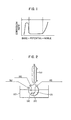
- Such unexpectedly heavy corrosion of stainless steel in a nitric acid solution containing heavy metal(s) and/or compound(s) thereof can be accounted for by the acute turn of surface potential of stainless steel to noble potential due to sharp increase of oxidative activity of nitric acid by the ions of heavy metal(s) dissolved in nitric acid or direct deposition of solid heavy metal(s) and/or compound(s) thereof on the stainless steel surface to cause a so-called “over-passive state corrosion", as diagrammatically illustrated in Fig. 1 attached hereto.
- overpassive state corrosion may occur even in nitric acid alone under high-temperature or high-concentration conditions, but it tends to take place very readily and extensively when heavy metal(s) and/or compound(s) thereof are contained in nitric acid.
- Nitric acid solutions containing heavy metals and/or compounds thereof are treated in various production plants and apparatuses, for example, nitric acid production plants using oxidation process of ammonia, apparatus for oxidation of organic compounds with nitric acid, apparatus for recovering metals from scraps of semiconductor materials, radioisotope reprocessing apparatus, and stainless steel surface cleaning apparatus, and therefore the development of the techniques for providing stainless steel with an excellent corrosion resistance against nitric acid solutions containing heavy metals and compounds thereof is an enormous industrial contribution.
- stainless steel with a low silicon content shows an excellent corrosion resistance in a system of nitric acid alone, while stainless steel with an increased silicon cntent shows an anticorrosive disposition in a nitric acid solution containing heavy metal(s) and/or compound(s) thereof.
- the present inventors have carried out extensive researches on the method for preventing corrosion of stainless steel which has good workability and weldability and is relatively easy to obtain economically and, as a result, found that stainless steel is remarkably prevented from corrosion in a nitric acid solution when an NOx gas is compulsorily added into the solution while defining the silicon content in stainless steel to at most 1% by weight so that the excellent workability and weldability of stainless steel are not impaired.
- the present invention was achieved on the basis of such finding.
- a method for preventing excess corrosion of an apparatus in which a nitric acid solution containing heavy metal(s) and/or compound(s) thereof is treated characterized in that stainless steel with a silicon content of 1% by weight or below is used as the material composing said apparatus, and that an NOx gas is compulsorily added into said nitric acid solution.
- the maximum amount of silicon allowed to be contained in stainless steel for affording thereto excellent corrosion resistance by forced addition of NOx into nitric acid containing heavy metal(s) and/or compound(s) thereof is 1% by weight, and if the silicon content exceeds 1% by weight, the desired corrosion resistance is not provided.
- the heavy metals and heavy metal compounds that may be contained in nitric acid include platinum, vanadium, cerium, gallium, ruthenium, uranium, plutonium and many other heavy metals and their compounds as well as mixtures thereof. These heavy metals and their compounds are usually used after decomposed and melted or by mixing them with nitric acid as an assistant for the ensuring oxidation reaction, but they may be inevitably contained in nitric acid in slight quantities.
- the NOx gas that is added into nitric acid in this invention includes NO gas, NO2 gas and their polymers N 2 0 4' N 2 0 3' etc., as well as mixtures thereof. Also, N 2 , 0 2 , H 2 0 and other like substances can be used while mixed in NOx gas as inert gas components.
- Blowing of NOx gas into nitric acid can be accomplished in various ways such as: directly blowing NOx gas into a nitric acid solution before the treatment thereof; blowing NOx gas directly into a nitric acid which has become strongly corrosive with the increase of the amount of heavy metal(s) and/or compound(s) thereof in the solution; blowing NOx gas into a gaseous phase above the nitric acid solution, etc.
- Such blowing can be accomplished more effectively by incorporating a proper mixing operation or pressure application.
- the NOx gas source besides those obtainable in the ordinary ways, it is possible to use the NOx gas produced when adding metal(s) or compound(s) thereof to nitric acid. Also, a separately produced NOx gas such as produced by reacting an ordinary acid with a nitrous acid compound can be used.
- the amount of NOx gas which needs to be blown for achieving the desired anticorrosive effect can not be definitely specified as it is variable depending on the various factors such as concentration and temperature of nitric acid, kind, valence and concentration of heavy metal(s) and compound(s) thereof, type and composition of NOx gas used, etc., but basically, said amount of NOx gas to be blown may be defined as that which is necessary for shifting the corrosion potential of stainless steel in the region of over-passive state into the region of passive stage, and the present invention provides a quite specific and effective method for achieving such shift of corrosion potential.
- An excess amount of NOx gas does not hamper the anticorrosive effect of this invention if the silicon content in the corrosion preventive surface of stainless steel is not greater than 1% by weight.
- an NOx gas removing device is attahced to and operated in correspondence to the run of the equipment which treats nitric acid, so the effective utilization of superfluous NOx gas will enable a reduction of required working rate of the NOx gas removing device.
- a 45% nitric acid solution containing NH 4 VO 3 and C uO was supplied continuously at a flow rate of 100 ml/hr into a 1-litre-capacity flask shown in Fig. 2 (the solution being discharged out from the outlet so that the liquid level in the flask was kept constant), and each test piece was subjected to a corrosion test in said solution under the boiling temperature, condition for a period of 100 hours. From the results shown in Table 2, it can be seen that stainless steel is extensively corroded in the 45% nitric acid solution containing NH 4 VO 3 and CuO, but if the silicon content in stailess steel is below 1%, the corrosion is drastically suppressed by the addition of NOx gas.
- test pieces A, B, C and D shown in Table 1 were subjected to a corrosion test in a 20% NHO 3 solution containing 2,000 mg/l of Ce 4+ at boiling temperature under normal pressure to obtain the results shown in Fig. 3.
- N0 2 gas was continuously blown into 250 cc of the testing solution at a rate of 5 cc/min for a period of 10 hours.
- the results dictate that stainless steel with an S i content below 1% by weight is markedly improved in its resistance to nitric acid by the blowing of NOx gas.
Landscapes
- Chemical & Material Sciences (AREA)
- Engineering & Computer Science (AREA)
- Materials Engineering (AREA)
- Mechanical Engineering (AREA)
- Metallurgy (AREA)
- Organic Chemistry (AREA)
- Preventing Corrosion Or Incrustation Of Metals (AREA)
Priority Applications (1)
| Application Number | Priority Date | Filing Date | Title |
|---|---|---|---|
| EP84114388A EP0182932A1 (de) | 1984-11-28 | 1984-11-28 | Verfahren zum Korrosionsschutz einer Einrichtung |
Applications Claiming Priority (1)
| Application Number | Priority Date | Filing Date | Title |
|---|---|---|---|
| EP84114388A EP0182932A1 (de) | 1984-11-28 | 1984-11-28 | Verfahren zum Korrosionsschutz einer Einrichtung |
Publications (1)
| Publication Number | Publication Date |
|---|---|
| EP0182932A1 true EP0182932A1 (de) | 1986-06-04 |
Family
ID=8192314
Family Applications (1)
| Application Number | Title | Priority Date | Filing Date |
|---|---|---|---|
| EP84114388A Withdrawn EP0182932A1 (de) | 1984-11-28 | 1984-11-28 | Verfahren zum Korrosionsschutz einer Einrichtung |
Country Status (1)
| Country | Link |
|---|---|
| EP (1) | EP0182932A1 (de) |
Citations (4)
| Publication number | Priority date | Publication date | Assignee | Title |
|---|---|---|---|---|
| US2837407A (en) * | 1955-07-08 | 1958-06-03 | Rau Eric | Method of reducing metallic corrosion by fuming nitric acid by addition of fluoride ion to acid |
| US3174818A (en) * | 1962-10-09 | 1965-03-23 | Francis G Rust | Reducing corrosion of stainless steel in hot nitric acid solutions by adding carbon black or elemental sulfur to the solution |
| US4111831A (en) * | 1976-06-03 | 1978-09-05 | Exxon Nuclear Company, Inc. | Inhibiting corrosion of stainless steel by ruthenium-containing nitric acid solution |
| JPS6046380A (ja) * | 1983-08-24 | 1985-03-13 | Sumitomo Chem Co Ltd | 装置の防食方法 |
-
1984
- 1984-11-28 EP EP84114388A patent/EP0182932A1/de not_active Withdrawn
Patent Citations (4)
| Publication number | Priority date | Publication date | Assignee | Title |
|---|---|---|---|---|
| US2837407A (en) * | 1955-07-08 | 1958-06-03 | Rau Eric | Method of reducing metallic corrosion by fuming nitric acid by addition of fluoride ion to acid |
| US3174818A (en) * | 1962-10-09 | 1965-03-23 | Francis G Rust | Reducing corrosion of stainless steel in hot nitric acid solutions by adding carbon black or elemental sulfur to the solution |
| US4111831A (en) * | 1976-06-03 | 1978-09-05 | Exxon Nuclear Company, Inc. | Inhibiting corrosion of stainless steel by ruthenium-containing nitric acid solution |
| JPS6046380A (ja) * | 1983-08-24 | 1985-03-13 | Sumitomo Chem Co Ltd | 装置の防食方法 |
Similar Documents
| Publication | Publication Date | Title |
|---|---|---|
| US6992043B2 (en) | Composition for scavenging sulfur compounds from fluids | |
| RU2070230C1 (ru) | Способ пассивирования металлических поверхностей | |
| EP0166557B1 (de) | Verfahren zur Behandlung von Abfällen | |
| DE3685674T2 (de) | Verfahren fuer die behandlung von ammoniumnitrat-haltigem abwasser. | |
| US4347144A (en) | Process for the purification of effluent | |
| EP0267166A2 (de) | Verfahren zur Verminderung von Stickstoffoxydemissionen aus Salpetersäure enthaltenden Lösungen | |
| US6887445B2 (en) | Process for sulfur scavenging | |
| EP0229407A1 (de) | Verfahren zur Entfernung von Teilchen und Eisencyanidkomplexen | |
| EP0158177A2 (de) | Verfahren zur Korrosionsinhibierung von Zirkon und seinen Legierungen | |
| CA1211689A (en) | Method for avoiding the corrosion of the strippers in the urea manufacturing plants | |
| Lin et al. | Catalytic wet air oxidation of phenolic wastewaters | |
| US5190623A (en) | Nuclear fuel reprocessing plant | |
| EP0588494B1 (de) | Verfahren und Zusammensetzung zum Entfernen von Sauerstoff | |
| EP0829556A1 (de) | Verfahren zur erhaltung der korrosionsbeständigkeit einer umlaufanlage aus stahl mit einer bleihaltigen kühlung | |
| EP0228104A2 (de) | Verfahren für die Beseitigung des Eisen-Zyanid-Komplexes | |
| US3436184A (en) | Process for recovering phosphorus from sludge | |
| US4356148A (en) | Method for preventing corrosion and hydrogen embrittlement of tantalum-made equipment handling hot concentrated sulphuric acid therein | |
| JPS6034502B2 (ja) | プルトニウムの還元方法 | |
| WO1996008447A1 (de) | Nitratrückgewinnungsanlage | |
| US4478802A (en) | Method for cleaning cyanide-bearing gas scrubbing waters produced in metallurgical industry | |
| Ridenour et al. | Preliminary Report on Effect of Cyanide Case Hardening, Copper and Zinc Plating Wastes on Activated Sludge Sewage Treatment | |
| DE2554026A1 (de) | Verfahren zur hemmung der korrosion in waessrigen systemen | |
| US3965194A (en) | Production of formaldehyde in carbon steel reactors | |
| EP1200360B1 (de) | Nitrifikation von abwasser | |
| JPS6046380A (ja) | 装置の防食方法 |
Legal Events
| Date | Code | Title | Description |
|---|---|---|---|
| PUAI | Public reference made under article 153(3) epc to a published international application that has entered the european phase |
Free format text: ORIGINAL CODE: 0009012 |
|
| AK | Designated contracting states |
Kind code of ref document: A1 Designated state(s): BE DE FR GB |
|
| 17P | Request for examination filed |
Effective date: 19861027 |
|
| 17Q | First examination report despatched |
Effective date: 19871012 |
|
| STAA | Information on the status of an ep patent application or granted ep patent |
Free format text: STATUS: THE APPLICATION IS DEEMED TO BE WITHDRAWN |
|
| 18D | Application deemed to be withdrawn |
Effective date: 19880222 |
|
| RIN1 | Information on inventor provided before grant (corrected) |
Inventor name: MIKI, MASAYOSHI Inventor name: OKUBO, MASAO Inventor name: OHRUI, TETSUYA |