EP0182989A1 - Normalisation de signaux de parole - Google Patents
Normalisation de signaux de parole Download PDFInfo
- Publication number
- EP0182989A1 EP0182989A1 EP85111566A EP85111566A EP0182989A1 EP 0182989 A1 EP0182989 A1 EP 0182989A1 EP 85111566 A EP85111566 A EP 85111566A EP 85111566 A EP85111566 A EP 85111566A EP 0182989 A1 EP0182989 A1 EP 0182989A1
- Authority
- EP
- European Patent Office
- Prior art keywords
- amplitude
- percentile
- speech signal
- values
- speech
- Prior art date
- Legal status (The legal status is an assumption and is not a legal conclusion. Google has not performed a legal analysis and makes no representation as to the accuracy of the status listed.)
- Granted
Links
Images



Classifications
-
- G—PHYSICS
- G10—MUSICAL INSTRUMENTS; ACOUSTICS
- G10L—SPEECH ANALYSIS TECHNIQUES OR SPEECH SYNTHESIS; SPEECH RECOGNITION; SPEECH OR VOICE PROCESSING TECHNIQUES; SPEECH OR AUDIO CODING OR DECODING
- G10L15/00—Speech recognition
- G10L15/02—Feature extraction for speech recognition; Selection of recognition unit
Definitions
- the present invention is related to the normalization of speech signals for speech recognition, and in particular to a method and a system for normalizing speech signals which avoid distortion in the spectrum of silence of the normalized speech.
- a common source of variation is due to changes in the glottal waveform of vowels, and the energy in highfrequency fricatives.
- appropriate filtering may be employed.
- a further object of the invention is a speech signal normalization method that avoids distortion in the spectrum of silence and which achieves the normalization in a relatively simple but rather effective way.
- a speech normalization method in which initially amplitude histograms are generated for different frequencies, in which a pair of particular percentile values is then obtained from these histograms for each of the frequencies, and in which finally during the actual normalization the amplitude values of the input speech signal are adapted using the pair of percentile values for each frequency.
- the advantage of this method is that an overall normalization is obtained with relatively few extra processing steps in addition to those otherwise necessary in a speech recognition system, and -that recognition results in such a system are substantially improved.
- the essential effect of this normalizing treatment is that the long-term spectrum of the resulting speech signal is given by the P(95) amplitude values, and the spectrum of silence is given by the P(05) amplitude values. After normalization, all speech has the same silence spectrum and long-term spectrum.
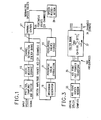
- Fig. 1 shows a block diagram of an arrangement by which a speech signal can be normalized according to the invention. There is a common portion used for both initial preparation and actual normalization, a second portion which is only used for initial generation of percentile amplitude values, and another portion for the actual normalization.
- Section 11 the available speech signal is prefiltered, sampled and digitized in the usual manner.
- the obtained digital values are intermediately stored in section 13 from where they can be extracted in blocks.
- Section 15 represents a filter bank for separating the speech signal (available in sampled and digital form) into 31 channels or frequency bands. In the present embodiment, there are eight bands of equal bandwidth for the range from 200 Hz to 1,000 Hz, and 23 further bands on a logarithmic scale for the range above 1 kHz. Another number of bands with another bandwidth distribution can of course be used if appropriate.
- the speech signal is then available on connections 17 in 31 separate channels. Though the separation of a digitized signal into subbands is a standard procedure, a few more details of the filter bank 15 will be described in chapter (C) with reference to Fig. 4.
- percentile values Prior to the actual normalization, percentile values must be obtained by analyzing a sample interval of the speech that is to be recognized. For this purpose, sections 19 through 23 are provided.
- histograms are generated from a 1-minute interval of the band-separated speech signal.
- One histogram is prepared for each frequency band. It shows how the amplitude values observed for the respective band are distributed over a plurality of levels or discrete amplitude ranges.
- the total amplitude range is separated into ninety 1-dB intervals which range from -20 dB to 70dB.
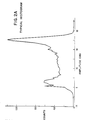
- Fig. 2A shows a typical histogram
- Fig. 2B is a listing of the amplitude counts of this histogram (both for a single one of the 31 bands).
- 620 samples had an amplitude of ca. 5 dB
- 1260 samples had an amplitude of ca. 50 dB
- C chapter (C) below with reference to Figs. 5A and 5B.
- the percentile amplitude values P(05) and P(9 5 ) for each band are extracted from the histograms. These are the two amplitudes for which only 5% of all counted amplitude values (of that respective band) were smaller or greater, respectively.
- the obtained 31 pairs of percentile amplitude values are stored in section 23 from whose output connections 25 they will be available for later reference.
- Section 27 is the portion for the actual normalization. On its input connections 17 it will receive a continuous stream of speech signal amplitude values A (in), separated according to frequency bands, and on its input connections 25 there are available the previously generated percentile amplitude values for all bands. Section 27 generates the normalized output amplitude values A(out) for each band according to the relation
- the normalized amplitude values A(out) could either be directly furnished to a speech recognition unit 29, or they could be intermediately stored for later reference.
- Unit 33 represents a Kaiser window which is used for shaping the spectrum of the input signal to make it more suitable for subsequent processing. It accepts blocks of 400 speech signal sample values and furnishes, at the ith output, blocks of the same size wherein the values are modified according to the desired window function (the Kaiser window for present embodiment). Windowing operations are described elsewhere, e.g. in the above mentioned article by H.F. Silverman et al. and thus no more details need be given here.
- unit 35 a Fast Fourier Transform is performed on each block of modified speech samples received from the window 33.
- the output of unit 35 is a block of amplitude values for 200 different frequencies. These values are then transferred to the filter bank unit 37 which generates amplitude values for 31 channels or frequency bands, representing a spectral analysis of the input speech signal.
- the fitter bank function can be represented by
- the sequential output values A(i) for each channel i represent the energy amplitude of the respective frequency band for consecutive time intervals of 0.0 1 sec each. These values are used as input for the histogram and percentile amplitude value generation and for the normalization operation.
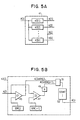
- each bin represents one of the k discrete amplitude levels BIN(j) that are provided (90 levels in the present embodiment), and it counts the occurrences of amplitude values A(i) that fall into the respective level which ranges from BIN(j) to BIN (j + 1 ).
- An incoming value A(i) is compared to consecutive level values BIN(j), starting with the lowest one, until it exceeds the current value BIN(j). Then the count value for the preceding level BINQ(j-1) is increased by one unit.
- Fig. 5B Details of one logic and counting circuit 43 are shown in Fig. 5B.
- the typical circuit counts the A(i) values that fall between the level border values BIN(j) and BIN(j + 1).
- Comparators 45 (C1) and 47 (C2), the latter followed by inverter 49 determine whether the current value A(i) is greater than BIN(j) or less than BIN(j+1). If this is true, AND gate 51 will furnish a counting pulse to a counter 53 whose output is the level count H(j).
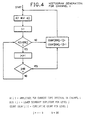
- Fig. 6 is a flow diagram of the procedure for extracting the percentile amplitude values P(05) and P(95) from the histograms. This is the operation corresponding to section 19 in Fig. 1. The extraction is done separately for each of the 31 channels.
- the accumulative count ACC is further increased by consecutive histogram count values H(j) but compared to the upper threshold count L95.
- ACC > L95 then the 95th percentile amplitude level is reached and the respective current amplitude value BIN(j) is stored as value P(95).
- Figs. 7A and 7B some details of the normalization circuitry are shown for executing the operation of section 27 in Fig. 1.
- this section receives consecutive amplitude values A(i) for the 31 channels on connections 17, and the percentile amplitude values P(05) and P(95) for all 31 channels on connections 25.
- the section contains 31 arithmetic modules 55, each for normalizing the amplitude values of one channel.
- One such arithmetic module 55 is shown in Fig. 7B. It comprises a subtractor 57 for subtracting, from each consecutive value A(in), the stored percentile amplitude value P(05).
- Another circuit 59 forms the difference P(95) - P(05) and computes the reciprocal value of this difference, then available on line 61.
- a multiplier 63 generates the product of the difference from subtractor 57 and the reciprocal value available on line 61, thus furnishing on its output the desired value for each occuring input value A(i) of this channel.
- a set of percentile values for all 3 1 bands is obtained by having one speaker read a sample text and analyzing a one minute interval of it
- the variations within this single speaker's utterances can be eliminated prior to the recognition process. If, however, the speech of several speakers must be recognized by the same system, a set of percentile amplitude values P(05) and P(95) for each band must be generated for each speaker using a one minute sample utterance of each.
- the different functions for executing present invention in particular the histogram generation, the percentile amplitude value extraction, and the actual normalization of current values using the predetermined percentile values, can be effected either in hardware or by software. This is a design choice and depends on required speed, possible multiple utilization of functions for other portions of a system, etc. Application of the invention will yield an improved performance anyway.
Landscapes
- Engineering & Computer Science (AREA)
- Computer Vision & Pattern Recognition (AREA)
- Computational Linguistics (AREA)
- Health & Medical Sciences (AREA)
- Audiology, Speech & Language Pathology (AREA)
- Human Computer Interaction (AREA)
- Physics & Mathematics (AREA)
- Acoustics & Sound (AREA)
- Multimedia (AREA)
- Measurement Of Mechanical Vibrations Or Ultrasonic Waves (AREA)
- Telephonic Communication Services (AREA)
Applications Claiming Priority (2)
| Application Number | Priority Date | Filing Date | Title |
|---|---|---|---|
| US662867 | 1984-10-19 | ||
| US06/662,867 US4817158A (en) | 1984-10-19 | 1984-10-19 | Normalization of speech signals |
Publications (2)
| Publication Number | Publication Date |
|---|---|
| EP0182989A1 true EP0182989A1 (fr) | 1986-06-04 |
| EP0182989B1 EP0182989B1 (fr) | 1990-03-14 |
Family
ID=24659567
Family Applications (1)
| Application Number | Title | Priority Date | Filing Date |
|---|---|---|---|
| EP85111566A Expired EP0182989B1 (fr) | 1984-10-19 | 1985-09-13 | Normalisation de signaux de parole |
Country Status (4)
| Country | Link |
|---|---|
| US (1) | US4817158A (fr) |
| EP (1) | EP0182989B1 (fr) |
| JP (1) | JPS6198400A (fr) |
| DE (1) | DE3576596D1 (fr) |
Cited By (3)
| Publication number | Priority date | Publication date | Assignee | Title |
|---|---|---|---|---|
| EP0518116A1 (fr) * | 1991-06-08 | 1992-12-16 | Rohde & Schwarz GmbH & Co. KG | Procédé pour mesurer la valeur de crête d'une tension alternative |
| FR2690550A1 (fr) * | 1992-04-28 | 1993-10-29 | Spic France Sa | Dispositif d'analyse de la parole et des phénomènes acoustiques. |
| EP1863013A3 (fr) * | 1998-10-09 | 2008-08-06 | Sony Corporation | Normalisation de données d'un dictionnaire de vecteurs codes pour la reconnaissance audio-visuelle de parole |
Families Citing this family (18)
| Publication number | Priority date | Publication date | Assignee | Title |
|---|---|---|---|---|
| DE4317424C2 (de) * | 1993-05-26 | 2002-06-13 | Eads Deutschland Gmbh | Verfahren zur Ermittlung einer periodischen Struktur in einem Linienspektrum und Verwendung eines solchen Verfahrens zur Erkennung und/oder Klassifizierung eines Hubschraubers |
| US5664171A (en) * | 1994-04-14 | 1997-09-02 | International Business Machines Corporation | System and method for query optimization using quantile values of a large unordered data set |
| US6151575A (en) * | 1996-10-28 | 2000-11-21 | Dragon Systems, Inc. | Rapid adaptation of speech models |
| US5822718A (en) * | 1997-01-29 | 1998-10-13 | International Business Machines Corporation | Device and method for performing diagnostics on a microphone |
| US5946654A (en) * | 1997-02-21 | 1999-08-31 | Dragon Systems, Inc. | Speaker identification using unsupervised speech models |
| US6029124A (en) * | 1997-02-21 | 2000-02-22 | Dragon Systems, Inc. | Sequential, nonparametric speech recognition and speaker identification |
| US6212498B1 (en) | 1997-03-28 | 2001-04-03 | Dragon Systems, Inc. | Enrollment in speech recognition |
| US6108658A (en) * | 1998-03-30 | 2000-08-22 | International Business Machines Corporation | Single pass space efficent system and method for generating approximate quantiles satisfying an apriori user-defined approximation error |
| US6163768A (en) | 1998-06-15 | 2000-12-19 | Dragon Systems, Inc. | Non-interactive enrollment in speech recognition |
| US6178400B1 (en) | 1998-07-22 | 2001-01-23 | At&T Corp. | Method and apparatus for normalizing speech to facilitate a telephone call |
| US6314396B1 (en) | 1998-11-06 | 2001-11-06 | International Business Machines Corporation | Automatic gain control in a speech recognition system |
| US6343288B1 (en) | 1999-03-12 | 2002-01-29 | International Business Machines Corporation | Single pass space efficient system and method for generating an approximate quantile in a data set having an unknown size |
| US6651040B1 (en) * | 2000-05-31 | 2003-11-18 | International Business Machines Corporation | Method for dynamic adjustment of audio input gain in a speech system |
| US7089184B2 (en) * | 2001-03-22 | 2006-08-08 | Nurv Center Technologies, Inc. | Speech recognition for recognizing speaker-independent, continuous speech |
| JP2004061617A (ja) * | 2002-07-25 | 2004-02-26 | Fujitsu Ltd | 受話音声処理装置 |
| US7697827B2 (en) | 2005-10-17 | 2010-04-13 | Konicek Jeffrey C | User-friendlier interfaces for a camera |
| EP2877992A1 (fr) * | 2012-07-24 | 2015-06-03 | Nuance Communications, Inc. | Entrées de normalisation de caractéristiques dans un traitement acoustique permettant la reconnaissance automatique de la parole |
| US9426592B2 (en) * | 2013-02-14 | 2016-08-23 | Google Inc. | Audio clipping detection |
Family Cites Families (13)
| Publication number | Priority date | Publication date | Assignee | Title |
|---|---|---|---|---|
| US32172A (en) * | 1861-04-30 | Printing-press | ||
| US2938079A (en) * | 1957-01-29 | 1960-05-24 | James L Flanagan | Spectrum segmentation system for the automatic extraction of formant frequencies from human speech |
| GB1435779A (en) * | 1972-09-21 | 1976-05-12 | Threshold Tech | Word recognition |
| JPS50155105A (fr) * | 1974-06-04 | 1975-12-15 | ||
| US4038503A (en) * | 1975-12-29 | 1977-07-26 | Dialog Systems, Inc. | Speech recognition apparatus |
| US4087630A (en) * | 1977-05-12 | 1978-05-02 | Centigram Corporation | Continuous speech recognition apparatus |
| JPS5529803A (en) * | 1978-07-18 | 1980-03-03 | Nippon Electric Co | Continuous voice discriminating device |
| US4184049A (en) * | 1978-08-25 | 1980-01-15 | Bell Telephone Laboratories, Incorporated | Transform speech signal coding with pitch controlled adaptive quantizing |
| JPS5672499A (en) * | 1979-11-19 | 1981-06-16 | Hitachi Ltd | Pretreatment for voice identifier |
| US4315319A (en) * | 1980-02-01 | 1982-02-09 | Rockwell International Corporation | Non-linear signal processor |
| USRE32172E (en) | 1980-12-19 | 1986-06-03 | At&T Bell Laboratories | Endpoint detector |
| US4388495A (en) * | 1981-05-01 | 1983-06-14 | Interstate Electronics Corporation | Speech recognition microcomputer |
| US4567610A (en) * | 1982-07-22 | 1986-01-28 | Wayland Research Inc. | Method of and apparatus for pattern recognition |
-
1984
- 1984-10-19 US US06/662,867 patent/US4817158A/en not_active Expired - Lifetime
-
1985
- 1985-07-17 JP JP60156211A patent/JPS6198400A/ja active Granted
- 1985-09-13 EP EP85111566A patent/EP0182989B1/fr not_active Expired
- 1985-09-13 DE DE8585111566T patent/DE3576596D1/de not_active Expired - Lifetime
Non-Patent Citations (2)
| Title |
|---|
| IBM TECHNICAL DISCLOSURE BULLETIN, vol. 16, no. 8, January 1974, pages 2610-2611, New York, US; P.S. COHEN et al.: "Automatic amplitude normalization of speech" * |
| IBM TECHNICAL DISCLOSURE BULLETIN, vol. 22, no. 12, May 1980, pages 5524-5525, New York, US; S.K. DAS: "Amplitude normalization for discrete utterance recognition" * |
Cited By (3)
| Publication number | Priority date | Publication date | Assignee | Title |
|---|---|---|---|---|
| EP0518116A1 (fr) * | 1991-06-08 | 1992-12-16 | Rohde & Schwarz GmbH & Co. KG | Procédé pour mesurer la valeur de crête d'une tension alternative |
| FR2690550A1 (fr) * | 1992-04-28 | 1993-10-29 | Spic France Sa | Dispositif d'analyse de la parole et des phénomènes acoustiques. |
| EP1863013A3 (fr) * | 1998-10-09 | 2008-08-06 | Sony Corporation | Normalisation de données d'un dictionnaire de vecteurs codes pour la reconnaissance audio-visuelle de parole |
Also Published As
| Publication number | Publication date |
|---|---|
| DE3576596D1 (de) | 1990-04-19 |
| JPH0312319B2 (fr) | 1991-02-19 |
| US4817158A (en) | 1989-03-28 |
| EP0182989B1 (fr) | 1990-03-14 |
| JPS6198400A (ja) | 1986-05-16 |
Similar Documents
| Publication | Publication Date | Title |
|---|---|---|
| EP0182989B1 (fr) | Normalisation de signaux de parole | |
| CA1193732A (fr) | Methode et appareil de reconnaissance de la parole pour reconnaitre les phonemes dans un signal vocal | |
| US5054085A (en) | Preprocessing system for speech recognition | |
| US5583961A (en) | Speaker recognition using spectral coefficients normalized with respect to unequal frequency bands | |
| US4081607A (en) | Keyword detection in continuous speech using continuous asynchronous correlation | |
| US8488800B2 (en) | Segmenting audio signals into auditory events | |
| CA2448182C (fr) | Segmentation de signaux audio en evenements auditifs | |
| EP2549475A1 (fr) | Segmentation de signaux audio en évenements auditifs | |
| EP0178509A1 (fr) | Système de formation d'éléments de référence pour la reconnaissance de la parole | |
| EP0074822B1 (fr) | Reconnaissance de la parole ou de sons similaires | |
| AU2002252143A1 (en) | Segmenting audio signals into auditory events | |
| US3940565A (en) | Time domain speech recognition system | |
| CA2148340C (fr) | Methode et appareil pour evaluer automatiquement de facon reproductible la qualite des transmissions d'un systeme de transmission de paroles | |
| US4677673A (en) | Continuous speech recognition apparatus | |
| US4509186A (en) | Method and apparatus for speech message recognition | |
| CA1329276C (fr) | Methode et appareil d'extraction de mots isoles contenus dans des paroles | |
| EP0248593A1 (fr) | Système de prétraitement pour la reconnaissance de la parole | |
| FR1405489A (fr) | Système d'analyse de la parole | |
| US4982433A (en) | Speech analysis method | |
| Qi et al. | Analysis of nasal consonants using perceptual linear prediction | |
| GB981153A (en) | Improved phonetic typewriter system | |
| JPH04230798A (ja) | 雑音予測装置 | |
| JPS6315296A (ja) | 音声認識装置 | |
| EP0275327A1 (fr) | Reconnaissance de la parole | |
| JPS61273599A (ja) | 音声認識装置 |
Legal Events
| Date | Code | Title | Description |
|---|---|---|---|
| PUAI | Public reference made under article 153(3) epc to a published international application that has entered the european phase |
Free format text: ORIGINAL CODE: 0009012 |
|
| AK | Designated contracting states |
Kind code of ref document: A1 Designated state(s): DE FR GB IT |
|
| 17P | Request for examination filed |
Effective date: 19860819 |
|
| 17Q | First examination report despatched |
Effective date: 19880505 |
|
| GRAA | (expected) grant |
Free format text: ORIGINAL CODE: 0009210 |
|
| AK | Designated contracting states |
Kind code of ref document: B1 Designated state(s): DE FR GB IT |
|
| PG25 | Lapsed in a contracting state [announced via postgrant information from national office to epo] |
Ref country code: IT Free format text: LAPSE BECAUSE OF FAILURE TO SUBMIT A TRANSLATION OF THE DESCRIPTION OR TO PAY THE FEE WITHIN THE PRESCRIBED TIME-LIMIT;WARNING: LAPSES OF ITALIAN PATENTS WITH EFFECTIVE DATE BEFORE 2007 MAY HAVE OCCURRED AT ANY TIME BEFORE 2007. THE CORRECT EFFECTIVE DATE MAY BE DIFFERENT FROM THE ONE RECORDED. Effective date: 19900314 |
|
| REF | Corresponds to: |
Ref document number: 3576596 Country of ref document: DE Date of ref document: 19900419 |
|
| ET | Fr: translation filed | ||
| PLBE | No opposition filed within time limit |
Free format text: ORIGINAL CODE: 0009261 |
|
| STAA | Information on the status of an ep patent application or granted ep patent |
Free format text: STATUS: NO OPPOSITION FILED WITHIN TIME LIMIT |
|
| 26N | No opposition filed | ||
| PGFP | Annual fee paid to national office [announced via postgrant information from national office to epo] |
Ref country code: GB Payment date: 19910823 Year of fee payment: 7 |
|
| PGFP | Annual fee paid to national office [announced via postgrant information from national office to epo] |
Ref country code: DE Payment date: 19910926 Year of fee payment: 7 |
|
| PG25 | Lapsed in a contracting state [announced via postgrant information from national office to epo] |
Ref country code: GB Effective date: 19920913 |
|
| GBPC | Gb: european patent ceased through non-payment of renewal fee |
Effective date: 19920913 |
|
| PG25 | Lapsed in a contracting state [announced via postgrant information from national office to epo] |
Ref country code: DE Effective date: 19930602 |
|
| PGFP | Annual fee paid to national office [announced via postgrant information from national office to epo] |
Ref country code: FR Payment date: 20020916 Year of fee payment: 18 |
|
| PG25 | Lapsed in a contracting state [announced via postgrant information from national office to epo] |
Ref country code: FR Free format text: LAPSE BECAUSE OF NON-PAYMENT OF DUE FEES Effective date: 20040528 |
|
| REG | Reference to a national code |
Ref country code: FR Ref legal event code: ST |