EP0183018A2 - Procédé pour l'assainissement d'un mur en briques d'une construction couverte d'un enduit de parement, détérioré par l'humidité - Google Patents
Procédé pour l'assainissement d'un mur en briques d'une construction couverte d'un enduit de parement, détérioré par l'humidité Download PDFInfo
- Publication number
- EP0183018A2 EP0183018A2 EP85112638A EP85112638A EP0183018A2 EP 0183018 A2 EP0183018 A2 EP 0183018A2 EP 85112638 A EP85112638 A EP 85112638A EP 85112638 A EP85112638 A EP 85112638A EP 0183018 A2 EP0183018 A2 EP 0183018A2
- Authority
- EP
- European Patent Office
- Prior art keywords
- brick wall
- plaster
- facing
- veneer
- cavity
- Prior art date
- Legal status (The legal status is an assumption and is not a legal conclusion. Google has not performed a legal analysis and makes no representation as to the accuracy of the status listed.)
- Granted
Links
- 239000011505 plaster Substances 0.000 title claims abstract description 34
- 239000011449 brick Substances 0.000 title claims abstract description 33
- 238000000034 method Methods 0.000 title claims abstract description 20
- 238000009418 renovation Methods 0.000 claims description 9
- 239000011431 lime mortar Substances 0.000 claims description 8
- 239000000463 material Substances 0.000 claims description 6
- 238000005253 cladding Methods 0.000 claims description 4
- 239000011464 hollow brick Substances 0.000 claims description 4
- 239000000919 ceramic Substances 0.000 claims description 3
- 125000006850 spacer group Chemical group 0.000 claims description 3
- 229910002651 NO3 Inorganic materials 0.000 claims description 2
- NHNBFGGVMKEFGY-UHFFFAOYSA-N Nitrate Chemical compound [O-][N+]([O-])=O NHNBFGGVMKEFGY-UHFFFAOYSA-N 0.000 claims description 2
- 238000006253 efflorescence Methods 0.000 claims description 2
- 238000009434 installation Methods 0.000 claims description 2
- 206010037844 rash Diseases 0.000 claims description 2
- FGIUAXJPYTZDNR-UHFFFAOYSA-N potassium nitrate Chemical compound [K+].[O-][N+]([O-])=O FGIUAXJPYTZDNR-UHFFFAOYSA-N 0.000 abstract description 12
- 238000009423 ventilation Methods 0.000 abstract description 11
- 239000004570 mortar (masonry) Substances 0.000 abstract description 6
- 235000010333 potassium nitrate Nutrition 0.000 abstract description 6
- 239000004323 potassium nitrate Substances 0.000 abstract description 6
- 239000004568 cement Substances 0.000 abstract description 5
- 235000019738 Limestone Nutrition 0.000 abstract 1
- 239000006028 limestone Substances 0.000 abstract 1
- 230000035515 penetration Effects 0.000 abstract 1
- 238000009419 refurbishment Methods 0.000 abstract 1
- 230000015572 biosynthetic process Effects 0.000 description 3
- 239000011440 grout Substances 0.000 description 3
- 206010061217 Infestation Diseases 0.000 description 2
- XAGFODPZIPBFFR-UHFFFAOYSA-N aluminium Chemical compound [Al] XAGFODPZIPBFFR-UHFFFAOYSA-N 0.000 description 2
- 229910052782 aluminium Inorganic materials 0.000 description 2
- 239000003795 chemical substances by application Substances 0.000 description 2
- 229910052500 inorganic mineral Inorganic materials 0.000 description 2
- 239000011707 mineral Substances 0.000 description 2
- 239000003973 paint Substances 0.000 description 2
- 239000011470 perforated brick Substances 0.000 description 2
- 230000000630 rising effect Effects 0.000 description 2
- 235000008733 Citrus aurantifolia Nutrition 0.000 description 1
- IOVCWXUNBOPUCH-UHFFFAOYSA-M Nitrite anion Chemical compound [O-]N=O IOVCWXUNBOPUCH-UHFFFAOYSA-M 0.000 description 1
- 235000011941 Tilia x europaea Nutrition 0.000 description 1
- 238000010521 absorption reaction Methods 0.000 description 1
- 239000010426 asphalt Substances 0.000 description 1
- 239000011230 binding agent Substances 0.000 description 1
- 238000007598 dipping method Methods 0.000 description 1
- 230000000694 effects Effects 0.000 description 1
- 239000011451 fired brick Substances 0.000 description 1
- 230000001771 impaired effect Effects 0.000 description 1
- 239000004571 lime Substances 0.000 description 1
- 239000000049 pigment Substances 0.000 description 1
- 230000000246 remedial effect Effects 0.000 description 1
- 238000009938 salting Methods 0.000 description 1
- 239000004576 sand Substances 0.000 description 1
- 238000009751 slip forming Methods 0.000 description 1
- 239000002689 soil Substances 0.000 description 1
- 238000005406 washing Methods 0.000 description 1
Images

Classifications
-
- E—FIXED CONSTRUCTIONS
- E04—BUILDING
- E04G—SCAFFOLDING; FORMS; SHUTTERING; BUILDING IMPLEMENTS OR AIDS, OR THEIR USE; HANDLING BUILDING MATERIALS ON THE SITE; REPAIRING, BREAKING-UP OR OTHER WORK ON EXISTING BUILDINGS
- E04G23/00—Working measures on existing buildings
- E04G23/02—Repairing, e.g. filling cracks; Restoring; Altering; Enlarging
- E04G23/0218—Increasing or restoring the load-bearing capacity of building construction elements
- E04G23/0222—Replacing or adding wall ties
-
- E—FIXED CONSTRUCTIONS
- E04—BUILDING
- E04B—GENERAL BUILDING CONSTRUCTIONS; WALLS, e.g. PARTITIONS; ROOFS; FLOORS; CEILINGS; INSULATION OR OTHER PROTECTION OF BUILDINGS
- E04B1/00—Constructions in general; Structures which are not restricted either to walls, e.g. partitions, or floors or ceilings or roofs
- E04B1/62—Insulation or other protection; Elements or use of specified material therefor
- E04B1/70—Drying or keeping dry, e.g. by air vents
- E04B1/7069—Drying or keeping dry, e.g. by air vents by ventilating
-
- E—FIXED CONSTRUCTIONS
- E04—BUILDING
- E04G—SCAFFOLDING; FORMS; SHUTTERING; BUILDING IMPLEMENTS OR AIDS, OR THEIR USE; HANDLING BUILDING MATERIALS ON THE SITE; REPAIRING, BREAKING-UP OR OTHER WORK ON EXISTING BUILDINGS
- E04G23/00—Working measures on existing buildings
- E04G23/02—Repairing, e.g. filling cracks; Restoring; Altering; Enlarging
- E04G23/0218—Increasing or restoring the load-bearing capacity of building construction elements
Definitions
- the invention relates to a method according to the preamble of claim 1.
- the cause of damage to structures is mostly due to the fact that, due to the cement content in the facade plaster, the breathability (ventilation) necessary for the removal of the moisture contained in the masonry or the moisture entering it from the soil is severely impaired. There is therefore damage to the saltpetre, which can be seen from the outside by destroying the paint and peeling off the plaster. Since the mere renewal of the plaster (cf. the magazine “Bauwelt", 1972 H. 19, pp.761, 762 and 764) does not remedy the actual cause of the damage, a permanent renovation cannot be achieved with such a measure; this is all the less because the nitrate infestation of the masonry that has already occurred is not taken into account. Since the saltpetre already present in the masonry soon migrates back into the plaster layer, damage to the facade occurs again after a relatively short time.
- the invention is based on the object
- the method according to the invention is used with particular advantage in the renovation of the facades of historically important buildings.
- plate-shaped components made of hollow-brick material can be used. They can be obtained by cutting approximately 3-4 cm thick slices from such bricks.
- this treatment not needing to extend over the entire thickness of the bricks, but limited to an area adjacent to the ventilation cavity can be.
- the elements are anchored in the masonry, spacers being arranged between the elements and the masonry. Their thickness is expediently chosen so that the cavity has at least a depth of about 1 cm.
- the veneer elements can be anchored by means of dowels.
- the facade plaster which according to the invention consists of lime mortar, i.e. a cement-free binder, that the plaster layer is also ventilated on the masonry side
- the invention provides that the recesses in the plate-shaped components within the plaster-side openings provided plaster base is permeable to air. This requirement is met, for example, by a porous, coarse-grained lime mortar. This can be worked into the openings in a still workable state, ie before setting, without filling them over their entire length in the direction of the ventilation cavity.
- the mortar can be removed with a crossbar.
- the facade plaster made of lime mortar is then applied to the veneer, which is expediently only smoothed, but not treated with felt.
- the thickness of the plaster layer can be about 1 - 1 1/2 cm.
- One third of the mortar for the fine plaster layer of the facade can consist of lime soaked in for a longer period and two thirds of pure fine-grained river sand. It can be colored with oxide pigments or a (commercially available) mineral structural plaster can be applied.
- the grout between the masonry bricks should advantageously be scraped out to a depth of about 1 cm.
- the efflorescence on the masonry is expediently treated with an anti-salting agent before the veneer is built up. It is important to ensure that the treatment agent is then completely removed by washing the masonry thoroughly.
- the open connection provided on the underside of the veneer between the outside air and the cavity between the veneer and the brick wall can be created in such a way that the bottom layer of the veneer elements is supported on a suitable commercially available rail, preferably made of aluminum, and this by individual support elements is kept at a distance from a superior base or the like.
- the support elements suitably consist of ceramic plates. Their thickness can be approximately 1 1/2 - 2 cm, which increases the height of the between the rail and the base created slot through which the outside air can penetrate into the cavity between the veneer and the brick wall and can provide the ventilation necessary for the removal of moisture.
- the air entering the cavity between the facing and the masonry from below is discharged upwards, an open connection between the outside air and the cavity also being provided on the top of the facing to maintain the air circulation.
- the upper opening can be closed at a later time if it can be seen that no more moisture rises from the foundation into the masonry and causes the formation of wall saltpetre.
- the veneer erected in the course of the renovation measures according to the invention need not extend over the entire height of an outer wall of the building. For cost reasons, it can be useful to limit the veneer to the area that is visibly damaged by moisture rising from the foundation
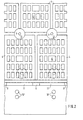
- the (old) wall to be renovated by the method according to the invention consists of the bricks 1, which are laid by means of the grout 2.
- the cement-containing plaster layer is first removed from the side of the (old) wall facing the facade. On this side, as can be seen from the drawing, the grout 2 is removed over a certain depth (cf. a).
- the foundation for the brick wall is formed by an old part 14 'and a new part 14 ".
- the latter preferably consists of hard-fired perforated bricks, which are introduced under the brick wall as part of the renovation measure.
- the aluminum foundation 14' is first laid from the facade via a certain depth, expediently cut out according to the height of the commercially available hard fired brick, in order to make room for their subsequent installation.
- the horizontal, continuously formed recesses 14 '"present in the new part 14" of the foundation can be used in conjunction with a later described one Base 10 and the cavity created between this and the foundation, the foundation 14 'are effectively ventilated and the moisture present therein is already discharged to the outside before it reaches the brick wall.
- the facing built at a distance from the brick wall consists of plate-shaped components 4, which also have horizontal, continuous recesses 4 'and suitably consist of hollow-brick material. You can use the commercially available hollow brick (formats: 24 x 12 cm; 24 x 17 cm; 24 x 30 cm).
- the veneer creates a ventilation cavity 5 between this and the existing brick wall.
- the width of the cavity is determined by the thickness of the spacers 6, which are expediently disc-shaped and are provided between the facing and the brick wall, through which (plastic) dowels 7 pass, by means of which the components 4 are fastened to the brick wall.
- the facing rests on a rail 8 with a U-profile.
- the front bend 8 'of this rail is embedded in the lime mortar plaster layer 12 applied to the components 4, before the application of which an air-permeable plaster base material 3 was introduced into the opening of the recesses 4' on the plaster side.
- the rear bend 8 "engages behind the lowest position of the components 4.
- the fixation of the lower components 4 which can be achieved thereby is further promoted by the fact that 8" mortar is introduced between them and the bend. In this way, existing inaccuracies can be compensated for. In this context, it proves to be useful if the bend 8 "is provided with recesses in which the mortar can settle.
- the rail 8 is supported on individual support elements 9, suitably made of ceramic plates, which can have a length of approximately 5 cm and a width of approximately 3-4 cm and a thickness of approximately 2 cm. They are at a distance of for example 30 cm on the preset during the remedial measures socket 10 is arranged, so that between the support elements 9 through openings 1 1 (see. Fig. 2) are formed for the inflowing of the facade forth in the cavity 5 air.
- the base 1 0 can be formed from sandstone slabs with a thickness of, for example, 3 cm, which are naturally permeable to air, but to promote particularly intensive ventilation, as shown in FIG. 1, can also be provided with horizontal, continuous recesses 10 ' can.
- the front of the sandstone base simultaneously protects the masonry against moisture and the foundation against the ingress of litter.
- the dowels 7 are mounted in the joints between plate-shaped components, it being possible for a plurality of components 4 to be fixed at one time by means of retaining disks 13 clamped between the dowel head and the elements.
- the measures according to the invention provide such effective ventilation of the brick wall that moisture no longer rise from the foundation into the wall and can cause the formation of damaging wall saltpetre there.
- the ventilation is illustrated in the figures by the arrows.
Landscapes
- Architecture (AREA)
- Engineering & Computer Science (AREA)
- Civil Engineering (AREA)
- Structural Engineering (AREA)
- Chemical Kinetics & Catalysis (AREA)
- Mechanical Engineering (AREA)
- Electrochemistry (AREA)
- Chemical & Material Sciences (AREA)
- Physics & Mathematics (AREA)
- Electromagnetism (AREA)
- Finishing Walls (AREA)
- Building Environments (AREA)
- Working Measures On Existing Buildindgs (AREA)
Priority Applications (1)
| Application Number | Priority Date | Filing Date | Title |
|---|---|---|---|
| AT85112638T ATE44997T1 (de) | 1984-11-27 | 1985-10-05 | Verfahren zur sanierung einer durch feuchtigkeit geschaedigten, mit einem fassadenputz versehenen ziegelmauer eines bauwerks. |
Applications Claiming Priority (2)
| Application Number | Priority Date | Filing Date | Title |
|---|---|---|---|
| DE3443084A DE3443084C1 (de) | 1984-11-27 | 1984-11-27 | Verfahren zur Sanierung einer durch Feuchtigkeit geschaedigten,mit einem Fassadenputz versehenen Ziegelmauer eines Bauwerks |
| DE3443084 | 1984-11-27 |
Publications (3)
| Publication Number | Publication Date |
|---|---|
| EP0183018A2 true EP0183018A2 (fr) | 1986-06-04 |
| EP0183018A3 EP0183018A3 (en) | 1987-05-13 |
| EP0183018B1 EP0183018B1 (fr) | 1989-07-26 |
Family
ID=6251187
Family Applications (1)
| Application Number | Title | Priority Date | Filing Date |
|---|---|---|---|
| EP85112638A Expired EP0183018B1 (fr) | 1984-11-27 | 1985-10-05 | Procédé pour l'assainissement d'un mur en briques d'une construction couverte d'un enduit de parement, détérioré par l'humidité |
Country Status (3)
| Country | Link |
|---|---|
| EP (1) | EP0183018B1 (fr) |
| AT (1) | ATE44997T1 (fr) |
| DE (1) | DE3443084C1 (fr) |
Cited By (1)
| Publication number | Priority date | Publication date | Assignee | Title |
|---|---|---|---|---|
| CN114352056A (zh) * | 2021-12-23 | 2022-04-15 | 上海建工集团股份有限公司 | 老旧墙面翻新生态面砖施工工艺 |
Families Citing this family (4)
| Publication number | Priority date | Publication date | Assignee | Title |
|---|---|---|---|---|
| DE4235595A1 (de) * | 1992-10-22 | 1994-04-28 | Fischer Artur Werke Gmbh | Befestigungsverfahren zur Sanierung einer Beton- oder Steinfassade |
| DE102010008724A1 (de) * | 2010-02-20 | 2011-08-25 | Walther, Jörg, Dr.-Ing., 09579 | Lüftungssystem zur Austrocknung von Gebäudewänden nach Durchfeuchtung |
| DE202014010594U1 (de) | 2014-07-17 | 2016-01-19 | Jens-Uwe Weichler | Vorrichtung zur Erneuerung von Gebäudefassaden |
| CN116905853B (zh) * | 2023-07-07 | 2026-01-06 | 中建八局第三建设有限公司 | 一种古建筑砖墙的修缮加固方法 |
Family Cites Families (2)
| Publication number | Priority date | Publication date | Assignee | Title |
|---|---|---|---|---|
| CH193005A (de) * | 1936-08-15 | 1937-09-30 | Bryner Emil | Verfahren zum Entfeuchten von verputztem, feuchtem Mauerwerk, und nach diesem Verfahren entfeuchtetes Mauerwerk. |
| AT342261B (de) * | 1976-08-23 | 1978-03-28 | Drabek Josef | Verfahren zur nachtraglichen trockenlegung feuchter ziegelmauern |
-
1984
- 1984-11-27 DE DE3443084A patent/DE3443084C1/de not_active Expired
-
1985
- 1985-10-05 AT AT85112638T patent/ATE44997T1/de active
- 1985-10-05 EP EP85112638A patent/EP0183018B1/fr not_active Expired
Cited By (1)
| Publication number | Priority date | Publication date | Assignee | Title |
|---|---|---|---|---|
| CN114352056A (zh) * | 2021-12-23 | 2022-04-15 | 上海建工集团股份有限公司 | 老旧墙面翻新生态面砖施工工艺 |
Also Published As
| Publication number | Publication date |
|---|---|
| EP0183018A3 (en) | 1987-05-13 |
| EP0183018B1 (fr) | 1989-07-26 |
| DE3443084C1 (de) | 1986-02-06 |
| ATE44997T1 (de) | 1989-08-15 |
Similar Documents
| Publication | Publication Date | Title |
|---|---|---|
| DE3784091T2 (de) | Mauern von ziegelpaneelen. | |
| DE4441646C5 (de) | Verfahren zur Herstellung einer Abdeckung für Balkone, Terrassen und dergleichen | |
| EP0183018B1 (fr) | Procédé pour l'assainissement d'un mur en briques d'une construction couverte d'un enduit de parement, détérioré par l'humidité | |
| DE19728184A1 (de) | Multifunktionale Mineralfaserplatte, Verfahren zu deren Herstellung und deren Verwendung | |
| DE2241805B2 (de) | Daemmplatte und verfahren zu ihrer herstellung | |
| EP0201757A3 (fr) | Revêtement de façades, en particulier pour la restauration de l'habitat ancien | |
| EP0148173B1 (fr) | Procede d'isolation ou d'isolation ulterieure en particulier de murs de batiments et element d'insertion pour executer ce procede | |
| DE826191C (de) | Verfahren zur Herstellung von Fassadenmauern | |
| EP0184167B1 (fr) | Dispositif d'imprégnation d'une maçonnerie pour former une barrière horizontale contre l'humidité ascendante | |
| EP1208273B1 (fr) | Procede de deshumidification et de reduction des sels causant des dommages, applique a un ouvrage de maconnerie | |
| DE4214043A1 (de) | Verfahren fuer die bauindustrie zur vermeidung von kapillarer wasserwanderung zwischen mauerwerk und putzsystem | |
| DE644586C (de) | Verfahren zur Herstellung von Hohlsteindecken | |
| DE2046393C3 (de) | Als Schallschluckelement verwendeter, keramischer Viellochstein | |
| DE324810C (de) | Lehmwand | |
| DE2408933C3 (de) | Zweischaliges, hinterlUftetes Mauerwerk | |
| DE963904C (de) | Gebaeudedecke aus Beton mit verlorener Schalung aus Holzwolleleichtbauplatten | |
| DE2316744A1 (de) | Verfahren zum herstellen von verputzten decken oder waenden und vorrichtung dazu | |
| DE1584825A1 (de) | Verfahren und Vorrichtung zur Herstellung von Fertigbauteilen | |
| EP0645506B1 (fr) | Méthode pour la réalisation d'une façade de bâtiment | |
| DE8435438U1 (de) | Vorrichtung zum traenken von mauerwerk zur erzeugung einer horizontalsperre gegen aufsteigende feuchtigkeit | |
| DE3315007A1 (de) | Verfahren zum bauen von wohnhaeusern und nutzgebaeuden | |
| DE7327537U (de) | Baukörper zum Fertigbelegen von Fußböden, Wänden und Decken mit Fliesen (Kacheln) | |
| DE2135018C3 (de) | Verfahren zur Herstellung eines Fertig-Baueiementes mit einer Oberflächenverkleidung, die völlig oder überwiegend aus keramischen Fliesen o.dgl. besteht | |
| DE7021311U (de) | Wandelement fuer gebaeude, insbesondere fuer fertighaeuser. | |
| DE2417138A1 (de) | Daemmschicht fuer eine zweischalige bauwerkswand |
Legal Events
| Date | Code | Title | Description |
|---|---|---|---|
| PUAI | Public reference made under article 153(3) epc to a published international application that has entered the european phase |
Free format text: ORIGINAL CODE: 0009012 |
|
| AK | Designated contracting states |
Kind code of ref document: A2 Designated state(s): AT BE CH FR GB LI NL |
|
| PUAL | Search report despatched |
Free format text: ORIGINAL CODE: 0009013 |
|
| AK | Designated contracting states |
Kind code of ref document: A3 Designated state(s): AT BE CH FR GB LI NL |
|
| 17P | Request for examination filed |
Effective date: 19870624 |
|
| 17Q | First examination report despatched |
Effective date: 19881014 |
|
| GRAA | (expected) grant |
Free format text: ORIGINAL CODE: 0009210 |
|
| AK | Designated contracting states |
Kind code of ref document: B1 Designated state(s): AT BE CH FR GB LI NL |
|
| PG25 | Lapsed in a contracting state [announced via postgrant information from national office to epo] |
Ref country code: GB Effective date: 19890726 Ref country code: FR Free format text: THE PATENT HAS BEEN ANNULLED BY A DECISION OF A NATIONAL AUTHORITY Effective date: 19890726 Ref country code: BE Effective date: 19890726 |
|
| REF | Corresponds to: |
Ref document number: 44997 Country of ref document: AT Date of ref document: 19890815 Kind code of ref document: T |
|
| EN | Fr: translation not filed | ||
| GBV | Gb: ep patent (uk) treated as always having been void in accordance with gb section 77(7)/1977 [no translation filed] | ||
| PG25 | Lapsed in a contracting state [announced via postgrant information from national office to epo] |
Ref country code: NL Effective date: 19900501 |
|
| NLV4 | Nl: lapsed or anulled due to non-payment of the annual fee | ||
| PLBE | No opposition filed within time limit |
Free format text: ORIGINAL CODE: 0009261 |
|
| STAA | Information on the status of an ep patent application or granted ep patent |
Free format text: STATUS: NO OPPOSITION FILED WITHIN TIME LIMIT |
|
| 26N | No opposition filed | ||
| PGFP | Annual fee paid to national office [announced via postgrant information from national office to epo] |
Ref country code: CH Payment date: 19910910 Year of fee payment: 7 |
|
| PGFP | Annual fee paid to national office [announced via postgrant information from national office to epo] |
Ref country code: AT Payment date: 19911031 Year of fee payment: 7 |
|
| PG25 | Lapsed in a contracting state [announced via postgrant information from national office to epo] |
Ref country code: AT Effective date: 19921005 |
|
| PG25 | Lapsed in a contracting state [announced via postgrant information from national office to epo] |
Ref country code: LI Effective date: 19921031 Ref country code: CH Effective date: 19921031 |
|
| REG | Reference to a national code |
Ref country code: CH Ref legal event code: PL |