EP0183096A1 - Elément de membrane pour cellule électrolytique - Google Patents
Elément de membrane pour cellule électrolytique Download PDFInfo
- Publication number
- EP0183096A1 EP0183096A1 EP85114059A EP85114059A EP0183096A1 EP 0183096 A1 EP0183096 A1 EP 0183096A1 EP 85114059 A EP85114059 A EP 85114059A EP 85114059 A EP85114059 A EP 85114059A EP 0183096 A1 EP0183096 A1 EP 0183096A1
- Authority
- EP
- European Patent Office
- Prior art keywords
- membrane
- gasket
- cell
- electrolytic cell
- layer
- Prior art date
- Legal status (The legal status is an assumption and is not a legal conclusion. Google has not performed a legal analysis and makes no representation as to the accuracy of the status listed.)
- Granted
Links
Images

Classifications
-
- C—CHEMISTRY; METALLURGY
- C25—ELECTROLYTIC OR ELECTROPHORETIC PROCESSES; APPARATUS THEREFOR
- C25B—ELECTROLYTIC OR ELECTROPHORETIC PROCESSES FOR THE PRODUCTION OF COMPOUNDS OR NON-METALS; APPARATUS THEREFOR
- C25B9/00—Cells or assemblies of cells; Constructional parts of cells; Assemblies of constructional parts, e.g. electrode-diaphragm assemblies; Process-related cell features
- C25B9/70—Assemblies comprising two or more cells
- C25B9/73—Assemblies comprising two or more cells of the filter-press type
- C25B9/75—Assemblies comprising two or more cells of the filter-press type having bipolar electrodes
-
- C—CHEMISTRY; METALLURGY
- C25—ELECTROLYTIC OR ELECTROPHORETIC PROCESSES; APPARATUS THEREFOR
- C25B—ELECTROLYTIC OR ELECTROPHORETIC PROCESSES FOR THE PRODUCTION OF COMPOUNDS OR NON-METALS; APPARATUS THEREFOR
- C25B13/00—Diaphragms; Spacing elements
- C25B13/04—Diaphragms; Spacing elements characterised by the material
- C25B13/08—Diaphragms; Spacing elements characterised by the material based on organic materials
-
- C—CHEMISTRY; METALLURGY
- C25—ELECTROLYTIC OR ELECTROPHORETIC PROCESSES; APPARATUS THEREFOR
- C25B—ELECTROLYTIC OR ELECTROPHORETIC PROCESSES FOR THE PRODUCTION OF COMPOUNDS OR NON-METALS; APPARATUS THEREFOR
- C25B9/00—Cells or assemblies of cells; Constructional parts of cells; Assemblies of constructional parts, e.g. electrode-diaphragm assemblies; Process-related cell features
- C25B9/60—Constructional parts of cells
- C25B9/65—Means for supplying current; Electrode connections; Electric inter-cell connections
-
- C—CHEMISTRY; METALLURGY
- C25—ELECTROLYTIC OR ELECTROPHORETIC PROCESSES; APPARATUS THEREFOR
- C25B—ELECTROLYTIC OR ELECTROPHORETIC PROCESSES FOR THE PRODUCTION OF COMPOUNDS OR NON-METALS; APPARATUS THEREFOR
- C25B9/00—Cells or assemblies of cells; Constructional parts of cells; Assemblies of constructional parts, e.g. electrode-diaphragm assemblies; Process-related cell features
- C25B9/70—Assemblies comprising two or more cells
- C25B9/73—Assemblies comprising two or more cells of the filter-press type
- C25B9/77—Assemblies comprising two or more cells of the filter-press type having diaphragms
Definitions
- This invention relates to membranes for use in electrolytic cells and, more particularly, to a membrane unit which will resist tearing upon application of a compressive force to a gasket bearing surface of the membrane.
- membranes for use in electrolytic cells there are many well-known membranes for use in electrolytic cells.
- typical membranes include the perfluorinated carboxylic or sulfonic cation exchange membranes such as the Nafion@ membranes manufactured by E. I. duPont de Nemours and Company or the Flemion@ membranes manufactured by Asahi Glass Company, Ltd.
- These membranes are typically available in sheet form and employed in filter press-type or flat plate-type electrolytic cells having monopolar or bipolar electrodes. Examples of bipolar, filter press-type cells are described in U.S. Patent Nos. 4,111,779 and 4,108,742.
- the bipolar, filter press-type electrolytic cell is composed of several bipolar unit cells arranged in series.
- One bipolar unit cell has an anode and cathode compartment separated by a partition wall.
- the anode and cathode are attached to opposite sides of the partition wall.
- the membrane is usually interposed between two adjacent unit cells to separate the anode compartment from the cathode compartment.
- a plurality of anode and cathode frames are installed in a parallel fashion and a longitudinal compressive clamping means is applied to the anode and- cathode frames with the membrane interposed between the frames to form the electrolytic cell in toto.
- a gasket between the membrane and the anode or cathode frame to provide the electrolytic cell with fluid-tight, i.e., a liquid- and gas-tight seal to prevent leakage of electrolyte between anode and cathode compartments or to the atmosphere. It is important to have a complete liquid- and gas-tight seal in electrolytic cells because these cells typically operate under corrosive environments.
- one side of the gasket is in contact with the lateral face of an electrode frame and the other side of the gasket is in contact with one side of the membrane's peripheral surface.
- Typical gasket materials include resilient material such as rubber or an elastomer.
- Commercial bipolar membrane electrolyzers generally use ethylene-propylene (EPM) or ethylene-propylene-diene (EPDM) as gasket material between the membrane and electrode frames. These materials tend to deform and expand outwardly as pressure is applied to the frames via the frame members. As the gaskets deform outwardly, certain membranes which are in contact with the gaskets tend to stretch when they are pulled under the pressure of the outwardly deforming gaskets. This stretching of the membrane beneath the gaskets employed on adjacent electrode frames can cause the membranes to break or tear when attempting to compress the frames into a fluid-tight cell.
- resilient gaskets require a high compressive force-to effect a seal which increases the risk of breaking or tearing the membrane.
- Any tears or breaks in the membranes may reduce current efficiency during operation, greatly increasing electrical current usage while reducing the electrolytic operating efficiency of the cell. Too great a drop in current efficiency and/or electrolytic operating efficiency can require costly shutdown of the entire cell while the damaged membrane or membranes are replaced.
- the present invention is an ion exchange membrane unit comprising at least one layer of a first material adapted for use as an ion exchange membrane and at least one layer of a second material adapted to reinforce the membrane, said reinforcing layer being secured to at least one side of the membrane around a gasket-bearing peripheral surface of the membrane.
- the present invention also resides in a method of sealing an electrolytic cell comprising the steps of
- a rectangular sheet 11 made of a membrane material is shown with a layer of a reinforcing material 12 attached, bonded or otherwise adhered to a peripheral portion of the membrane on opposite planar surfaces thereof.
- Figure 3 more clearly illustrates the reinforcing material 12 as a strip secured to both sides of the membrane 11 and only along a gasket-bearing surface of the membrane.
- Figure 4 shows the reinforcing material 12 applied to only one planar surface of the membrane and only along the peripheral, gasket-bearing surface of the membrane.
- "Gasket-bearing surface” is defined as that portion of the periphery of the membrane sheet which is subject to compression forces in order to effect a seal at the periphery of an electrode frame of an electrolyzer.
- the reinforcing material 12 has a picture-frame shape. It is to be understood, however, that the membrane unit or structure of this invention is not limited to a rectangular sheet but can be circular or of some other desired shape.
- the membrane 11 is made of a material having ion exchange properties. Such membrane is substantially impervious to the hydrodynamic flow of the electrolyte and the passage of gas products produced during electrolysis. Suitable are cation exchange membranes such as those composed of fluorocarbon polymers having a plurality of pendant sulfonic acid groups or carboxylic acid groups or mixtures of sulfonic and carboxylic acid groups.
- sulfonic acid groups and “carboxylic acid groups” are meant to include salts of sulfonic acid or salts of carboxylic acid which are suitably converted to or from the acid group by processes such as hydrolysis.
- carboxylic acid type cation exchange membrane is commercially available from Asahi Glass Company under the trademark Flemion@.
- a suitable membrane having cation exchange properties is a perfluoro- sulfonic acid membrane sold commercially by E. I. duPont de Nemours and Company uhder the trademark Nafion@.
- the reinforcing material 12 can be made of any material suitable for strengthening the gasket bearing surface area of the membrane 11.
- the reinforcing material 12 can be of the same or different material as the membrane.
- Preferably the reinforcing material 12 should have a heavier scrim than that of the membrane material.
- Both the membrane and the reinforcing material should be made of a corrosion- resistant, non-contaminating material which is stable upon contact with electrolyte media present in an electrolytic cell.
- Suitable materials which can be employed in accordance with this invention include, but are not limited to, the following: fluorine-containing polymers such as polytetrafluoroethylene (PTFE), fluorinated ethylene propylene copolymer (FEP) and per- fluoroalkoxy resin (PFA); polysulfide polymers, polyvinyl chloride, fluoroelastomers such as Viton®, a trademark of E. I. duPont de Nemours and Company, and chlorosulfonated polyethylenes such as Hypalon@, a trademark of E. I. duPont de Nemours and Company.
- fluorine-containing polymers such as polytetrafluoroethylene (PTFE), fluorinated ethylene propylene copolymer (FEP) and per- fluoroalkoxy resin (PFA); polysulfide polymers, polyvinyl chloride, fluoroelastomers such as Viton®, a trademark of E. I. duPont de
- the reinforcing material 12 can be attached or otherwise secured to the membrane 11 by any well known method in the art, for example, bonding with an adhesive, heat sealing, or ultrasonic sealing. It is preferred to heat seal the reinforcing material to the membrane.
- the membrane 11 contains perforations or openings 13 along its periphery or gasket-bearing surface.
- the reinforcing material 12 is secured to the gasket bearing surface and covers the openings 13 on both sides of the membrane 11.
- the membrane having such openings 13 allows the reinforcing material 12 on one side of the membrane to form a bond through the membrane to the reinforcing material 12 on the opposite side through the openings 13. This is particularly useful when bonding a reinforcing material which is difficult to attach to the membrane material.
- opening 13 should be provided in the peripheral surface of the membrane to provide additional securement of the reinforcing material to the membrane.
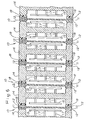
- an electrolysis cell assembly is shown wherein a membrane unit generally designated by reference number 10, comprising a membrane 11 and a reinforcing material 12 attached to both sides of the membrane 11, is interposed between two electrode frame units 14.
- a gasket 18 may be interposed between the membrane unit 10 and an electrode frame 14. It is also within the scope of the invention to interpose a gasket 18 on both sides of the membrane unit 10 and two adjacent electrode frames 14. Any gasket used in an electrolytic cell of the filter press type may be used.
- the gasket should be made of a corrosion resistant material, should have a high volume resistivity and good sealability after it has been compressed.
- Suitable materials for the gasket 14 may be, for example, EPDM, a chlorinated polyethylene (CPE), a polytetrafluoroethylene such as Teflon@, manufactured by E. I. duPont de Nemours and Company, and reinforced asbestos.
- An anode 15 and a cathode 16 are electrically connected with connectors 17 through the electrode frame 14.
- the electrolysis assembly above is typical of bipolar electrolytic cells of the filter press type such as described in U.S. Patent Nos. 4,111,77Q and 4,108,742. Any cell of the filter press type may be used in the present invention.
- the membrane unit 10 and a gasket 18 are interposed between two adjacent electrode frames 14 and a compressive force is applied to the cell assembly.
- the compressive force may be applied by any means known to those skilled in the art, for example, by clamping the frames together or by using a hydraulic ram.
- a hydraulic ram is used to squeeze the electrode frames, gaskets and membranes together.
- the actual compressive force applied will be dictated by the type of material used for the gasket.
- the film thickness used on the cathode side of the membrane was 15 mils thick while the film thickness used on the anode side of the membrane was 5 mils thick.
- the actual design used is the design shown in Figures 1 and 3.
- a laboratory electrolytic cell was used for testing the test samples.
- the cell consisted of an anode compartment frame and a cathode compartment frame.
- the anode compartment frame was made of titanium having the titanium surface located under the gasket area coated with a ruthenium dioxide coating to avoid possible crevice corrosion problems.
- the cathode compartment frame of the cell was made of an acrylic polymer.
- the anode of the cell was made of titanium with a ruthenium dioxide coating and the cathode was a nickel cathode.
- the gasket used was a 6.35 mm thick gasket made of EPDM rubber purchased from the Prince Rubber & Plastics Co., Inc. of Buffalo, New York.
- the gaskets were cut from single EPDM rubber sheets to form a picture-frame shape with dimensions of 9.5 cm outside--to-outside and 7.62 cm inside-to-inside. Thus, the width of the gasket surface was 9.5 mm.
- the total gasket area was 32..65.cm 2.
- the gasket was used on both sides of the membrane and contact loading was distributed over the reinforced surface.
- the cell of this example was operated to produce 32 weight percent caustic while controlling the anolyte salt at 200 grams per liter sodium chloride concentration.
- the cell temperature was maintained at 90°C with ampere loading controlled at 0.31 amp/cm 2 of projected anode area current density.
- the test was conducted for 210 days and during this period the caustic current efficiency averaged 95 percent with an average cell voltage of 3.5.
- the cell operated without leaks and performed without complications.
- the electrolytic cell used in this test is described in U.S. Patent application Serial No. 472,792, filed March 7, 1983, and is of a type well known in the industry as a bipolar flat plate-type cell having a nominal size of 1.22 met. by 3.05 met.
- the cell contained an anode of titanium with a ruthenium oxide coating and a cathode of steel.
- the gasket used was a 4.76 mm thick gasket made of EPDM rubber purchased from the Prince Rubber and Plastics Co., Inc., of Buffalo, New York. Specifications for the EPDM include "EPDM for Chlor-Alkali Service, Prince #6962.”
- the gaskets were cut from single EPDM rubber sheets to form a picture-frame shape with dimensions of 2.47 meter outside-to-outside and 2.37 meter inside-to-inside in the long direction and 1.25 meter outside-to-outside and 1.15 meter inside--to-inside in the short direction. Thus, the width of the gasket surface was 5.1 cm.
- the total gasket area was 3,676 cm 2 .
- the gasket was used on both sides of the membrane and contact loading was distributed over the reinforced surface.
- a hydraulic cylinder in a filter press arrangement was used to press together the cell units.
- the total force resulting from the action of the hydraulic press was 78,152 kg.
- the force exerted on the membrane was equivalent to 2,080 kPa.
- the cells were operated to produce from 12 to 16 weight percent caustic while controlling the anolyte salt at 200 grams per liter sodium chloride concentration.
- the cell temperature was maintained at 90°C with D.C. current controlled at 10.0 kiloamperes.
- the ampere loading was 0.31 amperes per square cm of projected anode area current density.
- the test was conducted for 199 days and during this period, the caustic current efficiency averaged 82-84 percent which was 4 percent below the expected caustic current efficiency for Nafion@ 324.
Landscapes
- Chemical & Material Sciences (AREA)
- Engineering & Computer Science (AREA)
- Chemical Kinetics & Catalysis (AREA)
- Electrochemistry (AREA)
- Materials Engineering (AREA)
- Metallurgy (AREA)
- Organic Chemistry (AREA)
- Electrolytic Production Of Non-Metals, Compounds, Apparatuses Therefor (AREA)
Applications Claiming Priority (2)
| Application Number | Priority Date | Filing Date | Title |
|---|---|---|---|
| US66804384A | 1984-11-05 | 1984-11-05 | |
| US668043 | 1984-11-05 |
Publications (2)
| Publication Number | Publication Date |
|---|---|
| EP0183096A1 true EP0183096A1 (fr) | 1986-06-04 |
| EP0183096B1 EP0183096B1 (fr) | 1991-02-27 |
Family
ID=24680765
Family Applications (1)
| Application Number | Title | Priority Date | Filing Date |
|---|---|---|---|
| EP85114059A Expired - Lifetime EP0183096B1 (fr) | 1984-11-05 | 1985-11-05 | Elément de membrane pour cellule électrolytique |
Country Status (9)
| Country | Link |
|---|---|
| EP (1) | EP0183096B1 (fr) |
| JP (1) | JPS61117294A (fr) |
| CN (1) | CN85108122A (fr) |
| AU (1) | AU562125B2 (fr) |
| BR (1) | BR8505502A (fr) |
| CA (1) | CA1287599C (fr) |
| DE (1) | DE3581896D1 (fr) |
| DK (1) | DK501585A (fr) |
| ES (1) | ES296350Y (fr) |
Cited By (7)
| Publication number | Priority date | Publication date | Assignee | Title |
|---|---|---|---|---|
| US4770757A (en) * | 1987-03-03 | 1988-09-13 | E. I. Du Pont De Nemours And Company | Edge reinforcement of membranes for chlor-alkali cells |
| EP0339114A1 (fr) * | 1988-04-28 | 1989-11-02 | E.I. Du Pont De Nemours And Company | Renforcement des bords de membranes pour des cellules chlore alkali |
| DE3928934C1 (fr) * | 1989-08-31 | 1990-10-11 | Sartorius Gmbh, 3400 Goettingen, De | |
| EP0690519A1 (fr) * | 1994-07-01 | 1996-01-03 | Japan Gore-Tex, Inc. | Ensemble d'étanchéité pour membrane d'échange d'ions polymère solide |
| US5945192A (en) * | 1995-06-29 | 1999-08-31 | Japan Gore-Tex, Inc. | Sealing assembly for a solid polymer ion exchange membrane |
| AT502170B1 (de) * | 2005-12-23 | 2007-02-15 | Semperit Ag Holding | Formkörper für eine filterpresse |
| EP4194588A1 (fr) * | 2021-12-08 | 2023-06-14 | thyssenkrupp nucera AG & Co. KGaA | Procédé d'étanchéification d'une cellule d'électrolyse et cellule d'électrolyse étanche |
Families Citing this family (1)
| Publication number | Priority date | Publication date | Assignee | Title |
|---|---|---|---|---|
| CN106830213A (zh) * | 2017-03-27 | 2017-06-13 | 长春云卫科技有限公司 | 酸性氧化电位水电解槽 |
Citations (4)
| Publication number | Priority date | Publication date | Assignee | Title |
|---|---|---|---|---|
| FR1540964A (fr) * | 1966-06-21 | 1968-10-04 | Monsanto Co | Cellule électrolytique et membrane composite |
| GB2013242A (en) * | 1977-12-26 | 1979-08-08 | Kanegafuchi Chemical Ind | Installation of membrane to electrolytic cell |
| DE2821983A1 (de) * | 1978-05-19 | 1979-11-22 | Hooker Chemicals Plastics Corp | Dichtelement fuer membranen, insbesondere bei filterpressenartig angeordneten elektrolysezellen |
| EP0051380B1 (fr) * | 1980-11-05 | 1985-05-29 | Olin Corporation | Dispositif d'étanchéité pour cellules du type filtre-presse |
Family Cites Families (5)
| Publication number | Priority date | Publication date | Assignee | Title |
|---|---|---|---|---|
| FR2146602A5 (en) * | 1971-07-20 | 1973-03-02 | Alsthom | Zinc/air cell - with plastics grid as spacer between anode and microporous membrane |
| JPS53146272A (en) * | 1977-05-27 | 1978-12-20 | Tokuyama Soda Co Ltd | Holder for ion exchange membrane |
| JPS5933195B2 (ja) * | 1979-09-04 | 1984-08-14 | 東ソー株式会社 | イオン交換膜の装着方法 |
| CA1174729A (fr) * | 1981-06-01 | 1984-09-18 | Patrick G. Grimes | Pile electrochimique |
| JPS584926U (ja) * | 1981-07-02 | 1983-01-13 | ミサワホ−ム株式会社 | 換気装置 |
-
1985
- 1985-10-31 DK DK501585A patent/DK501585A/da not_active Application Discontinuation
- 1985-11-01 JP JP60244235A patent/JPS61117294A/ja active Granted
- 1985-11-01 AU AU49293/85A patent/AU562125B2/en not_active Ceased
- 1985-11-04 CA CA000494496A patent/CA1287599C/fr not_active Expired - Fee Related
- 1985-11-04 ES ES1985296350U patent/ES296350Y/es not_active Expired
- 1985-11-04 CN CN198585108122A patent/CN85108122A/zh active Pending
- 1985-11-04 BR BR8505502A patent/BR8505502A/pt unknown
- 1985-11-05 EP EP85114059A patent/EP0183096B1/fr not_active Expired - Lifetime
- 1985-11-05 DE DE8585114059T patent/DE3581896D1/de not_active Expired - Fee Related
Patent Citations (4)
| Publication number | Priority date | Publication date | Assignee | Title |
|---|---|---|---|---|
| FR1540964A (fr) * | 1966-06-21 | 1968-10-04 | Monsanto Co | Cellule électrolytique et membrane composite |
| GB2013242A (en) * | 1977-12-26 | 1979-08-08 | Kanegafuchi Chemical Ind | Installation of membrane to electrolytic cell |
| DE2821983A1 (de) * | 1978-05-19 | 1979-11-22 | Hooker Chemicals Plastics Corp | Dichtelement fuer membranen, insbesondere bei filterpressenartig angeordneten elektrolysezellen |
| EP0051380B1 (fr) * | 1980-11-05 | 1985-05-29 | Olin Corporation | Dispositif d'étanchéité pour cellules du type filtre-presse |
Cited By (11)
| Publication number | Priority date | Publication date | Assignee | Title |
|---|---|---|---|---|
| US4770757A (en) * | 1987-03-03 | 1988-09-13 | E. I. Du Pont De Nemours And Company | Edge reinforcement of membranes for chlor-alkali cells |
| EP0339114A1 (fr) * | 1988-04-28 | 1989-11-02 | E.I. Du Pont De Nemours And Company | Renforcement des bords de membranes pour des cellules chlore alkali |
| DE3928934C1 (fr) * | 1989-08-31 | 1990-10-11 | Sartorius Gmbh, 3400 Goettingen, De | |
| DE3928934C2 (de) * | 1989-08-31 | 1999-04-29 | Sartorius Gmbh | Textilverstärktes mikroporöses Membranfilter, Verfahren zu seiner Herstellung und seine Verwendung |
| EP0690519A1 (fr) * | 1994-07-01 | 1996-01-03 | Japan Gore-Tex, Inc. | Ensemble d'étanchéité pour membrane d'échange d'ions polymère solide |
| US5945192A (en) * | 1995-06-29 | 1999-08-31 | Japan Gore-Tex, Inc. | Sealing assembly for a solid polymer ion exchange membrane |
| AT502170B1 (de) * | 2005-12-23 | 2007-02-15 | Semperit Ag Holding | Formkörper für eine filterpresse |
| EP4194588A1 (fr) * | 2021-12-08 | 2023-06-14 | thyssenkrupp nucera AG & Co. KGaA | Procédé d'étanchéification d'une cellule d'électrolyse et cellule d'électrolyse étanche |
| WO2023104817A1 (fr) * | 2021-12-08 | 2023-06-15 | thyssenkrupp nucera AG & Co. KGaA | Procédé pour l'étanchéification d'une cellule d'électrolyse et cellule d'électrolyse étanche |
| AU2022404755B2 (en) * | 2021-12-08 | 2026-02-05 | thyssenkrupp nucera AG & Co. KGaA | Method for sealing an electrolysis cell and sealed electrolysis cell |
| KR102991768B1 (ko) | 2021-12-08 | 2026-07-15 | 티센크루프 누세라 아게 운트 콤파니 카게아아 | 전해 셀의 밀봉 방법 및 밀봉된 전해 셀 |
Also Published As
| Publication number | Publication date |
|---|---|
| AU562125B2 (en) | 1987-05-28 |
| ES296350Y (es) | 1988-04-16 |
| DK501585D0 (da) | 1985-10-31 |
| AU4929385A (en) | 1986-05-15 |
| DE3581896D1 (de) | 1991-04-04 |
| ES296350U (es) | 1987-10-16 |
| JPS61117294A (ja) | 1986-06-04 |
| CA1287599C (fr) | 1991-08-13 |
| DK501585A (da) | 1986-05-06 |
| CN85108122A (zh) | 1986-07-16 |
| JPH0364598B2 (fr) | 1991-10-07 |
| BR8505502A (pt) | 1986-08-05 |
| EP0183096B1 (fr) | 1991-02-27 |
Similar Documents
| Publication | Publication Date | Title |
|---|---|---|
| US4894128A (en) | Membrane unit for electrolytic cell | |
| US4915803A (en) | Combination seal and frame cover member for a filter press type electrolytic cell | |
| EP0276351B1 (fr) | Dispositif d'étanchéité pour cellule d'électrolyse | |
| US4892632A (en) | Combination seal member and membrane holder for an electrolytic cell | |
| US4898653A (en) | Combination electrolysis cell seal member and membrane tentering means | |
| US4219394A (en) | Membrane assembly for electrolytic cells | |
| EP0051380B1 (fr) | Dispositif d'étanchéité pour cellules du type filtre-presse | |
| US4389289A (en) | Bipolar electrolyzer | |
| US4431502A (en) | Sealing means for filter press cells | |
| EP0055931B1 (fr) | Lubrifiant pour joint d'étanchéité | |
| US4654134A (en) | Combination seal and tentering means for electrolysis cells | |
| AU564709B2 (en) | Seal for electrolytic cells | |
| CA1287599C (fr) | Membrane pour pile electrochimique | |
| EP0402909B1 (fr) | Joints d'étanchéité pour cellules du type filtre-presse | |
| CA1154717A (fr) | Piles a membrane-electrode pour le fonctionnement a moyenne pression | |
| US4940518A (en) | Combination seal member and membrane holder for a filter press type electrolytic cell | |
| US4886586A (en) | Combination electrolysis cell seal member and membrane tentering means for a filter press type electrolytic cell | |
| US4585527A (en) | Electrolytic cell | |
| US4381984A (en) | Electrode frame | |
| US4877499A (en) | Membrane unit for electrolytic cell | |
| US4390408A (en) | Membrane electrode pack cells designed for medium pressure operation | |
| JPS63216990A (ja) | 電解槽の密封手段、電解槽アセンブリ、および電解槽密封方法 | |
| CA1315734C (fr) | Dispositif combine de scellement et de recouvrement pour cellule electrolytique | |
| EP0276350A1 (fr) | Dispositif d'étanchéité et tendeur combiné pour cellules d'electrolyse | |
| JPS63216989A (ja) | 電解槽の結合密封−幅出し手段およびアセンブリ、電解槽アセンブリ、並びに密封−幅出し方法 |
Legal Events
| Date | Code | Title | Description |
|---|---|---|---|
| PUAI | Public reference made under article 153(3) epc to a published international application that has entered the european phase |
Free format text: ORIGINAL CODE: 0009012 |
|
| 17P | Request for examination filed |
Effective date: 19851105 |
|
| AK | Designated contracting states |
Kind code of ref document: A1 Designated state(s): BE DE FR GB IT NL |
|
| 17Q | First examination report despatched |
Effective date: 19870625 |
|
| GRAA | (expected) grant |
Free format text: ORIGINAL CODE: 0009210 |
|
| AK | Designated contracting states |
Kind code of ref document: B1 Designated state(s): BE DE FR GB IT NL |
|
| ITF | It: translation for a ep patent filed | ||
| REF | Corresponds to: |
Ref document number: 3581896 Country of ref document: DE Date of ref document: 19910404 |
|
| ET | Fr: translation filed | ||
| PGFP | Annual fee paid to national office [announced via postgrant information from national office to epo] |
Ref country code: FR Payment date: 19910829 Year of fee payment: 7 |
|
| PGFP | Annual fee paid to national office [announced via postgrant information from national office to epo] |
Ref country code: BE Payment date: 19910927 Year of fee payment: 7 |
|
| PGFP | Annual fee paid to national office [announced via postgrant information from national office to epo] |
Ref country code: GB Payment date: 19911001 Year of fee payment: 7 |
|
| K2C3 | Correction of patent specification (complete document) published |
Effective date: 19910227 |
|
| PGFP | Annual fee paid to national office [announced via postgrant information from national office to epo] |
Ref country code: NL Payment date: 19911130 Year of fee payment: 7 |
|
| PLBE | No opposition filed within time limit |
Free format text: ORIGINAL CODE: 0009261 |
|
| STAA | Information on the status of an ep patent application or granted ep patent |
Free format text: STATUS: NO OPPOSITION FILED WITHIN TIME LIMIT |
|
| 26N | No opposition filed | ||
| PG25 | Lapsed in a contracting state [announced via postgrant information from national office to epo] |
Ref country code: GB Effective date: 19921105 |
|
| PG25 | Lapsed in a contracting state [announced via postgrant information from national office to epo] |
Ref country code: BE Effective date: 19921130 |
|
| BERE | Be: lapsed |
Owner name: THE DOW CHEMICAL CY Effective date: 19921130 |
|
| PG25 | Lapsed in a contracting state [announced via postgrant information from national office to epo] |
Ref country code: NL Effective date: 19930601 |
|
| GBPC | Gb: european patent ceased through non-payment of renewal fee |
Effective date: 19921105 |
|
| NLV4 | Nl: lapsed or anulled due to non-payment of the annual fee | ||
| PG25 | Lapsed in a contracting state [announced via postgrant information from national office to epo] |
Ref country code: FR Effective date: 19930730 |
|
| REG | Reference to a national code |
Ref country code: FR Ref legal event code: ST |
|
| PGFP | Annual fee paid to national office [announced via postgrant information from national office to epo] |
Ref country code: DE Payment date: 19960902 Year of fee payment: 12 |
|
| PG25 | Lapsed in a contracting state [announced via postgrant information from national office to epo] |
Ref country code: DE Free format text: LAPSE BECAUSE OF NON-PAYMENT OF DUE FEES Effective date: 19980801 |