EP0183196A2 - Bussystem - Google Patents
Bussystem Download PDFInfo
- Publication number
- EP0183196A2 EP0183196A2 EP85114803A EP85114803A EP0183196A2 EP 0183196 A2 EP0183196 A2 EP 0183196A2 EP 85114803 A EP85114803 A EP 85114803A EP 85114803 A EP85114803 A EP 85114803A EP 0183196 A2 EP0183196 A2 EP 0183196A2
- Authority
- EP
- European Patent Office
- Prior art keywords
- message
- station
- bus
- external
- data transfer
- Prior art date
- Legal status (The legal status is an assumption and is not a legal conclusion. Google has not performed a legal analysis and makes no representation as to the accuracy of the status listed.)
- Withdrawn
Links
Images












Classifications
-
- G—PHYSICS
- G06—COMPUTING OR CALCULATING; COUNTING
- G06F—ELECTRIC DIGITAL DATA PROCESSING
- G06F13/00—Interconnection of, or transfer of information or other signals between, memories, input/output devices or central processing units
- G06F13/38—Information transfer, e.g. on bus
- G06F13/42—Bus transfer protocol, e.g. handshake; Synchronisation
- G06F13/4204—Bus transfer protocol, e.g. handshake; Synchronisation on a parallel bus
- G06F13/4208—Bus transfer protocol, e.g. handshake; Synchronisation on a parallel bus being a system bus, e.g. VME bus, Futurebus, Multibus
- G06F13/4213—Bus transfer protocol, e.g. handshake; Synchronisation on a parallel bus being a system bus, e.g. VME bus, Futurebus, Multibus with asynchronous protocol
Definitions
- the presentation may be L nterrupted for long enough periods of time to prevent it from having a real-time appearance. In other words, a minimum data rate is not guaranteed.
- Anoer disadvantage of some prior systems is that the distances over which they can operate are too short.
- a further problem is that there is only one chance for a message to be sent, and when it is sent, there is no assurance that it was received.
- stations of the same group communicate with each other via an internal bus for the group as follows.
- Means are provided for ranting the stations access to an internal bus during periods of reset duration in a sequence that preferably, but not necessarily, only includes those stations having a message to send.
- a complete message includes the address, TO, of the station to which the message is to go, a desired number of words data and preferably the address, FROM, of the station sending he message.
- the first signal is asserted but the second is not, he delivery of the message to the station having the TO address s completed and the station sending the message is prepared to eceive a new message to send; but if the second signal is also sserted, the message is not delivered and remains in the sending taion until it is granted access to the internal bus during a ucceeding sequence.
- the sending station s prepared to receive a new message to send. This is also done f the extra bits indicate that the station having the TO address present and able to accept a message, in which event it is assumed that the message has been successfully delivered. owever, if the station having the TO addresss is present but cannot receive a message, the message remains in the sending station until it is given access to the bus at a later time and he message is assumed to have been delivered.
- a message that is generally but not necessarily provided by a rammed processor of a station is temporarily stored in the egisters of the transmitter means of that station and conveyed the registers of the data transfer means of any station via a ommon parallel bus comprised of data lines and control lines.
- the bus will hereinafter be referred to as an internal bus".
- the number of transmitter means involved in a sequence depends on the number having messages to send at any one time. After each message is placed on the internal.bus, the process is repeated. Because the messages are short, a number may be required before a station can convey all the information desired; but the sequential rate with which transmitter means have access to the bus is fast enough to give the information conveyed a continuous character.
- a transmitter means When a transmitter means is connected to the internal bus, it places the first and second words of the message thereon in sequence.
- the first word contains the address of the station to which the message is to be conveyed, hereinafter referred to as the TO address, and the second word is the address of the station sending the message, hereinafter referred to as the FROM address.
- the TO address the address of the station to which the message is to be conveyed
- the FROM address the address of the station sending the message
- the data transfer means asserts a busy signal -BSY on a -BSY control line while the FROM address is on the data lines of the internal bus.
- This control line is also connected to all the transmitter means, data transfer means and the arbitrator.
- the transmitter means places a first data word D 1 on the internal bus. All of the data words could be placed on the internal bus in sequence and loaded by the data transfer means into its registers if desired, but provision may be made for a processor to instruct a data transfer means to only receive a message from the same station from which it received its last message. To determine this, the data transfer means of the TO address station compares a copy of the last FROM address received with the FROM address in the current message. If they are not the same, -BSY is asserted on the -BSY control line. This can only occur while the D 1 data word is on the internal bus because the comparison can only be made while the FROM address is on the internal bus.
- the message remains in the registers of the transmitter means until it is successfully delivered to the TO address station during another turn on the bus, or until it is aborted by the processor.
- the assertion of -ACK and the non-assertion of -BSY assures that the message has been successfully delivered and the registers of the transmitter means are prepared to receive a new message from the programmed processor or other means.
- an "external transmitter means” and “external data transfer means” are provided and one more line is included in the internal bus than is required for the data.
- the data lines and the additional line are connected to the input of the external data transfer means, and the output of the external data transfer means is connected to the input of the external transmitter means. Its output is connected to the internal bus when it receives a clear-to-send signal from the arbitrator.
- an additional bit can be added to each word of the message. They do not come from the processor, but are added to each word of the message as it is placed on the internal bus. Initially, two of them respectively added to the FROM address and the D 1 data word have a logic level of "0". The bit added to the FROM address will be made a "1" by the external data transfer means if the TO address station is on the internal bus; and the bit added to the D l data word will be made a "1" if the TO address station is busy. In the situation where the TO address station is not present, both bits will be "0".
- the transmitter means Upon seeing this, the transmitter means will prepare its registers to receive a new message and flags will be set to indicate to the processor that no such station exists. If the TO address station is there and its data transfer means can receive a message, the bit added to the FROM address will be "1" and the bit added to the D 1 data word will be "0", but if the data transfer means is busy or cannot receive from the transmitting station, it will be "1".
- Time is saved in this bus system because a processor is not involved in making decisions related to the delivery or non- delivery of a message. All these decisions are made by hardwired state machines in the transmitter means, the data transfer means and the arbitrator. Time is also saved by virtue of the fact that the request-to-send and clear-to-send signals are conveyed on individual lines rather than via data lines of the bus.
- means are provided for sending a message from a station on one internal bus to a station on another internal bus. This may be necessary because of a practicable limit to the number of stations that can be on one internal bus or because it is desired to have a first group of stations on one internal bus at a point that is remote from a second group of stations on another internal bus.
- an external bus is connected between the output of the external data transfer means of the first group to a fifo buffer that is connected to the input of the external transmitter means of the second group.
- the external data transfer means determines from the fact that neither -ACK nor -BSY are asserted when the FROM address is on the internal bus that it is to place the ;message on the external bus. If the registers of the external data transfer means are not empty, it asserts -BSY on the control line while the D l data word is on the bus and the transmission is terminated and the message stays in the.registers of the transmitter means to wait for it to have another- turn on the internal bus. If, however, the registers of the external data transfer means are empty, it loads the message into registers selected by a two-bit state code machine.
- the external data transfer means of the first group Before the external data transfer means of the first group loads the external bus, it sends out a signal of enquiry to determine if the fifo in the second group can accept a word of data. If it can, an affirmation signal is sent back indicating this fact and the external data transfer means for the first group loads the external bus. It will have one line for each bit in the message, one line for the additional bit referred to above, two lines for the two bits from the code state machine, one line for the signal of enquiry, and one line for the affirmation signal.
- a Transmit Data Register Empty (TDRE) flag is checked to determine if the registers of the external transmitter means are empty. If they are, the message and the extra bit for each word are written into appropriate registers of the external transmitter means as directed by the code state machine bits.
- the external transmitter means asserts a request-to-send signal -RTS to the arbitrator for the second group; and when the arbitrator sends back a clear-to-send signal -CTS, the external transmitter means places the TO address and FROM address on the internal bus of the second group.
- the station having the TO address is not in the second group and if the registers of the external data transfer means of the second group are empty, the message and the extra bits in the FROM address and the D1 data word are loaded into the registers of the external data transfer means selected by its code state machine; but if the registers are not empty, the message and extra bits remain in the registers of the external transmitter means and the process is repeated until the message is successfully sent.
- the message and extra bit are conveyed from the registers of the external data transfer means of the second group to the external transmitter means of a third group in the same manner as they were conveyed from the registers of the external data trasnfer means of the first group to the external transmitter means of the second group.
- the message and extra bits will remain in the registers of the external transmitter means for the third group if the registers for the external data transfer means for the third group are full; but if the latter registers are empty, the message will be loaded into these registers.
- the extra bit added to the FROM address and the extra bit added to the D 1 data word are both changed to a "1" by the external data transfer means. If, however, the TO address station can accept the message, the extra bit in the FROM address is set at "1" and the bit added to the Dl data word remains at "0".
- the transmitter means that originated the message can know what happened to the message it sent, it is necessary that the external bus-eventually return to the input of the external transmitter means of the first group. In other words, the external bus must be in the form of a loop.
- the transmitter means originating the message can tell from the extra bits what happened to the message. If it was delivered, the registers of that transmitter means can be prepared to accept a new message; but if it was not delivered, the message remains in the registers of the transmitter means until it is successfully transmitted or until it is aborted by the associated processor. Then too, if the TO address is not present, the extra bits are "0,0" as previously discussed, a flag is set and the message is automatically aborted.
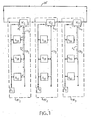
- FIGURE 1 In order to provide a basic understanding of the overall operation of a bus system incorporating this invention, reference is made to FIGURE 1 in which three mainframes MF 1 , MF 2 and MF 3 are shown at different points on an external bus XB' which is in the form of a loop.
- the mainframe MF 1 is comprised of a coupling means XC 1 for transferring signals from the external bus XB' to an internal bus IB 1 and vice-versa; three stations S 1A , S 1B and S 1C that can supply information to and receive information from the internal bus I B1 under the control of their respective microprocessors (not shown); and an arbitrator A 1 that determines the sequence in which the coupling means XC 1 and the stations S 1A , S 1B and S 1C have access to the internal bus IB 1 . Much time is saved by including the coupling means XC 1 or any station in the sequence only when XC 1 or that station has a message to deliver.
- Messages placed on the external bus XB' by the coupling means XC 1 flow around the loop formed by the external bus XB' in a counterclockwise direction, as indicated by the arrows.
- the purpose of the bus system is to deliver messages provided by the microprocessor of a station to a designated station, but the microprocessor is not part of the invention. As will be seen, microprocessors only need provide messages in a given format, but achieving that result is well within the skill of the art. Except for subscripts, the mainframes MF 2 and MF 3 are the same a MF 1 .
- a bus system incorporating this invention is capable of performing five different types of communications and reacting to different situations that may be encountered in each in a manner explained in detail in connection with FIGURES 3A through 3E. I the description of these five types of communication, the path or paths followed by the message is indicated by a designated dashed line in FIGURE 1.
- a first type of communication situation is from a station such as S 1A to a station such as S 1C in the same mainframe.
- the message flows from S 1A to S 1C via the internal bus IB 1 .
- S 1C can receive the message
- the message remains in the sending station S 1A until it is given another turn on the internal bus IB 1 and delivers the message or until the microprocessor of S lA aborts the message.
- a second type of communication situation occurs when a message from a station is put onto the external bus XB' for delivery to a station in another mainframe. If, for example, the message originates in S 1A of MF 1 and is intended for station S 3B in mainframe M F3 f it passes via the internal bus IB 1 to the coupling means XC 1 which places it on the external bus XB' as indicated by the dashed line l 2 . There are two situations that can be encountered. Either the coupling means XC l can make the transfer or it cannot. If it cannot, the message stays in the station S lA to await another turn unless it is aborted.
- a third type of communication situation occurs when a message on the external bus XB' arrives at the coupling means of a mainframe and is not intended for a station in that mainframe.
- An example is where a message is sent by S lA in the mainframe MF 1 and intended for station S 3B in the mainframe MF 3 .
- the coupling means XC 2 of the mainframe M F2 is to transfer the message from the portion of the external bus XB' on its left to the portion of the external bus XB' on its right via the internal bus IB 2.
- the coupling means XC 2 can transfer the message from the internal bus IB 2 to the external bus XB'; but in another, it cannot do so, in which event the message is stored in XC 2 to await another turn.
- a fourth type of communication situation occurs when a message on the external bus XB' arrives at a coupling means of a mainframe in which the station for which the message is intended resides, e.g., for the station S 3B in the mainframe MF 3 .
- a completely successful communication requires that the message be delivered to the station S 3B and also that it be transferred to the external bus XB' so as to eventually arrive at the mainframe from which it came.
- the coupling means XC 3 transfers the message from the section of the external bus XB' on its left to the internal bus I B3 and via the internal bus IB 3 to the station S 3B .
- the coupling means XC 3 also transfers the message from the internal bus IB c to the section of the external bux XB' on its right. In a situation where the station S3B can receive the message and the coupling means XC 3 can transfer the message to the external bus XB', the communication is completely successful; but there are four situations in which it is not. If the station S 3B cannot receive the message and the coupling means XC 3 cannot transfer it from the internal bus IB 3 to the external bus XB', the message stays in the part of the couping means XC3 at which it arrived. This also occurs if the coupling means XC 3 cannot transfer the message from the internal bus IB 3 to the external bus XB' even if the station S 3B can receive it.
- station S 3B There are two situations in which the message is not delivered to the. station S 3B and is returned by the external bus XB' to the mainframe from which it came, in which event the station that originated the message will send it again on its next turn on its internal bus, unless the message has been aborted by its microprocessor. In one of these latter situations, the station S 3B is busy; and in another, it has been instructed by its microprocessor to only receive a message from a different sending station.
- a fifth type of communication situation occurs when a message is returning to the mainframe containing the station that originated it, as briefly noted above. If, for example, the station S 1A originated the message, the coupling means XC 1 transfers it from the external bus XB' to the internal bus IB 1 and it flows along the internal bus IB i to the station S 1A , as indicated by the dashed line l 5 . The station S 1A examines the message to see if it has been successfully delivered. If so, S 1A is prepared to receive a new message to transmit; but if not, S 1A will retransmit the message when it gets another turn on the internal bus IB 1 , unless its microprocessor has aborted the message.
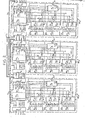
- FIGURES 3A through 3E The general manner in which a bus system of this invention carries out the five communication types of FIGURES 3A through 3E will now be described by reference to the block diagram of FIGURE 2.
- the system is shown as being'comprised of three mainframes MF A , MF B and MFC that are contained within separate rectangles formed by dash-dot lines. Since the mainframes are identical except for the letter subscripts employed, only the mainframe MF A will be described.
- the mainframe MF A is shown as having three stations S A1 , S A2 and S A3 which may be in the form of modules.
- the station S A1 is comprised of a microprocessor MP A1 and an internal chip IC A1 .
- the latter has a transmitter means TX A1 for transmitting signals to an internal bus IB A and a data transfer means DT A1 for transferring signals from the internal bus IB A to the microprocessor MP A1 .
- Information is passed from the microprocessor MP A1 via an eight-bit- wide input/output line I/O of the internal chip ICAl to registers in the transmitter means TX A1 selected by the combination of bits applied to the pins A0, Al and A2 when a -WR pin is low.
- FIGURE. 9 The registers of the internal chip IC A1 that are to be written into and read from are illustrated in FIGURE. 9 and the combinations of the logic states of A0, Al and A2 for both write and read situations are shown in FIGURE 10.
- the microprocessor MP A1 can also send a signal to a reset input of the internal chip IC A1 .
- the transmitter means TX A1 and the data transfer means DT A1 each have their own state machine. Except for the numerals in the subscripts, the stations S A2 and S A3 are identical to the station S A1 just described.
- the transmitter means TX A1 , TX A2 and TX A3 are respectively connected to the internal bus I BA via normally open switches s A1 , s A2 and s A3 ; and all of the data transfer means DT A1 , DT A2 and D TA3 are permanently connected to the internal bus IB A .
- An external chip XC A has a transmitter means TX A that receives data from an external bus XB via a fifo F A and conveys it to the internal bus IB A via a switch s A .
- the external chip XC A also has a data transfer means DT A that transfers data from the internal bus IB A to the external bus XB. If data is to pass directly from the transmitter means TX A to the data transfer means DT A , it is conveyed by the internal bus IB A .
- noise immunity can be enhanced by differentially coupling the external chip XC A to the external bus XB, in which event a differential driver DFDA is coupled between the output of the data transfer means DT A and the external bus XB, and a differential receiver DFR A is coupled between the external bus XB and the input of the transmitter means TX A .
- the mainframe MF A is inserted at one point in the external bus XB.
- the mainframes MF B and MF C are inserted at successive points along XB by similar connections of their respective external chips XC B and XC C .
- the external bus XB includes a bundles U, V, W, X and Y. Each of these bundles goes from the differential driver of one mainframe to the differential receiver of the- next mainframe. Because of . space limitations, however, the portions of the pairs between the differential driver DFD C of the mainframe MF C and the differential receiver DFR A are not shown. This part of XB therefore forms a loop.
- MF A is prior to M FB
- MF B is prior to MFC
- MF C is prior to MF A
- Another pair of conductors in XB is connected between the differential driver of one mainframe and the differential receiver of the previous mainframe.
- a pair Z l is connected between DFD A of MF A and DFR C of MF C
- a pair Z 2 is connected between DFD B of MF B and DFR A of MF A
- a pair Z 3 is connected between DFD C of MF C and DFR B of MF B .
- any of the transmitter means TX A1 , TX A2 , TX A3 and TX A When any of the transmitter means TX A1 , TX A2 , TX A3 and TX A have a complete message to place on the internal bus IB A , it asserts a signal -RTS (REQUEST TO SEND) on an individual control line between it and an arbitrator AA that will be described in detail at a later point. If the arbitrator A A grants such a request, it asserts a signal -CTS (CLEAR TO SEND) on an individual line between itself and the transmitter means selected so as to effectively close the corresponding one of the switches s A1 , s A2 , s A3 and s A .
- -RTS REQUEST TO SEND
- the arbitrator A A sends a -CTS signal in sequence to all transmitter means TX Al , TX A2 and TX A3 of the internal chips that have asserted -RTS and places the transmitter just given access to the internal bus IB A at the bottom of the sequence. In between each grant to successive transmitter means of the internal chips, it gives the transmitter means TX A of the external chip XC A an opportunity to have access to the internal bus IB A if TX A has a message to send.
- control lines -ACK and -BSY are connected to all of the internal chips IC A1 , IC A2 and IC A3 as well as to the arbitrator A A , and another control line BUF FUL is connected between the data transfer means DT A of the external chip XC A and the arbitrator A A .
- the TO address is the address of the station to which the message is to be sent and may or may not be in the same mainframe as the sending station. If two data words are supplied by the microprocessor, they will be written into the registers TD 1 and TD 2 ; but if only one data word is sent, it will be written into the register TD2. When TD 2 is written into the message is complete and -RTS is asserted.
- the FROM address is the address of the sending station. Before operations begin, the FROM address is written into the MFA register while the reset input of the internal chip is set.
- the eight bits of information in the registers of the transmitter means TX A1 have a ninth bit associated with them as illustrated below and that all nine bits are conveyed to the internal bus IB A .
- These words will now be referred to as frames and their designations are to the left.
- the first eight bits come from the registers indicated at the right, FIGURE 9, and the ninth bit is added.
- the BW bit in the TO frame will be set high by the transmitter state machine if the register TD 1 as no data and the register TD 2 does, and it will be set low if both TD 1 and TD 2 have data.
- the bit EA in the F frame and the bit NA in the D l frame will be low at this point.
- the CMD bit is not important to this invention, but provides an extra channel of communication that may be useful in certain circumstances. In a manner to be explained, it is set whenever a SEND CMD bit is set in the control register.
- FIGURES 3A 1 , 3B 1 , 3C 1 , 3D 1 and 3E 2 The only completely successful communications are those illustrated in FIGURES 3A 1 , 3B 1 , 3C 1 , 3D 1 and 3E 2 .
- the sending transmitter means places the TO and F frames on the internal bus IB A in sequence.
- the latter In a communication between a station such as S A1 and a station such as S A3 that are both in the mainframe MF A , the latter asserts a signal -AC:K on the control line of the same designation during the F frame to indicate that it is present; but if the communication is for a station in another mainframe such as S C2 in the mainframe MF C , -ACK is not asserted.
- the TO and F frames are automatically stored in the appropriate registers (shown in FIGURE 9) of the data transfer means DT A of the external chip XC A under the control of DT A 's state machine. This assumes that the registers are empty. What occurs if.the registers of DT A are not empty will be discussed in detail at a later point. If the communication is internal, the storage of the TO and F frames in this manner presents no problem because they can be written over.
- the addressee SA 3 is ready to accept data so that it does not assert -BSY.
- the absence of -BSY in either the F or D 1 frames permits the transmitter means TX A1 of the station SA 1 to complete the transmission through the frame D 2 .
- the control signal -BSY appearing in the D 2 frame is asserted by the arbitrator AA for synchronization purposes that will be explained when the flow charts are considered.
- the addressee S A3 has been instructed by its microprocessor MP A3 to receive from the same station that it last received a message from. If S A1 is that station, -BSY is not asserted and the transmission is completed; but if S A1 is not that station, a fact that cannot be determined until after the F frame, S A3 asserts -BSY during the D 1 frame and D 2 is not sent.
- the addressee S A3 is busy, i.e., its microprocessor MP A3 has not read all the data in its registers, the data transfer means DT A3 asserts -BSY during the F frame and the communication is terminated at that point; neither D 1 nor D 2 are placed on the internal bus IB A .
- the control signal -ACK is not asserted during the F frame on the -ACK control line of MF A because the addressee S C2 is not in MF A and no station in MF A can assert -BSY because no station in MF A is the addressee.
- the registers of the data transfer means DT A of the external chip XC A are empty so that they can receive data, in which event TX A1 places all four frames of the message on the internal bus IB A in sequence.
- the state machine for the data transfer means DT A of the external chip XC A also stores the frames D 1 and D 2 when they are put on the internal bus IB A by the transmitter means TX A1 of the station S A1 .
- a cede state machine that is not shown in FIGURE 2 but which is part of the data transfer means DT A sends a signal -DOCLK to the -WR pin of the external chip XC B in the next mainframe MF B along the external bus XB. If the fifo F B is ready to receive data, it asserts a signal -FIORDY that is conveyed by differential conductor pair Z 2 back to the code state machine via DFR A and the -RD pin so that the external communication can proceed.
- the code state machine of the data transfer means D TA of the external chip XC A provides four combinations of two bits from its status register that are used to successively select the order in which the data frames TO, F, D l and D 2 are to be read and placed on the external bus XB. These same bits are respectively placed on the output pins D09 and DO10 of the data transfer means D TA so that they are carried along with the rest of the message DO0-DO8 to the fifo F B of the next mainframe.
- the code bits are respectively connected to the WAO and WAl pins of the transmitter means TX B of the external chip XC B so as to place the first nine bits of the frames in the proper registers of TX B .
- the frames with the added bits appear at the output pins of DT A as illustrated below. Note that the bit positions DO0-DO8 correspond to the bit positions DO-D8 of the words on the internal bus IB A .
- the registers of the data transfer means DT A are not all empty so that DT A cannot receive a message.
- the signal BUF FUL is asserted during the TO frame, but the state machine of DT A has to wait until the end of the F frame to see by the assertion or non-assertion of -ACK whether the message is for a station in the mainframe MF A or for a station in another mainframe. If -ACK is asserted in the F frame, the addressee is in the same mainframe and D TA does nothing; but if -ACK is not asserted in the F frame, the addressee is in another mainframe, in which event DT A asserts -BSY during the D 1 frame. At this point, S A1 re-asserts RTS and tries to successfully complete its communication when granted CTS by the arbitrator A A .
- the message passes from the transmitter means TX B of the external chip XC B to its own data transfer means DT B via the internal bus IB B .
- TX B asserts a request-to-send signal on its -RTS control line to the arbitrator A B for the mainframe MF B . If the arbitrator A B asserts clear-to-send on the -CTS control line between it and TX B , the switch S B is closed to connect the data lines D08-DOO to the internal bus IB B .
- the state machine of TX B then places the TO frame on the internal bus I BB . Because the TO address is for the station S C2 which is not in the mainframe MF B , the signal -ACK will not be asserted.
- the registers of DT B are not empty so that it asserts a signal BUF FUL on the line to the arbitrator A B during the TO frame.
- the data transfer means DT B After waiting until the end of the F frame to see whether.the message is for a station in MF B , a fact that would be indicated by the assertion of -ACK in the F frame, the data transfer means DT B asserts -BSY during the D 1 frame and D 2 is not transmitted.
- the arbitrator A B then asserts -BSY on the -BSY control line for synchronization purposes and the message remains in TX B to await another turn on the internal bus I B B .
- the message arrives at the transmitter means of the external chip for the mainframe containing the TO address station, e.g., the message already described that originated in TX A1 of the station S A1 in MF A and which is intended for the station S C2 in MF C .
- the state machine of TX C asserts a request-to-send signal on the -RTS control line to the arbitrator A C . If the arbitrator A C asserts'clear-to-send on the -CTS control line to TX C , the switch s C is closed and TX C places the TO and F frames on the internal bus IB C in sequence.
- the station S C2 for which the message is intended asserts -ACK on the -ACK control line during the F frame, but because its registers are empty and because it has not been instructed by its microprocessor MP C2 to only receive a message from a station other than S A1 , it does not assert -BSY during the F frame.
- the registers of the data transfer means DT C of the external chip XC C of the mainframe MF C are ready to receive data so that BUF FUL is not asserted.
- TX C sequentially places the D 1 and D 2 frames on the internal bus IB C and they are stored in registers of the data transfer means D TC .
- the ninth bit EA is set to unity and NA is left at zero. This is necessary in order to permit the registers TTO, MFA, TD 1 and TD2 of the originating transmitter means TX A1 to receive another message. Otherwise, the message would be repeatedly transmitted.
- the station S C2 asserts -ACK during the F frame, but neither it nor the data transfer means DT C are capable of receiving data so that - B SY is asserted during the F frame and the message remains in TX C to await the assignment of another turn on the internal bus XB C by the arbitrator A C .
- the bits EA and NA remain at zero.
- the data registers of the data transfer means DT C of the external chip XC C are empty but the data registers of the address station S C2 are full so that it asserts -BSY as well as -ACK during the F frame.
- the state machine for the data transfer means DT C2 tests to see if the transmitter means TX C is sending the message. If so, it asserts - BSY during the D l frame. Otherwise, -BSY would be unasserted during the F frame and the communication would terminate as in the situation (10).
- the arbitrator A C asserts -BSY in the D 2 frame as is required for synchronization, and the state machine for DT C2 sets the ninth bit EA of the F frame and NA of the D 1 frame to a logic high.
- the registers of the data transfer means DT C are ready to receive data, but the station S C2 for which the message is intended has been instructed by its microprocessor MP C2 to only receive a message from a station other than S A1 at which the message originated.
- S C2 asserts -ACK during the F frame but the state machine for the data transfer means DT C1 cannot know until after the F frame where the message is coming from.
- the arbitrator A C asserts -BSY during the D 2 frame, as is usual so that the complete message is placed on the external bus X B even though it has not been delivered to S C2 . As in the situation (11), this is done in order to prevent the external bus XB from becoming clogged.
- the transmitter means TX A asserts -RTS.
- the switch s A is closed and the TO and F frames are put on the internal bus IB A .
- the data transfer state machine of DT A1 of the station S A1 determines whether or not the address in the F frame of the message is the same as the address of the station S A1 that is stored in its MFA register, FIGURE 9. If it is, -ACK and -BSY are asserted during the D 1 frame and the registers of the transmitter.
- FIGURE 2 explained in a general way the operation of the various components of a bus system incorporating this invention
- FIGURE 3 will explain the operation with reference to the flow charts for the various state machines.
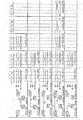
- FIGURES 3A, 3B, 3C, 3D and 3E are block diagrams respectively illustrating the paths to be followed by the message in different types of communication, and the graphs in the same respective rows illustrate the signals -BSY, -ACK and BUF FUL that occur in different situations.
- the blocks with XTX in their identification are transmitter means of an external chip; the blocks with XDT are data transfer means of an external chip; the blocks with ITX are transmitter means of an internal chip; and the blocks with IDT are data transfer means of an internal chip.
- An internal bus is designated by IB and the external bus is designated by XB.
- the graphical figures of the drawing are divided by dashed lines into successive time periods equal to one cycle of the clock pulses that are shown at the top of each column. Each time period is labelled at the top with the frame of the message that is occurring.
- the graphical situations are respectively identified by numbers in parentheses rather than by the figure designations.
- FIGURES 3A 1 , 3B 1 , 3C 1 and 3D 1 A completely successful delivery of the four frames TO, F, D 1 and D 2 of a message occurs only in FIGURES 3A 1 , 3B 1 , 3C 1 and 3D 1 ; and preparing a transmitter means for the transmission of a new message after a successful delivery occurs in FIGURE 3 E 2 ,
- FIGURES 3D 4 and 3D 5 represent a successful delivery of the four frames of a message because the time periods are labelled TO, F, D 1 and D 2 , they are situations in which the message is not delivered to the TO station and is sent on around the external bus XB to prevent lock-up.
- -BSY will be asserted by some state machine whenever a message is prematurely terminated and that -BSY is asserted by the arbitrator in the D 2 frame of a complete message. This is done for synchronization purposes.
- the assertion of -BSY resets all state machines (except the code state machine) to their initial state [0], and -BSY is only unasserted when the arbitrator receives an -RTS signal.
- Communication situation (1) is a completely successful communication in which the full message is delivered from ITX A to the registers of ID TA that is in the same mainframe and is the same as the situation in FIGURE 2 when, as previously discussed, a message was sent from the transmitter means TX A1 of station S A1 to the data transfer means DT A3 of station S A3 .
- the internal transmitter means IT XA places the TO and F frames on the internal bus IB as indicated by blocks 604 and 608 of FIGURE 6A.
- a decision block d603 checks the levels of -BSY and -ACK which are provided by the state machine for the internal data transfer means IDT A shown in FIGURE 7A in a manner described below. In this situation, -BSY is not asserted and -ACK is.
- the D l frame is placed on the internal bus IB by a block 618, and after a check of - BSY in the D1 frame by a decision block d605, the D 2 frame is placed on the internal bus IB by a block 620.
- the TDRE (TRANSMIT DATA REGISTER EMPTY) flag is then set by a block 622 so that the registers of the transmitter means I TXA can receive another message from the microprocessor, not shown in FIGURE 3A.
- the state machine for ITX A then returns to the state [0].
- the TO and F frames are placed on the internal bus IB as just described, but different paths are followed for different outputs of decision block d603.
- a decision block d702 determines that IDT A is a section of an internal chip, and in situations (1) and (2) it will indicate by the state of RDRF (READ DATA REGISTER FULL) that the registers of IDT A are empty.
- the TO address is loaded into a register RTO (see FIGURES 9 and 10 ) of IDT A by a block 710, and a check is made by a decision block d706 during the F frame to see if the TO address is the address of the station in which IDT A is located. This is done by comparing the address in the RTO register with the address in the MFA register. In situations (1) and (2), the address will be the same so that -ACK is asserted by a block 712.
- a decision block d708 checks during the F frame to see if the microprocessor has set the SAME SEND flag of the control registers shown in FIGURE 10B. 'If it has, it means that the data transfer means IDT A is to load a message on the internal bus IB into its registers only if it comes from the same station as the last message it received.
- the address SSA for the station from which the last message was received is in the RFA (RECEIVED FROM ADDRESS) register of the internal chip in which ITX A and IDT A are located.
- the F frame is loaded into its register by a block 716 and a new state [9] is entered at the start of the D 1 frame. If decision block d709 indicates that -BSY and -ACK are not asserted during the D 1 frame, the D 1 frame is loaded into the register DTD 1 of FIGURE 10A by a block 717 and a new state [14] is entered during the D 2 frame in which D2 is loaded by a block 718.
- the CMD flag in the status register of FIGURE 10A is set by a block 720, and the RDRF flag is set by a block 722 before the machine goes to the state [0].
- the BW bit which is the ninth bit in the TO frame, is set to "1" whenever the microprocessor writes data into the TD 2 register without first writing data into the TD 1 register; but it is set to "0" if data is in both registers.
- the BW bit and the RDRF flag bit can be used to indicate where the valid data is in the registers of the internal chip as indicated below.
- the external data transfer means XDT A of the external chip has no apparent part to play, it is on the internal bus IB and will accept data so that all the frames thereon could be stored in it. It operates when the MF/-M bit is set high, a fact that is detected by decision block d702 in the TO frame.
- a decision block d710 monitors the -CTS line to the transmitter means XTX A of its own external chip. In the situations (1) and (2), -CTS will be high because ITX A has received a -CTS (CLEAR TO SEND) signal and is therefore on the internal bus IB.
- the data transfer means such as XDT A of an external chip makes its BUF FUL signal high during the TO frame when its registers are full and low if they are empty.
- a decision block d711 monitors BUF FUL. If it is high, the machine advances to a state [11] during the F frame and decision block d712 monitors -BSY and -ACK. If -BSY is not asserted and -ACK is, it means that the system is in the situation (1).
- the state machine for XDT A then enters a state [5] during which, as shown below decision block d704 of FIGURE 7A, the machine will wait for -BSY to be asserted and then go to the state [0].
- the assertion of -ACK means that the message is for a station in the mainframe and that it is not to go external. This procedure occurs in situations (1) and (2).
- the registers of the external data transfer means XDTA will be empty, in which event blocks 724 and 726 will respectively load the TO and F frames into registers of XDT A ; but when decision block d713 checks -BSY and -ACK during the F frame, the machine again goes to the state [5] to await the assertion of -BSY before returning to the state [0].
- This situation is one where the message cannot be delivered to the internal data transfer means IDT A because its receiving registers are full.
- the same situation can exist in FIGURE 2 in communicating between the transmitter means TX A1 and the data transfer means DT A3 .
- the external data transfer means XDT A plays no part in situation (3) but it is on the bus.
- both -BSY and -ACK are asserted in the F frame so that the state machine is returned to the state [0] by decision block d712 of FIGURE 7B if the registers of XDT A are full, and by decision block d713, after loading the TO and F frames with blocks 724 and 726, if the registers are empty.
- the message is to go from an internal transmitter means ITX B to an external data transfer means XDT B , which is the same as the message going from the transmitter means TX Al to the data transfer means DT A in FIGURE 2.
- the TO and F frames of a message are placed on the internal bus IB by ITX B in the same way as described above in connection with ITX A of FIGURE 3A, i.e., by blocks 604 and 608 of FIGURE 6A.
- the decision block d702 of FIGURE 7A will indicate that MF/-M is high so that the state machine of FIGURE 7B for the data transfer means of an external chip goes into operation.
- a decision block d711 monitors the BUF FUL line that indicates in the TO frame whether the data registers of the data transfer means XDT B for the external'chip are full. If they are, the transmission cannot be completed.
- the decision block d712 in FIGURE 7B tests -ACK and -BSY. Since no data transfer means of an internal chip has been addressed, neither -BSY nor -ACK are asserted during the F frame. The machine goes into a state [15] where, as shown in connection with d708 of FIGURE 7A, -BSY is asserted to abort the transfer during the D l frame as can be seen in FIGURE 3 B2 , which is the situation (5).
- decision block d603 of the state machine of FIGURE 6A for an internal transmitter means such as I TXB causes the machine to go to a state [5] in which the D 1 and D 2 frames are put on the internal bus IB by blocks 624 and 626 respectively.
- Blocks 724 and 726 of FIGURE 7B respectively load the TO and F frames into the registers, and decision block d7l3 checks during the E frame for -ACK and -BSY. As noted above, they are not asserted. The state machine then goes to a state [9] which, as shown in connection with decision block d709 of FIGURE 7A, completes the communication.
- FIGURE 3C The communication type in which these situations occur is illustrated in FIGURE 3C.
- the message is to go from the transmitter means XTX C in an external chip to the'data transfer means XDT C of the same chip. This is the same way that the message went in FIGURE 2 from the transmitter means TX B of the external chip XC B to its data transfer means DT B .
- the transmitter means XTX C of the external chip After receiving the signal -CTS from the arbitrator, the transmitter means XTX C of the external chip successively places the TO and F frames on the internal-bus IB with the blocks 604 and 608 of FIGURE 6A in the same way as an internal transmitter means previously described, but decision block d602 will now have a high output for MF/-M so that the state machine for the transmitter means of an external chip will be in operation from. this point on.
- the functions of this state machine are illustrated in FIGURE 6B.
- a decision block d612 tests -BSY and -ACK during the F frame. Neither will be asserted in the F frame because the message is not for a station in this mainframe.
- the state machine for the external transmitter means XTX C then goes to a state [7] and places the D 1 frame on the internal bus IB with the block 638.
- a decision block d613 tests -BSY and -ACK in the D 1 frame.
- the assertion or non-assertion of these signals is determined by the state machine of FIGURE 7B for the data transfer means of an external chip such as XDT C .
- the decision block d710 will have a low output because -CTS has been asserted by the arbitrator on the line going to the external transmitter means XTX C .
- a decision block d714 of FIGURE 7B tests BUF FUL, which, as previously explained, indicates to the arbitrator whether or not the registers in XDT C are full or empty.
- the registers of the external data transfer means X DT C will be empty so that the output of the decision block d7l4 is low.
- the state machine of the external data transfer means XDT C then loads the TO frame into its register as indicated at block 728. It then enters a state [8] during the F frame and loads it into its register as indicated by a block 730.
- a decision block d716 tests -BSY and -ACK.
- the TO address is not in the mainframe so that -ACK and -BSY are not asserted.
- the machine then goes to a state [9] of FIGURE 7A but because the functions performed during this state are shown in connection with a decision block d709, they are not shown again in FIGURE 7B.
- state [9] a check of -BSY and -ACK is made during the D 1 frame by the decision block d709. As neither is asserted, the D l frame is loaded into a register of the external data transfer means X DTC by a block 717.
- the state machine for XDT C then enters a state [14] in which the D 2 frame is loaded into the D 2 register of XDTC by a block 718 and the CMD and RDRF bits are respectively set by blocks 720 and 722 before .the machine returns to the state [0]. This is the completed communication (6).
- FIGURE 3D The communication type in which the situations (8) through (12) occur is illustrated in FIGURE 3D.
- the message has to go from the transmitter means XTX D of an external chip to the data transfer means XDT D of the same external chip and to the data transfer means IDT D of an internal chip in the same mainframe. This is the same as the communication in FIGURE 2 from TX C to DT C and to DT C2 of the mainframe MF C .
- the TO and F frames are put on the internal bus IB by the blocks 604 and 608 of FIGURE 6A.
- the response of the internal data transfer means IDT D can be seen in FIGURE 7A.
- the output of decision block d702 will be low because it is ready to receive a message.
- the TO frame is loaded into its register by a block 710 and a decision block d706 indicates by a high output that the internal data transfer means IDTD is the addressee.
- a block 712 then asserts -ACK. Because the SAME SEND bit is not asserted in communication situation (8), the output of decision block d708 is low and the F frame is loaded into its register by the block 716.
- a test is then made of -BSY and -ACK in the D l frame by decision block d709.
- the response of the external data transfer means XDT D can be seen in FIGURE 7B.
- the output of a decision block d710 that tests whether -CTS has been sent to the external transmitter means XTX D is low because the latter is on the internal bus IB.
- decision block d714 will show that the registers of the external data transfer means XDT D are empty.
- the TO frame is then loaded into its register by a block 728, and the F frame is loaded into its register by the block 730.
- a test is then made of -BSY and -ACK in the F frame by the decision block d716. It will find that -ACK is asserted by the block 712 of FIGURE 7A as just described and that -BSY was not asserted during the F frame so that the machine goes to a state [13].
- -BSY and -ACK are tested in the F frame by the decision block d612.
- the D 1 frame is put on the internal bus IB by a block 650 and a test is made of BUF FUL and -BSY by decision block d615 in the D 1 frame.
- Block 717 loads the frame D l into its register, block 720 loads the CMD bit, and block 722 sets the RDRF flag in the status register
- the state machine (FIGURE 7B) for the external data transfer means XDTD had just entered the state [13].
- the D 1 frame is loaded into its register by a block 740, EA is set to "1" by a block 742, and a check of -BSY during the D 1 frame is made by decision block d7l7. Since -BSY is not asserted, the machine goes to a state [14] which, as can be seen from FIGURE 7A, loads the D 2 frame into its register and completes the transmission.
- the message is delivered to XDT D and IDT D as required.
- the procedure in the state machine of FIGURE 7B for the external data transfer means XDT D is as follows.
- the output of decision block d710 is low as it was in communication situation (8), but the output of decision block d714 is high because XDT D 's registers are full in this situation.
- the machine enters a state [1] where decision block d715 checks for -BSY during the F frame. Even though BUF FUL is asserted before the TO frame, it does not cause -BSY to be asserted in the F frame so that the output of decision block d715 is high and causes the machine to go to the state [15]. In this state, as shown in FIGURE 7A, -BSY is asserted during the D 1 frame as shown in FIGURE 3 D2 . The machine of FIGURE 7A then returns to the state [0].
- the procedure for the state machine of FIGURE 7A for the internal data transfer means IDT D is as follows.
- the TO frame is loaded into its register by the block 710, decision block d706 indicates that IDT D is the addressee and -ACK is asserted by the block 712 during the F frame as shown in FIGURE 3 D 2 . Since the SAME SEND bit is not set, a block 716 loads the F frame and decision block d709 checks -BSY and -ACK in the D l frame.
- decision block d612 of the state machine of FIGURE 6B for the external transmitter means XTX D checks -BSY and -ACK in the F frame. Since -ACK was asserted by block 712 of the state machine of FIGURE 7A for the internal data transfer means IDT D and -BSY has not been asserted, the output of decision block d612 leads to a block 650 where the D 1 frame is put on the internal bus IB.
- decision block d615 checks -BSY and BUF FUL. As stated, the assertion of BUF FUL caused - B SY to be asserted in the D l frame. This causes -RTS to be set for the external transmitter means XTX D by a block 652 so that it will await its next turn on the internal bus IB. The state machine then goes back to state [0].
- the TO address is latched and checked during the F frame to see if IDT D is the addressee. Since it is, -BSY and -ACK are asserted during the F frame by blocks 702 and 704 respectively as shown in FIGURE 3D 3 and the machine returns to the state [0].
- the TO and F frames are put on the internal bus IB by the external transmitter means XTX D .
- the reaction of the state machine of FIGURE 7B for the external data transfer means XDT D is as follows. Since XTX D is on the internal bus IB, the output of decision block d710 is low and the decision block d714 checks BUF FUL. In this situation, decision block d714 will indicate that the registers of XDT D are empty, and the TO and F frames are loaded into the registers by the blocks 728 and 730 respectively.
- the decision block d703 checks to see if I DTD is the addressee. Since it is and cannot receive data, it asserts -ACK and -BSY with blocks 702 and 704 respectively during the F frame before returning to the state [0].
- the state machine of FIGURE 6B for the external transmitter means X TXD monitors -BSY and -ACK during the F frame with decision block d612. Since they are asserted by the blocks 702 and 704 of the state machine of FIGURE 7B for the internal data transfer means IDT D , the state machine of FIGURE 6B checks BUF FUL in a decision block d6l4. Since the registers of the external data transfer means XDT D are empty, a state [2] is entered during which -BSY is asserted by a block 646 to prevent a return to the state [0], and the D l frame is placed on the internal bus IB by a block 648. The machine then enters the state [15] wherein, as seen in FIGURE 6A, the D 2 frame is placed on the internal bus IB before the machine returns to the state [0].
- the machine then proceeds to a state [14] in which, as shown in FIGURE 7A, it loads the D 2 frame into its register with a block 718, loads CMD with a block 720, and sets RDRF with a block 722 before returning to the state [oj. ⁇ When the D 2 frame is loaded, -DOCLK is asserted.
- the state machine of FIGURE 6B for the external transmitter means XTXD places the TO and F frames on the internal bus IB in the usual way.
- the reaction of the state machine of FIGURE 7B for the external data transfer means XDT D is as follows. Since XTX D is on the internal bus IB, the output of decision block d710 is low and decision block d7l4 checks BUF FUL. In this situation, decision block d7l4 will indicate that the registers of XDT D are empty and the TO and F frames are loaded into their registers by the blocks 728 and 730 respectively.
- the reaction of the state machine of FIGURE 7A for the internal data transfer means IDT D is as follows. Since MF/-M is asserted and RDRF is not asserted in decision block d702 of the state machine of FIGURE 7A for IDT D , the TO frame is loaded onto the internal bus IB by the block 710 and the decision block d706 checks to see if IDT D is the aodressee in the F frame. Since it is, -ACK is asserted by a block 712 and the decision block d708 checks to see if the SAME SEND bit has been asserted and if the FROM address in the message is the SSA (SAME SENDER ADDRESS) desired.
- the state machine of FIGURE 6B for the external transmitter means XTX D monitors -BSY and -ACK during the F frame in decision block d612. Although, as just described, -BSY is asserted in the Dl frame in the state [15], it is not asserted in the F frame; but -ACK is asserted in the F frame by the block 702 of the state machine of FIGURE 7A for ID TD so that the output of the decision block d612 of FIGURE 6B leads to a state [6] at the start of the D 1 frame.
- a block 650 places the Dl frame on the internal bus IB and a check is made of -BSY and BUF FUL by the decision block d615.
- the signal -BSY is asserted during the D 1 frame and BUF FUL is not, so that the machine proceeds to a state [15] in which, as shown in FIGURE 6A, the D2 frame is put on the internal bus IB. After setting TDRE, the transmitter state machine of FIGURE 6B goes to the state [0].
- FIGURE 3E the message on the external bus XB is placed in the fifo (not shown) of the external transmitter means XTX E . As each successive frame emerges from the fifo, it is written into the register of FTGURE 9 that is selected by the code state machine.
- FIGURE 3 E differs from FIGURES 3A through 3D in that the internal data transfer means I DTE ' is in the same internal chip as the internal transmitter means ITX E . This could be the case in FIGURES 3A through 3D as a message can be sent from the transmitter means of an internal chip to its own data transfer means.
- the external transmitter means XTX E obtains access to the internal bus IB and places the TO and F frames on it as shown by the blocks 604 and 608 of FIGURE 6A.
- the reaction of the internal data transfer means IDT E ' of the sending station can be seen from FIGURE 7A to be as follows.
- the decision block d702 determines whether the registers of IDT E ' are full. If they are, the machine enters a state [14] in which the decision block d703 determines in the F frame whether the message is for IDT E '. In communication situation (13), IDT E ' is in the sending station and not in the addressed station so that decision block d703 will have a low output.
- a decision block d704 checks -BSY and -MFA (MY FROM ADDRESS).
- the external transmitter means XTX E having a state machine that operates as in FIGURE 65 examines -BSY and -ACK in the F frame with the decision block d612. Since neither one is asserted because the TO address is not in the mainframe, the machine goes to a state [7] (not to be confused with the state [7] of FIGURE 7B) in which the D 1 frame is put on the internal bus I B by a block 638 and a test is made of -BSY and -ACK during the Dl frame by a decision block d6l3.
- the internal transmitter means ITX E gets off IB so that another transmitter means may get on it, and ITX E enters a state [13] in which a decision block d607 checks to see if the TDRE flag has been set. This may be done by its associated microprocessor.
- a decision block d608 then checks -BSY. During the D2 frame, the arbitrator (not shown) asserts -BSY in a manner to be explained and -BSY will remain asserted until a new communication begins, at which point the arbitrator unasserts -BSY. Thus, when the decision block d608 indicates that -BSY is unasserted, the TO frame of another transmission is on the internal bus IB.
- decision block d608 indicates that -BSY is unasserted, it means that a TO frame is on the internal bus IB and the machine then enters a state [8] while the F frame is present.
- the signal -BSY is checked by a decision block d609. If it indicates that -BSY is asserted during the F frame, it means that the message is for a station in the mainframe and is not a message returning to the station that originated it, and the machine loops back to the start of state [13].
- decision block d609 checks -MFA during the F frame. If -MFA is asserted, it means that the message on the internal bus IB is returning to the station that sent it.
- N A 1
- the state machine either sets the TDRE flag if its microprocessor has set the STOP XMIT flag or reasserts -RTS so as to request another turn on the internal bus IB.
- All of the stations in the same mainframe observe what is on the internal bus IB. For those that did not originate the message coming from the external transmitter means XTX E , their decision blocks d610 will indicate that -MFA is not asserted, in which event they go into a dummy state [9] before looping back to the start of state [13]. In other words, all of the internal transmitter means check out every message on the internal bus IB to see if it is the one they sent.
- the external data transfer means XDT E plays no role in the situation (13), it functions as follows.
- the external data transfer means XDT E which functions as shown in FIGURE 7B, determines in the TO frame by decision block d710 that the external transmitter means XTX E of the same chip is on the internal bus IB, and the decision block d714 checks BUF FUL. If the registers of XDT E are full, decision block d715 will check -BSY in the F frame. In communication situation (13), -BSY is not asserted in the F frame so that the machine goes to state [15] in which, as can be seen from FIGURE 7A, -BSY is asserted during the D 1 frame.
- the TO frame is loaded by block 728 and the F frame is loaded by the block 730.
- a check is made by decision block d7l6 of -BSY and -ACK in the F frame. Since neither are asserted in situation (13), the machine goes to state [9] shown in FIGURE 7A wherein a check is made of -BSY and -ACK during the D 1 frame by decision block d709. Since -BSY is asserted, the machine returns to the state [0] and the loaded words are not put on the external bus XB.
- the arbitrator performs three functions: (1) it determines the sequence with which the transmitter means of a mainframe are given access to the internal bus; (2) it provides synchronization of the state machines; and (3) it enables the clock only when a frame is being transmitted so as to reduce noise.
- the arbitrator checks each of the transmitter means for an assertion or non-assertion of a request-to-send signal -RTS in a sequence X, T l , X, T 2 , X, T 3 ... X, T n , X, T l , etc. wherein X indicates a check of the transmitter means of the external chip and T indicates a check of the transmitter means of an internal chip.
- a complete message includes four frames: TO, F, D l and D2 ; but as noted, there are some communication situations in which the message is terminated at the end of the F frame and some when the message is terminated at the end of the D l frame.
- the state machines for the stations of the mainframe assert -BSY in the last frame.
- the arbitrator asserts -BSY in the last frame.
- the state machines return to their starting states so that they are synchronized.
- the arbitrator maintains synchronization by keeping -BSY asserted after the last frame of each message until a transmitter means is given access to the'internal bus IB.
- the unassertion of -BSY at this time permits all state machines to start their procedures at the same time.
- FIGURES 3A 1 -3A 3 ; 3B 1 -3B 2 ; 3C 1 -3C 2 ; 3D 1 -3D 5 ; and 3E 2 shows that each has a unique combination of the frames TO, F, DI and D2 in which the control signals -BSY, -ACK and BUF FUL are aserted so that it would be possible to perform all the functions of the arbitrator state machine described above by providing thirteen different logic circuits for each mainframe, but it is far simpler and less expensive to provide an arbitrator that functions as illustrated by FIGURE 4.
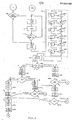
- FIGURE 4 is for the arbitrator A A of FIGURE 2, but the other arbitrators A B and A C would operate in the same way.
- a block 401 When the arbitrator is powered up, it is in a state [0] and a block 401 asserts -BSY so as to place the transmitter and data transfer state machines of both the internal and external chips in their starting states [0].
- a test is made by a decision block d40l to see whether or not a -CTS signal has been asserted by the transmitter means of any chip and therefore whether a -CTS is pending. If not, -BSY is still asserted by the block 401; but if so, the machine enters a state [8] in which -CTS is conveyed to the chip selected by the logic circuits in a block 404 formed by dashed lines and a clock is enabled for one cycle for the TO frame by a block 406. When the state [8] is entered and -BSY is unasserted, it signifies the start of a new transmission and thereby synchronizes the operation of all the state machines.
- a series of decision blocks d402 through d407 that respectively check each of the transmitter means of the mainframe MFA of FIGURE 2 in the following repeated sequence -- TX A , TX A1 , TX A , TX A2 , TX A and TX A3 -- to see whether or not it has asserted -RTS. If it has, the arbitrator asserts -CTS on the control line to that transmitter means as respectively indicated by the blocks 408, 410, 412, 414, 416 and 418 so as to connect it to the internal bus IB.
- a decision block d408 tests the state of BUF FUL in the TO frame to determine whether the data transfer registers of the external chip are full and tests -EXTCTS to see whether -CTS has been granted to the external chip.
- BUF FUL is a logic low, indicating that the data transfer registers of the external chip are empty, and if -EXTCTS for the external chip is a logic high, indicating that the external chip is not requesting access to the internal bus, or if BUF FUL is a logic high, indicating that the data transfer registers of the external chip are full, the machine proceeds to a state [4] to begin processing communication situations (1) through (5),(7),(9),(10) and (13). In the state [4], the clock is enabled for one cycle for the F frame by a block 420, and a test is made for -BSY by a decision block d409.
- decision block d409 indicates that -BSY is asserted during the F frame, situations (3) and (10) are involved.
- the state machine proceeds to a point A in the diagram where a test is made by a decision block d410 as to whether a signal -CTS is pending.
- decision block d410 indicates that -CTS is not pending, the machine reverts to the state [0] and the block 401 asserts -BSY as just described. If decision block d410 indicates that -CTS is pending, the machine enters the state [8] again.
- the state machine enters a state [5] in which the clock is enabled for the Dl frame by a block 421, and another test is made for -BSY by a decision block d411.
- decision block d411 indicates that -BSY is asserted during the D 1 frame, situations (2), (5), (7), (9) and (13) are involved and the machine goes to point A. Although -BSY is also asserted during the D l frame in situations (11) and (12), the data transfer registers of the external chip are not full and -CTS is granted to the external chip in these situations so that the conditions at the right side of the decision block d408 are not met.
- the decision block d411 indicates that -BSY is not asserted, the successful communication situations (1) and (4) are involved.
- the state machine enters a state [1] during which -BSY is asserted by a block 426 and the clock is enabled for the D 2 frame by a block 428. The state machine then goes to the point A.
- decision block d408 produces logic lows, it means that the data transfer register of the external chip is empty and that its transmitter means is on the internal bus IB, a condition that can only exist for situations (6), (8),(11),(12) and (13).
- the state machine enters a state [7] during which the clock is enabled for the F frame by a block 430 and a decision block d412 checks -BSY. This is the F frame.
- decision block d412 indicates that -BSY is not asserted, situation (11) is ruled out, and situations (6),(8), (12) and (13) are involved.
- the machine enters a state [3] during which the clock is enabled by a block 431 for the D 1 frame and a check is made for -ACK by a decision block d413.
- decision block d4l3 indicates that -ACK is asserted during the D l frame, the machine reverts to point A because, as illustrated by situation (13), -ACK is only asserted at this time when a message is returning to the station that originally sent it.
- decision block d413 indicates that -ACK is not asserted during the D l frame
- the machine enters the state [1] in which the D 2 frame is placed on the internal bus IB as illustrated by the situations (6),(8) and (12).
- decision block d412 indicates that -BSY is asserted during the F frame, situation (11) is involved and the machine enters a state [6].
- the signal -BSY is asserted by a block 422, and the clock is enabled for the D 1 frame by a block 424.
- situation (11) the message cannot be delivered to the receiver in the TO station because it has data in it, and the message is sent around the external bus XB to avoid lock-up.
- the machine then enters the state [1] in which the D 2 frame is placed on the internal loop and reaches the data transfer means of the external chip from which it goes around the external bus XB.
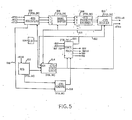
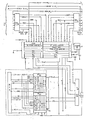
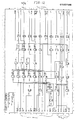
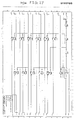
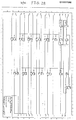
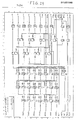
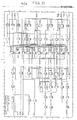
- FIGURE 5 specifically illustrates an arbitrator for a mainframe having three stations; but the schematic circuit diagrams in FIGURES 29, 30, 31, 32 and 33 are for an arbitrator in a mainframe having eight stations.
- Three request-to-send lines are designated - RTS 1 .
- the request-to-send lines are updated so that those lines on which an -RTS is asserted at that clock cycle are low.
- the registers are respectively connected to inputs i l , i 2 and i3 of a barrel shifter 506 which, at the particular instant illustrated, respectively connects i 1 , i 2 and i3 to inputs A, B and C of an -RTS priority encoder 508.
- the encoder determines the priority of the inputs A, B and C and informs the CTS decoder 510 of its decision. If the station has asserted -RTS so that the input A is in a low state, the decoder 510 asserts -CTS on the line to that station so as to put the transmitter on the internal bus; but, if the station is not asserting -RTS, no -CTS is granted. In either case, the decoder 510 places a bit on a line 511 to the barrel shifter 506 that causes it to effectively rotate the connections between its inputs i l , i 2 and i3 and the inputs A, B and C of the priority encoder 508. Thus, i 1 is connected to C, i 2 is connected to A and i3 is connected to B. If it is low, the decoder 510 will assert -CTS on the line to the station from which -RTS 2 comes.
- the transmitter means of the external chip, herein designated by XC 4 of the mainframe is given a chance on every other clock cycle to gain access to the internal bus.
- the request-to-send line -RTS 4 from the external chip is applied to a register 512 that is connected to a block 514 containing the state logic for asserting or not asserting -CTS on the line to XC 4 .
- the register 512 is also connected to a -CTS PENDING block 516 and when any of the stations are asserting an -RTS, a low state is supplied on a line 518 to the block 516.
- the line 511 having a bit indicating that one of the stations has been given a chance to get on the internal bus is connected to the block 514.
- the logic in the block 514 will assert -CTS on the line to XC4 so that its transmitter is connected to the internal bus.
- the state machine for the arbitrator is contained in a block 520 and, as can be seen from the flow chart of FIGURE 4, it is connected to the control lines -BSY and -ACK, the BUF FUL signal of the data transfer means of the external chip the system clock 504, the output of the block 514 on which -CTS is asserted for the external chip XC 4 , and to the output of the block 516 indicating whether any -CTS is pending, i.e., whether any of the stations or the external chip are aserting -RTS.
- the state machine of the block 520 asserts -BSY in the D 2 frame, enables the clock when required, and provides signals FRO and FR1 identifying the current frame.
- the state machine of the block 520 also supplies a signal 522 to the CTS decoder 510 so as to indicate that the transmitter means of the external chip XC 4 has been given its chance to get on the internal bus and that one of the stations may have its chance.
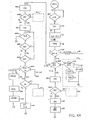
- FIGURES 6A and 6B Reference is made to the flow charts.of FIGURES 6A and 6B for an explanation of the operation of the state machines of the transmitters in the internal and external chips respectively. Although the operations performed by these transmitters are quite different, they use the same hardware except for the fact that a signal MF/-M is set at a logic low for an internal chip and at a logic high for an external chip.
- Situations (1) through (5) involve the transmitter means of an internal chip, and situations (6) through (13) involve the transmitter means of an external chip.
- the logic states of one or more of -BSY, -ACK and BUF FUL are examined during certain of the TO, F and D 1 frames so as to progressively eliminate certain communication situations and either prematurely terminate a communication before all frames are placed on the internal bus, or place all frames on the bus.
- the signal -BSY is asserted and at the beginning of the next communication, it is unasserted by the arbitrator.
- communication situations are indicated by a number in parentheses (), machine states are indicated by a number in brackets [], and the frames during which a decision block operates are indicated by TO, F, D l and D 2 .
- a transmitter means If a transmitter means has a message to send, it will automatically assert -RTS on the unique line between it and the arbitrator for the mainframe in which it resides when the D 2 frame is loaded into its register. It tests to see if it is granted time on the internal bus by checking the state of its unique -CTS line to the arbitrator, decision block d601. As long as the logic state is high, -CTS is not asserted and it stays in the state [0]; but if -CTS is asserted, the TO address is placed on the internal bus by a block 604, and the -RTS signal is cleared by a block 606. All of this is in the state [0].
- the machine then enters a state [1] during which a block 608 places the F frame on the internal bus and a decision block d602 tests the logic state of MF/-M to see whether it is an internal or an external chip.
- the output of the decision block d602 will be a logic low, and the communication situations in which the transmitter means of an internal chip may be involved are (1) through (5).
- a test is made of -BSY and -ACK by a decision block d603.
- decision block d603 indicates that -BSY is asserted, only the unsuccessful communication situation (3) is involved, whether or not -ACK is asserted. Before -RTS is reasserted, however, a test is made by a decision block d604 to see if the microprocessor for the internal chip has commanded it to cease further attempts to transmit by setting a STOP XMIT flag.
- decision block d603 indicates that -BSY is not asserted and that -ACK is asserted during the F frame, only the communication situations (1) and (2) can be involved because the assertion of -ACK indicates that the station having the TO address is present in the mainframe, a condition that does not exist in situations (4) and (5).
- the machine enters a state [3] during which the D l frame is placed on the internal bus by a block 618 and a test is made of -BSY by a decision block d605.
- decision block d605 indicates that -BSY is asserted during the D 1 frame, only unsuccessful communication situation ( 2 ) is involved.
- the assertion of - BSY during D1 means that the station having the TO address has been instructed by its microprocessor to receive from the same sender as before and that this message is not from that sender. In this situation, it is necessary to wait until the F frame in order to determine if the message is from the same sender.
- the assertion of -BSY during the D 1 frame is effected by the blocks 706 and 714 of FIGURE 7A, which illustrates the operation of a state machine of an internal data transfer means and which will be discussed below. The machine then carries out the function of the blocks contained within the dashed rectangle 616.
- decision block d605 indicates that -BSY is not asserted during the D 1 frame, only the successful communication situation (1) is involved.
- the machine then enters a state [15] during which a block 620 places the D 2 frame on the internal bus and a block 622 sets the TDRE flag indicating that another message can be written into the transmitter registers. The machine then returns to the state [0].
- decision block d603 indicates that neither -BSY nor -ACK are asserted in the F frame, situations (4) and (5) are involved because the station having the TO address must be in another mainframe.
- the machine enters a state [5] during which a block 624 places the D1 frame on the internal bus and a test is made of -BSY by a decision block d606.
- decision block d606 indicates that -BSY is asserted during the D l frame, the unsuccessful communication situation (5) is involved. Because the data transfer registers of the external chip have data in them, i.e., the buffor is full the state machine of the external data transfer means asserts -BSY during the D 1 frame, see block 732 in FIGURE 7B. It could not do this earlier because it is the lack of the assertion of -ACK in the F frame that informs the data transfer means of the external chip that it is to receive a message. With -BSY asserted in the D 1 frame, a successful transmission cannot be made and the internal transmitter state machine goes back to the state [0] by following procedure indicated by blocks contained within the dashed rectangle 616.
- decision block d606 indicates that -BSY is not asserted in the D 1 frame
- the successful communication situation (4) is involved.
- the data transfer registers of the external chip do not have data in them so that -BSY is not asserted by the data transfer state machine for the external chip.
- State [12] is entered during which the D2 frame is placed on the bus by a block 626 in accordance with situation (4).
- the four frames of the message are now in the data transfer registers of the external chip and ready for transmission around the external loop.
- the arbitrator state machine asserts -BSY during the D 2 frame for the purpose of synchronization.
- the arbitrator for the mainframe asserts -BSY for synchronization. After the four frames of a message are loaded into appropriate registers in the data transfer means of the external chip, they are passed around the external loop until they return to the transmitter means of the same external chip. What follows is a description of what occurs from the point of view of the originating transmitter means. Until it is known that either the message was delivered to the station in another mainframe having the TO address or the message has been aborted, the TDRE flag will not be set and no new message can be placed in the originating transmitter means.
- the machine enters a state [13] wherein a decision block d607 tests to see if the flag TDRE has been set and the message aborted by an instruction from the microprocessor of the station in which the originating transmitter means resides.
- decision block d607 indicates that the flag TDRE has been set for any reason, a new message may be written into the transmitter registers of the originating station and the message just sent may be destroyed. The machine then goes back to the state [0].
- decision block d607 indicates that the flag TDRE is not set, a test is made by a decision block d608 to see if -BSY is asserted.
- decision block d608 indicates that - B SY is still asserted, it means that no other transmitter means has been granted access to the internal bus, and the machine loops back to the beginning of the state [13].
- decision block d608 indicates that -BSY is unasserted, it means that a new transmission is started (see decision block d601) and that a new TO frame is on the internal bus.
- This TO frame could be from the transmitter means in the external chip or from another transmitter means in the same mainframe.
- the machine then enters a state [8] during which the F frame is on the internal bus and a new test is made of -BSY by a decision block d609.
- decision block d609 indicates that -BSY is asserted during the F frame, it means that the TO address is in the mainframe so that the message on the internal bus is not returning to the station that originated it, in which event the machine loops back to the beginning of state [13].
- decision block d609 indicates that -BSY is not asserted, it means that some transmitter means is on the internal bus and the state machine proceeds to a decision block d610 where the FROM address on the internal bus is compared with the address of the station in which the internal transmitter means retaining the original message resides, and a check is made of EA, which is the ninth bit of the F frame.
- decision block d610 indicates that the FROM address in the F frame on the internal bus is not the address of the station that originally sent the message in accordance with the situation (4), the level of EA does not matter and the state machine for any transmitter means which has transmitted a message and for which this occurs goes into a "dummy" state [9] for timing and synchronization before returning to the beginning of state [13]. This can occur if a message is sent from one station in the mainframe to another in the same mainframe or if a message is sent external by another station in the mainframe. Thus, the transmitter means of the originating station will go back to the beginning of the state [13] and keep looping through it until the flag TDRE is set, at which point it will return to the state [0], or until -BSY is unasserted.
- decision block d610 indicates that the FROM address on the internal bus is the same as the address of the station that originally sent the message in accordance with the situation (4) and if EA is a low state so that there is no TO address in the system, the machine proceeds to a state [10] during which a block 628 sets the NMAA flag; a block 630 sets the LTL flag; and a block 632 sets the TDRE flag so that the station that originated the message can receive a new one.
- decision block d610 indicates that the FROM address on the internal bus is the same as the address of the station that originally sent the message in accordance with the situation (4) and if the station to which that message was sent is in the system, the ninth bit EA of the F frame will have a logic high and the machine enters a state [11] during which the logic state of NA, the ninth bit of the Dl frame, is checked by a decision block d611.
- decision block d611 indicates that NA is a logic high so that the TO station was there but was busy, the procedure goes to the dashed rectangle 616 so that -RTS is reasserted or the message is aborted.
- decision block d611 indicates that NA is a logic low, the message has been delivered to the station having the TO address so that the TDRE flag can be set by a block 634 which makes the transmitter means that originated the message capable of accepting a new message. The machine then returns to the state [0].
- decision block d612 indicates that neither -BSY nor -ACK are asserted during the F frame, the possible situations are seen to be (6), (7) and (13), i.e., either the the message is from a station in a previous mainframe in the external loop and for a station in a subsequent mainframe, in which event the transmitter of the external chip tries to pass the message via the internal bus to its own data transfer means; or the station that originally launched the message is in the same mainframe as the external chip, in which event communication situation (13) is carried out, as has just been explained from the point of view of the transmitter of that station.
- the machine In order to determine which of the communication situations (6), (7) or (13) is involved the machine enters a state [7] during which a block 638 in the transmitter means of the external chip places the D 1 frame on the internal bus, and another test is made of the states of -BSY and -ACK by a decision block d613.
- decision block d613 indicates that neither -BSY nor -ACK are asserted during the D 1 frame
- the successful communi- cation situation (6) is carried out.
- the TO address station is not in this mainframe and the data transfer registers of the external chip are ready to accept data.
- the state [15] is then entered during which, as explained in connection with decision block d605 of FIGURE 6A, the D 2 frame is placed on the internal bus and the TDRE flag is set. Examination of FIGURE 4 shows that the arbitrator asserts -BSY during the D 2 frame.
- decision block d613 indicates that -BSY is asserted but that -ACK is not asserted during the D 1 frame, it means that the TO address station is not in this mainframe and that the date transfer registers of the external chip cannot accept data.
- the -RTS signal for the external chip is set by a block 640 to await the next turn on the internal bus, and the machine returns to the state [0]. This is situation (7).
- decision block d613 indicates that -ACK is asserted during the D 1 frame, situation (13) is involved.
- the data transfer means of the internal chip has determined by means of a decision block d704 or a decision block d707 (FIGURE 7A) in the data transfer state machine for an internal chip to be described below that the FROM address on the internal bus is the same as the address of the station in which the data transfer state machine resides and further that the internal bus is not busy. When these conditions exist, the data transfer state machine asserts -BSY and -ACK during the D 1 frame.
- the state machine for the transmitter means of the external chip finds by decision block d613 that -ACK is asserted during the D 1 frame, it can set its TDRE flag with a block 642 so that the transmitter means can receive a new message. The machine then returns to the state [0].
- decision block d612 indicates that -BSY and -ACK are asserted during the F frame, situations (10) and (11) may be involved.
- the TO station is in the mainframe but is busy.
- a test is made by decision block d6l4 as to whether BUF FUL is asserted, i.e., are the data transfer registers of the external chip full?
- the decision block d614 indicates that the buffer is full, -RTS is reasserted by a block 644, and the machine returns to the state [0].
- the message stays in the registers of the external transmitter means until its next turn on the internal bus or until the message is aberted.
- the decision block d6l4 indicates by a low logic value that the buffer is empty, the machine enters a state [2].
- the signal -BSY is asserted by a block 646 during the D 1 frame to keep other transmitter means and data transfer means synchronized and the D 1 frame is placed on the internal bus by a block 648.
- the message cannot be sent to the TO station because decision block d612 has indicated that it is busy, it can be sent around the external loop because the buffer is empty.
- the machine then enters the state [15] wherein, as previously explained, the D2 frame is placed on the internal bus and the TDRE flag is set so that the external transmitter means is free to handle another message before the machine returns to the state [0].
- decision block d612 indicates that -BSY is not asserted and that -ACK is asserted during the F frame, the TO station is in the same mainframe as the external chip and is not busy, so that situations (8), (9) and (12) are potentially possible.
- the machine enters a state [6] during which the D 1 frame is placed on the internal bus by a block 650 and a test is made at the end of the TO frame by a decision block d6l5 of the logic state of -BSY and BUF FUL of the external data transfer means.
- BUF FUL is low when the data transfer registers of the external chip are empty.
- decision block d615 indicates that -BSY is not asserted during the D 1 frame and that BUF FUL is low, situation (8) is involved. Since decision block d612 has already indicated that the data transfer means of the TO station is ready to receive data, the message can be conveyed to the external data transfer means for introduction to the external loop and to the TO station at the same time, as is required.
- the state machine then goes into the state [15] which, as previously explained in connection with the decision block d605 of FIGURE 6A, places the D 2 frame on the internal bus and sets the TDRE flag of the external transmitter state machine so that it is ready to receive a new message before going back to the state [0].
- decision block d615 indicates that -BSY is asserted during the D l frame
- situation (9) is involved.
- the signal -BSY is asserted during the Dl frame by the data transfer means of the external chip if its registers are full at the end of the TO frame.
- the message could be received by the TO station, it cannot be passed around the external bus so that it must remain in the registers of the external transmitter means until it is given another turn on the internal bus.
- -R T S is reasserted by a block 652 before the machine returns to the state [0].
- decision block d615 indicates that -BSY is asserted during the D I frame and that B UF FUL is low so that the registers of the external data transfer means are empty, situation (12) will be involved. Under this condition, the TO station has been instructed to receive its message from the same sender as before,, so that the message must be passed around the external bus until it again arrives at the transmitter means of the same external chip. The machine then goes into the state [15] during which it places the D 2 frame on the internal bus and sets the TDRE flag so that the external transmitter means may receive a new message.
- FIGURES 7A and 7B that respectively illustrate the operation of a state machine for the data transfer means or means of an internal chip such as IC A of FIGURE 2 and the operation of a state machine for the data transfer means or means of an external chip such as XC A
- the numbers enclosed in brackets [] indicate a state that is entered at a solid dot
- the numbers in parentheses () indicate the communication situations involved
- TO, F, D 1 and D 2 respectively indicate the frame occurring at the time.
- FIGURE 7A Before going into a detailed description of FIGURE 7A, it should be noted that the right half of the drawing relates to the operation occurring when the registers of the data transfer means of an internal chip are full, and the left half relates to the operations occurring when the registers of the data transfer means are empty.
- an internal data transfer means is involved in the communication situations noted above. Although it may not be readily apparent, an internal data transfer means plays a role in situation (13) by supplying signals that are used in that situation.
- a decision block d701 indicates by a logic high when -BSY is unasserted by the arbitrator for the mainframe in which the data transfer means resides. This means that a new message is starting and that the TO frame is on the internal bus. When this occurs, the procedure goes to a decision block d702.
- the decision block d703 determines whether the TO address on the internal bus is the same as the address of the station in which the data transfer means resides. Although this function would seem to more properly belong in' the state [0], when the TO address is on the internal bus, timing considerations require that this function be done in the state [4]. In order to do this, the TO address is latched.
- a block 702 If the decision block d703 indicates by a logic high that the TO address on the internal bus is the same as the address of the station in which the data transfer means resides, a block 702 asserts -ACK in the F frame to indicate that it is in the mainframe; and since decision block d702 has already determined that the registers of the data transfer means are full, -BSY is asserted by a block 704, a combination that occurs only in communication situations (3),(10), and (11). The machine then returns to the state [0].
- decision block d703 indicates that the TO address on the internal bus is not the same as that of the station in which the data transfer means resides, the procedure goes to a decision block d704.
- the decision block d704 determines whether or not -BSY and -MFA (MY FROM ADDRESS) are asserted during the F frame.
- the machine enters a state [7] during the D1 frame.
- the assertion of -BSY and -ACK during the D l frame is used at the bottom output of decision block d610 of the internal transmitter means of FIGURE 6A to set TDRE and prepare the transmitter means for the reception of a new message for transmission.
- the decision block d704 indicates that -BSY is asserted during the F frame, nothing can be done regardless of the level of -MFA so that the machine returns to the state [0].
- the signal -BSY may be asserted by another station or by the data transfer means of the external chip.
- decision block d704 indicates that neither -BSY nor -MFA are asserted, the machine enters a state [5] during which decision block d705 waits for -BSY to be asserted for synchronization purposes. When -BSY is asserted, the machine goes to state [0].
- decision block d702 indicates that the data transfer registers are empty and that MF/-M has been preset to a low logic level
- the data transfer means is in an internal chip and the procedure goes to a block 710 that loads the TO frame into the RTO register.
- the machine then enters a state [6] dusang which the F frame is on the internal bus and the procedure goes to a decision block d706.
- the decision block d706 determines whether the TO address on the internal bus is the same as the address of the station in which the data transfer means resides.
- a decision block d707 checks -BSY and -MFA and the ensuing operations are the same as previously described in connection with the decision block d704.
- -BSY is not asserted and -MFA is asserted
- the machine goes to the state [7] during which, as previously explained, -ACK and -BSY are asserted during the D l frame as is required in situation (13).
- an internal data transfer means can assert the signals -ACK and -BSY during the D 1 frame that its associated transmitter means requires to set TDRE and be ready to receive a new message.
- decision block d706 indicates that the TO address on the internal bus and the addresss of the station in which the internal data transfer means resides are the same, -ACK is asserted during the F frame by a block 712 and the procedure then goes to a decision block d708.
- the decision block d708 examines whether or not the seventh bit (SAME SEND) in the control register has been set and whether or not -SSA has a logic level indicating that the FROM address now on the internal bus is the same as the address in the RTO register, which is the address of the station from which the previous message was received.
- the decision block d708 indicates that SAME SEND flag has been set so that the data transfer means is to only receive from the same sender as before and SSA is not asserted, showing that the message currently on the internal bus is not from that same sender.
- the machine enters a state [15] in which -BSY is asserted by a block 714 during the Dl frame so as to terminate the transmission, and the machine returns to the state [0].
- the assertion of -BSY in the D l frame is used by the decision block d605 of an internal transmitter means shown in FIGURE 6A to terminate the transmission in situation (2) and by the decision block d6l5 of an external transmitter means shown in FIGURE 6B to terminate the transmission in situation (12).
- the SAME SEND flag is low so that this restriction is not in effect; thus it does not matter what the logic level of -SSA is in decision block d708.
- the F frame is loaded into the register of the internal data transfer means by a block 716.
- an indication by decision block d708 to the effect that the SAME SEND flag is set and that the current message is from the same station as last time causes the procedure to bypass the block 716 that loaded the F frame and follow the procedure of the state [9]. This prevents writing the same F frame into the register a second time.
- FIGURE 7B illustrates the operation of a state machine for an external data transfer means
- the right half of the drawing is for a situation in which the message on the internal bus is from an internal transmitter means
- the left half of the drawing is for the situation where the message on the internal bus is from the external transmitter means of the same chip.
- the external data transfer means plays no active role in the situation associated therewith, it still has some function to perform.
- the decision block d701 is the same for the data transfer state machines of internal and external chips. It waits for the arbitrator of the mainframe in which the external data transfer means resides to unassert -BSY, thus indicating that a new transmission is beginning and that the TO frame is on the internal bus.
- the signal MF/-M is preset to the high logic level. Regardless of the logic state of RDRF, the machine proceeds to a decision block d710.
- the output of the decision block d710 is high, it means that the message on the internal bus is from an internal transmitter means, so that situations (1) through (5) are involved. In situations (4) and (5), the message is to go to the data transfer means of the external chip. The procedure then goes to a decision block d711.
- the decision block d711 checks BUF FUL to see if the registers of the external data transfer means are full. If they are, the machine proceeds to a state [11] in which a decision block d712 tests -BSY and -ACK during the F frame.
- decision block d711 indicates that the data transfer registers of the external chip are empty, the TO frame is loaded into them by a block 724 and a state [10] is entered during which the F frame is loaded into the data transfer registers of the external chip by a block 726 and the assertion or non-assertion of -BSY and -ACK are tested during the F frame by a decision block d713.
- the decision block d713 indicates that -BSY is not asserted and that -ACK is.
- the machine proceeds to the state [5] during which, as previously explained in connection with decision block d705 of FIGURE 7A, it awaits the assertion of -BSY in the D 1 or D 2 frames before returning to the state [0].
- the signal -BSY can be asserted in the D 2 frame during a successful communication situation (1) or it can occur during the D1 frame, as in the unsuccessful communication situation (2), when the station with the TO address is instructed by its microprocessor to receive only from the same sender as previously and the FROM address on the bus is for a different station.
- situation (3) the decision block d7l3 indicates that -BSY and -ACK are asserted during the F frame. It is not a situation such as (10) because decision block d710 has indicated that the transmitter means of the external chip has not been given access to the internal bus. Situation (3) is terminated at the end of the F frame so that the state machine for the data transfer means of the external chip goes to the state [0] at the end of the F frame in order to stay in sync.
- decision block d7l3 indicates that neither -BSY nor -ACK are asserted during the F frame
- communication situation (4) is involved in which the message is being sent from a station in the mainframe where the external chip resides to a station in another mainframe. Because decision block d711 has already indicated that the data transfer registers of the external chip are empty, the transmission can be completed by proceeding to the state [9] during which, as described in connection with decision block d709 of FIGURE 7A, the message is delivered to the data transfer means of the external chip.
- decision block d710 indicates that -C TS is asserted, it means that the transmitter means of the external chip is on the internal bus so that situations (6) through (13) can be involved.
- decision block d7l4 indicates by the high logic level of BUF FUL that the data transfer registers of the external chip are full during the TO frame, i.e., the RDRF flag is set, situations (7),(9) and (13) are involved.
- the machine proceeds to a state [1] and decision block d715.
- the decision block d7l5 indicates by a logic low that -BSY is asserted during the F frame. It is asserted by the block 704 of FIGURE 7A because the TO address station is busy.
- the decision block d714 has already indicated that the registers of the data transfer means of the external chip are full. The message is terminated in the F frame so that the state machine returns to the state [0].
- decision block d715 idicates by a logic high that -BSY is not asserted during the F frame
- the situations (7) and (9) are involved because they require the external data transfer registers to be full during the TO frame as decision block d714 has already indicated; but the situation (13) could also be involved because, in this situation, it does not matter whether the data transfer registers of the external chip are full or not.
- the transmission of (7), (9) and (13) are to be aborted at the end of the D 1 frame, the machine enters the state [15] during which, as has been explained in connection with decision block d708 of FIGURE 7A for the internal data transfer means, -BSY is asserted during the D l frame.
- decision block d714 indicates by a logic low that the data transfer registers of the external chip are empty, a block 728 loads the TO frame into the registers and the machine enters a state [8] where a block 730 loads the F frame into the registers and the assertion or non-assertion of -BSY and -ACK is determined by a decision block d716.
- the decision block d716 indicates that both -BSY and -ACK are asserted during the F frame.
- the assertion of -BSY and -ACK means that the TO address of the message in the transmitter registers of the external chip is in the same mainframe but that it is busy.
- the message is passed from the transmitter means of the external chip to its data transfer means via the internal bus. From there, it goes on arouna cne external loop until it arrives once more at the transmitter means of the same external chip in the mainframe which initiated the message. The transmission is tried again unless the associated microprocessor has aborted it.
- the machine In order to carry out situation (11), the machine enters a state [12] during which a block 732 asserts -BSY during the D 1 frame to keep other transmitter means and data transfer means synchronized, a block 734 loads the D 1 frame from the internal bus, and blocks 736 and 738 respectively set NA (which is the ninth bit of the F frame) and EA (which is the ninth bit of the D l frame) to logic highs so as to indicate to the original sending station when the message reaches it in situation (13) that the station with the TO address was there but was busy.
- NA which is the ninth bit of the F frame
- EA which is the ninth bit of the D l frame
- the machine then enters the state [14] during which the message is loaded into the registers of the data transfer means of the external chip, as indicated by the blocks 718, 720 and 722 that were associated with one of the outputs of decision block d709 of FIGURE 7A.
- the decision block d716 indicates that -BSY is not asserted and that -ACK is. This means that the station having the TO address is in the mainframe.
- the machine enters a state [13] during which the Dl frame is loaded into a register of the data transfer means by a block 740 of the external chip, and EA is set to "1" by a block 742 so as to indicate that the TO address data transfer means can receive data.
- a decision block d717 checks -BSY during the D l frame.
- the successful communication situation (8) is carried out by entering a state [14] during which, as shown in FIGURE 7A, the D 2 frame is loaded into the register of the data transfer means of the external chip.
- the CMD flag is set as is the RDRF flag.
- the message can now go around the external loop. The delivery of the D 2 frame to the register of the data transfer means of the internal chip was explained in the discussion of FIGURE 7A.
- decision block d717 indicates that -BSY is asserted during D 1 by the block 714 of FIGURE 7A because the SAME SEND flag is set.
- the decision block d716 indicates that neither -BSY nor -ACK are asserted during the F frame which means that the TO address is not in the mainframe.
- the state machine then proceeds to the state [9] illustrated in FIGURE 7A in which -BSY and -ACK are checked in the Dl frame by.decision block d709. Since neither -BSY nor -ACK are asserted, the D 2 frame is loaded into a register of the data transfer means of the external chip.
- the microprocessor selects the registers to be read from or written into, but in an external, chip, there is no microprocessor and these functions are performed by the code state machine.
- the MF/-M bit is high, as it is on an external chip, the outputs of the two-bit code state machine are respectively connected to the RAl and RAO inputs of the data transfer means to select the register to be read and to the D09 and DO10 output pins that are respectively connected to the WA1 and WAO inputs of the transmitter means for the next external chip along the external bus XB in order to select a register to be written into that corresponds to the one being read from.
- An additional task of the code state machine is performance of a handshake operation for each word of a message that is sent from the data transfer means of one external chip to the transmitter means of the next external chip along the external bus XB.
- a state register 802 in FIGURE 8A contains the two bits for each of the states [01], [00], [10] and [11] as they occur. These bits are respectively applied to the inputs RAl and RAO of the data transfer means so as to select the register to be read from and via D09 and DO10 and the external bus X B to WAl and WAO of the transmitter for the next mainframe so as to select a corresponding register to be written into.
- an RDRF register flag is set low, a READY flag is set by a block 804 and the machine is placed in the state [01] so as to address the RFA (see FIGURE 9). While in this state, the logic state of RDRF is monitored by a decision block d801. The various signals referred to below are illustrated in FIGURE 8B.
- the output of decision block d801 goes high and a signal -DOCLK is sent via the external bus XB to the -WR input of the transmitter for the next mainframe along XB.
- the fifo If the fifo is ready to receive data, it asserts -FIORDY, and it is conveyed via the external bus XB to the -RD input of the data transfer means. This unasserts -DOCLK and causes the RFA frame to be written into the transmitter means via the external bus XB. The transmitter means responds by unasserting -FIORDY, thus indicating to the data transfer means that the MFA frame has been received, and clocks the state machine to its next state [00].
- a block 806 indicates this interaction between -DOCLK and -FIORDY, but the interaction is more clearly shown by FIGURE 8B.
- a decision block d802 and a block 808 respectively carry out functions corresponding to those of the blocks d801 and 806, and place the TO frame on the external bus XB.
- the machine advances to the state [10] in which a decision block d803 and a block 810 respectively carry out functions corresponding to those of the blocks d801 and 806 so as to place the D1 frame on the external bus XB and advance the machine to the state [11].
- a decision block d804 checks the logic states of RDRF and READY. The RDRF flag will be high because the D 2 frame is still in the DTD 2 register of the data transfer means and the READY flag will be high because it has not been cleared.
- FIGURE 9 for a description of details of the mainframe MF A that are not shown in FIGURE 2. Only the station S Al will be described, but all other stations of FIGURE 2 are the same. Although not shown, the mainframes MF B and MFC of FIGURE 2 are assumed to be present.
- the eight-bit wide I/O line is internally connected to the inputs DIO-DI7 of the external transmitter means TX Al and to the outputs DO0-DO7 of the external data transfer means DT Al .
- the latter are tri-stated when the microprocessor MP Al is sending data to TX Al .
- the pins A2, Al and AO through which MP Al selects the registers of the external transmitter means TX Al to be written into or the registers of the external data transfer means DT Al to be read are respectively internally connected to RA2 and WA2, RAl and WA1, and RAO and WAO.
- MP Al When the -WR pin is low, MP Al writes into the registers of TX Al selected by A2, Al and A0; and when the -RD pin is low, MP Al reads from the registers of DT Al selected by A2, Al and A0.
- Both the external data transfer means DT Al and the external transmitter means TXA1 communicate with the internal bus IB via pins DIBO-DIB8, the ninth bit DIB8 being for BW, EA, NA and CMD occurring during the frames TO, F, D 1 and D 2 respectively.
- the external data transfer means DT A1 is always connected to the internal bus IB so as to transfer any data thereon to the microprocessor MP A2 via its registers; but the external transmitter means TX Al is only connected to the internal bus IB via a switch s Al when it receives a -CTS command to send from the arbitrator AA in response to its assertion of -RTS.
- the nine lines of the internal bus IB are respectively connected to the pins DIBO-DIB8 that are connected to the data transfer means DT A and the transmitter means TXA in the same way as the pins of the same designation in the internal chip IC Al are connected to DT Al and TX Al , i.e., DT A is always connected to I B and TXA is only connected to the internal bus IB via a switch s A when TXA receives a -CTS command to send from the arbitrator A A ⁇
- An essential difference between the internal chip IC Al and the external chip XC A is the fact that the inputs DIO-DI7 to the external transmitter means TX A and the outputs DOO-D07 of the external data transfer means: DT A are respectively connected to separate pins as are WA2, WA1 and WA0 of TX A and RA2, RA1 and RA0 of DT A .
- the external data transfer means DT A transfers data from the internal bus IB to the external bus XB via pins DO0-DO7 and D08 and, as noted in FIGURE 2, the code bits supplied by the code state machine for the different registers of DTA being read from appear at pins D09 and D010. Selection of the register is attained by connecting D09 and DO10 to the pins RA0 and RA1.
- the signal -DOCLK supplied by DT A when data is written into its DTD 2 register goes to the next mainframe MF B via the differential driver DFD A ; and the signal -FIORDY on the pin -RD as made in response to a signal -DOCLK from the previous mainframe MF C also passes through the differential driver DFD A .
- -FIORDY goes via a conductor of the external bus XB to the previous mainframe MF C .
- a low logic level is applied to a pin labelled ENFIFO; and in order to clean the fifo, a low level is applied to a pin RSTFIO.
- the enabling and clearing of the fifo is under the control of the microprocessor MP Al ; but in the external transmitter means TX A , the fifo is always enabled in response to the low logic level that is applied to the ENFIFO pin. Clearing the fifo of the external transmitter means TX A is effected whenever power is not applied to the mainframe on either side of MF A , i.e., MF C and MF B in FIGURE 2.
- Each mainframe is provided with a power input such as indicated by the block 902 in FIGURE 9.
- the power input 902 provides a signal having a low logic level when power is not supplied to it and a high logic level when power is supplied to it.
- logic levels are conducted via the differential driver DFDA to a conductor of the external bus XB that goes to the RSTFIO pin on the external transmitter means TX B , in which event the signal is called IMFRDY, and to the RSTFIO pin of the external transmitter means TX C , in which event the signal is called OMFRDY.
- the pin RS T FIO of TXA receives a signal IMFRDY from the power input (not shown) of MF C and a signal OMFRDY from the power input (not shown) of MFB . If either signal has a low logic level, indicating a lack of power, the fifo of TX A is cleared.
- the power input 902 resets all of the chips when power comes on so as to set all the state machines to their starting state and perform the following functions that will subsequently be described. All interrupts of an interrupt register are disabled and a software reset bit in a control register and a TDRE bit indicating that the registers are empty are set in a status register. All other control register bits are made to have a logic low. In addition, the reset bit of each internal chip can be set by its microprocessor.
- a signal ONEMF is asserted that connects internal conduction between the input and output; but if only one of the cables is connected, a warning signal IOERR is generated that turns on a warning light.
- the BW bit of the TO frame is automatically set to unity when data is written into the TD 2 register of a transmitter means without data having been written into the TD 1 register. BW is set when TDRE is set and cleared when TD 1 is written into.
- the EA bit is low when the F frame is first placed on the internal bus IB but is set high by the state machine of the data transfer means of the station in another mainframe to which the message is sent whether it is busy or not. This means that the TO address is present.
- the NA bit is low when the D l frame is first placed on the internal bus IB but is set high by the state machine of the data transfer means of the station in another mainframe if it is the station to which the message is sent and is busy.
- the CMD bit is set by setting the SEND CMD bit of the control register.
- FIGURES 10, 10A, 10B and 10C for a detailed description of the registers of an internal chip such as IC Al . Also shown are the pins. Arrows on each pin show the direction of flow of data.
- the pins on the left side of FIGURE 10 are for communication with the associated microprocessor; the pins DIB are to be connected to the internal bus IB; and the pins -RTS, -CTS, -ACK, -BSY and CLK are to be connected as shown in FIGURES 2 ano 9.
- Each register has eight bits, and the logic levels of A2, Al and AO that are used to address it are indicated to the right of the register name.
- the associated microprocessor can only write into the registers in the column at the right that are in the transmitter means and read from the registers in the column at the left that are in the data transfer means, but the various state machines can read any of the registers as required.
- a microprocessor When a microprocessor has a message to send, it asserts -WR, sets A2, Al and AO to "0", “0” and “0” respectively and loads the TO address of the station to which the message is to go into the TTO register. At a previous time, the microprocessor asserted -RST, set A2, Al and AO to "0", “0” and “1” respectively and loaded the address for the station in which the internal chip resides into the MFA register. Two words of the message may then be loaded into the TD 1 and TD2 registers. If there is only one word of data in the message, it is loaded into the TD 2 register.
- the bits of the status register are as follows.
- the interrupt bit INT and the command bit CMD will be explained later.
- a RDRF bit is set at any time when the DTD 2 register of a data transfer means has data in it.
- a TDRE bit is set so as to permit a new message to be written into the registers TTO, MFA, TD 1 and TD2 of the transmitter means. If no station having the TO address is found, an NMAA bit is set; and if a message is aborted, an LTL bit will be set. The setting of LTL also sets TDRE.
- the control register of FIGURE 10B that is in a transmitter means performs the following functions. If it is desired that a station only receive a message from the same station that it just received a message from, its microprocessor sets the SAME SEND bit in the control register. In performing this function, a state machine for the data transfer means of the station to which the message is being sent will compare the address in its RFA register that came with the last message received with the address in the F frame of the message currently on the internal bus IB. If they are not the same, the station will assert -BSY. If it is desired to put a certain command into effect, the microprocessor sets the SEND CMD bit. This will cause the CMD bit in the status register to be set and will set the CMD bit in the D2 frame high.
- the microprocessor decides to abort a message, it sets the STOP XMIT bit; and if software reset is desired, the SOFT RESET bit is set. This prevents the internal chip from communicating with the internal bus IB and sets the TDRE bit in the status register at "1" so that the transmitter means may receive a new message. When a new message is received, TDRE goes to "0". No other bits in the various registers are affected.
- all registers can be changed in the normal fashion. It is the only condition in which the MFA register may be loaded.
- a software reset also disables a request IREQ that the microprocessor interrupt whatever else it is doing and proceed with functions related to the internal chip.
- a hardware reset effected by the power input 902 sets the SOFT RESET, it also forces all of the state machines to their initial states.
- the purpose of the interrupt mask register is to determine those conditions under which the IREQ pin is to be made low so as to interrupt whatever the associated microprocessor is doing and cause it to perform functions for the chip.
- a logic low will appear on the IREQ pin whenever the interrupt bit INT of. the status register is set, and it will be set when any of the other bits of the status register equal "1" and the corresponding bit in the interrupt mask equals "1".
- the microprocessor can set any of the bits D6-DO to either a "1" or a "0" in the following manner.
- bit D7 If the bit D7 equals "1”, all of the bits D6-DO that have a “1” will be set; but if D7 equals "0", all of the bits D6-DO that have a "1” will be cleared. Therefore, if it is desired that IREQ have a low value so that the microprocessor is interrupted whenever either CMD or BW in the status register equals "1", the microprocessor writes the following bits into the interrupt mask register: 11001000. The bit D7 equals "1” so that D6 and D3 are set at "I”. The bit D6 is the same bit that BW is on in the status register and D3 is the same bit that CMD is on in the status register.
- bits with the "0"'s are not affected so that if they were previously set, they will remain so. If all bits in the interrupt mask register are to be cleared, the microprocessor writes the bits 01111111. A bit in the status register is masked or prevented from asserting a low on IREQ when the corresponding bit in the interrupt mask equals "0".
- any bit in the interrupt mask register can be made equal to "0" or "1" without affecting the other bits, it is not necessary for the microprocessor to read this register or to keep it in memory so that the bits that are not to be affected can remain at their original values.
- the data transfer means of an internal chip does not require a register for the TO address on the internal bus IB because the latter can be compared with the station address in the MFA register.
- an additional register RTO shown in dashed lines in FIGURE 10 is required so that the TO address can be placed on the external bus XB.
- an external chip is not associated with a microprocessor, it does not require an interrupt mask or a control register.
- FIGURE 11 In view of the fact that the internal and external chips have so much in common; both are illustrated by the block diagram of FIGURE 11.
- the internal chip will be described first, and then the differences of the external chip wil be described.
- the purpose of FIGURE 11 is to identify the major components of the chips, to show in a general way the communications between them, and to identify the subsequent figures of the drawings that relate to each component. The operation of the chips is explained with the aid of the flow charts for the various state machines.
- the interface with its microprocessor is provided by a block 1102 containing the read-write select-logic circuits shown in FIGURE 12.
- the microprocessor provides the data inputs DO-D7 and inputs CS for indicating that the chip is selected for operation, -RD to indicate that the microprocessor is to read from its registers, and RAO-RA2 to indicate the registers to be read from.
- Part of the block diagram relates to the transmitter means of a chip and part to the data transfer means.
- the transmitter means is considered first.
- a station When a station has a message to send or has instructions to give on the eight input lines DIO-DI7, it asserts -WR and a combination of WAO-WA2 (as shown in FIGURE 9) to select the register to be written into.
- the bits DIO-DI7 and WAO-WA2 may go directly to the registers or indirectly via a fifo 1104 that is illustrated in FIGURE 24. If the fifo 1104 is to be used, the microprocessor asserts -ENFIFO.
- this signal to the fifo 1104 and a multiplexer 1106 having the circuits illustrated in FIGURE 25 causes the fifo 1104 to accept the information and the multiplexer 1106 to connect its input to the output of the fifo. If -ENFIFO is not asserted, the input of the multiplexer 1106 is directly connected to receive DIO-DI7 and WAO-WA2 so that the fifo 1104 is bypassed.
- the bits DIO-DI7 at the output of the multiplexer 1106 successively represent the TO address, the FROM address and data words D 1 and D2 .
- the lines DIO-DI7 are connected to the input of a block 1108 containing the transmitter registers illustrated in FIGURE 13 and are written into the appropriate register under the control of a write decoder 1110 illustrated in FIGURE 12 that deciphers the WAO-WA2 bits appearing at the output of the multiplexer 1106.
- a transmitter state machine 1112 (illustrated by the flow charts of FIGURES 6A and 6B and the schematic circuit diagrams of FIGURES 20, 21 and 22) asserts an -RTS signal on its individual line to the arbitrator of the mainframe in wnich the chip resides; and when the arbitrator asserts -CTS on the individual line to the state machine asserting the -RTS, the state machine 1112 causes a multiplexer 1114 having the circuits illustrated in FIGURE 13 to transmit the TO, F, D 1 and D 2 frames in sequence to an electrical output buffer 1116 having the circuits shown in FIGURE 23. The output of the buffer 1116 is connected to the internal bus IB of the mainframe.
- the bits DIO-DI7 are now termed DIBO-DIB7.
- the transmitter state machine 1112 requires information as to the assertion or non-assertion of -BSY and -ACK on the control lines for the mainframe.
- the state machine 1112 sets a TDRE bit in a status register 1118 having the circuits illustrated in FIGURE 17. Conversely, when the empty transmitter data register receives data, the TDRE bit in the status register 1118 is cleared.
- a ninth bit is added to the eight bits from the microprocessor to form the TO, F, D l and D 2 frames before they are put on the internal bus IB.
- the ninth bit is actually output to the internal bus IB by a bit-8 transmit logic contained in a block 1120 and having circuits shown in FIGURE 14. If the chip is the one that originated the message, the ninth bit for the TO frame is referred to as BW and is set by the transmitter state machine 1112 to a high or low level depending on whether the message received from the microprocessor had a D 1 word or not; and the setting of the ninth bit for the D 2 frame depends on whether the SEND CMD bit has been set in a control register 1122 to be described.
- the ninth bits for the F and Dl frames which are respectively called EA and NA, are at a low level.
- the bits for EA and NA are controlled by the state machine for the data transfer means of an external chip, as shown in FIGURE 7B, and will be discussed below.
- the DIO-DI7 lines from the multiplexer 1106 are respectively connected to the inputs of a control register 1122 and an interrupt mask register 1124, the circuits for both of which are shown in FIGURE 16. These registers can be written into whenever the write decoder 1110 receives the proper values of WAO-WA2.
- FIGURE 11 The components of the block diagram of FIGURE 11 that are involved with the data transfer means of an internal chip are as follows. As previously noted, the data transfer means are always connected to the internal bus IB. Electrical isolation buffers 1126 having the circuits shown in FIGURE 23 are connected between the internal bus IB and the receive-data registers shown in a block 1128. The circuits for the latter are shown in FIGURE 15. As the frames TO, F, D l and D 2 succcessively come along the internal bus IB, they are stored in appropriate registers of the block 1128 under the control of a state machine 1130, the function of which is explained in connection with the flow chart of FIGURE 7A and the circuits for which are shown in FIGURES 18 and 19.
- the register 1128 informs the state machine 1130 of this fact, and it sets the D5 bit (RDRF) in the status register 1118.
- the D5 bit is cleared when the microprocessor reads data from the registers.
- a microprocessor When a microprocessor reads data from the registers 1128, it sends appropriate sequences of RAO-RA2 to a read multiplexer 1132 and removes the tri-state condition of read output 1134.
- the circuits for both the read multiplexer 1132 and the read output 1134 are shown in FIGURE 26.
- the bit D8 which is the ninth bit of a message on the internal bus IB that respectively represents BW, EA, NA and CMD in the TO, F, D 1 and D 2 frames, is applied to a bit-8 data transfer means register 1136 having the circuits shown in FIGURE 23. This bit can be read by the microprocessor and is also supplied to the transmitter state machine 1112 so that it can determine what has happened to the message it sent.
- stations of the embodiment described have a microprocessor for each station, it is to be understood that any type of controller can be used and that a single controller could provide all the required functions.
- a series internal bus could be used in practicing the invention, it would slow down the rate of transmission.
- each of the transmitter means and data transfer means both internal and external, has its own state machine, but a single state machine could be used, if desired.
- the mainframes described are just one way of assembling a complete group of stations.
Landscapes
- Engineering & Computer Science (AREA)
- Theoretical Computer Science (AREA)
- Physics & Mathematics (AREA)
- General Engineering & Computer Science (AREA)
- General Physics & Mathematics (AREA)
- Bus Control (AREA)
- Small-Scale Networks (AREA)
- Multi Processors (AREA)
- Information Transfer Systems (AREA)
Applications Claiming Priority (2)
| Application Number | Priority Date | Filing Date | Title |
|---|---|---|---|
| US06/675,800 US4768145A (en) | 1984-11-28 | 1984-11-28 | Bus system |
| US675800 | 1984-11-28 |
Publications (2)
| Publication Number | Publication Date |
|---|---|
| EP0183196A2 true EP0183196A2 (de) | 1986-06-04 |
| EP0183196A3 EP0183196A3 (de) | 1988-12-28 |
Family
ID=24712028
Family Applications (1)
| Application Number | Title | Priority Date | Filing Date |
|---|---|---|---|
| EP85114803A Withdrawn EP0183196A3 (de) | 1984-11-28 | 1985-11-21 | Bussystem |
Country Status (3)
| Country | Link |
|---|---|
| US (1) | US4768145A (de) |
| EP (1) | EP0183196A3 (de) |
| JP (1) | JPS61275955A (de) |
Cited By (2)
| Publication number | Priority date | Publication date | Assignee | Title |
|---|---|---|---|---|
| EP0370628A3 (de) * | 1988-10-25 | 1991-09-04 | Hewlett-Packard Company | Pipelinecomputersystem mit Rangfolgenerhaltung |
| EP0415552A3 (en) * | 1989-08-01 | 1993-07-14 | Digital Equipment Corporation | Protocol for read and write transfers |
Families Citing this family (21)
| Publication number | Priority date | Publication date | Assignee | Title |
|---|---|---|---|---|
| US5222219A (en) * | 1988-10-25 | 1993-06-22 | Hewlett-Packard Company | Pipeline computer system having write order preservation |
| JPH03231320A (ja) * | 1990-02-06 | 1991-10-15 | Mitsubishi Electric Corp | マイクロコンピュータシステム |
| US5165024A (en) * | 1990-04-12 | 1992-11-17 | Apple Computer, Inc. | Information transfer and receiving system with a ring interconnect architecture using voucher and ticket signals |
| US5165019A (en) * | 1990-05-29 | 1992-11-17 | Apple Computer, Inc. | Ring interconnect system architecture |
| US6453406B1 (en) * | 1990-10-17 | 2002-09-17 | Compaq Computer Corporation | Multiprocessor system with fiber optic bus interconnect for interprocessor communications |
| JPH04236682A (ja) * | 1991-01-18 | 1992-08-25 | Mitsubishi Electric Corp | マイクロコンピュータシステム |
| JPH0689269A (ja) * | 1991-02-13 | 1994-03-29 | Hewlett Packard Co <Hp> | プロセッサの制御装置、プロセッサの休止装置およびそれらの方法 |
| US6940840B2 (en) | 1995-06-30 | 2005-09-06 | Interdigital Technology Corporation | Apparatus for adaptive reverse power control for spread-spectrum communications |
| US6885652B1 (en) | 1995-06-30 | 2005-04-26 | Interdigital Technology Corporation | Code division multiple access (CDMA) communication system |
| US5754803A (en) * | 1996-06-27 | 1998-05-19 | Interdigital Technology Corporation | Parallel packetized intermodule arbitrated high speed control and data bus |
| US6788662B2 (en) | 1995-06-30 | 2004-09-07 | Interdigital Technology Corporation | Method for adaptive reverse power control for spread-spectrum communications |
| US7020111B2 (en) | 1996-06-27 | 2006-03-28 | Interdigital Technology Corporation | System for using rapid acquisition spreading codes for spread-spectrum communications |
| US7072380B2 (en) | 1995-06-30 | 2006-07-04 | Interdigital Technology Corporation | Apparatus for initial power control for spread-spectrum communications |
| US6816473B2 (en) | 1995-06-30 | 2004-11-09 | Interdigital Technology Corporation | Method for adaptive forward power control for spread-spectrum communications |
| US7123600B2 (en) | 1995-06-30 | 2006-10-17 | Interdigital Technology Corporation | Initial power control for spread-spectrum communications |
| US7929498B2 (en) | 1995-06-30 | 2011-04-19 | Interdigital Technology Corporation | Adaptive forward power control and adaptive reverse power control for spread-spectrum communications |
| US6697350B2 (en) | 1995-06-30 | 2004-02-24 | Interdigital Technology Corporation | Adaptive vector correlator for spread-spectrum communications |
| ZA965340B (en) | 1995-06-30 | 1997-01-27 | Interdigital Tech Corp | Code division multiple access (cdma) communication system |
| US20020051434A1 (en) * | 1997-10-23 | 2002-05-02 | Ozluturk Fatih M. | Method for using rapid acquisition spreading codes for spread-spectrum communications |
| US7505458B2 (en) * | 2001-11-27 | 2009-03-17 | Tellabs San Jose, Inc. | Apparatus and method for a fault-tolerant scalable switch fabric with quality-of-service (QOS) support |
| CN118838644B (zh) * | 2024-07-31 | 2025-05-06 | 格兰菲智能科技股份有限公司 | 可任意位写操作的配置寄存器组电路 |
Family Cites Families (11)
| Publication number | Priority date | Publication date | Assignee | Title |
|---|---|---|---|---|
| GB1474385A (en) * | 1973-12-14 | 1977-05-25 | Int Computers Ltd | Multiprocessor data processing systems |
| US4038644A (en) * | 1975-11-19 | 1977-07-26 | Ncr Corporation | Destination selection apparatus for a bus oriented computer system |
| US4041472A (en) * | 1976-04-29 | 1977-08-09 | Ncr Corporation | Data processing internal communications system having plural time-shared intercommunication buses and inter-bus communication means |
| US4128883A (en) * | 1977-09-30 | 1978-12-05 | Ncr Corporation | Shared busy means in a common bus environment |
| US4205373A (en) * | 1978-05-22 | 1980-05-27 | Ncr Corporation | System and method for accessing memory connected to different bus and requesting subsystem |
| US4212080A (en) * | 1978-06-05 | 1980-07-08 | Milliken Walter C | Data transmission control system |
| US4384323A (en) * | 1980-02-25 | 1983-05-17 | Bell Telephone Laboratories, Incorporated | Store group bus allocation system |
| JPS57153359A (en) * | 1981-03-18 | 1982-09-21 | Ibm | Data processing system with common memory |
| DE3136355C2 (de) * | 1981-09-14 | 1985-04-25 | Siemens AG, 1000 Berlin und 8000 München | Einrichtung zum Betrieb eines Mikrocomputersystems |
| US4470114A (en) * | 1982-03-01 | 1984-09-04 | Burroughs Corporation | High speed interconnection network for a cluster of processors |
| US4511968A (en) * | 1983-03-24 | 1985-04-16 | Mds-Qantel, Inc. | Communication channel interface unit |
-
1984
- 1984-11-28 US US06/675,800 patent/US4768145A/en not_active Expired - Fee Related
-
1985
- 1985-11-21 EP EP85114803A patent/EP0183196A3/de not_active Withdrawn
- 1985-11-28 JP JP60269188A patent/JPS61275955A/ja active Pending
Cited By (2)
| Publication number | Priority date | Publication date | Assignee | Title |
|---|---|---|---|---|
| EP0370628A3 (de) * | 1988-10-25 | 1991-09-04 | Hewlett-Packard Company | Pipelinecomputersystem mit Rangfolgenerhaltung |
| EP0415552A3 (en) * | 1989-08-01 | 1993-07-14 | Digital Equipment Corporation | Protocol for read and write transfers |
Also Published As
| Publication number | Publication date |
|---|---|
| EP0183196A3 (de) | 1988-12-28 |
| US4768145A (en) | 1988-08-30 |
| JPS61275955A (ja) | 1986-12-06 |
Similar Documents
| Publication | Publication Date | Title |
|---|---|---|
| US4768145A (en) | Bus system | |
| EP0046203B1 (de) | Multiprozessoranordnung mit einem gemeinsamen Bus | |
| US5377189A (en) | Hybrid data communications systems | |
| US4345325A (en) | Message-interchange circuitry for microprocessors linked by synchronous communication network | |
| EP0064347A1 (de) | Lokal-Netzwerkschnittstelle zur Anwendung in einem Mehrstationwortverarbeitungssystem und ein Datenübertragungsnetzwerk | |
| US4642630A (en) | Method and apparatus for bus contention resolution | |
| US5748684A (en) | Resynchronization of a synchronous serial interface | |
| EP0156580A2 (de) | Datenübertragungssystem | |
| US4470114A (en) | High speed interconnection network for a cluster of processors | |
| EP0051794A1 (de) | Datenvermittlungssystem der distributiven Strukturenart mit einem Direkt-Zugriffskanal für den Nachrichtendialog zwischen mehreren Datenverarbeitungseinheiten | |
| EP0955590B1 (de) | Datenschnittstelle und hochgeschwindigkeitskommunikation mit dieser schnittstelle | |
| US3921137A (en) | Semi static time division multiplex slot assignment | |
| JPS639786B2 (de) | ||
| US4006457A (en) | Logic circuitry for selection of dedicated registers | |
| US5008880A (en) | Data transmission apparatus | |
| EP0243563B1 (de) | Nichtkodierte Information und Begleitdaten-Vermittlungsvorrichtung | |
| US7484028B2 (en) | Burst-capable bus bridges for coupling devices to interface buses | |
| JPS61121150A (ja) | 多点通信システム | |
| US4612635A (en) | Sequential data transmission system | |
| US7334061B2 (en) | Burst-capable interface buses for device-to-device communications | |
| US4623885A (en) | Method and arrangement for distribution of send permission to terminals in a telecommunication network | |
| EP0325080B1 (de) | Protokoll und Vorrichtung für selektives Abtasten von verschiedenen Leitungen, die mit einem Übertragungsgerät verbunden sind | |
| EP0269370B1 (de) | Speicherzugriffsteuerung | |
| US7012925B2 (en) | System for transmitting local area network (LAN) data frames | |
| EP0474698A1 (de) | Hybrides datenkommunikationssystem. |
Legal Events
| Date | Code | Title | Description |
|---|---|---|---|
| PUAI | Public reference made under article 153(3) epc to a published international application that has entered the european phase |
Free format text: ORIGINAL CODE: 0009012 |
|
| AK | Designated contracting states |
Kind code of ref document: A2 Designated state(s): DE FR GB IT NL SE |
|
| PUAL | Search report despatched |
Free format text: ORIGINAL CODE: 0009013 |
|
| AK | Designated contracting states |
Kind code of ref document: A3 Designated state(s): DE FR GB IT NL SE |
|
| STAA | Information on the status of an ep patent application or granted ep patent |
Free format text: STATUS: THE APPLICATION IS DEEMED TO BE WITHDRAWN |
|
| 18D | Application deemed to be withdrawn |
Effective date: 19890629 |
|
| RIN1 | Information on inventor provided before grant (corrected) |
Inventor name: HARMON, WILLIAM B. Inventor name: WHEELWRIGHT, LYNN M. Inventor name: COFFRON, JAMES W. |