EP0183339A2 - Outil pour séparer un sectionneur isolé de coupure en charge - Google Patents
Outil pour séparer un sectionneur isolé de coupure en charge Download PDFInfo
- Publication number
- EP0183339A2 EP0183339A2 EP85305801A EP85305801A EP0183339A2 EP 0183339 A2 EP0183339 A2 EP 0183339A2 EP 85305801 A EP85305801 A EP 85305801A EP 85305801 A EP85305801 A EP 85305801A EP 0183339 A2 EP0183339 A2 EP 0183339A2
- Authority
- EP
- European Patent Office
- Prior art keywords
- pole
- tool according
- rearward
- control rod
- connector
- Prior art date
- Legal status (The legal status is an assumption and is not a legal conclusion. Google has not performed a legal analysis and makes no representation as to the accuracy of the status listed.)
- Withdrawn
Links
Images

Classifications
-
- B—PERFORMING OPERATIONS; TRANSPORTING
- B25—HAND TOOLS; PORTABLE POWER-DRIVEN TOOLS; MANIPULATORS
- B25B—TOOLS OR BENCH DEVICES NOT OTHERWISE PROVIDED FOR, FOR FASTENING, CONNECTING, DISENGAGING, OR HOLDING
- B25B27/00—Hand tools, specially adapted for fitting together or separating parts or objects whether or not involving some deformation, not otherwise provided for
- B25B27/02—Hand tools, specially adapted for fitting together or separating parts or objects whether or not involving some deformation, not otherwise provided for for connecting objects by press fit or detaching same
-
- H—ELECTRICITY
- H01—ELECTRIC ELEMENTS
- H01R—ELECTRICALLY-CONDUCTIVE CONNECTIONS; STRUCTURAL ASSOCIATIONS OF A PLURALITY OF MUTUALLY-INSULATED ELECTRICAL CONNECTING ELEMENTS; COUPLING DEVICES; CURRENT COLLECTORS
- H01R43/00—Apparatus or processes specially adapted for manufacturing, assembling, maintaining, or repairing of line connectors or current collectors or for joining electric conductors
- H01R43/26—Apparatus or processes specially adapted for manufacturing, assembling, maintaining, or repairing of line connectors or current collectors or for joining electric conductors for engaging or disengaging the two parts of a coupling device
-
- H—ELECTRICITY
- H01—ELECTRIC ELEMENTS
- H01R—ELECTRICALLY-CONDUCTIVE CONNECTIONS; STRUCTURAL ASSOCIATIONS OF A PLURALITY OF MUTUALLY-INSULATED ELECTRICAL CONNECTING ELEMENTS; COUPLING DEVICES; CURRENT COLLECTORS
- H01R13/00—Details of coupling devices of the kinds covered by groups H01R12/70 or H01R24/00 - H01R33/00
- H01R13/46—Bases; Cases
- H01R13/53—Bases or cases for heavy duty; Bases or cases for high voltage with means for preventing corona or arcing
Definitions
- This invention relates to a live-line loadbreak tool for use with high voltage separable insulated connectors.
- One well known type of separable insulated connector known as a loadbreak elbow, comprises a sheath or body portion which, in use, engages over the bushing of a high voltage terminal, and a leg portion projecting angularly from the body portion, usually at right angles.
- a pulling eye is provided at one end of the body portion.
- a conventional loadbreak tool for pulling the connector from the bushing comprises a hand-held insulative pole having at its operative end a grasping mechanism for engaging the connector. Since the user must apply a considerable force to pull the connector from the terminal bushing, additional means such as a slide hammer may be incorporated in the tool to supplement the steady pull exerted by the user.
- conventional tools are hazardous to use under loadbreak conditions, particularly if the connector has become seized to the bushing as is often the case, because the user does not have complete control over the manipulation of the connector, or at least certain elements of the tool momentarily after the pull has been effected. The hazard arises from two causes. In the first place with the conventional tools the connector is not held firmly in a position suitable for further steps in the operating sequence. Also, when a slide hammer is incorporated, the user is not able to use both hands to hold the tool steady since one hand is used to slide the hammer and cannot be positively located on the pole.
- the present invention provides a loadbreak elbow tool which, in contrast to the conventional tools, will allow safe and rapid switching of separable insulated connnectors (loadbreak elbows) under normal operation conditions.
- the invention also provides a loadbreak elbow tool having a novel elbow grasping mechanism which ensures safe handling of the elbow connector once it has been pulled.
- an electrical component such as a distribution transformer 10 has a terminal 11 to which a cable 12 is connected by a separable insulated connector 13.
- the connector 13, or loadbreak elbow is of the type having an insulating sheath or body portion 14 which is fitted on the terminal bushing 15, and a leg portion 16 which projects at right angles from the body portion.
- the closed end of the body portion 14 is furnished with a pulling eye 17.
- the loadbreak tool for disconnecting the cable under loadbreak conditions comprises a longitudinally extending pole 18 having a grasping mechanism 19 at its forward end for engaging the connector 13.
- the pole is preferably of fibre glass reinforced resin or like rigid insulating material.
- Near the midpoint of the pole is a sleeve 20 from which a control rod 21 extends.
- a slide hammer 22 serving as an impact tool is slidably mounted on a cylindrical guide portion 23 towards the rearward end of the pole, the slide hammer being sufficiently long to be manually graspable by both hands of the operator and being slidable along said guide portion 23 between a forward limit position and a rearward limit position.
- the forward limit position is defined by the sleeve 20 serving as an abutment stop.
- Figure 1 shows the slide hammer 22 in its rearward position defined by a rearward abutment stop 24.
- the abutment stop 24 also serves as a catch member which, in the rearward position of the slide hammer 22, is automatically engaged by a spring-loaded pivoted latch lever 25 to retain the slide hammer positively in the rearward position once it has been actuated by both hands of the operator. In this way, since the slide hammer is prevented from sliding, the user can, with both hands remaining on the slide hammer, exercise greater control over the manipulation of the tool.
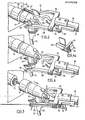
- the grasping mechanism 19 at the forward end of the pole 18 is best illustrated in Figures 3, 4 and 5.
- This comprises an angle member 26 rigidly mounted at the forward end of the pole 18, the angle member having transverse and longitudinal leg portions, a first bar member 27 and a second bar member 28.
- the first bar member 27 is pivotally mounted at one end of the angle member 26 for pivotal movement about a longitudinal axis.
- the bar member 27 is free to pivot to and from a limit position.
- Figure 5 shows the bar member in its limit position, wherein it lies parallel to the transverse leg portion of the angle member 26.
- the bar member 27 is resiliently biased towards the limit position by a spring 29 as shown in Figure 4a.
- the second bar member 28 is pivotally mounted at the other end of the angle member 26 for pivotal movement about a transverse axis, this transverse axis in the present example being perpendicular to the plane of the angle member 26.
- the bar member 28 is thus pivotally movable -to and from a limit position in which it extends longitudinally and substantially parallel to the longitudinal leg portion of the angle member 26.
- first and second bar members are formed, respectively, with a spigot 30 and cooperating socket 31.
- first and second bar members are rigidly interlocked by the spigot and socket joint; thus they define with the angle member 26 a four-sided closed loop which is adapted to encircle the leg portion 16 of the loadbreak elbow 13.
- a hook 32 is mounted rigidly on the transverse leg portion of the angle member 26. As shown in the drawings this hook 32 extends longitudinally into the loop and is positioned so as to engage the pulling eye 17 of the elbow.
- the bar member 28 In order to engage the grasping mechanism with the loadbreak elbow the bar member 28 must first be pivoted away from its limit position so as to open the device. This is achieved, by retracting the control rod 21, at the forward end of which is a pin 33 engaging in a cam slot 34 provided in a rearward extension of the bar member 28.
- This cam slot 34 lies in the plane of the angle member 26, that is to say, in a plane transverse to the transverse pivotal axis of the bar member 28.
- Retraction of the control rod 21 also opens the hook 32 by retracting a finger or clasp 35 extending from the forward end of the control rod.
- the grasping mechanism can now be slipped over the loadbreak elbow in the manner shown in Figures 3 and 4, the first angle member 27 being displaced against the spring bias away from its limit position and being returned automatically to the limit position once it has cleared the body portion 14 of the loadbreak elbow.
- the hook 32 is next threaded through the pulling eye 17. Thereafter the user must return the control rod 21 to its forward position, thereby returning the finger 35 into clasping engagement with the hook 32 and returning the second bar member 28 to its limit position at which it is rigidly interlocked with the bar member 27.
- the resultant configuration, in which the loadbreak connector is securely held is illustrated in Figure 5. This position, in which the grasping mechanism is securely locked, may be indicated by an indicator button operated by the spigot 30.
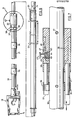
- the longitudinally movable control rod 21 is mounted alongside the pole 18 in sliding relation to it.
- the control rod itself is, of course, also of electrically insulating material such as fibre glass reinforced plastic.
- the sleeve 20 takes the form of a sliding collar to which the rear end of the control rod 21 is secured.
- the control rod 21 is constrained to be moved in the direction of its length by aligned bushes 36. Rotation of the sliding collar is prevented by means of a guide shaft 37 extending from the collar into a cylindrical bushing 38.
- a sleeve member 39 having a flange 40 is fixed onto the pole 18 by rivets 41 or similar fasteners.
- the sliding collar 20 telescopes onto the sleeve member 39 for sliding movement therealong, the flange 40 serving as an abutment stop.'
- a spring-loaded plunger 42 is located in a recess 43 in the sleeve member 39, the plunger being biased by a spring 44.
- a cup 45 engaging in the recess 43 and an aligned recess 46 in the sliding collar 20 serves to lock the sliding collar in one of its operative positions as shown.
- the stem of the plunger 42 extends through a longitudinal slot 47 in the sliding collar.
- the slide hammer 22 which is slidably mounted on the pole 18 comprises a long outer cylinder 50 of fibre glass reinforced plastic or like rigid insulating material, to the ends of which are fitted annular steel collars 51 and 52 serving as forward and rearward anvils. These collars strike the forward and rearward abutment stops 20, 24 respectively, at the ends of the hammer strokes.
- An internal weight 53 in the form of a hollow cylinder is inserted into the rearward end of the cylinder 20, the weight 53 serving to impart sufficient mass to impart adequate momentum to the slide hammer when it is operated.
- the slide hammer 22 be long enough to enable the operator to grasp it with 'both hands spaced at a convenient distance. It is also important that the weight 53 be sufficiently heavy to impart sufficient momentum to the slide hammer.
- the slide hammer should be between 85 cms and 91 cms in length, preferably 88 cms, and the total mass of the slide hammer with its weight 53 should be between 2 kg. and 3 kg., preferably 2.5 kg.
- the slide hammer differs fundamentally from the slide hammers of conventional tools, both by the fact that it is designed to be grasped by both hands of the operator, and by the fact that it is automatically retained in the rearward position once it has been operated. This absence of rebound, and above all the fact that the hammer is positively locked against further sliding movement during the moments immediately following switching of the loadbreak elbow, greatly facilitate safe manipulation of the tool during a switching operation.
Landscapes
- Engineering & Computer Science (AREA)
- Mechanical Engineering (AREA)
- Manufacturing & Machinery (AREA)
- Percussive Tools And Related Accessories (AREA)
Applications Claiming Priority (2)
| Application Number | Priority Date | Filing Date | Title |
|---|---|---|---|
| US676397 | 1984-11-29 | ||
| US06/676,397 US4582352A (en) | 1984-11-29 | 1984-11-29 | Live-line separable insulated connector tool |
Publications (2)
| Publication Number | Publication Date |
|---|---|
| EP0183339A2 true EP0183339A2 (fr) | 1986-06-04 |
| EP0183339A3 EP0183339A3 (fr) | 1988-03-02 |
Family
ID=24714343
Family Applications (1)
| Application Number | Title | Priority Date | Filing Date |
|---|---|---|---|
| EP85305801A Withdrawn EP0183339A3 (fr) | 1984-11-29 | 1985-08-15 | Outil pour séparer un sectionneur isolé de coupure en charge |
Country Status (4)
| Country | Link |
|---|---|
| US (1) | US4582352A (fr) |
| EP (1) | EP0183339A3 (fr) |
| CA (1) | CA1235718A (fr) |
| DK (1) | DK550785A (fr) |
Cited By (3)
| Publication number | Priority date | Publication date | Assignee | Title |
|---|---|---|---|---|
| US9656381B2 (en) | 2013-11-12 | 2017-05-23 | Cantega Technologies Inc. | Hot stick adapter, combination, and method |
| US10516222B2 (en) | 2011-05-12 | 2019-12-24 | Cantega Technologies Inc. | Tool and method for handling a part |
| CN110757411A (zh) * | 2019-11-26 | 2020-02-07 | 奇瑞汽车股份有限公司 | 一种汽车后盖气弹簧安装辅具 |
Families Citing this family (15)
| Publication number | Priority date | Publication date | Assignee | Title |
|---|---|---|---|---|
| US5096438A (en) * | 1990-06-28 | 1992-03-17 | Black Larry K | Electrical distribution line control sticks |
| US5638590A (en) * | 1995-05-15 | 1997-06-17 | Silano; Peter | Tool for servicing subterranean gate valves |
| US5794495A (en) * | 1996-09-25 | 1998-08-18 | Oklahoma Gas & Electric Company | Animal guard applicator |
| US6427563B1 (en) | 2000-07-25 | 2002-08-06 | Snap-On Technologies, Inc. | Insulating composite hollow shaft tool |
| US6401571B1 (en) * | 2000-12-15 | 2002-06-11 | Smiths Industries Aerospace & Defense Systems, Inc. | Lamp module removal and installation tool |
| US6453777B1 (en) * | 2001-08-10 | 2002-09-24 | Robert D. Newman | Non-metallic three-section extension pole having bulb changer |
| US6725745B1 (en) * | 2002-05-28 | 2004-04-27 | Brian A Palmieri | Safety fuse tool |
| US7066511B2 (en) * | 2003-03-27 | 2006-06-27 | Specialty Products Of Greenwood, Missouri, Inc. | Non-conductive extension pole |
| CN100433478C (zh) * | 2004-09-15 | 2008-11-12 | 江苏省电力公司无锡供电公司 | 电缆分支箱的电缆拆头装置 |
| US7181995B2 (en) * | 2005-01-13 | 2007-02-27 | Rider Jack H | Line work tool and method thereof |
| CN102197548B (zh) * | 2008-10-30 | 2013-12-04 | 富士通株式会社 | 连接器拔脱夹具以及使用该夹具的连接器拔脱方法 |
| US7984665B1 (en) * | 2009-03-25 | 2011-07-26 | Robertson Kenny D | Hot stick switch head |
| US8481878B2 (en) * | 2009-05-28 | 2013-07-09 | Daniel J. Elliott | Devices and methods related to battery modules |
| US10978262B2 (en) * | 2017-10-20 | 2021-04-13 | Otis Elevator Company | Reach tool for use in low voltage applications |
| CN107901018A (zh) * | 2017-12-15 | 2018-04-13 | 苏州浦灵达自动化科技有限公司 | 一种自动化设备用维修用勾线杆 |
Family Cites Families (7)
| Publication number | Priority date | Publication date | Assignee | Title |
|---|---|---|---|---|
| US3577848A (en) * | 1968-12-09 | 1971-05-11 | Robert C Mengle | Method of extracting o-rings from recessed grooves |
| BE757888A (fr) * | 1969-10-24 | 1971-04-01 | Burndy Corp | Outil pour le demontage et le montage de connecteurs |
| US3871056A (en) * | 1973-01-02 | 1975-03-18 | Anderson Electric Corp | Elbow connector puller |
| US3840969A (en) * | 1973-02-16 | 1974-10-15 | Kearney National Inc | Clamp stick |
| US4244613A (en) * | 1978-03-06 | 1981-01-13 | Tillman Lattie M | Fuse holder extractor and replacer tool |
| DE3038002A1 (de) * | 1980-10-08 | 1982-05-06 | Dehn + Söhne GmbH + Co KG, 8500 Nürnberg | Erdungsstange |
| US4483058A (en) * | 1983-03-03 | 1984-11-20 | A. B. Chance Company | Impact hammer elbow tool |
-
1984
- 1984-11-29 US US06/676,397 patent/US4582352A/en not_active Expired - Fee Related
-
1985
- 1985-06-27 CA CA000485684A patent/CA1235718A/fr not_active Expired
- 1985-08-15 EP EP85305801A patent/EP0183339A3/fr not_active Withdrawn
- 1985-11-28 DK DK550785A patent/DK550785A/da not_active Application Discontinuation
Cited By (4)
| Publication number | Priority date | Publication date | Assignee | Title |
|---|---|---|---|---|
| US10516222B2 (en) | 2011-05-12 | 2019-12-24 | Cantega Technologies Inc. | Tool and method for handling a part |
| US12381340B2 (en) | 2011-05-12 | 2025-08-05 | Cantega Technologies, Inc. | Tool and method for handling a part |
| US9656381B2 (en) | 2013-11-12 | 2017-05-23 | Cantega Technologies Inc. | Hot stick adapter, combination, and method |
| CN110757411A (zh) * | 2019-11-26 | 2020-02-07 | 奇瑞汽车股份有限公司 | 一种汽车后盖气弹簧安装辅具 |
Also Published As
| Publication number | Publication date |
|---|---|
| CA1235718A (fr) | 1988-04-26 |
| DK550785A (da) | 1986-05-30 |
| DK550785D0 (da) | 1985-11-28 |
| US4582352A (en) | 1986-04-15 |
| EP0183339A3 (fr) | 1988-03-02 |
Similar Documents
| Publication | Publication Date | Title |
|---|---|---|
| US4582352A (en) | Live-line separable insulated connector tool | |
| KR102021001B1 (ko) | 활선 작업용 수동 기계식 다기능 절연 기어 그립퍼 플라이어 스틱 및 이를 이용한 간접 활선공법 | |
| US11404802B2 (en) | Locking grounding clamp | |
| US4846725A (en) | Self-latching power line clamp | |
| US8820210B2 (en) | Firearm charging handle | |
| US3181533A (en) | Surgical snare | |
| EP4081075B1 (fr) | Pince télescopique pouvant être pliée | |
| AU552476B2 (en) | Rasp handle | |
| KR102028010B1 (ko) | 간접 활선 작업용 회전 기능 그립 올 클램프 스틱 및 이를 이용한 간접활선용 공구 회전 조작 방법 | |
| US4483058A (en) | Impact hammer elbow tool | |
| JPH08162213A (ja) | 給電側コネクタ | |
| US5127446A (en) | Banding tool with a force storing device | |
| EP0061257A1 (fr) | Crochet de blocage pour échafaudages | |
| US4768404A (en) | Cable stripping tool | |
| CA3107483A1 (fr) | Collier de masse a ressort | |
| US6067705A (en) | Header contact pin extraction tool and method of pin extraction | |
| EP1324448A2 (fr) | Pince à dénuder pour câbles | |
| US6922888B2 (en) | Loadbreak elbow pulling tool apparatus | |
| US20160105006A1 (en) | Shield Snipping Systems | |
| EP2785262B1 (fr) | Poignée chirurgicale et instrument chirurgical à tige tubulaire doté d'une poignée chirurgicale | |
| WO2016061271A1 (fr) | Systèmes d'enlèvement de l'isolation | |
| CN106602440B (zh) | 一种封闭式开关柜母线接地专用工具 | |
| CN206349674U (zh) | 一种封闭式开关柜母线接地专用工具 | |
| CN109994847A (zh) | 一种可锁止的临时短路接地线 | |
| US12017334B1 (en) | Method and assembly for grasping and positioning electric power cables in pad-mounted transformers |
Legal Events
| Date | Code | Title | Description |
|---|---|---|---|
| PUAI | Public reference made under article 153(3) epc to a published international application that has entered the european phase |
Free format text: ORIGINAL CODE: 0009012 |
|
| AK | Designated contracting states |
Kind code of ref document: A2 Designated state(s): BE DE FR GB IT SE |
|
| PUAL | Search report despatched |
Free format text: ORIGINAL CODE: 0009013 |
|
| AK | Designated contracting states |
Kind code of ref document: A3 Designated state(s): BE DE FR GB IT SE |
|
| RHK1 | Main classification (correction) |
Ipc: H01R 43/26 |
|
| 17P | Request for examination filed |
Effective date: 19880826 |
|
| 17Q | First examination report despatched |
Effective date: 19910503 |
|
| STAA | Information on the status of an ep patent application or granted ep patent |
Free format text: STATUS: THE APPLICATION IS DEEMED TO BE WITHDRAWN |
|
| 18D | Application deemed to be withdrawn |
Effective date: 19910914 |