EP0183410B1 - Dispositif de positionnement destiné à un capteur électrocardiographique - Google Patents
Dispositif de positionnement destiné à un capteur électrocardiographique Download PDFInfo
- Publication number
- EP0183410B1 EP0183410B1 EP85308090A EP85308090A EP0183410B1 EP 0183410 B1 EP0183410 B1 EP 0183410B1 EP 85308090 A EP85308090 A EP 85308090A EP 85308090 A EP85308090 A EP 85308090A EP 0183410 B1 EP0183410 B1 EP 0183410B1
- Authority
- EP
- European Patent Office
- Prior art keywords
- locating
- sensor
- electrocardiograph
- sensors
- zone
- Prior art date
- Legal status (The legal status is an assumption and is not a legal conclusion. Google has not performed a legal analysis and makes no representation as to the accuracy of the status listed.)
- Expired - Lifetime
Links
- 210000003484 anatomy Anatomy 0.000 claims abstract description 11
- 230000003601 intercostal effect Effects 0.000 claims description 11
- 210000001562 sternum Anatomy 0.000 claims description 9
- 210000000038 chest Anatomy 0.000 claims description 6
- 210000003109 clavicle Anatomy 0.000 claims description 2
- 239000000463 material Substances 0.000 claims description 2
- 230000006978 adaptation Effects 0.000 abstract description 2
- 238000005259 measurement Methods 0.000 description 10
- 238000002565 electrocardiography Methods 0.000 description 3
- 230000037361 pathway Effects 0.000 description 3
- 238000004070 electrodeposition Methods 0.000 description 2
- 239000000853 adhesive Substances 0.000 description 1
- 230000001070 adhesive effect Effects 0.000 description 1
- 230000003466 anti-cipated effect Effects 0.000 description 1
- 230000037237 body shape Effects 0.000 description 1
- 230000000737 periodic effect Effects 0.000 description 1
- 230000000717 retained effect Effects 0.000 description 1
Images


Classifications
-
- A—HUMAN NECESSITIES
- A61—MEDICAL OR VETERINARY SCIENCE; HYGIENE
- A61B—DIAGNOSIS; SURGERY; IDENTIFICATION
- A61B5/00—Measuring for diagnostic purposes; Identification of persons
- A61B5/68—Arrangements of detecting, measuring or recording means, e.g. sensors, in relation to patient
- A61B5/6801—Arrangements of detecting, measuring or recording means, e.g. sensors, in relation to patient specially adapted to be attached to or worn on the body surface
- A61B5/684—Indicating the position of the sensor on the body
- A61B5/6841—Indicating the position of the sensor on the body by using templates
-
- A—HUMAN NECESSITIES
- A61—MEDICAL OR VETERINARY SCIENCE; HYGIENE
- A61B—DIAGNOSIS; SURGERY; IDENTIFICATION
- A61B5/00—Measuring for diagnostic purposes; Identification of persons
- A61B5/103—Measuring devices for testing the shape, pattern, colour, size or movement of the body or parts thereof, for diagnostic purposes
- A61B5/107—Measuring physical dimensions, e.g. size of the entire body or parts thereof
-
- A—HUMAN NECESSITIES
- A61—MEDICAL OR VETERINARY SCIENCE; HYGIENE
- A61B—DIAGNOSIS; SURGERY; IDENTIFICATION
- A61B5/00—Measuring for diagnostic purposes; Identification of persons
- A61B5/24—Detecting, measuring or recording bioelectric or biomagnetic signals of the body or parts thereof
- A61B5/25—Bioelectric electrodes therefor
- A61B5/279—Bioelectric electrodes therefor specially adapted for particular uses
- A61B5/28—Bioelectric electrodes therefor specially adapted for particular uses for electrocardiography [ECG]
- A61B5/282—Holders for multiple electrodes
-
- A—HUMAN NECESSITIES
- A61—MEDICAL OR VETERINARY SCIENCE; HYGIENE
- A61B—DIAGNOSIS; SURGERY; IDENTIFICATION
- A61B5/00—Measuring for diagnostic purposes; Identification of persons
- A61B5/68—Arrangements of detecting, measuring or recording means, e.g. sensors, in relation to patient
- A61B5/6801—Arrangements of detecting, measuring or recording means, e.g. sensors, in relation to patient specially adapted to be attached to or worn on the body surface
- A61B5/6813—Specially adapted to be attached to a specific body part
- A61B5/6823—Trunk, e.g., chest, back, abdomen, hip
Definitions
- This invention relates to electrocardiography, and more particularly to a positioning device for electrocardiograph sensors that provide a record of the precise location of the sensors on an individual.
- electrocardiograph sensors or exploration electrodes are placed on an individual's chest in the vicinity of the heart. The positioning of such electrodes is usually made pursuant to instructions of the instrument manufacturer and the skill and judgment of the person administering the electrocardiogram.
- United States Patents 4,121,575 and 4,202,344 show an elastic belt-like chest piece used in electrocardiography which has a vertical mark for indicating the mid-chest or mid-sternum and a horizontal mark for indicating the mid-nipple line.
- the chest piece which has six electrode positions, is stretched according to the size of the patient and cannot be otherwise oriented for purposes of exactly locating an electrocardiograph sensor in a repeatable position.
- these devices do not furnish data for recording the precise electrode positions during the taking of an electrocardiogram.
- a primary objective in electrocardiography is to precisely locate the electrode sensors in proximity to well defined anatomic landmarks. Once this has been accomplished, more meaningful data can be derived from the electrical potentials of electrocardiograph sensors.
- US-A 3 525 330 discloses a vest-like garment to support and position electrocardiograph electrodes, and is provided with a grid-like pattern over at least a portion of its outer surface to provide grid co-ordinates for the desired locations of the electrodes.
- a depending element is attached to the garment so that the latter can be positioned with respect to the navel of the wearer to provide repeatability of measurement.
- an electrocardiograph sensor positioning device which may be placed on the chest of a patient and positioned according to anatomical landmarks and which further provides for defined positioning of a plurality of sensors relative to said device, comprising first and second locating members (12,14) angularly adjustable with respect to each other to a determinable angular position, cooperative indicia means (50, 72) on said first and second sensor locating members for providing an indication of said angular position, zone locating means (32, 36, 54) on said first and second sensor locating members for deining locating zones for a plurality of electrocardiograph sensors, and zone indicia means (40, 42, 68) at said zone locating means for providing an indication of the respective locations of said electrocardiograph sensors when said electrocardiograph sensors are positioned in respective said location zones, the second locating member (14) being of curved elongate structure including two curved portions (56 and 58 to 64) with a point of inflection therebetween.
- Embodiments of this invention each provide an electrocardiograph sensor positioning device that provides data for indicating the exact locations of electrocardiograph sensors that are positioned on an individual.
- These embodiments of electrocardiograph sensor positioning device can be used on persons with relatively small body structures as well as persons with relatively large body structures, can be retained by a patient after he has had an electrocardiograph examination and provide a record of the exact locations of the electrocardiograph examinations.
- These embodiments of electrocardiograph sensor positioning device are low cost and disposable.
- the first and second sensor locating members are pivoted to each other to provide a range of adjustability that permits adaptation of the device to patients of relatively small body structure as well as patients of relatively large body structure.
- the electrocardiograph sensor positioning device is thus adequate for use on patients of any size, sex or shape.
- one of the sensor locating members includes registering means that permits positioning thereof in a predetermined aligned position.
- the registering means also includes an indicating arrangement that provides data for assuring a repeatable location of the sensor locating member in the predetermined aligned position. If desired, any one of the locating members can be formed as an extendable member.
- electrocardiograph sensor positioning device are thus used to locate electrocardiograph sensors on the human anatomy by establishing a longitudinal reference between two anatomical landmarks on an individual. An origin of the longitudinal reference is determined which locates a first plurality of location zones for the electrocardiograph sensors. A second path is then established based on other anatomical landmarks and indicates a location zone for further electrocardiograph sensors. The second reference path is established after one of the sensor locating members is placed in a fixed position and the other of the sensor locating members is moved to a predetermined anatomical landmark area.
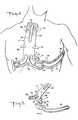
- An electrocardiograph sensor positioning device incorporating a preferred embodiment of the invention is generally indicated by the reference number 10 in Fig. 1.
- the device 10 comprises a pair of sensor locating members 12 and 14 moveable with respect to each other about a pivot 16 formed of pivot pieces 16a and 16b as shown in Fig. 5.
- the locating members 12 and 14 are preferably formed of a non-conductive flexible material such as plastic or paper having a thickness which permits such locating members to bend and conform to the curvature of the human anatomy at a precordial location such as shown in Fig. 4.
- the sensor locating member 12 has an elongated main section 18 that is formed with a relatively narrow slot 20 extending toward an end portion 22 of the main section 18.
- Indicia means such as a measurement scale 24 is provided alongside the slot 20.
- the measurement scale 24 is graduated in centimeters.
- a base portion 26 of the main section 18 includes a pair of diverging zone sections 28 and 30.
- the zone section 28 includes a curved slot 32 defining a zone or pathway 34, whereas the zone section 30 includes an oppositely curved slot 36 defining a zone or pathway 38.
- Measurement scales 40 and 42 are provided alongside the respective slots 32 and 36.
- a sternum notch register 44 provided intermediate the diverging zone sections 28 and 30 is colinear with the narrow slot 20.
- the sternum notch register 44 cooperates with the slot 20 to form a clavicle gauge based on indicated readings from the measurement scale 24.
- the sensor locating member 12 also includes a flange portion 46 adjacent the curved slot 36.
- a scale opening 48 having an indicia line 50 is provided on the flange portion 46, and a pivot opening 52 is spaced from the scale opening 48.
- the sensor locating member 14 which is elongated with some slight curves, is formed with a correspondingly shaped slot 54 that defines location zones 56, 58, 60, 62 and 64.
- the location zones 56, 58, 60, 62 and 64 collectively form a continuous pathway having a clearance zone 66 that extends beyond the location zone 56.
- Indicia means such as a measurement scale 68, preferably graduated in centimeters, is provided alongside the slot 54 at the location zones 56, 58, 60, 62 and 64.
- the sensor locating member 14 also includes a flange portion 70 adjacent the clearance zone 66.
- An angle indicia 72 is provided on the flange portion 70 and a pivot opening 74 is spaced from the angle indicia 72.
- the sensor locating member 12 is positioned according to some well known anatomical landmarks.
- the sternal angle or sternum notch determines the point at which the sternum notch register 44 of the sensor locating member 12 is positioned.
- the clavicular notch schematically indicated at the reference number 82 of Fig. 3 is aligned with the narrow slot 20 of the sensor locating member 12. It will be noted from Fig. 3 that a reference axis X-X can be shown to extend through the sternum notch 80 and the clavicular notch 82 to define a midclavicular line.
- the measurement scale 24 will indicate the location of the clavicular notch 82 for the particular patient being examined.
- a mark indicated by the arrow 84 in Fig. 4 can be made directly on the locating member 12 and thereby indicate a first identifiable characteristic of the patient being examined.
- the locating member 12 can be taped or otherwise secured to the patient's chest, as by tape strips 86 shown in Fig. 4.
- the locating member 14 is pivoted with respect to the locating member 12 to a position wherein the location zones 58, 60 and 62 align with the fifth intercostal space to the left of the midclavicular line X-X.
- the sensor locating member 14 is also secured to the patient, using adhesive strips such as 86.
- the angle at which the locating member 14 is pivoted with respect to the locating member 12 is read from the angle indicia scale 72 which shows through the scale opening 48 at the indicia line 50. This reading can be written directly on the flange 46, and represents a second identifiable characteristic of the patient being examined.
- the zones 34 and 38 of the locating member 12 surround a desired zone on the patient wherein the electrocardiograph sensors will be positioned.
- the desired zones on the human body can be characterized as the V1 and V2 sectors as indicated on the locating member 12 (Fig. 2) alongside the zones 34 and 38.
- the locating member 14 when positioned on a patient locates desired sensor positioning zones on the patient's anatomy within the zones 56, 58, 60, 62 and 64.
- the sensor positioning zones on the human anatomy corresponding to the zones 56, 58, 60, 62 and 64 are characterized as the V3 sector, the V4 sector, the V5 sector, the V6 sector and the V7 sector, respectively as indicated on the locating member 14 (Fig. 2).
- the V1 sector at zone 34 locates an electrocardiograph sensor schematically shown as 88 in Fig. 3 at the right border of the sternum in the fourth intercostal space.
- the V2 sector locates an electrocardiograph sensor 90 at the left border of the sternum in the fourth intercostal space.
- the V4 sector at zone 58 locates an electrocardiograph sensor 92 at the left midclavicular line in the fifth intercostal space.
- the V3 sector at zone 56 will locate an electrocardiograph sensor 94 at the left parasternal line approximately midway between the electrocardiograph sensors 90 and 92.
- the V5 sector at zone 60 locates an electrocardiograph sensor 96 at the anterior axillary line at the fifth intercostal space
- the V6 sector at zone 62 will locate an electrocardiograph sensor 98 at the midaxillary line, also at the fifth intercostal space
- the V7 sector at zone 64 will locate an electrocardiograph sensor 99 at the outer axillary line in the fifth intercostal space.
- the device 10 when an electrocardiogram examination is completed the device 10 can be given to the patient and the data that has been marked on said device can be recorded in the patient's medical records. Upon subsequent examination of the patient, the data provided by the device 10 will assure a substantially exact repeat of the location of the electrocardiograph sensors as they were positioned in the previous examination. Thus a more meaningful comparison of data obtained in a series of electrocardiograph examinations can be accomplished.
- the location of the electrocardiograph sensors 88 and 90 as shown in Fig. 3, defines another reference axis Y-Y. It has been found for human anatomies which range from 24 inches in height to 84 inches in height, and from 12 inches in width through 30 inches in width, and from 6 inches in depth through 20 inches in depth, that there are approximately 7,741,440 possible sensor locations when the height, width and depth dimensions are varied by one-eighth inch increments. If the sensor locations at the V1 and V2 sectors are considered to be constant, there are still more than 387,000 possible sensor locations for the previously described size range of human anatomy.
- individualized locating members (not shown) were prepared for a varying size range of human anatomies.
- the shape and size of the zones 34 and 38 of the locating member 12 represent a consensus of the various possible sensor locations for the range of body shapes previously described.
- the size and shape of the locating member 14 and the pivotal capability of the locating member 14 with respect to the locating member 12 represent a similar consensus of the desired locations of electrocardiograph sensors for the range of body size previously discussed.
- the electrocardiograph sensor positioning device is thus a device which is adaptable to a wide range of body sizes regardless of sex.
- the dimensions of the electrocardiograph sensor positioning device can vary, to exemplify the magnitudes being dealt with it has been found that a feasible overall height for the locating member 12 is 27 centimeters and a feasible overall width from the zone section 28 to the zone section 30 is approximately 17.8 centimeters.
- the slot 20 can be approximately 10 centimeters long and spaced 11 centimeters from the sternum notch register 44. The width of the zones should be sufficient to accommodate the particular size electrocardiograph sensor being used.
- a feasible overall length of the locating member 14 from terminal point to terminal point is approximately 30.5 centimeters and the overall height is approximately 11 centimeters. It has been found that a centimeter scale alongside the zones 56, 58, 60, 62 and 64 can extend from 1 to 24 centimeters.
- an adjustable electrocardiograph sensor positioning device can be built according to the principles shown in Fig. 6. Accordingly, a further embodiment of the electrocardiograph sensor positioning device is generally indicated by the reference number 100 in Fig. 6.
- the device 100 includes a sensor locating member 102 pivotally secured to a sensor locating member 104.
- the sensor locating member 102 includes a main section 18 and a slidable section 106 slidably secured to the main section 18 in any suitable known fashion.
- the slidable section 106 includes a slot 108 continuous with the slot 20 of the main section 18.
- the slot 108 also includes a measurement scale 110, the readings of which can be added to the exposed portion of the measurement scale 24 of the main section 18.
- the sensor locating member 104 includes a slidable section 110 slidably secured in any suitable known fashion to a pivotal section 112 that is similar in most respects to the sensor locating member 14 except for the fact that the V7 sector on the pivotal section 112 is open ended.
- a mark can be made directly thereon indicating the point at which the slidable section 110 has been extended.
- the graduated readings on the slidable section 110 can then be added to the graduated readings on the pivotal section 112 to ascertain the exact locations of the electrocardiograph sensors.
- V3, V4, V5, V6, V7 sectors can be indicated by appropriate abbreviations on the sensor locating member 104 and any selected mark that indicates the particular location of a sensor can be made as previously described.
- either embodiment of the electrocardiograph sensor positioning device can be made as a disposable article intended for one time use on a single individual.
Landscapes
- Health & Medical Sciences (AREA)
- Life Sciences & Earth Sciences (AREA)
- General Health & Medical Sciences (AREA)
- Animal Behavior & Ethology (AREA)
- Pathology (AREA)
- Engineering & Computer Science (AREA)
- Biomedical Technology (AREA)
- Heart & Thoracic Surgery (AREA)
- Medical Informatics (AREA)
- Molecular Biology (AREA)
- Surgery (AREA)
- Veterinary Medicine (AREA)
- Physics & Mathematics (AREA)
- Public Health (AREA)
- Biophysics (AREA)
- Oral & Maxillofacial Surgery (AREA)
- Dentistry (AREA)
- Cardiology (AREA)
- Measurement And Recording Of Electrical Phenomena And Electrical Characteristics Of The Living Body (AREA)
- Measuring Pulse, Heart Rate, Blood Pressure Or Blood Flow (AREA)
- Push-Button Switches (AREA)
- Chemical And Physical Treatments For Wood And The Like (AREA)
- Luminescent Compositions (AREA)
- Plural Heterocyclic Compounds (AREA)
- Lead Frames For Integrated Circuits (AREA)
- Electrotherapy Devices (AREA)
- Measurement Of The Respiration, Hearing Ability, Form, And Blood Characteristics Of Living Organisms (AREA)
Claims (11)
- Dispositif de positionnement pour un capteur électrocardiographique qui peut être placé sur la poitrine d'un patient et positionné selon des points de repère anatomiques et qui procure en outre un positionnement défini d'une pluralité de capteurs par rapport audit dispositif, comprenant des premier et second membres de localisation (12, 14) réglables angulairement l'un par rapport à l'autre à une position angulaire déterminable, un moyen d'indice coopératif (50, 72) sur lesdits premier et second membres de localisation de capteurs pour procurer une indication de ladite position angulaire, un moyen de localisation de zones (32, 36, 54) sur les premier et second membres de localisation de capteur pour définir des zones de localisation pour une pluralité de capteurs électrocardiographiques, et un moyen d'indice de zone (40, 42, 68) sur ledit moyen de localisation de zone pour procurer une indication des localisations respectives desdits capteurs électrocardiographiques lorsque lesdits capteurs électrocardiographiques sont positionnés sur lesdites zones de localisation respectives, le second membre de localisation (14) étant d'une structure allongée incurvée incluant deux parties incurvées (56 et 58 à 64) avec un point d'inflexion entre.
- Dispositif selon la revendication 1, pour une utilisation sur l'anatomie humaine ayant une encoche sternale et une encoche claviculaire, caractérisé en ce que l'un desdits membres de localisation de capteurs (12) inclut un moyen d'enregistrement (20, 44) pour aligner l'un desdits membres de localisation de capteurs dans une position prédéterminée le long d'une ligne imaginaire joignant l'encoche sternale et l'encoche claviculaire.
- Dispositif selon la revendication 2, caractérisé en ce que ledit moyen d'enregistrement inclut un moyen d'indice de clavicule (24) pour procurer un affichage de la localisation de ladite encoche claviculaire par rapport à ladite encoche sternale.
- Dispositif selon la revendication 2 ou 3, caractérisé en ce que ledit moyen d'enregistrement inclut une rainure (20) pour un alignement avec l'encoche claviculaire.
- Dispositif selon la revendication 2, 3 ou 4, caractérisé en ce que ledit membre de localisation de capteurs comporte deux desdits moyens de localisation de zones (32, 36), et en ce que lesdits deux moyens de localisation de zone comprennent des rainures incurvées ayant des extrémités voisines correspondantes et des extrémités opposées respectives qui divergent au loin l'une de l'autre.
- Dispositif selon l'une quelconque des revendications 2 à 5, caractérisé en ce que l'autre desdits moyens de localisation de capteurs (14) inclut au moins une rainure allongée (54), les limites de ladite rainure définissant les zones de localisation pour lesdits capteurs électrocardiographiques.
- Dispositif selon l'une quelconque des revendications 2 à 6, caractérisé en ce que ledit membre de localisation de capteurs (12) est étirable.
- Dispositif selon la revendication 1, caractérisé en ce que ledit membre de localisation de capteurs (12) définit un premier trajet de localisation (20) pour au moins un capteur électrocardiographique, ledit premier trajet de localisation formé pour avoir un premier alignement avec le quatrième espace intercostal sur le bord droit du sternum.
- Dispositif selon la revendication 8, caractérisé en ce que ledit second membre de localisation (14) définit un second trajet de localisation (54) qui est formé au-dessus d'une partie incurvée (58 à 64) pour avoir un second alignement avec le cinquième espace intercostal sur la ligne médioclaviculaire gauche et pour s'étendre le long du cinquième espace intercostal vers la ligne axillaire externe.
- Dispositif selon la revendication 9, caractérisé en ce que ledit second trajet de localisation (54) est formé sur la seconde partie incurvée (56) pour s'aligner avec la ligne parasternale gauche sur le quatrième espace intercostal lorsque ledit premier trajet de localisation (20) est sur le premier alignement et le second trajet de localisation (54) est sur le second alignement.
- Dispositif selon l'une quelconque des revendications précédentes, caractérisé en ce que lesdits premier et second membres de localisation de capteurs sont formés d'un matériau pliable flexible tel le plastique ou bien le papier pour se conformer à l'anatomie humaine.
Priority Applications (1)
| Application Number | Priority Date | Filing Date | Title |
|---|---|---|---|
| AT85308090T ATE75126T1 (de) | 1984-11-21 | 1985-11-07 | Vorrichtung zum positionieren von ekgableitungen. |
Applications Claiming Priority (2)
| Application Number | Priority Date | Filing Date | Title |
|---|---|---|---|
| US06/673,668 US4593698A (en) | 1984-11-21 | 1984-11-21 | Electrocardiograph sensor positioning device and method |
| US673668 | 1996-06-25 |
Publications (3)
| Publication Number | Publication Date |
|---|---|
| EP0183410A2 EP0183410A2 (fr) | 1986-06-04 |
| EP0183410A3 EP0183410A3 (en) | 1988-01-20 |
| EP0183410B1 true EP0183410B1 (fr) | 1992-04-22 |
Family
ID=24703617
Family Applications (1)
| Application Number | Title | Priority Date | Filing Date |
|---|---|---|---|
| EP85308090A Expired - Lifetime EP0183410B1 (fr) | 1984-11-21 | 1985-11-07 | Dispositif de positionnement destiné à un capteur électrocardiographique |
Country Status (13)
| Country | Link |
|---|---|
| US (1) | US4593698A (fr) |
| EP (1) | EP0183410B1 (fr) |
| JP (1) | JPS61131728A (fr) |
| KR (1) | KR920008155B1 (fr) |
| CN (1) | CN85108489B (fr) |
| AT (1) | ATE75126T1 (fr) |
| AU (1) | AU579203B2 (fr) |
| BR (1) | BR8505738A (fr) |
| CA (1) | CA1249927A (fr) |
| DE (1) | DE3585910D1 (fr) |
| DK (1) | DK161180C (fr) |
| NO (1) | NO172783C (fr) |
| NZ (1) | NZ214265A (fr) |
Families Citing this family (35)
| Publication number | Priority date | Publication date | Assignee | Title |
|---|---|---|---|---|
| IL84854A0 (en) * | 1986-12-22 | 1988-06-30 | Cardiotronics Int Inc | Ekg sensor sheet |
| JPH0626241Y2 (ja) * | 1989-01-31 | 1994-07-20 | シャープ株式会社 | シート状生体用電極保持体 |
| US5301681A (en) * | 1991-09-27 | 1994-04-12 | Deban Abdou F | Device for detecting cancerous and precancerous conditions in a breast |
| US20040127800A1 (en) * | 1995-07-06 | 2004-07-01 | Kimball Victor E. | Device for assessing perfusion failure in a patient by measurement of blood flow |
| US6141575A (en) * | 1996-08-16 | 2000-10-31 | Price; Michael A. | Electrode assemblies |
| US5995861A (en) * | 1996-08-16 | 1999-11-30 | Price; Michael A. | Precordial overlay for positioning electrocardiograph electrodes |
| US6975900B2 (en) | 1997-07-31 | 2005-12-13 | Case Western Reserve University | Systems and methods for determining a surface geometry |
| WO1999006112A1 (fr) | 1997-07-31 | 1999-02-11 | Case Western Reserve University | Systeme electrophysiologique de cartographie cardiaque base sur un catheter miniature sans contact non extensible a electrodes multiples et procede correspondant |
| US6115623A (en) * | 1997-08-14 | 2000-09-05 | Mcfee; Robin Beverly | Apparatus and method for consistent patient-specific EKG electrode positioning |
| US6400975B1 (en) * | 1997-08-14 | 2002-06-04 | Mcfee Robin B. | Apparatus and method for consistent patient-specific electrode positioning for EKG testing and delivery of electrical energy to the heart |
| US6173198B1 (en) * | 1999-01-29 | 2001-01-09 | Baxter International Inc. | Apparatus and method for the accurate placement of biomedical sensors |
| US8897861B2 (en) | 1999-07-27 | 2014-11-25 | Jorge Hernando Ordóñez-Smith | Electrocardiographic method and apparatus based on bipolar, non-vectorial, truncal leads or real unipolar leads |
| US20020099277A1 (en) * | 2000-09-12 | 2002-07-25 | Nexan Limited | Disposable vital signs monitoring sensor band with removable alignment sheet |
| US6768921B2 (en) * | 2000-12-28 | 2004-07-27 | Z-Tech (Canada) Inc. | Electrical impedance method and apparatus for detecting and diagnosing diseases |
| WO2003028801A2 (fr) * | 2001-10-04 | 2003-04-10 | Case Western Reserve University | Systemes et procedes d'imagerie electrocardiographique non invasive (ecgi) faisant appel a un residu minimum generalise (gmres) |
| AU2003286054A1 (en) * | 2002-11-29 | 2004-06-23 | Z-Tech (Canada) Inc. | Improved breast electrode array and method of analysis for detecting and diagnosing diseases |
| US8133177B2 (en) * | 2003-09-23 | 2012-03-13 | Vasamed, Inc. | System and method for assessing capillary vitality |
| US20080076998A1 (en) * | 2003-12-01 | 2008-03-27 | Z-Tech (Canada) Inc. | Breast electrode array and method of analysis for detecting and diagnosing diseases |
| US20060058690A1 (en) * | 2004-09-10 | 2006-03-16 | Optical Sensors, Inc. | Method and instrument for automated measurement of skin perfusion pressure |
| GB0605807D0 (en) * | 2006-03-23 | 2006-05-03 | Depuy Int Ltd | A template for use in a surgical procedure |
| US20070238386A1 (en) * | 2006-04-08 | 2007-10-11 | Schramm Michael R | Light Emitting Bubble Creation Device |
| US9254220B1 (en) | 2006-08-29 | 2016-02-09 | Vasamed, Inc. | Method and system for assessing severity and stage of peripheral arterial disease and lower extremity wounds using angiosome mapping |
| CN102379693A (zh) * | 2010-04-22 | 2012-03-21 | 无锡市优特科科技有限公司 | 心电电极安放定位装置 |
| US8870820B2 (en) | 2012-06-29 | 2014-10-28 | Combat Medical Systems, Llc | Locating device for needle insertion |
| US20200237251A9 (en) * | 2012-09-07 | 2020-07-30 | Respiratory Motion, Inc. | Electrode Padset Guide |
| US8989836B2 (en) * | 2013-03-08 | 2015-03-24 | Brainscope Company, Inc. | Electrode array and method of placement |
| CN104274243A (zh) * | 2013-07-04 | 2015-01-14 | 喻可芳 | 固定设备及其收集设备 |
| ES2748777T3 (es) * | 2015-02-24 | 2020-03-17 | Neuro France Implants | Dispositivo de esternón protésico con manubrio |
| EP3405226A4 (fr) | 2016-01-21 | 2019-12-04 | Helios Medical Ventures LLC | Dispositif de ciblage de site d'injection |
| US12296121B2 (en) | 2016-11-03 | 2025-05-13 | Merit Medical Systems, Inc. | Drainage catheter |
| US12465257B2 (en) | 2019-12-05 | 2025-11-11 | Biopotential Oy Ltd | Method and device for reproducible placement of ECG chest electrodes |
| CN110895827B (zh) * | 2019-12-23 | 2022-08-30 | 深圳市乐心平江科技有限公司 | 心电检测设备的贴置提示方法、贴置提示装置及介质 |
| CN112914583B (zh) * | 2021-02-25 | 2022-10-21 | 中国人民解放军陆军特色医学中心 | 一种非接触式确定心电图采集电极布置位置的方法 |
| WO2023212542A2 (fr) * | 2022-04-25 | 2023-11-02 | Ohio State Innovation Foundation | Dispositif pour assurer un placement exact et précis d'un capteur médical sur la poitrine d'un patient |
| US12605113B2 (en) | 2024-01-25 | 2026-04-21 | Alivecor, Inc. | Template device for repeatable placement of chest electrodes for ECG |
Family Cites Families (13)
| Publication number | Priority date | Publication date | Assignee | Title |
|---|---|---|---|---|
| NL14035C (fr) * | 1900-01-01 | |||
| US2245350A (en) * | 1939-05-23 | 1941-06-10 | George R Marshall | Sacral foramina finder |
| US3525330A (en) * | 1966-02-24 | 1970-08-25 | Lockheed Aircraft Corp | Surgical garment prescription method and apparatus |
| DE1952893C3 (de) * | 1969-10-21 | 1975-01-02 | Krampe & Co, Fertigung In Bergbaubedarf Gmbh, 4320 Hattingen | Faltwand für den Versatz an schreitendem Strebausbau |
| US3945122A (en) * | 1974-10-29 | 1976-03-23 | The United States Of America As Represented By The Secretary Of The Army | Three dimensional numerical surface descriptor |
| US4033333A (en) * | 1975-12-10 | 1977-07-05 | Combined Scientific Resources Corporation | Electrode arrangement for taking electrocardiograms |
| US4121575A (en) * | 1976-10-05 | 1978-10-24 | Harold Mills | Devices for rapid placement and recording of ECG precordial leads in patients |
| US4202344A (en) * | 1976-10-05 | 1980-05-13 | Harold Mills | Electrocardiograph electrodes and associated assemblies |
| FR2368940B1 (fr) * | 1976-10-28 | 1981-12-24 | Inst Nat Sante Rech Med | Appareil vectocardiographique muni d'un dispositif pour la |
| US4262424A (en) * | 1979-05-25 | 1981-04-21 | Hornbeck William W | Gauge for determination of shoulder bone angles in horses |
| US4312363A (en) * | 1980-02-26 | 1982-01-26 | Senco Products, Inc. | Surgical tissue thickness measuring instrument |
| US4432368A (en) * | 1980-09-24 | 1984-02-21 | Wallant International Trade, Inc. | Automatic electrode placement device |
| US4498480A (en) * | 1983-07-01 | 1985-02-12 | Mortensen John L | Adjustable probe belt assembly |
-
1984
- 1984-11-21 US US06/673,668 patent/US4593698A/en not_active Expired - Fee Related
-
1985
- 1985-11-05 CA CA000494642A patent/CA1249927A/fr not_active Expired
- 1985-11-05 NO NO854400A patent/NO172783C/no unknown
- 1985-11-07 DE DE8585308090T patent/DE3585910D1/de not_active Expired - Lifetime
- 1985-11-07 EP EP85308090A patent/EP0183410B1/fr not_active Expired - Lifetime
- 1985-11-07 AT AT85308090T patent/ATE75126T1/de not_active IP Right Cessation
- 1985-11-13 AU AU49848/85A patent/AU579203B2/en not_active Ceased
- 1985-11-14 BR BR8505738A patent/BR8505738A/pt unknown
- 1985-11-18 CN CN85108489A patent/CN85108489B/zh not_active Expired
- 1985-11-19 DK DK534685A patent/DK161180C/da active
- 1985-11-20 JP JP60260992A patent/JPS61131728A/ja active Granted
- 1985-11-20 KR KR1019850008682A patent/KR920008155B1/ko not_active Expired
- 1985-11-20 NZ NZ214265A patent/NZ214265A/xx unknown
Also Published As
| Publication number | Publication date |
|---|---|
| DE3585910D1 (de) | 1992-05-27 |
| CN85108489B (zh) | 1988-11-16 |
| EP0183410A2 (fr) | 1986-06-04 |
| KR920008155B1 (ko) | 1992-09-24 |
| CA1249927A (fr) | 1989-02-14 |
| AU4984885A (en) | 1986-05-29 |
| NO172783C (no) | 1993-09-08 |
| CN85108489A (zh) | 1986-06-10 |
| DK161180B (da) | 1991-06-10 |
| NO854400L (no) | 1986-05-22 |
| ATE75126T1 (de) | 1992-05-15 |
| EP0183410A3 (en) | 1988-01-20 |
| US4593698A (en) | 1986-06-10 |
| JPS61131728A (ja) | 1986-06-19 |
| NZ214265A (en) | 1989-03-29 |
| AU579203B2 (en) | 1988-11-17 |
| DK534685D0 (da) | 1985-11-19 |
| KR860003816A (ko) | 1986-06-13 |
| JPH0560379B2 (fr) | 1993-09-02 |
| DK534685A (da) | 1986-05-22 |
| BR8505738A (pt) | 1986-08-12 |
| DK161180C (da) | 1991-11-25 |
Similar Documents
| Publication | Publication Date | Title |
|---|---|---|
| EP0183410B1 (fr) | Dispositif de positionnement destiné à un capteur électrocardiographique | |
| US6141575A (en) | Electrode assemblies | |
| US5995861A (en) | Precordial overlay for positioning electrocardiograph electrodes | |
| US4550502A (en) | Device for analysis of recorded electrocardiogram | |
| US3742936A (en) | Rheoplethysmographic device and method of operation | |
| US6173198B1 (en) | Apparatus and method for the accurate placement of biomedical sensors | |
| ES2699832T3 (es) | Electrodo y método para determinar biopotenciales eléctricos | |
| US5758658A (en) | Compact human range of motion measurement system | |
| US20070129771A1 (en) | Device, method and stimulus unit for testing neuromuscular function | |
| Rautaharju et al. | A simple procedure for positioning precordial ECG and VCG electrodes using an electrode locator | |
| US20060253167A1 (en) | Device, method and stimulus unit for testing neuromuscular function | |
| US3525330A (en) | Surgical garment prescription method and apparatus | |
| US12465257B2 (en) | Method and device for reproducible placement of ECG chest electrodes | |
| US4282655A (en) | Cardiac axis calculator | |
| CN213371980U (zh) | 一种下肢深静脉血栓形成专用腿围测量装置 | |
| US4220163A (en) | Tibial torsion measuring device | |
| CN216365032U (zh) | 一种上肢淋巴水肿测量尺 | |
| TWI608823B (zh) | ECG measurement method | |
| JPH06197876A (ja) | 心電図胸部導出記録用パッド | |
| CN223586419U (zh) | 一种手腕神经位置测量及配对电极型号的尺子 | |
| RU2822816C1 (ru) | Способ позиционирования электрокардиографических электродов на грудной клетке | |
| CN219229873U (zh) | 一种颞颌关节层面定位测量装置及扫描成像系统 | |
| WO2025089993A2 (fr) | Procédé de positionnement d'électrodes électrocardiographiques sur la cage thoracique | |
| RAUTAHARJU et al. | RECOMMENDATIONS FOR CONSISTENT PLACEMENT OF THE CHEST ELECTRODES IN CLINICAL TRIALS AND EPIDEMIOLOGICAL STUDIES | |
| RU2664615C1 (ru) | Способ регистрации стандартной экг и устройство для его реализации |
Legal Events
| Date | Code | Title | Description |
|---|---|---|---|
| PUAI | Public reference made under article 153(3) epc to a published international application that has entered the european phase |
Free format text: ORIGINAL CODE: 0009012 |
|
| AK | Designated contracting states |
Kind code of ref document: A2 Designated state(s): AT BE CH DE FR GB IT LI NL SE |
|
| PUAL | Search report despatched |
Free format text: ORIGINAL CODE: 0009013 |
|
| AK | Designated contracting states |
Kind code of ref document: A3 Designated state(s): AT BE CH DE FR GB IT LI NL SE |
|
| 17P | Request for examination filed |
Effective date: 19880707 |
|
| 17Q | First examination report despatched |
Effective date: 19900206 |
|
| GRAA | (expected) grant |
Free format text: ORIGINAL CODE: 0009210 |
|
| AK | Designated contracting states |
Kind code of ref document: B1 Designated state(s): AT BE CH DE FR GB IT LI NL SE |
|
| PG25 | Lapsed in a contracting state [announced via postgrant information from national office to epo] |
Ref country code: SE Effective date: 19920422 Ref country code: NL Effective date: 19920422 Ref country code: LI Effective date: 19920422 Ref country code: CH Effective date: 19920422 Ref country code: BE Effective date: 19920422 Ref country code: AT Effective date: 19920422 |
|
| REF | Corresponds to: |
Ref document number: 75126 Country of ref document: AT Date of ref document: 19920515 Kind code of ref document: T |
|
| REF | Corresponds to: |
Ref document number: 3585910 Country of ref document: DE Date of ref document: 19920527 |
|
| ITF | It: translation for a ep patent filed | ||
| REG | Reference to a national code |
Ref country code: CH Ref legal event code: PL |
|
| ET | Fr: translation filed | ||
| NLV1 | Nl: lapsed or annulled due to failure to fulfill the requirements of art. 29p and 29m of the patents act | ||
| PLBE | No opposition filed within time limit |
Free format text: ORIGINAL CODE: 0009261 |
|
| STAA | Information on the status of an ep patent application or granted ep patent |
Free format text: STATUS: NO OPPOSITION FILED WITHIN TIME LIMIT |
|
| 26N | No opposition filed | ||
| PGFP | Annual fee paid to national office [announced via postgrant information from national office to epo] |
Ref country code: GB Payment date: 19951030 Year of fee payment: 11 |
|
| PGFP | Annual fee paid to national office [announced via postgrant information from national office to epo] |
Ref country code: FR Payment date: 19951109 Year of fee payment: 11 |
|
| PGFP | Annual fee paid to national office [announced via postgrant information from national office to epo] |
Ref country code: DE Payment date: 19951113 Year of fee payment: 11 |
|
| PG25 | Lapsed in a contracting state [announced via postgrant information from national office to epo] |
Ref country code: GB Effective date: 19961107 |
|
| GBPC | Gb: european patent ceased through non-payment of renewal fee |
Effective date: 19961107 |
|
| PG25 | Lapsed in a contracting state [announced via postgrant information from national office to epo] |
Ref country code: FR Effective date: 19970731 |
|
| PG25 | Lapsed in a contracting state [announced via postgrant information from national office to epo] |
Ref country code: DE Effective date: 19970801 |
|
| REG | Reference to a national code |
Ref country code: FR Ref legal event code: ST |