EP0183473A2 - Halbleiterlaservorrichtung - Google Patents
Halbleiterlaservorrichtung Download PDFInfo
- Publication number
- EP0183473A2 EP0183473A2 EP85308420A EP85308420A EP0183473A2 EP 0183473 A2 EP0183473 A2 EP 0183473A2 EP 85308420 A EP85308420 A EP 85308420A EP 85308420 A EP85308420 A EP 85308420A EP 0183473 A2 EP0183473 A2 EP 0183473A2
- Authority
- EP
- European Patent Office
- Prior art keywords
- laser
- light emitting
- area
- operation area
- semiconductor laser
- Prior art date
- Legal status (The legal status is an assumption and is not a legal conclusion. Google has not performed a legal analysis and makes no representation as to the accuracy of the status listed.)
- Withdrawn
Links
- 239000004065 semiconductor Substances 0.000 title claims abstract description 55
- 230000003287 optical effect Effects 0.000 claims abstract description 29
- 230000008878 coupling Effects 0.000 claims abstract description 5
- 238000010168 coupling process Methods 0.000 claims abstract description 5
- 238000005859 coupling reaction Methods 0.000 claims abstract description 5
- 239000000758 substrate Substances 0.000 claims description 22
- 239000013078 crystal Substances 0.000 claims description 5
- 230000010355 oscillation Effects 0.000 description 28
- 230000001427 coherent effect Effects 0.000 description 17
- 238000005253 cladding Methods 0.000 description 13
- 229910001218 Gallium arsenide Inorganic materials 0.000 description 12
- 238000001228 spectrum Methods 0.000 description 12
- 230000000903 blocking effect Effects 0.000 description 8
- 238000003776 cleavage reaction Methods 0.000 description 6
- 230000007017 scission Effects 0.000 description 6
- 238000004943 liquid phase epitaxy Methods 0.000 description 5
- 229910045601 alloy Inorganic materials 0.000 description 4
- 239000000956 alloy Substances 0.000 description 4
- 238000004891 communication Methods 0.000 description 4
- 238000000034 method Methods 0.000 description 4
- 229910017401 Au—Ge Inorganic materials 0.000 description 3
- 238000002347 injection Methods 0.000 description 3
- 239000007924 injection Substances 0.000 description 3
- 229910000980 Aluminium gallium arsenide Inorganic materials 0.000 description 2
- 230000015572 biosynthetic process Effects 0.000 description 2
- 238000003486 chemical etching Methods 0.000 description 2
- 230000001276 controlling effect Effects 0.000 description 2
- 238000009826 distribution Methods 0.000 description 2
- 238000005530 etching Methods 0.000 description 2
- 238000010438 heat treatment Methods 0.000 description 2
- 230000010365 information processing Effects 0.000 description 2
- 238000004519 manufacturing process Methods 0.000 description 2
- 239000007769 metal material Substances 0.000 description 2
- 238000000206 photolithography Methods 0.000 description 2
- 230000002265 prevention Effects 0.000 description 2
- 238000012545 processing Methods 0.000 description 2
- 230000001105 regulatory effect Effects 0.000 description 2
- 238000007738 vacuum evaporation Methods 0.000 description 2
- 238000013459 approach Methods 0.000 description 1
- 238000005229 chemical vapour deposition Methods 0.000 description 1
- 238000002109 crystal growth method Methods 0.000 description 1
- 230000007812 deficiency Effects 0.000 description 1
- 238000011161 development Methods 0.000 description 1
- 238000005516 engineering process Methods 0.000 description 1
- 230000003993 interaction Effects 0.000 description 1
- 239000000463 material Substances 0.000 description 1
- 239000000203 mixture Substances 0.000 description 1
- 238000012986 modification Methods 0.000 description 1
- 230000004048 modification Effects 0.000 description 1
- 238000001451 molecular beam epitaxy Methods 0.000 description 1
- 230000006798 recombination Effects 0.000 description 1
- 238000005215 recombination Methods 0.000 description 1
- 238000000927 vapour-phase epitaxy Methods 0.000 description 1
Images

Classifications
-
- H—ELECTRICITY
- H01—ELECTRIC ELEMENTS
- H01S—DEVICES USING THE PROCESS OF LIGHT AMPLIFICATION BY STIMULATED EMISSION OF RADIATION [LASER] TO AMPLIFY OR GENERATE LIGHT; DEVICES USING STIMULATED EMISSION OF ELECTROMAGNETIC RADIATION IN WAVE RANGES OTHER THAN OPTICAL
- H01S5/00—Semiconductor lasers
- H01S5/10—Construction or shape of the optical resonator, e.g. extended or external cavity, coupled cavities, bent-guide, varying width, thickness or composition of the active region
- H01S5/1028—Coupling to elements in the cavity, e.g. coupling to waveguides adjacent the active region, e.g. forward coupled [DFC] structures
- H01S5/1032—Coupling to elements comprising an optical axis that is not aligned with the optical axis of the active region
-
- H—ELECTRICITY
- H01—ELECTRIC ELEMENTS
- H01S—DEVICES USING THE PROCESS OF LIGHT AMPLIFICATION BY STIMULATED EMISSION OF RADIATION [LASER] TO AMPLIFY OR GENERATE LIGHT; DEVICES USING STIMULATED EMISSION OF ELECTROMAGNETIC RADIATION IN WAVE RANGES OTHER THAN OPTICAL
- H01S5/00—Semiconductor lasers
- H01S5/04—Processes or apparatus for excitation, e.g. pumping, e.g. by electron beams
- H01S5/042—Electrical excitation ; Circuits therefor
- H01S5/0421—Electrical excitation ; Circuits therefor characterised by the semiconducting contacting layers
- H01S5/0422—Electrical excitation ; Circuits therefor characterised by the semiconducting contacting layers with n- and p-contacts on the same side of the active layer
-
- H—ELECTRICITY
- H01—ELECTRIC ELEMENTS
- H01S—DEVICES USING THE PROCESS OF LIGHT AMPLIFICATION BY STIMULATED EMISSION OF RADIATION [LASER] TO AMPLIFY OR GENERATE LIGHT; DEVICES USING STIMULATED EMISSION OF ELECTROMAGNETIC RADIATION IN WAVE RANGES OTHER THAN OPTICAL
- H01S5/00—Semiconductor lasers
- H01S5/06—Arrangements for controlling the laser output parameters, e.g. by operating on the active medium
- H01S5/062—Arrangements for controlling the laser output parameters, e.g. by operating on the active medium by varying the potential of the electrodes
- H01S5/06203—Transistor-type lasers
- H01S5/06206—Controlling the frequency of the radiation, e.g. tunable twin-guide lasers [TTG]
-
- H—ELECTRICITY
- H01—ELECTRIC ELEMENTS
- H01S—DEVICES USING THE PROCESS OF LIGHT AMPLIFICATION BY STIMULATED EMISSION OF RADIATION [LASER] TO AMPLIFY OR GENERATE LIGHT; DEVICES USING STIMULATED EMISSION OF ELECTROMAGNETIC RADIATION IN WAVE RANGES OTHER THAN OPTICAL
- H01S5/00—Semiconductor lasers
- H01S5/20—Structure or shape of the semiconductor body to guide the optical wave ; Confining structures perpendicular to the optical axis, e.g. index or gain guiding, stripe geometry, broad area lasers, gain tailoring, transverse or lateral reflectors, special cladding structures, MQW barrier reflection layers
- H01S5/22—Structure or shape of the semiconductor body to guide the optical wave ; Confining structures perpendicular to the optical axis, e.g. index or gain guiding, stripe geometry, broad area lasers, gain tailoring, transverse or lateral reflectors, special cladding structures, MQW barrier reflection layers having a ridge or stripe structure
- H01S5/223—Buried stripe structure
- H01S5/2232—Buried stripe structure with inner confining structure between the active layer and the lower electrode
-
- H—ELECTRICITY
- H01—ELECTRIC ELEMENTS
- H01S—DEVICES USING THE PROCESS OF LIGHT AMPLIFICATION BY STIMULATED EMISSION OF RADIATION [LASER] TO AMPLIFY OR GENERATE LIGHT; DEVICES USING STIMULATED EMISSION OF ELECTROMAGNETIC RADIATION IN WAVE RANGES OTHER THAN OPTICAL
- H01S5/00—Semiconductor lasers
- H01S5/02—Structural details or components not essential to laser action
- H01S5/026—Monolithically integrated components, e.g. waveguides, monitoring photo-detectors, drivers
-
- H—ELECTRICITY
- H01—ELECTRIC ELEMENTS
- H01S—DEVICES USING THE PROCESS OF LIGHT AMPLIFICATION BY STIMULATED EMISSION OF RADIATION [LASER] TO AMPLIFY OR GENERATE LIGHT; DEVICES USING STIMULATED EMISSION OF ELECTROMAGNETIC RADIATION IN WAVE RANGES OTHER THAN OPTICAL
- H01S5/00—Semiconductor lasers
- H01S5/04—Processes or apparatus for excitation, e.g. pumping, e.g. by electron beams
- H01S5/042—Electrical excitation ; Circuits therefor
- H01S5/0425—Electrodes, e.g. characterised by the structure
- H01S5/04256—Electrodes, e.g. characterised by the structure characterised by the configuration
-
- H—ELECTRICITY
- H01—ELECTRIC ELEMENTS
- H01S—DEVICES USING THE PROCESS OF LIGHT AMPLIFICATION BY STIMULATED EMISSION OF RADIATION [LASER] TO AMPLIFY OR GENERATE LIGHT; DEVICES USING STIMULATED EMISSION OF ELECTROMAGNETIC RADIATION IN WAVE RANGES OTHER THAN OPTICAL
- H01S5/00—Semiconductor lasers
- H01S5/06—Arrangements for controlling the laser output parameters, e.g. by operating on the active medium
- H01S5/062—Arrangements for controlling the laser output parameters, e.g. by operating on the active medium by varying the potential of the electrodes
- H01S5/06209—Arrangements for controlling the laser output parameters, e.g. by operating on the active medium by varying the potential of the electrodes in single-section lasers
- H01S5/06213—Amplitude modulation
-
- H—ELECTRICITY
- H01—ELECTRIC ELEMENTS
- H01S—DEVICES USING THE PROCESS OF LIGHT AMPLIFICATION BY STIMULATED EMISSION OF RADIATION [LASER] TO AMPLIFY OR GENERATE LIGHT; DEVICES USING STIMULATED EMISSION OF ELECTROMAGNETIC RADIATION IN WAVE RANGES OTHER THAN OPTICAL
- H01S5/00—Semiconductor lasers
- H01S5/06—Arrangements for controlling the laser output parameters, e.g. by operating on the active medium
- H01S5/068—Stabilisation of laser output parameters
- H01S5/06817—Noise reduction
-
- H—ELECTRICITY
- H01—ELECTRIC ELEMENTS
- H01S—DEVICES USING THE PROCESS OF LIGHT AMPLIFICATION BY STIMULATED EMISSION OF RADIATION [LASER] TO AMPLIFY OR GENERATE LIGHT; DEVICES USING STIMULATED EMISSION OF ELECTROMAGNETIC RADIATION IN WAVE RANGES OTHER THAN OPTICAL
- H01S5/00—Semiconductor lasers
- H01S5/20—Structure or shape of the semiconductor body to guide the optical wave ; Confining structures perpendicular to the optical axis, e.g. index or gain guiding, stripe geometry, broad area lasers, gain tailoring, transverse or lateral reflectors, special cladding structures, MQW barrier reflection layers
- H01S5/22—Structure or shape of the semiconductor body to guide the optical wave ; Confining structures perpendicular to the optical axis, e.g. index or gain guiding, stripe geometry, broad area lasers, gain tailoring, transverse or lateral reflectors, special cladding structures, MQW barrier reflection layers having a ridge or stripe structure
- H01S5/223—Buried stripe structure
- H01S5/2232—Buried stripe structure with inner confining structure between the active layer and the lower electrode
- H01S5/2234—Buried stripe structure with inner confining structure between the active layer and the lower electrode having a structured substrate surface
Definitions
- This invention relates to semiconductor laser devices which produce laser light at a desired threshold current level with a desired oscillation wavelength and spectrum width (i.e., coherent length) by controlling the electric current to be injected thereinto.
- semiconductor laser devices have been developed as information processing light sources or optical communication light sources of optical discs, etc. If the operation characteristics of these semiconductor laser devices can be controlled by a variation in electric voltage or electric current to be injected thereinto, the individual operation characteristics among these devices will be made uniform and these devices will be used as a modulator for analog signal processing or optical communication, so that the application field of semiconductor laser devices can be enlarged.
- An approach for the prevention of noise derived from backlight is to make the coherent length of the laser light shorter than the resonation length (5 cm or more) of a resonator which is composed of the semiconductor laser devices and the optical devices.
- self-pulsation semiconductor laser devices are known as semiconductor laser devices producing laser light with such a coherent length, strict layer thickness control is required for the production of the laser devices, so that the production yield thereof is extremely low.
- the semiconductor laser device of this invention which overcomes the above-discussed and numerous other disadvantages and deficiencies of the prior art, comprises a striped laser-operation area, a light emitting diode area disposed parallel to said striped laser-operation area, an optical waveguide attaining an optical coupling between said laser-operation area and said light emitting area, and a means for independently supplying electric current to said laser-operation area and said light emitting area.
- the light emitting diode area is, in one preferred embodiment, continuous.
- the light emitting diode area is, in another preferred embodiment, composed of plural parts arranged at regular intervals.
- the current supplying means are, in one preferred embodiment, composed of an electrode, which is electrically separated into two parts, and electrical current paths, which are disposed in a substrate for multiple crystal growth.
- the electrode is, in another preferred embodiment, separated into two parts by a groove disposed at a position corresponding to the center between said laser operation area and said light emitting diode area.
- the electrical current paths are, in another preferred embodiment, U-channels disposed in the portions of the substrate corresponding to said laser operation area and said light emitting diode area, respectively.
- the invention described herein makes possible the objects of (1) providing a semiconductor laser device which can attain control of oscillation wavelengths, threshold current, oscillation spectrum widths, etc., so that the device can be used as light sources for AM modulation, FM modulation and/or heterodyne modulation for optical information processing and/or optical communication and moreover the device can be used as a switching element in digital circuits, etc.; (2) providing a semiconductor laser device which produces laser light having a coherent length ranging from several mm to several cm by the control of electric current injected thereinto thereby preventing optical output noise derived from backlight; and (3) providing a semiconductor laser device, oscillating laser light with a coherent length of 10 mm or less, which can be produced in a high yield.
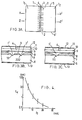
- FIGS 1(A), (B) and (C) show the VSIS (V-channeled substrate inner stripe) semiconductor laser device of a double heterostructure type of this invention, which comprises a striped laser operation area 1, a continuous light-emitting-diode area 2 disposed parallel to the laser operation area 1, and an optical waveguide 3 which optically couples the light emitting diode area 2 with the laser operation area 1.
- the laser operation area 1 and the light emitting diode area 2 are electrically separated by a striped channel 4 which is formed along the laser operation area 1 on the side containing the electrode 12, so that they independently operate when electric currents I 1 and I 2 are injected into the device.
- the laser operation area 1 has cleavage facets 5 and 5', whereas the light emitting diode area 2 has no cleavage facets so that it cannot attain laser oscillation therefrom.
- Figure 1(B) shows a sectional view on line X-X' of the portion of the semiconductor laser device shown in Figure 1(A) which attains an optical coupling between the laser operation area 1 and the light emitting diode area 2.
- Figure 1(C) is a front view showing the facets 5 and 5' of the semiconductor laser device shown in Figure 1(A).
- This semiconductor laser device is composed of a substrate 6 for multiple crystal growth, a current blocking layer 7 for the formation of a striped structure, a first cladding layer 8, an active layer 9, a second cladding layer 10, an ohmic contact. layer 11, an n-side electrode 12 and a p-side electrode 13.
- the current 1 2 is allowed to flow into the light emitting diode area 2, resulting in laser light within the portion of the active layer 9 corresponding to the light emitting diode area 2, and at the same time the current I 1 is allowed to flow into the laser operation area 1, resulting in laser oscillation in the laser operation area 1.
- the light produced in the light emitting diode area 2 is introduced into the portion of the active layer 9 corresponding to the laser operation area 1 through the optical waveguide 3.
- the density of the light to be introduced into the laser operation area 1 is proportional to the current I 2 .
- the laser oscillation operation characteristics i.e., the threshold current level, the oscillation wavelength and the spectrum width
- the laser oscillation operation characteristics vary depending upon the current 1 2 .
- the threshold current level of the laser operation area 1 becomes lower, the oscillation wavelength becomes longer and the spectrum width becomes smaller.
- a semiconductor laser device of a GaAl-AlGaAs system embodying this invention is described in greater detail below:
- an n-GaAs current blocking layer 7 having a thickness of 0.8 ⁇ m is grown by liquid phase epitaxy.
- a striped channel, having a depth of 0.2 ⁇ m and widths of 14 ⁇ m inside of the device as shown in Figure 1(B) and of 7 ⁇ m near both facets 5 and 5' as shown in Figure 1(C) is formed by photolithography and a chemical etching technique.
- a V-channel 1' corresponding to the laser operation area 1 and a V-channel 2' corresponding to the light emitting diode area 2 are formed within the striped channel by an etching technique in such a manner that both the V-channels 1' and 2' reach the p-GaAs substrate 6. It is to be understood that the ends of the V-channel 2' are not exposed from the facets 5 and 5' of the device.
- n-GaAs current blocking layer 7 containing the striped channel and the V-channels a p-Ga 0.5 Al 0.5 As cladding layer 8, a p-Ga 0.85 Al 0.15 As active layer 9, an n-Ga 0.5 Al 0.5 As cladding layer 10 and an n-GaAs cap layer 11 are successively grown by liquid phase epitaxy to form a double heterostructure on the substrate 6 which has the superimposed double-striped channels thereon.
- the active layer 9 is formed into a plane, resulting in a gain-guided semiconductor laser device.
- the back face of the substrate 6 is polished to adjust the whole thickness of the device to approximately 100 ⁇ m.
- the surface of the cap layer 11 and the back face of the substrate 6 are subjected to a vacuum evaporation treatment with metal materials of Au-Ge/Ni and Au-Zn, respectively, followed by heating at 450 °C to form an n-side electrode 12 made of an alloy of Au-Ge/Ni and a p-side electrode 13 made of an alloy of Au-Zn, respectively.
- the n-side electrode 12 is separated into two parts by a groove 4 which has a depth extending from the surface of the n-side electrode 12 to the n-cladding layer 10 at the portion corresponding to the center between the V-channels 1 1 and 2'.
- the electrical resistance between the two parts of the n-side electrode 12 exhibits several hundreds ohms, that is, these two parts of the n-side electrode 12 are electrically separated from each other.
- the facets 5 and 5' are formed by a cleavage, resulting in a semiconductor laser device unit having a resonator length of 250 ⁇ m.
- the V-channel l' extends from the facet 5 to the facet 5'.
- the portion of the active layer 9 positioned between the V-channel 1 1 and the n-side electrode 12 constitutes the laser operation area 1.
- the V-channel 2' is positioned with a length of approximately 200 ⁇ m alongside the V-channel 1'.
- the position of the active layer 9 positioned between the V-channel 2' and the n-side electrode 12 constitutes the light emitting diode area 2.
- the laser operation area 1 and the light emitting diode area 2 are optically coupled by the common active layer 9.
- the resulting semiconductor laser device has a modulating function.
- the electric current I 1 was allowed to flow into the laser operation area 1 resulting in laser oscillation.
- the oscillation threshold current I th was 45 mA and the oscillation wavelength ⁇ was 7750 ⁇ in the case where the electric current 1 2 was not allowed to flow into the light emitting diode area 2.
- the threshold current I th in the laser operation area 1 was reduced as the current 1 2 increased ( Figure 2(A)), whereas the oscillation wavelength ⁇ shifted to the long wavelength side as the current 1 2 increased ( Figure 2(B)).
- the spectrum width ⁇ f was reduced as the current 1 2 increased ( Figure 2(C)).
- the n-side electrode 12 which is positioned at the upper portion of the active layer 9 is electrically separated into two parts by the groove 4, and moreover the electric current paths which are constituted by the channels 111 and 222 in the substrate 6 are electrically separated from each other, so that the currents I 1 and I 2 which are allowed to flow thereinto are separated from each other.
- the portion of the active layer 9 positioned above the V-channel 1' attains laser oscillation.
- the carrier is recombined in the portion of the active layer 9 positioned above the V-channel 2', resulting in laser light.
- the laser light is transmitted to the laser operation area 1 within the active layer 9 to increase the optical density of the laser operation area 1, so that the laser oscillation conditions are changed to achieve modulation of the laser light.
- FIGS 3(A), 3(B) and 3(C) show another VSIS (V-channeled substrate inner stripe) semiconductor laser device of a double heterostructure type of this invention, which comprises a striped laser operation area 1, an intermittent light-emitting-diode area 2 consisting of a plurality of parts disposed at regular intervals in a straight line parallel to the laser operation area 1, and an optical waveguide 3 which optically couples the light emitting diode area 2 with the laser operation area 1.
- the laser operation area 1 is electrically separated from the light emitting diode area 2 by a striped channel 4 which is formed along the laser operation area 1 on the side containing the elec- .trode 12, so that the laser operation area 1 operates independently of the light emitting diode area 2 when electric currents I, and 1 2 are injected into the de,- vice.
- the laser operation area 1 has cleavage facets 5 and 5', whereas the light emitting diode area 2 has no cleavage facets so that it cannot attain laser oscillation therefrom.
- Figure 3(B) shows a sectional view on line Y-Y' of the portion of the semiconductor laser device shown in Figure 3(A) which attains optical coupling between the laser operation area 1 and the light emitting diode area 2.
- Figure 3(C) shows a sectional view on line Z-Z' at the laser operation area 1 of the semiconductor laser device shown in Figure 3(A).
- This semiconductor laser device is composed of a substrate 6 for multiple crystal growth, a current blocking layer 7 for the formation of a striped structure, a first cladding layer 8, an active layer 9, a second cladding layer 10, an ohmic contact layer 11, an n-side electrode 12 and a p-side electrode 13.
- the current 1 2 is allowed to flow into the light emitting diode area 2, resulting in laser light within the portion of the active layer 9 corresponding to each of the parts of the light emitting diode area 2, and at the same time the current I i is allowed to flow into the laser operation area 1, resulting in laser oscillation therein.
- the light produced in each of the parts of the light emitting diode area 2 is introduced into the portion of the active layer 9 corresponding to the laser operation area 1 through the optical waveguide 3.
- the portions of the active layer 9 which are irradiated with the lights from the light emitting diode area 2 and the other portions of the active layer 9 which are not irradiated with the lights from the light emitting diode area 2 are created alternatively in the direction of the striped laser operation area 1, resulting in a variety with regard to carrier density in the portion of the active layer 9 corresponding to the laser operation area 1 in the oscillation direction, that is, the carrier density is low in the portions which are irradiated with the lights from the light emitting diode area 2 whereas it is high for the portions which are not irradiated with the lights therefrom.
- the interaction between the lights and the carrier arises at each of the interfaces between the irradiated portions of the active layer 9 and the non-irradiated portions of the active layer 9, resulting in oscillation thereof. Therefore, laser light emitted from the facets 5 and 5' presents in multiple longitudinal modes each of which has a spectrum width of 1 ⁇ or more.
- the coherent length thereof is as small as 1 cm or less.
- the intensity of the lights produced in the light emitting diode area 2 can be regulated under the control of current I 2 , so that the distribution of the carrier density of the portion of the active layer 9 corresponding to the laser operation area 1 in the oscillation direction can be regulated thereby allowing alternation of the coherent length.
- a semiconductor laser device of a GaAs-AlGaAs system embodying this invention is described in greater de- cail below: On the (100) face of a p-GaAs substrate 6, an n-GaAs current blocking layer 7 having a thickness of 0.8 ⁇ m is grown by liquid phase epitaxy.
- n-GaAs current blocking layer 7 On the n-GaAs current blocking layer 7, a striped channel, having a depth of 0.2 ⁇ m and widths of 14 ⁇ m at the portions having both the laser operation area 1 and the light emitting diode area 2 shown in Figure 3(B) and of 0.7 ⁇ m at the portions having the laser operation area 1 alone shown in Figure 3(C), is formed by photolithography and a chemical etching technique. Then, a continuous V-channel 1 1 corresponding to the laser operation area 1 and an intermittent V-channel 2' corresponding to the light emitting diode area 2 are formed within the striped channel by an etching technique in such a manner that both the V-channels 1' and 2' reach the p-GaAs substrate 6.
- each of the parts of the V-channel 2' and each interval therebetween is 25 ⁇ m.
- a p-Ga 0.5 Al 0.5 As cladding layer 8 a p-Ga 0.85 Al 0.15 As active layer 9
- an n-Ga 0.5 Al 0.5 As cladding layer 10 and an n-GaAs cap layer 11 are successively grown by liquid phase epitaxy to form a double heterostructure on the substrate 6 having the superimposed double-striped channels thereon.
- the active layer 9 is formed into a plane, resulting in a gain-guided semiconductor laser device.
- the back face of the substrate 6 is polished to adjust the whole thickness of the device to approximately 100 pm. Then, the surface of the cap layer 11 and the back face of the substrate 6 are subjected to a vacuum evaporation treatment with metal materials of Au-Ge/Ni and Au-Zn, respectively, in the same manner as in Example 1, fol - lowed by the same heat-treatment as in Example 1 to form an n-side electrode 12 made of an alloy of Au-Ge-Ni and a p-side electrode 13 made of an alloy of Au-Zn, respectively.
- the n-side electrode 12 is separated into two parts by a groove 4 which has a depth ranging from the surface of the n-side electrode 12 to the n-cladding layer 10 at the portion corresponding to the center between the V-channels 1' and 2'. It was found experimentally that the electrical resistance between the two parts of the n-side electrode 12 exhibits several hundreds ohms, that is, these two parts of the n-side electrode 12 are electrically separated from each other.
- the facets 5 and 5' are likewise formed by cleavage, resulting in a semiconductor laser device unit having a resonator length of 250 p m.
- the V-channel 1' is in the range of the facet 5 to the facet 5'.
- the portion of the active layer 9 positioned between the V-channel 1' and the n-side electrode 12 constitutes the laser operation area 1.
- the portion of the active layer 9 positioned between the intermittent V-channel 2', which is disposed parallel to the V-channel 1' and each of the parts of which has a length of 25 ⁇ m, and the n-side electrode 12 constitutes the light emitting diode area 2 composed of plural parts.
- the laser operation area 1 and the light emitting diode area 2 are optically coupled by the common active layer 9.
- the resulting semiconductor laser device has a modulating function.
- the current I When electric current was injected into the device through the n-side electrode 12 and the p-side electrode 13, the current I, was allowed to flow into the laser operation area 1 resulting in laser oscillation.
- the oscillation threshold current Ith was 45 mA and the oscillation wavelength ⁇ was 7750 A.
- the laser oscillation took place in a single longitudinal mode with a spectrum width ⁇ of 0.001 ⁇ or less and a coherent length Lc of 1 cm or more.
- the laser operation area 1 began laser oscillation in multiple longitudinal modes and the spectrum width ⁇ thereof became great gradually.
- the spectrum width ⁇ was approximately 1 A which was extremely greater than that at the time when the current 1 2 was zero, and the coherent length Lc was as small as approximately 6 mm.
- the dependence of the coherent length Lc on the current I 2 is shown in Figure 4, which indicates that the coherent length Lc is gradually reduced with an increase in the injection current I 2 .
- the n-side electrode 12 positioned at the upper portion of the active layer 9 is electrically separated into two parts by the groove 4, and moreover, the electric current paths constituted by the channels 111 and 222 in the substrate 6 are electrically separated from each other, so that the currents 1 1 and I 2 which are allowed to flow thereinto are separated from each other.
- the portion of the active layer 9 positioned above the V-channel 1' begins laser oscillation operation.
- the semiconductor laser device of this Example can produce laser light with a short coherent length by controlling the injection current, thereby allowing for the prevention of optical output noise due to backlight. Moreover, by biasing the injection current at the optimum value for each device, devices which produce laser light with a coherent length of 10 mm or less can be produced in a high yield.
- any of these semiconductor laser devices according to this invention are not limited to the GaAs-GaAlAs system, but they can be applied to semiconductor materials of an InP-InGaAsP system and/or other heterostructure laser devices.
- the crystal growth method not only liquid phase epitaxy but also metal-organic chemical vapor deposition, vapor phase epitaxy, molecular beam epitaxy, etc., can be employed.
Landscapes
- Physics & Mathematics (AREA)
- Condensed Matter Physics & Semiconductors (AREA)
- General Physics & Mathematics (AREA)
- Electromagnetism (AREA)
- Optics & Photonics (AREA)
- Geometry (AREA)
- Semiconductor Lasers (AREA)
Applications Claiming Priority (4)
| Application Number | Priority Date | Filing Date | Title |
|---|---|---|---|
| JP24581884A JPS61121488A (ja) | 1984-11-19 | 1984-11-19 | 半導体レ−ザ素子 |
| JP245818/84 | 1984-11-19 | ||
| JP246664/84 | 1984-11-20 | ||
| JP24666484A JPS61124189A (ja) | 1984-11-20 | 1984-11-20 | 半導体レ−ザ素子 |
Publications (2)
| Publication Number | Publication Date |
|---|---|
| EP0183473A2 true EP0183473A2 (de) | 1986-06-04 |
| EP0183473A3 EP0183473A3 (de) | 1987-10-28 |
Family
ID=26537419
Family Applications (1)
| Application Number | Title | Priority Date | Filing Date |
|---|---|---|---|
| EP85308420A Withdrawn EP0183473A3 (de) | 1984-11-19 | 1985-11-19 | Halbleiterlaservorrichtung |
Country Status (1)
| Country | Link |
|---|---|
| EP (1) | EP0183473A3 (de) |
Family Cites Families (4)
| Publication number | Priority date | Publication date | Assignee | Title |
|---|---|---|---|---|
| US3702975A (en) * | 1970-12-09 | 1972-11-14 | Bell Telephone Labor Inc | Low threshold stripe geometry injection laser |
| US4325034A (en) * | 1980-02-12 | 1982-04-13 | Northern Telecom Limited | Semiconductor lasers with integrally formed light emitting diodes |
| US4347612A (en) * | 1980-08-25 | 1982-08-31 | Xerox Corporation | Semiconductor injection laser for high speed modulation |
| EP0149042B1 (de) * | 1984-01-13 | 1990-07-04 | Siemens Aktiengesellschaft | Halbleiter-Diodenlaser |
-
1985
- 1985-11-19 EP EP85308420A patent/EP0183473A3/de not_active Withdrawn
Also Published As
| Publication number | Publication date |
|---|---|
| EP0183473A3 (de) | 1987-10-28 |
Similar Documents
| Publication | Publication Date | Title |
|---|---|---|
| EP0359542B1 (de) | Halbleiterlaser | |
| US4903274A (en) | Semiconductor laser array device | |
| US4773076A (en) | Internal reflector interferometric semiconductor laser device | |
| US4679200A (en) | Semiconductor laser | |
| US4737962A (en) | Compound resonator type semiconductor laser device | |
| US4791649A (en) | Semiconductor laser device | |
| US6643309B1 (en) | Semiconductor laser device | |
| US4730326A (en) | Semiconductor laser array device | |
| JPS58196088A (ja) | 半導体レ−ザ素子 | |
| US4870651A (en) | Semiconductor light-emitting apparatus | |
| US4791651A (en) | Semiconductor laser array device | |
| JP2720407B2 (ja) | 電気的に同調可能の半導体レーザー | |
| US4754462A (en) | Semiconductor laser device with a V-channel and a mesa | |
| EP0178765B1 (de) | Lineare Anordnung von mehreren phasengekoppelten Lasern | |
| US4742526A (en) | Semiconductor laser array device | |
| EP0217627B1 (de) | Halbleiterlaservorrichtung | |
| US4768200A (en) | Internal current confinement type semiconductor light emission device | |
| US4910744A (en) | Buried heterostructure semiconductor laser device | |
| US5371757A (en) | Integrated semiconductor laser oscillator and off-axis amplifier | |
| US4941148A (en) | Semiconductor laser element with a single longitudinal oscillation mode | |
| US4325034A (en) | Semiconductor lasers with integrally formed light emitting diodes | |
| US4872174A (en) | Semiconductor laser device having a grating structure | |
| US4878223A (en) | Semiconductor laser array device | |
| US4903275A (en) | Phase modulation semiconductor laser array | |
| US4677633A (en) | Semiconductor laser with a two-striped channel |
Legal Events
| Date | Code | Title | Description |
|---|---|---|---|
| PUAI | Public reference made under article 153(3) epc to a published international application that has entered the european phase |
Free format text: ORIGINAL CODE: 0009012 |
|
| 17P | Request for examination filed |
Effective date: 19851128 |
|
| AK | Designated contracting states |
Kind code of ref document: A2 Designated state(s): DE GB NL |
|
| PUAL | Search report despatched |
Free format text: ORIGINAL CODE: 0009013 |
|
| AK | Designated contracting states |
Kind code of ref document: A3 Designated state(s): DE GB NL |
|
| STAA | Information on the status of an ep patent application or granted ep patent |
Free format text: STATUS: THE APPLICATION HAS BEEN WITHDRAWN |
|
| 18W | Application withdrawn |
Withdrawal date: 19880729 |
|
| RIN1 | Information on inventor provided before grant (corrected) |
Inventor name: YAMAMOTO, SABURO |