EP0183509B2 - Magnetbürstenentwicklungsverfahren - Google Patents
Magnetbürstenentwicklungsverfahren Download PDFInfo
- Publication number
- EP0183509B2 EP0183509B2 EP85308545A EP85308545A EP0183509B2 EP 0183509 B2 EP0183509 B2 EP 0183509B2 EP 85308545 A EP85308545 A EP 85308545A EP 85308545 A EP85308545 A EP 85308545A EP 0183509 B2 EP0183509 B2 EP 0183509B2
- Authority
- EP
- European Patent Office
- Prior art keywords
- toner
- development
- magnetic
- sleeve
- carrier
- Prior art date
- Legal status (The legal status is an assumption and is not a legal conclusion. Google has not performed a legal analysis and makes no representation as to the accuracy of the status listed.)
- Expired - Lifetime
Links
Images


Classifications
-
- G—PHYSICS
- G03—PHOTOGRAPHY; CINEMATOGRAPHY; ANALOGOUS TECHNIQUES USING WAVES OTHER THAN OPTICAL WAVES; ELECTROGRAPHY; HOLOGRAPHY
- G03G—ELECTROGRAPHY; ELECTROPHOTOGRAPHY; MAGNETOGRAPHY
- G03G13/00—Electrographic processes using a charge pattern
- G03G13/06—Developing
- G03G13/08—Developing using a solid developer, e.g. powder developer
- G03G13/09—Developing using a solid developer, e.g. powder developer using magnetic brush
Definitions
- This invention relates to an eletrophotographic developing method, and more specifically, to a magnetic brush developing method for forming a toner image of high quality by using a two-component developer comprising a magnetic carrier and a chargeable toner.
- the invention also pertains to a method for forming an image of high quality easily and conveniently without the need for a high level of mechanical precision in a development section.
- a chargeable toner and a magnetic carrier are mixed and the two-component mixture is fed onto a development sleeve equipped with a magnet therein to form a magnetic brush composed of this mixture.
- a chargeable toner image is formed on the electrophotographic plate.
- the chargeable toner upon frictional contact with the magnetic carrier, is charged to a polarity opposite to that of the latent electrostatic image on the electrophotographic plate.
- the toner particles on the magnetic brush are attracted and adhered to the latent electrostatic image by the Coulomb force whereby the latent electrostatic image is developed.
- the magnetic carrier since the magnetic carrier is attracted by the magnet within the sleeve and its charge is of the same polarity as the charge of the latent electrostatic image, the magnetic carrier remains on the sleeve.
- a development method for forming a toner image of high quality which comprises supplying a two-component developer composed of a mixture of magnetic carrier particles and toner paricles chargeable by frictional contact with the magnetic carrier particles onto a development sleeve comprised of a non-magnetic sleeve and provided therein, a magnet having alternately and circumferentially arranged magnetic poles of different polarities to thereby form a magnetic brush of the developer, and bringing the surface of a photosensitive drum bearing a latent electrostatic image into frictional contact with the magnetic brush while a bias voltage is applied between the photosensitive drum and the sleeve thereby to form a toner image corresponding to the latent electrostatic image; characterized in that a brush cutting doctor is disposed on the non-magnetic sleeve so that the tip of the doctor is positioned nearly centrally between two magnetic poles of different polarities, and the development is carried out while moving the photosensitive drum and the
- a magnet roll 1 having many magnetic poles N and S is received within a sleeve 2 made of a non-magnetic material such as aluminum.
- the magnet roll 1 is fixed and the sleeve 2 is provided so as to rotate in the direction of the arrow, i.e. in the counterclockwise direction.
- a two-component developer 3 is supplied to the sleeve from a developer agitating and supplying roller 4 to form a magnetic brush 5.
- the magnetic brush 5 rotates with the sleeve 2 and thus moves in the same direction as the rotating direction of the sleeve.
- a brush cutting doctor 7 is provided above the sleeve 2 so that its tip 6 is positioned nearly centrally between magnetic poles N and S. The doctor 7 cuts the magnetic brush 5 to a predetermined length.
- a drum 9 having an electrophotographic layer 8 In proximity to the non-magnetic sleeve 2 is disposed a drum 9 having an electrophotographic layer 8.
- the electrophotographic layer 8 is rotates so that it moves in the same direction as the moving direction of the magnetic brush 5 in a development zone 10.
- a latent electrostatic image on the photographic layer 8 is rubbed by the magnetic brush 5 and developed by the chargeable toner.
- a first characteristic feature of the invention is that the brush cutting doctor 7 is disposed in the aforesaid positional relation, and the moving directions of the photosensitive drum 9 and the development sleeve 2 are made the same at the position of frictional contact.
- the development of a latent electrostatic image formed on the photosensitive drum is carried out by forming a magnetic brush of a developer composed of a toner and a carrier on the development sleeve 2 and bringing the magnetic brush into frictional contact with the photosensitive drum.
- the conditions for the frictional contact between the magnetic brush and the photosensitive drum at this time are important, and the quality of the resulting copy depends upon the control of these conditions.
- the length of the magnetic brush is adjusted and the photosensitive drum and the development sleeve are moved in the same direction at the position of frictional contact so as to avoid any excessive force during frictional contact.
- the doctor is disposed so that its tip is positioned between magnetic poles.
- the magnetic flux is not concentrated as at the position of the magnetic poles, and the magnetic force acting on the developer is weak. Therefore, the developer does not form a brush but exists densely by its own weight on the surface of the sleeve. Accordingly, if the brush is cut at this position, it can be adjusted to a predetermined length with good precision.
- the "slippage of the developer”, as referred to herein, denotes a phenomenon in which since the magnetic interacting forces of the developer particles are large at a position near the magnetic poles where the magnetic restraining force is strong, the restriction of the tip portion of the magnetic brush results in restriction of the entire magnetic brush and hence the magnetic brush fails to move. Accordingly, if the magnetic brush is restricted between magnetic poles, cutting of the brush can be carried out stably over a long period of time, and the frictional conditions mentioned above can be easily controlled. Consequently, the latent electrostatic image can be developed to a toner image having excellent quality with an increased image density, a high resolution and excellent gradation without a significant scattering of the toner.
- the resulting image has an improved density, resolution and gradation and is free from fogging.
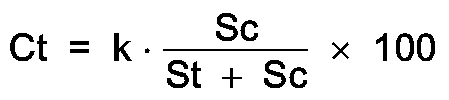
- the term Sc/(St + Sc) on the right side relates to the specific surface areas of the carrier and the toner. Specifically, it is a value expressing the proportion of the surface area of the carrier based on the total surface area of a mixture of equal weights of the carrier and the toner (to be referred to as the carrier surface occupancy ratio).
- the density of the resulting image is increased simultaneously with a decrease in fog density, an increase in resolution and an improvement in gradation.
- the coefficient k differs depending upon the shape of the carrier used. It is very critical with regard to the aforesaid various development characteristics to adjust the coefficient k to 0.90 to 1.14 for an irregularly shaped magnetic carrier and to 0.80 to 1.07 for a spherical magnetic carrier.
- the specific surface area (Sc) of the carrier in equation (1) means a measured value obtained by the transmission method.
- the transmission method is described in detail at pages 108 to 113 of "Powder Handbook", edited by Japan Powder Industry Association, published by Nikkan Kogyo Press.
- the reason for the determination of the specific surface area (St) of the toner in this way is that since the radius of the toner is much smaller than that of the carrier, the frictional contact of the toner with the carrier is limited to the raised portions on the surface of the toner and there is virtually no problem if only the raised portions on the surface are assumed to be an effective surface for triboelectrical charging; and that this assumption well agrees with the experimental fact.
- the developer containing the toner in the concentration is determined by the above equation (1) is applied to the developing method characterized by the first feature mentioned above.
- the electrostatic image can be developed to a toner image of excellent quality. This, however, is possible only when the conditions of the developer itself are optimal. Accordingly, the first feature of the invention is inseparable from the second feature regarding the concentration of the toner defined by the empirical equation (1).
- the toner is detached from the carrier which tends to move against the restricting force upon the action of the magnetic conveying force thereon.
- the developer adjusted to a predetermined toner concentration will have a toner concentration lower than the adjusted value when it is on the magnetic brush on which it contributes to the development.
- the restricting force at the time of brush cutting can be decreased in accordance with the first feature, the variations in toner concentration during the application of the doctor can be suppressed and the concentration of the toner in accordance with the second feature can be maintained effectively. For the foregoing reason, the best developing conditions can be maintained in this invention by the effective interaction of the conditions defined by the first and second features.
- a toner image of high quality can be formed in accordance with this invention by varrying out the magnetic brush development method which satisfies a combination of the first condition relating to the positional relation of the brush cutting doctor and the relation of the moving directions of the drum and the sleeve and the second condition relating to the concentration of the toner.
- a toner image having higher quality can be formed by combining the above two conditions with one of the following two additional conditions.
- a first additional condition concerns the relation between the distance (brush cutting clearance) a between the tip of the brush cutting doctor and the sleeve and the distance (development clearance) b between the drum and the sleeve. If the development method further satisfies this condition, a toner image of a high density and high quality can be formed easily without the need for a high level of mechanical precision in a development section.
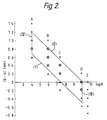
- the first additional condition is that the development is carried out under conditions defined by the following expressions (b - a)> -0.2 logR + 1.5 (b - a) ⁇ -0.2 logR + 2.0 10> logR> 4 where a (mm) is the clearance between the tip of the doctor 7 and the sleeve 2, b (mm) is the clearance between the sleeve 2 and the surface of the photosenstive layer 8, and R is the volume resistivity (ohms-cm) of the magnetic carrier in the two-component developer.
- This embodiment of the invention is based on the new discovery that a toner image having a satisfactory density and quality can be formed by selecting the difference (b - a) of the two clearances above within a specified range depending upon the electric resistance of the carrier.
- Figure 2 of the accompanying drawing is obtained by plotting the experimental results in an example to be described above.
- the electrical resistance R of the carrier is taken on the abscissa, and the difference (b - a) of the clearances, on the ordinate.
- the double circular marks refer to images having a density of at least 1.00 with no trouble in image quality.
- the X marks refer to images having an image density of less than 1.00.
- the triangular marks refer to images having quality defects such as trailing end missing, or having a reduced resolution.
- the difference (b - a) between the development clearance and the brush cutting clearance has closely to do with the development time which is the time during which the magnetic brush is in contact with the surface of the drum. If the difference (b - a) becomes larger, the development time becomes shorter. If the difference (b - a) becomes smaller, the development time becomes longer. If a carrier having a high electric resistance is used, the development time must be long in order to obtain the desired image density, namely the desired development current. On the other hand, with a carrier having a low electric resistance, a sufficient image density can be obtained by development for a short period of time. From the standpoint of preventing a decrease in the potential of the latent electrostatic image, the development time should preferably be shorter.
- the clearance b between the drum and the sleeve and the brush cutting clearance a can be any values which conform to the aforesaid relation.
- the clearance b is preferably 0.3 to 4 mm, especially 0.6 to 2 mm. If the b value exceeds the upper limit specified, the developer becomes difficult to hold on the surface of the sleeve and the toner and carrier particles tend to scatter. If it is below the specified limit, the amount of the developer on the sleeve surface is too small and the density of the developed image becomes low.
- the value a may be selected so as to satisfy the aforesaid relation on the basis of the aforesaid range of b.
- a second additional condition pertains to the relation between the peripheral speed (V D mm/sec) of the surface of the drum and the peripheral speed of the development sleeve (V S mm/sec).
- the second additional condition is that the development is carried out under conditions which satisfy the following expressions: V S /V D ⁇ -0.005V D + 5 V S /V D ⁇ -0.05V D + 3.5 400 ⁇ V D ⁇ 100 where V D is the peripheral speed (mm/sec) of the surface of the drum, and V S is the peripheral speed (mm/sec) of the development sleeve.
- This embodiment of the present invention is based on the finding that according to the developing conditions for the aforesaid method, there is an optimum range of the ratio of the peripheral speed of the development sleeve to the peripheral speed of the drum (V SVD ) depending upon the peripheral speed (V D ) of the photosensitive drum, and by performing the development under conditions within this range, a toner image of high density can be formed without troubles such as toner scattering, breaking, character blurring and fogging.
- Figure 3 is a graphic representation showing the relation between the peripheral speed (V D ) of the drum taken on the abscissa and the ratio of the peripheral speed of the sleeve to the peripheral speed of the drum (V S /V D ) taken on the ordinate, obtained by plotting the experimental results in an example given hereinafter.
- the double circular marks refer to images having an image density of at least 1.0 and being free from any trouble in image quality
- the X marks refer to images having an image density of less than 1.0
- the triangular marks refer to images having quality defects such as trailing end missing, fogging and breaking or having a reduced resolution.
- the peripheral speed (V S ) of the development sleeve has to do with both the supply of the developer (toner) to the developing zone and the frictional contact of the magnetic brush with the surface of the photosensitive drum.
- the peripheral speed (V D ) of the drum is varied, the peripheral speed (V S ) of the sleeve should also be varied accordingly. Namely, the V S /V D ratio should be maintained constant. This is the conventional concept.
- the other developing conditions may be those known per se.
- the carrier used may, for example, be a ferrite carrier or a known iron powder carrier.
- a ferrite carrier sintered ferrite particles, particularly spherical sintered ferrite particles, are used advantageously.
- the sintered ferrite particles preferably have a particle diameter of 20 to 200 ⁇ m in general.
- the particle diameter of the sintered ferrite particles is less than 20 ⁇ m, the flowability of the ferrite particles is reduced, and troubles tend to occur in the mixing and stirring of the carrier with the toner.
- the particle diameter of the ferrite particles is larger than 200 ⁇ m, the amount of the toner that can be mixed becomes excessively small, and its control becomes difficult.
- the sintered ferrite particles that can be used in this invention are known per se.
- they are composed of one or more ferrites selected from zinc iron oxide (ZnFe2O4), yttrium iron oxide (Y3Fe5O12), cadmium iron oxide (CdFe2O4), gadlinium iron oxide (Gd3Fe5O12), copper iron oxide (CuFe2O4), lead iron oxide (PbFe12O19), nickel iron oxide (NiFe2O4), neodymium iron oxide (NdFeO3), barium iron oxide (BaFe12O19), magnesium iron oxide (MgFe2O4), manganese iron oxide (MnFe2O4), and lanthanum iron oxide (LaFeO3).
- Sintered ferrite particles composed of zinc manganese iron oxide are particularly suitable for the object of this invention.
- the iron powder carrier has an electric resistance within the range described hereinabove and a particle diameter of 30 to 300 ⁇ m, and is particularly in the form of roundish particles with the corner portions removed.
- the toner that can be used in this invention may be any colored toner having chargeability and fixability. It may be a granular composition having a particle diameter of 5 to 30 ⁇ m comprising a binder resin and dispersed therein, a coloring pigment, a charge controlling agent, etc.
- the resin may include thermplastic resins, uncured thermosetting resins and initial condensates of thermosetting resins. Suitable examples of the resin include, in decreasing order of importance, vinyl aromatic resins such as polystyrene, acrylic resins, polyvinyl acetal resins, polyester resins, epoxy resins, phenolic resins, petroleum resins and olefinic resins.
- the pigment may be one or more of carbon black, Cadmium Yellow, Molybdenum Orange, Pyrazolone Red, Fast Violet B, Phthalocyanine Blue, etc.
- Examples of the charge controlling agent include oil-soluble dyes such as Nigrosine Base (C150415), Oil Black (Cl26150) and Spilon Black, metal naphthoates, fatty acid metal soaps, and resin acid soaps.
- a bias voltage is applied between the photosensitive drum and the development sleeve.
- the bias voltage is prescribed such that the charge is sufficiently injected into the toner during development, but troubles such as discharge breakdown do not occur in the photosensitive drum or the magnetic brush.
- the suitable bias voltage is generally 100 to 500 volts, particularly 150 to 300 volts.
- the polarity of the bias voltage should be the same as that of the charge of the photosensitive drum.
- Known electrophotographic materials may be used as the photosensitive plate. Examples are a selenium vapor-deposited photosensitive material, amorphous silicon photosensitive material, a CdS photosensitive material, and an organic photoconductive photosensitive material.
- a latent electrostatic image may be formed on the photosensitive material by methods known per se, for example by a combination of charging and imagewise exposure.
- Photosensitive drum Selenium Surface potential: 750 V Development bias: +200 V
- Carrier spherical ferrite carrier Electrical resistance (R) ...5.8 ⁇ 107 ohms-cm Particle diameter ...104 ⁇ m Saturation magnetization ...47 emu/g Specific surface area ...172 cm2/g
- Toner toner having a specific surface area of 4139 cm2/g Magnet strength of the main pole: 800 gauss
- Drum-sleeve distance 1.6 mm
- Brush cutting clearance 1.4 mm
Landscapes
- Physics & Mathematics (AREA)
- General Physics & Mathematics (AREA)
- Magnetic Brush Developing In Electrophotography (AREA)
Claims (6)
- Entwicklungsverfahren zur Ausbildung einer Tonerabbildung von hoher Qualität, das das Zuführen eines aus einer Mischung von magnetischen Trägerpartikeln und durch Reibberührung mit den magnetischen Trägerpartikeln ladungsfähigen Tonerpartikeln zusammengesetzten Zweikomponentenentwicklers auf einen Entwicklungszylinder, der aus einem unmagnetischen Mantelrohr sowie einem darin angeordneten Magneten mit abwechselnd und in Umfangsrichtung angeordneten Magnetpolen von unterschiedlichen Polaritäten besteht, um dadurch eine magnetische Bürste des Entwicklers zu bilden, und das Herbeiführen einer Reibberühung der Oberfläche einer lichtempfindlichen, eine latente, elektrostatische Abbildung tragenden Trommel mit der magnetischen Bürste, während eine Vorspannung zwischen der lichtempfindlichen Trommel und dem Zylinder angelegt wird, um dadurch eine der latenten, elektrostatischen Abbildung entsprechende Tonerabbildung auszubilden, umfaßt; dadurch gekennzeichnet, daß an dem unmagnetischen Mantelrohr ein Bürstentrimmschaber so angeordnet ist, daß die Schneide des Schabers nahezu zentral zwischen zwei Magnetpolen von unterschiedlichen Polaritäten positioniert ist, und daß die Entwicklung unter Bewegen der lichtempfindlichen Trommel sowie des Entwicklungszylinders in derselben Richtung an der Stelle einer Reibberührung und unter Verwendung eines Entwicklers ausgeführt wird, in welchem die Konzentration (Ct, %) des Toners durch die folgende Gleichung bestimmt ist
- Verfahren nach Anspruch 1, wobei die Entwicklung unter Bedingungen ausgeführt wird, die den folgenden Ausdrükken genügen


- Verfahren nach Anspruch 1, wobei die Entwicklung unter Bedingungen ausgeführt wird, die den folgenden Ausdrücken genügen


- Verfahren nach einem der vorhergehenden Ansprüche, wobei der magnetische Träger ein aus gesinterten Ferritpartikeln, die einen Partikeldurchmesser von 20 bis 200 µm haben, zusammengesetzter Träger ist.
- Verfahren nach einem der Ansprüche 1 - 3, wobei der magnetische Träger ein Eisenpulverträger mit einem Partikeldurchmesser von 30 bis 300 µm ist.
- Verfahren nach einem der vorhergehenden Ansprüche, wobei die Tonerpartikel eine granulierte Zusammensetzung mit einem Partikeldurchmesser von 5 bis 30 µm sind, die ein Bindemittelharz umfaßt und in der wenigstens ein Farbpigment sowie ein Ladungssteuerungsagens dispergiert sind.
Applications Claiming Priority (4)
| Application Number | Priority Date | Filing Date | Title |
|---|---|---|---|
| JP248679/84 | 1984-11-27 | ||
| JP59248679A JPH0680465B2 (ja) | 1984-11-27 | 1984-11-27 | 磁気ブラシ現像法 |
| JP59248678A JPH0723976B2 (ja) | 1984-11-27 | 1984-11-27 | 電子写真用現像法 |
| JP248678/84 | 1984-11-27 |
Publications (4)
| Publication Number | Publication Date |
|---|---|
| EP0183509A2 EP0183509A2 (de) | 1986-06-04 |
| EP0183509A3 EP0183509A3 (en) | 1987-11-11 |
| EP0183509B1 EP0183509B1 (de) | 1990-04-25 |
| EP0183509B2 true EP0183509B2 (de) | 1994-05-04 |
Family
ID=26538897
Family Applications (1)
| Application Number | Title | Priority Date | Filing Date |
|---|---|---|---|
| EP85308545A Expired - Lifetime EP0183509B2 (de) | 1984-11-27 | 1985-11-25 | Magnetbürstenentwicklungsverfahren |
Country Status (3)
| Country | Link |
|---|---|
| US (1) | US4672017A (de) |
| EP (1) | EP0183509B2 (de) |
| DE (1) | DE3577361D1 (de) |
Families Citing this family (15)
| Publication number | Priority date | Publication date | Assignee | Title |
|---|---|---|---|---|
| DE3650246T2 (de) * | 1985-09-17 | 1995-07-20 | Canon Kk | Entwicklungsverfahren und Gerät. |
| US4777107A (en) * | 1985-12-27 | 1988-10-11 | Canon Kabushiki Kaisha | Method and apparatus for image development using a two component developer with contact and non-contact development steps alternated by vibration of magnetic particles subject to electric and magnetic fields |
| US4973541A (en) * | 1986-10-03 | 1990-11-27 | Minolta Camera Kabushiki Kaisha | Electrostatic latent image developer comprising capsule toner of irregular shape, wrinkled surface |
| US4968577A (en) * | 1986-10-03 | 1990-11-06 | Minolta Camera Kabushiki Kaisha | Wrinkle configured electrophotographic capsule toner particles |
| US4862828A (en) * | 1987-02-27 | 1989-09-05 | Hitachi, Ltd. | Electrophotographic recording method and apparatus with non-contact development |
| US4873551A (en) * | 1987-03-16 | 1989-10-10 | Canon Kabushiki Kaisha | Developing apparatus using magnetic carrier under AC field |
| US5239343A (en) * | 1987-08-31 | 1993-08-24 | Canon Kabushiki Kaisha | Developing apparatus with regulating member having magnetic and non-magnetic members |
| DE68912286T2 (de) * | 1988-11-28 | 1994-04-28 | Mita Industrial Co Ltd | Magnetbürstenentwicklungsverfahren. |
| US5049470A (en) * | 1988-11-28 | 1991-09-17 | Mita Industrial Co., Ltd. | Development process for formation of high-quality image |
| US4949127A (en) * | 1988-11-28 | 1990-08-14 | Mita Industrial Co., Ltd. | Magnetic brush development process |
| DE69020238T2 (de) * | 1989-04-28 | 1995-11-02 | Mita Industrial Co Ltd | Entwicklungsverfahren mit ausgezeichneter Bildwiedergabe. |
| US5169738A (en) * | 1989-11-09 | 1992-12-08 | Canon Kabushiki Kaisha | Toner for developing electrostatic images, image forming method and image forming apparatus |
| US5078085A (en) * | 1989-11-30 | 1992-01-07 | Mita Industrial Co., Ltd. | Developing process |
| US5030977A (en) * | 1990-02-15 | 1991-07-09 | Acuprint, Inc. | Printed image magnetic signal level control apparatus and method |
| US8946101B2 (en) * | 2009-02-10 | 2015-02-03 | Honeywell International Inc. | Enhanced barrier multifunctional coatings for nylon films |
Family Cites Families (7)
| Publication number | Priority date | Publication date | Assignee | Title |
|---|---|---|---|---|
| US4391512A (en) * | 1979-01-06 | 1983-07-05 | Canon Kabushiki Kaisha | Developing device using magnetic developer |
| JPS55120042A (en) * | 1979-03-08 | 1980-09-16 | Canon Inc | Developing method and device |
| JPS5614242A (en) * | 1979-07-16 | 1981-02-12 | Canon Inc | Electrostatic developing method |
| US4625676A (en) * | 1982-02-17 | 1986-12-02 | Ricoh Company, Ltd. | Developing device |
| US4540645A (en) * | 1983-01-31 | 1985-09-10 | Mita Industrial Co Ltd | Magnetic brush development method |
| JPS6087352A (ja) * | 1983-10-19 | 1985-05-17 | Canon Inc | トナ−塗布方法 |
| JPH0648399B2 (ja) * | 1984-02-17 | 1994-06-22 | 三田工業株式会社 | 静電像の現像方法 |
-
1985
- 1985-11-25 EP EP85308545A patent/EP0183509B2/de not_active Expired - Lifetime
- 1985-11-25 DE DE8585308545T patent/DE3577361D1/de not_active Expired - Lifetime
- 1985-11-25 US US06/802,022 patent/US4672017A/en not_active Expired - Lifetime
Also Published As
| Publication number | Publication date |
|---|---|
| EP0183509A3 (en) | 1987-11-11 |
| US4672017A (en) | 1987-06-09 |
| DE3577361D1 (de) | 1990-05-31 |
| EP0183509A2 (de) | 1986-06-04 |
| EP0183509B1 (de) | 1990-04-25 |
Similar Documents
| Publication | Publication Date | Title |
|---|---|---|
| EP0139020B2 (de) | Elektrophotographisches verfahren | |
| EP0183509B2 (de) | Magnetbürstenentwicklungsverfahren | |
| EP0117572B1 (de) | Magnetbürsten-Entwicklungsverfahren | |
| US4345014A (en) | Magnetic brush developing method for use in electrography employing dual-component developing material | |
| US4949127A (en) | Magnetic brush development process | |
| EP0154433B1 (de) | Verfahren zur Entwicklung elektrostatischer Bilder | |
| EP0569966B1 (de) | Bilderzeugungsverfahren und Bilderzeugungsgerät | |
| EP0465116B1 (de) | Entwicklungsverfahren welches einen magnetischen Zweikomponentenentwickler verwendet | |
| EP0469876B1 (de) | Entwicklungsprozess mit Magnetbürste | |
| US4686935A (en) | Developing device | |
| EP0405686B1 (de) | Entwicklungsverfahren zur Herstellung von Bildern von hoher Qualität | |
| EP0431830B1 (de) | Träger für Zweikomponentenentwickler | |
| JPS59139056A (ja) | 磁気ブラシ現像方法 | |
| JP3067064B2 (ja) | 接触帯電用粒子、物体表面の帯電方法、感光体の帯電方法および画像形成装置 | |
| EP0474460B1 (de) | Entwicklungsverfahren | |
| JP2683623B2 (ja) | 二成分現像剤用キャリア | |
| JP3010917B2 (ja) | 絶縁性磁性1成分トナーの現像方法 | |
| JPH053588B2 (de) | ||
| JP3047073B2 (ja) | 高濃度現像方法 | |
| EP0405694B1 (de) | Entwicklungsverfahren, in dem ein Zweikomponenten-Entwickler verwendet wird | |
| EP0449541A1 (de) | 2-Komponenten-Entwickler zur Entwicklung elektrostatischer Abbildungen | |
| JPH0723976B2 (ja) | 電子写真用現像法 | |
| JPH0680465B2 (ja) | 磁気ブラシ現像法 | |
| EP0447153A1 (de) | Träger für Entwickler | |
| JPH05281789A (ja) | 絶縁性磁性1成分トナーの現像方法 |
Legal Events
| Date | Code | Title | Description |
|---|---|---|---|
| PUAI | Public reference made under article 153(3) epc to a published international application that has entered the european phase |
Free format text: ORIGINAL CODE: 0009012 |
|
| AK | Designated contracting states |
Kind code of ref document: A2 Designated state(s): DE FR GB NL |
|
| PUAL | Search report despatched |
Free format text: ORIGINAL CODE: 0009013 |
|
| AK | Designated contracting states |
Kind code of ref document: A3 Designated state(s): DE FR GB NL |
|
| 17P | Request for examination filed |
Effective date: 19880209 |
|
| 17Q | First examination report despatched |
Effective date: 19890712 |
|
| GRAA | (expected) grant |
Free format text: ORIGINAL CODE: 0009210 |
|
| AK | Designated contracting states |
Kind code of ref document: B1 Designated state(s): DE FR GB NL |
|
| REF | Corresponds to: |
Ref document number: 3577361 Country of ref document: DE Date of ref document: 19900531 |
|
| ET | Fr: translation filed | ||
| PLBI | Opposition filed |
Free format text: ORIGINAL CODE: 0009260 |
|
| 26 | Opposition filed |
Opponent name: CANON INC. Effective date: 19910124 |
|
| NLR1 | Nl: opposition has been filed with the epo |
Opponent name: CANON INC. |
|
| PUAH | Patent maintained in amended form |
Free format text: ORIGINAL CODE: 0009272 |
|
| STAA | Information on the status of an ep patent application or granted ep patent |
Free format text: STATUS: PATENT MAINTAINED AS AMENDED |
|
| 27A | Patent maintained in amended form |
Effective date: 19940504 |
|
| AK | Designated contracting states |
Kind code of ref document: B2 Designated state(s): DE FR GB NL |
|
| ET3 | Fr: translation filed ** decision concerning opposition | ||
| NLR2 | Nl: decision of opposition | ||
| NLR3 | Nl: receipt of modified translations in the netherlands language after an opposition procedure | ||
| PGFP | Annual fee paid to national office [announced via postgrant information from national office to epo] |
Ref country code: FR Payment date: 19971112 Year of fee payment: 13 |
|
| PGFP | Annual fee paid to national office [announced via postgrant information from national office to epo] |
Ref country code: GB Payment date: 19971117 Year of fee payment: 13 |
|
| PGFP | Annual fee paid to national office [announced via postgrant information from national office to epo] |
Ref country code: NL Payment date: 19971130 Year of fee payment: 13 |
|
| PGFP | Annual fee paid to national office [announced via postgrant information from national office to epo] |
Ref country code: DE Payment date: 19971201 Year of fee payment: 13 |
|
| PG25 | Lapsed in a contracting state [announced via postgrant information from national office to epo] |
Ref country code: GB Free format text: LAPSE BECAUSE OF NON-PAYMENT OF DUE FEES Effective date: 19981125 |
|
| PG25 | Lapsed in a contracting state [announced via postgrant information from national office to epo] |
Ref country code: NL Free format text: LAPSE BECAUSE OF NON-PAYMENT OF DUE FEES Effective date: 19990601 |
|
| GBPC | Gb: european patent ceased through non-payment of renewal fee |
Effective date: 19981125 |
|
| PG25 | Lapsed in a contracting state [announced via postgrant information from national office to epo] |
Ref country code: FR Free format text: LAPSE BECAUSE OF NON-PAYMENT OF DUE FEES Effective date: 19990730 |
|
| NLV4 | Nl: lapsed or anulled due to non-payment of the annual fee |
Effective date: 19990601 |
|
| REG | Reference to a national code |
Ref country code: FR Ref legal event code: ST |
|
| PG25 | Lapsed in a contracting state [announced via postgrant information from national office to epo] |
Ref country code: DE Free format text: LAPSE BECAUSE OF NON-PAYMENT OF DUE FEES Effective date: 19990901 |