EP0183620A1 - Sandwich-Paneel für die äussere Wärmedämmung von Gebäuden und Verfahren zu dessen Anwendung - Google Patents
Sandwich-Paneel für die äussere Wärmedämmung von Gebäuden und Verfahren zu dessen Anwendung Download PDFInfo
- Publication number
- EP0183620A1 EP0183620A1 EP85402302A EP85402302A EP0183620A1 EP 0183620 A1 EP0183620 A1 EP 0183620A1 EP 85402302 A EP85402302 A EP 85402302A EP 85402302 A EP85402302 A EP 85402302A EP 0183620 A1 EP0183620 A1 EP 0183620A1
- Authority
- EP
- European Patent Office
- Prior art keywords
- composite panel
- panel according
- facing
- composite
- fibers
- Prior art date
- Legal status (The legal status is an assumption and is not a legal conclusion. Google has not performed a legal analysis and makes no representation as to the accuracy of the status listed.)
- Withdrawn
Links
Images
Classifications
-
- E—FIXED CONSTRUCTIONS
- E04—BUILDING
- E04B—GENERAL BUILDING CONSTRUCTIONS; WALLS, e.g. PARTITIONS; ROOFS; FLOORS; CEILINGS; INSULATION OR OTHER PROTECTION OF BUILDINGS
- E04B1/00—Constructions in general; Structures which are not restricted either to walls, e.g. partitions, or floors or ceilings or roofs
- E04B1/62—Insulation or other protection; Elements or use of specified material therefor
- E04B1/74—Heat, sound or noise insulation, absorption, or reflection; Other building methods affording favourable thermal or acoustical conditions, e.g. accumulating of heat within walls
- E04B1/76—Heat, sound or noise insulation, absorption, or reflection; Other building methods affording favourable thermal or acoustical conditions, e.g. accumulating of heat within walls specifically with respect to heat only
- E04B1/762—Exterior insulation of exterior walls
-
- E—FIXED CONSTRUCTIONS
- E04—BUILDING
- E04F—FINISHING WORK ON BUILDINGS, e.g. STAIRS, FLOORS
- E04F13/00—Coverings or linings, e.g. for walls or ceilings
- E04F13/02—Coverings or linings, e.g. for walls or ceilings of plastic materials hardening after applying, e.g. plaster
- E04F13/04—Bases for plaster
Definitions
- the present invention relates to a composite panel for insulating buildings from the outside as well as to a new insulation technique using the composite panel.
- Thermal insulation from the outside is an insulation process which has many advantages. It eliminates most of the thermal bridges and thus ensures thermal uniformity of the insulated building. It increases the duration of the facades by protecting them against temperature differences and water. It improves summer comfort thanks to the great thermal inertia of the walls.
- the vetures technique uses elements of small dimensions with generally finished external facing, with visible joints, which are glued or mechanically placed on the wall to be insulated.
- One of the drawbacks of this technique is that it has to leave the joints visible.
- the technique of cladding consists of coming to fix on the wall to insulate a framework generally made of wood or metal. In this framework or between it and the wall is placed a cellular or fibrous thermal insulator. On this framework is fixed a facing skin in the form of small elements such as slates, tiles, shingles, etc.
- the technique of coatings on insulation and in particular thin coatings consists in gluing or mechanically fixing a cellular or fibrous insulator on the wall to be insulated. This insulation is then coated with a thin coating reinforced with a glass or plastic grid. This coating is then coated with a thick paint or a thick plastic coating to finish.
- the advantage of this technique is to offer a seamless appearance. Its disadvantage is that it requires many passes on construction sites.
- the invention overcomes the disadvantages mentioned. It offers a new composite panel for exterior insulation as well as a new insulation process using the composite panel.
- This composite panel according to the invention comprises a cellular or fibrous layer, in particular in expanded or extruded polystyrene, in polyurethane, in cellular glass of variable thickness according to the desired insulation and, glued on the insulating layer a facing formed of a sheet based on staple mineral fibers, linked together by a polymerized binder, having a fiber content greater than 70% of the total weight of the fibers and the binder, the remainder consisting essentially of the polymerized binder, this sheet having a high density , between 400 and 1000 kg / m 3 and preferably between 600 and 1000 kg / m 3 , a basis weight between 1 and 5 kg / m 2 . preferably between 2 and 4 kg / m 2 , and being obtained from at least one mattress of mineral fibers very highly compressed when hot.
- the facing sheet used in the panel according to the invention has excellent dimensional stability to humidity variations as demonstrated below and good water resistance. Indeed, such a facing sheet, with a volume basket of 620 kg / m 3 , placed in an ambient medium at 25 ° C and at a relative humidity rate of 85% undergoes an extension of 0.3 mm per meter only in relation to its size in an environment considered normal, namely 25 ° C and 65% relative humidity. In a dry environment, at 25 ° C and 30% relative humidity, the sheet undergoes shrinkage of only 0.20 minutes per meter, always relative to its size under normal conditions.
- a panel of wood particles, treated in the center of humidity, with a density of 750 kg / m 3 undergoes an extension of 2.8 minutes per meter and a shrinkage of 1.5 mm per meter in the same conditions.
- An asbestos-cement fiber board, with a density of 900kg / m 3 used for the construction of exterior walls of buildings undergoes an extension of 0.5 min per meter and a shrinkage of 0.25 mm per meter under the same conditions.
- the composite panel according to the invention further comprises a reinforcing reinforcement such as a canvas, a fabric, a glass, plastic or metal grid which can be integrated into the facing or deposited between the facing and the insulating core.
- a reinforcing reinforcement such as a canvas, a fabric, a glass, plastic or metal grid which can be integrated into the facing or deposited between the facing and the insulating core.
- the composite panel has a thinned edge all over its periphery.
- This thinning can be obtained directly by thinning the edges of the sheet by molding at the time of its manufacture or by machining.
- the facing is bonded to the insulating layer using an adhesive, for example a structural adhesive compatible with the facing and the insulating layer.
- an adhesive for example a structural adhesive compatible with the facing and the insulating layer.
- the sheet used as facing according to the invention is made from one or more primitive mineral insulation fibers, for example glass fibers, rock fibers, that is to say staple fibers whose average diameter is generally between 2 and 15 micrometers.
- These primitives contain an unpolymerized, thermosetting binder such as a formophenolic resin, melarine-formaldehyde, urea-formaldehyde at a rate of approximately 20% of the total weight of the fibers and the binder.
- These primitives have been compressed strongly with pressures of the order of 10 to 100 bars at the same time as they are heated to polymerize the binder, this thermocompression cycle being adjusted however to avoid a prepolymerization of the binder before final dimensioning.
- the facing has a reinforcing frame such as a glass grid, the latter is advantageously introduced during the shaping of the facing by cam pressing described above.
- the composite panel according to the invention offers a high impact resistance allowing its use as a component for insulation by the exterior of the building both on the ground floor and on the upper floor.
- the panel has good joinability, that is to say that it can be sawn, drilled, nailed without forming chips and without deformation. It can adapt to all the classic configurations of flat façades.
- the panel can be joined because of the almost zero dimensional variations in its components as previously demonstrated.
- the composite panel can be used as a component of clothing.
- This panel can also be used for the implementation of a new exterior insulation process.
- the external insulation process according to the invention consists in coating the wall with composite insulating panels of the type described above which are either glued or mechanically fixed to the wall to be insulated, then joint the panels with a strip preferably a glass grid plus a coating, then to cover the whole with a finishing layer either a thick layer of paint, or a thick plastic coating of finish.
- campite panel according to the invention does not, where appropriate, exclude several other passes according to the needs of the site, for example and possibly, the deposition of a bonding layer for the finishing layer.
- the composite panels are in the implementation of the process described above, placed on the wall edge to edge, preferably by successive horizontal rows with vertical joints alternated so as "stone joints" or not.
- the composite panel according to the invention can also be used in construction using prefabricated concrete elements and in this context, advantageously, the composite panel is associated with the concrete panel during the molding of the latter.
- the panel in the case of a molding using a mold placed horizontally, the panel is placed in the bottom of the mold for the manufacture of the prefabricated element, the face of the uncoated insulation being oriented. upwards and the facing towards the bottom of the mold, and the concrete is poured onto the composite panel. After setting the concrete and demoulding, a wall element is obtained on which the insulating layer, already provided with a protective skin, is already fixed.
- the composite panel with a wall element made of a material other than concrete, for example wood in the case of a wooden frame building, etc.
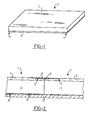
- the composite panel 1 shown in FIG. 1 comprises an insulating cellular layer 2, for example made of expanded polystyrene, the thickness of which is determined as a function of the desired insulation, for example the thickness can vary from 20 to 50 mm, coated with a facing 3 formed from a mattress of thermocompressed glass fibers with a density of 700 kg / m3.
- the thickness of the facing can also vary depending on the use of the panel. This thickness can be for example between 1 and 10 mm.
- the panel has on its entire periphery slimming edges 4, facilitating jointing, the thinning being for example a regular thinning of 1 to 3 mm thick by 40 to 70 mm wide.
- the facing 3 is made from a primitive of discontinuous insulating glass fibers, with a surface mass of 3 kg / m 2 , obtained by conventional fiberizing methods and in which the non-polymerized binder, in particular a resin formo-phenolic, represents approximately 20% by weight.
- the primitive is thermocompressed at a pressure of 10 bars, at a temperature of 200 ° C, for one minute.
- the facing obtained is then bonded using a polyurethane adhesive to the cell layer 2.
- the dimensions of the composite panel in length and in width may vary depending on the use of the panel.
- the dimensions may for example be between 0.80 and 3 m for the length and included between 0.40 and 1.20 m for the width.
- Figure 2 shows in section the jointing between two panels 1 glued to the wall 5 to be externally insulated.
- the two panels are glued to the wall by studs 6 using an appropriate adhesive, the face 7 corresponding to the insulation, for example made of expanded polystyrene, being oriented towards the wall.
- the panels are arranged edge to edge.
- the edges 4 of the panels are thinned to allow jointing without excess thickness using a glass grid 8 and a suitable coating 9 which can thus come flush with the surface of the panels.
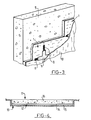
- FIG. 3 represents a technique of insulation from the outside using the panel according to the invention.
- the panels 1 are glued by studs on the wall 5.
- the panels are arranged edge to edge like "stone joints”.
- the jointing is then carried out using a fabric or glass grid 8 in the form of a strip and a suitable coating 9 which covers the grid and fills the V with the two thinned edges which touch. It then only remains to cover the entire wall with a finishing coating 10.
- Figure 4 shows the molding of a wall element 11 with integration of a composite insulation panel 12 according to the invention.
- the cacposite panel 12 is placed at the bottom of the mold 13, the insulation 14 being oriented upwards, the facing 15 being in contact with the bottom of the mold.
- the concrete is poured 16. After the concrete has set, an element of nur coated with an insulator is removed from the mold, which can be used as it is in a construction of prefabricated elements.
Landscapes
- Engineering & Computer Science (AREA)
- Architecture (AREA)
- Civil Engineering (AREA)
- Structural Engineering (AREA)
- Physics & Mathematics (AREA)
- Acoustics & Sound (AREA)
- Electromagnetism (AREA)
- Building Environments (AREA)
- Panels For Use In Building Construction (AREA)
- Finishing Walls (AREA)
Applications Claiming Priority (2)
| Application Number | Priority Date | Filing Date | Title |
|---|---|---|---|
| FR8418024A FR2573793B1 (fr) | 1984-11-27 | 1984-11-27 | Panneau composite pour l'isolation de batiments par l'exterieur et procede de mise en oeuvre |
| FR8418024 | 1984-11-27 |
Publications (1)
| Publication Number | Publication Date |
|---|---|
| EP0183620A1 true EP0183620A1 (de) | 1986-06-04 |
Family
ID=9309973
Family Applications (1)
| Application Number | Title | Priority Date | Filing Date |
|---|---|---|---|
| EP85402302A Withdrawn EP0183620A1 (de) | 1984-11-27 | 1985-11-26 | Sandwich-Paneel für die äussere Wärmedämmung von Gebäuden und Verfahren zu dessen Anwendung |
Country Status (2)
| Country | Link |
|---|---|
| EP (1) | EP0183620A1 (de) |
| FR (1) | FR2573793B1 (de) |
Cited By (2)
| Publication number | Priority date | Publication date | Assignee | Title |
|---|---|---|---|---|
| ITMO20080300A1 (it) * | 2008-11-21 | 2010-05-22 | Angelo Marchesi | Pannello isolante prefabbricato per il rivestimento di costruzioni edilizie, rivestimento isolante da esso ottenibile e relativo metodo di produzione |
| US20250012084A1 (en) * | 2023-07-07 | 2025-01-09 | Minye Co., Ltd. | Composite panel for preventing spread of fire due to insulation material during fire by simultaneously covering exterior of insulation material with mortar and coupling ultra-slim stone tile to surface of insulation material, and unit wall coupling structure using same |
Citations (7)
| Publication number | Priority date | Publication date | Assignee | Title |
|---|---|---|---|---|
| BE556263A (de) * | ||||
| FR2123259A1 (en) * | 1971-01-28 | 1972-09-08 | Nat Gypsum Co | Wall joint - between chamfered panels concealing a melt mesh and resin joint |
| FR2228613A1 (en) * | 1973-05-07 | 1974-12-06 | Saint Gobain | Modular panels of prefabricated cores between plastic skins - made using reciprocating bars to apply flexible laminates |
| FR2441691A1 (fr) * | 1978-11-17 | 1980-06-13 | Rhinolith Sa | Panneau isolant composite |
| FR2475970A1 (fr) * | 1980-02-01 | 1981-08-21 | Voisin & Pascal Carton | Procede de fabrication d'un carton thermoformable a base de fibres inorganiques, produit et pieces fabriquees suivant ce procede |
| EP0045023A1 (de) * | 1980-07-29 | 1982-02-03 | Eugen Traub | Verfahren zum Herstellen gedämmter Putzfassaden |
| EP0046460A2 (de) * | 1980-08-23 | 1982-03-03 | Hoechst Aktiengesellschaft | Schwer entflammbare dekorative Schichtstoffplatte |
-
1984
- 1984-11-27 FR FR8418024A patent/FR2573793B1/fr not_active Expired
-
1985
- 1985-11-26 EP EP85402302A patent/EP0183620A1/de not_active Withdrawn
Patent Citations (7)
| Publication number | Priority date | Publication date | Assignee | Title |
|---|---|---|---|---|
| BE556263A (de) * | ||||
| FR2123259A1 (en) * | 1971-01-28 | 1972-09-08 | Nat Gypsum Co | Wall joint - between chamfered panels concealing a melt mesh and resin joint |
| FR2228613A1 (en) * | 1973-05-07 | 1974-12-06 | Saint Gobain | Modular panels of prefabricated cores between plastic skins - made using reciprocating bars to apply flexible laminates |
| FR2441691A1 (fr) * | 1978-11-17 | 1980-06-13 | Rhinolith Sa | Panneau isolant composite |
| FR2475970A1 (fr) * | 1980-02-01 | 1981-08-21 | Voisin & Pascal Carton | Procede de fabrication d'un carton thermoformable a base de fibres inorganiques, produit et pieces fabriquees suivant ce procede |
| EP0045023A1 (de) * | 1980-07-29 | 1982-02-03 | Eugen Traub | Verfahren zum Herstellen gedämmter Putzfassaden |
| EP0046460A2 (de) * | 1980-08-23 | 1982-03-03 | Hoechst Aktiengesellschaft | Schwer entflammbare dekorative Schichtstoffplatte |
Cited By (3)
| Publication number | Priority date | Publication date | Assignee | Title |
|---|---|---|---|---|
| ITMO20080300A1 (it) * | 2008-11-21 | 2010-05-22 | Angelo Marchesi | Pannello isolante prefabbricato per il rivestimento di costruzioni edilizie, rivestimento isolante da esso ottenibile e relativo metodo di produzione |
| EP2189585A1 (de) * | 2008-11-21 | 2010-05-26 | Isolbau S.r.L. | Vorgefertigtes Isolierpaneel für Bauwerksverkleidungen, damit erlangte gedämmte Verkleidung und entsprechende Herstellungsmethode |
| US20250012084A1 (en) * | 2023-07-07 | 2025-01-09 | Minye Co., Ltd. | Composite panel for preventing spread of fire due to insulation material during fire by simultaneously covering exterior of insulation material with mortar and coupling ultra-slim stone tile to surface of insulation material, and unit wall coupling structure using same |
Also Published As
| Publication number | Publication date |
|---|---|
| FR2573793B1 (fr) | 1987-09-18 |
| FR2573793A1 (fr) | 1986-05-30 |
Similar Documents
| Publication | Publication Date | Title |
|---|---|---|
| EP2295666B1 (de) | Herstellungsverfahren für dämmpaneele und solch ein dämmpaneel | |
| AU647769B2 (en) | Methods for manufacturing composite surface elements | |
| JPS60148956A (ja) | 構造部材 | |
| EP0130921B1 (de) | Tragende Verbundbauplatte | |
| EP0153291A1 (de) | Isolierende Platte aus einem Verbundmaterial | |
| EP0086681B1 (de) | Wärmesolierende Bekleidung, auf Gebäudemauern angebracht und Anwendungsverfahren | |
| EP0211752A1 (de) | Vorgefertigte isolierende verstärkte Paneele und Verfahren zum Herstellen und Anbringen solcher Paneele | |
| FR2573793A1 (fr) | Panneau composite pour l'isolation de batiments par l'exterieur et procede de mise en oeuvre | |
| FR2631360A1 (fr) | Procede de construction permettant la realisation de maniere semi-industrialisee de batiments de forme courbe | |
| CH632797A5 (en) | Prefabricated construction element, method for constructing the element and use of the said element | |
| FR2852041A1 (fr) | Panneau composite integre de toiture de maison | |
| FR2462524A1 (fr) | Panneaux isolants pouvant etre utilises en construction | |
| EP0031171A2 (de) | Verfahren zur Erstellung eines Gebäudes mittels isolierter Platten nach dem System der verlorenen Schalung | |
| EP3559367A1 (de) | System zur thermischen isolierung von aussen, bestehend aus einem hochisolierenden pneumatischen mörtel, und verfahren zur herstellung des systems | |
| EP2052116B1 (de) | Verfahren zur wärmedämmung eines gebäudes durch sprühen einer bewehrungsschicht auf isolier paneele | |
| EP0018328A2 (de) | Vorgefertigtes Bauelement | |
| FR2524921A1 (fr) | Nouvelle structure de paroi composite, procedes pour sa mise en oeuvre dans le domaine du batiment et elements de construction ainsi obtenus | |
| FR2526832A1 (fr) | Cloison pour le batiment | |
| EP1663670B1 (de) | Formelement, herstellung davon und installationsverfahren dafür | |
| FR2562121A1 (fr) | Entrevous composite | |
| FR2918395A1 (fr) | Immeuble et procede de construction d'un immeuble | |
| FR2469258A1 (fr) | Nouveau procede pour la fabrication et l'execution d'elements prefabriques legers en platre | |
| BE708221A (de) | ||
| FR2465844A1 (fr) | Perfectionnements apportes aux panneaux prefabriques pour la realisation de constructions notamment a usage d'habitation, ainsi que les constructions faisant application de tels panneaux | |
| FR2589777A1 (fr) | Materiau nouveau a base de granulats de bois et de resine polyurethane et procede de fabrication d'elements prefabriques et objets moules pour l'industrie du batiment, du meuble, de la construction navale. |
Legal Events
| Date | Code | Title | Description |
|---|---|---|---|
| PUAI | Public reference made under article 153(3) epc to a published international application that has entered the european phase |
Free format text: ORIGINAL CODE: 0009012 |
|
| AK | Designated contracting states |
Kind code of ref document: A1 Designated state(s): AT BE CH DE FR GB IT LI LU NL |
|
| 17P | Request for examination filed |
Effective date: 19861203 |
|
| 17Q | First examination report despatched |
Effective date: 19880524 |
|
| STAA | Information on the status of an ep patent application or granted ep patent |
Free format text: STATUS: THE APPLICATION HAS BEEN WITHDRAWN |
|
| 18W | Application withdrawn |
Withdrawal date: 19880715 |
|
| RIN1 | Information on inventor provided before grant (corrected) |
Inventor name: LANTELME, JEAN-PAUL |