EP0183650A1 - Phenylhydrazine, Verfahren zu ihrer Herstellung und ihre Verwendung in der Schädlingsbekämpfung - Google Patents
Phenylhydrazine, Verfahren zu ihrer Herstellung und ihre Verwendung in der Schädlingsbekämpfung Download PDFInfo
- Publication number
- EP0183650A1 EP0183650A1 EP85810557A EP85810557A EP0183650A1 EP 0183650 A1 EP0183650 A1 EP 0183650A1 EP 85810557 A EP85810557 A EP 85810557A EP 85810557 A EP85810557 A EP 85810557A EP 0183650 A1 EP0183650 A1 EP 0183650A1
- Authority
- EP
- European Patent Office
- Prior art keywords
- formula
- compound according
- halogen
- alkyl
- alkylthio
- Prior art date
- Legal status (The legal status is an assumption and is not a legal conclusion. Google has not performed a legal analysis and makes no representation as to the accuracy of the status listed.)
- Granted
Links
- 0 C[C@]1CC[C@](*)CC1 Chemical compound C[C@]1CC[C@](*)CC1 0.000 description 6
Classifications
-
- C—CHEMISTRY; METALLURGY
- C07—ORGANIC CHEMISTRY
- C07D—HETEROCYCLIC COMPOUNDS
- C07D271/00—Heterocyclic compounds containing five-membered rings having two nitrogen atoms and one oxygen atom as the only ring hetero atoms
- C07D271/02—Heterocyclic compounds containing five-membered rings having two nitrogen atoms and one oxygen atom as the only ring hetero atoms not condensed with other rings
- C07D271/06—1,2,4-Oxadiazoles; Hydrogenated 1,2,4-oxadiazoles
- C07D271/07—1,2,4-Oxadiazoles; Hydrogenated 1,2,4-oxadiazoles with oxygen, sulfur or nitrogen atoms, directly attached to ring carbon atoms, the nitrogen atoms not forming part of a nitro radical
-
- A—HUMAN NECESSITIES
- A01—AGRICULTURE; FORESTRY; ANIMAL HUSBANDRY; HUNTING; TRAPPING; FISHING
- A01N—PRESERVATION OF BODIES OF HUMANS OR ANIMALS OR PLANTS OR PARTS THEREOF; BIOCIDES, e.g. AS DISINFECTANTS, AS PESTICIDES OR AS HERBICIDES; PEST REPELLANTS OR ATTRACTANTS; PLANT GROWTH REGULATORS
- A01N43/00—Biocides, pest repellants or attractants, or plant growth regulators containing heterocyclic compounds
- A01N43/72—Biocides, pest repellants or attractants, or plant growth regulators containing heterocyclic compounds having rings with nitrogen atoms and oxygen or sulfur atoms as ring hetero atoms
- A01N43/82—Biocides, pest repellants or attractants, or plant growth regulators containing heterocyclic compounds having rings with nitrogen atoms and oxygen or sulfur atoms as ring hetero atoms five-membered rings with three ring hetero atoms
-
- A—HUMAN NECESSITIES
- A01—AGRICULTURE; FORESTRY; ANIMAL HUSBANDRY; HUNTING; TRAPPING; FISHING
- A01N—PRESERVATION OF BODIES OF HUMANS OR ANIMALS OR PLANTS OR PARTS THEREOF; BIOCIDES, e.g. AS DISINFECTANTS, AS PESTICIDES OR AS HERBICIDES; PEST REPELLANTS OR ATTRACTANTS; PLANT GROWTH REGULATORS
- A01N47/00—Biocides, pest repellants or attractants, or plant growth regulators containing organic compounds containing a carbon atom not being member of a ring and having no bond to a carbon or hydrogen atom, e.g. derivatives of carbonic acid
- A01N47/08—Biocides, pest repellants or attractants, or plant growth regulators containing organic compounds containing a carbon atom not being member of a ring and having no bond to a carbon or hydrogen atom, e.g. derivatives of carbonic acid the carbon atom having one or more single bonds to nitrogen atoms
- A01N47/10—Carbamic acid derivatives, i.e. containing the group —O—CO—N<; Thio analogues thereof
- A01N47/24—Carbamic acid derivatives, i.e. containing the group —O—CO—N<; Thio analogues thereof containing the groups, or; Thio analogues thereof
-
- C—CHEMISTRY; METALLURGY
- C07—ORGANIC CHEMISTRY
- C07D—HETEROCYCLIC COMPOUNDS
- C07D307/00—Heterocyclic compounds containing five-membered rings having one oxygen atom as the only ring hetero atom
- C07D307/02—Heterocyclic compounds containing five-membered rings having one oxygen atom as the only ring hetero atom not condensed with other rings
- C07D307/04—Heterocyclic compounds containing five-membered rings having one oxygen atom as the only ring hetero atom not condensed with other rings having no double bonds between ring members or between ring members and non-ring members
- C07D307/10—Heterocyclic compounds containing five-membered rings having one oxygen atom as the only ring hetero atom not condensed with other rings having no double bonds between ring members or between ring members and non-ring members with substituted hydrocarbon radicals attached to ring carbon atoms
- C07D307/12—Radicals substituted by oxygen atoms
-
- C—CHEMISTRY; METALLURGY
- C07—ORGANIC CHEMISTRY
- C07D—HETEROCYCLIC COMPOUNDS
- C07D307/00—Heterocyclic compounds containing five-membered rings having one oxygen atom as the only ring hetero atom
- C07D307/02—Heterocyclic compounds containing five-membered rings having one oxygen atom as the only ring hetero atom not condensed with other rings
- C07D307/04—Heterocyclic compounds containing five-membered rings having one oxygen atom as the only ring hetero atom not condensed with other rings having no double bonds between ring members or between ring members and non-ring members
- C07D307/18—Heterocyclic compounds containing five-membered rings having one oxygen atom as the only ring hetero atom not condensed with other rings having no double bonds between ring members or between ring members and non-ring members with hetero atoms or with carbon atoms having three bonds to hetero atoms with at the most one bond to halogen, e.g. ester or nitrile radicals, directly attached to ring carbon atoms
- C07D307/20—Oxygen atoms
-
- C—CHEMISTRY; METALLURGY
- C07—ORGANIC CHEMISTRY
- C07D—HETEROCYCLIC COMPOUNDS
- C07D309/00—Heterocyclic compounds containing six-membered rings having one oxygen atom as the only ring hetero atom, not condensed with other rings
- C07D309/02—Heterocyclic compounds containing six-membered rings having one oxygen atom as the only ring hetero atom, not condensed with other rings having no double bonds between ring members or between ring members and non-ring members
- C07D309/08—Heterocyclic compounds containing six-membered rings having one oxygen atom as the only ring hetero atom, not condensed with other rings having no double bonds between ring members or between ring members and non-ring members with hetero atoms or with carbon atoms having three bonds to hetero atoms with at the most one bond to halogen, e.g. ester or nitrile radicals, directly attached to ring carbon atoms
- C07D309/10—Oxygen atoms
- C07D309/12—Oxygen atoms only hydrogen atoms and one oxygen atom directly attached to ring carbon atoms, e.g. tetrahydropyranyl ethers
-
- C—CHEMISTRY; METALLURGY
- C07—ORGANIC CHEMISTRY
- C07D—HETEROCYCLIC COMPOUNDS
- C07D413/00—Heterocyclic compounds containing two or more hetero rings, at least one ring having nitrogen and oxygen atoms as the only ring hetero atoms
- C07D413/02—Heterocyclic compounds containing two or more hetero rings, at least one ring having nitrogen and oxygen atoms as the only ring hetero atoms containing two hetero rings
- C07D413/12—Heterocyclic compounds containing two or more hetero rings, at least one ring having nitrogen and oxygen atoms as the only ring hetero atoms containing two hetero rings linked by a chain containing hetero atoms as chain links
Definitions
- the present invention relates to phenylhydrazines, processes for their preparation and their use in pest control.
- alkyl, alkoxy, alkylthio, alkylsulfinyl, alkylsulfonyl, alkenyl and alkynyl groups in R, R 2 , R 6 and Z can be straight-chain or branched and optionally by halogen, C 1 -C 6 -alkoxy or C I - C 6 alkylthio may be substituted.
- Examples of such groups include: methyl, methoxy, methylthio, trifluoromethyl, ethyl, ethoxy, pentafluoroalkoxy, propyl, propoxy, propylthio, isopropyl, isopropoxy, isopropylthio, n-butyl, n-butoxy, n-butylthio, n-pentyl, n- Pentoxy, n-pentylthio, n-hexyl, n-hexoxy, n-hexylthio and their isomers, 2-methylthioethoxy, 2-methoxyethoxy, propenyl or propynyl.
- the alkylene groups at R can be straight-chain or branched. Examples of such groups include:
- the compounds of the formula I are open-chain phenylhydrazines of the formula wherein R 1 , R 2 , R 3 , R 6 and n have the meaning given for the formula I or oxadiazolinones of the formula wherein R 1 , R 2 , R 6 and n have the meaning given for the formula I.
- R 1 , R 2 , R 3 , R 6 and n have the meaning given for the formula I.
- Bases for the second process step are, in particular, organic bases, such as trialkylamines, e.g. Triethylamine or ethyldiisopropylamine, pyridine, dialkylanilines or cyclic amidine bases are suitable.
- organic bases such as trialkylamines, e.g. Triethylamine or ethyldiisopropylamine, pyridine, dialkylanilines or cyclic amidine bases are suitable.
- Both process steps are carried out at a reaction temperature between -10 ° and 120 ° C, usually between 20 ° and 80 ° C, at normal or elevated pressure and preferably in an inert solvent or diluent.
- Suitable solvents or diluents are e.g.
- Ethers and ethereal compounds such as diethyl ether, dipropyl ether, dioxane, dimethoxyethane and tetrahydrofuran; Amides such as N, N-dialkylated carboxamides; aliphatic, aromatic and halogenated hydrocarbons, in particular benzene, toluene, xylenes, chloroform and chlorobenzene; Nitriles such as acetonitrile; Dimethyl sulfoxide and ketones such as acetone and methyl ethyl ketone as well as alcohols (only in the cyclization step), e.g. Methanol, ethanol, propyl alcohol, etc. and esters, e.g. Ethyl acetate.
- Amides such as N, N-dialkylated carboxamides
- aliphatic, aromatic and halogenated hydrocarbons in particular benzene, toluene, xylenes, chloroform and chlor
- the starting materials of the formula II can be prepared analogously to known methods (cf. Example 1).
- the compounds of formula I which S in its oxidized forms, ie as possess can also be obtained by oxidation of the corresponding compounds I in which the sulfur is present as sulfide.
- oxidations are well known in the literature and are, for example, using hydrogen peroxide, alkali metal periodates or organic peracids such as perbenzoic acid, 3-chloroperbenzoic acid or p Per ssigklare performed.
- Further reagents suitable for such reactions are listed in the monograph LF Fieser and M. Fieser, Reagents for Organic Synthesis Vol. 1-10 (J. Wiley and Sons, Inc.).
- the compounds of the formula I are suitable for controlling various types of pests on animals and plants and in the soil. They can be used to control insects, e.g. of the order Lepidoptera, Coleoptera, Homoptera, Heteroptera, Diptera, Thysanoptera, Orthoptera, Anoplura, Siphonaptera, Mallophaga, Thysanura, Isoptera, Psocoptera and Hymenoptera and of mites and ticks of the order Acarina.
- insects e.g. of the order Lepidoptera, Coleoptera, Homoptera, Heteroptera, Diptera, Thysanoptera, Orthoptera, Anoplura, Siphonaptera, Mallophaga, Thysanura, Isoptera, Psocoptera and Hymenoptera and of mites and ticks of the order Acarina.
- Compounds of the formula I are particularly suitable for combating plant-damaging insects in ornamental and useful plants, in particular in cotton and rice crops (for example Spodoptera littoralis, Heliothis virescens, Nephothettix cincticeps, Chilo suppressalis and Laodelphax striatellus) as well as vegetable and fruit crops (for example Leptinotarsa) decemlineata, Myzus persicae, Laspeyresia pomonella and Adoxophyes reticulana) and soil insects (e.g.
- cotton and rice crops for example Spodoptera littoralis, Heliothis virescens, Nephothettix cincticeps, Chilo suppressalis and Laodelphax striatellus
- vegetable and fruit crops for example Leptinotarsa) decemlineata, Myzus persicae, Laspeyresia pomonella and Adoxophyes reticulan
- Active ingredients of formula I also have a very beneficial effect against flies, such as Musca domestica and mosquito larvae.
- the compounds of formula I also have good nematicidal properties, furthermore they are notable for their broad, ovicidal and ovolarvonde action and have a valuable effect against ectoparasitic mites and ticks, for example the families Ixodidae, Argasidae and Dermanyssidae.
- the compounds of formula I also act against phytopathogenic fungi.
- Compounds of the formula I act against the phytopathogenic fungi belonging to the following classes: Ascomycetes (e.g. Erysiphaceae, Fusarium, Helminthosporium); Basidiomycetes such as Puccinia, Rhizoctonia, Tilletia, Hemileia; Fungi imperfecti (e.g. Cercospora, Botrytis, Septoria); Phycomycetes such as Phytophthora.
- Ascomycetes e.g. Erysiphaceae, Fusarium, Helminthosporium
- Basidiomycetes such as Puccinia, Rhizoctonia, Tilletia, Hemileia
- Fungi imperfecti e.g. Cercospora, Botrytis, Septoria
- Phycomycetes such as Phytophthora.
- the compounds of the formula I can advantageously be used as dressing agents for the treatment of seeds and stocks (fruits, tubers, grains) and plant cuttings or for seed furrow application to protect against fungal infections, insects and representatives of the Akarina order, and against phytopathogenic fungi and insects occurring in the soil .
- acaricidal or insecticidal effect can be significantly broadened by adding other insecticides and / or acaricides and adapted to the given circumstances.
- Suitable additives are e.g. org. Phosphorus compounds; Nitrophenols and their derivatives; Formamidines; Ureas; pyrethrin-like compounds as well as carbamates and chlorinated hydrocarbons.
- the compounds of the formula I are used in unchanged form or preferably together with the auxiliaries customary in formulation technology and are therefore used, for example, to form emulsion concentrates. th, directly sprayable or dilutable solutions, diluted emulsions, wettable powders, soluble powders, dusts, granules, also encapsulations in, for example, polymeric substances processed in a known manner.
- the application methods such as spraying, atomizing, dusting, scattering or pouring, are selected in the same way as the type of agent, in accordance with the desired objectives and the given conditions.
- the formulations i.e. the agents, preparations or compositions containing the active ingredient of formula I and optionally a solid or liquid additive are prepared in a known manner, e.g. by intimately mixing and / or grinding the active ingredients with extenders, e.g. with solvents, solid carriers, and optionally surface-active compounds (surfactants).
- extenders e.g. with solvents, solid carriers, and optionally surface-active compounds (surfactants).
- Possible solvents are: aromatic hydrocarbons, preferably the fractions Cs to C 12 , such as xylene mixtures or substituted naphthalenes, phthalic acid esters such as dibutyl or dioctyl phthalate, aliphatic hydrocarbons such as cyclohexane or paraffins, alcohols and glycols and their ethers and esters such as ethanol , Ethylene glycol, ethylene glycol monomethyl or ethyl ether, ethyl acetate, propyl myristate or propyl palmitate, ketones such as cyclohexanone, strongly polar solvents such as N-methyl-2-pyrrolidone, dimethyl sulfoxide or dimethylformamide, and optionally epoxidized vegetable oils such as epoxidized coconut oil or soybean oil; Silicone oils or water.
- aromatic hydrocarbons preferably the fractions Cs to C 12
- phthalic acid esters such as dibutyl or di
- Natural rock flours such as calcite, talc, kaolin, montmorillonite or attapulgite, are generally used as solid carriers, for example for dusts and dispersible powders.
- highly disperse silica or highly disperse absorbent polymers can also be added.
- Porous types such as pumice, broken brick, sepiolite or bentonite are suitable as granular, adsorptive granulate carriers, and non-sorptive carrier materials, such as calcite or sand.
- a large number of pregranulated materials of inorganic or organic nature, in particular dolomite or comminuted plant residues can be used.
- suitable surface-active compounds are nonionic, cationic and / or anionic surfactants with good emulsifying, dispersing and wetting properties.
- surfactants are also to be understood as mixtures of surfactants.
- Suitable anionic surfactants can be both so-called water-soluble soaps and water-soluble synthetic surface-active compounds.
- Suitable soaps are the alkali metal, alkaline earth metal or optionally substituted ammonium salts of higher fatty acids (C 10 -C 22 ), such as, for example, the Na or K salts of oleic or stearic acid, or of natural fatty acid mixtures, for example from coconut - or tall oil can be obtained.
- the fatty acid methyl taurine salts should also be mentioned.
- the fatty sulfonates or sulfates are generally present as alkali, alkaline earth or optionally substituted ammonium salts and have an alkyl radical with 8 to 22 carbon atoms, alkyl also including the alkyl part of acyl radicals, for example the sodium or calcium salt lignin sulfonic acid, dodecylsulfuric acid ester or a fatty alcohol sulfate mixture made from natural fatty acids.
- This subheading also includes the salts of sulfuric acid esters and sulphonic acid from fatty alcohol-ethylene oxide adducts.
- the sulfonated benzimidazole derivatives preferably contain 2 sulfonic acid groups and a fatty acid residue with 8-22 carbon atoms.
- Alkylarylsulfonates are, for example the sodium, calcium or triethanolamine salts or dodecylbenzenesulfonic acid, dibutylnaphthalenesulfonic acid, or a naphthalenesulfonic acid-formaldehyde condensation product.
- Corresponding phosphates such as e.g. Salts of the phosphoric acid ester of a p-nonylphenol- (4-14) -ethylene oxide adduct and phospholipids in question.
- Suitable nonionic surfactants are primarily polyglycol ether derivatives of aliphatic or cycloaliphatic alcohols, saturated or unsaturated fatty acids and alkylphenols, which can contain 3 to 30 glycol ether groups and 8 to 20 carbon atoms in the (aliphatic) hydrocarbon radical and 6 to 18 carbon atoms in the alkyl radical of the alkylphenols.
- nonionic surfactants are the water-soluble, 20 to 250 ethylene glycol ether groups and 10 to 100 propylene glycol ether groups containing polyethylene oxide adducts with polypropylene glycol, ethylenediaminopolypropylene glycol and alkylpolypropylene glycol with 1 to 10 carbon atoms in the alkyl chain.
- the compounds mentioned usually contain 1 to 5 ethylene glycol units per propylene glycol unit.
- nonionic surfactants are nonylphenol polyethoxyethanols, castor oil polyglycol ethers, castor oil thioxilate, polypropylene-polyethylene oxide adducts, tributylphenoxypolyethoxyethanol, polyethylene glycol and ethylphenoxypolyathoxyethanol.
- Fatty acid esters of polyoxyethylene sorbitan such as polyoxyethylene sorbitan trioleate, are also suitable.
- the cationic surfactants are primarily quaternary ammonium salts which contain at least one alkyl radical having 8 to 22 carbon atoms as N substituents and have low, optionally halogenated alkyl, benzyl or low hydroxyalkyl radicals as further substituents.
- the salts are preferably as Halides, Methylaulfate or ethyl before, for example stearyltrimethylammonium chloride or B enzyldi (2-chloroethyl) ethylammonium bromide.
- the pesticidal preparations generally contain 0.1 to 99%, in particular 0.1 to 95%, active ingredient of the formula I, 1 to 99.9% of a solid or liquid additive and 0 to 25%, in particular 0.1 to 25 X, a surfactant.
- the agents can also contain other additives such as stabilizers, defoamers, viscosity regulators, binders, adhesives and fertilizers or other active ingredients to achieve special effects.
- aqueous phase is then made alkaline with 10% aqueous sodium hydroxide solution and extracted three times with ether. After the usual work-up of the ether phases, the compound of the formula is obtained with a melting point of 72.5-74.5 ° C.
- Example 2 Formulation examples for active substances according to preparation example 1
- Emulsions of any desired concentration can be prepared from such concentrates by dilution with water.
- the solutions are suitable for use in the form of tiny drops.
- the active ingredient is dissolved in methylene chloride, sprayed onto the carrier and the solvent is then evaporated off in vacuo.
- Ready-to-use dusts are obtained by intimately mixing the carrier substances with the active ingredient.
- the active ingredient is mixed well with the additives and ground well in a suitable mill.
- Spray powder is obtained which can be diluted with water to form suspensions of any desired concentration.
- the active ingredient is mixed with the additives, ground and moistened with water. This mixture is extruded and then dried in an air stream.
- the finely ground active ingredient is applied evenly in a mixer to the kaolin moistened with polyethylene glycol. In this way, dust-free coating granules are obtained.
- the finely ground active ingredient is intimately mixed with the additives. This gives a suspension concentrate from which suspensions of any desired concentration can be prepared by dilution with water.
- Example 3 Biology examples for active substances according to preparation example 1
- the plants After the covering has dried on, the plants are populated with larvae of Spodoptera littoralis (L 1 stage). Two plants are used per test compound. The kill rate achieved is evaluated after 2, 4, 24, 48 and 72 hours. The test is carried out at 28 ° C and 60% relative humidity.
- Compounds according to Example 1 show in the above test 80-100% activity against Spodoptera littoralis larvae.
- One ml of an aqueous preparation containing 0.1% active substance is added to 9 ml of growth medium at 50 ° C. Now about 30 freshly hatched Lucilia sericata larvae are added to the culture medium. After 48 and 96 hours, the insecticidal effect is determined by determining the kill rate.
- Compounds according to Example 1 show 100% activity (mortality) in the above test.
- Heliothis egg cell on Eggophane on Cellophan® are immersed in these active ingredient-containing emulsions for three minutes and then sucked off on round filters.
- the clutches treated in this way are placed in petri dishes and stored in the dark. After 6 to 8 days, the hatching rate is determined in comparison to untreated controls. For the evaluation, the active ingredient concentration required for 100% killing of the eggs is determined.
- the primary leaves of Phaseolua vulgaris plants are coated with an infested leaf piece from a mass cultivation of Tetranychus urticae (OP-sens.) Or Tetranychus cinnabarinus (OP-tol.) 16 hours before the test for acaricidal activity. (The tolerance relates to the tolerance to diazinon).
- the infested plants treated in this way are sprayed with a test solution containing 400 ppm of the compound to be tested to the point of dripping wet.
- nymphs are counted in a glass tube and immersed for 1 to 2 minutes in 2 ml of an aqueous emulsion from a dilution series with 10, 1 or 0.1 ppm test substance each.
- the tube is then closed with a standardized cotton ball and turned upside down so that the active ingredient emulsion can be absorbed by the cotton wool.
- the evaluation takes place after 1 week. 2 repetitions are carried out for each experiment.
- the compounds according to preparation example 1 show an 80-100% activity against tick nymphs or larvae: Amblyomma hebraeum and Boophilus microplus.
- Rice plants are sprayed with a test solution containing 400 ppm of the compound to be tested. After the covering has dried on, the plants are populated with nymphs from Nilaparvata lugens (N2 or N3 stage). Two plants are used per test compound and per test species. The kill rate achieved is evaluated after 6 days. The test is carried out at 26 ° C and 60% relative humidity.
- Rice plants are watered with 5 ml of a test solution containing 50, 12.5 or 3 ppm of the compound to be tested and after 1, 2 or. 3 weeks with 20 nymphs each. The mortality rate achieved is evaluated 6 days after colonization. Compounds according to Example 1 show 80-100% activity in this test.
Landscapes
- Organic Chemistry (AREA)
- Chemical & Material Sciences (AREA)
- Life Sciences & Earth Sciences (AREA)
- Health & Medical Sciences (AREA)
- Environmental Sciences (AREA)
- Engineering & Computer Science (AREA)
- Dentistry (AREA)
- General Health & Medical Sciences (AREA)
- Wood Science & Technology (AREA)
- Zoology (AREA)
- Plant Pathology (AREA)
- Pest Control & Pesticides (AREA)
- Agronomy & Crop Science (AREA)
- Organic Low-Molecular-Weight Compounds And Preparation Thereof (AREA)
- Agricultural Chemicals And Associated Chemicals (AREA)
- Plural Heterocyclic Compounds (AREA)
- Pharmaceuticals Containing Other Organic And Inorganic Compounds (AREA)
Abstract
Description
- Die vorliegende Erfindung betrifft Phenylhydrazine, Verfahren zu ihrer Herstellung und ihre Verwendung in der Schädlingsbekämpfung.
- Die Phenylhydrazine haben die Formel I

- R1 -A-R-Z,
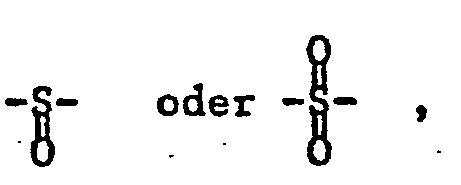
- A Sauerstoff, Schwefel,

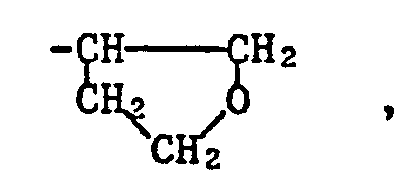
- R C1-C6-Alkylen, C1-C6-Halogenalkyl-C1-C6-alkylen, C1-C6-Alkoxy- C1-C6-alkylen oder C1-C6-Alkylthio-C1-C6-alkylen, Z Halogen, C1-C6-Halogenalkyl, C1-C6-Alkoxy, C1-C6-Alkylthio, C1-C6-Alkylsulfinyl oder C1-C6-Alkylsulfonyl, oder R und Z zusammen

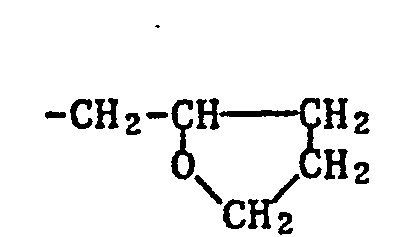

- R2 Wasserstoff, Halogen, C1-C6-Alkyl, C1-C6-Alkoxy, C1-C6-Alkylthio oder (C1-C6-Alkyl)zamino,
- n die Zahlen 1-4, wobei R2 verschieden sein kann, falls n eine der Zahlen 2-4 ist,
- R3 Halogen,
- R4 Wasserstoff,
- Rs -COOR6 oder
- R3, R4 und Rs zusammen ein Brückenglied der Formel

- Rs C1-C6-Alkyl, C2-C6-Alkenyl oder C2-C6-Alkinyl bedeuten. Unter Halogen bei R, Rz, R3 und Z ist Fluor, Chlor, Brom oder Jod zu verstehen. Bei R3 kommt insbesondere Fluor oder Chlor, aber ganz besonders Fluor, in Frage.
- Die Alkyl-, Alkoxy-, Alkylthio-, Alkylsulfinyl-, Alkylsulfonyl-, Alkenyl- und Alkinylgruppen bei R, R2, R6 und Z können geradkettig oder verzweigt und gegebenenfalls durch Halogen, Cl-C6-Alkoxy oder CI-C6-Alkylthio substituiert sein. Beispiele solcher Gruppen sind u.a.: Methyl, Methoxy, Methylthio, Trifluormethyl, Aethyl, Aethoxy, Pentafluoralkoxy, Propyl, Propoxy, Propylthio, Isopropyl, Isopropoxy, Isopropylthio, n-Butyl, n-Butoxy, n-Butylthio, n-Pentyl, n-Pentoxy, n-Pentylthio, n-Hexyl, n-Hexoxy, n-Hexylthio und deren Isomere, 2-Methylthioäthoxy, 2-Methoxyäthoxy, Propenyl oder Propinyl.
- Die Alkylengruppen bei R können geradkettig oder verzweigt sein. Beispiele solcher Gruppen sind u.a.:



- Die Verbindungen der Formel I sind offenkettige Phenylhydrazine der Formel


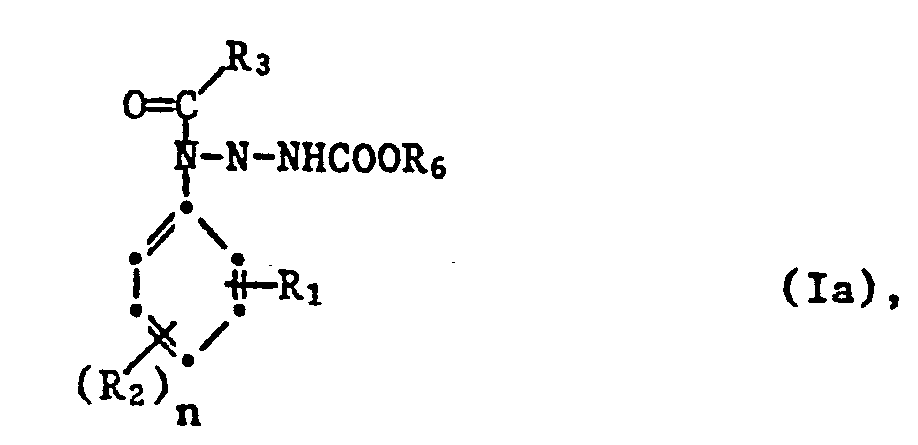
- Bevorzugt sind Verbindungen der Formel Ia worin

- A Sauerstoff, Schwefel,
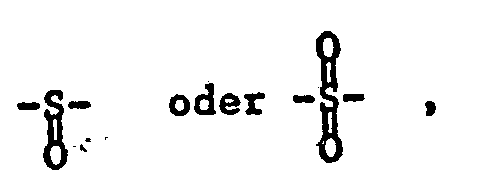
- R C2-C6-Alkylen, Z Halogen, C1-C6-Halogenalkyl, C1-C6-Alkoxy, C1-C6-Alkylthio, C1-C6-Alkylsulfinyl oder C1-C6-Alkylsulfonyl oder
- R und Z zusammen

- R2 Wasserstoff, Halogen, C1-C6-Alkyl, C1-C6-Alkoxy, C1-C6-Alkylthio oder (C1-C6-Alkyl)2amino,
- n die Zahlen 1-4, wobei R2 verschieden sein kann, falls n eine der Zahlen 2-4 ist,
- R3 Halogen und
- R6 C1-C6-Alkyl, C2-C6-Alkenyl oder C2-C6-Alkinyl bedeuten oder Verbindungen der Formel Ib, worin R1 -A-R-Z,
- A Sauerstoff, Schwefel,

- R C2-C6-Alkylen, Z Halogen, C1-C6-Halogenalkyl, C1-C6-Alkoxy, C1-C6-Alkylthio, C1-C6-Alkylsulfinyl oder C1-C6-Alkylsulfonyl oder R und Z zusammen

- R2 Wasserstoff, Halogen, C1-C6-Alkyl, C1-C6-Alkoxy, C1-C6-Alkylthio oder (C1-C6-Alkyl)2amino,
- n die Zahlen 1-4, wobei R2 verschieden sein kann, falls n eine der Zahlen 2-4 ist, und
- R6 C1-C6-Alkyl, C2-C6-Alkenyl oder C2-C6-Alkinyl bedeuten oder Verbindungen der Formel Ib, worin
- R -A-R-Z,
- A Sauerstoff, Schwefel,

- R C2-C6-Alkylen,
- Z Halogen, C1-C6-Alkoxy, C1-C6-Alkylthio, C1-C6-Alkylsulfinyl oder C1-C6-Alkylsulfonyl,
- R2 Wasserstoff, Halogen, C1-C6-Alkoxy, C1-C6-Alkylthio oder (C1-C6-Alkyl)2amino,
- n die Zahlen 1-4, wobei R2 verschieden sein kann, falls n eine der Zahlen 2-4 ist, und
- R6 CI-C6-Alkyl, C2-C6-Alkenyl oder C2-C6-Alkinyl bedeuten.
- Insbesondere bevorzugt sind Verbindungen der Formel Ia, worin
- R1 -A-R-Z,
- A Sauerstoff oder Schwefel,
- R1 unsubstituiertes C2-C6-Alkylen,
- Z Halogen, C1-C6-Alkoxy, C1-C6-Alkylthio, C1-C6-Alkylsulfinyl oder C1-C6-Alkylsulfonyl,
- R2 Wasserstoff, Halogen oder C1-C6-Alkyl,
- n die Zahl 1,
- R3 Halogen und
- R6 Methyl bedeuten oder Verbindungen der Formel Ia, worin
- R1 -A-R-Z in 2-Position zur Gruppe

- A Sauerstoff,
- R unsubstituiertes C2-C4-Alkylen,
- Z Halogen, C1-C4-Alkoxy, Ci-C4-Alkylthio, C1-C4-Alkylsulfinyl oder CI-C4-Alkylsulfonyl,
- R2 Wasserstoff, Halogen oder C1-C4-Alkyl,
- n die Zahl 1,
- i R3 Halogen und
- R6 Methyl bedeuten oder Verbindungen der Formel Ib, worin R1 -A-R-Z,
- A Sauerstoff oder Schwefel,
- R C2-C6-Alkylen,
- Z Halogen, CI-C6-Alkoxy, C1-C6-Alkylthio, C1-C6-Alkylsulfinyl oder CI-C6-Alkylsulfonyl
- R2 Wasserstoff, Malogen oder C1-C6-Alkyl,
- n die Zahl 1 und
- R6 Methyl bedeuten oder Verbindungen der Formel Ib, worin R1 -A-R-Z- in 2-Position zur
- Gruppe

- R C2-C4-Alkylen,
- Z Halogen, C1-C4-Alkoxy, C1-C4-Alkylthio, C1-C4-Alkylsulfinyl oder C1-C4-Alkylsulfonyl,
- R2 Wasserstoff, Halogen oder C1-C4-Alkyl,
- n die Zahl 1 und
- R6 Methyl bedeuten.
- Beispiele von Verbindungen der Formel I sind u.a.

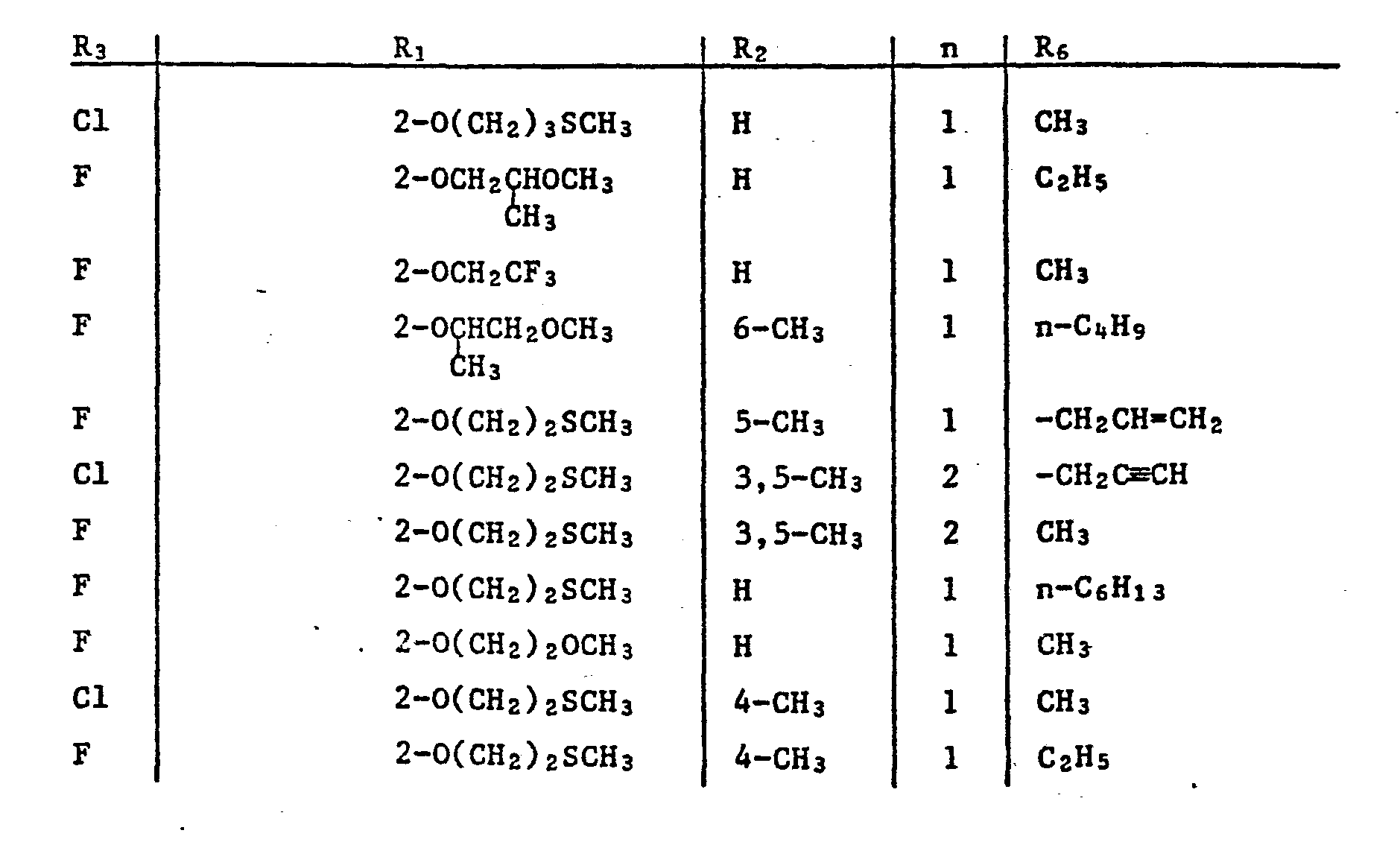


- Die Verbindungen der Formel I können nach an sich bekannten Methoden hergestellt werden, indem man in einer ersten Stufe durch Phosgenierung oder Fluorphosgenierung Verbindungen der Formel I herstellt, worin R5 = -COOR6, X = Halogen und Y = Wasserstoff bedeuten und diese offenkettigen Hydrazine anschliessed mittels einer Base zu Verbindungen der Formel I, worin R3, R4 und Rs zusammen


- In den Formeln II-V haben R1, R2, R3, R6 und n die für die Formel I angegebene Bedeutung.
- Als Basen für den zweiten Verfahrensschritt sind insbesondere organische Basen, wie Trialkylamine, z.B. Triäthylamin oder Aethyldiisopropylamin, Pyridin, Dialkylaniline oder cyclische Amidinbasen geeignet.
- Beide Verfahrensschritte werden bei einer Reaktionstemperatur zwischen -10° und 120°C, meist zwischen 20° und 80°C, bei normalem oder erhöhtem Druck und vorzugsweise in einem inerten Lösungs- oder Verdünnungsmittel durchgeführt. Als Lösungs- oder Verdünnungsmittel eignen sich z.B. Aether und ätherartige Verbindungen, wie Diäthyl- äther, Dipropyläther, Dioxan, Dimethoxyäthan und Tetrahydrofuran; Amide, wie N,N-dialkylierte Carbonsäureamide; aliphatische, aromatische sowie halogenierte Kohlenwasserstoffe, insbesondere Benzol, Toluol, Xylole, Chloroform und Chlorbenzol; Nitrile wie Acetonitril; Dimethylsulfoxid und Ketone wie Aceton und Methyläthylketon sowie Alkohole (nur beim Cyclisierungsachritt), z.B. Methanol, Aethanol, Propylalkohol usw. und Ester, z.B. Essigsäureäthylester.
- Die Ausgangsstoffe der Formeln II können analog bekannten Methoden hergestellt werden (vgl. Beispiel 1).
- Die Verbindungen der Formel I, welche S in seinen oxidierten Formen, also als

- Verbindungen der Formel I, in welcher R4 Wasserstoff, R5 -COOR6 und R3 Fluor bedeuten, können auch aus den entsprechenden Verbindungen der Formel I, in welcher R3 Chlor bedeutet, hergestellt werden; z.B. durch Umsatz mit Alkalifluoriden in geeigneten Lösungsmitteln gegebenenfalls unter Zusatz von Kronenverbindungen oder Phasentransferkatalysatoren, oder aber durch Umsatz mit wasserfreier Flussäure, Antimonfluorid oder andern geeigneten Reagentien (Angew. Chemie 89, 797 (1977).
- Die Verbindungen der Formel I eignen sich zur Bekämpfung von verschiedenartigen Schädlingen an Tieren und Pflanzen sowie im Boden. So können sie zur Bekämpfung von Insekten, z.B. der Ordnung Lepidoptera, Coleoptera, Homoptera, Heteroptera, Diptera, Thysanoptera, Orthoptera, Anoplura, Siphonaptera, Mallophaga, Thysanura, Isoptera, Psocoptera und Hymenoptera und von Milben und Zecken der Ordnung Acarina eingesetzt werden.
- Vor allem eignen sich Verbindungen der Formel I zur Bekämpfung von pflanzenschädigenden Insekten in Zier-und Nutzpflanzen, insbesondere in Baumwoll- und Reiskulturen (z.B. Spodoptera littoralis, Heliothis virescens, Nephothettix cincticeps, Chilo suppressalis und Laodelphax striatellus) sowie Gemüse- und Obstkulturen (z.B. Leptinotarsa decemlineata, Myzus persicae, Laspeyresia pomonella und Adoxophyes reticulana) und von Bodeninsekten (z.B. Aulacophoral femoralis, Chortophila brassicae, Diabrotica balteata, Pachnoda savignyi und Scotia ypsilon). Besonders hervorzuheben ist die hohe systemische Wirksamkeit, die vor allem bei der Bekämpfung saugender Insekten und phytopathogener Pilze zum Tragen kommt.
- Wirkstoffe der Formel I zeigen auch eine sehr günstige Wirkung gegen Fliegen, wie z.B. Musca domestica und Mückenlarven. Ausserdem besitzen die Verbindungen der Formel I auch gute nematizide Eigenschaften, ferner zeichnen sie sich durch eine breite, ovizide und ovolarvizide Wirkung aus und besitzen eine wertvolle Wirkung gegen ektoparasitäre Milben und Zecken, z.B. der Familien Ixodidae, Argasidae und Dermanyssidae.
- Die Verbindungen der Formel I wirken auch gegen phytopathogene Pilze. So wirken Verbindungen der Formel I gegen die den folgenden Klassen angehörenden phytopathogenen Pilze: Ascomycetes (z.B. Erysiphaceae, Fusarium, Helminthosporium); Basidiomycetes wie Puccinia, Rhizoctonia, Tilletia, Hemileia; Fungi imperfecti (z.B. Cercospora, Botrytis, Septoria); Phycomycetes wie Phytophthora.
- Die Verbindungen der Formel I können vorteilhaft als Beizmittel zur Behandlung von Saatgut und Vorrat (Früchte, Knollen, Körner) und Pflanzenstecklingen oder zur Saatfurchenapplikation zum Schutz vor Pilzinfektionen, Insekten und Vertretern der Ordnung Akarina, sowie gegen im Erdboden auftretende phytopathogene Pilze und Insekten eingesetzt werden.
- Die akarizide bzw. insektizide Wirkung lässt sich durch Zusatz von anderen Insektiziden und/oder Akariziden wesentlich verbreitern und an gegebene Umstände anpassen. Als Zusätze eignen sich z.B. org. Phosphorverbindungen; Nitrophenole und deren Derivate; Formamidine; Harnstoffe; pyrethrinartige Verbindungen sowie Karbamate und chlorierte Kohlenwasserstoffe.
- Mit besonderem Vorteil werden Verbindungen der Formel I auch mit Substanzen kombiniert, welche einen synergistischen oder verstärkenden Effekt ausüben. Beispiele solcher Verbindungen sind u.a. Piperonylbutoxid, Propinyläther, Propinyloxime, Propinylcarbamate und Propinylphosphonate, 2-(3,4-Methylendioxyphenoxy)-3,6,9- trioxaundecan (Sesamex resp. Sesoxane), S,S,S-Tributylphosphoro- trithioate, 1,2-Methylendioxy-4-(2-(octylsulfinyl)-propyl)-benzol.
- Die Verbindungen der Formel I werden in unveränderter Form oder vorzugsweise zusammen mit den in der Formulierungstechnik üblichen Hilfsmitteln eingesetzt und werden daher z.B. zu Emulsionskonzentra- ten, direkt versprühbaren oder verdünnbaren Lösungen, verdünnten Emulsionen, Spritzpulvern, löslichen Pulvern, Stäubemitteln, Granulaten, auch Verkapselungen in z.B. polymeren Stoffen in bekannter Weise verarbeitet. Die Anwendungsverfahren wie Versprühen, Vernebeln, Verstäuben, Verstreuen oder Giessen werden gleich wie die Art der Mittel den angestrebten Zielen und den gegebenen Verhältnissen entsprechend gewählt.
- Die Formulierungen, d.h. die den Wirkstoff der Formel I und gegebenenfalls einen festen oder flüssigen Zusatzstoff enthaltenden Mittel, Zubereitungen oder Zusammensetzungen werden in bekannter Weise hergestellt, z.B. durch inniges Vermischen und/oder Vermahlen der Wirkstoffe mit Streckmitteln, wie z.B. mit Lösungsmitteln, festen Trägerstoffen, und gegebenenfalls oberflächenaktiven Verbindungen (Tensiden).
- Als Lösungsmittel können in Frage kommen: Aromatische Kohlenwasserstoffe, bevorzugt die Fraktionen Cs bis C12, wie z.B. Xylolgemische oder substituierte Naphthaline, Phthalsäureester wie Dibutyl- oder Dioctylphthalat, aliphatische Kohlenwasserstoffe wie Cyclohexan oder Paraffine, Alkohole und Glykole sowie deren Aether und Ester, wie Aethanol, Aethylenglykol, Aethylenglykolmonomethyl- oder -äthyläther, Essigester, Propylmyristat oder Propylpalmitat, Ketone wie Cyclohexanon, stark polare Lösungsmittel wie N-Methyl-2-pyrrolidon, Dimethylsulfoxid oder Dimethylformamid, sowie gegebenenfalls epoxidierte Pflanzenöle wie epoxidiertes Kokosnussöl oder Sojaöl; Silikonöle oder Wasser.
- Als feste Trägerstoffe, z.B. für Stäubemittel und dispergierbare Pulver, werden in der Regel natürliche Gesteinsmehle verwendet, wie Calcit, Talkum, Kaolin, Montmorillonit oder Attapulgit. Zur Verbesserung der physikalischen Eigenschaften können auch hochdisperse Kieselsäure oder hochdisperse saugfähige Polymerisate zugesetzt werden. Als gekörnte, adsorptive Granulatträger kommen poröse Typen, wie z.B. Bimsstein, Ziegelbruch, Sepiolit oder Bentonit, als nicht sorptive Trägermaterialien z.B. Calcit oder Sand in Frage. Darüberhinaus kann eine Vielzahl von vorgranulierten Materialien anorganischer oder organischer Natur wie insbesondere Dolomit oder zerkleinerte Pflanzenrückstände verwendet werden.
- Als oberflächenaktive Verbindungen kommen je nach der Art des zu formulierenden Wirkstoffes der Formel I nichtionogene, kation-und/oder anionaktive Tenside mit guten Emulgier-, Dispergier- und Netzeigenschaften in Betracht. Unter Tensiden sind auch Tensidgemische zu verstehen.
- Geeignete anionische Tenside können sowohl sog. wasserlösliche Seifen wie wasserlösliche synthetischen oberflächenaktive Verbindungen sein.
- Als Seifen eignen sich die Alkali-, Erdalkali- oder gegebenenfalls substituierten Ammoniumsalze von höheren Fettsäuren (C10-C22), wie, z.B. die Na- oder K-Salze der Oel- oder Stearinsäure, oder von natürlichen Fettsäuregemischen, die z.B. aus Kokosnuss- oder Tallöl gewonnen werden können. Ferner sind auch die Fettsäuremethyl-taurinsalze zu erwähnen.
- Häufiger werden jedoch sog. synthetische Tenside verwendet, insbesondere Fettsulfonate, Fettsulfate, sulfonierte Benzimidazolderivate oder Alkylarylsulfonate.
- Die Fettsulfonate oder -sulfate liegen in der Regel als Alkali-, Erdalkali- oder gegebenenfalls substituierte Ammoniumsalze vor und weisen einen Alkylrest mit 8 bis 22 C-Atomen auf, wobei Alkyl auch den Alkylteil von Acylresten einschliesst, z.B. das Na- oder Ca-Salz der Ligninsulfonsäure, des Dodecylschwefelsäureesters oder eines aus natürlichen Fettsäuren hergestellten Fettalkoholsulfatgemisches. Hierher gehören auch die Salze der Schwefelsäureester und Sulfonsäure von Fettalkohol-Aethylenoxid-Addukten. Die sulfonierten Benzimidazolderivate enthalten vorzugsweise 2 Sulfonsäuregruppen und einen Fettsäurerest mit 8-22 C-Atomen. Alkylarylsulfonate sind z.B. die Na-, Ca- oder Triäthanolaminsalze oder Dodecylbenzolsulfonsäure, der Dibutylnaphthalinsulfonsäure, oder eines Naphthalinsulfonsäure-Formaldehydkondensationsproduktes.
- Ferner kommen auch entsprechende Phosphate wie z.B. Salze des Phosphorsäureesters eines p-Nonylphenol-(4-14)-Aethylenoxid-Adduktes und Phospholipide in Frage.
- Als nichtionische Tenside kommen in erster Linie Polyglykolätherderivate von aliphatischen oder cycloaliphatischen Alkoholen, gesättigten oder ungesättigten Fettsäuren und Alkylphenolen in Frage, die 3 bis 30 Glykoläthergruppen und 8 bis 20 Kohlenstoffatome im (aliphatischen) Kohlenwasserstoffrest und 6 bis 18 Kohlenstoffatome im Alkylrest der Alkylphenole enthalten können.
- Weitere geeignete nichtionische Tenside sind die wasserlöslichen, 20 bis 250 Aethylenglykoläthergruppen und 10 bis 100 Propylenglykoläthergruppen enthaltenden Polyäthylenoxid-Addukte an Polypropylenglykol, Aethylendiaminopolypropylenglykol und Alkylpolypropylenglykol mit 1 bis 10 Kohlenstoffatomen in der Alkylkette. Die genannten Verbindungen enthalten üblicherweise pro Propylenglykol-Einheit 1 bis 5 Aethylenglykoleinheiten.
- Als Beispiele nichtionischer Tenside seien Nonylphenolpolyäthoxy- äthanole, Ricinusölpolyglycoläther, Ricinusölthioxilat, Poly-- propylen-Polyäthylenoxid-Addukte, Tributylphenoxypolyäthoxyäthanol, Polyäthylenglykol und Oetylphenoxypolyathoxyäthanol erwähnt.
- Ferner kommen auch Fettsäureester von Polyoxyäthylensorbitan wie das Polyoxyäthylensorbitan-trioleat in Betracht.
- Bei den kationischen Tensiden handelt es sich vor allem um quartäre Ammoniumsalze, welche als N-Substituenten mindestens einen Alkylrest mit 8 bis 22 C-Atomen enthalten und als weitere Substituenten niedrige, gegebenenfalls halogenierte Alkyl-, Benzyl- oder niedrige Hydroxyalkylreste aufweisen. Die Salze liegen vorzugsweise als Halogenide, Methylaulfate oder Aethylsulfate vor, z.B. das Stearyltrimethylammoniumchlorid oder das Benzyldi(2-chloräthyl)-äthylammoniumbromid.
- Die in der Formulierungstechnik gebräuchlichen Tenside sind u.a. in folgenden Publikationen beschrieben:
- "McCutcheon's Detergents and Emulsifiers Annual" MC Publishing Corp., Ridgewood, New Jersey, 1979; Dr. Helmut Stache "Tensid Taschenbuch", Carl Hanser Verlag München/Wien 1981.
- Die pestiziden Zubereitungen enthalten in der Regel 0,1 bis 99 %, insbesondere 0,1 bis 95 %, Wirkstoff der Formel I, 1 bis 99,9 % eines festen oder flüssigen Zusatzstoffes und 0 bis 25 %, insbesondere 0,1 bis 25 X, eines Tensides.
- Während als Handelsware eher konzentrierte Mittel bevorzugt werden, verwendet der Endverbraucher in der Regel verdünnte Mittel.
- Die Mittel können auch weitere Zusätze wie Stabilisatoren, Entschäumer, Viskositätsregulatoren, Bindemittel, Haftmittel sowie Dünger oder andere Wirkstoffe zur Erzielung spezieller Effekte enthalten.
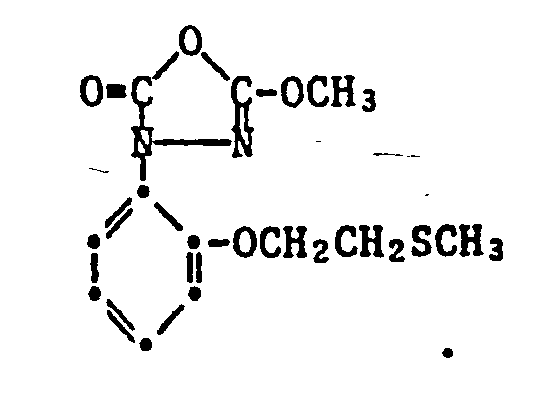
- Herstellung der Verbindung Nr. 1.1 der Formel

- a) Herstellung von 2-(2-Methylthioäthoxy)-nitrobenzol Zu 8,5 g einer 55%igen NaH Suspension in 150 ml abs. Tetrahydrofuran werden bei 20-25°C 16,3 g 2-Hydroxyäthylmethylsulfid zügetropft. Das Gemisch wird eine Stunde bei 20°C und 20 Minuten bei 40°C gerührt und anschliessend bei 20°C mit 25 g 1-Fluor-2-nitrobenzol versetzt. Nach 10stündigem Rühren der Suspension bei 20°C wird das Tetrahydrofuran im Vakuum abdestilliert. Der Rückstand wird mit Wasser versetzt und mehrmals mit Aether extrahiert. Man erhält ein Oel, welches ohne weitere Reinigung für die nachfolgende Hydrierung eingesetzt werden kann.
- b) Herstellung von 2-(2-Methylthioäthoxy)-anilin. 33,9 g des bei a) erhaltenen Oels werden in 100 ml abs. Tetrahydrofuran unter Zugabe von 13,6 g Raney-Nickel bei Normaldruck hydriert (Wasserstoffaufnahme - 10,6 Liter). Nach dem Abfiltrieren des Katalysators wird das Filtrat eingedampft und mittels Chromatographie (Kieselgel; Hexan/Essigsäureäthylester als Eluiermittel) gereinigt.
- Man erhält 27,4 g Oel, welches für die nachfolgende Reaktion direkt eingesetzt werden kann.
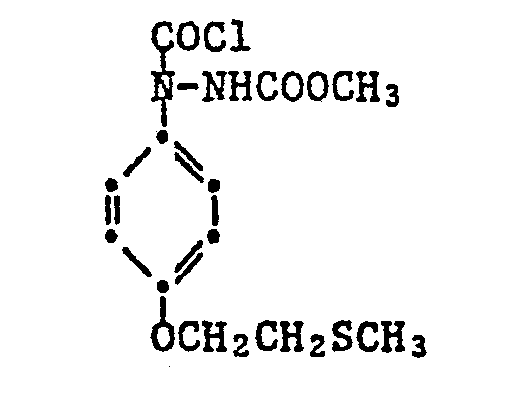
- 27,4 g des unter b) erhaltenen Anilins werden in 45 ml Eisessig vorgelegt und unter Eiskühlung mit einer Mischung von 37 ml konz. HCl und 75 ml H20 versetzt. Die entstandene Suspension wird bei 0-5°C mit 10,3 g NaNO2 in 22 ml Wasser diazotiert. Die Diazoniumlösung wird 10 Minuten bei 0°C nachgerührt und dann rasch mit einer Lösung von 80,7 g SnCl2·2H2O in 112 ml konz. HCl unter Kühlung versetzt. Nach vier Stunden wird das Reaktionsgemisch mit Wasser versetzt und mehrmals mit Aether extrahiert. Die wässrige Phase wird anschliessend mit 10%iger wässriger Natronlauge alkalisch gestellt und dreimal mit Aether extrahiert. Nach der üblichen Aufarbeitung der Aetherphasen erhält man die Verbindung der Formel

- Zu 14,4 g 2-(2-Methylthioäthoxy)-phenylhydrazin in 100 ml Tetrahydrofuran und 14 g N-Aethyldiisopropylamin werden bei 0°C 5,6 ml Chlorameisensäuremethylester zugetropft. Das Reaktionsgemisch wird nach zweistündigem Rühren bei 20°C eingedampft, mit H20 versetzt und mehrmals mit Essigsäureäthylester extrahiert. Nach der üblichen Aufarbeitung resultiert ein Feststoff, welcher aus Alkohol umkristallisiert wird. Man erhält die Verbindung der Formel

- 14,1 g 2-[2-(2-Methylthioäthoxy)-phenyl]-hydrazincarbonsäuremethyl- ester in 130 ml Toluol werden bei 20°C mit 80 ml einer 20%igen Lösung von Phosgen in Toluol versetzt. Anschliessend wird 3 Stunden auf 90°C erhitzt und das Lösungsmittel entfernt. Nach dem Umkristallisieren des Rückstandes in Aethylalkohol erhält man die Verbindung Nr. 1.1 der Formel

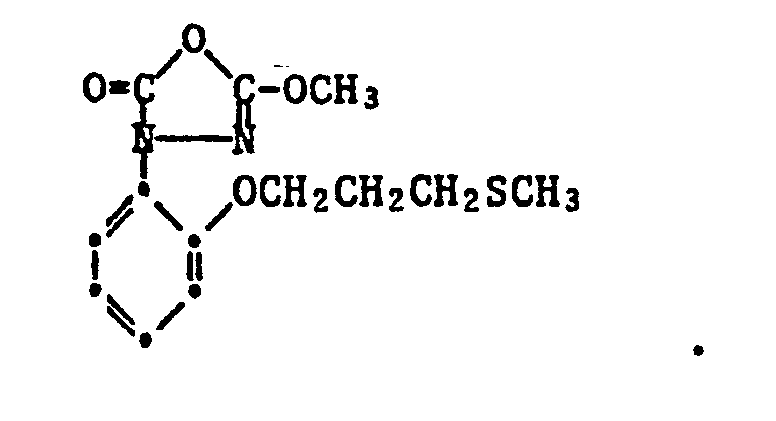
- Auf analoge Weise werden auch folgende Verbindungen hergestellt:


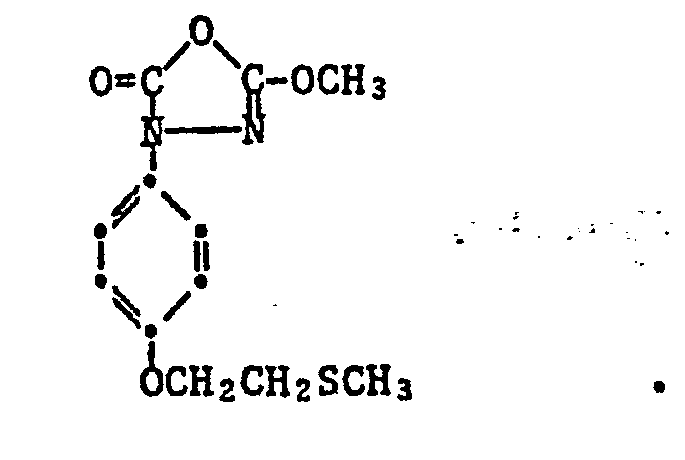
- Herstellung der Verbindung Nr. 2.1 der Formel

- Auf analoge Weise werden auch folgende Verbindungen hergestellt:


-

- Aus solchen Konzentraten können durch Verdünnen mit Wasser Emulsionen jeder gewünschten Konzentration hergestellt werden.

- Die Lösungen sind zur Anwendung in Form kleinster Tropfen geeignet.

- Der Wirkstoff wird in Methylenchlorid gelöst, auf den Träger aufgesprüht und das Lösungsmittel anschliessend im Vakuum abgedampft.

- Durch inniges Vermischen der Trägerstoffe mit dem Wirkstoff erhält man gebrauchsfertige Stäubemittel.
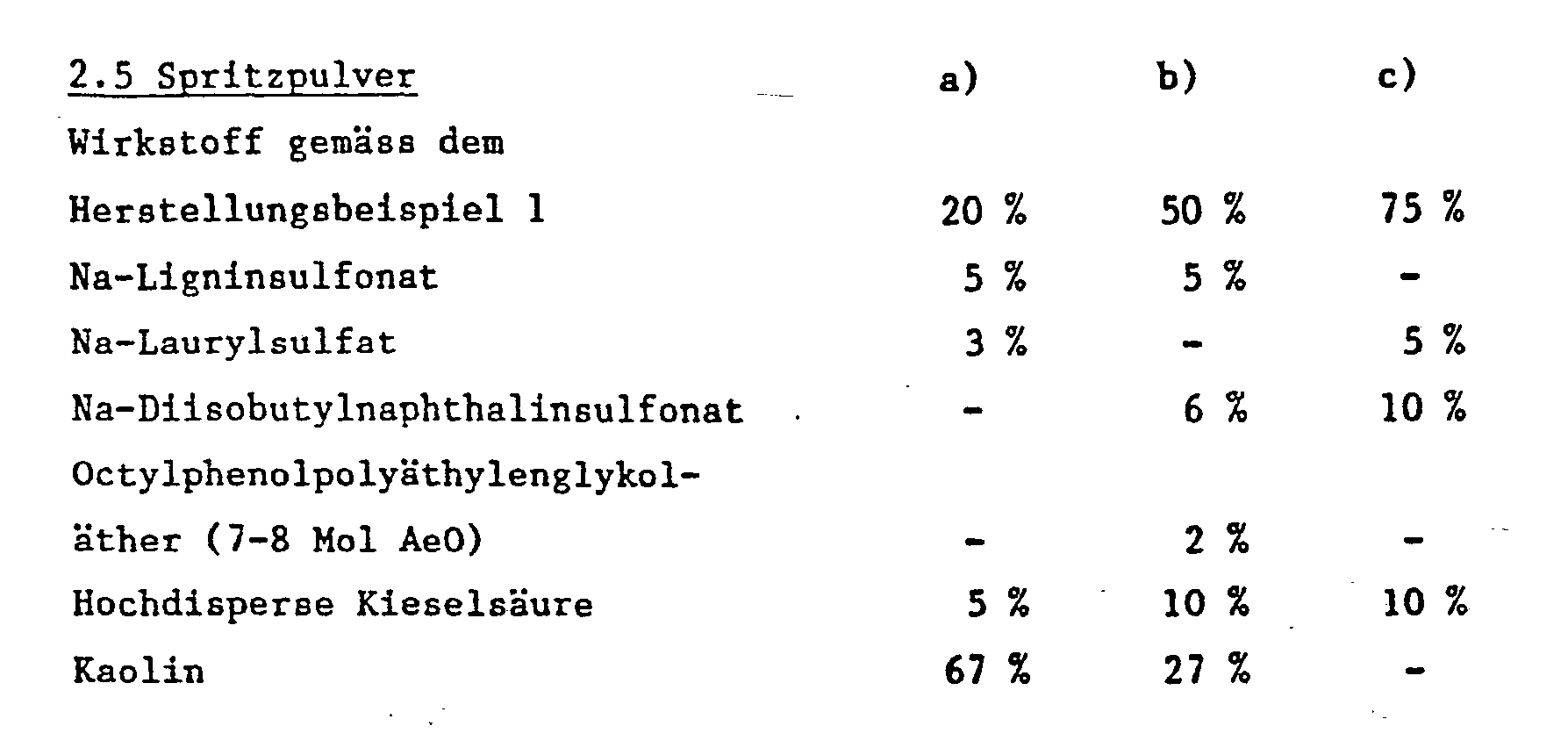
- Der Wirkstoff wird mit den Zusatzstoffen gut vermischt und in einer geeigneten Mühle gut vermahlen. Man erhält Spritzpulver, die sich mit Wasser zu Suspensionen jeder gewünschten Konzentration verdünnen lassen.

- Der Wirkstoff wird mit den Zusatzstoffen vermischt, vermahlen und mit Wasser angefeuchtet. Dieses Gemisch wird extrudiert und anschliessend im Luftstrom getrocknet.
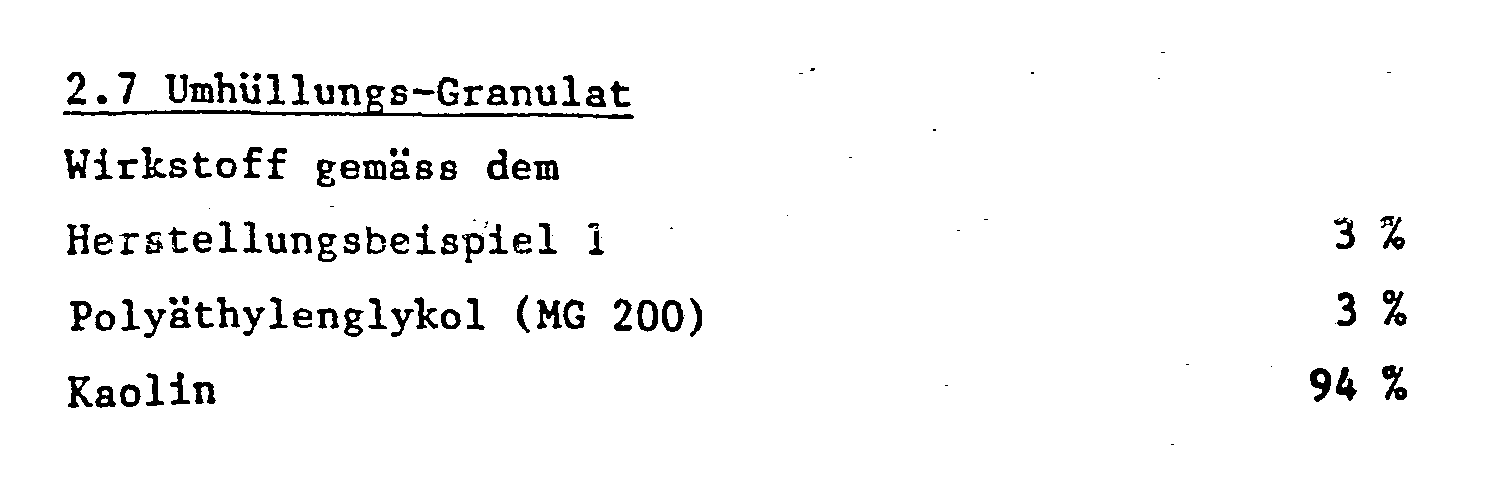
- Der feingemahlene Wirkstoff wird in einem Mischer auf das mit Polyäthylenglykol angefeuchtete Kaolin gleichmässig aufgetragen. Auf diese Weise erhält man staubfreie Umhüllungs-Granulate.

- Der fein gemahlene Wirkstoff wird mit den Zusatzstoffen innig vermischt. Man erhält so ein Suspensions-Konzentrat, aus welchem durch Verdünnen mit Wasser Suspensionen jeder gewünschten Konzentration hergestellt werden können.
- Nach dem Antrocknen des Belages werden die Pflanzen mit Larven von Spodoptera littoralis (L1-Stadium) besetzt. Man verwendet pro Versuchverbindung zwei Pflanzen. Die Auswertung der erzielten Abtötungsrate erfolgt nach 2, 4, 24, 48 und 72 Stunden. Der Versuch wird bei 28°C und 60 % relativer Luftfeuchtigkeit durchgeführt.
- Verbindungen gemäss Beispiel 1 zeigen im obigen Test 80-100%ige Wirkung gegenüber Spodoptera littoralis-Larven.
- Zu 9 ml eines Zuchtmediums wird bei 50°C ein ml einer 0,1 % Aktivsubstanz enthaltenden wässrigen Zubereitung hinzugefügt. Nun werden ca. 30 frisch geschlüpfte Lucilia sericata-Larven zum Zuchtmedium gegeben. Nach 48 und 96 Stunden wird die insektizide Wirkung durch Ermittlung der Abtötungsrate festgestellt.
- Verbindungen der Formel I gemäss Beispiel 1 zeigen in diesem Test ein 80-100%ige Wirkung gegen Lucilia sericata.
- Auf die Oberfläche von 150 ml Wasser, das sich in einem Behälter befindet, wird so viel einer 0,1%igen acetonischen Lösung des Wirkstoffs pipettiert, dass eine Konzentration von 12,5 ppm erhalten wird. Nach Verdunsten des Acetons wird der Behälter mit 30 bis 40 2tägigen Aedes-Larven beschickt. Nach 2 und 7 Tagen wird die % Mortalität (Anzahl der schwimmunfähigen Larven) geprüft.
- Verbindungen gemäss Beispiel 1 zeigen 100%ige Wirkung (Mortalität) im obigen Test.
- Entsprechende Mengenanteile einer benetzbaren pulverförmigen Formulierung, enthaltend 25 Gew.% des zu prüfenden Wirkstoffes, werden mit jeweils so viel Wasser vermischt, dass sich wässrige Emulsionen mit Wirkstoffkonzentrationen von 400 bis 12,5 ppm ergeben.
- In diese wirkstoffhaltigen Emulsionen werden eintägige Eigelege von Heliothis auf Cellophan® während drei Minuten eingetaucht und dann auf Rundfiltern abgenutscht. Die so behandelten Gelege werden in Petrischalen ausgelegt und in der Dunkelheit aufbewahrt. Nach '6 bis 8 Tagen wird die Schlupfrate im Vergleich zu unbehandelten Kontrollen festgelegt. Zur Auswertung wird die zur 100%igen Abtötung der Eier erforderliche Wirkstoffkonzentration bestimmt.
- Verbindungen gemäss Beipiel 1 zeigt bei 12,5 ppm 100%ige Wirkung (Mortalität) im obigem Test.
- Die Primärblätter von Phaseolua vulgaris-Pflanzen werden 16 Stunden vor dem Versuch auf akarizide Wirkung mit einem infestierten Blattstück aus einer Massenzucht von Tetranychus urticae (OP-sens.) bzw. Tetranychus cinnabarinus (OP-tol.) belegt. (Die Toleranz bezieht sich auf die Verträglichkeit gegenüber Diazinon).
- Die so behandelten infestierten Pflanzen werden mit einer Versuchslösung enthaltend 400 ppm der zu prüfenden Verbindung bis zur Tropfnässe besprüht.
- Nach 24 Stunden und wiederum nach 7 Tagen werden Imagines und Larven (alle beweglichen Stadien) unter dem Binokular auf lebende und tote Individuen ausgewertet. Man verwendet pro Konzentration und pro Testspezies eine Pflanze. Während des Versuchsverlaufs stehen die Pflanzen in Gewachshauskabinen bei 25°C.
- Verbindungen gemäss Beispiel 1 zeigen in diesem Versuch eine 80-100%ige Wirkung gegen Tetranychus urticae und Tetranychus cinnabarinus.
- Verbindungen gemäss Beispiel 1 zeigen im obigen Test die in der folgenden Tabelle angegebene Wirkung gegen Aphis craccivora.
- In der folgenden Tabelle sind Versuchsergebnisse auf der Basis des vorstehenden Beispiels aufgeführt, und zwar mit folgendem Bewertungsindex in bezug auf die prozentuale Abtötung der Schädlinge:

- Etwa 4 cm hohe, in Wasser angezogene Erbsenkeimlinge werden vor Versuchsbeginn je mit ca. 200 Individuen der Spezies Myzus persicae besiedelt. Die so behandelten Pflanzen werden 24 Stunden später mit einer wässrigen Suspension enthaltend 400 ppm der zu prüfenden Verbindung bis zur Tropfnässe besprüht. Man verwendet pro Konzentration zwei Pflanzen. Eine Auswertung der erzielten Abtötungsrate erfolgt 48 Stunden nach Applikation. Der Versuch wird bei 20-22°C und 60 % relativer Luftfeuchtigkeit durchgeführt.
- Verbindungen der Formel I gemäss Beispiel 1 zeigen in diesem Test eine 80-100%ige Wirkung.
- Es werden 5 etwa einen bis drei cm lange Maiskeimlinge sowie eine Rondelle aus Filterpapier in eine 0,2 bis 12,5 ppm des zu prüfenden Wirkstoffes enthaltende wässrige Zubereitung getaucht. Die feuchte Filterpapierrondelle wird auf dem Boden eines 200 ml Plastikbechers ausgelegt, und dann werden die 5 behandelten Maiskeimlinge zusammen mit 10 Larven von Diabrotica balteata des zweiten bis dritten Larvalstadiums in den Becher gegeben. Pro Wirkstoffkonrentration werden 2 Ansätze durchgeführt. Die mit den Larven besetzten Becher werden während 6 Tagen bei Tageslicht, einer relativen Luftfeuchtigkeit von 40 bis 60 % und einer Temperatur von 22 bis 24°C gehalten. Danach wird die prozentuale Abtötung der Testtiere bestimmt.
- Verbindungen gemäss Beispiel 1 zeigen in diesem Test 80-100%ige Wirkung.
- 50 Nymphen werden in ein Glasröhrchen gezählt und für 1 bis 2 Minuten in 2 ml einer wässrigen Emulsion aus einer Verdünnungsreihe mit je 10, 1 oder 0,1 ppm Testsubstanz getaucht. Das Röhrchen wird dann mit einem genormten Wattebausch verschlossen und auf den Kopf gestellt, damit die Wirkstoffemulsion von der Watte aufgenommen werden kann.
- Die Auswertung erfolgt nach 1 Woche. Für jeden Versuch werden 2 Wiederholungen durchgeführt.
- Mit einer analogen Verdünnungsreihe wie beim Test A) werden mit je 20 sensiblen resp. OP-reaistenten Larven Versuche durchgeführt. (Die Resistenz bezieht sich auf die Verträglichkeit von Diazinon).
- Die Verbindungen gemäss dem Herstellungsbeispiel 1 zeigen eine 80-100%ige Wirkung gegen Nymphen bzw. Larven der Zecken: Amblyomma hebraeum und Boophilus microplus.
- Reispflanzen werden mit einer Versuchslösung, enthaltend 400 ppm der zu prüfenden Verbindung, besprüht. Nach dem Antrocknen des Belages werden die Pflanzen mit Nymphen von Nilaparvata lugens (N2 oder N3-Stadium) besetzt. Man verwendet pro Versuchsverbindung und pro Test-Spezies zwei Pflanzen. Die Auswertung der erzielten Abtötungsrate erfolgt nach 6 Tagen. Der Versuch wird bei 26°C und 60 % relativer Luftfeuchtigkeit durchgeführt.
- Verbindungen gemäss Beispiel 1 zeigen im obigen Test 100 % Wirkung gegenüber Nilaparvata lugens-Nymphen.
- Reispflanzen werden mit 5 ml einer Versuchslösung, enthaltend 50, 12,5 oder 3 ppm der zu prüfenden Verbindung, angegossen und nach 1, 2 resp. 3 Wochen mit jeweils 20 Nymphen besiedelt. Die Auswertung der erzielten Abtötungsrate erfolgt 6 Tage nach der Besiedlung. Verbindungen gemäss Beispiel 1 zeigen 80-100%ige Wirkung in diesem Test.
Claims (62)














Applications Claiming Priority (8)
| Application Number | Priority Date | Filing Date | Title |
|---|---|---|---|
| CH565584 | 1984-11-27 | ||
| CH565684 | 1984-11-27 | ||
| CH5656/84 | 1984-11-27 | ||
| CH5655/84 | 1984-11-27 | ||
| CH312285 | 1985-07-18 | ||
| CH3122/85 | 1985-07-18 | ||
| CH4608/85 | 1985-10-25 | ||
| CH460885 | 1985-10-25 |
Publications (2)
| Publication Number | Publication Date |
|---|---|
| EP0183650A1 true EP0183650A1 (de) | 1986-06-04 |
| EP0183650B1 EP0183650B1 (de) | 1988-04-20 |
Family
ID=27428564
Family Applications (1)
| Application Number | Title | Priority Date | Filing Date |
|---|---|---|---|
| EP85810557A Expired EP0183650B1 (de) | 1984-11-27 | 1985-11-21 | Phenylhydrazine, Verfahren zu ihrer Herstellung und ihre Verwendung in der Schädlingsbekämpfung |
Country Status (12)
| Country | Link |
|---|---|
| US (1) | US4725302A (de) |
| EP (1) | EP0183650B1 (de) |
| KR (1) | KR860004037A (de) |
| AU (1) | AU590232B2 (de) |
| BR (1) | BR8505916A (de) |
| CA (1) | CA1258076A (de) |
| DE (1) | DE3562235D1 (de) |
| ES (1) | ES8703407A1 (de) |
| GR (1) | GR852840B (de) |
| HU (1) | HUT41376A (de) |
| IL (1) | IL77134A0 (de) |
| PH (1) | PH22982A (de) |
Cited By (5)
| Publication number | Priority date | Publication date | Assignee | Title |
|---|---|---|---|---|
| US4766146A (en) * | 1986-03-20 | 1988-08-23 | Ciba-Geigy Corporation | Pesticidal substituted hydrazinecarboxylic acid esters |
| WO1993010083A1 (en) * | 1991-11-22 | 1993-05-27 | Uniroyal Chemical Company, Inc. | Insecticidal phenylhydrazine derivatives |
| US5543404A (en) * | 1995-07-05 | 1996-08-06 | Uniroyal Chemical Company, Inc | Pesticidal phenylhydrazinephosphates |
| US5567723A (en) * | 1995-07-05 | 1996-10-22 | Uniroyal Chemical Company, Inc. | Miticidal hydrazine compounds and their intermediates |
| DE10102265C1 (de) * | 2001-01-18 | 2002-08-08 | Aventis Pharma Gmbh | Substituierte 3-Phenyl-5-alkoxi-1,3,4-oxdiazol-2-one, ihre Herstellung und Verwendung in Arzneistoffen |
Families Citing this family (4)
| Publication number | Priority date | Publication date | Assignee | Title |
|---|---|---|---|---|
| SK282306B6 (sk) * | 1991-11-22 | 2002-01-07 | Uniroyal Chemical Company, Inc. | Fenylhydrazínové deriváty, pesticídny prostriedok obsahujúci tieto zlúčeniny a spôsob kontrolovania nežiaduceho hmyzu |
| US6278022B1 (en) | 1999-11-01 | 2001-08-21 | Ck Witco Corporation | Process for the preparation of insecticidal phenylhydrazine derivatives |
| US6166243A (en) * | 1999-11-01 | 2000-12-26 | Ck Witco Corporation | Process for the preparation of insecticidal phenylhydrazine derivatives |
| US7592374B2 (en) * | 2005-03-03 | 2009-09-22 | Crompton Corporation | Insecticidal nitromethylene compounds |
Citations (4)
| Publication number | Priority date | Publication date | Assignee | Title |
|---|---|---|---|---|
| EP0000002A1 (de) * | 1977-06-01 | 1978-12-20 | Bayer Ag | Tetrahydrofuran-Derivate, Verfahren zu ihrer Herstellung sowie ihre Verwendung als Herbizide. |
| DE3047629A1 (de) * | 1979-12-17 | 1981-09-17 | Mitsui Toatsu Chemicals, Inc., Tokyo | "tetrahydrofuranderivate" |
| GB2093448A (en) * | 1981-02-05 | 1982-09-02 | Sandoz Ltd | Acylated hydrazine carboxylates |
| FR2466194B1 (de) * | 1979-09-28 | 1984-01-13 | Rhone Poulenc Agrochimie |
Family Cites Families (10)
| Publication number | Priority date | Publication date | Assignee | Title |
|---|---|---|---|---|
| FR2055926A5 (de) * | 1969-08-07 | 1971-05-14 | Rhone Poulenc Sa | |
| US4138404A (en) * | 1973-03-22 | 1979-02-06 | Rhone-Poulenc S.A. | Process for the preparation of oxadiazolines |
| US3941798A (en) * | 1973-03-22 | 1976-03-02 | Rhone Poulenc S.A. | 5-Alkyl-3-(2-hydroxylamino-4-chlorophenyl)-1,3,4-oxadiazolin-2-one compounds |
| FR2299328A1 (fr) * | 1975-02-03 | 1976-08-27 | Rhone Poulenc Ind | Derives de l'alcoyloxy-5 phenyl-3 oxyde azo |
| US4076824A (en) * | 1975-02-03 | 1978-02-28 | Rhone-Poulenc Industries | Anthelmintic oxadiazolinone derivatives |
| US4174958A (en) * | 1978-01-09 | 1979-11-20 | Shell Oil Company | Anilide derivative herbicides |
| US4318731A (en) * | 1979-08-25 | 1982-03-09 | Nihon Nohyaku Co., Ltd. | Δ2 -1,2,4-triazolin-5-one derivatives and herbicidal usage thereof |
| JPS5728039A (en) * | 1980-07-28 | 1982-02-15 | Mitsui Toatsu Chem Inc | Preparation of diphenyl ether compound |
| US4404019A (en) * | 1980-12-24 | 1983-09-13 | Sumitomo Chemical Company, Limited | 3-Chloro-1-phenyl-1,2,4-triazolin-5-ones and their use as herbicides |
| US4406910A (en) * | 1981-06-15 | 1983-09-27 | Shell Oil Company | Pesticidal 3-(2,3-dihydro-2-alkylbenzofuran-7-yl)-5-(R-oxy)-1,3,4-oxadiazol-2(3H)-ones |
-
1985
- 1985-11-20 US US06/800,179 patent/US4725302A/en not_active Expired - Fee Related
- 1985-11-21 EP EP85810557A patent/EP0183650B1/de not_active Expired
- 1985-11-21 DE DE8585810557T patent/DE3562235D1/de not_active Expired
- 1985-11-25 CA CA000496080A patent/CA1258076A/en not_active Expired
- 1985-11-25 GR GR852840A patent/GR852840B/el unknown
- 1985-11-25 IL IL77134A patent/IL77134A0/xx unknown
- 1985-11-26 BR BR8505916A patent/BR8505916A/pt unknown
- 1985-11-26 HU HU854516A patent/HUT41376A/hu unknown
- 1985-11-26 AU AU50358/85A patent/AU590232B2/en not_active Expired - Fee Related
- 1985-11-26 ES ES549266A patent/ES8703407A1/es not_active Expired
- 1985-11-26 KR KR1019850008830A patent/KR860004037A/ko not_active Withdrawn
- 1985-11-27 PH PH33101A patent/PH22982A/en unknown
Patent Citations (4)
| Publication number | Priority date | Publication date | Assignee | Title |
|---|---|---|---|---|
| EP0000002A1 (de) * | 1977-06-01 | 1978-12-20 | Bayer Ag | Tetrahydrofuran-Derivate, Verfahren zu ihrer Herstellung sowie ihre Verwendung als Herbizide. |
| FR2466194B1 (de) * | 1979-09-28 | 1984-01-13 | Rhone Poulenc Agrochimie | |
| DE3047629A1 (de) * | 1979-12-17 | 1981-09-17 | Mitsui Toatsu Chemicals, Inc., Tokyo | "tetrahydrofuranderivate" |
| GB2093448A (en) * | 1981-02-05 | 1982-09-02 | Sandoz Ltd | Acylated hydrazine carboxylates |
Cited By (6)
| Publication number | Priority date | Publication date | Assignee | Title |
|---|---|---|---|---|
| US4766146A (en) * | 1986-03-20 | 1988-08-23 | Ciba-Geigy Corporation | Pesticidal substituted hydrazinecarboxylic acid esters |
| WO1993010083A1 (en) * | 1991-11-22 | 1993-05-27 | Uniroyal Chemical Company, Inc. | Insecticidal phenylhydrazine derivatives |
| US5367093A (en) * | 1991-11-22 | 1994-11-22 | Uniroyal Chemical Company, Inc. | Insecticidal phenylhydrazine derivatives |
| US5543404A (en) * | 1995-07-05 | 1996-08-06 | Uniroyal Chemical Company, Inc | Pesticidal phenylhydrazinephosphates |
| US5567723A (en) * | 1995-07-05 | 1996-10-22 | Uniroyal Chemical Company, Inc. | Miticidal hydrazine compounds and their intermediates |
| DE10102265C1 (de) * | 2001-01-18 | 2002-08-08 | Aventis Pharma Gmbh | Substituierte 3-Phenyl-5-alkoxi-1,3,4-oxdiazol-2-one, ihre Herstellung und Verwendung in Arzneistoffen |
Also Published As
| Publication number | Publication date |
|---|---|
| CA1258076A (en) | 1989-08-01 |
| PH22982A (en) | 1989-02-24 |
| BR8505916A (pt) | 1986-08-19 |
| DE3562235D1 (en) | 1988-05-26 |
| AU5035885A (en) | 1986-06-05 |
| IL77134A0 (en) | 1986-04-29 |
| GR852840B (de) | 1986-03-21 |
| ES549266A0 (es) | 1987-02-16 |
| EP0183650B1 (de) | 1988-04-20 |
| KR860004037A (ko) | 1986-06-16 |
| ES8703407A1 (es) | 1987-02-16 |
| HUT41376A (en) | 1987-04-28 |
| AU590232B2 (en) | 1989-11-02 |
| US4725302A (en) | 1988-02-16 |
Similar Documents
| Publication | Publication Date | Title |
|---|---|---|
| EP0175649B1 (de) | Substituierte Carbodiimide | |
| EP0183650B1 (de) | Phenylhydrazine, Verfahren zu ihrer Herstellung und ihre Verwendung in der Schädlingsbekämpfung | |
| EP0110829B1 (de) | Schädlingsbekämpfungsmittel | |
| EP0411676B1 (de) | Substituierte Dioxanderivate | |
| EP0179020A2 (de) | Thioxanthene in der Schädlingsbekämpfung | |
| DE3544436A1 (de) | Neue dioxide | |
| EP0098800B1 (de) | Carbaminsäureester | |
| EP0256985A2 (de) | Substituierte Thioharnstoffe, Isothioharnstoffe und Carbodiimide | |
| EP0145662B1 (de) | Isothioharnstoffe | |
| EP0135105B1 (de) | Mittel zur Bekämpfung von Insekten und Vertretern der Ordnung Akarina, welche als aktive Komponente 2-(1-Indolinyl-methyl)-imidazoline oder deren Salzen enthalten | |
| EP0395581A1 (de) | N-Sulfenyl- und N-sulfinyl-N,N'-diacylhydrazide | |
| EP0113317B1 (de) | Carbamate | |
| EP0138772A1 (de) | Phenylcarboximidsäureester | |
| EP0207891A1 (de) | Salze von 3-Acylaminobenzisothiazol-S,S-dioxiden, Verfahren zu ihrer Herstellung und ihre Verwendung in der Schädlingsbekämpfung | |
| EP0262087A1 (de) | Substituierte Thioharnstoffe, Isothioharnstoffe und Carbodiimide | |
| EP0278915B1 (de) | Diphenyläthylen-Derivate | |
| EP0398842A1 (de) | Hydrazid-derivate | |
| EP0062003B1 (de) | Neue carboxylierte Oximcarbamate, Verfahren zu ihrer Herstellung, und ihre Verwendung in der Schädlingsbekämpfung | |
| EP0165903B1 (de) | Phenylbenzoylharnstoffe | |
| EP0049684B1 (de) | N-(Benzamidosulfenyl)-N-methyl-carbamate, Zwischenprodukte, Herstellung und Verwendung in der Schädlingsbekämpfung | |
| EP0200686A2 (de) | Oximderivate | |
| EP0225854A1 (de) | Substituierte Oxadiazinone als Schädlingsbekämpfungsmittel | |
| EP0053096A1 (de) | Unsymmetrische Bis-Carbamate, Verfahren zu ihrer Herstellung und ihre Verwendung in der Schädlingsbekämpfung | |
| EP0336888A1 (de) | Mittel zur Schädlingsbekämpfung | |
| EP0164308A1 (de) | N-Formyl-dithiophosphonsäureamide |
Legal Events
| Date | Code | Title | Description |
|---|---|---|---|
| PUAI | Public reference made under article 153(3) epc to a published international application that has entered the european phase |
Free format text: ORIGINAL CODE: 0009012 |
|
| 17P | Request for examination filed |
Effective date: 19851123 |
|
| AK | Designated contracting states |
Kind code of ref document: A1 Designated state(s): BE CH DE FR GB IT LI NL |
|
| 17Q | First examination report despatched |
Effective date: 19861219 |
|
| GRAA | (expected) grant |
Free format text: ORIGINAL CODE: 0009210 |
|
| AK | Designated contracting states |
Kind code of ref document: B1 Designated state(s): BE CH DE FR GB IT LI NL |
|
| REF | Corresponds to: |
Ref document number: 3562235 Country of ref document: DE Date of ref document: 19880526 |
|
| ET | Fr: translation filed | ||
| ITF | It: translation for a ep patent filed | ||
| GBT | Gb: translation of ep patent filed (gb section 77(6)(a)/1977) | ||
| PLBE | No opposition filed within time limit |
Free format text: ORIGINAL CODE: 0009261 |
|
| STAA | Information on the status of an ep patent application or granted ep patent |
Free format text: STATUS: NO OPPOSITION FILED WITHIN TIME LIMIT |
|
| 26N | No opposition filed | ||
| PGFP | Annual fee paid to national office [announced via postgrant information from national office to epo] |
Ref country code: FR Payment date: 19890929 Year of fee payment: 5 |
|
| PGFP | Annual fee paid to national office [announced via postgrant information from national office to epo] |
Ref country code: DE Payment date: 19891018 Year of fee payment: 5 |
|
| PGFP | Annual fee paid to national office [announced via postgrant information from national office to epo] |
Ref country code: GB Payment date: 19891031 Year of fee payment: 5 |
|
| PGFP | Annual fee paid to national office [announced via postgrant information from national office to epo] |
Ref country code: BE Payment date: 19891117 Year of fee payment: 5 |
|
| ITTA | It: last paid annual fee | ||
| PGFP | Annual fee paid to national office [announced via postgrant information from national office to epo] |
Ref country code: NL Payment date: 19891130 Year of fee payment: 5 |
|
| PGFP | Annual fee paid to national office [announced via postgrant information from national office to epo] |
Ref country code: CH Payment date: 19891204 Year of fee payment: 5 |
|
| PG25 | Lapsed in a contracting state [announced via postgrant information from national office to epo] |
Ref country code: GB Effective date: 19901121 |
|
| PG25 | Lapsed in a contracting state [announced via postgrant information from national office to epo] |
Ref country code: LI Effective date: 19901130 Ref country code: CH Effective date: 19901130 Ref country code: BE Effective date: 19901130 |
|
| BERE | Be: lapsed |
Owner name: CIBA-GEIGY A.G. Effective date: 19901130 |
|
| PG25 | Lapsed in a contracting state [announced via postgrant information from national office to epo] |
Ref country code: NL Effective date: 19910601 |
|
| NLV4 | Nl: lapsed or anulled due to non-payment of the annual fee | ||
| GBPC | Gb: european patent ceased through non-payment of renewal fee | ||
| PG25 | Lapsed in a contracting state [announced via postgrant information from national office to epo] |
Ref country code: FR Effective date: 19910731 |
|
| REG | Reference to a national code |
Ref country code: CH Ref legal event code: PL |
|
| PG25 | Lapsed in a contracting state [announced via postgrant information from national office to epo] |
Ref country code: DE Effective date: 19910801 |
|
| REG | Reference to a national code |
Ref country code: FR Ref legal event code: ST |