EP0183848B1 - Derives polyazaheterocycliques, leur procede de preparation et composition pharmaceutique - Google Patents
Derives polyazaheterocycliques, leur procede de preparation et composition pharmaceutique Download PDFInfo
- Publication number
- EP0183848B1 EP0183848B1 EP85901549A EP85901549A EP0183848B1 EP 0183848 B1 EP0183848 B1 EP 0183848B1 EP 85901549 A EP85901549 A EP 85901549A EP 85901549 A EP85901549 A EP 85901549A EP 0183848 B1 EP0183848 B1 EP 0183848B1
- Authority
- EP
- European Patent Office
- Prior art keywords
- group
- compound
- pyrimidine
- methyl
- formula
- Prior art date
- Legal status (The legal status is an assumption and is not a legal conclusion. Google has not performed a legal analysis and makes no representation as to the accuracy of the status listed.)
- Expired - Lifetime
Links
- 0 CC[C@](C)*[C@@](C)C1CCCCC1 Chemical compound CC[C@](C)*[C@@](C)C1CCCCC1 0.000 description 3
- CCZNIWCZHVBEGD-UHFFFAOYSA-N C(C=CN1)[n]2c1ncc2 Chemical compound C(C=CN1)[n]2c1ncc2 CCZNIWCZHVBEGD-UHFFFAOYSA-N 0.000 description 1
- YNQLUTRBYVCPMQ-UHFFFAOYSA-N CCc1ccccc1 Chemical compound CCc1ccccc1 YNQLUTRBYVCPMQ-UHFFFAOYSA-N 0.000 description 1
Classifications
-
- C—CHEMISTRY; METALLURGY
- C07—ORGANIC CHEMISTRY
- C07D—HETEROCYCLIC COMPOUNDS
- C07D487/00—Heterocyclic compounds containing nitrogen atoms as the only ring hetero atoms in the condensed system, not provided for by groups C07D451/00 - C07D477/00
- C07D487/02—Heterocyclic compounds containing nitrogen atoms as the only ring hetero atoms in the condensed system, not provided for by groups C07D451/00 - C07D477/00 in which the condensed system contains two hetero rings
- C07D487/04—Ortho-condensed systems
-
- A—HUMAN NECESSITIES
- A61—MEDICAL OR VETERINARY SCIENCE; HYGIENE
- A61P—SPECIFIC THERAPEUTIC ACTIVITY OF CHEMICAL COMPOUNDS OR MEDICINAL PREPARATIONS
- A61P9/00—Drugs for disorders of the cardiovascular system
- A61P9/04—Inotropic agents, i.e. stimulants of cardiac contraction; Drugs for heart failure
-
- A—HUMAN NECESSITIES
- A61—MEDICAL OR VETERINARY SCIENCE; HYGIENE
- A61P—SPECIFIC THERAPEUTIC ACTIVITY OF CHEMICAL COMPOUNDS OR MEDICINAL PREPARATIONS
- A61P9/00—Drugs for disorders of the cardiovascular system
- A61P9/08—Vasodilators for multiple indications
-
- A—HUMAN NECESSITIES
- A61—MEDICAL OR VETERINARY SCIENCE; HYGIENE
- A61P—SPECIFIC THERAPEUTIC ACTIVITY OF CHEMICAL COMPOUNDS OR MEDICINAL PREPARATIONS
- A61P9/00—Drugs for disorders of the cardiovascular system
- A61P9/10—Drugs for disorders of the cardiovascular system for treating ischaemic or atherosclerotic diseases, e.g. antianginal drugs, coronary vasodilators, drugs for myocardial infarction, retinopathy, cerebrovascula insufficiency, renal arteriosclerosis
-
- A—HUMAN NECESSITIES
- A61—MEDICAL OR VETERINARY SCIENCE; HYGIENE
- A61P—SPECIFIC THERAPEUTIC ACTIVITY OF CHEMICAL COMPOUNDS OR MEDICINAL PREPARATIONS
- A61P9/00—Drugs for disorders of the cardiovascular system
- A61P9/12—Antihypertensives
Definitions
- a polyazaheterocycle derivative a method of preparing said compound and a pharmaceutical composition.
- EP-A 68302 discloses imidazo[1,2-a]pyrimidine derivatives represented by, for example, 8-(2,6-dichlorophenyl)-2,3,5,8-tetrahydro-imidazo[1,2-a]pyrimidine which are useful as analgesics, hypotensives and bradycardics.
- the present invention relates to novel and pharmaceutically useful polyazaheterocycle derivatives methods of preparing said compounds and pharmaceutical compositions containing said compounds.
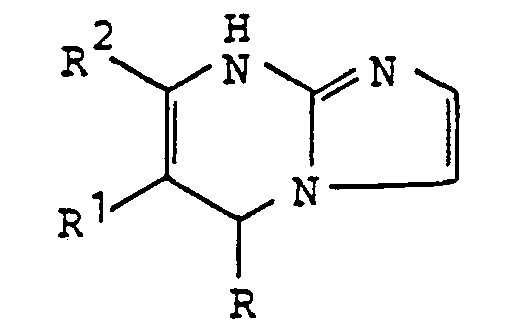
- the polyazaheterocycle derivative has the formula: wherein R is a hydrogen atom, a C 1-5 alkyl group (e.g. methyl, ethyl, propyl, isopropyl, butyl, isobutyl, sec-butyl, tert-butyl or pentyl), a C 3 - s cycloalkyl group (e.g.
- cyclopropyl cyclobutyl, cyclopentyl or cyclohexyl
- furyl group a thienyl group, a pyridyl group, or a phenyl group which may be optionally substituted by one or two substituents selected from the group consisting of a halogen atom (fluorine, chlorine, bromine or iodine), a C ' - 4 alkyl group (e.g. methyl, ethyl, propyl, isopropyl or butyl), a trifluoromethyl group, a C 1-4 alkoxy group (e.g.
- a phenyl-C 1-3 alkyl-oxy group e.g. benzyloxy, phenylethoxxy or phenylpropoxy
- a C 1-4 alkyl-thio group e.g. methylthio, ethylthio, propylthio or butylthio
- a phenyl-C 1-3 alkyl-thio group e.g. benzylthio, phenylethylthio or phenylpropylthio
- a C 1-4 alkanoyl group e.g. acetyl, propionyl or butyryl
- a benzoyl group a hydroxyl group, an amino group, a nitro group and a cyano group
- R' is a hydrogen atom; a cyano group; a carbamoyl group; a carboxyl group; a C 1-4 alkoxy-carbonyl group (e.g. methoxycarbonyl, ethoxycarbonyl, propoxycarbonyl or tert-butoxycarbonyl) which may be optionally substituted in the alkoxy moiety by one or two substituents selected from the group consisting of a C 1-4 alkoxy group (e.g.
- Ra' and Rb' is a C 1-4 alkyl group (e.g. methyl, ethyl, propyl, isopropyl, butyl or tert-butyl) or a phenyl-C 1-3 alkyl group (e.g.
- benzyl, phenylether or phenylpropyl), or Ra' and Rb 1 together with the adjacent nitrogen atom form a 5- to 7-membered heterocycle selected from the group consisting of pyrrolidine, piperidine, morpholine, piperazine, N-methylpiperazine, N-(2-hydroxyethyl)piperazine, azepine and diazepine], a nitro group, a phenyl group and a heteroaryl group selected from the group consisting of thienyl, furyl and pyridyl; or a C 2 - 6 alkanoyl group selected from the group consisting of acetyl, propionyl, butyryl, isobutyryl, valeryl, isovaleryl, pivaloyl and hexanoyl;
- R 2 is a C 1-5 alkyl group (e.g. methyl, ethyl, propyl, isopropyl, butyl, isobutyl, sec-butyl, tert-butyl or pentyl), a hydroxy-C 1-4 alkyl group (e.g. hydroxymethyl, hydroxyethyl, hydroxypropyl or hydroxybutyl), an acetoxy-C i - 4 alkyl group (e.g. acetoxymethyl, acetoxyethyl, acetoxypropyl or acetoxybutyl), a halo-C 1-4 alkyl group (e.g.
- fluoromethyl chloromethyl, bromomethyl, iodomethyl, fluoroethyl, chloroethyl, fluoropropyl, chloropropyl, fluorobutyl or chlorobutyl
- a dihalo-C 1 - 4 alkyl group e.g. difluoromethyl, dichloromethyl, dibromomethyl, difluoroethyl, dichloroethyl, difluoropropyl, dichloropropyl, difluorobutyl or dichlorobutyl
- a trifluoromethyl group e.g.
- methylthiocarbamoyloxymethyl ethylthiocarbamoyloxymethyl, propylthiocarbamoyloxymethyl, butylthiocarbamoyloxymethyl, methylthiocarbamoyloxyethyl, ethylthio- carbamoyloxyethyl, methylthiocarbamoyloxypropyl, ethylthiocarbamoyloxypropyl, methylthiocarbamoyl- oxybutyl or ethylthiocarbamoyloxybutyl), a formyl group, a hydroxyiminomethyl group or a cyano group; and
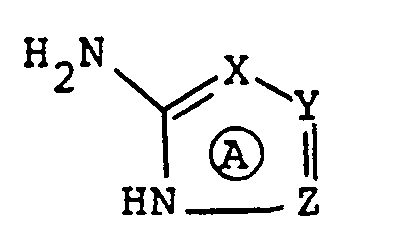
- Each of X, Y and Z is a member of the ring A, represents N or CH and forms tetrazolo-, triazolo-, imidazo- or pyrazolo-ring.
- the ring in the formula (I) and in the specification of the present invention represented by the formula: means a 4,7-dihydrotetrazolo[1,5-a]pyrimidine of the formula (a): a 4,7-dihydrotriazolo[1,5-a]pyrimidine of the formula (b): a 5,8-dihydroimidazo[1,2-a]pyrimidine of the formula (): a 1,4-dihydroimidazo[1,5-pyrimidine of the formula (d): or a 4,7-dihydropyrazolo[1,5-a]pyrimidine of the formula (e):
- the compounds of formula (I) of the present invention can be, for example, prepared by the following methods.
- any invert solvent can be employed as a suitable solvent in the methods (1 )-(4), and includes, for example, a lower alkanol (e.g. methanol, ethanol, propanol, isopropanol, butanol, tert-butanol or ethylene glycol), an aromatic hydrocarbon (e.g. benzene, toluene or xylene), an ether (e.g. diethyl ether, diisopropyl ether, dimethoxyethane, diethylene glycol dimethyl ether, tetrahydrofuran or dioxane), a halogenated lower alkane (e.g.
- a lower alkanol e.g. methanol, ethanol, propanol, isopropanol, butanol, tert-butanol or ethylene glycol
- aromatic hydrocarbon e.g. benzene, toluene or xylene
- an ether
- dichloromethane dichloroethane, chloroform or tetrachloromethane
- an acid amide e.g. dimethylformamide, N-methylpyrrolidone or hexamethylphosphoro triamide
- a lower alkanecarboxylic acid or an ester thereof e.g. formic acid, acetic acid, propionic acid, methyl acetate, ethyl acetate, butyl acetate or methyl propionate
- a nitrated lower alkane e.g. nitromethane or nitroethane
- dimethylsulfoxide sulforane, water, or a mixture thereof.
- the reactions of the methods (1 )-(4) perform at a temperature under 200°C, and preferably at a temperature of from room temperature to 150°C.
- the usual manners of organic chemical synthesis in the method (5) include, for example, formation of an aldehyde, a ketone, a carboxylic acid or an alcohol by hydrolysis of an acetal, a ketal or an ester in the presence of an acid or a base catalyst; formation of an aldehyde, a ketone, a carboxylic acid or an alcohol by removal of the protective group from the protected aldehyde, ketone, carboxylic acid or alcohol; formation of an oxime from an aldehyde or a ketone; reduction of an aldehyde or a nitro to an alcohol or an amine; formation of a nitrile by dehydration of an oximde or an amide; halogenation of an alkyl; acetoxylation of a haloalkyl; and formation of an urethane from an alcohol and an isocyanate.
- the compounds of formula (I) having an asymmetric carbon atom can be prepared as a racemate or an optically active isomer.
- the racemate can be divided into a desired optical isomer by means of a fractional recrystallization of a salt with an optically active acid.
- the compounds of formula (I) having at least two asymmetric carbon atoms can be prepared as an individual diastereomer or a mixture thereof.
- the individual diastereomer can be purified by means of fractional recrystallization or chromatography.
- syn- and anti-stereoisomers can exist in the compound (I) having an oxime of the present invention.
- the compounds of the present invention also include the syn- and anti-forms.
- the compounds of formula (I), optical isomers thereof or diastereomers thereof can, if desired, be converted into acid addition salts thereof with an inorganic acid (e.g. hydrochloric aid, hydrobromic acid, sulfuric acid or phosphoric acid), an organic acid (e.g. acetic acid, propionic acid, glycollic acid, succinic acid, maleic acid, fumaric acid, malic acid, tartaric acid, oxalic acid, citric acid, benzoic acid, cinnamic acid, mandelic aid, salicylic acid, 2-acetoxybenzoic acid, nicotinic acid or isonicotinic acid), an organic sulfonic acid (e.g.
- an inorganic acid e.g. hydrochloric aid, hydrobromic acid, sulfuric acid or phosphoric acid
- an organic acid e.g. acetic acid, propionic acid, glycollic acid, succinic acid, maleic acid, fumaric acid, malic
- the compounds (I) wherein R' is a carboxyl group can also be converted into metal salts thereof (e.g. sodium salt, potassium salt or aluminum salt) or salts with amines (e.g. a salt with triethylamine).
- metal salts thereof e.g. sodium salt, potassium salt or aluminum salt
- salts with amines e.g. a salt with triethylamine
- the compounds of the present invention exhibit antihypertensive, cardiovasodilative, cerebrovasodilative, cardiotonic and lipid peroxidation inhibiting activity as shown in the following pharmacological experiments, they are useful as drugs for the prophylaxis and the treatment of circulatory diseases such as antihypertensive agents, cardiotonics, drugs for the treatment of angina pectoris, heat failure or cardiac infarction, cerebral circulation improvers, prophylactics for the blood vessel, and so on.
- circulatory diseases such as antihypertensive agents, cardiotonics, drugs for the treatment of angina pectoris, heat failure or cardiac infarction, cerebral circulation improvers, prophylactics for the blood vessel, and so on.
- test compounds are as follows:
- test compound B Each of 30 mg/kg of test compound B was orally administered to five spontaneously hypertensive rats and the blood pressures were measured by tail cuff method.
- the mean blood pressure lowering value after 1 hour administration was 94 mmHg and that value after 5 hours administration was 47 mmHg.
- test compound on coronary blood flow was expressed as ED 50 (pg), a dose required to increase the coronary blood flow by a half of the effects of 3 pg of nifedipine (dimethyl 2,6-dimethyl-4-(2-nitrophenyl)-1,4-dihydropyridine-3,5-dicarboxylate). Each of half-life (T 1/2, minute) was measured as the duration of effects. The results are summarized in Table 1.
- the papillary muscle of the rabbit right ventricle was isolated and suspended in Krebs-Henseleit solution (consisting of 117 mM sodium chloride, 4.7 mM potassium chloride, 2.6 mM calcium chloride, 1.4 mM magnesium sulfate, 1.2 mM potassium dihydrogenphosphate, 24.9 mM sodium hydrogencarbonate and 11 mM glucose).
- the solution was maintained at 35°C and equilibrated with oxygen gas containing 5% of carbonic acid gas, and then the preparations were stimulated at frequency of 0.5 Hz.
- the developed tensions were measured with a force development transducer under a preload of 0.5 g. The results are summarized in the Table 3.
- the 50% inhibitory concentration (IC 50 , ⁇ mol) of test compound on the formation of malondialdehyde was 6 umol.
- Test compound C was orally or intraperitoneally administered to ddY strain mice. All mice survived at the oral dose of 1,000 mg/kg and at the intraperitoneal dose of 250 mg/kg for five days after administration.
- the compounds of the present invention when used as drugs, can be administered in the form of powder, tablets, capsules, granules, injectable solutions, suppositories, ointments or the like by mixing with a suitable carrier, excipient, diluent or the like.
- a suitable carrier excipient, diluent or the like.
- the dose for human adults usually ranges from 10 mg to 500 mg, but it may vary depending upon the age, body weight, and severity of the conditions to be treated.
- Ethyl ⁇ -acetyl- ⁇ -(3-aminopyrazol-2-ly)-[3-(2-trifluoromethylphenyl)propionate (34.5 g) is dissolved in 200 ml of chloroform and heated under reflux for 6 hours. After the reaction mixture is washed with water, dried and concentrated, the residue is purified by column chromatography on silica gel with chloroform-methanol eluents to give 24 g of the product.
- the product is crystallized from isopropylether and further recrystallized from ethanol to give 6-ethoxycarbonyl-5-methyl-7-(2-trifluoromethylphenyl)-4,7-dihydropyrazolo[1,5-a]pyrimidine, melting at 182-183°C.
- Ethyl ⁇ -acetyl-(3-(3-aminopyrazol-2-ly)-(3-(2-trifluoromethylphenyl)propionate is synthesized by the following manner.
- Ethyl ⁇ -acetyl-2-trifluoromethylcinnamate (36 g) and 10.5 g of 3-aminopyrazole are dissolved in 200 ml of ethanol, and the mixture is stirred at room temperature for 5 hours.
- the precipitated white crystals are collected by filtration to give 8.5 g of ethyl ⁇ -acetyl- ⁇ -(3-aminopyrazol-2-ly)-[3-(2-trifluoromethylphenyl)-propionate, melting at 136-137°C.
- a solution of 6.7 g of 6-ethoxycarbonyl-5,7-dimethyl-4,7-dihyydro-1,2,4-triazolo[1,5-a]pyrimidine in 40 ml of acetic acid is heated at 50°C.
- To the reaction mixture is added dropwise a solution of 4.8 g of bromine in 20 ml of acetic acid for 10 minutes, and the mixture is stirred at 50-60°C for an hour.
- the resulting mixture is poured into water, extracted with chloroform, washed with water and dried.
- the chloroform layer is purified by column chromatography on silica gel to give 0.5 g of 5-dibromomethyl-6- ethoxycarbonyl-7-methyl-4,7-dihydro-1,2,4-triazolo[1,5-a]pyrimidine, melting at 170-171 0 C with decomposition.
- Methyl 2-acetyl-3-(2-thienyl)acrylate was synthesized by the following manner.
- a mixture of 29.2 g of benzalacetone and 17.6 g of 3-amino-1,2,4-triazole is refluxed in 150 ml of dimethylformamide for 3 hours. On cooling at room temperature, crystals are precipitated and collected by filtration. The crystals are recrystallized from dimethylformamide to give 17 g of 5-methyl-7-phenyl-4,7-dihydro-1,2,4-triazole[1,5-a]pyrimidine, melting at 220-222°C.
- the crystals are recrystallized from a mixture of methanol and chloroform to give 5.5 g of 6-(2-methoxyethoxycarbonyl)-7-methyl-5-(2-trifluoromethylphenyl)-5,8-dihydroimidazo[1,2-a]pyrimidine, melting at 181-182°C.
- a mixture of 12.2 g of 2-trifluromethylbenzaldehyde, 11.2 g of 2-methoxyethyl acetoacetate, 1 ml of piperidine, 2 ml of acetic acid and 150 ml of benzene is refluxed under the condition of azeotropic dehydration for 3.5 hours.
- the solvent is distilled off under reduced pressure to give red brown oil.
- the oil is distilled off under reduced pressure to give 15.5 g of 2-methoxyethyl a-acetyl-2-trifluoromethyl- cinnamate, boling at 145--151°C/0.5 mmHg.
- Crystals are obtained by reacting 6.8 g of 2-aminoimidazole sulfate with 10.5 g of methyl 2-acetyl-3-cyclohexylacrylate in a similar manner as described in Example 13. Recrystallization from methanol gives 4.8 g of 5-cyclohexyl-6-methoxycarbonyl-7-methyl-5,8-dihydroimidazo[1,2-alpyrimidine, melting at 178°C.
- 2-aminoimidazole which is prepared from 7.9 g of 2-aminoimidazole sulfate and 2.2 g sodium hydroxide, is added 11.7 g of a-acetyl-3-nitrocrotonamide and heated under reflux for 5 hours. After cooling, the precipitated crystals are collected by filtration to give 12 g of 6-carbamoyl-7-methyl-5-(3-nitrophenyl)-5,8-dihydromidazo[1,2-a]pyrimidine, melting at 238-240°C.
- a-Acetyl-3-nitrocrotonamide is synthesized by the following manner.
- a mixture of 10 g of acetoacetamide and 15 g of 3-nitrobenzaldehyde in 100 ml of isopropanol is stirred at 35°C for 4 hours in the presence of 0.3 ml of piperidine and 0.5 ml of acetic acid.
- the precipitated yellow crystals are collected by filtration to give 20 g of a-acetyl-3-nitrocrotonamide, melting at 159-161°C.
- Ethyl 4,4-dimethoxy-2-(3-nitrobenzylidene)-3-oxobutylate is synthesized by the following manner.
- the crystals are recrystallized from a mixture of chloroform and methanol to give 2.0 g of 6-ethoxycarbonyl-7-hydroxyiminomethyl-5-(3-nitrophenyl)-5,8-dihydroimidazo[1,2-a]pyrimidine, melting at 229-230°C with decomposition.
- the precipitated crystals are collected by filtration and recrystallized from ethanol to give 0.32 g of 8-carboxy-3-ethoxycarbonyl-2-methyl-4-(3-nitrophenyl)-1,4-dihydroimidazo[1,5-a]pyrimidine, melting at 222°C with decomposition.
Landscapes
- Health & Medical Sciences (AREA)
- Organic Chemistry (AREA)
- Chemical & Material Sciences (AREA)
- Engineering & Computer Science (AREA)
- Bioinformatics & Cheminformatics (AREA)
- Cardiology (AREA)
- Life Sciences & Earth Sciences (AREA)
- Pharmacology & Pharmacy (AREA)
- Medicinal Chemistry (AREA)
- Nuclear Medicine, Radiotherapy & Molecular Imaging (AREA)
- Chemical Kinetics & Catalysis (AREA)
- Heart & Thoracic Surgery (AREA)
- Animal Behavior & Ethology (AREA)
- General Chemical & Material Sciences (AREA)
- General Health & Medical Sciences (AREA)
- Public Health (AREA)
- Veterinary Medicine (AREA)
- Hospice & Palliative Care (AREA)
- Urology & Nephrology (AREA)
- Vascular Medicine (AREA)
- Nitrogen Condensed Heterocyclic Rings (AREA)
- Pharmaceuticals Containing Other Organic And Inorganic Compounds (AREA)
Abstract
Claims (10)






Priority Applications (1)
| Application Number | Priority Date | Filing Date | Title |
|---|---|---|---|
| AT85901549T ATE56450T1 (de) | 1984-03-12 | 1985-03-07 | Polyazaheterozyklische abkoemmlinge, verfahren zu deren herstellung sowie arzneimittelzusammensetzung. |
Applications Claiming Priority (2)
| Application Number | Priority Date | Filing Date | Title |
|---|---|---|---|
| JP59047357A JPS60193990A (ja) | 1984-03-12 | 1984-03-12 | 新規なポリアザ複素環誘導体 |
| JP47357/84 | 1984-03-12 |
Publications (3)
| Publication Number | Publication Date |
|---|---|
| EP0183848A1 EP0183848A1 (fr) | 1986-06-11 |
| EP0183848A4 EP0183848A4 (fr) | 1987-10-27 |
| EP0183848B1 true EP0183848B1 (fr) | 1990-09-12 |
Family
ID=12772879
Family Applications (1)
| Application Number | Title | Priority Date | Filing Date |
|---|---|---|---|
| EP85901549A Expired - Lifetime EP0183848B1 (fr) | 1984-03-12 | 1985-03-07 | Derives polyazaheterocycliques, leur procede de preparation et composition pharmaceutique |
Country Status (4)
| Country | Link |
|---|---|
| EP (1) | EP0183848B1 (fr) |
| JP (1) | JPS60193990A (fr) |
| DE (1) | DE3579673D1 (fr) |
| WO (1) | WO1985004172A1 (fr) |
Families Citing this family (14)
| Publication number | Priority date | Publication date | Assignee | Title |
|---|---|---|---|---|
| US4918074A (en) * | 1984-03-12 | 1990-04-17 | Yoshitomi Pharmaceutical Industries, Ltd. | Polyazaheterocycle compounds |
| EP0217142A3 (fr) * | 1985-09-30 | 1988-01-07 | Yoshitomi Pharmaceutical Industries, Ltd. | Composé polyazahétérocyclique |
| US4746656A (en) * | 1986-07-21 | 1988-05-24 | E. R. Squibb & Sons, Inc. | 1,2,4,7-tetrahydro-2-oxopyrazolo[1,5-a]pyrimidine derivatives |
| DE3627411A1 (de) * | 1986-08-13 | 1988-02-18 | Bayer Ag | Triazolo-pyrimidin-2-sulfonamide |
| CA2057089A1 (fr) * | 1990-12-07 | 1992-06-08 | Eric E. Allen | Derives de substitution de pyrazolopyrimidines and d'imidazopyridazines, antagonistes de l'angiotensine ii |
| US5260285A (en) * | 1990-12-07 | 1993-11-09 | Merck & Co., Inc. | Substituted imidazopyridazines as angiotensin II antagonists |
| US5250521A (en) * | 1990-12-07 | 1993-10-05 | Merck & Co., Inc. | Substituted pyrazolopyrimidines as angiotensin II antagonists |
| US6538000B1 (en) | 1999-11-19 | 2003-03-25 | Abbott Laboratories | Tricyclic dihydropyrimidine potassium channel openers |
| US6274587B1 (en) | 1999-11-19 | 2001-08-14 | Abbott Laboratories | Tricyclic dihydropyrimidine potassium channel openers |
| MY125533A (en) | 1999-12-06 | 2006-08-30 | Bristol Myers Squibb Co | Heterocyclic dihydropyrimidine compounds |
| US7772232B2 (en) | 2004-04-15 | 2010-08-10 | Bristol-Myers Squibb Company | Quinazolinyl compounds as inhibitors of potassium channel function |
| US20090012103A1 (en) | 2007-07-05 | 2009-01-08 | Matthew Abelman | Substituted heterocyclic compounds |
| RU2537295C1 (ru) * | 2013-11-01 | 2014-12-27 | Общество с ограниченной ответственностью "Уральский центр биофармацевтических технологий" | 4-(2-ГИДРОКСИЭТОКСИ)МЕТИЛ)-5-МЕТИЛ-2-МЕТИЛМЕРКАПТО-1,2,4-ТРИАЗОЛО[1,5-a]ПИРИМИДИН-7(4Н)-ОН - ВЕЩЕСТВО, ОБЛАДАЮЩЕЕ ПРОТИВОВИРУСНЫМ ДЕЙСТВИЕМ, СПОСОБ ЕГО ПОЛУЧЕНИЯ И ПРИМЕНЕНИЕ ПРОТИВ ВОЗБУДИТЕЛЯ ЛИХОРАДКИ ЗАПАДНОГО НИЛА |
| RU2654463C1 (ru) * | 2017-04-21 | 2018-05-18 | Федеральное государственное бюджетное учреждение науки Институт органического синтеза им. И.Я. Постовского Уральского отделения Российской академии наук (ИОС УрО РАН) | Энантиомеры 6-этоксикарбонил-7-(тиен-2-ил)-5-метил-4,7-дигидро-1,2,4-триазоло[1,5-а]пиримидина и 6-этоксикарбонил-7-фенил-5-метил-4,7-дигидро-1,2,4-триазоло[1,5-а]пиримидина, обладающие туберкулостатической активностью |
Family Cites Families (4)
| Publication number | Priority date | Publication date | Assignee | Title |
|---|---|---|---|---|
| US3920654A (en) * | 1974-03-14 | 1975-11-18 | Dow Chemical Co | Methyl-(4-methylphenyl)-substituted-tetra-zolo(1,5-a)pyrimidine |
| JPS54160745A (en) * | 1978-06-06 | 1979-12-19 | Mochida Pharm Co Ltd | Circulatory disease treating agent |
| DE3124718A1 (de) * | 1981-06-24 | 1983-01-13 | Boehringer Ingelheim KG, 6507 Ingelheim | Neue imidazo (1,2-a)pyramidine, deren saeureadditionssalze, diese enthaltende arzneimittel und verfahren zu deren herstellung |
| JPH0576086A (ja) * | 1991-09-11 | 1993-03-26 | Matsushita Electric Ind Co Ltd | 通信装置 |
-
1984
- 1984-03-12 JP JP59047357A patent/JPS60193990A/ja active Granted
-
1985
- 1985-03-07 DE DE8585901549T patent/DE3579673D1/de not_active Expired - Lifetime
- 1985-03-07 EP EP85901549A patent/EP0183848B1/fr not_active Expired - Lifetime
- 1985-03-07 WO PCT/JP1985/000115 patent/WO1985004172A1/fr not_active Ceased
Also Published As
| Publication number | Publication date |
|---|---|
| JPH0417198B2 (fr) | 1992-03-25 |
| EP0183848A1 (fr) | 1986-06-11 |
| JPS60193990A (ja) | 1985-10-02 |
| WO1985004172A1 (fr) | 1985-09-26 |
| EP0183848A4 (fr) | 1987-10-27 |
| DE3579673D1 (de) | 1990-10-18 |
Similar Documents
| Publication | Publication Date | Title |
|---|---|---|
| RU2007403C1 (ru) | Способ получения пиразолпиридинового производного или его соли | |
| US5502187A (en) | Pharmaceutically active bicyclic-heterocyclic amines | |
| US5250534A (en) | Pyrazolopyrimidinone antianginal agents | |
| JPH0770128A (ja) | ピラゾロピリミジノン誘導体 | |
| WO1996028429A1 (fr) | PYRAZOLO [3,4-d] PYRIMIDIN-4-ONE A SUBSTITUTION EN POSITION 6 ET LEURS COMPOSITIONS ET PROCEDES D'UTILISATION | |
| AU708809B2 (en) | 6-aryl pyrazolo{3,4-d}pyrimidin-4-ones and compositions and methods of use thereof | |
| CZ210992A3 (en) | Pyrazolopyrimidine compounds, process of their preparation and use | |
| WO1994005661A1 (fr) | Agents antiangineux a la pyridopyrimidinone | |
| SK67699A3 (en) | Novel substituted pyrazole derivatives for the treatment of cardiocirculatory diseases | |
| EP0758653A1 (fr) | Derives d'imidazoquinazoline | |
| EP0183848A1 (fr) | Derives polyazaheterocycliques, leur procede de preparation et composition pharmaceutique | |
| US5840895A (en) | Triazole intermediates for tricyclic benzazepine and benzothiazepine derivatives | |
| WO2010072823A1 (fr) | Dérivés de pyrazole[1,5a]pyridine | |
| US5231094A (en) | Triazolopyrimidines which are angiotensin II receptor antagonists and pharmaceutical compositions in which they are present | |
| FR2523582A1 (fr) | Nouvelles 1h-pyrazolo(1,5-a)pyrimidines substituees, utiles notamment comme medicaments anti-inflammatoires et analgesiques, et procede pour leur preparation | |
| BG61728B1 (bg) | 2,9-дизаместени пурин-6-они | |
| CZ195293A3 (en) | PROCESS FOR PREPARING IN 5-POSITION SUBSTITUTED PYRROLO(2,3-d) PYRIMIDINES | |
| CA1271751A (fr) | Derives de dihydro-imidazo[1,2-a]pyrimidine | |
| US4910199A (en) | Imidazo[1,2-]pyridazines for cortical cholinergic deficiencies | |
| JP2003507479A (ja) | Gaba受容体リガンドとしてのイミダゾ−トリアジン誘導体 | |
| US4269980A (en) | (Substituted-phenyl)-1,2,4-triazolo[4,3-c]pyrimidines and (substituted-phenyl)-1,2,4-triazolo[1,5-c]pyrimidines | |
| EP0217142A2 (fr) | Composé polyazahétérocyclique | |
| US20070049597A1 (en) | p38 MAP kinase inhibitors and methods for using the same | |
| US4912104A (en) | Tricyclic fused pryimidine derivatives, and their use as pharmaceuticals | |
| US4883872A (en) | 3-oxo-1,2,4-triazolo(4,3-A) pyrimidine-6-carboxylic acid esters |
Legal Events
| Date | Code | Title | Description |
|---|---|---|---|
| PUAI | Public reference made under article 153(3) epc to a published international application that has entered the european phase |
Free format text: ORIGINAL CODE: 0009012 |
|
| 17P | Request for examination filed |
Effective date: 19851108 |
|
| AK | Designated contracting states |
Kind code of ref document: A1 Designated state(s): AT BE CH DE FR GB LI NL SE |
|
| A4 | Supplementary search report drawn up and despatched |
Effective date: 19871027 |
|
| 17Q | First examination report despatched |
Effective date: 19890614 |
|
| GRAA | (expected) grant |
Free format text: ORIGINAL CODE: 0009210 |
|
| AK | Designated contracting states |
Kind code of ref document: B1 Designated state(s): AT BE CH DE FR GB LI NL SE |
|
| REF | Corresponds to: |
Ref document number: 56450 Country of ref document: AT Date of ref document: 19900915 Kind code of ref document: T |
|
| REF | Corresponds to: |
Ref document number: 3579673 Country of ref document: DE Date of ref document: 19901018 |
|
| ET | Fr: translation filed | ||
| PGFP | Annual fee paid to national office [announced via postgrant information from national office to epo] |
Ref country code: GB Payment date: 19910307 Year of fee payment: 7 |
|
| PGFP | Annual fee paid to national office [announced via postgrant information from national office to epo] |
Ref country code: FR Payment date: 19910311 Year of fee payment: 7 |
|
| PGFP | Annual fee paid to national office [announced via postgrant information from national office to epo] |
Ref country code: SE Payment date: 19910318 Year of fee payment: 7 |
|
| PGFP | Annual fee paid to national office [announced via postgrant information from national office to epo] |
Ref country code: BE Payment date: 19910321 Year of fee payment: 7 |
|
| PG25 | Lapsed in a contracting state [announced via postgrant information from national office to epo] |
Ref country code: LI Free format text: LAPSE BECAUSE OF NON-PAYMENT OF DUE FEES Effective date: 19910331 Ref country code: CH Free format text: LAPSE BECAUSE OF NON-PAYMENT OF DUE FEES Effective date: 19910331 |
|
| PGFP | Annual fee paid to national office [announced via postgrant information from national office to epo] |
Ref country code: NL Payment date: 19910331 Year of fee payment: 7 Ref country code: AT Payment date: 19910331 Year of fee payment: 7 |
|
| PGFP | Annual fee paid to national office [announced via postgrant information from national office to epo] |
Ref country code: DE Payment date: 19910430 Year of fee payment: 7 |
|
| REG | Reference to a national code |
Ref country code: CH Ref legal event code: PL |
|
| PLBE | No opposition filed within time limit |
Free format text: ORIGINAL CODE: 0009261 |
|
| STAA | Information on the status of an ep patent application or granted ep patent |
Free format text: STATUS: NO OPPOSITION FILED WITHIN TIME LIMIT |
|
| 26N | No opposition filed | ||
| PG25 | Lapsed in a contracting state [announced via postgrant information from national office to epo] |
Ref country code: GB Effective date: 19920307 Ref country code: AT Effective date: 19920307 |
|
| PG25 | Lapsed in a contracting state [announced via postgrant information from national office to epo] |
Ref country code: SE Effective date: 19920308 |
|
| PG25 | Lapsed in a contracting state [announced via postgrant information from national office to epo] |
Ref country code: BE Effective date: 19920331 |
|
| BERE | Be: lapsed |
Owner name: YOSHITOMI PHARMACEUTICAL INDUSTRIES LTD Effective date: 19920331 |
|
| PG25 | Lapsed in a contracting state [announced via postgrant information from national office to epo] |
Ref country code: NL Effective date: 19921001 |
|
| GBPC | Gb: european patent ceased through non-payment of renewal fee | ||
| NLV4 | Nl: lapsed or anulled due to non-payment of the annual fee | ||
| PG25 | Lapsed in a contracting state [announced via postgrant information from national office to epo] |
Ref country code: FR Effective date: 19921130 |
|
| PG25 | Lapsed in a contracting state [announced via postgrant information from national office to epo] |
Ref country code: DE Effective date: 19921201 |
|
| REG | Reference to a national code |
Ref country code: FR Ref legal event code: ST |
|
| EUG | Se: european patent has lapsed |
Ref document number: 85901549.7 Effective date: 19921005 |