EP0184063A2 - Méthode de positionnement de formes d'impression avant le poinçonnage des trous de positionnement ainsi que dispositif pour la mise en oeuvre du procédé - Google Patents
Méthode de positionnement de formes d'impression avant le poinçonnage des trous de positionnement ainsi que dispositif pour la mise en oeuvre du procédé Download PDFInfo
- Publication number
- EP0184063A2 EP0184063A2 EP85114625A EP85114625A EP0184063A2 EP 0184063 A2 EP0184063 A2 EP 0184063A2 EP 85114625 A EP85114625 A EP 85114625A EP 85114625 A EP85114625 A EP 85114625A EP 0184063 A2 EP0184063 A2 EP 0184063A2
- Authority
- EP
- European Patent Office
- Prior art keywords
- measuring
- marks
- printing form
- measuring marks
- printing
- Prior art date
- Legal status (The legal status is an assumption and is not a legal conclusion. Google has not performed a legal analysis and makes no representation as to the accuracy of the status listed.)
- Granted
Links
Images

Classifications
-
- G—PHYSICS
- G03—PHOTOGRAPHY; CINEMATOGRAPHY; ANALOGOUS TECHNIQUES USING WAVES OTHER THAN OPTICAL WAVES; ELECTROGRAPHY; HOLOGRAPHY
- G03F—PHOTOMECHANICAL PRODUCTION OF TEXTURED OR PATTERNED SURFACES, e.g. FOR PRINTING, FOR PROCESSING OF SEMICONDUCTOR DEVICES; MATERIALS THEREFOR; ORIGINALS THEREFOR; APPARATUS SPECIALLY ADAPTED THEREFOR
- G03F9/00—Registration or positioning of originals, masks, frames, photographic sheets or textured or patterned surfaces, e.g. automatically
-
- B—PERFORMING OPERATIONS; TRANSPORTING
- B41—PRINTING; LINING MACHINES; TYPEWRITERS; STAMPS
- B41F—PRINTING MACHINES OR PRESSES
- B41F27/00—Devices for attaching printing elements or formes to supports
- B41F27/005—Attaching and registering printing formes to supports
-
- B—PERFORMING OPERATIONS; TRANSPORTING
- B41—PRINTING; LINING MACHINES; TYPEWRITERS; STAMPS
- B41P—INDEXING SCHEME RELATING TO PRINTING, LINING MACHINES, TYPEWRITERS, AND TO STAMPS
- B41P2227/00—Mounting or handling printing plates; Forming printing surfaces in situ
- B41P2227/30—Detecting the correct position of printing plates on the cylinder
Definitions
- the invention relates to a method for positioning printing formes before punching register holes.
- Printing forms such.
- the plates are inserted and removed manually, while the punching process takes place automatically, triggered by a three-point contact system as soon as the pressure plate is in contact with the system at three points of contact.
- the register perforations of printing plates are also carried out, among other things, for the register-containing plate folding, which is required for clamping the printing plates onto the rotary machine.
- An automatic folding machine is generally used for the register-correct plate folding, which is composed of a collecting unit, a single-stroke unit and a folding unit.
- the collection unit of the machine connects to the printing plate development device, from which the plates are taken over in a straight line or with a change of direction, as required.
- the pressure plate is positioned with the help of register pins and then precisely bent.
- the punching of register perforations is generally carried out after the development of the printing plate, since punching before the development of the printing plate makes it difficult to emphasize it and may can lead to the collapse of the charging voltage as a result of leakage currents which form via the stamping from the layer of the printing plate to be developed in the direction of the rear of the printing plate. A breakdown of this charging voltage generally also leads to an undesired discharge of carrier particles from the developer.
- the deformations occur primarily because the three-point contact system of conventional plate punches aligns the pressure plate as quickly as possible and with the appropriate force in one operation in such a way that the pressure plate comes into contact with the application points.
- the object of the present invention is to provide a method and an arrangement for positioning printing plates with great accuracy, which work without mechanical deformation on the plate edges of the printing plate and at least as quickly as conventional positioning methods and plate punches.
- this object is achieved in that during the exposure of the printing form, measurement marks are simultaneously exposed in a predetermined position relative to the type area of the original, which are subsequently developed with the printing form by toner, that the developed measurement marks are measured optically and that the printing form is first rough and then through the measured values received from the measuring marks are finely aligned until the measured values reach a maximum value.
- At least two measuring marks are exposed on the printing form, of which one measuring mark consists of a circular black area with a circular white area in the center and the other measuring mark consists of two lines running parallel to an edge of the printing form with a white area of 0.05 to 0.4 mm width between the lines.
- One measuring light beam expediently illuminates the two developed measuring marks, the light reflected by the measuring marks being measured and the printing form being positioned in accordance with the intensity of the reflected light until a maximum intensity of the reflected light occurs.
- a laser beam with a Gaussian intensity distribution is preferably used as the measuring light beam.
- the diameter or width is selected, the white surface of each measurement mark is equal to a beam width of the measuring light beam, between the level of the half width and the level of 1 / e2 - is intensity of the measuring light beam.
- the arrangement for carrying out the method is characterized in that a positionally stable laser, a beam splitter in the beam path of the laser for splitting the beam into two laser beams, lenses and a deflecting mirror in the beam paths of the laser beams are present are that each laser beam shines through an annular photosensitive element in the center, the photosensitive layer of which faces the printing form, and that the laser beams strike the measuring marks and are reflected by them onto the photosensitive layer of the associated annular element.
- a pressure plate 5 shown in FIG. 1 has register perforations 18, 20 and 19 along its narrow sides, which have different shapes.
- a measuring mark 21 near one of the register holes 20 consists of a circular black area of 1 to 3 mm in diameter, which has a white area of 0.05 to 0.4 mm in the center Has diameter.
- a measuring mark 22 opposite this measuring mark 21 consists of two lines of 2 to 5 mm in length which run parallel to the longitudinal edge of the printing plate 5 and which, with a width of 1 to 3 mm, include a white area of 0.05 to 0.4 mm in width. The width of the white area or the distance between the two lines of the measuring mark is equal to 22 the diameter of the white area of the other measurement mark 21.
- the measuring marks 21 and 22 are located opposite the two folding surfaces of the pressure plate 5, in which the register perforations 18, 20 and 19 are also located.
- the folding surfaces are bent in the folding unit of an automatic folding machine along the parallel lines dashed in FIG. 1 to the narrow sides of the printing plate 5, after the printing plate has previously been registered with registration pins , which enforce the register perforations 18, 20 and 19, was positioned with great accuracy.
- the measuring marks 21 and 22 are exposed in a predetermined position in relation to the type area of the original which is projected onto the charged printing plate 5, and then the printing plate 5 is developed with toner.
- the developed measuring marks 21 and 22 are then fixed and stripped and are assigned to the type area in a precise position.
- the templates for the measuring marks 21, 22 are located For example, on the glass plate of a template holder, in which the template to be exposed on the printing plate 5 is inserted. Another possibility of exposing the measuring marks is to print them onto a measuring foil or a mounting foil which is placed on the original in the original holder before exposure.
- the measuring marks 21, 22 developed are optically measured, as will be described in more detail below, in order to position the pressure plate 5 with great accuracy for punching the register perforations 18, 20 and 19, respectively.
- the printing plate 5 is initially aligned by a coarse adjustment followed by a fine adjustment which takes place on the basis of the measurement values of the reflected measurement light beams received by the measurement marks until the measurement values have reached a maximum value.
- the relationship between the circular measuring mark 21 and the intensity distribution of the measuring light beam which illuminates the measuring mark 21 will be explained with reference to FIG. 2.
- a laser beam with Gaussian intensity distribution is used as the measuring light beam which illuminates the measuring mark 21.
- the diameter d of the white area of the reference mark 21, 22 on the one hand greater than the half width of the measuring light beam and the other smaller than the width of the measuring light beam at a level which is the 1 / e2 - corresponds to the intensity of the measuring light beam.
- the reference mark 22 so that the distance and the width of the white surface between the two parallel lines of these reference mark on the one hand greater than the half width of the measuring light beam and the other smaller than the width of the measuring light beam at a level equal to the 1 / e2 - Intensity of the measuring light beam.
- a measuring light beam illuminates the two developed measuring marks 21 and 22, and the light reflected by the measuring marks is measured and the printing plate is positioned according to the intensity of the reflected light until a maximum intensity of the reflected light occurs.
- This makes use of the fact that the reflectivity of the white area of the measuring marks is approximately equal to twenty times the reflectivity of the black areas, ie the areas of the measuring marks developed with toner.
- the intensity of the reflected measuring light beam assumes a certain value, which increases with increasing proportion of the white surface in the illumination of the measuring mark or in the reflection of the light measuring beam and a maximum value achieved when the white surface of the measuring mark is centered with respect to the measuring light beam by an alignment of the printing plate and thus the measuring mark corresponding to the increase in the measured intensity of the reflected light measuring beam.
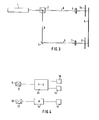
- Fig. 3 shows schematically a basic arrangement for Positioning the pressure plate 5, while in Fig. 4 details of this arrangement are shown schematically.
- the arrangement comprises a fixed laser 1, a beam splitter 2 in the beam path of the output beam of the laser 1, which splits the output beam into two initially perpendicular laser beams 6 and 8, of which the laser beam 6 is directed parallel to the other laser beam 8 by a deflecting mirror 7 becomes.
- lenses 3 and 4 which are arranged in front of ring-shaped photosensitive elements 9 and 10. These ring-shaped elements 9 and 10 are irradiated in the middle by the respective laser beam 6 and 8, respectively, and their light-sensitive layers face the printing plate 5.
- the laser beams 6 and 8 strike the measuring marks 21 and 22 and are reflected by them onto the light-sensitive layer of the associated ring-shaped element 9 and 10, respectively.
- the ring-shaped elements 9 and 10 can be photodetectors which consist of a number of photocells which are arranged in a ring around the laser beam.
- the photocells can be large-area silicon cells, for example.
- two lasers can also be provided, each of which directs a measuring light beam directly onto the printing plate 5. If there are more than two measuring marks on the printing plate 5, a corresponding number of laser beams must be provided.
- the intensity distribution in each individual laser beam is gaussian.
- the diameter of the individual measuring light beam occurring is larger than the diameter or the width of the white area of the measuring marks.
- a beam width is preferred in which the diameter or the width of the white area of the individual measurement mark intersects the measurement light beam between the i / e 2 and the half-value intensity level.
- the measuring light rays strike the pressure plate 5 perpendicularly and are arranged in a fixed position in relation to the punching tool in the folding unit of an automatic folding machine.
- the electrical outputs of the annular elements 9 and 10 are connected to current / voltage converters 11 and 12.
- the photocurrent generated by the reflected measuring light beam is converted in the respective ring-shaped photosensitive element into a direct voltage, which is fed to the control circuits 13 and 14.
- the control circuit 13 is connected to linear adjustment elements 15 and 16 for positioning the pressure plate 5 in the x and y directions.
- the control circuit 14 is connected to a rotation adjustment element 17 for positioning the pressure plate 5 by an angle of rotation V in the x-y plane.
- the linear adjustment elements and the rotation adjustment element are known components, a movement chain generally consisting of a motor, rotary encoder, reduction gear and a spindle-nut gear.
- the rough positioning of a printing plate takes place along a narrow side and a long side with an accuracy of approximately 0.2 to 0.3 mm.
- the measuring marks 21 and 22 are partially illuminated by the respective laser beam 6 and 8, respectively.
- the measuring mark 21 is first aligned with great accuracy by means of the linear adjusting elements 15 and 16, this measuring mark forming the fulcrum for the subsequent fine adjustment with the help of the rotary adjusting element 17.
- the rotation adjustment element 17 is actuated until the measuring light beam reflected by the measuring mark 22 has reached a maximum.
- the white areas of the measuring marks 21 and 22 are generally formed by the anodized aluminum of the printing plate 5, which has a reflection which is substantially higher than that of the printing plate 5, which is developed by toner. Due to the rough surface of the printing plate 5, the laser beams are reflected at different angles, so that it is ensured that the reflected laser beam strikes the associated photosensitive element 9 or 10 and is not exactly reflected back into its beam path.
- the measuring marks can also be reflected onto the printing plate 5 with the aid of suitable optics if the mounting film no longer has any space for applying the measuring marks.
- Another possibility of attaching the measuring marks is that the templates for the measuring marks to be projected onto the printing plate are on the end faces of the register pins for the print template are arranged in the template holder.
Landscapes
- Physics & Mathematics (AREA)
- General Physics & Mathematics (AREA)
- Exposure And Positioning Against Photoresist Photosensitive Materials (AREA)
Applications Claiming Priority (2)
| Application Number | Priority Date | Filing Date | Title |
|---|---|---|---|
| DE3443178 | 1984-11-27 | ||
| DE19843443178 DE3443178A1 (de) | 1984-11-27 | 1984-11-27 | Verfahren zum positionieren von druckformen vor dem stanzen von registerlochungen sowie anordnung zum durchfuehren des verfahrens |
Publications (3)
| Publication Number | Publication Date |
|---|---|
| EP0184063A2 true EP0184063A2 (fr) | 1986-06-11 |
| EP0184063A3 EP0184063A3 (en) | 1986-12-03 |
| EP0184063B1 EP0184063B1 (fr) | 1990-01-17 |
Family
ID=6251251
Family Applications (1)
| Application Number | Title | Priority Date | Filing Date |
|---|---|---|---|
| EP85114625A Expired - Lifetime EP0184063B1 (fr) | 1984-11-27 | 1985-11-18 | Méthode de positionnement de formes d'impression avant le poinçonnage des trous de positionnement ainsi que dispositif pour la mise en oeuvre du procédé |
Country Status (4)
| Country | Link |
|---|---|
| EP (1) | EP0184063B1 (fr) |
| JP (1) | JPS61143759A (fr) |
| AU (2) | AU596568B2 (fr) |
| DE (2) | DE3443178A1 (fr) |
Cited By (3)
| Publication number | Priority date | Publication date | Assignee | Title |
|---|---|---|---|---|
| EP0298642A3 (en) * | 1987-07-06 | 1989-04-26 | American Telephone And Telegraph Company | Method for aligning photomasks |
| EP0357961A3 (fr) * | 1988-08-10 | 1991-11-13 | ROOSEN, Reiner | Procédé et dispositif pour perçer des trous dans un plateau-presse |
| EP1138485A3 (fr) * | 2000-03-29 | 2003-08-20 | Koenig & Bauer Aktiengesellschaft | Méthode et dispositif d'accrochage en réglage du registre sécurisee d'une plaque d'impression sur le cylindre porte-plaque d'une machine à imprimer des feuilles |
Families Citing this family (5)
| Publication number | Priority date | Publication date | Assignee | Title |
|---|---|---|---|---|
| JPH0778633B2 (ja) * | 1987-02-12 | 1995-08-23 | 有限会社加茂電機研究所 | 刷版に印刷機へのセット用u字形切り込みを形成するためのレジスタパンチャ |
| JPH0520623U (ja) * | 1991-09-02 | 1993-03-19 | アツプリカ▲葛▼西株式会社 | ウエストバツグ |
| JPH0626547U (ja) * | 1992-08-07 | 1994-04-12 | リョービ株式会社 | ウエストバッグ |
| DE19919263B4 (de) * | 1999-04-09 | 2005-09-29 | Ronald Metje | Bearbeitungsvorrichtung zum Zurichten von Druckplatten für Druckmaschinen |
| DE102004024442B4 (de) * | 2004-05-14 | 2006-05-04 | Koenig & Bauer Ag | Verfahren zur Herstellung einer Druckform |
Family Cites Families (9)
| Publication number | Priority date | Publication date | Assignee | Title |
|---|---|---|---|---|
| JPS5114921B2 (fr) * | 1972-10-02 | 1976-05-13 | ||
| JPS5533146A (en) * | 1978-08-30 | 1980-03-08 | Dainippon Screen Mfg Co Ltd | Photoelectric element for detecting and positioning register mark for engraving |
| JPS55108666A (en) * | 1979-02-14 | 1980-08-21 | Dainippon Screen Mfg Co Ltd | Method and apparatus for automatic matching of image pattern |
| DE3116634A1 (de) * | 1981-04-27 | 1982-11-11 | Karl Süss KG, Präzisionsgeräte für Wissenschaft und Industrie - GmbH & Co, 8046 Garching | Vorrichtung zum automatischen justieren von ebenen gegenstaenden mit zwei bezugspunkten, insbesondere bei der herstellung von halbleiterbauelementen |
| DE3206119A1 (de) * | 1982-02-19 | 1983-09-01 | Krause Biagosch GmbH, 4800 Bielefeld | Vorrichtung zur herstellung von druckplatten |
| US4522903A (en) * | 1982-06-11 | 1985-06-11 | E. I. Du Pont De Nemours And Company | Sequential automatic registration and imagewise exposure of a sheet substrate |
| BR8302994A (pt) * | 1982-06-11 | 1984-01-31 | Du Pont | Processo de exposicao para formacao de imagem a radiacao actinica |
| US4508802A (en) * | 1982-06-11 | 1985-04-02 | E. I. Du Pont De Nemours And Company | Multiple registration and imaging process to form a set of registered imaged elements |
| JPS5928160A (ja) * | 1982-08-07 | 1984-02-14 | Dainippon Printing Co Ltd | 見当合せ用マ−クの形成方法 |
-
1984
- 1984-11-27 DE DE19843443178 patent/DE3443178A1/de not_active Withdrawn
-
1985
- 1985-11-18 DE DE8585114625T patent/DE3575481D1/de not_active Expired - Fee Related
- 1985-11-18 EP EP85114625A patent/EP0184063B1/fr not_active Expired - Lifetime
- 1985-11-22 AU AU50298/85A patent/AU596568B2/en not_active Ceased
- 1985-11-26 JP JP60263967A patent/JPS61143759A/ja active Pending
-
1990
- 1990-02-19 AU AU49912/90A patent/AU4991290A/en not_active Abandoned
Cited By (3)
| Publication number | Priority date | Publication date | Assignee | Title |
|---|---|---|---|---|
| EP0298642A3 (en) * | 1987-07-06 | 1989-04-26 | American Telephone And Telegraph Company | Method for aligning photomasks |
| EP0357961A3 (fr) * | 1988-08-10 | 1991-11-13 | ROOSEN, Reiner | Procédé et dispositif pour perçer des trous dans un plateau-presse |
| EP1138485A3 (fr) * | 2000-03-29 | 2003-08-20 | Koenig & Bauer Aktiengesellschaft | Méthode et dispositif d'accrochage en réglage du registre sécurisee d'une plaque d'impression sur le cylindre porte-plaque d'une machine à imprimer des feuilles |
Also Published As
| Publication number | Publication date |
|---|---|
| DE3575481D1 (de) | 1990-02-22 |
| AU596568B2 (en) | 1990-05-10 |
| JPS61143759A (ja) | 1986-07-01 |
| AU5029885A (en) | 1986-06-05 |
| EP0184063A3 (en) | 1986-12-03 |
| AU4991290A (en) | 1990-06-21 |
| EP0184063B1 (fr) | 1990-01-17 |
| DE3443178A1 (de) | 1986-05-28 |
Similar Documents
| Publication | Publication Date | Title |
|---|---|---|
| DE19829986C1 (de) | Verfahren zur Direktbelichtung von Leiterplattensubstraten | |
| EP0002668B1 (fr) | Dispositif de mesure optique de la distance | |
| DE3874028T2 (de) | Verfahren zur justierung von photomasken. | |
| EP0173849A2 (fr) | Lithographie par rayon laser | |
| DE3438949C2 (de) | Druckvorrichtung | |
| DE68901933T2 (de) | Vorrichtung zur lagefeststellung. | |
| DE2557675A1 (de) | Verfahren zur ausrichtung zweier planarer werkstuecke, z.b. einer maske zu einem wafer oder umgekehrt | |
| DE69000140T2 (de) | Schleifbearbeitungsverfahren mit messung einer formschleifscheibe und maschine zu dessen durchfuehrung. | |
| DE102019208936A1 (de) | Laserbearbeitungsvorrichtung | |
| EP0184063B1 (fr) | Méthode de positionnement de formes d'impression avant le poinçonnage des trous de positionnement ainsi que dispositif pour la mise en oeuvre du procédé | |
| DE19613561A1 (de) | Verfahren zum Vereinzeln von elektronischen Elementen | |
| DE4301570B4 (de) | Verfahren zur Herstellung einer Induktionsspule | |
| DE2948646C2 (de) | Projektionskopiervorrichtung | |
| DE2911458A1 (de) | Vorrichtung zur erkennung von nicht praeparierten briefmarken | |
| DE3510961A1 (de) | Justiervorrichtung | |
| DE69111361T2 (de) | Punkt-bestimmtes Belichtungssystem für einen Laserdrucker. | |
| DE69521779T2 (de) | Beleuchtungsvorrichtung zum Beleuchten von linienförmigen Bereichen | |
| EP0482240A1 (fr) | Procédé pour le façonnage précis de pièces à usiner plates ou légèrement courbées | |
| EP0080651A1 (fr) | Procédé pour ajuster le système de référence d'un appareil à laser travaillant en mode impulsionnel géant | |
| DE3033846A1 (de) | Stanzvorrichtung zur justierung von filmen, druckplatten u.dgl. | |
| DE4022904A1 (de) | Verfahren zum anbringen einer die orientierung des kristallgitters einer kristallscheibe angebenden markierung | |
| DE2018725A1 (de) | Verfahren und Vorrichtung zur Herstel-IHBf Hugn§sMtirc-r§rr8o"!; Culver City, Calif. (V.St.A.) | |
| DE102015222440A1 (de) | Laseroszillationsmechanismus | |
| DE4007716A1 (de) | Verfahren und vorrichtung zur erstellung einer kopiervorlage | |
| DE2306290A1 (de) | Verfahren zur vorbereitung einer druckplatte bzw. -form fuer die genaue registerhaltige anbringung an einer druckmaschine |
Legal Events
| Date | Code | Title | Description |
|---|---|---|---|
| PUAI | Public reference made under article 153(3) epc to a published international application that has entered the european phase |
Free format text: ORIGINAL CODE: 0009012 |
|
| AK | Designated contracting states |
Kind code of ref document: A2 Designated state(s): BE DE FR GB IT NL |
|
| PUAL | Search report despatched |
Free format text: ORIGINAL CODE: 0009013 |
|
| RHK1 | Main classification (correction) |
Ipc: G03F 9/00 |
|
| AK | Designated contracting states |
Kind code of ref document: A3 Designated state(s): BE DE FR GB IT NL |
|
| 17P | Request for examination filed |
Effective date: 19870424 |
|
| 17Q | First examination report despatched |
Effective date: 19880906 |
|
| GRAA | (expected) grant |
Free format text: ORIGINAL CODE: 0009210 |
|
| AK | Designated contracting states |
Kind code of ref document: B1 Designated state(s): BE DE FR GB IT NL |
|
| REF | Corresponds to: |
Ref document number: 3575481 Country of ref document: DE Date of ref document: 19900222 |
|
| ET | Fr: translation filed | ||
| ITF | It: translation for a ep patent filed | ||
| GBT | Gb: translation of ep patent filed (gb section 77(6)(a)/1977) | ||
| PLBE | No opposition filed within time limit |
Free format text: ORIGINAL CODE: 0009261 |
|
| STAA | Information on the status of an ep patent application or granted ep patent |
Free format text: STATUS: NO OPPOSITION FILED WITHIN TIME LIMIT |
|
| 26N | No opposition filed | ||
| PGFP | Annual fee paid to national office [announced via postgrant information from national office to epo] |
Ref country code: FR Payment date: 19911022 Year of fee payment: 7 |
|
| PGFP | Annual fee paid to national office [announced via postgrant information from national office to epo] |
Ref country code: BE Payment date: 19911113 Year of fee payment: 7 |
|
| ITTA | It: last paid annual fee | ||
| PGFP | Annual fee paid to national office [announced via postgrant information from national office to epo] |
Ref country code: GB Payment date: 19921022 Year of fee payment: 8 |
|
| PG25 | Lapsed in a contracting state [announced via postgrant information from national office to epo] |
Ref country code: BE Effective date: 19921130 |
|
| PGFP | Annual fee paid to national office [announced via postgrant information from national office to epo] |
Ref country code: NL Payment date: 19921130 Year of fee payment: 8 |
|
| PGFP | Annual fee paid to national office [announced via postgrant information from national office to epo] |
Ref country code: DE Payment date: 19930116 Year of fee payment: 8 |
|
| BERE | Be: lapsed |
Owner name: HOECHST A.G. Effective date: 19921130 |
|
| PG25 | Lapsed in a contracting state [announced via postgrant information from national office to epo] |
Ref country code: FR Effective date: 19930730 |
|
| REG | Reference to a national code |
Ref country code: FR Ref legal event code: ST |
|
| PG25 | Lapsed in a contracting state [announced via postgrant information from national office to epo] |
Ref country code: GB Effective date: 19931118 |
|
| PG25 | Lapsed in a contracting state [announced via postgrant information from national office to epo] |
Ref country code: NL Effective date: 19940601 |
|
| GBPC | Gb: european patent ceased through non-payment of renewal fee |
Effective date: 19931118 |
|
| NLV4 | Nl: lapsed or anulled due to non-payment of the annual fee | ||
| PG25 | Lapsed in a contracting state [announced via postgrant information from national office to epo] |
Ref country code: DE Effective date: 19940802 |