EP0184110A2 - Verfahren zur Herstellung von Alkylthioacetamidinen - Google Patents
Verfahren zur Herstellung von Alkylthioacetamidinen Download PDFInfo
- Publication number
- EP0184110A2 EP0184110A2 EP85114962A EP85114962A EP0184110A2 EP 0184110 A2 EP0184110 A2 EP 0184110A2 EP 85114962 A EP85114962 A EP 85114962A EP 85114962 A EP85114962 A EP 85114962A EP 0184110 A2 EP0184110 A2 EP 0184110A2
- Authority
- EP
- European Patent Office
- Prior art keywords
- formula
- und
- compounds
- der formel
- given above
- Prior art date
- Legal status (The legal status is an assumption and is not a legal conclusion. Google has not performed a legal analysis and makes no representation as to the accuracy of the status listed.)
- Withdrawn
Links
Classifications
-
- C—CHEMISTRY; METALLURGY
- C07—ORGANIC CHEMISTRY
- C07C—ACYCLIC OR CARBOCYCLIC COMPOUNDS
- C07C319/00—Preparation of thiols, sulfides, hydropolysulfides or polysulfides
- C07C319/14—Preparation of thiols, sulfides, hydropolysulfides or polysulfides of sulfides
Definitions
- the invention relates to a new process for the preparation of alkylthioacetamidines from chloroacetonitrile and alkyl mercaptans in the presence of an alcoholic alcoholate solution.
- alkoxyalkyl derivatives can be prepared by reacting alcoholates with haloalkyl derivatives (see, for example, "Methods of Organic Chemistry” Volume VI / 3, p. 26, Houben-Weyl-Müller, Thieme-Verlag- Stuttgart). It is also known that alkylthioalkyl derivatives can be prepared from the corresponding alkyl mercaptans and haloalkyl derivatives (cf. e.g. "Methods of Organic Chemistry", Volume IX, p. 103, Houben-Weyl-Müller, Thieme-Verlag-Stuttgart).
- reaction for the preparation of the compounds of the formula (I) is preferably carried out without isolation of the intermediate (IV).
- the compound of formula (II) which is required as a starting material for carrying out the process according to the invention is a generally known compound of organic chemistry.
- the compounds of the formulas (III), (IV) and (V) are generally known compounds of organic chemistry.
- the process according to the invention is carried out in both reaction steps in the presence of diluents.
- Solvents which are inert under the reaction conditions are suitable as such. These include in particular alcohols, such as methanol, ethanol and n-propanol. Methanol is preferably used as the solvent.
- the process according to the invention is carried out in step (a) in the presence of catalysts.
- catalysts are: alkali metal alcoholates, such as sodium or potassium methylate and sodium or potassium ethylate. Sodium methylate or ethylate are preferably used as the catalyst.
- the process according to the invention is carried out in step (b) in the presence of acid acceptors.
- the above-mentioned alkali metal alcoholates are preferably suitable as acid acceptors.
- Sodium methylate or ethylate are preferably used as the acid acceptor.
- methanol is used when using sodium methylate and ethanol when using sodium ethylate.
- the process according to the invention is generally carried out in both stages at temperatures between -20 ° C. and + 30 ° C. , preferably between -10 ° C. and + 20 ° C.
- the reactions are preferably carried out in an inert gas atmosphere.
- Argon or nitrogen is preferably used as the inert gas. It is preferred to work in the presence of nitrogen.
- Step (b) is generally carried out at a pressure between 1 and 10 bar, preferably between 1 and 5 bar.
- step (a) When carrying out the process according to the invention, in step (a), 0.01 mol to 0.2 mol, preferably 0.05 to 0.15 mol, of catalyst and 1 to 2.00 mol, preferably 1, to 1 mol of chloroacetonitrile of the formula (II) up to 1.5 mol of ammonium halide of the formula (III) are used.
- step (b) the reaction mixture is mixed with 1 mol of acid acceptor and 1 mol of alkyl mercaptan of the formula (V).
- reaction product of the formula (I) can be worked up by customary methods.
- the reaction product is preferably used in the next reaction without further working up, if appropriate after filtering off the inorganic salts.
- the compounds of formula (I) which can be prepared by the process according to the invention are important intermediates for the synthesis of insecticides. For example, use them to produce the substituted N, N-dimethyl-0-pyrimidinyl-carbamic acid esters, compounds with high insecticidal potency (see e.g. German Offenlegungsschrift No. 2 928 185).
Landscapes
- Chemical & Material Sciences (AREA)
- Organic Chemistry (AREA)
- Organic Low-Molecular-Weight Compounds And Preparation Thereof (AREA)
- Low-Molecular Organic Synthesis Reactions Using Catalysts (AREA)
Abstract

worin
- R = Alkyl
- X = Halogen
und
- n = 0 oder 1.
- Das neue Verfahren ist dadurch gekennzeichnet, daß man
- (a) Chloracetonitril der Formel (II)


- X die oben angegebene Bedeutung hat,
in Gegenwart von Katalysatoren und in Gegenwart von Verdünnungsmitteln bei Temperaturen zwischen -20°C und +30°C zu den Chloracetamidinen der Formel (IV)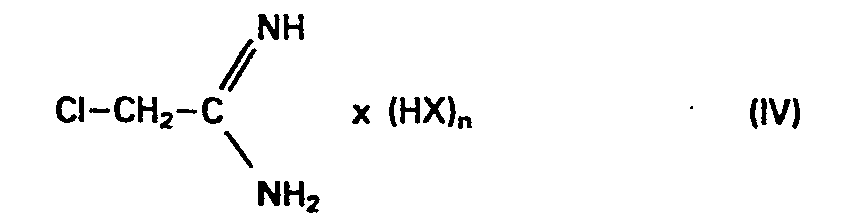
- X und n die oben angegebenen Bedeutungen haben, umsetzt und
- (b) diese Verbindungen der Formel (IV) gegebenenfalls ohne Isolierung mit Alkylmercaptanen der Formel (V)

- R die oben angegebene Bedeutung hat, in Gegenwart von Säureakzeptoren und in Gegenwart von Verdünnungsmitteln, bei Temperaturen zwischen -20°C und +30°C und einem Druck zwischen 1 und 10 bar zu den Verbindungen der Formel (I)·umsetzt.
Description
- Die Erfindung betrifft ein neues Verfahren zur Herstellung von Alkylthioacetamidinen aus Chloracetonitril und Alkylmercaptanen in Gegenwart einer alkoholischen Alkoholatlösung.
- Es ist bereits bekannt, daß man Alkoxyalkyl-Derivate herstellen kann, indem man Alkoholate mit Halogenalkyl-Derivaten umsetzt (vgl. z.B. "Methoden der organischen Chemie" Band VI/3, S. 26, Houben-Weyl-Müller, Thieme-Verlag-Stuttgart). Außerdem ist bekannt, daß man Alkylthioalkyl-Derivate aus den entsprechenden Alkylmercaptanen und Halogenalkyl-Derivaten herstellen kann (vgl. z.B. "Methoden der organischen Chemie", Band IX, S. 103, Houben-Weyl-Müller, Thieme-Verlag-Stuttgart).
- Es wurde nun gefunden, daß man Alkylthioacetamidine der Formel (I)

- R für Alkyl steht,
- X für Halogen steht und
- n für 0 oder 1 steht,
- erhält, wenn man
- (a) Chloracetonitril der Formel (II)


- X die oben angegebene Bedeutung hat,
- in Gegenwart von Katalysatoren und in Gegenwart von Verdünnungsmitteln bei Temperaturen zwischen -20°C und +30°C zu den Chloracetamidinen der Formel (IV)
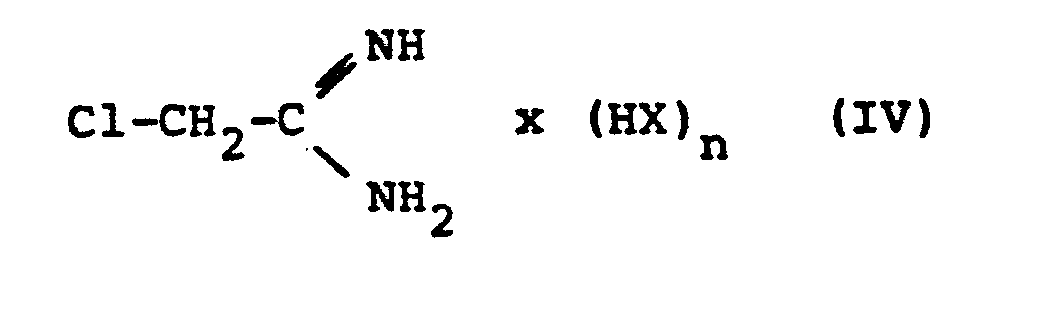
- X und n die oben angegebenen Bedeutungen haben,
umsetzt und - (b) diese Verbindungen der Formel (IV) gegebenenfalls ohne Isolierung mit Alkylmercaptanen der Formel (V)

- R die oben angegebene Bedeutung hat,
- in Gegenwart von Säureakzeptoren und in Gegenwart von Verdünnungsmitteln, bei Temperaturen zwischen -20°C und +30°C und einem Druck zwischen 1 und 10 bar zu den Verbindungen der Formel (I) umsetzt.
- Überraschenderweise ist es möglich mit Hilfe des erfindungsgemäßen Verfahrens die Umsetzung in kurzen Reaktionszeiten und mit hohen Ausbeuten durchzuführen, obwohl nach dem Stand der Technik die Bildung von Alkoxyacetamidinen im beträchtlichem Ausmaß hätte erwartet werden müssen. Als vorteilhaft erweist sich bei diesem Verfahren, daß eine Belastung der Abluft mit Alkylmercaptanen durch die Verwendung von geschlossenen Reaktoren weitgehend vermieden wird.
- Bevorzugt wird die Umsetzung zur Herstellung der Verbindungen der Formel (I) ohne Isolierung der Zwischenstufe (IV) durchgeführt.
- Bevorzugt werden mit dem erfindungsgemäßen Verfahren die Verbindungen der Formel (I) hergestellt, in welcher
- R für Alkyl mit 1 bis 6 Kohlenstoffatomen steht,
- X für Chlor oder Brom steht und
- n für 0 oder 1 steht.
- Besonders bevorzugt werden mit dem erfindungsgemäßen Verfahren die Verbindungen der Formel (I) hergestellt, in welcher
- R für Methyl, Ethyl, n-Propyl, i-Propyl, n-Butyl, i-Butyl, sec.-Butyl und tert.-Butyl steht,
- X für Chlor steht und
- n für 0 oder 1 steht.
- Verwendet man für das erfindungsgemäße Verfahren Chloracetonitril, Ammoniumchlorid und Methylmercaptan als Ausgangsstoffe, so kann die Reaktion durch das folgende Formelschema wiedergegeben werden:

- Die Verbindung der Formel (II), die als Ausgangsstoff für die Durchführung des erfindungsgemäßen Verfahrens benötigt wird, ist eine allgemein bekannte Verbindung der organischen Chemie.
- Die weiterhin als Ausgangsstoffe für das erfindungsgemäße Verfahren benötigten Verbindungen sind durch die Formeln (III), (IV) und (V) allgemein definiert. In diesen Formeln stehen X und n bzw. R für diejenigen Reste, welche oben bei der Definition der Verbindungen der Formel (I) genannt sind.
- Als Beispiele für die Verbindungen der Formel (III) seien genannt:
- Ammoniumchlorid, -bromid und -iodid.
- Als Beispiele für die Verbindungen der Formel (IV) seien genannt:
- Chloracetamidin, Chloracetamidin-Hydrochlorid und Chloracetamidin-Hydrobromid.
- Als Beispiele für die Verbindungen der Formel (V) seien genannt:
- Methyl-, Ethyl-, n-Propyl-, i-Propyl-, n-Butyl-, i-Butyl-, sec.-Butyl- und tert.-Butylmercaptan.
- Die Verbindungen der Formeln (III), (IV) und (V) sind allgemein bekannte Verbindungen der organischen Chemie.
- Das erfindungsgemäße Verfahren wird in beiden Reaktionsschritten in Gegenwart von Verdünnungsmitteln durchgeführt. Als solche kommen unter den Reaktionsbedingungen inerte Lösungsmittel in Frage. Hierzu gehören insbesondere Alkohole, wie Methanol, Ethanol und n-Propanol. Bevorzugt wird Methanol als Lösungsmittel eingesetzt.
- Das erfindungsgemäße Verfahren wird in Stufe (a) in Gegenwart von Katalysatoren durchgeführt. Als Katalysatoren kommen vorzugsweise in Frage: Alkalialkoholate, wie Natrium- oder Kaliummethylat und Natrium- oder Kaliumethylat. Bevorzugt werden Natriummethylat oder -ethylat als Katalysator eingesetzt.
- Das erfindungsgemäße Verfahren wird in Stufe (b) in Gegenwart von Säureakzeptoren durchgeführt. Als Säureakzeptoren kommen vorzugsweise die obengenannten Alkalialkoholate in Betracht. Bevorzugt werden Natriummethylat oder -ethylat als Säureakzeptor eingesetzt. Als Verdünnungsmittel wird beim Einsetzen von Natriummethylat Methanol, und beim Einsatz von Natriumethylat Ethanol eingesetzt.
- Das erfindungsgemäBe Verfahren wird in beiden Stufen im allgemeinen bei Temperaturen zwischen -20°C und +30°C, vorzugsweise zwischen -10°C und +20°C durchgeführt. Die Reaktionen werden vorzugsweise in einer Inertgasatmosphäre durchgeführt. Als Inertgas kommt vorzugsweise Argon oder Stickstoff in Betracht. Bevorzugt wird in Gegenwart von Stickstoff gearbeitet.
- Das erfindungsgemäße Verfahren wird in Stufe (a) bevorzugt unter Normaldruck durchgeführt. Stufe (b) wird im allgemeinen bei einem Druck zwischen 1 und 10 bar, vorzugsweise zwischen 1 und 5 bar durchgeführt.
- Bei der Durchführung des erfindungsgemäßen Verfahrens wird in Stufe (a) auf 1 Mol Chloracetonitril der Formel (II) 0,01 bis 0,2 Mol, vorzugsweise 0,05 bis 0,15 Mol Katalysator und 1 bis 2,00 Mol, vorzugsweise 1 bis 1,5 Mol Ammoniumhalogenid der Formel (III) eingesetzt. Zur weiteren Umsetzung entsprechend Stufe (b) wird das Reaktionsgemisch versetzt mit 1 Mol Säureakzeptor und 1 Mol Alkylmercaptan der Formel (V).
- Das Reaktionsprodukt der Formel (I) kann nach üblichen Methoden aufgearbeitet werden. Vorzugsweise wird das Reaktionsprodukt, gegebenenfalls nach Abfiltrieren der anorganischen Salze, ohne weitere Aufarbeitung in die nächste Umsetzung eingesetzt.
- Die nach dem erfindungsgemäßen Verfahren herstellbaren Verbindungen der Formel (I) sind wichtige Zwischenprodukte für die Synthese von Insektiziden. So lassen sich z.B. aus ihnen die substituierten N,N-Dimethyl-0-pyrimidinyl-carbaminsäureester, Verbindungen mit hoher insektizider Potenz herstellen (vgl. z.B. Deutsche Offenlegungsschrift Nr. 2 928 185).
- Die Weiterverarbeitung der Verbindungen der Formel (I) zu bekannten Schädlingsbekämpfungsmitteln sei beispielhaft anhand des folgenden Schemas verdeutlicht:

-

- Zu einer Mischung aus 100 kg Methanol (3125 Mol) und 4 kg (74 Mol) Natriummethylat werden bei 0°C bis 5°C 113 kg (1496 Mol) Chloracetonitril gegeben. Es wird 30 Minuten bei 0°C bis 5°C nachgerührt und anschließend mit 87,5 kg (1636 Mol) Ammoniumchlorid bei 0°C bis 5°C versetzt. Bei gleicher Temperatur wird erneut 30 Minuten nachgerührt, mit 316 kg 25 %ige methanolischer Natriummethylatlösung versetzt und anschließend werden 76 kg (1575 Mol) Methylmercaptan in den geschlossenen Reaktor gedrückt. Das Reaktionsgemisch wird 30 Minuten bei 0°C bis 5°C nachgerührt und vom Feststoff abfiltriert. Die gesamte Umsetzung wird unter Stickstoffatmosphäre durchgeführt. Aus dem Filtrat wird Methanol destillativ entfernt und das Reaktionsprodukt aus Aceton umkristallisiert.
- Man erhält auf diese Weise 190 kg (90 % der Theorie) 2-Methylthio-acetamidin-Hydrochlorid vom Schmelzpunkt 70°C.
Claims (10)




umsetzt und

und
und

dadurch gekennzeichnet, daß man Chloracetamidine der Formel (IV)


Applications Claiming Priority (2)
| Application Number | Priority Date | Filing Date | Title |
|---|---|---|---|
| DE19843444494 DE3444494A1 (de) | 1984-12-06 | 1984-12-06 | Verfahren zur herstellung von alkylthioacetamidinen |
| DE3444494 | 1984-12-06 |
Publications (2)
| Publication Number | Publication Date |
|---|---|
| EP0184110A2 true EP0184110A2 (de) | 1986-06-11 |
| EP0184110A3 EP0184110A3 (de) | 1987-01-28 |
Family
ID=6252050
Family Applications (1)
| Application Number | Title | Priority Date | Filing Date |
|---|---|---|---|
| EP85114962A Withdrawn EP0184110A3 (de) | 1984-12-06 | 1985-11-26 | Verfahren zur Herstellung von Alkylthioacetamidinen |
Country Status (7)
| Country | Link |
|---|---|
| US (1) | US4713490A (de) |
| EP (1) | EP0184110A3 (de) |
| JP (1) | JPS61140559A (de) |
| DE (1) | DE3444494A1 (de) |
| DK (1) | DK564985A (de) |
| HU (1) | HUT41380A (de) |
| ZA (1) | ZA859317B (de) |
Families Citing this family (1)
| Publication number | Priority date | Publication date | Assignee | Title |
|---|---|---|---|---|
| US8323918B2 (en) * | 2008-12-12 | 2012-12-04 | University Of South Carolina | Chloroacetamidine based inhibitors and activity based probes for the protein arginine methytransferases |
Family Cites Families (6)
| Publication number | Priority date | Publication date | Assignee | Title |
|---|---|---|---|---|
| US2147400A (en) * | 1937-04-02 | 1939-02-14 | Sharples Solvents Corp | Manufacture of hydrocarbon compounds containing sulphur |
| US2252723A (en) * | 1938-05-11 | 1941-08-19 | Ciba Pharm Prod Inc | Halogen-alkyl amidines and process of preparing same |
| NL302936A (de) * | 1963-01-24 | |||
| US3728389A (en) * | 1969-12-15 | 1973-04-17 | Burroughs Wellcome Co | Biologically active amidines and their preparation |
| DE2746057A1 (de) * | 1977-10-13 | 1979-04-26 | Basf Ag | Neue phosphor(phosphon)-saeureester |
| DE2928185A1 (de) * | 1979-07-12 | 1981-01-29 | Bayer Ag | N,n-dimethyl-o-pyrimidinyl-carbaminsaeureester, verfahren zu ihrer herstellung und ihre verwendung als schaedlingsbekaempfungsmittel |
-
1984
- 1984-12-06 DE DE19843444494 patent/DE3444494A1/de not_active Withdrawn
-
1985
- 1985-11-26 EP EP85114962A patent/EP0184110A3/de not_active Withdrawn
- 1985-11-27 US US06/802,799 patent/US4713490A/en not_active Expired - Fee Related
- 1985-12-02 JP JP60269537A patent/JPS61140559A/ja active Pending
- 1985-12-05 DK DK564985A patent/DK564985A/da not_active Application Discontinuation
- 1985-12-05 ZA ZA859317A patent/ZA859317B/xx unknown
- 1985-12-05 HU HU854659A patent/HUT41380A/hu unknown
Also Published As
| Publication number | Publication date |
|---|---|
| DE3444494A1 (de) | 1986-06-19 |
| EP0184110A3 (de) | 1987-01-28 |
| DK564985D0 (da) | 1985-12-05 |
| JPS61140559A (ja) | 1986-06-27 |
| ZA859317B (en) | 1986-08-27 |
| DK564985A (da) | 1986-06-07 |
| HUT41380A (en) | 1987-04-28 |
| US4713490A (en) | 1987-12-15 |
Similar Documents
| Publication | Publication Date | Title |
|---|---|---|
| WO1998023570A1 (de) | VERFAHREN ZUR HERSTELLUNG η, δ-UNGESÄTTIGTER KETONE DURCH UMSETZUNG TERTIÄRER ALLYLALKOHOLE MIT ALKENYLALKYLETHERN | |
| EP1247792B1 (de) | Verfahren zur Herstellung von halogensubstituierten Dibenzylalkoholen | |
| EP0132733B1 (de) | Neue Fluorpivalsäurefluoride und Verfahren zu ihrer Herstellung | |
| DE1695594A1 (de) | In 2-Stellung substituierte delta1-Pyrrolinverbindungen und Verfahren zu ihrer Herstellung | |
| EP0105494B1 (de) | Verfahren zur Herstellung von Benzthiazolyloxyphenoxypropionsäurederivaten | |
| EP0695744B1 (de) | Verfahren zur Herstellung von Cyanimino-1,3-thiazolidinen | |
| EP0206147B1 (de) | Verfahren zur Herstellung von 4,4'-Dinitrodibenzylen | |
| EP0439745B1 (de) | Verfahren zur Herstellung von 2-Chlor-5-methyl-pyridin | |
| EP0413264B1 (de) | Verfahren zur Herstellung von Chlorcarbonsäurechloriden | |
| DE3444494A1 (de) | Verfahren zur herstellung von alkylthioacetamidinen | |
| DE3244956A1 (de) | Verfahren zur herstellung von glycolsaeureamiden | |
| EP0157225B1 (de) | Verfahren zur Herstellung von Benzimidazolyl,-Benzoxazolyl- und Benzthiazolyloxyphenoxypropionsäurederivaten | |
| DE1670711C3 (de) | Verfahren zur Herstellung von Thionothiolphosphor-(-phosphon-, phosphin-)säuree stern | |
| EP0182168B1 (de) | Verfahren zur Herstellung von Hydroxymethylen-alkoxyessigsäureestern | |
| EP0022546A2 (de) | Verfahren zur Herstellung von 1-Oxophospholan-chlorhydrinen sowie einige spezielle dieser Verbindungen | |
| EP1104406B1 (de) | Verfahren zur herstellung von 1-alkyl-pyrazol-5-carbonsäureestern iii | |
| EP0002477B1 (de) | Verfahren zur Herstellung von 1,1-Dihalogen-4-methyl-1,3-pentadienen | |
| EP0333661B1 (de) | Verfahren zur Herstellung eines Pyrrol-Derivats | |
| EP0033885B1 (de) | Verfahren zur Herstellung von (2-Chlor-4-trifluormethyl-phenyl)-(3-methoxy-phenyl)-ether | |
| EP0000567B1 (de) | Verfahren zur Herstellung von 2,6-Di-tert.-alkyl-4-alkyliden-2,5-cyclohexadien-onen | |
| EP0453841A2 (de) | Verfahren zur Herstellung von 1-Alkoxyhexatrien-2-carbonsäureestern | |
| EP0168709A1 (de) | Verfahren zur Herstellung von chlorierten Phosphoryl-methylcarbonyl-Derivaten und neue Zwischenprodukte zu ihrer Herstellung | |
| DE3544691A1 (de) | Verfahren zur herstellung von 2-alkylsulfonyl-alkylen-pyrimidinen | |
| DE3441370A1 (de) | Verfahren zur herstellung von halogenierten 3,3-dimethyl-5-hexen-2-onen | |
| DE3616337A1 (de) | Verfahren zur herstellung von 2-alkylsulfonyl-alkylen-pyrimidinen |
Legal Events
| Date | Code | Title | Description |
|---|---|---|---|
| PUAI | Public reference made under article 153(3) epc to a published international application that has entered the european phase |
Free format text: ORIGINAL CODE: 0009012 |
|
| 17P | Request for examination filed |
Effective date: 19851126 |
|
| AK | Designated contracting states |
Kind code of ref document: A2 Designated state(s): AT BE CH DE FR GB IT LI NL |
|
| PUAL | Search report despatched |
Free format text: ORIGINAL CODE: 0009013 |
|
| AK | Designated contracting states |
Kind code of ref document: A3 Designated state(s): AT BE CH DE FR GB IT LI NL |
|
| STAA | Information on the status of an ep patent application or granted ep patent |
Free format text: STATUS: THE APPLICATION HAS BEEN WITHDRAWN |
|
| 17Q | First examination report despatched |
Effective date: 19870811 |
|
| 18W | Application withdrawn |
Withdrawal date: 19870912 |
|
| RIN1 | Information on inventor provided before grant (corrected) |
Inventor name: SEHNEM, HANS PETER, D.I. Inventor name: ARNDT, MICHAEL, DR. |