EP0184193A1 - Einen Benzolring enthaltende amphiphilische Diazetylenverbindung und aus dieser Verbindung hergestellter Film - Google Patents
Einen Benzolring enthaltende amphiphilische Diazetylenverbindung und aus dieser Verbindung hergestellter Film Download PDFInfo
- Publication number
- EP0184193A1 EP0184193A1 EP85115341A EP85115341A EP0184193A1 EP 0184193 A1 EP0184193 A1 EP 0184193A1 EP 85115341 A EP85115341 A EP 85115341A EP 85115341 A EP85115341 A EP 85115341A EP 0184193 A1 EP0184193 A1 EP 0184193A1
- Authority
- EP
- European Patent Office
- Prior art keywords
- film
- compound
- diacetylene
- benzene ring
- formula
- Prior art date
- Legal status (The legal status is an assumption and is not a legal conclusion. Google has not performed a legal analysis and makes no representation as to the accuracy of the status listed.)
- Granted
Links
Images

Classifications
-
- C—CHEMISTRY; METALLURGY
- C07—ORGANIC CHEMISTRY
- C07C—ACYCLIC OR CARBOCYCLIC COMPOUNDS
- C07C57/00—Unsaturated compounds having carboxyl groups bound to acyclic carbon atoms
- C07C57/30—Unsaturated compounds having carboxyl groups bound to acyclic carbon atoms containing six-membered aromatic rings
- C07C57/42—Unsaturated compounds having carboxyl groups bound to acyclic carbon atoms containing six-membered aromatic rings having unsaturation outside the rings
-
- B—PERFORMING OPERATIONS; TRANSPORTING
- B05—SPRAYING OR ATOMISING IN GENERAL; APPLYING FLUENT MATERIALS TO SURFACES, IN GENERAL
- B05D—PROCESSES FOR APPLYING FLUENT MATERIALS TO SURFACES, IN GENERAL
- B05D1/00—Processes for applying liquids or other fluent materials
- B05D1/18—Processes for applying liquids or other fluent materials performed by dipping
- B05D1/20—Processes for applying liquids or other fluent materials performed by dipping substances to be applied floating on a fluid
- B05D1/202—Langmuir Blodgett films (LB films)
-
- B—PERFORMING OPERATIONS; TRANSPORTING
- B82—NANOTECHNOLOGY
- B82Y—SPECIFIC USES OR APPLICATIONS OF NANOSTRUCTURES; MEASUREMENT OR ANALYSIS OF NANOSTRUCTURES; MANUFACTURE OR TREATMENT OF NANOSTRUCTURES
- B82Y30/00—Nanotechnology for materials or surface science, e.g. nanocomposites
-
- B—PERFORMING OPERATIONS; TRANSPORTING
- B82—NANOTECHNOLOGY
- B82Y—SPECIFIC USES OR APPLICATIONS OF NANOSTRUCTURES; MEASUREMENT OR ANALYSIS OF NANOSTRUCTURES; MANUFACTURE OR TREATMENT OF NANOSTRUCTURES
- B82Y40/00—Manufacture or treatment of nanostructures
-
- H—ELECTRICITY
- H10—SEMICONDUCTOR DEVICES; ELECTRIC SOLID-STATE DEVICES NOT OTHERWISE PROVIDED FOR
- H10K—ORGANIC ELECTRIC SOLID-STATE DEVICES
- H10K85/00—Organic materials used in the body or electrodes of devices covered by this subclass
- H10K85/10—Organic polymers or oligomers
- H10K85/141—Organic polymers or oligomers comprising aliphatic or olefinic chains, e.g. poly N-vinylcarbazol, PVC or PTFE
- H10K85/143—Polyacetylene; Derivatives thereof
Definitions
- the present invention relates to a novel amphiphilic diacetylene compound having both of a hydrophilic group and a hydrophobic group, and also relates to a film prepared therefrom.
- a stable monomolecular film cannot be prepared even if a solution of the symmetric diacetylene compound (disclosed in U.S. Patent No. 4384980) or the diacetylene compound having carboxyl group (disclosed in U.S. Patent No. 3501297) in a proper solvent such as chloroform, n-hexane or benzene is spreaded on water surface, because the compound does not have a hydrophobic molecular structure of an appropriate length. Further, the compounds cannot provide a built-up film (L-B film) by means of Langmuir-Blodgett method.
- linear diacetylene compounds redily form a single crystal and that the compounds can be polymerized in solid state with ultraviolet rays, y-rays, heat and the like.
- multilayered thin films such as L-B films can be photopolymerized [G. Lieser, B. Tieke and G. Wegner, Thin Solid Films, 68, 77(1980)].
- An object of the present invention is to provide an amphiphilic diacetylene compound which has a hydrophilic molecular structure such as carboxyl group or hydroxyl group, benzene ring and an hydrophobic molecular structure such as a chain having an appropriate amount of methylene groups, and has properties of conjugated triple bond.
- Another objects of the present invention is to provide a monomolecular film and a built-up film prepared by using the amphiphilic diacetylene compound.
- the compound (I) can form a monomolecular film and a built-up film, and in the film the compound can redily form a single crystal like the linear diacetylene compounds mentioned above. Further, the compound (I) can be polymerized in solid state with ultraviolet rays, ⁇ -rays, electron beams, heat and the like, and also the multilayered thin film such as L-B films can be photopolymerized.
- the compound and the film of the present invention can be used as electronic materials such as photoconductive materials and photo and eB resist materials, optical devices such as photo-responsive materials and nonlinear optical materials, and the like.
- amphiphilic diacetylene compound of the present invention is a novel compound having the formula (I): wherein “2", “m” and “n” > 0 and 25 ⁇ l + m + n ⁇ 8.
- the compound has a hydrophilic COOH group and a hydrophobic group and group in the molecule, and thus shows amphiphilic property. Therefore, a monomolecular film and a built-up film can readily be prepared from the compound (I) by a usual manner. Further, since the compound has the -C ⁇ C-C ⁇ C- group in the molecule, 1,4-addition reaction occurs. For instance, when an L-B film is prepared from the compound (I) and the 1,4-addition reaction is conducted by means of photopolymerization method, a strong film having ⁇ -conjugation bond can be obtained.
- each of "2", “m” and “n” is 0 or a positive integer and l + m + n must be not less than 8 and not more than 25.
- a + m + n is less than 8 a stable monomolecular film cannot be formed on water surface because percentage of the hydrophilic group is larger than that of the hydrophobic group, and thus the compound is partially dissolved in water.
- a + m + n is more than 25, a stable monomolecular film cannot be also formed on water surface as in case of being less than 8 because percentage of the hydrophobic group becomes too large.
- the compound is usable as electronic materials and optoelectronic materials.
- the diacetylene compound of the invention can be prepared, for instance, by means of a method where two acetylene compounds are coupled.
- one of the acetylene compounds is dissolved in a solvent and adding copper chloride as a catalyst to prepare a solution of copper acetylide.
- the solvent must dissolve the copper acetylide.
- Non- restrictive examples of the solvent are, for instance, water, methanol, N-methylpyrrolidone.
- the other acetylene compound is dissolved in a proper solvent after converting the end-CH to-CBr by using an aqueous solution of NaOBr or the like.
- the coupling reaction is carried out, for instance, by adding dropwise the latter solution to the former copper acetylide solution.
- the reaction conditions such as a reaction temperature, may be selected depending on the kinds of the used copper acetylide solution and the Br-modified acetylene compound.
- the reaction is conducted at a room temperature by using copper chloride as a catalyst in an amount of about 1 % by mole on the basis of the starting acetylene compound.
- the yield is about 40 to 70 %.
- the obtained compound (I) is amphiphilic.
- a monomolecular film can be prepared by preparing a dilute solution (concentration: 10 mole/i) of the compound (I) in a solvent which has a high vapor pressure and is insoluble in water, such as chloroform, benzene or hexane, falling gently the solution dropwise on a sufficiently wide and clean water surface, evaporating the solvent, and reducing the effective area of the compound spreaded on water surface.
- a built-up film having layers of the desired number, preferably 1 to 500 can be obtained, which are two-dimensionally arrayed in a regular manner.
- the thickness of the built-up film is, in general, about 20 to 15000 A.
- the conjugated diacetylene portion is polymerized with electron beams, ultraviolet rays, y-rays or heat to produce an ultrathin polymer film which has a highly ordered molecular configuration.
- the monomolecular film and the built-up film thus obtained are useful as an organic ultrathin layer for electronic materials such as electroconductive materials and photoconductive materials.
- the films can be used as resist materials being polymerizable with y-rays, electron beams and the like. Further, it is possible to use the films for optical waveguides because the organic ultrathin film has an ordered configuration. Moreover, the films can be used as materials for integrated optical circuits because the films are high nonlinear optical property.
- a startified organic ultrathin film may be prepared by using the diacetylene compound (I) alone, and may be prepared by admixing the compound (I) with other organic compounds.
- the film prepared by using the mixture can also be useful as the materials mentioned above, e.g. electronic materials and optoelectronic materials.
- the mixing ratio thereof is not particularly limited.
- the other compound is used in an amount of 0.25 to 4 moles per one mole of the diacetylene compound (I). Within the range the properties of the diacetylene compound (I), particularly photopolymerizability is not reduced. When the amount of the other compound is larger than that amount, the photopolymerizability becomes low.
- a four neck flask was charged with 10 ml of N-methylpyrrolidone, and 1.02 g (lOmM) of phenylacetylene was dissolved therein. Separately one dropping funnel was charged with 150 mg of hydroxylamine hydrochloride, 100 mg of copper chloride and 5 g of a 70 % aqueous solution of ethylamine, and another dropping funnel was charge with 2.61 g (lOmM) of 11-bromo-10-undecynoic acid in 10 ml of a 10 % methanol solution of potassium hydroxide. After attaching the funnels to the flask, the flask was filled with nitrogen gas and then the mixture was kept at 15°C.
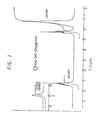
- the 1 H-NMR spectro-analysis was conducted under the condition, i.e. in CDCl 3 , with a pulse having 20 ⁇ sec width and at integrating number of 100.
- Fig. 1 IS menas a read intensity of integrated value, and VS means a read intensity of spectral peak.
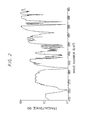
- the IR spectro-analysis was conducted by means of KBr method by scanning over all wave lengths for 6 minutes.
- CdCi 2 and KHCO 3 were added to water which was distilled twice so that the concentration thereof were 3 X 10 -4 mole/i and 5 X 10 -5 mole/l, respectively.
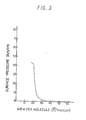
- 103.681 ⁇ l of the solution prepared above was dropped, and then the formed film was compressed by moving a barrier at a constant moving rate of 5 A /min.
- the changes of surface area of the film and surface pressure were measured at 15°C with an apparatus of MGW LAUDA available from Messgerate-Werk LAUDA Dr. Wobser KG.
- Fig. 3 the oxdinate means an area per molecule and the abscissa means a surface pressure.
- the above solution of the diacetylene comound was dropped onto the surface of the water at 15°C, and then a monomolecular film was formed by applying a constant pressure of 25 dyn/cm. After 30 minutes from the dropping, a quartz plate which was subjected to hydrophobic surface treatment with cadmium arachidate - - was reciprocally moved in the perpendicular direction to the water surface to prepare a built-up film of 14 layers on each side of the quartz plate.
- the obtained built-up film was analyzed by means of UV spectro-analysis. The results are shown in Fig. 4.
- the UV spectro-analysis was carried out over visible ray range and ultraviolet ray range for 12 minutes.
- the film has three peaks of the absorption of the diacetylene which was conjugated with the phenyl group.
- the compound (I) of the present invention has, as mentioned above, various excellent properties and effects.
- a stable monomolecular film can be prepared by dissolving the compound (I) in a solvent such as chloroform or benzene and spreading the solution on water surface. Accordingly, a multilayered built-up film can be easily prepared by moving a plate such as a quartz plate or a metal plate up and down.
- an L-B film which contains benzene ring conjugated with the diacetylene group can be prepared.
Landscapes
- Chemical & Material Sciences (AREA)
- Engineering & Computer Science (AREA)
- Nanotechnology (AREA)
- Organic Chemistry (AREA)
- Crystallography & Structural Chemistry (AREA)
- Physics & Mathematics (AREA)
- General Physics & Mathematics (AREA)
- Materials Engineering (AREA)
- Condensed Matter Physics & Semiconductors (AREA)
- Manufacturing & Machinery (AREA)
- Composite Materials (AREA)
- Organic Low-Molecular-Weight Compounds And Preparation Thereof (AREA)
- Addition Polymer Or Copolymer, Post-Treatments, Or Chemical Modifications (AREA)
- Manufacture Of Macromolecular Shaped Articles (AREA)
Applications Claiming Priority (2)
| Application Number | Priority Date | Filing Date | Title |
|---|---|---|---|
| JP59257118A JPS61134345A (ja) | 1984-12-05 | 1984-12-05 | ベンゼン環を含んだ両親媒性ジアセチレン化合物およびその膜 |
| JP257118/84 | 1984-12-05 |
Publications (2)
| Publication Number | Publication Date |
|---|---|
| EP0184193A1 true EP0184193A1 (de) | 1986-06-11 |
| EP0184193B1 EP0184193B1 (de) | 1989-08-30 |
Family
ID=17301979
Family Applications (1)
| Application Number | Title | Priority Date | Filing Date |
|---|---|---|---|
| EP85115341A Expired EP0184193B1 (de) | 1984-12-05 | 1985-12-03 | Einen Benzolring enthaltende amphiphilische Diazetylenverbindung und aus dieser Verbindung hergestellter Film |
Country Status (4)
| Country | Link |
|---|---|
| US (1) | US4748273A (de) |
| EP (1) | EP0184193B1 (de) |
| JP (1) | JPS61134345A (de) |
| DE (1) | DE3572652D1 (de) |
Cited By (2)
| Publication number | Priority date | Publication date | Assignee | Title |
|---|---|---|---|---|
| EP0284313A1 (de) * | 1987-03-25 | 1988-09-28 | K & V LICENCING OY | Methode für die Herstellung eines monomolekularen Films mit einer symmetrischen Molekularverteilung und die Verwendung eines solchen Films |
| EP0312100A3 (en) * | 1987-10-16 | 1989-07-26 | Matsushita Electric Industrial Co., Ltd. | Process for producing a polyacetylene |
Families Citing this family (5)
| Publication number | Priority date | Publication date | Assignee | Title |
|---|---|---|---|---|
| JPH0678394B2 (ja) * | 1987-10-15 | 1994-10-05 | 松下電器産業株式会社 | ポリアセチレンの製造方法 |
| JPH0678393B2 (ja) * | 1987-10-15 | 1994-10-05 | 松下電器産業株式会社 | ポリアセチレンの製造方法 |
| US4909598A (en) * | 1988-07-30 | 1990-03-20 | Konica Corporation | Non-linear optical device |
| JP2907222B2 (ja) * | 1989-01-27 | 1999-06-21 | 富士通株式会社 | 有機非線形光学材料 |
| US5050136A (en) * | 1990-10-01 | 1991-09-17 | The United States Of America As Represented By The Secretary Of The Navy | Super polyelectrolytic communication links |
Citations (1)
| Publication number | Priority date | Publication date | Assignee | Title |
|---|---|---|---|---|
| EP0022618A2 (de) * | 1979-06-25 | 1981-01-21 | University Patents, Inc. | Photopolymerisierbarer Gegenstand und Verfahren zur Herstellung von Resistbildern |
Family Cites Families (6)
| Publication number | Priority date | Publication date | Assignee | Title |
|---|---|---|---|---|
| US3501303A (en) * | 1966-06-06 | 1970-03-17 | Battelle Development Corp | Photosensitive crystalline polyacetylenic system and method of exposure |
| US3999946A (en) * | 1976-02-23 | 1976-12-28 | Allied Chemical Corporation | Time-temperature history indicators |
| US4189399A (en) * | 1977-07-19 | 1980-02-19 | Allied Chemical Corporation | Co-crystallized acetylenic compounds |
| US4209499A (en) * | 1977-10-21 | 1980-06-24 | Mobil Oil Corporation | Crystalline zeolite ZSM-43 synthesis thereof |
| JPS57143308A (en) * | 1981-03-02 | 1982-09-04 | Toshinobu Higashimura | Preparation of propiolic acid polymer |
| US4562141A (en) * | 1982-09-29 | 1985-12-31 | Ciba Geigy Corporation | Polymerisable composition comprising conjugated diacetylenic compounds, material coated therewith and the use thereof |
-
1984
- 1984-12-05 JP JP59257118A patent/JPS61134345A/ja active Pending
-
1985
- 1985-12-02 US US06/803,700 patent/US4748273A/en not_active Expired - Fee Related
- 1985-12-03 DE DE8585115341T patent/DE3572652D1/de not_active Expired
- 1985-12-03 EP EP85115341A patent/EP0184193B1/de not_active Expired
Patent Citations (1)
| Publication number | Priority date | Publication date | Assignee | Title |
|---|---|---|---|---|
| EP0022618A2 (de) * | 1979-06-25 | 1981-01-21 | University Patents, Inc. | Photopolymerisierbarer Gegenstand und Verfahren zur Herstellung von Resistbildern |
Non-Patent Citations (1)
| Title |
|---|
| CHEMISCHE BERICHTE, vol. 104, no. 5, 1971, pages 1616-1620; P.-H. BONNET et al.: "Umsetzung von Acetylenaldehyden mit Cyanid-Ionen" * |
Cited By (3)
| Publication number | Priority date | Publication date | Assignee | Title |
|---|---|---|---|---|
| EP0284313A1 (de) * | 1987-03-25 | 1988-09-28 | K & V LICENCING OY | Methode für die Herstellung eines monomolekularen Films mit einer symmetrischen Molekularverteilung und die Verwendung eines solchen Films |
| EP0312100A3 (en) * | 1987-10-16 | 1989-07-26 | Matsushita Electric Industrial Co., Ltd. | Process for producing a polyacetylene |
| US4968524A (en) * | 1987-10-16 | 1990-11-06 | Matsushita Electric Industrial Co., Ltd. | Process for producing a polyacetylene |
Also Published As
| Publication number | Publication date |
|---|---|
| US4748273A (en) | 1988-05-31 |
| DE3572652D1 (en) | 1989-10-05 |
| JPS61134345A (ja) | 1986-06-21 |
| EP0184193B1 (de) | 1989-08-30 |
Similar Documents
| Publication | Publication Date | Title |
|---|---|---|
| US4562141A (en) | Polymerisable composition comprising conjugated diacetylenic compounds, material coated therewith and the use thereof | |
| US7294449B1 (en) | Radiation patternable functional materials, methods of their use, and structures formed therefrom | |
| KR100637450B1 (ko) | 플루오로알킬술폰늄염의 광산발생기가 치환된 화합물과 이를 중합한 공중합체 | |
| WO2001095034A1 (fr) | Composition photosensible pour la fabrication de photoresist | |
| EP0184193B1 (de) | Einen Benzolring enthaltende amphiphilische Diazetylenverbindung und aus dieser Verbindung hergestellter Film | |
| JPS62572A (ja) | フッ素系有機薄膜の製造法 | |
| JP2002504577A (ja) | 改質多環式ポリマー | |
| KR100314761B1 (ko) | 노르보르넨에 콜릭산, 디옥시콜릭산 또는 리소콜릭산 유도체를 결합시킨 단량체를 이용한 중합체 및 이를 함유하는 포토레지스트 조성물 | |
| EP0815181A1 (de) | Elektrolumineszenzvorrichtung mit emission polarisierten lichtes | |
| WO2025079370A1 (ja) | レジスト組成物、レジストパターン形成方法及び化合物 | |
| JP2024079160A (ja) | レジスト組成物、レジストパターン形成方法、化合物及び酸拡散制御剤 | |
| del Pilar Carreón et al. | Langmuir-Blodgett membranes of m-Alca-1, 3-diynylbenzoic acids | |
| JP7776392B2 (ja) | レジスト組成物、レジストパターン形成方法および塩 | |
| DE69322339T2 (de) | 1-Pyrrolylsiliziumverbindungen, hieraus geformter, ultradünner, chemisch adsorbierter Film und Verfahren zur Herstellung | |
| Ahmed et al. | Bis (diacetylene) s I: Langmuir-Blodgett films | |
| US11780946B2 (en) | Alternating copolymer, method of producing alternating copolymer, method of producing polymeric compound, and method of forming resist pattern | |
| JP2021116343A (ja) | 相分離構造形成用樹脂組成物、相分離構造を含む構造体の製造方法、及びブロックコポリマー | |
| WO2025225219A1 (ja) | レジスト組成物、レジストパターン形成方法、化合物、酸発生剤、及び酸拡散制御剤 | |
| KR20250011127A (ko) | 레지스트 조성물, 레지스트 패턴 형성 방법, 화합물 및 산 확산 제어제 | |
| Marshall | Endgroup and sidechain functionalization of surface-initiated ROMP thin films: progress towards ROMP-based molecular wires | |
| CN121574285A (zh) | 一种醇溶性生物基香茅聚合物及其制备方法和应用 | |
| US7485407B2 (en) | Siloxane compound, photoresist composition including the siloxane compound and method of forming a pattern using the photoresist composition | |
| WO2025253927A1 (ja) | レジスト組成物、レジストパターン形成方法、化合物、及び高分子化合物 | |
| JP2026022587A (ja) | レジスト組成物、レジストパターン形成方法、化合物及び酸拡散制御剤 | |
| JPH0250094B2 (de) |
Legal Events
| Date | Code | Title | Description |
|---|---|---|---|
| PUAI | Public reference made under article 153(3) epc to a published international application that has entered the european phase |
Free format text: ORIGINAL CODE: 0009012 |
|
| AK | Designated contracting states |
Kind code of ref document: A1 Designated state(s): BE DE FR GB IT |
|
| 17P | Request for examination filed |
Effective date: 19861202 |
|
| 17Q | First examination report despatched |
Effective date: 19871229 |
|
| GRAA | (expected) grant |
Free format text: ORIGINAL CODE: 0009210 |
|
| AK | Designated contracting states |
Kind code of ref document: B1 Designated state(s): BE DE FR GB IT |
|
| REF | Corresponds to: |
Ref document number: 3572652 Country of ref document: DE Date of ref document: 19891005 |
|
| ITF | It: translation for a ep patent filed | ||
| ET | Fr: translation filed | ||
| PLBE | No opposition filed within time limit |
Free format text: ORIGINAL CODE: 0009261 |
|
| STAA | Information on the status of an ep patent application or granted ep patent |
Free format text: STATUS: NO OPPOSITION FILED WITHIN TIME LIMIT |
|
| 26N | No opposition filed | ||
| ITTA | It: last paid annual fee | ||
| PGFP | Annual fee paid to national office [announced via postgrant information from national office to epo] |
Ref country code: GB Payment date: 19921120 Year of fee payment: 8 |
|
| PGFP | Annual fee paid to national office [announced via postgrant information from national office to epo] |
Ref country code: FR Payment date: 19921209 Year of fee payment: 8 |
|
| PGFP | Annual fee paid to national office [announced via postgrant information from national office to epo] |
Ref country code: DE Payment date: 19921222 Year of fee payment: 8 |
|
| PGFP | Annual fee paid to national office [announced via postgrant information from national office to epo] |
Ref country code: BE Payment date: 19930115 Year of fee payment: 8 |
|
| PG25 | Lapsed in a contracting state [announced via postgrant information from national office to epo] |
Ref country code: GB Effective date: 19931203 |
|
| PG25 | Lapsed in a contracting state [announced via postgrant information from national office to epo] |
Ref country code: BE Effective date: 19931231 |
|
| BERE | Be: lapsed |
Owner name: KANEGAFUCHI KAGAKU KOGYO K.K. Effective date: 19931231 |
|
| GBPC | Gb: european patent ceased through non-payment of renewal fee |
Effective date: 19931203 |
|
| PG25 | Lapsed in a contracting state [announced via postgrant information from national office to epo] |
Ref country code: FR Effective date: 19940831 |
|
| PG25 | Lapsed in a contracting state [announced via postgrant information from national office to epo] |
Ref country code: DE Effective date: 19940901 |
|
| REG | Reference to a national code |
Ref country code: FR Ref legal event code: ST |