EP0184553B1 - Résines phénoliques modifiées et leur fabrication - Google Patents
Résines phénoliques modifiées et leur fabrication Download PDFInfo
- Publication number
- EP0184553B1 EP0184553B1 EP85810562A EP85810562A EP0184553B1 EP 0184553 B1 EP0184553 B1 EP 0184553B1 EP 85810562 A EP85810562 A EP 85810562A EP 85810562 A EP85810562 A EP 85810562A EP 0184553 B1 EP0184553 B1 EP 0184553B1
- Authority
- EP
- European Patent Office
- Prior art keywords
- group
- formula
- hydrogen
- substituted
- acid
- Prior art date
- Legal status (The legal status is an assumption and is not a legal conclusion. Google has not performed a legal analysis and makes no representation as to the accuracy of the status listed.)
- Expired - Lifetime
Links
Classifications
-
- C—CHEMISTRY; METALLURGY
- C09—DYES; PAINTS; POLISHES; NATURAL RESINS; ADHESIVES; COMPOSITIONS NOT OTHERWISE PROVIDED FOR; APPLICATIONS OF MATERIALS NOT OTHERWISE PROVIDED FOR
- C09D—COATING COMPOSITIONS, e.g. PAINTS, VARNISHES OR LACQUERS; FILLING PASTES; CHEMICAL PAINT OR INK REMOVERS; INKS; CORRECTING FLUIDS; WOODSTAINS; PASTES OR SOLIDS FOR COLOURING OR PRINTING; USE OF MATERIALS THEREFOR
- C09D5/00—Coating compositions, e.g. paints, varnishes or lacquers, characterised by their physical nature or the effects produced; Filling pastes
- C09D5/44—Coating compositions, e.g. paints, varnishes or lacquers, characterised by their physical nature or the effects produced; Filling pastes for electrophoretic applications
- C09D5/4419—Coating compositions, e.g. paints, varnishes or lacquers, characterised by their physical nature or the effects produced; Filling pastes for electrophoretic applications with polymers obtained otherwise than by polymerisation reactions only involving carbon-to-carbon unsaturated bonds
- C09D5/4469—Phenoplasts; Aminoplasts
-
- C—CHEMISTRY; METALLURGY
- C08—ORGANIC MACROMOLECULAR COMPOUNDS; THEIR PREPARATION OR CHEMICAL WORKING-UP; COMPOSITIONS BASED THEREON
- C08G—MACROMOLECULAR COMPOUNDS OBTAINED OTHERWISE THAN BY REACTIONS ONLY INVOLVING UNSATURATED CARBON-TO-CARBON BONDS
- C08G8/00—Condensation polymers of aldehydes or ketones with phenols only
- C08G8/28—Chemically modified polycondensates
-
- G—PHYSICS
- G03—PHOTOGRAPHY; CINEMATOGRAPHY; ANALOGOUS TECHNIQUES USING WAVES OTHER THAN OPTICAL WAVES; ELECTROGRAPHY; HOLOGRAPHY
- G03F—PHOTOMECHANICAL PRODUCTION OF TEXTURED OR PATTERNED SURFACES, e.g. FOR PRINTING, FOR PROCESSING OF SEMICONDUCTOR DEVICES; MATERIALS THEREFOR; ORIGINALS THEREFOR; APPARATUS SPECIALLY ADAPTED THEREFOR
- G03F7/00—Photomechanical, e.g. photolithographic, production of textured or patterned surfaces, e.g. printing surfaces; Materials therefor, e.g. comprising photoresists; Apparatus specially adapted therefor
- G03F7/004—Photosensitive materials
- G03F7/022—Quinonediazides
- G03F7/023—Macromolecular quinonediazides; Macromolecular additives, e.g. binders
-
- G—PHYSICS
- G03—PHOTOGRAPHY; CINEMATOGRAPHY; ANALOGOUS TECHNIQUES USING WAVES OTHER THAN OPTICAL WAVES; ELECTROGRAPHY; HOLOGRAPHY
- G03F—PHOTOMECHANICAL PRODUCTION OF TEXTURED OR PATTERNED SURFACES, e.g. FOR PRINTING, FOR PROCESSING OF SEMICONDUCTOR DEVICES; MATERIALS THEREFOR; ORIGINALS THEREFOR; APPARATUS SPECIALLY ADAPTED THEREFOR
- G03F7/00—Photomechanical, e.g. photolithographic, production of textured or patterned surfaces, e.g. printing surfaces; Materials therefor, e.g. comprising photoresists; Apparatus specially adapted therefor
- G03F7/16—Coating processes; Apparatus therefor
- G03F7/164—Coating processes; Apparatus therefor using electric, electrostatic or magnetic means; powder coating
-
- Y—GENERAL TAGGING OF NEW TECHNOLOGICAL DEVELOPMENTS; GENERAL TAGGING OF CROSS-SECTIONAL TECHNOLOGIES SPANNING OVER SEVERAL SECTIONS OF THE IPC; TECHNICAL SUBJECTS COVERED BY FORMER USPC CROSS-REFERENCE ART COLLECTIONS [XRACs] AND DIGESTS
- Y10—TECHNICAL SUBJECTS COVERED BY FORMER USPC
- Y10S—TECHNICAL SUBJECTS COVERED BY FORMER USPC CROSS-REFERENCE ART COLLECTIONS [XRACs] AND DIGESTS
- Y10S522/00—Synthetic resins or natural rubbers -- part of the class 520 series
- Y10S522/904—Monomer or polymer contains initiating group
Definitions
- the present invention relates to new modified phenolic resins and processes for their preparation. These new products are light sensitive and can be galvanically separated.
- Photosensitive phenol novolak resins are known per se and are mainly used in the production of photosensitive printing plates for lithography.
- the compounds are usually prepared by condensing a phenolic resin with quinonediazide sulfonyl chloride.
- the result is a product which is sensitive to light due to the presence of the quinodiazide groups and which has good adhesiveness and toughness due to the presence of the novolak "backbone". Plates coated with these materials show good mechanical abrasion resistance in the lithographic printing process.
- GB-PS 1,227,602 describes a presensitized lithographic printing plate which is coated with a water-insoluble condensation product.
- This condensation product is the ester of a benzo or naphthoquinonediazide sulfonic acid with a resin containing phenolic hydroxyl groups.
- a cresol-formaldehyde resin is mentioned as an example.
- GB-PS 1,329,888 describes the condensation product of a para-substituted phenolic resin, an alkyl, aryl, alkoxy, sulfoalkyl, aryloxy, aralkyloxy, carboalkoxy, aralkyl or acetyl group in the p-position to the phenolic hydroxy group the sulfonyl chloride of an o-benzoquinone or o-naphthoquinonediazide described.
- these condensation products are particularly suitable for the production of presensitized printing plates for photomechanical processes.
- GB-PS 1,330,932 describes condensation products of benzoquinone or naphthoquinonediazide sulfonyl chlorides with novolaks which are derived from a bisphenol and formaldehyde. The products can be used in the production of photosensitive plates for lithographic processes.
- the galvanic deposition of positive working photoresists leads to very even coatings; this is particularly important when coating edges or plated through openings if relatively thin films of the photoresist are used.
- electrodepositable photoresists can be formulated with a low proportion of organic solvents and they can be deposited from solutions with a high solids content. Both properties are for security reasons and ecological reasons desirable. Finally, the degree of use of the photoresist is high and it is possible to fully automate the coating process.
- Novolak resins containing carboxyl groups and modified by quinonediazide groups are known per se.
- the carboxyl groups are only in the phenol units that were used to produce the novolak.
- An example of such a unit is p-hydroxybenzoic acid.
- aqueous coating compositions made from resins containing phenol groups can be improved by reacting these resins by reaction with an aldehyde and either with an amino acid as described in US Pat. No. 4,362,853 or with a mercaptocarboxylic acid or sulfuric acid such as known from US-A 4,410,675, or modified with an aminosulfonic acid or aminophosphonic acid, as described in FR-A 2 523 980.
- this improves the resistance of resins containing phenol and quinonediazide sulfonyloxy groups to developers in the unexposed areas.
- the resin is preferably derived from a monohydric mononuclear phenol, in particular from phenol itself and / or from an alkyl-substituted phenol. But it is also derived from a bisphenol.
- the phenolic hydroxyl groups of the novolak resin are replaced by quinonediazide sulfonyloxy groups and the resin contains enough free phenolic hydroxyl groups to be soluble or dispersible in aqueous media.
- phenolic hydroxyl groups are replaced by quinonediazide sulfonyloxy radicals.
- phenolic hydroxyl groups can also be etherified. They are then present, for example, as alkoxy groups in which the alkyl group can in turn carry a hydroxyl or alkoxy group. However, some of the phenolic hydroxyl groups can also carry an ester group which differs from the quinonediazide sulfonyloxy group, for example acetyloxy, benzoyloxy, methanesulfonyloxy or p-toluenesulfonyloxy group.
- At least 4% of the aromatic rings of the novolak resin are substituted by a group of the formula -CH (R1) R2.
- the proportion of rings substituted in this way is preferably 7-75%.
- the resin can be diluted in aqueous media, at least 25%, in particular at least 50%, of the radicals R7 should preferably represent a hydrogen atom. Taking this preference into account, some of the radicals R7, preferably not more than 40%, should represent a group of the formula -SO2R11 or -COR12, or they should mean an alkyl group which is optionally substituted by a hydroxyl or alkoxy group.
- the sum p + nq + r + t is preferably chosen so that 7 to 75% of said aromatic rings are substituted by a group of the formula -CH (R1) R2.
- alkyl, alkoxy or alkenyl groups designated under the radicals R1, R4, R5, R6, R7, R8, R13 and R14 preferably have a carbon number of up to 20, preferably of up to 10.
- the aryl and arylalkyl groups within the definitions of R1, R5, R6, R8 and R9 preferably have a carbon number of up to 20, in particular up to 15.
- the divalent radicals R 3 preferably have up to 15, in particular up to 10, carbon atoms if they are aliphatic and up to 20, in particular up to 15, carbon atoms if they are aromatic or araliphatic.
- Monovalent radicals within the definitions R11 and R12 preferably have up to 20, especially up to 15, carbon atoms if they are aliphatic, aromatic or araliphatic, and up to 15, especially up to 10, carbon atoms if they are cycloaliphatic.
- R1 is hydrogen, methyl, ethyl or phenyl and a carboxylic acid group.
- Resins in which R1 is hydrogen are particularly preferred.
- R2 is preferably a sulfonic acid group or in particular a radical of the formula -A-R3-X, in which R3 is C1-C6alkylene, which is optionally substituted by a carboxylic acid group, or is a phenylene group, A is a sulfur atom or a radical of the formula -N (R4 ) - is, R4 is hydrogen or C1-C6alkyl, which may be substituted by a hydroxyl group, or represents a carboxylic acid group, X is a carboxylic acid or sulfonic acid group when A represents a sulfur atom, or X is a hydrogen atom, a hydroxyl group, a carboxylic acid group , Sulfonic acid or an amino group of the formula -N (R5) R6 when A is a group -NR4-, where R5 and R6 are independently hydrogen or C1-C6alkyl, or R6 is preferably a morpholino group.
- radicals R2 are the sulfonic acid group and radicals of the formulas -N (CH3) CH2COOH, -N (CH2COOH) CH2COOH, -NH-o-C6H4COOH, -NHCH2COOH, -NHCH (COOH) (CH2) 2COOH, -NHCH (COOH) CH2COOH, -NH-p-C6H4COOH, -SCH2COOH, -SCH (CH3) COOH, -SCH2CH2COOH, -SCH (COOH) CH2COOH, -NHCH2CH3, -N (CH2CH3) 2, -N [(CH2) 5CH3] 2, - NHCH2CH2OH, -NHCH2CH2OCH3, -N (CH2CH2OH) 2, -NH (CH2) 3OH, -NH (CH2) 4OH, -NHCH2CH2NH2 and -N ⁇ (CH2CH2) 2> O.
- R7 represents an optionally substituted alkyl group, it is further preferred that this alkyl group contains 1 to 4 carbon atoms and that it is optionally substituted by a hydroxyl group or by a C1-C4alkoxy group.
- the particularly preferred radicals R7 include, for example, methyl, ethyl, isopropyl, n-butyl, 2-hydroxyethyl, 2-hydroxypropyl, 2-methoxyethyl and 2-butoxyethyl.
- Preferred atoms and radicals R8 are chlorine and bromine and also hydroxyl groups, C1-C4alkoxy groups, C1-C8alkyl groups, carboxylic acid radicals, radicals of the formulas -OSO2R10, -OSO2R11 and -OCOR12 and radicals of the formula II in which Y is methylene, isopropylidene or a carbonyl group or a group the formulas -CH (COOH) - or -C (CH3) [(CH2) 2COOH] means.
- Resins are particularly preferred in which m is 0, so that R8 is absent, or in which m is 1 and the different groups R8 represent identical or different C1-C8-alkyl groups, or in which in some of the aromatic rings of the formula I m is 0 and for the rest of these rings m 1, where the different radicals R8 represent the same or different C1-C8alkyl groups.
- R8 are o-, m- and p-methyl, o-, m- and p-tert-butyl and o-, m- and p-octyl.
- R9 is preferably hydrogen, methyl, ethyl or phenyl and a carboxylic acid group. Resins in which R9 is hydrogen are very particularly preferred.
- R10 preferably denotes a 1,2-naphthoquinonediazide group of the formula IV.
- Preferred radicals R11 and R12 are C1-C4alkyl and C6-C10aryl, in particular methyl, phenyl and p-tolyl.
- R13 is preferably hydrogen, C1-C4alkyl or a radical of the formula -SO2R10, -SO2R11 or -COR12, wherein R10, R11 and R12 have the meaning defined above as preferred.
- R14 is preferably hydrogen or C1-C4alkyl.
- the invention also relates to a method for producing an electrodepositable photosensitive resin of the definition given above by:
- phenolic novolak which is prepared from a phenol (B) and an aldehyde (C), with a quinonediazide sulfonic acid (D) or one of its reactive derivatives, at least one of the components, i.e.
- the novolak (A), the Phenol (B) and / or the reaction product of the novolak (A) with the quinonediazide (D) is further reacted with an aldehyde (E) and a component (F) selected from the group consisting of primary or secondary amine, an acid which carries a primary or secondary amino group or a mercapto group and a carboxylic acid group, a sulfonic acid or a phosphonic acid group, from sulfuric acid or from a water-soluble salt of one of said acids.
- a component (F) selected from the group consisting of primary or secondary amine, an acid which carries a primary or secondary amino group or a mercapto group and a carboxylic acid group, a sulfonic acid or a phosphonic acid group, from sulfuric acid or from a water-soluble salt of one of said acids.
- the method comprises reacting the phenolic novolak resin (A) with the quinonediazide sulfonic acid (D) or one of its reactive derivatives followed by the reaction of the product with the aldehyde (E) and with the reactant (F); or the method preferably comprises reacting the phenolic novolak resin (A) with the aldehyde (E) and the reactant (F), followed by the reaction of the resulting product with a quinonediazide sulfonic acid (D) or one of its reactive derivatives.
- free phenolic residues can be etherified by an etherifying agent (G) or they can be esterified by an esterifying agent (H), the esterifying agent (H) being different from (D).
- This etherification or additional esterification can be carried out by using at least one of the components, i.e. the electrodepositable photoresist, the novolak (A), the reaction product of (A) with the quinonediazide sulfonic acid (D) or one of its derivatives, or the reaction product of the reaction of (A), the aldehyde (E) and the reactant (F), with the etherifying agent (G) or the esterifying agent (H), which differs from (D).
- the components i.e. the electrodepositable photoresist, the novolak (A), the reaction product of (A) with the quinonediazide sulfonic acid (D) or one of its derivatives, or the reaction product of the reaction of (A), the aldehyde (E) and the reactant (F), with the etherifying agent (G) or the esterifying agent (H), which differs from (D).
- the phenol (B) from which the novolak (A) is produced can be mono- or polyvalent and can have one or more aromatic rings.
- the resin (A) is produced from only one phenol (B), the latter should have 2 free positions in the ortho and / or para position to the phenolic hydroxyl group.
- the resin (A) is prepared from a mixture of phenols (B), at least one of these phenols should have 2 free positions in the ortho and / or para position to the phenolic hydroxyl group.
- Phenols (B) with the general formula V are preferred wherein m is 0, 1, 2 or 3, R15 has the same meaning as R8 in formula I, with the proviso that R15 is not a group of formula II but instead a group of formula VI occurs wherein Y, R7 and s have the meanings defined above.
- Preferred m values correspond to those which have already been given above.
- Preferred atoms or groups R15 correspond to those which have already been given as preferred for R8 above.
- Suitable phenols (B) are, for example, o-, m- and p-chlorophenol, resorcinol, 2,2-bis (4-hydroxyphenyl) propane, bis (4-hydroxyphenyl) methane, 4,4'-dihydroxybenzophenone, 2,2- Bis (4-hydroxyphenyl) acetic acid, 4,4-bis (4-hydroxyphenyl) pentanoic acid, p-hydroxybenzoic acid and mixtures of two or more of these phenols.
- Phenol, o-, m- or p-cresol, o-, m- or p-tert-butylphenol, o-, m- or p-octylphenol, and mixtures of two or more of these phenols are very particularly preferred as components (B) .
- (B) is a mixture of phenol and p-tert-butylphenol or a mixture of m- and p-cresols.
- the aldehyde (C) from which the novolak (A) is produced is preferably a compound of the formula VII R9-CHO (VII), wherein R9 and the preferred atoms or groups R9 have the meaning already given above.
- aldehydes are formaldehyde, acetaldehyde, propionaldehyde, benzaldehyde and glyoxylic acid, of which formaldehyde is very particularly preferred.
- the reaction between phenol (B) and aldehyde (C) to the novolak resin is usually carried out according to procedures known per se, the phenol being heated with a molar equivalent, or less, of the aldehyde in the presence of an acid.
- the preferred quinonediazide derivative (D) corresponds to formula VIII R10-SO2-Z (VIII), wherein R10 and the preferred radicals R10 have the meaning given above and Z represents a hydroxyl group, an alkoxy group, preferably having 1 to 4 carbon atoms, or a halogen atom, preferably a chlorine atom.
- (D) is 1,2-naphthoquinone-2-diazide-4- or -5-sulfonyl chloride or 1,2-benzoquinone-2-diazide-4-sulfonyl chloride.
- reaction between (D) and the phenolic novolak (A) or the phenol (B) or the reaction product of phenolic novolak (A), aldehyde (E) and reactant (F) is usually carried out in an inert solvent.
- Suitable condensing agents are, for example, acids when Z is a hydroxyl group or an alkoxy group, or a base is suitable when Z is a halogen atom.
- the product it is preferred that it have some free phenolic hydroxyl groups, and therefore less than one equivalent of the quinonediazide derivative (D) is preferably used in the esterification reaction.
- the aldehyde (E) preferably corresponds to the formula IX R1 CHO (IX), wherein R1 and the preferred radicals R1 have the meaning given above.
- This aldehyde can be the same as or different from the aldehyde (C) used to make the novolak (A).
- the aldehyde (E) is preferably formaldehyde, either used as such or in the form of paraformaldehyde.
- the reactant (F) preferably has the formula X or XI M2SO3 (X), HA-R3-X (XI), wherein M represents hydrogen or a monovalent metal atom, and R3, A and X and their preferred embodiments have the meanings already defined above, or represents morpholine.
- the reactant (F) is preferably an alkali metal sulfite, a primary or secondary alkylamine, in which one or more of the alkyl groups can be substituted by alkoxy radicals, an alkylenediamine, morpholine, or a hydroxylamine, an aminocarboxylic acid, in which an amino and a carboxyl group on an aliphatic , aromatic or araliphatic radical, or a mercapto carboxylic acid in which a mercapto group and a carboxyl group are bound to an aliphatic, aromatic or araliphatic radical.
- reactants (F) are sodium sulfite, ethylamine, 2-methoxyethylamine, diethylamine, dihexylamine, ethylenediamine, ethanolamine, diethanolamine, propanolamine, butanolamine, morpholine, sarcosine, iminodiacetic acid, anthranilic acid, glycine, glutamic acid, aspartic acid, p-aminoglycolic acid, p-aminobenzoic acid, p-aminobenzoic acid 2- or 3-mercaptopropionic acid and thio malic acid.
- An etherification reagent (G) to be used is to be understood as an etherification reagent known per se, for example an alcohol, such as methanol, ethanol, isopropanol, n-butanol, ethylene glycol, 2-methoxyethanol or 2-butoxyethanol, an alkylene oxide, such as ethylene or propylene oxide, a dialkyl sulfate, such as dimethyl sulfate, or an alkyl halide, such as methyl iodide.
- an alcohol such as methanol, ethanol, isopropanol, n-butanol, ethylene glycol, 2-methoxyethanol or 2-butoxyethanol
- an alkylene oxide such as ethylene or propylene oxide
- a dialkyl sulfate such as dimethyl sulfate
- an alkyl halide such as methyl iodide.
- An esterification reagent (H) which may be used is generally understood to mean a carboxylic acid or a sulfonic acid or one of its derivatives, for example compounds of the formulas XII or XIII R11-SO2-Z (XII) or R12-CO-Z (XIII), wherein R11, R12 and Z, and their preferred embodiments, have the meanings defined above.
- esterifying agents are acetyl chloride, benzoyl chloride, methanesulfonyl chloride and p-toluenesulfonyl chloride.
- the reaction between aldehyde (E), reactant (F) and novolak (A) or the reaction product of the novolak (A) with the quinonediazide (D) is usually carried out in an inert solvent such as an alcohol, an alkoxy alcohol, a ketone or an ether, at room temperature or at elevated temperature, preferably at 40-180 ° C, in the presence of a sufficient amount of a base.
- the amount of base is chosen so that at least part of the free acid is neutralized.
- the amount of reactant (F) is preferably 0.04-2.0, particularly preferably 0.07-0.8, molar proportions per equivalent of phenolic hydroxyl group of the novolak (A) or of the reaction product of the novolak (A) with the quinonediazide ( D).
- an esterification with the esterification agent (H) is to be carried out, this reaction is generally carried out in an inert solvent, for example in a ketone or an ether.
- the reaction is usually carried out at room temperature and in the presence of a suitable condensing agent, which can be a strong acid if Z represents a hydroxyl group or an alkoxy group, or can be a base if Z represents a halogen atom.
- the amount of the esterifying agent (H) is preferably not more than 0.4 mol per equivalent of phenolic hydroxyl group in (A).
- etherification agent (G) the etherification of phenolic resins can be carried out according to known procedures. It is preferred not to use more than 0.4 mole of the etherifying agent (G) per equivalent of the phenolic hydroxyl group of the novolak (A).
- the resins of the present invention are used as electrodepositable photoresists, they are used in the form of their salts which are soluble or dispersible in aqueous, including aqueous-organic, media.
- these media containing these salts can be used directly in the electrodeposition process.
- the resins are isolated in the form of their salts or bases, they are converted into their salts before they are used in the electrodeposition process; this is expediently done by adding a suitable acid or base, depending on whether the salt-forming groups in the radicals R 1 and R 2 or, if appropriate, further salt-forming groups which may be present in the resins are basic or acidic in nature.
- Suitable salt-forming acids include, for example, mineral acids, such as hydrochloric acid or sulfuric acid, or organic acids, such as acetic, propionic, lactic, maleic or glycolic acid.
- Suitable salt-forming bases include, for example, inorganic bases such as sodium or potassium hydroxide or carbonate or ammonia, or organic bases such as e.g. Triethylamine, triethanolamine, benzyldimethylamine, dimethylethanolamine and dimethylaminomethylpropanol.
- inorganic bases such as sodium or potassium hydroxide or carbonate or ammonia
- organic bases such as e.g. Triethylamine, triethanolamine, benzyldimethylamine, dimethylethanolamine and dimethylaminomethylpropanol.
- salts according to the invention are used as photoresists, they can be deposited on supports, photosensitive elements being formed.
- Suitable carriers include metals such as aluminum and copper, either in the form of solid metal foils or as a metal-coated laminate.
- the resins of the present invention can be used alone or, if desired, in admixture with compounds which are soluble or dispersible in aqueous media and which help improve the quality of the coating deposited.
- the typical compounds include, for example, acrylic, alkyl, polybutadiene or epoxy resins which can be diluted in aqueous media.
- the new resins are electrodeposited according to methods known per se. In general, voltages of up to 200 V are applied for periods of up to 5 minutes, but the precise conditions for the individual resins, substrates and desired layer thicknesses can easily be determined by the person skilled in the art on the basis of routine experiments.
- the coatings are dried and can then be exposed to actinic radiation, preferably radiation of wavelengths between 200-600 nm.
- actinic radiation preferably radiation of wavelengths between 200-600 nm.
- the exposure is usually carried out by an image-carrying slide.
- Novolak I This is a novolak which is produced by reacting 3 moles of phenol, 1 mole of p-tert-butylphenol and formaldehyde, and then reacting with 1,2-naphthoquinone-2-diazide-5-sulfonyl chloride.
- the product is a resin of the formula I, in which R9 is hydrogen, 88% of the groups R7 are hydrogen and the remainder is 1,2-naphthoquinone-2-diazide-5-sulfonyl group, m is 0 for 75% of the molecule and for the remaining 25% is 1, and R8 in this case represents tert-butyl, n has an average value of 7.1, and p, q and r are each 0.
- Novolak II This is a novolak, which is produced by reacting m-cresol, p-cresol and formaldehyde in the presence of oxalic acid as a catalyst.
- the molar ratio of the reactants is m-cresol: p-cresol: formaldehyde: oxalic acid 0.5: 0.5: 0.75: 0.006.
- the novolak has a softening point of 136 ° C and the structure of the formula I, in which R9 is hydrogen, R7 is hydrogen, m is 1, R8 is m-methyl and p-methyl (in equimolar amounts), p, q and r each Are 0 and n is a number with an average of 4.9.
- Novolak III This is a novolak obtained by the reaction of phenol, p-tert-butylphenol, formaldehyde and oxalic acid in a molar ratio of 0.75: 0.25: 0.9: 0.046.
- This novolak has a softening point of 119 ° C and has the structure of the formula I, in which R9 is hydrogen, R7 is hydrogen, m is 0 in 75% of the molecule and 1 in the remaining 25% of the molecule, where R8 then p- represents tert-butyl, n is a number with the mean value 7.5, and p, q and r are each 0.
- Example 1 10 g of novolak I are dissolved in 50 g of 2-butoxyethanol and heated to 50 ° C. A solution of 0.45 g sarcosine, 0.33 g paraformaldehyde (91% HCHO content), 1 g 20% aqueous sodium hydroxide solution and 10 g 2-butoxyethanol are added to this mixture and the solution is 2 hours at 50 ° C. It is then cooled to room temperature and 1000 ml of water are added. 10 ml of N-hydrochloric acid are added and a brown resinous precipitate is formed. This product is ground to a powder, washed with water and dried in a vacuum oven at 35 ° C.
- the infrared spectrum of this resin shows the following absorption maxima (measured in a KBr plate): 3350, 2940, 2860, 2150, 2100, 1600, 1500, 1470, 1450, 1430, 1360, 1250, 1190 and 1100 cm ⁇ 1.
- the exposed copper is removed by etching away using a 40% aqueous FeCl3 solution at 30 ° C.
- the plate is then washed with water and dried.
- the remaining coating is then exposed a second time without a mask (5000 W lamp; 1 minute) and removed by immersion in 2% aqueous sodium hydroxide solution.
- Example 2 Example 1 is repeated by reacting 10 g novolak I, 0.89 g sarcosine, 0.66 g paraformaldehyde, 2 g 20% aqueous sodium hydroxide solution and 60 g 2-butoxyethanol.
- This resin has an infrared absorption spectrum similar to that of the product from Example 1, it can be electrodeposited on a substrate and a positive image can be produced, as described in Example 1.
- Example 3 12 g of Novolak II are dissolved in 30 g acetone and 30 g dioxane and treated with a solution of 4 g 1,2-naphthoquinone-2-diazide-5-sulfonyl chloride in 10 g acetone and 10 g dioxane.
- the pH of the solution is adjusted to the value 8 by adding 10% aqueous sodium carbonate solution and then stirring for 90 minutes at room temperature.
- This solution is then poured into 100 ml of 3N hydrochloric acid, and the precipitate which has separated out is filtered off, washed with water and dried in a vacuum oven at 35.degree.
- the infrared spectrum of this product shows maxima of the absorption at (measured in KBr plates): 3350, 2940, 2860, 2150, 2100, 1600, 1490, 1450, 1400, 1360, 1260, 1190 and 1100 cm ⁇ 1.
- This product can be electrodeposited on a substrate and a positive image can be produced, as described in Example 1.
- Example 4 8 g of novolak III are dissolved in 40 g of acetone and treated with a solution of 4 g of 1,2-naphthoquinone-2-diazide-5-sulfonyl chloride in 20 g of acetone. The mixture is adjusted to a pH of 8 using 5% aqueous sodium carbonate solution and stirred for 1 hour at room temperature. It is then poured into 100 ml of 3N hydrochloric acid, the precipitate is filtered off, washed with water and dried in a vacuum oven at 35 ° C. 10 g of a product are obtained.
- This resin has an IR spectrum similar to that of the product in Example 1. It can also be electrodeposited on a substrate like the product in Example 1, and a positive image can also be obtained.
- Example 5 50 g of novolak III are dissolved in 150 g of 2-butoxyethanol and treated with a solution of 2.25 g of sarcosine, 1.65 g of paraformaldehyde, 50 g of 20% aqueous sodium hydroxide solution and 50 g of 2-butoxyethanol. The mixture is heated to 80 ° C. for 4 hours, cooled to room temperature, diluted with 2 liters of water and adjusted to a pH of 3 with hydrochloric acid. A white resinous precipitate forms. This is filtered off and dried. The dried product is ground to a powder, washed with water and dried in a vacuum oven at 35 ° C.
- Example 7 12 g of Novolak III are dissolved in 50 g of 2-butoxyethanol and treated with 2.1 g of diethanolamine, 2.4 g of formalin (HCHO content 38.3%) and 2.1 g of 75% lactic acid. This mixture is heated to 80 ° C. for 3 hours, cooled to room temperature, diluted with 1 liter of water and adjusted to a pH of 6. A precipitate precipitates, which is filtered off and dried at 35 ° C. in a vacuum oven.
- the IR spectrum of this product shows absorption maxima at: 3300, 2940, 2860, 2150, 2100, 1590, 1500, 1470, 1450, 1430, 1360, 1250, 1190, and 1080 cm ⁇ 1.
- the coated laminate is removed from the bath, rinsed with water and dried at 90 ° C for 5 minutes. It is then irradiated for 1 minute through an image-bearing mask. A 5000 W medium pressure mercury lamp is used at a distance of 75 cm.
- Example 8 10 g of novolak I are dissolved in 50 g of 2-butoxyethanol and heated to 50 ° C. A solution of 4.2 g of diethanolamine, 5.8 g of formalin (38.8%), 4.7 g of lactic acid (75%) and 10 g of 2-butoxyethanol is added. This mixture is then stirred at 70 ° C. for 1.5 hours, then cooled to room temperature and diluted with 1000 ml of water. Addition of 1N sodium hydroxide solution up to pH 6 leads to the precipitation of a precipitate is filtered off, washed and dried in a vacuum oven at 35 ° C.
- the IR spectrum of this resin shows absorption maxima at: 3350, 2940, 2860, 2150, 2100, 1590, 1500, 1470, 1450, 1430, 1360, 1250, 1190 and 1080 cm ⁇ 1.
- this resin can be electrodeposited on a substrate and a positive image can be produced.
- Example 9 36 g of novolak III are dissolved in 36 g of 2-buoxyethanol and 13.8 g of thioglycolic acid and 14.9 g of paraformaldehyde are added. The mixture is heated to 140 ° C for 2 hours. A vacuum is then applied, the mixture is heated to 180 ° C. and the volatile constituents are removed.
- the remaining novolak is a flexible solid and has the structural formula I, where m is 1 for 25% of the molecule and 0 for the remaining 75% of the molecule, R8 is p-tert-butyl, R1, R7 and R9 are hydrogen, R2 is a group -SCH2COOH, the sum (p + nq + r) assumes an average such that 50% of the aromatic rings are substituted by a group -CH (R1) R2 and n is an integer with the average 7.5.
- a yellow resinous precipitate is obtained, which is filtered off, washed and dried in a vacuum oven at 35 ° C.
- 18.8 g of a product of the formula I are obtained, in which m is 1 for 25% of the molecule and 0 for 75% of the molecule, R8 is p-tert-butyl, R1 and R9 are hydrogen, 82% of the radicals R7 are hydrogen are and the remaining 18% 1,2-naphthoquinone-2-diazid-5-sulfonyl, in which R2 is a group -SCH2COOH, the sum (p + nq + r) assumes an average such that 50% of the aromatic rings through a group -CH (R1) R2 are substituted, and n is an integer with the mean value of 7.5.
- This product can be electrodeposited on a substrate and a positive image can be produced, as described in Example 1.
- Example 10 A novolak is prepared by combining phenol, p-tert-butylphenol, 4,4-bis (4-hydroxyphenyl) pentanoic acid and formaldehyde (as a 38% formalin solution) using oxalic acid as a catalyst in a molar ratio of 0 , 75: 0.25: 0.1: 0.99: 0.016 heated.
- Volatiles are removed by distillation and a novolak with a softening point of 119 ° C. is obtained.
- the product can be deposited galvanically on a substrate and a positive image can be produced.
- Example 11 20 g of Novolak I are dissolved in 50 g of 2-butoxyethanol and heated to 70 ° C. A solution of 2.9 g of diethylamine, 6.2 g of formalin (HCHO content: 38.8%), 4.8 g of 75% lactic acid and 5 g of 2-butoxyethanol is added and this mixture is stirred for 1 hour at 70 ° C. After cooling to room temperature, 1000 ml of water containing 1.6 g of sodium hydroxide is added. The precipitate is filtered off, washed and dried in a vacuum oven at 35 ° C.
- the IR spectrum of this resin shows absorption maxima at: 3350, 2950, 2860, 2160, 2120, 1610, 1590, 1500, 1480, 1470, 1450, 1440, 1400, 1360, 1260, 1230, 1210 , 1190, 1170, 1150, 1110 and 1080 cm ⁇ 1.
- the product can be deposited galvanically on a substrate and a positive image can be produced with it.
Landscapes
- Chemical & Material Sciences (AREA)
- Physics & Mathematics (AREA)
- Organic Chemistry (AREA)
- Health & Medical Sciences (AREA)
- General Physics & Mathematics (AREA)
- Chemical Kinetics & Catalysis (AREA)
- Life Sciences & Earth Sciences (AREA)
- Polymers & Plastics (AREA)
- Wood Science & Technology (AREA)
- General Chemical & Material Sciences (AREA)
- Medicinal Chemistry (AREA)
- Materials Engineering (AREA)
- Engineering & Computer Science (AREA)
- Spectroscopy & Molecular Physics (AREA)
- Molecular Biology (AREA)
- Phenolic Resins Or Amino Resins (AREA)
- Non-Silver Salt Photosensitive Materials And Non-Silver Salt Photography (AREA)
- Materials For Photolithography (AREA)
- Photosensitive Polymer And Photoresist Processing (AREA)
Claims (18)
- Novolaque phénolique photosensible applicable par un dépôt galvanique, dans laquelle :I) au moins certains des hydroxyles phénoliques sont remplacés par des groupes quinone-diazidosulfonyloxy, etII) au moins certains des cycles aromatiques de la novolaque portent un radical -CH(R¹)R² à la position ortho et/ou para par rapport à un hydroxyle phénolique ou au groupe quinone-diazidosulfonyloxy, radical dans lequelR¹ représente l'hydrogène ou bien un alkyle, un aryle ou un groupe carboxylique, etR² un groupe d'acide sulfonique -SO₃H, un groupe -A-R³-X ou un groupe morpholino,R³ étant un groupe bivalent aliphatique, aromatique ou araliphatique, éventuellement substitué par un groupe d'acide carboxylique, sulfonique ou phosphorique,A un atome de soufre ou un radical -N(R⁴)-,R⁴ désignant l'hydrogène ou un alkyle éventuellement substitué par un groupe carboxylique ou par un groupe hydroxylique le cas échéant éthérifié, etX désigne un groupe carboxylique ou sulfonique ou encore, si A est le radical -N(R⁴)-, un groupe d'acide phosphonique, un groupe amino -N(R⁵)R⁶, un atome d'hydrogène ou un hydroryle,R⁵ et R⁶ étant chacun, indépendamment l'un de l'autre, un atome d'hydrogène ou un groupe alkyle, aryle, aralkyle ou alcényle éventuellement substitués par un hydroxyle.
- Résine selon la revendication 1 dans laquelle le groupe quinone-diazidosulfonyloxy est un groupe benzo- ou naphto-quinone-diazidosulfonyloxy.
- Résine de novolaque phénolique selon la revendication 1, de formule I ci-dessous

R⁷ désigne l'hydrogène ou un alkyle pouvant être substitué par un hydroxyle ou un alcoxy, ou bien un groupe -SO₂R¹⁰, -SO₂R¹¹ ou -COR¹², au moins 4% des radicaux R⁷ étant un groupe -SO₂R¹⁰,
R⁸ désigne un atome d'halogène, un hydroxyle ou un alcoxy ou bien un groupe carboxylique ou sulfonique éventuellement estérifié ou un alkyle, un alcényle ou un aryle éventuellement substitué par un hydroxyle ou un groupe carboxylique, ou encore R⁸ peut être un radical -N(R¹³)R¹⁴, -COR¹², -OCOR¹², -OSO₂R¹⁰ ou -OSO₂R¹², ou bien un groupe R⁸ pouvant être par radical aromatique un groupe de formule II
R⁹ désignant l'hydrogène ou bien un alkyle, un aryle ou un groupe carboxylique,
R¹⁰ un groupe 1,2-benzoquinonediazide ou 1,2-naphtoquinonediazide de formule III ou IV
R¹¹ et R¹² désignant chacun, indépendamment l'un de l'autre, un radical monovalent aliphatique, cycloaliphatique, aromatique ou araliphatique,
R¹³ l'hdyrogène, un alkyle ou un radical -COR¹², -SO₂R¹⁰ ou -SO₂R¹¹,
R¹⁴ l'hydrogène ou un alkyle,
Y un atome d'oxygène ou de soufre, un groupe carbonyle ou sulfonyle ou un alkylène en C₁-C₈ avec le cas échéant comme susbtituant un atome d'halogène, un hydroxyle éventuellement éthérifié, un groupe carboxylique éventuellement esterifié ou un aryle en C₆-C₁₂, aryle qui peut lui-même avoir éventuellement comme substituant un atome d'halogène, un hydroxyle éventuellement éthérifié ou un groupe carboxylique éventuellement estérifié,m est le nombre 0, 1, 2 ou 3,n un entier de 0 à 20,p, r et t sont chacun le nombre 0, 1 ou 2, indépendamment les uns des autres,g = 0 ou 1,s = 1 ou 2,et la somme (p+nq+r+t) est déterminée de manière qu'au moins 4% des cycles aromatiques concernés portent un radical -CH(R¹)R² à la position ortho et/ou para par rapport au groupe -OR⁷, la somme m+p ou m+r ne dépassant pas 4 et la somme m+q ne dépassant pas 3. - Résine selon la revendication 3 dans laquelle de 10 à 50% des radicaux R⁷ sont un groupe -SO₂R¹⁰ et de 7 à 75% des cycles aromatiques portent comme substituant un groupe -CH(R¹)R².
- Résine selon l'une des revendications 1 à 4 dans laquelle les radicaux R¹, R⁴, R⁵, R⁶, R⁷, R⁸, R¹³ et R¹⁴, en tant qu'alkyles, alcoxys ou alcényles, peuvent avoir jusqu'à 20 atomes de carbone, les radicaux R¹, R⁵, R⁶, R⁸ et R⁹ en tant qu'aryles ou aralkyles, peuvent avoir également jusqu'à 20 atomes de carbone, les radicaux bivalents R³ peuvent avoir jusqu'à 15 atomes de carbone si ce sont des radicaux aliphatiques et jusqu'à 20 si ce sont des radicaux aromatiques ou araliphatiques, et les radicaux monovalents R¹¹ et R¹² peuvent avoir jusqu'à 20 atomes de carbone s'il s'agit de radicaux aliphatiques, aromatiques ou araliphatiques, et jusqu'à 15 seulement s'il s'agit de radicaux cycloaliphatiques.
- Résine selon l'une des revendications 1 à 5 dans laquelle R¹ est l'hydrogène ou bien le groupe méthyle, éthyle ou phényle ou encore un groupe d'acide carboxylique.
- Résine selon l'une des revendications 1 à 6 dans laquelle R² est un groupe -A-R³-X, R³ désignant un alkylène en C₁-C₆ qui porte éventuellement un groupe carboxylique, ou bien un phénylène, A un atome de soufre ou un radical -N(R⁴)-, R⁴ étant l'hydrogène ou un alkyle en C₁-C₆ pouvant avoir un hydroxyle, ou encore un groupe carboxylique, et X un groupe d'acide carboxylique ou sulfonique si A est un atome de soufre, ou bien si A est un groupe -NR⁴-, X désignant un atome d'hydrogène, un hydroxyle ou bien un groupe carboxylique ou sulfonique ou un groupe amino -N(R⁵)R⁶, R⁵ et R⁶ étant chacun, indépendamment l'un de l'autre, l'hydrogène ou un alkyle en C₁-C₆, ou encore R² peut être un groupe morpholino.
- Résine selon l'une des revendications 3 à 7 dans laquelle m = 0, c'est-à-dire qu'il n'y a pas de radical R⁸, ou bien m = 1 et dans ce cas les divers groupes R⁸, qui peuvent être identiques ou différents, sont des alkyles en C₁-C₈, ou dans laquelle pour certains des cycles aromatiques de la formule I m = 0 et pour les autres de ces cycles m = 1, les divers groupes R⁸, qui peuvent être identiques ou différents, étant des alkyles en C₁-C₈.
- Résine selon l'une des revendications 1 à 8, caractérisée en ce qu'elle est à l'état d'un sel soluble ou pouvant être dipersé dans un milieu aqueux.
- Procédé de préparation de résines photosensibles applicables par un dépôt galvanique, selon la revendication 1, par réaction d'une novolaque phénolique (A), obtenue à partir d'un phénol (B) et d'un aldéhyde (C), avec un acide quinone-diazidosulfonique (D) ou un dérivé réactif de cet acide, en faisant également réagir l'un au moins de ces composants, c'est-à-dire la novolaque (A), le phénol (B) et/ou le produit de réaction de la novolaque (A) avec le quinone-diazide (D), avec un aldéhyde (E) et un composant (F) pris parmi une amine primaire ou secondaire, un acide portant un groupe amino primaire ou secondaire ou un groupe mercapto et un groupe d'acide carboxylique, sulfonique ou phosphonique, l'acide sulfureux et un sel hydrosoluble de l'un des acides concernés.
- Procédé selon la revendication 10, qui comprend la réaction de la novolaque phénolique (A) avec l'acide quinone-diazidosulfonique (D) ou un dérivé réactif de cet acide, suivie de la réaction du produit formé avec l'aldéhyde(E) et avec le réactif (F) ; ou bien qui comprend la réaction de la novolaque phénolique (A) avec l'aldéhyde (E) et le réactif (F), suivie d'une réaction du produit ainsi formé avec l'acide quinonediazidosulfonique (D) ou un dérivé réactif de celui-ci.
- Procédé selon la revendication 10 ou 11 dans lequel le phénol (B) a la formule générale V ci-dessous
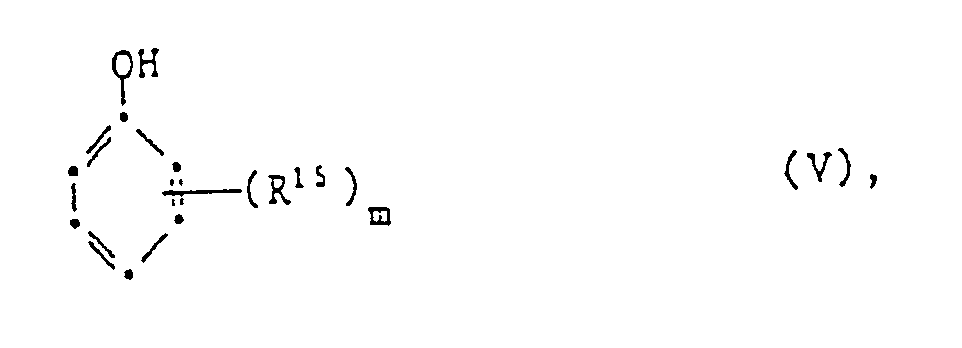

- Procédé selon l'une des revendications 10 à 12 dans lequel le phénol (B) est le phénol lui-même, le o-, m- ou p-crésol, le o-, m-, ou p-tert.butylphénol, le o-, m-, ou p-octylphénol ou encore un mélange de deux de ces phénols ou plus.
- Procédé selon l'une des revendications 10 à 13 dans lequel les aldéhydes (C) et (E) sont chacun le formaldéhyde.
- Procédé selon l'une des revendications 10 à 14 dans lequel (D) est le chlorure de 1,2-naphtoquinonediazido-4- ou -5-sulfonyle, ou le chlorure de 1,2-benzoquinone-2-diazido-4-sulfonyle.
- Procédé selon l'une des revendications 10 à 15, dans lequel le réactif (F) est un sulfite de métal alcalin, une alkylamine primaire ou secondaire dont un ou plusieurs des alkyles peuvent porter des groupes alcoxy, une alkylène-diamine, la morpholine ou une hydroxylamine ou encore un acide aminocarboxylique dont un groupe amino et un groupe carboxylique sont liés à un radical aliphatique, aromatique ou araliphatique, ou un acide mercaptocarboxylique dont un groupe mercapto et un groupe carboxylique sont également liés à un radical aliphatique, aromatique ou araliphatique.
- Procédé selon l'une des revendications 10 à 16 dans lequel la proportion de (D) est de 0,1 à 0,75 mol par équivalent de l'hydroxyle phénolique de la résine de novolaque (A), la proportion du réactif (F) est de 0,04 à 2,0 mol par équivalent de l'hydroxyle phénolique de la novolaque (A) ou du produit de réaction de (A) avec (D) et la proportion de l'aldéhyde (E) est de 1,1 à 4,0 mol par équivalent du réactif (F).
- Procédé selon l'une des revendications 10 à 17 dans lequel la réaction entre l'aldéhyde (E), le réactif (F) et la résine de novolaque (A) ou le produit de réaction de (A) avec le quinodiazide (D) est effectuée dans un solvant inerte à une température de 40 à 180°C, en présence d'une base en quantité suffisante pour neutraliser au moins une partie de l'acide libre.
Applications Claiming Priority (2)
| Application Number | Priority Date | Filing Date | Title |
|---|---|---|---|
| GB8430377 | 1984-12-01 | ||
| GB848430377A GB8430377D0 (en) | 1984-12-01 | 1984-12-01 | Modified phenolic resins |
Publications (3)
| Publication Number | Publication Date |
|---|---|
| EP0184553A2 EP0184553A2 (fr) | 1986-06-11 |
| EP0184553A3 EP0184553A3 (en) | 1988-08-10 |
| EP0184553B1 true EP0184553B1 (fr) | 1991-07-31 |
Family
ID=10570560
Family Applications (1)
| Application Number | Title | Priority Date | Filing Date |
|---|---|---|---|
| EP85810562A Expired - Lifetime EP0184553B1 (fr) | 1984-12-01 | 1985-11-25 | Résines phénoliques modifiées et leur fabrication |
Country Status (7)
| Country | Link |
|---|---|
| US (1) | US4839253A (fr) |
| EP (1) | EP0184553B1 (fr) |
| JP (1) | JPH0625242B2 (fr) |
| CA (1) | CA1258344A (fr) |
| DE (1) | DE3583659D1 (fr) |
| ES (1) | ES8700454A1 (fr) |
| GB (1) | GB8430377D0 (fr) |
Families Citing this family (14)
| Publication number | Priority date | Publication date | Assignee | Title |
|---|---|---|---|---|
| GB8505402D0 (en) * | 1985-03-02 | 1985-04-03 | Ciba Geigy Ag | Modified phenolic resins |
| GB8708747D0 (en) * | 1987-04-11 | 1987-05-20 | Ciba Geigy Ag | Formation of image |
| GB8802314D0 (en) * | 1988-02-03 | 1988-03-02 | Vickers Plc | Improvements in/relating to radiation-sensitive compounds |
| US5047128A (en) * | 1990-01-02 | 1991-09-10 | Shipley Company Inc. | Electrodialysis cell for removal of excess electrolytes formed during electrodeposition of photoresists coatings |
| GB2240549B (en) * | 1990-01-31 | 1993-01-13 | Sony Corp | Photoresist materials |
| US5268256A (en) * | 1990-08-02 | 1993-12-07 | Ppg Industries, Inc. | Photoimageable electrodepositable photoresist composition for producing non-tacky films |
| DE69130691T2 (de) * | 1990-08-02 | 1999-07-22 | Ppg Industries, Inc., Pittsburgh, Pa. | Lichtempfindliche, elektroabscheidbare Photoresistzusammensetzung |
| US5314789A (en) * | 1991-10-01 | 1994-05-24 | Shipley Company Inc. | Method of forming a relief image comprising amphoteric compositions |
| US5384229A (en) * | 1992-05-07 | 1995-01-24 | Shipley Company Inc. | Photoimageable compositions for electrodeposition |
| EP0653681B1 (fr) * | 1993-11-17 | 2000-09-13 | AT&T Corp. | Procédé pour la production d'un dispositif en utilisant une composition photosensible |
| US5589553A (en) * | 1995-03-29 | 1996-12-31 | Shipley Company, L.L.C. | Esterification product of aromatic novolak resin with quinone diazide sulfonyl group |
| KR100363695B1 (ko) * | 1998-12-31 | 2003-04-11 | 주식회사 하이닉스반도체 | 유기난반사방지중합체및그의제조방법 |
| JP5981465B2 (ja) * | 2014-01-10 | 2016-08-31 | 信越化学工業株式会社 | ネガ型レジスト材料及びこれを用いたパターン形成方法 |
| JP7539466B2 (ja) * | 2019-11-19 | 2024-08-23 | メルク パテント ゲゼルシャフト ミット ベシュレンクテル ハフツング | Pag不含ポジ型化学増幅レジスト組成物及びそれの使用法 |
Citations (2)
| Publication number | Priority date | Publication date | Assignee | Title |
|---|---|---|---|---|
| FR2523980A1 (fr) * | 1982-03-23 | 1983-09-30 | Ciba Geigy Ag | Sels resineux solubles dans l'eau ou dispersables dans l'eau, leur preparation et leur application dans des matieres pour revetement |
| US4410675A (en) * | 1982-12-15 | 1983-10-18 | Ciba-Geigy Corporation | Resinous salts, their preparations, and their use in coatings |
Family Cites Families (18)
| Publication number | Priority date | Publication date | Assignee | Title |
|---|---|---|---|---|
| BE506677A (fr) * | 1950-10-31 | |||
| FR1517197A (fr) * | 1966-03-25 | 1968-03-15 | Ici Ltd | Compositions d'enduisage rétifiables contenant une matière acide filmogène et unematière phénolique |
| GB1227602A (fr) * | 1967-11-24 | 1971-04-07 | ||
| JPS505083B1 (fr) * | 1970-09-16 | 1975-02-28 | ||
| JPS505084B1 (fr) * | 1970-09-16 | 1975-02-28 | ||
| JPS5024641B2 (fr) * | 1972-10-17 | 1975-08-18 | ||
| US3859099A (en) * | 1972-12-22 | 1975-01-07 | Eastman Kodak Co | Positive plate incorporating diazoquinone |
| US4139384A (en) * | 1974-02-21 | 1979-02-13 | Fuji Photo Film Co., Ltd. | Photosensitive polymeric o-quinone diazide containing lithographic printing plate and process of using the plate |
| DE2828037A1 (de) * | 1978-06-26 | 1980-01-10 | Hoechst Ag | Lichtempfindliches gemisch |
| JPS561044A (en) * | 1979-06-16 | 1981-01-08 | Konishiroku Photo Ind Co Ltd | Photosensitive composition |
| US4362853A (en) * | 1980-10-24 | 1982-12-07 | Ciba-Geigy Corporation | Resinous salts, their preparation, and their use in coatings |
| JPS58134631A (ja) * | 1982-01-08 | 1983-08-10 | Konishiroku Photo Ind Co Ltd | 感光性組成物 |
| JPS58203433A (ja) * | 1982-05-21 | 1983-11-26 | Fuji Photo Film Co Ltd | 感光性組成物 |
| AT375953B (de) * | 1983-03-21 | 1984-09-25 | Vianova Kunstharz Ag | Verfahren zur herstellung von selbstvernetzenden, kathodisch abscheidbaren etl-bindemitteln auf basis modifizierter alkylphenol-formaldehyd -kondensationsprodukte |
| EP0155231B2 (fr) * | 1984-03-07 | 1997-01-15 | Ciba-Geigy Ag | Procédé pour réaliser des images |
| US4592816A (en) * | 1984-09-26 | 1986-06-03 | Rohm And Haas Company | Electrophoretic deposition process |
| GB8505402D0 (en) * | 1985-03-02 | 1985-04-03 | Ciba Geigy Ag | Modified phenolic resins |
| US4578438A (en) * | 1985-03-11 | 1986-03-25 | Ciba-Geigy Corporation | Preparation of resinous products |
-
1984
- 1984-12-01 GB GB848430377A patent/GB8430377D0/en active Pending
-
1985
- 1985-11-25 DE DE8585810562T patent/DE3583659D1/de not_active Expired - Lifetime
- 1985-11-25 EP EP85810562A patent/EP0184553B1/fr not_active Expired - Lifetime
- 1985-11-29 ES ES549408A patent/ES8700454A1/es not_active Expired
- 1985-11-29 CA CA000496525A patent/CA1258344A/fr not_active Expired
- 1985-11-30 JP JP60270589A patent/JPH0625242B2/ja not_active Expired - Fee Related
-
1987
- 1987-08-28 US US07/091,328 patent/US4839253A/en not_active Expired - Fee Related
Patent Citations (2)
| Publication number | Priority date | Publication date | Assignee | Title |
|---|---|---|---|---|
| FR2523980A1 (fr) * | 1982-03-23 | 1983-09-30 | Ciba Geigy Ag | Sels resineux solubles dans l'eau ou dispersables dans l'eau, leur preparation et leur application dans des matieres pour revetement |
| US4410675A (en) * | 1982-12-15 | 1983-10-18 | Ciba-Geigy Corporation | Resinous salts, their preparations, and their use in coatings |
Also Published As
| Publication number | Publication date |
|---|---|
| CA1258344A (fr) | 1989-08-08 |
| DE3583659D1 (de) | 1991-09-05 |
| EP0184553A3 (en) | 1988-08-10 |
| JPS61133217A (ja) | 1986-06-20 |
| EP0184553A2 (fr) | 1986-06-11 |
| US4839253A (en) | 1989-06-13 |
| JPH0625242B2 (ja) | 1994-04-06 |
| GB8430377D0 (en) | 1985-01-09 |
| ES549408A0 (es) | 1986-10-01 |
| ES8700454A1 (es) | 1986-10-01 |
Similar Documents
| Publication | Publication Date | Title |
|---|---|---|
| EP0196999B1 (fr) | Résines phénoliques modifiées | |
| EP0131780B1 (fr) | Composition photosensible et matériel de reproduction fabriqué à partir de cette composition | |
| EP0155231B1 (fr) | Procédé pour réaliser des images | |
| DE68928823T2 (de) | Strahlungsempfindliche, positiv arbeitende Resistzusammensetzung | |
| EP0001254B1 (fr) | Composition photosensible à action positive comprenant un naphtoquinone-diazide halogéné | |
| EP0184553A2 (fr) | Résines phénoliques modifiées et leur fabrication | |
| DE3751598T2 (de) | Bilderzeugungsverfahren. | |
| DE2828037A1 (de) | Lichtempfindliches gemisch | |
| DE3515210A1 (de) | Trimethylsilygruppen enthaltende novolakharze, ihre verwendung zur herstellung von photoresist-material und -mustern | |
| EP0069966B1 (fr) | Composition sensible à la lumière à base de o-naphthoquinone-diazides et matériel à copier photosensible fabriqué de celli-ci | |
| EP0769485B1 (fr) | Composition pour photoréserve positive ainsi que photosensibilisateurs | |
| EP0369219B1 (fr) | Composés photosensibles et préparation de mélanges photosensibles et matériel d'enregistrement | |
| DE69226600T2 (de) | Strahlungsempfindliche positiv-arbeitende Resistzusammensetzung | |
| DE69130896T2 (de) | Strahlungsempfindliche positiv arbeitende Lackzusammensetzung | |
| US5726217A (en) | Tetraphenol compounds and process for producing the same | |
| DE68927315T2 (de) | Schutzlack-Zusammensetzung | |
| DE3811859C2 (de) | Verfahren zur Herstellung von Abbildungen | |
| DE69121739T2 (de) | Strahlungsempfindliche, positiv arbeitende Resistmasse | |
| EP0167778B1 (fr) | Dérivés de 1,2-naphtoquinonediazide contenant des groupes perfluoroalcoyles et matériel de reproduction contenant ces composés | |
| DE69032873T2 (de) | Vollständig substituierte Novalak-Polymere enthaltende Strahlungsempfindliche Zusammensetzungen | |
| DE69009269T2 (de) | Entwickler für lichtempfindliche Platten bei der Herstellung von lithographischen Druckplatten und Verfahren zur Herstellung der Platten. | |
| DE3886616T2 (de) | Positive photoempfindliche harzzubereitung und verfahren zur herstellung. | |
| DE68927129T2 (de) | Resistzusammensetzung, Phenolverbindung und Chinondiazidsulfonsäureester dieser Phenolverbindung | |
| DE69032830T2 (de) | Strahlungsempfindliche positiv-arbeitende Resistmasse | |
| JP3959755B2 (ja) | 5核体ノボラック化合物およびその用途 |
Legal Events
| Date | Code | Title | Description |
|---|---|---|---|
| PUAI | Public reference made under article 153(3) epc to a published international application that has entered the european phase |
Free format text: ORIGINAL CODE: 0009012 |
|
| 17P | Request for examination filed |
Effective date: 19851127 |
|
| AK | Designated contracting states |
Kind code of ref document: A2 Designated state(s): BE CH DE FR GB IT LI NL SE |
|
| PUAL | Search report despatched |
Free format text: ORIGINAL CODE: 0009013 |
|
| AK | Designated contracting states |
Kind code of ref document: A3 Designated state(s): BE CH DE FR GB IT LI NL SE |
|
| 17Q | First examination report despatched |
Effective date: 19900213 |
|
| GRAA | (expected) grant |
Free format text: ORIGINAL CODE: 0009210 |
|
| ITF | It: translation for a ep patent filed | ||
| AK | Designated contracting states |
Kind code of ref document: B1 Designated state(s): BE CH DE FR GB IT LI NL SE |
|
| REF | Corresponds to: |
Ref document number: 3583659 Country of ref document: DE Date of ref document: 19910905 |
|
| ET | Fr: translation filed | ||
| GBT | Gb: translation of ep patent filed (gb section 77(6)(a)/1977) | ||
| PLBE | No opposition filed within time limit |
Free format text: ORIGINAL CODE: 0009261 |
|
| STAA | Information on the status of an ep patent application or granted ep patent |
Free format text: STATUS: NO OPPOSITION FILED WITHIN TIME LIMIT |
|
| 26N | No opposition filed | ||
| EAL | Se: european patent in force in sweden |
Ref document number: 85810562.0 |
|
| REG | Reference to a national code |
Ref country code: CH Ref legal event code: PUE Owner name: CIBA-GEIGY AG TRANSFER- CIBA SC HOLDING AG |
|
| BECN | Be: change of holder's name |
Effective date: 19961129 |
|
| NLS | Nl: assignments of ep-patents |
Owner name: CIBA SC HOLDING AG |
|
| REG | Reference to a national code |
Ref country code: GB Ref legal event code: 732E |
|
| REG | Reference to a national code |
Ref country code: CH Ref legal event code: PFA Free format text: CIBA SC HOLDING AG TRANSFER- CIBA SPECIALTY CHEMICALS HOLDING INC. |
|
| NLT1 | Nl: modifications of names registered in virtue of documents presented to the patent office pursuant to art. 16 a, paragraph 1 |
Owner name: CIBA SPECIALTY CHEMICALS HOLDING INC. |
|
| REG | Reference to a national code |
Ref country code: FR Ref legal event code: TP |
|
| REG | Reference to a national code |
Ref country code: CH Ref legal event code: PUE Owner name: CIBA SPECIALTY CHEMICALS HOLDING INC. TRANSFER- VA |
|
| REG | Reference to a national code |
Ref country code: GB Ref legal event code: 732E |
|
| NLS | Nl: assignments of ep-patents |
Owner name: VANTICO AG |
|
| REG | Reference to a national code |
Ref country code: GB Ref legal event code: IF02 |
|
| REG | Reference to a national code |
Ref country code: FR Ref legal event code: TP |
|
| PGFP | Annual fee paid to national office [announced via postgrant information from national office to epo] |
Ref country code: GB Payment date: 20031029 Year of fee payment: 19 |
|
| PGFP | Annual fee paid to national office [announced via postgrant information from national office to epo] |
Ref country code: NL Payment date: 20031030 Year of fee payment: 19 Ref country code: CH Payment date: 20031030 Year of fee payment: 19 |
|
| PGFP | Annual fee paid to national office [announced via postgrant information from national office to epo] |
Ref country code: SE Payment date: 20031103 Year of fee payment: 19 Ref country code: DE Payment date: 20031103 Year of fee payment: 19 |
|
| PGFP | Annual fee paid to national office [announced via postgrant information from national office to epo] |
Ref country code: FR Payment date: 20031107 Year of fee payment: 19 |
|
| PGFP | Annual fee paid to national office [announced via postgrant information from national office to epo] |
Ref country code: BE Payment date: 20031209 Year of fee payment: 19 |
|
| PG25 | Lapsed in a contracting state [announced via postgrant information from national office to epo] |
Ref country code: GB Free format text: LAPSE BECAUSE OF NON-PAYMENT OF DUE FEES Effective date: 20041125 |
|
| PG25 | Lapsed in a contracting state [announced via postgrant information from national office to epo] |
Ref country code: SE Free format text: LAPSE BECAUSE OF NON-PAYMENT OF DUE FEES Effective date: 20041126 |
|
| PG25 | Lapsed in a contracting state [announced via postgrant information from national office to epo] |
Ref country code: LI Free format text: LAPSE BECAUSE OF NON-PAYMENT OF DUE FEES Effective date: 20041130 Ref country code: CH Free format text: LAPSE BECAUSE OF NON-PAYMENT OF DUE FEES Effective date: 20041130 Ref country code: BE Free format text: LAPSE BECAUSE OF NON-PAYMENT OF DUE FEES Effective date: 20041130 |
|
| BERE | Be: lapsed |
Owner name: *VANTICO A.G. Effective date: 20041130 |
|
| PG25 | Lapsed in a contracting state [announced via postgrant information from national office to epo] |
Ref country code: NL Free format text: LAPSE BECAUSE OF NON-PAYMENT OF DUE FEES Effective date: 20050601 Ref country code: DE Free format text: LAPSE BECAUSE OF NON-PAYMENT OF DUE FEES Effective date: 20050601 |
|
| EUG | Se: european patent has lapsed | ||
| GBPC | Gb: european patent ceased through non-payment of renewal fee |
Effective date: 20041125 |
|
| REG | Reference to a national code |
Ref country code: CH Ref legal event code: PL |
|
| PG25 | Lapsed in a contracting state [announced via postgrant information from national office to epo] |
Ref country code: FR Free format text: LAPSE BECAUSE OF NON-PAYMENT OF DUE FEES Effective date: 20050729 |
|
| NLV4 | Nl: lapsed or anulled due to non-payment of the annual fee |
Effective date: 20050601 |
|
| REG | Reference to a national code |
Ref country code: FR Ref legal event code: ST |
|
| BERE | Be: lapsed |
Owner name: *VANTICO A.G. Effective date: 20041130 |