EP0185216A2 - Porte-récipients - Google Patents
Porte-récipients Download PDFInfo
- Publication number
- EP0185216A2 EP0185216A2 EP85114878A EP85114878A EP0185216A2 EP 0185216 A2 EP0185216 A2 EP 0185216A2 EP 85114878 A EP85114878 A EP 85114878A EP 85114878 A EP85114878 A EP 85114878A EP 0185216 A2 EP0185216 A2 EP 0185216A2
- Authority
- EP
- European Patent Office
- Prior art keywords
- end wall
- articulated
- longitudinal
- crease line
- sections
- Prior art date
- Legal status (The legal status is an assumption and is not a legal conclusion. Google has not performed a legal analysis and makes no representation as to the accuracy of the status listed.)
- Withdrawn
Links
Images

Classifications
-
- B—PERFORMING OPERATIONS; TRANSPORTING
- B65—CONVEYING; PACKING; STORING; HANDLING THIN OR FILAMENTARY MATERIAL
- B65D—CONTAINERS FOR STORAGE OR TRANSPORT OF ARTICLES OR MATERIALS, e.g. BAGS, BARRELS, BOTTLES, BOXES, CANS, CARTONS, CRATES, DRUMS, JARS, TANKS, HOPPERS, FORWARDING CONTAINERS; ACCESSORIES, CLOSURES, OR FITTINGS THEREFOR; PACKAGING ELEMENTS; PACKAGES
- B65D71/00—Bundles of articles held together by packaging elements for convenience of storage or transport, e.g. portable segregating carrier for plural receptacles such as beer cans or pop bottles; Bales of material
- B65D71/0003—Tray-like elements provided with handles, for storage or transport of several articles, e.g. bottles, tins, jars
- B65D71/0022—Tray-like elements provided with handles, for storage or transport of several articles, e.g. bottles, tins, jars formed by folding or erecting one blank, and provided with vertical partitions
-
- B—PERFORMING OPERATIONS; TRANSPORTING
- B65—CONVEYING; PACKING; STORING; HANDLING THIN OR FILAMENTARY MATERIAL
- B65D—CONTAINERS FOR STORAGE OR TRANSPORT OF ARTICLES OR MATERIALS, e.g. BAGS, BARRELS, BOTTLES, BOXES, CANS, CARTONS, CRATES, DRUMS, JARS, TANKS, HOPPERS, FORWARDING CONTAINERS; ACCESSORIES, CLOSURES, OR FITTINGS THEREFOR; PACKAGING ELEMENTS; PACKAGES
- B65D2571/00—Bundles of articles held together by packaging elements for convenience of storage or transport, e.g. portable segregating carrier for plural receptacles such as beer cans, pop bottles; Bales of material
- B65D2571/00123—Bundling wrappers or trays
- B65D2571/00129—Wrapper locking means
- B65D2571/00135—Wrapper locking means integral with the wrapper
- B65D2571/00141—Wrapper locking means integral with the wrapper glued
-
- B—PERFORMING OPERATIONS; TRANSPORTING
- B65—CONVEYING; PACKING; STORING; HANDLING THIN OR FILAMENTARY MATERIAL
- B65D—CONTAINERS FOR STORAGE OR TRANSPORT OF ARTICLES OR MATERIALS, e.g. BAGS, BARRELS, BOTTLES, BOXES, CANS, CARTONS, CRATES, DRUMS, JARS, TANKS, HOPPERS, FORWARDING CONTAINERS; ACCESSORIES, CLOSURES, OR FITTINGS THEREFOR; PACKAGING ELEMENTS; PACKAGES
- B65D2571/00—Bundles of articles held together by packaging elements for convenience of storage or transport, e.g. portable segregating carrier for plural receptacles such as beer cans, pop bottles; Bales of material
- B65D2571/00123—Bundling wrappers or trays
- B65D2571/00333—Partitions, i.e. elements contacting a major part of each aarticle or extending across the whole length of the wrapper
- B65D2571/0037—Partitions, i.e. elements contacting a major part of each aarticle or extending across the whole length of the wrapper extending from at least a side wall
- B65D2571/00376—Squarings or the like
- B65D2571/00388—Two rows of more than two cells
-
- B—PERFORMING OPERATIONS; TRANSPORTING
- B65—CONVEYING; PACKING; STORING; HANDLING THIN OR FILAMENTARY MATERIAL
- B65D—CONTAINERS FOR STORAGE OR TRANSPORT OF ARTICLES OR MATERIALS, e.g. BAGS, BARRELS, BOTTLES, BOXES, CANS, CARTONS, CRATES, DRUMS, JARS, TANKS, HOPPERS, FORWARDING CONTAINERS; ACCESSORIES, CLOSURES, OR FITTINGS THEREFOR; PACKAGING ELEMENTS; PACKAGES
- B65D2571/00—Bundles of articles held together by packaging elements for convenience of storage or transport, e.g. portable segregating carrier for plural receptacles such as beer cans, pop bottles; Bales of material
- B65D2571/00123—Bundling wrappers or trays
- B65D2571/00432—Handles or suspending means
- B65D2571/00456—Handles or suspending means integral with the wrapper
- B65D2571/00475—Handles or suspending means integral with the wrapper and extending ion a substantially vertical plane
- B65D2571/00487—Handles or suspending means integral with the wrapper and extending ion a substantially vertical plane and formed integrally with a partition
-
- B—PERFORMING OPERATIONS; TRANSPORTING
- B65—CONVEYING; PACKING; STORING; HANDLING THIN OR FILAMENTARY MATERIAL
- B65D—CONTAINERS FOR STORAGE OR TRANSPORT OF ARTICLES OR MATERIALS, e.g. BAGS, BARRELS, BOTTLES, BOXES, CANS, CARTONS, CRATES, DRUMS, JARS, TANKS, HOPPERS, FORWARDING CONTAINERS; ACCESSORIES, CLOSURES, OR FITTINGS THEREFOR; PACKAGING ELEMENTS; PACKAGES
- B65D2571/00—Bundles of articles held together by packaging elements for convenience of storage or transport, e.g. portable segregating carrier for plural receptacles such as beer cans, pop bottles; Bales of material
- B65D2571/00123—Bundling wrappers or trays
- B65D2571/00432—Handles or suspending means
- B65D2571/00518—Handles or suspending means with reinforcements
- B65D2571/00524—Handles or suspending means with reinforcements integral
-
- B—PERFORMING OPERATIONS; TRANSPORTING
- B65—CONVEYING; PACKING; STORING; HANDLING THIN OR FILAMENTARY MATERIAL
- B65D—CONTAINERS FOR STORAGE OR TRANSPORT OF ARTICLES OR MATERIALS, e.g. BAGS, BARRELS, BOTTLES, BOXES, CANS, CARTONS, CRATES, DRUMS, JARS, TANKS, HOPPERS, FORWARDING CONTAINERS; ACCESSORIES, CLOSURES, OR FITTINGS THEREFOR; PACKAGING ELEMENTS; PACKAGES
- B65D2571/00—Bundles of articles held together by packaging elements for convenience of storage or transport, e.g. portable segregating carrier for plural receptacles such as beer cans, pop bottles; Bales of material
- B65D2571/00123—Bundling wrappers or trays
- B65D2571/00648—Elements used to form the wrapper
- B65D2571/00654—Blanks
- B65D2571/0066—Blanks formed from one single sheet
-
- B—PERFORMING OPERATIONS; TRANSPORTING
- B65—CONVEYING; PACKING; STORING; HANDLING THIN OR FILAMENTARY MATERIAL
- B65D—CONTAINERS FOR STORAGE OR TRANSPORT OF ARTICLES OR MATERIALS, e.g. BAGS, BARRELS, BOTTLES, BOXES, CANS, CARTONS, CRATES, DRUMS, JARS, TANKS, HOPPERS, FORWARDING CONTAINERS; ACCESSORIES, CLOSURES, OR FITTINGS THEREFOR; PACKAGING ELEMENTS; PACKAGES
- B65D2571/00—Bundles of articles held together by packaging elements for convenience of storage or transport, e.g. portable segregating carrier for plural receptacles such as beer cans, pop bottles; Bales of material
- B65D2571/00123—Bundling wrappers or trays
- B65D2571/00709—Shape of the formed wrapper, i.e. shape of each formed element if the wrapper is made from more than one element
- B65D2571/00802—Other shapes
-
- B—PERFORMING OPERATIONS; TRANSPORTING
- B65—CONVEYING; PACKING; STORING; HANDLING THIN OR FILAMENTARY MATERIAL
- B65D—CONTAINERS FOR STORAGE OR TRANSPORT OF ARTICLES OR MATERIALS, e.g. BAGS, BARRELS, BOTTLES, BOXES, CANS, CARTONS, CRATES, DRUMS, JARS, TANKS, HOPPERS, FORWARDING CONTAINERS; ACCESSORIES, CLOSURES, OR FITTINGS THEREFOR; PACKAGING ELEMENTS; PACKAGES
- B65D2571/00—Bundles of articles held together by packaging elements for convenience of storage or transport, e.g. portable segregating carrier for plural receptacles such as beer cans, pop bottles; Bales of material
- B65D2571/00123—Bundling wrappers or trays
- B65D2571/00833—Other details of wrappers
- B65D2571/00932—Flattenable or foldable packages
- B65D2571/00938—Means for maintaining collapsible packages in erected state
- B65D2571/00944—Hooks
- B65D2571/00956—Hooks engaging the bottom wall
Definitions
- the innovation relates to a container carrier made of a one-piece blank made of foldable flat material, in particular for bottles, with two side walls, a foldable base articulated longitudinally on one side wall by a crease line, the free edge of which can be connected to a base connecting flap of the other side wall, on the rest opposite edges of the side walls articulated end wall halves, with one end wall flap being articulated to the end wall halves lying on one side of the longitudinal walls parallel to the creasing line with the side wall and both end wall flaps over one over the Extending the height of the end wall halves, are connected to one another transversely by a crease line, while the other end wall halves parallel to the crease line are articulated with the side walls of longitudinal web portions which have first handle portions on the mutually facing sides, which are articulated to one another, and also each with two punched out in a longitudinal web section and articulated to these cross webs, which have cross web connecting tabs articulated on the free edge and connectable to the associated side wall, the cross web connecting tab
- Such a blank for a container carrier is known (DE-OS 34 02 729).
- the container set up from the blank has a longitudinal web and transverse webs articulated on the longitudinal web, which are connected to the longitudinal walls, preferably by gluing. In this way, three compartments are generally formed on each side of the longitudinal web for receiving containers, in particular bottles.
- the one connected to the longitudinal web Handle protrudes beyond the upper edges of the longitudinal and end walls, so that a comfortable carrying option is guaranteed even when containers are picked up.
- ble containers are prefabricated from the one-piece blanks in such a way that the container carrier can be folded flat after the prefabrication or gluing.
- the container carriers are delivered from the manufacturer to the user, who then finally sets up the container carriers and e.g. filled with bottles.
- the end walls can be folded over their height.
- the bottom can be folded over a longitudinal center crease line. When lying flat, the side walls are placed on the longitudinal web, while one end wall is folded outwards and the other inwards. The bottom is also folded outwards.
- the container carriers In the flat-lying state, the container carriers naturally have several layers of material lying one above the other.
- Known container carriers have the disadvantage that the number of layers of material varies over their area. Areas with six layers of material alternate with two and four-layer areas. Such a different material layer distribution is associated with considerable disadvantages.
- a disadvantage is that the volume occupied by the flat-lying container carrier, for example in an outer carton or in the magazine of a packaging machine, is determined by the maximum number of layers.
- the known container carriers therefore take up a relatively large volume.
- the volume has an impact on the transport and storage volume and thus on the transport and storage costs.
- parts of the blank to be connected are generally glued together.
- the parts to be bonded to one another must be pressurized for a certain period of time. Even pressure on the parts to be glued is made considerably more difficult by the different material layer distribution. In order nevertheless to obtain a uniform contact pressure over the respective surface to be pressurized, considerable structural expenditure is required which does not correspond to the standard of gluing machines.
- the flat-lying container carriers are erected in a packaging machine and filled with the containers.
- the supply to the packaging machine is expediently from a magazine.
- Container carrier with uneven material layer ver division lead to an oblique stack, which makes feeding into the packaging machine difficult. Because of the slanted stacking, the magazine can of course only have a certain length.
- the innovation is based on the object of improving a container carrier from a one-piece blank made of foldable flat material in such a way that a uniform material layer distribution is achieved.
- this object is achieved in that the second grip sections are articulated to the connecting section, the free edge of the crossbars facing the associated end wall half, the connecting straps of the crossbars initially lying on the end wall halves are punched out of the crossbar material and connected to a crossbar link section, the free one edge pointing towards the end wall half approximately coincides with the crease line between the longitudinal web section and end wall half or which is partially punched out of the material of the assigned end wall halves and which is articulated via a creasing line on the transverse web which runs parallel to the crease line between the end wall half and the longitudinal web section, with the Pre-assembly of the first handle sections around the crease line between the end wall halves and side walls are foldable onto the second handle sections and the end wall flaps of the other end wall halves around their creases Line to the end wall halves on the end wall halves and a portion of the second handle section are foldable, the parts folded in this way forming a distance at the facing edge or at most a
- the material volume of the flat-lying container carrier according to the invention is reduced by a third. Accordingly, more container carriers fit into a box for storage and transportation of the container carriers from the manufacturer to the user. This results in a considerable saving in storage and transport costs.
- the even distribution of the material layers enables perfect storage of the flat-lying container carriers in the packaging machine.
- a larger number of container carriers can be accommodated for a given length of magazine.
- the magazine length can be reduced for a given number of container carriers.
- the cutting according to the innovation for the container carrier there are two possibilities for the shaping of the transverse webs from the longitudinal web section.
- the free edge of at least one transverse connector connecting link abuts the crease line between the longitudinal web section and the adjacent end wall half.
- the compartments on this end face become longer by the slot width and no longer exactly square.
- this does not have a negative effect on bottle protection.
- transverse webs facing the associated end wall halves partially engage in the end wall halves with their connecting straps. This results in openings in the upright state on the end face.
- these can be kept very small if, according to an embodiment of the invention, two tab sections are articulated at a distance from one another coaxially on the transverse web and the connecting tabs are connected to the tab sections via arms. It needs only relatively little material to be removed from the end wall halves, in order to nevertheless obtain a firm connection of the corresponding transverse webs with the longitudinal wall.
- the openings in the end walls in the erected state therefore have a slit-like character and therefore do not impair the overall appearance of the container carrier.
- the tab sections of the two transverse webs are offset from one another with respect to the end wall halves.
- the dislocation is such that the individual recesses in the end wall halves do not overlap completely or partially. This results in four slot-like openings lying one above the other over the fold line in one end wall.
- cutting or punching lines are drawn with dashed lines and continuous lines.
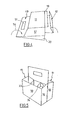
- the blank shown in FIG. 1 has two longitudinal walls 10, 11. On the outside of the longitudinal wall 10, a bottom 12 is articulated via a crease line, which is divided and foldable by a crease line 13 in the longitudinal center. At one end of the crease line 13 there is a triangular cutout 14. On the other opposite sides of the longitudinal wall 10, end wall halves 15, 16 are articulated via a crease line. On opposite the sides of the longitudinal wall 11, end wall halves 17, 18 are articulated via crease lines. On the outside of the longitudinal wall 11, a floor connection bracket 19 is articulated via a crease line. To the end wall halves 15, 17 connecting tabs 20, 21 are articulated via crease lines. The end wall connecting straps 20, 21 are connected to one another beyond the height of the end wall halves 15, 17 via a connecting section 22, which is divided in the middle by a crease line 23.
- Longitudinal web sections 24, 25 are articulated on the end wall halves 16, 18 via crease lines.
- the web sections 24, 25 have grip sections 26, 27 with grip holes 28, 29.
- the grip sections 26, 27 are articulated to one another via a crease line 30.
- Hook sections 31, 32 are formed on the outside of the web sections 24, 25 and engage in the recess 14 of the base 12 lying one above the other in the set-up state.
- such a feature is generally known.
- Two cross webs 33, 34 and 35, 36 are punched out in the web sections 24, 25 and articulated to the material of the longitudinal web sections 24, 25 via a crease line, as shown in FIG. 1.
- the creasing lines mentioned which are not provided with a reference number run parallel to one another.
- a cross line is at the cross web 33 or 35 articulated a cross bar connecting tab 37 or 38.
- the creasing line in question lies in line with the creasing line for the crosspiece 34 or 36.
- the connecting strap 37 or 38 is therefore completely punched out of the material of the crosspiece 34 or 36.
- the crosspiece 34, 36 also has a crosspiece connecting tab, which can be seen more clearly in FIG. 2.
- the connecting strap has a section 40 cut out of the crosspiece 34, to which two slightly diverging arms 41, 42 are connected.
- the arms extend in the direction of the crease line 43 between the longitudinal web section 24 and the end wall half 16.
- the arms 41, 42 are connected to sections 4f, 45, the longitudinal extent of which lies in the direction of the crease line 43.
- the sections 44, 45 are partially punched out of the material of the end wall half 16. In the example shown, they protrude 2.5 mm into the end wall half 16.
- sections 44, 45 are articulated to crossbar 34 via crease lines 46 and 47, respectively.
- the crossbar connecting tab 39 can therefore be pivoted about the creasing lines 46, 47 relative to the crossbar 34 for the purpose of connection to the associated longitudinal wall 10. The same naturally applies to the crossbar 36.
- Second handle sections 48, 49 are articulated to the connecting section 22 via creasing lines. They contain grip holes 50, 51 which interact with the grip holes 28, 29 in the erected state.
- FIGS. 3 and 4 The assembly of the blank according to FIG. 1 to form a flat container carrier can be seen from FIGS. 3 and 4, which are described below.
- the part of the blank according to FIG. 1 to the right of the crease lines between the longitudinal walls 10, 11 and the end wall halves 16, 18 is folded around these crease lines to the left onto the remaining part, as indicated by the dashed arrow 52.
- the end wall connecting flaps 20, 21 are folded around the associated crease line to the right onto the lower part mentioned, as indicated by the dashed arrow 53.
- a small distance is formed between the free edge of the web sections 24, 25 and the free edge of the connecting tabs 20, 21.
- the part folded in this way is folded around the crease line 30 or the crease line between the handle sections 48, 49, as indicated by the dashed arrow 54 in FIG. 4.
- hatched areas indicate the areas in which glue is applied.
- the glued application seen areas.
- the grip sections 26, 27 are glued to the grip sections 48, 49.
- the crossbars 33 to 36 are glued via their connecting straps to the inside of the longitudinal walls 10 and 11, pie connecting straps 20, 21 are glued to the handle sections 48, 49.
- another glue is applied in such a way that a longitudinal web section 26 or 27 is provided with glue with the exception of the cross webs 33 to 36.
- glue is also applied to the outside of one of the connecting straps 2U or 21.
- glue is applied to a section of the floor 12.
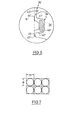
- FIG. 6 shows a representation similar to FIG. 2. The same reference numerals have therefore been used, but with a comma.
- FIG. 7 shows the compartmentalization in cross section, which occurs in an embodiment corresponding to FIG. 6.
- the received bottles 52 are represented by their base circumference. It can be seen that the bottles 52 have some play in the compartments 51 in the longitudinal direction. However, this does not have a disadvantageous effect on the protection of the bottles 52.
Landscapes
- Engineering & Computer Science (AREA)
- Mechanical Engineering (AREA)
- Cartons (AREA)
- Supplying Of Containers To The Packaging Station (AREA)
Applications Claiming Priority (4)
| Application Number | Priority Date | Filing Date | Title |
|---|---|---|---|
| DE8436854U | 1984-12-17 | ||
| DE19848436854 DE8436854U1 (de) | 1984-12-17 | 1984-12-17 | Behaeltertraeger |
| DE8505557U | 1985-02-27 | ||
| DE19858505557 DE8505557U1 (de) | 1985-02-27 | 1985-02-27 | Behaeltertraeger |
Publications (2)
| Publication Number | Publication Date |
|---|---|
| EP0185216A2 true EP0185216A2 (fr) | 1986-06-25 |
| EP0185216A3 EP0185216A3 (fr) | 1987-10-07 |
Family
ID=25950110
Family Applications (1)
| Application Number | Title | Priority Date | Filing Date |
|---|---|---|---|
| EP85114878A Withdrawn EP0185216A3 (fr) | 1984-12-17 | 1985-11-23 | Porte-récipients |
Country Status (3)
| Country | Link |
|---|---|
| EP (1) | EP0185216A3 (fr) |
| DK (1) | DK587885A (fr) |
| NO (1) | NO855053L (fr) |
Cited By (3)
| Publication number | Priority date | Publication date | Assignee | Title |
|---|---|---|---|---|
| EP0280095A1 (fr) * | 1987-02-11 | 1988-08-31 | Europa Carton Aktiengesellschaft | Porte-récipients, en particulier pour bouteilles |
| EP0396301A1 (fr) * | 1989-04-27 | 1990-11-07 | The Mead Corporation | Emballage porte-articles |
| EP0794130A1 (fr) * | 1996-03-04 | 1997-09-10 | FCP Europa Carton Faltschachtel GmbH | Porte-bouteilles |
Family Cites Families (2)
| Publication number | Priority date | Publication date | Assignee | Title |
|---|---|---|---|---|
| CA1195665A (fr) * | 1981-08-28 | 1985-10-22 | Prentice J. Wood | Porte-articles |
| DE3402729C2 (de) * | 1983-04-08 | 1986-06-19 | Europa Carton Ag, 2000 Hamburg | Behälterträger |
-
1985
- 1985-11-23 EP EP85114878A patent/EP0185216A3/fr not_active Withdrawn
- 1985-12-16 NO NO855053A patent/NO855053L/no unknown
- 1985-12-17 DK DK587885A patent/DK587885A/da not_active Application Discontinuation
Cited By (3)
| Publication number | Priority date | Publication date | Assignee | Title |
|---|---|---|---|---|
| EP0280095A1 (fr) * | 1987-02-11 | 1988-08-31 | Europa Carton Aktiengesellschaft | Porte-récipients, en particulier pour bouteilles |
| EP0396301A1 (fr) * | 1989-04-27 | 1990-11-07 | The Mead Corporation | Emballage porte-articles |
| EP0794130A1 (fr) * | 1996-03-04 | 1997-09-10 | FCP Europa Carton Faltschachtel GmbH | Porte-bouteilles |
Also Published As
| Publication number | Publication date |
|---|---|
| EP0185216A3 (fr) | 1987-10-07 |
| DK587885D0 (da) | 1985-12-17 |
| DK587885A (da) | 1986-06-18 |
| NO855053L (no) | 1986-06-18 |
Similar Documents
| Publication | Publication Date | Title |
|---|---|---|
| DE3885485T2 (de) | Tragebehälter mit mehreren Fächern. | |
| DE69401922T2 (de) | Tragbehälter aus karton mit handgriff für dosen | |
| DE7422464U (de) | Traeger fuer eine Anzahl von Behaeltern | |
| CH448872A (de) | Behälter aus Wellpappe | |
| WO2001000500A1 (fr) | Porte-contenants | |
| EP0399250B1 (fr) | Bande de matière d'emballage faite de flans reliés entre eux | |
| DE2833182A1 (de) | Traegerpackung | |
| DE68924785T2 (de) | Tragbehälter mit bodenseitiger füllöffnung. | |
| DE68924076T2 (de) | Aus zwei zuschnitten gefertigter trogförmiger behälter. | |
| EP0905032A1 (fr) | Flan et récipient construit à partir de ce flan ainsi qu'appareil pour sa fabrication | |
| EP0280095B1 (fr) | Porte-récipients, en particulier pour bouteilles | |
| EP1651533A1 (fr) | Cageot a plusieurs cavites | |
| DE3883418T2 (de) | Mehrfächer-Träger und Verfahren für seine Formung. | |
| EP0177911B1 (fr) | Flan préplié en une seule pièce formé d'un matériau pliable comme le carton, le carton ondulé ou analogue, ledit flan servant à la formation d'un plateau de groupement pour gobelets de section carrée ou rectangulaire | |
| DE3402729C2 (de) | Behälterträger | |
| DE68902471T2 (de) | Faltschachtel und zuschnitt dafuer. | |
| DE8505557U1 (de) | Behaeltertraeger | |
| DE60004774T2 (de) | Schachtel mit zwei zu einander versetzten Ausgabeöffnungen | |
| DE29513265U1 (de) | Teilbare Verpackung aus Wellpappe oder Karton | |
| DE10335201B4 (de) | Stabilisierungssteg an einer Mehrlochsteige | |
| DE4341129A1 (de) | Hohlkörper und Zuschnitt zur Herstellung des Hohlkörpers | |
| DE3730768A1 (de) | Verpackungsbehaelter, insbesondere zur aufnahme von schokoladentafeln | |
| DE8436854U1 (de) | Behaeltertraeger | |
| DE3021937A1 (de) | Flaschentraeger aus karton | |
| DE2836826A1 (de) | Traeger fuer behaelter |
Legal Events
| Date | Code | Title | Description |
|---|---|---|---|
| PUAI | Public reference made under article 153(3) epc to a published international application that has entered the european phase |
Free format text: ORIGINAL CODE: 0009012 |
|
| 17P | Request for examination filed |
Effective date: 19851218 |
|
| AK | Designated contracting states |
Kind code of ref document: A2 Designated state(s): AT BE CH DE FR GB LI NL SE |
|
| PUAL | Search report despatched |
Free format text: ORIGINAL CODE: 0009013 |
|
| AK | Designated contracting states |
Kind code of ref document: A3 Designated state(s): AT BE CH DE FR GB LI NL SE |
|
| 17Q | First examination report despatched |
Effective date: 19881026 |
|
| STAA | Information on the status of an ep patent application or granted ep patent |
Free format text: STATUS: THE APPLICATION IS DEEMED TO BE WITHDRAWN |
|
| 18D | Application deemed to be withdrawn |
Effective date: 19890304 |
|
| RIN1 | Information on inventor provided before grant (corrected) |
Inventor name: SKOLIK, BERNARD |