EP0185329B1 - Entwachsungskatalysatoren und -verfahren mit Silikoaluminophosphat-Molekularsieben - Google Patents
Entwachsungskatalysatoren und -verfahren mit Silikoaluminophosphat-Molekularsieben Download PDFInfo
- Publication number
- EP0185329B1 EP0185329B1 EP85115923A EP85115923A EP0185329B1 EP 0185329 B1 EP0185329 B1 EP 0185329B1 EP 85115923 A EP85115923 A EP 85115923A EP 85115923 A EP85115923 A EP 85115923A EP 0185329 B1 EP0185329 B1 EP 0185329B1
- Authority
- EP
- European Patent Office
- Prior art keywords
- sapo
- catalyst
- weight
- percent
- zeolite
- Prior art date
- Legal status (The legal status is an assumption and is not a legal conclusion. Google has not performed a legal analysis and makes no representation as to the accuracy of the status listed.)
- Expired
Links
- 239000003054 catalyst Substances 0.000 title claims abstract description 116
- 238000000034 method Methods 0.000 title claims abstract description 48
- 239000002808 molecular sieve Substances 0.000 title claims description 17
- URGAHOPLAPQHLN-UHFFFAOYSA-N sodium aluminosilicate Chemical compound [Na+].[Al+3].[O-][Si]([O-])=O.[O-][Si]([O-])=O URGAHOPLAPQHLN-UHFFFAOYSA-N 0.000 title claims description 17
- 229930195733 hydrocarbon Natural products 0.000 claims abstract description 28
- 150000002430 hydrocarbons Chemical class 0.000 claims abstract description 27
- 239000004215 Carbon black (E152) Substances 0.000 claims abstract description 24
- HNPSIPDUKPIQMN-UHFFFAOYSA-N dioxosilane;oxo(oxoalumanyloxy)alumane Chemical compound O=[Si]=O.O=[Al]O[Al]=O HNPSIPDUKPIQMN-UHFFFAOYSA-N 0.000 claims description 45
- 239000000203 mixture Substances 0.000 claims description 32
- 229910000323 aluminium silicate Inorganic materials 0.000 claims description 31
- 239000010457 zeolite Substances 0.000 claims description 30
- NNPPMTNAJDCUHE-UHFFFAOYSA-N isobutane Chemical compound CC(C)C NNPPMTNAJDCUHE-UHFFFAOYSA-N 0.000 claims description 24
- 238000001179 sorption measurement Methods 0.000 claims description 23
- ZMANZCXQSJIPKH-UHFFFAOYSA-N Triethylamine Chemical compound CCN(CC)CC ZMANZCXQSJIPKH-UHFFFAOYSA-N 0.000 claims description 21
- 238000005984 hydrogenation reaction Methods 0.000 claims description 21
- 229910021536 Zeolite Inorganic materials 0.000 claims description 20
- 238000009835 boiling Methods 0.000 claims description 19
- UFHFLCQGNIYNRP-UHFFFAOYSA-N Hydrogen Chemical compound [H][H] UFHFLCQGNIYNRP-UHFFFAOYSA-N 0.000 claims description 18
- 229910052739 hydrogen Inorganic materials 0.000 claims description 18
- 239000001257 hydrogen Substances 0.000 claims description 18
- 229910052751 metal Inorganic materials 0.000 claims description 13
- 239000002184 metal Substances 0.000 claims description 13
- 239000001282 iso-butane Substances 0.000 claims description 12
- 239000003921 oil Substances 0.000 claims description 10
- 239000011159 matrix material Substances 0.000 claims description 9
- 239000000126 substance Substances 0.000 claims description 9
- 239000007789 gas Substances 0.000 claims description 8
- 229910052809 inorganic oxide Inorganic materials 0.000 claims description 8
- PXHVJJICTQNCMI-UHFFFAOYSA-N nickel Substances [Ni] PXHVJJICTQNCMI-UHFFFAOYSA-N 0.000 claims description 8
- 239000011148 porous material Substances 0.000 claims description 8
- KDLHZDBZIXYQEI-UHFFFAOYSA-N palladium Substances [Pd] KDLHZDBZIXYQEI-UHFFFAOYSA-N 0.000 claims description 6
- BASFCYQUMIYNBI-UHFFFAOYSA-N platinum Substances [Pt] BASFCYQUMIYNBI-UHFFFAOYSA-N 0.000 claims description 6
- 150000001768 cations Chemical class 0.000 claims description 5
- 239000000446 fuel Substances 0.000 claims description 5
- 238000010438 heat treatment Methods 0.000 claims description 5
- 239000007788 liquid Substances 0.000 claims description 5
- 229910052799 carbon Inorganic materials 0.000 claims description 4
- 239000003795 chemical substances by application Substances 0.000 claims description 4
- 229910052804 chromium Inorganic materials 0.000 claims description 4
- 239000011651 chromium Substances 0.000 claims description 4
- 229910052750 molybdenum Inorganic materials 0.000 claims description 4
- 229910052759 nickel Inorganic materials 0.000 claims description 4
- 229910052763 palladium Inorganic materials 0.000 claims description 4
- 229910052697 platinum Inorganic materials 0.000 claims description 4
- 229910052703 rhodium Inorganic materials 0.000 claims description 4
- 239000010948 rhodium Substances 0.000 claims description 4
- 239000010936 titanium Substances 0.000 claims description 4
- 229910052719 titanium Inorganic materials 0.000 claims description 4
- 229910052721 tungsten Inorganic materials 0.000 claims description 4
- 229910052782 aluminium Inorganic materials 0.000 claims description 3
- XAGFODPZIPBFFR-UHFFFAOYSA-N aluminium Chemical compound [Al] XAGFODPZIPBFFR-UHFFFAOYSA-N 0.000 claims description 3
- 239000003245 coal Substances 0.000 claims description 3
- 238000010586 diagram Methods 0.000 claims description 3
- 230000000694 effects Effects 0.000 claims description 3
- 239000012013 faujasite Substances 0.000 claims description 3
- 239000000395 magnesium oxide Substances 0.000 claims description 3
- CPLXHLVBOLITMK-UHFFFAOYSA-N magnesium oxide Inorganic materials [Mg]=O CPLXHLVBOLITMK-UHFFFAOYSA-N 0.000 claims description 3
- 229910052710 silicon Inorganic materials 0.000 claims description 3
- 239000010703 silicon Substances 0.000 claims description 3
- PCTMTFRHKVHKIS-BMFZQQSSSA-N (1s,3r,4e,6e,8e,10e,12e,14e,16e,18s,19r,20r,21s,25r,27r,30r,31r,33s,35r,37s,38r)-3-[(2r,3s,4s,5s,6r)-4-amino-3,5-dihydroxy-6-methyloxan-2-yl]oxy-19,25,27,30,31,33,35,37-octahydroxy-18,20,21-trimethyl-23-oxo-22,39-dioxabicyclo[33.3.1]nonatriaconta-4,6,8,10 Chemical compound C1C=C2C[C@@H](OS(O)(=O)=O)CC[C@]2(C)[C@@H]2[C@@H]1[C@@H]1CC[C@H]([C@H](C)CCCC(C)C)[C@@]1(C)CC2.O[C@H]1[C@@H](N)[C@H](O)[C@@H](C)O[C@H]1O[C@H]1/C=C/C=C/C=C/C=C/C=C/C=C/C=C/[C@H](C)[C@@H](O)[C@@H](C)[C@H](C)OC(=O)C[C@H](O)C[C@H](O)CC[C@@H](O)[C@H](O)C[C@H](O)C[C@](O)(C[C@H](O)[C@H]2C(O)=O)O[C@H]2C1 PCTMTFRHKVHKIS-BMFZQQSSSA-N 0.000 claims description 2
- VYZAMTAEIAYCRO-UHFFFAOYSA-N Chromium Chemical compound [Cr] VYZAMTAEIAYCRO-UHFFFAOYSA-N 0.000 claims description 2
- ZOKXTWBITQBERF-UHFFFAOYSA-N Molybdenum Chemical compound [Mo] ZOKXTWBITQBERF-UHFFFAOYSA-N 0.000 claims description 2
- RTAQQCXQSZGOHL-UHFFFAOYSA-N Titanium Chemical compound [Ti] RTAQQCXQSZGOHL-UHFFFAOYSA-N 0.000 claims description 2
- 229910017052 cobalt Inorganic materials 0.000 claims description 2
- 239000010941 cobalt Substances 0.000 claims description 2
- GUTLYIVDDKVIGB-UHFFFAOYSA-N cobalt atom Chemical compound [Co] GUTLYIVDDKVIGB-UHFFFAOYSA-N 0.000 claims description 2
- 239000002283 diesel fuel Substances 0.000 claims description 2
- 239000011733 molybdenum Substances 0.000 claims description 2
- MHOVAHRLVXNVSD-UHFFFAOYSA-N rhodium atom Chemical compound [Rh] MHOVAHRLVXNVSD-UHFFFAOYSA-N 0.000 claims description 2
- 239000010937 tungsten Substances 0.000 claims description 2
- WFKWXMTUELFFGS-UHFFFAOYSA-N tungsten Chemical compound [W] WFKWXMTUELFFGS-UHFFFAOYSA-N 0.000 claims description 2
- 229910052707 ruthenium Inorganic materials 0.000 claims 3
- KJTLSVCANCCWHF-UHFFFAOYSA-N Ruthenium Chemical compound [Ru] KJTLSVCANCCWHF-UHFFFAOYSA-N 0.000 claims 1
- 239000007795 chemical reaction product Substances 0.000 claims 1
- 239000003350 kerosene Substances 0.000 claims 1
- 239000010687 lubricating oil Substances 0.000 claims 1
- 229910052727 yttrium Inorganic materials 0.000 claims 1
- 241000269350 Anura Species 0.000 description 32
- 238000006243 chemical reaction Methods 0.000 description 18
- PNEYBMLMFCGWSK-UHFFFAOYSA-N aluminium oxide Inorganic materials [O-2].[O-2].[O-2].[Al+3].[Al+3] PNEYBMLMFCGWSK-UHFFFAOYSA-N 0.000 description 13
- VYPSYNLAJGMNEJ-UHFFFAOYSA-N silicon dioxide Inorganic materials O=[Si]=O VYPSYNLAJGMNEJ-UHFFFAOYSA-N 0.000 description 13
- 239000010779 crude oil Substances 0.000 description 8
- IJGRMHOSHXDMSA-UHFFFAOYSA-N Atomic nitrogen Chemical compound N#N IJGRMHOSHXDMSA-UHFFFAOYSA-N 0.000 description 6
- 230000003197 catalytic effect Effects 0.000 description 6
- 238000005470 impregnation Methods 0.000 description 6
- 239000000243 solution Substances 0.000 description 6
- NINIDFKCEFEMDL-UHFFFAOYSA-N Sulfur Chemical compound [S] NINIDFKCEFEMDL-UHFFFAOYSA-N 0.000 description 5
- 239000010953 base metal Substances 0.000 description 5
- 238000004517 catalytic hydrocracking Methods 0.000 description 5
- -1 e.g. Substances 0.000 description 5
- 150000002739 metals Chemical class 0.000 description 5
- 238000002156 mixing Methods 0.000 description 5
- 239000000377 silicon dioxide Substances 0.000 description 5
- 238000010998 test method Methods 0.000 description 5
- XLYOFNOQVPJJNP-UHFFFAOYSA-N water Substances O XLYOFNOQVPJJNP-UHFFFAOYSA-N 0.000 description 5
- 150000001875 compounds Chemical class 0.000 description 4
- 238000011065 in-situ storage Methods 0.000 description 4
- 238000005342 ion exchange Methods 0.000 description 4
- 239000003208 petroleum Substances 0.000 description 4
- 150000003839 salts Chemical class 0.000 description 4
- 229910052717 sulfur Inorganic materials 0.000 description 4
- 239000011593 sulfur Substances 0.000 description 4
- QGZKDVFQNNGYKY-UHFFFAOYSA-N Ammonia Chemical compound N QGZKDVFQNNGYKY-UHFFFAOYSA-N 0.000 description 3
- QGZKDVFQNNGYKY-UHFFFAOYSA-O Ammonium Chemical compound [NH4+] QGZKDVFQNNGYKY-UHFFFAOYSA-O 0.000 description 3
- 238000002441 X-ray diffraction Methods 0.000 description 3
- 239000011230 binding agent Substances 0.000 description 3
- 230000015572 biosynthetic process Effects 0.000 description 3
- 238000001354 calcination Methods 0.000 description 3
- 230000000052 comparative effect Effects 0.000 description 3
- 229910052757 nitrogen Inorganic materials 0.000 description 3
- 229910000510 noble metal Inorganic materials 0.000 description 3
- 239000002245 particle Substances 0.000 description 3
- 238000003786 synthesis reaction Methods 0.000 description 3
- USFZMSVCRYTOJT-UHFFFAOYSA-N Ammonium acetate Chemical compound N.CC(O)=O USFZMSVCRYTOJT-UHFFFAOYSA-N 0.000 description 2
- 239000005695 Ammonium acetate Substances 0.000 description 2
- RWSOTUBLDIXVET-UHFFFAOYSA-N Dihydrogen sulfide Chemical compound S RWSOTUBLDIXVET-UHFFFAOYSA-N 0.000 description 2
- OAICVXFJPJFONN-UHFFFAOYSA-N Phosphorus Chemical compound [P] OAICVXFJPJFONN-UHFFFAOYSA-N 0.000 description 2
- XUIMIQQOPSSXEZ-UHFFFAOYSA-N Silicon Chemical compound [Si] XUIMIQQOPSSXEZ-UHFFFAOYSA-N 0.000 description 2
- FAPWRFPIFSIZLT-UHFFFAOYSA-M Sodium chloride Chemical compound [Na+].[Cl-] FAPWRFPIFSIZLT-UHFFFAOYSA-M 0.000 description 2
- UCKMPCXJQFINFW-UHFFFAOYSA-N Sulphide Chemical compound [S-2] UCKMPCXJQFINFW-UHFFFAOYSA-N 0.000 description 2
- 239000008186 active pharmaceutical agent Substances 0.000 description 2
- VXAUWWUXCIMFIM-UHFFFAOYSA-M aluminum;oxygen(2-);hydroxide Chemical compound [OH-].[O-2].[Al+3] VXAUWWUXCIMFIM-UHFFFAOYSA-M 0.000 description 2
- 229940043376 ammonium acetate Drugs 0.000 description 2
- 235000019257 ammonium acetate Nutrition 0.000 description 2
- 238000004458 analytical method Methods 0.000 description 2
- 239000007864 aqueous solution Substances 0.000 description 2
- 238000012512 characterization method Methods 0.000 description 2
- 229910052593 corundum Inorganic materials 0.000 description 2
- 238000004821 distillation Methods 0.000 description 2
- 238000011156 evaluation Methods 0.000 description 2
- 230000005484 gravity Effects 0.000 description 2
- 229910000037 hydrogen sulfide Inorganic materials 0.000 description 2
- 239000000463 material Substances 0.000 description 2
- 229910044991 metal oxide Inorganic materials 0.000 description 2
- 150000004706 metal oxides Chemical class 0.000 description 2
- 230000001590 oxidative effect Effects 0.000 description 2
- 229910052698 phosphorus Inorganic materials 0.000 description 2
- 239000011574 phosphorus Substances 0.000 description 2
- 241000894007 species Species 0.000 description 2
- 239000001993 wax Substances 0.000 description 2
- 229910001845 yogo sapphire Inorganic materials 0.000 description 2
- XZMCDFZZKTWFGF-UHFFFAOYSA-N Cyanamide Chemical compound NC#N XZMCDFZZKTWFGF-UHFFFAOYSA-N 0.000 description 1
- GRYLNZFGIOXLOG-UHFFFAOYSA-N Nitric acid Chemical compound O[N+]([O-])=O GRYLNZFGIOXLOG-UHFFFAOYSA-N 0.000 description 1
- BPQQTUXANYXVAA-UHFFFAOYSA-N Orthosilicate Chemical compound [O-][Si]([O-])([O-])[O-] BPQQTUXANYXVAA-UHFFFAOYSA-N 0.000 description 1
- MCMNRKCIXSYSNV-UHFFFAOYSA-N ZrO2 Inorganic materials O=[Zr]=O MCMNRKCIXSYSNV-UHFFFAOYSA-N 0.000 description 1
- 230000001476 alcoholic effect Effects 0.000 description 1
- 229910021529 ammonia Inorganic materials 0.000 description 1
- 125000004429 atom Chemical group 0.000 description 1
- UNYSKUBLZGJSLV-UHFFFAOYSA-L calcium;1,3,5,2,4,6$l^{2}-trioxadisilaluminane 2,4-dioxide;dihydroxide;hexahydrate Chemical compound O.O.O.O.O.O.[OH-].[OH-].[Ca+2].O=[Si]1O[Al]O[Si](=O)O1.O=[Si]1O[Al]O[Si](=O)O1 UNYSKUBLZGJSLV-UHFFFAOYSA-L 0.000 description 1
- 125000004432 carbon atom Chemical group C* 0.000 description 1
- QGJOPFRUJISHPQ-NJFSPNSNSA-N carbon disulfide-14c Chemical compound S=[14C]=S QGJOPFRUJISHPQ-NJFSPNSNSA-N 0.000 description 1
- 150000007942 carboxylates Chemical class 0.000 description 1
- 229910052676 chabazite Inorganic materials 0.000 description 1
- 239000003638 chemical reducing agent Substances 0.000 description 1
- 238000000975 co-precipitation Methods 0.000 description 1
- 239000002131 composite material Substances 0.000 description 1
- 230000029087 digestion Effects 0.000 description 1
- WEHWNAOGRSTTBQ-UHFFFAOYSA-N dipropylamine Chemical compound CCCNCCC WEHWNAOGRSTTBQ-UHFFFAOYSA-N 0.000 description 1
- 229910052675 erionite Inorganic materials 0.000 description 1
- 238000011049 filling Methods 0.000 description 1
- 238000009472 formulation Methods 0.000 description 1
- 239000003502 gasoline Substances 0.000 description 1
- 150000004820 halides Chemical class 0.000 description 1
- 238000010335 hydrothermal treatment Methods 0.000 description 1
- 150000002500 ions Chemical group 0.000 description 1
- 229910052741 iridium Inorganic materials 0.000 description 1
- GKOZUEZYRPOHIO-UHFFFAOYSA-N iridium atom Chemical compound [Ir] GKOZUEZYRPOHIO-UHFFFAOYSA-N 0.000 description 1
- 150000002736 metal compounds Chemical class 0.000 description 1
- 229910052976 metal sulfide Inorganic materials 0.000 description 1
- 229910052680 mordenite Inorganic materials 0.000 description 1
- AOPCKOPZYFFEDA-UHFFFAOYSA-N nickel(2+);dinitrate;hexahydrate Chemical compound O.O.O.O.O.O.[Ni+2].[O-][N+]([O-])=O.[O-][N+]([O-])=O AOPCKOPZYFFEDA-UHFFFAOYSA-N 0.000 description 1
- 229910017604 nitric acid Inorganic materials 0.000 description 1
- 239000012188 paraffin wax Substances 0.000 description 1
- 239000008188 pellet Substances 0.000 description 1
- 239000002574 poison Substances 0.000 description 1
- 231100000614 poison Toxicity 0.000 description 1
- 239000000843 powder Substances 0.000 description 1
- 238000000634 powder X-ray diffraction Methods 0.000 description 1
- 238000001556 precipitation Methods 0.000 description 1
- 239000002243 precursor Substances 0.000 description 1
- 238000002360 preparation method Methods 0.000 description 1
- 238000011084 recovery Methods 0.000 description 1
- 238000007670 refining Methods 0.000 description 1
- 229920006395 saturated elastomer Polymers 0.000 description 1
- 239000003079 shale oil Substances 0.000 description 1
- 150000004760 silicates Chemical class 0.000 description 1
- 239000011780 sodium chloride Substances 0.000 description 1
- 150000003464 sulfur compounds Chemical class 0.000 description 1
- 150000003568 thioethers Chemical class 0.000 description 1
- GWEVSGVZZGPLCZ-UHFFFAOYSA-N titanium dioxide Inorganic materials O=[Ti]=O GWEVSGVZZGPLCZ-UHFFFAOYSA-N 0.000 description 1
Images

Classifications
-
- C—CHEMISTRY; METALLURGY
- C10—PETROLEUM, GAS OR COKE INDUSTRIES; TECHNICAL GASES CONTAINING CARBON MONOXIDE; FUELS; LUBRICANTS; PEAT
- C10G—CRACKING HYDROCARBON OILS; PRODUCTION OF LIQUID HYDROCARBON MIXTURES, e.g. BY DESTRUCTIVE HYDROGENATION, OLIGOMERISATION, POLYMERISATION; RECOVERY OF HYDROCARBON OILS FROM OIL-SHALE, OIL-SAND, OR GASES; REFINING MIXTURES MAINLY CONSISTING OF HYDROCARBONS; REFORMING OF NAPHTHA; MINERAL WAXES
- C10G45/00—Refining of hydrocarbon oils using hydrogen or hydrogen-generating compounds
- C10G45/58—Refining of hydrocarbon oils using hydrogen or hydrogen-generating compounds to change the structural skeleton of some of the hydrocarbon content without cracking the other hydrocarbons present, e.g. lowering pour point; Selective hydrocracking of normal paraffins
- C10G45/60—Refining of hydrocarbon oils using hydrogen or hydrogen-generating compounds to change the structural skeleton of some of the hydrocarbon content without cracking the other hydrocarbons present, e.g. lowering pour point; Selective hydrocracking of normal paraffins characterised by the catalyst used
- C10G45/64—Refining of hydrocarbon oils using hydrogen or hydrogen-generating compounds to change the structural skeleton of some of the hydrocarbon content without cracking the other hydrocarbons present, e.g. lowering pour point; Selective hydrocracking of normal paraffins characterised by the catalyst used containing crystalline alumino-silicates, e.g. molecular sieves
-
- B—PERFORMING OPERATIONS; TRANSPORTING
- B01—PHYSICAL OR CHEMICAL PROCESSES OR APPARATUS IN GENERAL
- B01J—CHEMICAL OR PHYSICAL PROCESSES, e.g. CATALYSIS OR COLLOID CHEMISTRY; THEIR RELEVANT APPARATUS
- B01J29/00—Catalysts comprising molecular sieves
- B01J29/82—Phosphates
- B01J29/84—Aluminophosphates containing other elements, e.g. metals, boron
- B01J29/85—Silicoaluminophosphates [SAPO compounds]
Definitions
- the present invention relates to dewaxing and hydrodewaxing catalysts comprising silicoaluminophosphate molecular sieves, as hereinafter described, and to processes employing such catalysts.
- Dewaxing and hydrodewaxing processes are employed in the refining industry to treat petroleum fractions having initial boiling points over about 176.7°C to improve their pour point.
- the improvement in pour point is generally effected by selective removal of paraffinic hydrocarbons. Since the pour point of liquid hydrocarbon fuels, e.g., diesel fuels and other light gas oil fractions, are strictly controlled, the pour point specification of such fuels must be met if such are to be employed in their intended use.
- the instant invention provides for catalytic dewaxing and hydrodewaxing of hydrocarbon feedstocks by contacting such with catalysts comprising silicoaluminophosphate molecular sieves, as hereinafter described.
- the present invention relates to catalytic dewaxing and hydrodewaxing (hereinafter jointly referred to as "dewaxing") processes and the catalysts employed in such processes.
- the catalysts comprise: 1) at least one silicoaluminophosphate molecular sieve, as hereinafter described; and 2) optionally, and in the instance of hydrodewaxing at least one hydrogenation component.
- the catalyst of this invention may optionally contain particles of a traditional dewaxing catalyst having catalytic activity for dewaxing and/or hydrodewaxing hydrocarbon feedstocks at effective dewaxing conditions, e.g., particles of a traditional dewaxing catalyst containing a zeolitic aluminosilicate(s) of the type generally employed in such dewaxing catalysts.
- the silicoaluminophosphate molecular sieves employed in the instant invention i.e., catalysts and processes, are disclosed in US-A-4,440,871 and as characterized in their calcined form by an adsorption of isobutane of at least 2 percent by weight at a partial pressure of 665 mbar and a temperature of 20°C.
- the traditional dewaxing catalyst component e.g., a zeolitic aluminosilicate, if any, is characterized as being a dewaxing catalyst component, such as heretofore traditionally employed in dewaxing processes, e.g., the various forms of zeolite Y, silica-alumina, and hydrogenation components.
- silicoaluminophosphate molecular sieves employed in this invention are unique in that such are not zeolitic aluminosilicates, as heretofore employed in the prior art, but are specific silicoaluminophosphate molecular sieves, as hereinafter described.
- Dewaxing and hydrodewaxing processes involve converting high boiling and high pour point paraffinic waxes and hydrocarbons to lower boiling and lower pour point products. Further, hydrodewaxing involves hydrogenating unsaturates in the product.
- dewaxing is employed herein to generally mean the removal of hydrocarbons which readily solidify from petroleum stocks as waxes and includes catalytic dewaxing and hydrodewaxing.
- the catalysts of the instant invention have been observed to convert normal paraffins in the hydrocarbon products and, accordingly, reduce the pour point of such products, i.e., act as dewaxing catalysts. This reduction in the pour point by selective normal paraffin conversion is of commercial significance since distillate products have rigid specifications on the acceptable pour point.
- the silicoaluminophosphate molecular sieves employed in the instant invention are selected from the hereinafter described group of silicoaluminophosphate molecular sieves as being characterized in their calcined form by an adsorption of isobutane of at least 2 percent by weight at a partial pressure of 665 mbar and a temperature of 20°C.
- the silicoaluminophosphate molecular sieves are preferably also characterized in their calcined form by an adsorption of triethylamine of from zero to less than 5 percent by weight, preferably less than 3 percent by weight, at a partial pressure of 3.46 mbar and a temperature of 22°C.
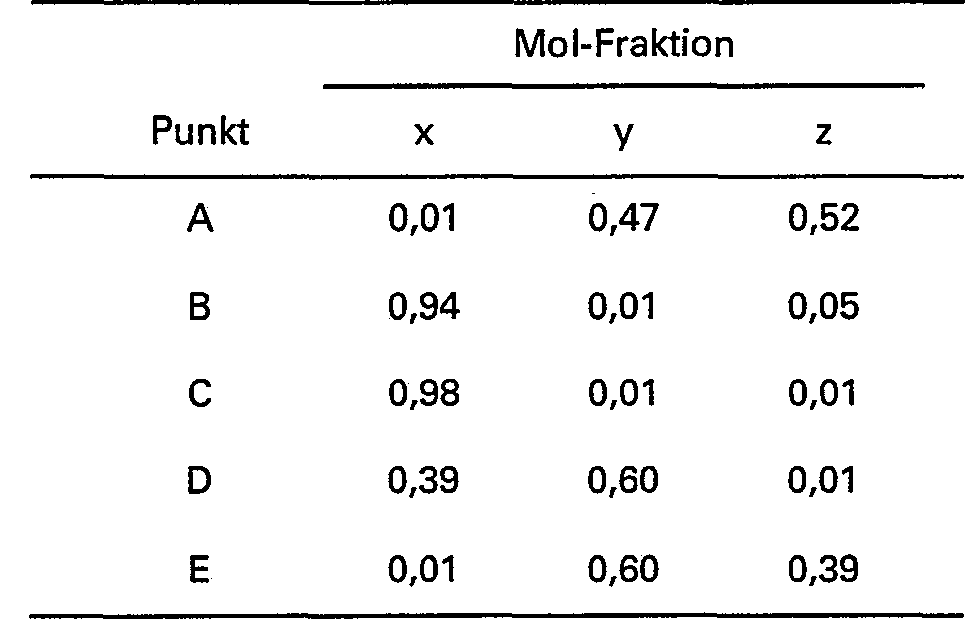
- SAPOs The silicoaluminophosphate molecular sieves of US-A-4,440,871 (referred to therein as "SAPOs") are microporous crystalline silicoaluminophosphates, the pores of which are uniform and have nominal diameters of greater than about 3xlO- lo m (3 Angstroms) and whose essential empirical chemical composition in the as-synthesized and anhydrous form is wherein "R” represents at least one organic templating agent present in the intracrystalline pore system; “m” represents the moles of “R” present per mole of (Si x Al y P z )O 2 ; “m” has a value of from 0.02 to 0.3; "x", "y” and “z” represent the mole fractions of silicon, aluminum and phosphorus respectively, present as tetrahedral oxides, said mole fractions being such that they are within the pentagonal compositional area defined by points ABCD and E of the ternary diagram which is Fig.
- SAPO molecular sieves of US-A-4,440,871 are also described as silicoaluminophosphates having a three-dimensional microporous framework structure of P02, A102 and Si0 2 tetrahedral units, and whose essential empirical chemical composition on an anhydrous basis is: wherein "R” represents at least one organic templating agent present in the intracrystalline pore system; “m” represents the moles of "R” present per mole of (Si, .
- AI Y P,)0 2 has a value of from zero to 0.3;
- "x", "y” and “z” represent respectively, the mole fractions of silicon, aluminum and phosphorus present in the oxide moiety, said mol fractions being within the compositional area bounded by points A, B, C, D and E on the ternary diagram which is Fig. 1, said silicoaluminophosphate having a characteristic X-ray powder diffraction pattern which contains at least the d-spacings set forth below in any one of Tables I, III, V, VII, IX, XII, XVII, XXI, XXIII or XXV of US-A-4,440,871.
- Such crystalline silicoaluminophosphates may be calcined at a temperature sufficiently high to remove at least some of any organic templating agent present in the intracrystalline pore system.
- the silicoaluminophosphates of US-A-4,440,871 are generally referred to therein as "SAPO-n", as a class, or as “SAPO-n” wherein "n” is an integer denoting a particular SAPO as its preparation is reported in US-A-4,440,871.
- SAPOs employed in the instant invention are characterized in their calcined form by an adsorption of isobutane of at least 2 percent by weight at a partial pressure of 665 mbar and a temperature of 20°C.
- the SAPO's are preferably also characterized in their calcined form by and adsorption of triethylamine of less than 5 percent by weight at a partial pressure of 3.46 mbar and a temperature of 22°C.
- SAPOs characterized by the above described adsorption of isobutane include, but are not limited to, SAPO-5, SAPO-11, SAPO-31, SAPO-37, SAPO-40, SAPO-41, and mixtures thereof.
- the above characterization of the SAPOs employed in the instant invention relates to an adsorption characterization that is carried out on a SAPO which has been subjected to a post synthesis treatment, e.g., calcination or chemical treatment, to remove a substantial portion of the template "R" which is present as a result of synthesis.
- a post synthesis treatment e.g., calcination or chemical treatment
- the instant invention necessarily includes the use of a non-calcined or modified SAPOs which are characterized by such adsorption in the modified or calcined form, since upon use of such a non-calcined SAPO in the instant process at effective dewaxing conditions the SAPO will be calcined or hydrothermally treated in situ so as to have the characteristic adsorption of isobutane or triethylamine.
- the SAPO will be rendered in situ to a form characterized by the aforementioned adsorption characteristics.
- an as-synthesized SAPO-11 is not characterized by the aforementioned adsorption of isobutane due to the presence of template "R" which is present as a result of synthesis, although the calcined form of SAPO-11 is characterized by the aforementioned adsorption of isobutane.
- reference to a SAPO having a particular adsorption characteristic in its calcined form is not intended to exclude the use of the SAPO in its as-synthesized form which upon in-situ calcination, hydrothermal treatment and/or other treatment, e.g., ion exchange with suitable atoms, would have such adsorption characteristics.
- the SAPOs of the instant invention may be employed in conjunction with traditional dewaxing catalysts and hydrocracking catalysts and accordingly, optionally, a zeolitic aluminosilicate component may be employed in conjunction with the SAPO-containing catalysts.
- the zeolitic aluminosilicate component of such catalysts may be any aluminosilicate heretofore employed as a component in dewaxing catalysts.
- zeolitic aluminosilicates disclosed heretofore as employable as component parts of traditional dewaxing catalysts are Zeolite Y, steam stabilized Zeolite Y (ultra-stable Y), Zeolite X, Zeolite beta (US-A-3,308,069), Silicalite (US-A-4,061,724), Zeolite KZ-20 (US-A-3,445,727), Zeolite ZSM-3 (US-A-3,415,736), faujasite, LZ-10 (GB-A-2,014,970), US-Y, ZSM-type zeolites, erionite, mordenite, offretite, chabazite, FU-1-type zeolite, NU-type zeolites and mixtures thereof.
- Traditional dewaxing catalysts containing amounts of Na 2 0 less than about one percent by weight are generally preferred.
- Zeolite Y is disclosed in US-A-3,130,007; and steam stabilized Y Zeolites, e.g., ultra-stable Y-type zeolites.
- LZ-210 Another zeolitic aluminosilicate employable herein is "LZ-210", is described in E.P.C. Publication No. 82,211 published June 29, 1983, incorporated herein by reference thereto.
- the hydrocracking catalyst disclosed in EP-A-0,124,120 may be employed as an optional LZ-210 containing hydrocracking component.
- ZSM-type zeolites is generally employed in the art to refer to those zeolites denominated by the nomenclature “ZSM-n” where "n” is an integer.
- the ZSM-type aluminosilicates include but are not limited to ZSM-5, ZSM-11, ZSM-12, ZSM-23, ZSM-35, ZSM-38, ZSM-48; and other similar materials.
- ZSM-5 is described in greater detail in US-A-3,702,886 and US-E-29,948. The entire descriptions contained within those patents, particularly the X-ray diffraction pattern of therein disclosed ZSM-5, are incorporated herein by reference.
- ZSM-11 is described in US-A-3,709,979. That description, and in particular the X-ray diffraction pattern of said ZSM-11, is incorporated herein by reference.
- ZSM-12 is described in US-A-3,832,449. That description, and in particular the X-ray diffraction pattern disclosed therein, is incorporated herein by reference.
- ZSM-23 is described in US-A-4,076,842.
- ZSM-35 is described in US-A-4,016,245.
- ZSM-38 is more particularly describing US-A-4,046,859.
- ZSM-48 is more particularly described in US-A-4,423,021.
- crystalline silicates such as silicalite (US ⁇ A ⁇ 4,061,724) may be employed with the SAPOs of the instant invention.
- the catalysts of the instant invention comprise at least one SAPO, as above characterized, and optionally, may also contain a hydrogenation catalyst and optionally, one or more traditional dewaxing or hydrocracking catalysts, including zeolitic aluminosilicate components.
- the relative amount of the SAPO component or traditional dewaxing component, if any, will depend at least in part, on the selected hydrocarbon feedstock and on the desired pour point of the product, but in all instances an effective amount of at least one SAPO is employed.
- the relative weight ratio of the zeolitic aluminosilicate to the SAPO is generally between 1:10 and 500:1, desirably between 1:10 and 200:1, preferably between 1:2 and 50:1, and most preferably is between 1:1 and 20:1.
- the zeolitic aluminosilicate and SAPO may be ion-exchanged with a selected cation(s) and/or thermally treated either before or after mixture with each other or after such have been added separately or concurrently to one or more inorganic oxide matrix components.
- SAPO molecular sieves When the SAPO molecular sieves are ion exchanged such are preferably exchanged with a hydrogen-forming cation species, e.g. NH4, H + , quaternary ammonium cations, etc.
- a hydrogen-forming cation species e.g. NH4, H + , quaternary ammonium cations, etc.
- the SAPO preferably has at least part of its cations as hydrogen-forming cation species.
- Hydrodewaxing catalysts may optionally contain a hydrogenation component of the type commonly employed in dewaxing catalysts.
- the hydrogenation component may be selected from the group of hydrogenation catalysts consisting of one or more metals of Group VI B and Group VIII, including the salts, complexes and solutions containing such metals.
- the preferred hydrogenation catalyst is at least one of the group of metals, salts and complexes selected from the group consisting of at least one of platinum, palladium, rhodium, iridium and mixtures thereof or at least one from the group consisting of nickel, molybdenum, cobalt, tungsten, titanium, chromium and mixtures thereof.
- the noble and base metals will not generally be employed in the same catalyst system.
- Reference to the catalytically active metal or metals is intended to encompass such metal or metals in the elemental state or in some form such as an oxide, sulfide, halide, carboxylate and the like.
- the hydrogenation component is present in an effective amount to provide an effective hydrodewaxing catalyst.
- the hydrogenation catalysts is a noble metal it is generally present in an amount between 0.05% and 1.5% by weight based on the total weight of the dewaxing catalyst including the weight of any binder or matrix material which may be present, as hereinafter discussed, although effective amounts outside this range may be employed. Although effective amounts in excess of 1.5 percent by weight may be employed, the preferred effective amount of the noble metal hydrogenation component is between 0.3% and 1.2% by weight.
- the effective amount will generally be between 1.0% and 30% percent by weight or more of the base metal, expressed as the oxide(s), based on the total weight of the dewaxing catalyst, although effective amounts outside this range may be employed.
- the final form of the hydrogenation component is not narrowly limited herein but may be a metal oxide, metal sulfide or other catalytically active form. Since sulfur is typically present in the hydrocarbon feedstock being treated, the actual form of some of the hydrogenation component(s) may well be at least in part a sulfide due to in situ reactions.
- a noble metal employed as the hydrogenation component the catalyst is generally activated in air and then reduced in a hydrogen atmosphere.
- base metals such are usually treated with a sulfur compound.
- the hydrogenation components can be incorporated into the overall catalyst composition by any one of numerous procedures. In general it has been observed that it is desirable to add the hydrogenation component to the catalyst as a separate component rather than provide such by ion exchange or impregnation of the SAPO component. They can be added either to the SAPO component, zeolitic aluminosilicate component, if any, or to any metal oxide or to a combination thereof by ion exchange, impregnation, occlusion and the like. In the alternative, multiple hydrogenation components (two or more) may be added as powders in the formulation of the catalyst.
- They may be added by co-mulling, impregnation, or ion exchange whereby one or more may be added to SAPO and/or zeolitic aluminosilicate by impregnation, co-mulling or co-precipitation.
- SAPO and/or zeolitic aluminosilicate may be added by co-mulling, impregnation or precipitation before the composite is finally calcined.
- noble or base metal compounds such as the sulfides, oxides or water-soluble salts
- these components can be added to the finished particle by impregnation with an aqueous, alcoholic, hydrocarbon or other nonaqueous solution of soluble compounds or precursors.
- the hydrogenation components can be combined with the SAPO and/or zeolitic aluminosilicate, if any, as the oxides such is generally not the case. They are usually added as a metal salt which can be thermally converted to the corresponding oxide in an oxidizing atmosphere or reduced to the metal with hydrogen or other reducing agent.
- the composition can be sulfided by reaction with a sulfur donor such as carbon disulfide, hydrogen sulfide, hydrocarbon thiols, elemental sulfur, and the like, described above.
- oxidizing or sulfiding processes are generally carried out on catalyst compositions which have been partially dried (as desired), tabletted, pelleted, extruded (with binder or matrix), or formed by other means and then calcined, e.g. at a temperature above 315.5°C, usually above 426.7°C.
- dewaxing catalysts are generally employed with a binder material or, as commonly referred to, with an inorganic oxide matrix which can be inert or also catalytically active.
- inorganic matrices such as silica, alumina, silica-alumina, silica-zirconia, silica-magnesia, alumina-boria, alumina-titania and the like and mixtures thereof may be employed.
- An inorganic oxide need not always be employed such as in the case of a preform containing the SAPO or may be employed in an amount between 1% and 95% by weight, preferably between 10% and 80% by weight, based on the total weight of the dewaxing catalyst.
- Crude oil feedstock is used herein to denominate any crude oil feedstock or portion thereof and includes full range crude oils from primary, secondary or tertiary recovery from conventional or offshore oil fields and to the myriad of feedstocks derived therefrom.
- "Crude oil feedstocks” may also be “syncrudes” such as those that can be derived from coal, Fischer Tropsch fuel products, shale oil, tar sands and bitumens.
- the crude oil feedstock may be virgin (straight run) or generated synthetically by blending. Such crude oil feedstocks are traditionally desalted prior to use since sodium chloride is known to be a poison in many dewaxing operations.
- crude oil feedstocks is intended to include component parts of crude oils which have heretofore been generally employed as feedstocks or potential feeds and includes feeds such as distillate gas oils, heavy vacuum gas oils, VGO, atmospheric and vacuum resids, syncrudes, pulverized coal and fractions boiling above the traditional end of the gasoline boiling range which generally includes compounds containing greater than about eleven carbon atoms and combinations thereof.
- the hydrocarbon feedstock for dewaxing typically boils above 176.7°C, preferably between 204.4°C and 648.9°C and more preferably between 204.4°C and 482.2°C.
- the hydrocarbon feedstock may be pre-treated in a hydrotreaterto reduce, i.e. remove, compounds which contain sulfur and/or nitrogen.
- the hydrocarbon feedstock may have a significant sulfur content, present as hydrogen sulfide, ranging from 0.1 to 3 weight percent, and nitrogen content, present as ammonia, in an amount up to 20,000 ppm.
- Temperature, space velocity, and other process variables may be adjusted to compensate for the effects of nitrogen on the dewaxing catalyst activity.
- the feedstock is contacted in the dewaxing reaction zone with the dewaxing catalyst and, optionally, in the presence of hydrogen-containing gas and/or a hydrogen generating compound.
- hydrogen is consumed in the hydrodewaxing process and an excess of hydrogen is typically maintained in the reaction zone.
- a hydrogen-to-oil (feed) ratio of at least 28.32 m 3 hydrogen per 159 liters of feed (1,000 standard cubic feet of hydrogen per barrel of feed (SCFB)) is employed, and the hydrogen-to-oil ratio may range up to 56.6 m 3 (20,000 SCFB).
- SCFB standard cubic feet of hydrogen per barrel of feed
- 113 to 340 m 3 4,000 to 12,000 SCFB
- dewaxing and hydrodewaxing conditions are disclosed in US-E-28,398, US-A-3,852,189 and US-A-4,282,085.
- the instant process is carried out under effective catalytic dewaxing or hydrodewaxing conditions.
- Catalytic dewaxing is generally carried out at a LHSV (liquid hourly space velocity) between 0.2 and 50, a temperature between 260.0°C and 648.8°C, a pressure between subatmospheric and 506.5 bar.
- Hydrodewaxing is generally carried out at a LHSV between 0.1 and 15, a temperature between 204.4°C and 482.2°C, at a pressure between 1.702 bar and 173.3 bar and using molar ratios of hydrogen to hydrocarbon feedstock between about 1 and about 100.
- Catalysts A, B and C Three catalysts were prepared for evaluation as dewaxing catalysts and were denominated Catalysts A, B and C. All weights are given as anhydrous weights unless otherwise designated.
- the catalysts were prepared as follows:
- the catalysts of Examples 1 to 3 were evaluated for hydrodewaxing and their use in reducing the pour point of hydrocarbon feedstocks by contacting a selected feedstock with hydrogen at a total pressure of 138.8 bar at a Liquid Hourly Space Velocity (LHSV) between 0.25 to 0.8 and a hydrogen flow rate of 10,000 SCFB (Standard Cubic Feet per Barrel) at temperatures between 371.1°C and 426.7°C. Products boiling below 315.5°C were collected and evaluated and the conversion given based on these products.
- LHSV Liquid Hourly Space Velocity
- the feedstock employed in the dewaxing examples set forth hereinafter was a vacuum gas oil having an IBP (Initial Boiling Point) of 293.3°C and FBP (Final Boiling Point) of 620°C (both determined by ASTM test method D-2887), API Gravity of 22.3 and having a pour point of greater than 35°C.
- the feedstock was characterized by the following physical and chemical characteristics:
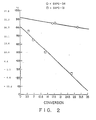
- Figs. 1 and 2 demonstrate the decrease in pour point as a function of conversion of products obtained using SAPO-11 (Catalyst A) as compared to SAPO-34 (Catalyst C).
- Tables B and D are graphically depicted in Fig. 2 and show the decrease in pour point as a function of conversion of products obtained using SAPO-31 (Catalyst B) as compared to SAPO-34 (Catalyst C).
- Figs. 1 and 2 demonstrate the decrease in the pour point of the products obtained by Catalyst A and B as compared to Catalyst C. Further, the decrease in pour point increases at a greater rate using Catalysts A and B with increasing conversion, indicating Catalysts A and B are more selective dewaxing catalysts.
- a catalyst was prepared employing SAPO-11 to demonstrate the hydrocracking and dewaxing functionality of the catalysts of this invention.
- SAPO-11 was prepared according to the procedure described in Example 18 of US Patent No. 4,440,871, except the final molar ratio of di-n-propylamine to AI 2 0 3 was 1.0 to 1.
- the catalyst was prepared by mixing 150 grams of SAPO-11 with 100 grams of Kaiser medium density alumina and a sufficient amount of water to form an extrudate mixture (paste). The mixture was extruded into 1.59 mm extrudates and dried in air at 100°C for 16 hours. The extrudates were then calcined in air at 480°C for 2 hours.
- the extrudates (153 gram) were then mixed (pore filled) with 150 cc of an aqueous solution containing 40.0 grams of nickel nitrate hexahydrate and 48.8 grams of ammonium metatungstate. The mixture was then dried for 16 hours at 100°C and then calcined at 480°C for 2 hours.
- the catalyst was prepared to contain, given as the weight percent oxide: 5 wt. % NiO; 23 wt.% W0 3 ; 36 wt.% SAPO-11; and 36% Al 2 O 3 . Chemical analysis for NiO and W0 3 gave 5.4 wt.% NiO and 23.0 wt.% W0 3 .
- the catalyst was evaluated by contacting a selected feedstock with hydrogen at a total pressure of 138.8 bar at a Liquid Hourly Space Velocity (LHSV) of one and a hydrogen flow rate of 10,000 SCFB (Standard Cubic Feed per Barrel) at temperatures between about 371.1°C and 448.9°C. Products boiling below 395.5°C, were collected and evaluated and the conversion given based on these products.
- the feedstock employed in this example was a vacuum gas oil having an IBP (Initial Boiling Point) of 293.3°C and a FBP (Final Boiling Point) of 620.0°C (both determined by ASTM test method D-2887), API Gravity of 22.3 and having a pour point of greater than 35.0°C.
- the feedstock was characterized by the following physical and chemical characteristics:
Landscapes
- Chemical & Material Sciences (AREA)
- Crystallography & Structural Chemistry (AREA)
- Engineering & Computer Science (AREA)
- Chemical Kinetics & Catalysis (AREA)
- Oil, Petroleum & Natural Gas (AREA)
- Organic Chemistry (AREA)
- General Chemical & Material Sciences (AREA)
- Materials Engineering (AREA)
- Catalysts (AREA)
- Production Of Liquid Hydrocarbon Mixture For Refining Petroleum (AREA)
- Silicates, Zeolites, And Molecular Sieves (AREA)
Claims (28)

Priority Applications (1)
| Application Number | Priority Date | Filing Date | Title |
|---|---|---|---|
| AT85115923T ATE39494T1 (de) | 1984-12-18 | 1985-12-13 | Entwachsungskatalysatoren und -verfahren mit silikoaluminophosphat-molekularsieben. |
Applications Claiming Priority (2)
| Application Number | Priority Date | Filing Date | Title |
|---|---|---|---|
| US68324684A | 1984-12-18 | 1984-12-18 | |
| US683246 | 1984-12-18 |
Publications (2)
| Publication Number | Publication Date |
|---|---|
| EP0185329A1 EP0185329A1 (de) | 1986-06-25 |
| EP0185329B1 true EP0185329B1 (de) | 1988-12-28 |
Family
ID=24743174
Family Applications (1)
| Application Number | Title | Priority Date | Filing Date |
|---|---|---|---|
| EP85115923A Expired EP0185329B1 (de) | 1984-12-18 | 1985-12-13 | Entwachsungskatalysatoren und -verfahren mit Silikoaluminophosphat-Molekularsieben |
Country Status (7)
| Country | Link |
|---|---|
| EP (1) | EP0185329B1 (de) |
| JP (1) | JPS62501368A (de) |
| CN (2) | CN1004142B (de) |
| AT (1) | ATE39494T1 (de) |
| AU (1) | AU5309086A (de) |
| DE (1) | DE3567029D1 (de) |
| WO (1) | WO1986003693A1 (de) |
Families Citing this family (14)
| Publication number | Priority date | Publication date | Assignee | Title |
|---|---|---|---|---|
| US4724066A (en) * | 1985-01-22 | 1988-02-09 | Mobil Oil Corporation | Composites of microporous aluminum phosphates and zeolites and conversions over these catalysts |
| IN167718B (de) * | 1985-06-28 | 1990-12-08 | Chevron Res | |
| US4859311A (en) * | 1985-06-28 | 1989-08-22 | Chevron Research Company | Catalytic dewaxing process using a silicoaluminophosphate molecular sieve |
| US4921594A (en) * | 1985-06-28 | 1990-05-01 | Chevron Research Company | Production of low pour point lubricating oils |
| EP0230005A3 (de) * | 1985-12-23 | 1987-08-26 | W.R. Grace & Co.-Conn. | Crack-Katalysator |
| US4695368A (en) * | 1986-07-31 | 1987-09-22 | Union Oil Company Of California | Process for producing high octane gasoline |
| US4859312A (en) * | 1987-01-12 | 1989-08-22 | Chevron Research Company | Process for making middle distillates using a silicoaluminophosphate molecular sieve |
| WO1995005242A1 (en) * | 1993-08-12 | 1995-02-23 | Aktsionernoe Obschestvo Otkrytogo Tipa 'yaroslavn Efteorgsintez' | Process for obtaining a catalyst for use in deparaffining oil fractions |
| CN1048429C (zh) * | 1994-02-05 | 2000-01-19 | 中国科学院大连化学物理研究所 | 以双模板剂合成磷酸硅铝分子筛的方法 |
| CN100425678C (zh) * | 2005-01-14 | 2008-10-15 | 中国石油化工股份有限公司 | 一种含复合分子筛的脱蜡催化剂及其制备方法 |
| CN103003396B (zh) * | 2010-06-30 | 2016-06-08 | 埃克森美孚研究工程公司 | 液相馏出物脱蜡 |
| CN103059941B (zh) * | 2013-01-08 | 2015-09-30 | 中国海洋石油总公司 | 制备高辛烷值石脑油的加氢裂化方法 |
| CA2904172C (en) * | 2013-03-14 | 2021-04-13 | E.I. Dupont De Nemours And Company | Process for improving cold flow properties and increasing yield of middle distillate feedstock through liquid full hydrotreating and dewaxing |
| CN109364945B (zh) * | 2018-10-11 | 2021-12-17 | 毛琴飞 | 一种全馏分裂解汽油选择性加氢的方法 |
Family Cites Families (4)
| Publication number | Priority date | Publication date | Assignee | Title |
|---|---|---|---|---|
| AU539269B2 (en) * | 1979-10-15 | 1984-09-20 | Mobil Oil Corp. | Preparing a zeolite containing group 8 metal catalyst |
| US4440871A (en) * | 1982-07-26 | 1984-04-03 | Union Carbide Corporation | Crystalline silicoaluminophosphates |
| DE3370469D1 (en) * | 1982-11-16 | 1987-04-30 | Hoechst Ag | Aluminium silicates with a zeolite structure and process for their preparation |
| US4512875A (en) * | 1983-05-02 | 1985-04-23 | Union Carbide Corporation | Cracking of crude oils with carbon-hydrogen fragmentation compounds over non-zeolitic catalysts |
-
1985
- 1985-12-13 DE DE8585115923T patent/DE3567029D1/de not_active Expired
- 1985-12-13 EP EP85115923A patent/EP0185329B1/de not_active Expired
- 1985-12-13 AT AT85115923T patent/ATE39494T1/de not_active IP Right Cessation
- 1985-12-17 AU AU53090/86A patent/AU5309086A/en not_active Abandoned
- 1985-12-17 WO PCT/US1985/002474 patent/WO1986003693A1/en not_active Ceased
- 1985-12-17 JP JP86500417A patent/JPS62501368A/ja active Pending
- 1985-12-17 CN CN85109627.1A patent/CN1004142B/zh not_active Expired
-
1988
- 1988-10-29 CN CN88107529.9A patent/CN1033757A/zh active Pending
Also Published As
| Publication number | Publication date |
|---|---|
| ATE39494T1 (de) | 1989-01-15 |
| CN1033757A (zh) | 1989-07-12 |
| CN1004142B (zh) | 1989-05-10 |
| WO1986003693A1 (en) | 1986-07-03 |
| AU5309086A (en) | 1986-07-22 |
| CN85109627A (zh) | 1986-06-10 |
| DE3567029D1 (en) | 1989-02-02 |
| EP0185329A1 (de) | 1986-06-25 |
| JPS62501368A (ja) | 1987-06-04 |
Similar Documents
| Publication | Publication Date | Title |
|---|---|---|
| US4960504A (en) | Dewaxing catalysts and processes employing silicoaluminophosphate molecular sieves | |
| AU594659B2 (en) | Dewaxing catalysts and processes employing non-zeolitic molecular sieves | |
| US4686029A (en) | Dewaxing catalysts and processes employing titanoaluminosilicate molecular sieves | |
| EP0297130B1 (de) | Erzeugung von mitteldestillation mit silicoaluminophosphat-molekularsieben | |
| AU593536B2 (en) | Hydrocracking catalysts and processes employing non-zeolitic molecular sieves | |
| AU5307686A (en) | Hydrocracking catalysts and processes employing silicoaluminophosphate molecular sieves | |
| US4913799A (en) | Hydrocracking catalysts and processes employing non-zeolitic molecular sieves | |
| EP1640434A1 (de) | Hydrokrackverfahren und Katalysatorzusammensetzung | |
| EP0185329A1 (de) | Entwachsungskatalysatoren und -verfahren mit Silikoaluminophosphat-Molekularsieben | |
| JPS6349542B2 (de) | ||
| EP0202304B1 (de) | Krackkatalysator und -verfahren mit nichtzeolitischen molekularsieben | |
| US4913798A (en) | Hydrocracking catalyts and processes employing silicoaluminophosphate molecular sieves | |
| US4857495A (en) | Hydrocracking catalysts and processes employing silicoaluminophosphate molecular sieves | |
| US4734185A (en) | Cracking process using zeolite and silicoaluminophosphate molecular sieve | |
| JP3045544B2 (ja) | 第二段階の水素化分解のために中間細孔サイズのシリコアルミノ燐酸塩分子ふるい触媒及び水素化分解触媒の組合せを使用して中間留分を製造する方法 | |
| US4804647A (en) | Dewaxing catalysts and processes employing titanoaluminosilicate molecular sieves | |
| JP3045541B2 (ja) | 結晶質シリコアルミノ燐酸塩の合成 | |
| AU5190486A (en) | Cracking catalysts and process using mixed catalyst systems |
Legal Events
| Date | Code | Title | Description |
|---|---|---|---|
| PUAI | Public reference made under article 153(3) epc to a published international application that has entered the european phase |
Free format text: ORIGINAL CODE: 0009012 |
|
| AK | Designated contracting states |
Kind code of ref document: A1 Designated state(s): AT BE CH DE FR GB IT LI LU NL SE |
|
| 17P | Request for examination filed |
Effective date: 19860704 |
|
| RIN1 | Information on inventor provided before grant (corrected) |
Inventor name: LONG, GARY NORMAN Inventor name: RABO, JULE ANTHONY Inventor name: SPRINGER, ALBERT RAYMOND Inventor name: PELLET, REGIS JOSEPH Inventor name: GORTSEMA, FRANK PETER |
|
| 17Q | First examination report despatched |
Effective date: 19870805 |
|
| GRAA | (expected) grant |
Free format text: ORIGINAL CODE: 0009210 |
|
| AK | Designated contracting states |
Kind code of ref document: B1 Designated state(s): AT BE CH DE FR GB IT LI LU NL SE |
|
| REF | Corresponds to: |
Ref document number: 39494 Country of ref document: AT Date of ref document: 19890115 Kind code of ref document: T |
|
| ITF | It: translation for a ep patent filed | ||
| REF | Corresponds to: |
Ref document number: 3567029 Country of ref document: DE Date of ref document: 19890202 |
|
| ET | Fr: translation filed | ||
| PLBE | No opposition filed within time limit |
Free format text: ORIGINAL CODE: 0009261 |
|
| STAA | Information on the status of an ep patent application or granted ep patent |
Free format text: STATUS: NO OPPOSITION FILED WITHIN TIME LIMIT |
|
| 26N | No opposition filed | ||
| PG25 | Lapsed in a contracting state [announced via postgrant information from national office to epo] |
Ref country code: LU Free format text: LAPSE BECAUSE OF NON-PAYMENT OF DUE FEES Effective date: 19891231 |
|
| PGFP | Annual fee paid to national office [announced via postgrant information from national office to epo] |
Ref country code: LU Payment date: 19901221 Year of fee payment: 6 |
|
| ITTA | It: last paid annual fee | ||
| EPTA | Lu: last paid annual fee | ||
| PGFP | Annual fee paid to national office [announced via postgrant information from national office to epo] |
Ref country code: CH Payment date: 19931215 Year of fee payment: 9 |
|
| PGFP | Annual fee paid to national office [announced via postgrant information from national office to epo] |
Ref country code: GB Payment date: 19941205 Year of fee payment: 10 |
|
| PGFP | Annual fee paid to national office [announced via postgrant information from national office to epo] |
Ref country code: DE Payment date: 19941208 Year of fee payment: 10 |
|
| PGFP | Annual fee paid to national office [announced via postgrant information from national office to epo] |
Ref country code: FR Payment date: 19941209 Year of fee payment: 10 |
|
| PGFP | Annual fee paid to national office [announced via postgrant information from national office to epo] |
Ref country code: AT Payment date: 19941213 Year of fee payment: 10 |
|
| PGFP | Annual fee paid to national office [announced via postgrant information from national office to epo] |
Ref country code: SE Payment date: 19941215 Year of fee payment: 10 |
|
| PG25 | Lapsed in a contracting state [announced via postgrant information from national office to epo] |
Ref country code: LI Effective date: 19941231 Ref country code: CH Effective date: 19941231 |
|
| PGFP | Annual fee paid to national office [announced via postgrant information from national office to epo] |
Ref country code: NL Payment date: 19941231 Year of fee payment: 10 |
|
| EAL | Se: european patent in force in sweden |
Ref document number: 85115923.6 |
|
| PGFP | Annual fee paid to national office [announced via postgrant information from national office to epo] |
Ref country code: BE Payment date: 19950207 Year of fee payment: 10 |
|
| REG | Reference to a national code |
Ref country code: CH Ref legal event code: PL |
|
| PG25 | Lapsed in a contracting state [announced via postgrant information from national office to epo] |
Ref country code: GB Effective date: 19951213 Ref country code: AT Effective date: 19951213 |
|
| PG25 | Lapsed in a contracting state [announced via postgrant information from national office to epo] |
Ref country code: SE Effective date: 19951214 |
|
| PG25 | Lapsed in a contracting state [announced via postgrant information from national office to epo] |
Ref country code: BE Effective date: 19951231 |
|
| BERE | Be: lapsed |
Owner name: UNION CARBIDE CORP. Effective date: 19951231 |
|
| PG25 | Lapsed in a contracting state [announced via postgrant information from national office to epo] |
Ref country code: NL Effective date: 19960701 |
|
| GBPC | Gb: european patent ceased through non-payment of renewal fee |
Effective date: 19951213 |
|
| PG25 | Lapsed in a contracting state [announced via postgrant information from national office to epo] |
Ref country code: FR Effective date: 19960830 |
|
| NLV4 | Nl: lapsed or anulled due to non-payment of the annual fee |
Effective date: 19960701 |
|
| PG25 | Lapsed in a contracting state [announced via postgrant information from national office to epo] |
Ref country code: DE Effective date: 19960903 |
|
| REG | Reference to a national code |
Ref country code: FR Ref legal event code: ST |