EP0185338A1 - Verfahren zum Beschichten von elektrisch leitfähige Oberflächen aufweisenden Substraten - Google Patents
Verfahren zum Beschichten von elektrisch leitfähige Oberflächen aufweisenden Substraten Download PDFInfo
- Publication number
- EP0185338A1 EP0185338A1 EP19850115992 EP85115992A EP0185338A1 EP 0185338 A1 EP0185338 A1 EP 0185338A1 EP 19850115992 EP19850115992 EP 19850115992 EP 85115992 A EP85115992 A EP 85115992A EP 0185338 A1 EP0185338 A1 EP 0185338A1
- Authority
- EP
- European Patent Office
- Prior art keywords
- primer
- pvc
- baking
- etl
- radiation
- Prior art date
- Legal status (The legal status is an assumption and is not a legal conclusion. Google has not performed a legal analysis and makes no representation as to the accuracy of the status listed.)
- Granted
Links
Classifications
-
- C—CHEMISTRY; METALLURGY
- C25—ELECTROLYTIC OR ELECTROPHORETIC PROCESSES; APPARATUS THEREFOR
- C25D—PROCESSES FOR THE ELECTROLYTIC OR ELECTROPHORETIC PRODUCTION OF COATINGS; ELECTROFORMING; APPARATUS THEREFOR
- C25D13/00—Electrophoretic coating characterised by the process
- C25D13/22—Servicing or operating apparatus or multistep processes
-
- C—CHEMISTRY; METALLURGY
- C09—DYES; PAINTS; POLISHES; NATURAL RESINS; ADHESIVES; COMPOSITIONS NOT OTHERWISE PROVIDED FOR; APPLICATIONS OF MATERIALS NOT OTHERWISE PROVIDED FOR
- C09D—COATING COMPOSITIONS, e.g. PAINTS, VARNISHES OR LACQUERS; FILLING PASTES; CHEMICAL PAINT OR INK REMOVERS; INKS; CORRECTING FLUIDS; WOODSTAINS; PASTES OR SOLIDS FOR COLOURING OR PRINTING; USE OF MATERIALS THEREFOR
- C09D5/00—Coating compositions, e.g. paints, varnishes or lacquers, characterised by their physical nature or the effects produced; Filling pastes
- C09D5/44—Coating compositions, e.g. paints, varnishes or lacquers, characterised by their physical nature or the effects produced; Filling pastes for electrophoretic applications
Definitions
- the invention relates to a method for coating substrates having electrically conductive surfaces by applying an ETL primer, drying or baking this primer and applying and baking at least one subsequent layer known per se
- Corrosion and stone chip protection plays an important role in the automotive industry. Primer and filler are largely responsible for this protection. A particular problem is the protection against corrosion and stone chips on welds and on the underbody. Improvements are made here by additional coating with a subsequent layer, e.g. PVC materials reached after baking the primer. This protection is all the more effective the better the adhesion of the subsequent layer to the primer
- electrodeposition paints can be deposited cathodically or anodically.
- the anodically depositable electrodeposition paints are called ATL, the cathodically depositable KTL and both together as ETL (electrodeposition paint).
- Subsequent layers of the primer can include fillers, e.g. based on alkyd and melamine resins, pasteisols - i.e. Dispersions of plastics, especially PVC, in plasticizers - or top coats.
- fillers e.g. based on alkyd and melamine resins
- pasteisols - i.e. Dispersions of plastics, especially PVC, in plasticizers - or top coats.
- adhesion problems with subsequent layers occur at low stoving temperatures, especially below 150 ° C. This reduces the good properties of the subsequent layers, especially the PVC materials, in terms of corrosion and stone chip protection
- a surface treatment by corona discharge - a silent glow discharge that leads to the formation of ozone under air - can be associated with an improvement of the subsequent layer, but the improvement in adhesion is still unsatisfactory.
- the object of the present invention is to improve the method for coating the substrates in such a way that improved adhesion of the subsequent layers to the ETL primer is achieved.
- the object of the invention is to achieve improved adhesion between the KTL primer and a subsequent PVC coating.
- the binder of the ETL primer is an aliphatic saturated synthetic resin which may contain aromatic groups, and after predrying or baking with high-energy rays such as UV light or electron beams, but especially UV rays. Light that is irradiated.
- ETL paints are water-thinnable, cathodically or anodically depositable electro-dipping paints.
- ATL primers contain acidic base resins which, according to the prior art and preferably according to the invention, have acid numbers from 20 to 200, preferably between 35 and 120 and average molecular weights between 300 and 8000, preferably between 2000 and 6000. Acid groups can be -COOH, -PO, H, or -SO, H, but especially -COOH.
- Base resins are e.g. saturated polyesters, self- and cross-linking polyacrylate resins, saturated epoxy resin esters or polyurethane resins.
- Melamine resins, phenolic resins and / or blocked isocyanates can be used as crosslinking agents, and polyepoxide resins can also be used if powder coatings are used.
- KTL primers contain basic base resins which, according to the prior art and preferably according to the invention, have amine numbers from 20 to 200, preferably from 30 to 100 and average molecular weights between 400 and 10,000, preferably between 1500 and 3000.
- Functional groups are for example -NH 2 , -NRH, NR 3 ⁇ , -SR 2 ⁇ and -PR 3 ⁇ .
- Primary are preferred.
- Base resins are, for example, amino epoxy resins (for example based on bisphenol A, reacted with epichlorohydrin), aminopolyacrylate resins, polyaminoamides and aminopolyurethanes.
- Suitable crosslinking agents are melamine resins, phenolic resins, blocked isocyanates or crosslinkers capable of transesterification. Isocyanates and / or crosslinking agents which are blocked in the basic medium are preferred.
- aqueous ETL baths are prepared in a known manner, for example in accordance with EP-A-0012463, DE-A-3024158, DE-A-2248836, DE-C-2320301 and DE-A-3 4 36346, with a non-volatile component from 8 to 25%, especially from 12 to 19% by weight.
- Usual follow-up layers of ETL primers which are used in accordance with the prior art and preferably in accordance with the invention are plasma brines, in particular PVC materials, fillers or topcoats.
- Plastisols consist of plastics or synthetic resins (for PVC materials mainly PVC) and plasticizers as well as additives such as light and heat stabilizers, viscosity regulators, pigments etc. (coating with lacquers and plastics, K. Weinmann, Vertag WA Colomb, Stuttgart 1967, p 229 ff)
- plasticizers for example Esters of phthalic acid, phosphoric acid or chlorinated aliphatic and aromatic compounds are used
- Plastisols can be applied to the primer by brushing, dipping, rolling, pouring, spraying, spreading or knife coating.
- the PVC material is gelled in a convection oven for 3 to 60 minutes between 100 and 200 ° C, especially 5 to 10 minutes at an object temperature of 120 to 180 ° C
- Fillers contain as base resins e.g. Alkyd-melamine resins (solvent-based) or water-dilutable maleate oil epoxy resins (EP-A-0015035, JP-64-25281, US-P-4042478).
- the fillers are usually sprayed on electrostatically and baked for 10 to 40 minutes at 100 to 200 ° C., preferably 15 to 30 minutes at 130 to 170 ° C.
- Topcoats contain, for example, alkyd, acrylate, amino, epoxy or polyurethane resins as binders and can be both solvent-based and water-soluble as well as powder coatings.
- the structure and composition of these systems have been widely described in the literature (ULLMANNS Encyclopedia of Industrial Chemistry, 4th edition, volume 15 or H. Kittel, textbook on paints and coatings, volume IV, published by A. Colomb, Berlin 1 976).
- the topcoat is applied by spraying, dipping, raking, brushing, rolling, pouring or mounting.
- curing can be carried out by baking (10 to 40 minutes at 80 to 200 ° C, preferably 15 to 30 minutes at 120 to 180 ° C), UV curing, electron beam curing or oxidative.
- the ETL primer is made from an aqueous, pigmented dispersion onto an electrically conductive object connected as cathode in KTL primers or anode in ATL primers by applying a voltage of 100 to 500 volts, but especially between 150 and 300 volts, between Deposition for 10 and 300 seconds and then thermally baked between 10 and 20 minutes at 100 to 250 ° C, but especially between 140 and 190 ° C object temperature.
- the irradiation with high-energy rays takes place. It is extremely surprising that this leads to an improvement in the adhesion of the subsequent layer, in particular PVC, since the binders are aliphatic saturated synthetic resins which contain no or at least essentially no double bonds which crosslink under the action of high-energy radiation.
- High-energy rays are understood to mean rays with a wavelength below 400 nm, in particular UV and electron rays.
- UV radiation source Commercial low, medium or high pressure mercury lamps are suitable as the radiation source for UV rays.
- the irradiation time depends on the radiation power of the rays ("UV-Curing, Science and Technology" by S.P. Papas, Technological Market Corp., Stampford (USA) 1978). It can be irradiated both polychromatically, starting with UV (A) and, depending on the system and binder, monochromatically in the entire UV range. UV radiation leads to an improvement in PVC adhesion both under air and under protective gas; radiation under protective gas (e.g. argon or nitrogen) is particularly advantageous.
- the irradiation time is between 0.5 and 60 seconds, preferably between 1 and 20 seconds.
- Sources of electron beams are e.g. Linear accelerators with an acceleration voltage of 150 to 600 KV and a beam current of up to 150 mA, as described in the "Textbook of Lacquers and Coatings", Volume VII, p. 274 to p. 282, H. Kittel, Verlag W.A. Colomb, are described.
- Base resin A2 Base resin for EPC (Electro Powder Coating) according to DE-A-3024158, page 10, lines 1 to 17, “comparison to A)".
- Base resin A3 Base resin by reacting Mannich bases with epoxy resins according to DE-C-2320301, example 1 .
- Base resin A4 acrylate resin according to DE-A-3436346 (amino-poly (meth) acrylate resin A1).
- Base resin A5 Primary amino group-containing amine-epoxy resin according to US Pat. No. 3,947,339, Example 1.
- Base resin A6 carbamic acid resin, made from butyl urethane and formaldehyde, with an acid number less than 1 (Resamin HF 450®, Hoechst AG, Frankfurt).
- Base resin A7 Acrylate made from acrylic acid, styrene, butyl acrylate and hydroxypropyl methacrylate, 70% in sec-butanol / ethylene glycol monobutyl ether, with an acid number of 60 to 90 (Resydrol WY 323®, Vianova Kunststoffharz Aktiengesellschaft, Vienna, Austria).
- Crosslinking agent B 1 non-acidic polyester according to EP-A-0012463, Example II (a).
- Crosslinking agent B2 Isophorone diisocyanate capped with ⁇ -caprolactam according to DE-A-3436346, crosslinking agent B3, (Crelan®UI, Bayer, Leverkusen).
- Crosslinking agent B3 melamine-formaldehyde resin, etherified with isobutanol, (Cymel 1141®, from American Cyanamid Co., Wayne, New Jersey, USA).
- Crosslinking agent B4 tris (isocyanatohexyl) biuret (Desmodur N-100 ®) capped with ⁇ -caprolactam according to DE-A-3436346, crosslinking agent B 2.
- Crosslinking agent B5 tolylene diisocyanate capped with 2-ethylhexanol according to US Pat. No. 3,947,339, Example 1.
- Crosslinking agent B6 methylated / ethylenated melamine-formaldehyde resin, solids content 98% by weight, acid number less than 1 (Cymel 1116 *, American Cyanamid Co., Wayne, New Jersey, USA).
- Powder coating C1 powder coating according to DE-A-3024158, "comparison to A)".
- the resin solution A1 (163.7 g; 114.6 g solids) and the polyester B1 (42.6 g), dissolved in ethylene glycol monobutyl ether (18.3 g), are mixed together. Then Pb-octoate (3.1 g) and formic acid (5.4 g) are added. Deionized water (393 g) is slowly added to this mixture with stirring.
- the milky dispersion obtained has a non-volatile content of 25% by weight.
- titanium dioxide (32.3 g), carbon black (3.2 g) and aluminum silicate (2.0 g) are dispersed in a sand mill for 90 minutes until a Hegman grain size of 10 to 20 is reached.
- the dispersion (400 g) described above is added to this pigment paste and further diluted with deionized water (612.5 g), so that a non-volatile content of 15% by weight is obtained.
- the resulting electrocoat has a pH of 5.8 and a bath conductivity of 1700 ⁇ S / cm.
- the sheets are rinsed with water.
- the cured KTL primers are irradiated about 1 hour after baking.
- UV lamp Hanovia type 8512 A 431
- UV lamps are arranged side by side so that there is an irradiation zone of 50 cm width.
- the sheets are placed on a conveyor belt at a speed of 2 m / min (15 sec. Irradiation time) and 6 m / min. (5 sec.) Guided through the irradiation zone.
- the emitters are enclosed by a hood, each with a slit of 2 cm in height at the front and rear for the conveyor belt.
- At the rear end of the hood there are nozzles through which nitrogen can be blown into the hood, so that a quasi-nitrogen atmosphere is present in the hood after a short flushing time of about 1 minute. When irradiated under protective gas, nitrogen is still blown through the hood.
- Intercol 20755® (from Intercol Kleb- und Riechstoff GmbH, Bodenheim / Rhein)
- PVC adhesion is checked 1 hour after baking.
- Electron beam system ESH 150-20 (Dürr, Stuttgart)
- the baked-on primer is irradiated with a radiation dose of 40 Mrad (400 kGry) both in air and directly in the scattered beam (the sheets were leaned against the side of the beam pipe).
- the filler After spraying onto the UV-exposed primer, the filler is baked at 140 ° C for 10 minutes
- the liability check is carried out 24 hours after baking.
- the pigmented electrocoat material is prepared as described in Example 1, but the crosslinker B1 has been replaced by crosslinker B2, dissolved in ethylene glycol monobutyl ether (18.3 g), and the pigment used is not carbon black, but only titanium dioxide (20.5 g) and aluminum silicate (15.0 g).
- Dry film thickness 18 to 19 ⁇ m.
- UV radiation and PVC testing as in example 1.
- the pigmented electrocoating material is produced according to Example 4, but the crosslinking agent B2 is replaced by the crosslinking agent B3, dissolved in butylglycol (18.3 g).
- Dry film thickness 19 to 20 pm.
- UV radiation and PVC testing as in example 1.
- the pigmented electrocoat material is produced according to Example 4, but the crosslinking agent B2 is replaced by the crosslinking agent B3, dissolved in butylglycol (18.3 g).
- Dry film thickness 19 to 20 ⁇ m.
- UV radiation and PVC testing as in example 1.
- the topcoat is sprayed onto the UV-irradiated primer and then baked at 150 ° C for 15 minutes.
- Dry film thickness 35 to 37 ⁇ m.
- the liability check is carried out 24 hours after baking.
- a pigmented electro-dip powder coating according to DE-A-3024158 (compared to Example A) was used, but the iron oxide pigment (50 parts) was replaced by titanium dioxide (45.5 parts) and carbon black (4.5 parts).
- coated sheets After the coated sheets have been rinsed with water, they are pre-gelled for 10 minutes at 70 ° C. and then baked for 15 minutes at an object temperature of 185 ° C.
- Dry film thickness 40 to 44 ⁇ m.
- UV radiation and PVC application as in example 1.
- Carbon black (12 g) and aluminum silicate (48 g) are added to the resin dispersion (400 g) described in DT 2320301 (example 1) with a nonvolatile content of 40% by weight and dispersed on a bead mill until a grain size is obtained from 10 to 20 according to Hegman.
- Deionized water (2540 g) is slowly added to the pigment paste obtained while stirring. The solids content of this dispersion is 15% by weight.
- UV radiation and PVC application as in example 1.
- the pigmented electrocoat material is produced using base resin A4 and crosslinking agent B1 according to DE-A-3436346, Example 3.
- the pigmented electrocoat material is produced according to Example 12, but crosslinker B1 is replaced by crosslinker B4.
- the pigmented electrocoat material is produced according to Example 12, but crosslinker B1 is replaced by crosslinker B3.
- the base resins A6 (43 g) and A7 (303 g; 212 g solids) are mixed with one another with the addition of ethylene glycol monobutyl ether (73 g). Then phthalocyanine yellow (65 g), azo pigment (43 g), titanium dioxide (22 g ) and aluminum silicate (15 g) and disperse the mixture in a bead mill for 90 minutes until a Hegman grain size of 10 to 15 is reached
- the crosslinking agent B6 (111 g; 109 g solids) and triethylamine (36 g) are dispersed in the mixture and then diluted with 2400 g deionized water, so that a solids content of 17% by weight is obtained.
- the resulting electrocoat has a pH of 8.9 and a bath conductivity of 800 pS / cm.
- UV radiation and PVC application as in example 1.
Landscapes
- Chemical & Material Sciences (AREA)
- Materials Engineering (AREA)
- Life Sciences & Earth Sciences (AREA)
- Organic Chemistry (AREA)
- Engineering & Computer Science (AREA)
- Wood Science & Technology (AREA)
- Health & Medical Sciences (AREA)
- Molecular Biology (AREA)
- Chemical Kinetics & Catalysis (AREA)
- Electrochemistry (AREA)
- Metallurgy (AREA)
- Paints Or Removers (AREA)
- Conductive Materials (AREA)
- Chemically Coating (AREA)
- Application Of Or Painting With Fluid Materials (AREA)
Abstract
Description
- Die Erfindung betrifft ein Verfahren zum Beschichten von .elektrisch leitfähige Oberflächen aufweisenden Substraten durch Auftragen einer ETL-Grundierung, Trocknen oder Einbrennen dieser Grundierung und Aufbringen und Einbrennen von mindestens einer an sich bekannten Folgeschicht
- Eine wichtige Rolle in der Autoindustrie spielt der Korrosions- und Steinschlagschutz. Für diesen Schutz sind maßgeblich Grundierung und Füller verantwortlich. Ein besonderes Problem ist dabei der Korrosions- und Steinschlagschutz an Schweißnähten und am Karosserieunterboden. Hier werden Verbesserungen durch zusätzliches Beschichten mit einer Nachfolgeschicht, z.B. PVC-Materialien nach dem Einbrennen der Grundierung erreicht. Diese Schutz ist um so wirkungsvoller, je besser die Haftung der Nachfolgeschicht zur Grundierung ist
- Stand der Technik für Grundierungen z.B. im Automobilbereich sind kathodisch oder anodisch abscheidbare Elektrotauchlacke. Die anodisch abscheidbaren Elektrotauchlacke werden als ATL, die kathodisch abscheidbaren als KTL und beide zusammen als ETL (Elektrotauchlack) bezeichnet.
- Nachfolgeschichten der Grundierung können Füller, z.B. auf der Basis von Alkyd- und Melaminharzen, Ptastisole - d.h. Dispersionen von Kunststoffen, insbesondere PVC, in Weichmachern - oder auch Decklacke sein.
- Sowohl aus technischen Gründen (z.B. Kunststoffteile am Auto) als auch zur Energieeinsparung fordert die Industrie immer niedrigere Einbrenntemperaturen für Grundierungen und Nachfolgeschichten, wobei die Eigenschaften der Materialien, wie Korrosions- und Steinschlagschutz, erhalten bleiben sollen.
- Nach dem Stand der Technik treten jedoch bei niedrigen Einbrenntemperaturen, besonders unterhalb 150°C, Haftungsschwierigkeiten mit Nachfolgeschichten auf. Damit werden die guten Eigenschaften der Nachfolgeschichten, insbesondere der PVC-Materialien in Bezug auf den Korrosions- und Steinschlagschutz gemindert
- Die Härtung von Elektrbtauchlacken mit doppelbindungshaltigen Bindemitteln durch energiereiche Strahlung ist in den US-A-4040925, 4035272, 4252734, 4039414, 4029561 und DE-A-2301075 und 3005034 beschrieben. Auch die Kombination von Oftentrocknung und Vemetzung von doppelbindungshaltigen ETL-Grundierungen durch UV-Bestrahlung ist aus den US-A-4035274 und 4066523 bekannt. Diese Elektrotauchlacke sind aus verschiedenen Gründen in der Praxis nicht im Einsatz: sie ziegen z.B. eine starke Vergilbung im UV-Licht sowie eine geringere PVC-Haftung als die heutigen ETL-Lacke.
- Eine Oberflächenbehandlung durch Corona-Entladung - eine stille Glimmentladung, die unter Luft zur Bildung von Ozon führt - kann zwar mit einer Verbesserung der Nachfolgeschicht verbunden sein, doch ist die Haftungsverbesserung immer noch unbefriedigend.
- Der vorliegenden Erfindung liegt die Aufgabenstellung zugrunde, das Verfahren zum Beschichten der Substrate dahingehend zu verbessem, daß eine verbesserte Haftung der Nachfolgeschichten auf der ETL-Grundierung erzielt wird. Besonders liegt der Erfindung die Aufgabenstellung zugrunde, eine verbesserte Haftung zwischen der KTL-Grundierung und einer nachfolgenden PVC-Beschichtung zu erzielen.
- Überraschenderweise wurde gefunden, daß diese Aufgabenstellung gelöst werden kann, wenn das Bindemittel der ETL-Grundierung ein aliphatisch gesättigtes, gegebenenfalls aromatische Gruppen enthaltendes Kunstharz ist, und nach dem Vortrocknen oder Einbrennen mit energiereichen Strahlen, wie UV-Licht oder Elektronenstrahlen, besonders aber UV-Licht, bestrahlt wird.
- Die Erfindung betritft demgemäß das in den Patentansprüchen beschriebene Verfahren.
- ETL-Lacke sind wasserverdünnbare, kathodisch oder anodisch abscheidbare Elektrotauchlacke. ATL-Grundierungen enthalten saure Basisharze, die gemäß dem Stand der Technik und vorzugsweise gemäß der Erfindung Säurezahlen von 20 bis 200, vorzugsweise zwischen 35 und 120 und mittlere Molekulargewichte zwischen 300 und 8000, bevorzugt zwischen 2000 und 6000 aufweisen. Als Säuregruppen können -COOH, -PO,H, oder -SO,H, besonders aber -COOH, auftreten.
- Basisharze sind z.B. gesättigte Polyester, selbst- und fremdvemetzende Polyacrylatharze, gesättigte Epoxidharzester oder Polyurethanharze. Als Vemetzungsmittel können Melaminharze, Phenolharze und/oder blockierts Isocyanate eingesetzt werden, sowie bei Einsatz von Pulverlacken auch Polyepoxidharze.
- KTL-Grundierungen enthalten basische Basisharze, die gemäß dem Stand der Technik und vorzugsweise gemäß der Erfindung Aminzahlen von 20 bis 200, vorzugsweise von 30 bis 100 und mittlere Molekulargewichte zwischen 400 und 10000, bevorzugt zwischen 1500 und 3000 aufweisen. Funktionelle Gruppen sind z.B. -NH2, -NRH, NR3 ⊕, -SR2 ⊕ und -PR3 ⊕. Bevorzugt sind primäre. sekundäre und tertiäre Amine. Basisharze sind z.B. Aminoepoxidharze (z.B. auf der Basis Bisphenol A, umgesetzt mit Epichlorhydrin), Aminopolyacrylatharze, Polyaminoamide sowie Aminopolyurethane. Als Vemetzungsmittel eignen sich Melaminharze, Phenolharze, blockierte Isocyanate oder umesterungsfähige Vemetzer. Bevorzugt werden im basischen Medium blockierte Isocyanate und/oder umesterungsfähige Vemetzer.
- Die Erstellung der wäßrigen ETL-Bäder erfolgt in bekannter Weise, z.B. entsprechend EP-A-0012463, DE-A-3024158, DE-A-2248836, DE-C-2320301 und DE-A-3436346, mit einem nichtflüchtigen Anteil von 8 bis 25%, besonders von 12 bis 19 Gew.-%.
- Übliche Nachfolgeschichten von ETL-Grundierungen, die gemäß dem Stand der Technik und vorzugsweise gemäß der Erfindung angewandt werden, sind Plasüsole, insbesondere PVC-Materialien, Füller oder Decklacke.
- Plastisole bestehen aus Kunststoffen bzw. Kunstharzen (bei PVC-Materialien überwiegend aus PVC) und Weichmachern sowie Zusatzmitteln wie Licht- und Wärmestabilisatoren, Viskositätsregulatoren, Pigmenten usw. (Beschichtung mit Lacken und Kunststoffen, K. Weinmann, Vertag W.A. Colomb, Stuttgart 1967, S. 229 ff) Als Weichmacher werden z.B. Ester der Phthalsäure, Phosphorsäure oder chlorierte aliphatische und aromatische Verbindungen verwendet
- Plastisole können durch Streichen, Tauchen, Walzen, Gießen, Spritzen, Aufziehen oder Aufrakeln auf die Grundierung aufgetragen werden. Das PVC-Maferial wird 3 bis 60 Minuten zwischen 100 und 200°C, besonders 5 bis 10 Minuten bei 120 bis 180°C Objekttemperatur, im Umluftofen geliert
- Füller enthalten als Basisharze z.B. Alkyd-Melamin-Harze (auf Lösungsmittelbasis) oder wasserverdünnbare Maleinatöl-Epoxid-Harze (EP-A-0015035, JP-64-25281, US-P-4042478). Die Füller werden in der Regel elektrostatisch aufgespritzt und 10 bis 40 Minuten bei 100 bis 200°C, vorzugsweise 15 bis 30 Minuten bei 130 bis 170°C, eingebrannt.
- Decklacke enthalten als Bindemittel z.B. Alkyd-, Acrylat-, Amino-, Epoxid- oder Polyurethanharze und können sowohl auf Lösungsmittelbasis als auch wasserlöslich sowie Pulverlacke sein. Der Aufbau und die Zusammensetzung dieser Systeme sind in der Literatur vielfach beschrieben (ULLMANNS Encyklopädie der technischen Chemie, 4. Auflage, Band 15 oder H. Kittel, Lehrbuch der Lacke und Beschichtungen, Band IV, Verlag A. Colomb, Berlin 1976). Der Decklack wird durch Spritzen, Tauchen, Aufrakein, Streichen, Walzen, Gießen oder Aufziehen aufgetragen, Die Aushärtung kann entsprechend dem eingesetzten System durch Einbrennen (10 bis 40 Minuten bei 80 bis 200°C, vorzugsweise 15 bis 30 Minuten bei 120 bis 180°C), UV-Härtung, Elektronenstrahlhärtung oder oxidativ erfolgen.
- Die ETL-Grundierung wird aus einer wäßrigen, pigmentierten Dispersion auf einen als Kathode bei KTL-Grundierungen bzw. Anode bei ATL-Grundierungen geschalteten, elektrisch leitfähigen Gegenstand durch Anlegen einer Spannung von 100 bis 500 Volt, besonders aber zwischen 150 und 300 Volt, zwischen 10 und 300 Sekunden abgeschieden und dann thermisch zwischen 10 und 20 Minuten bei 100 bis 250°C, besonders jedoch zwischen 140 und 190°C Objekttemperatur, eingebrannt.
- Anschließend erfolgt gemäß der Erfindung die Bestrahlung mit energiereichen Strahlen. Es ist außerordentlich überraschend, daß dies zu einer Verbesserung der Haftung der Nachfolgeschicht, insbesondere PVC, führt, da die Bindemittel aliphatisch gesättigte Kunstharze sind, die keine oder zumindest im wesentlichen keine Doppelbindungen enthalten, die unter Einwirkung von energiereicher Strahlung vemetzen. Unter energiereichen Strahlen werden Strahlen mit einer Wellenlänge, die unterhalb von 400 nm liegen, insbesondere UV- und Elektronenstrahlen, verstanden.
- Als Strahlungsquelle für UV-Strahlen sind handelsübliche Nieder-, Mittel- oder Hochdruck-Quecksilber-Lampen geeignet. Die Bestrahlungszeit richtet sich nach der Strahlungsleistung der Strahlen ("UV-Curing, Science and Technology" von S.P. Papas, Technol. Market. Corp., Stampford (USA) 1978). Es kann sowohl polychromatisch, beginnend beim UV(A) als auch system-und bindemittelabhängig monochromatisch im gesamten UV-Bereich bestrahlt werden. Die UV-Bestrahlung führt sowohl unter Luft als auch unter Schutzgas zu einer Verbesserung der PVC-Haftung, besonders vorteilhaft ist die Bestrahlung unter Schutzgas (z.B. Argon oder Stickstoff). Die Bestrahlungszeit liegt zwischen 0,5 und 60 Sekunden, vorzugsweise zwischen 1 und 20 Sekunden.
- Quellen für Elektronenstrahlen sind z.B. Linearbeschleuniger mit einer Beschleunigungsspannung von 150 bis 600 KV und einem Strahlstrom bis 150 mA, wie sie im "Lehrbuch der Lacke und Beschichtungen", Band VII, S. 274 bis S. 282, H. Kittel, Verlag W.A. Colomb, beschrieben sind.
- Die folgenden Beispiele erläutern die Erfindung.
- Zinkphosphatierte Bleche (Bonder 132/60/OA, Fa. Chemetall, Frankfurt) werden mit dem Stand der Technik entsprechenden Elektrotauchlacken beschichtet, die die folgenden Harze enthalten:
- Basisharze:
- Basisharz A1: Durch Säurezusatz wasserlösliches Amin-Epoxid-Harz auf der Basis von Bisphenol A, umgesetzt mit Epichlorhydrin, nach EP-A-0012463, Beispiel I (b).
- Basisharz A2: Basisharz für EPC (Electro Powder Coating) gemäß DE-A-3024158, Seite 10, Zeile 1 bis 17, "Vergleich zu A)".
- Basisharz A3: Basisharz durch Umsetzung von Mannichbasen mit Epoxidharzen nach DE-C-2320301, Beispiel 1.
- Basisharz A4: Acrylatharz nach DE-A-3436346 (Amino-Poly(meth)acrylatharz A1).
- Basisharz A5: Primäre Aminogruppen enthaltendes Amin-Epoxid-Harz nach US-P-3947339, Beispiel 1.
- Basisharz A6: Carbamidsäureharz, hergestellt aus Butylurethan und Formaldehyd, mit einer Säurezahl kleiner als 1 (Resamin HF 450®, Hoechst AG, Frankfurt).
- Basisharz A7: Aus Acrylsäure, Styrol, Butylacrylat und Hydroxypropylmethacrylat hergestelltes Acrylat, 70%ig in sek.-Butanol/Ethylenglykolmonobutylether, mit einer Säurezahl von 60 bis 90 (Resydrol WY 323®, Vianova Kunstharz Aktiengesellschaft, Wien, Österreich).
- Vemetzungsmittel B1: Nichtacider Polyester nach EP-A-0012463, Beispiel II (a).
- Vemetzungsmittel B2: Mit ε-Caprolactam verkapptes Isophorondiisocyanat nach DE-A-3436346, Vernetzungsmittel B3,(Crelan®UI, Fa. Bayer, Leverkusen).
- Vemetzungsmittel B3: Melamin-Formaldehyd-Harz, mit Isobutanol verethert, (Cymel 1141®, Fa. American Cyanamid Co., Wayne, New Jersey, USA).
- Vernetzungsmittel B4: Mit ε-Caprolactam verkapptes Tris-(isocyanatohexyl)-biuret (Desmodur N-100 ®) nach DE-A-3436346, Vernetzungsmittel B 2.
- Vernetzungsmittel B5: Mit 2-Ethylhexanol verkapptes Toluylendiisocyanat nach US-P-3947339, Biespiel 1.
- Vemetzungsmittel B6: Methyliertes/ehtyliertes MelaminFormaldehydharz, Festkörper 98 Gew.%, Säurezahl kleiner als 1 (Cymel 1116*, American Cyanamid Co., Wayne, New Jersey, USA).
- Pulverlack C1: Pulverlack nach DE-A-3024158, "Vergleich zu A)".
- Die Parameter der Vemetzungsmittel B 3 und B 6 sind nachfolgend zusammengestellt

- 702 g destillierte Sojafettsäure, 1011 g Trimethylolpropan, 1083 g Phthalsäureanhydrid und 204 g Benzoesäure werden unter Stickstaff unter Rühren und unter Rückfluß mit Wasserabscheider auf 220°C erhitzt. Diese Temperatur wird gehatten, bis die Säurezahl ca. 14 und die Viskosität bei 25°C nach Verdünnen mit Xylol auf 50% Festkörpergehalt 3000 bis 4000 mPas beträgt Das Alkydharz wird mit Xylol auf 60% Festkörpergehalt verdünnt
- Kennzahlen:
- Festkörpergehalt nach DIN 53 211 : 60 %
- Viskosität bei 25°C, 50%ig in Xylol 3600 mPas
- Säurezahl : 13 mg KOH/g Festharz
- 580 g destillierte Stearinsäure (Säurezahl = 208, Jodzahl unter 1, Titer = 54°C), 340 g α-Ethylhexansäure, 135 g Benzoesäure, 560 g Glycerin und 490 g Trimethylolpropan werden unter Stickstoff unter Rühren und unter Rückfluß mit Wasserabscheider auf 200°C erhitzt und gehalten, bis die Säurezahl unter 20 liegt Nach Abkühlen auf 160°C werden 1000 g Phthalsäureanhydrid, 150 g Isophthalsäure und 150 g Xylol zugegeben und unter Einrichtung eines Xylol-Kreislaufs auf 230°C erhitzt Diese Temperatur wird gehalten, bis die Säurezahl ca. 8 und die Viskosität bei 20°C, 50%ig in Xylol, 300 bis 400 mPas beträgt. Das Alkydharz wird mit Xylol auf 60% Festkörpergehalt verdünnt
- Kennzahlen:
- Festkörpergehalt nach DIN 53 211 : 60 %
- Viskosität bei 20°C, 50%ig in Xylol 300 bis 400 mPas
- Säurezahl : 7 mg/ g Festharz
- 590 g Formalin, 30%ig, 655 g n-Butanol, 600 g Isobutanol und 27 g wässerige Ammoniaklösung, 25%ig, werden unter Rühren und unter Rückfluß mit Wasserabscheider homogenisiert. Zu diesem Gemisch werden 455 g Paraformaldehyd, 91%ig, 412 g Melamin und 29 g p-Toluolsulfonamid zugegeben. Die Reaktionsmischung wird innerhalb 45 Minuten auf Rückflußtemperatur erhitzt und 5 Stunden unter Rückfluß gehalten.
- Nach Abkühlen auf 90°C werden 183 g Xylol, 0.6 g Phthalsäureanhydrid und 48 g Isobutanol zugesetzt. Die Reaktionsmischung wird erneut auf Rückflußtemperatur erhitzt und gehalten, bis 2 g der Reaktionsmischung mit 8 bis 14 ml Lackbenzin, Flammpunkt 36°C, Siedegrenzen 145 bis 200°C, Aromatengehalt 18 Vol.-%, eine deutliche Trübung zeigen. (Trübungstitration). Die Melaminharzlösung
- Kennzahlen:
- Festkörpergehalt, 1 Stunde bei 120°C : 56%
- Viskosität bei 25°C : 260 mPas
- Trübung mit Lackbenzin : 9 mV 2 g Melaminharzlösung
- Haftvermittler F1:
- Polyaminoamid gemäß der DE-B-2654871 aus 800 g polymerer Fettsäure (1) und 200 g polymerer Fettsäure (2) und 534 g Triethylentetramin hergestellt (Aminzahl 387, IA 78%)
-

- Die Harzlösung A1 (163.7 g; 114.6 g Festkörper) und der Polyester B1 (42.6 g), gelöst in Ethylenglykolmonobutylether (18.3 g), werden miteinander gemischt Dann wird Pb-octoat (3.1 g) und Ameisensäure (5.4 g) zugegeben. Zu dieser Mischung gibt man langsam unter Rühren deionisiertes Wasser (393 g). Die erhaltene, milchige Dispersion hat einen Anteil der nichtflüchtigen Bestandteile von 25 Gew.%.
- 200 g dieser Dispersion, Titandioxid (32.3 g), Ruß (3.2 g) und Aluminiumsilicat (2.0 g) werden 90 Minuten in einer Sandmühle dispergiert, bis eine Korngröße von 10 bis 20 nach Hegman erreicht ist. Zu dieser Pigmentpaste wird die oben beschriebene Dispersion (400 g) zugesetzt und mit deionisiertem Wasser (612.5 g) weiter verdünnt, so daß ein nichtflüchtiger Anteil von 15 Gew.% erhalten wird. Der resultierende Elektrotauchlack hat einen pH-Wert von 5.8 und eine Bad-Leitfähigkeit von 1700 µS/cm.
- Abscheidebedingungen:
- Spannung: 200 V
- Badtemperatur: 28°C
- Abscheidezeit: 3 Minuten
- Die Bleche werden nach der Abscheidung mit Wasser gespült.
- Einbrenntemperatur: 180°C
- Einbrennzeit 17 Minuten
- Trockenfilmstärke: 18 - 20 um
- Etwa 1 Stunde nach dem Einbrennen werden die ausgehärteten KTL-Grundierungen bestrahlt.
- UV-Strahler : Hanovia Typ 8512 A 431
- (Fa. Ulrich Steinemann AG,
- St Gallen Schweiz)
- Strahlungsintensität: 80 W/cm bei 365 nm
- Strahlungsabstand: 8 cm
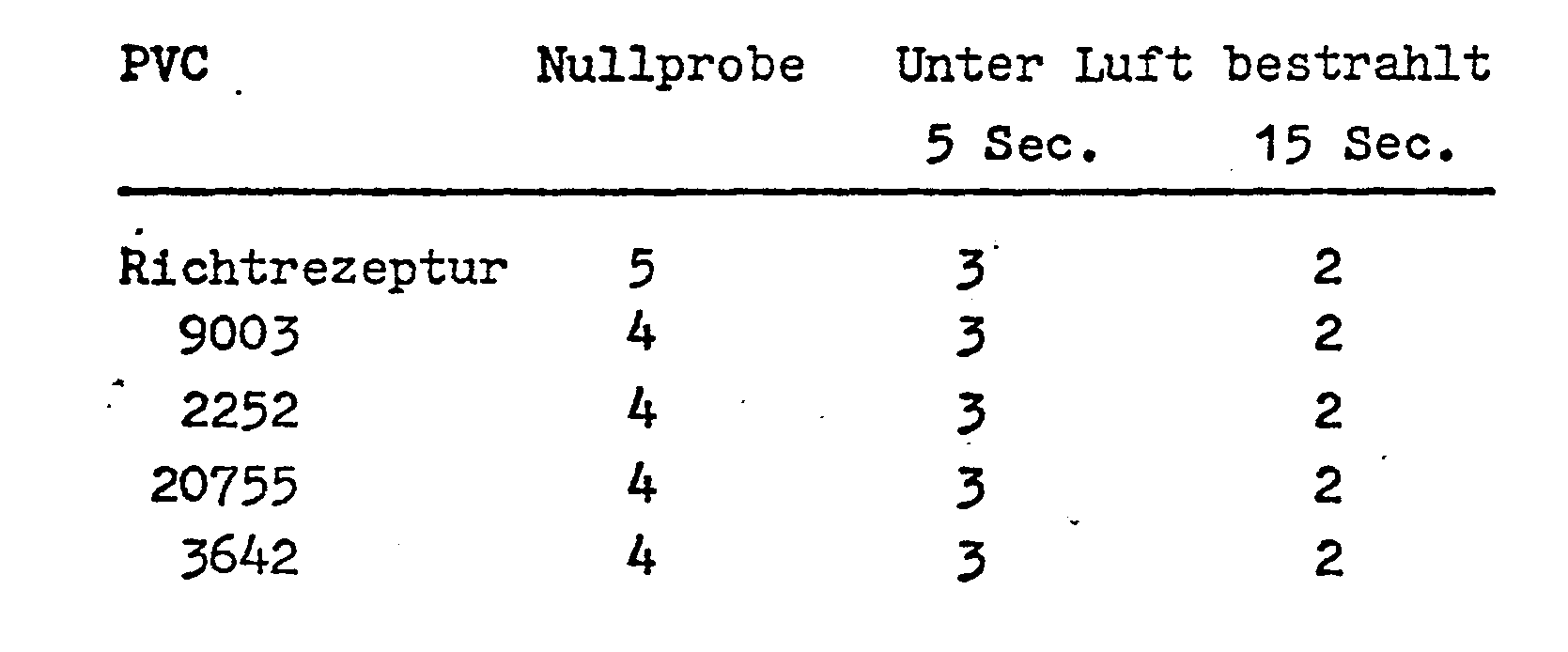
- 3 UV-Strahler sind nebeneinander so angeordnet, daß sich eine Bestrahlungszone von 50 cm Breite ergibt Die Bleche werden auf einem Transportband mit einer Geschwindigkeit von 2 m/Min (15 Sec. Bestrahlungszeit) und 6 m/Min. (5 Sec.) durch die Bestrahlungszone geführt Die Strahler sind von einer Haube umschlossen, die vorne und hinten jeweils einen Schlitz von 2 cm Höhe für das Transportband haben. Am hinteren Ende der Haube sitzen Düsen, durch die Stickstoff in die Haube geblasen werden kann, so daß nach einer kurzen Spülzeit von etwa 1 Minute eine Quasistickstoffatmosphäre in der Haube vorhanden ist Bei der Bestrahlung unter Schutzgas wird weiter Stickstoff durch die Haube geblasen.
- Es werden 1 cm breite und 2 mm dicke Streifen folgender PVC-Plastisole auf die so behandelten Testbleche aufgetragen:
- PVC-Richtrezeptur:

- Zu 100 Gew.-Teilen von diesem Plastisol wurden 1.5 Gew.-Teile Stabilisator (Di-n-butylzinn-bis-thioglycolsäureisooctylester) sowie 1 Gew.-Teil Haftvermittler Euretek 501®(Fa. Schering AG, Bergkamen) zugemischt.
- Außerdem wurden die nachfolgenden Plastisole verwendet, die im Handel erhältlich sind.
- Nahtabdichtung (zum Abdichten von Schweißnähten an Automobilkarossen):
- Dekalin 9003 (Fa. Dekalin Deutsche Klebstoff-Werke, Hanau)
- Stankiewicz 22520 (Fa. Dr. A. Stankiewicz GmbH, Celle)
- Intercol 20755® (Fa. Intercol Kleb- und Riechstoff GmbH, Bodenheim/Rhein)
- Terotek 3642® (Fa. Teroson GmbH, Heidelberg)
- Einbrennbedingungen: 7 Minuten 140°C Objekttemperatur
- Die PVC-Haftung wird 1 Stunde nach dem Einbrennen geprüft.
- PVC-Haftung nach UV-Bestrahlung


- Wie in Beispiel 1, jedoch Bestrahlung mit Elektronenstrahlen.
- Elektronenstrahlanlage : ESH 150-20 (Fa. Dürr,Stuttgart)
- Beschleunigungsspannung : 150 kV
- Die eingebrannte Grundierung wird mit einer Strahlendosis von 40 Mrad (400 kGry) sowohl unter Luft direkt als auch im Streustrahl (die Bleche wurden seitlich an das Strahlrohr gelehnt) bestrahlt.


- Wie Beispiel 1, jedoch wurde als Nachfolgeschicht der folgende Füller aufgetragen:

- Spritzverdünnung: Xylol/Ethylenglykolmonoethylether 4/1
- Nach dem Aufspritzen auf die UV-bestrahfte Grundierung wird der Füller 10 Minuten bei 140°C eingebrannt
- Trockenfilmstärke: 36 bis 38 pm
- Die Haftungsprüfung erfolgt 24 Stunden nach dem Einbrennen.
-


- Herstellung des pigmentierten Elektrotauchlackes erfolgt wie in Beispiel 1 beschrieben, jedoch ist der Vernetzer B1 durch Vernetzer B2, gelöst in Ethylenglykolmonobutylether (18.3 g) ersetzt und als Pigment wird nicht Ruß, sondern nur Titandioxid (20.5 g) und Aluminiumsilicat (15.0 g) verwendet.
- Abscheidebedingungen siehe Beispiel 1.
- Trockenfilmstärke: 18 bis 19 µm.
- UV-Bestrahlung und PVC-Prüfung wie Beispiel 1.


- Wie Beispiel 4, jedoch Bestrahlung mit Elektronenstrahlen.

- Herstellung des pigmentierten Elektrotauchlackes erfolgt nach Beispiel 4, jedoch ist der Vernetzer B2 durch den Vernetzer B3, gelöst in Butylglykol (18.3 g) ersetzt.
- Abscheidebedingungen siehe Beispiel 1.
- Trockenfilmstärke: 19 bis 20 pm.
- UV-Bestrahlung und PVC-Prüfung wie Beispiel 1.


- Herstellung des pigmentierten Elektrotauchlackes erfolgt nach Beispiel 4, jedoch ist der Vernetzer B2 durch den Vemetzer B3, gelöst in Butylglykol (18.3 g) ersetzt.
- Abscheidebedingungen siehe Beispiel 1.
- Trockenfilmstärke: 19 bis 20 µm.
- UV-Bestrahlung und PVC-Prüfung wie Beispiel 1.


- Wie Beispiel 6, jedoch Bestrahlung mit Elektronenstrahlen.


- Wie Beispiel 6, jedoch wurde folgender Decklack aufgetragen.

- Spritzverdünnung: Xylol/Butanol 9/1
- Der Decklack wird auf die UV-bestrahlte Grundierung aufgespritzt und dann 15 Minuten bei 150°C eingebrannt.
- Trockenfilmstärke: 35 bis 37 µm.
- Die Haftungsprüfung erfolgt 24 Stunden nach dem Einbrennen.
-


- Es wurde ein pigmentierter Elektrotauchpulverlack nach DE-A-3024158 (Vergleich zu Beispiel A) eingesetzt, wobei jedoch das Eisenoxidpigment (50 Teile) gegen Titandioxid (45.5 Teile) und Ruß (4.5 Teile) ausgetauscht wurde.
- Abscheidebedingungen:
- Spannung : 200 V
- Temperatur : 25°C
- Zeit : 25 Sekunden
- Nachdem die beschichteten Bleche mit Wasser gespült wurden, werden sie 10 Min. bei 70°C vorgeliert und dann 15 Min. bei 185°C Objekttemperatur eingebrannt.
- Trockenfilmstärke: 40 bis 44 µm.
- UV-Bestrahlung und PVC-Auftrag wie Beispiel 1.


- Wie Beispiel 9, jedoch Bestrahlung mit Elektronenstrahlen.


- Zu der in DT 2320301 (Beispiel 1) beschriebenen Harzdispersion (400 g) mit einem Gehalt an nichtflüchtigen Bestandteilen von 40 Gew.% werden Ruß (12 g) und Aluminiumsilicat (48 g) zugegeben und auf einer Perlmühle so lange dispergiert, bis eine Komgroße von 10 bis 20 nach Hegman beobachtet wird. Die erhaltene Pigmentpaste wird langsam unter Rühren mit deionisiertem Wasser (2540 g) versetzt. Der Festgehalt dieser Dispersion beträgt 15 Gew.%.
- Abscheidebedingungen:
- Spannung: 150 V
- Temperatur: 25°C
- Zeit 2 Minuten
- Trockenfilmstärke: 19 bis 20 µm
- Einbrennung siehe Beispiel 1.
- UV-Bestrahlung und PVC-Auftrag wie Beispiel 1.


- Die Herstellung des pigmentierten Elektrotauchlackes erfolgt mit Basisharz A4 und Vemetzungsmittel B1 nach DE-A-3436346, Beispiel 3.
- Abscheidebedingungen:
- Spannung: 210 V
- Temperatur: 28°C
- Zeit: 2 Minuten
- Trockenfilmstärke: 17 bis 18 µm
- Einbrennung sowie UV-Bestrahlung und PVC-Auftrag wie Beispiel 1.


- Wie Beispiel 12, jedoch Bestrahlung mit Elektronenstrahlen.
- Bestrahlung und PVC-Prüfung siehe Beispiel 1.
-


- Die Herstellung des pigmentierten Elektrotauchlackes erfolgt nach Beispiel 12, jedoch wird der Vemetzer B1 gegen den Vemetzer B4 ausgetauscht.
- Abscheidebedingungen:
- Spannung: 210 V
- Temperatur: 28°C
- Zeit 2 Minuten
- Trockenfilmstärke: 18 bis 19 um
- Einbrennung sowie UV-Bestrahlung und PVC-Auftrag wie Beispiel 1.


- Die Herstellung des pigmentierten Elektrotauchlackes erfolgt nach Beispiel 12, jedoch ist der Vemetzer B1 gegen den Vemetzer B3 ausgetauscht.
- Abscheidebedingungen:
- Spannung: 220 V
- Temperatur: 28°C
- Zeit 2 Minuten
- Trockenfilmstärke: 17 bis 18 µm
- Einbrennung sowie UV-Bestrahlung und PVC-Auftrag wie Beispiel 1.


- Die Herstellung des primäre Aminogruppen enthaltenden Epoxidharzes A5 mit verkapptem lsocyanat als Härter B5 zu einem pigmentierten Elektrotauchlack wurde nach US-PA-3947339, Beispiel 1, durchgeführt. Jedoch wurde in Beispiel A für die Pigmentpaste nicht Phthalocyanin blau (60 T) und Eisenoxid braun (140 T) sondern Ruß (40 T) und Aluminiumsilikat (160 T) eingesetzt.
- Abscheidebedingungen:
- Abscheidespannung: 280 V
- Abscheidetemperatur: 28°C
- Abscheidezeit: 2 Minuten
- Trockenfilmstärke: 20 bis 21 µm
- Einbrennbedingungen sowie UV-Bestrahlung und PVC-Auftragung wie Beispiel 1.

- Die Basisharze A6 (43 g) und A7 (303 g; 212 g Festkörper) werden unter Zusatz von Ethylenglykolmonobu- tylether (73 g) miteinander vermischt Dann gibt man Phthalocyanin gelb (65 g), Azopigment (43 g), Titandioxid (22 g) und Aluminiumsilicat (15 g) hinzu und dispergiert die Mischung 90 Minuten in einer Perlmühle bis eine Komgröße von 10 bis 15 nach Hegman erreicht ist
- Nach dem Abkühlen auf 25°C werden der Vernetzer B6 (111 g; 109 g Festkörper) und Triethylamin (36 g) in die Mischung dispergiert und dann mit 2400 g deionisiertem Wasser verdünnt, so daß ein Festkörperanteil von 17 Gew.% erhalten wird.
- Der resultierende Elektrotauchlack hat einen pH-Wert von 8.9 und eine Badleitfähigkeit von 800 pS/cm.
- Abscheidebedingungen:
- Abscheidespannung: 200 V
- Abscheidetemperatur: 25°C
- Abscheidezeit 2 Minuten
- Einbrennbedingungen: 25 Minuten bei 175°C
- Trockenfilmstärke: 18 bis 19 µm
- UV-Bestrahlung und PVC-Auftragung wie Beispiel 1.


Claims (6)
Priority Applications (1)
| Application Number | Priority Date | Filing Date | Title |
|---|---|---|---|
| AT85115992T ATE43368T1 (de) | 1984-12-15 | 1985-12-14 | Verfahren zum beschichten von elektrisch leitfaehige oberflaechen aufweisenden substraten. |
Applications Claiming Priority (2)
| Application Number | Priority Date | Filing Date | Title |
|---|---|---|---|
| DE3445857 | 1984-12-15 | ||
| DE3445857A DE3445857C2 (de) | 1984-12-15 | 1984-12-15 | Verfahren zum Beschichten von elektrisch leitfähige Oberflächen aufweisenden Substraten |
Publications (2)
| Publication Number | Publication Date |
|---|---|
| EP0185338A1 true EP0185338A1 (de) | 1986-06-25 |
| EP0185338B1 EP0185338B1 (de) | 1989-05-24 |
Family
ID=6252903
Family Applications (1)
| Application Number | Title | Priority Date | Filing Date |
|---|---|---|---|
| EP85115992A Expired EP0185338B1 (de) | 1984-12-15 | 1985-12-14 | Verfahren zum Beschichten von elektrisch leitfähige Oberflächen aufweisenden Substraten |
Country Status (3)
| Country | Link |
|---|---|
| EP (1) | EP0185338B1 (de) |
| AT (1) | ATE43368T1 (de) |
| DE (2) | DE3445857C2 (de) |
Families Citing this family (1)
| Publication number | Priority date | Publication date | Assignee | Title |
|---|---|---|---|---|
| US6423425B1 (en) | 1998-05-26 | 2002-07-23 | Ppg Industries Ohio, Inc. | Article having a chip-resistant electrodeposited coating and a process for forming an electrodeposited coating |
Citations (1)
| Publication number | Priority date | Publication date | Assignee | Title |
|---|---|---|---|---|
| US4025409A (en) * | 1975-07-14 | 1977-05-24 | Scm Corporation | Dual cure cathodic electrocoating process |
-
1984
- 1984-12-15 DE DE3445857A patent/DE3445857C2/de not_active Expired
-
1985
- 1985-12-14 AT AT85115992T patent/ATE43368T1/de not_active IP Right Cessation
- 1985-12-14 EP EP85115992A patent/EP0185338B1/de not_active Expired
- 1985-12-14 DE DE8585115992T patent/DE3570461D1/de not_active Expired
Patent Citations (1)
| Publication number | Priority date | Publication date | Assignee | Title |
|---|---|---|---|---|
| US4025409A (en) * | 1975-07-14 | 1977-05-24 | Scm Corporation | Dual cure cathodic electrocoating process |
Also Published As
| Publication number | Publication date |
|---|---|
| DE3445857C2 (de) | 1986-12-04 |
| EP0185338B1 (de) | 1989-05-24 |
| DE3445857A1 (de) | 1986-06-26 |
| ATE43368T1 (de) | 1989-06-15 |
| DE3570461D1 (en) | 1989-06-29 |
Similar Documents
| Publication | Publication Date | Title |
|---|---|---|
| DE69416984T3 (de) | Zyklisches Karbonat-härtbare Beschichtungszusammensetzung | |
| DE3538792C1 (de) | Elektrophoretisch ueberbeschichtbare im Elektrotauchlackierverfahren aufgebrachte UEberzuege | |
| EP0120466B2 (de) | Hitzehärtbare Überzugsmittel und deren Verwendung | |
| EP1261524B1 (de) | Verfahren zur herstellung von mehrschichtlackierungen auf elektrisch leitfähigen substraten | |
| EP0310971B1 (de) | Kathodisch adscheidbares wässriges Elektrotauchlack-überzugsmittel und dessen Verwendung | |
| EP0421238B1 (de) | Verwendung von vernetzten Polymermikroteilchen in Lacken als Füllstoffersatz und/oder als vernetzender Füllstoff | |
| DE3311517A1 (de) | In der hitze selbstvernetzende lackbindemittel, ihre herstellung und verwendung | |
| DE102010012047A1 (de) | Verfahren zur Beschichtung eines Metall- oder Kunststoffsubstrats, daraus erhältliche Beschichtung und beschichtetes Substrat | |
| EP0134983B1 (de) | Stickstoffbasische Gruppen tragendes Kunstharz, dessen Herstellung und Verwendung | |
| EP0301293B1 (de) | Kathodisch abscheidbare Kunstharze enthaltende wässrige Elektrotauchlackbäder und Verfahren zur Beschichtung elektrisch leitfähiger Substrate | |
| EP0380009B1 (de) | Hitzehärtbares Überzugsmittel für die kathodische Elektrotauchlackierung | |
| DE2814439A1 (de) | Kationische abscheidung von harzen | |
| DE69412448T2 (de) | Zyklisches Karbonat-härtbare Beschichtungszusammensetzung und Verfahren zu ihrer Verwendung für die kathodische Elektrotauchlackierung | |
| EP0154775B1 (de) | Wasserdispergierbare Bindemittel auf der Basis von modifizierten Epoxid-Amin-Addukten, deren Herstellung und Verwendung | |
| EP0039425B1 (de) | Wasserverdünnbare Bindemittel, ihre Herstellung und Verwendung | |
| DE3801786A1 (de) | Verfahren zur beschichtung elektrisch leitfaehiger substrate, nach diesem verfahren beschichtete substrate und waessrige elektrotauchlackbaeder | |
| EP0185338B1 (de) | Verfahren zum Beschichten von elektrisch leitfähige Oberflächen aufweisenden Substraten | |
| EP0544182B1 (de) | Polymere Umsetzungsprodukte | |
| EP0319792B1 (de) | Hitzehärtbares wässriges Überzugsmittel für die kathodische Elektrotauchlackierung | |
| DE8103758U1 (de) | Mit einer mehrschichtlackierung beschichtete radfelge, insbesondere fuer kraftfahrzeuge | |
| DE3328455A1 (de) | Verwendung von aminosaeure-salzaddukten, die urethanisierte aminogruppen enthalten, und deren umsetzungsprodukten mit epoxydgruppenhaltigen verbindungen als vernetzer von hydroxyl-und/oder epoxydgruppenhaltigen verbindungen, diese addukte und umsetzungsprodukte sowie verahren zu deren herstellung | |
| WO1991008266A1 (de) | Verfahren zum beschichten elektrisch leitfähiger substrate und kathodisch abscheidbarer wässriger elektrotauchlack | |
| EP1190119A1 (de) | Verfahren zur elektrotauchlackierung von kanten aufweisenden substraten | |
| EP1645581A1 (de) | Polyurethanharze mit Säuregruppen | |
| EP0538759A1 (de) | Kationische Harze auf Basis von Copolymerisaten aus Butadien und Acrylnitril |
Legal Events
| Date | Code | Title | Description |
|---|---|---|---|
| PUAI | Public reference made under article 153(3) epc to a published international application that has entered the european phase |
Free format text: ORIGINAL CODE: 0009012 |
|
| AK | Designated contracting states |
Kind code of ref document: A1 Designated state(s): AT BE CH DE FR GB IT LI NL SE |
|
| 17P | Request for examination filed |
Effective date: 19861218 |
|
| 17Q | First examination report despatched |
Effective date: 19871203 |
|
| GRAA | (expected) grant |
Free format text: ORIGINAL CODE: 0009210 |
|
| AK | Designated contracting states |
Kind code of ref document: B1 Designated state(s): AT BE CH DE FR GB IT LI NL SE |
|
| REF | Corresponds to: |
Ref document number: 43368 Country of ref document: AT Date of ref document: 19890615 Kind code of ref document: T |
|
| REF | Corresponds to: |
Ref document number: 3570461 Country of ref document: DE Date of ref document: 19890629 |
|
| ET | Fr: translation filed | ||
| ITF | It: translation for a ep patent filed | ||
| GBT | Gb: translation of ep patent filed (gb section 77(6)(a)/1977) | ||
| PGFP | Annual fee paid to national office [announced via postgrant information from national office to epo] |
Ref country code: BE Payment date: 19891020 Year of fee payment: 5 |
|
| PGFP | Annual fee paid to national office [announced via postgrant information from national office to epo] |
Ref country code: SE Payment date: 19891207 Year of fee payment: 5 |
|
| PGFP | Annual fee paid to national office [announced via postgrant information from national office to epo] |
Ref country code: CH Payment date: 19891219 Year of fee payment: 5 |
|
| PGFP | Annual fee paid to national office [announced via postgrant information from national office to epo] |
Ref country code: NL Payment date: 19891231 Year of fee payment: 5 |
|
| PLBE | No opposition filed within time limit |
Free format text: ORIGINAL CODE: 0009261 |
|
| STAA | Information on the status of an ep patent application or granted ep patent |
Free format text: STATUS: NO OPPOSITION FILED WITHIN TIME LIMIT |
|
| 26N | No opposition filed | ||
| PG25 | Lapsed in a contracting state [announced via postgrant information from national office to epo] |
Ref country code: SE Effective date: 19901215 |
|
| PGFP | Annual fee paid to national office [announced via postgrant information from national office to epo] |
Ref country code: AT Payment date: 19901221 Year of fee payment: 6 |
|
| ITTA | It: last paid annual fee | ||
| PG25 | Lapsed in a contracting state [announced via postgrant information from national office to epo] |
Ref country code: LI Effective date: 19901231 Ref country code: CH Effective date: 19901231 Ref country code: BE Effective date: 19901231 |
|
| BERE | Be: lapsed |
Owner name: HERBERTS G.M.B.H. Effective date: 19901231 |
|
| PG25 | Lapsed in a contracting state [announced via postgrant information from national office to epo] |
Ref country code: NL Effective date: 19910701 |
|
| NLV4 | Nl: lapsed or anulled due to non-payment of the annual fee | ||
| REG | Reference to a national code |
Ref country code: CH Ref legal event code: PL |
|
| PGFP | Annual fee paid to national office [announced via postgrant information from national office to epo] |
Ref country code: GB Payment date: 19911128 Year of fee payment: 7 |
|
| PG25 | Lapsed in a contracting state [announced via postgrant information from national office to epo] |
Ref country code: AT Effective date: 19911214 |
|
| PGFP | Annual fee paid to national office [announced via postgrant information from national office to epo] |
Ref country code: FR Payment date: 19911220 Year of fee payment: 7 |
|
| PGFP | Annual fee paid to national office [announced via postgrant information from national office to epo] |
Ref country code: DE Payment date: 19920213 Year of fee payment: 7 |
|
| PG25 | Lapsed in a contracting state [announced via postgrant information from national office to epo] |
Ref country code: GB Effective date: 19921214 |
|
| GBPC | Gb: european patent ceased through non-payment of renewal fee |
Effective date: 19921214 |
|
| PG25 | Lapsed in a contracting state [announced via postgrant information from national office to epo] |
Ref country code: FR Effective date: 19930831 |
|
| PG25 | Lapsed in a contracting state [announced via postgrant information from national office to epo] |
Ref country code: DE Effective date: 19930901 |
|
| REG | Reference to a national code |
Ref country code: FR Ref legal event code: ST |
|
| EUG | Se: european patent has lapsed |
Ref document number: 85115992.1 Effective date: 19910910 |