EP0185596B1 - Matériau de stockage d'énergie thermique et procédé de protection contre les chocs thermiques de composants, notamment électriques ou électroniques - Google Patents
Matériau de stockage d'énergie thermique et procédé de protection contre les chocs thermiques de composants, notamment électriques ou électroniques Download PDFInfo
- Publication number
- EP0185596B1 EP0185596B1 EP85402594A EP85402594A EP0185596B1 EP 0185596 B1 EP0185596 B1 EP 0185596B1 EP 85402594 A EP85402594 A EP 85402594A EP 85402594 A EP85402594 A EP 85402594A EP 0185596 B1 EP0185596 B1 EP 0185596B1
- Authority
- EP
- European Patent Office
- Prior art keywords
- fact
- material according
- solid
- phase transition
- amino
- Prior art date
- Legal status (The legal status is an assumption and is not a legal conclusion. Google has not performed a legal analysis and makes no representation as to the accuracy of the status listed.)
- Expired
Links
Images

Classifications
-
- C—CHEMISTRY; METALLURGY
- C09—DYES; PAINTS; POLISHES; NATURAL RESINS; ADHESIVES; COMPOSITIONS NOT OTHERWISE PROVIDED FOR; APPLICATIONS OF MATERIALS NOT OTHERWISE PROVIDED FOR
- C09K—MATERIALS FOR MISCELLANEOUS APPLICATIONS, NOT PROVIDED FOR ELSEWHERE
- C09K5/00—Heat-transfer, heat-exchange or heat-storage materials, e.g. refrigerants; Materials for the production of heat or cold by chemical reactions other than by combustion
Definitions
- the present invention relates to a thermal energy storage material for protection against thermal shock of components, in particular electrical or electronic.
- thermal energy storage medium materials having a change from liquid-solid phase to the desired temperature, for example salt hydrates.
- the phase change is accompanied by a change in enthalpy by which the material absorbs or releases heat.
- the present invention aims to overcome these drawbacks by providing an easier-to-use thermal energy storage material than materials with liquid-solid phase transition.
- the subject of the invention is a thermal energy storage material for the protection against thermal shock of components, in particular electrical or electronic, characterized in that it is constituted by the combination of at least one body having, in a temperature range between 0 ° C and 185 ° C, a solid-solid phase transition having an enthalpy variation at least equal to 50 J / g, and a body such as an adhesive or a polymer, stable at the phase transition temperature, and ensuring the mechanical resistance of the material.
- Such bodies have a phase transition, solid-solid having the above characteristics are known.
- the change in enthalpy at transition is due to the transition from an anisotropic state to an isotropic state (cf. Proc. Of the Energy Technology Vol. 10 [1983], p. 712 -720).
- the material according to the invention does not pose a problem of non-congruence.
- the volume changes at the solid-solid transition are less than those encountered during fusion.
- the use of these materials is further facilitated by the absence of a liquid phase and corrosion is negligible.
- the combination between the solid-solid transition body and the adhesive or the polymer consists of a substantially homogeneous mixture.
- the mixing can be carried out by adding the constituents in the liquid state.
- the material can then be molded to the desired shape depending on the intended application.
- the addition of the constituents can also be carried out in the solid state in the form of powder, the mixture then being for example implemented by sintering.
- the solid-solid phase transition body is encapsulated in the adhesive or the polymer. It is then possible, in particular, to produce sandwich structures in which the solid-solid phase transition material is placed between two sheets of polymer.
- the solid-solid phase transition body belongs to the group consisting of polyols, their amino and nitro derivatives, and mixtures of these bodies.
- polyols are preferably polyols with a tetrahedral structure, composed of five carbon atoms and having from 2 to 4 hydroxyl radicals attached to the four peripheral carbons.
- Polyols have the advantage of requiring a relatively high temperature to pass to the isotropic state, due to the significant cohesion of their structure which confers on them the presence of hydrogen bonds.
- binary mixtures of bodies from the polyol family form stable solid solutions, the transition temperature of which can be chosen by the composition of the mixture.
- the polyol used can belong to the group consisting of pentaerythritol, pentaglycerin and neopentylglycol.
- an amino or nitro derivative of a polyol this can be chosen from the group consisting of 2-amino-2-hydroxymethyl-1,3-propanediol 2-amino-2-methyl-propanediol-1 , 3 2-hydroxymethyl-2-nitro-propanediol-1,3 and 2-methyl-2-nitro-propanediol-1,3.
- the solid-solid phase transition body used can be a propionic acid such as 2,2-dimethyl propionic acid and bis (hydroxymethyl) -2,2 propionic acid.
- the invention also relates to a method of protection against thermal shocks of components, in particular electrical or electronic, characterized in that said component is placed in contact with a thermal energy storage material as described above. above.
- the component can for example be embedded in this material.
- the energy dissipated by the component is therefore stored by the material during the period of use, then dissipated later in the external environment.
- Table 1 gives the transition temperature and the enthalpy variation for pentaerythritol (C- (CH 2 -OH) 4 ), pentaglycerin (CH 3 -C- (CH 2 -OH) 3 ) and neopentylglycol (( CH 3/2 -C- (CH 2 -OHl 2 ) for two of the amino and nitro compounds of pentaglycerin and neopentylglycol and for two propionic acids.
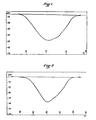
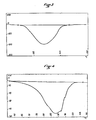
- Figures 1 to 4 are the thermograms obtained on an enthalpy analyzer of neopentylglycol, pentaglycerin, 2-amino-2-hydroxymethyl-propanediol-1,3 and 2-amino-2-methyl-propanediol-1,3.
- Table 2 summarizes the characteristics of the endothermic peak for each of these four bodies.
- FIG. 5 shows in 1 the transition enthalpy, and in 2, the transition temperature, of a mixture of pentaglycerin and neopentylglycol for proportions of pentaglycerin between 0 and 50%.
- the mixture is produced by adding the constituents in the liquid state. Given the high vapor pressure of these constituents near their melting temperature, the composition is checked by gas chromatography.
- Table 3 gives the value of the temperature and the transition enthalpy for some value of the mass fraction of pentaglycerin.
- Table 4 represents the values of the temperature and the transition enthalpy for the pentaglycerin on the one hand, and on the other hand for a material according to the invention produced either by encapsulation of pentaglycerin in, or by mixture of the latter with, an "Araldite" intended to ensure the mechanical strength of the material.
Landscapes
- Chemical & Material Sciences (AREA)
- Engineering & Computer Science (AREA)
- Chemical Kinetics & Catalysis (AREA)
- Combustion & Propulsion (AREA)
- Thermal Sciences (AREA)
- Materials Engineering (AREA)
- Organic Chemistry (AREA)
- Physics & Mathematics (AREA)
- Compositions Of Macromolecular Compounds (AREA)
- Laminated Bodies (AREA)
- Cooling Or The Like Of Electrical Apparatus (AREA)
- Organic Insulating Materials (AREA)
- Central Heating Systems (AREA)
- Compositions Of Oxide Ceramics (AREA)
- Adhesives Or Adhesive Processes (AREA)
- Constitution Of High-Frequency Heating (AREA)
- Fixed Capacitors And Capacitor Manufacturing Machines (AREA)
Description
- La présente invention concerne un matériau de stockage d'énergie thermique pour la protection contre les chocs thermiques de composants, notamment électriques ou électroniques.
- Lors de l'utilisation de certains composants électriques ou électroniques, une forte puissance doit parfois être dissipée dans un temps très bref. C'est en particulier le cas de composants électroniques appelés à fonctionner peu fréquemment ou de moteurs électriques confinés dans des enceintes fermées.
- On a déjà proposé d'utiliser comme milieu de stockage de l'énergie thermique, des matériaux présentant un changement de phase liquide-solide à la température souhaitée, par exemple des hydrates salins. Le changement de phase s'accompagne d'une variation d'enthalpie par laquelle le matériau absorbe ou restitue de la chaleur.
- Ces matériaux à transition de phase liquide-solide posent toutefois des problèmes de non congruence, de surfusion, et de changement de volume à la fusion, qui n'ont jusqu'à présent pas été résolus de manière satisfaisante.
- La présente invention vise à palier ces inconvénients en fournissant un matériau de stockage d'énergie thermique de mise en oeuvre plus facile que les matériaux à transition de phase liquide-solide.
- A cet effet, l'invention a pour objet un matériau de stockage d'énergie thermique pour la protection contre les chocs thermiques de composants, notamment électriques ou électroniques, caractérisé par le fait qu'il est constitué par la combinaison d'au moins un corps possédant, dans une gamme de températures comprise entre 0°C et 185°C, une transition de phase solide-solide présentant une variation d'enthalpie au moins égale à 50 J/g, et un corps tel qu'une colle ou un polymère, stable à la température de transition de phase, et assurant la résistance mécanique du matériau.
- De tels corps présentent une transition de phase, solide-solide présentant les caractéristiques ci-dessus sont connus. La variation d'enthalpie à la transition est due au passage d'un état anisotrope à un état isotrope (cf. Proc. of the Energy Technology Vol. 10 [1983], p. 712 -720).
- L'utilisation d'un corps à transition de phase solide-solide présente de nombreux avantages par rapport à celle d'un corps à transition liquide-solide.
- C'est ainsi que le matériau selon l'invention ne pose pas de problème de non congruence. De plus, les changements de volume à la transition solide-solide, sont inférieurs à ceux rencontrés lors de la fusion. La mise en oeuvre de ces matériaux est en outre facilitée par l'inexistence d'une phase liquide et la corrosion est négligeable.
- Enfin, il est possible, grâce à la réalisation de mélanges, d'obtenir une gamme continue de températures de transition, ce qui n'est pas le cas pour les matériaux à transition liquide-solide.
- Dans un premier mode de réalisation de l'invention, la combinaison entre le corps à transition solide-solide et la colle ou le polymère, est constituée par un mélange sensiblement homogène.
- Dans le cas où un polymère est utilisé pour assurer la résistance mécanique du matériau, le mélange peut s'effectuer par addition des constituants à l'état liquide. Le matériau peut alors être moulé à la forme souhaitée en fonction de l'application envisagée. L'addition des constituants peut également être effectuée à l'état solide sous forme de poudre, le mélange étant alors par exemple mis en oeuvre par frittage.
- Dans le cas où c'est une colle qui est utilisée, le corps à transition de phase peut être réduit en poudre et mélange à la colle avant durcissement de cette dernière.
- Dans un autre mode de réalisation de l'invention, le corps à transition de phase solide-solide est encapsulé dans la colle ou le polymère. Il est alors possible, en particulier, de réaliser des structures sandwich dans lesquelles le matériau à transition de phase solide-solide est disposé entre deux feuilles de polymère.
- Dans un mode de réalisation particulier de l'invention, le corps à transition de phase solide-solide appartient au groupe constitué par les polyols, leurs dérivés aminés et nitrés, et les mélanges de ces corps.
- Ces polyols sont de préférence des polyols à structure tétraédrique, composés de cinq atomes de carbone et ayant de 2 à 4 radicaux hydroxyles rattachés aux quatre carbones périphériques.
- Les polyols présentent l'avantage de nécessiter une température relativement élevée pour passer à l'état isotrope, en raison de la cohésion importante de leur structure que leur confrère la présence de liaisons hydrogène. En outre, les mélanges binaires de corps de la famille des polyols forment des solutions solides stables dont la température de transition peut être choisie par la composition du mélange.
- Plus particulièrement, le polyol utilisé peut appartenir au groupe constitué par le pentaerythritol, la pentaglycérine et le néopentylglycol.
- Si l'on utilise un dérivé aminé ou nitré d'un polyol, celui-ci peut être choisi dans le groupe constitué par l'amino-2 hydroxyméthyl-2 propanediol-1,3 l'amino-2 méthyl-2 propanediol-1,3 l'hydroxyméthyl-2 nitro-2 propanediol-1,3 et le méthyl-2 nitro-2 propanediol-1,3.
- Néanmoins, d'autres corps que les polyols peuvent être utilisés dans la mesure où ils présentent une transition de phase solide-solide dans la gamme de températures souhaitée et que leur variation d'enthalpie est suffisante.
- C'est ainsi, en particulier, que le corps à transition de phase solide-solide utilisé peut être un acide propionique tel que l'acide diméthyl-2,2 propionique et l'acide bis(hydroxyméthyl)-2,2 propionique.
- Dans le cas où l'on utilise une colle pour assurer la résistance mécanique du matériau, cette colle peut être une résine époxy du type de celle vendue sous la marque «Araldite» par la Société CIBA.
- L'invention a également pour objet un procédé de protection contre les chocs thermiques de composants, notamment électriques ou électroniques caractérisé par le fait que l'on place ledit composant au contact d'un matériau de stockage d'énergie thermique tel que décrit ci-dessus.
- Le composant peut par exemple être enrobé dans ce matériau.
- L'énergie dissipée par le composant est donc stockée par le matériau pendant la durée d'utilisation, puis dissipée ultérieurement dans le milieu extérieur.
- On a donne' ci-dessous, à titre d'exemple, les caractéristiques de la transition de phase solide-solide de quelques corps pouvant être utilisés pour la fabrication du matériau selon l'invention.
- Le tableau 1 donne la température de transition et la variation d'enthalpie pour le pentaerythritol (C-(CH2-OH)4), la pentaglycérine (CH3-C-(CH2-OH)3) et le néopentylglycol ((CH3/2-C-(CH2-OHl2) pour deux des composés aminés et nitrés de la pentaglycérine et du néopentylglycol et pour deux acides propioniques.

- Les figures 1 à 4 sont les thermogrammes obtenus sur analyseur enthalpique du néopentylglycol, de la pentaglycérine, de l'amino-2 hydroxymethyl-2 propanediol-1,3 et de l'amino-2 méthyl-2 propanediol-1,3.
- Le tableau 2 résume les caractéristiques du pic endothermique pour chacun de ces quatre corps.

- La figure 5 représente en 1 l'enthalpie de transition, et en 2, la température de transition, d'un mélange de pentaglycerine et de néopentylglycol pour de proportions de pentaglycérine comprises entre 0 et 50%.
- La réalisation du mélange est obtenu par addition desconstituants à l'état liquide. Vu la forte tension de vapeur de ces constituants aux abords de leur température de fusion, la composition est contrôlée par chromatographie en phase gazeuse.
- Il apparait clairement sur la figure 5 que, si l'on souhaite par exemple limiter la température de transition à 30°C. la proportion massique de pentaglycérine doit être comprise entre 14 et 33%.
- Le tableau 3 donne la valeur de la température et de l'enthalpie de transition pour quelque valeur de la fraction massique en pentaglycerine.

- Le tableau 4 représente les valeurs de la température et de l'enthalpie de transition pour la pentaglycérine d'une part, et d'autre part pour un matériau selon l'invention réalisé soit par encapsula- tion de pentaglycérine dans, soit par mélange de cette dernière avec, une «Araldite» ayant pour but d'assurer la résistance mécanique du matériau.
-

Claims (11)
Priority Applications (1)
| Application Number | Priority Date | Filing Date | Title |
|---|---|---|---|
| AT85402594T ATE42761T1 (de) | 1984-12-20 | 1985-12-20 | Material zur speicherung von waermeenergie und verfahren zum schutz von insbesondere elektrischen oder elektronischen komponenten gegen waermestoesse. |
Applications Claiming Priority (2)
| Application Number | Priority Date | Filing Date | Title |
|---|---|---|---|
| FR8419561A FR2575173B1 (fr) | 1984-12-20 | 1984-12-20 | Materiau de stockage d'energie thermique et procede de protection contre les chocs thermiques de composants, notamment electriques ou electroniques |
| FR8419561 | 1984-12-20 |
Publications (2)
| Publication Number | Publication Date |
|---|---|
| EP0185596A1 EP0185596A1 (fr) | 1986-06-25 |
| EP0185596B1 true EP0185596B1 (fr) | 1989-05-03 |
Family
ID=9310835
Family Applications (1)
| Application Number | Title | Priority Date | Filing Date |
|---|---|---|---|
| EP85402594A Expired EP0185596B1 (fr) | 1984-12-20 | 1985-12-20 | Matériau de stockage d'énergie thermique et procédé de protection contre les chocs thermiques de composants, notamment électriques ou électroniques |
Country Status (6)
| Country | Link |
|---|---|
| EP (1) | EP0185596B1 (fr) |
| JP (1) | JPH0662934B2 (fr) |
| AT (1) | ATE42761T1 (fr) |
| DE (2) | DE185596T1 (fr) |
| ES (1) | ES8704534A1 (fr) |
| FR (1) | FR2575173B1 (fr) |
Cited By (1)
| Publication number | Priority date | Publication date | Assignee | Title |
|---|---|---|---|---|
| KR101432393B1 (ko) * | 2012-12-28 | 2014-08-20 | 삼성전기주식회사 | 지자기 센서 모듈 밀봉용 에폭시 수지 조성물 및 이로 밀봉된 지자기 센서 모듈 |
Families Citing this family (6)
| Publication number | Priority date | Publication date | Assignee | Title |
|---|---|---|---|---|
| US4694119A (en) * | 1983-09-07 | 1987-09-15 | Sundstrand Data Control, Inc. | Heat shielded memory unit for an aircraft flight data recorder |
| ES2562188T3 (es) * | 2012-03-07 | 2016-03-02 | Siemens Aktiengesellschaft | Transformador encapsulado en resina |
| JP7155900B2 (ja) * | 2018-11-09 | 2022-10-19 | 東洋インキScホールディングス株式会社 | 蓄放熱層形成用組成物、該組成物を用いた蓄放熱層、及び蓄放熱積層体 |
| JP7180316B2 (ja) * | 2018-11-22 | 2022-11-30 | 東洋インキScホールディングス株式会社 | 蓄放熱材料、及びその製造方法 |
| JPWO2024162400A1 (fr) * | 2023-01-31 | 2024-08-08 | ||
| WO2026034467A1 (fr) * | 2024-08-05 | 2026-02-12 | 三菱ケミカル株式会社 | Matériau de stockage de chaleur, bloc-batterie, composition et kit de composition |
Family Cites Families (3)
| Publication number | Priority date | Publication date | Assignee | Title |
|---|---|---|---|---|
| US4100091A (en) * | 1977-01-17 | 1978-07-11 | Texaco Inc. | Process and means for absorbing and releasing thermal energy by utilizing the allothopic change of endo-5-norbornene-2, 3-dicarboxylic acid anhydride with heat |
| US4326238A (en) * | 1977-12-28 | 1982-04-20 | Fujitsu Limited | Electronic circuit packages |
| FR2480488A1 (fr) * | 1980-04-15 | 1981-10-16 | Eaton Manford | Liant thermiquement conducteur et isolant electriquement pour composants electriques et electroniques, et son procede de fabrication |
-
1984
- 1984-12-20 FR FR8419561A patent/FR2575173B1/fr not_active Expired
-
1985
- 1985-12-20 AT AT85402594T patent/ATE42761T1/de not_active IP Right Cessation
- 1985-12-20 ES ES550206A patent/ES8704534A1/es not_active Expired
- 1985-12-20 DE DE198585402594T patent/DE185596T1/de active Pending
- 1985-12-20 JP JP60289119A patent/JPH0662934B2/ja not_active Expired - Lifetime
- 1985-12-20 DE DE8585402594T patent/DE3569938D1/de not_active Expired
- 1985-12-20 EP EP85402594A patent/EP0185596B1/fr not_active Expired
Cited By (1)
| Publication number | Priority date | Publication date | Assignee | Title |
|---|---|---|---|---|
| KR101432393B1 (ko) * | 2012-12-28 | 2014-08-20 | 삼성전기주식회사 | 지자기 센서 모듈 밀봉용 에폭시 수지 조성물 및 이로 밀봉된 지자기 센서 모듈 |
Also Published As
| Publication number | Publication date |
|---|---|
| DE3569938D1 (en) | 1989-06-08 |
| FR2575173B1 (fr) | 1987-02-13 |
| EP0185596A1 (fr) | 1986-06-25 |
| FR2575173A1 (fr) | 1986-06-27 |
| JPS61233904A (ja) | 1986-10-18 |
| DE185596T1 (de) | 1987-03-19 |
| ES8704534A1 (es) | 1987-04-16 |
| ATE42761T1 (de) | 1989-05-15 |
| JPH0662934B2 (ja) | 1994-08-17 |
| ES550206A0 (es) | 1987-04-16 |
Similar Documents
| Publication | Publication Date | Title |
|---|---|---|
| CA1257062A (fr) | Procede de fabrication d'un materiau thermoplastique conducteur de l'electricite | |
| EP3108522B1 (fr) | Procédé de préparation d'une composition d'électrode ou a propriétés magnétiques, mélange et composition obtenus par ce procédé et cette électrode. | |
| EP0185596A1 (fr) | Matériau de stockage d'énergie thermique et procédé de protection contre les chocs thermiques de composants, notamment électriques ou électroniques | |
| WO2007084561A3 (fr) | Ensemble pile à combustible assemblé, procédés, systèmes et compositions d'agent d'étanchéité pour le produire | |
| FR3098817A1 (fr) | Compositions contenant des charges thermiquement conductrices | |
| EP1627017B1 (fr) | Conducteur electrique revetu d'une couche adherente et procede de fabrication d'un tel conducteur electrique | |
| FR2549407A1 (fr) | Agents soudables de scellement pour metaux et procede d'utilisation | |
| WO1993014136A1 (fr) | Composition de resine epoxy et applications, en particulier dans les structures composites | |
| FR2789385A1 (fr) | Composition ceramique piezoelectrique contenant du manganese et dispositif ceramique piezoelectrique l'utilisant | |
| WO2020058454A1 (fr) | Laminât flexible de cellules photovoltaïques et procédé de fabrication associé | |
| EP1328605B1 (fr) | Composition hydrophobe et utilisation sur un substrat pour pr venir la formation de glace et la corrosion | |
| CN110527474A (zh) | 一种硅烷改性聚醚导电密封胶及其制备方法 | |
| WO2004081139A1 (fr) | Dispositif electronique contenant un materiau d'interface thermique | |
| JPS5785820A (en) | Novel resin composition, paint containing said resin composition and painting thereof | |
| FR2469429A1 (fr) | Materiau plastique a conductibilite thermique elevee et bonne resistance mecanique | |
| EP0005387A1 (fr) | Mastic à résistance électrique non linéaire et élément de revêtement de zone de raccordement de matériel électrique | |
| KR101807432B1 (ko) | 고에너지 열가소성 바인더를 이용한 고체 추진제 조성물 | |
| US20090060772A1 (en) | Method of manufacturing metal-graphite brush material for motor | |
| EP0002418B1 (fr) | Procédé de fabrication de produits extrudés à base de compositions polyoléfiniques | |
| US20040143043A1 (en) | Process for incorporating one or more materials into a polymer composition and products produced thereby | |
| FR2623795A1 (fr) | Procede de production d'une ceramique de titanate de plomb-baryum modifie utile comme thermistance a coefficient positif de temperature | |
| FR2459815A1 (fr) | Materiau plastique a conductibilite thermique elevee et bonne resistance mecanique | |
| FR2593328A1 (fr) | Materiaux a conduction protonique, leur procede de preparation et leurs applications | |
| WO2020058626A1 (fr) | Compositions pour plaques bipolaires et methodes de fabrication de ces compositions | |
| FR2565400A1 (fr) | Condensateur de type a double couche electrochimique |
Legal Events
| Date | Code | Title | Description |
|---|---|---|---|
| PUAI | Public reference made under article 153(3) epc to a published international application that has entered the european phase |
Free format text: ORIGINAL CODE: 0009012 |
|
| AK | Designated contracting states |
Kind code of ref document: A1 Designated state(s): AT BE CH DE FR GB IT LI LU NL SE |
|
| ITCL | It: translation for ep claims filed |
Representative=s name: MODIANO & ASSOCIATI S.R.L. |
|
| TCAT | At: translation of patent claims filed | ||
| TCNL | Nl: translation of patent claims filed | ||
| DET | De: translation of patent claims | ||
| 17P | Request for examination filed |
Effective date: 19861215 |
|
| 17Q | First examination report despatched |
Effective date: 19880713 |
|
| GRAA | (expected) grant |
Free format text: ORIGINAL CODE: 0009210 |
|
| AK | Designated contracting states |
Kind code of ref document: B1 Designated state(s): AT BE CH DE FR GB IT LI LU NL SE |
|
| REF | Corresponds to: |
Ref document number: 42761 Country of ref document: AT Date of ref document: 19890515 Kind code of ref document: T |
|
| REF | Corresponds to: |
Ref document number: 3569938 Country of ref document: DE Date of ref document: 19890608 |
|
| GBT | Gb: translation of ep patent filed (gb section 77(6)(a)/1977) | ||
| ITF | It: translation for a ep patent filed | ||
| PLBE | No opposition filed within time limit |
Free format text: ORIGINAL CODE: 0009261 |
|
| STAA | Information on the status of an ep patent application or granted ep patent |
Free format text: STATUS: NO OPPOSITION FILED WITHIN TIME LIMIT |
|
| 26N | No opposition filed | ||
| ITTA | It: last paid annual fee | ||
| EPTA | Lu: last paid annual fee | ||
| EAL | Se: european patent in force in sweden |
Ref document number: 85402594.7 |
|
| PGFP | Annual fee paid to national office [announced via postgrant information from national office to epo] |
Ref country code: FR Payment date: 19981029 Year of fee payment: 14 |
|
| PGFP | Annual fee paid to national office [announced via postgrant information from national office to epo] |
Ref country code: SE Payment date: 19981127 Year of fee payment: 14 |
|
| PGFP | Annual fee paid to national office [announced via postgrant information from national office to epo] |
Ref country code: AT Payment date: 19981207 Year of fee payment: 14 |
|
| PGFP | Annual fee paid to national office [announced via postgrant information from national office to epo] |
Ref country code: GB Payment date: 19981210 Year of fee payment: 14 Ref country code: BE Payment date: 19981210 Year of fee payment: 14 |
|
| PGFP | Annual fee paid to national office [announced via postgrant information from national office to epo] |
Ref country code: DE Payment date: 19981222 Year of fee payment: 14 |
|
| PGFP | Annual fee paid to national office [announced via postgrant information from national office to epo] |
Ref country code: LU Payment date: 19981229 Year of fee payment: 14 |
|
| PGFP | Annual fee paid to national office [announced via postgrant information from national office to epo] |
Ref country code: NL Payment date: 19981231 Year of fee payment: 14 |
|
| PGFP | Annual fee paid to national office [announced via postgrant information from national office to epo] |
Ref country code: CH Payment date: 19990304 Year of fee payment: 14 |
|
| PG25 | Lapsed in a contracting state [announced via postgrant information from national office to epo] |
Ref country code: LU Free format text: LAPSE BECAUSE OF NON-PAYMENT OF DUE FEES Effective date: 19991220 Ref country code: GB Free format text: LAPSE BECAUSE OF NON-PAYMENT OF DUE FEES Effective date: 19991220 Ref country code: AT Free format text: LAPSE BECAUSE OF NON-PAYMENT OF DUE FEES Effective date: 19991220 |
|
| PG25 | Lapsed in a contracting state [announced via postgrant information from national office to epo] |
Ref country code: SE Free format text: LAPSE BECAUSE OF NON-PAYMENT OF DUE FEES Effective date: 19991221 |
|
| PG25 | Lapsed in a contracting state [announced via postgrant information from national office to epo] |
Ref country code: LI Free format text: LAPSE BECAUSE OF NON-PAYMENT OF DUE FEES Effective date: 19991231 Ref country code: CH Free format text: LAPSE BECAUSE OF NON-PAYMENT OF DUE FEES Effective date: 19991231 Ref country code: BE Free format text: LAPSE BECAUSE OF NON-PAYMENT OF DUE FEES Effective date: 19991231 |
|
| BERE | Be: lapsed |
Owner name: ASSOCIATION POUR LA RECHERCHE ET LE DEVELOPPEMENT Effective date: 19991231 |
|
| PG25 | Lapsed in a contracting state [announced via postgrant information from national office to epo] |
Ref country code: NL Free format text: LAPSE BECAUSE OF NON-PAYMENT OF DUE FEES Effective date: 20000701 |
|
| GBPC | Gb: european patent ceased through non-payment of renewal fee |
Effective date: 19991220 |
|
| EUG | Se: european patent has lapsed |
Ref document number: 85402594.7 |
|
| PG25 | Lapsed in a contracting state [announced via postgrant information from national office to epo] |
Ref country code: FR Free format text: LAPSE BECAUSE OF NON-PAYMENT OF DUE FEES Effective date: 20000831 |
|
| NLV4 | Nl: lapsed or anulled due to non-payment of the annual fee |
Effective date: 20000701 |
|
| PG25 | Lapsed in a contracting state [announced via postgrant information from national office to epo] |
Ref country code: DE Free format text: LAPSE BECAUSE OF NON-PAYMENT OF DUE FEES Effective date: 20001003 |
|
| REG | Reference to a national code |
Ref country code: FR Ref legal event code: ST |