EP0185961A2 - 1-Phenyl-imidazol-5-carbonsäure-Derivate, ein Verfahren zu ihrer Herstellung und ihre Verwendung als Wachstumsregulatoren - Google Patents
1-Phenyl-imidazol-5-carbonsäure-Derivate, ein Verfahren zu ihrer Herstellung und ihre Verwendung als Wachstumsregulatoren Download PDFInfo
- Publication number
- EP0185961A2 EP0185961A2 EP85115155A EP85115155A EP0185961A2 EP 0185961 A2 EP0185961 A2 EP 0185961A2 EP 85115155 A EP85115155 A EP 85115155A EP 85115155 A EP85115155 A EP 85115155A EP 0185961 A2 EP0185961 A2 EP 0185961A2
- Authority
- EP
- European Patent Office
- Prior art keywords
- alkyl
- substituted
- phenyl
- halogen
- cyclo
- Prior art date
- Legal status (The legal status is an assumption and is not a legal conclusion. Google has not performed a legal analysis and makes no representation as to the accuracy of the status listed.)
- Withdrawn
Links
- 0 CC1(*)CN=C(C)*CC1 Chemical compound CC1(*)CN=C(C)*CC1 0.000 description 3
- NEMCMBMCONRCKO-UHFFFAOYSA-N CC1OC=[O]CC1 Chemical compound CC1OC=[O]CC1 NEMCMBMCONRCKO-UHFFFAOYSA-N 0.000 description 1
- SECXISVLQFMRJM-UHFFFAOYSA-N CN(CCC1)C1=O Chemical compound CN(CCC1)C1=O SECXISVLQFMRJM-UHFFFAOYSA-N 0.000 description 1
Classifications
-
- C—CHEMISTRY; METALLURGY
- C07—ORGANIC CHEMISTRY
- C07D—HETEROCYCLIC COMPOUNDS
- C07D233/00—Heterocyclic compounds containing 1,3-diazole or hydrogenated 1,3-diazole rings, not condensed with other rings
- C07D233/54—Heterocyclic compounds containing 1,3-diazole or hydrogenated 1,3-diazole rings, not condensed with other rings having two double bonds between ring members or between ring members and non-ring members
- C07D233/64—Heterocyclic compounds containing 1,3-diazole or hydrogenated 1,3-diazole rings, not condensed with other rings having two double bonds between ring members or between ring members and non-ring members with substituted hydrocarbon radicals attached to ring carbon atoms, e.g. histidine
-
- A—HUMAN NECESSITIES
- A01—AGRICULTURE; FORESTRY; ANIMAL HUSBANDRY; HUNTING; TRAPPING; FISHING
- A01N—PRESERVATION OF BODIES OF HUMANS OR ANIMALS OR PLANTS OR PARTS THEREOF; BIOCIDES, e.g. AS DISINFECTANTS, AS PESTICIDES OR AS HERBICIDES; PEST REPELLANTS OR ATTRACTANTS; PLANT GROWTH REGULATORS
- A01N43/00—Biocides, pest repellants or attractants, or plant growth regulators containing heterocyclic compounds
- A01N43/48—Biocides, pest repellants or attractants, or plant growth regulators containing heterocyclic compounds having rings with two nitrogen atoms as the only ring hetero atoms
- A01N43/50—1,3-Diazoles; Hydrogenated 1,3-diazoles
-
- A—HUMAN NECESSITIES
- A01—AGRICULTURE; FORESTRY; ANIMAL HUSBANDRY; HUNTING; TRAPPING; FISHING
- A01N—PRESERVATION OF BODIES OF HUMANS OR ANIMALS OR PLANTS OR PARTS THEREOF; BIOCIDES, e.g. AS DISINFECTANTS, AS PESTICIDES OR AS HERBICIDES; PEST REPELLANTS OR ATTRACTANTS; PLANT GROWTH REGULATORS
- A01N43/00—Biocides, pest repellants or attractants, or plant growth regulators containing heterocyclic compounds
- A01N43/64—Biocides, pest repellants or attractants, or plant growth regulators containing heterocyclic compounds having rings with three nitrogen atoms as the only ring hetero atoms
- A01N43/647—Triazoles; Hydrogenated triazoles
- A01N43/653—1,2,4-Triazoles; Hydrogenated 1,2,4-triazoles
-
- A—HUMAN NECESSITIES
- A01—AGRICULTURE; FORESTRY; ANIMAL HUSBANDRY; HUNTING; TRAPPING; FISHING
- A01N—PRESERVATION OF BODIES OF HUMANS OR ANIMALS OR PLANTS OR PARTS THEREOF; BIOCIDES, e.g. AS DISINFECTANTS, AS PESTICIDES OR AS HERBICIDES; PEST REPELLANTS OR ATTRACTANTS; PLANT GROWTH REGULATORS
- A01N47/00—Biocides, pest repellants or attractants, or plant growth regulators containing organic compounds containing a carbon atom not being member of a ring and having no bond to a carbon or hydrogen atom, e.g. derivatives of carbonic acid
- A01N47/08—Biocides, pest repellants or attractants, or plant growth regulators containing organic compounds containing a carbon atom not being member of a ring and having no bond to a carbon or hydrogen atom, e.g. derivatives of carbonic acid the carbon atom having one or more single bonds to nitrogen atoms
- A01N47/28—Ureas or thioureas containing the groups >N—CO—N< or >N—CS—N<
- A01N47/34—Ureas or thioureas containing the groups >N—CO—N< or >N—CS—N< containing the groups, e.g. biuret; Thio analogues thereof; Urea-aldehyde condensation products
-
- C—CHEMISTRY; METALLURGY
- C07—ORGANIC CHEMISTRY
- C07D—HETEROCYCLIC COMPOUNDS
- C07D231/00—Heterocyclic compounds containing 1,2-diazole or hydrogenated 1,2-diazole rings
- C07D231/02—Heterocyclic compounds containing 1,2-diazole or hydrogenated 1,2-diazole rings not condensed with other rings
- C07D231/10—Heterocyclic compounds containing 1,2-diazole or hydrogenated 1,2-diazole rings not condensed with other rings having two or three double bonds between ring members or between ring members and non-ring members
- C07D231/12—Heterocyclic compounds containing 1,2-diazole or hydrogenated 1,2-diazole rings not condensed with other rings having two or three double bonds between ring members or between ring members and non-ring members with only hydrogen atoms, hydrocarbon or substituted hydrocarbon radicals, directly attached to ring carbon atoms
-
- C—CHEMISTRY; METALLURGY
- C07—ORGANIC CHEMISTRY
- C07D—HETEROCYCLIC COMPOUNDS
- C07D233/00—Heterocyclic compounds containing 1,3-diazole or hydrogenated 1,3-diazole rings, not condensed with other rings
- C07D233/54—Heterocyclic compounds containing 1,3-diazole or hydrogenated 1,3-diazole rings, not condensed with other rings having two double bonds between ring members or between ring members and non-ring members
- C07D233/56—Heterocyclic compounds containing 1,3-diazole or hydrogenated 1,3-diazole rings, not condensed with other rings having two double bonds between ring members or between ring members and non-ring members with only hydrogen atoms or radicals containing only hydrogen and carbon atoms, attached to ring carbon atoms
-
- C—CHEMISTRY; METALLURGY
- C07—ORGANIC CHEMISTRY
- C07D—HETEROCYCLIC COMPOUNDS
- C07D233/00—Heterocyclic compounds containing 1,3-diazole or hydrogenated 1,3-diazole rings, not condensed with other rings
- C07D233/54—Heterocyclic compounds containing 1,3-diazole or hydrogenated 1,3-diazole rings, not condensed with other rings having two double bonds between ring members or between ring members and non-ring members
- C07D233/66—Heterocyclic compounds containing 1,3-diazole or hydrogenated 1,3-diazole rings, not condensed with other rings having two double bonds between ring members or between ring members and non-ring members with hetero atoms or with carbon atoms having three bonds to hetero atoms with at the most one bond to halogen, e.g. ester or nitrile radicals, directly attached to ring carbon atoms
- C07D233/90—Carbon atoms having three bonds to hetero atoms with at the most one bond to halogen, e.g. ester or nitrile radicals
-
- C—CHEMISTRY; METALLURGY
- C07—ORGANIC CHEMISTRY
- C07D—HETEROCYCLIC COMPOUNDS
- C07D249/00—Heterocyclic compounds containing five-membered rings having three nitrogen atoms as the only ring hetero atoms
- C07D249/02—Heterocyclic compounds containing five-membered rings having three nitrogen atoms as the only ring hetero atoms not condensed with other rings
- C07D249/08—1,2,4-Triazoles; Hydrogenated 1,2,4-triazoles
-
- C—CHEMISTRY; METALLURGY
- C07—ORGANIC CHEMISTRY
- C07D—HETEROCYCLIC COMPOUNDS
- C07D403/00—Heterocyclic compounds containing two or more hetero rings, having nitrogen atoms as the only ring hetero atoms, not provided for by group C07D401/00
- C07D403/02—Heterocyclic compounds containing two or more hetero rings, having nitrogen atoms as the only ring hetero atoms, not provided for by group C07D401/00 containing two hetero rings
- C07D403/04—Heterocyclic compounds containing two or more hetero rings, having nitrogen atoms as the only ring hetero atoms, not provided for by group C07D401/00 containing two hetero rings directly linked by a ring-member-to-ring-member bond
-
- C—CHEMISTRY; METALLURGY
- C07—ORGANIC CHEMISTRY
- C07D—HETEROCYCLIC COMPOUNDS
- C07D403/00—Heterocyclic compounds containing two or more hetero rings, having nitrogen atoms as the only ring hetero atoms, not provided for by group C07D401/00
- C07D403/02—Heterocyclic compounds containing two or more hetero rings, having nitrogen atoms as the only ring hetero atoms, not provided for by group C07D401/00 containing two hetero rings
- C07D403/06—Heterocyclic compounds containing two or more hetero rings, having nitrogen atoms as the only ring hetero atoms, not provided for by group C07D401/00 containing two hetero rings linked by a carbon chain containing only aliphatic carbon atoms
-
- C—CHEMISTRY; METALLURGY
- C07—ORGANIC CHEMISTRY
- C07D—HETEROCYCLIC COMPOUNDS
- C07D405/00—Heterocyclic compounds containing both one or more hetero rings having oxygen atoms as the only ring hetero atoms, and one or more rings having nitrogen as the only ring hetero atom
- C07D405/02—Heterocyclic compounds containing both one or more hetero rings having oxygen atoms as the only ring hetero atoms, and one or more rings having nitrogen as the only ring hetero atom containing two hetero rings
- C07D405/04—Heterocyclic compounds containing both one or more hetero rings having oxygen atoms as the only ring hetero atoms, and one or more rings having nitrogen as the only ring hetero atom containing two hetero rings directly linked by a ring-member-to-ring-member bond
-
- C—CHEMISTRY; METALLURGY
- C07—ORGANIC CHEMISTRY
- C07D—HETEROCYCLIC COMPOUNDS
- C07D409/00—Heterocyclic compounds containing two or more hetero rings, at least one ring having sulfur atoms as the only ring hetero atoms
- C07D409/02—Heterocyclic compounds containing two or more hetero rings, at least one ring having sulfur atoms as the only ring hetero atoms containing two hetero rings
- C07D409/04—Heterocyclic compounds containing two or more hetero rings, at least one ring having sulfur atoms as the only ring hetero atoms containing two hetero rings directly linked by a ring-member-to-ring-member bond
-
- C—CHEMISTRY; METALLURGY
- C07—ORGANIC CHEMISTRY
- C07D—HETEROCYCLIC COMPOUNDS
- C07D411/00—Heterocyclic compounds containing two or more hetero rings, at least one ring having oxygen and sulfur atoms as the only ring hetero atoms
- C07D411/02—Heterocyclic compounds containing two or more hetero rings, at least one ring having oxygen and sulfur atoms as the only ring hetero atoms containing two hetero rings
- C07D411/04—Heterocyclic compounds containing two or more hetero rings, at least one ring having oxygen and sulfur atoms as the only ring hetero atoms containing two hetero rings directly linked by a ring-member-to-ring-member bond
-
- C—CHEMISTRY; METALLURGY
- C07—ORGANIC CHEMISTRY
- C07D—HETEROCYCLIC COMPOUNDS
- C07D413/00—Heterocyclic compounds containing two or more hetero rings, at least one ring having nitrogen and oxygen atoms as the only ring hetero atoms
- C07D413/02—Heterocyclic compounds containing two or more hetero rings, at least one ring having nitrogen and oxygen atoms as the only ring hetero atoms containing two hetero rings
- C07D413/04—Heterocyclic compounds containing two or more hetero rings, at least one ring having nitrogen and oxygen atoms as the only ring hetero atoms containing two hetero rings directly linked by a ring-member-to-ring-member bond
-
- C—CHEMISTRY; METALLURGY
- C07—ORGANIC CHEMISTRY
- C07D—HETEROCYCLIC COMPOUNDS
- C07D417/00—Heterocyclic compounds containing two or more hetero rings, at least one ring having nitrogen and sulfur atoms as the only ring hetero atoms, not provided for by group C07D415/00
- C07D417/02—Heterocyclic compounds containing two or more hetero rings, at least one ring having nitrogen and sulfur atoms as the only ring hetero atoms, not provided for by group C07D415/00 containing two hetero rings
- C07D417/04—Heterocyclic compounds containing two or more hetero rings, at least one ring having nitrogen and sulfur atoms as the only ring hetero atoms, not provided for by group C07D415/00 containing two hetero rings directly linked by a ring-member-to-ring-member bond
Definitions
- the invention relates to l-phenyl-imidazole-5-carboxylic acid derivatives such as nitriles (cyano compounds), amides or thiolesters, a process for the preparation of these derivatives and their use as growth regulators.
- the object of the present invention is therefore to synthesize new effective derivatives of 1-phenyl-imidazole-5-carboxylic acids, which can also be used as growth regulators in a smaller amount.
- alkyl, alkenyl and alkynyl radicals occurring in the definition of the general formula (I) can be both straight-chain and branched; halogen is to be understood as F, Cl, Br or J, in particular F, Cl or Br.
- Salt formation or quaternization takes place on the basic imidazole ring of the compounds of the formula I.
- R 4 , R 5 or R 9 a cation.
- further basic nitrogen atoms occur in the listed substituents in addition to the imidazole ring, multiple salt formation or quaternization is also possible.
- esters and thiolesters can also be obtained by alkylating the carboxylic acids with haloalkyl compounds in the presence of bases.
- organic solvents such as DMF or DMSO
- heterocyclic compounds of formula (I) with X and are accessible by reacting the corresponding carboxylic acids (see DE-A 32 17 094) or their activated representatives such as their acid chlorides with bifunctional compounds such as diamines, amino alcohols, aminothiols or amidoximes by methods known per se (see for example JP-A 57/175 177 and 57/175 179).
- the reduction of the lower alkyl esters with complex ones has proven to be advantageous Hydrides such as lithium aluminum hydride in tetrahydrofuran or diethyl ether.
- suitable oxidizing agents are dimethyl sulfoxide in the presence of oxalyl chloride or acetic anhydride.
- the ketone derivatives are obtained by reacting suitable dialkylamides of the carboxylic acids with Grignard reagents (see Synthesis (1984), p. 228 f).
- the further derivatizations to the oxime derivatives or the acetal-ketal, thioacetal or thioketal compounds are using common methods such as
- hydrohalic acids such as hydrochloric acid or hydrobromic acid, furthermore phosphoric acid, nitric acid, sulfuric acid, mono- and bifunctional carboxylic acids and hydroxycarboxylic acids such as acetic acid, maleic acid, succinic acid, fumaric acid, tartaric acid, citric acid, salicylic acid, sorbic acid or lactic acid, and sulfonic acids such as p-toluenesulfonic acid, or 1, 5 -Naphthalindisulfonkla.
- hydrohalic acids such as hydrochloric acid or hydrobromic acid, furthermore phosphoric acid, nitric acid, sulfuric acid, mono- and bifunctional carboxylic acids and hydroxycarboxylic acids
- acetic acid maleic acid, succinic acid, fumaric acid, tartaric acid, citric acid, salicylic acid, sorbic acid or lactic acid
- sulfonic acids such as p-toluenesulfonic acid, or 1,
- the acid addition salts of the compounds of the formula (I) can be obtained in a simple manner by customary salt formation methods, for example by dissolving a compound of the formula (I) in a suitable organic solvent and adding the acid and in a known manner, for example by filtration, isolated and, if appropriate can be cleaned by washing with an inert organic solvent.
- alkyl, alkylthioalkyl, alkoxyalkyl, in particular (C 1 -C 6 ) alkyl and optionally substituted in the phenyl radical, especially halogenated phenacyl halides are used. These derivatives are prepared by the generally customary methods.
- typical growth-regulating effects can be achieved, which - in comparison with the compounds known from DE-A 32 17 094 - can in some cases already be used at lower dosages. They intervene regulating the plant's own metabolism and can thus be used to influence plant constituents in a targeted manner and to facilitate harvesting as well as to trigger desiccation and stunted growth. They are also suitable for general control and inhibition of unwanted vegetative wax tum without killing the plants. Inhibiting vegetative growth plays a major role in many monocotyledonous and dicotyledonous crops, as this can reduce or completely prevent storage.
- the plant growth regulators which are characterized by an effective content of at least one of the compounds according to the invention.
- the application rate of the compounds according to the invention is generally 0.02 to 2.5 kg of active substance per ha, preferably 0.05 to 1.5 kg / ha.
- the compounds according to the invention can optionally also be advantageously combined with known growth regulators or natural or vegetable hormones.
- the compounds according to the invention can be used in the customary formulations as wettable powders, emulsifiable concentrates, sprayable solutions, dusts, mordants, dispersions, granules or microgranules.
- Spray powders are preparations which are uniformly dispersible in water and, in addition to the active substance (s), in addition to a diluent or inert substance, if appropriate, also wetting agents such as polyoxethylated fatty alcohols, alkyl or alkylphenyl sulfonates and / or dispersing agents such as lignin sulfone acidic sodium, 2,2'-dinaphthylmethane-6,6'-disulfonic acid sodium, dibutylnapthalenesulfonic acid sodium or oleoylmethyl tauric acid sodium. They are produced in the usual way, for example by grinding and mixing the components.
- wetting agents such as polyoxethylated fatty alcohols, alkyl or alkylphenyl sulfonates and / or dispersing agents such as lignin sulfone acidic sodium, 2,2'-dinaphthylmethane-6,6'-
- Emulsifiable concentrates can e.g. by dissolving the active ingredient (s) in an inert organic solvent such as butanol, cyclohexanone, dimethylformamide, xylene or else higher-boiling aromatics or aliphatic or cycloaliphatic hydrocarbons with the addition of one or more emulsifiers.
- an inert organic solvent such as butanol, cyclohexanone, dimethylformamide, xylene or else higher-boiling aromatics or aliphatic or cycloaliphatic hydrocarbons with the addition of one or more emulsifiers.
- the solvent content can also be omitted entirely or in part.
- alkyl-arylsulfonic acid calcium salts such as cadodecylbenzenesulfonate or nonionic emulsifiers
- fatty acid polyglycol esters alkylaryl polyglycol ethers, fatty alcohol polyglycol ethers, propyleneogide-ethylene oxide condensation products, fatty alcohol-propylene oxide condensation fatty acid ethers, polyorboxyl ester fatty acid ethylester, polyorboxyl fatty acid ethoxylate, orborbylsorboxy acid ethoxylate or sorboxyl fatty acid ethyl sorbetylsulfonate acid sorbate, sorbyl orbital fatty acid fatty acids, sorbyl fatty acid or sorbate, sorbyl fatty acid, sorbyl fatty acid, sorbate or polybutyl ether,
- Dusts can be obtained by grinding the active substance (s) with finely divided, solid substances, e.g. Talc, natural clays such as kaolin, bentonite, pyrophillite or diatomaceous earth are obtained.
- Granules can either be produced by spraying the active ingredient (s) onto adsorbable, granulated inert material or by applying active ingredient concentrations by means of binders, e.g. Polyvinyl alcohol, sodium polyacrylic acid or mineral oils on the surface of carriers such as sand, kaolinite or granulated inert material.
- binders e.g. Polyvinyl alcohol, sodium polyacrylic acid or mineral oils
- Suitable active ingredients can also be granulated in the manner customary for the production of fertilizer granules, if desired in a mixture with fertilizers.
- the active ingredient concentration in wettable powders is about 10 to 90% by weight, the remainder to 100% by weight consists of conventional formulation components.
- the active substance concentration can be approximately 10 to 80 G ew .-%.
- Dust-like formulations usually contain 5 to 20 wt .-% of active ingredient (s), sprayable solutions about 2 to 20 wt .-%.
- the active ingredient content depends in part on whether the active compound is in liquid or solid form and which granulation aids, fillers, etc. are used.
- the active ingredient formulations mentioned may contain the customary adhesives, wetting agents, dispersants, emulsifiers, penetrants, solvents, fillers or carriers.
- the concentrates which are commercially available, are diluted in the customary manner, if necessary, e.g. for wettable powders, emulsifiable concentrates, dispersions and sometimes also for microgranules using water. Dust-like and granulated preparations as well as sprayable solutions are usually no longer diluted with other inert substances before use.
- parts by weight (parts by weight) to parts by volume (parts by weight) such as kg to dm 3 (1) and percentages - unless stated otherwise - relate to the weight.
- a dusting agent is obtained by a) mixing 10 parts by weight of active ingredient (s) and 90 parts by weight of talc or another inert substance and comminuting in a beater mill, or by b) 60 parts by weight of active ingredient, 35 parts by weight of talc and 5 parts by weight of adhesive (for example a polysaccharide as (R) Rhodopol of Rhone-Poulenc S. A.) in the same manner homogenized.
- adhesive for example a polysaccharide as (R) Rhodopol of Rhone-Poulenc S. A.
- a wettable powder which is readily dispersible in water is obtained by mixing 25 pbw of active ingredient (s), 64 pbw of kaolin-containing quartz as an inert substance, 10 pbw of potassium lignin sulfonate and 1 pbw of sodium oleoylmethyl taurine as a wetting and dispersing aid and grinding in a pin mill.
- a formulation containing 5% active ingredient content may be composed as follows: 5% active ingredient (s), 6% of a sulfonated Napthalinformaldehydkondensats (eg (R) dis- persogen A from Hoechst AG), 2% of a sodium salt of a Alkylnapthalinsulfonklare (eg (R ) Leonil DB from HOECHST AG), 5% of a mixture of polypropylene glycol and Si0 2 (for example, (R) Acrotin 341 from Hoechst AG), 25% of SiO 2 (. z. B. (R) Sipernat D egussa AG) and 57 % Kaolin type 1777.
- 5% active ingredient (s) 6% of a sulfonated Napthalinformaldehydkondensats (eg (R) dis- persogen A from Hoechst AG), 2% of a sodium salt of a Alkylnapthalinsulf
- a dispersion concentrate which is easily dispersible in water is obtained by adding 20 pbw of active ingredient (s) with 6 pbw of an alkylphenol polyglycol ether (for example (R) Triton X 207 from Rohm and Haas Co.), 3 pbw of isotridecanol polyglycol ether and 18 ethylene oxide units) and 71 pbw of paraffinic mineral oil (Boiling range approx. 255 to over 377 ° C) mixed and ground in a friction ball mill to a fineness of less than 5 ⁇ m.
- an alkylphenol polyglycol ether for example (R) Triton X 207 from Rohm and Haas Co.
- isotridecanol polyglycol ether and 18 ethylene oxide units 3 pbw of isotridecanol polyglycol ether and 18 ethylene oxide units
- 71 pbw of paraffinic mineral oil Boiling range approx. 255 to over
- An emulsifiable concentrate is obtained from 15 pbw of active ingredient (s), 75 pbw of cyclohexanone as solvent and 10 pbw of oxyethylated nonylphenol (10 ethylene oxide units) as emulsifier.
- the growth is measured for all plants and the growth inhibition is calculated in% of the growth of the control plants.
- the phytotoxic effect of the compound is also observed.
- the inhibition of growth is determined as a percentage value, 100% meaning that growth has stopped and 0% means growth corresponding to the untreated control plants. It can be seen that the compounds have very good growth-regulating properties, see Table I.
- Rice plants are grown in small plots (2 mx 2 m) and treated with compounds according to the invention at the stage of maximum tillering.
- the substances are both applied by spraying and added to the water.
- the inhibition of growth is determined as a percentage value, 100% meaning that growth has stopped and 0% means growth corresponding to that of the untreated control plants.
- the very good growth inhibition of the compounds is shown, see Table II.
- the inhibition of growth is determined as a percentage value, 100% meaning that growth has stopped and 0% means growth corresponding to that of the untreated control plants. It can be seen that the compounds have very good growth-regulating properties, see Table III.
Landscapes
- Organic Chemistry (AREA)
- Chemical & Material Sciences (AREA)
- Life Sciences & Earth Sciences (AREA)
- Dentistry (AREA)
- Health & Medical Sciences (AREA)
- Engineering & Computer Science (AREA)
- Plant Pathology (AREA)
- General Health & Medical Sciences (AREA)
- Wood Science & Technology (AREA)
- Zoology (AREA)
- Environmental Sciences (AREA)
- Pest Control & Pesticides (AREA)
- Agronomy & Crop Science (AREA)
- Plural Heterocyclic Compounds (AREA)
- Agricultural Chemicals And Associated Chemicals (AREA)
Abstract

Description
- Die Erfindung betrifft l-Phenyl-imidazol-5-carbonsäureDerivate wie Nitrile (Cyanoverbindungen), Amide oder Thiolester, ein Verfahren zur Herstellung dieser Derivate und deren Verwendung als Wachstumsregulatoren.
- Im Phenylring substituierte 1-Phenyl-imidazol-5-carbonsäuren, -carbonsäureamide, -carbonsäureester bzw. -carbonsäurethiolester oder Salze dieser Carbonsäuren und deren Einsatz als Wachstumsregulatoren sind aus der DE-A 32 17 094 bekannt. Diese Verbindungen werden durch die folgende allgemeine Formel beschrieben,

- X 0, S oder N-R';
- R' H, Phenyl, (C2-C6)Alkenyl, unsubstituiertes oder bis zu dreifach durch (C1-C6)Alkoxy, Di(C1-C3)alkylamino oder Halogen substituiertes (C1-C12)Alkyl, wobei bei X=N-R' zwei gleiche oder verschiedene Reste R' am N gebunden sind; oder ein Metall- oder Ammoniumkation bei X-R' mit X=0⊖ oder S⊖;
- R", R"' unabhängig voneinander (C1-C4)Alkyl;
- R"" (C1-C4)Alkyl, (C1-C4)Alkoxy oder Halogen, wobei für n > 1 die Substituenten auch unterschiedlich sein können; und
- n 0, 1, 2 oder 3.
- Einige der bekannten Verbindungen weisen zwar bereits eine ausreichende Wirkung als Wachstumsregulatoren auf, bei ihrem Einsatz müssen jedoch häufig noch verhältnismäßig große Mengen verwendet werden, so daß gelegentlich auch unerwünschte Nebenwirkungen auftreten können.
- Aufgabe der vorliegenden Erfindung ist es deshalb, neue wirksame Derivate von 1-Phenyl-imidazol-5-carbonsäuren zu synthetisieren, die auch in geringerer Einsatzmenge als Wachstumsregulatoren angewendet werden können.
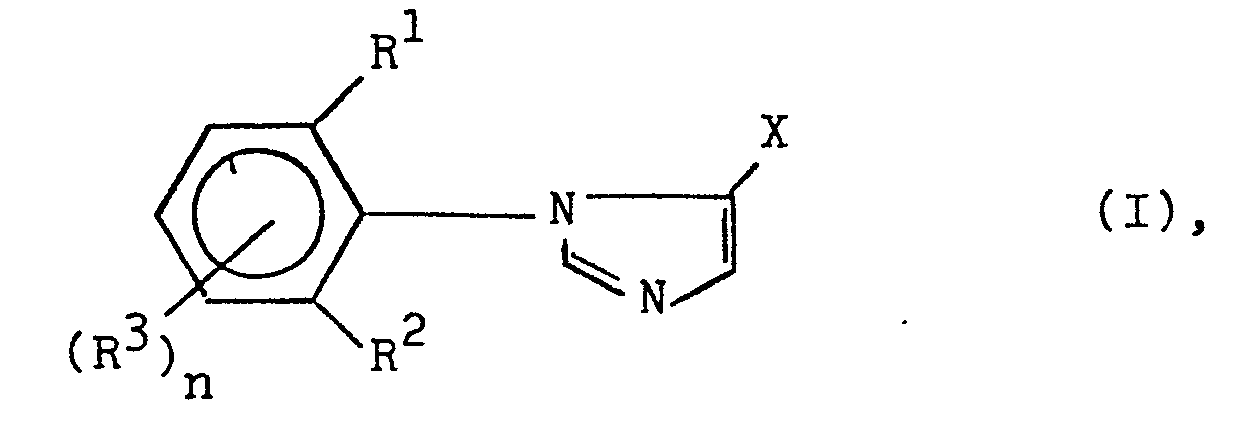
- Gegenstand der vorliegenden Erfindung sind daher die Verbindungen der Formel (I)

- 2 R , R2 unabhängig voneinander (C1-C4)Alkyl;
- R3 (C1-C4)Alkyl, (C1-C4)Alkoxy oder Halogen, wobei bei n > 1 die Substituenten auch unterschiedlich sein können;
- n 0, 1, 2 oder 3;


- Y 0, S oder N-R 6;
- Z 0 oder S;
- R4 substituiertes (C1-C12)Alkyl, vorzugsweise (C1-C6)Alkyl, das bis zu dreifach, vorzugsweise einfach substituiert ist durch Hydroxy, (C1-C4)Alkoxy-(C1-C4)alkoxy, Cyclo(C3-C7)alkyl, Benzyloxy, Benzyloxyethoxy, Phenyl, Halogenphenyl, Methylphenyl, Cyano, Carbamoyl, Oxiranyl, Mono(C1-C6)alkylamino, (C1-C4)Alkylthio, Trimethylsilyl, (C1-C4)Alkanoyl, (C1-C4)Alkoxycarbonyl, Phenoxy, Phenylthio, -0-N=C(-CH3)2, Triazolyl, Imidazolyl, Carboxyl oder Carboxylat mit einem Ammoniumoder Metallkation, vorzugsweise aus der Gruppe der Alkali- oder Erdalkalimetallkationen, oder mit einem organischen Ammonium-, Phosphonium-, Sulfonium- oder Sulfoxoniumkation; Halogen(C3-C6)alkenyl; unsubstituiertes oder durch Halogen oder (C1-C4)Alkyl substituiertes Cyclo(C3-C6)alkyl; unsubstituiertes oder durch Halogen oder Methyl substituiertes Cyclo(C5-C6)-alkenyl;(C3-C6)Alkinyl; 1,2-Epoxy-prop-3-yl; substituiertes Phenyl, welches ein- oder zweifach substituiert ist durch Halogen, Nitro, Cyano, (C1-C4)Alkyl, (C1-C4 )Alkoxycarbonyl oder (C1-C4)Alkoxy; -N=CR10R11, -NR6R12


- R5 substituiertes (C1-C12)Alkyl, vorzugsweise (C1-C6)Alkyl, das bis zu zweifach, vorzugsweise einfach substituiert Ist durch (C1-C4)Alkoxy- ethoxy, Cyclo(C3-C6)alkyl, Benzyloxy, Phenyl, (C 1-C4)Alkylthio, (C1-C4)Alkoxycarbonyl, Phen- oxy, Carboxyl oder Carboxylat mit einem Ammonium- oder Metallkation, vorzugsweise aus der Gruppe der Alkali- oder Erdalkalimetallkationen, oder mit einem organischen Ammonium-, Phosphonium-, Sulfonium- oder Sulfoxoniumkation; oder Cyclo(C3-C6)alkyl;
- R 6 H oder (C1-C4)Alkyl;
- R7 substituiertes (C1-C12)Alkyl, vorzugsweise (C1-C6)Alkyl, das bis zu zweifach, vorzugsweise einfach substituiert ist durch (C1-C4)Alkoxy- ethoxy, Hydroxyl, Cyclo(C3-C6)alkyl, Benzyloxy, Phenyl, Cyano, Carbamoyl, Carboxyl, (C1-C4)Alkoxycarbonyl, Formyl oder Phenoxy; Cyclo(C3-C6)alkyl; bis zu zweifach durch Halogen, Nitro, Cyano, (C1-C4)Alkyl oder (C1-C4)-Alkoxy subsituiertes Phenyl; -NR 6 R 13, -OR14, -NH-CO-NH2, -NH-CS-NH2 oder -SO2R15; oder R 6 und R7 bilden - gemeinsam mit dem Stickstoffatom an das sie gebunden sind - einen gesättigten oder ungesättigten, gegebenenfalls benzokondensierten drei- bis siebengliedrigen Ring, der bis zu drei Heteroatome aus der Gruppe O,N und S enthält und der unsubstituiert oder durch (C1-C4)Alkyl oder Halogen aubstituiert ist und eine Oxogruppe enthalten kann;
- R 8 unabhängig voneinander H, Halogen, (C1-C4)-Alkyl, Nitro oder Cyano;
- R9 H, (C1-C6)Alkyl oder Phenyl, oder bei Thiocarboxylaten ein Alkali- oder Erdalkalimetallkation, Ammonium- oder organisches Ammoniumkation;
- R10, R 11 unabhängig voneinander H, unsubstituiertes oder durch Triazolyl oder Imidazolyl substituiertes (C1-C6)Alkyl; Cyclo(C3-C6)-alkyl, (C3-C6)Alkenyl, Phenyl oder Benzyl; oder sie bilden gemeinsam mit dem Kohlenstoffatom, an das sie gebunden sind, ein unsubstituierte oder durch Methyl oder Halogen substituiertes Cyclo(C5-C7)alkyl;
- R 12 (C1-C4)Alkyl, Phenyl, (C1-C6)Alkylcarbonyl, Benzyl, Benzoyl, Halogenbenzyl, Halogenbenzoyl oder Methylbenzoyl;
- R 13 H, (C1-C4)Alkyl, Formyl, (C1-C6)Alkylcarbonyl, Benzoyl, Halogenbenzoyl, Methylbenzoyl oder Trihalogenacetyl;
- R14 H, (C1-C4)Alkyl oder Benzyl;
- R 15 (C1-C4)Alkyl, Phenyl, Chlorphenyl oder Methylphenyl,
- R 16 H, unsubstituiertes oder durch Phenyl oder (C1-C4)-Alkylphenyl substituiertes (C1-C12)-alkyl; (C1-C6)Alkylcarbonyl, Halogen(C1-C6)-alkylcarbonyl, N-(C1-C6)Alkylcarbamoyl, Benzoyl, Halogenbenzoyl oder Methylbenzoyl;
- R 17 0 (einschließlich der Bisulfidaddukte) oder =N-O-R16; und
- R18 unabhängig voneinander unsubstituiertes oder durch Phenyl, Cyclo(C5-C7)alkyl, (C1-C4)Alkoxy, (C1-C4)Alkylthio oder Halogen substituiertes (C1-C6)Alkyl; oder beide Reste R18 bilden, gemeinsam mit Z und dem Kohlenstoffatom an das sie gebunden sind, einen unsubstituierten oder durch (CI-C4)Alkyl, Hydroxy-(C1-C4)alkyl, Halogen-(C1-C4)alkyl oder Phenyl substituierten 5- oder 6-gliedrigen Ring
- Dabei können die bei der Definition der allgemeinen Formel (I) vorkommenden Alkyl-, Alkenyl- und Alkinylreste sowohl geradkettig als auch verzweigt sein; unter Halogen ist F, Cl, Br oder J, insbesondere F, Cl oder Br zu verstehen.
- Die Salzbildung oder Quaternisierung erfolgt am basischen Imidazolring der Verbindungen der Formel I. Diese Derivatisierung ist jedoch, im Falle R4, R5 oder R9 = ein Kation bedeutet, nicht möglich. Für den Fall, daß in den aufgeführten Substituenten - zusätzlich zum Imidazolring - weitere basische Stickstoffatome auftreten, ist auch eine mehrfache Salzbildung oder Quaternisierung möglich.
- Bevorzugt unter den Verbindungen der Formel I sind solche, bei denen
- R 1, R 2 unabhängig voneinander (C1-C3)Alkyl,
- R 3 Methyl oder Halogen, n 0 oder 1,

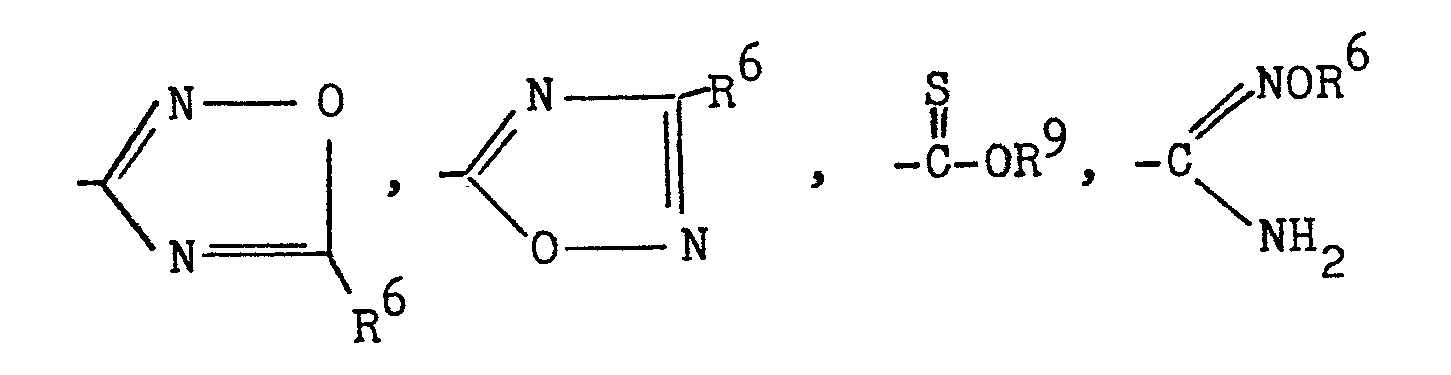

- R4 (C1-C6)Alkyl, das einfach durch Hydroxy substituiert ist, (C1-C4)Alkylthio, Cyclo(C3-C6)alkyl, C -Alkinyl, einen Rest der Formeln -N=CR10CR11 3 oder
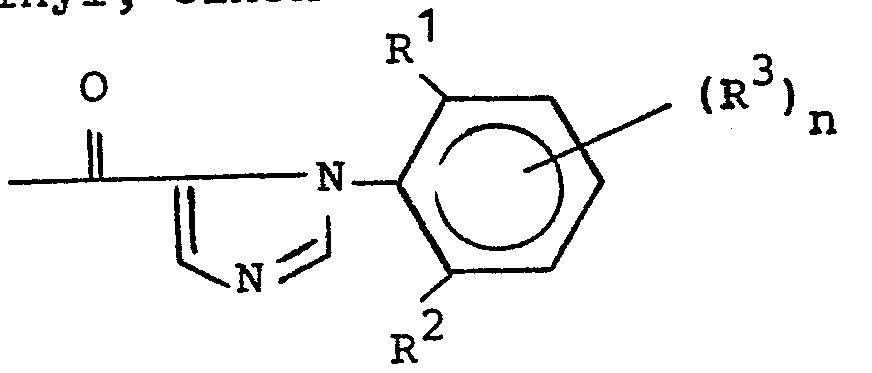
- R 6 H oder Methyl,
- R7 (C1-C6)-Alkyl, das einfach durch Hydroxy, Cyano, Carboxy, (C1-C4)Alkoxycarbonyl substituiert ist, einen Rest der Formeln -NR6R13,-OR14 oder -SO2R15; oder
- R6 und R7 bilden gemeinsam mit dem Stickstoffatom, an das sie gebunden sind, einen heterocyclischen Ring der Formeln

- R 9 (C1-C6)-Alkyl,
- R10, R 11 Methyl,
- R13, R 14 H,
- R 15 Chlorphenyl und
- R 17 0 (einschließlich der Bisulfidaddukte) bedeuten, sowie deren Salze und Quaternisierungsprodukte .
- Gegenstand der Erfindung sind außerdem Verfahren zur Herstellung der Verbindungen der allgemeinen Formel (I):
- Die Cyanoverbindung (X =-CN) erhält man, indem man das an sich bekannte Carbonsäureamid (X =-CONH2, siehe DE-A 32 17 094) dehydratisiert. Als Mittel hierzu kommen beispielsweise Phosphorpentachlorid, Phosphoroxychlorid, Thionylchlorid, Phosphorpentoxid und Acetanhydrid infrage. Die Reaktionstemperatur hängt stark von der Wahl des Dehydratisierungsmittels ab und liegt im allgemeinen zwischen 20 und 120°C. Gegebenenfalls können auch inerte organische Lösemittel zugesetzt werden.
- Die Ester, Thiolester oder Amidderivate (X=-COOR 4, -COSR 5, -CONR 6R1) lassen sich aus den Carbonsäuren (siehe DE-A 32 17 094) oder den daraus erhältlichen aktivierten Verbindungen wie Säurehalogeniden oder gemischte Kohlensäureanhydriden durch Umsetzung mit den entsprechenden Alkoholen, Thiolen oder Aminverbindungen herstellen. Ester und Thiolester lassen sich daneben auch durch Alkylierung der Carbonsäuren mit Halogenalkylverbindungen in Gegenwart von Basen erhalten.
- Die Tetrazole sind durch Umsetzung der Nitrile (X=-CN) mit Aziden in organischen Lösemitteln wie DMF oder DMSO bei Temperaturen von 20°C bis 150°C erhältlich. Die anderen heterocyclischen Verbindungen der Formel (I) mit X = Die Tetrazole sind durch Umsetzung der Nitrile (X=-CN) mit Aziden in organischen Lösemitteln wie DMF oder DMSO bei Temperaturen von 20°C bis 150°C erhältlich. Die anderen heterocyclischen Verbindungen der Formel (I) mit X =


- Die Thioester (X=-CSOR9, -CSSR9) lassen sich aus den entsprechenden Sauerstoffverbindungen (Ester) durch Umsetzung mit Phosphorpentasulfid, vorteilhaft in Gegenwart von Basen, in organischen Lösemitteln wie Dimethylformamid, Acetonitril, Toluol oder Xylol erhalten.
- Die Amidoxime

- Die Alkohole (X = -CH2-O-R16 mit R16 = H) lassen sich durch Reduktion aus den bekannten Säuren und Estern (siehe DE-A 32 17 094) herstellen. Als vorteilhaft erwies sich zum Beispiel die Reduktion der Niederalkylester mit komplexen Hydriden wie Lithiumaluminiumhydrid in Tetrahydrofuran oder Diethylether. Die Hydroxylgruppe läßt sich dann nach üblichen Verfahren wie Alkylierung, Acylierung oder Carbamoylierung in die anderen Verbindungen mit X = -CH2-OR16 und R 16 * H überführen.
- Die Aldehydderivate


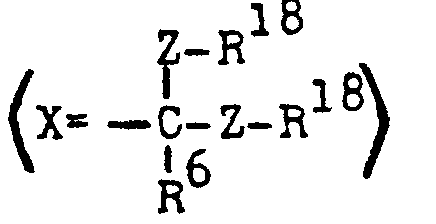
- Umsetzung mit Hydroxylaminhydrochlorid in Gegenwart von . anorganischen oder organischen Basen und gegebenenfalls anschließender Alkylierung, Acylierung oder Carbamoylierung, oder Umsetzung mit Alkoholen oder Thiolen unter Wasserabspaltung möglich.
- Erfindungsgemäß verwendbare Verbindungen sind - wie bereits vorstehend definiert - auch die Salze der Verbindungen der Formel (I) und die Quaternisierungsprodukte der Verbindungen der Formel (I).
- Zur Herstellung der Salze der Verbindungen der Formel (I) kommen folgende Säuren in Frage: Halogenwasserstoffsäuren wie Chlorwasserstoffsäure oder Bromwasserstoffsäure, ferner Phosphorsäure, Salpetersäure, Schwefelsäure, mono- und bifunktionelle Carbonsäuren und Hydroxycarbonsäuren wie Essigsäure, Maleinsäure, Bernsteinsäure, Fumarsäure, Weinsäure, Citronensäure, Salicylsäure, Sorbinsäure oder Milchsäure, sowie Sulfonsäuren wie p-Toluolsulfonsäure oder 1,5-Naphthalindisulfonsäure. Die Säureadditionssalze der Verbindungen der Formel (I) können in einfacher Weise nach üblichen Salzbildungsmethoden, z.B. durch Lösen einer Verbindung der Formel (I) in einem geeigneten organischen Lösemittel und Hinzufügen der Säure erhalten werden und in bekannter Weise, z.B. durch Abfiltrieren, isoliert und gegebenenfalls durch Waschen mit einem inerten organischen Lösemittel gereinigt werden.
- Zur Herstellung von Quaternisierungsprodukten verwendet man Alkyl-, Alkylthioalkyl-, Alkoxyalkyl-, insbesondere (CI-C6)Alkyl- und gegebenenfalls im Phenylrest substituierte, insbesondere halogenierte Phenacylhalogenide. Die Herstellung dieser Derivate erfolgt nach den allgemein üblichen Methoden.
- Mit den erfindungsgemäßen Verbindungen sind typische wachs- tu.msregulierende Effekte erzielbar, die - verglichen mit den aus der DE-A 32 17 094 bekannten Verbindungen - in einigen Fällen bereits bei niedrigeren Dosierungen einsetzen können. Sie greifen regulierend in den pflanzeneigenen Stoffwechsel ein und können damit zur gezielten Beeinflussung von Pflanzeninhaltsstoffen sowie zur Ernteerleichterung wie zum Auslösen von Desikkation und Wuchsstauchung eingesetzt werden. Des weiteren eignen sie sich auch zur generellen Steuerung und Hemmung von unerwünschtem vegetativen Wachstum, ohne dabei die Pflanzen abzutöten. Eine Hemmung des vegetativen Wachstums spielt bei vielen mono- und dikotylen Kulturen eine große Rolle, da das Lagern hierdurch verringert oder völlig verhindert werden kann. Besonders hervorzuheben ist die wachstumsregulatorische Wirksamkeit der Verbindungen als Wuchshemmer in Getreide, Mais, Soja, Tabak, Baumwolle, Ackerbohne, Raps, Reis, Rasen sowie ihre Fähigkeiten, den Gehalt an erwünschten Inhaltsstoffen wie Kohlehydraten (z.B. in Zuckerrohroder Hirsekulturen) und Protein bei Nutzpflanzen zu erhöhen. Schließlich zeigen die Verbindungen eine sehr gute Verbesserung der Fruchtabszission, insbesondere bei Zitrusfrüchten.
- Eine weitere Lösung der gestellten Aufgabe sind auch das Pflanzenwachstum regulierende Mittel, die sich durch einen wirksamen Gehalt mindestens einer der erfindungsgemäßen Verbindungen auszeichnen. Die Aufwandmenge der erfindungsgemäßen Verbindungen beträgt im allgemeinen 0,02 bis 2,5 kg Wirksubstanz pro ha, vorzugsweise 0,05 bis 1,5 kg/ha. Die erfindungsgemäßen Verbindungen lassen sich bei ihrem praktischen Einsatz gegebenenfalls auch vorteilhaft mit bekannten Wachstumsregulatoren oder natürlichen oder pflanzlichen Hormonen kombinieren.
- Die erfindungsgemäßen Verbindungen können, gegebenenfalls im Gemisch mit weiteren Wirkkomponenten, als Spritzpulver, emulgierbare Konzentrate, versprühbare Lösungen, Stäubemittel, Beizmittel, Dispersionen, Granulate oder Mikrogranulate in den üblichen Zubereitungen angewendet werden.
- Spritzpulver sind in Wasser gleichmäßig dispergierbare Präparate, die neben dem (den) Wirkstoff(en) außer gegebenenfalls einem Verdünnungs- oder Inertstoff noch Netzmittel wie polyoxethylierte Fettalkohole, Alkyl- oder Alkylphenylsulfonate und/oder Dispergierhilfsmittel wie ligninsulfonsaures Natrium, 2,2'-dinaphthylmethan-6,6'-disulfonsaures Natrium, dibutylnapthalinsulfonsaures Natrium oder auch oleoylmethyltaurinsaures Natrium enthalten. Die Herstellung erfolgt in üblicher Weise, z.B. durch Mahlen und Vermischen der Komponenten.
- Emulgierbare Konzentrate können z.B. durch Auflösen des (der) Wirkstoffe(s) in einem inerten organischen Lösemittel wie Butanol, Cyclohexanon, Dimethylformamid, Xylol oder auch höhersiedenden Aromaten oder aliphatischen oder cycloaliphatischen Kohlenwasserstoffen unter Zusatz von einem oder mehreren Emulgatoren hergestellt werden. Bei flüssigen Wirkstoffen kann der Lösemittelanteil auch ganz oder teilweise entfallen. Als Emulgatoren können beispielsweise verwendet werden: Alkyl-arylsulfonsaure Calciumsalze wie Cadodecylbenzolsulfonat oder nichtionische Emulgatoren wie Fettsäurepolyglykolester, Alkylarylpolyglykolether, Fettalkoholpolyglykolether, Propylenogid-Ethylenoxid-Kondensationsprodukte, Fettalkohol-Propylenoxid-Kondensationsprodukte, Alkylpolyglykolether, Sorbitanfettsäureester, Polyoxethylensorbitanfettsäureester oder Polyoxethylensorbitester.
- Stäubemittel kann man durch Vermahlen des (der) Wirkstoffe(s) mit feinverteilten, festen Stoffen, z.B. Talkum, natürlichen Tonen wie Kaolin, Bentonit, Pyrophillit oder Diatomeenerde erhalten. Granulate können entweder durch Verdüsen des (der) Wirkstoffe(s) auf adsorptionsfähiges, granuliertes Inertmaterial hergestellt werden oder durch Aufbringen von Wirkstoffkonzentrationen mittels Bindemitteln, z.B. Polyvinylalkohol, polyacrylsaurem Natrium oder auch Mineralölen auf die Oberfläche von Trägerstoffen wie Sand, Kaolinite oder von granuliertem Inertmaterial. Auch können geeignete Wirkstoffe in der für die Herstellung von Düngemittelgranulaten üblichen Weise - gewünschtenfalls in Mischung mit Düngemitteln - granuliert werden.
- In Spritzpulvern beträgt die Wirkstoffkonzentration etwa 10 bis 90 Gew.-%, der Rest zu 100 Gew.-% besteht aus üblichen Formulierungsbestandteilen. Bei emulgierbaren Konzentraten kann die Wirkstoffkonzentration etwa 10 bis 80 Gew.-% betragen. Staubförmige Formulierungen enthalten meistens 5 bis 20 Gew.-% an Wirkstoff(en), versprühbare Lösungen etwa 2 bis 20 Gew.-%. Bei Granulaten hängt der Wirkstoffgehalt zum Teil davon ab, ob die wirksame Verbindung flüssig oder fest vorliegt und welche Granulierhilfsmittel, Füllstoffe usw. verwendet werden. Daneben enthalten die genannten Wirkstofformulierungen gegebenenfalls die jeweils üblichen Haft-, Netz-, Dispergier-, Emulgier-, Penetrations-, Lösemittel, Füll- oder Trägerstoffe.
- Zur Anwendung werden die in handelsüblicher Form vorliegenden Konzentrate gegebenenfalls in üblicher Weise verdünnt, z.B. bei Spritzpulvern, emulgierbaren Konzentraten, Dispersionen und teilweise auch bei Mikrogranulaten mittels Wasser. Staubförmige und granulierte Zubereitungen sowie versprühbare Lösungen werden vor der Anwendung üblicherweise nicht mehr mit weiteren inerten Stoffen verdünnt.
- Auch Mischungen oder Mischformulierungen mit anderen Wirkstoffen wie Insektiziden, Akariziden, Herbiziden, Düngemitteln oder Fungiziden sind gegebenenfalls möglich.
- In den nachfolgenden Beispielen verhalten sich Gew.-Teile (GT) zu Vol.-Teilen (VT) wie kg zu dm3 (1) und %-Angaben beziehen sich - falls nichts anderes angegeben ist - auf das Gewicht.
- Ein Stäubemittel wird erhalten, indem man a) 10 GT Wirkstoff(e) und 90 GT Talkum oder einem anderen Inertstoff mischt und in einer Schlagmühle zerkleinert, oder indem man b) 60 GT Wirkstoff, 35 GT Talkum und 5 GT Haftmittel (z.B. ein Polysaccharid wie (R)Rhodopol der Rhone-Poulenc S.A.) in der gleichen Weise homogenisiert.
- Ein in Wasser leicht dispergierbares, benetzbares Pulver wird erhalten, indem man 25 GT Wirkstoff(e), 64 GT kaolinhaltigen Quarz als Inertstoff, 10 GT ligninsulfonsaures Kalium und 1 GT oleoylmethyltaurinsaures Natrium als Netz-und Dispergierhilfsmittel mischt und in einer Stiftmühle mahlt. Eine Formulierung mit 5 % Wirkstoffgehalt kann wie folgt zusammengesetzt sein: 5 % Wirkstoff(e), 6 % eines sulfonierten Napthalinformaldehydkondensats (z.B. (R)Dis- persogen A der HOECHST AG), 2 % eines Na-Salzes einer Alkylnapthalinsulfonsäure (z.B.(R)Leonil DB der HOECHST AG), 5 % eines Gemisches aus Polypropylenglykol und Si02 (z.B. (R)Acrotin 341 der HOECHST AG), 25 % eines SiO2 (z.B. (R)Sipernat der Degussa AG) und 57 % Kaolin Typ 1777.
- Ein in Wasser leicht dispergierbares Dispersionskonzentrat wird erhalten indem man 20 GT Wirkstoff(e) mit 6 GT eines Alkylphenolpolyglykolethers (z.B. (R)Triton X 207 von Rohm and Haas Co.), 3 GT Isotridecanolpolyglykolether 18 Ethylenoxid-Einheiten) und 71 GT paraffinischem Mineralöl (Siedebereich ca. 255 bis über 377°C) mischt und in einer Reibkugelmühle auf eine Feinheit von unter 5 um vermahlt.
- Ein emulgierbares Konzentrat wird erhalten aus 15 GT Wirkstoff(e), 75 GT Cyclohexanon als Lösemittel und 10 GT oxethyliertem Nonylphenol (10 Ethylenoxid-Einheiten) als Emulgator.
- 36,3 GT (0,15 mol) 1-(2,6-Diethylphenyl)-imidazol-5-carb- oxamid werden bei Raumtemperatur portionsweise zu 110 VT Phosphoroxychlorid gegeben. Nach 2 Stunden bei 80°C wird im Vakuum eingedampft, der Rückstand auf Eis gegeben, mit Natronlauge neutralisiert, und zweimal mit Toluol extrahiert. Nach dem Trocknen über Natriumsulfat wird die organische Phase eingedampft und im Vakuum destilliert. Man erhält 27,2 GT (81 % d. Theorie) an 5-Cyano-l-(2,6-diethylphenyl)-imidazol vom Siedepunkt (Kp) 133-5°C/0,01 mbar.
- Zu 6,0 GT (0,020 mol) 1-(2,6-Diethylphenyl)-imidazol-5-carbonylchlorid-Hydrochlorid (hergestellt aus 1-(2,6-Diethylphenyl)-imidazol-5-carbonsäure und Thionylchlorid bei 80°C) und 3,7 GT (0,0023 mol) N-Hydroxy-phthalimid in 50 VT absolutem Acetonitril gibt man 4,1 GT (0,029 mol) K2CO3 portionsweise zu. Man erhitzt 1 h auf 60°C, läßt abkühlen, gießt auf Wasser und saugt ab. Man erhält 6,9 GT (88 % d. Theorie) an Phthalimido-l-(2,6-diethylphenyl)-imidazol-5-carboxylat, einem farblosen Feststoff vom Schmelzpunkt (Fp) 179-80°C.
- Zu 25,0 GT (0,083 mol) 1-(2,6-Diethylphenyl)-imidazol-5-carbonylchlorid-Hydrochlorid (siehe Beispiel 2) in 50 VT Acetonitril tropft man bei Raumtemperatur ein Gemisch aus 5,5 GT (0,091 mol) Aminoethanol und 18,4 GT (0,18 mol) Triethylamin zu. Nach 1 h wird auf Wasser/Toluol gegeben, die organische Phase über Natriumsulfat getrocknet und eingedampft. Man erhält 16,1 GT (67,5 % d. Theorie) an N-(2-Hydroxyethyl)-1-(2,6-diethylphenyl)-imidazol-5-carb- oxamid, einem Feststoff vom Fp. 165-8°C.
- 20,0 GT (0,082 mol) 1-(2,6-Diethylphenyl)-imidazol-5-carbonsäure, 7,9 GT (0,082 mol) Chlordimethylsulfid und 14,7 GT (0,11 mol) Kaliumcarbonat werden in 100 VT absolutem Acetonitril 1 h unter Rückfluß erhitzt. Man läßt erkalten, gießt in 200 VT Wasser und extrahiert das Produkt zweimal mit je 100 VT Toluol. Nach dem Trocknen und Eindampfen erhält man 20,1 GT (80,1 % d. Theorie) an Methylthiomethyl-1-(2,6-diethylphenyl)-imidazol-5-carboxylat, einem hellgelben Öl. Die Identifizierung erfolgt 1H-NMR-spektroskopisch.
- 1-(2,6-Diethylphenyl)-5-(5-tetrazolyl)-imidazol
- 10,0 GT (0,044 mol) 5-Cyano-l-(2,6-diethylphenyl)-imidazol (siehe Beispiel 1), 2,4 GT (0,44 mol) Ammoniumchlorid und 2,9 GT (0,044 mol) Natriumazid werden 24 h bei 100°C in 50 VT absolutem Dimethylformamid gerührt. Nach dem Erkalten wird auf 200 VT Wasser gegeben, mit Eisessig auf pH 5 angesäuert und der Niederschlag abgesaugt. Man erhält 5,7 GT (48 % d. Theorie) an 1-(2,6-Diethylphenyl)-5-(tetrazolyl)-imidazol, einem hellgelben Feststoff vom Fp 109-13°C.
- 1-(2,6-Diethylphenyl)-5-(4,4-dimethyl-2-oxazolin-2-yl)-imidazol
- Zu 19,5 GT (0,062 mol) N-2-(1-Hydroxy-2-methyl-propyl)-1-(2,6-diethylphenyl)-imidazol-5-carboxamid in 60 VT absolutem Methylenchlorid tropft man bei Raumtemperatur 44 GT (0,37 mol) Thionylchlorid zu. Nach 1 h wird im Vakuum eingedampft, der Rückstand in 100 GT Wasser aufgenommen, das Gemisch mit Natriumbicarbonat neutralisiert, mit Toluol extrahiert und nach dem Trocknen (Na2S04) und Eindampfen über eine Kieselgelsäule chromatografiert (Laufmittel: Petrolether/Essigsäure 7:3). Man erhält 13,3 GT (72 % d. Theorie) an 1-(2,6-Diethylphenyl)-5-(4,4-dimethyl-2-oxa- zolin-2-yl)-imidazol, einem farblosen öl. Die Identifizierung erfolgt 1H-NMR-spektroskopisch.
- 1-(2,6-Diethylphenyl)-5-(3-methyl-1,2,4-oxdiazol-5-yl)-imidazol
- Zu 5,1 GT (0,047 mol) Acetamidoxim-Hydrochlorid in 50 VT Pyridin gibt man bei 0 bis 10°C 10,0 GT (0,033-mol) 1-(2,6-Diethylphenyl)-imidazol-5-carbonylchlorid-Hydrochlorid portionsweise zu. Nach zweistündigem Rühren bei Raumtemperatur gibt man auf Wasser und saugt ab. Man erhält 6,6 GT (50 % d. Theorie) an 1-(2,6-Diethylphenyl)-5-(3-methyl-1,2,4-oxdiazol-5-yl)-imidazol vom Fp 149-53°C.
- 1-(2,6-Diethylphenyl)-imidazol-5-carboxamidoxim
- 18,6 GT (0,083 mol) 5-Cyano-1-(2,6-diethylphenyl)-imidazol werden in 50 VT Ethanol gelöst, bei Raumtemperatur wird eine Lösung von 6,9 GT (0,99 mol) Hydroxylammoniumchlorid und 6,9 GT (0,05 ml) Kaliumcarbonat in 10 VT Wasser zugetropft. Man rührt 2 h bei 80°C, läßt abkühlen, nimmt in 300 VT Toluol auf, wäscht zweimal mit Wasser, trocknet und dampft ein. Man erhält 19,7 GT (92 % d. Theorie) an 1-(2,6-Diethylphenyl)-imidazol-5-carboxamidoxim, einem leicht hellgelben Feststoff vom Fp 107-12°C.
- 1-(2,6-Diethylphenyl)-5-(5-methyl-1,2,4-oxdiazol-3-yl)-imidazol
- 15,0 GT (0,045 mol) 0-Chloracetyl-1-(2,6-diethylphenyl)-imidazol-5-carboxamidoxim werden 2 h in 50 VT Eisessig bei 100°C gerührt. Man läßt abkühlen, nimmt in 200 VT Wasser/200 VT Toluol auf, neutralisiert mit Natriumhydrogencarbonat und trennt die organische Phase ab. Nach dem Trocknen, Eindampfen und Chromatografieren (Kieselgel, Laufmittel: Petrolether/Essigester 1:1) erhält man 7,3 GT (61 % d. Theorie) an 1-(2,6-Diethylphenyl)-5-(5-methyl-1,2,4-oxdiazol-3-yl)-imidazol, einem farblosen Öl. Die Identifizierung erfolgt 1H-NMR-spektroskopisch.
- N-Methylsulfonyl-1-(2,6-diethylphenyl)-imidazol-5-carbox- amid
- Zu einem Gemisch aus 13,6 GT (0,14 mol) Methansulfonamid, 24 GT (0,24 mol) Triethylamin und 100 VT absolutem Acetonitril gibt man bei Raumtemperatur 25 GT (0,08 mol) 1-(2,6-Diethylpheny1)-imidazol-5-carbonylchlorid-Hydrochlorid portionsweise zu. Nach 2 h wird auf Wasser gegeben, auf pH 4 angesäuert und abgesaugt. Man erhält 21,1 GT (79 % d. Theorie) an N-Methylsulfonyl-1-(2,6-diethylphenyl)-imidazol-5-carboxamid, einem Feststoff vom Fp 240-2°C.
- 5-(2-Benzimidazolyl)-1-(2,6-diethylphenyl)-imidazol
- 15,0 GT (0,045 mol) N-(2-Aminophenyl)-1-(2,6-diethylphenyl)-imidazol-5-carboxamid werden mit 0,5 GT p-Toluolsulfonsäure in 100 VT Xylol am Wasserabscheider erhitzt. Man läßt abkühlen, wäscht zweimal mit Wasser, trocknet und dampft ein. Man erhält 13,7 GT (96 % d. Theorie) an 5-(2-Benzimid- azolyl)-1-(2,6-diethylphenyl)-imidazol.
- 1-(2,6-Diethylphenyl)-5-hydroxymethyl-imidazol
- Zu 7,60 GT (0,20 mol) Lithiumalanat in 150 VT absolutem Tetrahydrofuran tropft man bei Raumtemperatur 54,8 GT (0,20 mol) Ethyl-1-(2,6-diethylphenyl)-imidazol-5-carboxylat zu. Nach 1 h werden vorsichtig 7,6 GT Wasser, 7,6 GT einer 15 %igen wäßrigen NaOH-Lösung und 22,8 GT Wasser zugetropft. Nach dem Absaugen des anorganischen Salzes wird die organische Phase eingedampft und man erhält 45,5 GT (99 % d. Theorie) an 1-(2,6-Diethylphenyl)-5-hydroxymethyl-imidazol, farblosen Nadeln vom Fp 79-82°C.
- 1-(2,6-Diethylphenyl)-5-formyl-imidazol
- Zu 500 VT absolutem Methylenchlorid und 32,5 GT (0,26 mol) Oxalylchlorid tropft man bei -78°C 26,4 GT (0,33 mol) absolutes Dimethylsulfoxid in 50 VT absolutem Methylenchlorid zu. Nach 1/2 h bei -78°C wird eine Lösung von 39,0 g (0,17 mol) 1-(2,6-Diethylphenyl)-5-hydroxymethyl-imidazol in 50 VT absolutem Methylenchlorid zugetropft. Nach 2 h bei -70°C werden 85 GT (0,85 mol) Triethylamin zugetropft. Nach dem Erwärmen auf Raumtemperatur wäscht man die organische Phase zweimal mit Wasser, trocknet (Na2SO4) und dampft ein. Man erhält 38,5 GT (98 % d. Theorie) an 1-(2,6-Diethylphenyl)-5-formyl-imidazol, einem hellgelben öl. Die Identifizierung erfolgt 1H-NMR-spektroskoplsch.
- 1-(2,6-Diethylphenyl)-5-hydroximinomethyl-imidazol
- Zu 16,8 GT (0,074 mol) 1-(2,6-Diethylphenyl)-5-formyl- imidazol in 30 VT Pyridin gibt man bei Raumtemperatur 7,7 GT (0,11 mol) Hydroxylammoniumchlorid portionsweise zu. Nach 4 h wird auf 500 VT Wasser gegossen und der Feststoff abgesaugt. Man erhält 13,0 GT (73 % d. Theorie) an 1-(2,6-Diethylphenyl)-5-hydroximinomethyl-imidazol vom Fp 180-3°C.
- 5-Acetyl-1-(2,6-diethylphenyl)-imidazol
- Zu einer aus 5,9 GT (0,042 mol) Methyljodid und 1,0 GT (0,042 mol) Magnesium in 100 VT absolutem Tetrahydrofuran hergestellten Methylmagnesiumbromidlösung tropft man bei Raumtemperatur eine Lösung von 8,7 GT (0,032 mol) N,N-Dimethyl-1-(2,6-diethylphenyl)-imidazol-5-carboxamid in 50 VT absolutem Tetrahydrofuran zu. Nach 1,5 h wird auf Ammoniumchloridlösung gegossen und das Produkt zweimal mit Ether extrahiert. Nach dem Trocknen (Na2S04) wird eingedampft. Man erhält 7,1 GT (91 % d. Theorie) an 5-Acetyl-1-(2,6-diethylphenyl)-imidazol, einem farblosen Öl. Die Identifizierung erfolgt H-NMR-spektroskopisch.
- Weitere Beispiele sind in Tabelle 1 aufgeführt.


- In Schalenversuchen im Gewächshaus werden junge Getreidepflanzen (Weizen, Gerste, Roggen) im 3-Blattstadium mit erfindungsgemäßen Verbindungen in verschiedenen Wirkstoffkonzentrationen (kg/ha) tropfnaß gespritzt.
- Nachdem die unbehandelten Kontrollpflanzen eine Wuchshöhe von etwa 55 cm erreicht haben, wird bei allen Plfanzen der Zuwachs gemessen und die Wuchshemmung in % des Zuwachses der Kontrollpflanzen berechnet. Es wird außerdem die phytotoxische Wirkung der Verbindung beobachtet. Die Wuchshemmung wird als prozentualer Wert ermittelt, wobei 100% den Stillstand des Wachstums und 0% ein Wachstum entsprechend den unbehandelten Kontrollpflanzen bedeuten. Es zeigt sich, daß die Verbindungen sehr gute wachstumsregulierende Eigenschaften besitzen, siehe Tabelle I.


- Reispflanzen werden in Kleinparzellen (2 m x 2 m) angezogen und im Stadium der maximalen Bestockung mit erfindungsgemäßen Verbindungen behandelt. Die Substanzen werden sowohl durch Spritzung appliziert als auch in das Wasser gegeben.
- Die Wuchshemmung wird als prozentualer Wert ermittelt, wobei 100% den Stillstand des Wachstums und 0% ein Wachstum entsprechend dem der unbehandelten Kontrollpflanzen bedeuten. Es zeigt sich die sehr gute Wuchshemmung der Verbindungen, siehe Tabelle II.


- Etwa 10 cm große Sojabohnen werden mit den Wirkstoffzubereitungen tropfnaß bespritzt. Nach 3 Wochen wird bonitiert.
- Die Wuchshemmung wird als prozentualer Wert ermittelt, wobei 100% den Stillstand des Wachstums und 0% ein Wachstum entsprechend dem der unbehandelten Kontrollpflanzen bedeuten. Es zeigt sich, daß die Verbindungen sehr gute wachstumsregulierende Eigenschaften besitzen, siehe Tabelle III.


bedeuten sowie deren für die Landwirtschaft einsetzbaren Salze oder Quaternisierungsprodukte.
Claims (10)


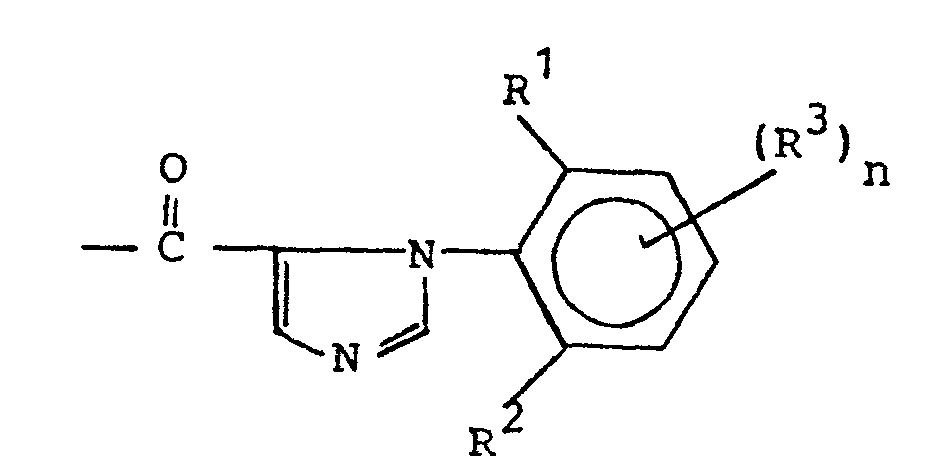
bedeuten sowie deren für die Landwirtschaft einsetzbaren Salze oder Quaternisierungsprodukte.


Applications Claiming Priority (2)
| Application Number | Priority Date | Filing Date | Title |
|---|---|---|---|
| DE3444918 | 1984-12-08 | ||
| DE19843444918 DE3444918A1 (de) | 1984-12-08 | 1984-12-08 | 1-phenyl-imidazol-5-carbonsaeure-derivate, ein verfahren zu ihrer herstellung und ihre verwendung als wachstumsregulatoren |
Publications (2)
| Publication Number | Publication Date |
|---|---|
| EP0185961A2 true EP0185961A2 (de) | 1986-07-02 |
| EP0185961A3 EP0185961A3 (de) | 1987-03-25 |
Family
ID=6252321
Family Applications (1)
| Application Number | Title | Priority Date | Filing Date |
|---|---|---|---|
| EP85115155A Withdrawn EP0185961A3 (de) | 1984-12-08 | 1985-11-29 | 1-Phenyl-imidazol-5-carbonsäure-Derivate, ein Verfahren zu ihrer Herstellung und ihre Verwendung als Wachstumsregulatoren |
Country Status (12)
| Country | Link |
|---|---|
| EP (1) | EP0185961A3 (de) |
| JP (1) | JPS61151175A (de) |
| AU (1) | AU5088485A (de) |
| BR (1) | BR8506130A (de) |
| DD (1) | DD239515A5 (de) |
| DE (1) | DE3444918A1 (de) |
| DK (1) | DK566885A (de) |
| ES (1) | ES8700241A1 (de) |
| HU (1) | HUT39960A (de) |
| PH (1) | PH21354A (de) |
| SU (1) | SU1452456A3 (de) |
| ZA (1) | ZA859364B (de) |
Cited By (6)
| Publication number | Priority date | Publication date | Assignee | Title |
|---|---|---|---|---|
| EP0243615A3 (en) * | 1986-03-12 | 1988-02-24 | Hoechst Aktiengesellschaft | 1-phenylimidazole-carbon acid amides, process for their preparation and their use as growth regulators |
| WO1988001268A1 (fr) * | 1986-08-11 | 1988-02-25 | Schering Aktiengesellschaft Berlin Und Bergkamen | Derives d'imidazole |
| EP0264577A1 (de) * | 1986-08-27 | 1988-04-27 | Hoechst Aktiengesellschaft | 2,3,6-Substituierte Phenylimidazolderivate, Verfahren zu ihrer Herstellung und ihre Verwendung als Wachstumsregulatoren |
| EP0319057A1 (de) * | 1987-11-06 | 1989-06-07 | Shell Internationale Researchmaatschappij B.V. | Imidazol-Derivate |
| EP0323799A1 (de) * | 1987-12-14 | 1989-07-12 | Schering Aktiengesellschaft | Imidazolderivate II |
| EP0494819A1 (de) * | 1991-01-09 | 1992-07-15 | Roussel Uclaf | Phenylimidazolidine, Verfahren zu deren Herstellung, deren Anwendung als Arzneimittel und diese enthaltende pharmazeutische Zusammenstellungen |
Families Citing this family (4)
| Publication number | Priority date | Publication date | Assignee | Title |
|---|---|---|---|---|
| DE3515094A1 (de) * | 1985-04-26 | 1986-10-30 | Hoechst Ag, 6230 Frankfurt | Verfahren zur herstellung von n-(2,6-dialkylphenyl)-n-formyl-glycinderivaten |
| DE3808896A1 (de) * | 1988-03-17 | 1989-09-28 | Hoechst Ag | Pflanzenschuetzende mittel auf basis von pyrazolcarbonsaeurederivaten |
| DE4017338A1 (de) * | 1990-05-30 | 1991-12-05 | Bayer Ag | Sulfonylierte carbonsaeureamide |
| CN101918389A (zh) * | 2007-11-02 | 2010-12-15 | 梅特希尔基因公司 | 组蛋白脱乙酰酶抑制剂 |
Family Cites Families (1)
| Publication number | Priority date | Publication date | Assignee | Title |
|---|---|---|---|---|
| DE3217094A1 (de) * | 1982-05-07 | 1983-11-10 | Hoechst Ag, 6230 Frankfurt | 1-substituierte imidazol-5-carbonsaeurederivate, ihre herstellung sowie ihre verwendung als biozide |
-
1984
- 1984-12-08 DE DE19843444918 patent/DE3444918A1/de not_active Withdrawn
-
1985
- 1985-11-29 EP EP85115155A patent/EP0185961A3/de not_active Withdrawn
- 1985-12-05 HU HU854660A patent/HUT39960A/hu unknown
- 1985-12-06 AU AU50884/85A patent/AU5088485A/en not_active Abandoned
- 1985-12-06 SU SU853990698A patent/SU1452456A3/ru active
- 1985-12-06 DK DK566885A patent/DK566885A/da not_active Application Discontinuation
- 1985-12-06 JP JP60273550A patent/JPS61151175A/ja active Pending
- 1985-12-06 ES ES549677A patent/ES8700241A1/es not_active Expired
- 1985-12-06 ZA ZA859364A patent/ZA859364B/xx unknown
- 1985-12-06 PH PH33137A patent/PH21354A/en unknown
- 1985-12-06 DD DD85283867A patent/DD239515A5/de unknown
- 1985-12-06 BR BR8506130A patent/BR8506130A/pt unknown
Cited By (6)
| Publication number | Priority date | Publication date | Assignee | Title |
|---|---|---|---|---|
| EP0243615A3 (en) * | 1986-03-12 | 1988-02-24 | Hoechst Aktiengesellschaft | 1-phenylimidazole-carbon acid amides, process for their preparation and their use as growth regulators |
| WO1988001268A1 (fr) * | 1986-08-11 | 1988-02-25 | Schering Aktiengesellschaft Berlin Und Bergkamen | Derives d'imidazole |
| EP0264577A1 (de) * | 1986-08-27 | 1988-04-27 | Hoechst Aktiengesellschaft | 2,3,6-Substituierte Phenylimidazolderivate, Verfahren zu ihrer Herstellung und ihre Verwendung als Wachstumsregulatoren |
| EP0319057A1 (de) * | 1987-11-06 | 1989-06-07 | Shell Internationale Researchmaatschappij B.V. | Imidazol-Derivate |
| EP0323799A1 (de) * | 1987-12-14 | 1989-07-12 | Schering Aktiengesellschaft | Imidazolderivate II |
| EP0494819A1 (de) * | 1991-01-09 | 1992-07-15 | Roussel Uclaf | Phenylimidazolidine, Verfahren zu deren Herstellung, deren Anwendung als Arzneimittel und diese enthaltende pharmazeutische Zusammenstellungen |
Also Published As
| Publication number | Publication date |
|---|---|
| AU5088485A (en) | 1986-06-12 |
| PH21354A (en) | 1987-10-15 |
| HUT39960A (en) | 1986-11-28 |
| ES8700241A1 (es) | 1986-10-01 |
| JPS61151175A (ja) | 1986-07-09 |
| ES549677A0 (es) | 1986-10-01 |
| DD239515A5 (de) | 1986-10-01 |
| DK566885D0 (da) | 1985-12-06 |
| SU1452456A3 (ru) | 1989-01-15 |
| EP0185961A3 (de) | 1987-03-25 |
| ZA859364B (en) | 1986-08-27 |
| BR8506130A (pt) | 1986-08-26 |
| DK566885A (da) | 1986-06-09 |
| DE3444918A1 (de) | 1986-06-12 |
Similar Documents
| Publication | Publication Date | Title |
|---|---|---|
| EP0269806B1 (de) | Phenylpyrazolcarbonsäurederivate, ihre Herstellung und Verwendung als Pflanzenwachstumsregulatoren und Safener | |
| EP0007990B1 (de) | Pyrazolätherderivate, Verfahren zu ihrer Herstellung und Herbizide, die diese Verbindungen enthalten | |
| EP0360163B1 (de) | Aromatische Carbonsäurederivate und ihre Verwendung zur Bekämpfung unerwünschten Pflanzenwuchses | |
| DE3406993A1 (de) | Neue azolderivate | |
| EP0137868B1 (de) | 1-Substituierte Imidazol-5-carbonsäurederivate, ihre Herstellung sowie ihre Verwendung als Biozide | |
| EP0527378B1 (de) | Salicyl(thio)etherderivate, Verfahren und Zwischenprodukte zu ihrer Herstellung | |
| EP0011693A1 (de) | Neue N-(trifluormethansulfonylaminophenyl)-substituierte N-Heterocyclen, ihre Herstellung, sie enthaltende Mittel und ihre Verwendung zur Beeinflussung des Pflanzenwachstums | |
| DD231481A5 (de) | Herbizide und wachstumsregulierende mittel | |
| EP0185961A2 (de) | 1-Phenyl-imidazol-5-carbonsäure-Derivate, ein Verfahren zu ihrer Herstellung und ihre Verwendung als Wachstumsregulatoren | |
| EP0199206A2 (de) | Cyclohexyl- und cyclohexenylimidazolverbindungen, Verfahren zu ihrer Herstellung und ihre Verwendung als Pflanzenschutzmittel | |
| EP0372329A2 (de) | Pyridinderivate und ihre Verwendung als herbizide Wirkstoffe | |
| DE3629064A1 (de) | 2,3,6-substituierte phenylimidazolderivate, verfahren zu ihrer herstellung und ihre verwendung als wachstumgsregulatoren | |
| DE3537290A1 (de) | 1,2,5-substituierte imidazolverbindungen, verfahren zu ihrer herstellung und ihre verwendung als wachstumsregulatoren | |
| DE3614364A1 (de) | 1-phenyl-imidazolverbindungen, verfahren zu ihrer herstellung und ihre verwendung als wachstumsregulatoren | |
| EP0053699A1 (de) | 2'-Phenylhydrazino-2-cyanacrylsäureester und diese enthaltende Herbizide | |
| DE4126936A1 (de) | Salicylsaeurederivate als selektive herbizide | |
| DE1964996A1 (de) | 9-Azolyl-fluoren-9-carbonsaeure-Derivate,Verfahren zu ihrer Herstellung und ihre Verwendung zur Regulierung des Pflanzenwachstums | |
| DE3345901A1 (de) | 1-acylimidazolinone, verfahren zu ihrer herstellung und ihre verwendung in der landwirtschaft | |
| EP0007588B1 (de) | Tetrahydro-1,3-oxazine, herbizide Mittel, die Acetanilide als herbizide Wirkstoffe und diese Tetrahydro-1,3-oxazine als antagonistische Mittel enthalten, sowie ihre Verwendung zur Bekämpfung unerwünschten Pflanzenwuchses | |
| EP0007575A1 (de) | Herbizide Mittel auf der Basis von Acetaniliden und ihre Verwendung zur Bekämpfung unerwünschten Pflanzenwuchses | |
| EP0208281B1 (de) | Chinolin-8-carbonsäureazolide, ein Verfahren zu ihrer Herstellung und ihre Verwendung als Herbizide | |
| EP0029001B1 (de) | Alpha-Phenoxy-propionyl-Azole, deren Herstellung, sie enthaltende herbizide Mittel und deren Verwendung | |
| EP0182246A1 (de) | Salze von 1-Phenyl-imidazol-5-carbonsäuren, ein Verfahren zu ihrer Herstellung und ihre Verwendung als Wachstumsregulatoren | |
| EP0160931A2 (de) | Azolylvinylether | |
| DD212884A5 (de) | Pflanzenschutz- und wachstumsregulierende mittel |
Legal Events
| Date | Code | Title | Description |
|---|---|---|---|
| PUAI | Public reference made under article 153(3) epc to a published international application that has entered the european phase |
Free format text: ORIGINAL CODE: 0009012 |
|
| AK | Designated contracting states |
Kind code of ref document: A2 Designated state(s): AT BE CH DE FR GB IT LI NL SE |
|
| PUAL | Search report despatched |
Free format text: ORIGINAL CODE: 0009013 |
|
| AK | Designated contracting states |
Kind code of ref document: A3 Designated state(s): AT BE CH DE FR GB IT LI NL SE |
|
| 17P | Request for examination filed |
Effective date: 19870725 |
|
| STAA | Information on the status of an ep patent application or granted ep patent |
Free format text: STATUS: THE APPLICATION HAS BEEN WITHDRAWN |
|
| 18W | Application withdrawn |
Withdrawal date: 19880806 |
|
| RIN1 | Information on inventor provided before grant (corrected) |
Inventor name: BUERSTELL, HELMUT, DR. Inventor name: HANDTE, REINHARD, DR. Inventor name: MILDENBERGER, HILMAR, DR. Inventor name: SCHMIERER, ROLAND, DR. |