EP0186025A2 - Kosmetische Zubereitungen mit Mandel-Proteinhydrolysat - Google Patents
Kosmetische Zubereitungen mit Mandel-Proteinhydrolysat Download PDFInfo
- Publication number
- EP0186025A2 EP0186025A2 EP85115631A EP85115631A EP0186025A2 EP 0186025 A2 EP0186025 A2 EP 0186025A2 EP 85115631 A EP85115631 A EP 85115631A EP 85115631 A EP85115631 A EP 85115631A EP 0186025 A2 EP0186025 A2 EP 0186025A2
- Authority
- EP
- European Patent Office
- Prior art keywords
- skin
- almond
- hair
- almond protein
- cosmetic
- Prior art date
- Legal status (The legal status is an assumption and is not a legal conclusion. Google has not performed a legal analysis and makes no representation as to the accuracy of the status listed.)
- Granted
Links
Classifications
-
- A—HUMAN NECESSITIES
- A61—MEDICAL OR VETERINARY SCIENCE; HYGIENE
- A61Q—SPECIFIC USE OF COSMETICS OR SIMILAR TOILETRY PREPARATIONS
- A61Q19/00—Preparations for care of the skin
-
- A—HUMAN NECESSITIES
- A61—MEDICAL OR VETERINARY SCIENCE; HYGIENE
- A61K—PREPARATIONS FOR MEDICAL, DENTAL OR TOILETRY PURPOSES
- A61K8/00—Cosmetics or similar toiletry preparations
- A61K8/18—Cosmetics or similar toiletry preparations characterised by the composition
- A61K8/30—Cosmetics or similar toiletry preparations characterised by the composition containing organic compounds
- A61K8/64—Proteins; Peptides; Derivatives or degradation products thereof
- A61K8/645—Proteins of vegetable origin; Derivatives or degradation products thereof
-
- A—HUMAN NECESSITIES
- A61—MEDICAL OR VETERINARY SCIENCE; HYGIENE
- A61Q—SPECIFIC USE OF COSMETICS OR SIMILAR TOILETRY PREPARATIONS
- A61Q19/00—Preparations for care of the skin
- A61Q19/10—Washing or bathing preparations
-
- A—HUMAN NECESSITIES
- A61—MEDICAL OR VETERINARY SCIENCE; HYGIENE
- A61Q—SPECIFIC USE OF COSMETICS OR SIMILAR TOILETRY PREPARATIONS
- A61Q5/00—Preparations for care of the hair
-
- A—HUMAN NECESSITIES
- A61—MEDICAL OR VETERINARY SCIENCE; HYGIENE
- A61Q—SPECIFIC USE OF COSMETICS OR SIMILAR TOILETRY PREPARATIONS
- A61Q17/00—Barrier preparations; Preparations brought into direct contact with the skin for affording protection against external influences, e.g. sunlight, X-rays or other harmful rays, corrosive materials, bacteria or insect stings
- A61Q17/04—Topical preparations for affording protection against sunlight or other radiation; Topical sun tanning preparations
-
- A—HUMAN NECESSITIES
- A61—MEDICAL OR VETERINARY SCIENCE; HYGIENE
- A61Q—SPECIFIC USE OF COSMETICS OR SIMILAR TOILETRY PREPARATIONS
- A61Q5/00—Preparations for care of the hair
- A61Q5/02—Preparations for cleaning the hair
Definitions
- the invention relates to cosmetic preparations for the care of skin and hair with a content of Man- del -Proteinhydrolysat.
- water soluble proteins and protein breakdown products e.g. can be obtained from water-insoluble proteins by hydrolysis or aminolysis, have a cosmetically favorable influence on the outer layers of the skin and the keratin of the hair. It is therefore also known to add water-soluble proteins or oligo- and polypeptides obtained from proteins by hydrolysis to cosmetic preparations for the care of the skin and hair (see, for example, soaps, oils, fats, waxes 108, No. 7 (1982), 177- 184). Water-soluble protein hydrolyzates have a certain substantivity to the skin and hair and in this way exert a colloidal protective effect, in particular against the degreasing and swelling effect of the surfactants on the skin and hair keratin.
- the fruits of the almond tree (prumus amygdalus, amygdalus communis) are pressed to remove almond oil after removing the hard shell.
- the press cake is ground, sieved and used, among other things, as almond bran (or almond flour) in cosmetics as a skin care product.
- almond bran is not water-soluble and therefore cannot be used universally in aqueous preparations.
- Their cosmetic 'effects are also only weakly pronounced, so that it is surprising that the hydrolysates of the almond proteins have much stronger cosmetic effects.
- the present invention thus shows a new way of opening up the cosmetically active ingredients apparently contained in the almond bran for universal use in cosmetic preparations for the care of skin and hair.
- Almond protein hydrolyzate can be obtained by processes known from the literature for the hydrolysis of proteins, for example by acid hydrolysis, alkaline hydrolysis or by enzymatic cleavage of the almond flour dispersed in water. Suitable hydrolysates are preferred for carrying out the invention obtained by enzymatic degradation of almond protein using proteases.
- Almond protein is characterized by a high content of acidic and basic amino acids and consists of 40 - 50% by weight of glutamic acid, aspartic acid and arginine.
- the enzymatic hydrolysis makes it possible, using selected proteolytic enzymes, selectively or preferentially bonds between very specific amino acids! to cleave hydrolytically and in this way to obtain oligo and poly peptides which preferably have very specific end groups.
- the carboxyl groups of lysine and arginine are preferably hydrolyzed by the enzyme pepsin, the carboxyl groups of leucine, tyrosine, phenylalanine and glutamic acid.
- the enzymatic hydrolysis can also be carried out in several stages, it being possible in each stage to maintain the optimum conditions in terms of pH and concentration for the enzyme used in each case.
- almond flour can be made using proteolytic enzymes, e.g. of trypsin and / or pepsin hydrolysates of a defined degree of degradation.
- proteolytic enzymes e.g. of trypsin and / or pepsin hydrolysates of a defined degree of degradation.
- Almond protein hydrolyzates whose commitment and polypeptides have an average molecular weight of 800-4000, preferably 2000-3000.
- the enzymatic hydrolysis of the almond protein can be interrupted by shifting the pH into a range in which the enzyme used is inactivated, and the average molecular weight of the hydrolyzate can be controlled in this way.
- the solids content is expediently set to a standardized value, for example from 20 to 25% by weight, at which the solution is still liquid and preserved with known water-soluble preservatives.
- Such an almond protein hydrolyzate solution contains approximately 9.5: - 12.5% by weight of amino acids, oligo- and polypeptides as well as water-soluble by-products which do not interfere with the use in cosmetic preparations and which may still impair the cosmetic effects of the protein hydrolyzate improve and can therefore remain in the protein hydrolyzate.
- a hydrolyzate with a total solids content of 20-25% by weight is typically about 7% by weight of carbohydrates and salts which make up an ash content of 4-5% by weight.
- the total nitrogen content is approximately 1.5-2.0% by weight.
- the water-soluble almond protein hydrolyzates can be added to the various cosmetic preparations for the care of skin and hair without any problems. They are compatible with the usual constituents of such preparations, in particular with anionic, ampholytic, zwitterionic and nonionic surfactants, with fat and oil components, water-soluble polymers, fragrances, preservatives, dyes and can also be incorporated into water-in-oil or oil-in-water emulsions and creams.
- Cosmetic preparations to which almond protein hydrolyzates can be added are primarily skin cleansing agents such as Bar soaps, liquid soaps, shower bath preparations, bath additives (foam bath preparations) and skin care products such as Skin creams of the water-in-oil and oil-in-water type, liquid emulsions (skin-milk), facial tonic and hair care products such as Shampoos, hair rinsing agents, hair waving agents, hair colorants, hair bleaches and hair setting preparations.
- skin cleansing agents such as Bar soaps, liquid soaps, shower bath preparations, bath additives (foam bath preparations)
- skin care products such as Skin creams of the water-in-oil and oil-in-water type, liquid emulsions (skin-milk), facial tonic and hair care products such as Shampoos, hair rinsing agents, hair waving agents, hair colorants, hair bleaches and hair setting preparations.
- almond protein hydrolyzates in preparations for cleansing the skin or hair containing surface-active substances, in particular high-foam anionic sulfate or sulfonate surfactants, ie surfactants, by a preferably linear alkyl group with 8-18 C atoms is particularly advantageous and are characterized by an -SO 3 H group or -OSO 3 H group.
- surfactants are, for example, the sodium, potassium, ammonium, mono-, di- and triethanolammonium salts of alkyl sulfates with 12-18 C atoms in the alkyl group, of alkyl ether sulfates with 12-16 C atoms in the alkyl group and 1 - 10 glycol ether groups in the molecule, of ⁇ -olefin sulfonates and!
- Skin and hair cleansing agents preferably contain 5-25% by weight of such anionic surfactants and 0.01-5% by weight (dry substance) of the almond protein hydrolyzate.
- Bar soaps based on sodium soaps from C 12 -C 18 fatty acids or liquid soaps based on potassium soaps or alkanolammonium soaps from C 12 -C 18 fatty acids or mixtures of soaps and synthetic anionic sulfate or sulfonate surfactants of the type mentioned above can also be added by 0.01 - 5% by weight (dry substance) of almond protein hydrolyzate can be improved in its skin cosmetic properties.
- a further preferred embodiment of the invention are skin and hair care products in the form of emulsions, either of the water-in-oil type or of the oil-in-water type or of mixed emulsion types.
- emulsions contain an oil phase in which the cosmetic oil components, fat bodies, wax components, paraffin and the oil-soluble emulsifiers are contained, and an aqueous phase in which the water-soluble cosmetic active ingredients, for example the almond protein hydrolyzates to be used according to the invention, glycerol, 1,2-propylene glycol , water-soluble salts (for example buffer salts), water-soluble hydrocolloids, for example carboxymethyl cellulose, hydroxyethyl cellulose, carboxy vinyl polymers (for example Carbopol (R) types), preservatives, water-soluble emulsifiers and, if appropriate, colorants and fragrances.
- water-soluble cosmetic active ingredients for example the almond protein hydrolyzates to be used according to the invention, glycerol, 1,2-prop
- hair care emulsions preferably contain 0.01-5% by weight of almond protein hydrolyzate to improve what binding capacity of the skin and the cosmetic properties of the hair.
- composition of the amino acids (after total hydrolysis) was:
Landscapes
- Health & Medical Sciences (AREA)
- Life Sciences & Earth Sciences (AREA)
- Animal Behavior & Ethology (AREA)
- General Health & Medical Sciences (AREA)
- Public Health (AREA)
- Veterinary Medicine (AREA)
- Dermatology (AREA)
- Birds (AREA)
- Epidemiology (AREA)
- Cosmetics (AREA)
- Peptides Or Proteins (AREA)
Abstract
Description
- Gegenstand der Erfindung sind kosmetische Zubereitungen zur Pflege von Haut und Haaren mit einem Gehalt an Man- del-Proteinhydrolysat.
- Es ist bekannt, daß wasserlösliche Proteine und Proteinabbauprodukte, die z.B. durch Hydrolyse oder Aminolyse aus wasserunlöslichen Proteinen gewonnen werden können, einen kosmetisch günstigen Einfluß auf die äußeren Schichten der Haut und das Keratin des Haars haben. Es ist daher auch bekannt, wasserlösliche Proteine oder durch Hydrolyse aus Proteinen gewonnene Oligo- und Polypeptide kosmetischen Zubereitungen zur Pflege der Haut und der Haare zuzusetzen (vgl. z.B. Seifen, öle, Fette, Wachse 108, Nr. 7 (1982), 177 - 184). Wasserlösliche Proteinhydrolysate besitzen eine gewisse Substantivität zur Haut und zum Haar und üben auf diese Weise eine kolloidale Schutzwirkung, insbesondere gegenüber der entfettenden und quellenden Wirkung der Tenside auf das Haut- und Haarkeratin aus.
- Bisher wurden überwiegend Faserproteine, z.B. Keratin, Kollagen und Elastin zur technischen Herstellung wasserlöslicher Hydrolysate für kosmetische Anwendungen eingesetzt. Von den pflanzlichen Proteinen wurde bisher nur Sojaprotein für die Herstellung kosmetisch anwendbarer Hydrolysate vorgeschlagen. Die mit den bekannten Proteinhydrolysaten erzielbaren kosmetischen Effekte sind jedoch so schwach, daß auch weiterhin das Bedürfnis bestand, Proteine mit verbesserter kosmetischer Wirkung aufzufinden.
- Es wurde nun gefunden, daß die hautschützenden und haarkosmetischen Effekte in besonders hohem Maße und darüber hinaus deutliche hautfeuchthaltende Wirkungen durch kosmetische Zubereitungen zur Reinigung und Pflege von Haut und Haaren erzielt werden, die ein Mandel-Proteinhydrolysat enthalten.
- Mandeln, die Früchte des Mandelbaumes (prumus amygdalus, amygdalus communis) werden nach Entfernung der harten Schale zur Gewinnung von Mandelöl gepreßt. Der Preßkuchen wird gemahlen, gesiebt und unter anderem auch als Mandelkleie (oder Mandelmehl) in der Kosmetik als Hautpflegemittel verwendet. Mandelkleie ist jedoch nicht wasserlöslich und daher nicht universell in wäßrigen Zubereitungen einsetzbar. Ihre kosmetischen 'Wirkungen sind darüber hinaus nur schwach ausgeprägt, so daß es als überraschend anzusehen ist, daß die Hydrolysate der Mandelproteine wesentlich stärkere kosmetische Wirkungen entfalten. Durch die vorliegende Erfindung wird also ein neuer Weg aufgezeigt, die offenbar in der Mandelkleie enthaltenen kosmetisch wirksamen Inhaltsstoffe für eine universelle Anwendung in kosmetischen Zubereitungen zur Pflege von Haut und Haaren zu erschließen.
- Die Gewinnung von Mandel-Proteinhydrolysat kann nach literaturbekannten Verfahren für die Hydrolyse von Proteinen, z.B. durch saure Hydrolyse, alkalische Hydrolyse oder durch enzymatische Spaltung des in Wasser dispergierten Mandelmehls erfolgen. Bevorzugt geeignete Hydrolysate für die Ausführung der Erfindung werden durch enzymatischen Abbau von Mandelprotein unter Verwendung von Proteasen gewonnen. Mandelprotein ist durch einen hohen Gehalt an sauren und basischen Aminosäuren gekennzeichnet und besteht zu 40 - 50 Gew.-% aus Glutaminsäure, Asparaginsäure und Arginin. Die enzymatische Hydrolyse macht es möglich, unter Verwendung ausgewählter proteolytischer Enzyme selektiv oder bevorzugt Bindungen zwischen ganz bestimmten Aminosäuren ! hydrolytisch zu spalten und auf diese Weise Oligo- und Poly-Peptide zu erhalten, die bevorzugt ganz bestimmte Endgruppen aufweisen. So werden z.B. in Gegenwart des proteolytischen Enzyms Trypsin bevorzugt der Carboxylgruppen des Lysins und Arginins, durch das Enzym Pepsin bevorzugt die Carboxylgruppen des Leucins, Tyrosins, Phenylalanins und der Glutaminsäure hydrolysiert.
- Die enzymatische Hydrolyse kann auch mehrstufig durchgeführt werden, wobei in jeder Stufe die für das jeweils eingesetzte Enzym optimalen Bedingungen in bezug auf pH-Wert und Konzentration eingehalten werden können. Die Verfahren zur enzymatischen Proteinhydrolyse sind literaturbekannt. In Houben-Weyl, ''Methoden der organischen Chemie", Band XI/2, (1958), 297 - 298 ist ein Verfahren zur enzymatischen Spaltung von Casein in zwei Stufen unter Verwendung von Pankreatin bei pH = 8 und mit Erepsin (Säugetierdünndarm-Präparat) bei pH = 7,6 beschrieben.
- In analoger Weise lassen sich aus Mandelmehl unter Verwendung von proteolytischen Enzymen, z.B. von Trypsin und/oder Pepsin Hydrolysate von definiertem Abbaugrad herstellen.
- Bevorzugt geeignet zur Herstellung von erfindungsgemäßen kosmetischen Zubereitungen sind Mandel-Proteinhydrolysate, deren Obligo- und Polypeptide ein mittleres Molekulargewicht von 800 - 4000, bevorzugt von 2000 - 3000 aufweisen. Die enzymatische Hydrolyse des Mandelproteins kann durch pH-Wert-Verschiebung in einen Bereich, bei welchem das verwendete Enzym inaktiviert wird, unterbrochen und das mittlere Molekulargewicht des Hydrolysats auf diese Weise gesteuert werden. Nach Abtrennung der wäßrigen Lösung des hydrolysierten Proteins von ungelösten Rückständen durch Zentrifugation und Filtration wird der Feststoffgehalt zweckmäßigerweise auf einen standardisierten Wert, z.B. von 20 - 25 Gew.-% eingestellt, bei welchem die Lösung noch flüssig ist und mit bekannten wasserlöslichen Konservierungsmitteln konserviert. Eine solche Mandel-Proteinhydrolysat-Lösung enthält ca. 9,5 : - 12,5 Gew.-% Aminosäuren, Oligo- und Polypeptide sowie wasserlösliche Nebenprodukte, die bei der Anwendung in kosmetischen Zubereitungen nicht stören, die gegebenenfalls die kosmetischen Wirkungen des Proteinhydrolysats noch verbessern und daher in dem Proteinhydrolysat verbleiben können. Typisch ist in einem Hydrolysat mit 20 - 25 Gew.-% Gesamt-Feststoff ein Gehalt von ca. 7 Gew.-% Kohlehydraten sowie von Salzen, die einen Aschegehalt von 4 - 5 Gew.-% ausmachen. Der Gehalt an Gesamt-Stickstoff beträgt ca. 1,5 - 2,0 Gew.-%.
- Die wasserlöslichen Mandel-Proteinhydrolysate lassen sich den verschiedenen kosmetischen Zubereitungen zur Pflege von Haut und Haaren ohne Probleme zusetzen. Sie sind mit den üblichen Bestandteilen solcher Zubereitungen, insbesondere mit anionischen, ampholytischen, zwitterionischen und nichtionogenen grenzflächenaktiven Stoffen, mit Fett- und ölkomponenten, wasserlöslichen Polymeren, Duftstoffen, Konservierungsstoffen, Farbstoffen verträglich und lassen sich auch in Emulsionen und Cremes vom Typ Wasser-in-öl oder Öl-in-Wasser einarbeiten.
- Kosmetische Zubereitungen, denen Mandel-Proteinhydrolysate zugesetzt werden können, sind vor allem Hautreinigungsmittel wie z.B. Stückseifen, flüssige Seifen, Duschbadepräparate, Badezusätze (Schaumbäde-Präparate) und Hautpflegemittel wie z.B. Hautcremes vom Typ Wasser-in-Öl und vom Typ Öl-in-Wasser, flüssige Emulsionen (Haut-Milch), Gesichtswasser und Haarpflegemittel wie z.B. Haarwaschmittel (Shampoos), Haarnachspülmittel, Haarwellmittel, Haarfärbemittel, Haarbleichmittel und Haarfestigerpräparate.
- Besonders vorteilhaft ist die Anwendung der Mandel-Proteinhydrolysate in Zubereitungen zur Reinigung der Haut oder der Haare mit einem Gehalt an oberflächenaktiven Stoffen, insbesondere an schaumstarken anionaktiven Sulfat- oder Sulfonattensiden, d.h. Tensiden, die durch eine bevorzugt lineare Alkylgruppe mit 8 - 18 C-Atomen und durch eine -SO3H-Gruppe oder -OSO3H-Gruppe gekennzeichnet sind. Beispiele für solche Tenside sind z.B. die Natrium-, Kalium-, Ammonium-, Mono-, Di- und Triethanolammoniumsalze von Alkylsulfaten mit 12 - 18 C-Atomen in der Alkylgruppe, von Alkylethersulfaten mit 12 - 16 C-Atomen in der Alkylgruppe und 1 - 10 Glykolethergruppen im Molekül, von α-Olefinsulfonaten und !Hydroxyalkansulfonaten, wie sie bei der Sulfonierung von α-Olefinen mit 12 - 18 C-Atomen erhalten werden, von linearen sekundären Alkansulfonaten mit 12 - 18 C-Atomen, von α-Sulfofettsäure (C12-C18)-methylestern, von Sulfobernsteinsäuremonoalkylestern mit 12 - 18 C-Atomen in der Alkylgruppe, von Acylisethionaten und Acyltauriden mit jeweils 8 - 18 C-Atomen in der Acylgruppe. Erfindungsgemäße Haut- und Haarreinigungsmittel enthalten bevorzugt 5 - 25 Gew.-% solcher anionischer Tenside und 0,01 - 5 Gew.-% (Trockensubstanz) des Mandel-Proteinhydrolysats.
- Stückseifen auf Basis von Natriumseifen von C12-C18-Fettsäuren oder flüssige Seifen aus Basis von Kaliumseifen oder Alkanolammoniumseifen von C12-C18-Fettsäuren oder von Mischungen aus Seifen und synthetischen anionischen Sulfat- oder Sulfonattensiden der o.g. Art können ebenfalls durch Zusatz von 0,01 - 5 Gew.-% (Trockensubstanz) Mandel-Proteinhydrolysat in ihren hautkosmetischen Eigenschaften verbessert werden.
- Eine weitere bevorzugte Ausführung der Erfindung sind Haut- und Haarpflegemittel in Form von Emulsionen, entweder vom Typ Wasser-in-öl oder vom Typ öl-in-Wasser oder von gemischten Emulsionstypen. Solche Emulsionen enthalten eine ölphase, in der die kosmetischen ölkomponenten, Fettkörper, Wachskomponenten, Paraffin und die öllöslichen Emulgatoren enthalten sind, und eine wäßrige Phase, in der die wasserlöslichen kosmetischen Wirkstoffe, z.B. die erfindungsgemäß zu verwendenden Mandel-Proteinhydrolysate, Glycerin, 1.2-Propylenglykol, wasserlösliche Salze (z.B. Puffersalze), wasserlösliche Hydrocolloide, z.B. Carboxymethylcellulose, Hydroxyethylcellulose, Carboxyvinylpolymere (z.B. Carbopol(R)-Typen), Konservierungsmittel, wasserlösliche Emulgatoren und ggf. Farb- und Duftstoffe ent- 'halten sind. Solche emulsionsförmige Hautpflegemittel, z.B. Hautcremes, Hautlotionen, Gesichtsmilch und Haarpflegemittel, z.B. Haarnachspülmittel, Haaravivageemulsionen enthalten bevorzugt 0,01 - 5 Gew.-% Mandel-Proteinhydrolysat zur Verbesserung des Wasserbindevermögens der Haut und der kosmetischen Eigenschaften des Haars.
- Die nachfolgenden Beispiele sollen den Erfindungsgegenstand näher erläutern.
- In den folgenden Beispielen wurde ein durch enzymatischen Abbau von Mandel-Protein unter Verwendung von Proteasen gewonnenes Hydrolysat mit folgenden ; technischen Kenndaten eingesetzt:

- Die (nach Totalhydrolyse) ermittelte Zusammensetzung der Aminosäuren war:

-
- 1. Schaumbad

- 2. Emulsions-Shampoo mit Ampholyt

- :3. Schnellhaarkur

- 4. AfterShave-Gel


- 5. Regenerationscreme O/W

- 6. Hautcreme O/W

- 7. Hautcreme W/O


- 8. Sonnenschutzcreme O/W

- 9. Feuchtigkeitsemulsion O/W
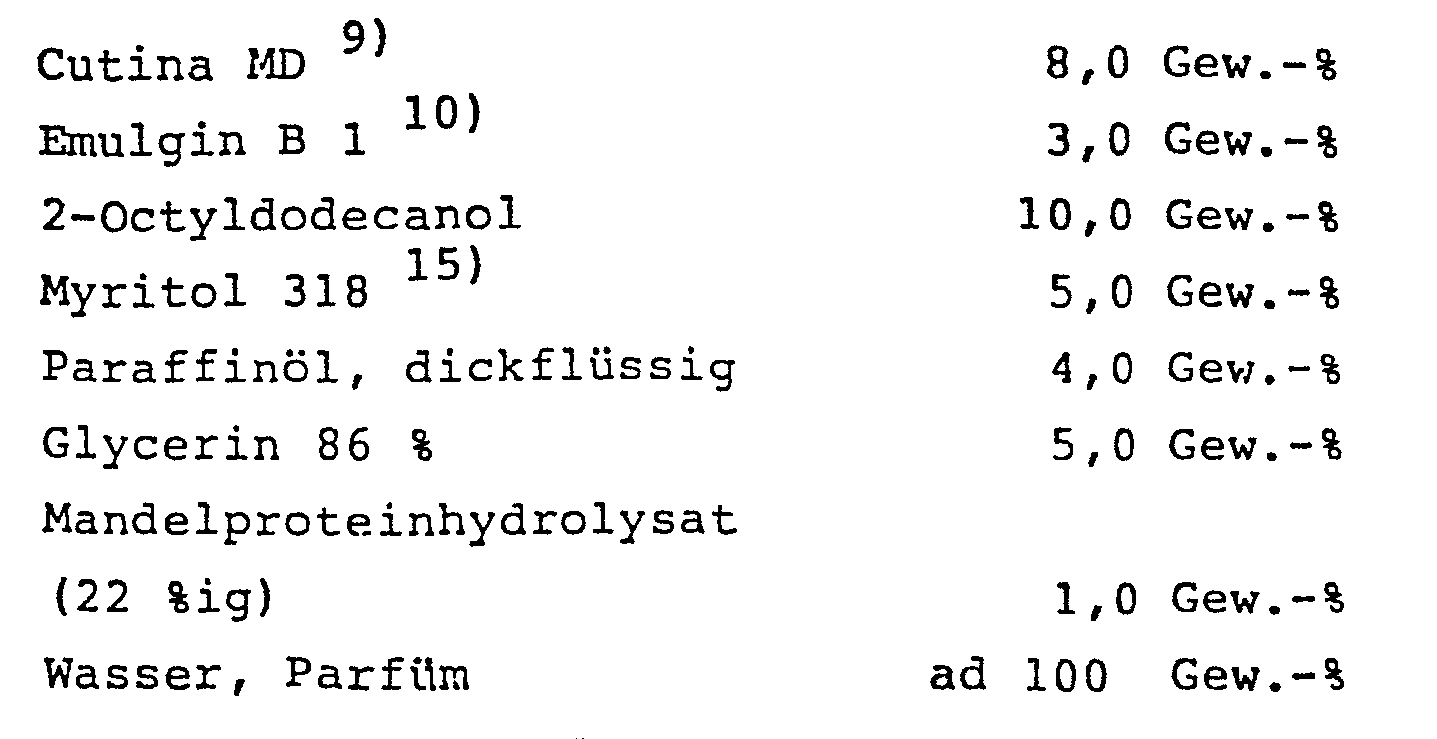
- 10. Feuchtigkeitsemulsion O/W

- In den Beispielen wurden die folgenden Handelsprodukte verwendet:


Claims (3)
Priority Applications (1)
| Application Number | Priority Date | Filing Date | Title |
|---|---|---|---|
| AT85115631T ATE64296T1 (de) | 1984-12-17 | 1985-12-09 | Kosmetische zubereitungen mit mandelproteinhydrolysat. |
Applications Claiming Priority (2)
| Application Number | Priority Date | Filing Date | Title |
|---|---|---|---|
| DE3445919 | 1984-12-17 | ||
| DE19843445919 DE3445919A1 (de) | 1984-12-17 | 1984-12-17 | Kosmetische zubereitung mit mandel-proteinhydrolysat |
Publications (3)
| Publication Number | Publication Date |
|---|---|
| EP0186025A2 true EP0186025A2 (de) | 1986-07-02 |
| EP0186025A3 EP0186025A3 (en) | 1987-09-16 |
| EP0186025B1 EP0186025B1 (de) | 1991-06-12 |
Family
ID=6252952
Family Applications (1)
| Application Number | Title | Priority Date | Filing Date |
|---|---|---|---|
| EP85115631A Expired - Lifetime EP0186025B1 (de) | 1984-12-17 | 1985-12-09 | Kosmetische Zubereitungen mit Mandel-Proteinhydrolysat |
Country Status (3)
| Country | Link |
|---|---|
| EP (1) | EP0186025B1 (de) |
| AT (1) | ATE64296T1 (de) |
| DE (2) | DE3445919A1 (de) |
Cited By (17)
| Publication number | Priority date | Publication date | Assignee | Title |
|---|---|---|---|---|
| EP0562263A1 (de) * | 1992-03-06 | 1993-09-29 | GOLDWELL GmbH | Haarwaschmittel |
| WO1993019724A1 (de) * | 1992-03-27 | 1993-10-14 | Henkel Kommanditgesellschaft Auf Aktien | Verfahren zur verminderung des gehaltes an freiem formaldehyd und ameisensäure in nichtionischen und anionischen tensiden |
| EP0776652A1 (de) | 1995-11-30 | 1997-06-04 | GOLDWELL GmbH | Oxidations-Haarfärbemittel enthaltend mindestens einen Pflanzenextract |
| EP1016401A1 (de) * | 1998-12-28 | 2000-07-05 | Kao Corporation | Haarreinigungsmittel |
| WO2000051556A1 (en) * | 1999-02-28 | 2000-09-08 | The Procter & Gamble Company | Hair care compositions comprising amino acid compounds |
| US6146429A (en) * | 1996-09-18 | 2000-11-14 | Wella Aktiengesellschaft | Carrier composition for oxidative dyeing of hair and method of dyeing hair using same |
| EP1133973A1 (de) * | 2000-01-19 | 2001-09-19 | GOLDWELL GmbH | Haarpflegemulsion |
| FR2814676A1 (fr) * | 2000-10-02 | 2002-04-05 | Silab Sa | Procede d'obtention d'un principe actif a effet tenseur immediat de la peau et principe actif obtenu |
| DE10002107C2 (de) * | 2000-01-19 | 2002-04-18 | Goldwell Gmbh | Haarpflegeemulsion |
| WO2003051320A1 (de) * | 2001-12-18 | 2003-06-26 | Henkel Kommanditgesellschaft Auf Aktien | Verfahren zur dauerhaften verformung keratinischer fasern und mittel |
| FR2863166A1 (fr) * | 2003-12-05 | 2005-06-10 | Silab Sa | Procede d'obtention d'un principe actif a base de tourteau d'olives et principe actif obtenu |
| EP1016402B1 (de) * | 1998-12-28 | 2006-09-13 | Kao Corporation | Haarkosmetische Zusammensetzung |
| FR2939037A1 (fr) * | 2008-12-02 | 2010-06-04 | Oreal | Association de glycine, de serine, de valine et de threonine pour proteger le cheveu chez l'homme |
| FR2939028A1 (fr) * | 2008-12-02 | 2010-06-04 | Oreal | Association d'acide glutamique, de glutathion reduit et de threonine pour proteger le cheveu chez la femme |
| WO2010064203A1 (en) * | 2008-12-02 | 2010-06-10 | L'oreal | Combination of reduced glutathione and amino acids for improving the quality of the hair in women |
| FR2955256A1 (fr) * | 2010-01-15 | 2011-07-22 | Silab Sa | Principe actif cosmetique capillaire issu de prunus amygdalus dulcis et utilisation |
| EP1813261A3 (de) * | 2006-01-30 | 2012-05-02 | Henkel AG & Co. KGaA | Blondierverfahren für keratinische Fasern |
Families Citing this family (4)
| Publication number | Priority date | Publication date | Assignee | Title |
|---|---|---|---|---|
| US5443855B1 (en) * | 1991-09-18 | 1998-02-10 | Revlon Consumer Prod Corp | Cosmetics and pharmaceuticals containing extensins and related methods |
| DK292A (da) * | 1991-11-29 | 1992-01-02 | Tanisake Kk | Middel |
| RU2146516C1 (ru) * | 1999-09-10 | 2000-03-20 | Аладьев Сергей Иванович | Косметическое средство |
| DE102014226175A1 (de) * | 2014-12-17 | 2016-06-23 | Henkel Ag & Co. Kgaa | Haarbehandlungsmittel, enthaltend mindestens ein saures Protein sowie mindestens ein Salz |
-
1984
- 1984-12-17 DE DE19843445919 patent/DE3445919A1/de not_active Withdrawn
-
1985
- 1985-12-09 EP EP85115631A patent/EP0186025B1/de not_active Expired - Lifetime
- 1985-12-09 DE DE8585115631T patent/DE3583222D1/de not_active Expired - Lifetime
- 1985-12-09 AT AT85115631T patent/ATE64296T1/de active
Cited By (22)
| Publication number | Priority date | Publication date | Assignee | Title |
|---|---|---|---|---|
| EP0562263A1 (de) * | 1992-03-06 | 1993-09-29 | GOLDWELL GmbH | Haarwaschmittel |
| WO1993019724A1 (de) * | 1992-03-27 | 1993-10-14 | Henkel Kommanditgesellschaft Auf Aktien | Verfahren zur verminderung des gehaltes an freiem formaldehyd und ameisensäure in nichtionischen und anionischen tensiden |
| US5478554A (en) * | 1992-03-27 | 1995-12-26 | Henkel Kommanditgesellschaft Auf Aktien | Process for reducing the content of free fromaldehyde and formic acid in nonionic and anionic surfactants |
| EP0776652B2 (de) † | 1995-11-30 | 2000-10-18 | GOLDWELL GmbH | Oxidations-Haarfärbemittel enthaltend mindestens einen Pflanzenextrakt und mindestens ein Eiweisshydrolysat |
| EP0776652A1 (de) | 1995-11-30 | 1997-06-04 | GOLDWELL GmbH | Oxidations-Haarfärbemittel enthaltend mindestens einen Pflanzenextract |
| DE19544655A1 (de) * | 1995-11-30 | 1997-06-05 | Goldwell Gmbh | Oxidations-Haarfärbemittel |
| US6146429A (en) * | 1996-09-18 | 2000-11-14 | Wella Aktiengesellschaft | Carrier composition for oxidative dyeing of hair and method of dyeing hair using same |
| US6348189B1 (en) | 1998-12-28 | 2002-02-19 | Kao Corporation | Hair cleansing compositions containing glycine and alanine |
| EP1016402B1 (de) * | 1998-12-28 | 2006-09-13 | Kao Corporation | Haarkosmetische Zusammensetzung |
| EP1016401A1 (de) * | 1998-12-28 | 2000-07-05 | Kao Corporation | Haarreinigungsmittel |
| WO2000051556A1 (en) * | 1999-02-28 | 2000-09-08 | The Procter & Gamble Company | Hair care compositions comprising amino acid compounds |
| EP1133973A1 (de) * | 2000-01-19 | 2001-09-19 | GOLDWELL GmbH | Haarpflegemulsion |
| DE10002107C2 (de) * | 2000-01-19 | 2002-04-18 | Goldwell Gmbh | Haarpflegeemulsion |
| FR2814676A1 (fr) * | 2000-10-02 | 2002-04-05 | Silab Sa | Procede d'obtention d'un principe actif a effet tenseur immediat de la peau et principe actif obtenu |
| WO2002028360A3 (fr) * | 2000-10-02 | 2002-09-06 | Silab Sa | Procede d'obtention d'un principe actif a effet tenseur immediat de la peau et principe actif obtenu |
| WO2003051320A1 (de) * | 2001-12-18 | 2003-06-26 | Henkel Kommanditgesellschaft Auf Aktien | Verfahren zur dauerhaften verformung keratinischer fasern und mittel |
| FR2863166A1 (fr) * | 2003-12-05 | 2005-06-10 | Silab Sa | Procede d'obtention d'un principe actif a base de tourteau d'olives et principe actif obtenu |
| EP1813261A3 (de) * | 2006-01-30 | 2012-05-02 | Henkel AG & Co. KGaA | Blondierverfahren für keratinische Fasern |
| FR2939037A1 (fr) * | 2008-12-02 | 2010-06-04 | Oreal | Association de glycine, de serine, de valine et de threonine pour proteger le cheveu chez l'homme |
| FR2939028A1 (fr) * | 2008-12-02 | 2010-06-04 | Oreal | Association d'acide glutamique, de glutathion reduit et de threonine pour proteger le cheveu chez la femme |
| WO2010064203A1 (en) * | 2008-12-02 | 2010-06-10 | L'oreal | Combination of reduced glutathione and amino acids for improving the quality of the hair in women |
| FR2955256A1 (fr) * | 2010-01-15 | 2011-07-22 | Silab Sa | Principe actif cosmetique capillaire issu de prunus amygdalus dulcis et utilisation |
Also Published As
| Publication number | Publication date |
|---|---|
| EP0186025A3 (en) | 1987-09-16 |
| EP0186025B1 (de) | 1991-06-12 |
| DE3445919A1 (de) | 1986-06-19 |
| ATE64296T1 (de) | 1991-06-15 |
| DE3583222D1 (de) | 1991-07-18 |
Similar Documents
| Publication | Publication Date | Title |
|---|---|---|
| EP0186025B1 (de) | Kosmetische Zubereitungen mit Mandel-Proteinhydrolysat | |
| US3033755A (en) | Process for removing the water soluble materials from a keratin structure and cosmetic or pharmaceutical product formed therefrom | |
| DE69926058T3 (de) | Derivate von Polyaminosäuren und ihre Verwerndung in Zusammensetzungen zur Behandlung von Keratinfasern | |
| EP0203418B1 (de) | Oligopeptid-Derivate, deren Herstellung und deren Verwendung als hautfreundliche Tenside | |
| DE2600514A1 (de) | Zusammensetzung zum schutz keratinartigen materials | |
| DE1617062A1 (de) | Hautpflege- und Reinigungsmittel | |
| DE3872704T2 (de) | Milchbestandteile enthaltende kosmetische mittel. | |
| EP0076444A2 (de) | Verwendung kolloidaler Lösungen von Seidenfibroin in haarkosmetischen Mitteln und Haarschampoo | |
| US4451385A (en) | Agent for reducing detergent irritation to skin and eyes | |
| EP0417619A1 (de) | Hochmolekulare Eiweissfettsäurekondensationsprodukte mit sehr guter Haut- und Schleimhautverträglichkeit | |
| DE69804203T2 (de) | Verwendung einer aus hibiskus-esculentus-samen extrahierten proteinfraktion in der kosmetik | |
| JPS5810512A (ja) | 化粧料 | |
| CH619002A5 (en) | Composition for protecting skin and hair. | |
| DE1617517C3 (de) | Verwendung von Skleroproteinabbauprodukten für kosmetische Zwecke | |
| JPS63302934A (ja) | 乳化組成物 | |
| KR20200016813A (ko) | 곤충의 효소 가수분해물을 함유하는 피부 미백용 조성물 | |
| US2900307A (en) | Clear liquid solubilized lanolin compositions | |
| DE2804024A1 (de) | Kosmetischer wirkstoff auf hautproteinbasis | |
| DE102017200434A1 (de) | Molke-haltiges Körperpflegeprodukt | |
| EP0187147A1 (de) | Präparat zur haar- und nagelpflege und verfahren zu seiner herstellung | |
| EP0499229B1 (de) | Alkylethercarbonsäuretauride | |
| JPH0520411B2 (de) | ||
| DE69809080T2 (de) | Kombination aus phenolderivaten und einem extrakt von iridaceen zur depigmentierung der haut oder ihrer anhangsgebilde und diese kombination enthaltende zusammensetzung | |
| DE3590272C2 (de) | Verwendung pflanzlicher Ölauszüge als Geschmeidigmacher in Haut- und Haarpflegeprodukten | |
| DE2519859A1 (de) | Kosmetikum |
Legal Events
| Date | Code | Title | Description |
|---|---|---|---|
| PUAI | Public reference made under article 153(3) epc to a published international application that has entered the european phase |
Free format text: ORIGINAL CODE: 0009012 |
|
| AK | Designated contracting states |
Kind code of ref document: A2 Designated state(s): AT BE CH DE FR GB IT LI NL SE |
|
| PUAL | Search report despatched |
Free format text: ORIGINAL CODE: 0009013 |
|
| AK | Designated contracting states |
Kind code of ref document: A3 Designated state(s): AT BE CH DE FR GB IT LI NL SE |
|
| 17P | Request for examination filed |
Effective date: 19880205 |
|
| 17Q | First examination report despatched |
Effective date: 19890714 |
|
| GRAA | (expected) grant |
Free format text: ORIGINAL CODE: 0009210 |
|
| AK | Designated contracting states |
Kind code of ref document: B1 Designated state(s): AT BE CH DE FR GB IT LI NL SE |
|
| REF | Corresponds to: |
Ref document number: 64296 Country of ref document: AT Date of ref document: 19910615 Kind code of ref document: T |
|
| ET | Fr: translation filed | ||
| REF | Corresponds to: |
Ref document number: 3583222 Country of ref document: DE Date of ref document: 19910718 |
|
| ITF | It: translation for a ep patent filed | ||
| GBT | Gb: translation of ep patent filed (gb section 77(6)(a)/1977) | ||
| PLBE | No opposition filed within time limit |
Free format text: ORIGINAL CODE: 0009261 |
|
| STAA | Information on the status of an ep patent application or granted ep patent |
Free format text: STATUS: NO OPPOSITION FILED WITHIN TIME LIMIT |
|
| 26N | No opposition filed | ||
| EAL | Se: european patent in force in sweden |
Ref document number: 85115631.5 |
|
| PGFP | Annual fee paid to national office [announced via postgrant information from national office to epo] |
Ref country code: AT Payment date: 20001213 Year of fee payment: 16 |
|
| PG25 | Lapsed in a contracting state [announced via postgrant information from national office to epo] |
Ref country code: AT Free format text: LAPSE BECAUSE OF NON-PAYMENT OF DUE FEES Effective date: 20011209 |
|
| REG | Reference to a national code |
Ref country code: GB Ref legal event code: IF02 |
|
| BECA | Be: change of holder's address |
Owner name: *COGNIS DEUTSCHLAND G.M.B.H. & CO. K.G.HENKELSTRAS |
|
| BECH | Be: change of holder |
Owner name: *COGNIS DEUTSCHLAND G.M.B.H. & CO. K.G.HENKELSTRAS |
|
| BECN | Be: change of holder's name |
Owner name: *COGNIS DEUTSCHLAND G.M.B.H. & CO. K.G.HENKELSTRAS |
|
| REG | Reference to a national code |
Ref country code: CH Ref legal event code: PUE Owner name: HENKEL KOMMANDITGESELLSCHAFT AUF AKTIEN TRANSFER- |
|
| NLS | Nl: assignments of ep-patents |
Owner name: COGNIS DEUTSCHLAND GMBH & CO. KG |
|
| REG | Reference to a national code |
Ref country code: GB Ref legal event code: 732E |
|
| REG | Reference to a national code |
Ref country code: FR Ref legal event code: TP |
|
| PGFP | Annual fee paid to national office [announced via postgrant information from national office to epo] |
Ref country code: DE Payment date: 20041202 Year of fee payment: 20 |
|
| PGFP | Annual fee paid to national office [announced via postgrant information from national office to epo] |
Ref country code: NL Payment date: 20041205 Year of fee payment: 20 |
|
| PGFP | Annual fee paid to national office [announced via postgrant information from national office to epo] |
Ref country code: SE Payment date: 20041206 Year of fee payment: 20 |
|
| PGFP | Annual fee paid to national office [announced via postgrant information from national office to epo] |
Ref country code: GB Payment date: 20041208 Year of fee payment: 20 Ref country code: FR Payment date: 20041208 Year of fee payment: 20 |
|
| PGFP | Annual fee paid to national office [announced via postgrant information from national office to epo] |
Ref country code: CH Payment date: 20041215 Year of fee payment: 20 |
|
| PGFP | Annual fee paid to national office [announced via postgrant information from national office to epo] |
Ref country code: BE Payment date: 20050629 Year of fee payment: 20 |
|
| PG25 | Lapsed in a contracting state [announced via postgrant information from national office to epo] |
Ref country code: GB Free format text: LAPSE BECAUSE OF EXPIRATION OF PROTECTION Effective date: 20051208 |
|
| PG25 | Lapsed in a contracting state [announced via postgrant information from national office to epo] |
Ref country code: NL Free format text: LAPSE BECAUSE OF EXPIRATION OF PROTECTION Effective date: 20051209 |
|
| REG | Reference to a national code |
Ref country code: GB Ref legal event code: PE20 |
|
| REG | Reference to a national code |
Ref country code: CH Ref legal event code: PL |
|
| NLV7 | Nl: ceased due to reaching the maximum lifetime of a patent |
Effective date: 20051209 |
|
| EUG | Se: european patent has lapsed | ||
| BE20 | Be: patent expired |
Owner name: *COGNIS DEUTSCHLAND G.M.B.H. & CO. K.G. Effective date: 20051209 |