EP0186034A2 - Polymere Verdickungsmittel für wässrige Hydraulikflüssigkeiten - Google Patents
Polymere Verdickungsmittel für wässrige Hydraulikflüssigkeiten Download PDFInfo
- Publication number
- EP0186034A2 EP0186034A2 EP85115674A EP85115674A EP0186034A2 EP 0186034 A2 EP0186034 A2 EP 0186034A2 EP 85115674 A EP85115674 A EP 85115674A EP 85115674 A EP85115674 A EP 85115674A EP 0186034 A2 EP0186034 A2 EP 0186034A2
- Authority
- EP
- European Patent Office
- Prior art keywords
- oder
- carbon atoms
- und
- für
- mit
- Prior art date
- Legal status (The legal status is an assumption and is not a legal conclusion. Google has not performed a legal analysis and makes no representation as to the accuracy of the status listed.)
- Withdrawn
Links
- 229920000642 polymer Polymers 0.000 title claims abstract description 25
- 239000012530 fluid Substances 0.000 title claims abstract description 17
- 239000002562 thickening agent Substances 0.000 title claims abstract description 16
- UFHFLCQGNIYNRP-UHFFFAOYSA-N Hydrogen Chemical compound [H][H] UFHFLCQGNIYNRP-UHFFFAOYSA-N 0.000 claims abstract description 13
- 125000004432 carbon atom Chemical group C* 0.000 claims abstract description 12
- 239000000178 monomer Substances 0.000 claims abstract description 11
- 229910052739 hydrogen Inorganic materials 0.000 claims abstract description 9
- 239000001257 hydrogen Substances 0.000 claims abstract description 9
- 125000002496 methyl group Chemical group [H]C([H])([H])* 0.000 claims abstract description 9
- IJGRMHOSHXDMSA-UHFFFAOYSA-N Atomic nitrogen Chemical compound N#N IJGRMHOSHXDMSA-UHFFFAOYSA-N 0.000 claims abstract description 6
- 229910052757 nitrogen Inorganic materials 0.000 claims abstract description 6
- 125000004070 6 membered heterocyclic group Chemical group 0.000 claims abstract description 3
- 125000002947 alkylene group Chemical group 0.000 claims abstract description 3
- 125000002887 hydroxy group Chemical group [H]O* 0.000 claims abstract description 3
- 125000004430 oxygen atom Chemical group O* 0.000 claims abstract description 3
- 239000000654 additive Substances 0.000 claims description 12
- 230000000996 additive effect Effects 0.000 claims description 7
- 239000002270 dispersing agent Substances 0.000 claims description 4
- 229910006069 SO3H Inorganic materials 0.000 abstract description 2
- KFZMGEQAYNKOFK-UHFFFAOYSA-N Isopropanol Chemical compound CC(C)O KFZMGEQAYNKOFK-UHFFFAOYSA-N 0.000 description 16
- 239000000243 solution Substances 0.000 description 12
- XLYOFNOQVPJJNP-UHFFFAOYSA-N water Substances O XLYOFNOQVPJJNP-UHFFFAOYSA-N 0.000 description 12
- -1 alkyl radical Chemical class 0.000 description 6
- 238000006116 polymerization reaction Methods 0.000 description 5
- 238000012360 testing method Methods 0.000 description 4
- COCLLEMEIJQBAG-UHFFFAOYSA-N 8-methylnonyl 2-methylprop-2-enoate Chemical compound CC(C)CCCCCCCOC(=O)C(C)=C COCLLEMEIJQBAG-UHFFFAOYSA-N 0.000 description 3
- ISAOCJYIOMOJEB-UHFFFAOYSA-N benzoin Chemical compound C=1C=CC=CC=1C(O)C(=O)C1=CC=CC=C1 ISAOCJYIOMOJEB-UHFFFAOYSA-N 0.000 description 3
- 239000012141 concentrate Substances 0.000 description 3
- 150000002148 esters Chemical class 0.000 description 3
- 125000001165 hydrophobic group Chemical group 0.000 description 3
- 239000003999 initiator Substances 0.000 description 3
- FQPSGWSUVKBHSU-UHFFFAOYSA-N methacrylamide Chemical compound CC(=C)C(N)=O FQPSGWSUVKBHSU-UHFFFAOYSA-N 0.000 description 3
- 239000012299 nitrogen atmosphere Substances 0.000 description 3
- 238000003756 stirring Methods 0.000 description 3
- OPQYOFWUFGEMRZ-UHFFFAOYSA-N tert-butyl 2,2-dimethylpropaneperoxoate Chemical compound CC(C)(C)OOC(=O)C(C)(C)C OPQYOFWUFGEMRZ-UHFFFAOYSA-N 0.000 description 3
- YAJYJWXEWKRTPO-UHFFFAOYSA-N 2,3,3,4,4,5-hexamethylhexane-2-thiol Chemical compound CC(C)C(C)(C)C(C)(C)C(C)(C)S YAJYJWXEWKRTPO-UHFFFAOYSA-N 0.000 description 2
- SMZOUWXMTYCWNB-UHFFFAOYSA-N 2-(2-methoxy-5-methylphenyl)ethanamine Chemical compound COC1=CC=C(C)C=C1CCN SMZOUWXMTYCWNB-UHFFFAOYSA-N 0.000 description 2
- KWIUHFFTVRNATP-UHFFFAOYSA-N Betaine Natural products C[N+](C)(C)CC([O-])=O KWIUHFFTVRNATP-UHFFFAOYSA-N 0.000 description 2
- CERQOIWHTDAKMF-UHFFFAOYSA-N Methacrylic acid Chemical compound CC(=C)C(O)=O CERQOIWHTDAKMF-UHFFFAOYSA-N 0.000 description 2
- KWIUHFFTVRNATP-UHFFFAOYSA-O N,N,N-trimethylglycinium Chemical compound C[N+](C)(C)CC(O)=O KWIUHFFTVRNATP-UHFFFAOYSA-O 0.000 description 2
- 244000028419 Styrax benzoin Species 0.000 description 2
- 235000000126 Styrax benzoin Nutrition 0.000 description 2
- 235000008411 Sumatra benzointree Nutrition 0.000 description 2
- 239000007864 aqueous solution Substances 0.000 description 2
- 229960002130 benzoin Drugs 0.000 description 2
- 229960003237 betaine Drugs 0.000 description 2
- 239000003995 emulsifying agent Substances 0.000 description 2
- 235000019382 gum benzoic Nutrition 0.000 description 2
- 239000000203 mixture Substances 0.000 description 2
- 150000002978 peroxides Chemical class 0.000 description 2
- KZNICNPSHKQLFF-UHFFFAOYSA-N succinimide Chemical compound O=C1CCC(=O)N1 KZNICNPSHKQLFF-UHFFFAOYSA-N 0.000 description 2
- 239000004094 surface-active agent Substances 0.000 description 2
- 229920003169 water-soluble polymer Polymers 0.000 description 2
- FSQQTNAZHBEJLS-OWOJBTEDSA-M (e)-4-amino-4-oxobut-2-enoate Chemical compound NC(=O)\C=C\C([O-])=O FSQQTNAZHBEJLS-OWOJBTEDSA-M 0.000 description 1
- KMNCBSZOIQAUFX-UHFFFAOYSA-N 2-ethoxy-1,2-diphenylethanone Chemical compound C=1C=CC=CC=1C(OCC)C(=O)C1=CC=CC=C1 KMNCBSZOIQAUFX-UHFFFAOYSA-N 0.000 description 1
- HRPVXLWXLXDGHG-UHFFFAOYSA-N Acrylamide Chemical compound NC(=O)C=C HRPVXLWXLXDGHG-UHFFFAOYSA-N 0.000 description 1
- LSDPWZHWYPCBBB-UHFFFAOYSA-N Methanethiol Chemical compound SC LSDPWZHWYPCBBB-UHFFFAOYSA-N 0.000 description 1
- NINIDFKCEFEMDL-UHFFFAOYSA-N Sulfur Chemical compound [S] NINIDFKCEFEMDL-UHFFFAOYSA-N 0.000 description 1
- 150000001298 alcohols Chemical class 0.000 description 1
- 150000001408 amides Chemical class 0.000 description 1
- 150000001414 amino alcohols Chemical class 0.000 description 1
- 239000003963 antioxidant agent Substances 0.000 description 1
- 239000003139 biocide Substances 0.000 description 1
- 239000003795 chemical substances by application Substances 0.000 description 1
- 150000001875 compounds Chemical class 0.000 description 1
- 239000000470 constituent Substances 0.000 description 1
- 238000005260 corrosion Methods 0.000 description 1
- 230000007797 corrosion Effects 0.000 description 1
- 230000001419 dependent effect Effects 0.000 description 1
- 125000004663 dialkyl amino group Chemical group 0.000 description 1
- WNAHIZMDSQCWRP-UHFFFAOYSA-N dodecane-1-thiol Chemical compound CCCCCCCCCCCCS WNAHIZMDSQCWRP-UHFFFAOYSA-N 0.000 description 1
- 229960002449 glycine Drugs 0.000 description 1
- 239000003112 inhibitor Substances 0.000 description 1
- JEIPFZHSYJVQDO-UHFFFAOYSA-N iron(III) oxide Inorganic materials O=[Fe]O[Fe]=O JEIPFZHSYJVQDO-UHFFFAOYSA-N 0.000 description 1
- 238000004519 manufacturing process Methods 0.000 description 1
- 238000005259 measurement Methods 0.000 description 1
- DFENKTCEEGOWLB-UHFFFAOYSA-N n,n-bis(methylamino)-2-methylidenepentanamide Chemical compound CCCC(=C)C(=O)N(NC)NC DFENKTCEEGOWLB-UHFFFAOYSA-N 0.000 description 1
- WDQKICIMIPUDBL-UHFFFAOYSA-N n-[2-(dimethylamino)ethyl]prop-2-enamide Chemical compound CN(C)CCNC(=O)C=C WDQKICIMIPUDBL-UHFFFAOYSA-N 0.000 description 1
- 239000003208 petroleum Substances 0.000 description 1
- 239000003209 petroleum derivative Substances 0.000 description 1
- 238000005191 phase separation Methods 0.000 description 1
- 239000011814 protection agent Substances 0.000 description 1
- 238000010526 radical polymerization reaction Methods 0.000 description 1
- 150000003254 radicals Chemical class 0.000 description 1
- 230000001105 regulatory effect Effects 0.000 description 1
- 238000000926 separation method Methods 0.000 description 1
- 239000002904 solvent Substances 0.000 description 1
- 239000000126 substance Substances 0.000 description 1
- 229960002317 succinimide Drugs 0.000 description 1
- 229910052717 sulfur Inorganic materials 0.000 description 1
- 239000011593 sulfur Substances 0.000 description 1
- 125000000999 tert-butyl group Chemical group [H]C([H])([H])C(*)(C([H])([H])[H])C([H])([H])[H] 0.000 description 1
- WMYJOZQKDZZHAC-UHFFFAOYSA-H trizinc;dioxido-sulfanylidene-sulfido-$l^{5}-phosphane Chemical class [Zn+2].[Zn+2].[Zn+2].[O-]P([O-])([S-])=S.[O-]P([O-])([S-])=S WMYJOZQKDZZHAC-UHFFFAOYSA-H 0.000 description 1
Classifications
-
- C—CHEMISTRY; METALLURGY
- C10—PETROLEUM, GAS OR COKE INDUSTRIES; TECHNICAL GASES CONTAINING CARBON MONOXIDE; FUELS; LUBRICANTS; PEAT
- C10M—LUBRICATING COMPOSITIONS; USE OF CHEMICAL SUBSTANCES EITHER ALONE OR AS LUBRICATING INGREDIENTS IN A LUBRICATING COMPOSITION
- C10M173/00—Lubricating compositions containing more than 10% water
- C10M173/02—Lubricating compositions containing more than 10% water not containing mineral or fatty oils
-
- C—CHEMISTRY; METALLURGY
- C10—PETROLEUM, GAS OR COKE INDUSTRIES; TECHNICAL GASES CONTAINING CARBON MONOXIDE; FUELS; LUBRICANTS; PEAT
- C10M—LUBRICATING COMPOSITIONS; USE OF CHEMICAL SUBSTANCES EITHER ALONE OR AS LUBRICATING INGREDIENTS IN A LUBRICATING COMPOSITION
- C10M145/00—Lubricating compositions characterised by the additive being a macromolecular compound containing oxygen
- C10M145/02—Macromolecular compounds obtained by reactions only involving carbon-to-carbon unsaturated bonds
- C10M145/10—Macromolecular compounds obtained by reactions only involving carbon-to-carbon unsaturated bonds containing monomers having an unsaturated radical bound to a carboxyl radical, e.g. acrylate
- C10M145/12—Macromolecular compounds obtained by reactions only involving carbon-to-carbon unsaturated bonds containing monomers having an unsaturated radical bound to a carboxyl radical, e.g. acrylate monocarboxylic
- C10M145/14—Acrylate; Methacrylate
-
- C—CHEMISTRY; METALLURGY
- C10—PETROLEUM, GAS OR COKE INDUSTRIES; TECHNICAL GASES CONTAINING CARBON MONOXIDE; FUELS; LUBRICANTS; PEAT
- C10M—LUBRICATING COMPOSITIONS; USE OF CHEMICAL SUBSTANCES EITHER ALONE OR AS LUBRICATING INGREDIENTS IN A LUBRICATING COMPOSITION
- C10M149/00—Lubricating compositions characterised by the additive being a macromolecular compound containing nitrogen
- C10M149/02—Macromolecular compounds obtained by reactions only involving carbon-to-carbon unsaturated bonds
- C10M149/04—Macromolecular compounds obtained by reactions only involving carbon-to-carbon unsaturated bonds containing monomers having an unsaturated radical bound to an amino group
-
- C—CHEMISTRY; METALLURGY
- C10—PETROLEUM, GAS OR COKE INDUSTRIES; TECHNICAL GASES CONTAINING CARBON MONOXIDE; FUELS; LUBRICANTS; PEAT
- C10M—LUBRICATING COMPOSITIONS; USE OF CHEMICAL SUBSTANCES EITHER ALONE OR AS LUBRICATING INGREDIENTS IN A LUBRICATING COMPOSITION
- C10M149/00—Lubricating compositions characterised by the additive being a macromolecular compound containing nitrogen
- C10M149/02—Macromolecular compounds obtained by reactions only involving carbon-to-carbon unsaturated bonds
- C10M149/06—Macromolecular compounds obtained by reactions only involving carbon-to-carbon unsaturated bonds containing monomers having an unsaturated radical bound to an amido or imido group
-
- C—CHEMISTRY; METALLURGY
- C10—PETROLEUM, GAS OR COKE INDUSTRIES; TECHNICAL GASES CONTAINING CARBON MONOXIDE; FUELS; LUBRICANTS; PEAT
- C10M—LUBRICATING COMPOSITIONS; USE OF CHEMICAL SUBSTANCES EITHER ALONE OR AS LUBRICATING INGREDIENTS IN A LUBRICATING COMPOSITION
- C10M149/00—Lubricating compositions characterised by the additive being a macromolecular compound containing nitrogen
- C10M149/02—Macromolecular compounds obtained by reactions only involving carbon-to-carbon unsaturated bonds
- C10M149/10—Macromolecular compounds obtained by reactions only involving carbon-to-carbon unsaturated bonds containing monomers having an unsaturated radical bound to a nitrogen-containing hetero ring
-
- C—CHEMISTRY; METALLURGY
- C10—PETROLEUM, GAS OR COKE INDUSTRIES; TECHNICAL GASES CONTAINING CARBON MONOXIDE; FUELS; LUBRICANTS; PEAT
- C10M—LUBRICATING COMPOSITIONS; USE OF CHEMICAL SUBSTANCES EITHER ALONE OR AS LUBRICATING INGREDIENTS IN A LUBRICATING COMPOSITION
- C10M151/00—Lubricating compositions characterised by the additive being a macromolecular compound containing sulfur, selenium or tellurium
- C10M151/02—Macromolecular compounds obtained by reactions involving only carbon-to-carbon unsaturated bonds
-
- C—CHEMISTRY; METALLURGY
- C10—PETROLEUM, GAS OR COKE INDUSTRIES; TECHNICAL GASES CONTAINING CARBON MONOXIDE; FUELS; LUBRICANTS; PEAT
- C10M—LUBRICATING COMPOSITIONS; USE OF CHEMICAL SUBSTANCES EITHER ALONE OR AS LUBRICATING INGREDIENTS IN A LUBRICATING COMPOSITION
- C10M2209/00—Organic macromolecular compounds containing oxygen as ingredients in lubricant compositions
- C10M2209/02—Macromolecular compounds obtained by reactions only involving carbon-to-carbon unsaturated bonds
- C10M2209/08—Macromolecular compounds obtained by reactions only involving carbon-to-carbon unsaturated bonds containing monomers having an unsaturated radical bound to a carboxyl radical, e.g. acrylate type
- C10M2209/084—Acrylate; Methacrylate
-
- C—CHEMISTRY; METALLURGY
- C10—PETROLEUM, GAS OR COKE INDUSTRIES; TECHNICAL GASES CONTAINING CARBON MONOXIDE; FUELS; LUBRICANTS; PEAT
- C10M—LUBRICATING COMPOSITIONS; USE OF CHEMICAL SUBSTANCES EITHER ALONE OR AS LUBRICATING INGREDIENTS IN A LUBRICATING COMPOSITION
- C10M2217/00—Organic macromolecular compounds containing nitrogen as ingredients in lubricant compositions
- C10M2217/02—Macromolecular compounds obtained from nitrogen containing monomers by reactions only involving carbon-to-carbon unsaturated bonds
- C10M2217/022—Macromolecular compounds obtained from nitrogen containing monomers by reactions only involving carbon-to-carbon unsaturated bonds containing monomers having an unsaturated radical bound to an amino group
-
- C—CHEMISTRY; METALLURGY
- C10—PETROLEUM, GAS OR COKE INDUSTRIES; TECHNICAL GASES CONTAINING CARBON MONOXIDE; FUELS; LUBRICANTS; PEAT
- C10M—LUBRICATING COMPOSITIONS; USE OF CHEMICAL SUBSTANCES EITHER ALONE OR AS LUBRICATING INGREDIENTS IN A LUBRICATING COMPOSITION
- C10M2217/00—Organic macromolecular compounds containing nitrogen as ingredients in lubricant compositions
- C10M2217/02—Macromolecular compounds obtained from nitrogen containing monomers by reactions only involving carbon-to-carbon unsaturated bonds
- C10M2217/022—Macromolecular compounds obtained from nitrogen containing monomers by reactions only involving carbon-to-carbon unsaturated bonds containing monomers having an unsaturated radical bound to an amino group
- C10M2217/023—Macromolecular compounds obtained from nitrogen containing monomers by reactions only involving carbon-to-carbon unsaturated bonds containing monomers having an unsaturated radical bound to an amino group the amino group containing an ester bond
-
- C—CHEMISTRY; METALLURGY
- C10—PETROLEUM, GAS OR COKE INDUSTRIES; TECHNICAL GASES CONTAINING CARBON MONOXIDE; FUELS; LUBRICANTS; PEAT
- C10M—LUBRICATING COMPOSITIONS; USE OF CHEMICAL SUBSTANCES EITHER ALONE OR AS LUBRICATING INGREDIENTS IN A LUBRICATING COMPOSITION
- C10M2217/00—Organic macromolecular compounds containing nitrogen as ingredients in lubricant compositions
- C10M2217/02—Macromolecular compounds obtained from nitrogen containing monomers by reactions only involving carbon-to-carbon unsaturated bonds
- C10M2217/024—Macromolecular compounds obtained from nitrogen containing monomers by reactions only involving carbon-to-carbon unsaturated bonds containing monomers having an unsaturated radical bound to an amido or imido group
-
- C—CHEMISTRY; METALLURGY
- C10—PETROLEUM, GAS OR COKE INDUSTRIES; TECHNICAL GASES CONTAINING CARBON MONOXIDE; FUELS; LUBRICANTS; PEAT
- C10M—LUBRICATING COMPOSITIONS; USE OF CHEMICAL SUBSTANCES EITHER ALONE OR AS LUBRICATING INGREDIENTS IN A LUBRICATING COMPOSITION
- C10M2217/00—Organic macromolecular compounds containing nitrogen as ingredients in lubricant compositions
- C10M2217/02—Macromolecular compounds obtained from nitrogen containing monomers by reactions only involving carbon-to-carbon unsaturated bonds
- C10M2217/028—Macromolecular compounds obtained from nitrogen containing monomers by reactions only involving carbon-to-carbon unsaturated bonds containing monomers having an unsaturated radical bound to a nitrogen-containing hetero ring
-
- C—CHEMISTRY; METALLURGY
- C10—PETROLEUM, GAS OR COKE INDUSTRIES; TECHNICAL GASES CONTAINING CARBON MONOXIDE; FUELS; LUBRICANTS; PEAT
- C10M—LUBRICATING COMPOSITIONS; USE OF CHEMICAL SUBSTANCES EITHER ALONE OR AS LUBRICATING INGREDIENTS IN A LUBRICATING COMPOSITION
- C10M2217/00—Organic macromolecular compounds containing nitrogen as ingredients in lubricant compositions
- C10M2217/06—Macromolecular compounds obtained by functionalisation op polymers with a nitrogen containing compound
-
- C—CHEMISTRY; METALLURGY
- C10—PETROLEUM, GAS OR COKE INDUSTRIES; TECHNICAL GASES CONTAINING CARBON MONOXIDE; FUELS; LUBRICANTS; PEAT
- C10M—LUBRICATING COMPOSITIONS; USE OF CHEMICAL SUBSTANCES EITHER ALONE OR AS LUBRICATING INGREDIENTS IN A LUBRICATING COMPOSITION
- C10M2221/00—Organic macromolecular compounds containing sulfur, selenium or tellurium as ingredients in lubricant compositions
- C10M2221/02—Macromolecular compounds obtained by reactions of monomers involving only carbon-to-carbon unsaturated bonds
-
- C—CHEMISTRY; METALLURGY
- C10—PETROLEUM, GAS OR COKE INDUSTRIES; TECHNICAL GASES CONTAINING CARBON MONOXIDE; FUELS; LUBRICANTS; PEAT
- C10N—INDEXING SCHEME ASSOCIATED WITH SUBCLASS C10M RELATING TO LUBRICATING COMPOSITIONS
- C10N2040/00—Specified use or application for which the lubricating composition is intended
- C10N2040/08—Hydraulic fluids, e.g. brake-fluids
-
- C—CHEMISTRY; METALLURGY
- C10—PETROLEUM, GAS OR COKE INDUSTRIES; TECHNICAL GASES CONTAINING CARBON MONOXIDE; FUELS; LUBRICANTS; PEAT
- C10N—INDEXING SCHEME ASSOCIATED WITH SUBCLASS C10M RELATING TO LUBRICATING COMPOSITIONS
- C10N2050/00—Form in which the lubricant is applied to the material being lubricated
- C10N2050/01—Emulsions, colloids, or micelles
Definitions
- the invention relates to polymeric thickeners based on esters or amides of acrylic or methacrylic acid containing dialkylamino groups.
- Hydraulic fluids based on water containing polymeric thickeners became particularly important.
- thickeners are known to contain water-soluble polymers with hydrophobic groups and a water-dispersible surface-active agent which has hydrophobic groups which associate with the hydrophobic groups of the polymer, the ratio of the water-soluble polymer and the dispersing agent being such that that under normal conditions water with a Content of 0.5% by weight of the thickener has at least twice the viscosity as untreated water.
- aqueous hydraulic fluids especially HWCFs
- the aqueous hydraulic fluids usually contain, in addition to the polymeric thickeners, corrosion protection agents, wear protection additives, antioxidants, surfactants and the like
- the poor compatibility of polymeric thickeners on the one hand and the other additives (packages) on the other hand is often problematic. It was also unsatisfactory that, at the same time as the polymeric thickeners, it was generally necessary to add emulsifiers or dispersants tailored to these thickeners. Another problem is the often unsatisfactory shear stability of the polymeric thickeners.
- the polymers P have average molecular weights (weight average) M between 50,000 and 300,000, preferably between 100,000 and 200,000. Furthermore, the viscosity of an aqueous solution containing 10% by weight of polymer P should be x) preferably 0.5-5, ⁇ 25 mm 2 / s at 40 ° C. Polymers P in which the monomers of the formula I are composed of dialkylaminoalkylamides of acrylic or methacrylic acid are particularly preferred.
- N, N-dimethyl and diethylaminoalkyl compounds such as, for example, the N, N-dimethylaminoethylacrylamide and methacrylamide and in particular the N, N-dimethylaminopropylacrylamide and methacrylamide and the N, N-dimethyl-N- (2 -acrylate- or methacryloyl) -oxyethyl) -aminoacetic acid betaine.
- Particularly suitable monomers of the formula I are the esters of alkanols with C 8 -C 18 carbon atoms.
- Examples include the esters of C 10 alcohols, especially isodecyl methacrylate.
- the polymers P can thus be prepared by radical polymerization of the monomers of the general formulas I and II in bulk or in aqueous or in aqueous-alcoholic solution, usually with addition of 0.1-1% by weight (based on the monomers) ) free radical initiators, especially peroxidic initiators such as. tert-butyl perisooctoate or tert-butyl perpivalate and the above-mentioned regulators of the type of tert-alkyl mercaptans such as e.g. tert. Dodecyl mercaptan in amounts of 0.2-1% by weight (based on the monomers) and at temperatures in the range 50-100 ° C. preferably sulfur regulator, in particular
- the photopolymerization can also be carried out with the addition of sensitizers or initiators such as aromatic keto compounds, e.g. Benzoin or in particular benzoin ethers such as e.g. Benzoin ethyl ether in amounts of 0.1-1% by weight (based on the monomers) and the abovementioned tert-alkyl mercaptan regulators in amounts of 0.2-1% by weight are used.
- sensitizers or initiators such as aromatic keto compounds, e.g. Benzoin or in particular benzoin ethers such as e.g. Benzoin ethyl ether in amounts of 0.1-1% by weight (based on the monomers) and the abovementioned tert-alkyl mercaptan regulators in amounts of 0.2-1% by weight are used.
- Suitable light sources are e.g. UV sources such as stop lamps. Otherwise, the polymerization processes of the prior art can be followed. (See H. Rauch-Puntigam, Th. Völker, Acryl- und Methacrylitatien, Springer-Verlag, Berlin, 1967).
- the aqueous hydraulic fluids Hfl according to the invention generally contain application concentrations of polymers P between 6 and 15% by weight, preferably between 6 and 12% by weight.
- the additives (packets) of the prior art must be considered as predefined. These usually contain dispersants, antiwear agents, rust inhibitors and optionally biocides in the usual amounts. Zinc dithiophosphates, amino alcohols, polyisobutenyl succinimide with N-aminoalkyl substituents and oxyethylated alkylphenols are often part of such additive packages.
- polymers P to be used according to the invention generally contain commercially available additives to aqueous hydraulic fluids, in the usual amounts, ie with commercially available Lichen additive packages proven to be compatible, usually not for phase separation. Separation of additive constituents etc. give cause.
- the polymers P to be used according to the invention are distinguished by a shear behavior which is particularly well adapted to the stress.
- a hydraulic gear pump of the type "Tyrone Mobil-Master P 16-45 is used to determine the shear stability. (Technical data: delivery volume 14.4 cm 3 / w; pressure: 70 bar; temperature 48 ° C; motor: three-phase motor power 4.0 kw, speed: 1425 rpm).
- Test conditions HWCF filling according to the invention. Rinse cycle: 3000 g; Test run: 3500 g, flow rate: 15 1 / min, running time: 14 hours, taking 50 ml - samples after 0.5; 1, 2; 4; 6; 8th; 10 and 14 hours running time.
- a solution in water containing 10% of polymer has a viscosity of 8.1 mm 2 / s at 40 ° C.
- a 10% polymer solution, which additionally contains a commercially available additive (HWBF concentrate "Gulf TS 905"), has a viscosity of 22 mm 2 / s at 40 ° C.
- the shear stability of this solution is determined in a gear pump of type Tyrone Mobil-Master P16-45 (14.4 em 3 / w) after 14 hours of operation at 48 ° C, 70 bar pressure, filling quantity 3.5 1 and delivery rate 15 1 / min measured.
- the viscosity loss is 27.5%.
- a solution in water containing 10% polymer and 5% of a commercially available additive has a viscosity of 40 mm 2 / s at 40 ° C and shows when testing the shear stability in the gear pump (see Example 1) a viscosity loss of 40%.
- Solutions in water containing 10% polymer have a viscosity of 10 mm 2 / s at 40 ° C.
- a solution of 10% of the polymer and 1% of a commercial additive show a viscosity of 32.7 mm 2 / s at 40 ° C.
- the drop in viscosity in the gear pump (see example 1) is 45% after 14 hours of testing.
Landscapes
- Chemical & Material Sciences (AREA)
- Chemical Kinetics & Catalysis (AREA)
- General Chemical & Material Sciences (AREA)
- Oil, Petroleum & Natural Gas (AREA)
- Organic Chemistry (AREA)
- Lubricants (AREA)
- Addition Polymer Or Copolymer, Post-Treatments, Or Chemical Modifications (AREA)
- Graft Or Block Polymers (AREA)
Abstract

worin
- R, für Wasserstoff oder eine Methylgruppe
- X für -O- oder -NR2 steht, worin R2 Wasserstoff oder einen Alkylrest mit 1 bis 3 Kohlenstoffatomen bedeutet,
- Y für eine, gegebenenfalls mit C1-C3-Alkylresten oder mit Hydroxygruppen substituierte Alkylengruppe mit 2 bis 3 Kohlenstoffatomen in der Kette und
- Z für einen Rest -SO3H, -NR3R4 oder einen Rest

- R3 und R4, sowie R'3 und R'4 unabhängig voneinander für Alkylreste mit 1 bis 4 Kohlenstoffatomen bedeuten oder miteinander, gegebenenfalls unter Einbeziehung eines weiteren Stickstoff- oder Sauerstoffatoms einen fünf- oder sechsgliedrigen Heterocyclus bilden und mit einem Gehalt von 0 - 5 Gew.-% an Monomeren der allgemeinen Formel II

worin - R', für Wasserstoff oder Methyl und R5 für einen Alkylrest mit 6 - 18 Kohlenstoffatomen steht, enthalten, wobei die Polymerisate P mittlere Molmassen M zwischen 50 000 und 300 000 besitzen.
Description
- Die Erfindung betrifft polymere Verdickungsmittel auf Basis von dialkylaminogruppenhaltigen Estern oder Amiden der Acryl- bzw. Methacrylsäure.
- Die verschiedenen Ölkrisen und die weltweite Versorgungslage mit Erdölprodukten gaben Anlaß zur verstärkten Suche nach - alternativen Lösungen für Hydraulikflüssigkeiten, die weniger von Erdöl abhängig sind. Dabei gewannen insbesondere Hydraulikflüssigkeiten auf der Basis von Wasser, die polymere Verdickungsmittel enthalten, an Bedeutung. Die Tendenz ging insbesondere in Richtung der Entwicklung von Hydraulikflüssigkeiten mit hohem Wassergehalt (High water content hydraulic fluids = HWCF's), d.h. mit einem Wassergehalt von 80 - 95 %. (Vgl. Kirk-Othmer, Encyclopedia of Chemical Technology 3rd. Ed., Vol. 12, S. 712-733, John Wiley, 1980).
- Aus dem europ. Patent 57 875 sind Verdickungsmittel bekannt, wasserlösliche Polymere mit hydrophoben Gruppen und ein in Wasser dispergierbares oberflächenaktives Mittel, das hydrophobe Gruppen besitzt, die sich mit den hydrophoben Gruppen des Polymeren assoziieren, enthalten, wobei das Verhältnis des wasserlöslichen Polymeren und des Dispersionsmittels so bemessen ist, daß bei Normalbedingungen Wasser mit einem Gehalt von 0,5 Gew.-% an dem Verdickungsmittel mindestens die doppelte Viskosität wie unbehandeltes Wasser aufweist.
- Die Verdickungsmittel des Standes der Technik für wäßrige Systeme konnten jedoch nicht völlig befriedigen. Die wäßrigen Hydraulikflüssigkeiten, speziell HWCF's, enthalten in der Regel neben den polymeren Verdickern noch Korrosionsschutzmittel, Verschleißschutzadditive, Antioxidantien, Tenside u.ä. Problematisch ist häufig die mangelnde Verträglichkeit von polymeren Verdickungsmitteln einerseits und den übrigen Zusätzen (Paketen) andererseits. Unbefriedigend war ferner, daß zugleich mit den polymeren Verdickungsmitteln im allgemeinen auf diese Verdickungsmittel zugeschnittene Emulgier-oder Dispergiermittel zugesetzt werden mußten. Ein weiteres Problem stellt die vielfach unbefriedigende Scherstabilität der polymeren Verdickungsmittel dar.
- Es wurde gefunden, daß wäßrige Hydraulikflüssigkeiten, die als Verdickungsmittel Polymerisate P mit einem Gehalt von 95 - 100 Gew.-% an einem oder mehreren wasserlöslichen Monomeren der allgemeinen Formel I


- Y für eine, gegebenenfalls mit C1-C3-Alkylresten oder mit Hydroxylgruppen substituierte Alkylengruppe mit 2 bis 3 Kohlenstoffatcmen in der Kette und
- Z für einen Rest -SO3H, -NR3R4 oder einen Rest

- R'4 unabhängig voneinander für Alkylreste mit 1 bis
- 4 Kohlenstoffatomen bedeuten
oder miteinander, gegebenenfalls unter Einbeziehung eines weiteren Stickstoff- oder Sauerstoffatoms einen fünf- oder sechsgliedrigen Heterocyclus bilden und zu einem Gehalt von 0 -5, Gew.-% an Monaneren der allgemeinen Formel II
- Alkylrest mit 6 - 18 Kohlenstoffatomen steht, enthalten,
wobei die Polymerisate P mittlere Molmassen (Gewichtsmittel) M zwischen 50 000 und 300 000, vorzugsweise zwischen 100 000 und 200 000 besitzen. Ferner soll die Viskosität einer 10 Gew.-% an Polymerisat P enthaltenden wäßrigen Lösung
x) vorzugsweise 0,5-5,
≤25 mm2/s bei 40°C liegen. Besonders bevorzugt sind Polymerisate P, worin die Monomeren der Formel I aus Dialkylaminoalkylamiden der Acryl- bzw. der Methacrylsäure aufgebaut sind. Besonders genannt seien die N,N-Dimethyl- und die Diethylaminoalkylverbindungen, wie z.B. das N,N-Dimethyl- aminoethylacrylamid und -methacrylamid und insbesondere das N,N-Dimethylaminopropylacrylamid und -methacrylamid sowie das N,N-Dimethyl-N-(2-acrylat- oder methacryloyl)-oxyethyl)-aminoessigsäurebetain . - Als Monomere der Formel I kommen insbesondere die Ester von Alkanolen mit C8-C18-Kohlenstoffatomen infrage. Genannt seien z.B. die Ester von C10-Alkoholen, speziell das Isodecylmethacrylat.
- Die Einhaltung des Molekulargewichtsbereichs der erfindungsgemäß anwendbaren Polymerisate P wird durch Anwendung von Reglern vom Typ der tert.-Alkyl-Mercaptoverbindungen sichergestellt. Eine zusätzliche Reglerwirkung geht im übrigen von zugesetztem Isopropanol aus, sofern in Lösung polymerisiert wird.
- Die Herstellung der Polymerisate P kann somit durch radikalische Polymerisation der Monomeren der allgemeinen Formel I und II in Substanz oder in wäßriger bzw. in wäßrig-alkoholischer Lösung erfolgen, gewöhnlich unter Zusatz von 0,1 - 1 Gew.-% (bezogen auf die Moncmeren) radikalbildenden Initiatoren, insbesondere peroxidischer Initiatoren wie z..B. tert.-Butylperisooctoat oder tert.-Butylperpivalat und den genannten Reglern vcm Typ der tert.-Alkylmercaptane wie z.B. tert. Dodecylmercaptan in Mengen von 0,2 - 1 Gew.-% (bezogen auf die Moncmeren) und bei Temperaturen im Bereich 50 - 100°C. vorzugsweise Schwefelregler, insbesondere
- Sofern die Polymerisation in Substanz erfolgt, kann auch die Photopolymerisation unter Zusatz von Sensibilisatoren bzw. Initiatoren wie aromatische Ketoverbindungen, z.B. Benzoin oder insbesondere Benzoinether wie z.B. Benzoinethylether in Mengen von 0,1 - 1 Gew.-% (bezogen auf die Moncmeren) und den genannten tert.-Alkylmercaptan-Reglern in Mengen von 0,2 - 1 Gew.-% angewendet werden.
- Als Lichtquelle eignen sich z.B. UV-Quellen wie Pauslampen. Im übrigen kann im Anschluß an die Polymerisationsverfahren des Standes der Technik vorgegangen werden. (Vgl. H. Rauch-Puntigam, Th. Völker, Acryl- und Methacrylverbindungen, Springer-Verlag, Berlin, 1967).
- Wegen der Wasserlöslichkeit der Polymerisate P gestaltet sich das Einbringen der Polymerisate in wäßrige Lösung zur Herstellung der Hydraulikflüssigkeiten Hfl problemlos.
- Die erfindungsgemäßen wäßrigen Hydraulikflüssigkeiten Hfl enthalten in der Regel Anwendungskonzentrationen an Polymerisaten P zwischen 6 und 15 Gew.-%, vorzugsweise zwischen 6 und 12 Gew.-%. Als vorgegeben müssen die Additive (Pakete) des Standes der Technik betrachtet werden. Diese enthalten gewöhnlich Dispergiermittel, Antiverschleißmittel, Rostinhibitoren und gegebenenfalls Biocide in den dafür üblichen Mengen. So gehören häufig Zinkdithiophosphate, Aminoalkohole, Polyisobutenylsuccinimid mit N-Aminoalkylsubstituenten sowie oxyethylierte Alkylphenole zum Bestand derartiger AdditivPakete.
- Es muß als ein erheblicher Vorteil der erfindungsgemäß anzuwendenden Polymerisate P gelten, daß sie sich in der Regel mit handelsüblichen Zusätzen zu wäßrigen Hydraulikflüssigkeiten, in den üblichen Mengen, d.h. mit handelsüblichen Additiv-Paketen als verträglich erwiesen, also gewöhnlich nicht zur Phasentrennung. Abscheidung von Additiv-Bestandteilen u.ä.Anlaß geben.
- Desweiteren zeichnen sich die erfindungsgemäß anzuwendenden Polymerisate P durch ein der Beanspruchung besonders gut angepaßtes Scherverhalten aus.
- Vom Stand der Technik heben sie sich vorteilhaft dadurch ab, daß auf den Zusatz spezifischer, speziell auf den Polymerisattyp zugeschnittener Emulgatoren zu der Wasserphase verzichtet werden kann. Auch die erforderlichen Zusatzmengen zu den Hydraulikflüssigkeiten Hfl liegen in einem anderen Bereich als im Stand der Technik gewöhnlich vorgesehen. Es konnte nicht erwartet werden, daß durch die vom Stand der Technik abweichenden Maßnahmen maßgebliche Verbesserungen in den Anwendungscharakteristiken erzielt werden könnten. Hervorzuheben ist z.B., daß bei Anwendung von signifikanten Anteilen von Acrylamid, Methacrylamid, Fumarsäureamid u.a. als Bestandteile der polymeren Verdickungsmittel diese verbesserten Gebrauchseigenschaften nicht erreicht werden können.
- Die folgenden Beispiele dienen zur Erläuterung der Erfindung. Die Viskositätsmessungen werden im Kapillar-Viskosimeter nach Ubbelohde (vgl. L. Ubbelohde, Zur Viskosimetrie, 7. Auflage, S. Hirzel-Verlag, Stuttgart, 1965) vorgenommen.
- Zur Bestimmung der Scherstabilität wird eine Hydraulik-Zahnradpumpe vom Typ "Tyrone Mobil-Master P 16-45 herangezogen. (Techn. Daten: Fördervolumen 14,4 cm3/w; Druck: 70 bar; Temperatur 48°C; Motor: Drehstrommotor Leistung 4,0 kw, Drehzahl: 1425 U/min).
- Prüfbedingungen: HWCF-Füllung gemäß Erfindung. Spüllauf: 3000 g; Prüflauf: 3500 g, Fließrate: 15 1/min, Laufzeit: 14 Stunden, Entnahme von 50 ml - Proben nach 0,5; 1, 2; 4; 6; 8; 10 und 14 Stunden Laufdauer.
- Ein Gemisch aus 1560 g (97,5 Gew.Teile, 9,18 mol) N-Dimethylaminopropylmethacrylamid, 40 g (2,5 Gew.Teile, 0,18 mol) Isodecylmethacrylat und 8 g (0,5 Gew.Teile) tert.-Butylperpivalat wird in 1200 g Isopropanol gelöst und im Verlauf von 3 Stunden in 1200 g auf 70°C geheiztes Isopropanol in N2-Atmosphäre unter Rühren eingetropft. Nach 5 Stunden werden 4 g des Peroxids nachgegeben und der Ansatz auspolymerisiert. Anschließend wird das Lösungsmittel im Vakuum entfernt. Eine 10 % Polymerisat enthaltende Lösung in Wasser hat bei 40°C eine Viskosität von 8,1 mm2/s. Eine 10 %ige Polymerisatlösung, die zusätzlich ein handelsübliches Additiv (HWBF-Konzentrat "Gulf TS 905") enthält, hat bei 40°C eine Viskosität von 22 mm2/s. Die Scherstabilität dieser Lösung wird in einer Zahnradpumpe von Typ Tyrone Mobil-Master P16-45 (14,4 em3/w) nach 14 Stunden Laufzeit bei 48°C, 70 bar Druck, Füllmenge 3,5 1 und Fördermenge 15 1/min gemessen. Der Viskositätsverlust beträgt 27,5 %.
- Eine Lösung aus 2000 g (11,76 mol) N-Dimethylaminopropylmethacrylamid, 20 g tert.-Butylperpivalat, 70 g (0,35 mol) tert.-Dodecylmercaptan und 300 ml Isopropanol werden im Verlaufe von 3 Stunden unter Rühren in 2000 g auf 75°C geheiztes Isopropanol in N2-Atmosphäre getropft. Nach dem Auspolymerisieren unter weiterer Zugabe von 10 g Peroxid und 35 g Mercaptan wird das Isopropanol im Vakuum abgezogen. Die Viskosität einer 10 % Polymerisat enthaltenden Lösung in Wasser beträgt bei 40°C 8 mm2/s. Eine 10 % Polymerisat und 5 % eines handelsüblichen Additivs (HWBF-Konzentrat "Lubrizol 5601 B") enthaltende Lösung in Wasser hat bei 40°C eine Viskosität von 40 mm2/s und zeigt bei der Prüfung der Scherstabilität in der Zahnradpumpe (s. Beispiel 1) einen Viskositätsverlust von 40 %.
- 1200 g (95 Gew.Teile, 5,58 mol) N,N-Dimethyl-N-(2-methacryloyl- oxyethyl)aminoessigsäurebetain, 63 g (5 Gew.Teile, 0,28 mol) Isodecylmethacrylat, 12,6 g (1 Gew.Teil) tert.-Butylperpivalat und 15 g (0,08 mol) tert.-Dodecylmercaptan werden in 1263 g Isopropanol bei 75°C in N2-Atmosphäre unter Rühren polymerisiert. Nach dem Auspolymerisieren wird das Isopropanol im Vakuum abgezogen und durch Wasser ersetzt. 10 % Polymerisat enthaltende Lösungen in Wasser haben bei 40°C eine Viskosität von 10 mm2/s. Eine Lösung von 10 % des Polymerisates und 1 % eines handelsüblichen Additivs (HWBF-Konzentrates "Lubrizol 5601 B") zeigen bei 40°C eine Viskosität von 32,7 mm2/s. Der Viskositätsabfall in der Zahnradpumpe (s. Beispiel 1) beträgt nach 14 Stunden Prüfdauer 45 %.
Claims (5)
dadurch gekennzeichnet,
daß als Verdickungsmittel Polymerisate P mit einem Gehalt von

worin R1 für Wasserstoff oder eine Methylgruppe

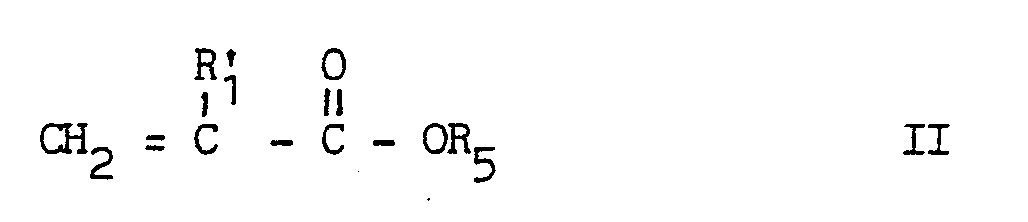
worin R'1 für Wasserstoff oder Methyl und R5 für einen Alkylrest mit 6 - 18 Kohlenstoffatanen steht,
enthalten, wobei die Polymerisate P mittlere Molmassen M zwischen 50 000 und 300 000 besitzen.
Applications Claiming Priority (2)
| Application Number | Priority Date | Filing Date | Title |
|---|---|---|---|
| DE19843447421 DE3447421A1 (de) | 1984-12-24 | 1984-12-24 | Polymere verdickungsmittel fuer waessrige hydraulikfluessigkeiten |
| DE3447421 | 1984-12-24 |
Publications (2)
| Publication Number | Publication Date |
|---|---|
| EP0186034A2 true EP0186034A2 (de) | 1986-07-02 |
| EP0186034A3 EP0186034A3 (de) | 1989-04-05 |
Family
ID=6253909
Family Applications (1)
| Application Number | Title | Priority Date | Filing Date |
|---|---|---|---|
| EP85115674A Withdrawn EP0186034A3 (de) | 1984-12-24 | 1985-12-10 | Polymere Verdickungsmittel für wässrige Hydraulikflüssigkeiten |
Country Status (6)
| Country | Link |
|---|---|
| EP (1) | EP0186034A3 (de) |
| JP (1) | JPS61157588A (de) |
| DE (1) | DE3447421A1 (de) |
| DK (1) | DK604185A (de) |
| FI (1) | FI855008A7 (de) |
| NO (1) | NO854438L (de) |
Cited By (1)
| Publication number | Priority date | Publication date | Assignee | Title |
|---|---|---|---|---|
| EP0279783A1 (de) * | 1987-02-18 | 1988-08-24 | Ciba-Geigy Ag | Insektizide und Parasitizide |
Families Citing this family (2)
| Publication number | Priority date | Publication date | Assignee | Title |
|---|---|---|---|---|
| BR8805577A (pt) * | 1987-10-30 | 1989-07-11 | Henkel Corp | Lubrificantes para fibras e processos para lubrificar fibras texteis e para aperfeicoar o efeito lubrificante de um lubrificante |
| FI901360A7 (fi) * | 1988-07-25 | 1990-03-19 | Po Turboatom | Palamaton voiteluneste |
Family Cites Families (2)
| Publication number | Priority date | Publication date | Assignee | Title |
|---|---|---|---|---|
| US3689470A (en) * | 1969-09-10 | 1972-09-05 | Rohm & Haas | Method of producing betaines,monomers and polymers containing betaine-type units and novel and useful copolymers thereby obtained |
| US4432881A (en) * | 1981-02-06 | 1984-02-21 | The Dow Chemical Company | Water-dispersible hydrophobic thickening agent |
-
1984
- 1984-12-24 DE DE19843447421 patent/DE3447421A1/de not_active Withdrawn
-
1985
- 1985-11-07 NO NO854438A patent/NO854438L/no unknown
- 1985-12-10 EP EP85115674A patent/EP0186034A3/de not_active Withdrawn
- 1985-12-17 FI FI855008A patent/FI855008A7/fi not_active IP Right Cessation
- 1985-12-23 DK DK604185A patent/DK604185A/da not_active Application Discontinuation
- 1985-12-24 JP JP60289529A patent/JPS61157588A/ja active Pending
Cited By (1)
| Publication number | Priority date | Publication date | Assignee | Title |
|---|---|---|---|---|
| EP0279783A1 (de) * | 1987-02-18 | 1988-08-24 | Ciba-Geigy Ag | Insektizide und Parasitizide |
Also Published As
| Publication number | Publication date |
|---|---|
| DE3447421A1 (de) | 1986-06-26 |
| FI855008A0 (fi) | 1985-12-17 |
| EP0186034A3 (de) | 1989-04-05 |
| NO854438L (no) | 1986-06-25 |
| JPS61157588A (ja) | 1986-07-17 |
| DK604185A (da) | 1986-06-25 |
| DK604185D0 (da) | 1985-12-23 |
| FI855008A7 (fi) | 1986-06-25 |
Similar Documents
| Publication | Publication Date | Title |
|---|---|---|
| EP0236844B1 (de) | Verwendung von additiven für Mineralöle mit stockpunktverbessernder Wirkung | |
| EP0225598B1 (de) | Hochscherstabile Mehrbereichsschmieröle mit verbessertem Viskositätsindex | |
| EP2445984B1 (de) | Additive zur inhibierung der gashydratbildung | |
| EP0418610B1 (de) | Dispergierwirksame Viskositäts-Index-Verbesserer | |
| EP0140274B2 (de) | Additive für Schmieröle | |
| EP0324887B1 (de) | Zusammensetzungen zur Befreiung festgesetzter Bohrgestänge | |
| EP1652909B1 (de) | Korrosionsschutzmittel für funktionelle Flüssigkeiten, wassermischbares Konzentrat und dessen Verwendung | |
| EP0088904B1 (de) | Konzentrierte Emulsionen von Olefincopolymerisaten | |
| EP0436872B1 (de) | Kraftübertragungsflüssigkeit auf Basis Mineralöl | |
| DE2658952A1 (de) | Alkylacrylat- oder insbesondere alkylmethacrylat-polymerisatgemisch sowie eine dasselbe enthaltende schmieroelformulierung | |
| EP0151467A2 (de) | Wässrige Funktionsflüssigkeiten auf der Basis von Polymeren | |
| DE2740449A1 (de) | Verfahren zur herstellung von schmieroelzusaetzen | |
| DE3214144C2 (de) | ||
| EP0728780B1 (de) | Pfropfpolymere mit Emulgatoreigenschaften | |
| DE10151187A1 (de) | Invertormischungen für Polymerdispersionen mit verbesserter Umweltverträglichkeit | |
| DE4227436A1 (de) | Mehrbasige saeureester als korrosionshemmer fuer oelbohrungen | |
| EP0090168A1 (de) | Konzentrierte Emulsionen von Olefincopolymerisaten | |
| DE3447421A1 (de) | Polymere verdickungsmittel fuer waessrige hydraulikfluessigkeiten | |
| EP2576644B1 (de) | Additive zur inhibierung der gashydratbildung | |
| EP1561005A2 (de) | Vinyllactamcopolymerisate als gashydratinhibitoren | |
| EP0398153A1 (de) | Wässrige Funktionsflüssigkeiten enthaltend Verdickungsmittel auf Poly(meth)acrylat-Basis | |
| EP0547519A1 (de) | Verfahren zur Herstellung einer wasserlöslichen Polymersuspension | |
| DE3329561C2 (de) | ||
| DE2005043C3 (de) | Verfahren zur Herstellung von anaerob polymerisierbaren flüssigen Mischungen mit erhöhter Härtungsgeschwindigkeit | |
| DE19641620A1 (de) | Schmiermittelzusammensetzung |
Legal Events
| Date | Code | Title | Description |
|---|---|---|---|
| PUAI | Public reference made under article 153(3) epc to a published international application that has entered the european phase |
Free format text: ORIGINAL CODE: 0009012 |
|
| AK | Designated contracting states |
Kind code of ref document: A2 Designated state(s): BE CH FR GB IT LI NL SE |
|
| PUAL | Search report despatched |
Free format text: ORIGINAL CODE: 0009013 |
|
| AK | Designated contracting states |
Kind code of ref document: A3 Designated state(s): BE CH FR GB IT LI NL SE |
|
| 17P | Request for examination filed |
Effective date: 19890421 |
|
| STAA | Information on the status of an ep patent application or granted ep patent |
Free format text: STATUS: THE APPLICATION HAS BEEN WITHDRAWN |
|
| 18W | Application withdrawn |
Withdrawal date: 19900126 |
|
| R18W | Application withdrawn (corrected) |
Effective date: 19900126 |
|
| RIN1 | Information on inventor provided before grant (corrected) |
Inventor name: FROEHLICH, AUGUST Inventor name: PENNEWISS, HORST, DR. Inventor name: HITZLER, OTTO |