EP0186047A2 - Kerbschlagzähe Thermoplastformmassen - Google Patents
Kerbschlagzähe Thermoplastformmassen Download PDFInfo
- Publication number
- EP0186047A2 EP0186047A2 EP85115780A EP85115780A EP0186047A2 EP 0186047 A2 EP0186047 A2 EP 0186047A2 EP 85115780 A EP85115780 A EP 85115780A EP 85115780 A EP85115780 A EP 85115780A EP 0186047 A2 EP0186047 A2 EP 0186047A2
- Authority
- EP
- European Patent Office
- Prior art keywords
- shell
- graft
- weight
- monomers
- core
- Prior art date
- Legal status (The legal status is an assumption and is not a legal conclusion. Google has not performed a legal analysis and makes no representation as to the accuracy of the status listed.)
- Granted
Links
Classifications
-
- C—CHEMISTRY; METALLURGY
- C08—ORGANIC MACROMOLECULAR COMPOUNDS; THEIR PREPARATION OR CHEMICAL WORKING-UP; COMPOSITIONS BASED THEREON
- C08F—MACROMOLECULAR COMPOUNDS OBTAINED BY REACTIONS ONLY INVOLVING CARBON-TO-CARBON UNSATURATED BONDS
- C08F285/00—Macromolecular compounds obtained by polymerising monomers on to preformed graft polymers
-
- C—CHEMISTRY; METALLURGY
- C08—ORGANIC MACROMOLECULAR COMPOUNDS; THEIR PREPARATION OR CHEMICAL WORKING-UP; COMPOSITIONS BASED THEREON
- C08L—COMPOSITIONS OF MACROMOLECULAR COMPOUNDS
- C08L57/00—Compositions of unspecified polymers obtained by reactions only involving carbon-to-carbon unsaturated bonds
-
- Y—GENERAL TAGGING OF NEW TECHNOLOGICAL DEVELOPMENTS; GENERAL TAGGING OF CROSS-SECTIONAL TECHNOLOGIES SPANNING OVER SEVERAL SECTIONS OF THE IPC; TECHNICAL SUBJECTS COVERED BY FORMER USPC CROSS-REFERENCE ART COLLECTIONS [XRACs] AND DIGESTS
- Y10—TECHNICAL SUBJECTS COVERED BY FORMER USPC
- Y10S—TECHNICAL SUBJECTS COVERED BY FORMER USPC CROSS-REFERENCE ART COLLECTIONS [XRACs] AND DIGESTS
- Y10S525/00—Synthetic resins or natural rubbers -- part of the class 520 series
- Y10S525/902—Core-shell
Definitions
- the invention relates to thermoplastic graft polymers with a particulate structure and a certain shell-shaped structure made of a special polymer.
- the graft polymers consist of an acrylate rubber of the 1st casing, which contains a core of a diene rubber, and a 2nd casing surrounding the acrylate rubber made of copolymer resin-forming monomers and special polyallyl monomers and an outer 3rd casing made of grafted copolymer resin-forming monomers.
- Notched impact-resistant polymers based on acrylate rubber are known which have improved properties in the elastomer phase due to a certain core-shell structure (EP-A 34 748).
- the invention relates to a process for the production of particulate graft polymers, which is characterized in that in the presence of (b) 10-80% by weight, based on the graft polymer, of a particulate, highly crosslinked acrylate rubber having an average particle diameter (d 50 ) of 0.2-1.0 ⁇ m, the particles of which contain (a) diene rubber core, (c) graft-polymerized a mixture of resin-forming vinyl monomers and polyallyl monomers (with at least 3 allyl groups in the molecule) in emulsion, and (d) the graft polymer thus formed with at least a further vinyl monomer graft-polymerized, the sum of (c) and (d) making up 90-20% by weight of the graft polymer mentioned.
- Another object of the invention is the use of these particulate graft polymers optionally in a mixture with brittle thermoplastic resins, preferably copolymers of styrene and acrylonitrile, ⁇ -methylstyrene and acrylonitrile, methyl methacrylate homo- or copolymers or vinyl chloride homo- or copolymers - as a thermoplastic molding composition.
- brittle thermoplastic resins preferably copolymers of styrene and acrylonitrile, ⁇ -methylstyrene and acrylonitrile, methyl methacrylate homo- or copolymers or vinyl chloride homo- or copolymers - as a thermoplastic molding composition.
- the invention thus furthermore relates to particulate graft polymers comprising a core a) which is a crosslinked diene rubber, a first shell b) which is a crosslinked acrylic rubber, a second shell c) which is a copolymer of resin-forming monomers and polyallyl monomers with at least three Allyl groups in the molecule and a third shell d), which is a copolymer or homopolymer of resin-forming monomers, which can be obtained by the above-mentioned method.
- the material of the core (a) is a cross-linked rubber made from one or more conjugated dienes, such as poly butadiene or a copolymer of a conjugated diene with an ethylenically unsaturated monomer such as styrene and / or acrylonitrile.
- conjugated dienes such as poly butadiene or a copolymer of a conjugated diene with an ethylenically unsaturated monomer such as styrene and / or acrylonitrile.
- the first shell (b) is a crosslinked acrylate rubber and is in particular a crosslinked polymer made from alkyl acrylates, optionally in a mixture with up to 40% by weight of other vinyl monomers.
- Suitable polymerizable acrylic acid esters include C 1 -C a -alkyl esters, for example methyl, ethyl, butyl, octyl and 2-ethylhexyl esters, haloalkyl esters, preferably C 1 -C 8 -haloalkyl esters, such as chloroethyl acrylate, and aromatic esters such as benzyl acrylate and phenethyl acrylate.
- esters of unsaturated carboxylic acids with a polyol preferably 2 to 20 carbon atoms in the ester group, such as ethylene glycol dimethacrylate, esters of a polybasic carboxylic acid with an unsaturated alcohol (preferably 8 to 30 carbon atoms in the ester residue), such as triallyl cyanurate; triallyl isocyanurate; divinyl compounds such as divinylbenzene; Esters of unsaturated carboxylic acids with unsaturated alcohols (preferably 6 to 12 carbon atoms in the ester radical), such as allyl methacrylate; phosphoric acid esters, for example triallyl phosphate and 1,3,5-triacryloyl-hexahydro-s-triazine.
- Particularly preferred polyfunctional monomers are triallyl cyanurate, triallyl isocyanurate, triallyl phosphate, and , Ethylene glycol dimethyl acrylate and 1,3,5-triacryloylhexahydro-s-triazine.
- the amount of the polyfunctional monomers used for crosslinking is preferably 0.05 to 5% by weight, in particular 0.2 to 3.0% by weight, of the mass of the first shell (b).
- the elastomer of the first shell (b) may additionally contain a copolymerizable monomer or a plurality of such monomers of the vinyl or vinylidene type in copolymerized form. Examples are: methyl methacrylate, butyacrylate, acrylonitrile, styrene, ⁇ -methylstyrene, acrylamides, vinyl alkyl ethers. These comonomers can be copolymerized in amounts of up to 40% by weight of the polymer (b).
- the second shell (c) represents a graft polymerized polymer of resin-forming monomers and polyallyl monomers with at least three allyl groups in the molecule; for this purpose, the shell is produced by copolymerization of 99.9-90% by weight (in particular 99-95% by weight) of resin-forming monomers and 0.1-10 (in particular 1-5)% by weight of polyallyl monomer.
- Suitable resin-forming monomers for the shell (c) are: oL-methylstyrene, p-methylstyrene, styrene, halostyrenes, acrylonitrile, methacrylonitrile, methyl methacrylate, cyclohexyl methacrylate, butyl methacrylate, vinyl chloride, preferably mixtures of styrene / acrylonitrile (in a ratio of 90:10 to 60 : 40), from methyl methacrylate / acrylonitrile and / or styrene (in a ratio of 100: 0 to 50:50), from ⁇ -methylstyrene / acrylonitrile (in a ratio of 75:25 to 65:35) and terpolymers from ⁇ -methylstyrene, acrylonitrile and methyl methacrylate; Compounds with at least three allyl groups in the molecule are suitable as polyallyl monomers; these monomers
- allyl groups Such polyallyl monomers are, for example, triallyl cyanurate, triallyl isocyanurate, triallyl phosphoric acid, allyl citrate, triallyl triazine, triallyl benzene, allyl polycarboxylate such as, for example, allyl polymethacrylic acid, pentaerythritol allyl ester, glycerol triallyloxybenzene with trisallyl oxychloride, trisallyl allyl ether, trisallyl oxychloride Triallyl cyanurate or triallyl isocyanurate are preferred.
- the third shell (d) is a grafted polymer made from resin-forming monomers.
- Suitable resin-forming monomers here are: ⁇ -methylstyrene, styrene, halostyrene, p-methylstyrene, acrylonitrile, methacrylonitrile, methyl methacrylate. Copolymers of styrene / acrylonitrile and copolymers containing methyl methacrylate are particularly preferred.
- the graft polymers according to the invention can be prepared in an aqueous emulsion as follows: First, the diene rubber for the core (a) is prepared in latex form by emulsion polymerization of a conjugated diene. This polymerization is known. Then In the presence of this latex, also in an aqueous emulsion, the acrylate rubber for the first shell (b) is produced by emulsifying the monomers (main constituent at least one acrylate) in the latex and polymerizing them in a manner known per se by means of radical-forming initiators. The acrylate rubber polymerizes on the diene rubber; it can be crosslinked during production by using polyfunctional monomers.
- the formation of new particles must be prevented as completely as possible.
- An emulsion stabilizer must be present in the amount required to cover the surface of the particles.
- the size of these particles can be varied within wide limits by carrying out the reaction. If an agglomerated latex is used as core (a) in order to obtain large particles, these can contain several diene rubber particles.
- the polymerization of the first shell (b) can also be carried out in such a way that particles with a diene rubber core and, at the same time, particles of pure crosslinked acrylate rubber are produced. Such mixtures can also be used in special circumstances to produce impact-resistant molding compositions.
- the second shell (c) is graft-polymerized onto the resulting latex by adding a mixture of the resin-forming vinyl monomers mentioned and polyallyl monomers within the meaning of the invention into the latex introduces and graft-polymerized by means of radical initiators, in particular of the water-soluble type.
- the procedure can be such that the graft polymerization of the shell (d) is already started during the graft polymerization of the shell (c).
- Graft polymers according to the invention therefore have a fuzzy transition between shell (c) and shell (d) and the structure of the shell must therefore differ from those shells in which the graft polymerization of (d) only begins after graft polymerization of (c) has completed becomes.
- thermoplastic shell (d) onto the preformed latex particles from (a), (b) and proportionate (c) - as already mentioned - vinyl monomers are radically polymerized in emulsion, temperatures normally of 40-90 ° C., in particular 50 - 75 ° C, are particularly suitable.
- the graft polymers according to the invention form with the formation of the various shells.
- these graft polymerizations known per se which are usually in the presence of radical initiators, For example, water-soluble initiators, emulsifiers or complexing agents and regulators are carried out, free polymers or copolymers of the monomers forming the shell generally form in addition to the graft polymer to a certain extent.
- the amount of this ungrafted polymer can be characterized by the degree of grafting or the grafting yield, it depends, inter alia, on the polymerization conditions, the composition of the grafting base, the size of the particles to be grafted, and the amount of grafting base.
- "P fropfpolymeri- sat" in the sense of the invention is therefore the product obtained by polymerization of vinyl monomers in the presence of the rubber latex, strictly speaking, that is, a mixture of graft polymer and free copolymer of the graft monomers.
- the graft polymers prepared in this way can be worked up by known processes. e.g. by coagulation of the latices with electrolytes (salts, acids or mixtures thereof and subsequent cleaning and drying) or by spray drying.
- the graft polymers of this invention are impact resistant thermoplastic molding compounds of high Witterun s and q aging resistance with improved heat resistance and improved processability.
- the presence of the shell (c) in the graft polymerization according to the invention does not impair its thermoplastic processing - via the molten state - but has a positive effect on the surface properties of, for example, injection molded or extruded moldings works.
- the formation of specks can be expected in the extrusions into films, which can have a very disadvantageous effect on the strength level of the film.
- the graft polymers according to the invention have a significantly lower tendency to form specks.
- the advantages outlined above, compared to known acrylic rubber molding compounds, are particularly evident when the special polyallyl monomers are used to construct the shell (c).
- the graft polymer according to the invention can be used directly from the molding compound if it consists of approximately 5 to 40% by weight of core (a) and first shell (b), based on the entire graft polymer. If the - (a) plus (b) content is higher, a brittle resin can be mixed. Brittle resins are preferably styrene, methyl methacrylate, acrylonitrile terpolymers, styrene or methylstyrene, acrylonitrile terpolymers or methyl methacrylate homopolymers or copolymers as well as vinyl chloride homopolymers or copolymers.
- the molding compositions according to the invention can contain dyes and pigments, stabilizers against the effects of light and heat, plasticizers, foaming agents and organic or inorganic fillers in the form of granules, powders or fibers. They can be deformed, for example, by injection molding or by extrusion and are suitable for moldings of all types which must be weather-resistant and impact-resistant. For example, they can also serve as the outer layer of a laminate made of several different polymers.
- Parts and percentages in the following exemplary embodiments are always parts by weight and percent by weight.
- a latex which contains butadiene / styrene copolymer particles having an average diameter (d 50 ) of 0.1 ⁇ in a concentration of approximately 40%.
- the average diameter d 50 is that above and below which 50% by weight of old particles lie).
- the following are placed in a reactor: 9.5 parts by weight of the latex 1.1 and 286 parts by weight of water. After heating to 65 ° C, 22 parts by weight solution 1) and then using a solution of 0.75 part by weight. Potassium peroxydisulfate in 18 parts by weight Water initiated. The rest of solution 1) and solution 2) are then metered uniformly into the reactor at 65 ° C. within 5 hours. After metering in, the mixture is polymerized at 65 ° C. for 4 hours.
- a latex which contains the polymer in a concentration of 37% by weight, the average particle diameter (d 50 value) is 0.42 ⁇ m.
- the polymerization is then initiated by adding a solution of 0.49 parts by weight. Potassium peroxydisulfate in 10 parts by weight Water.
- the resulting latex has a solids content of 33% by weight.
- the mixture is stirred at 75 ° C. for 4 hours.
- the resulting latex has a solids content of 33% by weight.
- the polymerization is then initiated by adding a solution of 0.45 part by weight. Potassium peroxydisulfate in 10 parts by weight Water. After a polymerization time of 1.5 hours, the monomers polymerized completely.
- the mixture is stirred at 75 ° C. for 4 hours.
- the resulting latex has a polymer solids content of 33% by weight.
- step 1.3 The procedure according to 1 is repeated, but in step 1.3 with solution 1) instead of styrene / acrylonitrile 47.6 parts by weight. Methyl methacrylate used.
- a latex which contains polybutadiene particles with an average diameter (d 50 ) of 0.4 ⁇ m in a concentration of 58%.
- the latex formed has a broad particle distribution of 0.2-0.9 ⁇ m and a solid of 35% by weight.
- the polymerization is then initiated by adding a solution of 0.6 part by weight. Potassium peroxydisulfate in 10 parts by weight Water.
- the mixture is stirred at 75 ° C. for 4 hours.
- the resulting latex has a polymer solids content of 34% by weight.
- the polymer is worked up in accordance with Section 8.
- Regulation 6.2 is repeated, with the change that instead of latex 6.1, the corresponding amount of water is placed in the reactor. Then proceed as in 6.2.
- the emulsions are mixed with 1.2 g . phenolic antioxidants, based on 100 parts of polymer, precipitated with a coagulation solution of Mg sulfate and acetic acid, washed with Water and then dried. The resulting polymer powders are then processed thermoplastically.
- Suspension PVC (with a K value of 70) 15 parts by weight Trimellitic acid C 1 -C 11 alkyl ester, 10 parts by weight a copolymer of 70 wt .-% vinyl acetate and 30 wt .-% ethylene and a graft polymer (50 parts by weight) are at 180 ° C for 15 min. rolled. The resulting compound is then pressed at 190 ° C. into a film with a thickness of 1 mm. The properties of the films are shown in Table 2.
Landscapes
- Chemical & Material Sciences (AREA)
- Health & Medical Sciences (AREA)
- Chemical Kinetics & Catalysis (AREA)
- Medicinal Chemistry (AREA)
- Polymers & Plastics (AREA)
- Organic Chemistry (AREA)
- Graft Or Block Polymers (AREA)
- Compositions Of Macromolecular Compounds (AREA)
Abstract
Description
- Die Erfindung betrifft thermoplastische Pfropfpolymerisate mit partikelförmiger Struktur und einem bestimmten schalenförmigen Aufbau aus speziellem Polymerisat.
- Im Prinzip bestehen die Pfropfpolymerisate aus einem Acrylatkautschuk der 1. Hülle, der als Kern einen Dienkautschuk enthält sowie einer den Acrylatkautschuk umgebenden 2. Hülle aus Copolymerisat harzbildender Monomerer und spezieller Polyallylmonomerer und einer äußeren 3. Hülle aus gepfropftem Copolymerisat harzbildener Monomerer.
- Bekannt sind kerbschlagzähe Polymerisate auf Acrylatkautschukbasis, die durch eine bestimmte Kern-Hüllen-Struktur in der Elastomerphase verbesserte Eigenschaften haben (EP-A 34 748).
- Bekannt sind weiterhin (vgl. US-PS 3 944 631) StyrolAcrylnitril-Pfropfpolymerisate auf vernetzte Acrylatkautschuke, in denen ein Teil des Styrol-Acrylnitril- Polymerisates vernetzt ist; solche Produkte besitzen Zähigkeit und Alterungsstabilität.
- Es wurde gefunden, daß man weitere Produkteigenschaften verbessern kann, wenn man in den Pfropfpolymerisaten sowohl der Elastomerphase als auch der Harzphase einen bestimmten Gradienten- oder Schalenaufbau vorsieht, wobei spezielle Comonomere eingesetzt werden; derartige Polymerisate besitzen verbesserte Wärmestandfestigkeiten, auch in Kombination mit anderen spröden Harzen, verbesserte Verarbeitbarkeit und liefern Formkörper, insbesondere Folien, ohne Fehlstellen und Inhomogenitäten.
- Gegenstand der Erfindung ist ein Verfahren zur Herstellung von teilchenförmigen Pfropfpolymerisaten, das dadurch gekennzeichnet ist, daß man in Anwesenheit von (b) 10-80 Gew.-%, bezogen auf Pfropfpolymerisat, eines teilchenförmigen stark vernetzten Acrylatkautschuks mit einem mittleren Teilchendurchmesser (d50) von 0,2-1,0 µm, dessen Teilchen einen (a) Dienkautschukkern enthalten, (c) eine Mischung aus harzbildenden Vinylmonomeren und Polyallylmonomeren (mit wenigstens 3 Allylgruppen im Molekül) in Emulsion propfpolymerisiert und (d) das so gebildete Pfropfpolymerisat mit wenigstens einem weiteren Vinylmonomeren pfropfpolymerisiert, wobei die Summe aus (c) und (d) 90-20 Gew.-% des genannten Pfropfpolymerisats ausmacht.
- Ein weiterer Gegenstand der Erfindung ist die Verwendung dieser teilchenförmigen Pfropfpolymerisate - gegebenenfalls im Gemisch mit spröden thermoplastischen Harzen, bevorzugt Copolymerisate von Styrol und Acrylnitril, α-Methylstyrol und Acrylnitril, Methylmethacrylathomo- oder Copolymerisaten oder Vinylchloridhomo-oder Copolymerisaten, - als thermoplastische Formmasse.
- Ein weiterer Gegenstand der Erfindung sind somit teilchenförmige Pfropfpolymerisate, enthaltend einen Kern a), der einen vernetzten Dienkautschuk darstellt, eine erste Hülle b) die einen vernetzten Acrylkautschuk darstellt, eine zweite Hülle c), die ein Copolymerisat aus harzbildenden Monomeren und Polyallylmonomeren mit wenigstens drei Allylgruppen im Molekül darstellt und eine dritte Hülle d), die ein Copolymer oder Homopolymer aus harzbildenden Monomeren darstellt, die nach dem oben angegebenen Verfahren erhältlich sind.
- Bevorzugt ist darin enthalten A) der Kern a) in Mengen von 0,5 bis 10 Gew.-%, bezogen auf das Gesamtgewicht von Kern a) und Hülle b), B) das Gesamtgewicht von Kern a) und Hülle b) ist 10 bis 80 Gew.-% (insbesondere 27 bis 70 Gew.-%), bezogen auf das gesamte Pfropfpolymerisat, C) die Teilchen aus Kern a) mit Hülle b) haben einen mittleren Durchmesser von 0,2 - 1 pm (insbesondere 0,4 - 0,6 pm) (dSO-Werte) und D) die Hülle c) weist die Mengen von 2,5 bis 20 Gew.-%, bezogen auf die Summe der Gewichte von Hülle c) und Hülle d) vor.
- Das Material des Kerns (a) ist ein vernetzter Kautschuk aus einem oder mehreren konjugierten Dienen, wie Polybutadien oder ein Copolymerisat eines konjugierten Diens mit einem ethylenisch ungesättigten Monomer wie Styrol und/oder Acrylnitril.
- Die erste Hülle (b) stellt einen vernetzten Acrylatkautschuk dar und ist insbesondere ein vernetztes Polymerisat aus Acrylsäurealkylestern, gegebenenfalls in Mischung mit bis zu 40 Gew.-% anderen Vinylmonomeren. Zu den geeigneten polymerisierbaren Acrylsäureestern gehören C1-Ca-Alkylester, beispielsweise Methyl-, Ethyl-, Butyl-, Octyl- und 2-Ethylhexylester, Halogenalkylestern, bevorzugt C1-C8-Halogenalkylester, wie Chlorethylacrylat, und aromatische Ester wie Benzylacrylat und Phenethylacrylat. Sie können einzeln oder in Mischung eingesetzt werden, wobei mindestens ein Alkylester im Gemisch vorhanden sein soll. Zur Vernetzung werden polyfunktionelle Monomere copolymerisiert. Beispiele sind: Ester von ungesättigten Carbonsäuren mit einem Polyol (vorzugsweise 2 bis 20 Kohlenstoffatome in der Estergruppe, wie Ethylenglykoldimethacrylat, Ester einer mehrbasischen Carbonsäure mit einem ungesättigten Alkohol (vorzugsweise 8 bis 30 Kohlenstoffatome im Esterrest), wie Triallylcyanurat; Triallylisocyanurat; Divinylverbindungen wie Divinylbenzol; Ester ungesättigter Carbonsäuren mit ungesättigten Alkoholen (bevorzugt 6 bis 12 Kohlenstoffatomen im Esterrest), wie Allylmethacrylat; Phosphorsäureester, beispielsweise Triallylphosphat und 1,3,5-Triacryloyl-hexahydro-s-triazin. Besonders bevorzugte polyfunktionelle Monomere sind Triallylcyanurat, Triallylisocyanurat, Triallylphosphat, Allylmethacrylat, Ethylenglykoldimethylacrylat und 1,3,5-Triacryloylhexahydro-s-triazin.
- Die Menge der zur Vernetzung benutzten polyfunktionellen Monomeren ist bevorzugt 0,05 bis 5 Gew.-%, insbesondere 0,2 bis 3,0 Gew.-% der Masse der ersten Hülle (b). Das Elastomer der ersten Hülle (b) kann zusätzlich noch ein copolymerisierbares Monomeres oder mehrere solcher Monomerer vom Vinyl- oder-Vinylidentyp einpolymerisiert enthalten. Beispiele sind: Methylmethacrylat, Butyacrylat, Acrylnitril, Styrol, α -Methylstyrol, Acrylamide, Vinylalkylether. Diese Comonomeren können in Mengen bis zu 40 Gew.-% des Polymerisates (b) einpolymerisiert werden. Die zweite Hülle (c) stellt ein pfropfpolymerisiertes Polymerisat aus harzbildenden Monomeren und Polyallylmonomeren mit wenigstens drei Allylgruppen im Molekül dar; dazu wird die Hülle hergestellt durch Copolymerisation von 99,9 - 90 Gew.-% (insb. 99 - 95 Gew.-%) harzbildender Monomerer und 0,1 - 10 (insbesondere 1 - 5) Gew.-% Polyallylmonomer.
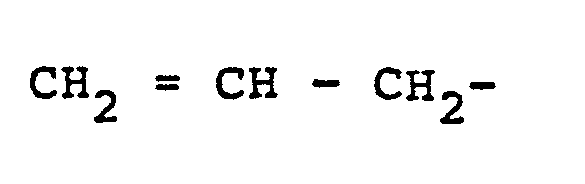
- Als harzbildende Monomere für die Hülle (c) sind geeignet: oL-Methylstyrol, p-Methylstyrol, Styrol, Halogenstyrole, Acrylnitril, Methacrylnitril, Methylmethacrylat, Cyclohexylmethacrylat, Butylmethacrylat, Vinylchlorid, vorzugsweise Mischungen aus Styrol/Acrylnitril (im Verhältnis 90:10 bis 60:40), aus Methylmethacrylat/ Acrylnitril und/oder Styrol (im Verhältnis 100:0 bis 50:50), aus α-Methylstyrol/Acrylnitril (im Verhältnis von 75:25 bis 65:35) und Terpolymerisate aus α -Methylstyrol, Acrylnitril und Methylmethacrylat; als Polyallylmonomere sind Verbindungen mit wenigstens drei Allylgruppen im Molekül geeignet; diese Monomere können cyclisch oder offenkettig sein; bevorzugt sind cyclische Monomere; bevorzugt sind weiterhin Monomere, die als ungesättigte, olefinische Gruppen nur Allylgruppen enthalten, also keine Vinyl- oder Vinylidengruppen. Als Allylgruppen werden folgende unsubstituierten Gruppierungen bezeichnet:
- Die dritte Hülle (d) stellt ein gepfropftes Polymerisat aus harzbildenden Monomeren dar. Als harzbildende Monomere sind hierbei geeignet:α-Methylstyrol, Styrol, Halogenstyrol, p-Methylstyrol, Acrylnitril, Methacrylnitril, Methylmethacrylat. Besonders bevorzugt sind Copolymere aus Styrol/Acrylnitril sowie Methylmethacrylat enthaltende Copolymerisate.
- Die erfindungsgemäßen Pfropfpolymerisate können in wäßriger Emulsion wie folgt hergestellt werden: zunächst wird durch Emulsionspolymerisation eines konjugierten Diens der Dienkautschuk für den Kern (a) in Latexform hergestellt. Diese Polymerisation ist bekannt. Dann wird in Gegenwart dieses Latex, ebenfalls in wäßriger Emulsion, der Acrylatkautschuk für die erste Hülle (b) hergestellt, indem man die Monomeren (Hauptbestandteil wenigstens ein Acrylat) in dem Latex emulgiert und in an sich bekannter Weise mittels radikalbildender Initiatoren polymerisiert. Der Acrylatkautschuk polymerisiert auf dem Dienkautschuk; er kann durch Mitverwendung polyfunktioneller Monomerer bereits bei der Herstellung vernetzt werden.
- Bei dieser Pfropfpolymerisation der ersten Hülle (b) muß die Bildung neuer Teilchen möglichst vollständig unterbunden werden. Ein Emulsionsstabilisator muß in zur Oberflächenbedeckung der Teilchen erforderlichen Menge vorhanden sein. Die Größe dieser Teilchen ist durch die Reaktionsführung in weiten Grenzen zu variieren. Verwendet man als Kern (a) einen agglomerierten Latex, um große Teilchen zu erhalten, so können diese mehrere Dienkautschukpartikel enthalten. Man kann die Polymerisation der ersten Hülle (b) auch so führen, daß Partikel mit Dienkautschukkern und gleichzeitig Partikel aus reinem vernetzten Acrylatkautschuk erzeugt werden. Auch solche Mischungen können unter besonderen Umständen zur Herstellung schlagfester Formmassen dienen.
- Nach Beendigung der Pfropfpolymerisation des Acrylatkautschuks (Hülle (b)) wird auf den anfallenden Latex die zweite Hülle (c) pfropfpolymerisiert, indem man ein Gemisch aus den genannten harzbildenden Vinylmonomeren und Polyallylmonomeren im Sinne der Erfindung in den Latex einbringt und radikalisch mittels Radikalinitiatoren, insbesondere des wasserlöslichen Typs, pfropfpolymerisiert. Dabei kann so vorgegangen werden, daß bereits während der Pfropfpolymerisation der Hülle (c) mit der Pfropfpolymerisation der Hülle (d) begonnen wird. Dieses Vorgehen hat zur Folge, daß der Gehalt an Polyallylverbindung (als Comonomer der die Hülle (c) bildenden Monomeren) kontinuierlich in der Schicht (c) (oder besonders im Grenzbereich zwischen Schicht (c) und Schicht (d)) abnimmt: In den erfindungsgemäßen Pfropfpolymerisaten liegt also ein unscharfer übergang zwischen Hülle (c) und Hülle (d) vor und der Aufbau der Hülle muß sich somit von solchen Hüllen unterscheiden, bei denen erst nach vollständig abgelaufener Pfropfpolymerisation von (c) mit der Pfropfpolymerisation von (d) begonnen wird.
- Unter Pfropfpolymerisation der die thermoplastische Hülle (d) bildenden Vinylmonomere auf die vorgebildeten Latexpartikel aus (a), (b) und anteilmäßigem (c) werden - wie bereits gesagt - Vinylmonomere in Emulsion radikalisch polymerisiert, wobei normalerweise Temperaturen von 40 - 90°C, insbesondere 50 - 75°C, besonders geeignet sind.
- Weiterhin ist zu erwähnen, daß nicht nur (d) auf (c), sondern auch (c) auf (b) und (b) auf (a) pfropfpolymerisiert vorliegen. Bei den Polymerisationen im Sinne der Erfindung bilden sich die erfindungsgemäßen Pfropfpolymerisate unter Ausbildung der verschiedenen Hüllen. Bei diesen an sich bekannten Pfropfpolymerisationen, die üblicherweise in Gegenwart von Radikalstartern, z.B. wasserlöslichen Initiatoren, Emulgatoren oder Komplexbildnern sowie Reglern durchgeführt werden, bilden sich im allgemeinen neben dem Pfropfpolymerisat im bestimmten Ausmaß freie Polymerisate bzw. Copolymerisate der die Hülle bildenden Monomeren. Die Menge dieses ungepfropften Polymerisats kann durch den Pfropfgrad bzw. die Pfropfausbeute charakterisiert werden, sie hängt ab u.a. von den Polymerisationsbedingungen, der Zusammensetzung der Pfropfbasis, der Größe der zu pfropfenden Teilchen, und der Menge an Pfropfbasis. "Pfropfpolymeri- sat" im Sinne der Erfindung ist deshalb das durch Polymerisation von Vinylmonomeren in Gegenwart des Kautschuklatex erhaltene Produkt, genau genommen also ein Gemisch aus Pfropfpolymerisat und freiem Copolymerisat der Pfropfmonomeren.
- Die so hergestellten Pfropfpolymerisate können nach bekannten Verfahren aufgearbeitet werden. z.B. durch Koagulation der Latices mit Elektrolyten (Salze, Säuren oder Gemische davon) und anschließende Reinigung und Trocknung) oder durch Sprühtrocknung.
- Die erfindungsgemäßen Pfropfpolymerisate sind kerbschlagzähe thermoplastische Formmassen hoher Witterunqs-und Alterungsbeständigkeit mit verbesserter Wärmeformbeständigkeit und verbesserter Verarbeitbarkeit. Insbesondere war es überraschend, daß durch die Gegenwart der Hülle (c) in der erfindungsgemäßen Pfropfpolymerisation deren thermoplastische Verarbeitung - über den geschmolzenen Zustand - nicht beeinträchtigt wird, sondern sich positiv auf die Oberflächeneigenschaften von z.B. spritzgegossenem oder extrudierten Formkörpern auswirkt. Beispielsweise ist bei den Extrusionen zu Folien mit der Bildung von Stippen zu rechnen, welche sich sehr nachteilig auf das Festigkeitsniveau der Folie auswirken können. Die erfindungsgemäßen Pfropfpolymerisate haben deutlich geringere Neigung zur Stippenbildung. Die geschilderten Vorteile treten gegenüber bekannten Acrylatkatuschuk-Formmassen insbesondere in Erscheinung, wenn man zum Aufbau der Hülle (c) die speziellen Polyallylmonomeren einsetzt.
- Das erfindungsgemäße Pfropfpolymerisat kann direkt ab Formmasse verwendet werden, wenn es zu etwa 5 bis 40 Gew.-% aus Kern (a) und erster Hüolle (b), bezogen auf das gesamte Pfropfpolymerisat, besteht. Wenn der - Gehalt an (a) plus (b) höher ist, kann ein sprödes Harz zugemischt werden. Spröde Harze sind vorzugsweise Styrol-, Methylmethacrylat-, Acrylnitril-Terpolymere, Styrol-, bzw. -Methylstyrol-, Acrylnitril-Terpolymer oder Methylmethacrylat-Homo- bzw. Copolymere sowie Vinylchloridhomo- oder Copolymerisate.
- Die erfindungsgemäßen Formmassen können Farbstoffe und Pigmente, Stabilisatoren gegen Licht- und Wärmeeinwirkung, Weichmacher, Schaummittel und organische oder anorganische Füllstoffe in Körnchen-, Pulver- oder Faserform enthalten. Sie können beispielsweise durch Spritzguß oder durch Strangpressen verformt werden und sind für Formkörper jeder Art geeignet, die witterungsbeständig und schlagfest sein müssen. Beispielsweise können sie auch als Außenschicht eines Laminats aus mehreren verschiedenen Polymeren dienen.
- Teile und Prozentangaben in den folgenden Ausführungsbeispielen sind immer Gewichts-Teile und Gewichts-Prozent.
- In einem Reaktor wird unter Rühren folgende Emulsion bei 65°C bis zum praktisch vollständigen Monomerumsatz innerhalb von ca. 22 Std. polymerisiert:

- Es wird ein Latex erhalten, der Butadien/Styrol-Copolymerisat-teilchen eines mittleren Durchmessers (d50) von 0,1 µ in einer Konzentration von ca. 40 % enthält. (Der mittlere Durchmesser d50 ist derjenige oberhalb dessen und unterhalb dessen je 50 Gew.-% alter Teilchen liegen).
- In einem Reaktor werden vorgelegt: 9,5 Gew.-Tl. des Latex 1.1 und 286 Gew.-Teile Wasser. Nach Aufheizen auf 65°C werden 22 Gew.-Tl. der Lösung 1) eingegeben und danach mittels einer Lösung von 0,75 Gew.-Tl. Kaliumperoxidisulfat in 18 Gew.-Tl. Wasser initiiert. Anschließend werden der Rest der Lösung 1) und die Lösung 2) gleichmäßig innerhalb von 5 Std. in den Reaktor bei 65°C eindosiert. Nach Zudosierende wird 4 Std. bei 65°C auspolymerisiert.
- Es wird ein Latex erhalten, der das Polymer in einer Konzentration von 37 Gew.-% enthält, der mittlere Teilchendurchmesser (d50-Wert) beträgt 0,42 µm.


- In einem Reaktor werden vorgelegt: 47 Gew.-Tl. des Latex 1.2 und 57 Gew.-Tl. Wasser. Nach Aufheizen auf 75°C gibt man folgende Monomerlösung in den Reaktor ein:

- Anschließend initiiert man die Polymerisation durch Zugabe einer Lösung von 0,49 Gew.-Tl. Kaliumperoxidisulfat in 10 Gew.-Tl. Wasser.
- Anschließend daran werden folgende Lösungen gleichmäßig bei 75°C innerhalb von 7 Std. in den Reaktor eindosiert:


- Der resultierende Latex hat einen Feststoffgehalt von 33 Gew.-%.
- Zur Aufarbeitung des Polymeren siehe Abschnitt 8.
- In einem Reaktor werden vorgelegt: 47 Gew.-Tl. des Latex 1.2 und 57 Gew.-Tl. Wasser. Nach Aufheizen auf 75°C gibt man eine Lösung von 0,49 Gew.-Tl. Kaliumperoxidisulfat in 10 Gew.-Tl. Wasser in den Reaktor. Anschließend werden folgende beiden Lösungen gleichmäßig bei 75°C innerhalb von 7 Std. in den Reaktor eindosiert:


- Zur Beendigung der Polymerisation wird 4 Std. bei 75°C nachgerührt.
- Der resultierende Latex hat einen Feststoffgehalt von 33 Gew.-%.
- Zur Aufarbeitung des Polymeren siehe Abschnitt 8.
- In einem Reaktorkolben werden vorgelegt: 47 Gew.-Tl. des Latex 1.2 und 57 Gew.-Tl. Wasser. Nach Aufheizen auf 75°C gibt man folgende Monomerlösung in den Reaktor ein:

- Anschließend initiiert man die Polymerisation durch Zugabe einer Lösung von 0,45 Gew.-Tl. Kaliumperoxidisulfat in 10 Gew.-Tl. Wasser. Nach 1,5 Std. Polymerisationszeit haben die Monomeren auspolymerisiert.
- Dann werden folgende Lösungen gleichmäßig bei 75°C innerhalb von 7 Std. in den Reaktor eindosiert, wobei die Polymerisation durch Zugabe von 0,1 Gew.-Tl. Kaliumperoxidisulfat in Wasser nachaktiviert wird:
-


- Zur Beendigung der Polymerisation wird 4 Std. bei 75°C nachgerührt. Der resultierende Latex hat einen Polymerfeststoffgehalt von 33 Gew.-%.
- Zur Aufarbeitung siehe Abschnitt 8.
- Die Verfahrensweise gemäß 1. wird wiederholt; dabei wird folgende Änderung getroffen:
- In der Stufe 1.3 werden anstatt 0,105 Gew.-Tle Triallylcyanurat 0,105 Gew.-Tl. Butylenglykoldiacrylat eingesetzt.
- Die Verfahrensweise gemäß 1. wird wiederholt, aber in der Stufe 1.3 bei der Lösung 1) anstatt Styrol/ Acrylnitril 47,6 Gew.-Tl. Methylmethacrylat eingesetzt.
-

- Es wird ein Latex erhalten, der Polybutadienteilchen eines mittleren Durchmessers (d50) von 0,4 µm in einer Konzentration von 58 % enthält.
-

- Innerhalb von 4 Std. werden bei 65°C folgende Mischungen in den Reaktor getrennt eindosiert:

- Anschließend läßt man 4 Std. bei 65°C auspolymerisieren. Der gebildete Latex besitzt eine breite Teilchenverteilung von 0,2 - 0,9 µm und einen Feststoff von 35 Gew.-%.
- Latex 6.2 und 60 Gew.-Tl. Wasser. Nach Aufheizen auf 70°C gibt man folgende Monomerlösung in den Reaktor ein:

- Anschließend initiiert man die Polymerisation durch Zugabe einer Lösung von 0,6 Gew.-Tl. Kaliumperoxidisulfat in 10 Gew.-Tl. Wasser.
- Im Anschluß daran werden folgende Lösungen gleichmäßig bei 70°C innerhalb von 6 Std. in den Reaktor eindosiert:

- Zur Beendigung der Polymerisation wird 4 Std. bei 75°C nachgerührt. Der resultierende Latex hat einen Polymerfeststoffgehalt von 34 Gew.-%. Das Polymerisat wird entsprechend Abschnitt 8 aufgearbeitet.
- Die Emulsionen werden nach Stabilisierung mit 1,2 Gew.-Tl. phenolischen Antioxidanzien, bezogen auf 100 Tl. Polymerisat, mit einer Koagulationslösung aus Mg-Sulfat und Essigsäure gefällt, gewaschen mit Wasser und danach getrocknet. Die resultierenden Polymerisatpulver werden danach thermoplastisch verarbeitet.
- Aus dem Pulver werden nach Granulierung bei 220°C Nornkleinstäbe hergestellt und diese nach DIN-Methoden auf Kerbschlagzähigkeit, Härte und Wärmestandfestigkeit (Vicat B) untersucht.

- 50 Gew.-Tl. Suspensions-PVC (mit einem K-Wert von 70) 15 Gew.-Tl. Trimellitsäure-C 1-C 11-alkylester, 10 Gew.-Tl. eines Copolymeren aus 70 Gew.-% Vinylacetat und 30 Gew.-% Ethylen und ein Pfropfpolymerisat (50 Gew.-Tl.) werden auf bei 180°C 15 min. gewalzt. Der resultierende Compound wird danach bei 190°C zu einer Folie einer Dicke von 1 mm verpreßt. Die Eigenschaften der Folien sind in Tabelle 2 wiedergegeben.

Claims (7)
Applications Claiming Priority (2)
| Application Number | Priority Date | Filing Date | Title |
|---|---|---|---|
| DE19843447249 DE3447249A1 (de) | 1984-12-22 | 1984-12-22 | Kerbschlagzaehe thermoplastformmassen |
| DE3447249 | 1984-12-22 |
Publications (3)
| Publication Number | Publication Date |
|---|---|
| EP0186047A2 true EP0186047A2 (de) | 1986-07-02 |
| EP0186047A3 EP0186047A3 (en) | 1988-01-20 |
| EP0186047B1 EP0186047B1 (de) | 1989-10-04 |
Family
ID=6253783
Family Applications (1)
| Application Number | Title | Priority Date | Filing Date |
|---|---|---|---|
| EP85115780A Expired EP0186047B1 (de) | 1984-12-22 | 1985-12-11 | Kerbschlagzähe Thermoplastformmassen |
Country Status (4)
| Country | Link |
|---|---|
| US (1) | US5382625A (de) |
| EP (1) | EP0186047B1 (de) |
| JP (1) | JPH0617429B2 (de) |
| DE (2) | DE3447249A1 (de) |
Cited By (2)
| Publication number | Priority date | Publication date | Assignee | Title |
|---|---|---|---|---|
| US5296546A (en) * | 1988-08-10 | 1994-03-22 | Mitsubishi Rayon Co., Ltd. | Weather resistant impact modifiers for thermoplastic resins |
| WO1999057168A1 (en) * | 1998-05-01 | 1999-11-11 | Bayer Corporation | Weatherable resinous composition having improved opacity and impact strength |
Families Citing this family (9)
| Publication number | Priority date | Publication date | Assignee | Title |
|---|---|---|---|---|
| US6087449A (en) * | 1995-08-31 | 2000-07-11 | Basf Aktiengesellschaft | Thermoplastic moulding materials having little haze |
| EP0985692B1 (de) * | 1998-09-09 | 2005-01-19 | Rohm And Haas Company | Verbesserte MBS schlagzähe Modifiziermittel |
| EP1514883B1 (de) * | 1998-09-09 | 2011-02-23 | Rohm And Haas Company | Ein Verfahren zur Herstellung einer Kernschalen-schlagmodifizierten Emulsion |
| KR100484722B1 (ko) * | 2002-01-25 | 2005-04-20 | 주식회사 엘지화학 | 다단계 중합에 의해 제조된 아크릴 충격보강제 및 그의제조방법 |
| EP1798253B8 (de) * | 2004-08-11 | 2014-06-18 | Kaneka Corporation | Verfahren zur herstellung einer mehrschichtigen harzfolie auf vinylidenfluoridbasis |
| KR100799605B1 (ko) * | 2006-05-04 | 2008-01-30 | 제일모직주식회사 | 내스크래치성이 우수한 수지 조성물 |
| KR100865497B1 (ko) * | 2006-12-28 | 2008-10-27 | 제일모직주식회사 | 충격보강제, 그 제조방법 및 이를 이용한 내스크래치성메타크릴레이트계 수지 조성물 |
| JP5324885B2 (ja) * | 2008-10-29 | 2013-10-23 | 三菱レイヨン株式会社 | 水性被覆材用樹脂分散液及びその製造方法、並びに水性被覆材 |
| EP3587467A1 (de) * | 2018-06-25 | 2020-01-01 | Rudolf GmbH | Funktionelle mehrwandige kern-schale-partikel |
Family Cites Families (11)
| Publication number | Priority date | Publication date | Assignee | Title |
|---|---|---|---|---|
| JPS5034592B1 (de) * | 1970-12-18 | 1975-11-10 | ||
| BE789798A (fr) * | 1971-10-07 | 1973-02-01 | Kureha Chemical Ind Co Ltd | Procede utilise pour fabriquer une composition de resine de chlorure devinyle |
| DE2364875B2 (de) * | 1972-12-29 | 1978-07-20 | Kureha Kagaku Kogyo K.K., Tokio | Photolytisch abbaubare Formmassen und deren Verwendung |
| US3900529A (en) * | 1973-10-09 | 1975-08-19 | Monsanto Co | Rubber modified high nitrile polymers and polymer blends produced thereby |
| DE2447948A1 (de) * | 1973-10-09 | 1975-04-17 | Monsanto Co | Verfahren zur modifizierung der schlagfestigkeit bei polymerisaten mit hohem nitrilgehalt |
| US4141935A (en) * | 1978-02-10 | 1979-02-27 | Rohm And Haas Company | Thermoplastic film having improved outdoor weatherability |
| DE3006804A1 (de) * | 1980-02-23 | 1981-09-10 | Bayer Ag, 5090 Leverkusen | Kerbschlagzaehe polymerisate mit verbesserter witterungsbestaendigkeit |
| US4341883A (en) * | 1980-10-29 | 1982-07-27 | Plaskolite, Inc. | Impact resistant blends of acrylate thermoplastic with sequentially polymerized four composition particulate additive |
| JPS57102940A (en) * | 1980-12-18 | 1982-06-26 | Mitsubishi Rayon Co Ltd | Polyvinyl chloride resin composition |
| DE3100714A1 (de) * | 1981-01-13 | 1982-08-12 | Bayer Ag, 5090 Leverkusen | Kautschukpulver |
| DE3210284A1 (de) * | 1982-03-20 | 1983-09-29 | Bayer Ag, 5090 Leverkusen | Polycarbonatabmischungen |
-
1984
- 1984-12-22 DE DE19843447249 patent/DE3447249A1/de not_active Withdrawn
-
1985
- 1985-12-11 EP EP85115780A patent/EP0186047B1/de not_active Expired
- 1985-12-11 DE DE8585115780T patent/DE3573433D1/de not_active Expired
- 1985-12-12 US US06/807,965 patent/US5382625A/en not_active Expired - Fee Related
- 1985-12-18 JP JP60283145A patent/JPH0617429B2/ja not_active Expired - Lifetime
Cited By (2)
| Publication number | Priority date | Publication date | Assignee | Title |
|---|---|---|---|---|
| US5296546A (en) * | 1988-08-10 | 1994-03-22 | Mitsubishi Rayon Co., Ltd. | Weather resistant impact modifiers for thermoplastic resins |
| WO1999057168A1 (en) * | 1998-05-01 | 1999-11-11 | Bayer Corporation | Weatherable resinous composition having improved opacity and impact strength |
Also Published As
| Publication number | Publication date |
|---|---|
| JPS61155416A (ja) | 1986-07-15 |
| DE3447249A1 (de) | 1986-07-03 |
| US5382625A (en) | 1995-01-17 |
| EP0186047A3 (en) | 1988-01-20 |
| EP0186047B1 (de) | 1989-10-04 |
| DE3573433D1 (en) | 1989-11-09 |
| JPH0617429B2 (ja) | 1994-03-09 |
Similar Documents
| Publication | Publication Date | Title |
|---|---|---|
| EP0246537B1 (de) | Kerbschlagzähe Pfropfpolymerisate | |
| EP0034748B1 (de) | Kerbschlagzähe Polymerisate mit verbesserter Witterungsbeständigkeit | |
| DE3750838T2 (de) | Kern-Schale-Polymer und einen Kern-Schale-Polymer enthaltende Zusammensetzungen. | |
| EP0113924B1 (de) | Schlagzähmodifizierungsmittel | |
| EP0164513B1 (de) | Thermoplastische Formmassen | |
| US5290858A (en) | Core-shell polymer, production and use thereof | |
| EP0470618B1 (de) | Thermoplastische Polyoxymethylen-Formmasse mit hoher Zähigkeit und ihre Verwendung | |
| EP0445601A1 (de) | Teilchenförmiges Pfropfpolymerisat mit verbesserter Haftung zwischen Pfropfgrundlage und Pfropfhülle | |
| EP0042091B1 (de) | Kerbschlagzähe Vinylchloridpolymerisate | |
| EP0186047B1 (de) | Kerbschlagzähe Thermoplastformmassen | |
| DE69123341T2 (de) | Kern-Schale-Polymer | |
| EP0337187B1 (de) | Polymerisatmischung für flexible Folien | |
| EP0526813B1 (de) | Ethylenpolymerisate enthaltende Polymerlegierungen für flexible Folien | |
| EP0296402B1 (de) | Thermoplastische Siliconkautschukpfropfpolymerisate (I) | |
| EP0370347B1 (de) | Alterungsbeständige thermoplastische Formmassen mit hoher Kerbschlagzähigkeit und Oberflächengüte | |
| EP0321832B1 (de) | Gummiartige thermoplastische Polymermischungen | |
| EP0161452B1 (de) | Thermoplastische Formmassen | |
| EP0370346B1 (de) | Polymermischungen mit guter Alterungsbeständigkeit | |
| EP0373415B1 (de) | Polymerisatmischung | |
| EP0219090A2 (de) | Formmasse auf Basis von Polycarbonat, SAN-Copolymerisaten und einem Propfmischpolymerisat | |
| EP0306806B1 (de) | Verfahren zur Herstellung von Pfropfpolymerisaten | |
| DE3743489A1 (de) | Flexible polymermischungen | |
| DE4005172C2 (de) | ||
| EP0490217B1 (de) | Formmassen mit verbessertem Brandverhalten | |
| EP0349845B1 (de) | Tieftemperaturzähe PVC-Silikonkautschuk-Formmassen |
Legal Events
| Date | Code | Title | Description |
|---|---|---|---|
| PUAI | Public reference made under article 153(3) epc to a published international application that has entered the european phase |
Free format text: ORIGINAL CODE: 0009012 |
|
| 17P | Request for examination filed |
Effective date: 19851211 |
|
| AK | Designated contracting states |
Kind code of ref document: A2 Designated state(s): DE FR GB IT |
|
| PUAL | Search report despatched |
Free format text: ORIGINAL CODE: 0009013 |
|
| AK | Designated contracting states |
Kind code of ref document: A3 Designated state(s): DE FR GB IT |
|
| 17Q | First examination report despatched |
Effective date: 19890213 |
|
| GRAA | (expected) grant |
Free format text: ORIGINAL CODE: 0009210 |
|
| AK | Designated contracting states |
Kind code of ref document: B1 Designated state(s): DE FR GB IT |
|
| ET | Fr: translation filed | ||
| REF | Corresponds to: |
Ref document number: 3573433 Country of ref document: DE Date of ref document: 19891109 |
|
| ITF | It: translation for a ep patent filed | ||
| GBT | Gb: translation of ep patent filed (gb section 77(6)(a)/1977) | ||
| PLBE | No opposition filed within time limit |
Free format text: ORIGINAL CODE: 0009261 |
|
| STAA | Information on the status of an ep patent application or granted ep patent |
Free format text: STATUS: NO OPPOSITION FILED WITHIN TIME LIMIT |
|
| 26N | No opposition filed | ||
| PGFP | Annual fee paid to national office [announced via postgrant information from national office to epo] |
Ref country code: DE Payment date: 19941114 Year of fee payment: 10 |
|
| PGFP | Annual fee paid to national office [announced via postgrant information from national office to epo] |
Ref country code: GB Payment date: 19941201 Year of fee payment: 10 |
|
| PGFP | Annual fee paid to national office [announced via postgrant information from national office to epo] |
Ref country code: FR Payment date: 19941216 Year of fee payment: 10 |
|
| ITTA | It: last paid annual fee | ||
| PG25 | Lapsed in a contracting state [announced via postgrant information from national office to epo] |
Ref country code: GB Effective date: 19951211 |
|
| GBPC | Gb: european patent ceased through non-payment of renewal fee |
Effective date: 19951211 |
|
| PG25 | Lapsed in a contracting state [announced via postgrant information from national office to epo] |
Ref country code: FR Effective date: 19960830 |
|
| PG25 | Lapsed in a contracting state [announced via postgrant information from national office to epo] |
Ref country code: DE Effective date: 19960903 |
|
| REG | Reference to a national code |
Ref country code: FR Ref legal event code: ST |