EP0186100A2 - Dispositif analytique et méthode pour son emploi - Google Patents
Dispositif analytique et méthode pour son emploi Download PDFInfo
- Publication number
- EP0186100A2 EP0186100A2 EP85116087A EP85116087A EP0186100A2 EP 0186100 A2 EP0186100 A2 EP 0186100A2 EP 85116087 A EP85116087 A EP 85116087A EP 85116087 A EP85116087 A EP 85116087A EP 0186100 A2 EP0186100 A2 EP 0186100A2
- Authority
- EP
- European Patent Office
- Prior art keywords
- matrix
- assay
- antibody
- sample
- reagent
- Prior art date
- Legal status (The legal status is an assumption and is not a legal conclusion. Google has not performed a legal analysis and makes no representation as to the accuracy of the status listed.)
- Granted
Links
Images


Classifications
-
- G—PHYSICS
- G01—MEASURING; TESTING
- G01N—INVESTIGATING OR ANALYSING MATERIALS BY DETERMINING THEIR CHEMICAL OR PHYSICAL PROPERTIES
- G01N33/00—Investigating or analysing materials by specific methods not covered by groups G01N1/00 - G01N31/00
- G01N33/48—Biological material, e.g. blood, urine; Haemocytometers
- G01N33/50—Chemical analysis of biological material, e.g. blood, urine; Testing involving biospecific ligand binding methods; Immunological testing
- G01N33/53—Immunoassay; Biospecific binding assay; Materials therefor
- G01N33/543—Immunoassay; Biospecific binding assay; Materials therefor with an insoluble carrier for immobilising immunochemicals
- G01N33/54366—Apparatus specially adapted for solid-phase testing
- G01N33/54386—Analytical elements
- G01N33/54387—Immunochromatographic test strips
- G01N33/54391—Immunochromatographic test strips based on vertical flow
-
- G—PHYSICS
- G01—MEASURING; TESTING
- G01N—INVESTIGATING OR ANALYSING MATERIALS BY DETERMINING THEIR CHEMICAL OR PHYSICAL PROPERTIES
- G01N33/00—Investigating or analysing materials by specific methods not covered by groups G01N1/00 - G01N31/00
- G01N33/48—Biological material, e.g. blood, urine; Haemocytometers
- G01N33/50—Chemical analysis of biological material, e.g. blood, urine; Testing involving biospecific ligand binding methods; Immunological testing
- G01N33/53—Immunoassay; Biospecific binding assay; Materials therefor
- G01N33/543—Immunoassay; Biospecific binding assay; Materials therefor with an insoluble carrier for immobilising immunochemicals
- G01N33/551—Immunoassay; Biospecific binding assay; Materials therefor with an insoluble carrier for immobilising immunochemicals the carrier being inorganic
- G01N33/552—Glass or silica
-
- G—PHYSICS
- G01—MEASURING; TESTING
- G01N—INVESTIGATING OR ANALYSING MATERIALS BY DETERMINING THEIR CHEMICAL OR PHYSICAL PROPERTIES
- G01N33/00—Investigating or analysing materials by specific methods not covered by groups G01N1/00 - G01N31/00
- G01N33/48—Biological material, e.g. blood, urine; Haemocytometers
- G01N33/50—Chemical analysis of biological material, e.g. blood, urine; Testing involving biospecific ligand binding methods; Immunological testing
- G01N33/53—Immunoassay; Biospecific binding assay; Materials therefor
- G01N33/576—Immunoassay; Biospecific binding assay; Materials therefor for hepatitis
-
- G—PHYSICS
- G01—MEASURING; TESTING
- G01N—INVESTIGATING OR ANALYSING MATERIALS BY DETERMINING THEIR CHEMICAL OR PHYSICAL PROPERTIES
- G01N33/00—Investigating or analysing materials by specific methods not covered by groups G01N1/00 - G01N31/00
- G01N33/48—Biological material, e.g. blood, urine; Haemocytometers
- G01N33/50—Chemical analysis of biological material, e.g. blood, urine; Testing involving biospecific ligand binding methods; Immunological testing
- G01N33/53—Immunoassay; Biospecific binding assay; Materials therefor
- G01N33/576—Immunoassay; Biospecific binding assay; Materials therefor for hepatitis
- G01N33/5761—Hepatitis B
Definitions
- This invention relates generally to analytical devices and methods, and more particularly relates to an improved solid-phase analytical device and method for conducting assays of fluids utilizing the device, especially enzyme immunoassays of biological fluids such as blood, serum, plasma, urine, spinal fluid and the like.
- EIA enzyme immunoassay
- EIA procedures involve a series of wet chemistry steps using liquid reagents, wherein the substance of interest (analyte) in a biological fluid under assay, e.g., an antigen or antibody in a test sample of whole blood or serum, is detected by initially causing such analyte in the sample to become bound to a corresponding antigen or antibody reagent which is introduced into the sample. Then, in a typical case where a so-called "sandwich" assay is performed, after unbound material has been removed, another antigen or antibody is introduced.
- a biological fluid under assay e.g., an antigen or antibody in a test sample of whole blood or serum
- This second antigen or antibody is one which has been labeled or conjugated with an enzyme or other substance capable of producing or causing, when reacted with another suitable reagent such as a chromogen or dye, a detectable response such as color development.
- a detectable response such as color development.
- the detectable response so produced can then be read and interpreted, visually or instrumentally, as an indication or measure of the presence or amount of the antigen or antibody present in the original sample.
- Solid-phase EIA procedures are generally considered preferable for both antibody and antigen assays because of their safety, ease of use, specificity and sensitivity by comparison with heretofore employed techniques such as the wet chemistry assays or radioimmunoassays (RIA). Moreover, the possibility that such solid-phase assays can be easily read instrumentally, such as by measuring color development by a spectrophotometer, is a feature of solid-phase EIA techniques which has resulted in their wide-spread use.
- a test sample suspected of containing an antibody or antigen of interest is typically contacted by a plastic or glass bead or other support material which has been previously coated over its surface with a protein or another substance capable of retaining the antigen or antibody, either by immobilization thereof on the surface or by chemical binding.
- the coated support material, with the antigen or antibody from the sample thereupon, is then washed to remove unbound material; an antibody or antigen in the sample which is not retained on the support is thus removed.
- a second antigen or antibody which may be conjugated (i.e., linked chemically) with an enzyme, is added and becomes bound to its corresponding antibody or antigen on the support.
- a chromogen for example, a benzidine-type indicator reactive in the presence of the enzyme, is then added and, because of its sensitivity to the presence of the enzyme, produces a color response which can be determinec sually or instrumentally.
- the present invention provides an improved, solid-phase analytical device, and an assay method using the device, which is advantageous over devices and assay methods of the prior art.
- the device of the invention although applicable to many types of analysis of various fluids, is especially advantageous over the conventional solid-phase immunoassay techniques aforedescribed, for performing immunoassays.
- the device of the invention is comparatively easy to use and less complex by comparison with prior art assay apparatus, and provides the additional advantage of being capable of appropriate treatment, during manufacture, to meet the particular needs of a given assay.
- the device of the invention has also been found to be highly sensitive and to various analytes, and to possess other advantages which are herein described.
- an analytical device for determining the presence or amount of a substance in a test sample comprises a porous, non-bibulous fiber matrix impregnated with a hydrophobic polymer.
- the fiber matrix is composed of a suitable, non-absorbent material such as glass, and the polymer forms a surface coating on at least a portion of the fibers of the matrix.
- the device further comprises a reagent, for example an antigen or antibody to a substance of interest in a sample undergoing analysis, which is capable of reaction with the substance in the sample.
- the polymer coating of the matrix is capable of retaining the reagent within the matrix, for example, immobilized upon or chemically bound to the polymer.
- the present invention provides a method for performing an assay utilizing the analytical device of the invention.
- the method comprises the steps of contacting a sample containing a substance, e.g., antigen or antibody, capable of being bound to the reagent retained within the matrix of the device, removing unbound material, and contacting the matrix with a second reagent capable of becoming bound to the substance which is bound by the reagent retained within the matrix. Thereafter, unbound material is again removed and the device contacted with a substance which, in the presence of the second reagent, produces a detectable response which is indicative of the presence and/or amount of the substance in the sample.
- a substance e.g., antigen or antibody
- the device 10 comprises a generally circular, disk-shaped reaction matrix 12, within which matrix 12 various chemical reactions and changes can take place when the device 10 is used (as described, infra, in detail) in the performance of assays for analytes of interest in a fluid undergoing analysis.
- the structure and composition of the matrix 12 is described in greater detail, infra.
- the device 10 also comprises a carrier 14 for the matrix 12, which can be made of any suitable material such as plastic, metal or other rigid or semi-rigid substance. In the preferred embodiment shown, the carrier 14 completely surrounds the matrix 12 and functions as a support therefor.
- the carrier l4. has a generally circular flange 16 extending into a generally circular cavity 18, which flange 16 serves as a support and surface for attachment (by means of heat sealing or a suitable adhesive, not shown) of the matrix 12 to the carrier 14.
- the analytical device 10 is shown mounted in holding apparatus 20 which, in this preferred embodiment of the invention, facilitates use of the device 10 in the performance of assays of various fluids, as described in more detail infra.
- the holding apparatus 20 includes a base 22 of a solid material such as plastic or metal, and support means 24 of similar composition integral therewith and adapted for supporting the device 10 in a suitable position for performing an assay.
- the apparatus 20 includes a hinge 26 connecting the support means 24 and the base 22 and functioning to enable, when the device 10 is mounted thereupon as shown, of the reaction matrix 12 of the device 10 to be brought into contact, as desired, with a layer of absorbent material 28 which is mounted within the base 22.
- the holding apparatus 20 also includes a positioning bar 30, which assists in proper orientation of the device 10 when the latter is placed in the apparatus 20, during for performance of an assay procedure.
- FIG. 5 of the drawings apparatus for instrumentally measuring a detectable response produced to an analyte of interest, during performance of an assay using an analytical device according to the invention (such as the device 10 shown and described with reference to Figs. 1 and 2), is illustrated generally at 32.
- a particularly advantageous feature of the instrument apparatus 32 is its incorporation therein of source means, shown at 34, for passing radiative energy, for example in the form of a light beam (shown at 36), through the reaction matrix 12 of the device 10; a portion of the light beam 36 emerging after passage through the matrix 12 thus impinges on detector means 38.
- a housing 40 fabricated of suitable material such as substantially solid metal, is provided as part of the apparatus 32 and includes a cavity 42 extending therethrough within which, at opposite ends thereof, are mounted the radiative energy source means 34 and the detector means 38.
- the apparatus 32 further includes a mounting slot 44 therein substantially perpendicularly disposed with respect to the cavity 42 and configured so as to receive and to hold therein the device 10, in order to obtain measurement of a detectable response therefrom corresponding to the passage through or absorbance of light by the matrix 12 as a result of chemical and biological reactions and changes which occur therein when an assay is performed.
- a conventional optical glass filter 46 is situated in the optical path of the light beam 36, and serves to pass only selected wavelength of light therethrough to the detector 38.
- the apparatus 32 can be considered a simple spectrophotometer.
- the detectable response in the matrix 12 produced by the reactions and changes produced during a particular assay is one wherein a color is developed in the matrix 12, and wherein increasing color development indicates an increasing level of a particular analyte in a test sample undergoing analysis, then a diminishing level of light passing through the matrix 12 and impinging upon the detector means 38 (i.e., more light is absorbed by the matrix 12), corresponds to that increased level of analyte in the sample.
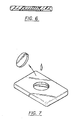
- the device 48 is generally similar to the device 10 shown and described in reference to Fig. 1, however, the device 48 further comprises an upper layer, or "overlayer" of material 50 disposed over the reaction matrix 52 thereof.
- the "overlayer” 50 is composed of a fibrous material such as glass or cellulose filter paper, and which, when the device 48 is used to perform an assay, can perform various functions.
- the overlayer can perform such functions as a reservoir to retain sample over the reaction matrix; as a vehicle to retain reagents, e.g., lyophilized reagents, to be used in an assay; as a "prefilter” to remove extraneous particulate matter in a sample, or, for example, to separate and to hold blood cells from a whole blood sample while allowing plasma to pass through.
- the "overlayer" matrix 50 can be removed, as desired, during a step of the assay in order to remove material which may be retained therein, or for other purposes such as to expose the reaction matrix 52. Such removal is illustrated in Fig. 7.
- an analytical device comprises a porous, non-bibulous fiber matrix impregnated with a hydrophobic polymer.
- 'porous' is meant that the matrix is composed of a material into and through which fluids can easily pass.
- non-bibulous is meant a fiber matrix material which is incapable of substantial absorption of water or aqueous solutions.
- properties of porosity, and non-bibulous qualities can be achieved simply by selection of an appropriate material for the reaction matrix material, such as glass, cellulose, nylon and other synthetic fibrous materials well known to those skilled in the art.
- the fiber matrix is impregnated, in at least a portion thereof, with a hydrophobic polymer, such hydrophobic properties can be derived from selection of the polymer.
- suitable polymers for impregnating the preparation of devices according to the invention include, for example, polystyrene, polymethylacrylate, polypropylene, polyacrylonitrile and polycarbonate.
- a suitable polymer such as one selected from the aforedescribed, is dissolved in an organic solvent, for example acetone, benzene or xylene. It is preferred that the concentration of polymer in the solvent be within the range of from about 0.1 to 100 milligrams per milliliter (mg/ml).
- the fibrous matrix material which can be selected, for example, from those aforedescribed is cut or otherwise formed to the shape desired (in the preferred embodiments hereof, substantially circular; however, it is to be appreciated that both the shape and dimensions of the matrix can vary widely, as can the shape and dimensions of the holder therefor).
- the formed matrix material is positioned appropriately over the hole therefor in the holder, and attached thereto using well-known means such as adhesive bonding or heat sealing, depending upon the composition of the holder.
- a small amount (in the usual case between about 1 and 250 microliters (ul) of the polymer solution is applied per square centimeter of the matrix.
- the solvent portion of the polymer solution is then allowed to evaporate or is driven off, usually at a temperature between about 20 and 40 degrees C, for between approximately 0.5 to 24 hours.
- This serves to impregnate the polymer onto at least a portion of the surfaces of the fibers in the matrix; substantially complete impregnation is preferred, but partial impregnation is usually sufficient to enable the device to perform satisfactorily in an assay procedure.
- these latter steps can be used to also bind the matrix to the holder, eliminating the need for adhesive or heat-bonding of the matrix to secure it to the holder.
- the preferred device is ready to be contacted with a reagent which is retained therewithin during the subsequent performance of an assay using the device.
- an antibody or antigen (in instances where it is intended that the device be utilized in immunoassays) is applied to the matrix; the antibody or antigen preferably has a concentration within the range of about 10 to 10,000 micrograms per milliliter (ug/ml), and is applied to the matrix in a volume of about 1-250 microliters per square centimeter of filter area. Then, the device is incubated at between about 20 and 50 degrees C for a period of approximately 2 to 18 hours.
- Excess fluid is thereafter removed by blotting with a suitably absorbent material, such as a cellulosic absorbent layer of material which can be manually manipulated into contact with the matrix or, when apparatus such as that shown in Figs. 3 and 4 is used, can be part of a holder for the device.
- a suitably absorbent material such as a cellulosic absorbent layer of material which can be manually manipulated into contact with the matrix or, when apparatus such as that shown in Figs. 3 and 4 is used, can be part of a holder for the device.
- this cycle of washing With a buffer and blotting can be repeated many times, depending upon the intended use of the device and the necessity, if the device is to be used in a particular assay, of devices prepared for use in that assay necessarily being largely free of unbound antibody or antigen prior to conduct of the assay procedure.
- devices of the invention can be specifically and especially prepared with the specificity and sensitivity requirements of a particular assay taken into account.
- the device provided by the invention can be advantageously employed in a wide variety of otherwise well-known assay techniques and procedures, and is not limited in application to the specific immunoassay techniques described in detail herein.
- the device can thus be used in so-called '. competitive binding" assays or similar procedures; in addition, it can be employed in other assays such as typical enzyme assays for such analytes as glucose, uric acid or the like, which are not immunoassays but which can advantageously be carries out by first retaining at least one reagent used in such assays within the reaction matrix of the device of the invention.
- the instant analytical device can be profitably applied to a wide variety of uses in various types of assay procedures, and thus is in no way limited to the details disclosed herein.
- Analytical devices produced in accordance with the principles of the instant invention are, however, especially advantageously adapted to be used to perform enzyme immunoassays, particularly so-call "sandwich” enzyme immunoassay, procedures.
- Such devices are capable of enabling such assays to be performed relatively more simply than typical "bead” or other assays of the prior art which require much more elaborate, time-consuming and costly equipment and materials, and as well have been found to be capable of surprising sensitivity.
- a generalized example for a preferred "sandwich" immunoassay procedure utilizing a device of the invention is as follows:
- the analytical device is capable of producing a detectable response which is indicative of the presence and/or amount of a substance in a fluid under analysis.
- a detectable response in preferred embodiments of the invention, can be color development in the reaction matrix of the device following a series of assay steps, such as those previously described, or it can be any number of responses well known in the analytical art and used for similar purposes.
- the response produced by the device can be one of fluorescence, provided appropriate reagents are employed in the assay, as is well known to those skilled in the art.
- the response can be also chemiluminescence, or any of a variety of radiative energy responses detectable either visually by the human eye, or instrumentally by various known equipment.
- a number of these disks were next positioned over injection-molded plastic holders having the overall shape and appearance of the holder 14 of the device 10 shown and described with reference to Figs. 1 and 2.
- the holders used in this particular case measured approximately 1-3/8 inches in width by 1-7/8 inches length, and had an overall thickness of approximately 1/8 inch, with a substantially centrally-located, circular hole extending therethrough about 14.5 mm in diameter (over which hole the disks were positioned).
- the holders, with the disks positioned thereupon were then placed in a fume hood and 90 microliters (ul) of the polystyrene mixture previously described were added to each disk, and the disk/holder assemblies allowed to stand under covers for between about 5 to 8 minutes.
- Example 2 Analytical devices which had been prepared in accordance with the instant invention as described in Example 1 were utilized to determine HBsAg in specimens of human blood serum, according to the following assay procedure. This Example particularly demonstrates the performance of such devices in one type of a so-called "sandwich" enzyme immunoassay.
- Partially purified guinea pig anti-HBsAg was diluted to 100 micrograms (ug) per ml in 50 millimolar (mM) sodium carbonate, pH 9.6. Forty ul of this antibody solution was then added to the reaction matrix area of a device prepared as previously described in Example 1. The device was then covered and sealed with "Parafilm” (commercially available from Scientific Products), whereafter it was allowed to stand at room temperature overnight. The Parafilm was then removed and the matrix area of the device was blotted by contacting its bottom side with a stack of water-absorbing paper (commercially available from Scott Paper Company), in order to remove excess fluid from the device.
- "Parafilm” commercially available from Scientific Products
- a sample comprising human blood serum
- the device with the sample thereon was then incubated, substantially as previously described, for a total of about 5 minutes.
- the matrix area was then blotted to remove excess fluid, as aforedescribed.
- the matrix was then washed with an application of phosphate buffered saline/Tween (PBS/Tween) solution seven separate times.
- PBS/Tween phosphate buffered saline/Tween
- a chromogen solution was prepared which contained 0.0175 % tetramethylbenzidine (TMB), 1.0 % acetic acid (HOAc), 2.02 % sodium phosphate (tribasic), 0.98 % citric acid and 0.02 % hydrogen peroxide (v/v) at pH 5.5. Twenty ul of the chromogen solution were-then added to the matrix of the device, with the result that a blue color began to develop virtually immediately in the matrix. The color development in the matrix was read visually, as an indication of the presence of HBsAg in the original sample.
- TMB tetramethylbenzidine
- HOAc 1.0 % acetic acid
- tribasic 2.02 % sodium phosphate
- 0.98 % citric acid 0.02 % hydrogen peroxide
- Example 5 "Sandwich” EIA for HBsAg; Utilization of an "Overlayer” in a Preferred Service of the Invention
- FIG. 6 Another assay was conducted using a further preferred embodiment of the analytical device of the invention, which device had been constructed substantially as illustrated and described in connection with Figs. 6 and 7 of the drawings.
- the particular device was one wherein a top, or “overlayer” of material was utilized, in this particular instance a circular piece of glass fiber matrix material (comprising 3 layers, each 1 mm in thickness and 11 mm in diameter, of Whatman GF/D filter paper, and having substantially the same shape as the reaction matrix of the device).
- the "overlayer” was employed as a "reservoir", or temporary "trap", for the test sample undergoing analysis for the presence of HBsAg therein.
- the antigen was immobilized within the reaction matrix of the device.
- Antibody in the sample then was allowed to compete with the antibody associated with the conjugate for binding to the solid phase antigen.
- the level of antibody in the sample correlate inversely with the amount of the conjugate which becomes bound to the solid phase during the assay.
- a recombinantly-engineered core antigen which had been produced by conventional genetic engineering techniques, was diluted to a leyel of 100 ug/ml with 50 mM sodium carbonate, pH 9.6.
- To the reaction matrix of the device were added 40 ul of the antigen solution.
- the device with the antigen solution so applied was then incubated at room temperature overnight, after which the reaction matrix was blotted as aforedescribed and the device again incubated with 20 ul of 2 % bovine serum albumin in phosphate buffered saline, at 40 degrees C for approximately 30 minutes.
- the device was then washed with PBS/Tween as in the previous Examples.
- a test sample of human serum was next mixed in a ratio of 1:2 with an anti-HBcAg HRPO conjugate.
- To the 'overlayer" matrix of the device which in this instance functioned as a reservoir as previously described, was added 300 ul of the mixture.
- the reaction matrix of the device was then blotted every 3 minutes, for a total of 15 minutes. The duration of each blotting was 0.5, 1, 2, 4 and 8 seconds, respectively.
- the device was thereafter washed as aforedescribed, color developed with TMB and read visually as previously described.
- a device in accordance with the invention was produced as described in Example 1, except that the glass fiber material was first coated with polystyrene as described therein at a concentration of 28 mg/ml. Thereafter, 25 ul of a deoxycholate-treated sample of N. Gonorrhoeae were added to the reaction matrix, and the device incubated at 40 degrees C for 5 minutes. Excess fluid was then blotted from the device as aforedescribed and the sample addition, incubation and blotting cycles repeated 6 additional times. The device was then washed, also as previously described, with PBS/Tween for 7 separate cycles. Twenty-five ul of rabbit anti-Gonorrhoeae which had been raised in rabbit with N.
- Devices prepared in accordance with the invention as described in Example 10 were utilized to assay for AFP in a sample of human whole blood.
- a monoclonal anti-AFP antibody which had been conventially produced and purified was diluted to 100 ug/ml with 50 mM sodium carbonate, pH 9.6.
- To the devices were then added 150 ul of the diluted antibody solution.
- the devices were then incubated overnight at room temperature, after which they were blotted from underneath their reaction matrices, as previously described. Fifty ul of 2 % BSA/PBS were then added to the reaction matrices and the devices incubated at 40 degrees C for about 1 hour, whereafter they were washed, as previously described, with PBS/Tween.
- a number of approximately 12 mm diameter disks were punched out of a sheet of Whatman GF/B filter paper, using the technique previously described. These- disks were then placed directly over the reaction matrices of the devices, and, to facilitate surface contact, both the disks and the reaction matrices of the devices were wet with anti-AFP:HRPO conjugate. The assay was then continued by adding 20 ul of human whole blood to the filter disks, which now constituted an upper, "overlayer" matrix of the devices. Each of the devices was next placed in holding apparatus, substantially as shown and described with reference to Figs. 3 and 4 of the drawings, and the reaction matrices of the devices held down against blotting material, substantially as shown at 28 of Fig. 3, which was mounted in the holding apparatus.
- the conjugate in an amount of about 75 ul, was added to the 'overlayer" over a period of about 1 to 2 seconds. Thereafter, the devices were incubated at room temperature for about 10 minutes; the "overlayer” matrices were removed, and the reaction matrices of the devices were washed with PBS/Tween. TMB, in an amount of 50 ul, was then added and color development proceeded as described in the preceding Examples, which was read visually.
- devices according to the invention can be used for quantitative assays as well as qualitative assays, and can produce data useful for constructing, e.g., a calibration curve for an instrument, such as the transmittance reader previously described. Observed reading from actual test samples can then be compared against the calibration curve. The interpolated value of the AFP concentration thus provides and estimation of the AFP level which was present in the sample. It is apparent that similar readings could also be obtained by using, for example, the apparatus shown and described with reference to Fig. 5 of the drawings.
Landscapes
- Health & Medical Sciences (AREA)
- Immunology (AREA)
- Life Sciences & Earth Sciences (AREA)
- Engineering & Computer Science (AREA)
- Chemical & Material Sciences (AREA)
- Molecular Biology (AREA)
- Biomedical Technology (AREA)
- Hematology (AREA)
- Urology & Nephrology (AREA)
- Food Science & Technology (AREA)
- General Physics & Mathematics (AREA)
- Cell Biology (AREA)
- Biotechnology (AREA)
- Medicinal Chemistry (AREA)
- Physics & Mathematics (AREA)
- Analytical Chemistry (AREA)
- Biochemistry (AREA)
- General Health & Medical Sciences (AREA)
- Microbiology (AREA)
- Pathology (AREA)
- Communicable Diseases (AREA)
- Inorganic Chemistry (AREA)
- Investigating Or Analysing Biological Materials (AREA)
- Investigating Or Analyzing Non-Biological Materials By The Use Of Chemical Means (AREA)
- Apparatus Associated With Microorganisms And Enzymes (AREA)
- Medicines Containing Antibodies Or Antigens For Use As Internal Diagnostic Agents (AREA)
Applications Claiming Priority (2)
| Application Number | Priority Date | Filing Date | Title |
|---|---|---|---|
| US68556584A | 1984-12-24 | 1984-12-24 | |
| US685565 | 1984-12-24 |
Publications (3)
| Publication Number | Publication Date |
|---|---|
| EP0186100A2 true EP0186100A2 (fr) | 1986-07-02 |
| EP0186100A3 EP0186100A3 (en) | 1989-04-05 |
| EP0186100B1 EP0186100B1 (fr) | 1992-04-01 |
Family
ID=24752751
Family Applications (1)
| Application Number | Title | Priority Date | Filing Date |
|---|---|---|---|
| EP85116087A Expired EP0186100B1 (fr) | 1984-12-24 | 1985-12-17 | Dispositif analytique et méthode pour son emploi |
Country Status (4)
| Country | Link |
|---|---|
| EP (1) | EP0186100B1 (fr) |
| JP (1) | JPS61173160A (fr) |
| CA (1) | CA1274174A (fr) |
| DE (1) | DE3585780D1 (fr) |
Cited By (13)
| Publication number | Priority date | Publication date | Assignee | Title |
|---|---|---|---|---|
| EP0253579A1 (fr) * | 1986-07-14 | 1988-01-20 | Hybritech Incorporated | Appareil et procédé pour essai immunologique |
| EP0253464A1 (fr) * | 1986-03-21 | 1988-01-20 | Hybritech Incorporated | Méthodes pour fournir des références internes pour l'utilisation dans des essais d'analyte-récepteur |
| EP0260965A3 (en) * | 1986-09-18 | 1988-10-12 | Pacific Biotech Inc. | Immunodiagnostic device |
| US4918025A (en) * | 1987-03-03 | 1990-04-17 | Pb Diagnostic Systems, Inc. | Self contained immunoassay element |
| WO1990008313A1 (fr) * | 1989-01-17 | 1990-07-26 | Molecular Devices Corporation | Poste de travail analytique |
| EP0296724A3 (en) * | 1987-06-01 | 1990-12-12 | Quidel | Assay and apparatus using a lateral flow, non-bibulous membrane |
| US5173261A (en) * | 1990-04-14 | 1992-12-22 | Boehringer Mannheim Gmbh | Test carrier for the analysis of fluids |
| US5252496A (en) * | 1989-12-18 | 1993-10-12 | Princeton Biomeditech Corporation | Carbon black immunochemical label |
| US5472868A (en) * | 1992-08-20 | 1995-12-05 | Eli Lilly & Company | Stable rabbit-mouse fusion partner |
| US5602040A (en) * | 1987-04-27 | 1997-02-11 | Unilever Patent Holdings B.V. | Assays |
| US5656448A (en) * | 1990-01-10 | 1997-08-12 | Princeton Biomeditech Corporation | Dipstick immunoassay device |
| US5763262A (en) * | 1986-09-18 | 1998-06-09 | Quidel Corporation | Immunodiagnostic device |
| US6287783B1 (en) | 1999-03-18 | 2001-09-11 | Biostar, Inc. | Optical assay device and method |
Families Citing this family (7)
| Publication number | Priority date | Publication date | Assignee | Title |
|---|---|---|---|---|
| US5622871A (en) | 1987-04-27 | 1997-04-22 | Unilever Patent Holdings B.V. | Capillary immunoassay and device therefor comprising mobilizable particulate labelled reagents |
| JPH079430B2 (ja) * | 1986-11-07 | 1995-02-01 | 工業技術院長 | イムノアツセイ用素子 |
| US4833087A (en) * | 1987-02-27 | 1989-05-23 | Eastman Kodak Company | Disposable container configured to produce uniform signal |
| US5244630A (en) * | 1988-04-22 | 1993-09-14 | Abbott Laboratories | Device for performing solid-phase diagnostic assay |
| US6352862B1 (en) | 1989-02-17 | 2002-03-05 | Unilever Patent Holdings B.V. | Analytical test device for imuno assays and methods of using same |
| JP3126383B2 (ja) * | 1991-03-28 | 2001-01-22 | 株式会社アズウェル | 簡易な分析装置 |
| EP2261656A4 (fr) * | 2008-03-21 | 2014-04-09 | Arkray Inc | Instrument d'essai à sec, procédé de mesure de métal et procédé de fabrication d'instrument d'essai à sec |
Family Cites Families (8)
| Publication number | Priority date | Publication date | Assignee | Title |
|---|---|---|---|---|
| FR2253552A1 (fr) * | 1973-12-07 | 1975-07-04 | Miles Lab | |
| DE2827780A1 (de) * | 1978-06-24 | 1980-01-03 | Degussa | Hitzdrahtanemometer zur messung der stroemungsgeschwindigkeit von gasen und fluessigkeiten (i) |
| JPS56156220A (en) * | 1980-04-07 | 1981-12-02 | Seikagaku Kogyo Co Ltd | Insoluble antigen or antibody, its preparation and measuring method of antigen and antibody with the same |
| US4363634A (en) * | 1980-07-18 | 1982-12-14 | Akzona Incorporated | Glass support coated with synthetic polymer for bioprocess |
| DE3045199A1 (de) * | 1980-12-01 | 1982-07-01 | Eppendorf Gerätebau Netheler + Hinz GmbH, 2000 Hamburg | Verbessertes immunologisches festphasen-verfahren und vorrichtung zur durchfuehrung dieses verfahrens |
| US4440301A (en) * | 1981-07-16 | 1984-04-03 | American Hospital Supply Corporation | Self-stacking reagent slide |
| CA1237645A (fr) * | 1982-12-21 | 1988-06-07 | John H. Fisher | Technique analytique |
| JPS6255084A (ja) * | 1985-04-04 | 1987-03-10 | ジエネツクス・コ−ポレイシヨン | 生体の固定化方法及びそれから得られた不溶化生体複合体 |
-
1985
- 1985-12-17 DE DE8585116087T patent/DE3585780D1/de not_active Expired - Fee Related
- 1985-12-17 EP EP85116087A patent/EP0186100B1/fr not_active Expired
- 1985-12-20 CA CA000498329A patent/CA1274174A/fr not_active Expired - Fee Related
- 1985-12-24 JP JP60289512A patent/JPS61173160A/ja active Pending
Cited By (20)
| Publication number | Priority date | Publication date | Assignee | Title |
|---|---|---|---|---|
| EP0253464A1 (fr) * | 1986-03-21 | 1988-01-20 | Hybritech Incorporated | Méthodes pour fournir des références internes pour l'utilisation dans des essais d'analyte-récepteur |
| EP0253579A1 (fr) * | 1986-07-14 | 1988-01-20 | Hybritech Incorporated | Appareil et procédé pour essai immunologique |
| EP0260965A3 (en) * | 1986-09-18 | 1988-10-12 | Pacific Biotech Inc. | Immunodiagnostic device |
| US5763262A (en) * | 1986-09-18 | 1998-06-09 | Quidel Corporation | Immunodiagnostic device |
| US4918025A (en) * | 1987-03-03 | 1990-04-17 | Pb Diagnostic Systems, Inc. | Self contained immunoassay element |
| US5602040A (en) * | 1987-04-27 | 1997-02-11 | Unilever Patent Holdings B.V. | Assays |
| EP0296724A3 (en) * | 1987-06-01 | 1990-12-12 | Quidel | Assay and apparatus using a lateral flow, non-bibulous membrane |
| WO1990008313A1 (fr) * | 1989-01-17 | 1990-07-26 | Molecular Devices Corporation | Poste de travail analytique |
| US6506612B2 (en) | 1989-12-18 | 2003-01-14 | Princeton Biomeditech Corporation | Immunoassay devices and materials |
| US5559041A (en) * | 1989-12-18 | 1996-09-24 | Princeton Biomeditech Corporation | Immunoassay devices and materials |
| US5728587A (en) * | 1989-12-18 | 1998-03-17 | Pmb-Selfcare, Llc | Immunoassay devices and materials |
| US6027943A (en) * | 1989-12-18 | 2000-02-22 | Princeton Biomeditech Corporation | Immunoassay devices and materials |
| US5252496A (en) * | 1989-12-18 | 1993-10-12 | Princeton Biomeditech Corporation | Carbon black immunochemical label |
| US6541277B1 (en) | 1989-12-18 | 2003-04-01 | Princeton Biomeditech Corporation | Immunoassay devices and materials |
| US6737277B1 (en) | 1989-12-18 | 2004-05-18 | Pmb-Selfcare Llc | Immunoassay devices and materials |
| US5656448A (en) * | 1990-01-10 | 1997-08-12 | Princeton Biomeditech Corporation | Dipstick immunoassay device |
| US5173261A (en) * | 1990-04-14 | 1992-12-22 | Boehringer Mannheim Gmbh | Test carrier for the analysis of fluids |
| US5472868A (en) * | 1992-08-20 | 1995-12-05 | Eli Lilly & Company | Stable rabbit-mouse fusion partner |
| US6287783B1 (en) | 1999-03-18 | 2001-09-11 | Biostar, Inc. | Optical assay device and method |
| US6770447B2 (en) | 1999-03-18 | 2004-08-03 | Thermo Biostar, Inc. | Optical assay device and method |
Also Published As
| Publication number | Publication date |
|---|---|
| EP0186100A3 (en) | 1989-04-05 |
| EP0186100B1 (fr) | 1992-04-01 |
| CA1274174A (fr) | 1990-09-18 |
| JPS61173160A (ja) | 1986-08-04 |
| DE3585780D1 (de) | 1992-05-07 |
Similar Documents
| Publication | Publication Date | Title |
|---|---|---|
| EP0335244B1 (fr) | Dispositif d'analyse en phase solide et procédé pour son utilisation | |
| CA1274174A (fr) | Trousse pour analyses et methode d'utilisation | |
| EP0138826B1 (fr) | Detection de gonadotrophine chorionique humaine | |
| EP0217403B1 (fr) | Dispositif analytique en phase solide et procédé pour son utilisation | |
| US4746631A (en) | Immunoassay method, device, and test kit | |
| US4740468A (en) | Concentrating immunochemical test device and method | |
| US4999285A (en) | Chromatographic cassette | |
| US4791461A (en) | Portable analyzer | |
| US4959307A (en) | Immunoseparating strip | |
| EP0259157B1 (fr) | Moyen de test pour l'immunoséparation | |
| CA1262061A (fr) | Analyseur portatif | |
| JP2554679B2 (ja) | 固相分析装置用試料集束部材 | |
| JPH07104354B2 (ja) | クラミジア・トラコマティスおよびネイセリア・ゴノリアエを検出するための分析装置および分析方法 | |
| US5260193A (en) | Immunoseparating strip | |
| CA2358506A1 (fr) | Procede et dispositif pour determiner un analyte | |
| CA1302244C (fr) | Bandelettes reactives seches presentant une couche excluant les erythrocites et empechant que ceux-ci masquent la presence de l'analyte | |
| EP0233690B1 (fr) | Conjugué d'hydantoine marquée et son utilisation dans un élément d'analyse et dans les immuno-essais | |
| JPS63210664A (ja) | 酸素要求検出系を用いる装置のための乾燥試験片及び被検流体中の分析成分の検出方法 | |
| JPH10185921A (ja) | 免疫学的定量装置 | |
| EP0483309A1 (fr) | Support solide comprenant des anticorps immobilises sur sa surface | |
| JPH03279861A (ja) | 分析物の測定方法 | |
| JP2714855B2 (ja) | 簡易免疫学的診断器 | |
| Monroe | Enzyme Channelling Immunoassay (ECIA): A Unique and Rapid Quantitative Technique |
Legal Events
| Date | Code | Title | Description |
|---|---|---|---|
| PUAI | Public reference made under article 153(3) epc to a published international application that has entered the european phase |
Free format text: ORIGINAL CODE: 0009012 |
|
| AK | Designated contracting states |
Kind code of ref document: A2 Designated state(s): BE CH DE FR GB IT LI NL SE |
|
| PUAL | Search report despatched |
Free format text: ORIGINAL CODE: 0009013 |
|
| RHK1 | Main classification (correction) |
Ipc: G01N 33/543 |
|
| AK | Designated contracting states |
Kind code of ref document: A3 Designated state(s): BE CH DE FR GB IT LI NL SE |
|
| 17P | Request for examination filed |
Effective date: 19890929 |
|
| 17Q | First examination report despatched |
Effective date: 19900622 |
|
| GRAA | (expected) grant |
Free format text: ORIGINAL CODE: 0009210 |
|
| AK | Designated contracting states |
Kind code of ref document: B1 Designated state(s): BE CH DE FR GB IT LI NL SE |
|
| ET | Fr: translation filed | ||
| REF | Corresponds to: |
Ref document number: 3585780 Country of ref document: DE Date of ref document: 19920507 |
|
| ITF | It: translation for a ep patent filed | ||
| PGFP | Annual fee paid to national office [announced via postgrant information from national office to epo] |
Ref country code: GB Payment date: 19921113 Year of fee payment: 8 |
|
| PGFP | Annual fee paid to national office [announced via postgrant information from national office to epo] |
Ref country code: SE Payment date: 19921118 Year of fee payment: 8 |
|
| PGFP | Annual fee paid to national office [announced via postgrant information from national office to epo] |
Ref country code: FR Payment date: 19921208 Year of fee payment: 8 |
|
| PGFP | Annual fee paid to national office [announced via postgrant information from national office to epo] |
Ref country code: CH Payment date: 19921210 Year of fee payment: 8 |
|
| PGFP | Annual fee paid to national office [announced via postgrant information from national office to epo] |
Ref country code: DE Payment date: 19921229 Year of fee payment: 8 |
|
| ITTA | It: last paid annual fee | ||
| PGFP | Annual fee paid to national office [announced via postgrant information from national office to epo] |
Ref country code: NL Payment date: 19921231 Year of fee payment: 8 |
|
| PGFP | Annual fee paid to national office [announced via postgrant information from national office to epo] |
Ref country code: BE Payment date: 19930114 Year of fee payment: 8 |
|
| PLBE | No opposition filed within time limit |
Free format text: ORIGINAL CODE: 0009261 |
|
| STAA | Information on the status of an ep patent application or granted ep patent |
Free format text: STATUS: NO OPPOSITION FILED WITHIN TIME LIMIT |
|
| 26N | No opposition filed | ||
| PG25 | Lapsed in a contracting state [announced via postgrant information from national office to epo] |
Ref country code: GB Effective date: 19931217 |
|
| PG25 | Lapsed in a contracting state [announced via postgrant information from national office to epo] |
Ref country code: SE Effective date: 19931218 |
|
| PG25 | Lapsed in a contracting state [announced via postgrant information from national office to epo] |
Ref country code: LI Effective date: 19931231 Ref country code: CH Effective date: 19931231 Ref country code: BE Effective date: 19931231 |
|
| BERE | Be: lapsed |
Owner name: ABBOTT LABORATORIES Effective date: 19931231 |
|
| PG25 | Lapsed in a contracting state [announced via postgrant information from national office to epo] |
Ref country code: NL Effective date: 19940701 |
|
| NLV4 | Nl: lapsed or anulled due to non-payment of the annual fee | ||
| GBPC | Gb: european patent ceased through non-payment of renewal fee |
Effective date: 19931217 |
|
| PG25 | Lapsed in a contracting state [announced via postgrant information from national office to epo] |
Ref country code: FR Effective date: 19940831 |
|
| REG | Reference to a national code |
Ref country code: CH Ref legal event code: PL |
|
| PG25 | Lapsed in a contracting state [announced via postgrant information from national office to epo] |
Ref country code: DE Effective date: 19940901 |
|
| REG | Reference to a national code |
Ref country code: FR Ref legal event code: ST |
|
| EUG | Se: european patent has lapsed |
Ref document number: 85116087.9 Effective date: 19940710 |