EP0186170A2 - Verfahren zur kontinuierlichen Verkokung von Steinkohlenhartpech - Google Patents
Verfahren zur kontinuierlichen Verkokung von Steinkohlenhartpech Download PDFInfo
- Publication number
- EP0186170A2 EP0186170A2 EP85116423A EP85116423A EP0186170A2 EP 0186170 A2 EP0186170 A2 EP 0186170A2 EP 85116423 A EP85116423 A EP 85116423A EP 85116423 A EP85116423 A EP 85116423A EP 0186170 A2 EP0186170 A2 EP 0186170A2
- Authority
- EP
- European Patent Office
- Prior art keywords
- stage
- coke
- smoldering
- briquettes
- heating
- Prior art date
- Legal status (The legal status is an assumption and is not a legal conclusion. Google has not performed a legal analysis and makes no representation as to the accuracy of the status listed.)
- Granted
Links
Images
Classifications
-
- C—CHEMISTRY; METALLURGY
- C10—PETROLEUM, GAS OR COKE INDUSTRIES; TECHNICAL GASES CONTAINING CARBON MONOXIDE; FUELS; LUBRICANTS; PEAT
- C10L—FUELS NOT OTHERWISE PROVIDED FOR; NATURAL GAS; SYNTHETIC NATURAL GAS OBTAINED BY PROCESSES NOT COVERED BY SUBCLASSES C10G OR C10K; LIQUIFIED PETROLEUM GAS; USE OF ADDITIVES TO FUELS OR FIRES; FIRE-LIGHTERS
- C10L5/00—Solid fuels
- C10L5/02—Solid fuels such as briquettes consisting mainly of carbonaceous materials of mineral or non-mineral origin
- C10L5/34—Other details of the shaped fuels, e.g. briquettes
- C10L5/36—Shape
- C10L5/361—Briquettes
-
- C—CHEMISTRY; METALLURGY
- C10—PETROLEUM, GAS OR COKE INDUSTRIES; TECHNICAL GASES CONTAINING CARBON MONOXIDE; FUELS; LUBRICANTS; PEAT
- C10B—DESTRUCTIVE DISTILLATION OF CARBONACEOUS MATERIALS FOR PRODUCTION OF GAS, COKE, TAR, OR SIMILAR MATERIALS
- C10B53/00—Destructive distillation, specially adapted for particular solid raw materials or solid raw materials in special form
- C10B53/08—Destructive distillation, specially adapted for particular solid raw materials or solid raw materials in special form in the form of briquettes, lumps and the like
-
- C—CHEMISTRY; METALLURGY
- C10—PETROLEUM, GAS OR COKE INDUSTRIES; TECHNICAL GASES CONTAINING CARBON MONOXIDE; FUELS; LUBRICANTS; PEAT
- C10B—DESTRUCTIVE DISTILLATION OF CARBONACEOUS MATERIALS FOR PRODUCTION OF GAS, COKE, TAR, OR SIMILAR MATERIALS
- C10B55/00—Coking mineral oils, bitumen, tar, and the like or mixtures thereof with solid carbonaceous material
-
- C—CHEMISTRY; METALLURGY
- C10—PETROLEUM, GAS OR COKE INDUSTRIES; TECHNICAL GASES CONTAINING CARBON MONOXIDE; FUELS; LUBRICANTS; PEAT
- C10L—FUELS NOT OTHERWISE PROVIDED FOR; NATURAL GAS; SYNTHETIC NATURAL GAS OBTAINED BY PROCESSES NOT COVERED BY SUBCLASSES C10G OR C10K; LIQUIFIED PETROLEUM GAS; USE OF ADDITIVES TO FUELS OR FIRES; FIRE-LIGHTERS
- C10L5/00—Solid fuels
- C10L5/02—Solid fuels such as briquettes consisting mainly of carbonaceous materials of mineral or non-mineral origin
- C10L5/06—Methods of shaping, e.g. pelletizing or briquetting
- C10L5/10—Methods of shaping, e.g. pelletizing or briquetting with the aid of binders, e.g. pretreated binders
- C10L5/14—Methods of shaping, e.g. pelletizing or briquetting with the aid of binders, e.g. pretreated binders with organic binders
-
- C—CHEMISTRY; METALLURGY
- C10—PETROLEUM, GAS OR COKE INDUSTRIES; TECHNICAL GASES CONTAINING CARBON MONOXIDE; FUELS; LUBRICANTS; PEAT
- C10L—FUELS NOT OTHERWISE PROVIDED FOR; NATURAL GAS; SYNTHETIC NATURAL GAS OBTAINED BY PROCESSES NOT COVERED BY SUBCLASSES C10G OR C10K; LIQUIFIED PETROLEUM GAS; USE OF ADDITIVES TO FUELS OR FIRES; FIRE-LIGHTERS
- C10L9/00—Treating solid fuels to improve their combustion
- C10L9/08—Treating solid fuels to improve their combustion by heat treatments, e.g. calcining
-
- Y—GENERAL TAGGING OF NEW TECHNOLOGICAL DEVELOPMENTS; GENERAL TAGGING OF CROSS-SECTIONAL TECHNOLOGIES SPANNING OVER SEVERAL SECTIONS OF THE IPC; TECHNICAL SUBJECTS COVERED BY FORMER USPC CROSS-REFERENCE ART COLLECTIONS [XRACs] AND DIGESTS
- Y02—TECHNOLOGIES OR APPLICATIONS FOR MITIGATION OR ADAPTATION AGAINST CLIMATE CHANGE
- Y02P—CLIMATE CHANGE MITIGATION TECHNOLOGIES IN THE PRODUCTION OR PROCESSING OF GOODS
- Y02P20/00—Technologies relating to chemical industry
- Y02P20/10—Process efficiency
- Y02P20/129—Energy recovery, e.g. by cogeneration, H2recovery or pressure recovery turbines
Definitions
- the invention relates to a process for the continuous coking of hard coal pitch for the production of calcined molded coke, consisting of the process stages specified in the preamble of the main claim.
- Hard pitch from hard coal or lignite is commonly used to make electrode coke.
- a coke can be produced from the hard pitch, which is present in liquid and pumpable form at a temperature of approximately 300 ° C., by various known methods. These processes include the so-called delayed coking process, in which coke is produced under pressure at temperatures of around 500 ° C. The known processes also include pitch coking in horizontal chamber coking ovens, in which pitch coke is produced without pressure from hard pitch. Finally, the fluid coking process delivers a highly inflated coke that is used practically only as a fuel.
- a calcined molded coke is to be produced from hard coal pitch. It will with liquid hard pitch obtained at approx. 300 ° C, first heated and smoldered at a temperature of up to 600 ° C, briquetted the coke with the addition of hot binder hard pitch, calcined the briquettes at temperatures up to approx. 1,400 ° C and then cooled.
- Lurgi-Ruhrgas (LR) process e.g. B. fine-grained coal, using as a heat carrier in the circulating smoked coke, which was heated by partial combustion (see. Ullmann, volume 14, 1977, page 516/517). From the resulting smoked coke, for. B. by the BFL hot briquetting process molded coke (see Ullmann, op. Cit., Page 562/563).
- LR Lurgi-Ruhrgas
- the object of the invention is now to propose a method of the type defined in the introduction in which such exhaust gas purification can be dispensed with, a reusable gas with a higher calorific value is obtained and the abrasion and burn-up in the briquettes is reduced.
- the vertical chamber shaft furnace can be operated without any afterburning and processing of the exhaust gases.
- the combustion exhaust gases from indirect heating are either routed directly to the chimney in the usual way or they are used for preheating the combustion media in recuperative or regenerative heat exchange.
- the particular advantage of the use of the vertical chamber shaft furnace according to the invention instead of a rotary kiln for calcining the hard pitch is that, surprisingly, the briquettes can be coked in the shaft kiln even without the circulation carried out in the rotary kiln and there is no annoying abrasion or burning of the briquettes.
- the additional energy for the continuous circulation of the briquettes in the rotary kiln can be saved when using the shaft furnace according to the invention.
- the raw gases produced during the smoldering and calcining can advantageously be cooled and cleaned in a common washing cooler and then used for underfiring.
- a shaft furnace can be used, as described in DE-PS 28 18 456 or DE-OS 33 44 106.5.
- a vertical chamber furnace with a coke drying cooling stage immediately following the heating stage can be seen, the vertical chamber furnace, however, for one discontinuous operation is determined.
- such a vertical chamber furnace with an immediately subsequent coke dry cooling stage can also be used for the continuous coking of hard coal pitch with direct and / or indirect transfer of the heat in the coke dry cooling stage.
- a particularly favorable way of utilizing the heat transferred in the coke dry cooling is when the preheated air used for heating in the smoldering stage is used exclusively in the coke drying cooling stage. It has been shown that the preheated air can be heated sufficiently indirectly even without the addition of fuel gas. If that is not the case, you can easily z. B. a liquid gas can be added.
- the combustion air in addition to the usual use of a regenerator or recuperator for preheating the combustion air for heating the vertical chamber shaft furnace, the combustion air can also be preheated in the coke oven cooling stage.
- the heating of the hard pitch in the smoldering stage can also be simplified and improved in accordance with the invention in that a portion of the hot briquettes is removed from the vertical chamber shaft furnace, preferably before entering the cooling stage, and is used to heat the hard pitch in the smoldering stage.
- the hard pitch which is in liquid form at a temperature of approx. 300 ° C., can be sprayed onto the continuously moving mold coke pieces in a simple manner.
- the amount of hot briquettes returned can be chosen so that their sensible heat is sufficient to smolder the hard pitch and additional heating is not required.
- the mixture is then expediently comminuted and then added to the briquetting stage.
- the 300 ° C hot pitch is injected with the aid of a metering pump via line 1 in a manner known per se, approximately in the middle of rotary drum 3.
- the rotary drum 3 is only heated indirectly, with air preheated to about 900 ° C. being fed into the heating chamber 4 for heating in the heat exchanger 46 of the coke dry cooling stage 40.
- the air leaves this heating chamber 4 at a temperature of approximately 600 ° C. and is fed via line 37 to the steam generator 45, from which it is released.
- the carbonization is withdrawn via line 34 from the rotary drum 3 and after dust removal in the cyclone g bun 35 via the line 39 to the washing cooler fed 27th
- the washing liquid is circulated by means of the pump 31 and cooled by the cooler 29.
- a smoldering tar is drawn off from the washer-cooler circuit via line 38, while the cooled and cleaned gas is passed with the aid of the fan 24 via line 33 for indirect heating of the vertical chamber shaft furnace 17.
- the Schwelkoks leaves the rotary drum at a temperature of about 600 ° C and is given together with the fine dust coming from the cyclone via line 36 via the Schwelkoks specialister 6 in a bunker 7.
- part of the smoldering coke can be returned via line 5 to the feed side of the rotary drum.
- the smoldering coke is fed from the bunker 7 via the feed lock 8 into the mixer 9 in a manner known per se and mixed there with hard pitch which is also about 300 ° C. as a binder.
- the mixture reaches the roller press 11 via the distributor 10.
- the hot briquettes are placed on a sieve 14 via the briquette conveyor 12 and then reach the vertical chamber shaft furnace 17 via the entry lock 16 at the top.
- the fine fractions sieved in the sieve 14 are returned to the mixer 9 via the line 15.
- the briquettes are heated to a temperature of approximately 1,300 ° C. and calcined.
- the coke dry cooling stage 40 follows directly in the shaft furnace, in which the briquettes are cooled to a temperature of approximately 150 to 200 ° C. by circulating cooling gas before they reach the coke conveyor 42 via the discharge lock 41.
- the cooling gas is cooled in the heat exchanger 46 and is circulated with the aid of the fan 23.
- the cold cooling gas is added to the bottom of the cooling stage, it flows in countercurrent through the coke bed and is drawn off again via line 43.
- air supplied via the blower 22 can either be heated, but it is also possible to generate high-tension steam in a simple manner.
- the indirect heating 18 of the vertical chamber shaft furnace 17 is supplied with both combustion air via the lines 19 and the fan 20 and an underfire gas which has been cleaned in the washer-cooler circuit 26, 28, 30 with the aid of the fan 21 and via the line 32.
- the combustion q sabgas reaches the chimney via line 47, while the raw gas is fed via line 25 to the top of the washer cooler 26.
Landscapes
- Chemical & Material Sciences (AREA)
- Oil, Petroleum & Natural Gas (AREA)
- Engineering & Computer Science (AREA)
- Organic Chemistry (AREA)
- Geology (AREA)
- Life Sciences & Earth Sciences (AREA)
- Geochemistry & Mineralogy (AREA)
- General Life Sciences & Earth Sciences (AREA)
- Environmental & Geological Engineering (AREA)
- Materials Engineering (AREA)
- Chemical Kinetics & Catalysis (AREA)
- General Chemical & Material Sciences (AREA)
- Physics & Mathematics (AREA)
- Thermal Sciences (AREA)
- Combustion & Propulsion (AREA)
- Coke Industry (AREA)
Abstract
Description
- Die Erfindung bezieht sich auf ein Verfahren zur kontinuierlichen Verkokung von Steinkohlenhartpech zur Herstellung von kalziniertem Formkoks, bestehend aus den im Oberbegriff des Hauptanspruches angegebenen Verfahrensstufen.
- Ein Hartpech aus Steinkohle oder Braunkohle wird üblicherweise zur Herstellung von Elektrodenkoks benutzt. Aus dem bei einer Temperatur von ca. 300 °C in flüssiger und pumpfähiger Form vorliegenden Hartpech kann nach verschiedenen bekannten Verfahren ein Koks erzeugt werden. Zu diesen Verfahren gehört das sogenannte Delayed-Coking-Verfahren, bei dem Koks unter Druck bei Temperaturen von ca. 500 °C hergestellt wird. Weiterhin zählt zu den bekannten Verfahren die Pechverkokung in Horizontalkammerverkokungsöfen, bei dem aus Hartpech drucklos Pechkoks hergestellt wird. Das Fluid-Coking-Verfahren liefert schließlich einen stark aufgeblähten Koks, der praktisch nur als Brennstoff eingesetzt wird.
- Bei dem gattungsgemäßen Verfahren soll aus Steinkohlenhartpech ein kalzinierter Formkoks erzeugt werden. Dabei wird das mit ca. 300 °C anfallende flüssige Hartpech zunächst aufgeheizt und bei einer Temperatur von bis zu 600 °C geschwelt, der Schwelkoks unter Zugabe von heißem Binder-Hartpech brikettiert, die Briketts bei Temperaturen bis ca. 1.400 °C kalziniert und anschließend gekühlt.
- Nach dem Lurgi-Ruhrgas (LR)-Verfahren wird z. B. feinkörnige Kohle geschwelt, wobei als Wärmeträger im Kreislauf geführter Schwelkoks dient, der durch teilweise Verbrennung aufgeheizt wurde (vgl. Ullmann, Band 14, 1977, Seite 516/517). Aus dem anfallenden Schwelkoks kann z. B. nach dem BFL-Heißbrikettierverfahren Formkoks hergestellt werden (vgl. Ullmann, a.a.O., Seite 562/563). Diese Verfahren beschränken sich aber auf den Einsatz von Kohle und enthalten keine Hinweise über nachgeschaltete Kalzinierstufen.
- Zur Kalzinierung der Briketts ist es darüber hinaus bekannt, die Briketts in einem Drehrohrofen im Gegenstrom direkt mit heißen Gasen zu beaufschlagen. Dabei werden die Briketts laufend umgewälzt und unterliegen einem hohen Abrieb. Durch die ausschließlich direkte Beheizung unter Zugabe von Luft ist auch der Abbrand erheblich. Die bei der Kalzinierung entstehenden Schwachgase werden einer Nachverbrennung unterzogen und nach üblicher Entstaubung und Entschwefelung über einen Kamin ins Freie geleitet. Diese Aufarbeitung und Abgasreinigung ist aufwendig. Eine andere Nutzung des bei dieser direkten Beheizung anfallenden Gases ist wegen des sehr geringen Heizwertes nicht möglich.
- Aufgabe der Erfindung ist es nun, ein Verfahren der eingangs definierten Art vorzuschlagen, bei dem eine derartig aufwendige Abgasreinigung entfallen kann, ein weiterverwendbares Gas mit höherem Heizwert gewonnen und der Abrieb und Abbrand bei den Briketts verringert wird.
- Zur Lösung dieser Aufgabe wird vorgeschlagen, daß die Kalzinierung in einem indirekt beheizten Vertikalkammerschachtofen erfolgt.
- Bei dieser ausschließlich indirekten Beheizung des Vertikalkammerschachtofens kann bei der Kalzinierung ein sehr hochwertiges Starkgas abgezogen werden, das als Heizgas dienen kann. Ohne jegliche Nachverbrennung und Aufarbeitung der Abgase kann der Vertikalkammerschachtofen betrieben werden. Die Verbrennungsabgase der indirekten Beheizung werden entweder in üblicher Weise direkt zum Kamin geleitet oder sie dienen im rekuperativen oder regenerativen Wärmeaustausch zur Vorwärmung der Verbrennungsmedien.
- Der besondere Vorteil der erfindungsgemäßen Verwendung des Vertikalkammerschachtofens anstelle eines Drehrohrofens zur Kalzinierung des Hartpeches liegt darin, daß überraschenderweise die Briketts in dem Schachtofen auch ohne die im Drehrohrofen vorgenommene Umwälzung verkokt werden können und es dabei nicht zu störendem Abrieb unc Abbrand der Briketts kommt. Die zusätzliche Energie zur dauernden Umwälzung der Briketts im Drehrohrofen kann beim erfindungsgemäßen Einsatz des Schachtofens eingespart werden.
- Die bei der Schwelung und Kalzinierung anfallenden Rohgase können günstigerweise in einem gemeinsamen Waschkühler gekühlt und gereinigt werden und anschließend zur Unterfeuerung dienen.
- Erfindungsgemäß kann beispielsweise ein Schachtofen verwendet werden, wie er in der DE-PS 28 18 456 oder der DE-OS 33 44 106.5 beschrieben ist. Aus der letztgenannten Schrift ist insbesondere ein Vertikal kammerofen mit einer sich unmittelbar an die Beheizungsstufe anschließenden Kokstrockenkühlstufe ersichtlich, wobei der Vertikal kammerofen allerdings für einen diskontinuierlichen Betrieb bestimmt ist. Erfindungsgemäß kann ein derartiger Vertikalkammerofen mit unmittelbar anschließender Kokstrockenkühlstufe auch zur kontinuierlichen Verkokung von Steinkohlenhartpech mit direkter und/oder indirekter Übertragung der Wärme in der Kokstrockenkühlstufe verwendet werden.
- Eine besonders günstige Art der Ausnutzung der in der Kokstrockenkühlung übertragenen Wärme liegt dann vor, wenn zur Beheizung in der Schwelstufe ausschließlich in der Kokstrokkenkühlstufe indirekt auf 800 bis 1.000 °C vorgeheizte Luft dient. Es hat sich gezeigt, daß mit der vorgewärmten Luft auch ohne Zugabe von Brenngas die Schwelstufe ausreichend indirekt beheizt werden kann. Falls das einmal nicht der Fall ist, kann auf einfache Weise zusätzlich z. B. ein Flüssiggas zugegeben werden.
- Erfindungsgemäß kann neben der üblichen Verwendung eines Regenerators oder Rekuperators zur Vorwärmung der Verbrennungsluft für die Beheizung des Vertikalkammerschachtofens die Verbrennungsluft auch in der Kokstrockenkühlstufe vorgewärmt werden.
- Die Aufheizung des Hartpeches in der Schwelstufe kann erfindungsgemäß auch dadurch vereinfacht und verbessert werden, daß ein Teil der heißen Briketts, vorzugsweise vor Eintritt in die Kühlstufe, aus dem Vertikalkammerschachtofen abgezogen wird und zur Erhitzung des Hartpeches in der Schwelstufe dient. Dabei läßt sich in einfacher Weise das mit einer Temperatur von ca. 300 °C in flüssiger Form vorliegende Hartpech auf die kontinuierlich bewegten Formkoksstücke spritzen. Die Menge der rückgeführten heiben Briketts kann so gewänlt werden, daß deren fühlbare Wärme zur Schwelung des Hartpeches ausreicht und auf eine zusätzliche Beheizung verzichtet werden kann. Nach Verlassen der Schwelung wird das Gemisch dann zweckmäßigerweise zerkleinert und dann in die Brikettierstufe gegeben.
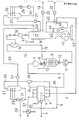
- Die Erfindung wird anhand der beigefügten Figur beispielsweise näher erläutert.
- Das 300 °C heiße Hartpech wird mit Hilfe einer Dosierpumpe über die Leitung 1 in an sich bekannter Weise etwa in der Mitte der Drehtrommel 3 eingespritzt. Die Drehtrommel 3 wird ausschließlich indirekt beheizt, wobei zur Beheizung im Wärmetauscher 46 der Kokstrockenkühlstufe 40 auf ca. 900 °C vorgewärmte Luft über die Leitung 2 in den Beheizungsraum 4 gegeben wird. Diesen Beheizungsraum 4 verläßt die Luft mit einer Temperatur von ca. 600 °C und sie wird über die Leitung 37 dem Dampferzeuger 45 zugeführt, aus dem sie ins Freie gelangt. Das Schwelgas wird über die Leitung 34 aus der Drehtrommel 3 abgezogen und nach Entstau- bung im Zyklon 35 über die Leitung 39 dem Waschkühler 27 zugeführt. Die Waschflüssigkeit wird mit Hilfe der Pumpe 31 im Kreislauf geführt und über den Kühler 29 gekühlt. Aus dem Waschkühlerkreislauf wird über die Leitung 38 ein Schwelteer abgezogen, während das gekühlte und gereinigte Gas mit Hilfe des Gebläses 24 über die Leitung 33 zur indirekten Beheizung des Vertikalkammer-Schachtofens 17 geleitet wird.
- Der Schwelkoks verläßt die Drehtrommel mit einer Temperatur von ca. 600 °C und wird gemeinsam mit dem über die Leitung 36 vom Zyklon her kommenden Feinstaub über den Schwelkoksförderer 6 in einen Bunker 7 gegeben. Zur Verbesserung des Wärmeaustausches und der Entgasung in der Schwelstufe kann ein Teil des Schwelkokses über die Leitung 5 zur Aufgabeseite der Drehtrommel zurückgeführt werden. Aus dem Bunker 7 wird der Schwelkoks über die Aufgabeschleuse 8 in an sich bekannter Weise in den Mischer 9 gegeben und dort mit ebenfalls ca. 300 °C heißem Hartpech als Binder vermischt. Über den Zuteiler 10 gelangt das Gemisch in die Walzenpresse 11. Die heißen Briketts werden über den Brikettförderer 12 auf ein Sieb 14 gegeben und gelangen anschließend über die Eintragschleuse 16 oben in den Vertikalkammer-Schachtofen 17.
- Die in dem Sieb 14 abgesiebten Feinanteile werden über die Leitung 15 in den Mischer 9 zurückgegeben. Während ihrer kontinuierlichen Bewegung durch den Vertikalkammer-Schachtofen 17 werden die Briketts auf eine Temperatur von ca. 1 300 °C aufgeheizt und kalziniert. Unterhalb der Kalzinierstufe schließt sich im Schachtofen direkt die Kokstrockenkühlstufe 40 an, in der die Briketts durch im Kreislauf geführtes Kühlgas auf eine Temperatur von ca. 150 bis 200 °C gekühlt werden, bevor sie über die Austragsschleuse 41 auf den Koksförderer 42 gelangen. Das Kühlgas wird im Wärmeaustauscher 46 gekühlt und wird mit Hilfe des Gebläses 23 umgewälzt. Das kalte Kühlgas wird unten in die Kühlstufe gegeben, es strömt im Gegenstrom durch die Koksschüttung und wird über die Leitung 43 wieder abgezogen. Im Wärmetauscher 46 kann entweder über das Gebläse 22 zugeführte Luft erhitzt werden, es kann aber auch in einfacher Weise hochgespannter Dampf erzeugt werden.
- Der indirekten Beheizung 18 des Vertikalkammer-Schachtofens 17 wird sowohl Verbrennungsluft über die Leitungen 19 und das Gebläse 20 als auch ein Unterfeuerungsgas, das im Waschkühlerkreislauf 26, 28, 30 gereinigt worden ist, mit Hilfe des Gebläses 21 und über die Leitung 32 zugeführt. Das Verbrennunqsabgas gelangt über die Leitung 47 zum Kamin, während das Rohgas über die Leitung 25 zum Kopf des Waschkühlers 26 geführt wird.
-
- (1) Hartpechaufgabe
- (2) Luft
- (3) Drehtrommel
- (4) Beheizungsraum
- (5) Rückführungsleitung für Schwelkoks
- (6) Schwelkoksförderer
- (7) Bunker
- (8) Aufgabeschleuse
- (9) Mischer
- (10) Zuteiler
- (11) Walzenpresse
- (12) Brikettförderer
- (13) Hartpech als Binder
- (14) Sieb
- (15) Rückführung
- (16) Eintragsschleuse
- (17) Vertikalkammerschachtofen
- (18) indirekte Beheizung
- (19) Luftzufuhr
- (20) Gebläse
- (21) Gebläse
- (22) Gebläse
- (23) Gebläse
- (24) Gebläse
- (25) Rohgas
- (26) Waschkühler
- (27) Waschkühler
- (28) Kühler
- (29) Kühler
- (30) Pumpe
- (31) Pumpe
- (32) Unterfeuerungsgas
- (33) Unterfeuerungsgas
- (34) Schwelgas
- (35) Zyklon
- (36) Schwelkoks
- (37) Abluft
- (38) Schwelteer
- (39) Schwelgas
- (40) Kühl stufe
- (41) Austragsschleuse
- (42) Koksförderer
- (43) heißes Kühlgas
- (44) kaltes Kühlgas
- (45) Dampferzeugung
- (46) Wärmetauscher
- (47) Verbrennungsabgas
Claims (9)
dadurch gekennzeichnet , daß die Kalzinierung in einem indirekt beheizten Vertikalkammer- schachtofen erfolgt und ein Starkgas erzeugt wird, das nach einer Reinigung und Kühlung für die indirekte Beheizung in der Schwelstufe und/oder Kalzinierstufe oder für andere Zwecke dient.
Applications Claiming Priority (2)
| Application Number | Priority Date | Filing Date | Title |
|---|---|---|---|
| DE3447418A DE3447418C2 (de) | 1984-12-24 | 1984-12-24 | Verfahren zur kontinuierlichen Verkokung von Steinkohlenhartpech |
| DE3447418 | 1984-12-24 |
Publications (3)
| Publication Number | Publication Date |
|---|---|
| EP0186170A2 true EP0186170A2 (de) | 1986-07-02 |
| EP0186170A3 EP0186170A3 (en) | 1988-01-20 |
| EP0186170B1 EP0186170B1 (de) | 1990-04-11 |
Family
ID=6253906
Family Applications (1)
| Application Number | Title | Priority Date | Filing Date |
|---|---|---|---|
| EP85116423A Expired - Lifetime EP0186170B1 (de) | 1984-12-24 | 1985-12-21 | Verfahren zur kontinuierlichen Verkokung von Steinkohlenhartpech |
Country Status (2)
| Country | Link |
|---|---|
| EP (1) | EP0186170B1 (de) |
| DE (1) | DE3447418C2 (de) |
Cited By (2)
| Publication number | Priority date | Publication date | Assignee | Title |
|---|---|---|---|---|
| WO2002068563A3 (de) * | 2001-02-25 | 2002-12-05 | Alvaro De Oliveira Prado | Verfahren und vorrichtung für die behandlung von kohlenstoffhaltigem gut |
| CN111089473A (zh) * | 2020-01-09 | 2020-05-01 | 江苏凤谷节能科技有限公司 | 一种用于兰炭改性的竖炉 |
Families Citing this family (3)
| Publication number | Priority date | Publication date | Assignee | Title |
|---|---|---|---|---|
| DE4325775C2 (de) * | 1993-07-31 | 2002-06-20 | Sgl Carbon Ag | Verfahren zum Wiederverwerten von kohlenstoffaserhaltigen Verbundwerkstoffen |
| CN114317018A (zh) * | 2021-11-23 | 2022-04-12 | 淮北矿业股份有限公司 | 一种提高低煤化度煤结焦性的方法 |
| CN119736102B (zh) * | 2024-12-25 | 2025-10-31 | 山东大学 | 一种石油焦的资源化利用方法和系统 |
Family Cites Families (3)
| Publication number | Priority date | Publication date | Assignee | Title |
|---|---|---|---|---|
| DE2818456C2 (de) * | 1978-04-27 | 1981-09-17 | Fa. Carl Still Gmbh & Co Kg, 4350 Recklinghausen | Verfahren zur Herstellung von abriebfesten Koksformlingen aus Steinkohlen-, Braunkohlen- oder Torfbriketts |
| DE2913666C2 (de) * | 1979-04-05 | 1986-01-02 | Carl Still Gmbh & Co Kg, 4350 Recklinghausen | Verfahren zur Herstellung von Hüttenformkoks |
| US4388152A (en) * | 1980-08-04 | 1983-06-14 | Conoco Inc. | Process for producing blast furnace grade coke, a distillable product and fuel gases from a heavy, high sulfur, crude oil |
-
1984
- 1984-12-24 DE DE3447418A patent/DE3447418C2/de not_active Expired
-
1985
- 1985-12-21 EP EP85116423A patent/EP0186170B1/de not_active Expired - Lifetime
Cited By (2)
| Publication number | Priority date | Publication date | Assignee | Title |
|---|---|---|---|---|
| WO2002068563A3 (de) * | 2001-02-25 | 2002-12-05 | Alvaro De Oliveira Prado | Verfahren und vorrichtung für die behandlung von kohlenstoffhaltigem gut |
| CN111089473A (zh) * | 2020-01-09 | 2020-05-01 | 江苏凤谷节能科技有限公司 | 一种用于兰炭改性的竖炉 |
Also Published As
| Publication number | Publication date |
|---|---|
| EP0186170A3 (en) | 1988-01-20 |
| EP0186170B1 (de) | 1990-04-11 |
| DE3447418C2 (de) | 1986-10-16 |
| DE3447418A1 (de) | 1986-07-03 |
Similar Documents
| Publication | Publication Date | Title |
|---|---|---|
| EP0111081B1 (de) | Verfahren zur Pyrolyse von Abfallstoffen | |
| EP1226222B1 (de) | Verfahren zur vergasung von organischen stoffen und stoffgemischen | |
| EP0047856B1 (de) | Verfahren zur Herstellung von Calciumcarbid | |
| DE2738442A1 (de) | Verfahren bzw. anlage zur nutzung der fuehlbaren kokswaerme in einer verkokungsanlage | |
| DE2733365A1 (de) | Verfahren bzw. anlage zur nutzung der fuehlbaren kokswaerme an einer verkokungsanlage | |
| DE2434827B2 (de) | ||
| EP0186170B1 (de) | Verfahren zur kontinuierlichen Verkokung von Steinkohlenhartpech | |
| DE3644775C2 (de) | ||
| US4305788A (en) | Process for the production of molded metallurgical coke from coal briquettes | |
| DE2929786C2 (de) | ||
| DE2307924B2 (de) | Verfahren zur Direktreduktion von Eisenerzen | |
| DE3110191C2 (de) | Verfahren zur Kühlung von Kammerkoks | |
| DE2153677A1 (de) | Verfahren und Vorrichtung zur Karbonisierung von Kohle zur Herstellung von Koks | |
| DE3121050A1 (de) | Verfahren und vorrichtung zur vergleichmaessigung der einsatzkohlemischungen fuer verkokungsofenbatterien | |
| CH634345A5 (en) | Process for further use of crude blast furnace gas | |
| DE2802212A1 (de) | Verfahren zum aufarbeiten von holz fuer dessen metallurgische nutzung | |
| DE2916260C2 (de) | ||
| DE607009C (de) | Verfahren zur restlosen Vergasung in stetig betriebenen Vertikalkammeroefen | |
| AT158736B (de) | Verfahren zur Herstellung von Hartpech. | |
| DE3023228C2 (de) | Verwendung eines Gegenlaufofens zum Herstellen von Hochofenkoks | |
| DE2553760A1 (de) | Verfahren und anlage zur schwelung von kohle | |
| DE1796063C (de) | Verfahren zur Beheizung von Ver kokungsofen | |
| DE974519C (de) | Verfahren zur Entgasung von staubfoermigen oder feinkoernigen Brennstoffen | |
| AT219559B (de) | Verfahren und Einrichtung zum getrennten Entwässern, Entgasen und Verkoken oder Verschwelen von festen Brennstoffen | |
| AT87580B (de) | Verfahren zur Erzeugung von Roheisen oder Stahl im Elektrohochofen. |
Legal Events
| Date | Code | Title | Description |
|---|---|---|---|
| PUAI | Public reference made under article 153(3) epc to a published international application that has entered the european phase |
Free format text: ORIGINAL CODE: 0009012 |
|
| 17P | Request for examination filed |
Effective date: 19851221 |
|
| AK | Designated contracting states |
Kind code of ref document: A2 Designated state(s): BE FR GB IT |
|
| RIN1 | Information on inventor provided before grant (corrected) |
Inventor name: KRAMER,ECKART Inventor name: ALSCHER,ARNOLD,DR. Inventor name: DUNGS, HORST Inventor name: LORENZ, KURT, DR. |
|
| RAP1 | Party data changed (applicant data changed or rights of an application transferred) |
Owner name: RUETGERSWERKE AKTIENGESELLSCHAFT Owner name: FIRMA CARL STILL GMBH & CO. KG. |
|
| PUAL | Search report despatched |
Free format text: ORIGINAL CODE: 0009013 |
|
| AK | Designated contracting states |
Kind code of ref document: A3 Designated state(s): BE FR GB IT |
|
| RAP1 | Party data changed (applicant data changed or rights of an application transferred) |
Owner name: STILL OTTO GMBH Owner name: RUETGERSWERKE AKTIENGESELLSCHAFT |
|
| 17Q | First examination report despatched |
Effective date: 19890714 |
|
| GRAA | (expected) grant |
Free format text: ORIGINAL CODE: 0009210 |
|
| RAP1 | Party data changed (applicant data changed or rights of an application transferred) |
Owner name: STILL OTTO GMBH Owner name: RUETGERSWERKE AKTIENGESELLSCHAFT |
|
| AK | Designated contracting states |
Kind code of ref document: B1 Designated state(s): BE FR GB IT |
|
| PG25 | Lapsed in a contracting state [announced via postgrant information from national office to epo] |
Ref country code: IT Free format text: LAPSE BECAUSE OF FAILURE TO SUBMIT A TRANSLATION OF THE DESCRIPTION OR TO PAY THE FEE WITHIN THE PRESCRIBED TIME-LIMIT;WARNING: LAPSES OF ITALIAN PATENTS WITH EFFECTIVE DATE BEFORE 2007 MAY HAVE OCCURRED AT ANY TIME BEFORE 2007. THE CORRECT EFFECTIVE DATE MAY BE DIFFERENT FROM THE ONE RECORDED. Effective date: 19900411 Ref country code: GB Effective date: 19900411 Ref country code: FR Effective date: 19900411 |
|
| EN | Fr: translation not filed | ||
| GBV | Gb: ep patent (uk) treated as always having been void in accordance with gb section 77(7)/1977 [no translation filed] | ||
| PLBE | No opposition filed within time limit |
Free format text: ORIGINAL CODE: 0009261 |
|
| STAA | Information on the status of an ep patent application or granted ep patent |
Free format text: STATUS: NO OPPOSITION FILED WITHIN TIME LIMIT |
|
| 26N | No opposition filed | ||
| PGFP | Annual fee paid to national office [announced via postgrant information from national office to epo] |
Ref country code: BE Payment date: 19931122 Year of fee payment: 9 |
|
| PG25 | Lapsed in a contracting state [announced via postgrant information from national office to epo] |
Ref country code: BE Effective date: 19941231 |
|
| BERE | Be: lapsed |
Owner name: STILL OTTO G.M.B.H. Effective date: 19941231 Owner name: RUTGERSWERKE A.G. Effective date: 19941231 |