EP0186180A2 - Fluorelastomer mit hohem Molekulargewicht - Google Patents
Fluorelastomer mit hohem Molekulargewicht Download PDFInfo
- Publication number
- EP0186180A2 EP0186180A2 EP85116480A EP85116480A EP0186180A2 EP 0186180 A2 EP0186180 A2 EP 0186180A2 EP 85116480 A EP85116480 A EP 85116480A EP 85116480 A EP85116480 A EP 85116480A EP 0186180 A2 EP0186180 A2 EP 0186180A2
- Authority
- EP
- European Patent Office
- Prior art keywords
- fluoroelastomer
- units
- molecular weight
- vdf
- hfp
- Prior art date
- Legal status (The legal status is an assumption and is not a legal conclusion. Google has not performed a legal analysis and makes no representation as to the accuracy of the status listed.)
- Granted
Links
Images

Classifications
-
- C—CHEMISTRY; METALLURGY
- C08—ORGANIC MACROMOLECULAR COMPOUNDS; THEIR PREPARATION OR CHEMICAL WORKING-UP; COMPOSITIONS BASED THEREON
- C08F—MACROMOLECULAR COMPOUNDS OBTAINED BY REACTIONS ONLY INVOLVING CARBON-TO-CARBON UNSATURATED BONDS
- C08F14/00—Homopolymers and copolymers of compounds having one or more unsaturated aliphatic radicals, each having only one carbon-to-carbon double bond, and at least one being terminated by a halogen
- C08F14/18—Monomers containing fluorine
- C08F14/22—Vinylidene fluoride
-
- C—CHEMISTRY; METALLURGY
- C08—ORGANIC MACROMOLECULAR COMPOUNDS; THEIR PREPARATION OR CHEMICAL WORKING-UP; COMPOSITIONS BASED THEREON
- C08F—MACROMOLECULAR COMPOUNDS OBTAINED BY REACTIONS ONLY INVOLVING CARBON-TO-CARBON UNSATURATED BONDS
- C08F214/00—Copolymers of compounds having one or more unsaturated aliphatic radicals, each having only one carbon-to-carbon double bond, and at least one being terminated by a halogen
- C08F214/18—Monomers containing fluorine
- C08F214/22—Vinylidene fluoride
Definitions
- This invention relates to a novel vinylidene fluoride fluoroelastomer having a high molecular weight.
- the present fluoroelastomer has both low compression set and high elongation properties and shows good processability in spite of a high molecular weight.
- Patent 2,968,649 discloses a fluoroelastomeric terpolymer consisting of 97 to 65 wt% VdF and HFP units and 3 to 35 wt% tetrafluoroethylene (denoted as TFE hereinafter) units, the VdF and HFP units being present in a weight ratio within the range of 2.33:1.0 to 0.667:1.0.
- Japanese Patent Publication 18957/1973 teaches a fluoroelastomeric terpolymer containing 90 to 70 wt% VdF and HFP units and 10 to 30 wt% TFE units and having a weight ratio of VdF to HFP in the range of 1.6:1 to 4:1.
- U.S. Patent 4,123,603 discloses a fluoroelastomeric terpolymer of 57 to 61 wt% VdF units, 27 to 31 wt% HFP units and 10 to 14 wt% TFE.
- U.S. Patent 3,845,024 teaches a continuous cascade process employing two reactors for preparing a fluoroelastomer having a bimodal molecular weight distribution by means of emulsion polymerization.
- the final blended fluoroelastomer which has a bimodal molecular weight distribution consists of a high molecular weight copolymer having an inherent viscosity (dt/g) of 1.5 to 3 and a low molecular weight copolymer having an inherent viscosity (dt/g) of 0.1 to 0.8, while the final fluoroelastomer has an inherent viscosity (dl/g) of 0.4 to 1.5.
- This fluoroelastomer has improved processability and a relatively high molecular weight in comparison with the conventional fluoroelastomer.
- compression set and elongation properties are generally incompatible with each other because a decrease in compression set results in a decrease in elongation for a fluoroelastomet.
- a high molecular weight is contrary to good processability. It has, therefore, been difficult to simultaneously satisfy these properties.
- Other mechanical properties, such as tensile strength and resistance to the formation and growth of cracks are also improved and shown in detail hereinafter.
- the present invention is directed to a vinylidene fluoride fluoroelastomer containing 65 to 100 wt% of VdF and HFP units and 35 to 0 wt% of TFE units wherein the improvement is characterized in that
- the present fluoroelastomer has improved properties in compression set and elongation.
- the present fluoroelastomer containing 53 wt% VdF units, 25 wt% HFP units and 22 wt% TFE units has an intrinsic viscosity (ml/g) of 350, a ratio Mw/Mn of 6, and a ratio h 2 /h l of 3.4 and shows an elongation value of 260% or more and a compression set value of 18% in comparison with an elongation of 200% shown by the presently marketed standard fluoroelastomer having a compression set of 20%.
- the present fluoroelastomer has a low Mooney viscosity of at most about 100 which is similar to the conventional terpolymerized fluoroelastomer having a normal inherent viscosity.
- the present fluoroelastomer shows good processability in spite of a higher molecular weight.
- the present fluoroelastomer contains 65 to 100 wt% of VdF and HFP units and 35 to 0 wt% of TFE units, and the weight ratio of VdF to HF P units is in the range of 80:20 to 50:50.
- TFE units When the amount of TFE units is higher than the above, the product loses its elastomeric property and shows a plastic property similar to the conventional elastomer.
- HFP units is higher than the above, it is difficult to obtain a fluoroelastomer having the higher molecular weight which is an object of the present invention and, when the HFP amount is lower, the product becomes plastic rather than elastic.
- a preferable weight ratio of VdF to HFP units in the case of a copolymer of VdF and HFP units, is in the range of 55:45 to 70:30.
- the weight ratio of VdF and HFP units to TFE units is in the range of 70:30 to 90:10, and the weight ratio of VdF units to HFP units is 75:25 to 50:50.
- the present fluoroelastomer has an extremely high intrinsic viscosity (ml/g) (denoted as [n] hereinafter) of 250 to 500, preferably 250 to 450, more preferably 250 to 300.
- the [ ⁇ ] .of conventional fluoroelastomers is controlled to below 100 in due consideration of processability. The higher the value of [ ⁇ ], the harder the conventional fluoroelastomer becomes, resulting in more difficult banding of the fluoroelastomer on the mixing-roll. In fact, it is substantially impossible to roll-mix a fluoroelastomer having an [ n] of 220 or more.
- Mooney viscosity which is a measure of processability, increases in proportion to [n].
- the present fluoroelastomer has a high [ ⁇ ] of 250 or more, shows a constant Mooney viscosity of about 70 to 120 (ML 1+10 121°C) which is not in proportion to [ n] , and yet does not show tackiness to the mixing-roll.
- the present fluoroelastomer therefore, shows excellent processability in banding on the mixing roll without showing tackiness and in incorporating components such as carbon black, an acid acceptor and the like. In other words, the present fluoroelastomer shows good processability in spite of the high molecular weight.
- the present fluoroelastomer when the value of [ ⁇ ] is lower than 250, even if the other requirements are satisfied, the improvement in mechanical properties, compression set and dynamic properties is inadequate.
- the value of compression set changes sharply with an inflection point at an [n] of 250.
- the present fluoroelastomer simultaneously has excellent properties in both compression set and elongation. Compression set values for the present fluoroelastomer are superior to the conventional marketed copolymer.
- the value of [ ⁇ ] is higher than 500, good processability is lost and it is difficult to use the fluoroelastomer.
- Molecular weight distribution is generally expressed by. the ratio (Mw/Mn) of a weight average molecular weight ( M w) to a number average molecular weight (Mn).
- Mw/Mn weight average molecular weight
- Mn number average molecular weight
- the ratio (Mw/Mn) of the present fluoroelastomer is in the relatively narrow range of 2 to 12 in spite of a bimodal molecular weight distribution.
- the preferable ratio is in the range of 4 to 12 and the more preferable ratio is from 4 to 10.
- the present fluoroelastomer has a bimodal molecular weight distribution which is composed of a higher molecular weight component and a lower molecular weight component.
- the weight average molecular weights (Mw) of these two components are in the range of 50-250xl04 and 5-50xl04 corresponding to the higher molecular weight component and the lower molecular weight component, respectively.
- the feature of the bimodal distribution of the present fluoroelastomer is shown in Fig. 1 which is a chart of gel permeation chromatography. In Fig. 1, two peaks (h 2 ) and (h l ) correspond to the higher molecular weight component and the lower molecular weight component, respectively.
- the ratio (h 2 /h 1 ) of the two peak-heights is in the range of 0.8 to 4.0, preferably 1 . 2 to 2 .4 and this ratio is an important factor in the present invention because, in addition to [n], the ratio h 2 /h 1 affects the balance of processability, mechanical properties, compression set and resistance to the formation and growth of cracks.
- the value of [n] in the present invention is measured using a methylethylketone solution of the fluoroelastomer with a capillary viscometer at 35°C according to the provisions of JIS K2283 (ASTM D445).
- the GPC measurements are carried out under the following conditions and apparatus:
- the preferable one to prepare the present fluoroelastomer is the suspension polymerization method which can prepare the fluoroelastomer in one step. It is also possible to prepare the present fluoroelastomer by mechanical blending of high and lower molecular weight components which are prepared by suitable methods, respectively.
- the suspension polymerization method employed in the present invention is illustrated in more detail below.
- a liquid monomer mixture or monomer mixture dissolved in an inactive organic solvent is dispersed in water containing a suspension stabilizer. If necessary, a chain transfer agent may be added to the inactive organic solvent.
- Polymerization is initiated by the addition of an oil-soluble catalyst under 1-100 kg/ cm 2- G at 0-130°C. During the polymerization, additional monomer mixtures are charged to the polymerization system to maintain a constant pressure. It is also possible and desirable to conduct partition-additions of the catalyst during the polymerization. It is preferable that the amount of the catalyst be reduced smoothly or step by step at every addition.
- the polymerization is preferably carried out under the conditions of 50 to 70 0 C and 5 to 50 kg/cm 2 -G.
- composition of the monomer units in the final product fluoroelastomer is arranged by the proportion of monomers in the monomer mixtures employed at the start of the polymerization and during the polymerization procedure.
- the proportion of monomers and the component of each of the monomer units are analyzed using gas chromatography and 19 F NMR, respectively.
- Preferable compounds are perfluorocarbons such as perfluorocyclobutane, perfluorodimethylcyclobutane and perfluorokerosene, and chlorofluorocarbons such as 1,1,2-trichloro-1,2,2-trifluoroethane, 1,2-dichloro-I,1,2,2-tetrafluoroethane, trichlorofluoromethane and dichlorodifluoromethane.
- perfluorocarbons such as perfluorocyclobutane, perfluorodimethylcyclobutane and perfluorokerosene
- chlorofluorocarbons such as 1,1,2-trichloro-1,2,2-trifluoroethane, 1,2-dichloro-I,1,2,2-tetrafluoroethane, trichlorofluoromethane and dichlorodifluoromethane.
- the suspension stabilizer there may be used methylcellulose, starch, polyvinylalcohol, carboxymethylcellulose, bentonite, talc and the like.
- dialkylperoxy- dicarbonates such as diisopropyl peroxydicarbonate and di-n-propyl-peroxydicarbonate, peroxyester compounds such as t-butylperoxyisobutylate and t-butylperoxy- pivalate
- diacylperoxides such as dipropionylperoxide and di[perfluoro (or chlorofluoro) acyl]peroxides such as di(perfluoropropionyl)peroxide, di(perfluorobutylyl)-peroxide and di(trichlorooctafluorohexanoyl)peroxide.
- the di[perfluoro (or chlorofluoro) acyl]peroxides are preferable because the obtained fluoroelast
- chain transfer agent such as methanol, ethanol, isopentane, diethylmalonate carbontetrachloride and the like in order to arrange the molecular weight.
- the present fluoroelastome.r can be cured by using an ordinary curing method such as a diamine, peroxide or polyol method.
- an ordinary curing method such as a diamine, peroxide or polyol method.
- the polyol curing method is generally conducted in the field of sheets such as 0-rings and diaphragms which demand excellent compression set, the polyol method is illustrated below as one example.
- the present fluoroelastomer is mixed by an open roll mill or a Banbury mixer together with an acid-acceptor, a polyhydroxy compound, a curing accelerator and, if necessary, a filler and then is cured.
- an acid-acceptor there may be used a divalent metal oxide or hydroxide such as an oxide or hydroxide of calcium, magnesium, zinc or lead.
- the amount of the acid-acceptor used is in the range of 2 to 30 parts by weight per 100 parts by weight of the fluoroelastomer.
- a polyhydroxide compound there may be used hydroquinone, bisphenol A, bisphenol AF, 4,4'-dihydroxydiphenylmethane, 2,2-bis(4-hydroxyphenyl)butane and the like, used in an amount of 0.5 to 5 parts by weight per 100 parts by weight of the fluoroelastomer.
- onium salt compounds such as tetramethyl, tetraethyl, tetrapropyl or tetrabutylammonium chloride, tetrabutylammonium bromide and tetrabutyl, benzyltriphenyl or benzyltrioctylphosphonium chLoride and the like, used in an amount of 0.2 to 10 parts by weight per 100 parts by weight of the fluoroelastomer.
- onium salt compounds such as tetramethyl, tetraethyl, tetrapropyl or tetrabutylammonium chloride, tetrabutylammonium bromide and tetrabutyl, benzyltriphenyl or benzyltrioctylphosphonium chLoride and the like, used in an amount of 0.2 to 10 parts by weight per 100 parts by weight of the fluoroelastomer.
- a filler there may be used, for example, carbon black, silica, clay, talc and the like, if necessary.
- a press curing operation may be conducted under 100 to 200°C, 20 to 100 kg/cm 2- G and 10 to 180 minutes.
- the post-curing operation may be conducted under conditions of 150 to 300°C and 0 to 30 hours.
- the present fluoroelastomer has advantages such as a excellent heat resistance, solvent resistance and chemical resistance as with the conventional fluoroelastomer, and further shows excellent characteristics in mechanical properties such as tensile strength and elongation, compression set, processability, and resistance to the formation and growth of cracks.
- the fluoroelastomer is cured by the standard polyol curing method under the following conditions.
- Compression set is measured with an 0-ring (No. P-24 ,type) that is maintained at 200°C under a deflection of 25% for 72 hours followed by standing at a room temperature for 30 minutes, using a thickness gauge (Kyoto Kobunshi Keiki Co., Ltd. Japan) according to the provisions of JIS K6301.
- Resistance to the formation and growth of cracks is measured with a sample according to the provisions of JIS K6301 using a de Mattia machine, and shown by the number of 90° flexings required to produce a crack with a length of 10 mm.
- Rebound resilience is measured with a sample (8 x 8 x 4mm) according to the provisions BS903 at 23°C using the Resilience Testor (Toyo Seiki Seisaku-Sho, Ltd. Japan).
- a fifty liter autoclave provided with a mechanical stirrer is thoroughly replaced with N2 gas and then evacuated. After repeating the replacing evacuation procedure three times, the autoclave is evacuated as fully as possible, and then charged with 18.56 kg of pure water purged with N 2 gas, 8.33 kg of 1,1,2-trichloro-1,2,2-trifluoroethane (noted as R-113 hereinafter) and 6.2 g of methyl cellulose as a suspension stabilizer, and kept at 50°C with 476 r.p.m. of agitation.
- the inner pressure of the autoclave becomes 16.4 kg/cm 2 -G by the charge of a monomer mixture of 26.5% of VdF, 66.9% of HER and 6.6% of TFE.
- the obtained fluoroelastomer has 52.6% VdF units, 24.6% HFP units and 22.8% TFE units (by the analysis of 19F NMR), [ ⁇ ] of 268, h 2/ h l of 1.77 and M w/ M n of 6.5.
- the fluoroelastomer is subjected to a polyol-curing under standard.conditions as described hereinbefore.
- the obtained fluoroelastomer shows excellent processability in banding on the mixing roll without showing tackiness and in incorporation of components such as carbon black, magnesium oxide, calcium hydroxide and the like.
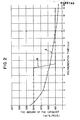
- the polymerization reaction is conducted for 13.25 hours by using the same method as in Example 1 except that methylcellulose is employed in an amount of 8.4g instead of 6.2 g, the initial inner pressure is arranged to 16.0 kg/cm 2 -G by initially charging a monomer mixture of 26.4% VdF, 67.1% HFP and 6.5% TFE, the partition-additions of FPO are conducted by the method of B in Fig. 2 instead of A and the inner pressure is maintained by charging an additional monomer mixture of 45.7% VdF, 32.0% HFP and 22.3% TFE when the inner pressure reduces to 15.5 kg/cm 2- G,
- the yield is 13.9 kg.
- the fluoroelastomer has 52.6% VdF units, 24.1% HFP units and 23.3% TFE units, [n] of 247, h 2 /h l of 2.07 and M w/ M n of 8.9, and has excellent rolling properties similar to the product of Example 1. The other properties are shown in Table 1.
- Example 3 Polymerization similar to Example 3 is carried out for 4.5 hours except that 18.6 g instead of 9.3 g of methylcellulose is used as a suspension stabilizer, 341.6 g instead of 85.4 g of IPP is used, the initial monomer mixture is composed of 27.5% VdF, 66.7% HFP and 5.8% TFE, and the additional monomer mixture is composed of 45.0% VdF, 32.1% HFP and 22.9% TFE. The yield of fluoroelastomer is 8 kg. The other results are shown in Table 1.
- Example 2 Polymerization similar to Example 1 is carried out for 3.5 hours except that 8,54 kg instead of 8.33 kg of R-113 is used, methylcellulose is used in an amount of 9.3 g instead of 6.2 g, the initial inner pressure is arranged to 17 kg/cm 2- G by charging an initial monomer mixture of 24.5% VdF, 69.6% HFP and 5.9% TFE, a catalyst comprising 170.8 g of IPP is collectively charged, and the inner pressure is maintained by charging an additional monomer mixture of 50.5% VdF, 28.1% HFP and 21.4% TFE at an inner pressure of 16.5 kg/cm 2- G. The yield of fluoroelastomer is 4.4 kg. The other results are shown in Table 1.
- a fifteen liter autoclave provided with a mechanical stirrer is thoroughly replaced with nitrogen gas and then evacuated. After repeating the replacing-evacuation procedure three times, the autoclave is evacuated as fully as possible, and then charged with 5800 g of pure water purged with nitrogen gas, 2670 g of R-113 and 2.9 g of methylcellulose as a suspension-stabilizer, and then maintained at 50°C with 500 rpm of agitation.
- a monomer mixture consisting of 27.2% of VdF, 66.7% of HFP and 6.1% of TFE is charged into the autoclave. The inner-pressure of the autoclave reaches 15.3 kg/cm 2- G by the charging procedure. Polymerization is initiated by the addition of 8 g of FPO.
- the obtained suspension is dehydrated with a centrifugal separator, washed thoroughly and vacuum-dried at 100°C to obtain 2.5 kg of fluoroelastomer.
- the obtained fluoroelastomer has 52.2% of VdF units 23.2% of H F P units and 24.6% of TFE units (by the analysis of 19 FNMR), [ ⁇ ] of 300, h 2 /h i of 1.8 and M w/ M n of 4.8.
- the fluoroelastomer is subjected to a polyol-curing under the standard conditions described hereinbefore.
- the fluoroelastomer shows excellent processability in tackiness on the mixing roll and in incorporation of components such as carbon black, magnesium oxide and calcium hydroxide, etc., and has a Mooney viscosity (ML 1+10 121°C) of 100.
- the other properties are shown in Table 2.
- Polymerization is conducted for 6 hours by using the same method described in Example 6 except that the initially charged monomer mixture consists of 24.4% of VdF, 70.0% HFP and 5.6% of TFE, 1 6 0 g of FPO is collectively charged, the additionally charged monomer mixture consists of 45.5% of VdF, 30.5% of HFP and 24.0% of TFE, and a polymerization temperature of 25°C is employed instead of 50° C .
- One kg of the fluoroelastomer is obtained by this method.
- the fluoroelastomer obtained consists of 53.4% VdF units, 24.8% HFP units and 21.8% TFE units, and shows [ ⁇ ] of 200, h 2/ h l of 0.8 and Rw/Rn of 7.1.
- the fluoroelastomer is cured by the same method as in Example 6 and shows a Mooney viscosity (ML 1+10 121°C) of 85.
- the other properties are shown in Table 2.
- a fifteen liter autoclave provided with a mechanical stirrer is thoroughly replaced with nitrogen gas and then evacuated. After repeating the replacement/evacuation procedure three times, the autoclave is evacuated as fully as possible, and then charged with 7500 g of pure-water purged with nitrogen gas, 22.5g of ammonium persulfate and 22.5 g of ammonium perfluorooctanoate as an emulsifier, and maintained at 85°C.
- a monomer mixture of 38.4% VdF, 39.2% HFP and 22 . 4 % TFE is charged into the autoclave. The inner-pressure of the autoclave becomes 8 kg/cm 2 -G by this charging procedure.
- the fluoroelastomer is obtained from the resultant emulsion by salting-out with the addition of a solution of magnesium chloride, washed thoroughly, vacuum-dried at 100°C.
- the yield of fluoroelastomer is about 1.3 kg.
- the fluoroelastomer has 45. 9% VdF units, 32.7 % HFP units and 21.4% TFE units (by the analysis of 19 NMR), shows [ ⁇ ] of 80 and M w/ M n of 27.4 and does not show a bimodal molecular weight distribution.
- The- fluoroelastomer cured by the same method as Example 6 shows a Mooney viscosity (ML 1+10 121°C) of 80.
- the other properties are shown in Table 2.
- Polymerization similar to Example 6 is repeated for 18 hours except that methylcellulose is used in an amount of 5.8 g instead of 2.9 g, the initial inner pressure is arranged to 15.5 kg/cm 2- G by charging a monomer mixture of 20.8% VdF and 79.2% HFP, the inner pressure is maintained at 15.5 kg/cm 2- G by charging an additional monomer mixture of 58.7% VdF and 41.3% HFP reducing the pressure to 15.0 kg/ cm 2- G and the total amount of FPO charged during the 18 hours of polymerization is 358 g instead of 218 g.
- Example 8 Polymerization similar to Example 8 is carried out for 10 hours except that as a catalyst, 106.8 g of IPP are used collectively, the initial monomer mixture is composed of 26.8% VdF and 73.2% HFP, and the additional monomer mixture has a composition of 58.5% VdF and 41.5% HFP.
Landscapes
- Chemical & Material Sciences (AREA)
- Health & Medical Sciences (AREA)
- Chemical Kinetics & Catalysis (AREA)
- Medicinal Chemistry (AREA)
- Polymers & Plastics (AREA)
- Organic Chemistry (AREA)
- Addition Polymer Or Copolymer, Post-Treatments, Or Chemical Modifications (AREA)
Applications Claiming Priority (8)
| Application Number | Priority Date | Filing Date | Title |
|---|---|---|---|
| JP27333884 | 1984-12-26 | ||
| JP273338/84 | 1984-12-26 | ||
| JP10223985 | 1985-05-14 | ||
| JP102239/85 | 1985-05-14 | ||
| JP195617/85 | 1985-09-04 | ||
| JP19561785 | 1985-09-04 | ||
| JP199015/85 | 1985-09-09 | ||
| JP60199015A JPS6259611A (ja) | 1985-09-09 | 1985-09-09 | 含フツ素エラストマ−の製造法 |
Publications (3)
| Publication Number | Publication Date |
|---|---|
| EP0186180A2 true EP0186180A2 (de) | 1986-07-02 |
| EP0186180A3 EP0186180A3 (en) | 1986-12-03 |
| EP0186180B1 EP0186180B1 (de) | 1990-04-04 |
Family
ID=27468992
Family Applications (1)
| Application Number | Title | Priority Date | Filing Date |
|---|---|---|---|
| EP85116480A Expired - Lifetime EP0186180B1 (de) | 1984-12-26 | 1985-12-23 | Fluorelastomer mit hohem Molekulargewicht |
Country Status (5)
| Country | Link |
|---|---|
| US (1) | US4690994A (de) |
| EP (1) | EP0186180B1 (de) |
| KR (1) | KR900001557B1 (de) |
| CA (1) | CA1244196A (de) |
| DE (1) | DE3576960D1 (de) |
Cited By (7)
| Publication number | Priority date | Publication date | Assignee | Title |
|---|---|---|---|---|
| US4830920A (en) * | 1987-05-08 | 1989-05-16 | Asahi Kasei Kogyo Kabushiki Kaisha | Fluorine-containing elastomer and a shaped article thereof |
| EP0353636A1 (de) * | 1988-07-29 | 1990-02-07 | Asahi Kasei Kogyo Kabushiki Kaisha | Fluorelastomer mit ausgezeichneter Verarbeitbarkeit |
| EP0434046A1 (de) * | 1989-12-20 | 1991-06-26 | E.I. Du Pont De Nemours And Company | Fluor enthaltende Elastomer-Zusammensetzung |
| US5109086A (en) * | 1989-03-15 | 1992-04-28 | Shin-Etsu Chemical Co., Ltd. | Process for producing a vinylidene fluoride copolymer |
| US5175223A (en) * | 1990-03-09 | 1992-12-29 | Ausimont S.P.A. | New fluoroelastomers based on vinylidene fluoride, hexafluoropropene and tetrafluoroethylene |
| US5474850A (en) * | 1992-05-22 | 1995-12-12 | Ames Rubber Corporation | Metal oxide free fluoroelastomer fusing member containing same |
| WO2002055567A3 (fr) * | 2001-01-10 | 2003-10-16 | Solvay | Procede de preparation de polymeres halogenes en deux etapes et polymeres halogenes plurimodales |
Families Citing this family (6)
| Publication number | Priority date | Publication date | Assignee | Title |
|---|---|---|---|---|
| JP3461291B2 (ja) * | 1998-08-06 | 2003-10-27 | ヤマウチ株式会社 | 熱プレスのクッション材用ゴム、熱プレス用クッション材およびプリント基板の製造方法 |
| AU2002303564A1 (en) * | 2001-05-02 | 2002-11-11 | 3M Innovative Properties Company | Aqueous emulsion polymerization in the presence of ethers as chain transfer agents to produce fluoropolymers |
| US6838512B2 (en) | 2003-06-05 | 2005-01-04 | 3M Innovative Properties Company | Cold shrink fluoroelastomeric article |
| US8242210B2 (en) | 2007-08-29 | 2012-08-14 | Solvay Solexis S.P.A. | (Per)fluoroelastomeric compositions |
| CN103665238B (zh) * | 2013-12-11 | 2015-08-26 | 中昊晨光化工研究院有限公司 | 一种宽分子量分布氟橡胶的合成方法 |
| CN103724511B (zh) * | 2013-12-30 | 2016-06-15 | 山东华夏神舟新材料有限公司 | 一种油封用氟橡胶的制备方法 |
Family Cites Families (11)
| Publication number | Priority date | Publication date | Assignee | Title |
|---|---|---|---|---|
| DE1078329B (de) * | 1955-04-27 | 1960-03-24 | Du Pont | Verfahren zur Herstellung eines elastischen Mischpolymerisats aus Vinylidenfluorid und einem anderen Fluorolefin |
| US3069401A (en) * | 1960-02-23 | 1962-12-18 | Du Pont | Copolymers of hexafluoropropylene vinylidene fluoride and aliphatic, chain transfer agents |
| US3056767A (en) * | 1960-11-14 | 1962-10-02 | Du Pont | Copolymers of vinylidene fluoride, hexafluoropropene, and perfluoro-2-butene |
| US3194796A (en) * | 1962-03-22 | 1965-07-13 | Du Pont | Elastomeric fluorocarbon terpolymers of vinylidene fluoride, hexafluoropropylene and a halogen free polar monomer |
| US3839305A (en) * | 1970-12-14 | 1974-10-01 | Du Pont | Method of making vinylidene fluoride copolymers |
| US3845024A (en) * | 1972-11-22 | 1974-10-29 | Du Pont | Continuous process for production of fluoroelastomers |
| US3929934A (en) * | 1973-11-19 | 1975-12-30 | Du Pont | Novel fluoroelastomers in powder form |
| IT1019846B (it) * | 1974-08-09 | 1977-11-30 | Montedison Spa | Procedimento di preparazione di copolimeri elastomerici del fluoruro di vinilidene ad elevate carat teristiche e copolimeri elastomeri ci cosi ottenuti |
| US4141874A (en) * | 1975-11-15 | 1979-02-27 | Daikin Kogyo Co., Ltd. | Fluorine-containing elastomeric copolymers, process for preparing the same and composition containing the same |
| US4123603A (en) * | 1977-05-31 | 1978-10-31 | E. I. Du Pont De Nemours And Company | Fluoroelastomer composition |
| US4549921A (en) * | 1983-10-28 | 1985-10-29 | E. I. Du Pont De Nemours And Company | Lamination of fluorocarbon films |
-
1985
- 1985-12-02 CA CA000496639A patent/CA1244196A/en not_active Expired
- 1985-12-05 US US06/804,772 patent/US4690994A/en not_active Expired - Lifetime
- 1985-12-23 EP EP85116480A patent/EP0186180B1/de not_active Expired - Lifetime
- 1985-12-23 DE DE8585116480T patent/DE3576960D1/de not_active Expired - Lifetime
- 1985-12-26 KR KR1019850009837A patent/KR900001557B1/ko not_active Expired
Cited By (9)
| Publication number | Priority date | Publication date | Assignee | Title |
|---|---|---|---|---|
| US4830920A (en) * | 1987-05-08 | 1989-05-16 | Asahi Kasei Kogyo Kabushiki Kaisha | Fluorine-containing elastomer and a shaped article thereof |
| EP0353636A1 (de) * | 1988-07-29 | 1990-02-07 | Asahi Kasei Kogyo Kabushiki Kaisha | Fluorelastomer mit ausgezeichneter Verarbeitbarkeit |
| US4985520A (en) * | 1988-07-29 | 1991-01-15 | Asahi Kasei Kogyo Kabushiki Kaisha | Fluoroelastomer having excellent processability |
| US5109086A (en) * | 1989-03-15 | 1992-04-28 | Shin-Etsu Chemical Co., Ltd. | Process for producing a vinylidene fluoride copolymer |
| EP0434046A1 (de) * | 1989-12-20 | 1991-06-26 | E.I. Du Pont De Nemours And Company | Fluor enthaltende Elastomer-Zusammensetzung |
| US5175223A (en) * | 1990-03-09 | 1992-12-29 | Ausimont S.P.A. | New fluoroelastomers based on vinylidene fluoride, hexafluoropropene and tetrafluoroethylene |
| US5474850A (en) * | 1992-05-22 | 1995-12-12 | Ames Rubber Corporation | Metal oxide free fluoroelastomer fusing member containing same |
| US5922416A (en) * | 1992-05-22 | 1999-07-13 | Ames Rubber Corporation | Method for fabricating metal oxide free fluoroelastomer fusing member |
| WO2002055567A3 (fr) * | 2001-01-10 | 2003-10-16 | Solvay | Procede de preparation de polymeres halogenes en deux etapes et polymeres halogenes plurimodales |
Also Published As
| Publication number | Publication date |
|---|---|
| KR900001557B1 (ko) | 1990-03-15 |
| EP0186180A3 (en) | 1986-12-03 |
| CA1244196A (en) | 1988-11-01 |
| KR860009053A (ko) | 1986-12-19 |
| EP0186180B1 (de) | 1990-04-04 |
| DE3576960D1 (de) | 1990-05-10 |
| US4690994A (en) | 1987-09-01 |
Similar Documents
| Publication | Publication Date | Title |
|---|---|---|
| US6509429B1 (en) | Process for preparing fluorine-containing polymer | |
| EP0647253B1 (de) | Vernetzte fluoroelastomere zusammensetzungen | |
| US4789717A (en) | Process for the polymerization in aqueous dispersion of fluorinated monomers | |
| US3707529A (en) | Elastomeric vinylidene fluoride polymers with 55-95 percent non-ionic end groups | |
| EP0186180B1 (de) | Fluorelastomer mit hohem Molekulargewicht | |
| JPH1060054A (ja) | フッ化ビニリデンの重合方法 | |
| EP0169328A2 (de) | Emulsionspolymerisation von Vinylidenfluoridpolymeren | |
| EP0127407A2 (de) | Kern/Schale Fluoropolymeren-Zusammensetzungen | |
| US4920170A (en) | Process for producing fluorine-containing elastic copolymer | |
| EP3008099B1 (de) | Fluorierte copolymerisate mit einpolymerisierten einheiten eines vinylperfluoroalkyl- oder vinylperfluoroalkylenoxyperfluoro- vinylethers | |
| JPS62112611A (ja) | 含フツ素エラストマ− | |
| US4734474A (en) | Fluorine-containing sulfonyl polymer | |
| JPS6127404B2 (de) | ||
| JP2679729B2 (ja) | 加硫可能な組成物 | |
| US6686427B2 (en) | Vinylidene fluoride polymer and process for production thereof | |
| RU2107698C1 (ru) | Фторэластомерный сополимер | |
| JPH03247608A (ja) | パーオキシド加硫可能な含フッ素エラストマーの製造方法 | |
| JP2580299B2 (ja) | 含フッ素エラストマー | |
| US5264509A (en) | Fluoroelastomers based on vinylidene fluoride exhibiting superior resistance to organic bases | |
| JP3521430B2 (ja) | フッ素系共重合体,その製造方法およびフッ素系エラストマー | |
| GB2517481A (en) | Method of making peroxide fluoropolymers using non-fluorindated emulsifiers | |
| JPH04258614A (ja) | 含フッ素エラストマー | |
| JPS62156111A (ja) | 高性能含フツ素エラストマ− | |
| JP2002037965A (ja) | 押出加工性に優れたゲル成分含有含フッ素エラストマー | |
| JPH02117945A (ja) | フルオロエラストマー組成物 |
Legal Events
| Date | Code | Title | Description |
|---|---|---|---|
| PUAI | Public reference made under article 153(3) epc to a published international application that has entered the european phase |
Free format text: ORIGINAL CODE: 0009012 |
|
| AK | Designated contracting states |
Kind code of ref document: A2 Designated state(s): BE DE FR GB IT NL |
|
| PUAL | Search report despatched |
Free format text: ORIGINAL CODE: 0009013 |
|
| AK | Designated contracting states |
Kind code of ref document: A3 Designated state(s): BE DE FR GB IT NL |
|
| 17P | Request for examination filed |
Effective date: 19870430 |
|
| 17Q | First examination report despatched |
Effective date: 19880708 |
|
| GRAA | (expected) grant |
Free format text: ORIGINAL CODE: 0009210 |
|
| AK | Designated contracting states |
Kind code of ref document: B1 Designated state(s): BE DE FR GB IT NL |
|
| REF | Corresponds to: |
Ref document number: 3576960 Country of ref document: DE Date of ref document: 19900510 |
|
| ET | Fr: translation filed | ||
| ITF | It: translation for a ep patent filed | ||
| ITTA | It: last paid annual fee | ||
| PLBE | No opposition filed within time limit |
Free format text: ORIGINAL CODE: 0009261 |
|
| STAA | Information on the status of an ep patent application or granted ep patent |
Free format text: STATUS: NO OPPOSITION FILED WITHIN TIME LIMIT |
|
| 26N | No opposition filed | ||
| REG | Reference to a national code |
Ref country code: GB Ref legal event code: 732E |
|
| REG | Reference to a national code |
Ref country code: FR Ref legal event code: TP |
|
| NLS | Nl: assignments of ep-patents |
Owner name: E.I. DUPONT DE NEMOURS & COMPANY |
|
| PGFP | Annual fee paid to national office [announced via postgrant information from national office to epo] |
Ref country code: NL Payment date: 19960913 Year of fee payment: 12 |
|
| PGFP | Annual fee paid to national office [announced via postgrant information from national office to epo] |
Ref country code: BE Payment date: 19960926 Year of fee payment: 12 |
|
| PG25 | Lapsed in a contracting state [announced via postgrant information from national office to epo] |
Ref country code: BE Free format text: LAPSE BECAUSE OF NON-PAYMENT OF DUE FEES Effective date: 19971231 |
|
| BERE | Be: lapsed |
Owner name: E.I. DU PONT DE NEMOURS & CY Effective date: 19971231 |
|
| PG25 | Lapsed in a contracting state [announced via postgrant information from national office to epo] |
Ref country code: NL Free format text: LAPSE BECAUSE OF NON-PAYMENT OF DUE FEES Effective date: 19980701 |
|
| NLV4 | Nl: lapsed or anulled due to non-payment of the annual fee |
Effective date: 19980701 |
|
| REG | Reference to a national code |
Ref country code: GB Ref legal event code: IF02 |
|
| PGFP | Annual fee paid to national office [announced via postgrant information from national office to epo] |
Ref country code: FR Payment date: 20041208 Year of fee payment: 20 |
|
| PGFP | Annual fee paid to national office [announced via postgrant information from national office to epo] |
Ref country code: DE Payment date: 20041216 Year of fee payment: 20 |
|
| PGFP | Annual fee paid to national office [announced via postgrant information from national office to epo] |
Ref country code: GB Payment date: 20041222 Year of fee payment: 20 |
|
| PG25 | Lapsed in a contracting state [announced via postgrant information from national office to epo] |
Ref country code: GB Free format text: LAPSE BECAUSE OF EXPIRATION OF PROTECTION Effective date: 20051222 |
|
| REG | Reference to a national code |
Ref country code: GB Ref legal event code: PE20 |