EP0186381A2 - Thermostat diagnostique - Google Patents
Thermostat diagnostique Download PDFInfo
- Publication number
- EP0186381A2 EP0186381A2 EP85309001A EP85309001A EP0186381A2 EP 0186381 A2 EP0186381 A2 EP 0186381A2 EP 85309001 A EP85309001 A EP 85309001A EP 85309001 A EP85309001 A EP 85309001A EP 0186381 A2 EP0186381 A2 EP 0186381A2
- Authority
- EP
- European Patent Office
- Prior art keywords
- building
- furnace
- thermostat
- indoor temperature
- time
- Prior art date
- Legal status (The legal status is an assumption and is not a legal conclusion. Google has not performed a legal analysis and makes no representation as to the accuracy of the status listed.)
- Withdrawn
Links
Images
Classifications
-
- F—MECHANICAL ENGINEERING; LIGHTING; HEATING; WEAPONS; BLASTING
- F24—HEATING; RANGES; VENTILATING
- F24D—DOMESTIC- OR SPACE-HEATING SYSTEMS, e.g. CENTRAL HEATING SYSTEMS; DOMESTIC HOT-WATER SUPPLY SYSTEMS; ELEMENTS OR COMPONENTS THEREFOR
- F24D19/00—Details
- F24D19/10—Arrangement or mounting of control or safety devices
-
- G—PHYSICS
- G05—CONTROLLING; REGULATING
- G05D—SYSTEMS FOR CONTROLLING OR REGULATING NON-ELECTRIC VARIABLES
- G05D23/00—Control of temperature
- G05D23/19—Control of temperature characterised by the use of electric means
- G05D23/1902—Control of temperature characterised by the use of electric means characterised by the use of a variable reference value
Definitions
- This invention relates generally to building thermostats, and has to do in particular with a thermostat capable of displaying the thermal efficiency or performance of a building and its heating system, as well as providing the usual controlling functions.
- microprocessor-based thermostats to control heating and cooling systems is also known, for example Janes, U.S. Patent 4,388,692.
- the present invention uses a menu-driven arrangement which greatly simplifies user ergonomics. Instead of using separate buttons for each thermostat function, the user merely selects the correct position on the menu, presses the program button, raises or lowers the value and presses the accept button. This same sequence applies to all the thermostat functions.
- Another advantage of a preferred embodiment of this invention is embodied in the design of the thermostat itself.
- the door and keypad have been designed to prioritize user interaction according to the level of sophistication.
- buttons are accessible through the opening provided. These are used to override the temperature on a temporary basis. This can be done without any knowledge of further programming.
- the closed door also shows only the relevant parts of the LCD display needed for this simple level of consumer interaction. This is particularly appropriate for babysitters or house occupants who need a simple means of temporary temperature control.
- the present invention provides a simple means of providing reliable short-term data indicating energy efficiency.
- the transient effects due to building capacitance and weather are eliminated by selecting only significant data below a given outside temperature average.
- Data are further averaged over a two-week sampling period to eliminate weather transient effects. They are then normalized by comparison with a baseline performance value for the building stored in the microprocessor. The normalized data are then presented in the form of a percent of 'energy index' which can be easily understood by the consumer.
- a further advantage of this diagnostic thermostat/energy monitoring system is that it is low in cost and can be offered to the user at a price comparable to other thermostats now on the market..
- the thermostat can be designed to present the information on a large menu-driven LCD display which allows easy use without user training. Periods of high and low energy consumption can be presented as a bar graph on the display for quick reference.
- thermostat which combines the monitoring capabilities described earlier with the normal function of a thermostat. Because the thermostat is already controlling the heating plant, part of the computation or sensing mechanism required is already present and supplied by the thermostat function.
- this invention provides a diagnostic thermostat for a building, comprising:
- this invention provides a method of . diagnosing the heating performance of a building which includes a furnace, comprising the steps:
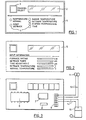
- the thermostat shown in the figures, particularly in Figure 3, incorporates a microprocessor 6 which utilizes a digital display to show several pieces of information, selectable by the operator.
- the unit also incorporates an electronic clock 7.
- the thermostat senses outside temperature by virtue of an outside temperature probe 11 and wires 12 connecting the probe 11 to the thermostat shown in Figure 3.
- the thermostat can calculate, store and display energy used per degree day for a given period of elapsed time. This information represents the performance or efficiency of the building and its heating system. Naturally, any other units may also be employed.
- the thermostat could express the average building performance in BTUs per degree day over the previous two week period, two months, or even a year. It could also express this information in terms of energy savings or in terms of a percent reduction from an initial standard energy consumption rate.
- the data would be accumulated in the memory of the microprocessor, and displayed upon command on the digital display.
- an indoor temperature sensor 8 is illustrated, along with a wiring terminal 9.
- the wiring terminal 9 also allows the connection of the control wires 14 going to the furnace 10.
- diagnostic thermostat One important advantage of the diagnostic thermostat disclosed herein is that improvements in the building or its heating system would become immediately visible in terms of the building efficiency. For example, improved sealing of doors and windows or building insulation would show up as an immediate improvement in building efficiency, i.e. less BTUs per degree day over a given period. Similarly, a decrease in furnace efficiency, such as would occur with a clogged filter or combustion jet, would show up as a decrease in building efficiency, i.e. more BTUs per degree day.
- the front panel 1 includes a digital display 2 that can show the indoor temperature or any of the functions indicated.
- the channels are selected by the user pressing the select button 3, and the particular function being displayed is indicated by the appropriate LED indicator 4.
- the installer or homeowner can program in fixed data such as the furnace rating (in BTU/hr or KW) and the night setback information.
- thermostat Several other options could also be incorporated into the thermostat disclosed herein.
- the system as it is would illustrate the effects of passive solar heating as an improvement in performance on sunny days.
- the thermostat could be adapted to monitor solar gain directly via a small window-mounted solar sensor.
- the microprocessor could easily be programmed to set back temperatures at night to a level determined by the operator.
- the system could also be used for monitoring the efficiency of cooling systems, or both heating and cooling systems together.
- thermostat microprocessor could be used to compute and display other environmental information, such as humidity or air pollutants (indoor or outdoor), using the appropriate sensors.
- a further function could be to predict the weather by means of measuring such variables as temperatures, humidities or their rates of change, then processing this information by means of software stored in the microprocessor.
- the microprocessor could be used to store indoor or outdoor temperature records over a past period, for the information of the operator. For example, it could display the maximum and minimum outdoor temperature for the past 24 hr. period. It is additionally contemplated that the energy savings could be displayed as an 'energy consumption index' which would set itself to 100% during the first month of cold weather operation, and thereafter show a number proportional to the increase or decrease in energy consumpsion. For example, if a user insulated the building and reduced his index to 83%, this means he would save approximately 17% on his fuel bills.
- the thermostat would be required to take average data over a period of time (for example one or two weeks), in order to eliminate short-term transient effects in the weather and building heating system.
- thermostat it is contemplated to arrange the thermostat such that it would not make a computation of.heating efficiency at times when the outside temperature was greater than a certain predetermined level. This will further.tend to eliminate transient effects which arise when only a marginal amount of heat is required to maintain the building interior at room temperature.
- the energy savings could be expressed in terms of BTU, KWH or dollars saved over a period of time. This would require the input of user information such as furnace rating or fuel price via the thermostat keypad.
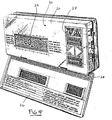
- a preferred embodiment of the thermostat is shown at .20, having a digital display 22, and an input pad 24.
- a door 26 hinged at the line 28 is adapted to close over the forward face 30 of the thermostat 20, thus restricting access to a limited portion of the display 22 and a limited portion of the keypad 24.
- operation of the thermostat could be restricted to a simple lowering or raising of the indoor temperature, without the user being able to access the other functions of the thermostat. This would be particularly suitable when the thermostat is to be operated by a babysitter, or other persons who are not trained in the use of all functions of the thermostat.
- the following pages contain the program documentation, ROM and RAM usage, data and program structures, flow code, and the internal program used in a preferred embodiment of this thermostat.
Landscapes
- Engineering & Computer Science (AREA)
- Physics & Mathematics (AREA)
- Thermal Sciences (AREA)
- Chemical & Material Sciences (AREA)
- Combustion & Propulsion (AREA)
- Mechanical Engineering (AREA)
- General Engineering & Computer Science (AREA)
- General Physics & Mathematics (AREA)
- Automation & Control Theory (AREA)
- Control Of Temperature (AREA)
- Air Conditioning Control Device (AREA)
- Investigating Or Analyzing Materials Using Thermal Means (AREA)
Applications Claiming Priority (2)
| Application Number | Priority Date | Filing Date | Title |
|---|---|---|---|
| CA469847 | 1984-12-11 | ||
| CA000469847A CA1240766A (fr) | 1984-12-11 | 1984-12-11 | Thermostat diagnostique |
Publications (2)
| Publication Number | Publication Date |
|---|---|
| EP0186381A2 true EP0186381A2 (fr) | 1986-07-02 |
| EP0186381A3 EP0186381A3 (fr) | 1986-11-12 |
Family
ID=4129360
Family Applications (1)
| Application Number | Title | Priority Date | Filing Date |
|---|---|---|---|
| EP85309001A Withdrawn EP0186381A3 (fr) | 1984-12-11 | 1985-12-11 | Thermostat diagnostique |
Country Status (2)
| Country | Link |
|---|---|
| EP (1) | EP0186381A3 (fr) |
| CA (1) | CA1240766A (fr) |
Cited By (3)
| Publication number | Priority date | Publication date | Assignee | Title |
|---|---|---|---|---|
| EP0825391A1 (fr) * | 1996-08-05 | 1998-02-25 | Spiros Crisanthou Prevezanos | Comportement énergétique des bâtiments |
| US9416987B2 (en) | 2013-07-26 | 2016-08-16 | Honeywell International Inc. | HVAC controller having economy and comfort operating modes |
| CN114200988A (zh) * | 2021-12-06 | 2022-03-18 | 深圳市时誉高精科技有限公司 | 基于大数据的室内恒温器管理系统 |
Family Cites Families (5)
| Publication number | Priority date | Publication date | Assignee | Title |
|---|---|---|---|---|
| US4234927A (en) * | 1978-05-08 | 1980-11-18 | First Theodore C | Micro processor controlled sensor system for apartment house |
| NL7903911A (nl) * | 1979-05-17 | 1980-11-19 | Tricentrol B V | Werkwijze en inrichting voor het regelen van de temperatuur binnen een omsloten ruimte. |
| DE3127471A1 (de) * | 1981-07-11 | 1983-01-20 | Robert Bosch Gmbh, 7000 Stuttgart | Elektronisches steuergeraet fuer heizungsanlagen |
| GB2102964A (en) * | 1981-07-30 | 1983-02-09 | Satchwell Controls Limited | Meters |
| BE890497A (fr) * | 1981-09-25 | 1982-03-25 | Acec | Dispositif modulaire de gestion chronothermique pour chauffage centralise |
-
1984
- 1984-12-11 CA CA000469847A patent/CA1240766A/fr not_active Expired
-
1985
- 1985-12-11 EP EP85309001A patent/EP0186381A3/fr not_active Withdrawn
Cited By (4)
| Publication number | Priority date | Publication date | Assignee | Title |
|---|---|---|---|---|
| EP0825391A1 (fr) * | 1996-08-05 | 1998-02-25 | Spiros Crisanthou Prevezanos | Comportement énergétique des bâtiments |
| US9416987B2 (en) | 2013-07-26 | 2016-08-16 | Honeywell International Inc. | HVAC controller having economy and comfort operating modes |
| CN114200988A (zh) * | 2021-12-06 | 2022-03-18 | 深圳市时誉高精科技有限公司 | 基于大数据的室内恒温器管理系统 |
| CN114200988B (zh) * | 2021-12-06 | 2023-01-10 | 深圳市时誉高精科技有限公司 | 基于大数据的室内恒温器管理系统 |
Also Published As
| Publication number | Publication date |
|---|---|
| CA1240766A (fr) | 1988-08-16 |
| EP0186381A3 (fr) | 1986-11-12 |
Similar Documents
| Publication | Publication Date | Title |
|---|---|---|
| US4685615A (en) | Diagnostic thermostat | |
| US10534383B2 (en) | HVAC controller with performance log | |
| US20250258045A1 (en) | System and method for evaluating changes in the efficiency of an hvac system | |
| EP2722601A2 (fr) | Procédés et appareils d'affichage d'économie d'énergie à partir d'un système HVAC | |
| US8751186B2 (en) | System and method for calculating the thermal mass of a building | |
| US4644320A (en) | Home energy monitoring and control system | |
| US4002890A (en) | Method of charging fuel costs among the various apartments in an apartment house or the like and suitable devices in this connection | |
| CA2598405A1 (fr) | Appareil d'affichage d'information de dispositif reseaute et reseau comportant ce dernier | |
| CA2041717A1 (fr) | Systeme de regulation du confort ambiant et methode de mesure de la temperature moyenne de rayonnement | |
| WO1999023455A1 (fr) | Dispositif et procede de mesure et d'affichage de la consommation d'energie et procede d'etalonnage d'un tel dispositif | |
| US4186563A (en) | Cooling efficiency meter circuit for an air conditioner | |
| JP5282060B2 (ja) | エネルギー使用量表示装置 | |
| WO2000058668A1 (fr) | Chauffe-eau | |
| EP0186381A2 (fr) | Thermostat diagnostique | |
| JPH0587403A (ja) | 給湯装置 | |
| JP2010079580A (ja) | Q値測定システム及びq値測定方法 | |
| CN1375752A (zh) | 智能温度控制器 | |
| Palmiter et al. | Low cost performance evaluation of passive solar buildings | |
| Kon | Thermal comfort sensor | |
| Sharp | Non-intrusive load monitoring systems: Considerations for use and potential applications | |
| CN119687506A (zh) | 分布式供热系统的供热状态调控方法及调控装置 | |
| JD | Computerized instrumented residential audit (CIRA) | |
| JPH06217650A (ja) | 施設園芸用温室の天窓開閉装置制御部およびその運転方法 | |
| Hancock et al. | New Technology Demonstration Program, Kennedy Space Center, Hangar L Heat Pipe Project: Performance Evaluation Report | |
| Fanney | Field Monitoring of a Variable-Speed Integrated Heat Pump/Water Heating Appliance |
Legal Events
| Date | Code | Title | Description |
|---|---|---|---|
| PUAI | Public reference made under article 153(3) epc to a published international application that has entered the european phase |
Free format text: ORIGINAL CODE: 0009012 |
|
| AK | Designated contracting states |
Kind code of ref document: A2 Designated state(s): AT BE CH DE FR GB IT LI LU NL SE |
|
| PUAL | Search report despatched |
Free format text: ORIGINAL CODE: 0009013 |
|
| RHK1 | Main classification (correction) |
Ipc: G01K 17/06 |
|
| AK | Designated contracting states |
Kind code of ref document: A3 Designated state(s): AT BE CH DE FR GB IT LI LU NL SE |
|
| 17P | Request for examination filed |
Effective date: 19870427 |
|
| 17Q | First examination report despatched |
Effective date: 19881118 |
|
| STAA | Information on the status of an ep patent application or granted ep patent |
Free format text: STATUS: THE APPLICATION IS DEEMED TO BE WITHDRAWN |
|
| 18D | Application deemed to be withdrawn |
Effective date: 19890530 |