EP0186443B1 - Siliciumnitridfilme für integrierte Schaltungen - Google Patents
Siliciumnitridfilme für integrierte Schaltungen Download PDFInfo
- Publication number
- EP0186443B1 EP0186443B1 EP85309262A EP85309262A EP0186443B1 EP 0186443 B1 EP0186443 B1 EP 0186443B1 EP 85309262 A EP85309262 A EP 85309262A EP 85309262 A EP85309262 A EP 85309262A EP 0186443 B1 EP0186443 B1 EP 0186443B1
- Authority
- EP
- European Patent Office
- Prior art keywords
- silicon nitride
- silane
- approximately
- ammonia
- chamber
- Prior art date
- Legal status (The legal status is an assumption and is not a legal conclusion. Google has not performed a legal analysis and makes no representation as to the accuracy of the status listed.)
- Expired - Lifetime
Links
Images



Classifications
-
- H—ELECTRICITY
- H10—SEMICONDUCTOR DEVICES; ELECTRIC SOLID-STATE DEVICES NOT OTHERWISE PROVIDED FOR
- H10P—GENERIC PROCESSES OR APPARATUS FOR THE MANUFACTURE OR TREATMENT OF DEVICES COVERED BY CLASS H10
- H10P14/00—Formation of materials, e.g. in the shape of layers or pillars
- H10P14/60—Formation of materials, e.g. in the shape of layers or pillars of insulating materials
- H10P14/63—Formation of materials, e.g. in the shape of layers or pillars of insulating materials characterised by the formation processes
- H10P14/6326—Deposition processes
- H10P14/6328—Deposition from the gas or vapour phase
- H10P14/6334—Deposition from the gas or vapour phase using decomposition or reaction of gaseous or vapour phase compounds, i.e. chemical vapour deposition
- H10P14/6336—Deposition from the gas or vapour phase using decomposition or reaction of gaseous or vapour phase compounds, i.e. chemical vapour deposition in the presence of a plasma [PECVD]
-
- C—CHEMISTRY; METALLURGY
- C23—COATING METALLIC MATERIAL; COATING MATERIAL WITH METALLIC MATERIAL; CHEMICAL SURFACE TREATMENT; DIFFUSION TREATMENT OF METALLIC MATERIAL; COATING BY VACUUM EVAPORATION, BY SPUTTERING, BY ION IMPLANTATION OR BY CHEMICAL VAPOUR DEPOSITION, IN GENERAL; INHIBITING CORROSION OF METALLIC MATERIAL OR INCRUSTATION IN GENERAL
- C23C—COATING METALLIC MATERIAL; COATING MATERIAL WITH METALLIC MATERIAL; SURFACE TREATMENT OF METALLIC MATERIAL BY DIFFUSION INTO THE SURFACE, BY CHEMICAL CONVERSION OR SUBSTITUTION; COATING BY VACUUM EVAPORATION, BY SPUTTERING, BY ION IMPLANTATION OR BY CHEMICAL VAPOUR DEPOSITION, IN GENERAL
- C23C16/00—Chemical coating by decomposition of gaseous compounds, without leaving reaction products of surface material in the coating, i.e. chemical vapour deposition [CVD] processes
- C23C16/22—Chemical coating by decomposition of gaseous compounds, without leaving reaction products of surface material in the coating, i.e. chemical vapour deposition [CVD] processes characterised by the deposition of inorganic material, other than metallic material
- C23C16/30—Deposition of compounds, mixtures or solid solutions, e.g. borides, carbides, nitrides
- C23C16/34—Nitrides
- C23C16/345—Silicon nitride
-
- H—ELECTRICITY
- H10—SEMICONDUCTOR DEVICES; ELECTRIC SOLID-STATE DEVICES NOT OTHERWISE PROVIDED FOR
- H10D—INORGANIC ELECTRIC SEMICONDUCTOR DEVICES
- H10D30/00—Field-effect transistors [FET]
- H10D30/60—Insulated-gate field-effect transistors [IGFET]
- H10D30/68—Floating-gate IGFETs
- H10D30/681—Floating-gate IGFETs having only two programming levels
-
- H—ELECTRICITY
- H10—SEMICONDUCTOR DEVICES; ELECTRIC SOLID-STATE DEVICES NOT OTHERWISE PROVIDED FOR
- H10P—GENERIC PROCESSES OR APPARATUS FOR THE MANUFACTURE OR TREATMENT OF DEVICES COVERED BY CLASS H10
- H10P14/00—Formation of materials, e.g. in the shape of layers or pillars
- H10P14/60—Formation of materials, e.g. in the shape of layers or pillars of insulating materials
- H10P14/66—Formation of materials, e.g. in the shape of layers or pillars of insulating materials characterised by the type of materials
- H10P14/668—Formation of materials, e.g. in the shape of layers or pillars of insulating materials characterised by the type of materials the materials being characterised by the deposition precursor materials
- H10P14/6681—Formation of materials, e.g. in the shape of layers or pillars of insulating materials characterised by the type of materials the materials being characterised by the deposition precursor materials the precursor containing a compound comprising Si
- H10P14/6682—Formation of materials, e.g. in the shape of layers or pillars of insulating materials characterised by the type of materials the materials being characterised by the deposition precursor materials the precursor containing a compound comprising Si the compound being a silane, e.g. disilane, methylsilane or chlorosilane
-
- H—ELECTRICITY
- H10—SEMICONDUCTOR DEVICES; ELECTRIC SOLID-STATE DEVICES NOT OTHERWISE PROVIDED FOR
- H10P—GENERIC PROCESSES OR APPARATUS FOR THE MANUFACTURE OR TREATMENT OF DEVICES COVERED BY CLASS H10
- H10P14/00—Formation of materials, e.g. in the shape of layers or pillars
- H10P14/60—Formation of materials, e.g. in the shape of layers or pillars of insulating materials
- H10P14/69—Inorganic materials
- H10P14/694—Inorganic materials composed of nitrides
- H10P14/6943—Inorganic materials composed of nitrides containing silicon
- H10P14/69433—Inorganic materials composed of nitrides containing silicon the material being a silicon nitride not containing oxygen, e.g. SixNy or SixByNz
-
- Y—GENERAL TAGGING OF NEW TECHNOLOGICAL DEVELOPMENTS; GENERAL TAGGING OF CROSS-SECTIONAL TECHNOLOGIES SPANNING OVER SEVERAL SECTIONS OF THE IPC; TECHNICAL SUBJECTS COVERED BY FORMER USPC CROSS-REFERENCE ART COLLECTIONS [XRACs] AND DIGESTS
- Y10—TECHNICAL SUBJECTS COVERED BY FORMER USPC
- Y10S—TECHNICAL SUBJECTS COVERED BY FORMER USPC CROSS-REFERENCE ART COLLECTIONS [XRACs] AND DIGESTS
- Y10S428/00—Stock material or miscellaneous articles
- Y10S428/922—Static electricity metal bleed-off metallic stock
- Y10S428/9335—Product by special process
- Y10S428/938—Vapor deposition or gas diffusion
Definitions
- topside layer In the construction of semiconductor integrated circuits, several types of topside layers are currently in use. This topside “passivation layer” is used as a dielectric barrier to protect the underlying circuitry of the integrated circuit from both moisture and contaminants, which can cause corrosion or electric shorts.
- UV ultraviolet
- EPROM erasable programmable read only memory
- the erase feature is provided by shining ultraviolet light onto the semiconductor chip. This excites the electrons trapped on a floating gate region of the circuit structure and causes the electrons to move off the floating gate.
- the topside passivation layer of the integrated circuit must be transparent to UV light to a degree sufficient to allow the energy levels of the trapped electrons to be raised to a state where they can diffuse off the gate.
- Silicon nitride is considered to be one of the best compositions for use as a passivation layer on semiconductor integrated circuits as a dielectric. It is known to have a high resistance to moisture and hydrogen penetration which would ruin the circuit. Moreover, diffusivity of various impurities, such as sodium, is much lower in silicon nitride than in other insulators, such as silicon dioxide. thus, integrated circuits made with a silicon nitride passivation layer are less susceptible to ionic contamination problems.
- Silicon nitride is generally deposited by combining silane (SiH 4 ) and ammonia (NH 3 ) by the following chemical vapor deposition (CVD) reaction:
- This pyrolytic reaction can take place at atmospheric pressure both with nitrogen (at approximately 650°C) or hydrogen (at approximately 1000°C) as carrier gases. However, these temperatures are impractical for deposition of topside films.
- Plasma deposition involves the use of gas reactants, in an evacuated reactor, that are converted into very reactive chemical species with the help of an RF glow discharge and result in vapor deposition of the desired material.
- the plasma-deposition process is a variation of the CVD process in which a gas plasma replaces the heat-induced decomposition reactions.
- the most significant difference lies in the lower temperature of the plasma deposition process (approximately 200 to 450°C), which does not cause a phase change of the underlying metallic alloy film and does not alter the junction depth of transistors.
- silicon nitride deposited by plasma techniques is opaque to UV light at 253.7 nm (the wavelength of mercury UV light used to erase EPROM devices). See e.g., K. Alexander, et al., Moisture Resistive, U. V. Transmissive Passivation for Plastic Encapsulated EPROM Devices, IEEE International Reliability Physics Symposium, Las Vegas (1984); J. K. Chu, et al., Plasma CVD Oxynitride as a Dielectric and Passivation Film, Electrochem. Soc. Ext. Abstr., Vol., 83-2, Abstract No. 321 (1983); M.J. Rand and D. R. Wonsidler, Optical Absorption as a Control Test for Plasma Silicon Nitride Deposition, J. Electrochem. Soc. Vol. 125, No. 1, 99 (1978).
- silicon nitride has been considered unsuitable for use as a passivation layer on UV EPROM devices.
- silicon oxynitride films with refractive indices below 1.80 are widely considered to be the films of choice as passivation layers for EPROM packaging. Processes have been developed to yield oxynitride films with refractive indices of 1.70 ⁇ 0.1. However, erase times of films created in some commercially available plasma deposition systems were found to be much shorter than others. This result, in conjunction with data on integrity of the films, suggested that deposition conditions strongly affect film characteristics. A wide range of deposition parameters, including flows of each participant gas in the reaction, temperature, pressure, RF power and frequency, as well as geometry of the different systems, were thus subject to the investigation leading to the present invention.
- the present invention seeks to provide a method of forming an ultraviolet radiation sensitive EPROM with a silicon nitride passivation layer.
- such a method comprises establishing a flow of silane and ammonia over the substrate of an EPROM wafer in a heated and evacuated reaction chamber, and catalysing the atmosphere in the chamber to create a plasma such that the silane and ammonia react to deposit a silicon nitride film on the substrate, the film being of sufficient thickness to form a passivation layer, the temperature of the chamber being in the range of 350°C to 450°C, and the ratio of silane to ammonia in the said flow and the temperature within the said range each being selected such that not more than 2% excess silicon is present in the deposited passivation layer whereby the layer is transparent to ultraviolet radiation.
- an exemplary EPROM structure is generally indicated at numeral 2.
- the operation of EPROM integrated circuits is known in the art. With respect to the present invention, it is relevant to understand that incident UV light, shown as arrows 4, must excite the electrons trapped on a polysilicon floating gate 6 to an extent whereby they will then move off of the floating gate 6, migrating across the insulator layer 8 to control gate 5 and to substrate 7, hence "erasing" the stored memory data bit.
- the passivation layer 9 must be largely transparent to light in the ultraviolet wavelength 253.7 nm.
- n N (A) The refractive index of pyrolytic silicon nitride as a function of wavelength, n N (A) is known to obey the following relationship:
- n( ⁇ ) the refractive index of plasma nitride as a function of wavelength
- the absorption coefficient of an amorphous dielectric can be expressed as where E is the photon energy, Eg is the energy band gap of the dielectric, A and r are constants depending on the nature of the amorphous film and B is a constant which can be evaluated if Eg. A, r and the cross-over value of a, i.e. a c , are given.
- E h e / ⁇ where h is Planck's constant and c is speed of light in vacuum.
- silicon nitride films were deposited on a bare silicon single crystal substrate in a plasma reactor, using SiH 4 , NH 3 and N 2 gases with varied silane-to-ammonia gas flow ratio and constant total gas flow.
- Refractive index of the deposited films at 632.8 nm were measured using a Rudolph ellipsometer.
- the thickness of the films were then measured, with the knowledge of their refractive indicies, using a Nanospec thickness gauge.
- An HP spectrophotometer was utilized to obtain reflectance versus wavelength of the incident light in the 200 nm to 800 nm range. The angle of incidence was fixed at 30°.
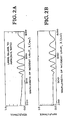
- Figures 2 and 3 show the resultant theoretical and experimental reflectance versus wavelength, from silicon nitride processed with "large” and “small” SiH 4 -to-NH 3 ratios.
- the measured refractive indices of "large” and “small” ratio films are, respectively, 2.14 and 1.93.
- the corresponding measured thicknesses of the films are, respectively; 765 nm and 770 nm. Values of various other parameters used for the simulation are given in the Figures' captions. These values yielded the excellent fit between experimental and theoretical spectra shown in the Figures.
- Transmittance of these films can be calculated based on the knowledge of their optical constants. Calculations demonstrated that only a slight percentage of excess silicon in stoichiometric silicon nitride would decrease transmittance, T, by orders of magnitude.
- the results for films 1 11m thick on a quartz substrate are summarized in the table of Figure 4.
- Refractive index, n, and absorption coefficient, a for any medium depend on the energy and thereby, the wavelength of the incident radiation.
- the absorption coefficient is a strong measure of the absorptance.
- absorptance increases exponentially by a) increasing the absorption coefficient, keeping the thickness constant, and b) increasing the thickness, keeping the absorption coefficient constant.
- values of n and a for silicon nitride, as well as amorphous Si are taken from commonly known data. Values of n and a for silicon nitride with excess Si are estimated based on a simple structural model assuming mechanical mixture of silicon nitride and Si. The microstructure of plasma deposited nitride is certainly more complicated due to large amounts (20%) of hydrogen usually incorporated in the films, which tends to reduce n and a. The conclusion, however, remains the same: excess silicon in a plasma deposition reaction renders a silicon nitride layer which is opaque to UV light.
- the refractive index and energy band gap of stoichiometric silicon nitride are, respectively, 1.96 and 5.2 eV.
- the film with refractive index of 2.14 is virtually opaque to UV light.
- Plasma deposition techniques are known in the state of the art of fabrication of semiconductor integrated circuits. Therefore, the present process can be carried out with a variety of commercially available equipment. Two embodiments are described herein in detail as performed using t e Plasma Enhanced Chemical Vapor Deposition (PECVD) system manufactured by Advanced Semiconductor Materials America, Inc. (ASM), and the AMS 3300, manufactured by Applied Materials Corporation. It is to be understood that parameter variations for the process will vary due to the geometry and operating specifications of the particular plasma deposition machine used to deposit the silicon nitride film on the semiconductor substrate or device.
- PECVD Plasma Enhanced Chemical Vapor Deposition
- ASM Advanced Semiconductor Materials America, Inc.
- AMS 3300 manufactured by Applied Materials Corporation
- the ASM system was used. The following steps are those performed in accordance with the prescribed techniques recommended by the manufacturer of the system.
- the semiconductor device such as a wafer upon which EPROM circuitry has been fabricated, is loaded into the machine's reaction chamber.
- the recommended operating temperature of the chamber is 380 degrees Centigrade.
- the chamber is evacuated and the gas inlet and outlet lines are purged to clean the system of any unwanted contaminants.
- the next step is to introduce the reactants, silane and ammonia, into the chamber in order to establish a uniform flow over the wafer, establishing a contant pressure.
- the ASM operating parameters call for a flow ratio of 600 standard cubic centimeters per minute (SCCM) of silane to 4500 SCCM of ammonia, or a ratio of 2:15.
- the atmosphere of the reaction chamber is intermittently irradiated with an RF of 50 kHz to catalyze a plasma environment (by ionizing the particles of gas in the chamber, causing the decomposition of the silane), allowing it to react with the ammonia. Silicon nitride is deposited thereby upon the wafer.
- the temperature of the reaction chamber is raised to 400 degrees Centigrade. (For devices using metal interconnects other than aluminum, the temperature may be operably higher).
- the AMS 3300 system was used to deposit the silicon nitride passivation layer.
- nitrogen is used as a carrier gas for introducing the flow of silane and ammonia across the surface of the wafer upon which the silicon nitride layer is to be deposited.
- the reaction chamber temperature has an upper practical limit of 350 degrees Centigrade.
- the carrier gas is used to improve the uniformity of the deposited layer. With the pure nitrogen present, the ratio of silane-to-ammonia is lowered from the recommended 16:21 to 7:21 and the flow of nitrogen is increased by approximately 11%. By doing so, a silicon nitride film having an index of refraction of 1.93 ⁇ 0.03 is achieved.
- An acceptable thickness for silicon nitride passivation layers is approximately one micron. Deposition rates also vary with machine geometries. For example, the ASM system has a deposition rate of 25 nm per minute. The plasma deposition must be carried on for at least 40 minutes to obtain an acceptable layer. Thicker layers can be deposited by lengthening the reaction times.
- the ratio of silane-to-ammonia must be carefully adjusted and the temperature raised sufficiently so that silicon in excess of the level which exists in stoichiometrically pure silicon nitride is minimized in order for the layer formed to be transparent to ultraviolet light.
- An EPROM having a superior passivation layer of silicon nitride can be thusly fabricated.
- Ultraviolet light transparent silicon nitride films deposited in accordance with the above- described techniques allow erasure of an EPROM within three to thirty minutes.
Landscapes
- Chemical & Material Sciences (AREA)
- Mechanical Engineering (AREA)
- General Chemical & Material Sciences (AREA)
- Chemical Kinetics & Catalysis (AREA)
- Engineering & Computer Science (AREA)
- Materials Engineering (AREA)
- Inorganic Chemistry (AREA)
- Metallurgy (AREA)
- Organic Chemistry (AREA)
- Formation Of Insulating Films (AREA)
- Chemical Vapour Deposition (AREA)
- Bipolar Transistors (AREA)
- Element Separation (AREA)
- Non-Volatile Memory (AREA)
Claims (11)
Priority Applications (1)
| Application Number | Priority Date | Filing Date | Title |
|---|---|---|---|
| AT85309262T ATE55510T1 (de) | 1984-12-21 | 1985-12-19 | Siliciumnitridfilme fuer integrierte schaltungen. |
Applications Claiming Priority (2)
| Application Number | Priority Date | Filing Date | Title |
|---|---|---|---|
| US684516 | 1984-12-21 | ||
| US06/684,516 US4618541A (en) | 1984-12-21 | 1984-12-21 | Method of forming a silicon nitride film transparent to ultraviolet radiation and resulting article |
Publications (3)
| Publication Number | Publication Date |
|---|---|
| EP0186443A2 EP0186443A2 (de) | 1986-07-02 |
| EP0186443A3 EP0186443A3 (en) | 1988-09-14 |
| EP0186443B1 true EP0186443B1 (de) | 1990-08-08 |
Family
ID=24748354
Family Applications (1)
| Application Number | Title | Priority Date | Filing Date |
|---|---|---|---|
| EP85309262A Expired - Lifetime EP0186443B1 (de) | 1984-12-21 | 1985-12-19 | Siliciumnitridfilme für integrierte Schaltungen |
Country Status (5)
| Country | Link |
|---|---|
| US (1) | US4618541A (de) |
| EP (1) | EP0186443B1 (de) |
| JP (1) | JP2630355B2 (de) |
| AT (1) | ATE55510T1 (de) |
| DE (1) | DE3579137D1 (de) |
Families Citing this family (53)
| Publication number | Priority date | Publication date | Assignee | Title |
|---|---|---|---|---|
| FR2580864B1 (fr) * | 1984-12-18 | 1987-05-22 | Thomson Csf | Couche barriere au bombardement ionique pour tube a vide |
| US4786864A (en) * | 1985-03-29 | 1988-11-22 | International Business Machines Corporation | Photon assisted tunneling testing of passivated integrated circuits |
| US4761332A (en) * | 1985-06-24 | 1988-08-02 | International Business Machines Corporation | Planarized ceramic substrates |
| US5010024A (en) * | 1987-03-04 | 1991-04-23 | Advanced Micro Devices, Inc. | Passivation for integrated circuit structures |
| EP0281324B1 (de) * | 1987-03-04 | 2000-07-19 | Advanced Micro Devices, Inc. | Passivationsschicht für integrierte Schaltungsstruktur |
| JP2551595B2 (ja) * | 1987-07-31 | 1996-11-06 | 工業技術院長 | 半導体不揮発性メモリ素子 |
| US5020030A (en) * | 1988-10-31 | 1991-05-28 | Huber Robert J | Nonvolatile SNOS memory cell with induced capacitor |
| JPH0645893B2 (ja) * | 1989-02-17 | 1994-06-15 | 科学技術庁長官官房会計課長 | 薄膜の形成方法 |
| US4951063A (en) * | 1989-05-22 | 1990-08-21 | Xerox Corporation | Heating elements for thermal ink jet devices |
| EP0408054A3 (en) * | 1989-07-14 | 1991-10-30 | Kabushiki Kaisha Toshiba | Ultraviolet erasable non-volatile semiconductor memory apparatus |
| US5041888A (en) * | 1989-09-18 | 1991-08-20 | General Electric Company | Insulator structure for amorphous silicon thin-film transistors |
| DE4013306A1 (de) * | 1990-04-26 | 1991-10-31 | Hoechst Ag | Optische formkoerper aus siliziumnitrid, sowie verfahren zu deren herstellung |
| FR2666324B1 (fr) * | 1990-09-03 | 1993-04-09 | Saint Gobain Vitrage Int | Couches minces de nitrure de silicium a proprietes ameliorees. |
| EP0484916A3 (en) * | 1990-11-07 | 1993-06-02 | Sumitomo Electric Industries, Limited | Silicon nitride sintered body |
| JP2667605B2 (ja) * | 1991-02-21 | 1997-10-27 | 株式会社東芝 | 不揮発性半導体記憶装置およびその製造方法 |
| US5260236A (en) * | 1991-06-07 | 1993-11-09 | Intel Corporation | UV transparent oxynitride deposition in single wafer PECVD system |
| JP2791525B2 (ja) * | 1992-04-16 | 1998-08-27 | 三菱電機株式会社 | 反射防止膜の選定方法およびその方法により選定された反射防止膜 |
| JP3632256B2 (ja) * | 1994-09-30 | 2005-03-23 | 株式会社デンソー | 窒化シリコン膜を有する半導体装置の製造方法 |
| US5578517A (en) * | 1994-10-24 | 1996-11-26 | Taiwan Semiconductor Manufacturing Company Ltd. | Method of forming a highly transparent silicon rich nitride protective layer for a fuse window |
| US5883001A (en) * | 1994-11-07 | 1999-03-16 | Macronix International Co., Ltd. | Integrated circuit passivation process and structure |
| US5780891A (en) * | 1994-12-05 | 1998-07-14 | Micron Technology, Inc. | Nonvolatile floating gate memory with improved interploy dielectric |
| US5728453A (en) * | 1995-12-28 | 1998-03-17 | Advanced Micro Devices, Inc. | Method of fabricating topside structure of a semiconductor device |
| US6168983B1 (en) | 1996-11-05 | 2001-01-02 | Power Integrations, Inc. | Method of making a high-voltage transistor with multiple lateral conduction layers |
| US6207994B1 (en) | 1996-11-05 | 2001-03-27 | Power Integrations, Inc. | High-voltage transistor with multi-layer conduction region |
| US6639277B2 (en) * | 1996-11-05 | 2003-10-28 | Power Integrations, Inc. | High-voltage transistor with multi-layer conduction region |
| US6566281B1 (en) * | 1997-10-15 | 2003-05-20 | International Business Machines Corporation | Nitrogen-rich barrier layer and structures formed |
| US6166439A (en) * | 1997-12-30 | 2000-12-26 | Advanced Micro Devices, Inc. | Low dielectric constant material and method of application to isolate conductive lines |
| US6768171B2 (en) | 2000-11-27 | 2004-07-27 | Power Integrations, Inc. | High-voltage transistor with JFET conduction channels |
| US6509220B2 (en) | 2000-11-27 | 2003-01-21 | Power Integrations, Inc. | Method of fabricating a high-voltage transistor |
| US6424007B1 (en) | 2001-01-24 | 2002-07-23 | Power Integrations, Inc. | High-voltage transistor with buried conduction layer |
| US6555873B2 (en) * | 2001-09-07 | 2003-04-29 | Power Integrations, Inc. | High-voltage lateral transistor with a multi-layered extended drain structure |
| US6573558B2 (en) * | 2001-09-07 | 2003-06-03 | Power Integrations, Inc. | High-voltage vertical transistor with a multi-layered extended drain structure |
| US7786533B2 (en) | 2001-09-07 | 2010-08-31 | Power Integrations, Inc. | High-voltage vertical transistor with edge termination structure |
| US6635544B2 (en) | 2001-09-07 | 2003-10-21 | Power Intergrations, Inc. | Method of fabricating a high-voltage transistor with a multi-layered extended drain structure |
| US7221011B2 (en) * | 2001-09-07 | 2007-05-22 | Power Integrations, Inc. | High-voltage vertical transistor with a multi-gradient drain doping profile |
| US6930364B2 (en) * | 2001-09-13 | 2005-08-16 | Silicon Light Machines Corporation | Microelectronic mechanical system and methods |
| US6963403B2 (en) * | 2002-01-15 | 2005-11-08 | Council Of Scientific And Industrial Research | Method for determining the reflectance profile of materials |
| DE10223954A1 (de) * | 2002-05-29 | 2003-12-11 | Infineon Technologies Ag | Plasmaangeregtes chemisches Gasphasenabscheide-Verfahren zum Abscheiden von Siliziumnitrid oder Siliziumoxinitrid, Verfahren zum Herstellen einer Schicht-Anordnung und Schicht-Anordnung |
| EP1398830A1 (de) * | 2002-09-12 | 2004-03-17 | STMicroelectronics S.r.l. | Verfahren zur Definition der Kontaktöffnungen für die elektrischen Verbindungen zu den aktiven Elementen |
| US6924241B2 (en) * | 2003-02-24 | 2005-08-02 | Promos Technologies, Inc. | Method of making a silicon nitride film that is transmissive to ultraviolet light |
| US8420520B2 (en) * | 2006-05-18 | 2013-04-16 | Megica Corporation | Non-cyanide gold electroplating for fine-line gold traces and gold pads |
| US7468536B2 (en) | 2007-02-16 | 2008-12-23 | Power Integrations, Inc. | Gate metal routing for transistor with checkerboarded layout |
| US7595523B2 (en) | 2007-02-16 | 2009-09-29 | Power Integrations, Inc. | Gate pullback at ends of high-voltage vertical transistor structure |
| US8653583B2 (en) | 2007-02-16 | 2014-02-18 | Power Integrations, Inc. | Sensing FET integrated with a high-voltage transistor |
| US7859037B2 (en) | 2007-02-16 | 2010-12-28 | Power Integrations, Inc. | Checkerboarded high-voltage vertical transistor layout |
| US7557406B2 (en) | 2007-02-16 | 2009-07-07 | Power Integrations, Inc. | Segmented pillar layout for a high-voltage vertical transistor |
| US8563095B2 (en) * | 2010-03-15 | 2013-10-22 | Applied Materials, Inc. | Silicon nitride passivation layer for covering high aspect ratio features |
| US9660053B2 (en) | 2013-07-12 | 2017-05-23 | Power Integrations, Inc. | High-voltage field-effect transistor having multiple implanted layers |
| US9543396B2 (en) | 2013-12-13 | 2017-01-10 | Power Integrations, Inc. | Vertical transistor device structure with cylindrically-shaped regions |
| US10325988B2 (en) | 2013-12-13 | 2019-06-18 | Power Integrations, Inc. | Vertical transistor device structure with cylindrically-shaped field plates |
| US20160023242A1 (en) * | 2014-07-28 | 2016-01-28 | Osram Sylvania Inc. | Method of making wavelength converters for solid state lighting applications |
| JP7076971B2 (ja) * | 2017-09-28 | 2022-05-30 | キヤノン株式会社 | 撮像装置およびその製造方法ならびに機器 |
| JP2026036904A (ja) * | 2024-08-21 | 2026-03-06 | 株式会社東芝 | ガスバリアフィルム及び光電変換デバイス |
Family Cites Families (6)
| Publication number | Priority date | Publication date | Assignee | Title |
|---|---|---|---|---|
| JPS5432509B2 (de) * | 1972-06-02 | 1979-10-15 | ||
| JPS5244795A (en) * | 1975-10-08 | 1977-04-08 | Hitachi Ltd | Formation of silicon nitride film |
| SE7700229L (sv) * | 1976-01-22 | 1977-07-23 | Western Electric Co | Forfarande for beleggning av substrat genom utfellning fran ett plasma |
| US4181751A (en) * | 1978-05-24 | 1980-01-01 | Hughes Aircraft Company | Process for the preparation of low temperature silicon nitride films by photochemical vapor deposition |
| JPS554918A (en) * | 1978-06-26 | 1980-01-14 | Hitachi Ltd | Passivation film structure and manufacturing method thereof |
| JPS56149306A (en) * | 1980-04-21 | 1981-11-19 | Kokusai Electric Co Ltd | Formation of silicon nitride film |
-
1984
- 1984-12-21 US US06/684,516 patent/US4618541A/en not_active Expired - Lifetime
-
1985
- 1985-12-19 DE DE8585309262T patent/DE3579137D1/de not_active Expired - Lifetime
- 1985-12-19 EP EP85309262A patent/EP0186443B1/de not_active Expired - Lifetime
- 1985-12-19 AT AT85309262T patent/ATE55510T1/de not_active IP Right Cessation
- 1985-12-20 JP JP60289137A patent/JP2630355B2/ja not_active Expired - Lifetime
Also Published As
| Publication number | Publication date |
|---|---|
| DE3579137D1 (de) | 1990-09-13 |
| ATE55510T1 (de) | 1990-08-15 |
| EP0186443A3 (en) | 1988-09-14 |
| JP2630355B2 (ja) | 1997-07-16 |
| US4618541A (en) | 1986-10-21 |
| JPS61159576A (ja) | 1986-07-19 |
| EP0186443A2 (de) | 1986-07-02 |
Similar Documents
| Publication | Publication Date | Title |
|---|---|---|
| EP0186443B1 (de) | Siliciumnitridfilme für integrierte Schaltungen | |
| US4581622A (en) | UV erasable EPROM with UV transparent silicon oxynitride coating | |
| US6395650B1 (en) | Methods for forming metal oxide layers with enhanced purity | |
| US4371587A (en) | Low temperature process for depositing oxide layers by photochemical vapor deposition | |
| EP1340247B1 (de) | Verfahren zur ausbildung dielektrischer filme | |
| US4447469A (en) | Process for forming sulfide layers by photochemical vapor deposition | |
| Ito et al. | Very thin silicon nitride films grown by direct thermal reaction with nitrogen | |
| EP0030798A1 (de) | Verfahren zum Niederschlagen von Oxydschichten durch photochemischen Dampfniederschlag bei niedrigen Temperaturen | |
| JPS60258915A (ja) | レ−ザ−化学気相沈積方法および装置 | |
| US6924241B2 (en) | Method of making a silicon nitride film that is transmissive to ultraviolet light | |
| US20030003243A1 (en) | Method for forming film | |
| Bergonzo et al. | Low pressure photodeposition of silicon nitride films using a xenon excimer lamp | |
| Stein | Hydrogen content and annealing of memory quality silicon-oxynitride films | |
| US6906365B2 (en) | Ferroelectric memory device including an upper protection electrode | |
| Nguyen et al. | Plasma deposition and characterization of thin silicon‐rich silicon nitride films | |
| US6037614A (en) | Methods for manufacturing group IV element alloy semiconductor materials and devices that include such materials | |
| Inada et al. | Chemical vapor deposition of silicon nitride: encapsulant layers for annealing gallium arsenide | |
| Lee et al. | The preparation, characterization and application of plasma-enhanced chemically vapour deposited silicon nitride films deposited at low temperatures | |
| Gritsenko et al. | Study of Excess Silicon at Si3 N 4/Thermal SiO2 Interface Using EELS and Ellipsometric Measurements | |
| Shibagaki et al. | Low temperature silicon nitride deposition using microwave-excited active nitrogen | |
| Jun et al. | Composition, oxidation, and optical properties of fluorinated silicon nitride film by inductively coupled plasma enhanced chemical vapor deposition | |
| Bulkin et al. | Optical properties of SiNx deposited by electron cyclotron resonance plasma-enhanced deposition | |
| Inushima et al. | Film growth mechanism of photo-chemical vapor deposition | |
| Hodge et al. | Silicon oxidation by rapid thermal processing (RTP) | |
| Numasawa et al. | Photo CVD system for silicon nitride film |
Legal Events
| Date | Code | Title | Description |
|---|---|---|---|
| PUAI | Public reference made under article 153(3) epc to a published international application that has entered the european phase |
Free format text: ORIGINAL CODE: 0009012 |
|
| AK | Designated contracting states |
Kind code of ref document: A2 Designated state(s): AT BE CH DE FR GB IT LI LU NL SE |
|
| PUAL | Search report despatched |
Free format text: ORIGINAL CODE: 0009013 |
|
| AK | Designated contracting states |
Kind code of ref document: A3 Designated state(s): AT BE CH DE FR GB IT LI LU NL SE |
|
| 17P | Request for examination filed |
Effective date: 19881029 |
|
| 17Q | First examination report despatched |
Effective date: 19890210 |
|
| GRAA | (expected) grant |
Free format text: ORIGINAL CODE: 0009210 |
|
| AK | Designated contracting states |
Kind code of ref document: B1 Designated state(s): AT BE CH DE FR GB IT LI LU NL SE |
|
| PG25 | Lapsed in a contracting state [announced via postgrant information from national office to epo] |
Ref country code: SE Free format text: THE PATENT HAS BEEN ANNULLED BY A DECISION OF A NATIONAL AUTHORITY Effective date: 19900808 Ref country code: NL Effective date: 19900808 Ref country code: LI Effective date: 19900808 Ref country code: IT Free format text: LAPSE BECAUSE OF FAILURE TO SUBMIT A TRANSLATION OF THE DESCRIPTION OR TO PAY THE FEE WITHIN THE PRESCRIBED TIME-LIMIT;WARNING: LAPSES OF ITALIAN PATENTS WITH EFFECTIVE DATE BEFORE 2007 MAY HAVE OCCURRED AT ANY TIME BEFORE 2007. THE CORRECT EFFECTIVE DATE MAY BE DIFFERENT FROM THE ONE RECORDED. Effective date: 19900808 Ref country code: FR Effective date: 19900808 Ref country code: CH Effective date: 19900808 Ref country code: BE Effective date: 19900808 Ref country code: AT Effective date: 19900808 |
|
| REF | Corresponds to: |
Ref document number: 55510 Country of ref document: AT Date of ref document: 19900815 Kind code of ref document: T |
|
| REF | Corresponds to: |
Ref document number: 3579137 Country of ref document: DE Date of ref document: 19900913 |
|
| REG | Reference to a national code |
Ref country code: CH Ref legal event code: PL |
|
| PG25 | Lapsed in a contracting state [announced via postgrant information from national office to epo] |
Ref country code: GB Effective date: 19901219 |
|
| EN | Fr: translation not filed | ||
| PG25 | Lapsed in a contracting state [announced via postgrant information from national office to epo] |
Ref country code: LU Free format text: LAPSE BECAUSE OF NON-PAYMENT OF DUE FEES Effective date: 19901231 |
|
| NLV1 | Nl: lapsed or annulled due to failure to fulfill the requirements of art. 29p and 29m of the patents act | ||
| PLBE | No opposition filed within time limit |
Free format text: ORIGINAL CODE: 0009261 |
|
| STAA | Information on the status of an ep patent application or granted ep patent |
Free format text: STATUS: NO OPPOSITION FILED WITHIN TIME LIMIT |
|
| 26N | No opposition filed | ||
| GBPC | Gb: european patent ceased through non-payment of renewal fee | ||
| PG25 | Lapsed in a contracting state [announced via postgrant information from national office to epo] |
Ref country code: DE Effective date: 19910903 |