EP0186480B1 - Procédé pour synthétiser un catalyseur de type zéolite, sous des conditions contrôlées du pH afin de prolonger la vie du catalyseur - Google Patents
Procédé pour synthétiser un catalyseur de type zéolite, sous des conditions contrôlées du pH afin de prolonger la vie du catalyseur Download PDFInfo
- Publication number
- EP0186480B1 EP0186480B1 EP85309382A EP85309382A EP0186480B1 EP 0186480 B1 EP0186480 B1 EP 0186480B1 EP 85309382 A EP85309382 A EP 85309382A EP 85309382 A EP85309382 A EP 85309382A EP 0186480 B1 EP0186480 B1 EP 0186480B1
- Authority
- EP
- European Patent Office
- Prior art keywords
- reaction mixture
- sio2
- zeolite
- initial
- catalyst
- Prior art date
- Legal status (The legal status is an assumption and is not a legal conclusion. Google has not performed a legal analysis and makes no representation as to the accuracy of the status listed.)
- Expired - Lifetime
Links
Images


Classifications
-
- C—CHEMISTRY; METALLURGY
- C07—ORGANIC CHEMISTRY
- C07C—ACYCLIC OR CARBOCYCLIC COMPOUNDS
- C07C1/00—Preparation of hydrocarbons from one or more compounds, none of them being a hydrocarbon
- C07C1/20—Preparation of hydrocarbons from one or more compounds, none of them being a hydrocarbon starting from organic compounds containing only oxygen atoms as heteroatoms
-
- B—PERFORMING OPERATIONS; TRANSPORTING
- B01—PHYSICAL OR CHEMICAL PROCESSES OR APPARATUS IN GENERAL
- B01J—CHEMICAL OR PHYSICAL PROCESSES, e.g. CATALYSIS OR COLLOID CHEMISTRY; THEIR RELEVANT APPARATUS
- B01J29/00—Catalysts comprising molecular sieves
- B01J29/04—Catalysts comprising molecular sieves having base-exchange properties, e.g. crystalline zeolites
- B01J29/06—Crystalline aluminosilicate zeolites; Isomorphous compounds thereof
- B01J29/40—Crystalline aluminosilicate zeolites; Isomorphous compounds thereof of the pentasil type, e.g. types ZSM-5, ZSM-8 or ZSM-11, as exemplified by patent documents US3702886, GB1334243 and US3709979, respectively
-
- C—CHEMISTRY; METALLURGY
- C01—INORGANIC CHEMISTRY
- C01B—NON-METALLIC ELEMENTS; COMPOUNDS THEREOF; METALLOIDS OR COMPOUNDS THEREOF NOT COVERED BY SUBCLASS C01C
- C01B33/00—Silicon; Compounds thereof
- C01B33/20—Silicates
- C01B33/26—Aluminium-containing silicates, i.e. silico-aluminates
- C01B33/28—Base exchange silicates, e.g. zeolites
- C01B33/2807—Zeolitic silicoaluminates with a tridimensional crystalline structure possessing molecular sieve properties; Isomorphous compounds wherein a part of the aluminium ore of the silicon present may be replaced by other elements such as gallium, germanium, phosphorus; Preparation of zeolitic molecular sieves from molecular sieves of another type or from preformed reacting mixtures
- C01B33/2876—Zeolitic silicoaluminates with a tridimensional crystalline structure possessing molecular sieve properties; Isomorphous compounds wherein a part of the aluminium ore of the silicon present may be replaced by other elements such as gallium, germanium, phosphorus; Preparation of zeolitic molecular sieves from molecular sieves of another type or from preformed reacting mixtures from a reacting mixture containing an amine or an organic cation, e.g. a quaternary onium cation-ammonium, phosphonium, stibonium
-
- B—PERFORMING OPERATIONS; TRANSPORTING
- B01—PHYSICAL OR CHEMICAL PROCESSES OR APPARATUS IN GENERAL
- B01J—CHEMICAL OR PHYSICAL PROCESSES, e.g. CATALYSIS OR COLLOID CHEMISTRY; THEIR RELEVANT APPARATUS
- B01J2229/00—Aspects of molecular sieve catalysts not covered by B01J29/00
- B01J2229/30—After treatment, characterised by the means used
- B01J2229/36—Steaming
-
- C—CHEMISTRY; METALLURGY
- C07—ORGANIC CHEMISTRY
- C07C—ACYCLIC OR CARBOCYCLIC COMPOUNDS
- C07C2529/00—Catalysts comprising molecular sieves
- C07C2529/04—Catalysts comprising molecular sieves having base-exchange properties, e.g. crystalline zeolites, pillared clays
- C07C2529/06—Crystalline aluminosilicate zeolites; Isomorphous compounds thereof
- C07C2529/40—Crystalline aluminosilicate zeolites; Isomorphous compounds thereof of the pentasil type, e.g. types ZSM-5, ZSM-8 or ZSM-11
-
- Y—GENERAL TAGGING OF NEW TECHNOLOGICAL DEVELOPMENTS; GENERAL TAGGING OF CROSS-SECTIONAL TECHNOLOGIES SPANNING OVER SEVERAL SECTIONS OF THE IPC; TECHNICAL SUBJECTS COVERED BY FORMER USPC CROSS-REFERENCE ART COLLECTIONS [XRACs] AND DIGESTS
- Y02—TECHNOLOGIES OR APPLICATIONS FOR MITIGATION OR ADAPTATION AGAINST CLIMATE CHANGE
- Y02P—CLIMATE CHANGE MITIGATION TECHNOLOGIES IN THE PRODUCTION OR PROCESSING OF GOODS
- Y02P20/00—Technologies relating to chemical industry
- Y02P20/50—Improvements relating to the production of bulk chemicals
-
- Y—GENERAL TAGGING OF NEW TECHNOLOGICAL DEVELOPMENTS; GENERAL TAGGING OF CROSS-SECTIONAL TECHNOLOGIES SPANNING OVER SEVERAL SECTIONS OF THE IPC; TECHNICAL SUBJECTS COVERED BY FORMER USPC CROSS-REFERENCE ART COLLECTIONS [XRACs] AND DIGESTS
- Y02—TECHNOLOGIES OR APPLICATIONS FOR MITIGATION OR ADAPTATION AGAINST CLIMATE CHANGE
- Y02P—CLIMATE CHANGE MITIGATION TECHNOLOGIES IN THE PRODUCTION OR PROCESSING OF GOODS
- Y02P20/00—Technologies relating to chemical industry
- Y02P20/50—Improvements relating to the production of bulk chemicals
- Y02P20/52—Improvements relating to the production of bulk chemicals using catalysts, e.g. selective catalysts
-
- Y—GENERAL TAGGING OF NEW TECHNOLOGICAL DEVELOPMENTS; GENERAL TAGGING OF CROSS-SECTIONAL TECHNOLOGIES SPANNING OVER SEVERAL SECTIONS OF THE IPC; TECHNICAL SUBJECTS COVERED BY FORMER USPC CROSS-REFERENCE ART COLLECTIONS [XRACs] AND DIGESTS
- Y10—TECHNICAL SUBJECTS COVERED BY FORMER USPC
- Y10S—TECHNICAL SUBJECTS COVERED BY FORMER USPC CROSS-REFERENCE ART COLLECTIONS [XRACs] AND DIGESTS
- Y10S423/00—Chemistry of inorganic compounds
- Y10S423/22—MFI, e.g. ZSM-5. silicalite, LZ-241
Definitions
- This invention relates to methods of preparing shape selective zeolite catalysts, such as ZSM-5, and methods for their use to synthesize hydrocarbons such as olefins, in particular by conversion of lower monohydric-alcohols and/or their ether derivatives.
- Olefins especially ethylene and propylene, are used on a large scale as intermediates for the manufacture of staple products such as olefin polymers, ethylene oxide, non-ionic detergents, glycols and fibre-forming polyesters.
- Processes for producing olefins usually involve non-catalytic pyrolysis of volatile hydrocarbons such as natural gas liquids or petroleum distillates. Catalytic pyrolysis processes have been proposed but do not appear to have reached industrial use.
- Shape selective zeolite materials both natural and synthetic, have been demonstrated in the past to have catalytic capabilities for various types of organic compound conversions. These materials are ordered porous crystalline metalosilicates (e.g. aluminosilicates) having a definite crystalline structure within which there are a large number of cavities and channels, which are precisely uniform in size. Since the dimensions of these pores are such as to accept, for adsorption, molecules of certain dimensions while rejecting those of larger dimensions, these materials are deemed to possess the property of shape selectivity, have been referred to as "molecular sieves", and are utilized in a variety of ways to take advantage of these properties.
- porous crystalline metalosilicates e.g. aluminosilicates
- Such shape selective zeolites include a wide variety of positive ion-containing crystalline aluminosilicates, both natural and synthetic.
- Aluminosilicates can be described as a rigid three-dimensional network of SiO4 and AlO4 in which the tetrahedra are cross-linked by the sharing of oxygen atoms whereby the ratio of the total aluminum and silicon atoms to oxygen is 1:2.
- the electrovalence of the tetrahedra-containing aluminum is typically balanced by the inclusion in the crystal of a cation, for example an alkali metal or an alkaline earth metal cation. This can be expressed by formula wherein the ratio of Al to the number of various cations, such as Ca/2, Sr/2, Na, K, or Li is equal to unity.
- One type of cation may be exchanged either in entirety or partially by another type of cation utilizing ion exchange techniques in a conventional manner.
- cation exchange it has been possible to vary the size of the pores in a given aluminosilicate by suitable selection of the particular cation.
- the spaces between the tetradehra are occupied by molecules of water prior to dehydration.
- a preferred group of shape selective crystalline aluminosilicates designated as those of the ZSM-5 type (e.g. see U.S Patent No. 3,702,886) is well known for use in the synthesis of olefins from syn gas derived materials such as methanol.
- Other shape selective zeolite materials are also well known for this purpose as discussed in the aforedescribed patents.
- Subatmospheric partial pressure of the reactant feed is obtained either by maintaining a partial vacuum in the conversion zone, or by co-feeding a diluent.
- Suitable diluents include any substantially inert substance that is a gas or vapor at reaction temperature such as steam, as well as nitrogen, carbon dioxide, carbon monoxide, hydrogen, and the like.
- Zeolite catalytic properties can be strongly influenced by such factors as crystal morphology, uniformity of crystal morphology, acidity characteristics and silica/alumina mole ratio, cation identity, pore size distribution, degree of crystallinity, as well as by control of numerous process conditions employed during the preparation of the zeolite which in turn can affect one or more of the aforedescribed characteristics in addition to producing indeterminate effects.
- the number of permutations and combinations of possible preparative process conditions, and resulting catalyst characteristics is astronomical. Consequently, one is faced with a sea of variables in attempting to correlate a particular set of catalyst properties, a means for consistently achieving these properties, and the ultimate effect of a given set of properties on catalyst performance.
- catalyst performance includes not only catalyst activity, and selectivity to a particular product distribution but also catalyst life.
- catalyst life As with such catalyst properties as activity and selectivity, one can control catalyst life through control of the operating conditions. However, it would be a significant advantage if catalyst life could be improved by improving the nature of the catalyst itself through its preparative procedure.
- the present invention focuses on the combination of active pH control with an acid to adjust the initial pH of the reaction mixture within specifically defined limits, in the presence of sodium cations and at a specifically defined SiO2/Al2O3 mole ratio conducive to the synthesis of olefins from methanol.
- alkalinity of the reaction mixture.
- the concept of increasing or decreasing alkalinity is to be distinguished from increasing or decreasing pH.
- relatively strong bases such as NaOH or TPAOH are present in the initial reaction mixture, the pH of the same will almost always be 14. Thus, as more base is added while the alkalinity may increase, the initial pH will remain at 14.
- Chao et al discloses the effects on nucleation rate and crystal growth, of varying the initial SiO2/Al2O3 ratio, alkalinity, and reaction temperature during zeolite synthesis from Na+/TPA+ aluminosilicate gels. While sulfuric acid is disclosed as one of the reagents used in the experimental section, neither the amount nor the manner in which it is used is reported.
- Chao et al propose that alkalinity of the hydrogel affects the nucleation rate through two mechanisms, namely (1) the dissolution of the gel materials and formation of Al(OH)n, and (2) the polymerization of dissolved silicate and aluminate ions to form aluminosilicate or polysilicate ions which can act as a source of nuclei. From the data presented, the authors propose that increasing the alkalinity of the reaction mixture (a) increases dissolution of silicate species of the hydrogel, thereby shortening the induction period (i.e increasing nucleation rate), but (b) eventually results in restriction of the aforedescribed polymerization thereby lengthening the induction period at very high alkalinity.
- TPABr is employed as the TPA+ source
- Ludox* A540 aqueous colloidal silica
- Reheis* F-2000 aluminum hydroxide gel powder as the alumina source.
- the only initial reaction mixture pH reported in Ghamami et al is that of Composition XIV prepared in the absence of sodium. This pH value is not actively controlled (e.g. with acid), but is merely a result of the conditions established from the initial amounts and identity of ingredients selected.
- the TPABr salt is essentially neutral in terms of its effect on pH, and when a mixture containing a TPABr/NH4OH/H2O mole ratio of 8:120:750 was prepared, the pH of this mixture was 14.
- Ludox* AS40 which has a pH of 9.2, can influence the initial pH of the reaction mixture.
- Reheis* alumina exhibits a pH of 8.6 and its addition to the reaction mixture can also affect the initial pH of the same. Consequently, it has been concluded that the identity of the source of the alumina and silica in Composition XIV of Ghamami et al is responsible for the inherent initial 12.5 pH of the same. * Trademark
- Kikuchi et al discloses the preparation, and testing for methanol conversion, of ZSM-5 catalysts. Kikuchi et al examine two catalysts designated A and B. Catalyst A is prepared in accordance with the standard Mobil ZSM-5 technique of U.S. Patent No. 3,702,886, using silica gel, TPA+ and NaAlO2.
- Catalyst B is prepared using water glass (92.9% SiO2, 9% Na2O), aluminum nitrate and TPA+. However, sufficient 1N HNO3 is added to the reaction mixture for Catalyst B to bring the reaction mixture pH to 10-10.5. As the pH is reduced, a gellous solution forms and is stirred. Catalyst samples A and B are then tested for methanol conversion with further testing of Catalyst B at varying SiO2/Al2O3 ratios.
- Kikuchi et al report that the size of the crystallites of Catalyst B is about 4 times that of Catalyst A and that the crystallinity of Catalyst B after 1 day of crystallization is about the same as Catalyst A after 6 days.
- Catalyst B is said to show a selectivity to lower olefins about 1.5 times that of Catalyst A at similar conversion levels.
- Kikuchi et al conclude that the differences in activity may be attributable to a slight difference in pore structure which cannot be identified by XRD, which in turn may enhance the rate of diffusion of the olefin out of the pores.
- European Patent Application 93,519 discloses a process for preparing high silica containing zeolites of the ZSM-5 family wherein a buffer is employed to control the pH of the reaction mixture during crystallization between 9.5 and 12. This process is said to be based on the discovery that the final pH of the reaction mixture, will determine the morphology of the resulting crystals. More specifically, a final pH of 10-10.5 is said to produce rod-shaped crystals, a final pH of 12 to 12.5 twinned short prismatic crystals with near spherulitic morphology, and a final pH of 11 to 12, a morphology intermediate between the above noted morphologies.
- the reaction mixture which is associated with the above morphologies contains water, a source of quaternary ammonium cations, silica, and an alkali metal.
- An aluminum source is optional.
- No utility is disclosed for the zeolites prepared in accordance with this process and consequently the activity of such zeolites was never tested for any purpose.
- the buffers disclosed at page 3 are conjugate bases, i.e. salts, of a weak acid and a strong base.
- the present invention excludes the presence of buffers from the reaction mixture.
- the activity of the catalysts of the present invention has been found to be dependent on the initial pH of the reaction mixture and hence there is no need to employ a buffer.
- U.S. Patent No. 4,275,047 discloses a process for preparing zeolites such as ZSM-5 wherein the use of alkylammonium ions can be avoided by inclusion in the reaction mixture of a seed zeolite having a specifically defined pore diameter.
- the reaction mixture is disclosed as preferably containing one or more anions of strong acids, especially chloride, bromide, iodide or sulphate. Such anions can be introduced as an acid, and/or alkali metal, aluminum, ammonium or onium salts.
- H2SO4 is employed in Example 5, it is assumed, as a source of sulphate ions. No initial reaction mixture pH is specified.
- the crystallization time of a Na free, TPA+/NH4+ based system is reported as 93 days. While both acidic and basic systems are studied, the TPA is added as the bromide salt, and in some instances the pH of the reaction mixture is increased from acidic (e.g. 2-4) to basic (pH 9) by the addition of sodium silicate.
- acidic e.g. 2-4
- basic pH 9
- Gabelica et al One significant observation by Gabelica et al is that the initial SiO2/Al2O3 ratio appeared to have little influence on the final zeolite composition, the latter being strongly dependent on the nature of the alkali counterion, which in turn affected the size of the crystallites. None of the Gabelica et al zeolites are tested for catalyst performance.
- initial pH 9.0 to 12.5
- alkali metal cations e.g. sodium
- the present invention is based, inter-alia, on the discovery of the functional relationship between the initial pH of, and the presence or absence of sodium cations, within, the reaction mixture employed for ZSM-5 type zeolite synthesis, and the ultimate zeolite catalyst performance for olefin synthesis.
- the control of the initial reaction mixture pH is an active control requiring the use and presence of an acid.
- the use of initial pH control is distinguishable from control of the alkalinity of the reaction mixture in that variations in alkalinity of the reaction mixture do not necessarily result in a variation of the pH of the same.
- only slight variations of the initial pH can result in drastic variations in catalyst life.
- the natural alkalinity of conventional reaction mixtures can be influenced by the identity and amounts of the silica source, the alumina source, the organic cation source, dilution, and the type of inorganic salts such as NH4Br. Consequently, the natural alkalinity of the initial reaction mixture will fluctuate uncontrollably in response to changes in one or more such variables.
- the amounts and proportions of the components of known sodium containing ZSM-5 producing reaction mixtures are typically not actively controlled with acid to achieve a particular initial pH or to impart a particular catalyst performance.
- initial pH control has been employed the pH employed was limited to 10-10.5.
- the present invention relies on the combination of two critical variables, namely, active initial pH control and sodium cation presence, to improve catalyst life. This technique also permits one to control other synthesis process variables independently of the initial pH of the reaction mixture to maximize catalyst performance.
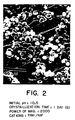
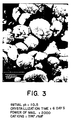
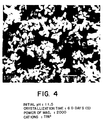
- Figures 1 to 4 are scanning electron photographs of various zeolites synthesized in accordance with the examples and comparative examples provided hereinafter and summarized at Table 1.
- nitrogeneous aluminosilicate zeolites preferably of the ZSM-5 type are produced and then optionally converted to the hydrogen form and calcined to render them suitable for olefin synthesis.
- an aluminum source is reacted with a silica source (a) in the presence of (i) a tetraalkylammonium hydroxide, (ii) a sodium cation source and (b) in an initial pH adjusted reaction mixture.
- the aluminum source must be capable of being solubilized in the reaction mixture under reaction conditions.
- the alumina source can be an aluminum salt such as aluminum chloride, sulphate, and/or nitrate, or alumina itself, in a form which is, or can be hydrated such as colloidal alumina, gamma alumina or the alpha or beta aluminum trihydrate as well as mixtures of the above.
- the preferred alumina source is aluminum nitrate.
- the silica source can be of any type having sufficient chemical reactivity to take part in the zeolite synthesis at an adequate rate.
- the silica source is an amorphous silica, such as a colloidal silica e.g., available under the tradename LudoxTM which typically contains 20 to 50% w/w silica in aqueous suspension, sodium silicate, fumed silica, precipitated silica, and mixtures of the same.
- LudoxTM a colloidal silica
- the preferred silica source is sodium silicate.
- tetraalkylammonium hydroxide (TAAOH) suitable for use in the present invention is conventional in the synthesis of zeolite type catalysts and each alkyl group thereof contains typically from about C1 to C4 carbons, preferably about C2 to C3 carbons, and most preferably C3 carbons, including tetrapropyl ammonium, and tetraethyl ammonium. Tetrapropylammonium hydroxide is preferred.
- the tetraalkyl ammonium hydroxide functions as a strong base to achieve the minimum pH of the reaction mixture prior to the acid addition described hereinafter.
- the sodium cation source can be any conventional sodium containing reagent typically employed in zeolite synthesis as a source of sodium cations which are incorporated into the zeolite to balance the electrovalence of the aluminum containing tetrahedra of the zeolite.
- Suitable reagents which can constitute the sodium cation source include sodium silicate which also can constitute the silica source, and sodium hydroxide, which can also function as a base to assist in achieving the minimum pH requirements of the reaction mixture prior to acid addition specified hereinafter.
- Other sources of the sodium cation include sodium aluminate and sodium salts, such as sodium chloride.
- the sodium cation source is provided to the reaction mixture to achieve therein a Na2O/SiO2 mole ratio of at least about 0.05, preferably at least about 0.1 and most preferably at least about 0.3.
- the zeolite forming reaction is conducted in accordance with the process of the present invention by heating a suitable aqueous reactant mixture.
- the initial reaction mixture employed will typically have an initial composition expressed in terms of oxide mole ratios within the following ranges prior to acid addition: Broad Preferred Most Preferred (TAA)2O/SiO2 0.01 to 5 0.05 to 1 0.05 to 0.4 SiO2/Al2O3 80 to 2200 220 to 800 220 to 650 H2O/SiO2 10 to 200 20 to 140 40 to 90 OH ⁇ /SiO2 0.02 to 10 0.2 to 5 0.3 to 3 H2O/OH ⁇ 5 to 500 10 to 200 20 to 175 Na2O/SiO2 0.05 to 5 0.1 to 4 0.3 to 3 wherein TAA is the sum of the tetraalkyl ammonium cations
- the admixing of the aforedescribed ingredients typically at room temperature is controlled to impart to the reaction mixture an initial pH at room temperature (i.e. between 20 and 25°C) prior to adding acid, of typically not less than about 13, and most preferably about 14.
- the pH of the reaction mixture is then adjusted by the addition of sufficient strong inorganic acid, to a value of typically from about 11.3 to about 11.7, preferably from about 11.4 to about 11.6 (e.g. 11.5).
- the term "acid" as used herein in conjunction with pH adjustment is defined to exclude any silica or alumina source with acid properties relative to more basic components employed in the reaction mixture.
- strong acid is meant one that reacts completely with the aqueous solvent to give the conjugate acid of the solvent, i.e. H3O+.
- the use of a strong acid avoids the formation of a buffer in the reaction mixture in accordance with EPA 93,519.
- the pH of the reaction mixture during crystallization is not controlled, e.g., with a buffer.
- Suitable strong inorganic acids include HNO3, H2SO4, HCl, and mixtures thereof.
- the preferred acid is HNO3.
- the acid will decompose during calcination of the zeolite.
- reaction mixture components are combined by mixing the sodium cation source, the silica source and the tetraalkylammonium hydroxide, to form an aqueous solution to which is added the alumina source and the resulting mixture then adjusted for pH with acid.
- the pH adjusted reaction mixture is placed in a closed container, such as Teflon* lined autoclave and heated, typically to a temperature of from about 100 to about 220, preferably from about 120 to about 190, and most preferably from about 140 to about 165°C, until completion of the crystallization, e.g. , for a period of typically from about 1 to about 10, preferably from about 3 to about 8, and most preferably from about 4 to about 6 days. Generally a minimum of about 3 days, preferably 6 days is needed for complete crystallization. Periods in excess of 6 days are of no apparent advantage. * Trademark
- crystallization can be conducted at atmospheric, subatmospheric, or superatmospheric pressures in air, it is preferred, to replace the air in the reaction vessel with an inert gas, such as nitrogen under a pressure of from 5 to 100 psi (34 to 689 kPa), to avoid possible oxidation of the organic base.
- an inert gas such as nitrogen under a pressure of from 5 to 100 psi (34 to 689 kPa)
- the reaction mixture is stirred during all or part of the crystallization period.
- the degree of agitation is not critical but typically is sufficient to uniformly mix the contents of the reaction mixture (e.g. about 650-1000 rpm).
- the product crystals are separated, as by cooling and filtering, and are water washed and dried at a temperature of typically from about 80 to about 120°C.
- the zeolite obtained will preferably possess a SiO2/Al2O3 mole ratio of at least 70 (e.g. at least 100), typically from about 70 to about 2000 (e.g. , 100 to 1000), preferably from about 200 to about 800, and most preferably from about 200 to about 650 (e.g. 200 to 350).
- SiO2/Al2O3 mole ratio will vary typically from about 10 to about 60% of the initial starting ratio.
- the process of the present invention is applicable to the preparation of zeolites which employ a tetraalkylammonium hydroxide base including ZSM-5 (see e.g. U.S. Patent No. 3,702,886); ZSM-11 (see e.g U.S. Patent No. 3,709,979); and ZSM-12 (see e.g. U.S. Patent No. 3,832,449).
- ZSM-5 see e.g. U.S. Patent No. 3,702,886
- ZSM-11 see e.g U.S. Patent No. 3,709,979
- ZSM-12 see e.g. U.S. Patent No. 3,832,449.
- the resulting zeolites which contain a mixture of organic and sodium cations are catalytically inactive for the methanol to olefin reactions.
- the same is converted to the hydrogen form by conventional techniques.
- the sodium cations are first replaced with an intermediate cation, such as by ammonium ion exchange, e.g. using ammonium nitrate, which is convertable to the hydrogen cation upon calcination.
- the zeolite is then activated for a time effective to convert the zeolite to the hydrogen cation form by calcination at a temperature of typically from about 400 to about 900, preferably from about 450 to about 750, and most preferably from about 500 to about 600°C, preferably in air.
- Typical calcination times can vary from about 2 to about 15 hours (e.g. 5 to 10 hours).
- Conventional exchange procedures may result in a residual sodium ion content in the exchanged zeolite of from about 20 to about 100ppm.
- the zeolite catalyst is adaptable to use in the various physical forms in which catalysts are commonly used as particulate material in a contact bed, or a coating material on monolithic structures generally being used in a form to provide high surface area.
- the catalyst can if desired, be composited with various catalyst binder or support materials which do not adversely affect the catalyst or the reactions in which the catalyst is to be employed. Representative matrix materials are disclosed in U.S. Patent No. 4,025,571 at Col. 9.
- the reactions conducted in accordance with the use of the zeolites prepared in accordance with the process of the present invention are well known for synthesizing olefins.
- Such reactions can be broadly characterized by the condensation of certain feed materials to form hydrocarbon mixtures rich in light olefins, e.g., C1 to C5, especially ethylene and propylene.
- Suitable feeds for this reaction include any monohydric alcohol having from 1 to 4 carbon atoms and/or ethers derived from these alcohols.
- methanol, ethanol, n-propanol, isopropanol, n-butanol, sec-butanol and isobutanol may be used either alone or in admixture with one another, or in admixture with ethers derived from such alcohols.
- ethers such as methylethyl ether and dimethyl ether may be similarly used.
- Particularly preferred feeds are methanol, dimethyl ether and mixtures thereof.
- the alcohols employed in the feed may be manufactured from synthesis gas, i.e. , a mixture of CO and H2, from coal, by fermentation, by manufacture from a petroleum fraction in excess supply, or any other suitable means.
- the process of this invention for using the zeolite herein is preferably conducted such that alcohol and/or ether conversion is carried out in the vapor phase by contact in a reaction zone, such as for example, a fixed bed of catalyst, under effective conversion conditions, said catalyst being characterized as above-defined.
- the alcohol and/or ether hydrocarbon conversion process described herein also may be carried out as a batch-type, semi-continuous or continuous operation utilizing a fixed or moving (e.g. fluidized) bed catalyst system.
- a catalyst zone wherein the alcohol and/or ether charge is passed concurrently or countercurrently through a moving bed of particle-form catalyst.
- the latter after use may be conducted to a regeneration zone wherein coke is burned from the catalyst in an oxygen-containing atmosphere, e.g. air, at an elevated temperature, after which the regenerated catalyst is recycled to the conversion zone for further contact with the alcohol and/or ether feed.
- an oxygen-containing atmosphere e.g. air
- the hydrocarbon feed gas may optionally also contain diluents including any substantially inert substance that is a gas or vapor at reaction temperature.
- diluents including any substantially inert substance that is a gas or vapor at reaction temperature.
- Gaseous nitrogen, carbon dioxide, and carbon monoxide are examples of such materials.
- Alkanes having up to 3 carbon atoms such as methane, ethane and propane may also be employed as diluents, while C4 and higher carbon number alkanes are undesirable since they are more rapidly converted to coke.
- aromatic hydrocarbons which can be used in conjunction with an alcohol, e.g. methanol feed
- aromatic hydrocarbons include benzene, C1 to C5 (e.g. C1 to C2) alkyl mono or poly substituted benzenes, para-xylene, toluene, and mixtures thereof.
- the aromatic hydrocarbon promoters are chosen to be of such a size as to be adsorbed into and diffuse within the zeolite pores. While they preferably are reactive towards Bronsted acids they should not irreversibly neutralize the same.
- the preferred aromatic promoters include benzene, para-xylene and toluene.
- the mole ratio of aromatic hydrocarbon to methanol will typically vary from about 0.2:1 to about .01:1, preferably from about 0.1:1 to about 0.02:1, and most preferably from about 0.07:1 to about 0.04:1.
- Water in the form of steam can also be included in the feed containing the alcohol and aromatic hydrocarbon at a molar ratio of alcohol to water of typically from about 1:0.05 to about 1:0.7, preferably from about 1:0.3 to about 1:0.5, and most preferably from about 1:0.1 to about 1:0.2.
- the molar ratio of dimethyl ether to steam is typically controlled to be from about 1:5 to about 1:0.2, preferably from about 1:2 to about 1:0.5, and most preferably from about 1:0.7 to about 1:1.2 for a period of typically from about 2 to about 24, preferably from about 4 to about 10, and most preferably from about 5 to about 8 hours, under the hereindescribed reaction conditions. It is most preferred that the catalyst be contacted first with steam alone for a period of typically from about 1 to about 10, and preferably from about 2 to about 5 hours at the hereindescribed reaction temperatures and conditions.
- the temperature at which the alcohol and/or ether hydrocarbon conversion process is conducted should be minimized to limit the rate of coke build-up. Accordingly, the temperature of the reaction zone typically will vary from about 250 to about 500, preferably from about 300 to about 450, and most preferably from about 320 to about 360°C.
- the feed may be passed over the catalyst at a contact time with the catalyst sufficient to achieve a WHSV of typically from about 2 to about 10, preferably from about 2 to about 7, and most preferably from about 2.5 to about 4 hr ⁇ 1.
- the reaction pressure typically will be controlled to be about 1 atmosphere. Excessively high pressures alter reaction rates and product selectivity and coking increases significantly.
- the reaction product effluent from the hydrocarbon conversion process of the present invention contains a hydrocarbon mixture particularly rich in the light olefins, ethylene and propylene, as well as some aromatic hydrocarbons. Generally, a major fraction of the total olefins, calculated on a carbon basis, is ethylene plus propylene.
- the predominant aromatic hydrocarbons are monocyclic hydrocarbons, notably C8 and C9+ aromatics. Thus, the predominant hydrocarbons are separated from one another by methods well known in the art.
- conversion, selectivity, and yield are calculated on a % carbon basis as follows: wherein Cn is a hydrocarbon product (excluding dimethyl ether) having n carbon atoms and i is the maximum number of carbon atoms of any compound in the product.
- zeolite synthesis is conducted in a ParrTM autoclave equipped with a Teflon * liner.
- the liner is cleaned with HF acid prior to each synthesis.
- the air present therein is purged by flushing with nitrogen and the autoclave then pressurized to 50 to 100 psi with the N2.
- the testing of the zeolites prepared as described hereinafter is conducted in a tube reactor comprising a stainless steel tube having the dimensions: length 36cm, O.D. 1.27cm, and I.D. 1.0cm.
- the tube is employed in a verticle position. Across the bottom opening thereof is placed a wire mesh screen on top of which is placed glass wool. About 1cc of inert alumina particles (-30+80 mesh U.S. sieve series) are placed on top of the glass wool. About 1g of each zeolite tested is then inserted on top of the glass wool and covered with the same, followed by about 1cc of alumina particles, on top of which is placed more glass wool.
- the reactant feed is passed through the top of the reactor and the products collected from the bottom.
- Reactor effluent samples are analyzed by on line gas chromatography (G.C.)at the designated on-stream times.
- Inlet lines to the reactor are placed in a hot box where any liquid feed is vaporized.
- the reactor is heated in a radiant I.R. furnace and the reaction temperature is determined from thermocouples placed in the upper zone of alumina particles.
- Zeolite characterization data obtained for the zeolite samples discussed hereinafter include SiO2/Al2O3 mole ratio; % crystallinity obtained through XRD-analysis, acidity equivalents, surface area, average crystal size.
- the initial SiO2/Al2O3 mole ratio reported at Table 1 is derived from calculations based on the amount of initial materials employed in the synthesis.
- the final SiO2/Al2O3 mole ratio is based on elemental analysis.
- the % crystallinity XRD-data was collected on a Phillips ADP-3600 diffractometer using CuK radiation at 45KV, 40MA. Prior to analysis, the samples were placed in a constant humidity atmosphere over a saturated CaCl2 solution. Each sample was scanned in the range 4° ⁇ 2° ⁇ 100°. The same treatment was provided for the "standard", and data were collected prior to the other analyses so that direct comparison of intensities could be made.
- Catalyst acidity measurements described herein are determined by measuring the ammonia adsorption of a catalyst sample on a Perkin Elmer TGS-II thermogravimetric analyzer using the following procedure:
- Average crystal size determinations are made from the SEM photographs. More specifically, powder samples were dispersed ultrasonically in a 0.1% ethyl alcohol solution. The prepared samples were then drawn onto cover slips affixed to Al analysis mounts. Gold was next sputtered onto the surfaces to provide conductivity in the SEM. A JSM-U3 scanning electron microscope marketed by JEOL (USA), Inc. of Peabody, Ma was used to produce a magnification series from a representative area of each sample. A 45° tilt angle was imposed during the microscopy phase of study. Each micrograph bears a magnification "micron bar" to enable crystal size determination calculations.
- flow rates expressed as ml/hr represent the volume of liquid per hour.
- Flow rates expressed as ml/min represent the volume of a gas per minute.
- a 1 gram sample of catalyst is always employed in the reactor unless otherwise specified.
- the autoclave was then cooled down to room temperature and the solid product was filtered and washed with 800ml distilled water.
- This comparative example is intended to illustrate the effect of a preparative procedure using an initial pH adjustment to 10-10.5 and wherein the sodium is derived from the use of water glass (29% SiO2, 9% Na2O) as the silica and sodium source.
- an atttempt was made to follow the teachings of Kikuchi et al without defeating the primary purpose of the comparative example.
- a 1 day crystallization time with stirring was used.
- Kikuchi et al are silent regarding the preparation of Catalyst B, as to whether calcination was employed; if it was employed what the conditions of calcination were; as well as the sequence of any calcination in relation to the cation exchange procedure, e.g., cation exchange before or after calcination.
- Ammonium nitrate was employed for cation exchange rather than HCl as per Kikuchi et al. Since the zeolite is essentially inactive without calcination, it was decided to employ a calcination temperature in accordance with Example 1, i.e. 550°C. Furthermore, calcination was conducted before and after cation exchange.
- the autoclave was then cooled down to room temperature and the solid product was filtered and washed with 800ml distilled water.
- the product was then dried in a vacuum oven at 120°C for 16 hours and then calcined for 5 to 10 hours at 550°C with a stream of air (20 ml/min).
- the calcined product was then ion exchanged with 250 ml 1N NH4NO3.
- the product was then filtered and washed with water. The ion exchange procedure was repeated 3 times. At the end of ion exchange, the product was filtered, dried in the vacuum oven and calcined as described above.
- the catalyst from Comparative Example 1, Part C was regenerated using a gaseous mixture of air (30 ml/min) and N2 (30 ml/min) at 450°C. The regeneration procedure was employed for 18 hours. Upon completion of regeneration, the catalyst was subjected to start-up in steam as per Example 1, Part B. Upon completion of start-up, a methanol/toluene feed (9:1 V/V) was passed over the catalyst at a WHSV of 3.5 hr ⁇ 1 at 335°C for 70 hours. No data is reported herein for this run.
- the results of product analysis are summarized at Table 1, Runs 8 to 11 at the indicated on-stream times measured from completion of start-up.
- Example 2 The regenerated catalyst of Example 2, Part A, was subjected to start-up as per Example 1, Part B.
- This comparative example is intended to provide a basis for comparison with Example 2, using a sodium based preparation representative of Kikuchi et al (pH 10.5) but using a 6 day crystallization time in the absence of stirring.
- This comparative example is intended to illustrate the performance of catalyst prepared in the absence of sodium using a mono TPA+ cation at an initial pH of 11.5.
- the catalyst from Comparative Example 4, Part B was then regenerated as per Comparative Example 1, Part D, subjected to start-up in steam as per Example 1, Part B, and again contacted with the methanol/benzene/water/N2 feed of Part B above, the methanol/benzene/H2O mixture being introduced at a WHSV of 5.25 hr ⁇ 1.
- the reaction temperature on-stream time profile (measured from completion of start-up) for this run was as follows: 350°C / 0 to 15 hours 355°C / 16 to 87 hours 365°C / 88 to 96 hours No data is reported herein for this run.
- the catalyst from Part C, above, was regenerated as per Comparative Example 1, Part D, subjected to start-up as per Example 1, Part B, and Part C of Comparative Example 4 repeated using a methanol/benzene/H2O WHSV of 7 hr ⁇ 1 and the following temperature/on-stream time profile: 350°C / 0 to 20 hours 365°C / 21 to 48 hours No data is reported for this run.
- the catalyst was regenerated as per Part D of this comparative example and stored for 4 weeks.
- the catalyst was regenerated as per Comparative Example 1, Part D, with the exception that duration of the regeneration was 65 hours at 450°C.
- the catalyst was then subjected to start-up as per Example 1, Part B.
- a methanol/toluene feed (2:1 molar; WHSV 3.5 hr ⁇ 1 ) was mixed with N2 (20 ml/min) and passed through the reactor at 335°C for 49 hours. No data is reported herein.
- the catalyst from Part G was then regenerated for 65 hours at 450°C as per Comparative Example 1, Part D, subjected to start-up as per Example 1, Part 8, and the run of Part F was repeated for 20 hours using a phenol/methanol (1:4 molar ratio) feed mixture with N2 (20 ml/min). No data is reported herein.
- the catalyst from Part H was then regenerated, subjected to start-up as per Part H, and the run of Part H repeated for 16 hours using a phenol/methanol (1:1 molar) mixture and N2 (20 ml/min). A feed pump malfunction forced the run to be aborted. No data is reported for this run. The catalyst was therefore regenerated as per Comparative Example 1, Part D and stored for 4 weeks.
- the catalyst from Part I was taken out of storage, loaded into the reactor and subjected to start-up as per Example 1, Part B.
- Product samples were removed at the on-stream times shown at Table 1 (measured upon completion of start-up), Runs 20 to 21, analyzed, and the results reported therein.
- Example 1 Referring to the runs of Example 1 it can be seen that conversion is maintained at 100% up to an on-stream time of 92 hours and is still very high (92%) after 113 hours on-stream time. In contrast, referring to the runs of Comparative Example 1, based on Kikuchi et al at a pH of 10.5 it can be seen that conversion has dropped to 88% after only 7 hours and degrades quickly thereafter to 58% after only 22 hours on-stream time. Considering the 88% conversion of Run 6 (7 hours on-stream) to be approximately equal to the 92% conversion of Run 5 (113 hours on-stream), the catalyst life has been increased by a factor of about 7 by controlling the initial pH to be 11.5 rather than 10.5.
- Example 2 and Comparative Example 3 employ the same catalyst as Example 1 and Comparative Example 2, respectively, but conduct the reaction in the presence of a feed containing methanol and toluene.
- Run 4 Example 1; methanol feed
- Run 15 Example 2; methanol/toluene feed
- the use of the methanol/toluene feed increases the catalyst life slightly, such that the conversion is 100% after 109 hours on-stream time (Run 15) versus 96% conversion at 108 hours on-stream time (Run 4).
- the methanol/toluene feed has almost no effect on catalyst life for the catalyst of Comparative Example 2 and Comparative Example 3; the conversion at 11 hours on-stream time being 61% with methanol (Run 10) versus 60% with methanol/toluene (Run 19) at the same on-stream time.
- the catalyst of the present invention (pH 11 .5) is more responsive to the inclusion of an aromatic hydrocarbon in terms of increased catalyst life, than a catalyst prepared at an initial pH of 10.5.
- Comparative Example 4 is included to illustrate the performance of a catalyst prepared in accordance with U.S. Patent No. 4851605 and at an initial pH of 11.5 but in the absence of sodium. As can be seen from Runs 20-21 the catalyst life of the catalysts of the present invention is significantly increased over the sodium free preparation.
- Figures 1 to 3 illustrate effects on morphology of including sodium in the preparation at varying initial reaction mixture pH's.
- Figure 3 the crystals appear spherulitic.
- Figure 2 the same morphology is observed but the spherulites are much smaller in diameter.
- Spherulites similarly sized to those of Figure 2 are observed at a pH of 11.5 ( Figure 1A) in the presence of stirring.
- Figure 1B when the crystals of Figure 1A are observed under a magnification of 10,000X ( Figure 1B), what initially appeared to be spherulites under 2000X, now appear as crystalline aggregates.
- a distinct change in morphology appears to occur in going from a pH of 10.5 to 11.5 in the presence of sodium.
- This change in morphology is accompanied by significant change in catalyst performance, namely, catalyst life.
- Figure 4 illustrates a zeolite prepared at an initial reaction mixture pH of 11.5 but in the absence of sodium.
- This zeolite can be described as being comprised of compound crystals having (i) a primary morphological component characterized as orthorhombic wherein the major exposed and opposed planes possess a hexagonal configuration, and (ii) one or more secondary morphological components characterized as orthorhombic wherein the major exposed and opposed planes possess a rectangular configuration; one face of the major exposed plane of the second morphological component being common with, and wholly subsumed within the major exposed plane of the primary morphological component.
- This configuration is very unlike the morphology of the zeolites of the present invention.
Landscapes
- Chemical & Material Sciences (AREA)
- Organic Chemistry (AREA)
- Life Sciences & Earth Sciences (AREA)
- Materials Engineering (AREA)
- Engineering & Computer Science (AREA)
- Chemical Kinetics & Catalysis (AREA)
- Crystallography & Structural Chemistry (AREA)
- General Life Sciences & Earth Sciences (AREA)
- Geology (AREA)
- Inorganic Chemistry (AREA)
- Catalysts (AREA)
- Organic Low-Molecular-Weight Compounds And Preparation Thereof (AREA)
- Production Of Liquid Hydrocarbon Mixture For Refining Petroleum (AREA)
- Silicates, Zeolites, And Molecular Sieves (AREA)
- Low-Molecular Organic Synthesis Reactions Using Catalysts (AREA)
Claims (29)
- Procédé de production d'une zéolite formée d'un aluminosilicate cristallin ayant un rapport molaire SiO₂/Al₂O₃ de 70 à 2000, qui consiste :(1) à préparer un mélange réactionnel ne contenant pas de tampon, qui comprend :(a) au moins un hydroxyde de tétra-alkylammonium en une quantité suffisante pour que le mélange réactionnel, en l'absence initiale dudit acide de (f), ait un pH non inférieur à 13 lorsqu'il est mesuré à la température ambiante ;(b) au moins une source de cations sodium ;(c) au moins une source de silice ;(d) au moins une source d'alumine ;(e) de l'eau ; et(f) au moins un acide inorganiqueet qui a un rapport molaire Na₂O/SiO₂ au moins égal à 0,05 ; et à ajuster avec ledit acide le pH initial du mélange réactionnel à une valeur de 11,3 à 11,7 mesurée à la température ambiante ;(2) à chauffer le mélange réactionnel jusqu'à ce que des cristaux de zéolite se forment ; et(3) à séparer lesdits cristaux du mélange réactionnel.
- Procédé suivant la revendication 1, dans lequel l'hydroxyde de tétra-alkylammonium est l'hydroxyde de tétrapropylammonium.
- Procédé suivant la revendication 2, dans lequel le silicate de sodium constitue la source de silice et la source de cations sodium.
- Procédé suivant la revendication 3, dans lequel la source d'alumine est le nitrate d'aluminium.
- Procédé suivant la revendication 2, dans lequel le pH initial du mélange réactionnel est ajusté avec un acide entre 11,4 et 11,6.
- Procédé suivant la revendication 2, dans lequel l'acide est HNO₃.
- Procédé suivant la revendication 1, dans lequel le pH du mélange réactionnel initial en l'absence dudit acide est égal à 14, et une quantité suffisante d'acide est ajoutée pour réduire le pH initial du mélange réactionnel à 11,5.
- Procédé suivant la revendication 1, dans lequel le rapport molaire SiO₂/Al₂O₃ du produit zéolitique résultant a une valeur d'environ 100 à environ 1000.
- Procédé suivant l'une quelconque des revendications 1 et 2, dans lequel le mélange réactionnel avant l'addition d'acide a une composition comprise dans les plages suivantes de rapports molaires :
(TAA)₂O/SiO₂ 0,01 à 5 SiO₂/Al₂O₃ 80 à 2200 H₂O/SiO₂ 10 à 200 Na₂O/SiO₂ 0,05 à 5 où TAA représente la somme des cations tétra-alkylammonium. - Procédé suivant la revendication 1, dans lequel les cristaux de zéolite séparés sont convertis à la forme hydrogène par échange cationique et calcination.
- Procédé suivant la revendication 1, dans lequel le mélange réactionnel est chauffé à une température de 100 à 220°C pendant une période de 3 à 8 jours.
- Procédé de production d'une zéolite ZSM-5 à base d'un aluminosilicate cristallin, qui consiste :(A) à préparer, en l'absence d'un tampon, un mélange réactionnel comprenant de l'hydroxyde de tétrapropylammonium, une source de silice, une source d'alumine, une source de cations sodium et de l'eau, lesdits composants du mélange réactionnel étant présents en quantités suffisantes pour que le mélange réactionnel : (i) ait un pH initial non inférieur à 13 ; et (ii) ait la composition suivante, exprimée en termes de rapports molaires :
(TPA)₂O/SiO₂ 0,05 à 1 SiO₂/Al₂O₃ 220 à 800 H₂O/SiO₂ 20 à 140 OH⁻/SiO₂ 0,2 à 5 H₂O/OH⁻ 10 à 200 Na₂O/SiO₂ 0,1 à 4 TPA désignant l'ion tétrapropylammonium ; (B) à ajuster le pH initial du mélange réactionnel à une valeur comprise entre 11,3 et 11,7, mesurée à la température ambiante, par l'addition d'acide nitrique ;(C) à chauffer le mélange réactionnel dont le pH est ajusté d'une manière et dans des conditions suffisantes pour provoquer la formation des cristaux de ladite zéolite ; et(D) à séparer lesdits cristaux du mélange réactionnel. - Procédé suivant la revendication 12, dans lequel les cristaux sont échangés contre un cation ammonium pour remplacer les cations sodium qui y sont présents et calcinés à une température de 400 à 900°C d'une manière suffisante pour convertir la zéolite en la forme hydrogène.
- Procédé suivant la revendication 12, dans lequel le rapport molaire Na₂O/SiO₂ dans ledit mélange réactionnel a une valeur de 0,3 à 3.
- Procédé suivant la revendication 12, dans lequel la source d'alumine est le nitrate d'aluminium et le silicate de sodium constitue la source de silice et de cations sodium.
- Procédé suivant la revendication 12, dans lequel le rapport molaire SiO₂/Al₂O₃ du produit zéolitique cristallin va de 200 à 650.
- Procédé suivant la revendication 12, dans lequel le mélange réactionnel dont le pH est ajusté est chauffé à une température de 120 à 190°C pendant une période de 3 à 8 jours.
- Procédé suivant la revendication 17, dans lequel le mélange réactionnel est agité pendant au moins 24 heures au cours du chauffage.
- Procédé suivant la revendication 17, dans lequel le chauffage est conduit en atmosphère inerte à une pression de 5 à 100 lb/in² (34 à 689 kPa).
- Procédé de transformation d'une charge hydrocarbonée en un mélange d'hydrocarbures riche en oléfines, qui consiste à faire entrer en contact, dans des conditions de transformation à une température de réaction de transformation de 250 à 500°C, une charge constituée d'un ou plusieurs alcools monohydroxyliques de 1 à 4 atomes de carbone, d'éthers qui en sont dérivés ou de mélanges desdits alcools et éthers, avec une zéolite à base d'un aluminosilicate cristallin, ladite zéolite étant préparée par le procédé consistant :(A) à mélanger, pour former un mélange réactionnel en l'absence de tampon :(a) au moins un hydroxyde de tétra-alkylammonium en une quantité suffisante pour que le mélange réactionnel, en l'absence initiale dudit acide (f), ait un pH non inférieur à 13, mesuré à la température ambiante ;(b) au moins une source de cations sodium ;(c) au moins une source de silice ;(d) au moins une source d'alumine ;(e) de l'eau : et(f) au moins un acide inorganiqued'une manière et dans des conditions suffisantes pour (i) conférer un rapport molaire SiO₂/Al₂O₃ de 70 à 2000 à la zéolite cristalline ; (ii) conférer un rapport molaire Na₂O/SiO₂ audit mélange d'au moins 0,05 et (iii) ajuster, avec ledit acide, le pH initial du mélange réactionnel, mesuré à la température ambiante, à une valeur de 11,3 à 11,7 ;(B) à chauffer le mélange réactionnel jusqu'à ce que des cristaux de ladite zéolite se forment ;(C) à séparer lesdits cristaux du mélange réactionnel ; et(D) à convertir les cristaux résultants en la forme hydrogène par échange et calcination.
- Procédé suivant la revendication 20, dans lequel l'hydroxyde de tétra-alkylammonium est l'hydroxyde de tétrapropylammonium, le silicate de sodium constitue la source de silice et de sodium, la source d'aluminium est du nitrate d'aluminium et l'acide est HNO₃ dans le mode opératoire de préparation de la zéolite.
- Procédé suivant la revendication 20, dans lequel la charge comprend au moins un alcool monohydroxylique et comprend en outre au moins un composé aromatique.
- Procédé suivant la revendication 22, dans lequel la charge comprend en outre de la vapeur d'eau.
- Procédé de transformation d'une charge hydrocarbonée en un mélange d'hydrocarbures riche en oléfines, qui consiste à faire entrer en contact, dans des conditions de transformation à une température de réaction de transformation de 250 à 500°C, une charge comprenant un ou plusieurs alcools monohydroxyliques ayant 1 à 4 atomes de carbone, des éthers qui en sont dérivés ou des mélanges desdits alcools et éthers, avec une zéolite ZSM-5 formée d'un aluminosilicate cristallin, ladite zéolite étant préparée par le procédé consistant :(1) à former, en l'absence d'un tampon, un mélange réactionnel comprenant de l'hydroxyde de tétrapropylammonium, une source de silice, une source d'alumine, une source de cations sodium et de l'eau, lesdits composants du mélange réactionnel étant présents en quantités suffisantes pour conférer au mélange réactionnel : (i) un pH initial non inférieur à environ 13 ; et (ii) la composition suivante, exprimée en termes de rapports molaires :
(TPA)₂O/SiO₂ 0,05 à 1 SiO₂/Al₂O₃ 220 à 800 H₂O/SiO₂ 20 à 140 OH⁻/SiO₂ 0,2 à 5 H₂O/OH⁻ 10 à 200 Na₂O/SiO₂ 0,1 à 4 TPA désignant l'ion tétrapropylammonium ; (2) à ajuster le pH du mélange réactionnel entre 11,4 et 11,6, mesuré à la température ambiante, par l'addition d'acide nitrique ;(3) à chauffer le mélange réactionnel dont le pH a été ajusté, d'une manière et dans des conditions suffisantes pour provoquer la formation de cristaux de ladite zéolite ;(4) à séparer les cristaux du mélange réactionnel ; et(5) à convertir les cristaux résultants en la forme hydrogène par échange et calcination. - Procédé suivant la revendication 24, dans lequel la charge hydrocarbonée comprend du méthanol.
- Procédé suivant la revendication 24, dans lequel la charge hydrocarbonée comprend de l'éther diméthylique.
- Procédé suivant la revendication 26, dans lequel la charge hydrocarbonée contient de la vapeur d'eau en une quantité suffisante pour qu'il y ait un rapport molaire de l'éther diméthylique à la vapeur d'eau de 1:5 à 1:0,2.
- Procédé suivant la revendication 25, dans lequel la charge comprend en outre au moins un composé aromatique choisi dans le groupe formé du benzène, du toluène et du paraxylène.
- Procédé suivant la revendication 28, dans lequel la charge comprend en outre de la vapeur d'eau en une quantité suffisante pour qu'il y ait un rapport molaire du méthanol à l'eau de 1:0,05 à 1:0,7.
Priority Applications (1)
| Application Number | Priority Date | Filing Date | Title |
|---|---|---|---|
| AT85309382T ATE80130T1 (de) | 1984-12-21 | 1985-12-20 | Verfahren zur synthese eines zeolithkatalysators unter ph-kontrollierten bedingungen zur verlaengerung der lebensdauer des katalysators. |
Applications Claiming Priority (2)
| Application Number | Priority Date | Filing Date | Title |
|---|---|---|---|
| US06/685,153 US4764356A (en) | 1984-12-21 | 1984-12-21 | Process for synthesizing a zeolite catalyst on a pH controlled basis to improve catalyst life |
| US685153 | 2007-03-12 |
Publications (3)
| Publication Number | Publication Date |
|---|---|
| EP0186480A2 EP0186480A2 (fr) | 1986-07-02 |
| EP0186480A3 EP0186480A3 (en) | 1989-05-31 |
| EP0186480B1 true EP0186480B1 (fr) | 1992-09-02 |
Family
ID=24750986
Family Applications (1)
| Application Number | Title | Priority Date | Filing Date |
|---|---|---|---|
| EP85309382A Expired - Lifetime EP0186480B1 (fr) | 1984-12-21 | 1985-12-20 | Procédé pour synthétiser un catalyseur de type zéolite, sous des conditions contrôlées du pH afin de prolonger la vie du catalyseur |
Country Status (5)
| Country | Link |
|---|---|
| US (2) | US4764356A (fr) |
| EP (1) | EP0186480B1 (fr) |
| JP (1) | JPS61183115A (fr) |
| AT (1) | ATE80130T1 (fr) |
| DE (1) | DE3586585T2 (fr) |
Cited By (1)
| Publication number | Priority date | Publication date | Assignee | Title |
|---|---|---|---|---|
| CN109647329A (zh) * | 2019-01-29 | 2019-04-19 | 大连理工大学盘锦产业技术研究院 | 一种无粘结剂复合分子筛制备方法及其在油品吸附脱硫中的应用 |
Families Citing this family (31)
| Publication number | Priority date | Publication date | Assignee | Title |
|---|---|---|---|---|
| IL79906A (en) * | 1986-09-01 | 1990-08-31 | Yeda Res & Dev | Crystalline aluminosilicate zeolite catalyst for the selective isomerization of xylene |
| NZ225813A (en) * | 1987-09-02 | 1990-11-27 | Mobil Oil Corp | Zsm-5 in crystal form having specific dimensions, and preparation thereof |
| US5166111A (en) * | 1989-07-07 | 1992-11-24 | Chevron Research Company | Low-aluminum boron beta zeolite |
| DE4009459A1 (de) * | 1990-03-23 | 1991-09-26 | Metallgesellschaft Ag | Verfahren zur erzeugung von niederen olefinen |
| US7838708B2 (en) * | 2001-06-20 | 2010-11-23 | Grt, Inc. | Hydrocarbon conversion process improvements |
| JP2007525477A (ja) * | 2003-07-15 | 2007-09-06 | ジーアールティー インコーポレイテッド | 炭化水素の合成 |
| US20050171393A1 (en) * | 2003-07-15 | 2005-08-04 | Lorkovic Ivan M. | Hydrocarbon synthesis |
| US20080275284A1 (en) | 2004-04-16 | 2008-11-06 | Marathon Oil Company | Process for converting gaseous alkanes to liquid hydrocarbons |
| US8173851B2 (en) | 2004-04-16 | 2012-05-08 | Marathon Gtf Technology, Ltd. | Processes for converting gaseous alkanes to liquid hydrocarbons |
| US7674941B2 (en) * | 2004-04-16 | 2010-03-09 | Marathon Gtf Technology, Ltd. | Processes for converting gaseous alkanes to liquid hydrocarbons |
| US8642822B2 (en) | 2004-04-16 | 2014-02-04 | Marathon Gtf Technology, Ltd. | Processes for converting gaseous alkanes to liquid hydrocarbons using microchannel reactor |
| US20060100469A1 (en) | 2004-04-16 | 2006-05-11 | Waycuilis John J | Process for converting gaseous alkanes to olefins and liquid hydrocarbons |
| US7244867B2 (en) | 2004-04-16 | 2007-07-17 | Marathon Oil Company | Process for converting gaseous alkanes to liquid hydrocarbons |
| US7390358B2 (en) * | 2004-05-21 | 2008-06-24 | Intevep, S.A. | Modified kaolin compositions and methods for making same |
| AP2673A (en) | 2006-02-03 | 2013-05-23 | Grt Inc | Continuous process for converting natural gas to liquid hydrocarbons |
| SG187456A1 (en) * | 2006-02-03 | 2013-02-28 | Grt Inc | Separation of light gases from halogens |
| EA017229B1 (ru) * | 2007-05-14 | 2012-10-30 | Грт, Инк. | Способ конверсии углеводородного сырья с электролитическим извлечением галогенов |
| MX2009012581A (es) * | 2007-05-24 | 2010-03-15 | Grt Inc | Reactor de zonas que incorpora captura y liberacion de haluro de hidrogeno reversible. |
| US8282810B2 (en) | 2008-06-13 | 2012-10-09 | Marathon Gtf Technology, Ltd. | Bromine-based method and system for converting gaseous alkanes to liquid hydrocarbons using electrolysis for bromine recovery |
| US8273929B2 (en) * | 2008-07-18 | 2012-09-25 | Grt, Inc. | Continuous process for converting natural gas to liquid hydrocarbons |
| US20100270167A1 (en) * | 2009-04-22 | 2010-10-28 | Mcfarland Eric | Process for converting hydrocarbon feedstocks with electrolytic and photoelectrocatalytic recovery of halogens |
| US8198495B2 (en) | 2010-03-02 | 2012-06-12 | Marathon Gtf Technology, Ltd. | Processes and systems for the staged synthesis of alkyl bromides |
| US8367884B2 (en) | 2010-03-02 | 2013-02-05 | Marathon Gtf Technology, Ltd. | Processes and systems for the staged synthesis of alkyl bromides |
| US8815050B2 (en) | 2011-03-22 | 2014-08-26 | Marathon Gtf Technology, Ltd. | Processes and systems for drying liquid bromine |
| US9387465B2 (en) | 2011-04-15 | 2016-07-12 | Exxonmobil Chemical Patents Inc. | Process for producing molecular sieve materials |
| US8436220B2 (en) | 2011-06-10 | 2013-05-07 | Marathon Gtf Technology, Ltd. | Processes and systems for demethanization of brominated hydrocarbons |
| US8829256B2 (en) | 2011-06-30 | 2014-09-09 | Gtc Technology Us, Llc | Processes and systems for fractionation of brominated hydrocarbons in the conversion of natural gas to liquid hydrocarbons |
| US8802908B2 (en) | 2011-10-21 | 2014-08-12 | Marathon Gtf Technology, Ltd. | Processes and systems for separate, parallel methane and higher alkanes' bromination |
| US9193641B2 (en) | 2011-12-16 | 2015-11-24 | Gtc Technology Us, Llc | Processes and systems for conversion of alkyl bromides to higher molecular weight hydrocarbons in circulating catalyst reactor-regenerator systems |
| CN109651036B (zh) * | 2017-10-10 | 2022-03-11 | 中国石油化工股份有限公司 | 一种由合成气制备低碳烯烃的方法 |
| CN107827691B (zh) * | 2017-11-06 | 2020-09-01 | 中石化炼化工程(集团)股份有限公司 | 一种合成气制取低碳烯烃的方法 |
Family Cites Families (15)
| Publication number | Priority date | Publication date | Assignee | Title |
|---|---|---|---|---|
| US3775299A (en) * | 1970-04-13 | 1973-11-27 | Mobil Oil Corp | Catalytic cracking with catalyst of zeolite in weighted matrix |
| US3894107A (en) * | 1973-08-09 | 1975-07-08 | Mobil Oil Corp | Conversion of alcohols, mercaptans, sulfides, halides and/or amines |
| US4139600A (en) * | 1977-04-22 | 1979-02-13 | Mobil Oil Corporation | Synthesis of zeolite ZSM-5 |
| US4296083A (en) * | 1977-04-22 | 1981-10-20 | Mobil Oil Corporation | Zeolite synthesis |
| NZ193928A (en) * | 1979-06-11 | 1982-09-07 | Mobil Oil Corp | Preparation of large crystal zeolite zsm-5 |
| NZ193927A (en) * | 1979-06-11 | 1982-09-07 | Mobil Oil Corp | Continuous stream method of preparing crystalline zeolite |
| NZ193929A (en) * | 1979-10-09 | 1982-09-07 | Mobil Oil Corp | Preparation of large crystal zeolite zsm-5 |
| GB2079735A (en) * | 1980-07-07 | 1982-01-27 | Chevron Res | Novel zeolite designated CZH-5 |
| GB2084552A (en) * | 1980-09-26 | 1982-04-15 | Norton Co | Silica polymorph |
| EP0054386B1 (fr) * | 1980-12-17 | 1985-03-27 | Imperial Chemical Industries Plc | Zéolithes |
| US4323481A (en) * | 1981-02-26 | 1982-04-06 | Standard Oil Company (Indiana) | Synthesis of molecular sieves using beta-diketones as organic templates |
| AU559968B2 (en) * | 1982-04-29 | 1987-03-26 | Mobil Oil Corp. | Controlled morphology high silica zeolites |
| US4665268A (en) * | 1982-09-30 | 1987-05-12 | Mobil Oil Corporation | Catalytic conversion of methanol to light olefins |
| US4665269A (en) * | 1984-06-13 | 1987-05-12 | Mobil Oil Corporation | Conversion of oxygenates over novel catalyst composition |
| US4709114A (en) * | 1985-06-27 | 1987-11-24 | Mobil Oil Corporation | Catalytic oxygenate conversion |
-
1984
- 1984-12-21 US US06/685,153 patent/US4764356A/en not_active Expired - Fee Related
-
1985
- 1985-12-05 JP JP60272665A patent/JPS61183115A/ja active Pending
- 1985-12-20 EP EP85309382A patent/EP0186480B1/fr not_active Expired - Lifetime
- 1985-12-20 AT AT85309382T patent/ATE80130T1/de not_active IP Right Cessation
- 1985-12-20 DE DE8585309382T patent/DE3586585T2/de not_active Expired - Fee Related
-
1987
- 1987-11-16 US US07/121,017 patent/US4804800A/en not_active Expired - Fee Related
Non-Patent Citations (1)
| Title |
|---|
| NATURE, vol. 285, no. 5759, 1st May 1980, pages 30-31, Macmillan Journals Ltd., Basingstoke, GB; D.M. BIBBY et al.:"NH4+-tetraalkyl ammonium systems in the sybthesis of zeolites" * |
Cited By (1)
| Publication number | Priority date | Publication date | Assignee | Title |
|---|---|---|---|---|
| CN109647329A (zh) * | 2019-01-29 | 2019-04-19 | 大连理工大学盘锦产业技术研究院 | 一种无粘结剂复合分子筛制备方法及其在油品吸附脱硫中的应用 |
Also Published As
| Publication number | Publication date |
|---|---|
| EP0186480A2 (fr) | 1986-07-02 |
| US4804800A (en) | 1989-02-14 |
| DE3586585D1 (de) | 1992-10-08 |
| US4764356A (en) | 1988-08-16 |
| JPS61183115A (ja) | 1986-08-15 |
| EP0186480A3 (en) | 1989-05-31 |
| ATE80130T1 (de) | 1992-09-15 |
| DE3586585T2 (de) | 1993-03-11 |
Similar Documents
| Publication | Publication Date | Title |
|---|---|---|
| EP0186480B1 (fr) | Procédé pour synthétiser un catalyseur de type zéolite, sous des conditions contrôlées du pH afin de prolonger la vie du catalyseur | |
| US4851605A (en) | Process for synthesizing a zeolite catalyst on a pH controlled sodium free basis | |
| Yamamura et al. | Synthesis of ZSM-5 zeolite with small crystal size and its catalytic performance for ethylene oligomerization | |
| US5232579A (en) | Catalytic cracking process utilizing a zeolite beta catalyst synthesized with a chelating agent | |
| RU2322392C2 (ru) | Кристаллический алюмосиликатный цеолит uzm-4m, способ его получения и способ превращения углеводородов | |
| US4638106A (en) | Two stage process for improving the catalyst life of zeolites in the synthesis of lower olefins from alcohols and their ether derivatives | |
| US5360774A (en) | Method for recharging a spend fluid catalytic cracking process catalyst | |
| US4079096A (en) | Manufacture of light olefins | |
| US4992611A (en) | Direct conversion of C1 -C4 oxygenates to low aromatic distillate range hydrocarbons | |
| EP0168185A2 (fr) | Amélioration de la durée de vie des catalyseurs zéolitiques | |
| CN1307101C (zh) | Mfi型结晶硅铝酸盐沸石的制备 | |
| EP0014023B1 (fr) | Méthode de production d'aluminosilicates cristallins | |
| US4806701A (en) | Process for upgrading light paraffins | |
| US5118894A (en) | Production of ethylbenzene | |
| EP0518341B1 (fr) | Procédé pour la conversion catalytique de composés organiques | |
| US5451391A (en) | Process for the synthesis of a crystalline aluminosilicate enriched in silica, having the structure of mazzite, the aluminosilicate obtained and its use as catalyst for the conversion of hycrocarbons | |
| US5098894A (en) | Binderless zeolite catalysts, production thereof and catalytic reaction therewith | |
| US4977120A (en) | Binderless zeolite catalysts, production thereof and catalytic reaction therewith | |
| US4537757A (en) | Crystalline aluminosilicate AZ-1 and a process for producing the same | |
| US5304601A (en) | Catalysts based on a faujasite and its application | |
| US4834961A (en) | Aluminosilicate zeolite having an offretite structure | |
| Suzuki et al. | Effect of crystallization time on the physicochemical and catalytic properties of a ZSM-5 type zeolite | |
| US4926006A (en) | Aluminoborosilicate containing alkaline earth metal, a method for the preparation thereof and a method for the catalytic preparation of a lower olefin therewith | |
| US4946813A (en) | Catalysts for upgrading light paraffins | |
| EP0107877A2 (fr) | Procédé de préparation d'un mélange d'hydrocarbures aromatiques |
Legal Events
| Date | Code | Title | Description |
|---|---|---|---|
| PUAI | Public reference made under article 153(3) epc to a published international application that has entered the european phase |
Free format text: ORIGINAL CODE: 0009012 |
|
| 17P | Request for examination filed |
Effective date: 19860120 |
|
| AK | Designated contracting states |
Kind code of ref document: A2 Designated state(s): AT BE CH DE FR GB IT LI LU NL SE |
|
| PUAL | Search report despatched |
Free format text: ORIGINAL CODE: 0009013 |
|
| AK | Designated contracting states |
Kind code of ref document: A3 Designated state(s): AT BE CH DE FR GB IT LI LU NL SE |
|
| 17Q | First examination report despatched |
Effective date: 19910419 |
|
| GRAA | (expected) grant |
Free format text: ORIGINAL CODE: 0009210 |
|
| AK | Designated contracting states |
Kind code of ref document: B1 Designated state(s): AT BE CH DE FR GB IT LI LU NL SE |
|
| PG25 | Lapsed in a contracting state [announced via postgrant information from national office to epo] |
Ref country code: LI Effective date: 19920902 Ref country code: CH Effective date: 19920902 Ref country code: AT Effective date: 19920902 |
|
| REF | Corresponds to: |
Ref document number: 80130 Country of ref document: AT Date of ref document: 19920915 Kind code of ref document: T |
|
| REF | Corresponds to: |
Ref document number: 3586585 Country of ref document: DE Date of ref document: 19921008 |
|
| PGFP | Annual fee paid to national office [announced via postgrant information from national office to epo] |
Ref country code: GB Payment date: 19921113 Year of fee payment: 8 |
|
| PGFP | Annual fee paid to national office [announced via postgrant information from national office to epo] |
Ref country code: SE Payment date: 19921116 Year of fee payment: 8 |
|
| ITF | It: translation for a ep patent filed | ||
| PGFP | Annual fee paid to national office [announced via postgrant information from national office to epo] |
Ref country code: FR Payment date: 19921127 Year of fee payment: 8 |
|
| PGFP | Annual fee paid to national office [announced via postgrant information from national office to epo] |
Ref country code: BE Payment date: 19921204 Year of fee payment: 8 |
|
| ET | Fr: translation filed | ||
| REG | Reference to a national code |
Ref country code: CH Ref legal event code: PL |
|
| ITTA | It: last paid annual fee | ||
| PG25 | Lapsed in a contracting state [announced via postgrant information from national office to epo] |
Ref country code: LU Free format text: LAPSE BECAUSE OF NON-PAYMENT OF DUE FEES Effective date: 19921231 |
|
| PGFP | Annual fee paid to national office [announced via postgrant information from national office to epo] |
Ref country code: NL Payment date: 19921231 Year of fee payment: 8 |
|
| PGFP | Annual fee paid to national office [announced via postgrant information from national office to epo] |
Ref country code: DE Payment date: 19930218 Year of fee payment: 8 |
|
| PLBE | No opposition filed within time limit |
Free format text: ORIGINAL CODE: 0009261 |
|
| STAA | Information on the status of an ep patent application or granted ep patent |
Free format text: STATUS: NO OPPOSITION FILED WITHIN TIME LIMIT |
|
| 26N | No opposition filed | ||
| PG25 | Lapsed in a contracting state [announced via postgrant information from national office to epo] |
Ref country code: GB Effective date: 19931220 |
|
| PG25 | Lapsed in a contracting state [announced via postgrant information from national office to epo] |
Ref country code: SE Effective date: 19931221 |
|
| PG25 | Lapsed in a contracting state [announced via postgrant information from national office to epo] |
Ref country code: BE Effective date: 19931231 |
|
| BERE | Be: lapsed |
Owner name: EXXON RESEARCH AND ENGINEERING CY Effective date: 19931231 |
|
| PG25 | Lapsed in a contracting state [announced via postgrant information from national office to epo] |
Ref country code: NL Effective date: 19940701 |
|
| NLV4 | Nl: lapsed or anulled due to non-payment of the annual fee | ||
| GBPC | Gb: european patent ceased through non-payment of renewal fee |
Effective date: 19931220 |
|
| PG25 | Lapsed in a contracting state [announced via postgrant information from national office to epo] |
Ref country code: FR Effective date: 19940831 |
|
| PG25 | Lapsed in a contracting state [announced via postgrant information from national office to epo] |
Ref country code: DE Effective date: 19940901 |
|
| REG | Reference to a national code |
Ref country code: FR Ref legal event code: ST |
|
| EUG | Se: european patent has lapsed |
Ref document number: 85309382.1 Effective date: 19940710 |