EP0186512A2 - Verfahren zum Regeln der Erstarrungsseigerung von Stahl - Google Patents
Verfahren zum Regeln der Erstarrungsseigerung von Stahl Download PDFInfo
- Publication number
- EP0186512A2 EP0186512A2 EP85309473A EP85309473A EP0186512A2 EP 0186512 A2 EP0186512 A2 EP 0186512A2 EP 85309473 A EP85309473 A EP 85309473A EP 85309473 A EP85309473 A EP 85309473A EP 0186512 A2 EP0186512 A2 EP 0186512A2
- Authority
- EP
- European Patent Office
- Prior art keywords
- steel
- phase
- cooling
- segregation
- rate
- Prior art date
- Legal status (The legal status is an assumption and is not a legal conclusion. Google has not performed a legal analysis and makes no representation as to the accuracy of the status listed.)
- Granted
Links
Images



Classifications
-
- C—CHEMISTRY; METALLURGY
- C21—METALLURGY OF IRON
- C21D—MODIFYING THE PHYSICAL STRUCTURE OF FERROUS METALS; GENERAL DEVICES FOR HEAT TREATMENT OF FERROUS OR NON-FERROUS METALS OR ALLOYS; MAKING METAL MALLEABLE, e.g. BY DECARBURISATION OR TEMPERING
- C21D1/00—General methods or devices for heat treatment, e.g. annealing, hardening, quenching or tempering
- C21D1/84—Controlled slow cooling
-
- B—PERFORMING OPERATIONS; TRANSPORTING
- B22—CASTING; POWDER METALLURGY
- B22D—CASTING OF METALS; CASTING OF OTHER SUBSTANCES BY THE SAME PROCESSES OR DEVICES
- B22D11/00—Continuous casting of metals, i.e. casting in indefinite lengths
- B22D11/12—Accessories for subsequent treating or working cast stock in situ
- B22D11/124—Accessories for subsequent treating or working cast stock in situ for cooling
Definitions
- the present invention relates to a method for controlling the solidification segregation of steel, particularly for mitigating the solidification segregation which causes defects in steel products obtained by continuous casting, etc., more particularly for effectively controlling inter-dendritic segregation during the solidification of steel.
- direct rolling the casting is not allowed to cool down to room temperature, but is rolled directly after the continuous casting.
- hot-charge rolling the casting is charged in a heating furnace before cooling to room temperature and is then rolled.
- Japanese Unexamined Patent Publication (Kokai) No. 55-84203 proposes a method for suppressing the surface cracks in direct rolling and hot-charge rolling.
- the method proposed by this publication involves subjecting the casting, after its melting and solidification (the primary cooling), to ultraslow cooling during a secondary cooling stage until the initiation of the hot-rolling.
- This publication threw light, by a simulation experiment, on a particular temperature range of from 1300°C to 900°C wherein elements, such as phosphorus, sulfur, oxygen, and nitrogen, detrimental to the hot- workability of steels segregate and precipitate as non-metallic inclusions, and drew attention to the fact that surface cracks frequently occur when the percentage of reduction in area of steel materials becomes less than 60%.
- the method proposed in this publication controls the morphology of the above-mentioned elements precipitated as non-metallic inclusions so as to suppress the hot-cracking of castings.
- Japanese Unexamined Patent Publication No. 55 - 109503 and No. 55-110724 also disclose to slowly cool the continuous castings prior to the hot-rolling and to directly roll them.
- Japanese Examined Patent Publication (Kokoku) No. 49-6974 discloses a cooling and heating treatment of a continuously cast strand in which the temperature difference between the surface and central liquid of the castings is kept from becoming excessively great.
- a-phase stabilizing elements P, Si, S, Cr, Nb, V, Mo, or the like
- y-phase stabilizing elements C, Mn, Ni, or the like
- the present inventors aim to provide a method for effectively separating these solute elements.
- the main problem is to prevent a centerline segregation formed by inter-dendritic segregation and an accumulation thereof.
- the present invention provides a controlling method particularly effective on inter-dendritic and centerline segregation in the solidification segregation of steel.
- a method for controlling solidification segregation in casting of carbon steel containing 0.53 wt% or less of carbon wherein a-phase stabilizing elements and y-phase stabilizing elements of the carbon steel are separated from each other at inter-dendritic portions of the carbon steel, including the steps of adding 2 wt% or less of at least one element selected from the group consisting of Be, Cr, Nb, Sn, Ti, Mo, and V into the molten steel; then pouring the molten steel into a mold; subsequently initiating solidification of the molten steel in the mold and forming a primary crystal of 6-phase; cooling the steel down through a coexistence temperature range where the 6-phase and a y-phase are formed by one of a peritectic reaction and an Ar4 transformation; and completing the solidification by means of cooling down to a temperature where steel has the single y-phase.
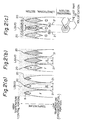
- steel having a carbon content of between 0.17 wt% and 0.53 wt% undergoes, during the cooling, a change from the liquid (L) phase (region above the curve 1) to the liquid (L) phase plus the 6-phase, and, a change from the liquid (L) phase plus the 6-phase to the liquid (L) phase plus the y-phase at 1495°C (line 3).
- the steel becomes entirely the y-phase at a temperature below the line 6.
- a-phase stabilizing elements such as P, Si, S, and Cr, especially P and S, are collected in the 6-phase, i.e., the untransformed 6-phase, at a transformation temperature of 1495°C, while y-phase stabilizing elements such as, C, Mn, Ni, especially Mn, are collected in the y-phase.
- the a-phase stabilizing elements are collected or segregated in a part of the y-phase last transformed from the 6-phase.
- the segregation sites which exhibit the P concentration peak are separated from those exhibiting the Mn concentration peak and therefore duplicate segregation of P and Mn is avoided.
- the a-phase stabilizing elements are collected in or segregated in a part of the y-phase last transformed from the 6-phase.
- the segregation sites which exhibit the P concentration-peak are separated from those exhibiting the Mn concentration-peak and thus duplicate segregation of P and Mn is avoided.
- both the peritectic reaction and Ar4 transformation can be utilized for separating the a- and y-phase stabilizing elements from one another.
- the diffusion rates of impurities or additive elements in solid iron are 10 to 100 times higher in 6-phase than in y-phase (H. Oikawa, Tetsu to Hagane, 68 (1982) p. 1489). This accelerates the diffusion from segregated high concentration sites to surrounding low concentration sites. Accordingly, when the amount and existence time of the 6-phase is increased in the solidification process of steel, the segregation can be mitigated in accordance with the increased amount and time.
- the addition of a-phase stabilizing elements expands the 6-phase region in the dendritic portion and thus the coexistence region where the 6- and y-phases are contiguous to one another.
- a-phase stabilizing element promotes the diffusion and separation of P and Mn and thereby mitigates the duplicate segregation as well as reduces the peak value of segregation.
- a method for controlling an "A" type segregation of large size steel ingots by addition of Mo (Nippon Seikosho Technical Report, 40 (1980) p. 1).
- the liquid has a lower density than that of liquid bulk, because this layer is rich in solute with lower density.
- An upward convection current is generated due to the liquid phase having a lower density, with the result that the upward current line of the convection current remains as a streak and causes the formation of the "A" type segregation.
- the above-mentioned method intends to increase the density of the liquid phase by adding Mo, thereby impeding the upward convection current and the resultant "A" type segregation.
- the method according to the present invention is distinct from the above-mentioned method in principle.
- 2 wt% or less of one or more of Be, Cr, Nb, Sn, Ti, Mo, and V are added to the molten steel.
- the lowest effective amount of addition is not limited. However, the present inventors observed that an addition of 0.005 wt% is effective. Further, the method according to the present invention is effective when steel has a carbon content of or infinitely close to 0 wt%, e.g., about 0.001 wt%.
- the method of addition is not limited.
- the traditional methods may be used, such as throwing down of ferro alloy, injection method, bullet shooting, and wire addition.
- the strength of the above-mentioned separation varies depending on the carbon content of steel and cooling rate.
- the amount of addition to obtain a certain strength of separation increases as the carbon content and/or cooling rate increase. Therefore, the amount of addition is so preferably determined depending on carbon content of steel and cooling rate that Mnd/Mno is not less than 1 and Pd/Po is not more than 1, where Mnd/Mno and Pd/Po are the values hereinafter, in Example 1, referred to as the degrees of inter-dendritic segregations of Mn and P, respectively.
- the effects of mitigating and separating segregation are further enhanced when steel is slowly cooled at a cooling rate of 40°C/min or less during cooling in the specific temperature range (the embodiment a)).
- the upper boundary of the specific temperature range is a temperature just below the melting point of steel where the formation of the primary 6-phase begins, while the lower boundary is a temperature at which the Ar4 transformation or peritectic reaction ends, with the result that the steel has a single y-phase.
- the above-mentioned slow cooling in the specific temperature range assists the separation of the a-phase stabilizing elements and the y-phase stabilizing elements in the steel.
- the steel is fast cooled at a cooling rate of 30°C/min or more down to about 1000°C (embodiment c)). This fast cooling helps to keep the segregation peaks separated, as they were separated by the 6 to y transformation, still at ambient temperature (EPC publication No. 85300700.3).
- the separation of a-phase stabilizing elements and y- phase stabilizing elements proceeds in a quasi- isothermal manner in the temperature range of the coexistence region of 6- and y-phases. Consequently, the separation may be further promoted by reheating the steel from a temperature below and to a temperature in the coexistence region and/or by a holding the steel at a temperature in the coexistence region.
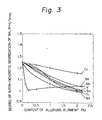
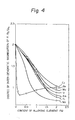
- Figs. 3 and 4 show the relationships between the contents of alloying elements and the grees of inter-dendritic segregations of Mn and P, spectively.
- the degrees of inter-dendritic segregations for Mn and P are indicated by the values of quotients Mnd/Mno and Pd/Po, where Mnd and Pd indicate the concentrations of Mn and P at inter-dendritic sites while Mno and Po indicate the mean concentrations of Mn and P, respectively.
- the degree of inter-dendritic segregation of P is largely decreased by the additions of one or more element of the a-phase stabilizing elements Be, Cr, Nb, Sn, Ti, Mo, and V.
- the additions also effectively reduce the degree of inter-dendritic segregation of Mn, th gh the reductions are less than those for P. That is, the degrees of inter-dendritic segregations of both the a-phase stabilizing element, P, and the y-phase stabilizing element, Mn, are simultaneously decreased by the addition.
- the degrees of inter-dendritic segregations of P and Mn are reduced by slow cooling at a cooling rate of 20°C/min (less than 40°C/min) in the coexistence region of 6- and y-phases, e.g., as for process B in comparison with process A. Further reductions in the degrees of inter-dendritic segregations of P and Mn are obtained by the additional heating and cooling step in the coexistence region of 6-and y-phases, e.g., as for process C in comparison with process B.
- the heating rate of 50°C/min is higher than the cooling rate of 20°C/min in process C.
Landscapes
- Engineering & Computer Science (AREA)
- Chemical & Material Sciences (AREA)
- Mechanical Engineering (AREA)
- Physics & Mathematics (AREA)
- Thermal Sciences (AREA)
- Crystallography & Structural Chemistry (AREA)
- Materials Engineering (AREA)
- Metallurgy (AREA)
- Organic Chemistry (AREA)
- Continuous Casting (AREA)
Applications Claiming Priority (4)
| Application Number | Priority Date | Filing Date | Title |
|---|---|---|---|
| JP274352/84 | 1984-12-28 | ||
| JP27435284A JPS61154748A (ja) | 1984-12-28 | 1984-12-28 | 連続鋳造鋳片の凝固偏析制御法 |
| JP27435184A JPS61157612A (ja) | 1984-12-28 | 1984-12-28 | 鋼の凝固偏析制御法 |
| JP274351/84 | 1984-12-28 |
Publications (3)
| Publication Number | Publication Date |
|---|---|
| EP0186512A2 true EP0186512A2 (de) | 1986-07-02 |
| EP0186512A3 EP0186512A3 (en) | 1988-02-10 |
| EP0186512B1 EP0186512B1 (de) | 1990-08-08 |
Family
ID=26551003
Family Applications (1)
| Application Number | Title | Priority Date | Filing Date |
|---|---|---|---|
| EP85309473A Expired EP0186512B1 (de) | 1984-12-28 | 1985-12-24 | Verfahren zum Regeln der Erstarrungsseigerung von Stahl |
Country Status (3)
| Country | Link |
|---|---|
| US (1) | US4809765A (de) |
| EP (1) | EP0186512B1 (de) |
| DE (1) | DE3579138D1 (de) |
Cited By (1)
| Publication number | Priority date | Publication date | Assignee | Title |
|---|---|---|---|---|
| CN111899230A (zh) * | 2020-07-15 | 2020-11-06 | 重庆大学 | 基于钢铸坯低倍组织三维特征的质量量化及自动多级评判方法 |
Families Citing this family (3)
| Publication number | Priority date | Publication date | Assignee | Title |
|---|---|---|---|---|
| JPH0688125A (ja) * | 1992-09-09 | 1994-03-29 | Aichi Steel Works Ltd | 連続鋳造片及び鋼塊の熱間加工法 |
| FR2767273B1 (fr) * | 1997-08-14 | 1999-10-15 | Vallourec Ind | Procede de fabrication par coulee continue de produits en acier |
| US10031087B2 (en) | 2016-09-22 | 2018-07-24 | SSAB Enterprises, LLC | Methods and systems for the quantitative measurement of internal defects in as-cast steel products |
Family Cites Families (12)
| Publication number | Priority date | Publication date | Assignee | Title |
|---|---|---|---|---|
| US3771584A (en) * | 1971-01-08 | 1973-11-13 | Roblin Industries | Method for continuously casting steel billet strands to minimize the porosity and chemical segregation along the center line of the strand |
| JPS496974A (de) * | 1972-03-13 | 1974-01-22 | ||
| JPS544224A (en) * | 1977-06-11 | 1979-01-12 | Nippon Steel Corp | Improving method for toughness of steel material |
| JPS5852444B2 (ja) * | 1978-12-19 | 1983-11-22 | 新日本製鐵株式会社 | 熱間圧延時の鋼片表面割れ抑制法 |
| JPS5910846B2 (ja) * | 1979-02-16 | 1984-03-12 | 新日本製鐵株式会社 | 高温鋳片直接圧延方法 |
| JPS5830366B2 (ja) * | 1979-02-16 | 1983-06-29 | 新日本製鐵株式会社 | 低炭素熱延鋼材の製造方法 |
| JPS5615A (en) * | 1979-06-14 | 1981-01-06 | Sanyo Electric Co Ltd | Tape recorder |
| JPS57130759A (en) * | 1981-02-07 | 1982-08-13 | Kawasaki Steel Corp | Production of niobium-containing strong and tough steel |
| JPS581012A (ja) * | 1981-06-25 | 1983-01-06 | Nippon Steel Corp | 均質な鋼の製造方法 |
| AT377287B (de) * | 1982-04-13 | 1985-02-25 | Ver Edelstahlwerke Ag | Kaltverfestigender austenitischer manganhartstahl und verfahren zur herstellung desselben |
| JPS6056453A (ja) * | 1983-09-08 | 1985-04-02 | Sumitomo Metal Ind Ltd | 連続鋳造法 |
| EP0153062B1 (de) * | 1984-02-10 | 1990-12-05 | Nippon Steel Corporation | Verfahren für eine abgeschwächte Seigerungserstarrung von Stahl |
-
1985
- 1985-12-24 EP EP85309473A patent/EP0186512B1/de not_active Expired
- 1985-12-24 DE DE8585309473T patent/DE3579138D1/de not_active Expired - Lifetime
-
1988
- 1988-05-27 US US07/201,370 patent/US4809765A/en not_active Expired - Fee Related
Cited By (2)
| Publication number | Priority date | Publication date | Assignee | Title |
|---|---|---|---|---|
| CN111899230A (zh) * | 2020-07-15 | 2020-11-06 | 重庆大学 | 基于钢铸坯低倍组织三维特征的质量量化及自动多级评判方法 |
| CN111899230B (zh) * | 2020-07-15 | 2023-11-17 | 重庆大学 | 基于钢铸坯低倍组织三维特征的质量量化及自动多级评判方法 |
Also Published As
| Publication number | Publication date |
|---|---|
| EP0186512B1 (de) | 1990-08-08 |
| US4809765A (en) | 1989-03-07 |
| DE3579138D1 (de) | 1990-09-13 |
| EP0186512A3 (en) | 1988-02-10 |
Similar Documents
| Publication | Publication Date | Title |
|---|---|---|
| US4247326A (en) | Free machining steel with bismuth | |
| EP0027510B1 (de) | Wismut enthaltender Stahl | |
| JPH0694057B2 (ja) | 耐海水性に優れたオーステナイト系ステンレス鋼の製造方法 | |
| JP2024529951A (ja) | 中炭素高マンガンバナジウム含有合金構造用の丸鋼材組織の制御方法 | |
| JPH0569910B2 (de) | ||
| US3928028A (en) | Grain refinement of copper alloys by phosphide inoculation | |
| US4738301A (en) | Method for mitigating solidification segregation of steel | |
| EP0186512B1 (de) | Verfahren zum Regeln der Erstarrungsseigerung von Stahl | |
| JPH01149917A (ja) | りん偏析の極めて小さな鋼塊の製造方法 | |
| US3990887A (en) | Cold working steel bar and wire rod produced by continuous casting | |
| US4014683A (en) | Method of making Drawing Quality steel | |
| CA1168480A (en) | Prevention method of surface crackings on ni- containing, continuously cast steel products | |
| US4238230A (en) | Process for producing free-machining steel | |
| US1727088A (en) | Method of making rimming steel | |
| JP2593384B2 (ja) | 連続鋳造法 | |
| JPH0568525B2 (de) | ||
| SU1435609A1 (ru) | Способ получени чугуна с вермикул рным графитом | |
| JPS619554A (ja) | 冷間圧延用鍛鋼ロ−ル | |
| JPS61154748A (ja) | 連続鋳造鋳片の凝固偏析制御法 | |
| JPS61157612A (ja) | 鋼の凝固偏析制御法 | |
| RU2690084C1 (ru) | Способ производства поковок из штамповых сталей типа 5ХНМ | |
| SU1089149A1 (ru) | Способ выплавки рельсовой стали | |
| JP2750208B2 (ja) | 連続鋳造鋳片の熱間割れ防止方法 | |
| JP2593385B2 (ja) | 連続鋳造法 | |
| JPS60166151A (ja) | 鋼の連続鋳造機 |
Legal Events
| Date | Code | Title | Description |
|---|---|---|---|
| PUAI | Public reference made under article 153(3) epc to a published international application that has entered the european phase |
Free format text: ORIGINAL CODE: 0009012 |
|
| AK | Designated contracting states |
Kind code of ref document: A2 Designated state(s): DE FR GB IT |
|
| PUAL | Search report despatched |
Free format text: ORIGINAL CODE: 0009013 |
|
| AK | Designated contracting states |
Kind code of ref document: A3 Designated state(s): DE FR GB IT |
|
| 17P | Request for examination filed |
Effective date: 19880729 |
|
| 17Q | First examination report despatched |
Effective date: 19890213 |
|
| GRAA | (expected) grant |
Free format text: ORIGINAL CODE: 0009210 |
|
| AK | Designated contracting states |
Kind code of ref document: B1 Designated state(s): DE FR GB IT |
|
| REF | Corresponds to: |
Ref document number: 3579138 Country of ref document: DE Date of ref document: 19900913 |
|
| ITF | It: translation for a ep patent filed | ||
| ET | Fr: translation filed | ||
| ITTA | It: last paid annual fee | ||
| PLBE | No opposition filed within time limit |
Free format text: ORIGINAL CODE: 0009261 |
|
| STAA | Information on the status of an ep patent application or granted ep patent |
Free format text: STATUS: NO OPPOSITION FILED WITHIN TIME LIMIT |
|
| 26N | No opposition filed | ||
| PGFP | Annual fee paid to national office [announced via postgrant information from national office to epo] |
Ref country code: FR Payment date: 19951212 Year of fee payment: 11 |
|
| PGFP | Annual fee paid to national office [announced via postgrant information from national office to epo] |
Ref country code: GB Payment date: 19951215 Year of fee payment: 11 |
|
| PGFP | Annual fee paid to national office [announced via postgrant information from national office to epo] |
Ref country code: DE Payment date: 19951222 Year of fee payment: 11 |
|
| PG25 | Lapsed in a contracting state [announced via postgrant information from national office to epo] |
Ref country code: GB Effective date: 19961224 |
|
| GBPC | Gb: european patent ceased through non-payment of renewal fee |
Effective date: 19961224 |
|
| PG25 | Lapsed in a contracting state [announced via postgrant information from national office to epo] |
Ref country code: FR Effective date: 19970829 |
|
| PG25 | Lapsed in a contracting state [announced via postgrant information from national office to epo] |
Ref country code: DE Effective date: 19970902 |
|
| REG | Reference to a national code |
Ref country code: FR Ref legal event code: ST |